9.7 Entrance Corner
Q1. A beaker of circular cross section of radius 4 cm is filled with mercury up to a height of 10 cm . Find the force exerted by the mercury on the bottom of the beaker. The atmospheric pressure \(=10^5 \mathrm{~N} \mathrm{~m}^{-2}\). Density of mercury \(=13600 \mathrm{~kg} \mathrm{~m}^{-3}\). Take \(\mathrm{g}=10 \mathrm{~m} \mathrm{~s}^{-2}\).
Solution: To find the force exerted on the bottom of the beaker, we need to calculate the total pressure at the bottom and then multiply it by the area of the base. The pressure at the surface
\(
\begin{aligned}
& =\text { atmospheric pressure } \\
& =10^5 \mathrm{~N} \mathrm{~m}^{-2} \text {. }
\end{aligned}
\)
The pressure at the bottom
\(
\begin{aligned}
& =10^5 \mathrm{~N} \mathrm{~m}^{-2}+h \rho g \\
& =10^5 \mathrm{~N} \mathrm{~m}^{-2}+(0 \cdot 1 \mathrm{~m})\left(13600 \mathrm{~kg} \mathrm{~m}^{-3}\right)\left(10 \mathrm{~m} \mathrm{~s}^{-2}\right) \\
& =10^5 \mathrm{~N} \mathrm{~m}^{-2}+13600 \mathrm{~N} \mathrm{~m}^{-2} \\
& =1 \cdot 136 \times 10^5 \mathrm{~N} \mathrm{~m}^{-2} .
\end{aligned}
\)
The force exerted by the mercury on the bottom \((F=P \times A)\)
\(
\begin{aligned}
& =\left(1.136 \times 10^5 \mathrm{~N} \mathrm{~m}^{-2}\right) \times(3.14 \times 0.04 \mathrm{~m} \times 0.04 \mathrm{~m}) \\
& =571 \mathrm{~N}
\end{aligned}
\)
Q2. The density of air near earth’s surface is \(1.3 \mathrm{~kg} \mathrm{~m}^{-3}\) and the atmospheric pressure is \(1.0 \times 10^5 \mathrm{~N} \mathrm{~m}^{-2}\). If the atmosphere had uniform density, same as that observed at the surface of the earth, what would be the height of the atmosphere to exert the same pressure?
Solution: To find the height of a “uniform” atmosphere that exerts the same pressure as the real atmosphere, we use the hydrostatic pressure formula for a fluid of constant density.
The pressure exerted by a column of fluid of height \(h\) and density \(\rho\) is given by:
\(
P=\rho g h
\)
\(
h=\frac{1.0 \times 10^5 \mathrm{~N} \mathrm{~m}^{-2}}{\left(1.3 \mathrm{~kg} \mathrm{~m}^{-3}\right)\left(9.8 \mathrm{~m} \mathrm{~s}^{-2}\right)}=7850 \mathrm{~m} .
\)
Even Mount Everest ( 8848 m) would have been outside the atmosphere.
Q3. The liquids shown in figure below in the two arms are mercury (specific gravity \(=13.6\)) and water. If the difference of heights of the mercury columns is 2 cm , find the height \(h\) of the water column.
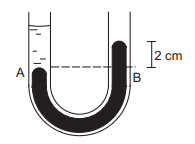
Solution: To solve this problem, we apply the principle of hydrostatics in a U-tube: at the same horizontal level in a continuous fluid, the pressure must be equal.
Identify the Interface:
We choose a reference level (horizontal line) at the interface where the water meets the mercury. Let’s call this point A (in the water arm) and point B (in the mercury arm at the same horizontal level).
Formulate the Pressure Equality:
The pressure at point A is due to the column of water of height \(h\). The pressure at point B is due to the difference in mercury heights (given as 2 cm).
\(
P_A=P_B
\)
Solution : Suppose the atmospheric pressure \(=P_0\).
Pressure at \(A=P_0+h\left(1000 \mathrm{~kg} \mathrm{~m}^{-3}\right) g\).
Pressure at \(B=P_0+(0.02 \mathrm{~m})\left(13600 \mathrm{~kg} \mathrm{~m}^{-3}\right) g\).
These pressures are equal as \(A\) and \(B\) are at the same horizontal level. Thus,
\(
\begin{aligned}
h & =(0.02 \mathrm{~m}) 13.6 \\
& \approx 0.27 \mathrm{~m}=27 \mathrm{~cm} .
\end{aligned}
\)
Q4. A cylindrical vessel containing a liquid is closed by a smooth piston of mass \(m\) as shown in the figure. The area of cross section of the piston is \(A\). If the atmospheric pressure is \(P_0\), find the pressure of the liquid just below the piston.
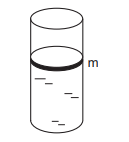
Solution: Let the pressure of the liquid just below the piston be \(P\). The forces acting on the piston are
(a) its weight, \(m g\) (downward)
(b) force due to the air above it, \(P_0 A\) (downward)
(c) force due to the liquid below it, \(P A\) (upward).
If the piston is in equilibrium,
\(
P A=P_0 A+m g
\)
\(
P=P_0+\frac{m g}{A} .
\)
Q5. The area of cross section of the two arms of a hydraulic press are \(1 \mathrm{~cm}^2\) and \(10 \mathrm{~cm}^2\) respectively (figure below). A force of 5 N is applied on the water in the thinner arm. What force should be applied on the water in the thicker arm so that the water may remain in equilibrium?
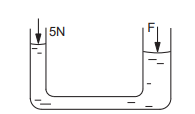
Solution: To find the force required to maintain equilibrium in a hydraulic press, we apply Pascal’s Law, which states that any pressure applied to an enclosed fluid is transmitted equally in all directions throughout the fluid.
Identify the Principle:
In a hydraulic system in equilibrium, the pressure at any horizontal level within the same fluid must be equal. Therefore, the pressure exerted by the piston in the thinner arm \(\left(P_1\right)\) must be equal to the pressure exerted by the piston in the thicker arm (\(P_2\)).
\(
P_1=P_2
\)
Since Pressure = Force / Area, we have:
\(
\frac{F_1}{A_1}=\frac{F_2}{A_2}
\)
Force on thinner \(\operatorname{arm}\left(F_1\right): 5 \mathrm{~N}\)
Area of thinner \(\operatorname{arm}\left(A_1\right): 1 \mathrm{~cm}^2\)
Area of thicker \(\operatorname{arm}\left(A_2\right): 10 \mathrm{~cm}^2\)
Calculate the Required Force (\(F_2\)):
Rearranging the formula to solve for \(F_2\) :
\(
F_2=F_1 \times\left(\frac{A_2}{A_1}\right)
\)
Substitute the values:
\(
\begin{gathered}
F_2=5 \mathrm{~N} \times\left(\frac{10 \mathrm{~cm}^2}{1 \mathrm{~cm}^2}\right) \\
F_2=5 \times 10 \\
F_2=50 \mathrm{~N}
\end{gathered}
\)
To keep the system in equilibrium, a force of 50 N must be applied to the water in the thicker arm.
Q6. A copper piece of mass 10 g is suspended by a vertical spring. The spring elongates 1 cm over its natural length to keep the piece in equilibrium. A beaker containing water is now placed below the piece so as to immerse the piece completely in water. Find the elongation of the spring. Density of copper \(=9000 \mathrm{~kg} \mathrm{~m}^{-3}\). Take \(g=10 \mathrm{~m} \mathrm{~s}^{-2}\).
Solution: To find the new elongation of the spring, we need to account for the Buoyant Force (\(F_b\)) that acts on the copper piece when it is submerged in water. This force effectively “helps” the spring support the weight.
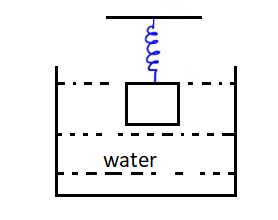
Initial State (In Air):
When the copper piece is hanging in the air, the spring force (\(k x_1\)) balances the weight of the copper (\(m g\)).
Mass(\(m\)): \(10 \mathrm{~g}=0.01 \mathrm{~kg}\)
Elongation (\(x_1\)): \(1 \mathrm{~cm}=0.01 \mathrm{~m}\)
The force equation is:
\(
k x_1=m g
\)
\(
\begin{gathered}
k(0.01)=(0.01)(10) \\
k=10 \mathrm{~N} / \mathrm{m}
\end{gathered}
\)
Final State (In Water):
When the piece is submerged, three forces are in equilibrium: the upward spring force (\(k x_2\)), the upward buoyant force (\(F_b\)), and the downward weight (\(m g\)).
The new force equation is:
\(
k x_2+F_b=m g \Longrightarrow k x_2=m g-F_b
\)
Step A: Calculate Buoyant Force (\(F_b\))
Buoyant force is the weight of the displaced water: \(F_b=V_{c u} \cdot \rho_{\text {water }} \cdot g\).
First, find the volume of the copper (\(V_{c u}\)):
\(
V_{c u}=\frac{\text { mass }}{\text { density }}=\frac{0.01 \mathrm{~kg}}{9000 \mathrm{~kg} / \mathrm{m}^3}=\frac{1}{9 \times 10^5} \mathrm{~m}^3
\)
Now, calculate \(F_b\) (using \(\rho_{\text {water }}=1000 \mathrm{~kg} / \mathrm{m}^3\)):
\(
F_b=\left(\frac{1}{9 \times 10^5}\right) \cdot(1000) \cdot(10)=\frac{1}{90} \mathrm{~N}
\)
Step B: Solve for New Elongation (\(x_2\))
Substitute the known values into the equilibrium equation:
\(
\begin{gathered}
10 \cdot x_2=(0.01 \cdot 10)-\frac{1}{90} \\
10 \cdot x_2=0.1-0.0111 \ldots \\
10 \cdot x_2=0.0888 \ldots \\
x_2=0.00888 \ldots \mathrm{~m}
\end{gathered}
\)
Converting back to centimeters:
\(
x_2 \approx 0.89 \mathrm{~cm}
\)
The elongation of the spring reduces from 1 cm to approximately 0.89 cm because the water provides an upward push (buoyancy), reducing the tension required from the spring.
Q7. A cubical block of wood of edge 3 cm floats in water. The lower surface of the cube just touches the free end of a vertical spring fixed at the bottom of the pot. Find the maximum weight that can be put on the block without wetting it. Density of wood \(=800 \mathrm{~kg} \mathrm{~m}^{-3}\) and spring constant of the spring \(=50 \mathrm{~N} \mathrm{~m}^{-1}\). Take \(g=10 \mathrm{~m} \mathrm{~s}^{-2}\).
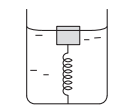
Solution: To solve this, we need to find the state where the block is pushed down just until its top surface is level with the water surface (since any more weight would “wet” it).
Identify the Physical State:
Initially, the block is floating and just touching the spring. When we add the maximum weight (\(W\)), the block is submerged completely. At this point, the spring is compressed by the distance the block moved downward.
Key Measurements:
Edge \((a): 3 \mathrm{~cm}=0.03 \mathrm{~m}\)
Volume \((V): a^3=(0.03)^3=2.7 \times 10^{-5} \mathrm{~m}^3\)
Density of wood \(\left(\rho_w\right): 800 \mathrm{~kg} \mathrm{~m}^{-3}\)
Spring constant (\(k\)): \(50 \mathrm{~N} \mathrm{~m}^{-1}\)
Find the Initial Submersion:
Before the weight is added, the block floats. The height submerged (\(h\)) is found by:
\(
\begin{gathered}
\rho_w \cdot V \cdot g=\text { Area } \cdot h \cdot \rho_{\text {water }} \cdot g \\
h=\frac{\rho_w}{\rho_{\text {water }}} \cdot a=\frac{800}{1000} \cdot 3 \mathrm{~cm}=2.4 \mathrm{~cm}
\end{gathered}
\)
Since the block is 3 cm tall and 2.4 cm is already underwater, the height of the block above the water is:
\(
\text { Height above water }=3 \mathrm{~cm}-2.4 \mathrm{~cm}=0.6 \mathrm{~cm}=0.006 \mathrm{~m}
\)
Equilibrium at Maximum Weight:
To submerge the block completely without wetting the top, we must push it down by exactly that 0.006 m . This distance is also the compression of the spring (\(x\)).
At this equilibrium, the total downward forces must equal the total upward forces:
Downward Forces = Upward Forces
\(
W+m_{\text {wood }} g=F_{\text {buoyant }}+F_{\text {spring }}
\)
Substitute the formulas:
\(
W+\left(\rho_w V g\right)=\left(\rho_{\text {water }} V g\right)+(k x)
\)
Calculation:
First, calculate the terms:
Weight of wood: \((800) \cdot\left(2.7 \times 10^{-5}\right) \cdot(10)=0.216 \mathrm{~N}\)
Buoyant force (full): \((1000) \cdot\left(2.7 \times 10^{-5}\right) \cdot(10)=0.270 \mathrm{~N}\)
Spring force: \(50 \cdot 0.006=0.300 \mathrm{~N}\)
Now, solve for \(W\) :
\(
\begin{gathered}
W+0.216=0.270+0.300 \\
W+0.216=0.570 \\
W=0.354 \mathrm{~N}
\end{gathered}
\)
The maximum weight that can be put on the block is 0.354 N.
Q8. A wooden plank of length 1 m and uniform cross section is hinged at one end to the bottom of a tank as shown in figure (below). The tank is filled with water up to a height of 0.5 m. The specific gravity of the plank is 0.5. Find the angle \(\theta\) that the plank makes with the vertical in the equilibrium position. (Exclude the case \(\theta=0\).)
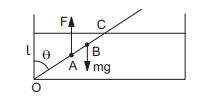
Solution: To solve for the equilibrium angle \(\theta\), we need to analyze the torques acting on the plank about the hinge at the bottom of the tank. For the plank to be in equilibrium, the net torque must be zero.
Identify the Forces:
There are two primary forces exerting torque on the plank:
Weight of the plank (\(W\)): Acts downwards from the geometric center of the plank.
Buoyant force (\(F_b\)): Acts upwards from the center of the submerged portion of the plank.
Geometry of the Plank:
Total length \((L): 1.0 \mathrm{~m}\).
Submerged height of water (\(h\)): 0.5 m.
Submerged length of plank (\(l\)): From trigonometry, \(l=\frac{h}{\cos \theta}=\frac{0.5}{\cos \theta}\).
Specific Gravity \((S): 0.5\), meaning \(\rho_{\text {plank }}=0.5 \rho_{\text {water }}\).
Calculating the Torques about the Hinge:
The torque \(\tau\) is given by Force × Perpendicular distance from the hinge.
Torque due to Weight \(\left(\tau_w\right)\) :
The weight acts at a distance \(L / 2\) from the hinge. The perpendicular component of the distance is \((L / 2) \sin \theta\).
\(
\begin{gathered}
\tau_w=\left(m_{\text {plank }} g\right) \cdot \frac{L}{2} \sin \theta \\
\tau_w=\left(\rho_p \cdot A \cdot L \cdot g\right) \cdot \frac{L}{2} \sin \theta
\end{gathered}
\)
Torque due to Buoyancy \(\left(\tau_b\right)\) :
The buoyancy acts at the center of the submerged part, which is at a distance \(l / 2\) from the hinge. The perpendicular distance is \((l / 2) \sin \theta\).
\(
\begin{gathered}
\tau_b=\left(V_{\text {submerged }} \cdot \rho_w \cdot g\right) \cdot \frac{l}{2} \sin \theta \\
\tau_b=\left(A \cdot l \cdot \rho_w \cdot g\right) \cdot \frac{l}{2} \sin \theta
\end{gathered}
\)
Equilibrium Condition:
Setting the clockwise torque equal to the counter-clockwise torque \(\left(\tau_w=\tau_b\right)\) :
\(
\left(\rho_p A L g\right) \frac{L}{2} \sin \theta=\left(\rho_w A l g\right) \frac{l}{2} \sin \theta
\)
Cancel \(A, g, \sin \theta\) (since \(\theta \neq 0\)), and the factor of 2 :
\(
\rho_p L^2=\rho_w l^2
\)
Substitute \(\rho_p=0.5 \rho_w\) and \(l=\frac{0.5}{\cos \theta}\) :
\(
\begin{aligned}
0.5 \rho_w(1)^2 & =\rho_w\left(\frac{0.5}{\cos \theta}\right)^2 \\
0.5 & =\frac{0.25}{\cos ^2 \theta}
\end{aligned}
\)
Solve for \(\theta\):
\(
\begin{gathered}
\cos ^2 \theta=\frac{0.25}{0.5}=0.5 \\
\cos \theta=\sqrt{0.5}=\frac{1}{\sqrt{2}} \\
\theta=45^{\circ}
\end{gathered}
\)
The plank makes an angle of \(45^{\circ}\) with the vertical.
Q9. A cylindrical block of wood of mass \(M\) is floating in water with its axis vertical. It is depressed a little and then released. Show that the motion of the block is simple harmonic and find its frequency.
Solution: Suppose a height \(h\) of the block is dipped in the water in equilibrium position. If \(r\) be the radius of the cylindrical block, the volume of the water displaced \(=\pi r^2 h\). For floating in equilibrium
\(
\pi r^2 h \rho g=W \dots(i)
\)
where \(\rho\) is the density of water and \(W\) the weight of the block.
Now suppose during the vertical motion, the block is further dipped through a distance \(x\) at some instant. The volume of the displaced water is \(\pi r^2(h+x)\). The forces acting on the block are, the weight \(W\) vertically downward and the buoyancy \(\pi r^2(h+x) \rho g\) vertically upward.
Net force on the block at displacement \(x\) from the equilibrium position is
\(
\begin{aligned}
F & =W-\pi r^2(h+x) \rho g \\
& =W-\pi r^2 h \rho g-\pi r^2 \rho x g
\end{aligned}
\)
Using (i),
\(
F=-\pi r^2 \rho g x=-k x, \text { where } k=\pi r^2 \rho g .
\)
Thus, the block executes SHM with frequency
\(
v=\frac{1}{2 \pi} \sqrt{\frac{k}{M}}=\frac{1}{2 \pi} \sqrt{\frac{\pi r^2 \rho g}{M}} .
\)
Q10. Water flows in a horizontal tube as shown in figure (below). The pressure of water changes by \(600 \mathrm{~N} \mathrm{~m}^{-2}\) between \(A\) and \(B\) where the areas of cross section are \(30 \mathrm{~cm}^2\) and \(15 \mathrm{~cm}^2\) respectively. Find the rate of flow of water through the tube.
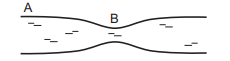
Solution: Let the velocity at \(A=v_A\) and that at \(B=v_B\)
By the equation of continuity, \(\frac{v_B}{v_A}=\frac{30 \mathrm{~cm}^2}{15 \mathrm{~cm}^2}=2\).
By Bernoulli equation,
\(
P_A+\frac{1}{2} \rho v_A^2=P_B+\frac{1}{2} \rho v_B^2
\)
\(
P_A-P_B=\frac{1}{2} \rho\left(2 v_A\right)^2-\frac{1}{2} \rho v_A^2=\frac{3}{2} \rho v_A^2,
\)
\(
600 \mathrm{~N} \mathrm{~m}^{-2}=\frac{3}{2}\left(1000 \mathrm{~kg} \mathrm{~m}^{-3}\right) v_A^2
\)
\(
v_A=\sqrt{0.4 \mathrm{~m}^2 \mathrm{~s}^{-2}}=0.63 \mathrm{~m} \mathrm{~s}^{-1}
\)
The rate of flow \(=\left(30 \mathrm{~cm}^2\right)\left(0.63 \mathrm{~m} \mathrm{~s}^{-1}\right)=1890 \mathrm{~cm}^3 \mathrm{~s}^{-1}\).
Q11. The area of cross section of a large tank is \(0.5 \mathrm{~m}^2\). It has an opening near the bottom having area of cross section \(1 \mathrm{~cm}^2\). A load of 20 kg is applied on the water at the top. Find the velocity of the water coming out of the opening at the time when the height of water level is 50 cm above the bottom. Take \(g=10 \mathrm{~m} \mathrm{~s}^{-2}\).
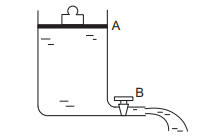
Solution: As the area of cross section of the tank is large compared to that of the opening, the speed of water in the tank will be very small as compared to the speed at the opening. The pressure at the surface of water in the tank is that due to the atmosphere plus due to the load.
\(
P_A=P_0+\frac{(20 \mathrm{~kg})\left(10 \mathrm{~m} \mathrm{~s}^{-2}\right)}{0.5 \mathrm{~m}^2}=P_0+400 \mathrm{~N} \mathrm{~m}^{-2} .
\)
At the opening, the pressure is that due to the atmosphere.
Using Bernoulli equation
\(
P_A+\rho g h+\frac{1}{2} \rho v_A^2=P_B+\frac{1}{2} \rho v_B^2
\)
or, \(P_0+400 \mathrm{~N} \mathrm{~m}^{-2}+\left(1000 \mathrm{~kg} \mathrm{~m}^{-3}\right)\left(10 \mathrm{~m} \mathrm{~s}^{-2}\right)(0.5 \mathrm{~m})+0\)
\(
=P_0+\frac{1}{2}\left(1000 \mathrm{~kg} \mathrm{~m}^{-3}\right) v_B^2
\)
or, \(\quad 5400 \mathrm{~N} \mathrm{~m}^{-2}=\left(500 \mathrm{~kg} \mathrm{~m}^{-3}\right)^3 v_B^2\)
\(
v_B \approx 3.3 \mathrm{~m} \mathrm{~s}^{-1} .
\)
Q12. A solid sphere, of radius \(R\) acquires a terminal velocity \(v_1\) when falling (due to gravity) through a viscous fluid having a coefficient of viscosity. The sphere is broken into 27 identical solid spheres. If each of these spheres acquires a terminal velocity, \(v_2\), when falling through the same fluid, the ratio \(\left(v_1 / v_2\right)\) equals: [JEE Main 2019]
(a) \(\frac{1}{9}\)
(b) \(\frac{1}{27}\)
(c) 27
(d) 9
Solution: (d) Step 1: Establish the relationship for terminal velocity
The terminal velocity \(v\) of a solid sphere falling through a viscous fluid is determined by Stokes’
Law. The formula is:
\(
v=\frac{2}{9} \frac{r^2(\rho-\sigma) g}{\eta}
\)
From this equation, we can see that if the fluid properties \((\eta, \sigma)\) and the sphere density \((\rho)\) remain constant, the terminal velocity is directly proportional to the square of the radius:
\(
v \propto r^2
\)
Step 2: Relate the radii of the spheres
When one large sphere of radius \(R\) is broken into 27 identical smaller spheres of radius \(r\), the total volume is conserved.
Volume of large sphere: \(V_1=\frac{4}{3} \pi R^3\)
Total volume of 27 small spheres: \(V_2=27 \times\left(\frac{4}{3} \pi r^3\right)\)
By setting \(V_1=V_2\) :
\(
\begin{gathered}
\frac{4}{3} \pi R^3=27 \times \frac{4}{3} \pi r^3 \\
R^3=27 r^3
\end{gathered}
\)
Taking the cube root of both sides gives:
\(
R=3 r
\)
Step 3: Calculate the ratio \(\left(v_1 / v_2\right)\)
Now, substitute the relationship between the radii into the proportionality found in Step 1:
\(
\frac{v_1}{v_2}=\frac{R^2}{r^2}
\)
Since \(R=3 r\) :
\(
\begin{gathered}
\frac{v_1}{v_2}=\frac{(3 r)^2}{r^2} \\
\frac{v_1}{v_2}=\frac{9 r^2}{r^2} \\
\frac{v_1}{v_2}=9
\end{gathered}
\)
Q13. The number density of molecules of a gas depends on their distance r from the origin as, \(n(r)=n_0 e^{-\alpha r^4}\). Then the total number of molecules is proportional to : [JEE main 2019]
(a) \(n_0 \alpha^{-3 / 4}\)
(b) \(n_0 \alpha^{-3}\)
(c) \(n_0 \alpha^{1 / 4}\)
(d) \(\sqrt{n_0} \alpha^{1 / 2}\)
Solution: (a) To find the total number of molecules \(N\), we need to integrate the number density \(n(r)\) over the entire volume of space.
Step 1: Set up the integral
In spherical coordinates, the total number of molecules is the integral of the density over all space. Since the density depends only on the radial distance \(r\), we use the volume element for a spherical shell, \(d V=4 \pi r^2 d r\).
\(
\begin{gathered}
N=\int_0^{\infty} n(r) \cdot 4 \pi r^2 d r \\
N=4 \pi n_0 \int_0^{\infty} e^{-\alpha r^4} r^2 d r
\end{gathered}
\)
Step 2: Use substitution to simplify
To solve this integral, we use a substitution to make the exponent linear. Let:
\(
x=\alpha r^4
\)
Now, find \(r[latex] and [latex]d r\) in terms of \(x\) :
\(r=\left(\frac{x}{\alpha}\right)^{1 / 4}=\alpha^{-1 / 4} x^{1 / 4}\)
Differentiating both sides: \(d r=\alpha^{-1 / 4} \cdot \frac{1}{4} x^{-3 / 4} d x\)
Also, \(r^2=\left(\alpha^{-1 / 4} x^{1 / 4}\right)^2=\alpha^{-1 / 2} x^{1 / 2}\).
Step 3: Substitute back into the integral
Substitute these values into the expression for \(N\) :
\(
N=4 \pi n_0 \int_0^{\infty} e^{-x}\left(\alpha^{-1 / 2} x^{1 / 2}\right)\left(\frac{1}{4} \alpha^{-1 / 4} x^{-3 / 4}\right) d x
\)
Pull the constants (including \(\alpha\) ) out of the integral:
\(
\begin{gathered}
N=\frac{4 \pi n_0}{4} \alpha^{-1 / 2} \alpha^{-1 / 4} \int_0^{\infty} e^{-x} x^{(1 / 2-3 / 4)} d x \\
N=\pi n_0 \alpha^{-3 / 4} \int_0^{\infty} e^{-x} x^{-1 / 4} d x
\end{gathered}
\)
Step 4: Determine the proportionality
The integral \(\int_0^{\infty} e^{-x} x^{-1 / 4} d x\) is a constant (specifically, it relates to the Gamma function \(\Gamma(3 / 4)\)). Since we only need to find what the total number of molecules is proportional to, we focus on the terms outside the integral:
\(
N \propto n_0 \alpha^{-3 / 4}
\)
Q14. A submarine experiences a pressure of \(5.05 \times 10^6 \mathrm{~Pa}\) at a depth of \(d_1\) in a sea. When it goes further to a depth of \(d_2\), it experiences a pressure of \(8.08 \times 10^6 \mathrm{~Pa}\). Then \(\mathrm{d}_2-\mathrm{d}_1\) is approximately (density of water \(=10^3 \mathrm{~kg} / \mathrm{m}^3\) and acceleration due to gravity \(=10 \mathrm{~ms}^{-2}\)) : [JEE Main 2019]
(a) 600 m
(b) 400 m
(c) 300 m
(d) 500 m
Solution: (c) To find the difference in depth, we use the relationship between hydrostatic pressure and depth in a fluid.
Step 1: Recall the Pressure Formula
The total pressure \(P\) at a depth \(d\) in a liquid is given by:
\(
P=P_0+\rho g d
\)
Where:
\(P_0\) is the atmospheric pressure at the surface.
\(\rho\) is the density of the fluid \(\left(10^3 \mathrm{~kg} / \mathrm{m}^3\right)\).
\(g\) is the acceleration due to gravity \(\left(10 \mathrm{~m} / \mathrm{s}^2\right)\).
\(d\) is the depth.
Step 2: Set up equations for both depths
Let \(P_1\) be the pressure at depth \(d_1\) and \(P_2\) be the pressure at depth \(d_2\).
1. \(P_1=P_0+\rho g d_1=5.05 \times 10^6 \mathrm{~Pa}\)
2. \(P_2=P_0+\rho g d_2=8.08 \times 10^6 \mathrm{~Pa}\)
To find the change in depth \(\left(d_2-d_1\right)\), we subtract the first equation from the second to eliminate the atmospheric pressure \(P_0\) :
\(
\begin{gathered}
P_2-P_1=\left(P_0+\rho g d_2\right)-\left(P_0+\rho g d_1\right) \\
P_2-P_1=\rho g\left(d_2-d_1\right)
\end{gathered}
\)
Step 3: Solve for \(\left(d_2-d_1\right)\)
Plug in the given values:
\(
\begin{gathered}
\left(8.08 \times 10^6\right)-\left(5.05 \times 10^6\right)=\left(10^3\right)(10)\left(d_2-d_1\right) \\
3.03 \times 10^6=10^4\left(d_2-d_1\right)
\end{gathered}
\)
Now, divide by \(10{ }^4\) :
\(
\begin{gathered}
d_2-d_1=\frac{3.03 \times 10^6}{10^4} \\
d_2-d_1=3.03 \times 10^2 \\
d_2-d_1=303 \mathrm{~m}
\end{gathered}
\)
Rounding to the nearest provided option gives 300 m.
Q15. A cubical block of side 0.5 m floats on water with \(30 \%\) of its volume under water. What is the maximum weight that can be put on the block without fully submerging it under water? [Take, density of water \(=10^3 \mathrm{~kg} / \mathrm{m}^3\)] [JEE Main 2019]
(a) 30.1 kg
(b) 87.5 kg
(c) 65.4 kg
(d) 46.3 kg
Solution: (b) To solve this, we apply the principle of floatation, which states that a floating object displaces a weight of fluid equal to its own weight.
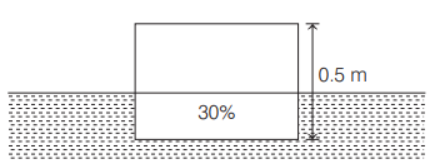
Step 1: Calculate the Volume of the Block
The block is a cube with side \(a=0.5 \mathrm{~m}\).
\(
V=a^3=(0.5)^3=0.125 \mathrm{~m}^3
\)
Step 2: Determine the Weight of the Block
Initially, the block floats with \(30 \%\) of its volume submerged. According to Archimedes’
Principle, the weight of the block (\(W_b\)) equals the buoyant force from the submerged volume.
Submerged volume \(\left(V_{\text {sub }}\right): 0.30 \times 0.125 \mathrm{~m}^3=0.0375 \mathrm{~m}^3\)
Buoyant force \(\left(F_B\right)\) : \(\rho_{\text {water }} \times V_{\text {sub }} \times g\)
Since the block is in equilibrium:
\(
W_b=1000 \times 0.0375 \times g=37.5 g \text { Newtons }
\)
(This means the mass of the block is 37.5 kg ).
Step 3: Calculate the Total Buoyant Force when fully submerged
To find the maximum weight \(W_{\text {max }}\) we can add without sinking the block, we look at the condition where the block is just fully submerged. In this state, 100% of its volume is underwater.
Total Buoyant Force \(\left(F_{B, \text { total }}\right): \rho_{\text {water }} \times V_{\text {total }} \times g\)
\(
F_{B, \text { total }}=1000 \times 0.125 \times g=125 g \text { Newtons }
\)
Step 4: Find the Maximum Added Mass
At the point of full submergence, the total downward weight (block + added weight) must equal the total buoyant force:
\(
\begin{gathered}
\left(m_{\text {block }}+m_{\text {added }}\right) g=F_{B, \text { total }} \\
\left(37.5+m_{\text {added }}\right) g=125 g
\end{gathered}
\)
Cancel \(g\) from both sides:
\(
\begin{gathered}
37.5+m_{\text {added }}=125 \\
m_{\text {added }}=125-37.5 \\
m_{\text {added }}=87.5 \mathrm{~kg}
\end{gathered}
\)
Conclusion: The maximum weight (mass) that can be put on the block is 87.5 kg.
Q16. Water from a tap emerges vertically downwards with an initial speed of \(1.0 \mathrm{~ms}^{-1}\). The cross-sectional area of the tap is \(10^{-4} \mathrm{~m}^2\). Assume that the pressure is constant throughout the stream of water and that the flow is streamlined. The cross-sectional area of the stream, 0.15 m below the tap would be : (Take \(\mathrm{g}=10 \mathrm{ms}^{-2}\)) [JEE Main 2019]
(a) \(5 \times 10^{-4} \mathrm{~m}^2\)
(b) \(2 \times 10^{-5} \mathrm{~m}^2\)
(c) \(5 \times 10^{-5} \mathrm{~m}^2\)
(d) \(1 \times 10^{-5} \mathrm{~m}^2\)
Solution: (c) To solve for the new cross-sectional area, we need to combine the Equation of Continuity and the Equations of Motion.
Step 1: Calculate the velocity of water at the lower point
As the water falls vertically, it accelerates due to gravity. We can find the final velocity \(v\) at a distance \(h=0.15 \mathrm{~m}\) below the tap using the third equation of motion:
\(
v^2=u^2+2 g h
\)
Given:
Initial speed \(u=1.0 \mathrm{~m} / \mathrm{s}\)
Height \(h=0.15 \mathrm{~m}\)
Gravity \(g=10 \mathrm{~m} / \mathrm{s}^2\)
\(
\begin{gathered}
v^2=(1.0)^2+2(10)(0.15) \\
v^2=1+3=4 \\
v=\sqrt{4}=2.0 \mathrm{~m} / \mathrm{s}
\end{gathered}
\)
Step 2: Apply the Equation of Continuity
For a streamlined flow of an incompressible fluid, the volume flow rate remains constant. This is expressed as:
\(
A_1 v_1=A_2 v_2
\)
Where:
\(A_1=10^{-4} \mathrm{~m}^2\) (Area at the tap)
\(v_1=1.0 \mathrm{~m} / \mathrm{s}\) (Velocity at the tap)
\(A_2=\) ? (Area 0.15 m below)
\(v_2=2.0 \mathrm{~m} / \mathrm{s}\) (Velocity calculated in Step 1)
Step 3: Solve for \(\boldsymbol{A}_{\mathbf{2}}\)
Rearrange the equation to solve for \(\boldsymbol{A}_{\mathbf{2}}\) :
\(
\begin{gathered}
A_2=\frac{A_1 v_1}{v_2} \\
A_2=\frac{10^{-4} \times 1.0}{2.0} \\
A_2=0.5 \times 10^{-4} \mathrm{~m}^2
\end{gathered}
\)
To match the scientific notation in the options:
\(
A_2=5 \times 10^{-5} \mathrm{~m}^2
\)
Conclusion: The cross-sectional area of the stream 0.15 m below the tap is \(5 \times 10^{-5} \mathrm{~m}^2\).
Q17. The ratio of surface tensions of mercury and water is given to be 7.5 while the ratio of their densities is 13.6. Their contact angles, with glass, are close to \(135^{\circ}\) and \(0^{\circ}\), respectively. It is observed that mercury gets depressed by an amount \(h\) in a capillary tube of radius \(r_1\), while water rises by the same amount \(h\) in a capillary tube of radius \(r_2\). The ratio, \(\left(r_1 / r_2\right)\), is then close to: [JEE Main 2019]
(a) \(2 / 5\)
(b) \(2 / 3\)
(c) \(3 / 5\)
(d) \(4 / 5\)
Solution: (a) To find the ratio of the radii \(r_1 / r_2\), we use the formula for the capillary rise (or depression) \(h\) :
\(
h=\frac{2 T \cos \theta}{r \rho g}
\)
Where:
\(T=\) Surface tension
\(\theta=\) Contact angle
\(r=\) Radius of the capillary tube
\(\rho=\) Density of the liquid
\(g=\) Acceleration due to gravity
Step 1: Set up the equations for both liquids
Let the subscripts 1 and 2 represent mercury and water, respectively.
For Mercury:
\(
h_1=\frac{2 T_1 \cos \theta_1}{r_1 \rho_1 g}
\)
For Water:
\(
h_2=\frac{2 T_2 \cos \theta_2}{r_2 \rho_2 g}
\)
Since the problem states that the depression of mercury is equal to the rise of water, we take the magnitude \(\left|h_1\right|=h_2=h\) :
\(
\frac{2 T_1\left|\cos 135^{\circ}\right|}{r_1 \rho_1 g}=\frac{2 T_2 \cos 0^{\circ}}{r_2 \rho_2 g}
\)
Step 2: Simplify and substitute the ratios
We can cancel the constants (2 and \(g\)) and rearrange the equation to solve for \(r_1 / r_2\) :
\(
\frac{r_1}{r_2}=\left(\frac{T_1}{T_2}\right)\left(\frac{\rho_2}{\rho_1}\right)\left(\frac{\left|\cos 135^{\circ}\right|}{\cos 0^{\circ}}\right)
\)
Given values:
\(\frac{T_1}{T_2}=7.5\)
\(\frac{\rho_1}{\rho_2}=13.6 \Longrightarrow \frac{\rho_2}{\rho_1}=\frac{1}{13.6}\)
\(\left|\cos 135^{\circ}\right|=\left|-\frac{1}{\sqrt{2}}\right| \approx 0.707\)
\(\cos 0^{\circ}=1\)
Step 3: Calculate the numerical value
\(
\begin{gathered}
\frac{r_1}{r_2}=(7.5) \times\left(\frac{1}{13.6}\right) \times\left(\frac{0.707}{1}\right) \\
\frac{r_1}{r_2} \approx \frac{7.5 \times 0.707}{13.6} \\
\frac{r_1}{r_2} \approx \frac{5.3025}{13.6} \approx 0.4=2 / 5
\end{gathered}
\)
Q18. A wooden block floating in a bucket of water has \(4 / 5\) of its volume submerged. When certain amount of an oil is poured into the bucket, it is found that the block is just under the oil surface with half of its volume under water and half in oil. The density of oil relative to that of water is : [JEE Main 2019]
(a) 0.8
(b) 0.7
(c) 0.6
(d) 0.5
Solution: (c)
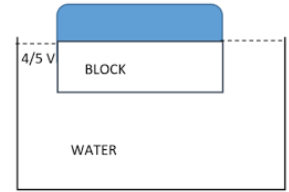
To solve this problem, we apply the Principle of Flotation, which states that for a floating object, the weight of the object is equal to the buoyant force exerted by the displaced fluid(s).
Case 1: Block floating in water only
Let \(V\) be the total volume of the wooden block, \(\rho_b\) be the density of the block, and \(\rho_w\) be the density of water.
In equilibrium:
\(
\begin{aligned}
& \text { Weight of block }=\text { Buoyant force from water } \\
& \qquad V \rho_b g=V_{s u b} \rho_w g
\end{aligned}
\)
The problem states \(4 / 5\) of the volume is submerged:
\(
\begin{aligned}
& V \rho_b=\left(\frac{4}{5} V\right) \rho_w \\
& \rho_b=\frac{4}{5} \rho_w=0.8 \rho_w
\end{aligned}
\)
Case 2: Block floating in oil and water
When oil is poured, the block is “just under the oil surface,” meaning it is fully submerged in the two-liquid system. Half the volume (\(V / 2\)) is in water and the other half (\(V / 2\)) is in oil. Let \(\rho_o\) be the density of the oil.
In equilibrium:
Weight of block = Buoyant force from water + Buoyant force from oil
\(
V \rho_b g=\left(\frac{V}{2}\right) \rho_w g+\left(\frac{V}{2}\right) \rho_o g
\)
Cancel \(V\) and \(g\) from both sides:
\(
\rho_b=\frac{\rho_w+\rho_o}{2}
\)
Step 3: Calculate Relative Density
Substitute the value of \(\rho_b\) from Case \(1\left(0.8 \rho_w\right)\) into the equation from Case 2:
\(
0.8 \rho_w=\frac{\rho_w+\rho_o}{2}
\)
Multiply by 2:
\(
\begin{gathered}
1.6 \rho_w=\rho_w+\rho_o \\
\rho_o=1.6 \rho_w-\rho_w \\
\rho_o=0.6 \rho_w
\end{gathered}
\)
The density of oil relative to water is:
\(
\text { Relative Density }=\frac{\rho_o}{\rho_w}=0.6
\)
Q19. A simple pendulum oscillating in air has period \(T\). The bob of the pendulum is completely immersed in a non-viscous liquid. The density of the liquid is \(1 / 16\) th of the material of the bob. If the bob is inside liquid all the time, its period of oscillation in this liquid is : [JEE Main 2019]
(a) \(2 T \sqrt{\frac{1}{10}}\)
(b) \(4 T \sqrt{\frac{1}{14}}\)
(c) \(4 T \sqrt{\frac{1}{15}}\)
(d) \(2 T \sqrt{\frac{1}{14}}\)
Solution: (c) To find the new time period of the pendulum in the liquid, we need to determine the effective acceleration due to gravity (\(g_{e f f}\)) acting on the bob.
The Time Period Formula:
The time period of a simple pendulum is given by:
\(
T=2 \pi \sqrt{\frac{l}{g}}
\)
When immersed in a liquid, the downward force of gravity is partially opposed by the upward buoyant force, changing the effective gravity.
Finding Effective Gravity (\(g_{\text {eff }}\)):
When the bob is in the liquid, two vertical forces act on it:
1. Weight (\(W\)): \(V \rho_b g\) (acting downwards)
2. Buoyant Force \(\left(F_B\right): V \rho_l g\) (acting upwards)
The net downward force is:
\(
F_{n e t}=V \rho_b g-V \rho_l g=V \rho_b g_{e f f}
\)
Dividing by the mass of the bob \(\left(V \rho_b\right)\) :
\(
g_{e f f}=g\left(1-\frac{\rho_l}{\rho_b}\right)
\)
Given that the density of the liquid is \(1 / 16\) th of the material of the \(\operatorname{bob}\left(\rho_l=\frac{1}{16} \rho_b\right)\) :
\(
g_{e f f}=g\left(1-\frac{1}{16}\right)=g\left(\frac{15}{16}\right)
\)
Calculating the New Time Period (\(T^{\prime}\)):
The new time period \(T^{\prime}\) is:
\(
T^{\prime}=2 \pi \sqrt{\frac{l}{g_{e f f}}}
\)
Substituting \(g_{\text {eff }}=\frac{15}{16} g\) :
\(
\begin{gathered}
T^{\prime}=2 \pi \sqrt{\frac{l}{g \times \frac{15}{16}}} \\
T^{\prime}=2 \pi \sqrt{\frac{l}{g}} \times \sqrt{\frac{16}{15}}
\end{gathered}
\)
Since \(T=2 \pi \sqrt{\frac{l}{g}}\) :
\(
\begin{aligned}
& T^{\prime}=T \times \frac{4}{\sqrt{15}} \\
& T^{\prime}=4 T \sqrt{\frac{1}{15}}
\end{aligned}
\)
Q20. If ‘ \(M\) ‘ is the mass of water that rises in a capillary tube of radius ‘ \(r\) ‘, then mass of water which will rise in a capillary tube of radius ‘ \(2 r\) ‘ is : [JEE Main 2019]
(a) M
(b) 4 M
(c) \(M / 2\)
(d) 2 M
Solution: (d) To solve this, we need to look at the relationship between the radius of the capillary tube and the mass of the liquid that rises within it.
The Capillary Rise Formula:
The height \(h\) to which water rises in a capillary tube of radius \(r\) is given by:
\(
h=\frac{2 T \cos \theta}{r \rho g}
\)
This shows that \(h \propto \frac{1}{r}\)
Expressing Mass in terms of Radius:
The mass \(M\) of the water in the capillary column is the product of the volume of the cylinder and the density of water:
\(
\begin{gathered}
M=\text { Volume × Density } \\
M=\left(\pi r^2 h\right) \times \rho
\end{gathered}
\)
Now, substitute the expression for \(h\) into the mass equation:
\(
M=\pi r^2\left(\frac{2 T \cos \theta}{r \rho g}\right) \rho
\)
Simplifying the Relationship:
If we cancel out the common terms \((r, \rho)\) :
\(
M=\frac{2 \pi r T \cos \theta}{g}
\)
From this simplified formula, we can see that for a given liquid and tube material (\(T, \theta\), and \(g\) are constant):
\(
M \propto r
\)
Calculation for Radius \(2 r\):
Let \(M_1\) be the mass for radius \(r\), and \(M_2\) be the mass for radius \(2 r\).
Since \(M\) is directly proportional to \(r\) :
\(
\begin{aligned}
& \frac{M_2}{M_1}=\frac{2 r}{r} \\
& M_2=2 M_1
\end{aligned}
\)
Given \(M_1=M\), the new mass is:
\(
M_2=2 M
\)
Q21. Water from a pipe is coming at a rate of 100 litres per minute. If the radius of the pipe is 5 cm , the Reynolds number for the flow is of the order of : (density of water \(=1000 \mathrm{~kg} / \mathrm{m}^3\), coefficient of viscosity of water \(=1 \mathrm{mPas}\)) [JEE Main 2019]
(a) \(10^6\)
(b) \(10^4\)
(c) \(10^3\)
(d) \(10^2\)
Solution: (b) To find the order of magnitude of the Reynolds number, we need to calculate its value using the flow parameters provided.
Step 1: Identify the Formula
The Reynolds number (Re) for flow in a pipe is given by:
\(
R e=\frac{\rho v D}{\eta}
\)
Where:
\(\rho=[latex] Density of water [latex]\left(1000 \mathrm{~kg} / \mathrm{m}^3\right)\)
\(v=\) Velocity of flow
\(D=\) Diameter of the pipe (\(2 \times\) radius)
\(\eta=\) Coefficient of viscosity (\(1 \mathrm{mPa} \cdot \mathrm{s}=10^{-3} \mathrm{~Pa} \cdot \mathrm{~s}\))
Step 2: Convert Units to SI
First, we convert the volume flow rate \((Q)\) from litres per minute to \(\mathrm{m}^3 / \mathrm{s}\) :
\(Q=100\) litres \(/ \min =\frac{100 \times 10^{-3} \mathrm{~m}^3}{60 \mathrm{~s}}=\frac{1}{600} \mathrm{~m}^3 / \mathrm{s}\)
Next, the radius (\(r\)) and diameter (\(D\)):
\(r=5 \mathrm{~cm}=0.05 \mathrm{~m}\)
\(D=2 r=0.1 \mathrm{~m}\)
Step 3: Calculate Velocity (\(v\))
Flow rate is defined as \(Q=A \times v\), where \(A\) is the cross-sectional area (\(\pi r^2\)):
\(
\begin{gathered}
v=\frac{Q}{\pi r^2}=\frac{1 / 600}{\pi(0.05)^2} \\
v=\frac{1}{600 \times \pi \times 0.0025}=\frac{1}{1.5 \pi} \approx 0.212 \mathrm{~m} / \mathrm{s}
\end{gathered}
\)
Step 4: Calculate Reynolds Number (Re)
Now, substitute all values into the Re formula:
\(
\begin{aligned}
& R e=\frac{1000 \times\left(\frac{1}{1.5 \pi}\right) \times 0.1}{10^{-3}} \\
& R e=\frac{100}{1.5 \pi \times 10^{-3}}=\frac{10^5}{1.5 \pi}
\end{aligned}
\)
Using \(\pi \approx 3.14\) :
\(
R e \approx \frac{100,000}{4.71} \approx 21,231
\)
Conclusion: The value 21,231 can be written in scientific notation as \(2.1 \times 10^4\). Therefore, the order of magnitude is: \(10^4\).
Q22. A load of mass \(M ~ \mathrm{~kg}\) is suspended from a steel wire of length 2 m and radius 1.0 mm in Searle’s apparatus experiment. The increase in length produced in the wire is 4.0 mm. Now the load is fully immersed in a liquid of relative density 2. The relative density of the material of load is 8. [JEE Main 2019]
The new value of increase in length of the steel wire is:
(a) 5.0 mm
(b) zero
(c) 3.0 mm
(d) 4.0 mm
Solution: (c) To solve for the new increase in length, we need to understand how the tension in the wire changes when the load is immersed in a liquid.
Step 1: The Relationship between Force and Extension
According to Hooke’s Law and the definition of Young’s Modulus (\(Y\)):
\(
\begin{gathered}
Y=\frac{\text { Stress }}{\text { Strain }}=\frac{F / A}{\Delta L / L} \\
\Delta L=\frac{F L}{A Y}
\end{gathered}
\)
Since the wire material (Young’s Modulus \(Y\)), length \((L)\), and cross-sectional area \((A)\) remain constant, the extension \(\Delta L\) is directly proportional to the tension (Force \(F\)) in the wire:
\(
\Delta L \propto F
\)
Step 2: Case 1: Load in Air
When the mass \(M\) is hanging in the air, the tension \(F_1\) is simply the weight of the load:
\(
F_1=M g=V \rho_s g
\)
Where \(V\) is the volume of the load and \(\rho_s\) is the density of the steel load. We are given the initial extension \(\Delta L_1=4.0 \mathrm{~mm}\).
Case 2: Load Immersed in Liquid
When the load is fully immersed in a liquid, an upward buoyant force (\(F_B\)) acts on it, reducing the tension in the wire.
\(
\begin{gathered}
F_2=\text { Weight }- \text { Buoyant Force } \\
F_2=V \rho_s g-V \rho_l g \\
F_2=V g\left(\rho_s-\rho_l\right)
\end{gathered}
\)
Step 3: Calculating the Ratio
We can find the ratio of the new tension to the old tension using relative densities (\(\sigma\)):
\(
\frac{F_2}{F_1}=\frac{V g\left(\rho_s-\rho_l\right)}{V \rho_s g}=\frac{\rho_s-\rho_l}{\rho_s}=1-\frac{\rho_l}{\rho_s}
\)
Given:
Relative density of load \(\left(\rho_s\right)=8\)
Relative density of liquid \(\left(\rho_l\right)=2\)
\(
\frac{F_2}{F_1}=1-\frac{2}{8}=1-\frac{1}{4}=\frac{3}{4}
\)
Step 4: Finding the New Extension (\(\Delta L_2\))
Since \(\Delta L \propto F\) :
\(
\begin{gathered}
\frac{\Delta L_2}{\Delta L_1}=\frac{F_2}{F_1} \\
\Delta L_2=\Delta L_1 \times\left(\frac{3}{4}\right) \\
\Delta L_2=4.0 \mathrm{~mm} \times \frac{3}{4} \\
\Delta L_2=3.0 \mathrm{~mm}
\end{gathered}
\)
Q23. A soap bubble, blown by a mechanical pump at the mouth of a tube, increases in volume, with time, at a constant rate. The graph that correctly depicts the time dependence of pressure inside the bubble is given by : [JEE Main 2019]
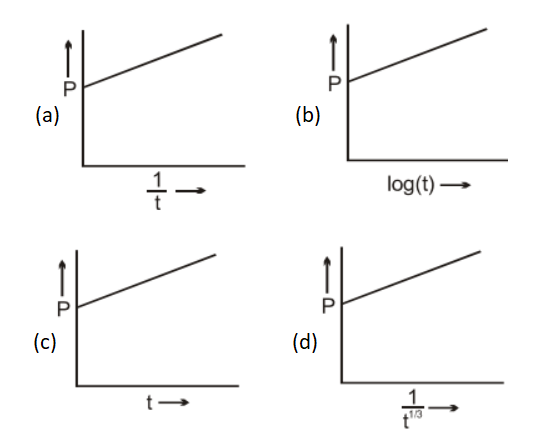
Solution: (d) To find the correct graph for the pressure inside the soap bubble over time, we need to relate the internal pressure \(P\) to the time \(t\) using the condition that the volume \(V\) increases at a constant rate.
Step 1: Constant Rate of Volume Increase
The problem states that the volume \(V\) increases at a constant rate, say \(C\) :
\(
\frac{d V}{d t}=C
\)
Integrating both sides with respect to time (assuming \(V=0\) at \(t=0\)):
\(
V=C t
\)
Since the bubble is spherical, \(V=\frac{4}{3} \pi r^3\) :
\(
\frac{4}{3} \pi r^3=C t \Longrightarrow r^3 \propto t \Longrightarrow r \propto t^{1 / 3}
\)
Step 2: Pressure Inside a Soap Bubble
The pressure inside a soap bubble \(P_{\text {in }}\) is greater than the outside atmospheric pressure \(P_0\) due to surface tension \(T\). For a soap bubble (which has two surfaces):
\(
P_{i n}=P_0+\frac{4 T}{r}
\)
Let \(P\) represent the total pressure inside the bubble as shown on the \(y\)-axis of the graphs.
Step 3: Time Dependence of Pressure
Substitute the relationship \(r \propto t^{1 / 3}\) into the pressure equation:
\(
P=P_0+\frac{4 T}{k \cdot t^{1 / 3}}
\)
Where \(k\) is a proportionality constant. This can be rewritten as:
\(
P=P_0+\frac{4 T}{k}\left(\frac{1}{t^{1 / 3}}\right)
\)
This equation is in the form of a straight line: \(y=m x+c\)
\(y=P\) (Pressure)
\(x=\frac{1}{t^{1 / 3}}\)
\(m=\frac{4 T}{k}\) (Slope)
\(c=P_0\) (Intercept on the P -axis)
Conclusion: The graph of \(P\) versus \(\frac{1}{t^{1 / 3}}\) should be a straight line with a positive slope and a non-zero intercept (\(P_0\)).
Q24. A long cylindrical vessel is half filled with a liquid. When the vessel is rotated about its own vertical axis, the liquid rises up near the wall. If the radius of vessel is 5 cm and its rotational speed is 2 rotations per second, then the difference in the heights between the centre and the sides, in cm, will be : [JEE Main 2019]
(a) 2.0
(b) 1.2
(c) 0.1
(d) 0.4
Solution: (a) When a cylindrical vessel containing a liquid rotates about its vertical axis, the free surface of the liquid takes the shape of a paraboloid.
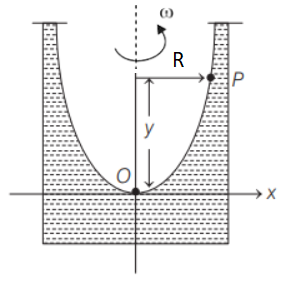
The height \(y\) of the liquid at a radial distance \(x\) from the axis of rotation is given by the equation:
\(
y=\frac{\omega^2 x^2}{2 g}
\)
Step 1: Identify the given values:
Radius (\(R[latex]): [latex]5 \mathrm{~cm}=0.05 \mathrm{~m}\)
Rotational speed (\(f\)): 2 rotations per second (rps)
Angular velocity \((\omega): 2 \pi f=2 \pi(2)=4 \pi \mathrm{rad} / \mathrm{s}\)
Acceleration due to gravity \((g): \approx 10 \mathrm{~m} / \mathrm{s}^2\) (or \(9.8 \mathrm{~m} / \mathrm{s}^2\) for more precision)
Step 2: Calculate the height difference (\(h\))
The difference in height between the center \((x=0)\) and the sides \((x=R)\) is:
\(
h=y_{\text {side }}-y_{\text {center }}=\frac{\omega^2 R^2}{2 g}
\)
Substituting the values:
\(
\begin{aligned}
& h=\frac{(4 \pi)^2 \times(0.05)^2}{2 \times 10} \\
& h=\frac{16 \pi^2 \times 0.0025}{20}
\end{aligned}
\)
Using the approximation \(\pi^2 \approx 10\) :
\(
\begin{gathered}
h=\frac{16 \times 10 \times 0.0025}{20} \\
h=\frac{160 \times 0.0025}{20}=8 \times 0.0025 \\
h=0.02 \mathrm{~m} = 2 \mathrm{~cm}
\end{gathered}
\)
Q25. A liquid of density \(\rho\) is coming out of a hose pipe of radius a with horizontal speed \(v\) and hits a mesh. \(50 \%\) of the liquid passes through the mesh unaffected. \(25 \%\) looses all of its momentum and \(25 \%\) comes back with the same speed. The resultant pressure on the mesh will be : [JEE Main 2019]
(a) \(\frac{3}{4} \rho v^2\)
(b) \(\frac{1}{4} \rho v^2\)
(c) \(\frac{1}{2} \rho v^2\)
(d) \(\rho v^2\)
Solution: (a) To find the resultant pressure on the mesh, we use the relationship between force, momentum, and pressure.
Step 1: Calculate the Mass Flow Rate
The mass of liquid hitting the mesh per unit time (\(\frac{d m}{d t}\)) is given by:
\(
\frac{d m}{d t}=\rho A v=\rho\left(\pi a^2\right) v
\)
Step 2: Analyze the Change in Momentum (\(\Delta p\))
Force is defined as the rate of change of momentum: \(F=\frac{d p}{d t}\). We must analyze the three portions of the liquid separately:
Case 1: 50% passes through unaffected
The velocity remains \(v\). The change in momentum is zero.
\(
\Delta p_1=0
\)
Case 2: \(25 \%\) loses all momentum
The liquid stops (final velocity \(=0\)). The change in velocity is \((v-0)=v\).
\(
F_2=\left(0.25 \frac{d m}{d t}\right) \times v=0.25 \rho A v^2
\)
Case 3: \(25 \%\) rebounds with same speed
The liquid hits with \(v\) and returns with \(-v\). The change in velocity is \(v-(-v)=2 v\).
\(
F_3=\left(0.25 \frac{d m}{d t}\right) \times 2 v=0.5 \rho A v^2
\)
Step 3: Calculate Total Force and Pressure
The total force \(F\) exerted on the mesh is the sum of the individual forces:
\(
\begin{gathered}
F_{\text {total }}=F_1+F_2+F_3 \\
F_{\text {total }}=0+0.25 \rho A v^2+0.5 \rho A v^2 \\
F_{\text {total }}=0.75 \rho A v^2=\frac{3}{4} \rho A v^2
\end{gathered}
\)
Pressure \((P)\) is defined as Force per unit Area \((A)\) :
\(
\begin{gathered}
P=\frac{F_{\text {total }}}{A}=\frac{\frac{3}{4} \rho A v^2}{A} \\
P=\frac{3}{4} \rho v^2
\end{gathered}
\)
Q26. Water flows into a large tank with flat bottom at the rate of \(10^{-4} \mathrm{~m}^3 \mathrm{~s}^{-1}\). Water is also leaking out of a hole ofarea \(1 \mathrm{~cm}^2\) at its bottom. If the height of the water in the tank remains steady, then this height is [JEE Main 2019]
(a) 2.9 cm
(b) 5.1 cm
(c) 4 cm
(d) 1.7 cm
Solution: (b) To find the steady height of the water in the tank, we apply the Principle of Continuity and Torricelli’s Law.
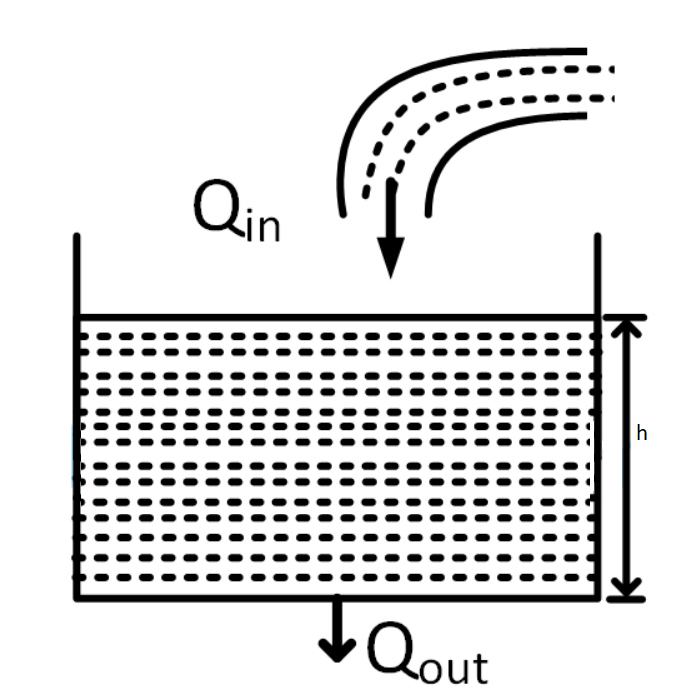
Step 1: Understand the “Steady Height” Condition
The height of the water remains steady when the rate at which water enters the tank is exactly equal to the rate at which it leaks out.
\(
\text { Rate of } \operatorname{Inflow}\left(Q_{\text {in }}\right)=\text { Rate of Outflow }\left(Q_{\text {out }}\right)
\)
Step 2: Identify the Given Values
Inflow rate \(\left(Q_{i n}\right): 10^{-4} \mathrm{~m}^3 / \mathrm{s}\)
Area of the hole \((A)\) : \(1 \mathrm{~cm}^2=1 \times 10^{-4} \mathrm{~m}^2\)
Acceleration due to gravity \((g): 9.8 \mathrm{~m} / \mathrm{s}^2\) (standard for JEE problems unless 10 is specified)
Step 3: Apply Torricelli’s Law
The velocity (\(v\)) of water leaking out of a hole at a depth \(h\) below the surface is:
\(
v=\sqrt{2 g h}
\)
The outflow rate is the product of the area of the hole and the velocity:
\(
Q_{o u t}=A \times v=A \sqrt{2 g h}
\)
Step 4: Solve for Height (\(h\))
Equate \(Q_{\text {in }}\) and \(Q_{\text {out }}\) :
\(
10^{-4}=\left(10^{-4}\right) \sqrt{2 g h}
\)
\(h=0.051 \times 100 \mathrm{~cm}=5.1 \mathrm{~cm}\).
Q27. The top of a water tank is open to air and its water level is mainted. It is giving out \(0.74 \mathrm{~m}^3\) water per minute through a circular opening of 2 cm radius in its wall. The depth of the center of the opening from the level of water in the tank is close to : [JEE Main 2019]
(a) 6.0 m
(b) 4.8 m
(c) 9.6 m
(d) 2.9 m
Solution: (b)
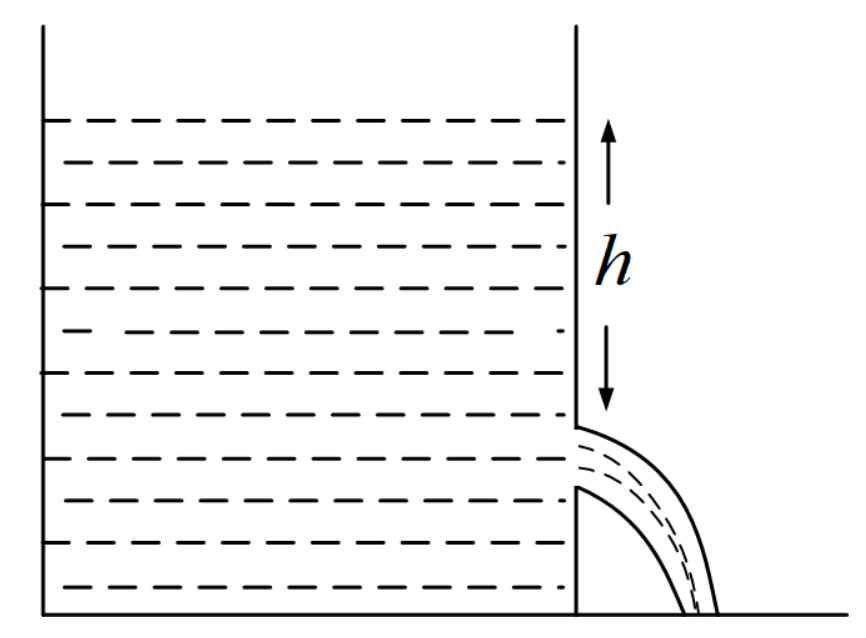
To solve for the depth of the opening, we use the principle of Torricelli’s Law and the Continuity Equation.
Step 1: Convert Units to SI
First, we must ensure all given values are in meters, seconds, and cubic meters.
Volume flow rate (Q):
\(
Q=0.74 \mathrm{~m}^3 / \mathrm{min}=\frac{0.74}{60} \mathrm{~m}^3 / \mathrm{s} \approx 0.01233 \mathrm{~m}^3 / \mathrm{s}
\)
Radius of the opening (\(r\)):
\(
r=2 \mathrm{~cm}=0.02 \mathrm{~m}
\)
Area of the opening (A):
\(
A=\pi r^2=\pi \times(0.02)^2=4 \pi \times 10^{-4} \mathrm{~m}^2
\)
Step 2: Relate Flow Rate to Velocity
The volume flow rate is the product of the area of the opening and the velocity \((v)\) of the water:
\(
Q=A \times v \Longrightarrow v=\frac{Q}{A}
\)
Substituting the values:
\(
\begin{gathered}
v=\frac{0.74 / 60}{4 \pi \times 10^{-4}} \\
v=\frac{0.74}{60 \times 4 \times 3.14 \times 10^{-4}} \approx \frac{0.74}{0.07536} \approx 9.82 \mathrm{~m} / \mathrm{s}
\end{gathered}
\)
Step 3: Apply Torricelli’s Law
The velocity of efflux \((v)\) from an opening at a depth \(h\) below the free surface is given by:
\(
v=\sqrt{2 g h}
\)
Squaring both sides to solve for \(h\) :
\(
v^2=2 g h \Longrightarrow h=\frac{v^2}{2 g}
\)
Using \(g=10 \mathrm{~m} / \mathrm{s}^2\):
\(
h=\frac{(9.82)^2}{2 \times 10} \approx \frac{96.43}{20} \approx 4.8 \mathrm{~m}
\)
Q28. A small soap bubble of radius 4 cm is trapped inside another bubble of radius 6 cm without any contact. Let \(P_2\) be the pressure inside the inner bubble and \(P_0\), the pressure outside the outer bubble. Radius of another bubble with pressure difference \(P_2-P_0\) between its inside and outside would be : [JEE 2018]
(a) 12 cm
(b) 2.4 cm
(c) 6 cm
(d) 4.8 cm
Solution: (b) To find the radius of a single bubble that has the same pressure difference as the nested bubble system, we need to calculate the total excess pressure from the outside to the innermost part.
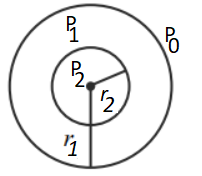
Step 1: Understanding Excess Pressure in a Soap Bubble
A soap bubble has two surfaces (inner and outer). The excess pressure \(\Delta P\) inside a bubble of radius \(R\) with surface tension \(T\) is given by:
\(
\Delta P=\frac{4 T}{R}
\)
Step 2: Calculating \(P_2-P_0\)
In this setup, we have two bubbles. Let’s break down the pressure jumps:
Jump 1 (Outer Bubble): The pressure difference between the space between the bubbles (\(P_1\)) and the outside (\(P_0\)) is:
\(
P_1-P_0=\frac{4 T}{r_1}=\frac{4 T}{6}
\)
Jump 2 (Inner Bubble): The pressure difference between the inside of the inner bubble (\(P_2\)) and the space between the bubbles (\(P_1\)) is:
\(
P_2-P_1=\frac{4 T}{r_2}=\frac{4 T}{4}
\)
To find the total pressure difference \(P_2-P_0\), we sum these two equations:
\(
\begin{gathered}
P_2-P_0=\left(P_2-P_1\right)+\left(P_1-P_0\right) \\
P_2-P_0=\frac{4 T}{4}+\frac{4 T}{6}
\end{gathered}
\)
Step 3: Finding the Equivalent Radius (\(R_{e q}\))
We are looking for a single bubble of radius \(R_{e q}\) such that its excess pressure equals \(P_2-P_0\) :
\(
\frac{4 T}{R_{e q}}=\frac{4 T}{4}+\frac{4 T}{6}
\)
Dividing both sides by \(4 T\) :
\(
\frac{1}{R_{e q}}=\frac{1}{4}+\frac{1}{6}
\)
Now, we solve for \(R_{e q}\) :
\(
\begin{aligned}
& \frac{1}{R_{e q}}=\frac{3+2}{12}=\frac{5}{12} \\
& R_{e q}=\frac{12}{5}=2.4 \mathrm{~cm}
\end{aligned}
\)
Q29. A solid sphere of radius \(r\) made of a soft material of bulk modulus \(K\) is surrounded by a liquid in a cylindrical container. A massless piston of area \(a\) floats on the surface of the liquid, covering entire cross section of cylindrical container. When a mass \(m\) is placed on the surface of the piston to compress the liquid, the fractional decrement in the radius of the sphere, \(\left(\frac{d r}{r}\right)\) is: [JEE Main 2018 (Offline)]
(a) \(\frac{m g}{K a}\)
(b) \(\frac{K a}{m g}\)
(c) \(\frac{K a}{3 m g}\)
(d) \(\frac{m g}{3 K a}\)
Solution: (d) To find the fractional decrement in the radius of the sphere, we need to relate the applied pressure to the volume change and then to the radius change.
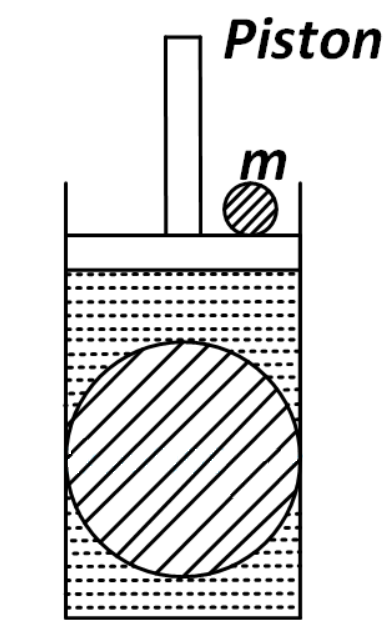
Step 1: Determine the pressure applied to the liquid
When a mass \(m\) is placed on the piston of area \(a\), it exerts a force \(F=m g\) due to gravity. The increase in pressure \(\Delta P\) throughout the liquid (and thus on the sphere) is:
\(
\Delta P=\frac{F}{a}=\frac{m g}{a}
\)
Step 2: Relate pressure to volume change using Bulk Modulus
The Bulk Modulus \(K\) is defined as the ratio of the change in pressure to the fractional change in volume:
\(
K=\frac{\Delta P}{-\frac{\Delta V}{V}}
\)
Rearranging this to find the fractional change in volume \(\frac{\Delta V}{V}\) (we use the absolute value for the decrement):
\(
\frac{\Delta V}{V}=\frac{\Delta P}{K}
\)
Substituting the value of \(\Delta P\) from Step 1:
\(
\frac{\Delta V}{V}=\frac{m g}{K a}
\)
Step 3: Relate volume change to radius change
The volume of a sphere is \(V=\frac{4}{3} \pi r^3\). To find how the volume changes with the radius, we take the derivative (or use logs):
\(
\begin{gathered}
V \propto r^3 \\
\frac{d V}{V}=3 \frac{d r}{r}
\end{gathered}
\)
This shows that the fractional change in volume is three times the fractional change in the radius.
Step 4: Solve for \(\frac{d r}{r}\)
Substitute the result from Step 2 into the relationship found in Step 3:
\(
\begin{aligned}
& 3 \frac{d r}{r}=\frac{m g}{K a} \\
& \frac{d r}{r}=\frac{m g}{3 K a}
\end{aligned}
\)
Q30. When an air bubble of radius r rises from the bottom to the surface of a lake its radius becomes \(\frac{5 r}{4}\). Taking the atmospheric pressure to be equal to 10 m height of water column, the depth of the lake would approximately be (ignore the surface tension and the effect of temperature) : [JEE Main 2018]
(a) 11.2 m
(b) 8.7 m
(c) 9.5 m
(d) 10.5 m
Solution: (c) Step 1: Identify Given Parameters
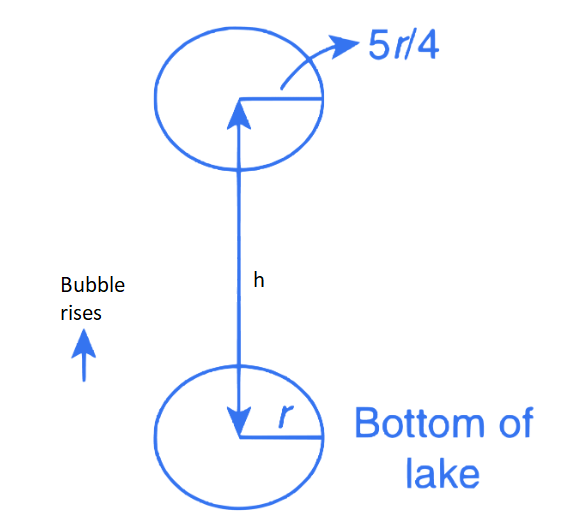
Atmospheric pressure (\(\boldsymbol{P}_{\text {atm }}\)) is given as equal to the pressure of a 10 m water column: \(P_{a t m}=10 \mathrm{~m}\).
Initial radius at the bottom of the lake: \(r_{\text {bottom }}=r\).
Final radius at the surface: \(r_{\text {surface }}=\frac{5 r}{4}\).
Ignore temperature change (isothermal process) and surface tension.
Step 2: Apply Boyle’s Law
Since temperature is constant, we use Boyle’s Law \(\left(P_1 V_1=P_2 V_2\right)\). The volume of a spherical bubble is given by \(V=\frac{4}{3} \pi r^3\).
At the surface: \(P_{\text {surface }}=P_{\text {atm }}=10 \mathrm{~m}\) of water.
At the bottom: \(P_{\text {bottom }}=P_{\text {atm }}+h\), where \(h\) is the depth of the lake.
Using the relation \(P_{\text {bottom }} \cdot V_{\text {bottom }}=P_{\text {surface }} \cdot V_{\text {surface }}\) :
\(
\left(P_{a t m}+h\right) \times \frac{4}{3} \pi(r)^3=P_{a t m} \times \frac{4}{3} \pi\left(\frac{5 r}{4}\right)^3
\)
\(
\begin{aligned}
&\begin{gathered}
(10+h)=10 \times\left(\frac{5}{4}\right)^3 \\
(10+h)=10 \times \frac{125}{64} \\
(10+h)=19.53125 \\
h=19.53-10=9.53 \mathrm{~m}
\end{gathered}\\
&\text { Rounding to the nearest given option, the depth is approximately } 9.5 \mathrm{~m} \text {. }
\end{aligned}
\)
Q31. A thin uniform tube is bent into a circle of radius \(r\) in the vertical plane. Equal volumes of two immiscible liquids, whose densities are \(\rho_1\) and \(\rho_2\left(\rho_1>\rho_2\right)\), fill half the circle. The angle \(\theta\) between the radius vector passing through the common interface and the vertical is : [JEE Main 2018]
(a) \(\theta=\tan ^{-1} \pi\left(\frac{\rho_1}{\rho_2}\right)\)
(b) \(\theta=\tan ^{-1} \frac{\pi}{2}\left(\frac{\rho_1}{\rho_2}\right)\)
(c) \(\theta=\tan ^{-1}\left(\frac{\rho_1-\rho_2}{\rho_1+\rho_2}\right)\)
(d) \(\theta=\tan ^{-1} \frac{\pi}{2}\left(\frac{\rho_1+\rho_2}{\rho_1-\rho_2}\right)\)
Solution: (c) Formula Used:
\(
P=\rho g h
\)
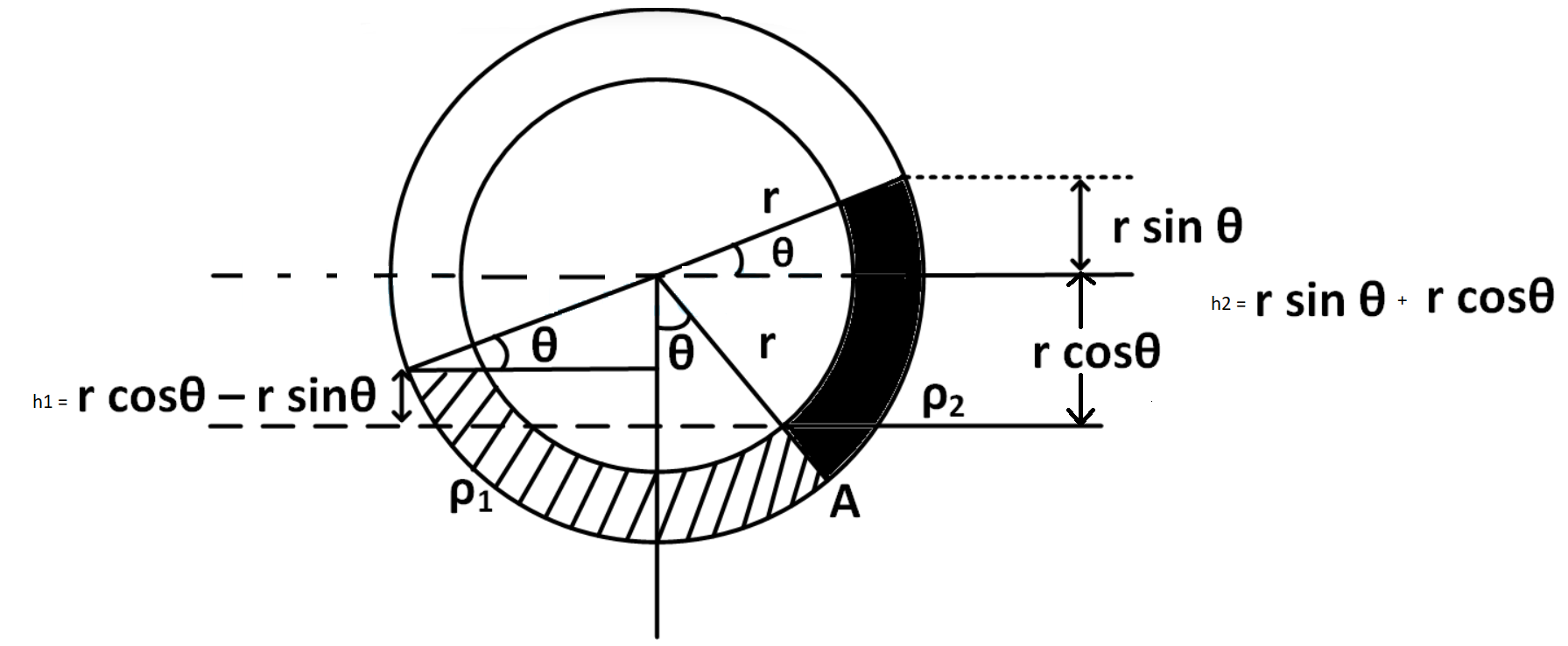
We are using the pressure balance method at the horizontal level of the interface. Let’s break down the physics and geometry behind each step to see exactly why those equations work.
Step 1: The Geometry of the Setup
Since the liquids fill exactly half the circle (an angle of \(\pi\) or \(180^{\circ}\)), and the two liquids have equal volumes, each liquid occupies a quadrant (an angle of \(90^{\circ}\)).
If we define the common interface at an angle \(\theta\) from the vertical bottom:
Liquid \(2\left(\rho_2\right)\) extends from the interface \((\theta)\) up to \(90^{\circ}\) on one side. Its top surface is at an angle \(\left(90^{\circ}+\theta\right)\) from the bottom.
Liquid \(1\left(\rho_1\right)\) extends from the interface \((\theta)\) up to \(90^{\circ}\) on the other side. Its top surface is at an angle (\(90^{\circ}-\theta\)) from the bottom.
Step 2: Finding Vertical Heights (Depth)
Pressure in a static fluid depends only on the vertical depth (h) from the free surface (\(P= \rho g h)\). We need the vertical distance from the free surface of each liquid down to the interface.
For Liquid 2: The vertical height from the center to the interface is \(r \cos \theta\). The vertical height from the center to its top surface is \(r \sin \theta\) (since \(\cos (90+\theta)=-\sin \theta)\).
The total vertical column height is the sum: \(h_2=r \cos \theta+r \sin \theta\).
For Liquid 1: The vertical height from the center to the interface is \(r \cos \theta\). The vertical height from the center to its top surface is \(r \sin \theta\) (since \(\cos (90-\theta)=\sin \theta\)).
Since this top surface is below the center but above the interface, the vertical column height is the difference: \(h_1=r \cos \theta-r \sin \theta\).
Step 3: Balancing Pressure at the Interface
At equilibrium, the pressure at the interface must be the same whether you calculate it from the side of Liquid 1 or Liquid 2.
\(
P_{\text {interface }}=P_{\text {atm }}+\rho_2 g(r \cos \theta+r \sin \theta)=P_{\text {atm }}+\rho_1 g(r \cos \theta-r \sin \theta)
\)
By canceling \(P_{\text {atm }}\) and \(g\), we get your starting equation:
\(
(r \cos \theta+r \sin \theta) \rho_2=(r \cos \theta-r \sin \theta) \rho_1
\)
Step 4: Algebraic Simplification
To solve for \(\theta\), we move the densities to one side and the trigonometric functions to the other:
\(
\frac{\rho_1}{\rho_2}=\frac{\cos \theta+\sin \theta}{\cos \theta-\sin \theta}
\)
To turn this into tangent, we divide the numerator and denominator of the right side by \(\cos \theta\) :
\(
\frac{\rho_1}{\rho_2}=\frac{1+\tan \theta}{1-\tan \theta}
\)
Cross-multiplying gives:
\(
\begin{aligned}
& \rho_1(1-\tan \theta)=\rho_2(1+\tan \theta) \\
& \rho_1-\rho_1 \tan \theta=\rho_2+\rho_2 \tan \theta
\end{aligned}
\)
\(
\begin{aligned}
&\text { Finally, group the } \tan \theta \text { terms: }\\
&\begin{gathered}
\rho_1-\rho_2=\left(\rho_1+\rho_2\right) \tan \theta \\
\tan \theta=\frac{\rho_1-\rho_2}{\rho_1+\rho_2}
\end{gathered}
\end{aligned}
\)
Why this makes sense?
If \(\rho_1=\rho_2\), the numerator becomes 0 , so \(\tan \theta=0\) and \(\theta=0\). This means for two identical liquids, the interface sits perfectly at the bottom. Since \(\rho_1>\rho_2\) in this problem, the heavier liquid “pushes” the interface up toward the side of the lighter liquid, resulting in a positive angle \(\theta\).
Q32. Two tubes of radii \(r_1\) and \(r_2\), and lengths \(l_1\) and \(l_2\), respectively, are connected in series and a liquid flows through each of them in stream line conditions. \(P_1\) and \(P_2\) are pressure differences across the two tubes. If \(P_2\) is \(4 P_1\) and \(I_2\) is \(\frac{1_1}{4}\), then the radius \(r_2\) will be equal to: [JEE Main 2017]
(A) \(r_1\)
(B) \(2 r_1\)
(C) \(4 r_1\)
(D) \(\frac{r_1}{2}\)
Solution: (D) To find the radius \(r_2\) for the second tube, we can break the solution down into these logical steps:
Step 1: Identify the Flow Condition
Since the liquid is in streamline flow and the tubes are connected in series, the volume flow rate \((Q)\) must be identical for both tubes. If it weren’t, liquid would be “piling up” at the junction.
\(
Q_1=Q_2
\)
Step 2: Apply Poiseuille’s Law
According to Poiseuille’s Law, the volume flow rate is:
\(
Q=\frac{\pi P r^4}{8 \eta l}
\)
By setting \(Q_1=Q_2\) and canceling out the common constants (\(\pi, 8\), and the viscosity \(\eta\)), we establish the following relationship:
\(
\frac{P_1 r_1^4}{l_1}=\frac{P_2 r_2^4}{l_2}
\)
Step 3: Substitute the Given Ratios
We are given the specific conditions for the second tube relative to the first:
\(P_2=4 P_1\)
\(l_2=\frac{l_1}{4}\)
Plugging these into our relationship:
\(
\frac{P_1 r_1^4}{l_1}=\frac{\left(4 P_1\right) \cdot r_2^4}{\left(l_1 / 4\right)}
\)
Step 4: Simplify and Solve for \(r_2\)
First, simplify the fraction on the right side:
\(
\frac{P_1 r_1^4}{l_1}=16\left(\frac{P_1 r_2^4}{l_1}\right)
\)
\(
\begin{aligned}
&r_1=\sqrt[4]{16} \cdot r_2\\
&r_1=2 r_2\\
&r_2=\frac{r_1}{2}
\end{aligned}
\)
Q33. Consider a water jar of radius \(R\) that has water filled up to height \(H\) and is kept on a stand of height \(h\) (see figure). Through a hole of radius \(\mathrm{r}(\mathrm{r} \ll \mathrm{R})\) at its bottom, the water leaks out and the stream of water coming down towards the ground has a shape like a funnel as shown in the figure. If the radius of the cross-section of water stream when it hits the ground is \(x\). Then : [JEE Main 2016]
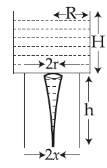
(a) \(x=r\left(\frac{H}{H+h}\right)\)
(b) \(x=r\left(\frac{H}{H+h}\right)^{\frac{1}{2}}\)
(c) \(x=r\left(\frac{H}{H+h}\right)^{\frac{1}{4}}\)
(d) \(x=r\left(\frac{H}{H+h}\right)^2\)
Solution: (c) Step 1: Velocity of Efflux at the Hole (\(v_1\))
According to Torricelli’s Theorem, the velocity of the water as it leaves the hole at the bottom of the jar is determined by the height of the water \(H\) above it:
\(
v_1=\sqrt{2 g H}
\)
At this point (the top of the “funnel”), the radius of the stream is \(r\).
Step 2: Velocity of the Stream at the Ground (\(v_2\))
As the water falls through the stand height \(h\), it gains additional speed due to gravity. We use the kinematic equation \(v_f^2=v_i^2+2 a s\) to find the velocity at the bottom:
\(
v_2^2=v_1^2+2 g h
\)
Substituting \(v_1^2=2 g H\) :
\(
v_2^2=2 g H+2 g h \Longrightarrow v_2=\sqrt{2 g(H+h)}
\)
Step 3: Applying the Equation of Continuity
The principle of continuity states that for an incompressible fluid in steady flow, the volume flow rate \((A \times v)\) must be constant.
\(
A_1 v_1=A_2 v_2
\)
Substitute the area of the circles (\(\pi r^2\) and \(\pi x^2\)):
\(
\pi r^2 \sqrt{2 g H}=\pi x^2 \sqrt{2 g(H+h)}
\)
Step 4: Solving for \(x\)
Cancel \(\pi\) and \(\sqrt{2 g}\) from both sides:
\(
r^2 \sqrt{H}=x^2 \sqrt{H+h}
\)
Isolate \(x^2\) :
\(
x^2=r^2 \frac{\sqrt{H}}{\sqrt{H+h}}=r^2\left(\frac{H}{H+h}\right)^{1 / 2}
\)
Take the square root of both sides to find \(x\) :
\(
x=r\left(\frac{H}{H+h}\right)^{1 / 4}
\)
Insight: This mathematical result confirms why the stream looks like a funnel. Since the water moves faster as it falls \(\left(v_2>v_1\right)\), the cross-sectional area must shrink (\(x<r)\) to ensure the same amount of water passes through any horizontal plane per second.
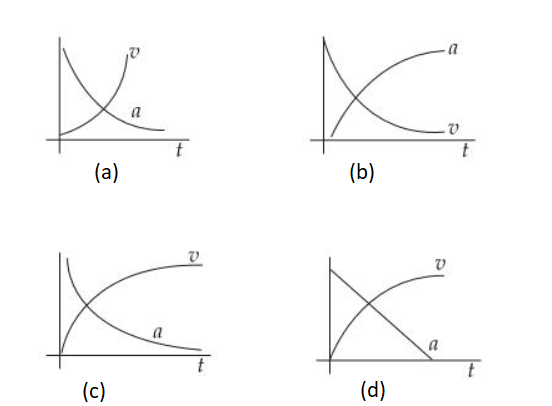
Q34. Which of the following option correctly describes the variation of the speed \(v\) and acceleration ‘ \(a\) ‘ of a point mass falling vertically in a viscous medium that applies a force \(\mathrm{F}=-k v\), where ‘ \(k\) ‘ is a constant, on the body ? (Graphs are schematic and not drawn to scale) [JEE Main 2016]
Solution: (c) Step 1: Set up the Equation of Motion
For a mass \(m\) falling vertically, two forces act on it:
Gravity: \(m g\) (downward)
Viscous Drag: \(F=-k v\) (upward, opposing motion)
Using Newton’s Second Law (\(F_{\text {net }}=m a\)):
\(
\begin{gathered}
m g-k v=m a \dots(1)\\
a=g-\frac{k}{m} v
\end{gathered}
\)
Step 2: Analysis of Acceleration (\(a\) vs \(t\))
At the start (\(t=0\)), the velocity \(v=0\).
Initial acceleration: \(a=g\).
As the object speeds up, the term \(\frac{k}{m} v\) increases, which makes the acceleration \(a\) decrease.
Eventually, \(k v\) becomes equal to \(m g\). At this point, \(a=0\) and the body reaches terminal velocity \(\left(v_t\right)\).
Graph characteristics for \(a\) : It starts at a maximum value (\(g\)) and decreases exponentially toward zero.
Step 3: Analysis of Velocity (\(v\) vs \(t\))
By substituting \(a=\frac{d v}{d t}\) into the equation and integrating, we find the velocity at any time \(t\) :
\(
v(t)=\frac{m g}{k}\left(1-e^{-\frac{k}{m} t}\right)
\)
Initially \((t=0)\) : \(v=0\).
As \(t \rightarrow \infty: v\) approaches a constant value, \(v_t=\frac{m g}{k}\).
The slope of the \(v-t\) graph is acceleration. Since acceleration is decreasing, the curve is concave down.
Graph characteristics for \(v\) : It starts at the origin and increases exponentially, leveling off at the terminal velocity.
\(
\begin{aligned}
& {ma}={mg}-{k} \times \frac{m g}{k}\left(1-{e}^{-\frac{k t}{m}}\right) \\
& ={mg}-{mg}+{mge}^{-\frac{k t}{m}} \\
& {a}={ge}^{-\frac{k t}{m}}
\end{aligned}
\)
The correct description involves an exponentially increasing velocity and an exponentially decreasing acceleration.
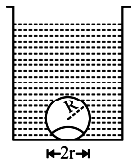
Q35. On heating water, bubbles being formed at the bottom of the vessel detach and rise. Take the bubbles to be spheres of radius \(R\) and making a circular contact of radius \(r\) with the bottom \(R\) and making a circular contact of radius \(r\) with the bottom of the vessel. If \(r \ll R\) and the surface tension of water is \(T\), value of \(r\) just before bubbles detach is: (density of water is \(\rho_w\)) [JEE Main 2014]
(A) \(R^2 \sqrt{\frac{\rho_w g}{3 T}}\)
(B) \(R^2 \sqrt{\frac{\rho_w g}{6 T}}\)
(C) \(R^2 \sqrt{\frac{\rho_w g}{T}}\)
(D) \(R^2 \sqrt{\frac{2 \rho_w g}{3 T}}\)
Solution: (D) To find the value of \(r\) at the moment of detachment, we must analyze the forces acting on the bubble. The bubble will detach when the upward buoyancy force just exceeds the downward force due to surface tension.
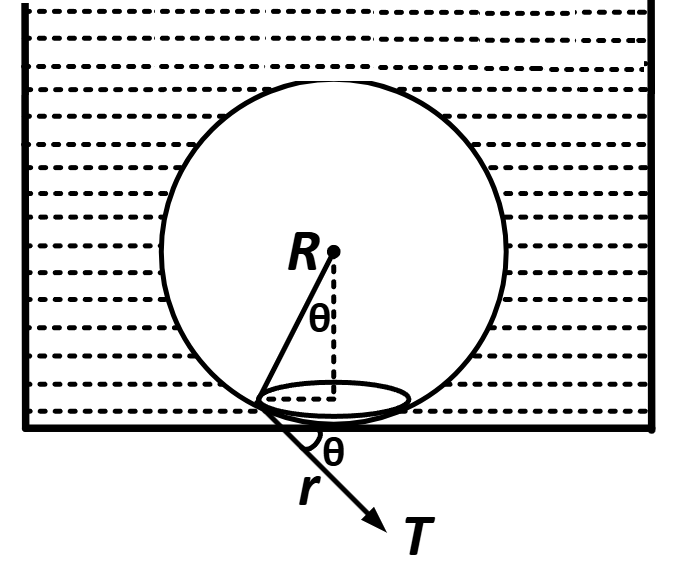
Step 1: Identify the Upward Force (Buoyancy)
The buoyancy force \(F_B\) is equal to the weight of the liquid displaced by the bubble. Since the bubble is a sphere of radius \(R\) :
\(
F_B=V \rho_w g=\left(\frac{4}{3} \pi R^3\right) \rho_w g
\)
Step 2: Identify the Downward Force (Surface Tension)
The surface tension force \(F_s\) acts along the circumference of the contact circle of radius \(r\).
The vertical component of the surface tension force holds the bubble to the bottom.
At the contact interface, the force is \(T \times\) (length of contact).
The angle \(\theta\) at the contact point can be approximated because \(r \ll R\). For a spherical shape, \(\sin \theta=\frac{r}{R}\).
The downward force due to surface tension is:
\(
F_s=(T \cdot 2 \pi r) \sin \theta
\)
Substituting \(\sin \theta=\frac{r}{R}\) :
\(
F_s=(2 \pi r T)\left(\frac{r}{R}\right)=\frac{2 \pi r^2 T}{R}
\)
Step 3: Equate the Forces for Detachment
At the exact moment before detachment, the upward force equals the downward force:
\(
\begin{gathered}
F_B=F_s \\
\frac{4}{3} \pi R^3 \rho_w g=\frac{2 \pi r^2 T}{R}
\end{gathered}
\)
\(
\begin{aligned}
&\frac{4}{3} R^3 \rho_w g=\frac{2 r^2 T}{R}\\
&r^2=\frac{4 R^4 \rho_w g}{6 T}=\frac{2 R^4 \rho_w g}{3 T}\\
&r=R^2 \sqrt{\frac{2 \rho_w g}{3 T}}
\end{aligned}
\)
The value of \(r\) just before the bubble detaches is:
\(
r=R^2 \sqrt{\frac{2 \rho_w g}{3 T}}
\)
Q36. An open glass tube is immersed in mercury in such a way that a length of 8 cm extends above the mercury level. The open end of the tube is then closed and scaled and the tube is raised vertically up by additional 46 cm. What will be length of the air column above mercury in the tube now? (Atmospheric pressure \(=76 \mathrm{~cm}\) of Hg) [JEE Main 2014]
(a) 16 cm
(b) 22 cm
(c) 38 cm
(d) 6 cm
Solution: (a) Length of the air column above mercury in the tube is,
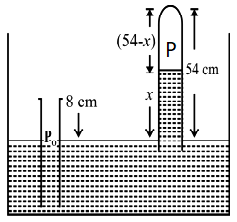
\(
\begin{aligned}
& P+x=P_0 \\
& \Rightarrow P=(76-x) \\
& \Rightarrow 8 \times A \times 76=(76-x) \times A \times(54-x) \\
& \therefore x=38
\end{aligned}
\)
Thus, length of air column \(=54-38=16 c m\).
Explanation: To solve this problem, we need to use Boyle’s Law \(\left(P_1 V_1=P_2 V_2\right)\), which applies because the temperature and the amount of trapped air remain constant throughout the process.
Step 1: Analyze the Initial State
Initially, the tube is open and immersed in mercury with 8 cm extending above the level.
Pressure (\(P_1\)): Since the tube is open, the pressure inside is equal to the atmospheric pressure.
\(
P_1=76 \mathrm{~cm} \text { of } \mathrm{Hg}
\)
Length of air column \(\left(L_1\right)\) : The portion above the mercury level.
\(
L_1=8 \mathrm{~cm}
\)
Volume (\(V_1\)): If \(A\) is the cross-sectional area, \(V_1=A \times 8\).
Step 2: Analyze the Final State
The tube is sealed and raised by an additional 46 cm . Let the new length of the air column be \(x\)
Total length of the tube above the external mercury level: Initially it was 8 cm , and it was raised by 46 cm , so the total height of the top of the tube from the external mercury surface is \(8+46=54 \mathrm{~cm}\).
Length of mercury column inside the tube: If the air column is \(x\), the remaining height inside the tube filled with mercury is \((54-x)\).
Pressure (\(P_2\)): The pressure of the trapped air must balance the external atmospheric pressure minus the weight of the mercury column inside the tube.
\(
\begin{gathered}
P_2=P_{a t m}-\text { height of } \mathrm{Hg} \text { column } \\
P_2=76-(54-x)=22+x \mathrm{~cm} \text { of } \mathrm{Hg}
\end{gathered}
\)
Volume \(\left(V_2\right): V_2=A \times x\).
Step 3: Apply Boyle’s Law
Since \(P_1 V_1=P_2 V_2\) :
\(
76 \times(A \cdot 8)=(22+x) \times(A \cdot x)
\)
Divide both sides by \(\boldsymbol{A}\) :
\(
608=22 x+x^2
\)
Rearrange into a quadratic equation:
\(
x^2+22 x-608=0
\)
\(
\begin{aligned}
&x=\frac{-22 \pm 54}{2}\\
&\text { Since length cannot be negative, we take the positive root: }\\
&x=\frac{32}{2}=16 \mathrm{~cm}
\end{aligned}
\)
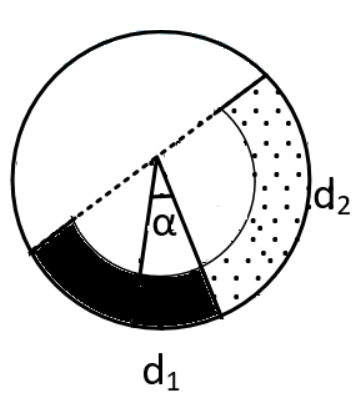
Q37. There is a circular tube in a vertical plane. Two liquids which do not mix and of densities \(d_1\) and \(d_2\) are filled in the tube. Each liquid subtends \(90^{\circ}\) angle at center. Radius joining their interface makes an angle \(\alpha\) with vertical. Radio \(\frac{d_1}{d_2}\) is : [JEE Main 2014]
(A) \(\frac{1+\sin \alpha}{1-\sin \alpha}\)
(B) \(\frac{1+\cos \alpha}{1-\cos \alpha}\)
(C) \(\frac{1+\tan \alpha}{1-\tan \alpha}\)
(D) \(\frac{1+\sin \alpha}{1-\cos \alpha}\)
Solution: (c) The key to this problem is measuring the vertical depth of the liquid columns sitting above the common interface at Point A.
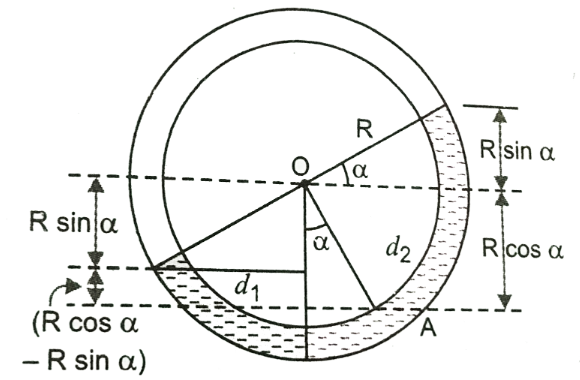
Step 1: Right Side (Density \(\boldsymbol{d}_{\mathbf{2}}\))
The Interface (A): Located at a vertical depth of \(R \cos \alpha\) below the horizontal center line.
The Top Surface: Located at a vertical height of \(R \sin \alpha\) above the horizontal center line.
Total Vertical Column Height: To get from the top surface to point A, you must travel down \(R \sin \alpha\) to reach the center line, and then another \(R \cos \alpha\) to reach the interface.
Height \(h_2=R \cos \alpha+R \sin \alpha\)
Step 2: Left Side (Density \(\boldsymbol{d}_{\mathbf{1}}\))
The Interface (A): Still at \(R \cos \alpha\) below the center.
The Top Surface: As shown in the diagram, this surface is at a depth of \(R \sin \alpha\) below the horizontal center line.
Total Vertical Column Height: The liquid column is only the vertical distance between the surface and point A.
Height \(h_1=R \cos \alpha-R \sin \alpha\)
Final Pressure Balance
Since the system is in equilibrium, the pressure exerted by the column of \(d_1\) must equal the pressure exerted by the column of \(d_2\) at point A (ignoring atmospheric pressure as it acts on both open ends equally).
\(
\begin{gathered}
P_1=P_2 \\
d_1 g(R \cos \alpha-R \sin \alpha)=d_2 g(R \cos \alpha+R \sin \alpha)
\end{gathered}
\)
Cancel \(g\) and \(R\) :
\(
d_1(\cos \alpha-\sin \alpha)=d_2(\cos \alpha+\sin \alpha)
\)
Rearrange for the ratio:
\(
\frac{d_1}{d_2}=\frac{\cos \alpha+\sin \alpha}{\cos \alpha-\sin \alpha}
\)
Convert to tangent (by dividing all terms by \(\cos \alpha\)):
\(
\frac{d_1}{d_2}=\frac{1+\tan \alpha}{1-\tan \alpha}
\)
Q38. A uniform cylinder of length \(L\) and mass \(M\) having cross-sectional area \(A\) is suspended, with its length vertical, from a fixed point by a mass-less spring such that it is half submerged in a liquid of density \(\sigma\) at equilibrium position. The extension \(x_0\) of the spring when it is in equilibrium is: [JEE Main 2013]
(A) \(\frac{M g}{k}\)
(B) \(\frac{M g}{k}\left(1-\frac{L A \sigma}{M}\right)\)
(C) \(\frac{M g}{k}\left(1-\frac{L A \sigma}{2 M}\right)\)
(D) \(\frac{M g}{k}\left(1+\frac{L A \sigma}{M}\right)\)
Solution: (c) From figure, \(k x_0+F_B=M g\)
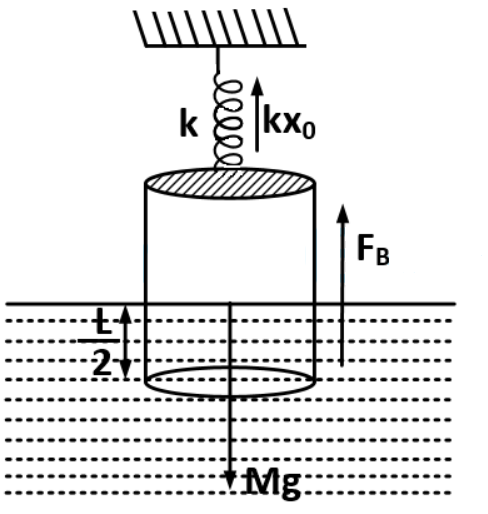
\(
k x_0+\sigma \frac{L}{2} A g=M g
\)
[ as mass = density × volume ]
\(
\begin{aligned}
& \Rightarrow k x_0=M g-\sigma \frac{L}{2} A g \\
& \Rightarrow x_0=\frac{M g-\frac{\sigma L A g}{2}}{k} \\
& =\frac{M g}{k}\left(1-\frac{L A \sigma}{2 M}\right)
\end{aligned}
\)
Explanation: To find the extension \(x_0\) at equilibrium, we need to balance the three forces acting on the cylinder.
Step 1: Identify the Forces
When the cylinder is in equilibrium, the net force acting on it is zero. The forces are:
Gravity (\(F_g\)): Acting downward.
\(
F_g=M g
\)
Spring Force (\(F_s\)): Acting upward, where \(k\) is the spring constant and \(x_0\) is the extension.
\(
F_s=k x_0
\)
Buoyant Force (\(F_B\)): Acting upward, equal to the weight of the liquid displaced.
\(
F_B=V_{\text {submerged }} \cdot \sigma \cdot g
\)
Step 2: Calculate the Buoyant Force
The problem states the cylinder is half submerged in the liquid. Since the total length is \(L\) and the cross-sectional area is \(\boldsymbol{A}\), the submerged volume is:
\(
V_{\text {submerged }}=A \cdot\left(\frac{L}{2}\right)
\)
Substituting this into the buoyant force equation:
\(
F_B=\left(\frac{A L}{2}\right) \sigma g
\)
Step 3: Establish the Equilibrium Equation
Summing the upward forces and setting them equal to the downward force:
\(
\begin{gathered}
\text { Upward Forces }=\text { Downward Force } \\
k x_0+F_B=M g \\
k x_0+\frac{A L \sigma g}{2}=M g
\end{gathered}
\)
Step 4: Solve for \(x_0\)
Isolate the term with \(x_0\) :
\(
k x_0=M g-\frac{A L \sigma g}{2}
\)
Factor out \(\boldsymbol{M g}\) from the right side:
\(
\begin{aligned}
& k x_0=M g\left(1-\frac{A L \sigma g}{2 M g}\right) \\
& k x_0=M g\left(1-\frac{L A \sigma}{2 M}\right)
\end{aligned}
\)
Divide by \(k\) to find the extension:
\(
x_0=\frac{M g}{k}\left(1-\frac{L A \sigma}{2 M}\right)
\)
Q39. A thin liquid film formed between a U-shaped wire and a light slider supports a weight of \(1.5 \times 10^{-2} N\) (see figure). The length of the slider is 30 cm and its weight negligible. The surface tension of the liquid film is [JEE Main 2012]
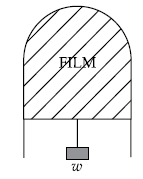
(A) \(0.0125 \mathrm{Nm}^{-1}\)
(B) \(0.1 \mathrm{Nm}^{-1}\)
(C) \(0.05 \mathrm{Nm}^{-1}\)
(D) \(0.025 \mathrm{Nm}^{-1}\)
Solution: (D) To find the surface tension of the liquid film, we need to balance the upward force exerted by the surface tension against the downward force exerted by the weight.
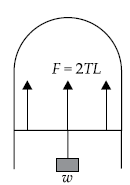
Step 1: Understand the Nature of a Liquid Film
A thin liquid film (like a soap film) has two free surfaces-one in the front and one in the back. Therefore, the force of surface tension acts twice along the length of the slider.
Step 2: Identify the Forces
Downward Force (\(F_{\text {down }}\)): This is the weight supported by the film.
\(
F_{\text {down }}=W=1.5 \times 10^{-2} \mathrm{~N}
\)
Upward Force (\(F_{u p}\)): This is the force due to surface tension (\(T\)). Since there are two surfaces, the force is:
\(
F_{u p}=2 \cdot(T \cdot l)
\)
Where \(l\) is the length of the slider.
Step 3: Set up the Equilibrium Equation
At equilibrium, the upward force equals the downward force:
\(
2 \pi=W
\)
Step 4: Solve for Surface Tension (\(T\))
Given:
\(W=1.5 \times 10^{-2} \mathrm{~N}\)
\(l=30 \mathrm{~cm}=0.3 \mathrm{~m}\)
Substitute the values:
\(
2 \cdot T \cdot(0.3)=1.5 \times 10^{-2}
\)
\(
T=2.5 \times 10^{-2} \mathrm{~N} / \mathrm{m}
\)
The surface tension of the liquid film is:
\(
2.5 \times 10^{-2} \mathrm{~N} / \mathrm{m} \text { (or } 0.025 \mathrm{~N} / \mathrm{m} \text { ) }
\)
Q40. Work done in increasing the size of a soap bubble from a radius of 3 cm to 5 cm is nearly (Surface tension of soap solution \(=0.03 {~Nm}^{-1}\), [JEE Main 2011]
(A) \(0.2 \pi {~mJ}\)
(B) \(2 \pi m J\)
(C) \(0.4 \pi m{~mJ}\)
(D) \(4 \pi m J\)
Solution: (C)
\(\begin{aligned}
& W=T \times \text { change in surface area } \\
& W=2 T 4 \pi\left[(5)^2-(3)^2\right] \times 10^{-4} \\
& =2 \times 0.03 \times 4 \pi[25-9] \times 10^{-4} J \\
& =0.4 \pi \times 10^{-3} J \\
& =0.4 \pi m J
\end{aligned}
\)
Explanation: To find the work done in increasing the size of a soap bubble, we need to calculate the change in its surface energy.
Step 1: Understand Surface Energy of a Soap Bubble
A soap bubble is a thin film of liquid with two free surfaces (the inner surface and the outer surface). Therefore, the total surface area is twice the area of a sphere.
The surface energy \(U\) is given by:
\(
U=2 \times(\text { Surface Tension } \text { × } \text { Area })=2 T\left(4 \pi R^2\right)=8 \pi R^2 T
\)
Step 2: Calculate Initial and Final Surface Areas
The work done (\(W\)) is equal to the increase in surface energy:
\(
W=\Delta U=8 \pi T\left(R_2^2-R_1^2\right)
\)
Given values:
Surface Tension \((T)=0.03 \mathrm{Nm}^{-1}\)
Initial radius \(\left(R_1\right)=3 \mathrm{~cm}=3 \times 10^{-2} \mathrm{~m}\)
Final radius \(\left(R_2\right)=5 \mathrm{~cm}=5 \times 10^{-2} \mathrm{~m}\)
Step 3: Substitute and Solve
First, calculate the difference in the squares of the radii:
\(
\begin{gathered}
R_2^2-R_1^2=\left(5 \times 10^{-2}\right)^2-\left(3 \times 10^{-2}\right)^2 \\
R_2^2-R_1^2=(25-9) \times 10^{-4}=16 \times 10^{-4} \mathrm{~m}^2
\end{gathered}
\)
Now, substitute everything into the work formula:
\(
\begin{gathered}
W=8 \pi \times 0.03 \times\left(16 \times 10^{-4}\right) \\
W=8 \pi \times\left(3 \times 10^{-2}\right) \times\left(16 \times 10^{-4}\right) \\
W=(8 \times 3 \times 16) \pi \times 10^{-6} \\
W=384 \pi \times 10^{-6} \mathrm{Joules}
\end{gathered}
\)
Step 4: Convert to milliJoules (mJ)
Since \(1 \mathrm{~mJ}=10^{-3} \mathrm{~J}\) :
\(
W=0.384 \pi \times 10^{-3} \mathrm{~J}
\)
\(
\begin{aligned}
&W=0.384 \pi \mathrm{~mJ}\\
&\text { Rounding to the nearest nearly equivalent value provided in the options: }\\
&W \approx 0.4 \pi \mathrm{~mJ}
\end{aligned}
\)
Q41. Water is flowing continuously from a tap having an internal diameter \(8 \times 10^{-3} \mathrm{~m}\). The water velocity as it leaves the tap is \(0.4 \mathrm{~ms}^{-1}\). The diameter of the water stream at a distance \(2 \times 10^{-1} m\) below the tap is close to : [JEE Main 2011]
(A) \(7.5 \times 10^{-3} m\)
(B) \(9.6 \times 10^{-3} \mathrm{~m}\)
(C) \(3.6 \times 10^{-3} \mathrm{~m}\)
(D) \(5.0 \times 10^{-3} \mathrm{~m}\)
Solution: (C) From Bernoulli’s theorem,
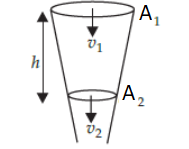
\(
\begin{aligned}
& P_0+\frac{1}{2} \rho v_1^2 \rho g h=P_0+\frac{1}{2} \rho v_2^2+0 \\
& v_2=\sqrt{v_1^2+2 g h} \\
& =\sqrt{0.16+2 \times 10 \times 0.2} \\
& =2.03 \mathrm{~m} / \mathrm{s}
\end{aligned}
\)
From equation of continuity
\(
\begin{aligned}
& A_2 v_2=A_1 v_1 \\
& \pi \frac{D_2^2}{4} \times v_2=\pi \frac{D_1^2}{4} v_1 \\
& \Rightarrow D_1=D_2 \sqrt{\frac{v_1}{v_2}}=3.6 \times 10^{-3} m
\end{aligned}
\)
Q42. A ball is made of a material of density \(\rho\) where \(\rho_{\text {oil }}<\rho<\rho_{\text {water }}\) with \(\rho_{\text {oil }}\) and \(\rho_{\text {water }}\) representing the densities of oil and water, respectively. The oil and water are immiscible. If the above ball is in equilibrium in a mixture of this oil and water, which of the following pictures represents its equilibrium position? [JEE Main 2010]
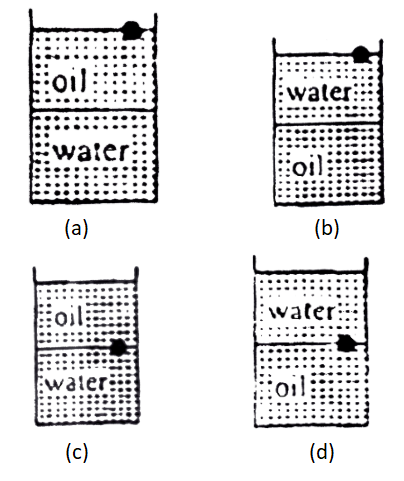
Solution: (c) To determine the correct equilibrium position of the ball, we need to consider two physical principles: the relative densities of the liquids and Archimedes’ Principle.
Step 1: Relative Densities of the Liquids
Oil is less dense than water (\(\rho_{\text {oil }}<\rho_{\text {water }}\)). In a mixture of immiscible liquids, the less dense liquid will always float on top of the more dense liquid.
Oil should be the top layer.
Water should be the bottom layer.
Looking at the options, pictures (b) and (d) are physically impossible because they show water floating on oil. We can eliminate them immediately.
Step 2: Density of the Ball and Buoyancy
We are given the density of the ball (\(\rho\)) relative to the liquids:
\(
\rho_{\text {oil }}<\rho<\rho_{\text {water }}
\)
Compared to Oil: Since \(\rho>\rho_{\text {oil }}\), the ball is “heavier” than oil and will sink through the oil layer. It cannot float on the surface of the oil.
Compared to Water: Since \(\rho<\rho_{\text {water }}\), the ball is “lighter” than water and will float on the water. It cannot sink to the bottom of the water layer.
Step 3: Finding the Equilibrium Position
Because the ball sinks in oil but floats in water, it will naturally settle at the interface (the boundary) between the two liquids.
At this position, the total buoyant force \(\left(F_B\right)\) provided by the displaced oil and the displaced water equals the weight of the ball (\(W\)):
\(
\begin{gathered}
W=F_{B(\text { oil })}+F_{B(\text { water })} \\
V \rho g=V_{\text {oil }} \rho_{\text {oil }} g+V_{\text {water }} \rho_{\text {water }} g
\end{gathered}
\)
Picture (a): Shows the ball floating on top of the oil. This is incorrect because \(\rho>\rho_{\text {oil }}\).
Picture (c): Shows the oil on top and the ball resting at the interface of the oil and water. This correctly satisfies all density conditions.
Q43. A spherical solid ball of volume \(V\) is made of a material of density \(\rho_1\). It is falling through a liquid of density \(\rho_2\left(\rho_2<\rho_1\right)\). Assume that the liquid applies a viscous force on the ball that is proportional to the square of its speed \(v\), i.e., \(F_{\text {viscous }}=-k v^2(k>0)\). The terminal speed of the ball is [JEE Main 2008]
(A) \(\sqrt{\frac{V g\left(\rho_1-\rho_2\right)}{k}}\)
(B) \(\frac{V g p_1}{k}\)
(C) \(\sqrt{\frac{V g \rho_1}{k}}\)
(D) \(\frac{V g\left(\rho_1-\rho_2\right)}{k}\)
Solution: (A) The forces acting on the ball are gravity force, buoyancy force and viscous force. When ball acquires terminal speed, it is in dynamic equilibrium, let terminal speed of ball be \(v_T\). So,
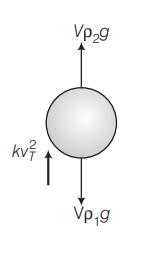
\(
\begin{aligned}
& \rho_2 g+k v_T^2=V \rho_1 g \\
& \text { or } \quad v_T=\sqrt{\frac{V\left(\rho_1-\rho_2\right) g}{k}}
\end{aligned}
\)
Explanation: To find the terminal speed of the ball, we need to look at the state where the forces acting on the ball are perfectly balanced, resulting in zero net acceleration.
Step 1: Identify the forces acting on the ball
When the ball falls through the liquid, three main forces are at play:
Weight (\(F_g\)): Acting downward.
\(
F_g=V \rho_1 g
\)
Buoyant Force (\(F_B\)): Acting upward (equal to the weight of the displaced liquid).
\(
F_B=V \rho_2 g
\)
Viscous Drag (\(F_v\)): Acting upward (opposing the motion).
\(
F_v=k v^2
\)
Step 2: Define the condition for Terminal Speed
Terminal speed \(\left(v_T\right)\) is reached when the downward force is exactly balanced by the sum of the upward forces. At this point, the net force is zero (\(F_{\text {net }}=0\)), and the velocity becomes constant.
\(
\begin{aligned}
& \text { Downward Force }=\text { Upward Forces } \\
& \qquad F_g=F_B+F_v
\end{aligned}
\)
Step 3: Set up the equation
Substitute the expressions for the forces into the equilibrium equation:
\(
V \rho_1 g=V \rho_2 g+k v_T^2
\)
Rearrange the equation to isolate the viscous term:
\(
\begin{gathered}
k v_T^2=V \rho_1 g-V \rho_2 g \\
k v_T^2=V g\left(\rho_1-\rho_2\right)
\end{gathered}
\)
\(
v_T=\sqrt{\frac{V g\left(\rho_1-\rho_2\right)}{k}}
\)
Q44. A capillary tube \((A)\) is dipped in water. Another identical tube \((B)\) is dipped in a soap-water solution. Which of the following shows the relative nature of the liquid columns in the two tubes? [JEE 2008]
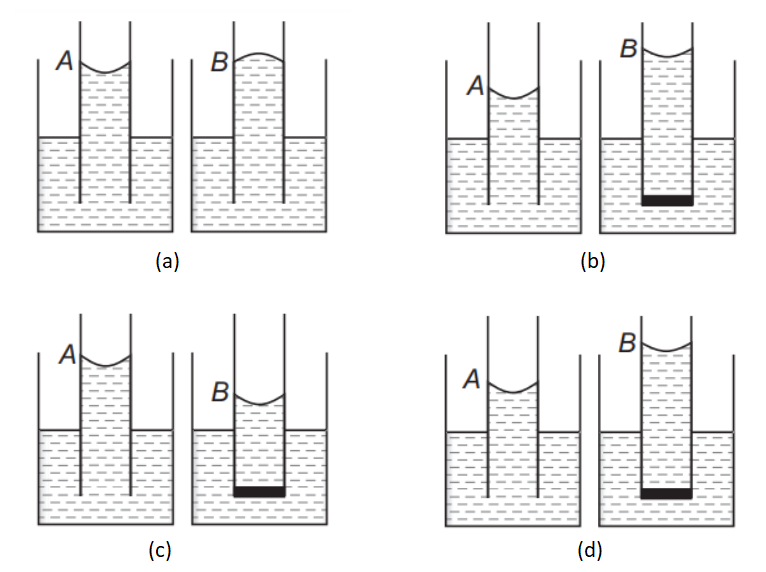
Solution: (c) Step 1: The Physics of Capillary Rise
The height (h) of a liquid column in a capillary tube is determined by Jurin’s Law:
\(
h=\frac{2 T \cos \theta}{r \rho g}
\)
Where:
\(T\) is surface tension.
\(\theta\) is the contact angle.
\(r\) is the tube radius.
\(\rho\) is density.
Step 2: Effect of Soap on Water
Adding soap to water acts as a surfactant, which significantly reduces the surface tension (\(T\)).
Because \(h\) is directly proportional to \(T(h \propto T)\), a decrease in surface tension leads to a decrease in the height of the liquid column.
Therefore, the height in Tube B (soap-water) must be lower than the height in Tube A (pure water).
Step 3: Evaluating the Meniscus
Both water and soap-water “wet” the glass of the tube.
When a liquid wets the surface, the adhesive forces are stronger than the cohesive forces, resulting in a concave meniscus (curving upward at the edges).
Diagrams that show a convex meniscus (like the one in Tube B of option a) are incorrect for water-based solutions.
Step 4: Selecting the Correct Diagram
Let’s look at the options in your image:
(a) Tube B shows a convex meniscus. Incorrect.
(b) Tube B shows the liquid level higher than Tube A. Incorrect.
(c) Tube B has a concave meniscus and the liquid height is lower than in Tube A. This aligns perfectly with the reduction in surface tension. Correct.
(d) Tube A shows the liquid level lower than Tube B. Incorrect.
Q45. A jar is filled with two non-mixing liquids 1 and 2 having densities \(\rho_1\) and \(\rho_2\) respectively. A solid ball, made of a material of density \(\rho_3\), is dropped in the jar. It comes to equilibrium in the position shown in the figure. Which of the following is true for \(\rho_1, \rho_1\) and \(\rho_3\) ? [JEE 2008]
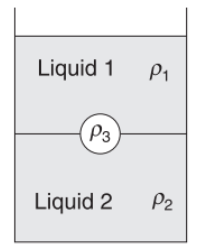
(A) \(\rho_3<\rho_1<\rho_2\)
(B) \(\rho_1>\rho_3>\rho_2\)
(C) \(\rho_1<\rho_2<\rho_3\)
(D) \(\rho_1<\rho_3<\rho_2\)
Solution: (d) Based on the diagram provided and the laws of buoyancy, we can determine the correct relationship between the densities \(\rho_1, \rho_2\), and \(\rho_3\) by analyzing the equilibrium of the system.
Step 1: Relative Density of the Liquids (\(\rho_1\) and \(\rho_2\))
In a stable arrangement of immiscible liquids, the density determines the layering.
Liquid 1 is on top, which means it must be less dense than the liquid below it.
Therefore: \(\rho_1<\rho_2\)
Step 2: Density of the Ball (\(\rho_3\)) Relative to the Liquids
The ball is at equilibrium at the interface, which tells us how its density compares to each layer:
Compared to Liquid 1: The ball has sunk through Liquid 1 and did not float on its surface. This implies that the ball is denser than Liquid 1.
\(\rho_3>\rho_1\)
Compared to Liquid 2: The ball is floating on Liquid 2 and has not sunk to the bottom of the jar. This implies that the ball is less dense than Liquid 2.
\(\rho_3<\rho_2\)
Step 3: The Final Relationship
Combining these observations, we get the following density gradient:
\(
\rho_1<\rho_3<\rho_2
\)
Why this happens (The Physics)?
At equilibrium, the weight of the ball is balanced by the total buoyant force from both liquids.
\(
\begin{gathered}
W=F_{B 1}+F_{B 2} \\
V \rho_3 g=V_1 \rho_1 g+V_2 \rho_2 g
\end{gathered}
\)
Because the ball is partially submerged in both liquids, its density \(\rho_3\) must be a “weighted average” of the two liquid densities. Mathematically, \(\rho_3\) must lie strictly between the values of the top and bottom liquid densities.
Q46. If the terminal speed of a sphere of gold (density \(=19.5 \mathrm{~kg} / \mathrm{m}^3\)) is \(0.2 \mathrm{~m} / \mathrm{s}\) in a viscous liquid (density \(=1.5 \mathrm{~kg} / \mathrm{m}^3\), find the terminal speed of a sphere of silver (density = \(10.5 \mathrm{~kg} / \mathrm{m}^3\)) of the same size in the same liquid [JEE 2006]
(A) \(0.4 \mathrm{~m} / \mathrm{s}\)
(B) \(0.133 \mathrm{~m} / \mathrm{s}\)
(C) \(0.1 \mathrm{~m} / \mathrm{s}\)
(D) \(0.2 \mathrm{~m} / \mathrm{s}\)
Solution: (C) To find the terminal speed of the silver sphere, we use Stokes’ Law. When a sphere reaches terminal velocity in a viscous fluid, the net force is zero.
Step 1: The Formula for Terminal Velocity
The terminal velocity \(\left(v_t\right)\) of a sphere of radius \(r\) and density \(\rho\) falling through a liquid of density \(\sigma\) and viscosity \(\eta\) is given by:
\(
v_t=\frac{2}{9} \frac{r^2 g(\rho-\sigma)}{\eta}
\)
Step 2: Identify the Constants
In this problem, we are comparing two spheres (gold and silver) where:
The radius (\(r\)) is the same.
The liquid \((\sigma, \eta)\) is the same.
Gravity (\(g\)) is constant.
Because everything except the density of the sphere and the terminal velocity is constant, we can establish a proportionality:
\(
v_t \propto(\rho-\sigma)
\)
Step 3: Set up the Ratio
Let \(v_g\) and \(\rho_g\) be the velocity and density of gold, and \(v_s\) and \(\rho_s\) be those of silver.
\(
\frac{v_s}{v_g}=\frac{\rho_s-\sigma}{\rho_g-\sigma}
\)
Substituting the given values:
\(v_g=0.2 \mathrm{~m} / \mathrm{s}\)
\(\rho_g=19.5 \mathrm{~kg} / \mathrm{m}^3\)
\(\rho_s=10.5 \mathrm{~kg} / \mathrm{m}^3\)
\(\sigma=1.5 \mathrm{~kg} / \mathrm{m}^3\)
Step 4: Solve for \(v_s\)
\(
\frac{v_s}{0.2}=\frac{10.5-1.5}{19.5-1.5}
\)
\(
v_s=0.2 \times 0.5=0.1 \mathrm{~m} / \mathrm{s}
\)
The terminal speed of the silver sphere is \(\mathbf{0 . 1 ~ m} / \mathbf{s}\).
Q47. A 20 cm long capillary tube is dipped in water. The water rises up to 8 cm. If the entire arrangement is put in a freely falling elevator the length of water column in the capillary tube will be [JEE 2005]
(A) 10 cm
(B) 8 cm
(C) 20 cm
(D) 4 cm
Solution: (C) To find the length of the water column in a freely falling elevator, we need to look at the physics of capillary rise and how “effective gravity” influences the system.
Step 1: The Formula for Capillary Rise
The height \(h\) of a liquid in a capillary tube is given by Jurin’s Law:
\(
h=\frac{2 T \cos \theta}{r \rho g}
\)
Where:
\(T=\) Surface tension
\(\theta=\) Contact angle
\(r=\) Radius of the tube
\(\rho=\) Density of the liquid
\(g=\) Acceleration due to gravity
Step 2: Effect of Free Fall
In a freely falling elevator, the effective acceleration due to gravity \(\left(g_{\text {eff }}\right)\) becomes zero.
Looking at the formula:
\(
h \propto \frac{1}{g}
\)
As \(g \rightarrow 0\), the theoretical height \(h\) approaches infinity (\(h \rightarrow \infty\)).
Step 3: Determining the Actual Length
Since the water “wants” to rise to an infinite height due to the lack of weight to pull it down, it will rise until it reaches the very end of the tube.
The capillary tube is 20 cm long.
The water will climb the entire available length of the tube.
Once it reaches the top, it will not overflow; instead, the radius of the meniscus will adjust to maintain equilibrium at the top edge.
Conclusion: Because the tube is 20 cm long and the effective gravity is zero, the water will fill the entire length of the tube.
Q48. Spherical balls of radius \(R\) are falling in a viscous fluid of viscosity \(\eta\) with a velocity \(v\). The retarding viscous force acting on the spherical ball is [JEE 2004]
(A) inversely proportional to both radius \(R\) and velocity \(v\)
(B) directly proportional to both radius \(R\) and velocity \(v\)
(C) directly proportional to \(R\) but inversely proportional to \(v\)
(D) inversely proportional to \(R\), but directly proportional to velocity \(v\)
Solution: (B) Stokes’ Law
When a spherical object moves through a viscous fluid, the fluid exerts a retarding force (drag) on the object. For a sphere of radius \(R\) moving with a velocity \(v\) in a medium of viscosity \(\eta\), the viscous force \(F\) is given by the formula:
\(
F=6 \pi \eta R v
\)
Analyzing the Relationships
From the formula \(F=6 \pi \eta R v\), we can observe the following:
Proportionality to Radius \((R)\) : The force \(F\) is in the numerator, so \(F \propto R\). If the radius increases, the viscous force increases.
Proportionality to Velocity (\(v\)): The force \(F\) is also in the numerator with respect to velocity, so \(F \propto v\). As the ball moves faster, the resistance from the fluid increases.
Proportionality to Viscosity \((\eta)\) : The force is also directly proportional to the coefficient of viscosity.
Conclusion: The retarding viscous force is directly proportional to both the radius \(R\) of the spherical ball and its velocity \(v\).
Correct Option: (B) directly proportional to both radius \(R\) and velocity \(v\).
Q49. If two soap bubbles of different radii are connected by a tube [JEE 2004]
(A) air flows from the smaller bubble to the bigger
(B) air flows from bigger bubble to the smaller bubble till the sizes are interchanged
(C) air flows from the bigger bubble to the smaller bubble till the sizes become equal
(D) there is no flow of air.
Solution: (A) To determine the direction of air flow, we need to compare the excess pressure inside each soap bubble.
Step 1: The Physics of Excess Pressure
For a soap bubble of radius \(R\) and surface tension \(T\), the excess pressure \(\Delta P\) inside the bubble (compared to the outside atmosphere) is given by the formula:
\(
\Delta P=\frac{4 T}{R}
\)
Note that a soap bubble has two surfaces (inner and outer), which is why the factor is \(4 T\) rather than \(2 T\) (used for a single-surface liquid drop).
Step 2: Comparing the Two Bubbles
Let the two bubbles have radii \(R_1\) (smaller) and \(R_2\) (bigger), so \(R_1<R_2\).
Smaller Bubble \(\left(R_1\right): \Delta P_1=\frac{4 T}{R_1}\)
Bigger Bubble \(\left(R_2\right): \Delta P_2=\frac{4 T}{R_2}\)
Step 3: Direction of Flow
Since \(R_1<R_2\), it follows that:
\(
\Delta P_1>\Delta P_2
\)
Air always flows from a region of higher pressure to a region of lower pressure. Therefore, the air will flow from the smaller bubble (higher pressure) into the bigger bubble (lower pressure).
Step 4: Final Outcome
As air leaves the smaller bubble, its radius \(R_1\) decreases even further, making the pressure inside it even higher (\(\Delta P \propto 1 / R\)). Conversely, the bigger bubble grows, and its pressure decreases. This is an unstable equilibrium; the smaller bubble will continue to shrink until it collapses, and the bigger bubble will consume all the air.
Correct Option: (A) air flows from the smaller bubble to the bigger.
Q50. A cylinder of height \(20 m\) is completely filled with water. The velocity of efflux of water (in \(m^{-1}\)) through a small hole on the side wall of the cylinder near its bottom is [JEE 2002]
Solution: (20) To find the velocity of efflux, we use Torricelli’s Law, which is derived from Bernoulli’s principle.
The Physics of Efflux:
Torricelli’s Law states that the speed \(v\) of a liquid leaking out of a small hole at a depth \(h\) below the free surface is the same as the speed a body would acquire in falling freely from a height \(h\).
Step 1: Identify the Formula
The velocity of efflux (\(v\)) is given by:
\(
v=\sqrt{2 g h}
\)
Where:
\(g\) is the acceleration due to gravity (approximately \(10 \mathrm{~m} / \mathrm{s}^2\)).
\(h\) is the depth of the hole from the free surface of the water.
Step 2: Substitute the Values
In this problem:
Height of the water column \((h)=20 \mathrm{~m}\)
Gravity \((g)=10 \mathrm{~m} / \mathrm{s}^2\)
\(
\begin{gathered}
v=\sqrt{2 \times 10 \times 20} \\
v=\sqrt{400} \\
v=20 \mathrm{~m} / \mathrm{s}
\end{gathered}
\)
The velocity of efflux of water through the hole near the bottom of the cylinder is \(20 \mathrm{~m} / \mathrm{s}\).