7.1 Introduction
Gravitation, or gravity, is the fundamental force of attraction between any two objects with mass or energy, causing them to pull toward each other; it’s what keeps planets orbiting stars, holds galaxies together, gives objects weight, and makes things fall to Earth. The force depends on the masses of the objects (more mass means stronger pull) and the distance between them (greater distance means weaker pull).
Key Concepts
Universal Attraction: Every particle with mass attracts every other particle with mass.
Mass & Distance: The strength of gravity increases with more mass and decreases as the square of the distance between the objects’ centers.
Newton’s Law of Universal Gravitation: Mathematically expressed as \(F = G \frac{m_1 m_2}{r^2}\), where \(F\) is force, \(G\) is the gravitational constant, \(m_1\) and \(m_2\) are the masses, and \(r\) is the distance.
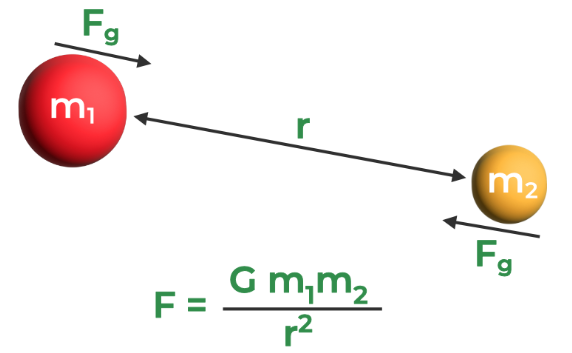
Examples in Action
Orbits: The Sun’s gravity keeps Earth in orbit; Earth’s gravity keeps the Moon in orbit.
Weight: Your weight is the measure of Earth’s gravitational pull on your mass.
Formation: Gravity pulled dust and gas together to form stars, planets, and galaxies.
Difference between Gravity and Gravitational Force
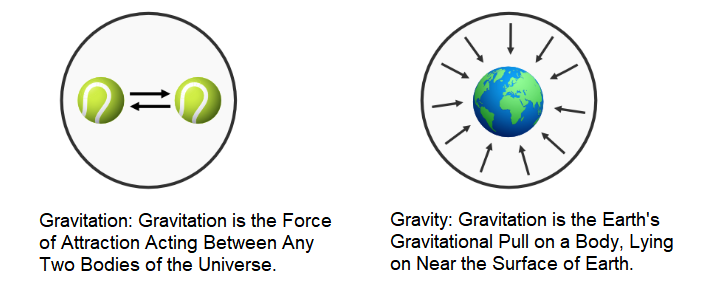
Let’s discuss the key differences between gravity and gravitational force in detail as mentioned in the table below:
\(\begin{array}{|l|l|}
\hline \text { Gravity } & \text { Gravitational Force } \\
\hline \begin{array}{l}
\text { Gravity is always of attractive type of } \\
\text { force. }
\end{array} & \begin{array}{l}
\text { While gravitational force can be } \\
\text { attractive as well as the centre repulsive } \\
\text { type of force. }
\end{array} \\
\hline \text { This is not a Universal Force. } & \text { This is a Universal Force. } \\
\hline \begin{array}{l}
\text { Gravity is experienced along the line } \\
\text { joining the earth’s center and the center } \\
\text { of the body. }
\end{array} & \begin{array}{l}
\text { This force can be experienced along the } \\
\text { radial direction from the masses. }
\end{array} \\
\hline
\end{array}
\)