1.11 Collisions
COLLISIONS
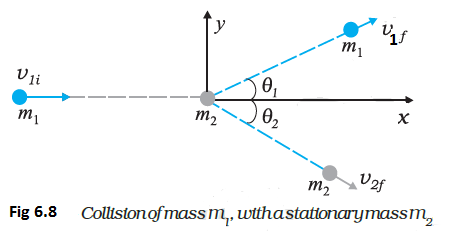
In this section, we shall apply these laws to a commonly encountered phenomena, namely collisions. Several games such as billiards, marbles, or carrom involve collisions. We shall study the collision of two masses in an idealized form. Consider two masses \(m_{1}\) and \(m_{2}\). The particle \(m_{1}\) is moving with speed \(v_{1 i}\), the subscript ‘ \(i\) ‘ implying initial. We can consider \(m_{2}\) to be at rest. No loss of generality is involved in making such a selection. In this situation, the mass \(m_{1}\) collides with the stationary mass \(m_{2}\) and this is depicted in Figure 6.8.
The masses \(m_{1}\) and \(m_{2}\) fly-off in different directions. We shall see that there are relationships, which connect the masses, the velocities, and the angles.
Elastic and Inelastic Collisions
In all collisions the total linear momentum is conserved; the initial momentum of the system is equal to the final momentum of the system. One can argue this as follows. When two objects collide, the mutual impulsive forces acting over the collision time \(\Delta t\) cause a change in their respective momenta :
\(
\begin{array}{l}
\Delta \vec{p}_{1}=\vec{F}_{12} \Delta t \\
\Delta \vec{p}_{2}=\vec{F}_{21} \Delta t
\end{array}
\)
where \(\vec{F}_{12}\) is the force exerted on the first particle by the second particle. \(\vec{F}_{21}\) is likewise the force exerted on the second particle by the first particle. Now from Newton’s third law, \(\vec{F}_{12}=-\vec{F}_{21}\). This implies
\(\Delta \vec{p}_{1}+\Delta \vec{p}_{2}=\mathbf{0}\)
The above conclusion is true even though the forces vary in a complex fashion during the collision time \(\Delta t\). Since the third law is true at every instant, the total impulse on the first object is equal and opposite to that on the second.
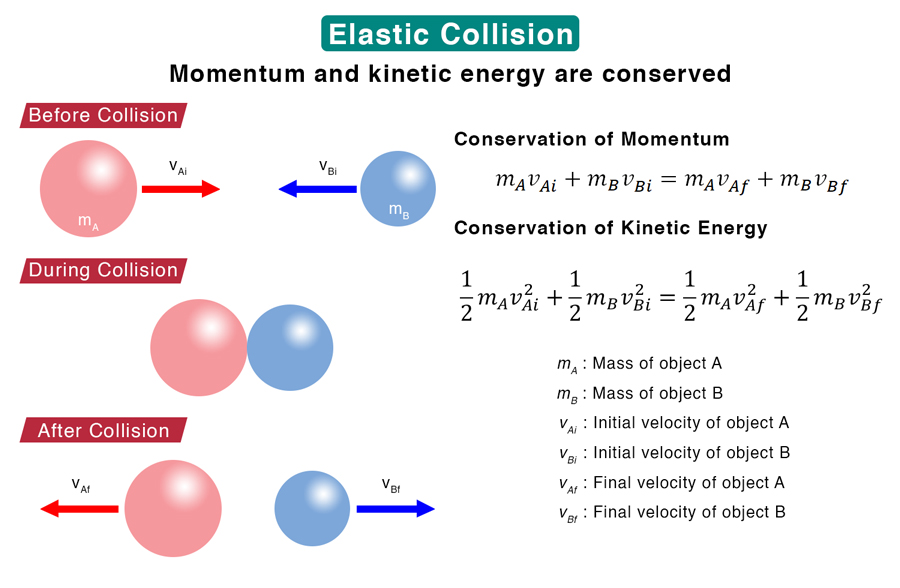
In an elastic collision, both momentum and total kinetic energy are conserved, and objects bounce apart without lasting deformation. In an inelastic collision, only momentum is conserved, and some kinetic energy is converted to other forms like heat, sound, or deformation energy.
Elastic Collisions
- Definition: The total kinetic energy before and after the collision remains the same.
- Behavior: Objects typically bounce off each other without permanent change in shape.
- Examples (approximations in the real world):
- Colliding billiard balls
- A superball bouncing off a hard floor
- Collisions between subatomic particles
- Colliding billiard balls
Inelastic Collisions
- Definition: Some of the kinetic energy is lost (converted to other energy forms) during the collision.
- Behavior: Objects may stick together (perfectly inelastic) or deform upon impact.
- Examples:
- A car crash, where kinetic energy is lost to heat, sound, and deforming the car’s body.
- A ball of clay hitting a wall and sticking to it.
- A football player tackling another and moving together after the tackle.
- A car crash, where kinetic energy is lost to heat, sound, and deforming the car’s body.
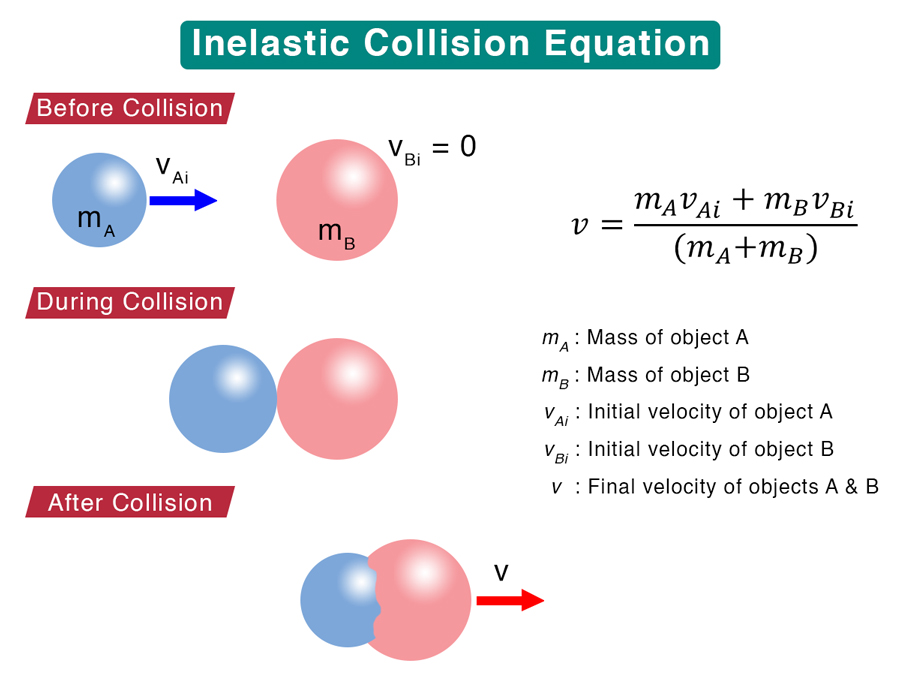
On the other hand, the total kinetic energy of the system is not necessarily conserved. The impact and deformation during the collision may generate heat and sound. Part of the initial kinetic energy is transformed into other forms of energy. A useful way to visualize the deformation during collision is in terms of a ‘compressed spring’. If the ‘spring’ connecting the two masses regains its original shape without loss in energy, then the initial kinetic energy is equal to the final kinetic energy but the kinetic energy during the collision time \(\Delta t\) is not constant. Such a collision is called an elastic collision. On the other hand, the deformation may not be relieved and the two bodies could move together after the collision. A collision in which the two particles move together after the collision is called a completely inelastic collision. The intermediate case where the deformation is partly relieved and some of the initial kinetic energy is lost is more common and is appropriately called an inelastic collision.
Elastic Collision in One Dimension
Consider two elastic bodies \(A\) and \(B\) moving along the same line (Figure 6.9). The body \(A\) has a mass \(m_{1}\) and moves with a velocity \(v_{1}\) towards right and the body \(B\) has a mass \(m_{2}\) and moves with a velocity \(v_{2}\) in the same direction. We assume \(v_{1}>v_{2}\) so that the two bodies may collide. Let \(v_{1}^{\prime}\) and \(v_{2}^{\prime}\) be the final velocities of the bodies after the collision. The total linear momentum of the two bodies remains constant, so that,
\(\begin{aligned}
& m_{1} v_{1}+m_{2} v_{2} &=m_{1} v_{1}^{\prime}+m_{2} v_{2}^{\prime} \dots (i)\\
\text { or, } & m_{1} v_{1}-m_{1} v_{1}^{\prime} =m_{2} v_{2}^{\prime}-m_{2} v_{2} \\
\text { or, } & m_{1}\left(v_{1}-v_{1}^{\prime}\right) &=m_{2}\left(v_{2}^{\prime}-v_{2}\right) \dots (ii)
\end{aligned}\)
Also, since the collision is elastic, the kinetic energy before the collision is equal to the kinetic energy after the collision. Hence,
\(
\begin{aligned}
\frac{1}{2} m_{1} v_{1}^{2}+\frac{1}{2} m_{2} v_{2}^{2} &=\frac{1}{2} m_{1} v_{1}^{\prime 2}+\frac{1}{2} m_{2} v_{2}^{\prime 2} \\
\text { or, } \quad m_{1} v_{1}^{2}-m_{1} v_{1}^{\prime 2} &=m_{2} v_{2}^{\prime 2}-m_{2} v_{2}^{2}
\end{aligned}
\)
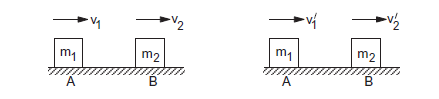 Figure 6.9
\(\begin{aligned} \text { or, } \quad m_{1}\left(v_{1}^{2}-v_{1}^{\prime 2}\right) &=m_{2}\left(v_{2}^{\prime 2}-v_{2}^{2}\right) \dots (iii) \\ \text { Dividing (iii) by (ii), } \\ v_{1}+v_{1}^{\prime} &=v_{2}^{\prime}+v_{2} \\ v_{1}-v_{2} &=v_{2}^{\prime}-v_{1}^{\prime} \dots (iv) \end{aligned}\)
Now, \(\left(v_{1}-v_{2}\right)\) is the rate at which the separation between the bodies decreases before the collision. Similarly, \(\left(v_{2}^{\prime}-v_{1}^{\prime}\right)\) is the rate of increase of separation after the collision. So the equation (iv) may be written as
The velocity of separation (after collision) = Velocity of approach (before the collision)…. (6.12)
This result is very useful in solving problems involving elastic collision. The final velocities \(v_{1}^{\prime}\) and \(v_{2}^{\prime}\) may be obtained from equation (i) and (iv). Multiply equation (iv) by \(m_{2}\) and subtract from equation (i).
\(
\begin{array}{ll}
2 m_{2} v_{2}+\left(m_{1}-m_{2}\right) v_{1}=\left(m_{1}+m_{2}\right) v_{1}^{\prime} \\
\text { or, } \quad v_{1}^{\prime}=\frac{\left(m_{1}-m_{2}\right)}{m_{1}+m_{2}} v_{1}+\frac{2 m_{2}}{m_{1}+m_{2}} v_{2} \quad \ldots \quad(6.13)
\end{array}
\)
Now multiply equation (iv) by \(m_{1}\) and add to equation (i),
\(
\begin{array}{c}
2 m_{1} v_{1}-\left(m_{1}-m_{2}\right) v_{2}=\left(m_{2}+m_{1}\right) v_{2}^{\prime} \\
\text { or, } \quad v_{2}^{\prime}=\frac{2 m_{1} v_{1}}{m_{1}+m_{2}}-\frac{\left(m_{1}-m_{2}\right) v_{2}}{m_{1}+m_{2}} \quad \ldots \quad(6.14)
\end{array}
\)
Equations (6.13) and (6.14) give the final velocities in terms of the initial velocities and the masses.
Special cases :
Case-1: Elastic collision between a heavy body and a light body:
Let \(m_{1} \gg m_{2}\). A heavy body hits a light body from behind. We have,
\(
\begin{array}{ll}
\text { and } \quad & \frac{m_{1}-m_{2}}{m_{1}+m_{2}} \approx 1, \frac{2 m_{2}}{m_{1}+m_{2}} \approx 0 \\
& \frac{2 m_{1}}{m_{1}+m_{2}} \approx 2 .
\end{array}
\)
With these approximations, the final velocities of the bodies are, from (6.13) and (6.14),
\(v_{1}^{\prime} \approx v_{1} \text { and } v_{2}^{\prime} \approx 2 v_{1}-v_{2} \)
The heavier body continues to move with almost the same velocity. If the lighter body were kept at rest \(v_{2}=0, v_{2}{ }^{\prime}=2 v_{1}\) which means the lighter body, after getting a push from the heavier body will fly away with a velocity double the velocity of the heavier body.
Next, if we consider \(m_{2} \gg m_{1}\). A light body hits a heavy body from behind. We have,
The final velocities of the bodies are, from (6.13) and (6.14),
\(v_{1}^{\prime} \approx-v_{1}+2 v_{2} \text { and } v_{2}^{\prime} \approx v_{2} \text {. }\)
The heavier body continues to move with almost the same velocity, the velocity of the lighter body changes. If the heavier body were at rest, \(v_{2}=0\) then \(v_{1}^{\prime}=-v_{1}\), the lighter body returns after collision with almost the same speed. This is the case when a ball collides elastically with a fixed wall and returns with the same speed.
Case-2: Elastic collision of two bodies of equal mass:
Putting \(m_{1}=m_{2}\) in equation (6.13) and (6.14)
\(v_{1}{ }^{\prime}=v_{2} \text { and } v_{2}{ }^{\prime}=v_{1} \)
When two bodies of equal mass collide elastically, their velocities are mutually interchanged.
Example 1: A 2 kg object \(\left(\mathrm{m}_1\right)\) moving at \(3 \mathrm{~m} / \mathrm{s}\left(\mathrm{u}_1\right)\) collides elastically with a stationary 3 kg object \(\left(\mathrm{m}_2\right)\). Find their final velocities.
Solution: Given:
\(m_1=2 \mathrm{~kg}\)
\(u_1=3 \mathrm{~m} / \mathrm{s}\)
\(m_2=3 \mathrm{~kg}\)
\(u_2=0 \mathrm{~m} / \mathrm{s}\)
Formulas for Final Velocities:
\(v_1=\frac{\left(m_1-m_2\right) u_1+2 m_2 u_2}{m_1+m_2}\)
\(v_2=\frac{\left(m_2-m_1\right) u_2+2 m_1 u_1}{m_1+m_2}\)
Final velocity of object \(1\left(v_1\right)\) :
\(v_1=\frac{(2 \mathrm{~kg}-3 \mathrm{~kg})(3 \mathrm{~m} / \mathrm{s})+2(3 \mathrm{~kg})(0 \mathrm{~m} / \mathrm{s})}{2 \mathrm{~kg}+3 \mathrm{~kg}}\)
\(v_1=\frac{(-1 \mathrm{~kg})(3 \mathrm{~m} / \mathrm{s})+0}{5 \mathrm{~kg}}\)
\(v_1=-0.6 \mathrm{~m} / \mathrm{s}\)
Final velocity of object \(2\left(v_2\right)\) :
\(v_2=\frac{(3 \mathrm{~kg}-2 \mathrm{~kg})(0 \mathrm{~m} / \mathrm{s})+2(2 \mathrm{~kg})(3 \mathrm{~m} / \mathrm{s})}{2 \mathrm{~kg}+3 \mathrm{~kg}}\)
\(v_2=\frac{0+(4 \mathrm{~kg})(3 \mathrm{~m} / \mathrm{s})}{5 \mathrm{~kg}}\)
\(v_2=2.4 \mathrm{~m} / \mathrm{s}\)
The first body moves at \(-0.6 \mathrm{~m} / \mathrm{s}\) (bounces backward), and the second body moves forward at \(2.4 \mathrm{~m} / \mathrm{s}\).
Perfectly Inelastic Collision in One Dimension
Final Velocity
When perfectly inelastic bodies moving along the same line collide, they stick to each other. Let \(m_{1}\) and \(m_{2}\) be the masses, \(v_{1}\) and \(v_{2}\) be their velocities before the collision and \(V\) be the common velocity of the bodies after the collision. By the conservation of linear momentum,
\(
\begin{aligned}
m_{1} v_{1}+m_{2} v_{2} &=m_{1} V+m_{2} V \\
\text { or, } \quad V &=\frac{m_{1} v_{1}+m_{2} v_{2}}{m_{1}+m_{2}} \dots (6.15)
\end{aligned}
\)
Loss in Kinetic Energy
The kinetic energy before the collision is
\(
\frac{1}{2} m_{1} v_{1}^{2}+\frac{1}{2} m_{2} v_{2}^{2}
\)
and that after the collision is \(\frac{1}{2}\left(m_{1}+m_{2}\right) V^{2}\). Using equation (i), the loss in kinetic energy due to the collision is
\(
\begin{aligned}
& \frac{1}{2} m_{1} v_{1}^{2}+\frac{1}{2} m_{2} v_{2}^{2}-\frac{1}{2}\left(m_{1}+m_{2}\right) V^{2} \\
=& \frac{1}{2}\left[m_{1} v_{1}^{2}+m_{2} v_{2}^{2}-\frac{\left(m_{1} v_{1}+m_{2} v_{2}\right)^{2}}{m_{1}+m_{2}}\right]
\end{aligned}
\)
\(
\begin{array}{l}
=\frac{1}{2}\left[\frac{m_{1} m_{2}\left(v_{1}^{2}+v_{2}^{2}-2 v_{1} v_{2}\right)}{m_{1}+m_{2}}\right] \\
=\frac{m_{1} m_{2}\left(v_{1}-v_{2}\right)^{2}}{2\left(m_{1}+m_{2}\right)} .
\end{array}
\)
We see that the loss in kinetic energy is positive.
Example 2: A cart A of mass \(50 \mathrm{~kg}\) moving at a speed of \(20 \mathrm{~km} / \mathrm{h}\) hits a lighter cart \(B\) of mass \(20 \mathrm{~kg}\) moving towards it at a speed of \(10 \mathrm{~km} / \mathrm{h}\). The two carts cling to each other. Find the speed of the combined mass after the collision.
Solution: This is an example of an inelastic collision. As the carts move towards each other, their momenta have opposite signs. If the common speed after the collision is \(V\), momentum conservation gives
\(
\begin{array}{c}
(50 \mathrm{~kg})(20 \mathrm{~km} / \mathrm{h})-(20 \mathrm{~kg})(10 \mathrm{~km} / \mathrm{h})=(70 \mathrm{~kg}) V \\
V=\frac{80}{7} \mathrm{~km} / \mathrm{h}
\end{array}
\)
Coefficient Of Restitution
The Coefficient of Restitution (COR) is a measure of the elasticity of a collision between two objects, quantifying how much kinetic energy is conserved during the impact. It is defined as the ratio of their relative speed after the collision to their relative speed before the collision.
- Range of values: The COR is a dimensionless value typically between 0 and 1.
- \(e\)=1: Represents a perfectly elastic collision, where no kinetic energy is lost and objects rebound with the same relative speed they approached with.
- \(e\)=0: Represents a perfectly inelastic collision, where the maximum kinetic energy is lost and the objects stick together after impact.
- Real-world collisions: Most real-world collisions fall between 0 and 1 , as some energy is always lost to heat, sound, and deformation.
We have seen that for a perfectly elastic collision velocity of separation = velocity of approach and for a perfectly inelastic collision, velocity of separation \(=0\).
In general, the bodies are neither perfectly elastic nor perfectly inelastic. In that case we can write
velocity of separation \(=e\) (velocity of approach),
where \(0<e<1\). The constant \(e\) depends on the materials of the colliding bodies. This constant is known as the coefficient of restitution. If \(e=1\), the collision is perfectly elastic and if \(e=0\), the collision is perfectly inelastic.
Example 3: A block of mass \(m\) moving at speed \(v\) collides with another block of mass \(2 \mathrm{~m}\) at rest. The lighter block comes to rest after the collision. Find the coefficient of restitution.
Solution: Suppose the second block moves at speed \(v^{\prime}\) towards right after the collision. From the principle of conservation of momentum,
\(
m v=2 m v^{\prime} \text { or } v^{\prime}=v / 2 .
\)
Hence, the velocity of separation \(=v / 2\) and the velocity of approach \(=v\). By definition,
\(
e=\frac{\text { velocity of the separation }}{\text { velocity of approach }}=\frac{v / 2}{v}=\frac{1}{2} .
\)
Elastic Collision in two Dimension
Consider two objects \(A\) and \(B\) of mass \(m_{1}\) and \(m_{2}\) kept on the \(X\)-axis (Figure 6.10). Initially, the object \(B\) is at rest and \(A\) moves towards \(B\) with a speed \(u_{1}\). If the collision is not head-on (the force during the collision is not along the initial velocity), the objects move along different lines. Suppose the object \(A\) moves with a velocity \(\overrightarrow{v_{1}}\) making an angle \(\theta\) with the \(X\)-axis and the object \(B\) moves with a velocity \(\overrightarrow{v_{2}}\) making an angle \(\Phi\) with the same axis. Also, suppose \(\overrightarrow{v_{1}}\) and \(\overrightarrow{v_{2}}\) lie in \(X-Y\) plane. Using conservation of momentum in \(X\) and \(Y\) directions, we get
\(
\text { and } \quad \begin{aligned}
m_{1} u_{1} &=m_{1} v_{1} \cos \theta+m_{2} v_{2} \cos \Phi & \ldots & \text { (i) } \\
0 &=m_{1} v_{1} \sin \theta-m_{2} v_{2} \sin \Phi . & \ldots & \text { (ii) }
\end{aligned}
\)
If the collision is elastic, the final kinetic energy is equal to the initial kinetic energy. Thus,
\(
\frac{1}{2} m_{1} u_{1}^{2}=\frac{1}{2} m_{1} v_{1}^{2}+\frac{1}{2} m_{2} v_{2}^{2} \dots (iii)
\)
We have four unknowns \(v_{1}, v_{2}, \theta\) and \(\Phi\) to describe the final motion whereas there are only three relations. Thus, the final motion cannot be uniquely determined with this information.
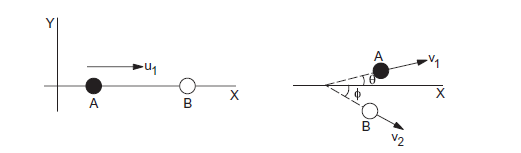 Figure 6.10
In fact, the final motion depends on the angle between the line of force during the collision and the direction of the initial velocity. The momentum of each object must be individually conserved in the direction perpendicular to the force. The motion along the line of force may be treated as a one-dimensional collision.
Example 4: A ball (A) of mass 1 kg moves at \(4 \mathrm{~m} / \mathrm{s}\) toward a stationary ball (B) of mass 1 kg. After an elastic collision, ball A moves off at an angle of \(60^{\circ}\) with a speed of \(2 \mathrm{~m} / \mathrm{s}\) relative to its original path. Find ball B’s final speed and direction.
Solution: Initial Conditions: \(m_A=1 \mathrm{~kg}, u_A=4 \mathrm{~m} / \mathrm{s}, u_B=0\).
Final Conditions: \(m_A=1 \mathrm{~kg}, v_A=2 \mathrm{~m} / \mathrm{s}\) at \(\phi_A=60^{\circ}\). Find \(v_B\) and angle \(\phi_B\).
Apply Conservation of Momentum in \(\mathbf{x}\)-direction:
\(
\begin{aligned}
& m_A u_A=m_A v_A \cos \left(\phi_A\right)+m_B v_B \cos \left(\phi_B\right) \\
& 1 \times 4=1 \times 2 \times \cos \left(60^{\circ}\right)+1 \times v_B \cos \left(\phi_B\right) \\
& 4=2 \times 0.5+v_B \cos \left(\phi_B\right) \Longrightarrow 3=v_B \cos \left(\phi_B\right)
\end{aligned}
\)
Apply Conservation of Momentum in \(\mathbf{y}\)-direction:
\(
0=m_A v_A \sin \left(\phi_A\right)+m_B v_B \sin \left(\phi_B\right)
\)
\(0=1 \times 2 \times \sin \left(60^{\circ}\right)+1 \times v_B \sin \left(\phi_B\right)\) (assuming ball B goes in the negative \(y\) direction to balance, making the y component term negative in the equation setup of the search result’s example, here we just show the components are balanced)
\(
v_B \sin \left(\phi_B\right)=-2 \times \sin \left(60^{\circ}\right) \approx-1.732 \mathrm{~m} / \mathrm{s}
\)
Solve for \(\boldsymbol{v}_{\boldsymbol{B}}\) and \(\boldsymbol{\phi}_{\boldsymbol{B}}\) (by squaring and adding the \(x\) and \(y\) momentum equations):
\(
\begin{aligned}
& \left(v_B \cos \left(\phi_B\right)\right)^2+\left(v_B \sin \left(\phi_B\right)\right)^2=3^2+(-1.732)^2 \\
& v_B^2\left(\cos ^2\left(\phi_B\right)+\sin ^2\left(\phi_B\right)\right)=9+3 \approx 12 \\
& v_B=\sqrt{12} \approx 3.464 \mathrm{~m} / \mathrm{s}
\end{aligned}
\)
The angle is \(\phi_B=\arctan \left(\frac{-1.732}{3}\right) \approx-30^{\circ}\).
Ball B moves at approximately \(3.46 \mathrm{~m} / \mathrm{s}\) at an angle of \(30^{\circ}\) below the \(x\)-axis.
Inelastic Collision in two Dimension
An inelastic collision in two dimensions is a collision where objects stick together or move as one unit, conserving both the x and y components of momentum but not kinetic energy. To solve for the final velocity, momentum is calculated separately for the \(x\) and \(y\) axes, and the resulting components are then used with the Pythagorean theorem and trigonometry to find the final speed and direction.
Key principles: Conservation of momentum: Total momentum is conserved, meaning the total momentum of the system before the collision equals the total momentum afterward.
Momentum in 2D: Since momentum is a vector, it’s broken down into two independent components: one for the \(x\)-axis and one for the \(y\)-axis.
Momentum equations:
\(P_{x, \text { initial }}=P_{x, \text { final }}\)
\(P_{y, \text { initial }}=P_{y, \text { final }}\)
Kinetic energy is not conserved: Kinetic energy is lost to heat, sound, or deformation during the collision.
How to solve a 2D inelastic collision
Break down initial velocities: Use trigonometry to find the \(x\) and \(y\) components of each object’s initial velocity.
Apply conservation of momentum:
For the \(\mathbf{x}\)-axis: The sum of the initial \(\mathbf{x}\)-momenta equals the final \(\mathbf{x}\)-momentum of the combined mass.
\(m_1 v_{1 x}+m_2 v_{2 x}=\left(m_1+m_2\right) v_f \cos \theta\)
For the \(\mathbf{y}\)-axis: The sum of the initial \(\mathbf{y}\)-momenta equals the final \(\mathbf{y}\)-momentum of the combined mass.
\(m_1 v_{1 y}+m_2 v_{2 y}=\left(m_1+m_2\right) v_f \sin \theta\)
Solve for the final velocity components:
\(v_{f x}=\frac{m_1 v_{1 x}+m_2 v_{2 x}}{m_1+m_2}\)
\(v_{f y}=\frac{m_1 v_{1 y}+m_2 v_{2 y}}{m_1+m_2}\)
Calculate the final speed: Use the Pythagorean theorem with the final velocity components.
\(v_f=\sqrt{\left(v_{f x}\right)^2+\left(v_{f y}\right)^2}\)
Find the final direction: Use the tangent function to find the angle of the final velocity vector.
\(\tan \theta=\frac{v_{f y}}{v_{f x}}\)
Example 5: Two cars collide at an intersection as shown below. The cars become entangled with one another sticking together after the impact. Based on the information given below on the initial velocities and assuming both cars slide away from the crash at the 30 degree angle as shown, what must the initial velocity of car \(B\) been before the impact?
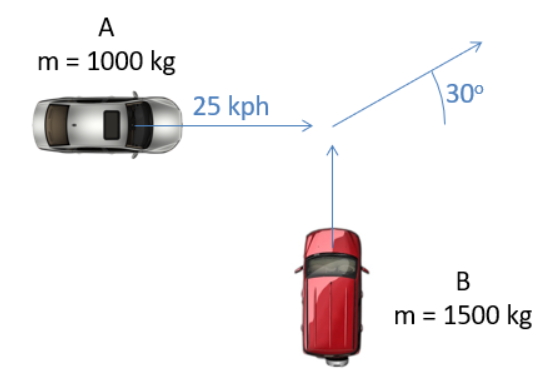
Solution: Car A (mass \(m_1=1000 \mathrm{~kg}\) ) travels horizontally (x-direction).
Car B (mass \(m_2=1500 \mathrm{~kg}\) ) travels vertically (y-direction).
They stick together after impact (perfectly inelastic collision).
The combined wreck slides away at a \(30^{\circ}\) angle from the direction of A.
\(
V_A=25 \mathrm{~km} / \mathrm{h} .
\)
Find \(V_B\) before impact.
Momentum conservation in the x -direction
\(
\begin{gathered}
m_1 V_A=\left(m_1+m_2\right) V_f \cos 30^{\circ} \\
V_f=\frac{m_1 V_A}{\left(m_1+m_2\right) \cos 30^{\circ}}
\end{gathered}
\)
Momentum conservation in the \(\mathbf{y}\)-direction
\(
m_2 V_B=\left(m_1+m_2\right) V_f \sin 30^{\circ}
\)
\(
\begin{aligned}
&m_2 V_B=\left(m_1+m_2\right)\left(\frac{m_1 V_A}{\left(m_1+m_2\right) \cos 30^{\circ}}\right) \sin 30^{\circ}\\
&V_B=\frac{m_1}{m_2} V_A \tan 30^{\circ}
\end{aligned}
\)
\(
\begin{aligned}
&\begin{aligned}
& \tan 30^{\circ}=0.577 \\
& m_1=1000 \\
& m_2=1500 \\
& V_A=25 \mathrm{~km} / \mathrm{h}
\end{aligned}\\
&\begin{gathered}
V_B=\frac{1000}{1500}(25)(0.577) \\
V_B=0.6667 \times 14.425 \approx 9.62 \mathrm{~km} / \mathrm{h}
\end{gathered}
\end{aligned}
\)
Example 6: A 5-gram bullet (mass \(m_1\) ) moving entirely in the positive \(x\)-direction with a velocity of \(300 \mathrm{~m} / \mathrm{s}\) collides with a 2-kilogram wooden block ( \(m_2\) ) moving entirely in the positive ydirection at \(5 \mathrm{~m} / \mathrm{s}\). The bullet embeds in the block, and they move as a single unit. Calculate their final velocity (magnitude and direction).
Solution: Given,
\(
\begin{aligned}
& m_1=0.005 \mathrm{~kg}(\text { converted from } 5 \mathrm{~g}) \\
& \vec{v}_{1 i}=(300 \mathrm{~m} / \mathrm{s}) \hat{i}+(0 \mathrm{~m} / \mathrm{s}) \hat{j} \\
& m_2=2.0 \mathrm{~kg} \\
& \vec{v}_{2 i}=(0 \mathrm{~m} / \mathrm{s}) \hat{i}+(5 \mathrm{~m} / \mathrm{s}) \hat{j}
\end{aligned}
\)
Apply Conservation of Momentum in \(\mathbf{x}\)-direction: The total initial momentum in the x -direction equals the total final momentum in the x -direction.
\(m_1 v_{1 i x}+m_2 v_{2 i x}=\left(m_1+m_2\right) v_{f x}\)
\({ }^{\circ}(0.005 \mathrm{~kg})(300 \mathrm{~m} / \mathrm{s})+(2.0 \mathrm{~kg})(0 \mathrm{~m} / \mathrm{s})=(0.005 \mathrm{~kg}+2.0 \mathrm{~kg}) v_{f x}\)
\({ }^{\circ} 1.5 \mathrm{~kg} \cdot \mathrm{~m} / \mathrm{s}=(2.005 \mathrm{~kg}) v_{f x}\)
\({ }^{\circ} v_{f x} \approx 0.748 \mathrm{~m} / \mathrm{s}\)
Apply Conservation of Momentum in \(\mathbf{y}\)-direction: The total initial momentum in the y -direction equals the total final momentum in the y -direction.
\(m_1 v_{1 i y}+m_2 v_{2 i y}=\left(m_1+m_2\right) v_{f y}\)
\({ }_{\circ}(0.005 \mathrm{~kg})(0 \mathrm{~m} / \mathrm{s})+(2.0 \mathrm{~kg})(5 \mathrm{~m} / \mathrm{s})=(0.005 \mathrm{~kg}+2.0 \mathrm{~kg}) v_{f y}\)
\({ }^{\circ} 10 \mathrm{~kg} \cdot \mathrm{~m} / \mathrm{s}=(2.005 \mathrm{~kg}) v_{f y}\)
\({ }^{\circ} v_{f y} \approx 4.988 \mathrm{~m} / \mathrm{s}\)
Calculate Final Velocity Magnitude: Use the Pythagorean theorem to find the magnitude of the final velocity vector.
\(v_f=\sqrt{v_{f x}^2+v_{f y}^2}\)
\(v_f=\sqrt{(0.748 \mathrm{~m} / \mathrm{s})^2+(4.988 \mathrm{~m} / \mathrm{s})^2} \approx 5.04 \mathrm{~m} / \mathrm{s}\)
Calculate Final Velocity Direction: Use trigonometry to find the angle ( \(\theta\) ) of the final velocity relative to the positive \(x\)-axis.
\(\theta=\tan ^{-1}\left(\frac{v_{f y}}{v_{f x}}\right)\)
\(\theta=\tan ^{-1}\left(\frac{4.988 \mathrm{~m} / \mathrm{s}}{0.748 \mathrm{~m} / \mathrm{s}}\right) \approx 81.45^{\circ}\)
Impulse and Impulsive Force
When two bodies collide, they exert forces on each other while in contact. The momentum of each body is changed due to the force on it exerted by the other. On an ordinary scale, the time duration of this contact is very small and yet the change in momentum is sizeable. This means that the magnitude of the force must be large on an ordinary scale. Such large forces acting for a very short duration are called impulsive forces. The force may not be uniform while the contact lasts.
The change in momentum produced by such an impulsive force is
\(
\vec{P}_{f}-\vec{P}_{i}=\int_{P_{i}}^{P_{f}} d \vec{P}=\int_{t_{i}}^{t_{f}} \frac{d \vec{P}}{d t} d t=\int_{t_{i}}^{t_{f}} \vec{F} d t
\)
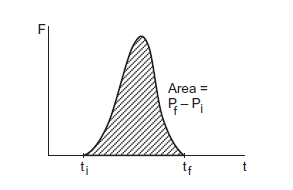 Figure 6.11
This quantity \(\int_{t_{i}}^{t_{f}} \vec{F} d t\) is known as the impulse of the force \(\vec{F}\) during the time interval \(t_{i}\) to \(t_{f}\) and is equal to the change in the momentum of the body on which it acts. Obviously, it is the area under the \(F\)–\(t\) curve for one-dimensional motion.
Impulse ( \(\mathbf{J}\) ) is a measure of the overall effect of a force acting over time and is equal to the change in an object’s momentum ( \(\boldsymbol{\Delta} \mathbf{p}\) ).
- Formula: \(\mathbf{J}=\mathbf{F}_{\text {avg }} \cdot \Delta t=\Delta \mathbf{p}=m \mathbf{v}_f-m \mathbf{v}_i\).
- Units: Newton-seconds ( \(\mathbf{N} \cdot\) s ) or kilogram-meters per second ( \(\mathrm{kg} \cdot \mathrm{m} / \mathrm{s}\) ).
- Impulsive Force (\(F\)) is the term for the high-magnitude force that occurs during a sudden, short-duration event like an impact or explosion.
Example 7: A 0.5 kg soccer ball is kicked, changing its velocity from \(0 \mathrm{~m} / \mathrm{s}\) (at rest) to \(18 \mathrm{~m} / \mathrm{s}\) in 0.02 s. Calculate the Impulse and average Impulsive Force.
Solution: Calculate the Impulse:
\(\mathbf{J}=\Delta \mathbf{p}=m \mathbf{v}_f-m \mathbf{v}_i\)
\(\mathbf{J}=(0.5 \mathrm{~kg})(18 \mathrm{~m} / \mathrm{s})-(0.5 \mathrm{~kg})(0 \mathrm{~m} / \mathrm{s})\)
\(\mathrm{J}=9.0 \mathrm{~N} \cdot \mathrm{~s}\)
Calculate the average Impulsive Force:
\(\mathrm{F}_{\text {avg }}=\frac{\mathrm{J}}{\Delta t}=\frac{\Delta \mathrm{p}}{\Delta t}\)
\(\mathrm{F}_{\text {avg }}=\frac{9.0 \mathrm{~N} \cdot \mathrm{~s}}{0.02 \mathrm{~s}}\)
\(\mathrm{F}_{\text {avg }}=450 \mathrm{~N}\)
Example 8: A block of mass \(m\) moving at a velocity \(v\) collides head on with another block of mass \(2 m\) at rest. If the coefficient of restitution is \(1 / 2\), find the velocities of the blocks after the collision.
Solution: Suppose after the collision the block of mass \(m\) moves at a velocity \(u_1\) and the block of mass \(2 m\) moves at a velocity \(u_2\). By conservation of momentum,
\(
m v=m u_1+2 m u_2 \dots(i)
\)
The velocity of separation is \(u_2-u_1\) and the velocity of approach is \(v\).
So, \(u_2-u_1=v / 2 \dots(ii)\)
From (i) and (ii), \(u_1=0\) and \(u_2=v / 2\).
Example 9: The two balls shown in figure below are identical, the first moving at a speed \(v\) towards right and the second staying at rest. The wall at the extreme right is fixed. Assume all collisions to be elastic. Show that the speeds of the balls remain unchanged after all the collisions have taken place.
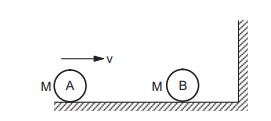
Solution: 1st collision : As the balls have equal mass and make elastic collision, the velocities are interchanged. Hence, after the first collision, the ball \(A\) comes to rest and the ball \(B\) moves towards right at a speed \(v\).
2nd collision : The ball \(B\) moving with a speed \(v\), collides with the wall and rebounds. As the wall is rigid and may be taken to be of infinite mass, momentum conservation gives no useful result. Velocity of separation should be equal to the velocity of approach. Hence, the ball rebounds at the same speed \(v\) towards left.
3rd collision : The ball \(B\) moving towards left at the speed \(v\) again collides with the ball \(A\) kept at rest. As the masses are equal and the collision is elastic, the velocities are interchanged. Thus, the ball \(B\) comes to rest and the ball \(A\) moves towards left at a speed \(v\). No further collision takes place. Thus, the speeds of the balls remain the same as their initial values.
Example 10: A block of mass 1.2 kg moving at a speed of \(20 \mathrm{~cm} / \mathrm{s}\) collides head-on with a similar block kept at rest. The coefficient of restitution is \(3 / 5\). Find the loss of kinetic energy during the collision.
Solution: Suppose the first block moves at a speed \(v_1\) and the second at \(v_2\) after the collision. Since the collision is head-on, the two blocks move along the original direction of motion of the first block.
By conservation of linear momentum,
\(
(1 \cdot 2 \mathrm{~kg})(20 \mathrm{~cm} / \mathrm{s})=(1 \cdot 2 \mathrm{~kg}) v_1+(1 \cdot 2 \mathrm{~kg}) v_2
\)
or, \(v_1+v_2=20 \mathrm{~cm} / \mathrm{s} . \dots(i)\)
The velocity of separation is \(v_2-v_1\) and the velocity of approach is \(20 \mathrm{~cm} / \mathrm{s}\). As the coefficient of restitution is \(3 / 5\), we have,
\(
v_2-v_1=(3 / 5) \times 20 \mathrm{~cm} / \mathrm{s}=12 \mathrm{~cm} / \mathrm{s} \dots(ii)
\)
By (i) and (ii),
\(
v_1=4 \mathrm{~cm} / \mathrm{s} \text { and } v_2=16 \mathrm{~cm} / \mathrm{s} .
\)
The loss in kinetic energy is
\(
\begin{aligned}
& \frac{1}{2}(1.2 \mathrm{~kg})\left[(20 \mathrm{~cm} / \mathrm{s})^2-(4 \mathrm{~cm} / \mathrm{s})^2-(16 \mathrm{~cm} / \mathrm{s})^2\right] \\
& =(0.6 \mathrm{~kg})\left[0.04 \mathrm{~m}^2 / \mathrm{s}^2-0.0016 \mathrm{~m}^2 / \mathrm{s}^2-0.0256 \mathrm{~m}^2 / \mathrm{s}^2\right] \\
& =(0.6 \mathrm{~kg})\left(0.0128 \mathrm{~m}^2 / \mathrm{s}^2\right)=7.7 \times 10^{-3} \mathrm{~J} .
\end{aligned}
\)
Example 11: A ball of mass \(m\) hits the floor with a speed \(v\) making an angle of incidence \(\theta\) with the normal. The coefficient of restitution is \(e\). Find the speed of the reflected ball and the angle of reflection of the ball.
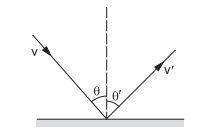
Solution: Suppose the angle of reflection is \(\theta^{\prime}\) and the speed after the collision is \(v^{\prime}\). The floor exerts a force on the ball along the normal during the collision. There is no force parallel to the surface. Thus, the parallel component of the velocity of the ball remains unchanged. This gives
\(
v^{\prime} \sin \theta^{\prime}=v \sin \theta \dots(i)
\)
For the components normal to the floor, the velocity of separation \(=v^{\prime} \cos \theta^{\prime}\) and the velocity of approach \(=v \cos \theta\).
Hence, \(v^{\prime} \cos \theta^{\prime}=e v \cos \theta \dots(ii)\)
From (i) and (ii),
\(
v^{\prime}=v \sqrt{\sin ^2 \theta+e^2 \cos ^2 \theta}
\)
and \(\quad \tan \theta^{\prime}=\frac{\tan \theta}{e}\).
For elastic collision, \(e=1\) so that \(\theta^{\prime}=\theta\) and \(v^{\prime}=v\).
Example 12: A block of mass \(m\) and a pan of equal mass are connected by a string going over a smooth light pulley as shown in figure below. Initially the system is at rest when a particle of mass \(m\) falls on the pan and sticks to it. If the particle strikes the pan with a speed \(v\) find the speed with which the system moves just after the collision.
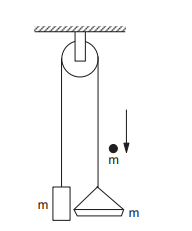
Solution: Step 1: Analyze the collision and forces
The collision between the falling particle and the pan is an instantaneous event. During this short time interval, the impulsive forces (collision force, tension in the string) are much larger than non-impulsive forces like gravity. The impulse due to gravity during the instantaneous collision is negligible. The system before the collision consists of the block of mass \(m\), the pan of mass \(m\) (both at rest), and the particle of mass \(m\) falling with speed \(v\). After the collision, the particle sticks to the pan, and the combined panparticle mass \((2 m)\) and the block \((m)\) move with a common speed \(V\).
Step 2: Apply impulse-momentum theorem
We apply the impulse-momentum theorem to each part of the system over the duration of the collision \((\Delta t)\). We define the downward direction as positive for the pan’s side.
For the particle, the only significant force is the upward collision force \(F_c\) :
\(
\int-F_c d t=m V-m v \dots(1)
\)
For the pan, the significant forces are the downward collision force \(F_c\) and the upward tension \(T^{\prime}\) :
\(
\int\left(F_c-T^{\prime}\right) d t=m V-0=m V \dots(2)
\)
For the block, the only significant force is the upward tension \(T^{\prime}\) (gravity is negligible during the impulse):
\(
\int-T^{\prime} d t=m(-V)-0=-m V \dots(3)
\)
From equation (3), the tension impulse \(\int T^{\prime} d t\) is \(m V\). Substitute this into equation (2):
\(
\begin{gathered}
\int F_c d t-\int T^{\prime} d t=m V \\
\int F_c d t-m V=m V \\
\int F_c d t=2 m V
\end{gathered}
\)
Now substitute the value of \(\int F_c d t\) into equation (1):
\(
\begin{gathered}
-(2 m V)=m V-m v \\
-2 m V=m V-m v \\
3 m V=m v
\end{gathered}
\)
We can solve for the final speed \(V\) :
\(
\begin{aligned}
V & =\frac{m v}{3 m} \\
V & =\frac{v}{3}
\end{aligned}
\)
Alternate: Let \(N=\) magnitude of the contact force between the particle and the pan
\(
T=\text { tension in the string }
\)
Consider the impulse imparted to the particle. The force is \(N\) in upward direction and the impulse is \(\int N d t\). This should be equal to the change in its momentum.
Thus, \(\int N d t=m v-m V \dots(i)\)
Similarly considering the impulse imparted to the pan,
\(
\int(N-T) d t=m V \dots(ii)
\)
and that to the block,
\(
\int T d t=m V \dots(iii)
\)
Adding (ii) and (iii),
\(
\int N d t=2 m V
\)
Comparing with (i),
\(
m v-m V=2 m V
\)
or, \(V=v / 3 \)