2.5 Acceleration
Acceleration
The time rate of change of velocity of a body is called acceleration.
\(
\therefore \quad \text { Acceleration }=\frac{\text { Change in velocity }(\Delta v)}{\text { Time interval }(\Delta t)}
\)
If in a given time interval, the velocity of a body changes from \(u\) to \(v\), then acceleration \(a\) is expressed as
\(
a=\frac{\text { Final velocity }- \text { Initial velocity }}{\text { Time interval }}=\frac{v-u}{t}
\)
It is a vector quantity. Its SI unit is \(\mathrm{ms}^{-2}\) and CGS unit is \(\mathrm{cms}^{-2}\).
Its dimensional formula is \(\left[\mathrm{M}^0 \mathrm{LT}^{-2}\right]\). Its direction is same as that of change in velocity (not of the velocity).
Average acceleration
When an object is moving with a variable acceleration, then the average acceleration of the object for the given motion
is defined as the ratio of the total change in velocity of the object to the total time taken.
\(
\text { Average acceleration }=\mathbf{a}_{\mathrm{av}}=\frac{\text { Total change in velocity }}{\text { Total time taken }}=\frac{\Delta \mathbf{v}}{\Delta t}=\frac{\mathbf{v}_f-\mathbf{v}_i}{\Delta t}
\)
Retardation
\(a==\frac{v-u}{t}\)
When the velocity of a body increases with time, acceleration is positive and when the velocity of a body decreases with time (i.e. \(u>v\) ), then acceleration becomes negative. This negative acceleration is also called deceleration or retardation. In other words, retardation opposes the motion of body.
Instantaneous acceleration
The acceleration of an object at a given instant of time or at a given point during the motion, is called its instantaneous acceleration. i.e.
\(
\mathbf{a}=\lim _{\Delta t \rightarrow 0} \frac{\Delta \mathbf{v}}{\Delta t}=\frac{d \mathbf{v}}{d t}=\frac{d^2 \mathbf{s}}{d t^2}
\)
Key points regarding acceleration
- A body falling down from a height or a body rolling down on a smooth inclined plane has uniform acceleration. For a body falling or rolling under gravity, the acceleration is uniform because the net force causing the motion is constant. Near the Earth’s surface, the force of gravity is practically constant, and for a smooth inclined plane, the component of gravity causing the motion is constant as well.
- If a car travelling along a straight road, increases its speed by unequal amounts in equal intervals of time, then the car is said to be moving with non-uniform acceleration. A car has non-uniform acceleration because it is a measure of the rate at which velocity changes. If the speed increases by unequal amounts over equal time intervals, the rate of change of velocity is not constant, meaning the acceleration is not uniform.
- If a particle is accelerated for time \(t_1\) with acceleration \(a_1\) and for time \(t_2\) with acceleration \(a_2\), then average acceleration is
\(
a_{\mathrm{av}}=\frac{a_1 t_1+a_2 t_2}{t_1+t_2}
\) - Acceleration can also be written as
\(
a=\frac{d v}{d t}=\frac{d v}{d x} \cdot \frac{d x}{d t}=v\left(\frac{d v}{d x}\right)
\)
Example 1: A particle is moving in \(x\) – \(y\) plane. Its \(x\) and \(y\) co-ordinates vary with time as
\(
x=2 t^2 \text { and } y=t^3
\)
Here, \(x\) and \(y\) are in metres and \(t\) in seconds. Find average acceleration between a time interval from \(t=0\) to \(t=2 \mathrm{~s}\).
Solution: The position vector of the particle at any time \(t\) can be given as
\(
\mathbf{r}=x \hat{\mathbf{i}}+y \hat{\mathbf{j}}=2 t^2 \hat{\mathbf{i}}+t^3 \hat{\mathbf{j}}
\)
The instantaneous velocity is \(\quad \mathbf{v}=\frac{d \mathbf{r}}{d t}=\left(4 t \hat{\mathbf{i}}+3 t^2 \hat{\mathbf{j}}\right)\)
\(
\begin{aligned}
\mathbf{a}_{\mathrm{av}} & =\frac{\Delta \mathbf{v}}{\Delta t}=\frac{\mathbf{v}_f-\mathbf{v}_i}{\Delta t}=\frac{\mathbf{v}_{2 \mathrm{sec}}-\mathbf{v}_{0 \mathrm{sec}}}{2-0} \\
& =\frac{\left[(4)(2) \hat{\mathbf{i}}+(3)(2)^2 \hat{\mathbf{j}}\right]-\left[(4)(0) \hat{\mathbf{i}}+(3)(0)^2 \hat{\mathbf{j}}\right]}{2} \\
& =(4 \hat{\mathbf{i}}+6 \hat{\mathbf{j}}) \mathrm{m} / \mathrm{s}^2
\end{aligned}
\)
Example 2: A car starts from rest, attains a velocity of \(18 \mathrm{kmh}^{-1}\) with an acceleration of \(0.5 \mathrm{~ms}^{-2}\), travels 4 km with this uniform velocity and then comes to halt with a uniform deceleration of \(0.4 \mathrm{~ms}^{-2}\). Calculate the total time of travel of the car.
Solution: Let the car be accelerated from \(A\) to \(B\), it moves with uniform velocity from \(B\) to \(C\) of 4 km distance and then moves with uniform deceleration of \(0.4 \mathrm{~ms}^{-2}\) from \(C\) to \(D\) as shown below.

For motion of car from \(A\) to \(B, a=0.5 \mathrm{~ms}^{-2}\)
\(
\begin{aligned}
u & =0 \text { and } v=18 \mathrm{~km} \mathrm{~h}^{-1} \\
& =18 \times \frac{5}{18} \mathrm{~ms}^{-1}=5 \mathrm{~ms}^{-1}
\end{aligned}
\)
Time, \(\quad t_1=\frac{v-u}{a} \dots(i)\)
Substituting given values of \(v, u\) and \(a\) for \(A\) to \(B\) motion, we get
\(
t_1=\frac{5-0}{0.5}=10 \mathrm{~s} \dots(ii)
\)
For motion of car from \(B\) to \(C\),
\(
\begin{aligned}
s & =4 \mathrm{~km}=4000 \mathrm{~m} \\
v & =5 \mathrm{~ms}^{-1} \\
t_2 & =\frac{\text { distance }}{\text { velocity }} \\
& =\frac{4000}{5}=800 \mathrm{~s} \dots(iii)
\end{aligned}
\)
For motion of car from \(C\) to \(D, v=0, u=5 \mathrm{~ms}^{-1}\) and \(a=-0.4 \mathrm{~ms}^{-2}\) (negative sign shows deceleration) Time taken, \(t_3=\frac{v-u}{a}=\frac{0-5}{-0.4} =\frac{-5}{-0.4}=12.5 \mathrm{~s} \dots(iv)\)
Total time taken, \(T=t_1+t_2+t_3\)
Substituting values of \(t_1, t_2\) and \(t_3\) from Eqs. (ii), (iii) and (iv) respectively, we get
\(
T=(10+800+12.5) \mathrm{s}=822.5
\)
Thus, total time of travel of the car is 822.5 s.
Example 3: A particle travels first half of the total time with speed \(v_1\) and second half time with speed \(v_2\). Find the average speed during the complete journey.
Solution:

\begin{gathered}
d_1=v_1 t \text { and } d_2=v_2 t \\
\text { Average speed }=\frac{\text { total distance }}{\text { total time }}=\frac{d_1+d_2}{t+t}=\frac{v_1 t+v_2 t}{2 t}=\frac{v_1+v_2}{2}
\end{gathered}
\)
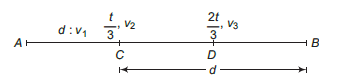
Example 4: A particle travels first half of the total distance with speed \(v_1\). In second half distance, constant speed in \(\frac{1}{3} r d\) time is \(v_2\) and in remaining \(\frac{2}{3} r d\) time constant speed is \(v_3\). Find average speed during the complete journey.
Solution:
\(
\begin{aligned}
C D+D B=d & \Rightarrow v_2\left(\frac{t}{3}\right)+\left(\frac{2 t}{3}\right)\left(v_3\right)=d \\
t & =\frac{3 d}{v_2+2 v_3} \dots(i) \\
t_{A C} & =\frac{d}{v_1}
\end{aligned}
\)
\(
\begin{aligned}
&\text { Now, }\\
&\begin{aligned}
\text { average speed } & =\frac{\text { total distance }}{\text { total time }}=\frac{d+d}{t_{A C}+t_{C D}+t_{D B}} \\
& =\frac{2 d}{\frac{d}{v_1}+\frac{t}{3}+\frac{2 t}{3}}=\frac{2 d}{\left(\frac{d}{v_1}+t\right)}
\end{aligned}
\end{aligned}
\)
\(
\begin{aligned}
&\text { Substituting value of } t \text { from Eq. (i), we have }\\
&\begin{aligned}
\text { average speed } & =\frac{2 d}{\left(d / v_1\right)+\left(3 d / v_2+2 v_3\right)} \\
& =\frac{2 v_1\left(v_2+2 v_3\right)}{3 v_1+v_2+2 v_3}
\end{aligned}
\end{aligned}
\)