6.5 Vector product of two vectors
The vector product or cross product of two vectors is defined as a vector having magnitude equal to the product of their magnitudes with the sine of angle between them, and its direction is perpendicular to the plane containing both the vectors according to right hand screw rule.
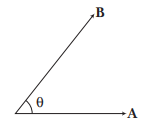
Thus, if \(\mathbf{A}\) and \(\mathbf{B}\) are two vectors, then their vector product, i.e. \(\mathbf{A} \times \mathbf{B}\) gives a vector \(\mathbf{C}\) and is defined by \(\mathbf{C}=\mathbf{A} \times \mathbf{B}=A B \sin \theta \hat{\mathbf{n}}\). where, \(\hat{\mathbf{n}}\) is a unit vector perpendicular to the plane of \(\mathbf{A}\) and \(\mathbf{B}\).
The direction of \(\mathbf{C}\) (or of \(\hat{\mathbf{n}}\) ) is determined by right hand screw rule and right hand thumb rule.
Right Hand Screw Rule:
Rotate a right handed screw from first vector (\(\mathbf{A}\)) towards second vector (\(\mathbf{B}\)). The direction in which right handed screw moves gives the direction of vector ( \(\mathbf{C}\) ) as shown in Figure below.
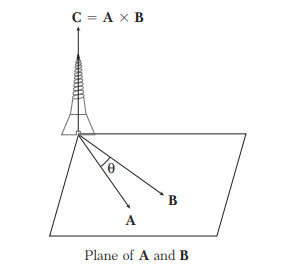
The direction of \(\mathbf{C}\) (or of \(\hat{\mathbf{n}}\) ) is perpendicular to the plane containing \(\mathbf{A}\) and \(\mathbf{B}\); and its sense is decided by right hand screw rule.
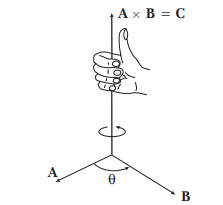
Right Hand Thumb Rule:
If the fingers of the right hand be curled in the direction in which vector \(\mathbf{A}\) must be turned through the smaller included angle \(\theta\) to coincide with the direction of vector \(\mathbf{B}\), the thumb points in the direction of \(\mathbf{C}\) as shown in Figure below.
Important points regarding vector product
(i) \(\mathbf{A} \times \mathbf{B}=-\mathbf{B} \times \mathbf{A}\)
(ii) The magnitude of cross product of two parallel vectors is zero, as \(|\mathbf{A} \times \mathbf{B}|=A B \sin \theta\) and \(\theta=0^{\circ}\) for two parallel vectors. Thus,
\(
\hat{\mathbf{i}} \times \hat{\mathbf{i}}=\hat{\mathbf{j}} \times \hat{\mathbf{j}}=\hat{\mathbf{k}} \times \hat{\mathbf{k}}=0
\)
(iii) If two vectors are perpendicular to each other, we have \(\theta=90^{\circ}\), i.e. \(\sin \theta=1\). So that, \(\mathbf{A} \times \mathbf{B}=A B \hat{\mathbf{n}}\). These vectors \(\mathbf{A}, \mathbf{B}\) and \(\mathbf{A} \times \mathbf{B}\) thus form a right handed system of mutually perpendicular vectors. It follows at once from the above that in case of the orthogonal triad of unit vectors \(\hat{\mathbf{i}}, \hat{\mathbf{j}}\) and \(\hat{\mathbf{k}}\) (each perpendicular to each other)
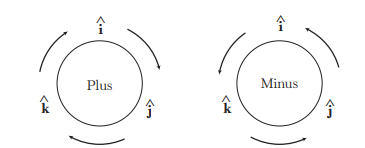
\(\quad \begin{array}{ll} & \hat{\mathbf{i}} \times \hat{\mathbf{j}}=-\hat{\mathbf{j}} \times \hat{\mathbf{i}}=\hat{\mathbf{k}} \\ & \hat{\mathbf{j}} \times \hat{\mathbf{k}}=-\hat{\mathbf{k}} \times \hat{\mathbf{j}}=\hat{\mathbf{i}} \\ & \hat{\mathbf{k}} \times \hat{\mathbf{i}}=-\hat{\mathbf{i}} \times \hat{\mathbf{k}}=\hat{\mathbf{j}}\end{array}\)
(iv) \(\mathbf{A} \times(\mathbf{B}+\mathbf{C})=\mathbf{A} \times \mathbf{B}+\mathbf{A} \times \mathbf{C}\)
(v) A vector product can be expressed in terms of rectangular components of the two vectors and put in the determinant form as may be seen from the following
Let \(\quad \mathbf{A}=a_1 \hat{\mathbf{i}}+b_1 \hat{\mathbf{j}}+c_1 \hat{\mathbf{k}}\)
and \(\quad \mathbf{B}=a_2 \hat{\mathbf{i}}+b_2 \hat{\mathbf{j}}+c_2 \hat{\mathbf{k}}\)
Putting it in determinant form, we have
\(
\mathbf{A} \times \mathbf{B}=\left|\begin{array}{ccc}
\hat{\mathbf{i}} & \hat{\mathbf{j}} & \hat{\mathbf{k}} \\
a_1 & b_1 & c_1 \\
a_2 & b_2 & c_2
\end{array}\right|
\)
It may be noted that the scalar components of the first vector \(\mathbf{A}\) occupy the middle row of the determinant.
(vi) A unit vector ( \(\hat{\mathbf{n}}\) ) perpendicular to \(\mathbf{A}\) as well as \(\mathbf{B}\) is given by \(\hat{\mathbf{n}}=\frac{\mathbf{A} \times \mathbf{B}}{|\mathbf{A} \times \mathbf{B}|}\)
(vii) If \(\mathbf{A}, \mathbf{B}\) and \(\mathbf{C}\) are coplanar, then \([\mathbf{A} \cdot(\mathbf{B} \times \mathbf{C})]=0\)
(viii) Angle between \((\mathbf{A}+\mathbf{B})\) and \((\mathbf{A} \times \mathbf{B})\) is \(90^{\circ}\).
(ix) Two vectors can be shown parallel to each other, if
The coefficient of \(\hat{\mathbf{i}}, \hat{\mathbf{j}}\) and \(\hat{\mathbf{k}}\) of both the vectors bear a constant ratio. For example, a vector \(\mathbf{A}=a_1 \hat{\mathbf{i}}+b_1 \hat{\mathbf{j}}+c_1 \hat{\mathbf{k}}\) is parallel to another vector \(\mathbf{B}=a_2 \hat{\mathbf{i}}+b_2 \hat{\mathbf{j}}+c_2 \hat{\mathbf{k}}\), if
\(
\frac{a_1}{a_2}=\frac{b_1}{b_2}=\frac{c_1}{c_2}
\)
The cross product of both the vectors is zero. For instance \(\mathbf{A}\) and \(\mathbf{B}\) are parallel to each other, if
\(
\mathbf{A} \times \mathbf{B}=\left|\begin{array}{ccc}
\hat{\mathbf{i}} & \hat{\mathbf{j}} & \hat{\mathbf{k}} \\
a_1 & b_1 & c_1 \\
a_2 & b_2 & c_2
\end{array}\right|=0
\)
(x) The area of triangle bounded by vectors \(\mathbf{A}\) and \(\mathbf{B}\) is \(\frac{1}{2}|\mathbf{A} \times \mathbf{B}|\).
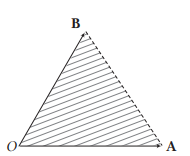
Area of triangle \(\boldsymbol{A} \boldsymbol{B} \boldsymbol{C}\) If position vector of \(A\) is \(\mathbf{a}\), position vector of \(B\) is \(\mathbf{b}\) and position vector of \(C\) is \(\mathbf{c}\), then
Area of triangle \(A B C=\frac{1}{2}|\mathbf{a} \times \mathbf{b}+\mathbf{b} \times \mathbf{c}+\mathbf{c} \times \mathbf{a}|\)
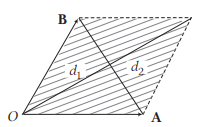
(xi) Area of parallelogram shown in figure is
\begin{aligned}
&=|\mathbf{A} \times \mathbf{B}|=\frac{1}{2}\left|d_1 \times d_2\right|\\
&\text { where, } d_1 \text { and } d_2 \text { are diagonals. }
\end{aligned}
\)
Scalar Product (Dot Product)
If there are two vectors \(\mathbf{A}\) and \(\mathbf{B}\) having angle \(\theta\) between them, then their scalar product is written as
\(
\mathbf{A} \cdot \mathbf{B}=A B \cos \theta
\)
Important points regarding dot product
The following points should be remembered regarding the dot product
(i) \(\mathbf{A} \cdot \mathbf{B}=\mathbf{B} \cdot \mathbf{A}\) (i.e. dot product is commutative)
(ii) \(\mathbf{A} \cdot(\mathbf{B}+\mathbf{C})=\mathbf{A} \cdot \mathbf{B}+\mathbf{A} \cdot \mathbf{C}\) (i.e. dot product is distributive)
(iii) \(\mathbf{A} \cdot \mathbf{A}=A^2\) (also called self-dot product)
(iv) \(\mathbf{A} \cdot \mathbf{B}=A(B \cos \theta)=A\) (component of \(\mathbf{B}\) along \(\mathbf{A}\) ) or \(\quad \mathbf{A} \cdot \mathbf{B}=B(A \cos \theta)=B\) (component of \(\mathbf{A}\) along \(\mathbf{B}\) )
(v) \(\hat{\mathbf{i}} \cdot \hat{\mathbf{i}}=\hat{\mathbf{j}} \cdot \hat{\mathbf{j}}=\hat{\mathbf{k}} \cdot \hat{\mathbf{k}}=(1)(1) \cos 0^{\circ}=1\)
(vi) \(\hat{\mathbf{i}} \cdot \hat{\mathbf{j}}=\hat{\mathbf{j}} \cdot \hat{\mathbf{k}}=\hat{\mathbf{i}} \cdot \hat{\mathbf{k}}=(1)(1) \cos 90^{\circ}=0\)
(vii) \(\left(a_1 \hat{\mathbf{i}}+b_1 \hat{\mathbf{j}}+c_1 \hat{\mathbf{k}}\right) \cdot\left(a_2 \hat{\mathbf{i}}+b_2 \hat{\mathbf{j}}+c_2 \hat{\mathbf{k}}\right)\)
\(
=a_1 a_2+b_1 b_2+c_1 c_2
\)
(viii) \(\cos \theta=\frac{\mathbf{A} \cdot \mathbf{B}}{A B}\) (cosine of angle between \(\mathbf{A}\) and \(\mathbf{B}\) )
(ix) Two vectors are perpendicular (i.e. \(\theta=90^{\circ}\) ), if their dot product is zero.
(x) Dot product of two vectors will be maximum when vectors are parallel \((\) i.e. \(\theta=0)(\mathbf{A} \cdot \mathbf{B})_{\text {max }}=A B\)
Example 1: Find the scalar and vector products of two vectors. \(\mathbf{a}=(3 \hat{\mathbf{i}}-4 \hat{\mathbf{j}}+5 \hat{\mathbf{k}})\) and \(\mathbf{b}=(-2 \hat{\mathbf{i}}+\hat{\mathbf{j}}+3 \hat{\mathbf{k}})\)
Solution:
\(
\begin{aligned}
\mathbf{a} \cdot \mathbf{b} & =(3 \hat{\mathbf{i}}-4 \hat{\mathbf{j}}+5 \hat{\mathbf{k}}) \cdot(-2 \hat{\mathbf{i}}+\hat{\mathbf{j}}-3 \hat{\mathbf{k}}) \\
& =-6-4-15 \\
& =-25
\end{aligned}
\)
\(
\begin{aligned}
&\mathbf{a} \times \mathbf{b}=\left|\begin{array}{ccc}
\hat{\mathbf{i}} & \hat{\mathbf{j}} & \hat{\mathbf{k}} \\
3 & -4 & 5 \\
-2 & 1 & -3
\end{array}\right|=7 \hat{\mathbf{i}}-\hat{\mathbf{j}}-5 \hat{\mathbf{k}}\\
&\text { Note } \mathbf{b} \times \mathbf{a}=-7 \hat{\mathbf{i}}+\hat{\mathbf{j}}+5 \hat{\mathbf{k}}
\end{aligned}
\)
Example 2: Show that the vector \(\mathbf{A}=\hat{\mathbf{i}}-\hat{\mathbf{j}}+2 \hat{\mathbf{k}}\) is parallel to a vector \(\mathbf{B}=3 \hat{\mathbf{i}}-3 \hat{\mathbf{j}}+6 \hat{\mathbf{k}}\).
Solution: A vector \(\mathbf{A}\) is parallel to an another vector \(\mathbf{B}\), if it can be written as
\(
\mathbf{A}=m \mathbf{B}
\)
Here,
\(
\mathbf{A}=(\hat{\mathbf{i}}-\hat{\mathbf{j}}+2 \hat{\mathbf{k}})=\frac{1}{3}(3 \hat{\mathbf{i}}-3 \hat{\mathbf{j}}+6 \hat{\mathbf{k}})
\)
\(
(\because \mathbf{B}=3 \hat{\mathbf{i}}-3 \hat{\mathbf{j}}+6 \hat{\mathbf{k}})
\)
\(
\therefore \quad \mathbf{A}=\frac{1}{3} \mathbf{B}
\)
This implies that \(\mathbf{A}\) is parallel to \(\mathbf{B}\) and magnitude of \(\mathbf{A}\) is 1/3 times the magnitude of \(\mathbf{B}\).
Example 3: Find a unit vector perpendicular to
\(
\mathbf{A}=2 \hat{\mathbf{i}}+3 \hat{\mathbf{j}}+\hat{\mathbf{k}} \text { and } \mathbf{B}=\hat{\mathbf{i}}-\hat{\mathbf{j}}+\hat{\mathbf{k}} \text { both. }
\)
Solution: Given, \(\mathbf{A}=2 \hat{\mathbf{i}}+3 \hat{\mathbf{j}}+\hat{\mathbf{k}}\) and \(\mathbf{B}=\hat{\mathbf{i}}-\hat{\mathbf{j}}+\hat{\mathbf{k}}\)
Now, \(\mathbf{C}=\mathbf{A} \times \mathbf{B}\) is a vector, perpendicular to both \(\mathbf{A}\) and \(\mathbf{B}\).
Hence, a unit vector \(\hat{\mathbf{n}}\) is perpendicular to both \(\mathbf{A}\) and \(\mathbf{B}\). It can be written as
\(
\hat{\mathbf{n}}=\frac{\mathbf{C}}{C}=\frac{\mathbf{A} \times \mathbf{B}}{|\mathbf{A} \times \mathbf{B}|}
\)
Here,
\(
\begin{aligned}
\mathbf{A} \times \mathbf{B} & =\left|\begin{array}{ccc}
\hat{\mathbf{i}} & \hat{\mathbf{j}} & \hat{\mathbf{k}} \\
2 & 3 & 1 \\
1 & -1 & 1
\end{array}\right| \\
& =\hat{\mathbf{i}}(3+1)+\hat{\mathbf{j}}(1-2)+\hat{\mathbf{k}}(-2-3) \\
& =4 \hat{\mathbf{i}}-\hat{\mathbf{j}}-5 \hat{\mathbf{k}}
\end{aligned}
\)
Further, \(|\mathbf{A} \times \mathbf{B}|=\sqrt{(4)^2+(-1)^2+(-5)^2}=\sqrt{42}\)
∴ The desired unit vector is \(\hat{\mathbf{n}}=\frac{\mathbf{A} \times \mathbf{B}}{|\mathbf{A} \times \mathbf{B}|}\)
\(
\hat{\mathbf{n}}=\frac{1}{\sqrt{42}}(4 \hat{\mathbf{i}}-\hat{\mathbf{j}}-5 \hat{\mathbf{k}})
\)
Example 4: If \(\mathbf{a}=3 \hat{\mathbf{i}}+\hat{\mathbf{j}}-4 \hat{\mathbf{k}}, \mathbf{b}=6 \hat{\mathbf{i}}+5 \hat{\mathbf{j}}-2 \hat{\mathbf{k}}\), then find the area of a triangle whose adjacent sides are determined by \(\mathbf{a}\) and \(\mathbf{b}\).
Solution: Cross product of vectors \(\mathbf{a}\) and \(\mathbf{b}\),
\(
\begin{aligned}
& \mathbf{a} \times \mathbf{b}=\left|\begin{array}{ccc}
\hat{\mathbf{i}} & \hat{\mathbf{j}} & \hat{\mathbf{k}} \\
3 & 1 & -4 \\
6 & 5 & -2
\end{array}\right| \\
= & \hat{\mathbf{i}}(-2+20)-\hat{\mathbf{j}}(-6+24)+\hat{\mathbf{k}}(15-6)=18 \hat{\mathbf{i}}-18 \hat{\mathbf{j}}+9 \hat{\mathbf{k}}
\end{aligned}
\)
Magnitude of \(\mathbf{a}\) and \(\mathbf{b}\),
\(
\begin{aligned}
& |\mathbf{a} \times \mathbf{b}|=\sqrt{(18)^2+(-18)^2+(9)^2}=\sqrt{729}=27 \\
& \therefore \text { Area of } \Delta=\frac{1}{2}|\mathbf{a} \times \mathbf{b}|=\frac{27}{2} \\
& =13.5 \text { sq. units }
\end{aligned}
\)
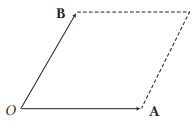
Example 5: The adjacent sides of a parallelogram is given by two vectors \(\mathbf{A}\) and \(\mathbf{B}\), where \(\mathbf{A}=5 \hat{\mathbf{i}}-4 \hat{\mathbf{j}}+3 \hat{\mathbf{k}}\) and \(\mathbf{B}=3 \hat{\mathbf{i}}-2 \hat{\mathbf{j}}-\hat{\mathbf{k}}\). Calculate the area of parallelogram.
Solution: Here, \(\mathbf{A}\) and \(\mathbf{B}\) represents the adjacent sides of a parallelogram.
\begin{aligned}
\mathbf{A} & =5 \hat{\mathbf{i}}-4 \hat{\mathbf{j}}+3 \hat{\mathbf{k}} \\
\mathbf{B} & =3 \hat{\mathbf{i}}-2 \hat{\mathbf{j}}-\hat{\mathbf{k}} \\
\text { Area of parallelogram } & =|\mathbf{A} \times \mathbf{B}| \\
\therefore \quad \mathbf{A} \times \mathbf{B} & =\left|\begin{array}{ccc}
\hat{\mathbf{i}} & \hat{\mathbf{j}} & \hat{\mathbf{k}} \\
5 & -4 & 3 \\
3 & -2 & -1
\end{array}\right| \\
& =\hat{\mathbf{i}}(4+6)-\hat{\mathbf{j}}(-5-9)+\hat{\mathbf{k}}(-10+12) \\
& =10 \hat{\mathbf{i}}+14 \hat{\mathbf{j}}+2 \hat{\mathbf{k}} \\
\Rightarrow \quad|\mathbf{A} \times \mathbf{B}| & =\sqrt{(10)^2+(14)^2+(2)^2} \\
& =\sqrt{300}=10 \sqrt{3} \text { sq. units }
\end{aligned}
\)
Example 6: Prove that the vectors \(\mathbf{A}=2 \hat{\mathbf{i}}-3 \hat{\mathbf{j}}+\hat{\mathbf{k}}\) and \(\mathbf{B}=\hat{\mathbf{i}}+\hat{\mathbf{j}}+\hat{\mathbf{k}}\) are mutually perpendicular.
Solution:
\(
\begin{aligned}
\mathbf{A} \cdot \mathbf{B} & =(2 \hat{\mathbf{i}}-3 \hat{\mathbf{j}}+\hat{\mathbf{k}}) \cdot(\hat{\mathbf{i}}+\hat{\mathbf{j}}+\hat{\mathbf{k}}) \\
& =(2)(1)+(-3)(1)+(1)(1)
\end{aligned}
\)
\(
=0=A B \cos \theta \quad(\because \mathbf{A} \cdot \mathbf{B}=A B \cos \theta)
\)
\(
\therefore \quad \cos \theta=0 \quad(\text { As } A \neq 0, B \neq 0)
\)
\(
\theta=90^{\circ} \left(\because \cos 90^{\circ}=0\right)
\)
the vectors \(\mathbf{A}\) and \(\mathbf{B}\) are mutually perpendicular.
Example 7: Find the angle between two vectors
\(
\mathbf{A}=2 \hat{\mathbf{i}}+\hat{\mathbf{j}}-\hat{\mathbf{k}} \text { and } \mathbf{B}=\hat{\mathbf{i}}-\hat{\mathbf{k}}
\)
Solution:
\(
\begin{aligned}
A & =|\mathbf{A}|=\sqrt{(2)^2+(1)^2+(-1)^2}=\sqrt{6} \\
B & =|\mathbf{B}|=\sqrt{(1)^2+(-1)^2}=\sqrt{2} \\
\mathbf{A} \cdot \mathbf{B} & =(2 \hat{\mathbf{i}}+\hat{\mathbf{j}}-\hat{\mathbf{k}}) \cdot(\hat{\mathbf{i}}-\hat{\mathbf{k}})=(2)(1)+(-1)(-1)=3
\end{aligned}
\)
Now, \(\quad \cos \theta=\frac{\mathbf{A} \cdot \mathbf{B}}{A B}=\frac{3}{\sqrt{6} \cdot \sqrt{2}}=\frac{3}{\sqrt{12}}=\frac{\sqrt{3}}{2}\)
\(
\therefore \quad \theta=30^{\circ}
\)