9.3 Streamline flow
Flow of Fluids
So far we have studied fluids at rest. The study of the fluids in motion is known as fluid dynamics. In this section, we will study fluids in motion. When a fluid is in flow, its motion can either be smooth (steady flow which is known as also streamline flow) or irregular (turbulent flow) depending on its velocity of flow.
Streamline Flow (Laminar Flow)
When a water tap is turned on slowly, the water flow is smooth initially but loses its smoothness when the speed of the outflow is increased. In studying the motion of fluids, we focus our attention on what is happening to various fluid particles at a particular point in space at a particular time. The flow of the fluid is said to be steady if at any given point, the velocity of each passing fluid particle remains constant in time. This does not mean that the velocity at different points in space is same. The velocity of a particular particle may change as it moves from one point to another. That is, at some other point the particle may have a different velocity, but every other particle which passes the second point behaves exactly as the previous particle that has just passed that point. Each particle follows a smooth path, and the paths of the particles do not cross each other. Streamline flow typically occurs at lower velocities. When the speed of the fluid increases too much, the flow can become turbulent. Streamline flow has following characteristics (a stream line flow is shown below):

Parallel Paths:
In streamlined flow, fluid particles move in straight or gently curving paths that never intersect with one another.
Consistent Speed:
Each particle moves at a constant speed along its path. This means that if you were to watch a particle, it would keep moving steadily without speeding up or slowing down.
Orderly Movement:
There’s no mixing or swirling in streamlined flow. The fluid layers slide over one another smoothly, like sheets of paper sliding over each other.
Predictable:
Because the flow is so orderly, it’s easy to predict where a particle will go. This makes calculations and designs based on streamlined flow very reliable.
Low Velocity:
Streamline flow typically occurs at lower velocities. When the speed of the fluid increases too much, the flow can become turbulent.

If the velocity of fluid particles at any point does not vary with time, the flow is said to be steady. Steady flow is also called streamlined or laminar flow. The velocity at different points may be different. Hence, in the figure, we can say that velocity of fluid particles at different points 1,2 and 3 remains same with time.
i.e. \(\mathbf{v}_1=\) constant, \(\mathbf{v}_2=\) constant, \(\mathbf{v}_3=\) constant, but
\(
\mathbf{v}_1 \neq \mathbf{v}_2 \neq \mathbf{v}_3
\)
The path followed by a fluid particle in steady flow is called streamline. Velocity of fluid particle at any point of the streamline is along tangent to the curve at that point. Streamline flow is possible only if the liquid velocity does not exceed a limiting value called critical velocity.
Streamline flow Equation of Continuity
The Equation of Continuity asserts that for an incompressible fluid, the product of area and fluid speed at all points all along the pipe is constant. The Equation of Continuity asserts that if no leaks exist, the volume of fluid entering one end of a tube in a particular time interval equals the volume leaving the other end of the tube within the same time interval.
This equation helps us understand how fluids behave when they move through different shapes of pipes or channels. It’s crucial for designing systems like water supply networks, air conditioning ducts, and even for understanding blood flow in arteries. Think of a river. In some places, it’s wide and the water flows gently. In other places, the river narrows, and the water rushes through quickly. The Equation of Continuity explains this behavior – the water speeds up where the river is narrow because the area decreases, so the velocity must increase to maintain the balance.

The Equation of Continuity is based on the principle of conservation of mass, which states that mass cannot be created or destroyed within a closed system.
Imagine a pipe (shown above in diagram) with varying cross-sectional areas through which an incompressible fluid (like water) is flowing. Let’s take two different sections of the pipe, section 1 with area \(\left({A}_1\right)\) and section 2 with area \(\left({A}_2\right)\).
In a small time interval \((\Delta {t})\), the fluid will move a distance \(\left(\Delta {x}_1\right)\) at section 1 with velocity \(\left({v}_1\right)\) and \(\left(\Delta {X}_2\right)\) at section 2 with velocity \(\left({v}_2\right)\).
The volume of fluid passing through section 1 in time \((\Delta t)\) is \(\left({A}_1 \Delta {x}_1\right)\), and through section 2 is \(\left(A_2 \Delta x_2\right)\).
The distance of each section of fluid travels is related to its velocity and time:
\(
\begin{aligned}
& \Delta x_1=v_1 \Delta t \\
& \Delta x_2=v_2 \Delta t
\end{aligned}
\)
Since the fluid is incompressible, its density ( \(\rho\) ) remains constant. The mass of fluid passing through each section is the product of density and volume (\(\rho=\frac{m}{V}\)):
\(
\begin{aligned}
& m_1=\rho A_1 \Delta x_1 \\
& m_2=\rho A_2 \Delta x_2
\end{aligned}
\)
The mass entering section 1 must equal the mass leaving section 2 in the time \((\Delta t)\) :
\(
\begin{aligned}
m_1 & =m_2 \\
\rho A_1 \Delta x_1 & =\rho A_2 \Delta x_2
\end{aligned}
\)
Replace ( \(\Delta {x}_1\) ) and ( \(\Delta {x}_2\) ) with their respective expressions involving velocity and time:
\(
\rho A_1 v_1 \Delta t=\rho A_2 v_2 \Delta t
\)
The density ( \(\rho\) ) and time ( \(\Delta t\) ) are the same on both sides of the equation, so they cancel out:
\(
A_1 v_1=A_2 v_2
\)
This equation tells us that the product of the cross-sectional area and the velocity at any two points along the pipe is constant for an incompressible fluid. It implies that where the pipe narrows (small (\(A\)), the velocity (\(v\)) increases, and where the pipe widens (large \(A\)), the velocity (\(v\)) decreases.
Example 1: Water is flowing through a horizontal tube of non-uniform cross-section. At a place, the radius of the tube is 1.0 cm and the velocity of water is \(2 \mathrm{~ms}^{-1}\). What will be the velocity of water, where the radius of the pipe is 2.0 cm ?
Solution: Using equation of continuity,
\(
\begin{gathered}
A_1 v_1=A_2 v_2 \quad \text { or } \quad v_2=\left(\frac{A_1}{A_2}\right) v_1 \\
v_2=\left(\frac{\pi r_1^2}{\pi r_2^2}\right) v_1=\left(\frac{r_1}{r_2}\right)^2 v_1
\end{gathered}
\)
Given, \(r_1=1 \mathrm{~cm}=1 \times 10^{-2} \mathrm{~m}, r_2=2 \mathrm{~cm}=2 \times 10^{-2} \mathrm{~m}\), \(v_1=2 \mathrm{~ms}^{-1}\)
Substituting the above values, we get
\(
v_2=\left(\frac{1.0 \times 10^{-2}}{2.0 \times 10^{-2}}\right)^2(2) \text { or } v_2=0.5 \mathrm{~ms}^{-1}
\)
Example 2: shows a liquid being pushed out of a tube by pressing a piston. The area of cross section of the piston is \(1.0 \mathrm{~cm}^2\) and that of the tube at the outlet is \(20 \mathrm{~mm}^2\). If the piston is pushed at a speed of \(2 \mathrm{~cm} \mathrm{~s}^{-1}\), what is the speed of the outgoing liquid?
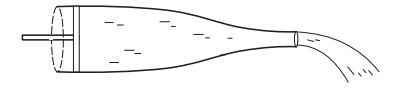
Solution: From the equation of continuity
\(
\begin{gathered}
A_1 v_1=A_2 v_2 \\
\left(1.0 \mathrm{~cm}^2\right)\left(2 \mathrm{~cm} \mathrm{~s}^{-1}\right)=\left(20 \mathrm{~mm}^2\right) v_2 \\
v_2=\frac{1.0 \mathrm{~cm}^2}{20 \mathrm{~mm}^2} \times 2 \mathrm{~cm} \mathrm{~s}^{-1} \\
=\frac{100 \mathrm{~mm}^2}{20 \mathrm{~mm}^2} \times 2 \mathrm{~cm} \mathrm{~s}^{-1}=10 \mathrm{~cm} \mathrm{~s}^{-1}
\end{gathered}
\)
Turbulent Flow
Turbulent flow is characterized by chaotic changes in pressure and flow velocity. It is the opposite of streamlined flow and occurs at high velocities or with large obstacles. Turbulent flow is a type of fluid motion that is chaotic and unpredictable. Unlike streamlined flow, where the fluid moves in orderly layers, turbulent flow is characterized by irregular fluctuations and mixing.

In rivers and canals, where speed of water is quite high or the boundary surfaces cause abrupt changes in velocity of the flow, then the flow becomes irregular. Such flow of liquid is known as turbulent flow. Thus, the flow of fluid in which velocity of all particles crossing a given point is not same and the motion of the fluid becomes irregular or disordered. This is called turbulent flow.
A few examples of turbulent flow are
- a jet of air striking a flat plate.
- the smoke rising from a burning stock of wood.
A jet of air striking a flat plate placed perpendicular to it. This is an example of turbulent flow.
