JEE PYQs Integer Type
SUMMARY
- The basic property of a fluid is that it can flow. The fluid does not have any resistance to change of its shape. Thus, the shape of a fluid is governed by the shape of its container.
- A liquid is incompressible and has a free surface of its own. A gas is compressible and it expands to occupy all the space available to it.
- If \(F\) is the normal force exerted by a fluid on an area \(A\) then the average pressure \(P_{\mathrm{av}}\) is defined as the ratio of the force to area
\(
P_{a v}=\frac{F}{A}
\) - The unit of the pressure is the pascal (Pa). It is the same as \(\mathrm{N} \mathrm{m}^{-2}\). Other common units of pressure are
\(
\begin{aligned}
& 1 \mathrm{~atm}=1.01 \times 10^5 \mathrm{~Pa} \\
& 1 \mathrm{bar}=10^5 \mathrm{~Pa} \\
& 1 \mathrm{torr}=133 \mathrm{~Pa}=0.133 \mathrm{kPa} \\
& 1 \mathrm{~mm} \text { of } \mathrm{Hg}=1 \text { torr }=133 \mathrm{~Pa}
\end{aligned}
\) - Pascal’s law states that: Pressure in a fluid at rest is same at all points which are at the same height. A change in pressure applied to an enclosed fluid is transmitted undiminished to every point of the fluid and the walls of the containing vessel.
- The pressure in a fluid varies with depth h according to the expression
\(
P=P_{\mathrm{a}}+\rho g h
\)
where \(\rho\) is the density of the fluid, assumed uniform. - The volume of an incompressible fluid passing any point every second in a pipe of non uniform cross section is the same in the steady flow.
\(v A=\) constant (\(v\) is the velocity and \(A\) is the area of cross section)
The equation is due to mass conservation in incompressible fluid flow. - Bernoulli’s principle states that as we move along a streamline, the sum of the pressure (\(P\)), the kinetic energy per unit volume (\(\rho v^2 / 2\)) and the potential energy per unit volume (\(\rho g y\)) remains a constant.
\(P+\rho v^2 / 2+\rho g y=\) constant
The equation is basically the conservation of energy applied to non viscuss fluid motion in steady state. There is no fluid which have zero viscosity, so the above statement is true only approximately. The viscosity is like friction and converts the kinetic energy to heat energy. - Though shear strain in a fluid does not require shear stress, when a shear stress is applied to a fluid, the motion is generated which causes a shear strain growing with time. The ratio of the shear stress to the time rate of shearing strain is known as coefficient of viscosity, \(\eta\). \(\eta=\frac{\text { shearing stress }}{\text { strain rate }}=\frac{F / A}{v / l}=\frac{F l}{v A}\)
where symbols have their usual meaning and are defined in the text. - Stokes’ law states that the viscous drag force \(\mathbf{F}\) on a sphere of radius a moving with velocity \(\mathbf{v}\) through a fluid of viscosity is, \(\mathbf{F}=6 \pi \eta a \mathbf{v}\).
- Surface tension is a force per unit length (or surface energy per unit area) acting in the plane of interface between the liquid and the bounding surface. It is the extra energy that the molecules at the interface have as compared to the interior.
- Terminal Velocity \(v_t=\frac{2}{9} \frac{r^2(\rho-\sigma) g}{\eta}\)
Quiz Summary
0 of 44 Questions completed
Questions:
Information
You have already completed the quiz before. Hence you can not start it again.
Quiz is loading…
You must sign in or sign up to start the quiz.
You must first complete the following:
Results
Results
0 of 44 Questions answered correctly
Your time:
Time has elapsed
You have reached 0 of 0 point(s), (0)
Earned Point(s): 0 of 0, (0)
0 Essay(s) Pending (Possible Point(s): 0)
Categories
- Not categorized 0%
- 1
- 2
- 3
- 4
- 5
- 6
- 7
- 8
- 9
- 10
- 11
- 12
- 13
- 14
- 15
- 16
- 17
- 18
- 19
- 20
- 21
- 22
- 23
- 24
- 25
- 26
- 27
- 28
- 29
- 30
- 31
- 32
- 33
- 34
- 35
- 36
- 37
- 38
- 39
- 40
- 41
- 42
- 43
- 44
- Current
- Review
- Answered
- Correct
- Incorrect
- Question 1 of 44
1. Question
A soap bubble of surface tension \(0.04 \mathrm{~N} / \mathrm{m}\) is blown to a diameter of 7 cm. If \((15000-x) \mu \mathrm{J}\) of work is done in blowing it further to make its diameter 14 cm, then the value of \(x\) is ____ . [JEE Main 2026 (Online) 24th January Evening Shift] \((\pi=22 / 7)\)
CorrectIncorrectHint
(a) To find the value of \(x\), we need to calculate the work done in increasing the size of the soap bubble.
Step 1: Calculate the Change in Surface Area
A soap bubble has two liquid-air interfaces (the inside and the outside). Therefore, the total surface area is \(2 \times 4 \pi r^2\). The change in surface area (\(\Delta A\)) when the radius increases from \(r_1\) to \(r_2\) is:
\(
\Delta A=8 \pi\left(r_2^2-r_1^2\right)
\)
Given:
\(r_1=3.5 \mathrm{~cm}=0.035 \mathrm{~m}\)
\(r_2=7 \mathrm{~cm}=0.07 \mathrm{~m}\)
\(\pi=22 / 7\)
\(
\begin{gathered}
\Delta A=8 \times \frac{22}{7} \times\left(0.07^2-0.035^2\right) \\
\Delta A=\frac{176}{7} \times(0.0049-0.001225)=\frac{176}{7} \times 0.003675 \\
\Delta A=176 \times 0.000525=0.0924 \mathrm{~m}^2
\end{gathered}
\)
Step 2: Calculate Work Done and Solve for \(x\)
The work done (\(W\)) is the product of surface tension (\(T\)) and the increase in surface area:
\(
W=T \times \Delta A
\)
\(
W=0.04 \times 0.0924=0.003696 \mathrm{~J}
\)
Now, convert this value to microjoules \((\mu \mathrm{J})\) :
\(
W=0.003696 \times 10^6 \mu \mathrm{~J}=3696 \mu \mathrm{~J}
\)
According to the problem, \(W=(15000-x) \mu \mathrm{J}\) :
\(
\begin{aligned}
& 3696=15000-x \\
& x=15000-3696
\end{aligned}
\)
\(
x=11304
\) - Question 2 of 44
2. Question
Sixty four rain drops of radius 1 mm each falling down with a terminal velocity of \(10 \mathrm{~cm} / \mathrm{s}\) coalesce to form a bigger drop. The terminal velocity of bigger drop is ____ \(\mathrm{cm} / \mathrm{s}\). [JEE Main 2026 (Online) 24th January Morning Shift]
CorrectIncorrectHint
(c) To find the terminal velocity of the bigger drop, we need to consider how the radius changes when the drops coalesce and how that affects the terminal velocity.
Step 1: Find the Radius of the Bigger Drop
When 64 small drops coalesce(come together to form one mass or whole), the total volume remains constant. Let \(r\) be the radius of a small drop and \(R\) be the radius of the bigger drop.
\(
\begin{gathered}
V_{\text {big }}=64 \times V_{\text {small }} \\
\frac{4}{3} \pi R^3=64 \times \frac{4}{3} \pi r^3 \\
R^3=64 r^3
\end{gathered}
\)
Taking the cube root of both sides:
\(
\begin{gathered}
R=\sqrt[3]{64} \times r \\
R=4 r
\end{gathered}
\)
Step 2: Relate Terminal Velocity to Radius
The terminal velocity (\(v\)) of a spherical body falling through a viscous medium is given by the formula:
\(
v=\frac{2}{9} \frac{r^2 g(\rho-\sigma)}{\eta}
\)
Where:
\(r\) is the radius
\(g\) is acceleration due to gravity
\(\rho\) is the density of the drop
\(\sigma\) is the density of the medium (air)
\(\eta\) is the coefficient of viscosity
From this formula, we can see that terminal velocity is directly proportional to the square of the radius:
\(
v \propto r^2
\)
Step 3: Calculate the New Terminal Velocity
Let \(v_1\) be the terminal velocity of the small drop and \(v_2\) be the terminal velocity of the big drop.
\(
\frac{v_2}{v_1}=\left(\frac{R}{r}\right)^2
\)
Substituting \(R=4 r\) :
\(
\begin{gathered}
\frac{v_2}{10}=\left(\frac{4 r}{r}\right)^2 \\
\frac{v_2}{10}=4^2 \\
\frac{v_2}{10}=16 \\
v_2=16 \times 10=160 \mathrm{~cm} / \mathrm{s}
\end{gathered}
\)
The terminal velocity of the bigger drop is \(160 \mathrm{~cm} / \mathrm{s}\). - Question 3 of 44
3. Question
A ball of radius \(r\) and density \(\rho\) dropped through a viscous liquid of density \(\sigma\) and viscosity \(\eta\) attains its terminal velocity at time \(t\), given by \(t=A \rho^a r^b \eta^c \sigma^d\), where \(A\) is a constant and \(a, b, c\) and \(d\) are integers. The value of \(\frac{b+c}{a+d}\) is ______. [JEE Main 2026 (Online) 23rd January Evening Shift]
CorrectIncorrectHint
(d) To find the value of \(\frac{b+c}{a+d}\), we use the method of Dimensional Analysis. We are given the relation for time \(t\) :
\(
t=A \rho^a r^b \eta^c \sigma^d
\)
Step 1: Identify the Dimensions of Each Quantity
First, let’s list the dimensions of all the physical quantities involved:
Time \((t):\left[M^0 L^0 T^1\right]\)
Density (\(\rho\) and \(\sigma\)): Mass/Volume \(\Rightarrow\left[M^1 L^{-3} T^0\right]\)
Radius (\(r\)): \(\left[M^0 L^1 T^0\right]\)
Viscosity \((\eta)\) : From \(F=6 \pi \eta r v\), we get \(\eta=\frac{F}{r v}=\frac{\left[M^1 L^1 T^{-2}\right]}{\left[L^1\right]\left[L^1 T^{-1}\right]} \Rightarrow\left[M^1 L^{-1} T^{-1}\right]\)
Step 2: Set up the Dimensional Equation
Equating the dimensions on both sides:
\(
\left[M^0 L^0 T^1\right]=\left[M L^{-3}\right]^a \cdot[L]^b \cdot\left[M L^{-1} T^{-1}\right]^c \cdot\left[M L^{-3}\right]^d
\)
Combining the powers for \(M, L\), and \(T\) :
\(
\left[M^0 L^0 T^1\right]=\left[M^{a+c+d}\right] \cdot\left[L^{-3 a+b-c-3 d}\right] \cdot\left[T^{-c}\right]
\)
Step 3: Solve for the Exponents
By comparing the powers on both sides:
For \(T:-c=1 \Longrightarrow \mathbf{c}=-\mathbf{1}\)
For \(M: a+c+d=0 \Longrightarrow a+d-1=0 \Longrightarrow \mathbf{a}+\mathbf{d}=\mathbf{1}\)
For \(L:-3 a+b-c-3 d=0\)
Substitute \(c=-1\) :
\(
-3 a+b+1-3 d=0
\)
Rearrange: \(b+1-3(a+d)=0\)
Since we know \(a+d=1\) :
\(
\begin{aligned}
& b+1-3(1)=0 \\
& b-2=0 \Longrightarrow \mathbf{b}=\mathbf{2}
\end{aligned}
\)
Step 4: Calculate the Final Value
We need to find the value of \(\frac{b+c}{a+d}\) :
\(b=2\)
\(c=-1\)
\(a+d=1\)
\(
\text { Value }=\frac{2+(-1)}{1}=\frac{1}{1}=1
\)
The value of \(\frac{b+c}{a+d}\) is \(\mathbf{1}\). - Question 4 of 44
4. Question
The terminal velocity of a metallic ball of radius 6 mm in a viscous fluid is \(20 \mathrm{~cm} / \mathrm{s}\). The terminal velocity of another ball of same material and having radius 3 mm in the same fluid will be _____ \(\mathrm{cm} / \mathrm{s}\). [JEE Main 2026 (Online) 21st January Evening Shift]
CorrectIncorrectHint
(b) To find the terminal velocity of the second ball, we use the relationship between terminal velocity and the radius of a spherical object falling through a viscous medium.
Step 1: Establish the Relationship
The terminal velocity \(\left(v_t\right)\) of a sphere of radius \(r\) and density \(\rho\) falling through a fluid of density \(\sigma\) and viscosity \(\eta\) is given by:
\(
v_t=\frac{2}{9} \frac{r^2 g(\rho-\sigma)}{\eta}
\)
Since both balls are made of the same material (\(\rho\) is constant) and are falling through the same fluid (\(\sigma\) and \(\eta\) are constant), the terminal velocity is directly proportional to the square of the radius:
\(
v_t \propto r^2
\)
Step 2: Set up the Ratio
Let \(v_1\) and \(r_1\) be the velocity and radius of the first ball, and \(v_2\) and \(r_2\) be those of the second ball.
\(
\frac{v_2}{v_1}=\left(\frac{r_2}{r_1}\right)^2
\)
Given values:
\(r_1=6 \mathrm{~mm}\)
\(v_1=20 \mathrm{~cm} / \mathrm{s}\)
\(r_2=3 \mathrm{~mm}\)
Step 3: Calculate the Final Velocity
Substitute the values into the ratio:
\(
\begin{gathered}
\frac{v_2}{20}=\left(\frac{3}{6}\right)^2 \\
\frac{v_2}{20}=\left(\frac{1}{2}\right)^2 \\
\frac{v_2}{20}=\frac{1}{4} \\
v_2=\frac{20}{4}=5 \mathrm{~cm} / \mathrm{s}
\end{gathered}
\)
The terminal velocity of the second ball is \(\mathbf{5 ~ c m} / \mathbf{s}\). - Question 5 of 44
5. Question
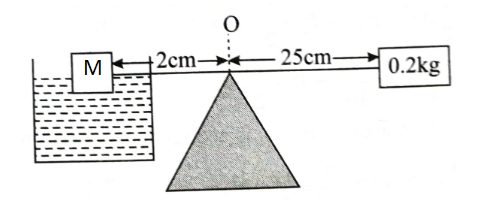
A cube having a side of 10 cm with unknown mass and 200 gm mass were hung at two ends of a uniform rigid rod of 27 cm long. The rod along with masses was placed on a wedge keeping the distance between wedge point and 200 gm weight as 25 cm. Initially the masses were not at balance. A beaker is placed beneath the unknown mass and water is added slowly to it. At given point the masses were in balance and half volume of the unknown mass was inside the water. (Take the density of unknown mass is more than that of the water, the mass did not absorb water and water density is \(1 \mathrm{gm} / \mathrm{cm}^3\).) The unknown mass is ____ kg. [JEE Main 2025 (Online) 8th April Evening Shift]
CorrectIncorrectHint
(c)

To solve for the unknown mass, we need to apply the Principle of Moments (Torque balance) about the wedge (fulcrum).
Step 1: Analyze the Geometry of the Rod
Total length of the rod: 27 cm
Distance from wedge to \(\mathbf{2 0 0 ~ g}\) mass \(\left(d_1\right): \mathbf{2 5 ~ c m}\)
Distance from wedge to unknown mass (\(d_2\)): \(27-25=2 \mathrm{~cm}\)
Step 2: Determine the Forces Acting on the Masses
On the \(\mathbf{2 0 0 ~ g}\) mass (\(m_1\)): The only force is its weight, \(W_1=m_1 g\).
\(m_1=200 \mathrm{~g}=0.2 \mathrm{~kg}\)
On the unknown mass \((M)\) : There are two forces acting downward/upward at this end:
Weight \(\left(W_M\right): M g\) acting downwards.
Buoyant Force \(\left(F_B\right)\) : Acting upwards because it is partially submerged.
Calculating Buoyant Force (\(F_B\)):
Volume of the cube \((V):(10 \mathrm{~cm})^3=1000 \mathrm{~cm}^3\)
Submerged volume (\(V_{\text {sub }}\)): Half of the volume \(=500 \mathrm{~cm}^3\)
Density of water \(\left(\rho_w\right): 1 \mathrm{~g} / \mathrm{cm}^3\)
\(F_B=V_{s u b} \times \rho_w \times g=500 \times 1 \times g=500 g\) (in dynes, where mass is in grams)
In SI units: \(F_B=(0.5 \mathrm{~kg}) \times g\)
The net downward force at the unknown mass end is \((M-0.5) g\).
Step 3: Apply the Torque Balance Equation
For the rod to be in equilibrium, the clockwise torque must equal the counter-clockwise torque about the wedge:
\(
\begin{gathered}
\text { Torque }_1=\text { Torque }_2 \\
m_1 g \times d_1=\left(M-m_{\text {water_displaced }}\right) g \times d_2
\end{gathered}
\)
Substitute the known values (using grams for simplicity in the ratio):
\(
\begin{gathered}
200 \mathrm{~g} \times 25 \mathrm{~cm}=\left(M_{\text {grams }}-500 \mathrm{~g}\right) \times 2 \mathrm{~cm} \\
5000=2 M_{\text {grams }}-1000 \\
2 M_{\text {grams }}=6000 \\
M_{\text {grams }}=3000 \mathrm{~g}
\end{gathered}
\)
Step 4: Convert to Kilograms
\(
M=\frac{3000}{1000} \mathrm{~kg}=3 \mathrm{~kg}
\) - Question 6 of 44
6. Question
The excess pressure inside a soap bubble \(A\) in air is half the excess pressure inside another soap bubble \(B\) in air. If the volume of the bubble \(A\) is \(n\) times the volume of the bubble \(B\), then, the value of \(n\) is ____. [JEE Main 2025 (Online) 3rd April Evening Shift]
CorrectIncorrectHint
(d) To find the value of \(n\), we need to relate the excess pressure inside a soap bubble to its volume.
Step 1: Excess Pressure Formula
For a soap bubble in air (which has two surfaces), the excess pressure \(P\) is given by the formula:
\(
P=\frac{4 T}{R}
\)
where \(T\) is the surface tension and \(R\) is the radius of the bubble.
From this formula, we can see that excess pressure is inversely proportional to the radius:
\(
P \propto \frac{1}{R} \quad \text { or } \quad R \propto \frac{1}{P}
\)
Step 2: Relate the Radii of Bubbles A and B
The problem states that the excess pressure of bubble \(A\left(P_A\right)\) is half the excess pressure of bubble \(B\left(P_B\right)\) :
\(
P_A=\frac{1}{2} P_B \Longrightarrow \frac{P_A}{P_B}=\frac{1}{2}
\)
Using the inverse relationship between radius and pressure:
\(
\frac{R_A}{R_B}=\frac{P_B}{P_A}=\frac{1}{1 / 2}=2
\)
So, \(R_A=2 R_B\).
Step 3: Relate the Volumes
The volume \(V\) of a spherical bubble is given by \(V=\frac{4}{3} \pi R^3\). Therefore, volume is proportional to the cube of the radius:
\(
V \propto R^3
\)
We are given that \(V_A=n V_B\). Let’s set up the ratio:
\(
n=\frac{V_A}{V_B}=\left(\frac{R_A}{R_B}\right)^3
\)
Substitute the ratio of the radii we found in Step 2:
\(
\begin{gathered}
n=(2)^3 \\
n=8
\end{gathered}
\)
The value of \(n\) is 8. - Question 7 of 44
7. Question
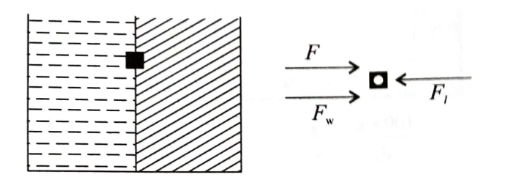
A vessel with square cross-section and height of 6 m is vertically partitioned. A small window of \(100 \mathrm{~cm}^2\) with hinged door is fitted at a depth of 3 m in the partition wall. One part of the vessel is filled completely with water and the other side is filled with the liquid having density \(1.5 \times 10^3 \mathrm{~kg} / \mathrm{m}^3\). What force one needs to apply on the hinged door so that it does not get opened ? [JEE Main 2025 (Online) 2nd April Morning Shift]
(Acceleration due to gravity \(=10 \mathrm{~m} / \mathrm{s}^2\) )CorrectIncorrectHint
(a)

To find the force required to keep the hinged door closed, we must calculate the net pressure acting on the window due to the different liquids on either side of the partition.
Step 1: Identify the Given Parameters
Depth of the window (\(h\)): 3 m
Area of the window \((A): 100 \mathrm{~cm}^2=100 \times 10^{-4} \mathrm{~m}^2=0.01 \mathrm{~m}^2\)
Density of water \(\left(\rho_w\right): 1.0 \times 10^3 \mathrm{~kg} / \mathrm{m}^3\)
Density of the liquid \(\left(\rho_l\right): 1.5 \times 10^3 \mathrm{~kg} / \mathrm{m}^3\)
Acceleration due to gravity \((g): 10 \mathrm{~m} / \mathrm{s}^2\)
Step 2: Calculate the Pressure on Both Sides
The gauge pressure at a depth \(h\) in a fluid is given by \(P=\rho g h\).
Pressure from the water side \(\left(P_w\right)\) :
\(
P_w=\rho_w \cdot g \cdot h=\left(1.0 \times 10^3\right) \cdot 10 \cdot 3=30,000 \mathrm{~Pa}
\)
Pressure from the liquid side (\(P_l\)):
\(
P_l=\rho_l \cdot g \cdot h=\left(1.5 \times 10^3\right) \cdot 10 \cdot 3=45,000 \mathrm{~Pa}
\)
Step 3: Calculate the Net Pressure and Net Force
The net pressure (\(\Delta P\)) acting on the door is the difference between the pressures on both sides:
\(
\Delta P=P_l-P_w=45,000-30,000=15,000 \mathrm{~Pa}
\)
The force (\(F\)) required to keep the door closed must counteract the force exerted by this net pressure:
\(
\begin{gathered}
F=\Delta P \times A \\
F=15,000 \mathrm{~N} / \mathrm{m}^2 \times 0.01 \mathrm{~m}^2 \\
F=150 \mathrm{~N}
\end{gathered}
\)
The force one needs to apply on the hinged door is \(\mathbf{1 5 0 ~ N}\). - Question 8 of 44
8. Question
An air bubble of radius 1.0 mm is observed at a depth 20 cm below the free surface of a liquid having surface tension \(0.095 \mathrm{~J} / \mathrm{m}^2\) and density \(10^3 \mathrm{~kg} / \mathrm{m}^3\). The difference between pressure inside the bubble and atmospheric pressure is ____ \(\mathrm{N} / \mathrm{m}^2\). (Take \(\mathrm{g}=10 \mathrm{~m} / \mathrm{s}^2\)) [JEE Main 2025 (Online) 23rd January Evening Shift]
CorrectIncorrectHint
(b) To find the difference between the pressure inside the air bubble and the atmospheric pressure, we need to account for both the hydrostatic pressure of the liquid and the excess pressure due to surface tension.
Step 1: Identify the Pressure Components
The pressure inside an air bubble (\(P_{i n}\)) submerged in a liquid is balanced by three components:
Atmospheric Pressure (\(P_0\)): Acting on the surface of the liquid.
Hydrostatic Pressure (\(P_h\)): Due to the depth of the liquid.
Excess Pressure (\(P_{e x}\)): Due to the surface tension of the liquid-air interface.
The total pressure inside is:
\(
P_{i n}=P_0+\rho g h+\frac{2 T}{R}
\)
We are asked for the difference between the inside pressure and atmospheric pressure (\(P_{\text {in }}-P_0\)):
\(
\Delta P=\rho g h+\frac{2 T}{R}
\)
Step 2: List the Given Values
Radius \((R)\) : \(1.0 \mathrm{~mm}=10^{-3} \mathrm{~m}\)
Depth (h): \(20 \mathrm{~cm}=0.2 \mathrm{~m}\)
Surface Tension \((T)\) : \(0.095 \mathrm{~J} / \mathrm{m}^2\) (Note: \(1 \mathrm{~J} / \mathrm{m}^2=1 \mathrm{~N} / \mathrm{m}\))
Density (\(\rho\)): \(10^3 \mathrm{~kg} / \mathrm{m}^3\)
Gravity (\(g\)): \(10 \mathrm{~m} / \mathrm{s}^2\)
Step 3: Calculate each Component
Hydrostatic Pressure (\(\rho g h\)):
\(
\begin{gathered}
P_h=10^3 \times 10 \times 0.2 \\
P_h=2000 \mathrm{~N} / \mathrm{m}^2
\end{gathered}
\)
Excess Pressure \(\left(\frac{2 T}{R}\right)\) :
Note: An air bubble inside a liquid has only one surface (liquid-air interface), unlike a soap bubble in air which has two.
\(
\begin{gathered}
P_{e x}=\frac{2 \times 0.095}{10^{-3}} \\
P_{e x}=\frac{0.19}{10^{-3}}=190 \mathrm{~N} / \mathrm{m}^2
\end{gathered}
\)
Step 4: Calculate the Total Pressure Difference
\(
\begin{gathered}
\Delta P=P_h+P_{e x} \\
\Delta P=2000+190 \\
\Delta P=2190 \mathrm{~N} / \mathrm{m}^2
\end{gathered}
\)
The difference between the pressure inside the bubble and the atmospheric pressure is 2190 \(\mathrm{N} / \mathrm{m}^2\). - Question 9 of 44
9. Question
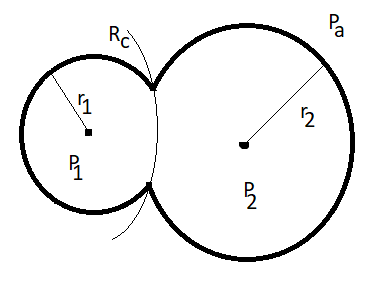
Two soap bubbles of radius 2 cm and 4 cm , respectively, are in contact with each other. The radius of curvature of the common surface, in cm , is _____. [JEE Main 2025 (Online) 22nd January Morning Shift]
CorrectIncorrectHint
(a) To find the radius of curvature of the common surface between two contacting soap bubbles, we must look at the pressure difference across that surface.

Step 1: Analyze the Pressure in Each Bubble
The excess pressure inside a soap bubble of radius \(r\) is given by \(P=\frac{4 T}{r}\). Let the two bubbles have radii \(r_1=2 \mathrm{~cm}\) and \(r_2=4 \mathrm{~cm}\).
Pressure inside bubble \(1\left(P_1\right): P_0+\frac{4 T}{r_1}\)
Pressure inside bubble \(2\left(P_2\right): P_0+\frac{4 T}{r_2}\)
Since \(r_1<r_2\), the pressure inside the smaller bubble \(\left(P_1\right)\) is greater than the pressure inside the larger bubble (\(P_2\)).
Step 2: Determine the Pressure Difference at the Interface
When the bubbles are in contact, the common surface will bulge toward the larger bubble because of the higher pressure in the smaller one. The pressure difference across this common interface (\(\Delta P\)) is:
\(
\begin{gathered}
\Delta P=P_1-P_2 \\
\Delta P=\left(P_0+\frac{4 T}{r_1}\right)-\left(P_0+\frac{4 T}{r_2}\right) \\
\Delta P=4 T\left(\frac{1}{r_1}-\frac{1}{r_2}\right)
\end{gathered}
\)
Step 3: Calculate the Radius of Curvature (\(R_c\))
The common interface is itself a spherical surface governed by the same surface tension laws. Therefore, the pressure difference across it must also satisfy:
\(
\Delta P=\frac{4 T}{R_c}
\)
Equating the two expressions for \(\Delta P\) :
\(
\begin{gathered}
\frac{4 T}{R_c}=4 T\left(\frac{1}{r_1}-\frac{1}{r_2}\right) \\
\frac{1}{R_c}=\frac{1}{r_1}-\frac{1}{r_2} \\
R_c=\frac{r_1 r_2}{r_2-r_1}
\end{gathered}
\)
Step 4: Substitute the Values
Substitute \(r_1=2 \mathrm{~cm}\) and \(r_2=4 \mathrm{~cm}\) :
\(
\begin{gathered}
R_c=\frac{2 \times 4}{4-2} \\
R_c=\frac{8}{2} \\
R_c=4 \mathrm{~cm}
\end{gathered}
\)
The radius of curvature of the common surface is \(\mathbf{4 ~ c m}\). - Question 10 of 44
10. Question
Small water droplets of radius 0.01 mm are formed in the upper atmosphere and falling with a terminal velocity of \(10 \mathrm{~cm} / \mathrm{s}\). Due to condensation, if 8 such droplets are coalesced and formed a larger drop, the new terminal velocity will be _____ \(\mathrm{cm} / \mathrm{s}\). [JEE Main 2024 (Online) 8th April Evening Shift]
CorrectIncorrectHint
(d) To find the new terminal velocity of the larger drop, we follow a similar logic to previous coalescence problems, focusing on the change in radius and how it influences velocity.
Step 1: Find the Radius of the Larger Drop
When 8 small droplets coalesce into one large drop, the total volume remains conserved. Let \(r\) be the radius of the small droplet and \(R\) be the radius of the larger drop.
\(
\begin{gathered}
V_{\text {large }}=8 \times V_{\text {small }} \\
\frac{4}{3} \pi R^3=8 \times\left(\frac{4}{3} \pi r^3\right) \\
R^3=8 r^3
\end{gathered}
\)
Taking the cube root of both sides:
\(
\begin{gathered}
R=\sqrt[3]{8} \times r \\
R=2 r
\end{gathered}
\)
Step 2: Relate Terminal Velocity to Radius
According to Stokes’ Law, the terminal velocity \(\left(v_t\right)\) of a spherical body is directly proportional to the square of its radius \(\left(r^2\right)\), assuming the density of the medium and the viscosity remain constant:
\(
v_t \propto r^2
\)
Step 3: Calculate the New Terminal Velocity
Let \(v_1\) be the initial terminal velocity (\(10 \mathrm{~cm} / \mathrm{s}\)) and \(v_2\) be the new terminal velocity. We can set up the following ratio:
\(
\frac{v_2}{v_1}=\left(\frac{R}{r}\right)^2
\)
Substitute \(R=2 r\) :
\(
\begin{gathered}
\frac{v_2}{10}=\left(\frac{2 r}{r}\right)^2 \\
\frac{v_2}{10}=2^2 \\
\frac{v_2}{10}=4 \\
v_2=4 \times 10=40 \mathrm{~cm} / \mathrm{s}
\end{gathered}
\)
The new terminal velocity is \(40 \mathrm{~cm} / \mathrm{s}\). - Question 11 of 44
11. Question
A liquid column of height 0.04 cm balances excess pressure of a soap bubble of certain radius. If density of liquid is \(8 \times 10^3 \mathrm{~kg} \mathrm{~m}^{-3}\) and surface tension of soap solution is \(0.28 \mathrm{Nm}^{-1}\), then diameter of the soap bubble is ____ cm. (if \(\mathrm{g}=10 \mathrm{~m} \mathrm{~s}^{-2}\))
CorrectIncorrectHint
(c) To find the diameter of the soap bubble, we need to equate the hydrostatic pressure of the liquid column to the excess pressure inside the soap bubble.
Step 1: Calculate the Hydrostatic Pressure
The pressure exerted by the liquid column is given by the formula \(P=h \rho g\). First, we convert the height from centimeters to meters: \(h=0.04 \mathrm{~cm}=4 \times 10^{-4} \mathrm{~m}\). Substituting the given values:
\(
P=\left(4 \times 10^{-4} \mathrm{~m}\right)\left(8 \times 10^3 \mathrm{~kg} \mathrm{~m}^{-3}\right)\left(10 \mathrm{~m} \mathrm{~s}^{-2}\right)=32 \mathrm{~Pa}
\)
Step 2: Equate Excess Pressure to Hydrostatic Pressure
A soap bubble has two air-liquid interfaces, so its excess pressure is \(P_{e x}=\frac{4 T}{R}\), where \(T\) is the surface tension and \(R\) is the radius. Since the liquid column balances this pressure:
\(
\frac{4 T}{R}=32 \mathrm{~Pa}
\)
Substitute \(T=0.28 \mathrm{~N} / \mathrm{m}\) :
\(
\frac{4 \times 0.28}{R}=32 \Longrightarrow \frac{1.12}{R}=32
\)
Step 3: Solve for Diameter
Rearrange to find the radius \(R\) :
\(
R=\frac{1.12}{32}=0.035 \mathrm{~m}
\)
The diameter \(D\) is twice the radius:
\(
D=2 R=2 \times 0.035 \mathrm{~m}=0.07 \mathrm{~m}
\)
Convert the diameter back to centimeters:
\(
D=0.07 \times 100=7 \mathrm{~cm}
\)
The diameter of the soap bubble is 7 cm. - Question 12 of 44
12. Question
A big drop is formed by coalescing 1000 small droplets of water. The ratio of surface energy of 1000 droplets to that of energy of big drop is \(\frac{10}{x}\). The value of \(x\) is _____. [JEE Main 2024 (Online) 6th April Morning Shift]
CorrectIncorrectHint
(a) To find the value of \(x\), we need to compare the total surface energy of the initial droplets to the surface energy of the single large drop formed after coalescence.
Step 1: Find the Radius of the Big Drop
When 1000 small droplets coalesce, the total volume remains constant. Let \(r\) be the radius of a small droplet and \(R\) be the radius of the big drop.
\(
\begin{gathered}
V_{\text {big }}=1000 \times V_{\text {small }} \\
\frac{4}{3} \pi R^3=1000 \times \frac{4}{3} \pi r^3 \\
R^3=1000 r^3
\end{gathered}
\)
Taking the cube root of both sides:
\(
R=\sqrt[3]{1000} \times r=10 r
\)
Step 2: Calculate Surface Energies
Surface energy (\(U\)) is defined as the product of surface tension (\(T\)) and surface area (\(A\)).
\(
U=T \times A
\)
Surface energy of 1000 small droplets (\(U_{\text {small_total }}\)):
\(
U_{\text {small_total }}=1000 \times\left(T \times 4 \pi r^2\right)=4000 \pi r^2 T
\)
Surface energy of the big drop (\(U_{\text {big }}\)):
\(
U_{b i g}=T \times 4 \pi R^2
\)
Substitute \(R=10 r\) :
\(
U_{b i g}=T \times 4 \pi(10 r)^2=400 \pi r^2 T
\)
Step 3: Find the Ratio and Solve for \(x\)
The problem asks for the ratio of the surface energy of the 1000 droplets to that of the big drop:
\(
\begin{gathered}
\text { Ratio }=\frac{U_{\text {small_total }}}{U_{\text {big }}}=\frac{4000 \pi r^2 T}{400 \pi r^2 T} \\
\text { Ratio }=\frac{4000}{400}=10
\end{gathered}
\)
According to the problem, this ratio is given as \(\frac{10}{x}\) :
\(
\begin{aligned}
10 & =\frac{10}{x} \\
x & =1
\end{aligned}
\)
The value of \(x\) is 1. - Question 13 of 44
13. Question
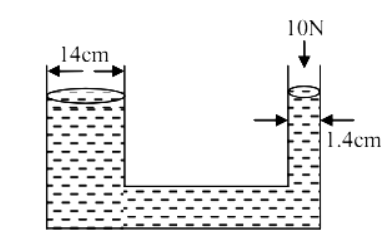
A hydraulic press containing water has two arms with diameters as mentioned in the figure. A force of 10 N is applied on the surface of water in the thinner arm. The force required to be applied on the surface of water in the thicker arm to maintain equilibrium of water is ____ N. [JEE Main 2024 (Online) 5th April Evening Shift]
 CorrectIncorrect
Hint
(c) According to Pascal’s Law, the pressure applied to an enclosed fluid is transmitted undiminished to every portion of the fluid. For equilibrium at the same horizontal level:
\(
\begin{aligned}
& P_1=P_2 \\
& \frac{F_1}{A_1}=\frac{F_2}{A_2}
\end{aligned}
\)
Where \(A\) is the cross-sectional area, calculated as \(A=\frac{\pi d^2}{4}\).
The ratio of the areas is proportional to the square of the ratio of the diameters:
\(
\begin{gathered}
\frac{F_1}{d_1^2}=\frac{F_2}{d_2^2} \\
F_2=F_1 \times\left(\frac{d_2}{d_1}\right)^2
\end{gathered}
\)
Substitute the known values:
\(
\begin{gathered}
F_2=10 \times\left(\frac{14}{1.4}\right)^2 \\
F_2=10 \times(10)^2 \\
F_2=10 \times 100=1000 \mathrm{~N}
\end{gathered}
\)
The force required to be applied on the thicker arm is \(\mathbf{1 , 0 0 0 ~ N}\). - Question 14 of 44
14. Question
Mercury is filled in a tube of radius 2 cm up to a height of 30 cm . The force exerted by mercury on the bottom of the tube is ____ N. (Given, atmospheric pressure \(=10^5 \mathrm{Nm}^{-2}\), density of mercury \(=1.36 \times 10^4 \mathrm{~kg} \mathrm{~m}^{-3}, \mathrm{~g}=10 \mathrm{~m} \mathrm{~s}^{-2}, \pi=\frac{22}{7}\)) [JEE Main 2024 (Online) 4th April Evening Shift]
CorrectIncorrectHint
(d)
\(
\begin{aligned}
F & =\left(p_0+\rho g h\right) A \\
& =\left(10^5+1.36 \times 10^4 \times 10 \times \frac{3}{10}\right) \frac{22}{7}\left(\frac{2}{100}\right)^2 \\
& =177 \mathrm{~N}
\end{aligned}
\)Explanation: To find the force exerted by mercury on the bottom of the tube, we need to calculate the total pressure at the bottom and then multiply it by the cross-sectional area of the tube.
Step 1: Identify the Given Parameters
Radius (\(r\)): \(2 \mathrm{~cm}=0.02 \mathrm{~m}\)
Height (\(h\)): \(30 \mathrm{~cm}=0.3 \mathrm{~m}\)
Density of mercury (\(\rho\)): \(1.36 \times 10^4 \mathrm{~kg} / \mathrm{m}^3\)
Atmospheric pressure (\(P_{a t m}\)): \(10^5 \mathrm{~N} / \mathrm{m}^2\)
Gravity (\(g\)): \(10 \mathrm{~m} / \mathrm{s}^2\)
Constant (\(\pi\)): \(22 / 7\)
Step 2: Calculate the Total Pressure at the Bottom
The total pressure (\(P_{\text {total }}\)) at the bottom of the tube is the sum of the atmospheric pressure and the hydrostatic pressure exerted by the mercury column.
\(
P_{\text {total }}=P_{a t m}+\rho g h
\)
Substitute the values:
\(
P_{\text {total }}=10^5+\left(1.36 \times 10^4 \times 10 \times 0.3\right)
\)
\(
\begin{gathered}
P_{\text {total }}=100,000+(136,000 \times 0.3) \\
P_{\text {total }}=100,000+40,800=140,800 \mathrm{~N} / \mathrm{m}^2
\end{gathered}
\)
Step 3: Calculate the Cross-Sectional Area
The area (\(A\)) of the bottom of the tube is:
\(
\begin{gathered}
A=\pi r^2=\frac{22}{7} \times(0.02)^2 \\
A=\frac{22}{7} \times 0.0004=\frac{0.0088}{7} \mathrm{~m}^2
\end{gathered}
\)
Step 4: Calculate the Force
The force \((F)\) exerted on the bottom is the product of the total pressure and the area:
\(
\begin{gathered}
F=P_{\text {total }} \times A \\
F=140,800 \times \frac{0.0088}{7} \\
F=\frac{1239.04}{7} \\
F \approx 177 \mathrm{~N}
\end{gathered}
\)
The force exerted by mercury on the bottom of the tube is \(\mathbf{1 7 7} \mathbf{N}\). - Question 15 of 44
15. Question
A soap bubble is blown to a diameter of 7 cm. 36960 erg of work is done in blowing it further. If surface tension of soap solution is \(40 \mathrm{dyne} / \mathrm{cm}\) then the new radius is ____ cm Take \(\left(\pi=\frac{22}{7}\right)\). [JEE Main 2024 (Online) 4th April Morning Shift]
CorrectIncorrectHint
(a) To find the new radius of the soap bubble, we use the relationship between surface tension, surface area, and work done. Since the units are given in CGS (erg, dyne/cm, cm), we will perform all calculations in that system.
Step 1: Establish the Work Done Formula
A soap bubble has two surfaces (inner and outer). The work done (\(W\)) to increase the surface area is:
\(
\begin{gathered}
W=T \times \Delta A \\
W=T \times\left[8 \pi\left(R_2^2-R_1^2\right)\right]
\end{gathered}
\)
Step 2: Identify the Given Values
Initial diameter \(\left(d_1\right): 7 \mathrm{~cm}\)
Initial radius \(\left(R_1\right): 3.5 \mathrm{~cm}\)
Work done (\(W\)): 36960 erg
Surface tension (\(T\)): 40 dyne \(/ \mathrm{cm}\)
Constant (\(\pi\)): \(22 / 7\)
Step 3: Set up the Equation
Substitute the known values into the work done formula:
\(
36960=40 \times 8 \times \frac{22}{7} \times\left(R_2^2-3.5^2\right)
\)
\(
R_2=7 \mathrm{~cm}
\)
The new radius is \(\mathbf{7 c m}\). - Question 16 of 44
16. Question
A plane is in level flight at constant speed and each of its two wings has an area of \(40 \mathrm{~m}^2\). If the speed of the air is \(180 \mathrm{~km} / \mathrm{h}\) over the lower wing surface and \(252 \mathrm{~km} / \mathrm{h}\) over the upper wing surface, the mass of the plane is ____ kg. (Take air density to be \(1 \mathrm{~kg} \mathrm{~m}^{-3}\) and \(\mathrm{g}=10 \mathrm{~ms}^{-2}\)) [JEE Main 2024 (Online) 1st February Morning Shift]
CorrectIncorrectHint
(c) To find the mass of the plane, we apply Bernoulli’s Principle, which relates the pressure difference between the top and bottom of the wings to the lift force generated.
Step 1: Identify Given Values and Convert Units
Total Wing Area (\(A\)): Two wings of \(40 \mathrm{~m}^2\) each \(\Longrightarrow A=2 \times 40=80 \mathrm{~m}^2\).
Air Speed over Lower Surface \(\left(v_1\right): 180 \mathrm{~km} / \mathrm{h}=180 \times \frac{5}{18}=50 \mathrm{~m} / \mathrm{s}\).
Air Speed over Upper Surface \(\left(v_2\right): 252 \mathrm{~km} / \mathrm{h}=252 \times \frac{5}{18}=70 \mathrm{~m} / \mathrm{s}\).
Air Density (\(\rho\)): \(1 \mathrm{~kg} / \mathrm{m}^3\).
Gravity (\(g\)): \(10 \mathrm{~m} / \mathrm{s}^2\).
Step 2: Calculate the Pressure Difference
According to Bernoulli’s equation (assuming the height difference between the wing surfaces is negligible):
\(
P_1+\frac{1}{2} \rho v_1^2=P_2+\frac{1}{2} \rho v_2^2
\)
The pressure difference (\(\Delta P\)) is:
\(
\Delta P=P_1-P_2=\frac{1}{2} \rho\left(v_2^2-v_1^2\right)
\)
Substitute the values:
\(
\begin{gathered}
\Delta P=\frac{1}{2} \times 1 \times\left(70^2-50^2\right) \\
\Delta P=\frac{1}{2} \times(4900-2500) \\
\Delta P=\frac{1}{2} \times 2400=1200 \mathrm{~N} / \mathrm{m}^2
\end{gathered}
\)
Step 3: Equate Lift Force to Weight
For level flight at constant speed, the lift force (\(F_L\)) must equal the weight of the plane (\(m g\)):
\(
\begin{gathered}
F_L=m g \\
\Delta P \times A=m g
\end{gathered}
\)
Substitute the known values to solve for \(m\) :
\(
\begin{gathered}
1200 \times 80=m \times 10 \\
96000=10 \mathrm{~m} \\
m=9600 \mathrm{~kg}
\end{gathered}
\)
The mass of the plane is 9600 kg. - Question 17 of 44
17. Question
A big drop is formed by coalescing 1000 small identical drops of water. If \(E_1\) be the total surface energy of 1000 small drops of water and \(E_2\) be the surface energy of single big drop of water, then \(E_1: E_2\) is \(x: 1\) where \(x=\) ____. [JEE Main 2024 (Online) 30th January Evening Shift]
CorrectIncorrectHint
(a) To find the value of \(x\), we need to compare the total surface energy of the initial small drops with the surface energy of the final big drop.
Step 1: Find the Relationship between Radii
When 1000 small droplets coalesce into one big drop, the total volume remains constant. Let \(r\) be the radius of each small drop and \(R\) be the radius of the big drop.
\(
\begin{gathered}
V_{\text {big }}=1000 \times V_{\text {small }} \\
\frac{4}{3} \pi R^3=1000 \times\left(\frac{4}{3} \pi r^3\right) \\
R^3=1000 r^3
\end{gathered}
\)
Taking the cube root of both sides:
\(
R=10 r
\)
Step 2: Calculate Surface Energies
Surface energy (\(E\)) is given by the product of surface tension (\(T\)) and the total surface area (\(\boldsymbol{A}\)):
\(
E=T \times A
\)
Total surface energy of 1000 small drops (\(E_1\)):
\(
E_1=1000 \times\left(T \times 4 \pi r^2\right)=4000 \pi r^2 T
\)
Surface energy of the single big drop (\(E_2\)):
\(
E_2=T \times 4 \pi R^2
\)
Substitute \(R=10 r\) :
\(
E_2=T \times 4 \pi(10 r)^2=400 \pi r^2 T
\)
Step 3: Find the Ratio \(E_1: E_2\)
Now, calculate the ratio of the two energies:
\(
\begin{aligned}
& \frac{E_1}{E_2}=\frac{4000 \pi r^2 T}{400 \pi r^2 T} \\
& \frac{E_1}{E_2}=\frac{4000}{400}=10
\end{aligned}
\)
So, \(E_1: E_2=10: 1\).
The problem states that the ratio \(E_1: E_2\) is \(x: 1\). By comparing:
\(
\begin{gathered}
x: 1=10: 1 \\
x=10
\end{gathered}
\) - Question 18 of 44
18. Question
In a test experiment on a model aeroplane in wind tunnel, the flow speeds on the upper and lower surfaces of the wings are \(70 \mathrm{~ms}^{-1}\) and \(65 \mathrm{~ms}^{-1}\) respectively. If the wing area is \(2 \mathrm{~m}^2\), the lift of the wing is ____ \(N\). (Given density of air \(=1.2 \mathrm{~kg} \mathrm{~m}^{-3}\)) [JEE Main 2024 (Online) 29th January Morning Shift]
CorrectIncorrectHint
(d)
\(
\begin{aligned}
& \mathrm{F}=\frac{1}{2} \rho\left(\mathrm{v}_1^2-\mathrm{v}_2^2\right) \mathrm{A} \\
& \mathrm{~F}=\frac{1}{2} \times 1.2 \times\left(70^2-65^2\right) \times 2 \\
& =810 \mathrm{~N}
\end{aligned}
\)Explanation:
To find the lift on the aeroplane wing, we use Bernoulli’s Principle, which relates the speed of a fluid to its pressure.
Step 1: Understand the Principle of Lift
According to Bernoulli’s equation, for a horizontal flow, the sum of pressure and kinetic energy per unit volume is constant:
\(
P_1+\frac{1}{2} \rho v_1^2=P_2+\frac{1}{2} \rho v_2^2
\)
Where:
\(P_1, v_1\) are pressure and velocity at the lower surface.
\(P_2, v_2\) are pressure and velocity at the upper surface.
\(\rho\) is the density of air.
Because the air moves faster over the top surface \(\left(v_2>v_1\right)\), the pressure on top is lower (\(P_2<P_1\)). This pressure difference creates the upward lift force.
Step 2: Calculate the Pressure Difference (\(\boldsymbol{\Delta} \boldsymbol{P}\))
Rearranging the Bernoulli equation to find \(\Delta P=P_1-P_2\) :
\(
\Delta P=\frac{1}{2} \rho\left(v_2^2-v_1^2\right)
\)
Given values:
\(v_2=70 \mathrm{~m} / \mathrm{s}\) (Upper surface)
\(v_1=65 \mathrm{~m} / \mathrm{s}\) (Lower surface)
\(\rho=1.2 \mathrm{~kg} / \mathrm{m}^3\)
Substitute the values:
\(
\begin{aligned}
& \Delta P=\frac{1}{2} \times 1.2 \times\left(70^2-65^2\right) \\
& \Delta P=0.6 \times(4900-4225) \\
& \Delta P=0.6 \times 675=405 \mathrm{~N} / \mathrm{m}^2
\end{aligned}
\)
Step 3: Calculate the Lift Force (\(F\))
The lift force is the product of the pressure difference and the total wing area (\(\boldsymbol{A}\)):
\(
F=\Delta P \times A
\)
Given:
\(A=2 \mathrm{~m}^2\)
\(
F=405 \times 2=810 \mathrm{~N}
\)
The lift of the wing is \(\mathbf{8 1 0 ~} \mathbf{N}\). - Question 19 of 44
19. Question
The reading of pressure metre attached with a closed pipe is \(4.5 \times 10^4 \mathrm{~N} / \mathrm{m}^2\). On opening the valve, water starts flowing and the reading of pressure metre falls to \(2.0 \times 10^4 \mathrm{~N} / \mathrm{m}^2\). The velocity of water is found to be \(\sqrt{V} \mathrm{~m} / \mathrm{s}\). The value of \(V\) is ____. [JEE Main 2024 (Online) 27th January Evening Shift]
CorrectIncorrectHint
(b) To find the value of \(V\), we use Bernoulli’s Principle, which relates the pressure and velocity of a fluid at different points in a streamline.
Step 1: Establish the Principle
According to Bernoulli’s equation for a horizontal pipe:
\(
P_1+\frac{1}{2} \rho v_1^2=P_2+\frac{1}{2} \rho v_2^2
\)
Where:
\(P_1\) and \(v_1\) are the initial pressure and velocity (closed pipe).
\(P_2\) and \(v_2\) are the final pressure and velocity (open valve).
\(\rho\) is the density of water \(\left(1000 \mathrm{~kg} / \mathrm{m}^3\right)\).
Step 2: Identify the Given Values
Initial Pressure \(\left(P_1\right): 4.5 \times 10^4 \mathrm{~N} / \mathrm{m}^2\)
Initial Velocity \(\left(v_1\right)\) : Since the pipe is closed, \(v_1=0 \mathrm{~m} / \mathrm{s}\).
Final Pressure \(\left(P_2\right): 2.0 \times 10^4 \mathrm{~N} / \mathrm{m}^2\)
Final Velocity \(\left(v_2\right): \sqrt{V} \mathrm{~m} / \mathrm{s}\).
Step 3: Solve for \(V\)
Substituting the values into the Bernoulli equation:
\(
4.5 \times 10^4+\frac{1}{2}(1000)(0)^2=2.0 \times 10^4+\frac{1}{2}(1000)(\sqrt{V})^2
\)
Simplify the equation:
\(
4.5 \times 10^4=2.0 \times 10^4+500 V
\)
Subtract \(2.0 \times 10^4\) from both sides:
\(
\begin{gathered}
2.5 \times 10^4=500 V \\
25000=500 V
\end{gathered}
\)
\(
V=50
\) - Question 20 of 44
20. Question
There is an air bubble of radius 1.0 mm in a liquid of surface tension \(0.075 \mathrm{Nm}^{-1}\) and density \(1000 \mathrm{~kg} \mathrm{~m}^{-3}\) at a depth of 10 cm below the free surface. The amount by which the pressure inside the bubble is greater than the atmospheric pressure is _____ \(\mathrm{Pa}\left(\mathrm{g}=10 \mathrm{~ms}^{-2}\right)\) [JEE Main 2023 (Online) 15th April Morning Shift]
CorrectIncorrectHint
(d) To find the total pressure difference between the inside of the air bubble and the atmosphere, we need to account for two factors: the hydrostatic pressure of the liquid and the excess pressure created by surface tension.
Step 1: Hydrostatic Pressure (\(P_h\))
The pressure exerted by the liquid at a certain depth is given by:
\(
P_h=\rho g h
\)
Given values:
Density \((\rho)=1000 \mathrm{~kg} \mathrm{~m}^{-3}\)
Gravity \((g)=10 \mathrm{~ms}^{-2}\)
Depth \((h)=10 \mathrm{~cm}=0.1 \mathrm{~m}\)
\(
P_h=1000 \times 10 \times 0.1=1000 \mathrm{~Pa}
\)
Step 2: Excess Pressure (\(P_{e x}\))
An air bubble inside a liquid has only one liquid-air interface. Therefore, the excess pressure is:
\(
P_{e x}=\frac{2 T}{R}
\)
Given values:
Surface tension \((T)=0.075 \mathrm{Nm}^{-1}\)
Radius \((R)=1.0 \mathrm{~mm}=10^{-3} \mathrm{~m}\)
\(
P_{e x}=\frac{2 \times 0.075}{10^{-3}}=\frac{0.15}{0.01}=150 \mathrm{~Pa}
\)
Step 3: Total Pressure Difference
The pressure inside the bubble (\(P_{i n}\)) is greater than the atmospheric pressure (\(P_0\)) by the sum of the liquid pressure and the excess pressure:
\(
\begin{gathered}
\Delta P=P_{i n}-P_0=P_h+P_{e x} \\
\Delta P=1000 \mathrm{~Pa}+150 \mathrm{~Pa}=1150 \mathrm{~Pa}
\end{gathered}
\)
The amount by which the pressure inside the bubble is greater than the atmospheric pressure is \(\mathbf{1 1 5 0 ~ P a}\). - Question 21 of 44
21. Question
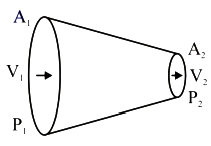
Glycerin of density \(1.25 \times 10^3 \mathrm{~kg} \mathrm{~m}^{-3}\) is flowing through the conical section of pipe The area of cross-section of the pipe at its ends are \(10 \mathrm{~cm}^2\) and \(5 \mathrm{~cm}^2\) and pressure drop across its length is \(3 \mathrm{Nm}^{-2}\). The rate of flow of glycerin through the pipe is \(x \times 10^{-5} \mathrm{~m}^3 \mathrm{~s}^{-1}\). The value of \(x\) is ____. [JEE Main 2023 (Online) 12th April Morning Shift]
CorrectIncorrectHint
(c) To find the rate of flow (discharge) of glycerin, we need to use the Equation of Continuity and Bernoulli’s Principle.
Step 1: Identify Given Parameters
Density (\(\rho\)): \(1.25 \times 10^3 \mathrm{~kg} \mathrm{~m}^{-3}\)
Area at end \(1\left(A_1\right): 10 \mathrm{~cm}^2=10 \times 10^{-4} \mathrm{~m}^2=10^{-3} \mathrm{~m}^2\)
Area at end \(2\left(A_2\right): 5 \mathrm{~cm}^2=5 \times 10^{-4} \mathrm{~m}^2\)
Pressure drop \(\left(\Delta P=P_1-P_2\right): 3 \mathrm{Nm}^{-2}\)
Step 2: Use the Equation of Continuity
The volume flow rate \((Q)\) is constant throughout the pipe:
\(
Q=A_1 v_1=A_2 v_2
\)
From this, we can express the velocities in terms of \(Q\) :
\(
v_1=\frac{Q}{A_1} \quad \text { and } \quad v_2=\frac{Q}{A_2}
\)
Step 3: Apply Bernoulli’s Principle
For a horizontal pipe, the height remains constant, so:
\(
\begin{gathered}
P_1+\frac{1}{2} \rho v_1^2=P_2+\frac{1}{2} \rho v_2^2 \\
P_1-P_2=\frac{1}{2} \rho\left(v_2^2-v_1^2\right)
\end{gathered}
\)
Substitute \(v_1\) and \(v_2\) with the flow rate \(Q\) :
\(
\Delta P=\frac{1}{2} \rho\left(\frac{Q^2}{A_2^2}-\frac{Q^2}{A_1^2}\right)=\frac{1}{2} \rho Q^2\left(\frac{1}{A_2^2}-\frac{1}{A_1^2}\right)
\)
Step 4: Solve for \(Q\)
Plugging in the area values:
\(
\begin{aligned}
& \frac{1}{A_2^2}=\frac{1}{\left(5 \times 10^{-4}\right)^2}=\frac{1}{25 \times 10^{-8}}=0.04 \times 10^8=4 \times 10^6 \\
& \frac{1}{A_1^2}=\frac{1}{\left(10 \times 10^{-4}\right)^2}=\frac{1}{100 \times 10^{-8}}=0.01 \times 10^8=1 \times 10^6
\end{aligned}
\)
Difference: \(\left(4 \times 10^6-1 \times 10^6\right)=3 \times 10^6 \mathrm{~m}^{-4}\)
Now substitute everything into the Bernoulli equation:
\(
3=\frac{1}{2} \times\left(1.25 \times 10^3\right) \times Q^2 \times\left(3 \times 10^6\right)
\)
Divide both sides by 3:
\(
\begin{gathered}
1=\frac{1}{2} \times 1.25 \times 10^3 \times Q^2 \times 10^6 \\
1=\frac{1.25}{2} \times 10^9 \times Q^2 \\
Q^2=\frac{2}{1.25 \times 10^9}=\frac{1.6}{10^9}=16 \times 10^{-10}
\end{gathered}
\)
Taking the square root:
\(
Q=4 \times 10^{-5} \mathrm{~m}^3 \mathrm{~s}^{-1}
\)
Step 5: Determine \(x\)
The problem gives the flow rate as \(x \times 10^{-5} \mathrm{~m}^3 \mathrm{~s}^{-1}\).
Comparing \(4 \times 10^{-5}\) with \(x \times 10^{-5}\) :
\(
x=4
\)
The value of \(x\) is 4. - Question 22 of 44
22. Question
The surface tension of soap solution is \(3.5 \times 10^{-2} \mathrm{Nm}^{-1}\). The amount of work done required to increase the radius of soap bubble from 10 cm to 20 cm is ____ \(\times 10^{-4} \mathrm{~J}\). (take \(\pi=22 / 7\)) [JEE Main 2023 (Online) 11th April Evening Shift]
CorrectIncorrectHint
(d) To find the work done in increasing the radius of the soap bubble, we calculate the change in surface energy.
Step 1: Identify the formula for work done
A soap bubble has two free surfaces (inner and outer). The work done (\(W\)) in increasing the radius of a soap bubble is equal to the increase in its surface energy, which is the product of surface tension \(({T})\) and the change in total surface area \((\Delta A)\).
\(
\begin{gathered}
W=T \times \Delta A=T \times 2 \times\left(4 \pi R_2^2-4 \pi R_1^2\right) \\
W=8 \pi T\left(R_2^2-R_1^2\right)
\end{gathered}
\)
Step 2: Substitute the given values
Given values:
Surface tension \(T=3.5 \times 10^{-2} \mathrm{Nm}^{-1}\)
Initial radius \(R_1=10 \mathrm{~cm}=0.1 \mathrm{~m}\)
Final radius \(R_2=20 \mathrm{~cm}=0.2 \mathrm{~m}\)
\(\pi=22 / 7\)
Substitute these into the equation:
\(
W=8 \times \frac{22}{7} \times\left(3.5 \times 10^{-2}\right) \times\left(0.2^2-0.1^2\right)
\)
Step 3: Perform the calculation
Simplify the expression:
\(
\begin{gathered}
W=8 \times 22 \times\left(0.5 \times 10^{-2}\right) \times(0.04-0.01) \\
W=176 \times 0.5 \times 10^{-2} \times 0.03 \\
W=88 \times 0.03 \times 10^{-2} \\
W=2.64 \times 10^{-2} \mathrm{~J}
\end{gathered}
\)
To express this in the form \(x \times 10^{-4} \mathrm{~J}\) :
\(
W=264 \times 10^{-4} \mathrm{~J}
\)
The required value is 264. - Question 23 of 44
23. Question
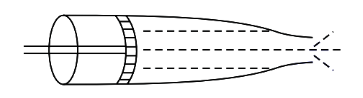
Figure below shows a liquid being pushed out of the tube by a piston having area of cross section \(2.0 \mathrm{~cm}^2\). The area of cross section at the outlet is \(10 \mathrm{~mm}^2\). If the piston is pushed at a speed of \(4 \mathrm{~cm} \mathrm{~s}^{-1}\), the speed of outgoing fluid is ____ \(\mathrm{cms}^{-1}\) [JEE Main 2023 (Online) 10th April Evening Shift]
 CorrectIncorrect
Hint
(a) By equation of continuity
\(
\begin{aligned}
& A_1 V_1=A_2 V_2 \\
& V_2=\frac{2 \times 4}{10 \times 10^{-2}}=80 \mathrm{~cm} / \mathrm{s}
\end{aligned}
\) - Question 24 of 44
24. Question
An air bubble of diameter 6 mm rises steadily through a solution of density \(1750 \mathrm{~kg} / \mathrm{m}^3\) at the rate of \(0.35 \mathrm{~cm} / \mathrm{s}\). The co-efficient of viscosity of the solution (neglect density of air) is ____ Pas (given, \(\mathrm{g}=10 \mathrm{~ms}^{-2}\)). [JEE Main 2023 (Online) 8th April Morning Shift]
CorrectIncorrectHint
(b) To find the coefficient of viscosity \((\eta)\) of the solution, we use the formula for the terminal velocity of a spherical body moving through a viscous medium.
Step 1: Identify the Given Parameters
Diameter of the bubble (\(D\)): \(6 \mathrm{~mm}=6 \times 10^{-3} \mathrm{~m}\)
Radius of the bubble \((r)\) : \(3 \times 10^{-3} \mathrm{~m}\)
Terminal Velocity (\(v\)): \(0.35 \mathrm{~cm} / \mathrm{s}=3.5 \times 10^{-3} \mathrm{~m} / \mathrm{s}\)
Density of the solution \((\sigma): 1750 \mathrm{~kg} / \mathrm{m}^3\)
Density of air (\(\rho\)): Neglected ( 0 )
Acceleration due to gravity \((g): 10 \mathrm{~m} / \mathrm{s}^2\)
Step 2: The Terminal Velocity Formula
The terminal velocity for a bubble rising in a liquid is given by:
\(
v=\frac{2}{9} \frac{r^2 g(\rho-\sigma)}{\eta}
\)
Since an air bubble rises, the buoyant force exceeds the weight. When neglecting the density of air (\(\rho \approx 0\)), the formula for the magnitude of the velocity is:
\(
v=\frac{2}{9} \frac{r^2 g \sigma}{\eta}
\)
Step 3: Solve for Viscosity (\(\eta\))
Rearrange the formula to isolate \(\eta\) :
\(
\eta=\frac{2 r^2 g \sigma}{9 v}
\)
Substitute the values:
\(
\eta=\frac{2 \times\left(3 \times 10^{-3}\right)^2 \times 10 \times 1750}{9 \times\left(3.5 \times 10^{-3}\right)}
\)
\(
\eta=10^1=10 \mathrm{~Pas}
\)
The coefficient of viscosity of the solution is \(\mathbf{1 0 ~ P a s}\). - Question 25 of 44
25. Question
The surface of water in a water tank of cross section area \(750 \mathrm{~cm}^2\) on the top of a house is \(h \mathrm{~m}\) above the tap level. The speed of water coming out through the tap of cross section area \(500 \mathrm{~mm}^2\) is \(30 \mathrm{~cm} / \mathrm{s}\). At that instant, \(\frac{d h}{d t}\) is \(x \times 10^{-3} \mathrm{~m} / \mathrm{s}\). The value of \(x\) will be ____. [JEE Main 2023 (Online) 1st February Evening Shift]
CorrectIncorrectHint
(b) To solve this problem, we use the Equation of Continuity, which states that for an incompressible fluid (like water), the volume flow rate entering a system must equal the volume flow rate leaving it.
Step 1: Identify Given Parameters and Convert Units
First, we express all given values in SI units (meters and seconds) to ensure consistency:
Tank cross-sectional area \(\left(A_1\right): 750 \mathrm{~cm}^2=750 \times 10^{-4} \mathrm{~m}^2\)
Tap cross-sectional area \(\left(A_2\right): 500 \mathrm{~mm}^2=500 \times 10^{-6} \mathrm{~m}^2\)
Speed of water at the \(\operatorname{tap}\left(v_2\right): 30 \mathrm{~cm} / \mathrm{s}=30 \times 10^{-2} \mathrm{~m} / \mathrm{s}\)
Step 2: Apply the Principle of Continuity
For an incompressible fluid, the volume flow rate must be constant throughout the system. The rate at which the water level drops \(\left(\frac{d h}{d t}\right)\) corresponds to the velocity of the water surface in the tank \(\left(\nu_1\right)\). The equation of continuity is:
\(
A_1 v_1=A_2 v_2
\)
Rearranging to solve for \(v_1\) (which represents the magnitude of \(\frac{d h}{d t}\)):
\(
v_1=\frac{A_2 v_2}{A_1}
\)
Step 3: Calculate the Value of \(\boldsymbol{x}\)
Substitute the converted values into the equation:
\(
\begin{gathered}
v_1=\frac{\left(500 \times 10^{-6} \mathrm{~m}^2\right) \cdot\left(30 \times 10^{-2} \mathrm{~m} / \mathrm{s}\right)}{750 \times 10^{-4} \mathrm{~m}^2} \\
v_1=\frac{500 \cdot 30}{750} \times \frac{10^{-8}}{10^{-4}} \mathrm{~m} / \mathrm{s} \\
v_1=\frac{15000}{750} \times 10^{-4} \mathrm{~m} / \mathrm{s} \\
v_1=20 \times 10^{-4} \mathrm{~m} / \mathrm{s}=2 \times 10^{-3} \mathrm{~m} / \mathrm{s}
\end{gathered}
\)
Given that \(\frac{d h}{d t}=x \times 10^{-3} \mathrm{~m} / \mathrm{s}\), we compare the terms:
\(
\begin{aligned}
x \times 10^{-3} & =2 \times 10^{-3} \\
x & =2
\end{aligned}
\) - Question 26 of 44
26. Question
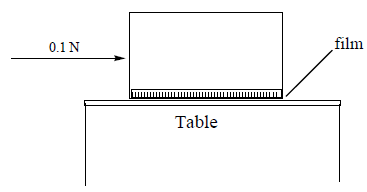
A metal block of base area \(0.20 \mathrm{~m}^2\) is placed on a table, as shown in figure. A liquid film of thickness 0.25 mm is inserted between the block and the table. The block is pushed by a horizontal force of 0.1 N and moves with a constant speed. IF the viscosity of the liquid is \(5.0 \times 10^{-3} \mathrm{Pl}\), the speed of block is _____ \(\times 10^{-3} \mathrm{~m} / \mathrm{s}\). [JEE Main 2023 (Online) 29th January Evening Shift]
 CorrectIncorrect
Hint
(a) To find the speed of the metal block, we use the concept of viscous force acting within the liquid film, which is governed by Newton’s Law of Viscosity.
Step 1: Identify the Governing Principle
When the block moves with a constant speed, the net force acting on it is zero. This means the horizontal pushing force (\(F\)) is exactly balanced by the viscous drag force (\(F_v\)) exerted by the liquid film.
Step 2: Apply Newton’s Law of Viscosity
Since the block moves with a constant speed, the applied horizontal force is balanced by the viscous drag force. The formula for the viscous force \(F\) is:
\(
F=\eta A \frac{v}{l}
\)
Where \(v\) is the constant speed of the block. We rearrange the formula to solve for \(v\) :
\(
v=\frac{F \cdot l}{\eta \cdot A}
\)
Step 3: Calculate the Speed
Substitute the given values into the equation:
\(
\begin{gathered}
v=\frac{0.1 \times\left(0.25 \times 10^{-3}\right)}{5.0 \times 10^{-3} \times 0.20} \\
v=\frac{0.025 \times 10^{-3}}{1.0 \times 10^{-3}} \\
v=0.025 \mathrm{~m} / \mathrm{s}
\end{gathered}
\)
To match the required format \(\left(\ldots \times 10^{-3} \mathrm{~m} / \mathrm{s}\right)\) :
\(
v=25 \times 10^{-3} \mathrm{~m} / \mathrm{s}
\)
The speed of the block is \(25 \times 10^{-3} \mathrm{~m} / \mathrm{s}\). - Question 27 of 44
27. Question
A spherical drop of liquid splits into 1000 identical spherical drops. If \(u_i\) is the surface energy of the original drop and \(u_f\) is the total surface energy of the resulting drops, the (ignoring evaporation), \(\frac{u_f}{u_i}=\left(\frac{10}{x}\right)\). Then value of \(x\) is _____ : [JEE Main 2023 (Online) 25th January Evening Shift]
CorrectIncorrectHint
(a) To find the value of \(x\), we need to compare the initial surface energy of the single large drop with the total surface energy of the 1000 smaller drops.
Step 1: Establish the Relationship between Radii
When a single large drop of radius \(R\) splits into 1000 identical smaller drops of radius \(r\), the total volume remains constant (ignoring evaporation).
\(
\begin{gathered}
V_{\text {initial }}=V_{\text {total final }} \\
\frac{4}{3} \pi R^3=1000 \times\left(\frac{4}{3} \pi r^3\right) \\
R^3=1000 r^3
\end{gathered}
\)
Taking the cube root of both sides:
\(
R=10 r \quad \text { or } \quad r=\frac{R}{10}
\)
Step 2: Calculate Surface Energies
Surface energy \((u)\) is the product of surface tension \((T)\) and the surface area \((A)\).
\(
u=T \times A
\)
Initial Surface Energy (\(u_i\)):
\(
u_i=T \times 4 \pi R^2
\)
Final Total Surface Energy (\(u_f\)):
\(
u_f=1000 \times\left(T \times 4 \pi r^2\right)
\)
Substitute \(r=\frac{R}{10}\) :
\(
\begin{gathered}
u_f=1000 \times T \times 4 \pi\left(\frac{R}{10}\right)^2 \\
u_f=1000 \times T \times 4 \pi \frac{R^2}{100} \\
u_f=10 \times\left(T \times 4 \pi R^2\right)=10 u_i
\end{gathered}
\)
Step 3: Find the Ratio and Solve for \(x\)
We have found that:
\(
\frac{u_f}{u_i}=10
\)
The problem states that the ratio is given by:
\(
\frac{u_f}{u_i}=\frac{10}{x}
\)
By comparing the two expressions:
\(
\begin{aligned}
10 & =\frac{10}{x} \\
x & =1
\end{aligned}
\)
The value of \(x\) is \(\mathbf{1}\). - Question 28 of 44
28. Question
A Spherical ball of radius 1 mm and density \(10.5 \mathrm{~g} / \mathrm{cc}\) is dropped in glycerine of coefficient of viscosity 9.8 poise and density \(1.5 \mathrm{~g} / \mathrm{cc}\). Viscous force on the ball when it attains constant velocity is \(3696 \times 10^{-x} \mathrm{~N}\). The value of \(x\) is ____. [JEE Main 2023 (Online) 24th January Evening Shift]
(Given, \(\mathrm{g}=9.8 \mathrm{~m} / \mathrm{s}^2\) and \(\pi=\frac{22}{7}\))CorrectIncorrectHint
(d)

To solve for the value of \(x\), we need to calculate the viscous force acting on the ball when it reaches terminal velocity (constant velocity).
Step 1: Analyze the Forces at Equilibrium
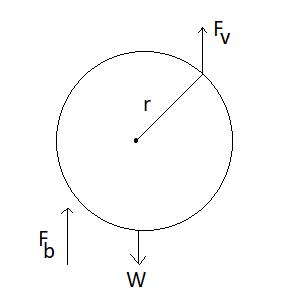
When the ball attains a constant (terminal) velocity, the net force acting on it is zero. At this point, the upward forces (Viscous Force and Buoyant Force) exactly balance the downward force (Weight).
\(
\begin{gathered}
F_v+F_b=W \\
\Longrightarrow F_v=W-F_b
\end{gathered}
\)
Where:
\(F_v\) is the Viscous Force.
\(W\) is the Weight of the ball \(\left(V \cdot \rho_{\text {ball }} \cdot g\right)\).
\(F_b\) is the Buoyant Force \(\left(V \cdot \rho_{g l y c e r i n e} \cdot g\right)\).
Step 2: Formulate the Equation for Viscous Force
Combining the terms from Step 1:
\(
\begin{gathered}
F_v=V g\left(\rho_{b a l l}-\rho_{l i q u i d}\right) \\
F_v=\frac{4}{3} \pi r^3 g\left(\rho_s-\rho_l\right)
\end{gathered}
\)
Step 3: Convert Units to SI
To get the force in Newtons \((N)\), we must convert all given values to the SI system:
Radius (\(r\)): \(1 \mathrm{~mm}=10^{-3} \mathrm{~m}\)
Density of ball \(\left(\rho_s\right)\) : \(10.5 \mathrm{~g} / \mathrm{cc}=10.5 \times 10^3 \mathrm{~kg} / \mathrm{m}^3\)
Density of glycerine \(\left(\rho_l\right): 1.5 \mathrm{~g} / \mathrm{cc}=1.5 \times 10^3 \mathrm{~kg} / \mathrm{m}^3\)
Gravity \((g): 9.8 \mathrm{~m} / \mathrm{s}^2\)
Viscosity \((\eta): 9.8\) poise \(=0.98 \mathrm{~Pas}\) (Though not needed for this specific force calculation, it confirms the medium is viscous).
Step 4: Calculate the Viscous Force
Substitute the values into the equation:
\(
\begin{gathered}
F_v=\frac{4}{3} \times \frac{22}{7} \times\left(10^{-3}\right)^3 \times 9.8 \times\left(10.5 \times 10^3-1.5 \times 10^3\right) \\
F_v=\frac{4}{3} \times \frac{22}{7} \times 10^{-9} \times 9.8 \times\left(9 \times 10^3\right)
\end{gathered}
\)
\(
F_v=369.6 \times 10^{-6} \mathrm{~N}
\)
Step 5: Determine the value of \(x\)
The problem states the force is \(3696 \times 10^{-x} \mathrm{~N}\). Let’s adjust our result to match this format:
\(
369.6 \times 10^{-6}=3696 \times 10^{-7} \mathrm{~N}
\)
Comparing this to \(3696 \times 10^{-x}\) :
\(
x=7
\)
The value of \(x\) is 7. - Question 29 of 44
29. Question
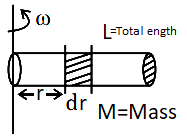
A tube of length 50 cm is filled completely with an incompressible liquid of mass 250 g and closed at both ends. The tube is then rotated in horizontal plane about one of its ends with a uniform angular velocity \(x \sqrt{F} \mathrm{rad} \mathrm{s}^{-1}\). If \(F\) be the force exerted by the liquid at the other end then the value of \(x\) will be ____. [JEE Main 2022 (Online) 29th July Evening Shift]
CorrectIncorrectHint
(d)

To find the value of \(x\), we need to relate the centrifugal force exerted by the rotating liquid to the angular velocity of the tube.
Understanding the Physics:
When the tube rotates, every infinitesimal element of the liquid experiences a centrifugal force. Because the liquid is incompressible and the tube is closed, this force is transmitted through the liquid, resulting in a pressure gradient. The force \(F\) exerted at the “other end” (the outer end) is the result of the cumulative centrifugal force of the entire liquid column.
Deriving the Force Formula:
Consider a small element of liquid of length \(d r\) at a distance \(r\) from the axis of rotation.
Mass of the element (\(d m\)): Since the liquid is uniform, \(d m=\frac{M}{L} d r\) (where \(M\) is total mass and \(L\) is length).
Centrifugal force on the element (\(d F\)):
\(
d F=(d m) \omega^2 r=\left(\frac{M}{L} d r\right) \omega^2 r
\)
To find the total force \(F\) at the outer end, we integrate from \(r=0\) to \(r=L\) :
\(
\begin{aligned}
& F=\int_0^L \frac{M}{L} \omega^2 r d r \\
& F=\frac{M \omega^2}{L} \int_0^L r d r
\end{aligned}
\)
\(
\begin{gathered}
F=\frac{M \omega^2}{L}\left[\frac{r^2}{2}\right]_0^L \\
F=\frac{M \omega^2 L}{2}
\end{gathered}
\)
Solving for Angular Velocity (\(\omega\))
Rearranging the formula to solve for \(\omega\) :
\(
\begin{gathered}
\omega^2=\frac{2 F}{M L} \\
\omega=\sqrt{\frac{2}{M L}} \sqrt{F}
\end{gathered}
\)
Substituting the Given Values
Mass (\(M\)): \(250 \mathrm{~g}=0.25 \mathrm{~kg}\)
Length (\(L\)): \(50 \mathrm{~cm}=0.5 \mathrm{~m}\)
\(
\omega=\sqrt{\frac{2}{0.25 \times 0.5}} \sqrt{F}
\)
\(
\omega=4 \sqrt{F}
\)
Finding the Value of \(x\)
The problem states that the angular velocity is \(x \sqrt{F}\). By comparing \(\omega=4 \sqrt{F}\) with the given expression: \(x=4\)
The value of \(x\) is 4. - Question 30 of 44
30. Question
The velocity of a small ball of mass 0.3 g and density \(8 \mathrm{~g} / \mathrm{cc}\) when dropped in a container filled with glycerine becomes constant after some time. If the density of glycerine is \(1.3 \mathrm{~g} / \mathrm{cc}\), then the value of viscous force acting on the ball will be \(x \times 10^{-4} \mathrm{~N}\), The value of \(x\) is _____. [use \(\mathrm{g}=10 \mathrm{~m} / \mathrm{s}^2\)] [JEE Main 2022 (Online) 29th July Evening Shift]
CorrectIncorrectHint
(a) To solve for the viscous force, we need to analyze the state of the ball when its velocity becomes constant-this state is known as terminal velocity.
Step 1: Equilibrium of Forces
When the ball reaches a constant velocity, the acceleration is zero, meaning the net force is zero. In a viscous liquid, three main forces act on the ball:
Weight (\(W\)): Acts vertically downward.
Buoyant Force (\(F_B\)): Acts vertically upward.
Viscous Force (\(F_v\)): Acts vertically upward (opposing motion).
At terminal velocity:
\(
\begin{gathered}
W=F_B+F_v \\
\Longrightarrow F_v=W-F_B
\end{gathered}
\)
Step 2: Calculate Weight (\(W\))
First, convert the mass from grams to kilograms:
\(
m=0.3 \mathrm{~g}=0.3 \times 10^{-3} \mathrm{~kg}=3 \times 10^{-4} \mathrm{~kg}
\)
Using \(g=10 \mathrm{~m} / \mathrm{s}^2\) :
\(
W=m \cdot g=\left(3 \times 10^{-4}\right) \times 10=3 \times 10^{-3} \mathrm{~N}
\)
Step 3: Calculate Buoyant Force (\(F_B\))
The buoyant force is the weight of the displaced glycerine. Since the ball is fully submerged, the volume of displaced glycerine equals the volume of the ball (\(V\)).
\(
\begin{gathered}
V=\frac{m}{\rho_{\text {ball }}} \\
F_B=V \cdot \rho_{g l y} \cdot g=\left(\frac{m}{\rho_{\text {ball }}}\right) \cdot \rho_{g l y} \cdot g \\
F_B=W\left(\frac{\rho_{\text {gly }}}{\rho_{\text {ball }}}\right)
\end{gathered}
\)
Substitute the densities (since we are taking a ratio, units of g/cc are fine):
\(
\begin{gathered}
F_B=\left(3 \times 10^{-3}\right) \times\left(\frac{1.3}{8}\right) \\
F_B=\frac{3.9}{8} \times 10^{-3}=0.4875 \times 10^{-3} \mathrm{~N}
\end{gathered}
\)
Step 4: Calculate Viscous Force (\(F_v\)) and \(x\)
\(
\begin{gathered}
F_v=W-F_B \\
F_v=\left(3 \times 10^{-3}\right)-\left(0.4875 \times 10^{-3}\right) \\
F_v=2.5125 \times 10^{-3} \mathrm{~N}
\end{gathered}
\)
To find \(x\), we must express this in the form \(x \times 10^{-4} \mathrm{~N}\) :
\(
F_v=25.125 \times 10^{-4} \mathrm{~N}
\)
By comparing the terms, \(x=25.125\).
\(
x \approx 25
\) - Question 31 of 44
31. Question
The diameter of an air bubble which was initially 2 mm, rises steadily through a solution of density \(1750 \mathrm{~kg} \mathrm{~m}^{-3}\) at the rate of \(0.35 \mathrm{cms}^{-1}\). The coefficient of viscosity of the solution is ____ poise (in nearest integer). (the density of air is negligible). [JEE Main 2022 (Online) 28th July Morning Shift]
CorrectIncorrectHint
(a) To find the coefficient of viscosity \((\eta)\), we use the formula for the terminal velocity of a sphere moving through a viscous fluid, derived from Stokes’ Law.
Identify Given Values and Convert to SI Units
Diameter (\(d\)): \(2 \mathrm{~mm}=2 \times 10^{-3} \mathrm{~m}\)
Radius (\(r\)): \(1 \mathrm{~mm}=1 \times 10^{-3} \mathrm{~m}\)
Density of solution \(\left(\rho_l\right)\) : \(1750 \mathrm{~kg} \mathrm{~m}^{-3}\)
Density of air \(\left(\rho_a\right)\) : Negligible \((\approx 0)\)
Terminal velocity (\(v\)): \(0.35 \mathrm{~cm} \mathrm{~s}^{-1}=3.5 \times 10^{-3} \mathrm{~m} \mathrm{~s}^{-1}\)
Acceleration due to gravity (\(g\)): \(9.8 \mathrm{~m} \mathrm{~s}^{-2}\) (or \(10 \mathrm{~m} \mathrm{~s}^{-2}\) for calculation simplicity in JEE, though 9.8 is standard)
The Terminal Velocity Formula:
For an air bubble rising in a liquid, the terminal velocity \(v\) is given by:
\(
v=\frac{2 r^2 g\left(\rho_a-\rho_l\right)}{9 \eta}
\)
Since the bubble is rising, we take the magnitude of the velocity and use the density difference (\(\rho_l-\rho_a\)). Because \(\rho_a\) is negligible:
\(
v=\frac{2 r^2 g \rho_l}{9 \eta}
\)
Calculate Viscosity (\(\boldsymbol{\eta}\)) in SI Units (Pas):
Rearranging for \(\eta\) :
\(
\eta=\frac{2 r^2 g \rho_l}{9 v}
\)
Substitute the values:
\(
\eta=\frac{2 \times\left(10^{-3}\right)^2 \times 9.8 \times 1750}{9 \times\left(3.5 \times 10^{-3}\right)}
\)
\(
\eta=\frac{0.0343}{0.0315} \approx 1.088 \mathrm{~Pas}
\)
Convert to Poise:
The question asks for the answer in poise.
Knowing that \(1 \mathrm{~Pas}=10\) poise:
\(
\text { Viscosity in poise }=1.088 \times 10=10.88 \text { poise }
\)
Rounding to the nearest integer:
\(
\eta \approx 11 \text { poise }
\) - Question 32 of 44
32. Question
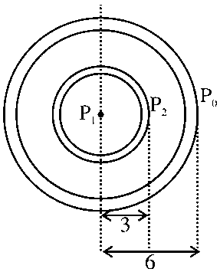
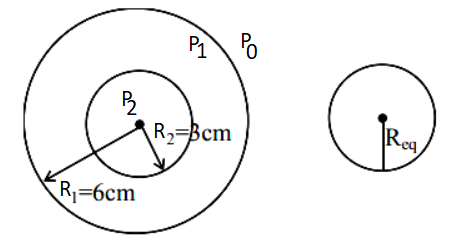
A spherical soap bubble of radius 3 cm is formed inside another spherical soap bubble of radius 6 cm. If the internal pressure of the smaller bubble of radius 3 cm in the above system is equal to the internal pressure of the another single soap bubble of radius \(r\) cm . The value of \(r\) is ____. [JEE Main 2022 (Online) 27th July Evening Shift]
CorrectIncorrectHint
(b)

To solve for the radius \(r\), we must calculate the total internal pressure of the nested bubble system and equate it to the pressure of a single bubble.
Step 1: Understand the Pressure in a Soap Bubble
A soap bubble has two liquid-air interfaces (inner and outer). Therefore, the excess pressure (\(\Delta P)\) inside a soap bubble of radius \(R\) relative to the pressure outside is given by:
\(
\Delta P=\frac{4 T}{R}
\)
where \(T\) is the surface tension of the soap solution.
Step 2: Calculate Pressure in the Nested System
Let \(P_0\) be the atmospheric pressure.
Pressure inside the larger bubble (\(P_1\)):
The larger bubble has a radius \(R_1=6 \mathrm{~cm}\). The pressure inside it is the atmospheric pressure plus the excess pressure:
\(
P_1=P_0+\frac{4 T}{6}
\)
Pressure inside the smaller bubble (\(P_2\)):
The smaller bubble (radius \(R_2=3 \mathrm{~cm}\)) is inside the larger one. Therefore, the pressure outside the smaller bubble is \(P_1\). Its internal pressure is:
\(
P_2=P_1+\frac{4 T}{3}
\)
Substitute \(P_1\) into the equation:
\(
P_2=\left(P_0+\frac{4 T}{6}\right)+\frac{4 T}{3}
\)
Step 3: Equate to a Single Bubble
The problem states that this internal pressure \(P_2\) is equal to the internal pressure of a single bubble of radius \(r\). For a single bubble of radius \(r\) sitting in the atmosphere:
\(
P_{\text {single }}=P_0+\frac{4 T}{r}
\)
Setting \(P_2=P_{\text {single }}\) :
\(
P_0+\frac{4 T}{6}+\frac{4 T}{3}=P_0+\frac{4 T}{r}
\)
Step 4: Solve for \(r\)
Cancel \(P_0\) and \(4 T\) from both sides:
\(
\frac{1}{6}+\frac{1}{3}=\frac{1}{r}
\)
\(
r=2 \mathrm{~cm}
\) - Question 33 of 44
33. Question
The excess pressure inside a liquid drop is \(500 \mathrm{Nm}^{-2}\). If the radius of the drop is 2 mm, the surface tension of liquid is \(x \times 10^{-3} \mathrm{Nm}^{-1}\). The value of \(x\) is _____. [JEE Main 2022 (Online) 30th June Morning Shift]
CorrectIncorrectHint
(d) To find the value of \(x\), we use the formula for the excess pressure inside a liquid drop.
Given Data:
Excess pressure \((\Delta P)=500 \mathrm{~N} \mathrm{~m}^{-2}\)
Radius of the drop \((r)=2 \mathrm{~mm}=2 \times 10^{-3} \mathrm{~m}\)
Surface tension \((T)=x \times 10^{-3} \mathrm{~N} \mathrm{~m}^{-1}\)
Formula:
The excess pressure inside a spherical liquid drop is given by:
\(
\Delta P=\frac{2 T}{r}
\)
Calculation:
Substitute the given values into the formula:
\(
500=\frac{2 \times\left(x \times 10^{-3}\right)}{2 \times 10^{-3}}
\)
The term \(2 \times 10^{-3}\) in the denominator and the 2 and \(10^{-3}\) in the numerator are related. Let’s simplify:
\(
500=\frac{2 T}{2 \times 10^{-3}}
\)
\(
\begin{aligned}
&\begin{gathered}
500=\frac{T}{10^{-3}} \\
T=500 \times 10^{-3} \mathrm{Nm}^{-1}
\end{gathered}\\
&\text { Comparing this with the given expression } T=x \times 10^{-3} \mathrm{~N} \mathrm{~m}^{-1} \text { : }\\
&x=500
\end{aligned}
\) - Question 34 of 44
34. Question
A small spherical ball of radius 0.1 mm and density \(10^4 \mathrm{~kg} \mathrm{~m}^{-3}\) falls freely under gravity through a distance \(h\) before entering a tank of water. If, after entering the water the velocity of ball does not change and it continue to fall with same constant velocity inside water, then the value of \(h\) will be _____ m. [JEE Main 2022 (Online) 29th June Evening Shift]
(Given \(\mathrm{g}=10 \mathrm{~ms}^{-2}\), viscosity of water \(\left.=1.0 \times 10^{-5} \mathrm{~N}-\mathrm{sm}^{-2}\right)\).CorrectIncorrectHint
(a) To find the height \(h\), we need to calculate the velocity the ball reaches during its free fall and set it equal to the terminal velocity it maintains inside the water.
Step 1: Calculate the Terminal Velocity \(\left(v_t\right)\)
Inside the water, the ball moves at a constant velocity when the downward force of gravity is perfectly balanced by the upward buoyant force and the viscous drag force.
Using the terminal velocity formula:
\(
v_t=\frac{2 r^2(\rho-\sigma) g}{9 \eta}
\)
Given values:
Radius (\(r\)): \(0.1 \mathrm{~mm}=10^{-4} \mathrm{~m}\)
Density of ball \((\rho): 10^4 \mathrm{~kg} \mathrm{~m}^{-3}\)
Density of water \((\sigma): 10^3 \mathrm{~kg} \mathrm{~m}^{-3}\)
Viscosity \((\eta): 1.0 \times 10^{-5} \mathrm{~N} \mathrm{~s} \mathrm{~m}^{-2}\)
Gravity (\(g\)): \(10 \mathrm{~m} \mathrm{~s}^{-2}\)
Calculation:
\(
\begin{gathered}
v_t=\frac{2 \times\left(10^{-4}\right)^2 \times\left(10^4-10^3\right) \times 10}{9 \times 10^{-5}} \\
v_t=\frac{2 \times 10^{-8} \times 9000 \times 10}{9 \times 10^{-5}}
\end{gathered}
\)
\(
v_t=\frac{18 \times 10^{-4}}{9 \times 10^{-5}}=2 \times 10^1=20 \mathrm{~m} \mathrm{~s}^{-1}
\)
Step 2: Calculate the Free Fall Height (h)
The problem states that the velocity does not change upon entering the water. This means the final velocity of the free fall (\(v\)) is equal to the terminal velocity (\(v_t\)).
Using the third equation of motion \(\left(v^2=u^2+2 g h\right)\) where initial velocity \(u=0\) :
\(
\begin{gathered}
v^2=2 g h \\
(20)^2=2 \times 10 \times h \\
400=20 h \\
h=\frac{400}{20}=20 \mathrm{~m}
\end{gathered}
\) - Question 35 of 44
35. Question
A liquid of density \(750 \mathrm{kgm}^{-3}\) flows smoothly through a horizontal pipe that tapers in cross-sectional area from \(\mathrm{A}_1=1.2 \times 10^{-2} \mathrm{~m}^2\) to \(\mathrm{A}_2=\frac{A_1}{2}\). The pressure difference between the wide and narrow sections of the pipe is 4500 Pa. The rate of flow of liquid is ____ \(\times 10^{-3} \mathrm{~m}^3 \mathrm{~s}^{-1}\). [JEE Main 2022 (Online) 28th June Evening Shift]
CorrectIncorrectHint
(b)

To find the rate of flow (discharge \(Q\)), we need to apply the Equation of Continuity and Bernoulli’s Principle for a horizontal pipe.
Step 1: Apply the Equation of Continuity
The volume flow rate \(Q\) is constant throughout the pipe.
\(
Q=A_1 v_1=A_2 v_2
\)
Given that \(A_2=\frac{A_1}{2}\), we can find the relationship between the velocities:
\(
A_1 v_1=\left(\frac{A_1}{2}\right) v_2 \Longrightarrow v_2=2 v_1
\)
Step 2: Apply Bernoulli’s Equation
For a horizontal pipe (where potential energy remains constant), the equation is:
\(
P_1+\frac{1}{2} \rho v_1^2=P_2+\frac{1}{2} \rho v_2^2
\)
Rearranging to find the pressure difference (\(\Delta P\)):
\(
P_1-P_2=\frac{1}{2} \rho\left(v_2^2-v_1^2\right)
\)
Given values:
\(\Delta P=4500 \mathrm{~Pa}\)
\(\rho=750 \mathrm{~kg} \mathrm{~m}^{-3}\)
\(v_2=2 v_1\)
Calculation:
\(
\begin{gathered}
4500=\frac{1}{2} \times 750 \times\left(\left(2 v_1\right)^2-v_1^2\right) \\
4500=375 \times\left(4 v_1^2-v_1^2\right) \\
4500=375 \times 3 v_1^2 \\
4500=1125 v_1^2 \\
v_1^2=\frac{4500}{1125}=4 \Longrightarrow v_1=2 \mathrm{~m} \mathrm{~s}^{-1}
\end{gathered}
\)
Step 3: Calculate the Rate of Flow (\(Q\))
Now, use the area \(\boldsymbol{A}_1\) to find the discharge:
\(
\begin{gathered}
Q=A_1 \times v_1 \\
Q=\left(1.2 \times 10^{-2} \mathrm{~m}^2\right) \times\left(2 \mathrm{~m} \mathrm{~s}^{-1}\right) \\
Q=2.4 \times 10^{-2} \mathrm{~m}^3 \mathrm{~s}^{-1}
\end{gathered}
\)
To match the required format \(\left(\times 10^{-3} \mathrm{~m}^3 \mathrm{~s}^{-1}\right)\) :
\(
Q=24 \times 10^{-3} \mathrm{~m}^3 \mathrm{~s}^{-1}
\)
The rate of flow is \(24 \times 10^{-3} \mathrm{~m}^3 \mathrm{~s}^{-1}\). - Question 36 of 44
36. Question
The area of cross-section of a large tank is \(0.5 \mathrm{~m}^2\). It has a narrow opening near the bottom having area of cross-section \(1 \mathrm{~cm}^2\). A load of 25 kg is applied on the water at the top in the tank. Neglecting the speed of water in the tank, the velocity of the water, coming out of the opening at the time when the height of water level in the tank is 40 cm above the bottom, will be ____ \(\mathrm{cms}^{-1}\). [Take \(\mathrm{g}=10 \mathrm{~ms}^{-2}\)] [JEE Main 2022 (Online) 27th June Morning Shift]
CorrectIncorrectHint
(c) To find the efflux velocity, we apply Bernoulli’s Principle between the top surface of the water (Point 1) and the narrow opening at the bottom (Point 2).
Step 1: Identify the Pressures and Energies
At the top (Point 1): The pressure \(P_1\) is the sum of atmospheric pressure \(P_{\text {atm }}\) and the pressure exerted by the 25 kg load.
Pressure from load \(=\frac{m g}{A}=\frac{25 \times 10}{0.5}=500 \mathrm{~Pa}\).
So, \(P_1=P_{a t m}+500 \mathrm{~Pa}\).
Potential energy per unit volume \(=\rho g h=1000 \times 10 \times 0.4=4000 \mathrm{~J} \mathrm{~m}^{-3}\).
Kinetic energy is neglected \(\left(v_1 \approx 0\right)\).
At the opening (Point 2): The pressure \(P_2\) is simply atmospheric pressure \(P_{\text {atm }}\) because the water is transitioning into the air.
\(P_2=P_{a t m}\).
Potential energy = 0 (reference level at the bottom).
Kinetic energy per unit volume \(=\frac{1}{2} \rho v_2^2\).
Step 2: Apply Bernoulli’s Equation
\(
P_1+\rho g h+\frac{1}{2} \rho v_1^2=P_2+0+\frac{1}{2} \rho v_2^2
\)
Substitute the known values:
\(
\left(P_{a t m}+500\right)+4000+0=P_{a t m}+\frac{1}{2}(1000) v_2^2
\)
The \(P_{\text {atm }}\) cancels out from both sides:
\(
\begin{gathered}
4500=500 v_2^2 \\
v_2^2=\frac{4500}{500}=9 \\
v_2=3 \mathrm{~m} \mathrm{~s}^{-1}
\end{gathered}
\)
Step 3: Convert to Required Units
The question asks for the velocity in \(\mathrm{cm} \mathrm{s}^{-1}\).
\(
v_2=3 \times 100 \mathrm{~cm} \mathrm{~s}^{-1}=300 \mathrm{~cm} \mathrm{~s}^{-1}
\)
The velocity of the water coming out is \(300 \mathrm{~cm} \mathrm{~s}^{-1}\). - Question 37 of 44
37. Question
An ideal fluid of density \(800 \mathrm{kgm}^{-3}\), flows smoothly through a bent pipe (as shown in figure) that tapers in cross-sectional area from a to \(\frac{a}{2}\). The pressure difference between the wide and narrow sections of pipe is 4100 Pa. At wider section, the velocity of fluid is \(\frac{\sqrt{x}}{6} \mathrm{~ms}^{-1}\) for \(\mathrm{x}=\) _____ (Given \(\mathrm{g}=10 \mathrm{~ms}^{-2}\)) [JEE Main 2022 (Online) 26th June Morning Shift]
 CorrectIncorrect
Hint
(b) To find the value of \(x\), we apply the Equation of Continuity and Bernoulli’s Principle for a pipe that changes both in cross-sectional area and height.
Step 1: Analyze continuity and Bernoulli’s equation
For an ideal fluid flowing from a wide section (area \(\boldsymbol{A}_1=a\)) to a narrow section (area \(A_2=\frac{a}{2}\)), the equation of continuity states:
\(
A_1 v_1=A_2 v_2 \Longrightarrow a v_1=\frac{a}{2} v_2 \Longrightarrow v_2=2 v_1
\)
Using Bernoulli’s equation between the wide section (1) and narrow section (2), where the height difference \(h=1 \mathrm{~m}\) (from the standard problem figure where the wide section is higher):
\(
P_1+\frac{1}{2} \rho v_1^2+\rho g h_1=P_2+\frac{1}{2} \rho v_2^2+\rho g h_2
\)
Substituting \(v_2=2 v_1\) and \(h_1-h_2=1 \mathrm{~m}\) (with \(P_1-P_2=4100 \mathrm{~Pa}\)):
\(
\begin{gathered}
4100+\rho g(1)=\frac{1}{2} \rho\left(2 v_1\right)^2-\frac{1}{2} \rho v_1^2 \\
4100+800(10)(1)=\frac{3}{2} \rho v_1^2
\end{gathered}
\)
Step 2: Solve for velocity and \(\boldsymbol{x}\)
Calculate the numerical value of \(v_1\) :
\(
\begin{gathered}
12100=\frac{3}{2}(800) v_1^2 \\
12100=1200 v_1^2 \Longrightarrow v_1^2=\frac{121}{12} \\
v_1=\sqrt{\frac{121}{12}}=\frac{11}{\sqrt{12}}=\frac{11}{2 \sqrt{3}}
\end{gathered}
\)
To find \(x\), we rationalize the expression to match the form \(v_1=\frac{\sqrt{x}}{6}\) :
\(
v_1=\frac{11 \times \sqrt{3}}{2 \sqrt{3} \times \sqrt{3}}=\frac{11 \sqrt{3}}{6}=\frac{\sqrt{121 \times 3}}{6}=\frac{\sqrt{363}}{6}
\)
The value of \(x\) is 363. - Question 38 of 44
38. Question
The velocity of upper layer of water in a river is \(36 \mathrm{~kmh}^{-1}\). Shearing stress between horizontal layers of water is \(10^{-3} \mathrm{Nm}^{-2}\). Depth of the river is ____ m. (Co-efficient of viscosity of water is \(10^{-2} \mathrm{Pa.s}\))
CorrectIncorrectHint
(d) To find the depth of the river, we apply the concept of Viscosity and Newton’s Law of Viscosity, which relates shearing stress to the velocity gradient between fluid layers.
Step 1: Identify and Convert Given Values
Velocity of upper layer \((v): 36 \mathrm{~km} \mathrm{~h}^{-1}\). We must convert this to \(\mathrm{m} \mathrm{s}^{-1}\) :
\(
v=36 \times \frac{5}{18}=10 \mathrm{~m} \mathrm{~s}^{-1}
\)
Shearing stress \((\tau): 10^{-3} \mathrm{~N} \mathrm{~m}^{-2}\)
Coefficient of viscosity \((\eta): 10^{-2} \mathrm{~Pa} \mathrm{~s}\)
Velocity at the bottom: We assume the water at the riverbed is stationary (\(v_{\text {bottom }}=0\)).
Step 2: Apply Newton’s Law of Viscosity
The shearing stress \((\tau)\) is proportional to the velocity gradient \(\left(\frac{d v}{d x}\right)\) :
\(
\tau=\eta \frac{d v}{d x}
\)
In this context, \(d v\) is the change in velocity from top to bottom \(\left(10 \mathrm{~m} \mathrm{~s}^{-1}-0=10 \mathrm{~m} \mathrm{~s}^{-1}\right)\), and \(d x\) is the depth of the river (\(d\)).
\(
\tau=\eta \frac{v}{d}
\)
Step 3: Calculate the Depth (\(d\))
Rearrange the formula to solve for \(d\) :
\(
d=\frac{\eta \times v}{\tau}
\)
Substitute the values:
\(
\begin{gathered}
d=\frac{10^{-2} \times 10}{10^{-3}} \\
d=\frac{10^{-1}}{10^{-3}} \\
d=10^{-1} \times 10^3 \\
d=100 \mathrm{~m}
\end{gathered}
\)
The depth of the river is 100 m. - Question 39 of 44
39. Question
A soap bubble of radius 3 cm is formed inside the another soap bubble of radius 6 cm. The radius of an equivalent soap bubble which has the same excess pressure as inside the smaller bubble with respect to the atmospheric pressure is ____ cm. [JEE Main 2021 (Online) 26th August Morning Shift]
CorrectIncorrectHint
(b)

To find the radius of the equivalent soap bubble, we need to calculate the total excess pressure inside the innermost bubble and then find a single bubble that matches that pressure.
Step 1: Understand the Pressure in Nested Bubbles
A soap bubble has two surfaces (inner and outer), so the excess pressure \(\Delta P\) for a single bubble of radius \(R\) is given by:
\(
\Delta P=\frac{4 T}{R}
\)
where \(T\) is the surface tension of the soap solution.
When one bubble is inside another, the pressures add up relative to the outside atmosphere.
Pressure inside the large bubble \(\left(P_1\right)\) relative to the atmosphere \(\left(P_0\right)\) :
\(
P_1-P_0=\frac{4 T}{R_1}
\)
Pressure inside the small bubble \(\left(P_2\right)\) relative to the pressure of the large bubble \(\left(P_1\right)\) :
\(
P_2-P_1=\frac{4 T}{R_2}
\)
Step 2: Calculate Total Excess Pressure
The total excess pressure inside the smaller bubble with respect to the atmospheric pressure is:
\(
\begin{gathered}
\Delta P_{\text {total }}=\left(P_2-P_1\right)+\left(P_1-P_0\right) \\
\Delta P_{\text {total }}=\frac{4 T}{R_2}+\frac{4 T}{R_1}
\end{gathered}
\)
Given values:
\(R_1=6 \mathrm{~cm}\)
\(R_2=3 \mathrm{~cm}\)
\(
\begin{gathered}
\Delta P_{\text {total }}=4 T\left(\frac{1}{3}+\frac{1}{6}\right) \\
\Delta P_{\text {total }}=4 T\left(\frac{2+1}{6}\right)=4 T\left(\frac{3}{6}\right)=\frac{4 T}{2}
\end{gathered}
\)
Step 3: Find the Equivalent Radius (\(R_{e q}\))
An equivalent bubble with radius \(R_{\text {eq }}\) must have the same excess pressure:
\(
\begin{gathered}
\frac{4 T}{R_{e q}}=\Delta P_{\text {total }} \\
\frac{4 T}{R_{e q}}=\frac{4 T}{2}
\end{gathered}
\)
By comparing both sides:
\(
R_{e q}=2 \mathrm{~cm}
\)
The radius of the equivalent soap bubble is 2 cm. - Question 40 of 44
40. Question
The water is filled upto height of 12 m in a tank having vertical sidewalls. A hole is made in one of the walls at a depth ‘ \(h\) ‘ below the water level. The value of ‘ \(h\) ‘ for which the emerging steam of water strikes the ground at the maximum range is ____ m. [JEE Main 2021 (Online) 27th July Evening Shift]
CorrectIncorrectHint
(c)

To find the depth \(h\) for maximum horizontal range, we need to derive the expression for the range \(R\) and then find its maximum value.
Step 1: Calculate Efflux Velocity
According to Torricelli’s Law, the velocity \(v\) of the water emerging from a hole at a depth \(h\) below the free surface is given by:
\(
v=\sqrt{2 g h}
\)
Step 2: Determine Time of Flight
The water travels a vertical distance of \(H-h\) to reach the ground, where \(H=12 \mathrm{~m}\). Using the second equation of motion for the vertical direction (with initial vertical velocity \(u_y=0\)):
\(
H-h=\frac{1}{2} g t^2
\)
Solving for time \(t\) :
\(
t=\sqrt{\frac{2(H-h)}{g}}
\)
Step 3: Find Horizontal Range
The horizontal range \(R\) is the product of the horizontal velocity and the time of flight:
\(
R=v \times t=\sqrt{2 g h} \times \sqrt{\frac{2(H-h)}{g}}=2 \sqrt{h(H-h)}
\)
Step 4: Maximize the Range
To find the maximum range, we differentiate \(R^2\) (or \(R\)) with respect to \(h\) and set it to zero:
\(
\begin{gathered}
\frac{d}{d h}\left(h H-h^2\right)=H-2 h=0 \\
h=\frac{H}{2}
\end{gathered}
\)
Substituting \(H=12 \mathrm{~m}\) :
\(
h=\frac{12}{2}=6 \mathrm{~m}
\)
The value of \(h\) for which the range is maximum is \(\mathbf{6 ~ m}\). - Question 41 of 44
41. Question
Consider a water tank as shown in the figure. It’s cross-sectional area is \(0.4 \mathrm{~m}^2\). The tank has an opening B near the bottom whose cross-section area is \(1 \mathrm{~cm}^2\). A load of 24 kg is applied on the water at the top when the height of the water level is 40 cm above the bottom, the velocity of water coming out the opening B is \(v\mathrm{~ms}^{-1}\). [JEE Main 2021 (Online) 18th March Evening Shift]
The value of \(v\), to the nearest integer, is ____ [Take value of g to be \(10 \mathrm{~ms}^{-2}\)] CorrectIncorrect
Hint
(c) To solve for the efflux velocity \(v\), we apply Bernoulli’s Principle between the top surface of the water (Point A) and the opening at the bottom (Point B).
Step 1: Analyze Pressure and Energy at Point A (Top)
At the top of the tank, the total pressure is the sum of the atmospheric pressure (\(P_{\text {atm }}\)) and the pressure exerted by the external load.
Pressure from load: \(P_{\text {load }}=\frac{m g}{A r e a}=\frac{24 \times 10}{0.4}=\frac{240}{0.4}=600 \mathrm{~Pa}\)
Total Pressure \(\left(P_A\right): P_{a t m}+600 \mathrm{~Pa}\)
Potential Energy per unit volume: \(\rho g h=1000 \times 10 \times 0.4=4000 \mathrm{~J} \mathrm{~m}^{-3}\)
Kinetic Energy: Since the tank area (\(0.4 \mathrm{~m}^2\)) is much larger than the opening area (\(10^{-4} \mathrm{~m}^2\)), the velocity at the top is negligible (\(v_A \approx 0\)).
Step 2: Analyze Pressure and Energy at Point B (Opening)
At the opening, the water is released into the atmosphere.
Total Pressure \(\left(P_B\right): P_{a t m}\)
Potential Energy: 0 (taking the bottom as the reference level)
Kinetic Energy per unit volume: \(\frac{1}{2} \rho v^2\)
Step 3: Apply Bernoulli’s Equation
\(
P_A+\rho g h+\frac{1}{2} \rho v_A^2=P_B+\rho g(0)+\frac{1}{2} \rho v^2
\)
Substitute the values:
\(
\left(P_{a t m}+600\right)+4000+0=P_{a t m}+\frac{1}{2}(1000) v^2
\)
The atmospheric pressure ( \(P_{\text {atm }}\) ) cancels out:
\(
\begin{gathered}
4600=500 v^2 \\
v^2=\frac{4600}{500}=\frac{46}{5} \\
v^2=9.2
\end{gathered}
\)
Taking the square root:
\(
v=\sqrt{9.2} \approx 3.03 \mathrm{~m} \mathrm{~s}^{-1}
\)
Rounding to the nearest integer, we get:
\(
v=3
\) - Question 42 of 44
42. Question
Suppose you have taken a dilute solution of oleic acid in such a way that its concentration becomes \(0.01 \mathrm{~cm}^3\) of oleic acid per cm \(\mathrm{cm}^3\) of the solution. Then you make a thin film of this solution (monomolecular thickness) of area \(4 \mathrm{~cm}^2\) by considering 100 spherical drops of radius \(\left(\frac{3}{40 \pi}\right)^{\frac{1}{3}} \times 10^{-3} \mathrm{~cm}\). Then the thickness of oleic acid layer will be \(x \times 10^{-14} \mathrm{~m}\). Where \(x\) is ____. [JEE Main 2021 (Online) 17th March Evening Shift]
CorrectIncorrectHint
(b) To find the value of \(x\), we will calculate the volume of the oleic acid used and divide it by the area of the film to find its thickness.
Step 1: Calculate the volume of solution drops
The volume of a single spherical drop is given by the formula \(V_{d r o p}=\frac{4}{3} \pi r^3\). Given the radius \(r=\left(\frac{3}{40 \pi}\right)^{\frac{1}{3}} \times 10^{-3} \mathrm{~cm}\), we calculate the volume:
\(
\begin{gathered}
V_{\text {drop }}=\frac{4}{3} \pi\left[\left(\frac{3}{40 \pi}\right)^{\frac{1}{3}} \times 10^{-3} \mathrm{~cm}\right]^3=\frac{4}{3} \pi \times \frac{3}{40 \pi} \times 10^{-9} \mathrm{~cm}^3 \\
V_{\text {drop }}=\frac{4}{40} \times 10^{-9}=10^{-1} \times 10^{-9}=10^{-10} \mathrm{~cm}^3
\end{gathered}
\)
For 100 drops, the total volume of the solution \(V_{\text {total }}\) is:
\(
V_{\text {total }}=100 \times 10^{-10} \mathrm{~cm}^3=10^{-8} \mathrm{~cm}^3
\)
Step 2: Determine the volume of pure oleic acid
The concentration of the solution is \(0.01 \mathrm{~cm}^3\) of olecic acid per \(\mathrm{cm}^3\) of solution. Therefore, the actual volume of olecic acid \(V_{\text {oleic }}\) in the film is:
\(
V_{\text {oleic }}=\text { Concentration } \times V_{\text {total }}=0.01 \times 10^{-8} \mathrm{~cm}^3=10^{-10} \mathrm{~cm}^3
\)
Step 3: Calculate the thickness of the film
The volume of a film is the product of its area \(A\) and its thickness \(t(V=A \times t)\). Given \(A=4 \mathrm{~cm}^2\) :
\(
t=\frac{V_{\text {oleic }}}{A}=\frac{10^{-10} \mathrm{~cm}^3}{4 \mathrm{~cm}^2}=0.25 \times 10^{-10} \mathrm{~cm}
\)
Now, convert the thickness from centimeters to meters (\(1 \mathrm{~cm}=10^{-2} \mathrm{~m}\)):
\(
t=0.25 \times 10^{-10} \times 10^{-2} \mathrm{~m}=0.25 \times 10^{-12} \mathrm{~m}
\)
To express this in the form \(x \times 10^{-14} \mathrm{~m}\) :
\(
t=25 \times 10^{-14} \mathrm{~m}
\)
Comparing \(t=25 \times 10^{-14} \mathrm{~m}\) with the given expression \(x \times 10^{-14} \mathrm{~m}\), we find:
\(
x=25
\) - Question 43 of 44
43. Question
A hydraulic press can lift 100 kg when a mass ‘ \(m\) ‘ is placed on the smaller piston. It can lift _____ kg when the diameter of the larger piston is increased by 4 times and that of the smaller piston is decreased by 4 times keeping the same mass ‘ \(m\) ‘ on the smaller piston. [JEE Main 2021 (Online) 24th February Morning Shift]
CorrectIncorrectHint
(a) To solve this, we use Pascal’s Law, which states that pressure applied to an enclosed fluid is transmitted undiminished to every portion of the fluid and to the walls of the containing vessel.
Step 1: Establish the Initial Condition
In a hydraulic press, the pressure (\(P\)) is the same at both pistons.
\(
P=\frac{F_1}{A_1}=\frac{F_2}{A_2}
\)
Where:
\(F_1=m g\) (force on the smaller piston)
\(A_1=\pi\left(\frac{d_1}{2}\right)^2\) (area of the smaller piston)
\(F_2=M_1 g\) (force/weight lifted by the larger piston, where \(M_1=100 \mathrm{~kg}\))
\(A_2=\pi\left(\frac{d_2}{2}\right)^2\) (area of the larger piston)
From the pressure equality:
\(
\frac{m}{d_1^2}=\frac{100}{d_2^2} \Longrightarrow 100=m\left(\frac{d_2}{d_1}\right)^2 \dots(1)
\)
Step 2: Apply the Changes to Diameters
Now, the diameters are modified:
New diameter of larger piston \(\left(\boldsymbol{d}_2^{\prime}\right)=\mathbf{4} \boldsymbol{d}_2\)
New diameter of smaller piston \(\left(d_1^l\right)=\frac{d_1}{4}\)
Let the new mass lifted be \(M_2\). Using the same principle:
\(
\begin{gathered}
\frac{m}{\left(d_1^{\prime}\right)^2}=\frac{M_2}{\left(d_2^{\prime}\right)^2} \\
\frac{m}{\left(d_1 / 4\right)^2}=\frac{M_2}{\left(4 d_2\right)^2}
\end{gathered}
\)
Rearranging for \(M_2\) :
\(
\begin{gathered}
M_2=m \times \frac{\left(4 d_2\right)^2}{\left(d_1 / 4\right)^2} \\
M_2=m \times \frac{16 d_2^2}{d_1^2 / 16} \\
M_2=m \times 16 \times 16 \times\left(\frac{d_2}{d_1}\right)^2
\end{gathered}
\)
\(
M_2=256 \times\left[m\left(\frac{d_2}{d_1}\right)^2\right]
\)
Step 3: Substitute the Initial Value
From Equation 1, we know that \(m\left(\frac{d_2}{d_1}\right)^2=100\).
\(
\begin{aligned}
& M_2=256 \times 100 \\
& M_2=25,600 \mathrm{~kg}
\end{aligned}
\)
The hydraulic press can lift \(25,600 \mathrm{~kg}\). - Question 44 of 44
44. Question
When a long glass capillary tube of radius 0.015 cm is dipped in a liquid, the liquid rises to a height of 15 cm within it. If the contact angle between the liquid and glass to close to \(0^{\circ}\), the surface tension of the liquid, in milliNewton \(\mathrm{m}^{-1}\), is \(\left[\rho_{\text {(liquid) }}=900 \mathrm{kgm}^{-3}, \mathrm{~g}=10 \mathrm{~ms}^{-2}\right]\)
(Give answer in closest integer) _____ . [JEE Main 2020 (Online) 3rd September Morning Slot]CorrectIncorrectHint
(b) To find the surface tension of the liquid, we use the formula for capillary rise.
Step 1: Identify the Formula
The height \(h\) to which a liquid rises in a capillary tube is given by:
\(
h=\frac{2 T \cos \theta}{r \rho g}
\)
Rearranging to solve for surface tension (\(T\)):
\(
T=\frac{h r \rho g}{2 \cos \theta}
\)
Step 2: Convert Units to SI
Before calculating, ensure all values are in standard SI units:
Height (\(h\)): \(15 \mathrm{~cm}=0.15 \mathrm{~m}\)
Radius (\(r\)): \(0.015 \mathrm{~cm}=0.015 \times 10^{-2} \mathrm{~m}=1.5 \times 10^{-4} \mathrm{~m}\)
Density (\(\rho\)): \(900 \mathrm{~kg} \mathrm{~m}^{-3}\)
Acceleration due to gravity (\(g\)): \(10 \mathrm{~m} \mathrm{~s}^{-2}\)
Contact angle \((\theta): 0^{\circ}\) (Since \(\cos 0^{\circ}=1\))
Step 3: Calculate Surface Tension (\(T\))
Substitute the values into the rearranged formula:
\(
T=\frac{0.15 \times\left(1.5 \times 10^{-4}\right) \times 900 \times 10}{2 \times 1}=0.10125 \mathrm{~N} \mathrm{~m}^{-1}
\)
Step 4: Convert to milliNewton \(\mathrm{m}^{-1}\)
The question asks for the answer in \(\mathrm{mN} \mathrm{m}^{-1}\) :
\(
\begin{gathered}
T=0.10125 \times 10^3 \mathrm{mN} \mathrm{~m}^{-1} \\
T=101.25 \mathrm{mN} \mathrm{~m}^{-1}
\end{gathered}
\)
Rounding to the closest integer:
\(
T=101
\)
The surface tension of the liquid is \(101 \mathrm{mN} \mathrm{m}^{-1}\).