1.7 The concept of potential energy
Potential Energy
Potential energy is the energy an object possesses due to its position, condition, or state, rather than its motion. This stored energy has the “potential” to do work. It is typically associated with forces like gravity, elasticity, or chemical bonds.
For example, A block attached to a compressed or elongated spring possesses some energy called elastic potential energy. This block has a capacity to do work.
Similarly, a stone when released from a certain height also has energy in the form of gravitational potential energy. Two charged particles kept at certain distance has electric potential energy.
The dimensions of potential energy are \(\left[\mathrm{ML}^2 \mathrm{~T}^{-2}\right]\) and the unit is joule ( J ), the same as kinetic energy or work.
There are mainly two types of potential energies as discussed below:
Gravitational potential energy
Gravitational potential energy of a body is the energy associated with it due to the virtue of its position above the surface of earth. If an object of mass \(m\) is placed at height \(h\) above earth’s surface, then
Gravitational potential energy, \(U=PE=m g h\)
Example 1: Prove that \(U=PE=m g h\)
Solution: Force: Near the Earth’s surface, the force of gravity (weight) acting on an object of mass \(m\) is considered constant and is given by \(F=m g\), where \(g\) is the acceleration due to gravity (approx. \(9.8 \mathrm{~m} / \mathrm{s}^2\) ).
Work: Work ( \(W\) ) is defined as force multiplied by the displacement in the direction of the force: \(W=F \times h\).
Potential Energy: To lift an object to a height \(\boldsymbol{h}\), an external force equal to \(\boldsymbol{m g}\) must be applied vertically upward, against gravity. The work done by this external force is \(W=(m g) \times h=m g h\).
Storage: This work done is stored in the object as gravitational potential energy ( \(\boldsymbol{U}\) ) relative to its starting point (which is defined as the zero potential energy reference point).
Example 2: A stone of mass 0.4 kg is thrown vertically up with a speed of \(9.8 \mathrm{~ms}^{-1}\). Find the potential energy after half second.
Solution: Here, mass, \(m=0.4 \mathrm{~kg}\), speed, \(u=9.8 \mathrm{~ms}^{-1}\), acceleration, \(a=-g=-9.8 \mathrm{~m} / \mathrm{s}^2\) and time, \(t=\frac{1}{2} \mathrm{~s}\)
From second equation of motion,
\(
\begin{aligned}
h & =s=u t+\frac{1}{2} a t^2 \\
& =\left(9.8 \times \frac{1}{2}\right)+\left(\frac{1}{2} \times(-9.8) \times \frac{1}{2} \times \frac{1}{2}\right)=3.67 \mathrm{~m}
\end{aligned}
\)
∴ Potential energy \(=m g h=(0.4)(9.8)(3.67)=14.386 \mathrm{~J}\)
Change in potential energy
Potential energy is defined only for a conservative force because the work done by a conservative force is path-independent. This means the change in potential energy between two points is a unique value, regardless of the path taken. For non-conservative forces, it has no meaning (for a non-conservative force like friction, the work done depends on the path length, so a unique potential energy value cannot be assigned to a specific position. The energy is typically dissipated as heat or sound, not stored as recoverable potential energy). The change in potential energy \((d U)\) of a system corresponding to a conservative internal force is given by
\(
d U=-F \cdot d \mathbf{r}=-d W \quad\left(\because F=-\frac{d U}{d r}\right)
\)
\(
\int_{U_i}^{U_f} d U=-\int_{\mathbf{r}_i}^{\mathbf{r}_f} \mathbf{F} \cdot d \mathbf{r} \text { or } U_f-U_i=-\int_{\mathbf{r}_i}^{\mathbf{r}_f} \mathbf{F} \cdot d \mathbf{r}
\)
We generally choose the reference point at infinity and assume potential energy to be zero there, i.e. if we take \(r_i=\infty\) (infinite) and \(U_i=0\), then we can write
\(
U=-\int_{\infty}^{\mathbf{r}} \mathbf{F} \cdot d \mathbf{r}=-W
\)
Potential energy of a body or system is the negative of work done by the conservative forces in bringing it from infinity to the present position.
Note: The negative sign ensures that the system’s potential energy increases when work is done against the conservative force.
For example, when you lift an apple (doing positive work against gravity), the gravitational force does negative work, and the apple’s potential energy increases.
Therefore, potential energy is defined as “\(-W\)” (negative work done by the relevant conservative force) to be consistent with the principle of conservation of energy.
Note: Regarding the potential energy it is worth noting that
- Potential energy is a property of the entire system because it arises from the interactions (forces) and the relative arrangement of multiple objects within that system, not a single object in isolation.
- Potential energy depends on the frame of reference because its value is measured relative to an arbitrarily chosen zero-potential energy point or coordinate system origin. The change in potential energy, however, is independent of the reference frame and is the physically significant, measurable quantity.
- For three dimensional motion of the particle
\(
\mathbf{F}=-\left(\frac{\partial U}{\partial x} \hat{\mathbf{i}}+\frac{\partial U}{\partial y} \hat{\mathbf{j}}+\frac{\partial U}{\partial z} \hat{\mathbf{k}}\right)
\)
where, \(\frac{\partial U}{\partial x}=\) partial derivative of \(U\) w.r.t. \(x\), \(\frac{\partial U}{\partial y}=\) partial derivative of \(U\) w.r.t. \(y\) and \(\frac{\partial U}{\partial z}=\) partial derivative of \(U\) w.r.t. \(z\)
Note: Work done over an infinitesimal displacement:
The work ( \(d W\) ) done by a force ( \(F\) ) over an infinitesimal displacement ( \(d r\) ) in one dimension (or in the radial direction for a central force) is given by:
\(
d W=F \cdot d r=F d r
\)
Relating work to potential energy:
By the definition of potential energy, this infinitesimal work is also related to the change in potential energy ( \(d U\) ) by:
\(
d W=-d U
\)
Equating the expressions for work:
Setting the two expressions for \(d W\) equal to each other:
\(
F d r=-d U
\)
Rearranging the equation to solve for the force \(F\) gives the desired relationship:
\(
F=-\frac{d U}{d r}
\)
Example 3: Calculate the work done in lifting a 300 N weight to a height of 10 m with an acceleration \(0.5 \mathrm{~ms}^{-2}\). (Take, \(g=10 \mathrm{~ms}^{-2}\) )
Solution: Step 1: Calculate Mass and Lifting Force
The mass ( \(m\) ) of the weight is calculated from its weight ( \(w\) ) and the acceleration due to gravity (g) using the formula \(m=\frac{w}{g}\). The net force required to lift the object with acceleration \(a\) is given by \(F_{\text {net }}=m a\). The total lifting force \(\left(F_{l i f t}\right)\) must overcome gravity and provide the net upward force, so
\(
\begin{aligned}
& F_{\text {lift }}=F_{\text {gravity }}+F_{\text {net }}=m g+m a=m(g+a) . \\
& m=\frac{300 \mathrm{~N}}{10 \mathrm{~ms}^{-2}}=30 \mathrm{~kg} \\
& F_{\text {lift }}=30 \mathrm{~kg} \times\left(10 \mathrm{~ms}^{-2}+0.5 \mathrm{~ms}^{-2}\right)=30 \mathrm{~kg} \times 10.5 \mathrm{~ms}^{-2}=315 \mathrm{~N}
\end{aligned}
\)
Step 2: Calculate Work Done
Work done ( \(W\) ) by the lifting force is calculated as the force multiplied by the vertical distance (height, \(h\) ) over which it acts, \(W=F_{\text {lift }} \times h\).
\(
W=315 \mathrm{~N} \times 10 \mathrm{~m}=3150 \mathrm{~J}
\)
The work done in lifting the weight is \(\mathbf{3 1 5 0 ~ J}\).
Example 4: Two cylindrical vessels of equal cross-sectional area \(A\) contain water up to heights \(h_1\) and \(h_2\). The vessels are inter-connected, so that the levels in them are equal. Calculate the work done by the force of gravity during the process. The density of water is \(\rho\).
Solution: According to the question, we draw the following diagram.
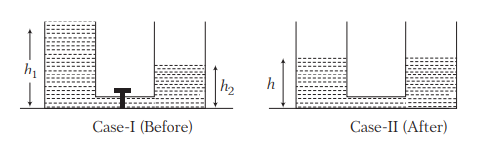
Since, the mass of water remains same,
\(
\rho A h_1+\rho A h_2=\rho A h+\rho A h \Rightarrow h=\frac{h_1+h_2}{2}
\)
Potential energy of first case,
\(
U_1=\left(\rho A h_1\right) g \frac{h_1}{2}+\left(\rho A h_2\right) g \frac{h_2}{2}=\frac{\rho A g}{2}\left(h_1^2+h_2^2\right)
\)
Potential energy of second case,
\(
U_2=(\rho A h) g \frac{h}{2} \times 2=\frac{\rho A g\left(h_1+h_2\right)^2}{4}
\)
Since, the gravitational force is a conservative force, then
\(
W_{g r}=U_1-U_2=\frac{\rho A g}{4}\left(h_1-h_2\right)^2
\)
Example 5: A particle is moving on frictionless XY-plane. It is acted upon a conservative force described by the potential energy function:
where,
\(
U(x, y, z)=\frac{1}{2} k\left(x^2+y^2+z^2\right)
\)
Derive an expression for the force acting on the particle.
Solution: Force acting on the particle in \(x\)-direction is given by
\(
F_x=-\frac{\partial U}{\partial x}=-\frac{1}{2} k(2 x+0+0)=-k x
\)
Similarly, \(F_y=-k y\) and \(F_z=-k z\)
∴ Force acting on the particle is
\(
\mathbf{F}=F_x \hat{\mathbf{i}}+F_y \hat{\mathbf{j}}+F_z \hat{\mathbf{k}}=-k(x \hat{\mathbf{i}}+y \hat{\mathbf{j}}+z \hat{\mathbf{k}})=-k \mathbf{r}
\)
where, \(\mathbf{r}=\) position vector of the particle \(=x \hat{\mathbf{i}}+y \hat{\mathbf{j}}+z \hat{\mathbf{k}}\)
Work done in pulling a chain against gravity
Consider a chain of length \(L\) and mass \(M\) is held on a frictionless table with \(L / x\) of its length hanging over the edge. We have to find the work done in pulling the hanging portion of the chain on the table.
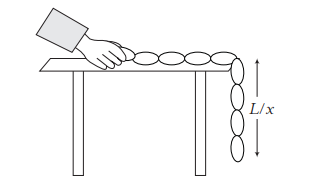
The chain has a total length \(L\) and mass \(M\). The linear mass density is \(\lambda=M / L\). A length \(h=L / x\) is hanging over the edge. The work done to lift the hanging portion can be calculated using integration over the continuous mass distribution.
Consider an infinitesimal mass element \(d m\) at a distance \(y\) below the table’s edge. The mass of this element is \(d m=\lambda d y=(M / L) d y\). The work \(d W\) required to lift this element to the table is \(d W=d m \times g \times y\). The total work \(W\) is found by integrating \(d W\) from \(y=0\) to \(y=h=L / x\).
\(
W=\int_0^{L / x} \frac{M g}{L} y d y
\)
The integral is evaluated as follows:
\(
\begin{gathered}
W=\frac{M g}{L}\left[\frac{y^2}{2}\right]_0^{L / x} \\
W=\frac{M g}{L}\left(\frac{(L / x)^2}{2}-0\right) \\
W=\frac{M g L^2}{2 L x^2} \\
W=\frac{M g L}{2 x^2}
\end{gathered}
\)
The work done in pulling the hanging portion of the chain onto the table is \(W=\frac{M g {L}}{2 x^2}\)
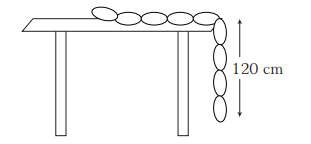
Example 6: A uniform chain of length \(4 m\) is kept on a table such that a length of 120 cm hangs freely from the edge of the table. The total mass of the chain is 4 kg. What is the work done in pulling the entire chain on the table?
Solution: Fraction of length of the chain hanging from the table,
\(
\frac{L}{x}=120 \mathrm{~cm} \Rightarrow x=\frac{10}{3}
\)
Work done in pulling the chain on the table,
W=\frac{m g L}{2 x^2}=\frac{4 \times 10 \times 4}{2 \times(10 / 3)^2}=7.2 \mathrm{~J}
\)
Alternative Solution
Centre of mass of hanging part of the chain,
\(
h=\frac{120}{2}=60 \mathrm{~cm}=0.6 \mathrm{~m}
\)
Mass per unit length of chain, \(\mu=\frac{M}{L}=\frac{4}{4}=1 \mathrm{~kg} / \mathrm{m}\)
Mass of hanging part of chain of length, \(l=120 \mathrm{~cm}=1.2 \mathrm{~m}\)
\(
M^{\prime}=\mu l=1 \times 1.2=1.2 \mathrm{~kg}
\)
∴ Work done in pulling the entire chain on the table,
\(
\begin{aligned}
W & =\text { Gravitational potential energy } \\
& =M^{\prime} g h=1.2 \times 10 \times 0.6=7.2 \mathrm{~J}
\end{aligned}
\)
Equilibrium
If a large number of forces act on a system or on an object simultaneously in such a way that the resultant force on it is zero, then it is said to be in translational equilibrium. If the forces acting on the object are conservative and it is in equilibrium, then
\(
F_{\mathrm{net}}=0 \Rightarrow-\frac{d U}{d r}=0 \quad \text { or } \quad \frac{d U}{d r}=0
\)
So, when force is conservative and object is in equilibrium, slope of \(U-r\) graph is zero or its potential energy is either minimum or maximum or constant.
On this basis, equilibrium of object or a system can be divided into three types:
- Stable equilibrium: An object is said to be in stable equilibrium, if on slight displacement from equilibrium position, it has tendency to come back. Here, potential energy in equilibrium position is minimum as compared to its neighbouring points or \(\frac{d^2 U}{d r^2}=\) positive.
- Unstable equilibrium: An object is said to be in unstable equilibrium, if on slight displacement from equilibrium position, it moves in the direction of displacement. In unstable equilibrium, potential energy is maximum or \(\frac{d^2 U}{d r^2}=\) negative.
- Neutral equilibrium: An object is said to be in neutral equilibrium, if on displacement from its equilibrium position, it has neither the tendency to move in direction of displacement nor to come back to equilibrium position. In neutral equilibrium, potential energy of the object is constant or \(\frac{d^2 U}{d r^2}=0\).
Potential energy curve for equilibrium
\(E_{\text {mech }}=\) constant is represented by horizontal dotted line in the following graph.
At \(x\), kinetic energy, \(\quad K=E_{\text {mech }}-U(x)\)
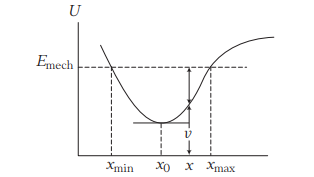
The points \(x=x_{\max }\) and \(x=x_{\min }\) are called turning points. At these points, velocity of the particle decreases to zero and reverses.
From \(x_{\min }\) to \(x_0\), slope of \(U(x)\) is negative, \(F=-\frac{d U}{d x}\) is positive and acts towards \(x_0\).
At \(x_0, F=0\). So, \(x_0\) is known as stable equilibrium point.
Beyond \(x_0\), slope is positive, indicating a negative force, towards \(x_0\).
From the PE and position graph,
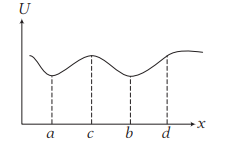
\begin{aligned}
\text { At } x & =a, b, U \text { is minimum ⇒ stable equilibrium } \\
& x=c, U \text { is maximum } \Rightarrow \text { unstable equilibrium } \\
x & =d, U \text { is constant } \Rightarrow \text { neutral equilibrium }
\end{aligned}
\)
Example 7: The potential energy of a conservative system is given by \(U=a x^2-b x\) (where, \(a\) and \(b\) are positive constants). Find the equilibrium position and discuss whether the equilibrium is stable, unstable or neutral.
Solution: In a conservative field, \(F=-\frac{d U}{d x}\)
\(
\therefore \quad F=-\frac{d}{d x}\left(a x^2-b x\right)=b-2 a x
\)
For equilibrium, \(F=0 \Rightarrow b-2 a x=0\)
\(
\therefore \quad x=\frac{b}{2 a}
\)
From the given equation, we can see that \(\frac{d^2 U}{d x^2}=2 a\) (positive), i.e. \(U\) is minimum.
Therefore, \(x=\frac{b}{2 a}\) is the stable equilibrium position.
Example 8: The potential energy for a conservative force system is given by \(U=a x^2-b x\), where \(a\) and \(b\) are constants. Find out (i) an expression of force (ii) potential energy at equilibrium.
Solution: (i) For conservative force, \(F=-\frac{d U}{d x}=-(2 a x-b)=-2 a x+b\)
(ii) At equilibrium, \(F=0 \Rightarrow-2 a x+b=0 \Rightarrow x=\frac{b}{2 a}\)
\(
\therefore \quad U=a\left(\frac{b}{2 a}\right)^2-b\left(\frac{b}{2 a}\right)=\frac{b^2}{4 a}-\frac{b^2}{2 a}=-\frac{b^2}{4 a}
\)