6.4 Linear momentum of a system of particles
For a system of \(n\)-particles, total linear momentum is vector sum of linear momenta of individual particles, where linear momentum of an individual particle is product of its mass and velocity ( \(\mathbf{p}=m \mathbf{v}\) ).
So, linear momentum of system is given by
\(
\mathbf{p}=\mathbf{p}_1+\mathbf{p}_2+\mathbf{p}_3+\ldots+\mathbf{p}_n
\)
or \(\mathbf{p}=m_1 \mathbf{v}_1+m_2 \mathbf{v}_2+m_3 \mathbf{v}_3+\cdots+m_n \mathbf{v}_n \dots(i)\)
From the concept of centre of mass, we know that,
\(
M \mathbf{v}_{\mathrm{CM}}=m_1 \mathbf{v}_1+m_2 \mathbf{v}_2+m_3 \mathbf{v}_3+\cdots+m_n \mathbf{v}_n \dots(ii)
\)
From Eqs. (i) and (ii), we get
\(
\text { Total linear momentum, } \mathbf{p}=M \mathbf{v}_{\mathrm{CM}} \dots(iii)
\)
Thus, the total momentum of a system of particles is equal to the product of the total mass and velocity of its centre of mass.
Note: Relation between momentum and kinetic energy,
\(p=\sqrt{2 m K}\)
Conservation of linear momentum for system of particles
According to law of conservation of linear momentum, total linear momentum of a system of particles remains constant or conserved in the absence of any external force (Isolation is Key: This total remains constant only if the system is “isolated” or “closed,” meaning the net external force \(\left(\Sigma F_{\text {ext }}\right)\) is zero). Total linear momentum of system of particles,
\(
\mathbf{p}=M \mathbf{v}_{\mathrm{CM}}
\)
Differentiating both sides w.r.t. \(t\), we get
\(
\frac{\mathrm{d} \mathbf{p}}{\mathrm{~d} t}=M \frac{\mathrm{~d} \mathbf{v}_{\mathrm{CM}}}{\mathrm{~d} t}=M \mathbf{a}_{\mathrm{CM}}
\)
Here, from Newton’s second law of motion, \(M \mathbf{a}_{\mathrm{CM}}\) will be equal to the external force.
\(
\frac{\mathrm{d} \mathbf{p}}{\mathrm{~d} t}=\mathbf{F}_{e x t}
\)
Suppose now, that the sum of external forces acting on a system of particles is zero. Therefore, \(\mathbf{F}_{e x t}=0\).
\(\mathbf{F}_{e x t}=\frac{\mathrm{d} \mathbf{p}}{\mathrm{d} t}=0 \quad\) or \(\quad \mathbf{p}=\) Constant
Therefore,
\(
\begin{aligned}
M \mathbf{v}_{\mathrm{CM}} & =\text { constant } \\
\mathbf{v}_{\mathrm{CM}} & =\text { constant }
\end{aligned}
\)
So, we can conclude that, if net external force on the system is zero, the linear momentum of the system is constant, hence centre of mass will move with constant velocity.
Here, rate of change of momentum is zero, i.e. momentum of system remains constant.
So, \(\mathbf{p}_{\text {initial }}=\mathbf{p}_{\text {final }}\)
Above expression represents the law of conservation of linear momentum for system of particles.
Remark: Thus, when the total external force acting on a system of particles is zero, the total linear momentum of the system is constant. This is the law of conservation of the total linear momentum of a system of particles. Because of Eqn. (iii), this also means that when the total external force on the system is zero the velocity of the centre of mass remains constant (We assume throughout the discussion on systems of particles in this chapter that the total mass of the system remains constant.)
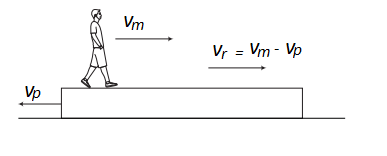
Example 1: A man of mass \(m_1\) is standing on a platform of mass \(m_2\) kept on a smooth horizontal surface. The man starts moving on the platform with a velocity \(v_r\) relative to the platform. Find the recoil velocity of platform.
Solution: Step 1: Define velocities:
Let, \(v_m=\) velocity of the man w.r.t. ground
\(v_p=\) recoil velocity of the platform w.r.t. ground
Given: the man moves with relative velocity \(v_r\) with respect to the platform.
So, \(v_r=v_m-v_p \dots(1)\)
Step 2: Apply conservation of momentum:
Initially, both are at rest, so total momentum is zero.
\(
P_{\text {initial }}=m_1 v_m+m_2 v_p=0 \dots(2)
\)
Step 3: Relate velocities using relative motion:
The man’s velocity relative to the platform \(\left(v_r\right)\) is given by \(v_m-v_p\). Thus, the man’s absolute velocity relative to the ground is \(v_m=v_r+v_p\).
Step 4: Apply conservation of momentum and solve:
Since there are no external horizontal forces, the total momentum of the system is conserved \(\left(\boldsymbol{P}_{\text {initial }}=\boldsymbol{P}_{\text {final }}\right)\). The final momentum \(\left(\boldsymbol{P}_{\text {final }}\right)\) is the sum of the man’s and the platform’s momenta:
\(
\boldsymbol{P}_{\text {final }}=m_1 v_m+m_2 v_p
\)
Substitute \(\boldsymbol{v}_{\boldsymbol{m}}\) :
\(
\boldsymbol{P}_{\text {final }}=m_1\left(v_r+v_p\right)+m_2 v_p=m_1 v_r+\left(m_1+m_2\right) v_p
\)
Setting \(\boldsymbol{P}_{\text {final }}=\boldsymbol{P}_{\text {initial }}=0\) :
\(
0=m_1 v_r+\left(m_1+m_2\right) v_p
\)
Solving for the platform’s velocity \(\left(l{v}_{{p}}\right)\) :
\(
v_p=-\frac{m_1 v_r}{m_1+m_2}
\)
The recoil velocity of the platform is \(v_p=-\frac{m_1 v_r}{m_1+m_2}\) and the magnitude is \(\frac{m_1 v_r}{m_1+m_2}\).
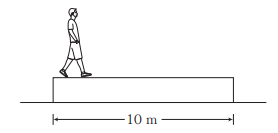
Example 2: A wooden plank of mass 20 kg is resting on a smooth horizontal floor as shown in figure. A man of mass 60 kg starts moving from one end of the plank to the other end. The length of the plank is 10 m . Find the displacement of the plank over the floor when the man reaches the other end of the plank.
Solution: Step 1: Define variables and principle
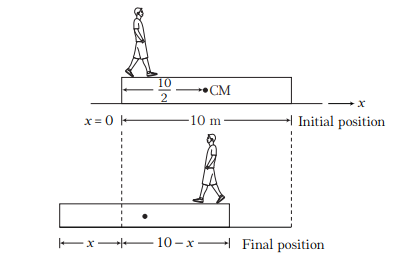
The system consists of the man and the plank. Since the floor is smooth, there are no external horizontal forces acting on the system. Consequently, the center of mass (CM) of the man-plank system remains unchanged throughout the movement. Therefore, the centre of mass does not move in horizontal direction.
Let \(x\) be the displacement of the plank. Assuming the origin, i.e. \(x=0\) at the position as shown in figure.
Let, the plank moves a distance \(x\) backward relative to the floor.
The man walks from one end to the other, i.e. 10 m relative to the plank.
Choice of reference and coordinates:
Take the left end of the plank initially at \(x=0\).
Initial CM of the man: at \(x=0\) (he starts at the left end).
Initial CM of the plank: at its midpoint, \(x=5 \mathrm{~m}\).
Masses:
\(
m=60 \mathrm{~kg}, \quad M=20 \mathrm{~kg}
\)
\(
\begin{aligned}
&\text { Initial center of mass }\\
&x_{\mathrm{CM}, \mathrm{i}}=\frac{60(0)+20(5)}{60+20}=\frac{100}{80}=\frac{5}{4}
\end{aligned}
\)
Final positions (ground frame):
Plank moves backward by \(x\) → CM of plank at \(5-x\)
Man walks 10 m relative to the plank → Man’s ground displacement \(=10-x\)
Final center of mass:
\(
x_{\mathrm{CM}, \mathrm{f}}=\frac{60(10-x)+20(5-x)}{80}
\)
Apply CM conservation:
\(
\begin{gathered}
x_{\mathrm{CM}, \mathrm{i}}=x_{\mathrm{CM}, \mathrm{f}} \\
\frac{5}{4}=\frac{60(10-x)+20(5-x)}{80}
\end{gathered}
\)
Multiply both sides by 80 :
\(
\begin{gathered}
100=600-60 x+100-20 x \\
100=700-80 x \\
80 x=600 \\
x=7.5 \mathrm{~m}
\end{gathered}
\)
The plank moves 7.5 m backward.
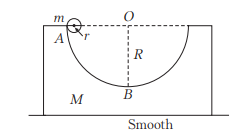
Example 3: A block of mass \(M\) with a semi-circular track of radius \(R\) rests on a smooth floor. A sphere of mass \(m\) and radius \(r\) is released from rest at point \(A\). Find the velocity of sphere and track when the sphere reaches at \(B\).
Solution: According to the question,
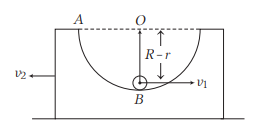
When the sphere reaches at point \(B\)
Let, \(v_1=\) velocity of \(m\) (sphere)
\(v_2=\) velocity of \(M\) (Block)
Step 1: Conservation of Momentum
Since the floor is smooth (frictionless), the total horizontal momentum of the system is conserved.
The initial momentum is zero, as the system starts from rest. The final momenta of the sphere and block are \(m v_1\) and \(M v_2\) in opposite directions.
\(
m v_1=M v_2
\)
Step 2: Conservation of Energy
Energy is conserved from point A (height \({R}-{r}\) ) to point B (height 0 relative to the track’s bottom).
The initial energy is purely potential energy: \(m g(R-r)\). The final energy is purely kinetic energy for both masses: \(\frac{1}{2} m v_1^2+\frac{1}{2} M v_2^2\).
\(
m g(R-r)=\frac{1}{2}\left(m v_1^2+M v_2^2\right)
\)
Step 3: Solving the equations
Solving the two conservation equations simultaneously for \(v_1\) and \(v_2\) yields the final expressions.
\(
v_1=\sqrt{\frac{2 M g(R-r)}{M+m}} \text { and } v_2=\frac{m}{M} \sqrt{\frac{2 M g(R-r)}{M+m}}
\)
Example 4: A disc of mass 100 g is kept floating horizontally in air by firing bullets, each of mass \(5 g\) with the same velocity at the same rate of 10 bullets per second. The bullets rebound with the same speed in opposite direction. Find the velocity of each bullet at the time of impact.
Solution: Step 1: Identify the forces and relevant physical principles
The disc remains floating horizontally, which means the net vertical force acting on it is zero. The downward force is its weight due to gravity ( \(W\) ). The upward force is the average force exerted by the stream of bullets ( \(F_{\text {bullets }}\) ). This problem involves the principles of momentum and force, as the force from the bullets is derived from the rate of change of their momentum.
Mass of the disc, \(M=100 \mathrm{~g}=0.1 \mathrm{~kg}\).
Mass of each bullet, \(m=5 \mathrm{~g}=0.005 \mathrm{~kg}\).
Rate of bullets, \(n=10\) bullets/s.
Acceleration due to gravity, \(\mathrm{g}=9.8 \mathrm{~m} / \mathrm{s}^2\).
Step 2: Calculate the change in momentum per bullet
Let the initial upward velocity of a bullet be \(v\). Since the bullet rebounds with the same speed in the opposite direction, its final velocity is \(-v\).
The change in momentum ( \(\Delta p\) ) for a single bullet is:
\(
\Delta p=m v_{\text {final }}-m v_{\text {initial }}=m(-v)-m v=-2 m v
\)
The magnitude of the change in momentum is \(2 m v\). This is the impulse transferred to the disc by each bullet.
Step 3: Calculate the total upward force from the bullets
The total force \(F_{\text {bullets }}\) exerted on the disc is the total change in momentum per unit time, which is the change in momentum per bullet multiplied by the rate of bullets fired \((n)\) :
\(
F_{\text {bullets }}=n \cdot|\Delta p|=n(2 m v)
\)
Step 4: Equate forces and solve for the velocity
For the disc to float, the upward force must equal the downward force (weight):
\(
\begin{aligned}
& F_{\text {bullets }}=W \\
& n(2 m v)=M g
\end{aligned}
\)
Rearranging the equation to solve for the velocity \(v\) :
\(
v=\frac{M g}{2 m n}
\)
Substitute the given values into the equation:
\(
\begin{gathered}
v=\frac{0.1 \mathrm{~kg} \cdot 9.8 \mathrm{~m} / \mathrm{s}^2}{2 \cdot 0.005 \mathrm{~kg} \cdot 10 \mathrm{~s}^{-1}} \\
v=\frac{0.98 \mathrm{~kg} \cdot \mathrm{~m} / \mathrm{s}^2}{0.1 \mathrm{~kg} / \mathrm{s}} \\
v=9.8 \mathrm{~m} / \mathrm{s}
\end{gathered}
\)
The velocity of each bullet at the time of impact is \(9.8 \mathrm{~m} / \mathrm{s}\).
Example 5: A plank of mass 5 kg is placed on a frictionless horizontal plane as shown in figure. Further, a block of mass 1 kg is placed over the plank. A massless spring of natural length \(2 m\) is fixed to the plank by its one end. The other end of spring is compressed by the block by half of spring’s natural length. The system is now released from the rest. What is the velocity of the plank when block leaves the plank? (The stiffness constant of spring is \(100 \mathrm{Nm}^{-1}\) )
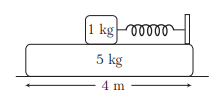
Solution: Step 1: Define variables and principles
The problem involves a closed system where no external horizontal forces act (the horizontal plane is frictionless). The internal forces are the spring force and normal forces. We can apply the principles of conservation of linear momentum and conservation of mechanical energy.
Mass of plank, \(M=5 \mathrm{~kg}\)
Mass of block, \(m=1 \mathrm{~kg}\)
Spring constant, \(k=100 \mathrm{Nm}^{-1}\)
Initial compression, \(x=1 \mathrm{~m}\)
Initial momentum \(P_i=0\), initial energy \(E_i=\frac{1}{2} k x^2\)
Step 2: Apply conservation laws
When the block leaves the plank (at the spring’s natural length), let the plank’s velocity be \({v}_{{M}}\) and the block’s velocity be \({v}_{{m}}\).
Conservation of Momentum: The total momentum remains zero.
\(
M v_M+m v_m=0 \Longrightarrow 5 v_M+1 v_m=0 \Longrightarrow v_m=-5 v_M
\)
Conservation of Energy: The initial potential energy converts to kinetic energy of both masses.
\(
\begin{aligned}
\frac{1}{2} k x^2 & =\frac{1}{2} M v_M^2+\frac{1}{2} m v_m^2 \\
k x^2 & =M v_M^2+m v_m^2
\end{aligned}
\)
Step 3: Calculate the velocity
Substitute the momentum relationship ( \(v_m=-5 v_M\) ) into the energy equation:
\(
\begin{gathered}
k x^2=M v_M^2+m\left(-5 v_M\right)^2 \\
k x^2=M v_M^2+25 m v_M^2 \\
v_M^2=\frac{k x^2}{M+25 m}
\end{gathered}
\)
Substitute the numerical values:
\(
\begin{gathered}
v_M^2=\frac{100 \mathrm{Nm}^{-1} \times(1 \mathrm{~m})^2}{5 \mathrm{~kg}+25 \times 1 \mathrm{~kg}} \\
v_M^2=\frac{100}{30}=\frac{10}{3} \mathrm{~m}^2 / \mathrm{s}^2 \\
v_M=\sqrt{\frac{10}{3}} \mathrm{~m} / \mathrm{s}
\end{gathered}
\)
Example 6: Two charged particles of masses \(m\) and \(2 m\) are placed a distance \(d\) apart on a smooth horizontal table. Because of their mutual attraction, they move towards each other and collide. Where will the collision occur with respect to the initial positions?
Solution: Center of Mass (COM) Principle: For a system of particles, the total momentum is conserved if no external forces act on it (like gravity on a smooth table). This means the center of mass of the two particles will remain stationary throughout their motion.
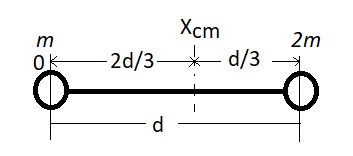
Calculating COM Position: The position of the center of mass \(X_{cm}\) for two masses ( \(m_1, m_2\) ) separated by a distance ( \(d\) ) is given by:
\(
X_{c m}=\frac{m_1 r_1+m_2 r_2}{m_1+m_2} .
\)
Let \(m_1=m\) (at position \(r_1=0\) ) and \(m_2=2 m\) (at position \(r_2=d\) ).
\(X_{c m}=\frac{(m)(0)+(2 m)(d)}{m+2 m}=\frac{2 m d}{3 m}=\frac{2 d}{3}\).
Collision Point: Since the COM stays put at \(2 d / 3\) from mass \(m\), the particles will move towards and meet at this point.
From \(2 m\)‘s Perspective: The distance from mass \(2 m\) to the COM is \(d-2 d / 3=d / 3\)
Conclusion: The collision happens at the center of mass, which is located \(2 d / 3\) from the initial position of the lighter mass ( \(m\) ) and \(d / 3\) from the heavier mass ( \(2 m\) ).
Example 7: The hero of a stunt film fires 50 g bullets from a machine gun, each at a speed of \(1.0 \mathrm{~km} / \mathrm{s}\). If he fires 20 bullets in 4 seconds, what average force does he exert against the machine gun during this period ?
Solution: Step 1: Calculate Total Momentum Change
The total change in momentum ( \(\Delta p\) ) is the product of the number of bullets ( \(N\) ), the mass per bullet \((m)\), and the speed per bullet \((v)\).
\(
\Delta p=N \times m \times v
\)
We convert the mass to kilograms ( 0.050 kg ) and the speed to meters per second ( \(1000 \mathrm{~m} / \mathrm{s}\) ).
\(
\Delta p=20 \times 0.050 \mathrm{~kg} \times 1000 \mathrm{~m} / \mathrm{s}=1000 \mathrm{~kg} \cdot \mathrm{~m} / \mathrm{s}
\)
Step 2: Determine Average Force
The average force ( \(\boldsymbol{F}_{\text {avg }}\) ) exerted is the total change in momentum divided by the total time interval ( \(\Delta t\) ).
\(
F_{\text {avg }}=\frac{\Delta p}{\Delta t}
\)
We use the calculated total momentum change and the given time of 4 s.
\(
F_{\mathrm{avg}}=\frac{1000 \mathrm{~kg} \cdot \mathrm{~m} / \mathrm{s}}{4 \mathrm{~s}}=250 \mathrm{~N}
\)
The average force exerted against the machine gun is 250 N.
Example 8: A block moving horizontally on a smooth surface with a speed of \(20 \mathrm{~m} / \mathrm{s}\) bursts into two equal parts continuing in the same direction. If one of the parts moves at \(30 \mathrm{~m} / \mathrm{s}\), with what speed does the second part move and what is the fractional change in the kinetic energy?
Solution: Step 1: Determine the speed of the second part
The total linear momentum of the system is conserved as there are no external horizontal forces.
Let the initial mass be \(m\), initial velocity \({v}_{{i}}\), velocities of the two equal parts (each of mass \(m / 2\) ) be \(v_1\) and \(v_2\).
The conservation of momentum equation is:
\(
m v_i=\frac{m}{2} v_1+\frac{m}{2} v_2
\)
Dividing by \(m\) :
\(
v_i=\frac{v_1+v_2}{2}
\)
Rearranging to solve for \(v_2\) :
\(
v_2=2 v_i-v_1
\)
Substituting the given values \(v_i=20 \mathrm{~m} / \mathrm{s}\) and \(v_1=30 \mathrm{~m} / \mathrm{s}\) :
\(
\begin{gathered}
v_2=2(20 \mathrm{~m} / \mathrm{s})-30 \mathrm{~m} / \mathrm{s} \\
v_2=40 \mathrm{~m} / \mathrm{s}-30 \mathrm{~m} / \mathrm{s}=10 \mathrm{~m} / \mathrm{s}
\end{gathered}
\)
Step 2: Calculate the fractional change in kinetic energy
The initial kinetic energy \(K_i\) is:
\(
K_i=\frac{1}{2} m v_i^2
\)
The final kinetic energy \(K_{\boldsymbol{f}}\) is:
\(
K_f=\frac{1}{2}\left(\frac{m}{2}\right) v_1^2+\frac{1}{2}\left(\frac{m}{2}\right) v_2^2=\frac{m}{4}\left(v_1^2+v_2^2\right)
\)
The fractional change in kinetic energy is \(\frac{\Delta K}{K_i}=\frac{K_f-K_i}{K_i}\).
\(
\frac{K_f}{K_i}=\frac{\frac{m}{4}\left(v_1^2+v_2^2\right)}{\frac{1}{2} m v_i^2}=\frac{v_1^2+v_2^2}{2 v_i^2}
\)
Substituting the calculated values:
\(
\begin{gathered}
\frac{K_f}{K_i}=\frac{(30 \mathrm{~m} / \mathrm{s})^2+(10 \mathrm{~m} / \mathrm{s})^2}{2(20 \mathrm{~m} / \mathrm{s})^2} \\
\frac{K_f}{K_i}=\frac{900+100}{2 \times 400}=\frac{1000}{800}=\frac{10}{8}=1.25
\end{gathered}
\)
The fractional change is:
\(
\frac{\Delta K}{K_i}=1.25-1=0.25
\)
The second part moves at a speed of \(\mathbf{1 0 ~ m} / \mathrm{s}\) and the fractional change in the kinetic energy is \(\mathbf{0 . 2 5}\).
Example 9: A car of mass \(M\) is moving with a uniform velocity \(v\) on a horizontal road when the hero of a Hindi film drops himself on it from above. Taking the mass of the hero to be \(m\), what will be the velocity of the car after the event?
Solution: Step 1: Define initial momentum
The system consists of the car and the hero. Initially, the car moves horizontally with velocity \({v}\) and mass \({M}\), while the hero has a horizontal velocity of \(\mathbf{0}\) (only vertical velocity which does not affect horizontal momentum).
The total initial horizontal momentum ( \({P}_{\text {initial }}\) ) is calculated as:
\(
P_{\text {initial }}=M v+m(0)=M v
\)
Step 2: Define final state and final momentum
After the hero drops onto the car, they move together as a single system (a perfectly inelastic collision). The total mass of the combined system is \({M}+{m}\), and they move with a common final velocity \(V_{\text {final }} \cdot\)
The total final horizontal momentum ( \({P}_{\text {final }}\) ) is:
\(
P_{\text {final }}=(M+m) V_{\text {final }}
\)
Step 3: Apply conservation of linear momentum
According to the principle of conservation of linear momentum, the total initial momentum equals the total final momentum in the absence of external horizontal forces:
\(
\begin{gathered}
P_{\text {initial }}=P_{\text {final }} \\
M v=(M+m) V_{\text {final }}
\end{gathered}
\)
Solving for the final velocity \(V_{\text {final }}\) :
\(
V_{\mathrm{final}}=\frac{M v}{M+m}
\)
The velocity of the car after the hero drops himself onto it is \(V_{\mathrm{final}}=\frac{M v}{M+m}\)
Example 10: A space shuttle, while travelling at a speed of \(4000 \mathrm{~km} / \mathrm{h}\) with respect to the earth, disconnects and ejects a module backward, weighing one fifth of the residual part. If the shuttle ejects the disconnected module at a speed of \(100 \mathrm{~km} / \mathrm{h}\) with respect to the state of the shuttle before the ejection, find the final velocity of the shuttle.
Solution: Step 1: Define Variables and Principle
We use the principle of conservation of linear momentum. Let \(m_s\) be the mass of the residual shuttle and \(m_m\) be the mass of the ejected module. The problem states \(m_m=\frac{1}{5} m_s\). The initial total mass of the system is \(M=m_s+m_m=m_s+\frac{1}{5} m_s=\frac{6}{5} m_s\). The initial velocity is \(v_i=4000 \mathrm{~km} / \mathrm{h}\). The module is ejected backward at a speed of \(v_{\text {rel }}=100 \mathrm{~km} / \mathrm{h}\) with respect to the initial state of the shuttle, meaning its velocity relative to Earth after ejection is \(v_m=v_i-v_{\text {rel }}\)
Step 2: Apply Conservation of Momentum
The total initial momentum \({P}_{{i}}\) must equal the total final momentum \({P}_{{f}}\).
\(
P_i=M v_i=\frac{6}{5} m_s v_i
\)
The final momentum is the sum of the shuttle’s final momentum \(\left(m_s v_s\right)\) and the module’s final momentum ( \(m_m v_m\) ).
\(
P_f=m_s v_s+m_m v_m=m_s v_s+\frac{1}{5} m_s v_m
\)
Setting \(P_i=P_f\) and dividing by \(m_s\) :
\(
\frac{6}{5} v_i=v_s+\frac{1}{5} v_m
\)
Step 3: Calculate the Final Velocity
Substitute \(v_m=v_i-100 \mathrm{~km} / \mathrm{h}\) into the momentum equation:
\(
\begin{gathered}
\frac{6}{5} v_i=v_s+\frac{1}{5}\left(v_i-100\right) \\
\frac{6}{5} v_i=v_s+\frac{1}{5} v_i-20
\end{gathered}
\)
Rearranging to solve for \(\boldsymbol{v}_s\) :
\(
\begin{gathered}
v_s=\frac{6}{5} v_i-\frac{1}{5} v_i+20 \\
v_s=v_i+20
\end{gathered}
\)
Substitute the value \(\boldsymbol{v}_{\boldsymbol{i}}=4000 \mathrm{~km} / \mathrm{h}\) :
\(
v_s=4000+20=4020 \mathrm{~km} / \mathrm{h}
\)
The final velocity of the shuttle is \(\mathbf{4 0 2 0 ~ k m} / \mathbf{h}\).
Example 11: A boy of mass 25 kg stands on a board of mass 10 kg which in turn is kept on a frictionless horizontal ice surface. The boy makes a jump with a velocity component \(5 \mathrm{~m} / \mathrm{s}\) in a horizontal direction with respect to the ice. With what velocity does the board recoil? With what rate are the boy and the board separating from each other?
Solution: Step 1: Apply Conservation of Momentum
The system of the boy and the board is isolated on a frictionless surface, so total horizontal momentum is conserved. The initial momentum is zero.
\(
m_{\text {boy }} v_{\text {boy }}+m_{\text {board }} v_{\text {board }}=0
\)
We are given the boy’s velocity with respect to the ice as \(v_{\text {boy }}=5 \mathrm{~m} / \mathrm{s}\).
\(
(25 \mathrm{~kg})(5 \mathrm{~m} / \mathrm{s})+(10 \mathrm{~kg}) v_{\text {board }}=0
\)
Solving for the board’s velocity:
\(
v_{\text {board }}=-\frac{25 \mathrm{~kg} \times 5 \mathrm{~m} / \mathrm{s}}{10 \mathrm{~kg}}=-12.5 \mathrm{~m} / \mathrm{s}
\)
The negative sign indicates the board moves in the opposite direction to the boy. The magnitude of the recoil velocity is \(\mathbf{1 2 . 5 ~ m} / \mathrm{s}\).
Step 2: Calculate Separation Rate
The rate at which the boy and board separate is the magnitude of their relative velocity.
\(
\begin{gathered}
v_{\text {relative }}=\left|v_{\text {boy }}-v_{\text {board }}\right| \\
v_{\text {relative }}=|5 \mathrm{~m} / \mathrm{s}-(-12.5 \mathrm{~m} / \mathrm{s})| \\
v_{\text {relative }}=|5 \mathrm{~m} / \mathrm{s}+12.5 \mathrm{~m} / \mathrm{s}|=17.5 \mathrm{~m} / \mathrm{s}
\end{gathered}
\)
The separation rate is \(\mathbf{1 7 . 5 ~ m} / \mathrm{s}\).
The board recoils with a velocity of \(\mathbf{1 2 . 5 ~ m} / \mathrm{s}\).
Example 12: A man of mass \(m\) is standing on a platform of mass \(M\) kept on smooth ice. If the man starts moving on the platform with a speed \(v\) relative to the platform, with what velocity relative to the ice does the platform recoil?
Solution: Initial State: The man (mass \(m\) ) and platform (mass \(M\) ) are at rest on smooth ice, so the total initial momentum ( \({P}_{\text {initial }}\) ) is zero.
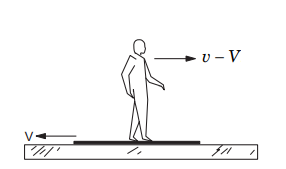
Define Velocities (Relative to Ice):
Let \(V\) be the velocity of the platform relative to the ice (this will be the recoil velocity).
The man’s velocity relative to the platform is \(v\).
Therefore, the man’s velocity relative to the ice \(\left(v_{\text {man }}\right)\) is \(v_{\text {man }}=v-V\) (since they move in opposite directions, if \(V\) is platform’s recoil, man moves with \(v\) relative to platform, so his ground speed is less than \(v\) if platform moves opposite).
Conservation of Momentum: Total momentum remains zero ( \({P}_{\text {final }}=\mathbf{0}\) ).
\(P_{\text {final }}=(\) momentum of man \()+(\) momentum of platform \()\)
\(0=m \cdot v_{\text {man }}+M \cdot V\)
\(0=m(v-V)+M V\)
\(
V=\frac{m v}{M+m}
\)
The platform recoils with a speed of \(\frac{m v}{M+m}\) in the direction opposite to the man’s movement relative to the platform.
Example 13: A ball of mass \(m\), moving with a velocity \(v\) along \(X\)-axis, strikes another ball of mass \(2 m\) kept at rest. The first ball comes to rest after collision and the other breaks into two equal pieces. One of the pieces starts moving along \(Y\)-axis with a speed \(v_1\). What will be the velocity of the other piece?
Solution: The total linear momentum of the balls before the collision is \(m v\) along the \(X\)-axis. After the collision, momentum of the first ball \(=0\), momentum of the first piece \(=m v_1\) along the \(Y\)-axis and momentum of the second piece \(=m v_2\) along its direction of motion where \(v_2\) is the speed of the second piece. These three should add to \(m v\) along the \(X\)-axis, which is the initial momentum of the system.
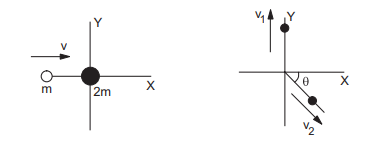
Taking components along the \(X\)-axis,
\(
m v_2 \cos \theta=m v \dots(i)
\)
and taking components along the \(Y\)-axis,
\(
m v_2 \sin \theta=m v_1 \dots(ii)
\)
From (i) and (ii),
\(
v_2=\sqrt{v^2+v_1^2} \text { and } \tan \theta=v_1 / v
\)
Example 14: A bullet of mass 50 g is fired from below into the bob of mass 450 g of a long simple pendulum as shown in figure below. The bullet remains inside the bob and the bob rises through a height of 1.8 m. Find the speed of the bullet. Take \(g=10 \mathrm{~m} / \mathrm{s}^2\).
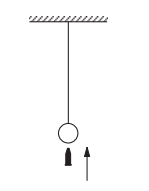
Solution: Step 1: Determine the velocity of the combined system after impact
First, we find the velocity ( \({V}\) ) of the bullet and bob system immediately after the inelastic collision using the conservation of mechanical energy as the system rises to a height (h) of 1.8 m. The potential energy gained equals the initial kinetic energy of the combined mass. We use \(g=10 \mathrm{~m} / \mathrm{s}^2\).
The energy conservation equation is \(\frac{1}{2}(m+M) V^2=(m+M) g h\) which simplifies to \(V^2=2 g h\).
\(
V=\sqrt{2 g h}
\)
Substituting the values:
\(
V=\sqrt{2 \times 10 \mathrm{~m} / \mathrm{s}^2 \times 1.8 \mathrm{~m}}=\sqrt{36 \mathrm{~m}^2 / \mathrm{s}^2}=6 \mathrm{~m} / \mathrm{s}
\)
Step 2: Apply conservation of linear momentum
Next, we apply the principle of conservation of linear momentum during the collision. The total momentum before the impact equals the total momentum immediately after the impact.
Mass of bullet, \(m=50 \mathrm{~g}=0.05 \mathrm{~kg}\).
Mass of bob, \(M=450 \mathrm{~g}=0.45 \mathrm{~kg}\).
Total mass, \((m+M)=0.05 \mathrm{~kg}+0.45 \mathrm{~kg}=0.5 \mathrm{~kg}\).
Let \(v\) be the initial speed of the bullet.
The momentum conservation equation is \(m v=(m+M) V\).
\(
v=\frac{(m+M) V}{m}
\)
Substituting the values calculated in the previous step:
\(
v=\frac{0.5 \mathrm{~kg} \times 6 \mathrm{~m} / \mathrm{s}}{0.05 \mathrm{~kg}}=\frac{3 \mathrm{~kg} \cdot \mathrm{~m} / \mathrm{s}}{0.05 \mathrm{~kg}}=60 \mathrm{~m} / \mathrm{s}
\)
The speed of the bullet was \(60 \mathrm{~m} / \mathrm{s}\).