14.8 Entrance Corner
Q1. The displacement of a particle of a string carrying \(a\) travelling wave is given by
\(
y=(3.0 \mathrm{~cm}) \sin 6.28(0.50 x-50 t),
\)
where \(x\) is in centimetre and \(t\) in second. Find (a) the amplitude, (b) the wavelength, (c) the frequency and (d) the speed of the wave.
Solution: Comparing with the standard wave equation
\(
\begin{aligned}
y & =A \sin (k x-\omega t) \\
& =A \sin 2 \pi\left(\frac{x}{\lambda}-\frac{t}{T}\right)
\end{aligned}
\)
we see that,
amplitude \(=A=3.0 \mathrm{~cm}\),
wavelength \(=\lambda=\frac{1}{0.50} \mathrm{~cm}=2.0 \mathrm{~cm}\),
and the frequency \(={f}=\frac{1}{T}=50 \mathrm{~Hz}\).
The speed of the wave is \(v={f} \lambda\)
\(
\begin{aligned}
& =\left(50 \mathrm{~s}^{-1}\right)(2 \cdot 0 \mathrm{~cm}) \\
& =100 \mathrm{~cm} \mathrm{~s}^{-1}
\end{aligned}
\)
Q2. The equation for a wave travelling in \(x\)-direction on a string is
\(
y=(3 \cdot 0 \mathrm{~cm}) \sin \left[\left(3 \cdot 14 \mathrm{~cm}^{-1}\right) x-\left(314 \mathrm{~s}^{-1}\right) t\right] .
\)
(a) Find the maximum velocity of a particle of the string.
(b) Find the acceleration of a particle at \(x=6.0 \mathrm{~cm}\) at time \(t=0.11 \mathrm{~s}\).
Solution: (a) The velocity of the particle at \(x\) at time \(t\) is
\(
\begin{aligned}
v=\frac{\partial y}{\partial t} & =(3 \cdot 0 \mathrm{~cm})\left(-314 \mathrm{~s}^{-1}\right) \cos \left[\left(3 \cdot 14 \mathrm{~cm}^{-1}\right) x-\left(314 \mathrm{~s}^{-1}\right) t\right] \\
& =\left(-9 \cdot 4 \mathrm{~m} \mathrm{~s}^{-1}\right) \cos \left[\left(3 \cdot 14 \mathrm{~cm}^{-1}\right) x-\left(314 \mathrm{~s}^{-1}\right) t\right] .
\end{aligned}
\)
The maximum velocity of a particle will be
\(
v=9 \cdot 4 \mathrm{~m} \mathrm{~s}^{-1} .
\)
(b) The acceleration of the particle at \(x\) at time \(t\) is
\(
\begin{aligned}
a=\frac{\partial v}{\partial t} & =-\left(9 \cdot 4 \mathrm{~m} \mathrm{~s}^{-1}\right)\left(314 \mathrm{~s}^{-1}\right) \sin \left[\left(3 \cdot 14 \mathrm{~cm}^{-1}\right) x-\left(314 \mathrm{~s}^{-1}\right) t\right] \\
& =-\left(2952 \mathrm{~m} \mathrm{~s}^{-2}\right) \sin \left[\left(3 \cdot 14 \mathrm{~cm}^{-1}\right) x-\left(314 \mathrm{~s}^{-1}\right) t\right] .
\end{aligned}
\)
The acceleration of the particle at \(x=6.0 \mathrm{~cm}\) at time \(t=0 \cdot 11 \mathrm{~s}\) is \(a=-\left(2952 \mathrm{~m} \mathrm{~s}^{-2}\right) \sin [6 \pi-11 \pi]=0\).
Q3. A long string having a cross-sectional area \(0.80 \mathrm{~mm}^2\) and density \(12.5 \mathrm{~g} \mathrm{~cm}^{-3}\), is subjected to a tension of 64 N along the \(X\)-axis. One end of this string is attached to a vibrator moving in transverse direction at a frequency of 20 Hz . At \(t=0\), the source is at a maximum displacement \(y=1.0 \mathrm{~cm}\). (a) Find the speed of the wave travelling on the string. (b) Write the equation for the wave. (c) What is the displacement of the particle of the string at \(x=50 \mathrm{~cm}\) at time \(t=0.05 s\)? (d) What is the velocity of this particle at this instant?
Solution: (a) The mass of 1 m long part of the string is
\(
\begin{aligned}
m & =\left(0.80 \mathrm{~mm}^2\right) \times(1 \mathrm{~m}) \times\left(12.5 \mathrm{~g} \mathrm{~cm}^{-3}\right) \\
& =\left(0.80 \times 10^{-6} \mathrm{~m}^3\right) \times\left(12.5 \times 10^3 \mathrm{~kg} \mathrm{~m}^{-3}\right) \\
& =0.01 \mathrm{~kg}
\end{aligned}
\)
The linear mass density is \(\mu=0.01 \mathrm{~kg} \mathrm{~m}^{-1}\). The wave speed is \(v=\sqrt{T / \mu}\)
\(
=\sqrt{\frac{64 \mathrm{~N}}{0.01 \mathrm{~kg} \mathrm{~m}^{-1}}}=80 \mathrm{~m} \mathrm{~s}^{-1} .
\)
(b) The amplitude of the source is \(A=1.0 \mathrm{~cm}\) and the frequency is \(\nu=20 \mathrm{~Hz}\). The angular frequency is \(\omega=2 \pi \nu=40 \pi \mathrm{~s}^{-1}\). Also at \(t=0\), the displacement is equal to its amplitude, i.e., at \(t=0, y=A\). The equation of motion of the source is, therefore,
\(
y=(1.0 \mathrm{~cm}) \cos \left[\left(40 \pi \mathrm{~s}^{-1}\right) t\right] \dots(i)
\)
The equation of the wave travelling on the string along the positive \(X\)-axis is obtained by replacing \(t\) with \(t-x / v\) in equation (i). It is, therefore,
\(
\begin{aligned}
y & =(1 \cdot 0 \mathrm{~cm}) \cos \left[\left(40 \pi \mathrm{~s}^{-1}\right)\left(t-\frac{x}{v}\right)\right] \\
& =(1 \cdot 0 \mathrm{~cm}) \cos \left[\left(40 \pi \mathrm{~s}^{-1}\right) t-\left(\frac{\pi}{2} \mathrm{~m}^{-1}\right) x\right], \dots(ii)
\end{aligned}
\)
where the value of \(v\) has been put from part (a).
(c) The displacement of the particle at \(x=50 \mathrm{~cm}\) at time \(t=0.05 \mathrm{~s}\) is by equation (ii),
\(
\begin{aligned}
y & =(1.0 \mathrm{~cm}) \cos \left[\left(40 \pi \mathrm{~s}^{-1}\right)(0.05 \mathrm{~s})-\left(\frac{\pi}{2} \mathrm{~m}^{-1}\right)(0.5 \mathrm{~m})\right] \\
& =(1.0 \mathrm{~cm}) \cos \left[2 \pi-\frac{\pi}{4}\right] \\
& =\frac{1.0 \mathrm{~cm}}{\sqrt{ } 2}=0.71 \mathrm{~cm}
\end{aligned}
\)
(d) The velocity of the particle at position \(x\) at time \(t\) is, by equation (ii),
\(
v=\frac{\partial y}{\partial t}=-(1 \cdot 0 \mathrm{~cm})\left(40 \pi \mathrm{~s}^{-1}\right) \sin \left[\left(40 \pi \mathrm{~s}^{-1}\right) t-\left(\frac{\pi}{2} \mathrm{~m}^{-1}\right) x\right] .
\)
Putting the values of \(x\) and \(t\),
\(
\begin{aligned}
v & =-\left(40 \pi \mathrm{~cm} \mathrm{~s}^{-1}\right) \sin \left(2 \pi-\frac{\pi}{4}\right) \\
& =\frac{40 \pi}{\sqrt{2}} \mathrm{~cm} \mathrm{~s}^{-1} \approx 89 \mathrm{~cm} \mathrm{~s}^{-1}
\end{aligned}
\)
Q4. The speed of a transverse wave, going on a wire having a length 50 cm and mass 5.0 g, is \(80 \mathrm{~m} \mathrm{~s}^{-1}\). The area of cross section of the wire is \(1.0 \mathrm{~mm}^2\) and its Young modulus is \(16 \times 10^{11} \mathrm{~N} \mathrm{~m}^{-2}\). Find the extension of the wire over its natural length.
Solution: The linear mass density is
\(
\mu=\frac{5 \times 10^{-3} \mathrm{~kg}}{50 \times 10^{-2} \mathrm{~m}}=1.0 \times 10^{-2} \mathrm{~kg} \mathrm{~m}^{-1} .
\)
The wave speed is \(v=\sqrt{T / \mu}\).
Thus, the tension is \(T=\mu v^2\)
\(
=\left(1.0 \times 10^{-2} \mathrm{~kg} \mathrm{~m}^{-1}\right) \times 6400 \mathrm{~m}^2 \mathrm{~s}^{-2}=64 \mathrm{~N} .
\)
The Young modulus is given by
\(
Y=\frac{T / A}{\Delta L / L}
\)
The extension is, therefore,
\(
\begin{aligned}
\Delta L & =\frac{T L}{A Y} \\
& =\frac{(64 \mathrm{~N})(0.50 \mathrm{~m})}{\left(1.0 \times 10^{-6} \mathrm{~m}^2\right) \times\left(16 \times 10^{11} \mathrm{~N} \mathrm{~m}^{-2}\right)}=0.02 \mathrm{~mm}
\end{aligned}
\)
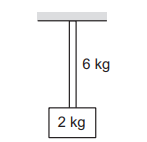
Q5. A uniform rope of length 12 m and mass 6 kg hangs vertically from a rigid support. A block of mass 2 kg is attached to the free end of the rope. A transverse pulse of wavelength 0.06 m is produced at the lower end the rope. What is the wavelength of the pulse when it reaches the top of the rope?
Solution: As the rope is heavy, its tension will be different at different points. The tension at the free end will be \((2 \mathrm{~kg}) g\) and that at the upper end it will be \((8 \mathrm{~kg}) g\).
We have,
\(
v={f} \lambda
\)
\(
\sqrt{T / \mu}=f \lambda
\)
\(
\sqrt{ } T / \lambda=f \sqrt{ } \mu \dots(i)
\)
The frequency of the wave pulse will be the same everywhere on the rope as it depends only on the frequency of the source. The mass per unit length is also the same throughout the rope as it is uniform. Thus, by
(i), \(\frac{\sqrt{ } T}{\lambda}\) is constant.
Hence, \(\quad \frac{\sqrt{(2 \mathrm{~kg}) g}}{0.06 \mathrm{~m}}=\frac{\sqrt{(8 \mathrm{~kg}) g}}{\lambda_1}\),
where \(\lambda_1\) is the wavelength at the top of the rope. This gives \(\lambda_1=0 \cdot 12 \mathrm{~m}\).
Q6. Two waves passing through a region are represented by
\(
y=(1 \cdot 0 \mathrm{~cm}) \sin \left[\left(3 \cdot 14 \mathrm{~cm}^{-1}\right) x-\left(157 \mathrm{~s}^{-1}\right) t\right]
\)
and \(\quad y=(1.5 \mathrm{~cm}) \sin \left[\left(1.57 \mathrm{~cm}^{-1}\right) x-\left(314 \mathrm{~s}^{-1}\right) t\right]\).
Find the displacement of the particle at \(x=4.5 \mathrm{~cm}\) at time \(t=5.0 \mathrm{~ms}\).
Solution: According to the principle of superposition, each wave produces its disturbance independent of the other and the resultant disturbance is equal to the vector sum of the individual disturbances. The displacements of the particle at \(x=4.5 \mathrm{~cm}\) at time \(t=5.0 \mathrm{~ms}\) due to the two waves are,
\(
\begin{aligned}
y_1= & (1.0 \mathrm{~cm}) \sin \left[\left(3.14 \mathrm{~cm}^{-1}\right)(4.5 \mathrm{~cm})\right. \\
& \left.\quad-\left(157 \mathrm{~s}^{-1}\right)\left(5.0 \times 10^{-3} \mathrm{~s}\right)\right] \\
= & (1.0 \mathrm{~cm}) \sin \left[4.5 \pi-\frac{\pi}{4}\right] \\
= & (1.0 \mathrm{~cm}) \sin [4 \pi+\pi / 4]=\frac{1.0 \mathrm{~cm}}{\sqrt{ } 2}
\end{aligned}
\)
\(
\begin{aligned}
y_2= & (1.5 \mathrm{~cm}) \sin \left[\left(1.57 \mathrm{~cm}^{-1}\right)(4.5 \mathrm{~cm})\right. \\
& \left.\quad-\left(314 \mathrm{~s}^{-1}\right)\left(5.0 \times 10^{-3} \mathrm{~s}\right)\right] \\
= & (1.5 \mathrm{~cm}) \sin \left[2.25 \pi-\frac{\pi}{2}\right] \\
= & (1.5 \mathrm{~cm}) \sin [2 \pi-\pi / 4] \\
= & -(1.5 \mathrm{~cm}) \sin \frac{\pi}{4}=-\frac{1.5 \mathrm{~cm}}{\sqrt{ } 2} .
\end{aligned}
\)
\(
\begin{aligned}
&\text { The net displacement is }\\
&y=y_1+y_2=\frac{-0.5 \mathrm{~cm}}{\sqrt{ } 2}=-0.35 \mathrm{~cm} .
\end{aligned}
\)
Q7. The vibrations of a string fixed at both ends are described by the equation
\(
y=(5.00 \mathrm{~mm}) \sin \left[\left(1.57 \mathrm{~cm}^{-1}\right) x\right] \sin \left[\left(314 \mathrm{~s}^{-1}\right) t\right]
\)
(a) What is the maximum displacement of the particle at \(x=5.66 \mathrm{~cm}\) ? (b) What are the wavelengths and the wave speeds of the two transverse waves that combine to give the above vibration? (c) What is the velocity of the particle at \(x=5.66 \mathrm{~cm}\) at time \(t=2.00 \mathrm{~s}\)? (d) If the length of the string is 10.0 cm, locate the nodes and the antinodes. How many loops are formed in the vibration?
Solution: (a) The amplitude of the vibration of the particle at position \(x\) is
\(
A=\left|(5 \cdot 00 \mathrm{~mm}) \sin \left[\left(1 \cdot 57 \mathrm{~cm}^{-1}\right) x\right]\right|
\)
For
\(
\begin{aligned}
x & =5.66 \mathrm{~cm} \\
A & =\left|(5.00 \mathrm{~mm}) \sin \left[\frac{\pi}{2} \times 5.66\right]\right|
\end{aligned}
\)
\(
\begin{aligned}
& =\left|(5 \cdot 00 \mathrm{~mm}) \sin \left(2 \cdot 5 \pi+\frac{\pi}{3}\right)\right| \\
& =\left|(5 \cdot 00 \mathrm{~mm}) \cos \frac{\pi}{3}\right|=2 \cdot 50 \mathrm{~mm} .
\end{aligned}
\)
(b) From the given equation, the wave number \(k=1.57 \mathrm{~cm}^{-1}\) and the angular frequency \(\omega=314 \mathrm{~s}^{-1}\). Thus, the wavelength is
\(
\lambda=\frac{2 \pi}{k}=\frac{2 \times 3.14}{1.57 \mathrm{~cm}^{-1}}=4.00 \mathrm{~cm}
\)
and the frequency is \(\nu=\frac{\omega}{2 \pi}=\frac{314 \mathrm{~s}^{-1}}{2 \times 3 \cdot 14}=50 \mathrm{~s}^{-1}\).
The wave speed is \(v=\nu \lambda=\left(50 \mathrm{~s}^{-1}\right)(4 \cdot 00 \mathrm{~cm})=2 \cdot 00 \mathrm{~m} \mathrm{~s}^{-1}\).
(c) The velocity of the particle at position \(x\) at time \(t\) is given by
\(
\begin{aligned}
v & =\frac{\partial y}{\partial t}=(5.00 \mathrm{~mm}) \sin \left[\left(1.57 \mathrm{~cm}^{-1}\right) x\right] \\
& {\left[314 \mathrm{~s}^{-1} \cos \left(314 \mathrm{~s}^{-1}\right) t\right] } \\
& =\left(157 \mathrm{~cm} \mathrm{~s}^{-1}\right) \sin \left(1.57 \mathrm{~cm}^{-1}\right) x \cos \left(314 \mathrm{~s}^{-1}\right) t
\end{aligned}
\)
Putting \(x=5.66 \mathrm{~cm}\) and \(t=2.00 \mathrm{~s}\), the velocity of this particle at the given instant is
\(
\begin{aligned}
& \left(157 \mathrm{~cm} \mathrm{~s}^{-1}\right) \sin \left(\frac{5 \pi}{2}+\frac{\pi}{3}\right) \cos (200 \pi) \\
= & \left(157 \mathrm{~cm} \mathrm{~s}^{-1}\right) \times \cos \frac{\pi}{3} \times 1=78.5 \mathrm{~cm} \mathrm{~s}^{-1}
\end{aligned}
\)
(d) The nodes occur where the amplitude is zero, i.e.,
\(
\sin \left(1.57 \mathrm{~cm}^{-1}\right) x=0 .
\)
\(
\left(\frac{\pi}{2} \mathrm{~cm}^{-1}\right) x=n \pi,
\)
where \(n\) is an integer.
Thus,
\(
x=2 n \mathrm{~cm} .
\)
The nodes, therefore, occur at \(x=0,2 \mathrm{~cm}, 4 \mathrm{~cm}, 6 \mathrm{~cm}\), 8 cm and 10 cm . Antinodes occur in between them, i.e., at \(x=1 \mathrm{~cm}, 3 \mathrm{~cm}, 5 \mathrm{~cm}, 7 \mathrm{~cm}\) and 9 cm . The string vibrates in 5 loops.
Q8. A guitar string is 90 cm long and has a fundamental frequency of 124 Hz . Where should it be pressed to produce a fundamental frequency of 186 Hz ?
Solution: The fundamental frequency of a string fixed at both ends is given by
\(
\nu=\frac{1}{2 L} \sqrt{\frac{T}{\mu}} .
\)
As \(T\) and \(\mu\) are fixed, \(\frac{\nu_1}{\nu_2}=\frac{L_2}{L_1}\)
\(
L_2=\frac{\nu_1}{\nu_2} L_1=\frac{124 \mathrm{~Hz}}{186 \mathrm{~Hz}}(90 \mathrm{~cm})=60 \mathrm{~cm} .
\)
Thus, the string should be pressed at 60 cm from an end.
Q9. A sonometer wire has a total length of 1 m between the fixed ends. Where should the two bridges be placed below the wire so that the three segments of the wire have their fundamental frequencies in the ratio \(1: 2: 3\) ?
Solution: Suppose the lengths of the three segments are \(L_1, L_2\) and \(L_3\) respectively. The fundamental frequencies are
\(
\begin{aligned}
& \nu_1=\frac{1}{2 L_1} \sqrt{T / \mu} \\
& \nu_2=\frac{1}{2 L_2} \sqrt{T / \mu} \\
& \nu_3=\frac{1}{2 L_3} \sqrt{T / \mu}
\end{aligned}
\)
so that \(\quad \nu_1 L_1=\nu_2 L_2=\nu_3 L_3 \dots(i)\).
As \(\nu_1: \nu_2: \nu_3=1: 2: 3\), we have
\(
\begin{aligned}
& \nu_2=2 \nu_1 \text { and } \nu_3=3 \nu_1 \text { so that by (i) } \\
& L_2=\frac{\nu_1}{\nu_2} L_1=\frac{L_1}{2} \\
& L_3=\frac{\nu_1}{\nu_3} L_1=\frac{L_1}{3}
\end{aligned}
\)
As \(L_1+L_2+L_3=1 \mathrm{~m}\),
we get \(\quad L_1\left(1+\frac{1}{2}+\frac{1}{3}\right)=1 \mathrm{~m}\)
\(
L_1=\frac{6}{11} \mathrm{~m} .
\)
Thus, \(L_2=\frac{L_1}{2}=\frac{3}{11} \mathrm{~m}\)
and \(L_3=\frac{L_1}{3}=\frac{2}{11} \mathrm{~m}\)
One bridge should be placed at \(\frac{6}{11} \mathrm{~m}\) from one end and the other should be placed at \(\frac{2}{11} \mathrm{~m}\) from the other end.
Q10. A wire having a linear mass density \(5 \cdot 0 \times 10^{-3} \mathrm{~kg} \mathrm{~m}^{-1}\) is stretched between two rigid supports with a tension of 450 N. The wire resonates at a frequency of 420 Hz. The next higher frequency at which the same wire resonates is 490 Hz . Find the length of the wire.
Solution: Suppose the wire vibrates at 420 Hz in its \(n\)th harmonic and at 490 Hz in its (\(n+1\))th harmonic.
\(
420 \mathrm{~s}^{-1}=\frac{n}{2 L} \sqrt{T / \mu} \dots(i)
\)
and \(490 \mathrm{~s}^{-1}=\frac{(n+1)}{2 L} \sqrt{T / \mu} \dots(ii)\)
This gives \(\frac{490}{420}=\frac{n+1}{n}\)
\(
n=6
\)
Putting the value in (i),
\(
420 \mathrm{~s}^{-1}=\frac{6}{2 L} \sqrt{\frac{450 \mathrm{~N}}{5 \cdot 0 \times 10^{-3} \mathrm{~kg} \mathrm{~m}^{-1}}}=\frac{900}{L} \mathrm{~m} \mathrm{~s}^{-1}
\)
\(
L=\frac{900}{420} \mathrm{~m}=2 \cdot 1 \mathrm{~m} .
\)
Q11. Two sources of sound \(S_1\) and \(S_2\) produce sound waves of same frequency 660 Hz. A listener is moving from source \(S_1\) towards \(S_2\) with a constant speed \(u \mathrm{~m} / \mathrm{s}\) and he hears 10 beats \(/ \mathrm{s}\). The velocity of sound is \(330 \mathrm{~m} / \mathrm{s}\). Then, \(u\) equals : [JEE Main 2019]
(a) \(10.0 \mathrm{~m} / \mathrm{s}\)
(b) \(5.5 \mathrm{~m} / \mathrm{s}\)
(c) \(15.0 \mathrm{~m} / \mathrm{s}\)
(d) \(2.5 \mathrm{~m} / \mathrm{s}\)
Solution: (d) To solve this problem, we need to apply the Doppler Effect for a moving observer and stationary sources.
Step 1: Identify the Apparent Frequencies
The listener is moving away from source \(S_1\) and moving toward source \(S_2\). Let \(v\) be the speed of sound and \(u\) be the speed of the listener.
Frequency from \(S_1\left(f_1\right)\) : Since the listener is moving away from the source, the observed frequency decreases.
\(
f_1=f\left(\frac{v-u}{v}\right)
\)
Frequency from \(S_2\left(f_2\right)\) : Since the listener is moving toward the source, the observed frequency increases.
\(
f_2=f\left(\frac{v+u}{v}\right)
\)
Step 2: Calculate the Beat Frequency
The beat frequency \(\left(f_b\right)\) is the absolute difference between the two observed frequencies. Since the listener is moving toward \(S_2, f_2\) will be greater than \(f_1\).
\(
\begin{gathered}
f_b=f_2-f_1 \\
f_b=f\left(\frac{v+u}{v}\right)-f\left(\frac{v-u}{v}\right) \\
f_b=\frac{f}{v}[(v+u)-(v-u)] \\
f_b=\frac{f}{v}(2 u)
\end{gathered}
\)
Step 3: Substitute the Given Values
We are given:
Frequency of sources \((f)=660 \mathrm{~Hz}\)
Velocity of sound \((v)=330 \mathrm{~m} / \mathrm{s}\)
Beat frequency \(\left(f_b\right)=10\) beats/s
Plugging these into the simplified formula:
\(
\begin{gathered}
10=\frac{660}{330} \times(2 u) \\
10=2 \times 2 u \\
10=4 u \\
u=\frac{10}{4}=2.5 \mathrm{~m} / \mathrm{s}
\end{gathered}
\)
Final Answer: The speed of the listener \(u\) is \(\mathbf{2 . 5 ~ m} / \mathrm{s}\).
Q12. A small speaker delivers 2 W of audio output. At what distance from the speaker will one detect 120 dB intensity sound ? [Given reference intensity of sound as \(10^{-12} \mathrm{~W} / \mathrm{m}^2\)] [JEE Main 2019]
(a) 20 cm
(b) 10 cm
(c) 40 cm
(d) 30 cm
Solution: (c) To find the distance at which the sound intensity reaches 120 dB , we need to convert the intensity level from decibels to \(\mathrm{W} / \mathrm{m}^2\) and then relate it to the power of the source.
Step 1: Calculate the Intensity (\(I\)) in \(W / m^2\)
The sound intensity level (\(L\)) in decibels is given by the formula:
\(
L=10 \log _{10}\left(\frac{I}{I_0}\right)
\)
Given:
\(L=120 \mathrm{~dB}\)
\(I_0=10^{-12} \mathrm{~W} / \mathrm{m}^2\)
Substituting the values:
\(
120=10 \log _{10}\left(\frac{I}{10^{-12}}\right)
\)
\(
I=10^{12} \times 10^{-12}=1 \mathrm{~W} / \mathrm{m}^2
\)
Step 2: Relate Intensity to Distance
Assuming the speaker acts as a point source radiating sound uniformly in all directions, the intensity \(I\) at a distance \(r\) is:
\(
I=\frac{P}{4 \pi r^2}
\)
Given:
Power \((P)=2 \mathrm{~W}\)
Intensity \((I)=1 \mathrm{~W} / \mathrm{m}^2\)
Solving for \(r\) :
\(
\begin{gathered}
1=\frac{2}{4 \pi r^2} \\
r^2=\frac{2}{4 \pi}=\frac{1}{2 \pi}
\end{gathered}
\)
\(
r=\sqrt{\frac{1}{2 \pi}} \text { meters }
\)
Step 3: Numerical Calculation
Using the approximation \(\pi \approx 3.14\) :
\(
r=\sqrt{\frac{1}{6.28}} \approx \sqrt{0.159} \approx 0.398 \mathrm{~m}
\)
Converting meters to centimeters:
\(
r \approx 0.398 \times 100 \mathrm{~cm} \approx 39.8 \mathrm{~cm}
\)
Rounding to the nearest provided option, we get 40 cm.
Final Answer: The distance from the speaker is approximately 40 cm.
Q13. A tuning fork of frequency 480 Hz is used in an experiment for measuring speed of sound \((\mathrm{v})\) in air by resonance tube method. Resonance is observed to occur at two successive lengths of the air column, \(\mathrm{l}_1=30 \mathrm{~cm}\) and \(\mathrm{l}_2=70 \mathrm{~cm}\). Then, \(v\) is equal to [JEE Main 2019]
(a) \(338 \mathrm{~ms}^{-1}\)
(b) \(384 \mathrm{~ms}^{-1}\)
(c) \(379 \mathrm{~ms}^{-1}\)
(d) \(332 \mathrm{~ms}^{-1}\)
Solution: (b) In a resonance tube experiment (a closed-end air column), the speed of sound is determined by the distance between two successive resonance positions.
Step 1: Understand the Physics of Successive Resonance
In a resonance tube, the air column vibrates such that there is a node at the water surface and an antinode near the open end. The distance between two successive resonance lengths (\(l_1\) and \(l_2\)) corresponds exactly to half a wavelength (\(\frac{\lambda}{2}\)).
Step 2: Calculate the Wavelength (\(\lambda\))
The relationship between successive lengths is:
\(
l_2-l_1=\frac{\lambda}{2}
\)
Given:
\(l_1=30 \mathrm{~cm}=0.3 \mathrm{~m}\)
\(l_2=70 \mathrm{~cm}=0.7 \mathrm{~m}\)
Substituting the values:
\(
0.7-0.3=\frac{\lambda}{2}
\)
\(
\lambda=0.8 \mathrm{~m}
\)
Step 3: Calculate the Speed of Sound (\(v\))
The speed of sound is the product of the frequency \((f)\) and the wavelength \((\lambda)\) :
\(
v=f \lambda
\)
Given:
\(f=480 \mathrm{~Hz}\)
\(\lambda=0.8 \mathrm{~m}\)
\(
\begin{aligned}
& v=480 \times 0.8 \\
& v=384 \mathrm{~m} / \mathrm{s}
\end{aligned}
\)
Final Answer: The speed of sound in air is \(384 \mathrm{~ms}^{-1}\).
Q14. A progressive wave travelling along the positive \(x\)-direction is represented by \(y(x, t)=A \sin (k x-\omega t+\phi)\). Its snapshot at \(t=0\) is given in the figure. [JEE Main 2019]
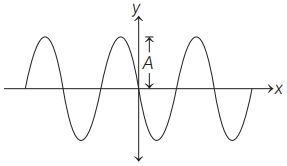
For this wave, the phase \(\phi\) is :
(a) \(\frac{\pi}{2}\)
(b) \(\pi\)
(c) 0
(d) \(-\frac{\pi}{2}\)
Solution: (b) Step 1: Analyze the Boundary Conditions at \(t=0\)
The wave equation at \(t=0\) is:
\(
y(x, 0)=A \sin (k x+\phi)
\)
From your provided graph at \(x=0\) :
The displacement \({y}\) is \({0}\).
This means \(\sin (\phi)=0\), so \(\phi\) must be either 0 or \(\pi\).
Step 2: Check the Slope (Direction of Change)
This is the deciding factor. Let’s look at what happens to the wave as we move slightly to the right of the origin \((x>0)\) :
In the graph, as \(x\) increases from 0 , the wave immediately goes downward into the negative \(y\) region.
Mathematically, this means the slope \(\frac{d y}{d x}\) at the origin must be negative.
Step 3: Test the Phase Options
The derivative of the wave function with respect to \(x\) at \(t=0\) is:
\(
\frac{d y}{d x}=A k \cos (k x+\phi)
\)
At the origin (\(x=0\)):
\(
\text { Slope }=A k \cos (\phi)
\)
If \(\phi=0: \cos (0)=1\). The slope is positive (wave goes up).
If \(\phi=\pi: \cos (\pi)=-1\). The slope is negative (wave goes down).
Conclusion: Since the snapshot shows the wave heading into a “trough” (negative \(y\)) as you move in the positive \(x\) direction from the origin, the phase constant \(\phi\) must be \(\pi\).
Q15. A submarine (A) travelling at \(18 \mathrm{~km} / \mathrm{hr}\) is being chased along the line of its velocity by another submarine (B) travelling at \(27 \mathrm{~km} / \mathrm{hr}\). B sends a sonar signal of 500 Hz to detect A and receives a reflected sound of frequency \(\nu\). The value of \(\nu\) is close to: (Speed of sound in water \(=1500 \mathrm{~ms}^{-1}[latex]) [JEE Main 2019]
(a) 507 Hz
(b) 502 Hz
(c) 499 Hz
(d) 504 Hz
Solution: (b) To solve this problem, we need to apply the Doppler Effect in two distinct stages: first, when the signal travels from submarine [latex]B\) to submarine \(A\), and second, when the signal reflects off \(A\) and returns to \(B\). There is a common approximation used for these “chase” problems where the speed of the submarines is much smaller than the speed of sound (\(u \ll v\)).
Step-by-Step Precise Calculation:
The general formula for a signal reflected from a moving target back to the source is:
\(
\nu=f_0\left(\frac{v+v_b}{v-v_b}\right)\left(\frac{v-v_a}{v+v_a}\right)
\)
Where \(v_b=7.5 \mathrm{~m} / \mathrm{s}\) (Source/Observer) and \(v_a=5 \mathrm{~m} / \mathrm{s}\) (Target).
Substitute the values:
\(
\begin{gathered}
\nu=500\left(\frac{1500+7.5}{1500-7.5}\right)\left(\frac{1500-5}{1500+5}\right) \\
\nu=500\left(\frac{1507.5}{1492.5}\right)\left(\frac{1495}{1505}\right)
\end{gathered}
\)
Simplify the fractions:
\(
\begin{aligned}
& \frac{1507.5}{1492.5} \approx 1.01005 \\
& \frac{1495}{1505} \approx 0.99335
\end{aligned}
\)
Multiply together:
\(
\begin{gathered}
\nu \approx 500 \times 1.01005 \times 0.99335 \\
\nu \approx 500 \times 1.00333 \\
\nu \approx 501.66 \mathrm{~Hz}
\end{gathered}
\)
Why \(\mathbf{5 0 2 ~ H z}\) ?
In many competitive exams, if you use the approximate Doppler formula for small velocities:
\(
\begin{gathered}
\Delta f \approx f_0 \frac{2\left(v_b-v_a\right)}{v} \\
\Delta f \approx 500 \frac{2(7.5-5)}{1500} \\
\Delta f \approx 500 \frac{5}{1500}=\frac{2500}{1500}=1.66 \mathrm{~Hz}
\end{gathered}
\)
Adding this shift to the original frequency:
\(
\nu=500+1.66=501.66 \mathrm{~Hz}=502 \mathrm{~Hz}
\)
Q16. A source of sound S is moving with a velocity of \(50 \mathrm{~m} / \mathrm{s}\) towards a stationary observer. The observer measures the frequency of the source as 1000 Hz. What will be the apparent frequency of the source when it is moving away from the observer after crossing him? (Take velocity of sound in air is \(350 \mathrm{~m} / \mathrm{s}\)) [JEE Main 2019]
(a) 750 Hz
(b) 857 Hz
(c) 807 Hz
(d) 1143 Hz
Solution: (a) To solve this, we use the Doppler Effect formula for a moving source and a stationary observer.
Step 1: Find the Actual Frequency (\(f\))
When the source moves towards the stationary observer, the measured frequency (\(f_{\text {towards }}\)) is given by:
\(
f_{\text {towards }}=f\left(\frac{v}{v-v_s}\right)
\)
Given:
\(f_{\text {towards }}=1000 \mathrm{~Hz}\)
\(v=350 \mathrm{~m} / \mathrm{s}\) (speed of sound)
\(v_s=50 \mathrm{~m} / \mathrm{s}\) (speed of source)
\(
\begin{gathered}
1000=f\left(\frac{350}{350-50}\right) \\
1000=f\left(\frac{350}{300}\right) \\
f=1000 \times \frac{300}{350}=\frac{6000}{7} \mathrm{~Hz}
\end{gathered}
\)
Step 2: Find the Apparent Frequency (\(f_{\text {away }}\))
When the source is moving away from the observer after crossing them, the formula changes to:
\(
f_{\text {away }}=f\left(\frac{v}{v+v_s}\right)
\)
Substitute the value of \({f}\) we found in Step 1:
\(
\begin{gathered}
f_{a w a y}=\left(\frac{6000}{7}\right) \times\left(\frac{350}{350+50}\right) \\
f_{a w a y}=\left(\frac{6000}{7}\right) \times\left(\frac{350}{400}\right)
\end{gathered}
\)
Step 3: Calculation
Simplify the expression:
\(
\begin{gathered}
f_{a w a y}=\frac{6000 \times 350}{7 \times 400} \\
f_{a w a y}=\frac{60 \times 350}{7 \times 4} \\
f_{a w a y}=15 \times 50 \\
f_{a w a y}=750 \mathrm{~Hz}
\end{gathered}
\)
Final Answer: The apparent frequency of the source as it moves away is \(\mathbf{7 5 0 ~ H z}\).
Q17. The correct figure that shows, schematically, the wave pattern produced by superposition of two waves of frequencies 9 Hz and 11 Hz, is : [ JEE Main 2019]
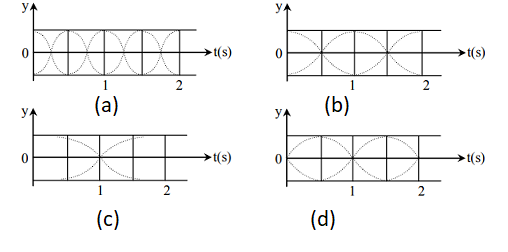
Solution: (a) To find the correct schematic, we simply need to count how many “beats” occur within the 2second interval shown on the \(x\)-axis.
Calculate the Beat Frequency (\(f_b\)):
The beat frequency is the number of times the sound reaches maximum loudness (the “bulge” or “envelope”) per second.
\(
\begin{gathered}
f_b=\left|f_2-f_1\right| \\
f_b=|11-9|=2 \mathrm{~Hz}
\end{gathered}
\)
This means there should be 2 beats every 1 second.
Determine the Total Beats in the Graph:
The provided graphs show a time interval from \(t=0\) to \(t=2 \mathrm{~s}\).
Since there are 2 beats per second, in 2 seconds there must be:
\(
2 \text { beats } / \mathrm{s} \times 2 \mathrm{~s}=4 \text { beats total }
\)
Analyze the Options:
Let’s count the number of “loops” or “envelopes” shown between 0 and 2 seconds in your image:
Figure (a): Shows \(\mathbf{4}\) beats in 2 seconds. (This matches our calculation of 2 beats/s).
Figure (b): Shows 2 beats in 2 seconds. (This would be 1 beat/s).
Figure (c): Shows 1 beat in 2 seconds. (This would be 0.5 beat/s).
Figure (d): Shows 2 beats in 2 seconds, but with a different starting phase.
Final Answer: Since we calculated that there should be 2 beats every second (resulting in 4 beats over the 2second span shown), Figure (a) is the correct schematic representation.
Q18. A stationary source emits sound waves of frequency 500 Hz. Two observers moving along a line passing through the source detect sound to be of frequencies 480 Hz and 530 Hz. Their respective speeds are, in \(ms^{-1}\), (Given speed of sound \(=300 \mathrm{~m} / \mathrm{s}\)) [JEE Main 2019 (Online) 10th April Morning Slot]
(a) 12,18
(b) 16,14
(c) 12,16
(d) 8,18
Solution: (a) To solve this, we use the Doppler Effect formula for a stationary source and a moving observer.
The Doppler Formula:
When the source is stationary, the apparent frequency (\(f^{\prime}\)) heard by an observer moving with velocity \(v_o\) is:
\(
f^{\prime}=f\left(\frac{v \pm v_o}{v}\right)
\)
Use + if the observer is moving toward the source (frequency increases).
Use – if the observer is moving away from the source (frequency decreases).
Step 1: Analyze Observer 1
Source frequency (\(f\)): 500 Hz
Detected frequency \(\left(f_1^{\prime}\right): 480 \mathrm{~Hz}\)
Speed of sound (\(v\)): \(300 \mathrm{~m} / \mathrm{s}\)
Since \(480<500\), the observer is moving away from the source.
\(
480=500\left(\frac{300-v_1}{300}\right)
\)
\(
v_1=12 \mathrm{~m} / \mathrm{s}
\)
Step 2: Analyze Observer 2
Source frequency (\(f\)): 500 Hz
Detected frequency (\(f_2^{\prime}\)): 530 Hz
Since \(530>500\), the observer is moving toward the source.
\(
530=500\left(\frac{300+v_2}{300}\right)
\)
\(
v_2=18 \mathrm{~m} / \mathrm{s}
\)
Final Answer: The speeds of the observers are \(\mathbf{1 2 ~ m} / \mathbf{s}\) and \(\mathbf{1 8 ~ m} / \mathbf{s}\), respectively.
Q19. A string 2.0 m long and fixed at its ends is driven by a 240 Hz vibrator. The string vibrates in its third harmonic mode. The speed of the wave and its fundamental frequency is : [JEE Main 2019]
(a) \(180 \mathrm{~m} / \mathrm{s}, 80 \mathrm{~Hz}\)
(b) \(180 \mathrm{~m} / \mathrm{s}, 120 \mathrm{~Hz}\)
(c) \(320 \mathrm{~m} / \mathrm{s}, 120 \mathrm{~Hz}\)
(d) \(320 \mathrm{~m} / \mathrm{s}, 80 \mathrm{~Hz}\)
Solution: (d) To solve for the speed of the wave and the fundamental frequency, we can break the problem down into two simple steps based on the properties of standing waves on a string.
Step 1: Find the Fundamental Frequency (\(f_1\))
For a string fixed at both ends, the frequencies of the harmonics are integer multiples of the fundamental frequency (\(f_n=n \cdot f_1\)).
Given:
The string is in its third harmonic mode (\(n=3\)).
The frequency of this mode (\(f_3\)) is \(\mathbf{2 4 0 ~ H z}\).
\(
\begin{gathered}
f_3=3 \cdot f_1 \\
240=3 \cdot f_1 \\
f_1=\frac{240}{3}=80 \mathrm{~Hz}
\end{gathered}
\)
Step 2: Find the Speed of the Wave (\(v\))
The fundamental frequency for a string of length \(L\) is given by the formula:
\(
f_1=\frac{v}{2 L}
\)
Given:
Length \((L)=2.0 \mathrm{~m}\)
Fundamental frequency \(\left(f_1\right)=80 \mathrm{~Hz}\)
Rearranging to solve for velocity (\(v\)):
\(
\begin{gathered}
v=f_1 \cdot 2 L \\
v=80 \cdot(2 \cdot 2.0) \\
v=80 \cdot 4 \\
v=320 \mathrm{~m} / \mathrm{s}
\end{gathered}
\)
Q20. Two cars \(A\) and \(B\) are moving away from each other in opposite directions. Both the cars are moving with a speed of \(20 \mathrm{~ms}^{-1}\) with respect to the ground. If an observer in car A detects a frequency 2000 Hz of the sound coming from car B, what is the natural frequency of the sound source in car B ? \(\left(\right.\) speed of sound in air \(\left.=340 \mathrm{~ms}^{-1}\right):\) [JEE Main 2019]
(a) 2300 Hz
(b) 2060 Hz
(c) 2250 Hz
(d) 2150 Hz
Solution: (c)
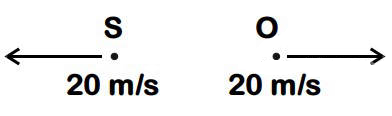
\begin{aligned}
& f=\frac{\left(v \pm u_0\right)}{\left(v \pm u_s\right)} \cdot f_0=\frac{(v-20)}{(v+20)} \cdot f_0 \\
& \Rightarrow 2000=\frac{320}{360} \cdot f_0 \\
& \Rightarrow \frac{2000 \times 9}{8}=f_0=2250 \mathrm{~Hz}
\end{aligned}
\)
Explanation: To find the natural frequency of the source in car B, we apply the Doppler Effect for a case where both the source and the observer are moving away from each other.
Step 1: Identify the Relative Motion
Source (Car B): Moving away from the observer at \(v_s=20 \mathrm{~m} / \mathrm{s}\).
Observer (Car A): Moving away from the source at \(v_o=20 \mathrm{~m} / \mathrm{s}\).
Speed of Sound (\(v\)): \(340 \mathrm{~m} / \mathrm{s}\).
Detected Frequency \(\left(f^{\prime}\right): 2000 \mathrm{~Hz}\).
Step 2: Apply the Doppler Formula
When both the source and observer move away from each other, the apparent frequency decreases. The formula is:
\(
f^{\prime}=f\left(\frac{v-v_o}{v+v_s}\right)
\)
Where:
\(f^{\prime}\) is the observed frequency \((2000 \mathrm{~Hz})\)
\(f\) is the natural (original) frequency
\(v\) is the speed of sound \((340 \mathrm{~m} / \mathrm{s})\)
\(v_o\) is the speed of the observer \((20 \mathrm{~m} / \mathrm{s})\)
\(v_s\) is the speed of the source (\(20 \mathrm{~m} / \mathrm{s}\))
Step 3: Solve for Natural Frequency (\(f\))
Substitute the given values into the equation:
\(
2000=f\left(\frac{340-20}{340+20}\right)
\)
\(
f=2250 \mathrm{~Hz}
\)
Final Answer: The natural frequency of the sound source in car B is \(\mathbf{2 2 5 0 ~ H z}\).
Q21. The pressure wave, \(P=0.01 \sin [1000 t-3 x] \mathrm{Nm}^{-2}\), corresponds to the sound produced by a vibrating blade on a day when atmospheric temperature is \(0^{\circ} \mathrm{C}\). On some other day, when temperature is \(T\) , the speed of sound produced by the same blade and at the same frequency is found to be \(336 \mathrm{~ms}^{-1}\). Approximate value of \(T\) is [JEE Main 2019]
(a) \(12^{\circ} \mathrm{C}\)
(b) \(15^{\circ} \mathrm{C}\)
(c) \(4^{\circ} \mathrm{C}\)
(d) \(11^{\circ} \mathrm{C}\)
Solution: (c) To find the temperature \(T\), we first need to determine the initial speed of sound at \(0^{\circ} \mathrm{C}\) from the given wave equation and then use the relationship between the speed of sound and absolute temperature.
Step 1: Find the speed of sound at \(0^{\circ} \mathrm{C}\left(v_0\right)\)
The general form of a traveling wave is \(P=P_0 \sin (\omega t-k x)\).
From the given equation \(P=0.01 \sin (1000 t-3 x)\) :
Angular frequency \((\omega)=1000 \mathrm{rad} / \mathrm{s}\)
Wave number \((k)=3 \mathrm{rad} / \mathrm{m}\)
The speed of the wave \((v)\) is given by the ratio of \(\omega\) to \(k\) :
\(
v_0=\frac{\omega}{k}=\frac{1000}{3} \approx 333.33 \mathrm{~m} / \mathrm{s}
\)
So, at \(0^{\circ} \mathrm{C}\) (which is 273 K), the speed \(v_0\) is approximately \(333.33 \mathrm{~m} / \mathrm{s}\).
Step 2: Use the Temperature-Speed Relationship
The speed of sound in air is proportional to the square root of its absolute temperature (\(T\) in Kelvin):
\(
v \propto \sqrt{T} \Longrightarrow \frac{v_T}{v_0}=\sqrt{\frac{T}{273}}
\)
Given:
\(v_T=336 \mathrm{~m} / \mathrm{s}\)
\(v_0=\frac{1000}{3} \mathrm{~m} / \mathrm{s}\)
Substitute these into the ratio:
\(
\frac{336}{1000 / 3}=\sqrt{\frac{T}{273}}
\)
\(
T=1.016064 \times 273 \approx 277.38 \mathrm{~K}
\)
To find the temperature in Celsius \((t)\) :
\(
\begin{gathered}
t=T-273 \\
t=277.38-273=4.38^{\circ} \mathrm{C}
\end{gathered}
\)
The approximate value is \(4^{\circ} \mathrm{C}\).
Alternate:
\(
\begin{aligned}
& \text { Speed of sound }=\frac{\mathrm{w}}{\mathrm{k}} \\
& \quad=\frac{1000}{3} \\
& \mathrm{v} \propto \sqrt{\mathrm{~T}} \\
& \frac{\mathrm{~V}_2}{\mathrm{~V}_1}=\sqrt{\frac{\mathrm{T}_2}{\mathrm{~T}_1}} \\
& \frac{336}{1000 / 3}=\sqrt{\frac{7}{273}} \\
& \mathrm{~T}=277 \mathrm{~K} \text { (appr.) } \\
& \mathrm{T}=4^{\circ} \mathrm{C}
\end{aligned}
\)
Q22. A string is clamped at both the ends and it is vibrating in its 4th harmonic. The equation of the stationary wave is \(Y=0.3 \sin (0.157 x) \cos (200 p t)\). The length of the string is : (All quantities are in SI units.) [JEE Main 2019]
(a) 60 m
(b) 20 m
(c) 80 m
(d) 40 m
Solution: (c) To find the length of the string, we need to extract the wave number from the given equation and relate it to the harmonic mode of the string.
Step 1: Extract the Wave Number (\(k\))
The general equation for a stationary (standing) wave is:
\(
y=2 A \sin (k x) \cos (\omega t)
\)
Comparing this to the given equation \(Y=0.3 \sin (0.157 x) \cos (200 \pi t)\), we identify the wave number (\(k\)):
\(
k=0.157 \mathrm{~m}^{-1}
\)
Step 2: Calculate the Wavelength (\({\lambda}\))
The relationship between the wave number \(k\) and the wavelength \(\lambda\) is:
\(
k=\frac{2 \pi}{\lambda}
\)
Using the approximation \(\pi \approx 3.14\) :
\(
0.157=\frac{2 \times 3.14}{\lambda}
\)
\(
\lambda=\frac{6.28}{0.157}=40 \mathrm{~m}
\)
Step 3: Relate Wavelength to String Length (\(L\))
For a string fixed at both ends vibrating in its \(n^{\text {th }}\) harmonic, the length of the string \(L\) is given by:
\(
L=n\left(\frac{\lambda}{2}\right)
\)
Given:
Harmonic mode \((n)=4\)
Wavelength \((\lambda)=40 \mathrm{~m}\)
Substitute the values:
\(
\begin{gathered}
L=4 \times\left(\frac{40}{2}\right) \\
L=4 \times 20
\end{gathered}
\)
\(
L=80 \mathrm{~m}
\)
Final Answer: The length of the string is 80 m.
Alternate:
\(\begin{aligned}
& \mathrm{y}=\operatorname{asin}(.157 \mathrm{x}) \cos (200 \pi \mathrm{t}) \\
& \frac{2 \pi}{\lambda}=.157 \\
& \lambda=40 \\
& 4^{\text {th }} \text { harmonic real } \\
& \ell=4 \frac{\lambda}{2} \\
& \ell=2 \lambda \\
& =80 \mathrm{~m}
\end{aligned}
\)
Q23. A wire of length \(2 L\) , is made by joining two wires A and B of same length but different radii \(r\) and \(2 r\) and made of the same material. It is vibrating at a frequency such that the joint of the two wires forms a node. If the number of antinodes in wire \(A\) is \(p\) and that in \(B\) is \(q\) then the ratio \(p\) : \(q\) is : [JEE Main 2019]
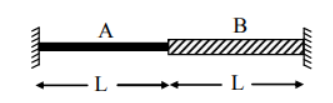
(a) 3 : 5
(b) 4 : 9
(c) 1: 2
(d) 1: 4
Solution: (c) To solve this, we need to understand how the wave speed and the number of antinodes (loops) change between two joined wires of different radii.
Step 1: Determine the Relationship Between Wave Speed and Radius
The speed of a transverse wave on a string is given by \(v=\sqrt{\frac{T}{\mu}}\), where \(T\) is the tension and \(\mu\) is the linear mass density.
Since the wires are joined and under the same weight/pull, the tension \(T\) is the same for both A and B.
Linear mass density \(\mu\) is mass per unit length: \(\mu=\rho \times\) Area \(=\rho\left(\pi r^2\right)\).
The speed \(v\) is therefore inversely proportional to the radius \(r\) :
\(
v \propto \frac{1}{\sqrt{r^2}} \Longrightarrow v \propto \frac{1}{r}
\)
Let \(v_A\) and \(v_B\) be the speeds in wires A and B :
\(
\frac{v_A}{v_B}=\frac{r_B}{r_A}=\frac{2 r}{r}=2
\)
Step 2: Relate Speed to the Number of Antinodes
Both wires are vibrating at the same frequency \(f\) because they are part of the same system.
For a wire of length \(L\) with \(n\) antinodes (loops), the frequency is:
\(
f=\frac{n \cdot v}{2 L}
\)
Since \(f\) and \(L\) are the same for both segments:
\(
n \cdot v=\text { constant } \Longrightarrow n \propto \frac{1}{v}
\)
Step 3: Calculate the Ratio \(p: q\)
Let \(p\) be the number of antinodes in wire A and \(q\) be the number of antinodes in wire B .
Using the inverse relationship from Step 2:
\(
\frac{p}{q}=\frac{v_B}{v_A}
\)
Substitute the speed ratio we found in Step \(1\left(\frac{v_A}{v_B}=2\right)\) :
\(
\frac{p}{q}=\frac{1}{2}
\)
Alternate: Speed and Frequency Relationship:
As you noted, the tension \(T\) is common. Because the radius of wire B is \(2 r\), its linear mass density \(\mu_2\) is \(\mathbf{4} \mu_1\).
\(
V_1=\sqrt{\frac{T}{\mu}} \quad \text { and } \quad V_2=\sqrt{\frac{T}{4 \mu}}=\frac{V_1}{2}
\)
The Condition for a Node at the Joint:
For a node to exist at the joint (where both wires have length \(L\)), each wire must be vibrating in one of its allowed harmonic modes. Since the wires are joined, they must share a common frequency \(f\).
For wire \(\mathrm{A}: f=p \cdot \frac{V_1}{2 L}\)
For wire B: \(f=q \cdot \frac{V_2}{2 L}\)
Finding the Ratio:
Since the frequencies are equal:
\(
\begin{gathered}
p \cdot \frac{V_1}{2 L}=q \cdot \frac{V_2}{2 L} \\
p \cdot V_1=q \cdot V_2
\end{gathered}
\)
Substituting \(V_2=\frac{V_1}{2}\) :
\(
\begin{gathered}
p \cdot V_1=q \cdot \frac{V_1}{2} \\
p=\frac{q}{2} \Longrightarrow \frac{p}{q}=\frac{1}{2}
\end{gathered}
\)
Another way:
\(\begin{aligned}
& \mathrm{f}=\frac{\mathrm{N}}{2 \ell} \sqrt{\frac{\mathrm{~T}}{\rho \pi \mathrm{r}^2}} \Rightarrow \mathrm{~N} \propto \mathrm{r} \\
& \mathrm{~N}_1: \mathrm{N}_2=\mathrm{r}: 2 \mathrm{r}=1: 2
\end{aligned}
\)
Q24. A resonance tube is old and has jagged end. It is still used in the laboratory to determine velocity of sound in air. A tuning fork of frequency 512 Hz produces first resonance when the tube is filled with water to a mark 11 cm below a reference mark, near the open end of the tube. The experiment is repeated with another fork of frequency 256 Hz which produces first resonance when water reaches a mark 27 cm below the reference mark. The velocity of sound in air, obtained in the experiment, is close to : [JEE Main 2019]
(a) \(335 \mathrm{~ms}^{-1}\)
(b) \(328 \mathrm{~ms}^{-1}\)
(c) \(341 \mathrm{~ms}^{-1}\)
(d) \(322 \mathrm{~ms}^{-1}\)
Solution: (b) Because the resonance tube has a “jagged end,” the end correction (\(e\))-the small distance beyond the physical top of the tube where the pressure antinode actually forms-is unknown. To find the velocity of sound (\(v\)), we must set up a system of equations to account for this.
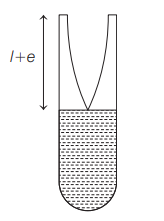
Step 1: The Resonance Formula
For the first resonance in a closed-end tube, the effective length of the air column is one-fourth of a wavelength:
\(
L+e=\frac{\lambda}{4}=\frac{v}{4 f}
\)
Where:
\(L=\) length of the air column (distance from water to the reference mark)
\(e=\) end correction (distance from reference mark to the antinode)
\(f=\) frequency of the tuning fork
\(v=\) speed of sound
Step 2: Set up the Equations
We have two different scenarios with two different tuning forks:
For \(f_1=512 \mathrm{~Hz}\) :
\(11+e=\frac{v}{4 \times 512} \quad \Longrightarrow \quad 11+e=\frac{v}{2048} \dots(1)\)
For \(f_2=256 \mathrm{~Hz}\) :
\(
27+e=\frac{v}{4 \times 256} \quad \Longrightarrow \quad 27+e=\frac{v}{1024} \dots(2)
\)
Step 3: Eliminate the End Correction (\(e\))
To find \(v\), subtract Eq. 1 from Eq. 2:
\(
\begin{gathered}
(27+e)-(11+e)=\frac{v}{1024}-\frac{v}{2048} \\
16=\frac{2 v-v}{2048} \\
16=\frac{v}{2048}
\end{gathered}
\)
Step 4: Solve for \(v\)
The lengths were given in cm, so we convert the final result to \(\mathbf{m} \boldsymbol{/} \mathbf{s}\) :
\(
\begin{gathered}
v=16 \times 2048 \mathrm{~cm} / \mathrm{s} \\
v=32768 \mathrm{~cm} / \mathrm{s} \\
v=327.68 \mathrm{~m} / \mathrm{s}
\end{gathered}
\)
The value is closest to \(328 \mathrm{~ms}^{-1}\).
Final Answer: The velocity of sound in air obtained in the experiment is approximately \(328 \mathrm{~ms}^{-1}\).
Q25. A travelling harmonic wave is represented by the equation \(y(x, t)=10^{-3} \sin (50 t+2 x)\), where, \(x\) and \(y\) are in mater and \(t\) is in seconds. Which of the following is a correct statement about the wave? [JEE Main 2029]
(A) The wave is propagating along the positive \(x\)-axis with speed \(100 \mathrm{~ms}^{-1}\)
(B) The wave is propagating along the positive \(x\)-axis with speed \(25 \mathrm{~ms}^{-1}\)
(C) The wave is propagating along the negative \(x\)-axis with speed \(25 \mathrm{~ms}^{-1}\)
(D) The wave is propagating along the negative \(x\)-axis with speed \(100 \mathrm{~ms}^{-1}\)
Solution: (c) To determine the direction and speed of the wave, we compare the given equation to the standard form of a travelling harmonic wave.
Determine the Direction of Propagation:
The general equation for a wave is:
\(
y(x, t)=A \sin (\omega t \pm k x)
\)
If the signs of the \(\omega t\) and \(k x\) terms are the same (both positive or both negative), the wave propagates in the negative \(x\)-direction.
If the signs are opposite, the wave propagates in the positive \(x\)-direction.
In the given equation \(y(x, t)=10^{-3} \sin (50 t+2 x)\), both \(50 t\) and \(2 x\) are positive. Therefore, the wave is propagating along the negative \(x\)-axis.
Calculate the Wave Speed (\(v\)):
From the equation \(y(x, t)=10^{-3} \sin (50 t+2 x)\), we can identify:
Angular frequency \((\omega)=50 \mathrm{rad} / \mathrm{s}\)
Wave number \((k)=2 \mathrm{rad} / \mathrm{m}\)
The speed of the wave \(v\) is given by the formula:
\(
v=\frac{\omega}{k}
\)
Substituting the values:
\(
v=\frac{50}{2}=25 \mathrm{~ms}^{-1}
\)
Final Answer: The wave is propagating along the negative \(x\)-axis with a speed of \(25 \mathrm{~ms}^{-1}\).
Q26. Equation of travelling wave on a stretched string of linear density \(5 \mathrm{~g} / \mathrm{m}\) is \(\mathrm{y}=0.03 \sin (450 \mathrm{t}-9 \mathrm{x})\) where distance and time are measured in SI units. The tension in the string is : [JEE Main 2019]
Solution: Step 1: Extract Wave Velocity from the Equation
The standard mathematical form for a wave traveling along the x -axis is:
\(
y=A \sin (\omega t-k x)
\)
By comparing this to our given equation, \(y=0.03 \sin (450 t-9 x)\), we can identify the following constants:
Angular frequency \((\omega): 450 \mathrm{rad} / \mathrm{s}\)
Wave number \((k): 9 \mathrm{~m}^{-1}\)
The velocity of the wave \((v)\) is the ratio of how fast it oscillates to how it spreads in space:
\(
\begin{gathered}
v=\frac{\omega}{k} \\
v=\frac{450}{9}=50 \mathrm{~m} / \mathrm{s}
\end{gathered}
\)
Step 2: Relate Velocity to Tension and Density
The speed of a transverse wave on a string is physically determined by the tension (\(T\)) pulling the string tight and the linear mass density \((\mu)\) resisting motion due to inertia.
The formula for wave speed is:
\(
v=\sqrt{\frac{T}{\mu}}
\)
To find the Tension \((T)\), we rearrange the formula:
\(
T=\mu v^2
\)
Plugging in the values (converted to SI units):
Linear density \((\mu): 5 \mathrm{~g} / \mathrm{m}=0.005 \mathrm{~kg} / \mathrm{m}\)
Velocity (\(v\)): \(50 \mathrm{~m} / \mathrm{s}\)
\(
\begin{gathered}
T=0.005 \times(50)^2 \\
T=0.005 \times 2500 \\
T=12.5 \mathrm{~N}
\end{gathered}
\)
Final Answer: The tension in the string is 12.5 N.
Q27. A string of length 1 m and mass 5 g is fixed at both ends. The tension in the string is 8.0 N. The string is set into vibration using an external vibrator of frequency 100 Hz. The separation between successive nodes on the string is close to [JEE Main 2019 (Online) 10th January Morning Slot]
(a) 16.6 cm
(b) 10.0 cm
(c) 20.0 cm
(d) 33.3 cm
Solution: (c) To find the separation between successive nodes, we need to determine the wavelength of the wave produced in the string.
Step 1: Calculate the Wave Velocity (\(v\))
The velocity of a transverse wave on a stretched string depends on the tension (\(T\)) and the linear mass density (\(\mu\)).
First, we find the linear mass density (\(\mu\)):
\(
\mu=\frac{\text { mass }}{\text { length }}=\frac{5 \mathrm{~g}}{1 \mathrm{~m}}=5 \times 10^{-3} \mathrm{~kg} / \mathrm{m}
\)
Now, calculate the velocity (\(v\)):
\(
\begin{gathered}
v=\sqrt{\frac{T}{\mu}} \\
v=\sqrt{\frac{8.0}{5 \times 10^{-3}}}=\sqrt{\frac{8000}{5}}=\sqrt{1600} \\
v=40 \mathrm{~m} / \mathrm{s}
\end{gathered}
\)
Step 2: Calculate the Wavelength (\(\lambda\))
Using the relationship between velocity \((v)\), frequency \((f)\), and wavelength \((\lambda)\) :
\(
v=f \lambda \Longrightarrow \lambda=\frac{v}{f}
\)
Given the vibrator frequency \(f=100 \mathrm{~Hz}\) :
\(
\lambda=\frac{40}{100}=0.4 \mathrm{~m}
\)
Step 3: Find the Distance Between Successive Nodes
In a standing wave, the distance between two successive nodes is equal to half of the wavelength (\(\lambda / 2\)).
\(
\begin{gathered}
\text { Distance }=\frac{\lambda}{2} \\
\text { Distance }=\frac{0.4 \mathrm{~m}}{2}=0.2 \mathrm{~m}=20 \mathrm{~cm}
\end{gathered}
\)
The separation between successive nodes is 20.0 cm.
Q28. A train moves towards a stationary observer with speed \(34 \mathrm{~m} / \mathrm{s}\). The train sounds a whistle and its frequency registered by the observer is \(f_1\). If the speed of the train is reduced to \(17 \mathrm{~m} / \mathrm{s}\), the frequency registered is \(f_2\). If speed of sound is \(340 \mathrm{~m} / \mathrm{s}\), then the ratio \(f_1 / f_2\) is [JEE Main 2019]
Solution: This problem involves the Doppler Effect, which describes the change in frequency of a wave in relation to an observer who is moving relative to the wave source.
Step 1: Understand the Doppler Effect Formula
When a source of sound moves toward a stationary observer, the apparent frequency \(\left(f^{\prime}\right)\) is higher than the actual frequency (\(f_0\)) and is calculated using:
\(
f^{\prime}=f_0\left(\frac{v}{v-v_s}\right)
\)
Where:
\(v=\) speed of sound \(=340 \mathrm{~m} / \mathrm{s}\)
\(v_s=\) speed of the source (train)
\(f_0=\) original frequency of the whistle
Step 2: Calculate \(f_1\) and \(f_2\)
We need to find the frequencies for the two different speeds of the train.
For \(f_1\) (Train speed \(v_{s 1}=34 \mathrm{~m} / \mathrm{s}\)):
\(
f_1=f_0\left(\frac{340}{340-34}\right)=f_0\left(\frac{340}{306}\right)
\)
For \(f_2\) (Train speed \(v_{s 2}=17 \mathrm{~m} / \mathrm{s}\)):
\(
f_2=f_0\left(\frac{340}{340-17}\right)=f_0\left(\frac{340}{323}\right)
\)
Step 3: Find the Ratio \(f_1 / f_2\)
Now, divide the expression for \(f_1\) by the expression for \(f_2\) :
\(
\frac{f_1}{f_2}=\frac{f_0\left(\frac{340}{306}\right)}{f_0\left(\frac{340}{323}\right)}
\)
The \(f_0\) and the 340 in the numerators cancel out, leaving:
\(
\frac{f_1}{f_2}=\frac{323}{306}=\frac{19}{18}
\)
The ratio \(f_1 / f_2\) is \(19 / 18\).
Q29. A musician using an open flute of length 50 cm producess second harmonic sound waves. A person runs towards the musician from another end of hall at a speed of \(10 \mathrm{~km} / \mathrm{h}\). If the wave speed is \(330 \mathrm{~m} / \mathrm{s}\), the frequency heard by the running person shall be close to : [JEE Main 2019 (Online) 9th January Evening Slot]
(a) 666 Hz
(b) 753 Hz
(c) 500 Hz
(d) 333 Hz
Solution: (a) This problem combines the physics of standing waves in pipes with the Doppler effect. We need to find the source frequency first, then adjust it for the observer’s motion.
Step 1: Calculate the Source Frequency (\(f_s\))
An open flute acts as an open organ pipe (open at both ends). For an open pipe of length \(L\), the harmonics are given by:
\(
f_n=\frac{n v}{2 L}
\)
Given values:
Length \((L)=50 \mathrm{~cm}=0.5 \mathrm{~m}\)
Harmonic \((n)=2\) (Second harmonic)
Speed of sound \((v)=330 \mathrm{~m} / \mathrm{s}\)
\(
f_s=\frac{2 \times 330}{2 \times 0.5}=\frac{660}{1.0}=660 \mathrm{~Hz}
\)
Step 2: Convert Observer Speed to SI Units
The person (observer) is running at \(10 \mathrm{~km} / \mathrm{h}\). We must convert this to \(\mathrm{m} / \mathrm{s}\) :
\(
v_o=10 \times \frac{5}{18} \mathrm{~m} / \mathrm{s} \approx 2.778 \mathrm{~m} / \mathrm{s}
\)
Step 3: Apply the Doppler Effect
When an observer moves towards a stationary source, the apparent frequency \(\left(f^{\prime}\right)\) increases:
\(
f^{\prime}=f_s\left(\frac{v+v_o}{v}\right)
\)
Plugging in the values:
\(f_s=660 \mathrm{~Hz}\)
\(v=330 \mathrm{~m} / \mathrm{s}\)
\(v_o=2.778 \mathrm{~m} / \mathrm{s}\)
\(
\begin{gathered}
f^{\prime}=660\left(\frac{330+2.778}{330}\right) \\
f^{\prime}=660\left(\frac{332.778}{330}\right) \\
f^{\prime}=2 \times 332.778 \\
f^{\prime}=665.556 \mathrm{~Hz}
\end{gathered}
\)
Final Result: The frequency heard by the running person is approximately \(\mathbf{6 6 6 ~ H z}\).
Q30. A heavy ball of mass \(M\) is suspendeed from the ceiling of a car by a light string of mass \(m(m \ll M)\). When the car is at rest, the speed of transverse waves in the string is \(60 \mathrm{~ms}^{-1}\). When the car has acceleration \(a\), the wave-speed increases to \(60.5 \mathrm{~ms}^{-1}\). The value of \(a\), in terms of gravitational acceleration \(g\), is closest to : [JEE Main 2019]
(A) \(\frac{g}{30}\)
(B) \(\frac{g}{5}\)
(C) \(\frac{g}{10}\)
(D) \(\frac{g}{20}\)
Solution: (B) Step 1: Analyze Tension at Rest
When the car is at rest, the only force acting on the ball is gravity. Therefore, the tension (\(T\)) in the string is equal to the weight of the ball:
\(
T_1=M g
\)
The wave speed is given by \(v=\sqrt{T / \mu}\). Since the linear mass density \((\mu)\) is constant:
\(
v_1=\sqrt{\frac{M g}{\mu}}=60 \mathrm{~m} / \mathrm{s} \dots(1)
\)
Step 2: Analyze Tension with Acceleration
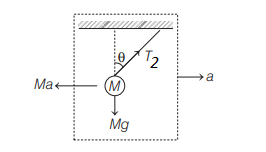
When the car accelerates horizontally with acceleration \(a\), the ball experiences a horizontal pseudo-force (\(M a\)). The string now hangs at an angle, and the new tension (\(T_2\)) is the resultant of the gravitational force and the pseudo-force.
The effective acceleration (\(g_{\text {eff }}\)) is:
\(
g_{e f f}=\sqrt{g^2+a^2}
\)
So, the new tension is \(T_2=M \sqrt{g^2+a^2}\). The new wave speed is:
\(
v_2=\sqrt{\frac{M \sqrt{g^2+a^2}}{\mu}}=60.5 \mathrm{~m} / \mathrm{s} \dots(2)
\)
Step 3: Use the Ratio of Speeds
Divide Equation 2 by Equation 1:
\(
\begin{gathered}
\frac{v_2}{v_1}=\frac{\sqrt{\frac{M \sqrt{g^2+a^2}}{\mu}}}{\sqrt{\frac{M g}{\mu}}}=\sqrt{\frac{\sqrt{g^2+a^2}}{g}} \\
\frac{60.5}{60}=\left(\frac{g^2+a^2}{g^2}\right)^{1 / 4} \\
1+\frac{0.5}{60}=\left(1+\frac{a^2}{g^2}\right)^{1 / 4}
\end{gathered}
\)
Using the Binomial Approximation \((1+x)^n \approx 1+n x\) (since \(a\) is small compared to \(g\)):
\(
1+\frac{1}{120} \approx 1+\frac{1}{4}\left(\frac{a^2}{g^2}\right)
\)
\(
\begin{aligned}
&\frac{1}{120}=\frac{1}{4} \frac{a^2}{g^2}\\
&\frac{a^2}{g^2}=\frac{4}{120}=\frac{1}{30}\\
&a=\frac{g}{\sqrt{30}} \simeq \frac{g}{5}
\end{aligned}
\)
Q31. Two sitar strings, A and B, playing the note ‘Dha’ are slightly out of tune and produce beats of frequency 5 Hz. The tension of the string B is slightly increased and the beat frequency is found to decrease by 3 Hz. If the frequency of \(A\) is 425 Hz , the original frequency of \(B\) is : [JEE Main 2018]
(a) 430 Hz
(b) 420 Hz
(c) 428 Hz
(d) 422 Hz
Solution: (b) To solve this problem, we use the principle of beat frequency and the relationship between string tension and frequency.
Step 1: Determine Possible Frequencies for B
The beat frequency is the absolute difference between the frequencies of two sound sources.
\(
\text { Beat frequency }\left(\left|f_A-f_B\right|\right)=5 \mathrm{~Hz}
\)
Given \(f_A=425 \mathrm{~Hz}\), the original frequency of string \(\mathrm{B}\left(f_B\right)\) could be either:
\(f_B=f_A+5=430 \mathrm{~Hz}\)
\(f_B=f_A-5=420 \mathrm{~Hz}\)
Step 2: Analyze the Effect of Increasing Tension
The frequency of a vibrating string (\(f\)) is directly proportional to the square root of the tension (\(T\)):
\(
f=\frac{1}{2 L} \sqrt{\frac{T}{\mu}} \Longrightarrow f \propto \sqrt{T}
\)
When the tension of string \(\mathbf{B}\) is increased, its frequency (\(f_B\)) must also increase.
Step 3: Use the Beat Frequency Change to Identify \(f_B\)
The problem states that after increasing the tension, the beat frequency decreases to 3 Hz (\(5-2=3\) or simply “decreases by 3,” implying the gap narrowed). Let’s test our two possibilities:
Case 1: If \(f_B\) was 430 Hz
If \(f_B\) increases (e.g., to 431 or 432 Hz), the gap between \(f_A(425)\) and \(f_B\) would increase (\(432-425=7\)). This contradicts the problem, which says the beat frequency decreased.
Case 2: If \(f_B\) was 420 Hz
If \(f_B\) increases (e.g., to 422 or 423 Hz), the gap between \(f_A(425)\) and \(f_B\) would decrease \((425-422=3)\). This matches the behavior described in the problem.
Final Conclusion: Since increasing the frequency of B narrowed the gap to A, B must have started at a lower frequency than A. The original frequency of B is \(\mathbf{4 2 0 ~ H z}\).
Q32. The end correction of a resonance column is 1 cm. If the shortest length resonating with the tunning fork is 10 cm, the next resonating length should be : [JEE Main 2018]
(a) 28 cm
(b) 32 cm
(c) 36 cm
(d) 40 cm
Solution: (b) To solve this problem, we need to understand the resonance behavior of a closed organ pipe (which a resonance column represents) and how the end correction affects the effective length of the air column.
Step 1: Understand Effective Length
In a resonance column, the antinode of the standing wave actually forms slightly outside the open end of the tube. This small extra distance is called the end correction (\(e\)).
The effective length (\(L_{\text {eff }}\)) is the sum of the measured length of the air column (\(l\)) and the end correction (\(e\)):
\(
L_{e f f}=l+e
\)
Step 2: Identify the Resonance Conditions
For a pipe closed at one end, resonance occurs at specific lengths corresponding to odd multiples of a quarter wavelength \((\lambda / 4)\) :
1. First resonance (shortest length, \(l_1\)):
\(
l_1+e=\frac{\lambda}{4}
\)
2. Second resonance (next length, \(l_2\)):
\(
l_2+e=\frac{3 \lambda}{4}
\)
Step 3: Calculate the Next Resonating Length
We are given:
End correction \((e)=1 \mathrm{~cm}\)
Shortest length \(\left(l_1\right)=10 \mathrm{~cm}\)
Using the first resonance condition:
\(
\begin{gathered}
10+1=\frac{\lambda}{4} \\
11=\frac{\lambda}{4} \Longrightarrow \lambda=44 \mathrm{~cm}
\end{gathered}
\)
Now, substitute \(\lambda\) into the second resonance condition to find \(l_2\) :
\(
l_2+1=\frac{3(44)}{4}
\)
\(
l_2=32 \mathrm{~cm}
\)
The next resonating length should be \(\mathbf{3 2 ~ c m}\).
Q33. A granite rod of 60 cm length is clamped at its middle point and is set into longitudinal vibrations. The density of granite is \(2.7 \times 10^3 \mathrm{~kg} / \mathrm{m}^3\) and its Young’s modulus is \(9.27 \times 10^{10} \mathrm{~Pa}\). What will be the fundamental frequency of the longitudinal vibrations? [JEE Main 2018]
(a) 7.5 kHz
(b) 5 kHz
(c) 2.5 kHz
(d) 10 kHz
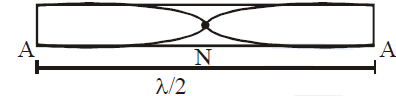
Solution: (b) To solve for the fundamental frequency of longitudinal vibrations in a rod clamped at its center, we follow these two primary steps. Since rod is clamped at middle fundamental wave shape is as follow:
Step 1: Calculate the Speed of Longitudinal Waves (\(v\))
In a solid rod, the speed of a longitudinal wave depends on the material’s Young’s modulus (\(Y\)) and its density (\(\rho\)).
\(
v=\sqrt{\frac{Y}{\rho}}
\)
Given values:
Young’s modulus \((Y)=9.27 \times 10^{10} \mathrm{~Pa}\)
Density \((\rho)=2.7 \times 10^3 \mathrm{~kg} / \mathrm{m}^3\)
\(
\begin{gathered}
v=\sqrt{\frac{9.27 \times 10^{10}}{2.7 \times 10^3}}=\sqrt{3.433 \times 10^7} \approx \sqrt{34.33 \times 10^6} \\
v \approx 5.85 \times 10^3 \mathrm{~m} / \mathrm{s}=5850 \mathrm{~m} / \mathrm{s}
\end{gathered}
\)
Step 2: Determine the Fundamental Frequency (\(f\))
When a rod is clamped at its middle, the center point acts as a node (no displacement) and the two free ends act as antinodes (maximum displacement).
For the fundamental mode of vibration in this configuration:
The distance from an antinode to a node is \(\lambda / 4\).
Since there is an antinode at each end and a node in the middle, the total length \((L)\) of the rod is:
\(
\begin{gathered}
L=\frac{\lambda}{4}+\frac{\lambda}{4}=\frac{\lambda}{2} \\
\lambda=2 L
\end{gathered}
\)
Given values:
Length \((L)=60 \mathrm{~cm}=0.6 \mathrm{~m}\)
Wavelength \((\lambda)=2 \times 0.6=1.2 \mathrm{~m}\)
Now, use the wave equation \(v=f \lambda\) :
\(
\begin{aligned}
{f} & =\frac{{v}}{\lambda}=\frac{5.85 \times 10^3}{1.2} \\
& =4.88 \times 10^3 \mathrm{~Hz} \simeq 5 \mathrm{KHz}
\end{aligned}
\)
Q34. 5 beats / second are heard when a tuning fork is sounded with a sonometer wire under tension, when the length of the sonometer wire is either 0.95 m or 1 m. The frequency of the fork will be : [JEE Main 2018]
(a) 195 Hz
(b) 150 Hz
(c) 300 Hz
(d) 251 Hz
Solution: (a) To solve this, we use the relationship between the frequency of a vibrating string and its length, combined with the concept of beat frequency.
Step 1: Understand the Frequency-Length Relationship
For a sonometer wire under constant tension, the frequency (\(f\)) is inversely proportional to its length \((L)\) :
\(
f \propto \frac{1}{L} \Longrightarrow f \times L=\text { constant }
\)
This means:
A shorter wire \((0.95 \mathrm{~m})\) will have a higher frequency \(\left(f_1\right)\).
A longer wire \((1.0 \mathrm{~m})\) will have a lower frequency \(\left(f_2\right)\).
Step 2: Set up the Beat Equations
Let the frequency of the tuning fork be \(n\). In both cases, the beat frequency is 5 Hz.
For \(L_1=0.95 \mathrm{~m}\) : Since this wire is shorter, its frequency \(f_1\) is higher than \(n\).
\(
f_1=n+5
\)
For \(L_2=1.0 \mathrm{~m}\) : Since this wire is longer, its frequency \(f_2\) is lower than \(n\).
\(
f_2=n-5
\)
Step 3: Use the Inverse Proportion
Since \(f_1 L_1=f_2 L_2\), we can substitute the expressions from Step 2:
\(
(n+5) \times 0.95=(n-5) \times 1.0
\)
Now, solve for \(n\) :
\(
0.95 n+(5 \times 0.95)=n-5
\)
\(
n=195 \mathrm{~Hz}
\)
Final Answer: The frequency of the tuning fork is \(\mathbf{1 9 5 ~ H z}\).
Q35. A tuning fork vibrates with frequency 256 Hz and gives one beat per second with the third normal mode of vibration of an open pipe. What is the length of the pipe? (Speed of sound in air is \(340 m s^{-1}\)) [JEE Main 2018]
(a) 220 cm
(b) 190 cm
(c) 180 cm
(d) 200 cm
Solution: (d) Here, we are given the frequency of the fork and the thing which we have to determine is the length of the pipe. Therefore, we have to find the frequency of the pipe first which can be obtained by the given frequency of the fork. After that, by using the equation of frequency we can get our answer.
Formulas used:
\(f=\frac{n v}{2 l}\), where, \(f\) is the frequency of open pipe, \(n\) is the number of normal mode of vibration, \(v\) is the speed of sound of air and \(l\) is the length of open pipe.
Complete step by step solution:
Our first step is to find the frequency of the open pipe from the frequency of vibrating fork which is given to us in the question.We know that,
Frequency of open pipe \(=\) Frequency of fork \(\pm 1\)
\(
\begin{aligned}
& f=256 \pm 1 \mathrm{~Hz} \\
& \Rightarrow f=257 \mathrm{~Hz} \text { or } 255 \mathrm{~Hz}
\end{aligned}
\)
We have to calculate the length of the pipe for both these frequencies.
So let us first calculate for \(f=257 \mathrm{~Hz}\)
We know that \(f=\frac{n v}{2 l}\)
Here, it is given that the fork gives one beat per second with the third normal mode of vibration of an open pipe. Therefore we will take \(n=3\) and Speed of sound of air is \(340 \mathrm{~ms}^{-1}\)
\(
\Rightarrow 255=\frac{3 \times 340}{2 \times l} \Rightarrow l=2 \mathrm{~m}=200 \mathrm{~cm}
\)
Similarly for \(f=255 \mathrm{~Hz}\), we get
\(
\Rightarrow 255=\frac{3 \times 340}{2 \times l} \therefore l=2 m=200 c m
\)
We can see that for both the cases, the value of the length is approximate 200 cm.
Q36. A standing wave is formed by the superposition of two waves travelling in opposite directions. The transverse displacement is given by \({y}({x}, \mathrm{t})=0.5 \sin \left(\frac{5 \pi}{4} x\right) \cos (200 \pi \mathrm{t})\). [JEE Main 2017]
What is the speed of the travelling wave moving in the positive \(x\) direction?
(\(x\) and \(t\) are in meter and second, respectively.)
(a) \(160 \mathrm{~m} / \mathrm{s}\)
(b) \(90 \mathrm{~m} / \mathrm{s}\)
(c) \(180 \mathrm{~m} / \mathrm{s}\)
(d) \(120 \mathrm{~m} / \mathrm{s}\)
Solution: (a) Step 1: Identify the Wave Parameters
The given equation for the standing wave is:
\(
y(x, t)=0.5 \sin \left(\frac{5 \pi}{4} x\right) \cos (200 \pi t)
\)
The standard mathematical form for a standing wave is:
\(
y(x, t)=A_s \sin (k x) \cos (\omega t)
\)
By comparing these two, we can extract the specific values for the wave number (\(k\)) and the angular frequency (\(\omega\)):
Wave number \((k): \frac{5 \pi}{4} \mathrm{rad} / \mathrm{m}\)
Angular frequency \((\omega): 200 \pi \mathrm{rad} / \mathrm{s}\)
Step 2: Calculate the Wave Speed
The speed \((v)\) of the individual traveling waves (both the one moving in the positive \(x\) direction and the one in the negative \(x\) direction) is determined by the ratio of the angular frequency to the wave number:
\(
v=\frac{\omega}{k}
\)
Now, substitute the values we found in Step 1:
Now, substitute the values we found in Step 1:
\(
v=\frac{200 \pi}{\frac{5 \pi}{4}}
\)
To solve this, multiply by the reciprocal:
\(
\begin{gathered}
v=200 \pi \times \frac{4}{5 \pi} \\
v=\frac{800}{5}
\end{gathered}
\)
The speed of the traveling wave moving in the positive \(x\) direction is \(160 \mathrm{~m} / \mathrm{s}\).
Q37. In an experiment to determine the period of a simple pendulum of length 1 m , it is attached to different spherical bobs of radii \(r_1[latex] and [latex]r_2\). The two spherical bobs have uniform mass distribution. If the relative difference in the periods, is found to be \(5 \times 10^{-4} s\), the difference in radii, \(\left|r_1-r_2\right|\) is best given by: [JEE Main 2017]
Solution: The time period is given by the formula
\(
T=2 \pi \sqrt{\frac{l}{g}}
\)
which clearly indicates that the time period is directly proportional to the length of the pendulum \(l\), that is,
\(
T \propto \sqrt{l}
\)
Here, \(l=1 \mathrm{~m}\). Therefore,
\(
\frac{\Delta T}{T}=\frac{1}{2} \frac{\Delta l}{l} \dots(1)
\)
Step 2: Finding the Value of \(T\)
For a simple pendulum with a length \(l=1 \mathrm{~m}\), we calculate the standard period \(T\) :
\(
T=2 \pi \sqrt{\frac{l}{g}}
\)
Using the common approximation \(g \approx \pi^2\) (which is standard for these competitive physics problems):
\(
T=2 \pi \sqrt{\frac{1}{\pi^2}}=2 \pi \cdot \frac{1}{\pi}=2 \text { seconds }
\)
Step 3: Correct Substitution
Now, substitute \(T=2 \mathrm{~s}, l=1 \mathrm{~m}\), and \(\Delta T=5 \times 10^{-4} \mathrm{~s}\) into the rearranged equation:
\(
\Delta l=2 \cdot(1) \cdot \frac{5 \times 10^{-4}}{2}
\)
The 2 in the numerator and the 2 in the denominator cancel out:
\(
\Delta l=5 \times 10^{-4} \mathrm{~m}=0.5 \mathrm{~mm}
\)
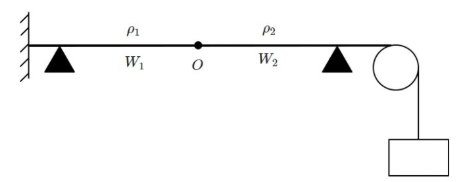
Q38. Two wires \(\mathrm{W}_1\) and \(\mathrm{W}_2\) have the same radius r and respective densities \(\rho_1\) and \(\rho_2\) such that \(\rho_2=4 \rho_1\). They are joined together at the point O , as shown in the figure. The combination is used as a sonometer wire and kept under tension \(T\). The point O is midway between the two bridges. When a stationary wave is set up in the composite wire, the joint is found to be a node. The ratio of the number of antinodes formed in \(W_1\) to \(W_2\) is : [JEE Main 2017]
(a) \(1: 1\)
(b) \(1: 2\)
(c) \(1: 3\)
(d) \(4 : 1\)
Solution: (b) Step 1: Understand the Wave Velocity
The velocity \(v[latex] of a transverse wave in a string is given by the formula:
[latex]
v=\sqrt{\frac{T}{\mu}}
\)
where \(T\) is the tension and \(\mu\) is the mass per unit length (linear density).
Since both wires have the same radius \(r\), the linear density \(\mu[latex] can be expressed in terms of volume density [latex]\rho\) :
\(
\mu=\text { Area } \times \rho=\left(\pi r^2\right) \rho
\)
Since \(T\) and \(r\) are the same for both wires, the velocity is inversely proportional to the square root of the density:
\(
v \propto \frac{1}{\sqrt{\rho}}
\)
Given \(\rho_2=4 \rho_1\), the ratio of velocities is:
\(
\frac{v_1}{v_2}=\sqrt{\frac{\rho_2}{\rho_1}}=\sqrt{\frac{4 \rho_1}{\rho_1}}=2
\)
Step 2: Relate Frequency and Loops
In a stationary wave, both wires must vibrate at the same frequency \(f\). The frequency for a wire of length \(L\) with \(n\) loops (antinodes) is:
\(
f=\frac{n \cdot v}{2 L}
\)
Since the joint \(O\) is at the midpoint, both wires have the same length \(L\). For the frequency to be the same in both segments:
\(
\begin{aligned}
& \frac{n_1 v_1}{2 L}=\frac{n_2 v_2}{2 L} \\
& n_1 v_1=n_2 v_2
\end{aligned}
\)
Step 3: Calculate the Ratio
Rearranging the equation to find the ratio of antinodes \(\left(n_1: n_2\right)\) :
\(
\frac{n_1}{n_2}=\frac{v_2}{v_1}
\)
Using the velocity ratio we found in Step \(1\left(\frac{v_1}{v_2}=2\right)\) :
\(
\frac{n_1}{n_2}=\frac{1}{2}
\)
Q39. An observer is moving with half the speed of light towards a stationary microwave source emitting waves at frequency 10 GHz. What is the frequency of the microwave measured by the observer? (speed of light \(=3 \times 10^8 \mathrm{~ms}^{-1}\)) [JEE Main 2017]
(a) 15.3 GHz
(b) 10.1 GHz
(c) 12.1 GHz
(d) 17.3 GHz
Solution: (d) To find the frequency measured by the observer, we must use the Relativistic Doppler Effect formula. Since the observer is moving at a significant fraction of the speed of light (\(0.5 c\)), the classical Doppler formula is not sufficient.
Step 1: Identify the Variables
Source frequency \(\left(f_s\right): 10 \mathrm{GHz}\)
Relative velocity \((v): 0.5 c\) (where \(c\) is the speed of light)
Direction: Towards the source (this means the observed frequency will be higher).
Step 2: Apply the Relativistic Doppler Formula
When the observer and source are approaching each other, the observed frequency (\(f_{\text {obs }}\)) is given by:
\(
f_{o b s}=f_s \sqrt{\frac{1+\beta}{1-\beta}}
\)
Where \(\beta\) is the ratio of the velocity to the speed of light (\(\beta=\frac{v}{c}\)).
Step 3: Calculate the Result
Given \(v=0.5 c\), we have \(\beta=0.5\). Substituting this into the formula:
\(
f_{o b s}=10 \sqrt{\frac{1+0.5}{1-0.5}}
\)
\(
\begin{gathered}
f_{o b s}=10 \sqrt{\frac{1.5}{0.5}} \\
f_{o b s}=10 \sqrt{3}
\end{gathered}
\)
Using the value \(\sqrt{3} \approx 1.732\) :
\(
\begin{aligned}
& f_{\text {obs }} \approx 10 \times 1.732 \\
& f_{\text {obs }} \approx 17.32 \mathrm{GHz}
\end{aligned}
\)
Final Answer: The frequency measured by the observer is 17.3 GHz.
Q40. A toy-car, blowing its horn, is moving with a steady speed of \(5 \mathrm{~m} / \mathrm{s}\), away from a wall. An observer, towards whom the toy car is moving, is able to hear 5 beats per second. If the velocity of sound in air is \(340 \mathrm{~m} / \mathrm{s}\), the frequency of the horn of the toy car is close to : [JEE Main 2016]
(a) 680 Hz
(b) 510 Hz
(c) 340 Hz
(d) 170 Hz
Solution: (d)
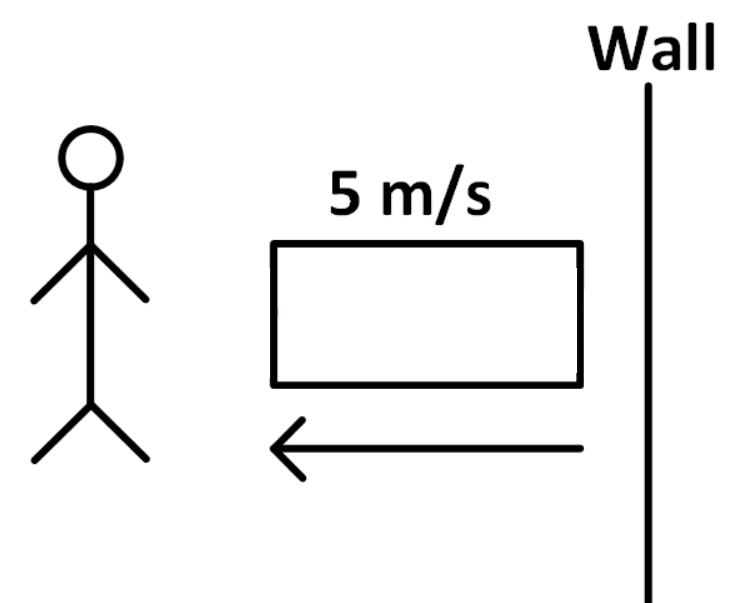
Step 1: Analyze the Setup
The toy car is moving towards the observer and away from the wall.
Let \(f\) be the actual frequency of the horn.
Let \(v_s=5 \mathrm{~m} / \mathrm{s}\) be the speed of the car.
Let \(v=340 \mathrm{~m} / \mathrm{s}\) be the speed of sound.
Step 2: Calculate the Two Frequencies
Frequency heard directly from the car (\(f_1\)):
Since the car is moving toward the observer, the frequency is upward-shifted:
\(
f_1=f\left(\frac{v}{v-v_s}\right)
\)
Frequency reflected from the wall (\(f_2\)):
The wall “hears” a frequency from a source moving away from it. Since the wall is stationary and reflects the sound, the observer hears this reflected sound as if it’s coming from a stationary source.
\(
\boldsymbol{f}_2=\boldsymbol{f}\left(\frac{v}{v+v_s}\right)
\)
Step 3: Use the Beat Frequency
The observer hears 5 beats per second, which is the difference between these two frequencies:
\(
\begin{gathered}
f_1-f_2=5 \\
f\left(\frac{v}{v-v_s}\right)-f\left(\frac{v}{v+v_s}\right)=5
\end{gathered}
\)
Factor out \(f \cdot v\) :
\(
\begin{gathered}
f v\left(\frac{1}{v-v_s}-\frac{1}{v+v_s}\right)=5 \\
f v\left(\frac{\left(v+v_s\right)-\left(v-v_s\right)}{v^2-v_s^2}\right)=5 \\
f v\left(\frac{2 v_s}{v^2-v_s^2}\right)=5
\end{gathered}
\)
Step 4: Solve for \(\boldsymbol{f}\)
Substitute the known values \(\left(v=340, v_s=5\right)\) :
\(
f \cdot 340\left(\frac{2 \cdot 5}{340^2-5^2}\right)=5
\)
\(
f \approx 5 \cdot 34=170 \mathrm{~Hz}
\)
Final Answer: The frequency of the horn is \(\mathbf{1 7 0 ~ H z}\).
Q41. Two engines pass each other moving in opposite directions with uniform speed of \(30 \mathrm{~m} / \mathrm{s}\). One of them is blowing a whistle of frequency 540 Hz. Calculate the frequency heard by driver of second engine before they pass each other. Speed of sound is \(330 \mathrm{~m} / \mathrm{sec}\) : [JEE Main 2016]
(a) 450 Hz
(b) 540 Hz
(c) 648 Hz
(d) 270 Hz
Solution: (c) To calculate the frequency heard by the driver of the second engine, we apply the Doppler Effect for a situation where both the source and the observer are moving toward each other.
Step 1: Identify the Variables
Actual frequency \(\left(f_s\right): 540 \mathrm{~Hz}\)
Speed of the source \(\left(v_s\right): 30 \mathrm{~m} / \mathrm{s}\) (Engine 1)
Speed of the observer \(\left(v_o\right): 30 \mathrm{~m} / \mathrm{s}\) (Engine 2)
Speed of sound (\(v\)): \(330 \mathrm{~m} / \mathrm{s}\)
Step 2: Determine the Sign Convention
Before the engines pass each other, they are approaching one another.
The motion of the observer toward the source increases the observed frequency (numerator is \(v+v_o\)).
The motion of the source toward the observer also increases the observed frequency (denominator is \(v-v_s\)).
Step 3: Apply the Doppler Formula
The formula for the observed frequency (\(f^{\prime}\)) is:
\(
f^{\prime}=f_s\left(\frac{v+v_o}{v-v_s}\right)
\)
Substitute the given values:
\(
\begin{gathered}
f^{\prime}=540\left(\frac{330+30}{330-30}\right) \\
f^{\prime}=540\left(\frac{360}{300}\right)
\end{gathered}
\)
\(
f^{\prime}=648 \mathrm{~Hz}
\)
Final Answer: The frequency heard by the driver of the second engine before they pass is 648 Hz.
Q42. A uniform string of length \(20 m\) is suspended from a rigid support. A short wave pulse is introduced at its lowest end. It starts moving up the string. The time taken to reach the supports is : [JEE Main 2016]
(take \(g=10 m s^{-2}\))
(a) \(2 \sqrt{2} s\)
(b) \(2 \pi \sqrt{2} s\)
(c) \(2 \pi \sqrt{2} s\)
(d) \(2 s\)
Solution: (a) This is a classic problem involving a varying tension string. Because the string is uniform and has mass, the tension isn’t constant; it’s higher at the top because it has to support the weight of the string below it.
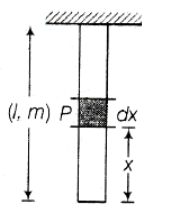
Step 1: Determine the Velocity at any point \(x\)
Let \(x\) be the distance from the lowest end of the string.
The tension \(T(x)\) at a point \(x\) is equal to the weight of the string segment below that point:
\(
T(x)=\mu x g
\)
Where \(\mu\) is the mass per unit length of the string.
The velocity \(v\) (at point P) of a wave pulse is given by \(v=\sqrt{\frac{T}{\mu}}\). Substituting our expression for \(T(x)\) :
\(
v(x)=\sqrt{\frac{\mu x g}{\mu}}=\sqrt{g x}
\)
Step 2: Set up the Kinematic Equation
Since velocity is the rate of change of position \(\left(v=\frac{d x}{d t}\right)\), we can write:
\(
\frac{d x}{d t}=\sqrt{g x}
\)
Rearranging the terms to integrate:
\(
d t=\frac{d x}{\sqrt{g x}}=\frac{1}{\sqrt{g}} x^{-1 / 2} d x
\)
Step 3: Integrate to find Total Time
To find the total time \(t\), we integrate from the bottom (\(x=0\)) to the top (\(x=L\), where \(L=\) 20 m):
\(
\begin{aligned}
\int_0^t d t & =\frac{1}{\sqrt{g}} \int_0^L x^{-1 / 2} d x \\
t & =\frac{1}{\sqrt{g}}\left[2 x^{1 / 2}\right]_0^L \\
t & =\frac{2 \sqrt{L}}{\sqrt{g}}=2 \sqrt{\frac{L}{g}}
\end{aligned}
\)
Step 4: Substitute the Values
Substitute \(L=20 \mathrm{~m}\) and \(g=10 \mathrm{~m} / \mathrm{s}^2\) :
\(
\begin{aligned}
& t=2 \sqrt{\frac{20}{10}} \\
& t=2 \sqrt{2} \mathrm{~s}
\end{aligned}
\)
Final Answer: The time taken for the pulse to reach the support is \(2 \sqrt{2} \mathrm{~s}\).
Q43. A pipe open at both ends has a fundamental frequency \(f\) in air. The pipe is dipped vertically in water so that half of it is in water. The fundamental frequency of the air column is now : [JEE Main 2016, 2012]
(a) \(2 f\)
(b) \(f\)
(c) \(\frac{f}{2}\)
(d) \(\frac{3 f}{4}\)
Solution: (b) To solve this, we compare the physics of an open pipe to that of a closed pipe (since the water surface acts as a lid).
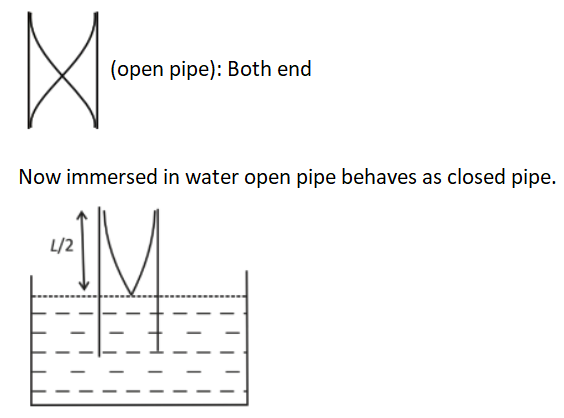
Step 1: Analyze the Pipe in Air (Open-Open)
An open pipe of length \(L\) has its fundamental frequency when the length corresponds to half a wavelength (\(\lambda / 2\)).
The fundamental frequency \(f\) is given by:
\(
f=\frac{v}{2 L}
\)
Step 2: Analyze the Pipe in Water (Open-Closed)
When the pipe is dipped vertically so that half of it is in water:
New Length \(\left(L^{\prime}\right)\) : Only the upper half contains air, so \(L^{\prime}=\frac{L}{2}\).
Boundary Condition: The bottom end is now water, making it a closed end. The pipe now behaves as an Open-Closed pipe.
The fundamental frequency of an open-closed pipe is given by:
\(
f^{\prime}=\frac{v}{4 L^{\prime}}
\)
Step 3: Calculate the New Frequency
Substitute \(L^{\prime}=\frac{L}{2}\) into the formula for \(f^{\prime}\) :
\(
f^{\prime}=\frac{v}{4\left(\frac{L}{2}\right)}=\frac{v}{2 L}
\)
Step 4: Compare the Frequencies
Looking back at Step 1, we see that \(f=\frac{v}{2 L}\). Therefore:
\(
f^{\prime}=f
\)
Final Answer: Even though the pipe is shorter, the change from an “open-open” system to an “open-closed” system results in the exact same fundamental frequency.
Q44. A train is moving on a straight track with speed \(20 \mathrm{~ms}^{-1}\). It is blowing its whistle at the frequency of 1000 Hz. The percentage change in the frequency heard by a person standing near the track as the train passes him is (speed of sound \(=320 \mathrm{~ms}^{-1}\)) close to : [JEE Main 2015]
(a) \(18 \%\)
(b) \(24 \%\)
(c) \(6 \%\)
(d) \(12 \%\)
Solution: (d) To find the percentage change in frequency, we need to calculate the frequency heard by the observer as the train approaches him and as it recedes from him.
Step 1: Identify the Variables
Source frequency \(\left(f_s\right): 1000 \mathrm{~Hz}\)
Speed of the source \(\left(v_s\right): 20 \mathrm{~m} / \mathrm{s}\)
Speed of sound (\(v[latex]): [latex]320 \mathrm{~m} / \mathrm{s}\)
Observer speed \(\left(v_o\right): 0 \mathrm{~m} / \mathrm{s}\) (standing near the track)
Step 2: Calculate Frequency during Approach (\(f_{\text {app }}\))
As the train moves towards the observer, the frequency is shifted upward:
\(
\begin{gathered}
f_{a p p}=f_s\left(\frac{v}{v-v_s}\right) \\
f_{a p p}=1000\left(\frac{320}{320-20}\right)=1000\left(\frac{320}{300}\right)=\frac{3200}{3} \mathrm{~Hz} \approx 1066.67 \mathrm{~Hz}
\end{gathered}
\)
Step 3: Calculate Frequency during Recession (\(f_{\text {rec }}\))
As the train moves away from the observer, the frequency is shifted downward:
\(
f_{r e c}=f_s\left(\frac{v}{v+v_s}\right)
\)
\(
f_{\text {rec }}=1000\left(\frac{320}{320+20}\right)=1000\left(\frac{320}{340}\right)=\frac{3200}{3.4} \mathrm{~Hz} \approx 941.18 \mathrm{~Hz}\approx 12 \%
\)
Q45. A pipe of length \(85 c m\) is closed from one end. Find the number of possible natural oscillations of air column in the pipe whose frequencies lie below 1250 Hz. The velocity of sound in air is \(340 \mathrm{~m} / \mathrm{s}\). [JEE Main 2014]
Solution: To find the number of natural oscillations (harmonics) below a certain frequency for a closed pipe, we need to look at the formula for the allowed frequencies of an air column closed at one end.
Step 1: Identify the Pipe Type and Parameters
A pipe closed at one end (an Open-Closed pipe) only produces odd harmonics.
Length (\(L\)): \(85 \mathrm{~cm}=0.85 \mathrm{~m}\)
Velocity of sound (\(v\)): \(340 \mathrm{~m} / \mathrm{s}\)
Maximum frequency \(\left(f_{\text {max }}\right): 1250 \mathrm{~Hz}\)
Step 2: Calculate the Fundamental Frequency
The fundamental frequency (\(f_1\)) for a pipe closed at one end is given by:
\(
f_1=\frac{v}{4 L}
\)
Substituting the values:
\(
\begin{gathered}
f_1=\frac{340}{4 \times 0.85} \\
f_1=\frac{340}{3.4}
\end{gathered}
\)
Step 3: Identify the Higher Harmonics
In a pipe closed at one end, the possible frequencies (\(f_n\)) are odd multiples of the fundamental frequency:
\(
f_n=n \cdot f_1 \quad \text { where } n=1,3,5,7, \ldots
\)
We need to find how many of these frequencies are less than 1250 Hz :
\(n=1: f_1=100 \mathrm{~Hz}\)
\(n=3: f_3=300 \mathrm{~Hz}\)
\(n=5: f_5=500 \mathrm{~Hz}\)
\(n=7: f_7=700 \mathrm{~Hz}\)
\(n=9: f_9=900 \mathrm{~Hz}\)
\(n=11: f_{11}=1100 \mathrm{~Hz}\)
\(n=13: f_{13}=1300 \mathrm{~Hz}\) (This is above 1250 Hz)
Step 4: Count the Oscillations
The frequencies that lie below 1250 Hz are \(100,300,500,700,900\), and 1100 Hz.
Counting these values:
\(
n=\{1,3,5,7,9,11\}
\)
There are 6 possible natural oscillations of the air column whose frequencies lie below 1250 Hz.
Q46. A sonometer wire of length \(1.5 m\) is made of steel. The tension in it produces an elastic strain of \(1 \%\). What is the fundamental frequency of steel if density and elasticity of steel are \(7.7 \times 10^3 \mathrm{~kg} / \mathrm{m}^3\) and \(2.2 \times 10^{11} \mathrm{~N} / \mathrm{m}^2\) respectively? [JEE Main 2013]
(a) 188.5 Hz
(b) 178.2 Hz
(c) 200.5 Hz
(d) 770 Hz
Solution: (b) To find the fundamental frequency, we need to determine the velocity of the transverse wave in the wire using the provided elastic properties.
Step 1: Calculate the Tension (\(T\)) and Linear Mass Density (\(\mu\))
The fundamental frequency \(f\) of a sonometer wire is given by:
\(
f=\frac{1}{2 L} \sqrt{\frac{T}{\mu}}
\)
We can express the term \(\sqrt{T / \mu}\) in terms of stress and density. Let \(A\) be the cross-sectional area of the wire:
Tension (\(T\)): Stress \(\times A\)
Linear density \((\mu)\) : Density \((\rho) \times A\)
Substituting these into the velocity formula \(v=\sqrt{T / \mu}\) :
\(
v=\sqrt{\frac{\text { Stress } \times A}{\rho \times A}}=\sqrt{\frac{\text { Stress }}{\rho}}
\)
Step 2: Determine the Stress from Elastic Strain
According to Hooke’s Law, Stress is the product of Young’s Modulus (\(Y\)) and Strain:
\(
\text { Stress }=Y \times \text { Strain }
\)
Given:
Young’s Modulus \((Y)=2.2 \times 10^{11} \mathrm{~N} / \mathrm{m}^2\)
Strain \(=1 \%=0.01\)
\(
\text { Stress }=2.2 \times 10^{11} \times 0.01=2.2 \times 10^9 \mathrm{~N} / \mathrm{m}^2
\)
Step 3: Calculate Wave Velocity (\(v\))
Now, use the density of steel (\(\rho=7.7 \times 10^3 \mathrm{~kg} / \mathrm{m}^3\)):
\(
\begin{gathered}
v=\sqrt{\frac{2.2 \times 10^9}{7.7 \times 10^3}} \\
v=\sqrt{\frac{2.2}{7.7} \times 10^6}=\sqrt{\frac{2}{7} \times 10^6} \\
v=10^3 \times \sqrt{0.2857} \approx 10^3 \times 0.5345 \approx 534.5 \mathrm{~m} / \mathrm{s}
\end{gathered}
\)
Step 4: Calculate Fundamental Frequency (\(f\))
Substitute the velocity and the length (\(L=1.5 \mathrm{~m}\)) into the frequency formula:
\(
\begin{gathered}
f=\frac{v}{2 L} \\
f=\frac{534.5}{2 \times 1.5}=\frac{534.5}{3} \\
f \approx 178.17 \mathrm{~Hz}
\end{gathered}
\)
Final Answer: The fundamental frequency is approximately 178.2 Hz.
Q47. The transverse displacement \(y(x, t)\) of a wave on a string is given by \(y(x, t)=e^{-\left(a x^2+b t^2+2 \sqrt{a b} x t\right)}\). This represents \(a\) : [JEE Main 2011]
(a) wave moving in \(-x\) direction with speed \(\sqrt{\frac{b}{a}}\)
(b) standing wave of frequency \(\sqrt{b}\)
(c) standing wave of frequency \(\frac{1}{\sqrt{b}}\)
(d) wave moving in \(+x\) direction speed \(\sqrt{\frac{a}{b}}\)
Solution: (a) To solve this, we need to look at the mathematical structure of the displacement function to determine if it describes a traveling wave and, if so, in which direction it moves.
Step 1: Simplify the Exponential Term
The expression in the exponent is:
\(
a x^2+b t^2+2 \sqrt{a b} x t
\)
Notice that this is a perfect square in the form \(A^2+B^2+2 A B=(A+B)^2\). We can rewrite it as:
\(
(\sqrt{a} x+\sqrt{b} t)^2
\)
So, the displacement function becomes:
\(
y(x, t)=e^{-(\sqrt{a} x+\sqrt{b} t)^2}
\)
Step 2: Identify the Wave Type
A general traveling wave is represented by a function of the form \(f(a x \pm b t)\).
If the sign between the \(x\) and \(t\) terms is positive \((+x)\), the wave is moving in the negative \(x\) direction.
If the sign is negative (\(-x\)), the wave is moving in the positive \(x\) direction.
In our equation, the term is (\(\sqrt{a} x+\sqrt{b} t\)). Since the signs are the same (both positive), the wave is moving in the negative \(x\) direction.
Step 3: Calculate the Wave Speed
For a wave function \(f(k x+\omega t)\), the wave speed \(v\) is given by the ratio of the coefficient of \(t\) to the coefficient of \(x\) :
\(
v=\frac{\omega}{k}
\)
In our case:
Coefficient of \(t(\omega)=\sqrt{b}\)
Coefficient of \(x(k)=\sqrt{a}\)
Therefore:
\(
v=\frac{\sqrt{b}}{\sqrt{a}}=\sqrt{\frac{b}{a}}
\)
Conclusion: The function represents a pulse (or wave) moving in the negative \(x\) direction with a speed of \(\sqrt{b / a}\).
Q48. The equation of a wave on a string of linear mass density \(0.04 \mathrm{~kg} \mathrm{~m}^{-1}\) is given by
\(
y=0.02(m) \sin \left[2 \pi\left(\frac{t}{0.04(s)}-\frac{x}{0.50(m)}\right)\right] .
\)
The tension in the string is
(a) 4.0 N
(b) 12.5 N
(c) 0.5 N
(d) 6.25 N
Solution: (d) Step 1: Extract Wave Parameters
The given wave equation is:
\(
y=0.02 \sin \left[2 \pi\left(\frac{t}{0.04}-\frac{x}{0.50}\right)\right]
\)
Distributing the \(2 \pi\) inside the brackets, we get the standard form \(y=A \sin (\omega t-k x)\) :
\(
y=0.02 \sin \left(\frac{2 \pi}{0.04} t-\frac{2 \pi}{0.50} x\right)
\)
From this, we identify:
Angular frequency \((\omega): \frac{2 \pi}{0.04} \mathrm{rad} / \mathrm{s}\)
Wave number \((k): \frac{2 \pi}{0.50} \mathrm{rad} / \mathrm{m}\)
Step 2: Calculate Wave Speed (\(v\))
The speed of the wave is the ratio of the angular frequency to the wave number:
\(
\begin{gathered}
v=\frac{\omega}{k} \\
v=\frac{2 \pi / 0.04}{2 \pi / 0.50}=\frac{0.50}{0.04}=12.5 \mathrm{~m} / \mathrm{s}
\end{gathered}
\)
Step 3: Relate Speed to Tension (\(T\))
The speed of a transverse wave on a string is determined by the tension and the linear mass density (\(\mu\)):
\(
v=\sqrt{\frac{T}{\mu}}
\)
Rearranging to solve for Tension (\(T\)):
\(
T=v^2 \cdot \mu
\)
Given the linear mass density \(\mu=0.04 \mathrm{~kg} / \mathrm{m}\) :
\(
\begin{gathered}
T=(12.5)^2 \times 0.04 \\
T=156.25 \times 0.04 \\
T=6.25 \mathrm{~N}
\end{gathered}
\)
Final Answer: The tension in the string is 6.25 N.
Q49. Three sound waves of equal amplitudes have frequencies \((\nu-1), \nu,(\nu+1)\). They superpose to give beats. The number of beats produced per second will be [JEE Main 2009]
Solution: In the case of three frequencies with a common difference (like an arithmetic progression), the beat frequency is determined by the difference between the successive frequencies.
\(
\text { Beat frequency }=(\nu)-(\nu-1)=1
\)
\(
\text { Beat frequency }=(\nu+1)-\nu=1
\)
While there is a complex interference pattern, the human ear perceives the rise and fall of intensity at the rate of the common difference.
Final Answer: The number of beats produced per second is 2.
Q50. While measuring the speed of sound by performing a resonance column experiment, a student gets the first resonance condition at a column length of \(18 c m\) during winter. Repeating the same experiment during summer, she measures the column length to be \(x c m\) for the second resonance. Then [JEE 2008]
(a) \(18>x\)
(b) \(x>54\)
(c) \(54>x>36\)
(d) \(36>x>18\)
Solution: (b) To solve this problem, we need to account for two factors: how the speed of sound changes with temperature and how the resonance lengths in a closed pipe relate to one another.
Step 1: Temperature and the Speed of Sound
The speed of sound in air (\(v\)) is proportional to the square root of the absolute temperature (\(T\)):
\(
v \propto \sqrt{T}
\)
Since summer is warmer than winter (\(T_{\text {summer }}>T_{\text {winter }}\)), the speed of sound is higher in the summer:
\(
v_{\text {summer }}>v_{\text {winter }}
\)
Step 2: Resonance Conditions in a Closed Column
A resonance column acts as a pipe closed at one end (the water surface). Resonance occurs when the length of the air column ( \(l\) ) matches the odd multiples of a quarter-wavelength (\(\lambda / 4\)).
First Resonance \(\left(l_1\right): l_1+e=\frac{\lambda}{4}\)
Second Resonance \(\left(l_2\right): l_2+e=\frac{3 \lambda}{4}\)
(Note: \(e\) is the end correction, which accounts for the fact that the antinode forms slightly outside the top of the tube.)
Step 3: Compare Winter and Summer
The frequency (\(f\)) of the tuning fork remains constant in both seasons. Since \(v=f \lambda\), the wavelength \(\lambda\) is directly proportional to the speed of sound \((v)\).
Because \(v_{\text {summer }}>v_{\text {winter }}\), it follows that:
\(
\lambda_{\text {summer }}>\lambda_{\text {winter }}
\)
In winter, the first resonance is at 18 cm . Neglecting end correction for a moment to establish a baseline:
\(
\frac{\lambda_{\text {winter }}}{4} \approx 18 \mathrm{~cm} \Longrightarrow \lambda_{\text {winter }} \approx 72 \mathrm{~cm}
\)
In summer, the wavelength \(\lambda_{\text {summer }}\) must be greater than 72 cm.
For the second resonance in summer (\(x\)):
\(
x+e=\frac{3 \lambda_{\text {summer }}}{4}
\)
If we use the winter wavelength as a minimum baseline:
\(
x \approx \frac{3(72)}{4}=3 \times 18=54 \mathrm{~cm}
\)
Since \(\lambda_{\text {summer }}>\lambda_{\text {winter }}\), the actual length \(x\) must be greater than 54 cm.
Step 4: Account for End Correction
Even if we include the end correction \(e\), the relationship holds.
From winter: \(\frac{\lambda_w}{4}=18+e\).
In summer: \(x+e=\frac{3 \lambda_s}{4}>\frac{3 \lambda_w}{4}=3(18+e)=54+3 e\).
\(
x>54+2 e
\)
Since \(e\) is a positive value, \(x\) is clearly greater than 54.
Final Answer: The second resonance length in summer will be greater than 54 cm.
Q51. A wave travelling along the \(x\)-axis is described by the equation \(y(x, t)=0.005 \cos (\alpha x-\beta t)\). If the wavelength and the time period of the wave are \(0.08 m\) and \(2.0 s\), respectively, then \(\alpha\) and \(\beta\) in appropriate units are [JEE 2008]
(a) \(\alpha=25.00 \pi, \beta=\pi\)
(b) \(\alpha=\frac{0.08}{\pi}, \beta=\frac{2.0}{\pi}\)
(c) \(\alpha=\frac{0.04}{\pi}, \beta=\frac{1.0}{\pi}\)
(d) \(\alpha=12.50 \pi, \beta=\frac{\pi}{2.0}\)
Solution: (a) \(y(x, t)=0.005 \cos (\alpha x-\beta t)(\) Given \()\)
Comparing it with the standard equation of wave
\(y(x, t)=a \cos (k x-\omega t)\) we get
\(k=\alpha \quad\) and \(\quad \omega=\beta\)
\(\therefore \frac{2 \pi}{\gamma}=\alpha \quad\) and \(\quad \frac{2 \pi}{T}=\beta\)
\(\therefore \alpha=\frac{2 \pi}{0.08}=25 \pi \quad\) and \(\quad \beta=\frac{2 \pi}{2}=\pi\)
Q52. A sound absorber attenuates the sound level by \(20 ~d B\). The intensity decreases by a factor of
(a) 100
(b) 1000
(c) 10000
(d) 10
Solution: (a) To find the factor by which the intensity decreases, we use the mathematical relationship between sound intensity level (in decibels) and physical intensity.
Step 1: Understand the Decibel Scale
The sound intensity level \(L\) (in dB ) is defined by the logarithmic formula:
\(
L=10 \log _{10}\left(\frac{I}{I_0}\right)
\)
where \(I\) is the intensity of the sound and \(I_0\) is the reference intensity.
When sound is attenuated (reduced), the change in the sound level \(\Delta L\) is given by:
\(
\Delta L=L_1-L_2=10 \log _{10}\left(\frac{I_1}{I_2}\right)
\)
Here, \(\frac{I_1}{I_2}\) represents the factor by which the intensity has decreased.
Step 2: Substitute the Given Values
We are given that the sound level is attenuated by 20 dB.
\(
20=10 \log _{10}\left(\frac{I_1}{I_2}\right)
\)
Divide both sides by 10 :
\(
2=\log _{10}\left(\frac{I_1}{I_2}\right)
\)
Step 3: Solve for the Intensity Ratio
To remove the logarithm, we rewrite the equation in exponential form:
\(
\begin{aligned}
& \frac{I_1}{I_2}=10^2 \\
& \frac{I_1}{I_2}=100
\end{aligned}
\)
Final Answer: The intensity decreases by a factor of 100.
Q53. A whistle producing sound waves of frequencies 9500 Hz and above is approaching a stationary person with speed \(v ~m s^{-1}\). The velocity of sound in air is \(300 \mathrm{~ms}^{-1}\). If the person can hear frequencies upto a maximum of \(10,000 \mathrm{~HZ}\), the maximum value of \(v\) upto which he can hear whistle is [JEE 2006]
(a) \(15 \sqrt{2} m s^{-1}\)
(b) \(\frac{15}{\sqrt{2}} m s^{-1}\)
(c) \(15 \mathrm{~ms}^{-1}\)
(d) \(30 m s^{-1}\)
Solution: (c) To solve for the maximum speed \(v\), we use the Doppler Effect for a source moving toward a stationary observer.
Step 1: Identify the Variables
Source frequency \(\left(f_s\right): 9500 \mathrm{~Hz}\) (This is the lowest frequency the whistle produces; as the speed \(v\) increases, this frequency will be shifted upward toward the observer’s limit).
Observer’s maximum audible frequency (\(f_{\text {obs }}\)): \(10,000 \mathrm{~Hz}\)
Speed of sound \(\left(v_a\right): 300 \mathrm{~m} / \mathrm{s}\)
Speed of the source \(\left(v_s\right): v\) (the value we need to find)
Step 2: Apply the Doppler Formula
When a source moves toward a stationary observer, the observed frequency is given by:
\(
f_{o b s}=f_s\left(\frac{v_a}{v_a-v_s}\right)
\)
We want to find the maximum speed \(v\) such that the lowest frequency of the whistle \((9500 \mathrm{~Hz})\) just reaches the observer’s highest audible limit \((10,000 \mathrm{~Hz})\). If the car goes any faster, the 9500 Hz sound will be shifted above \(10,000 \mathrm{~Hz}\), becoming inaudible to this person.
Step 3: Calculate the Speed \(v\)
Substitute the known values into the equation:
\(
10,000=9500\left(\frac{300}{300-v}\right)
\)
Simplify the equation by dividing both sides by 500 :
\(
20=19\left(\frac{300}{300-v}\right)
\)
\(
\begin{gathered}
20 \\
v=15 \mathrm{~m} / \mathrm{s}
\end{gathered}
\)
Final Answer: The maximum value of \(v\) up to which the person can hear the whistle is \(15 \mathrm{~m} / \mathrm{s}\).
Q54. A string is stretched between fixed points separated by 75.0 cm. It is observed to have resonant frequencies of 420 Hz and 315 Hz . There are no other resonant frequencies between these two. Then, the lowest resonant frequency for this string is [JEE 2006]
(a) 105 Hz
(b) 1.05 Hz
(c) 1050 Hz
(d) 10.5 Hz
Solution: (a) Given \(\frac{n v}{2 \ell}=315\) and \((n+1) \frac{v}{2 \ell}=420\)
\(
\Rightarrow \frac{n+1}{n}=\frac{420}{315} \Rightarrow n=3
\)
Hence \(3 \times \frac{v}{2 \ell}=315 \Rightarrow \frac{v}{2 \ell}=105 \mathrm{~Hz}\)
Lowest resonant frequency is when \(n=1\)
Therefore lowest resonant frequency \(=105 \mathrm{~Hz}\).
Explanation: To find the lowest resonant frequency (the fundamental frequency), we use the properties of standing waves on a string fixed at both ends.
Step 1: Understand Resonance on a Fixed String
For a string of length \(L\) fixed at both ends, the resonant frequencies (\(f_n\)) are integer multiples of the fundamental frequency \(\left(f_1\right)\) :
\(
f_n=n \cdot f_1 \quad \text { where } n=1,2,3, \ldots
\)
This means that the difference between any two successive resonant frequencies is equal to the fundamental frequency:
\(
\Delta f=f_{n+1}-f_n=(n+1) f_1-n f_1=f_1
\)
Step 2: Analyze the Given Frequencies
We are given two consecutive resonant frequencies:
\(f_n=315 \mathrm{~Hz}\)
\(f_{n+1}=420 \mathrm{~Hz}\)
The problem states there are no other resonant frequencies between these two, confirming they are successive harmonics.
Step 3: Calculate the Fundamental Frequency
The difference between these two successive frequencies will give us the lowest resonant frequency (\(f_1\)):
\(
\begin{gathered}
f_1=420 \mathrm{~Hz}-315 \mathrm{~Hz} \\
f_1=105 \mathrm{~Hz}
\end{gathered}
\)
Step 4: Verification (Optional)
We can check which harmonics these frequencies represent:
For \(315 \mathrm{~Hz}: n=\frac{315}{105}=3\) (3rd harmonic)
For \(420 \mathrm{~Hz}: n=\frac{420}{105}=4\) (4th harmonic)
Since these are consecutive integers, our result is consistent.
Final Answer: The lowest resonant frequency for this string is 105 Hz.
Q55. An observer moves towards a stationary source of sound, with a velocity one-fifth of the velocity of sound. What is the percentage increase in the apparent frequency? [JEE 2005]
(a) \(0.5 \%\)
(b) zero
(c) \(20 \%\)
(d) \(5 \%\)
Solution: (c) To find the percentage increase in the apparent frequency, we use the Doppler Effect formula for a moving observer and a stationary source.
Step 1: Identify the Variables
Source frequency \(\left(f_s\right): f\)
Velocity of sound (\(v\)): \(v\)
Velocity of the observer \(\left(v_o\right): \frac{1}{5} v\) or \(0.2 v\)
Direction: The observer is moving towards the source, which means the apparent frequency will increase.
Step 2: Apply the Doppler Formula
For an observer moving toward a stationary source, the apparent frequency (\(f^{\prime}\)) is:
\(
f^{\prime}=f_s\left(\frac{v+v_o}{v}\right)
\)
Substitute \(v_o=0.2 v\) into the equation:
\(
f^{\prime}=f\left(\frac{v+0.2 v}{v}\right)
\)
\(
\begin{gathered}
f^{\prime}=f\left(\frac{1.2 v}{v}\right) \\
f^{\prime}=1.2 f
\end{gathered}
\)
Step 3: Calculate the Percentage Increase
The increase in frequency (\(\Delta f\)) is:
\(
\Delta f=f^{\prime}-f=1.2 f-f=0.2 f
\)
To find the percentage increase:
\(
\begin{array}{ll}
\% \text { increase }=\left(\frac{\Delta f}{f}\right) \times 100 \\
\% \text { increase }=\left(\frac{0.2 f}{f}\right) \times 100 \\
\% \text { increase }=20 \%
\end{array}
\)
The percentage increase in the apparent frequency is \(20 \%\).
Q56. When two tuning forks (fork 1 and fork 2 ) are sounded simultaneously, 4 beats per second are heated. Now, some tape is attached on the prong of the fork 2 . When the tuning forks are sounded again, 6 beats per second are heard. If the frequency of fork 1 is 200 Hz , then what was the original frequency of fork 2 ? [JEE 2005]
(a) 202 Hz
(b) 200 Hz
(c) 204 Hz
(d) 196 Hz
Solution: (d) To solve this, we need to analyze how adding mass (tape) to a tuning fork affects its frequency and how that change impacts the beat frequency.
Step 1: Analyze the Initial Condition
The beat frequency is the absolute difference between the frequencies of the two forks.
Given:
Frequency of Fork \(1\left(f_1\right)=200 \mathrm{~Hz}\)
Initial beats \(=4\) beats \(/ \mathrm{s}\)
This means the initial frequency of Fork \(2\left(f_2\right)\) could be either:
Case A: \(f_2=200+4=204 \mathrm{~Hz}\)
Case B: \(f_2=200-4=196 \mathrm{~Hz}\)
Step 2: Effect of Adding Tape
When tape is attached to a prong of a tuning fork, its mass increases. An increase in mass causes the fork to vibrate more slowly, meaning its frequency decreases.
Let the new frequency of Fork 2 be \(f_2^{\prime}\). We know that \(f_2^{\prime}<f_2\).
Step 3: Test Both Cases with the New Beat Frequency
After adding the tape, the new beat frequency is 6 beats/s.
Testing Case A (\(f_2=204 \mathrm{~Hz}\)):
If \(f_2\) was 204 Hz and it decreases (e.g., to \(203,202,201 \mathrm{~Hz}\)), the gap between \(f_1\) ( 200 Hz ) and \(f_2^{\prime}\) decreases.
To get 6 beats/s, \(f_2^{\prime}\) would have to drop all the way to 194 Hz (passing through 200 Hz first). While possible with a lot of weight, we usually look for the most direct relationship in these problems.
Testing Case B (\(f_2=196 \mathrm{~Hz}\)):
If \(f_2\) was 196 Hz and it decreases, it moves further away from 200 Hz (e.g., to \(195,194 \mathrm{~Hz}\)).
The difference \(\left|200-f_2^{\prime}\right|\) increases.
Since the beat frequency increased from \(\mathbf{4}\) to \(\mathbf{6}\), this perfectly matches the behavior of a frequency that was already lower than the reference and dropped further.
\(|200-194|=6\) beats \(/ \mathrm{s}\)
Conclusion: In Case B, decreasing the frequency of Fork 2 increases the beat frequency, which matches the problem’s observation (\(4 \rightarrow 6\)). In Case A, decreasing the frequency would initially decrease the beats \((4 \rightarrow 3 \rightarrow 2 \ldots)\).
Final Answer: The original frequency of fork 2 was 196 Hz.
Q57. The displacement \(y\) of a particle in a medium can be expressed as, \(y=10^{-6} \sin \left(100 t+20 x+\frac{\pi}{4}\right) m\) where \(t\) is in second and \(x\) in meter. The speed of the wave is [JEE 2004]
(a) \(20 \mathrm{~m} / \mathrm{s}\)
(b) \(5 \mathrm{~m} / \mathrm{s}\)
(c) \(2000 \mathrm{~m} / \mathrm{s}\)
(d) \(5 \pi \mathrm{~m} / \mathrm{s}\)
Solution: (a) From equation given,
\(
\omega=100 \text { and } k=20, v=\frac{\omega}{k}=\frac{100}{20}=5 \mathrm{~m} / \mathrm{s}
\)
Q58. A tuning fork of known frequency 256 Hz makes 5 beats per second with the vibrating string of a piano. The beat frequency decreases to 2 beats per second when the tension in the piano string is slightly increased. The frequency of the piano string before increasing the tension was [JEE 2003]
(a) \(256+2 \mathrm{~Hz}\)
(b) \(256-2 \mathrm{~Hz}\)
(c) \(256-5 \mathrm{~Hz}\)
(d) \(256+5 \mathrm{~Hz}\)
Solution: (c) To solve this, we need to analyze the relationship between the string’s tension, its frequency, and the resulting beat frequency.
Step 1: Analyze the Initial Condition
The beat frequency is the difference between the two frequencies.
Given:
Frequency of the tuning fork \(\left(f_t\right)=256 \mathrm{~Hz}\)
Initial beats \(=5[latex] beats [latex]/ \mathrm{s}\)
The initial frequency of the piano string \(\left(f_s\right)\) could be either:
Case A: \(f_s=256+5=261 \mathrm{~Hz}\)
Case B: \(f_s=256-5=251 \mathrm{~Hz}\)
Step 2: Effect of Increasing Tension
The frequency of a vibrating string (\(f\)) is directly proportional to the square root of its tension (\(T\)):
\(
f=\frac{1}{2 L} \sqrt{\frac{T}{\mu}} \Longrightarrow f \propto \sqrt{T}
\)
When the tension in the piano string is increased, the frequency of the string (\(f_s\)) increases.
Step 3: Evaluate the Change in Beats
The new beat frequency is 2 beats/s. Let’s see which case matches this decrease.
Testing Case A (\(f_s=261 \mathrm{~Hz}\)):
If the string frequency starts at 261 Hz and increases (e.g., to \(262,263 \mathrm{~Hz}\)), it moves further away from the 256 Hz tuning fork.
The beat frequency would increase \((5 \rightarrow 6 \rightarrow 7 \ldots)\). This does not match the problem.
Testing Case B \(\left(f_s=251 \mathrm{~Hz}\right)\) :
If the string frequency starts at 251 Hz and increases (e.g., to \(252,253,254 \mathrm{~Hz}\)), it moves closer to the 256 Hz tuning fork.
The beat frequency would decrease \((5 \rightarrow 4 \rightarrow 3 \rightarrow 2)\). This matches the problem perfectly.
Conclusion: The string frequency must have been lower than the tuning fork frequency so that an increase in tension (and thus frequency) reduced the gap between them.
Final Answer: The frequency of the piano string before increasing the tension was \(256-5 \mathrm{~Hz}\) (which is 251 Hz ).
Q59. The displacement \(y\) of a wave travelling in the \(x\)-direction is given by
\(
y=10^{-4} \sin \left(600 t-2 x+\frac{\pi}{3}\right) \text { metres }
\)
where \(x\) is expressed in metres and \(t\) in seconds. The speed of the wave – motion, in \(m s^{-1}\), is
(a) 300
(b) 600
(c) 1200
(d) 200
Solution: (a) \(y=10^{-4} \sin \left(600 t-2 x+\frac{\pi}{3}\right)\)
But \(y=A \sin (\omega t-k x+\phi)\)
On comparing we get \(\omega=600 ; k=2\)
\(
v=\frac{\omega}{k}=\frac{600}{2}=300 m s^{-1}
\)
Q60. A metal wire of linear mass density of \(9.8 \mathrm{~g} / \mathrm{m}\) is stretched with a tension of 10 kg -wt between two rigid supports 1 metre apart. The wire passes at its middle point between the poles of a permanent magnet, and it vibrates in resonance when carrying an alternating current of frequency \(n\). The frequency \(n\) of the alternating source is [JEE 2003]
(a) 50 Hz
(b) 100 Hz
(c) 200 Hz
(d) 25 Hz
Solution: (a) For a string vibrating between two rigid support, the fundamental frequency is given by
\(
f=\frac{1}{2 \ell} \sqrt{\frac{T}{\mu}}=\frac{1}{2 \times} \sqrt{\frac{10 \times 9.8}{9.8 \times 10^{-3}}}=50 \mathrm{~Hz}
\)
As the string is vibrating in resonance to a.c of frequency \(f\), therefore both the frequencies are same.