6.2 Centre of mass
For a system of particles or a body, the centre of mass is defined as a point at which the total mass of the system or of the body is supposed to be concentrated. The center of mass (CM) is the average position of all the mass in a system, a balance point where an object can be supported, calculated by summing the mass of each part multiplied by its position, then dividing by the total mass, crucial for understanding how objects move and balance, though it doesn’t always lie within the object itself, like a ring.
Key Concepts
Balance Point: If you could place a pivot under an object’s CM, it would balance perfectly.
Not Always Physical: For a donut, the CM is in the hole; for a boomerang, it’s outside the object.
System CM: For multiple objects (like people on a seesaw or Earth-Moon system), the CM is a weighted average of their individual masses and positions.
The center of mass (CM) for two objects
The center of mass (CM) for two objects is derived from the principle of balanced torques or as a weighted average of positions, resulting in the formula \(x_{c m}=\frac{m_1 x_1+m_2 x_2}{m_1+m_2}\), where \(m_1, m_2\) are masses and \(x_1, x_2\) are their positions relative to an origin; this formula shows the CM lies on the line between objects, closer to the heavier one, balancing the system as if all mass were at that single point, as demonstrated by \(m_1 d_1=m_2 d_2\) where \(d_1, d_2\) are distances from the CM.
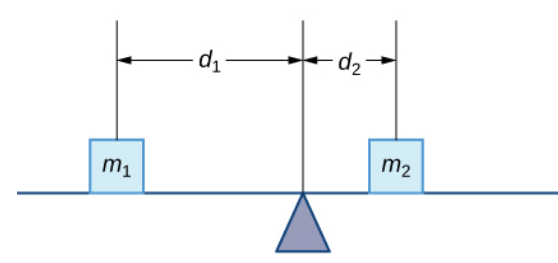
Derivation: In the seesaw example shown below, we balanced the system by moving the masses (children) with respect to the fulcrum. However, we are really interested in systems in which the masses are not allowed to move, and instead we balance the system by moving the fulcrum. Suppose we have two point masses, \(m_1\) and \(m_2\), located on a number line at points \(x_1\) and \(x_2\), respectively. The center of mass, \(x_{c m}\), is the point where the fulcrum should be placed to make the system balance.
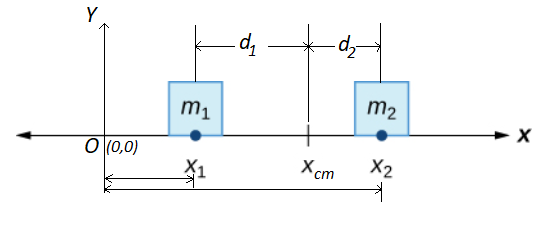
Concept: For a system to be balanced at its center of mass, the clockwise torque must equal the counter-clockwise torque.
Setup: Place two masses, \(m_1\) and \(m 2\), at positions \(x_1\) and \(x_2\) on a line (as shown in above figure), with the CM at \(\boldsymbol{x}_{\boldsymbol{c m}}\).
Distances: The distance from \(m_1\) to the CM is \(d_1=\left|x_1-x_{c m}\right|\), and from \(m_2\) to the CM is \(d_2=\left|x_2-x_{c m}\right|\) (assuming \(x_1<x_{c m}<x_2\) ).
Torque Equation: Torque \(=\) Mass × Distance from pivot.
Torque from \(m_1\) : \(m_1 \times d_1\)
Torque from \(m_2: m_2 \times d_2\)
Balance condition: \(m_1 d_1=m_2 d_2\).
Substitute and Solve: Substitute \(d_1=x_{c m}-x_1\) and \(d_2=x_2-x_{c m}\) (assuming \(\left.x_1<x_2\right)\).
\(m_1\left(x_{c m}-x_1\right)=m_2\left(x_2-x_{c m}\right)\)
\(m_1 x_{c m}-m_1 x_1=m_2 x_2-m_2 x_{c m}\)
\(m_1 x_{c m}+m_2 x_{c m}=m_1 x_1+m_2 x_2\)
\(x_{c m}\left(m_1+m_2\right)=m_1 x_1+m_2 x_2\)
\(x_{c m}=\frac{m_1 x_1+m_2 x_2}{m_1+m_2}\).
Note: In standard physics problems involving position along a line, the variables \(x_1\) and \(x_2\) represent the coordinates of masses \(m_1\) and \(m_2\), respectively, relative to a single, chosen origin (or reference point).
The center of mass position \(\boldsymbol{x}_{\boldsymbol{c m}}\) is also defined relative to this same origin by the formula:
\(
x_{c m}=\frac{m_1 x_1+m_2 x_2}{m_1+m_2}
\)
Derivation from Weighted Average
Concept: The center of mass is the weighted average of the positions of all particles in a system, where weights are their masses.
Formula: If we have \(n\) particles of masses \(m_1, m_2\). \(\ldots m_1\) respectively, along a straight line taken as the \(x\) – axis, then by definition the position of the centre of the mass of the system of particles is given by
\(
x_{c m}=\frac{m_1 x_1+m_2 x_2+\ldots .+m_n x_n}{m_1+m_2+\ldots .+m_n}=\frac{\sum m_i x_i}{\sum m_i}
\)
where \(x_1, x_2, \ldots x_{\mathrm{n}}\) are the distances of the particles from the origin.
In a compact form for \(n\) particles, \(x_{c m}=\frac{\sum_{i=1}^n m_i x_i}{\sum_{i=1}^N m_i}\).
For Two Objects: Setting \(n=2\) :
\(x_{c m}=\frac{m_1 x_1+m_2 x_2}{m_1+m_2}\).
Key Takeaways
- The formula is a weighted average, placing the CM closer to the object with more mass.
- If \(m_1=m_2\), the formula simplifies to \(x_{c m}=\frac{m\left(x_1+x_2\right)}{2 m}=\frac{x_1+x_2}{2}\), meaning it’s exactly halfway.
- If \(m_1 \neq m_2\). centre of mass is nearer to the particle of larger mass.
Formula and Calculation:
For discrete particles (1-Dimension): \(x_{cm}=\frac{\sum m_i x_i}{M}\) where \(m_i\) is each mass, \(x_i\) is its position, and \(M\) is total mass.
For continuous objects/systems: The formula extends to vectors, finding separate \(\mathrm{X}, \mathrm{Y}\), and \(\mathrm{Z}\) coordinates by averaging the mass-weighted positions.
Example 1: Two point masses 3 kg and 5 kg are at 4 m and 8 m from the origin on X -axis. Locate the position of center of mass of the two point masses (i) from the origin and (ii) from 3 kg mass.
Solution: Let us take, \(\mathrm{m}_1=3 \mathrm{~kg}\) and \(\mathrm{m}_2=5 \mathrm{~kg}\)
(i) To find center of mass from the origin:
The point masses are at positions, \(x_1=4 m, x_2=8 m\) from the origin along \(X\) axis.
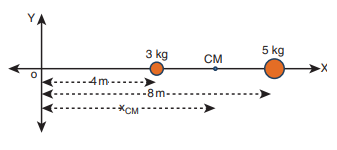
The center of mass \(\mathrm{x}_{\mathrm{CM}}\):
\(
\begin{aligned}
& x_{\mathrm{CM}}=\frac{m_1 x_1+m_2 x_2}{m_1+m_2} \\
& x_{\mathrm{CM}}=\frac{(3 \times 4)+(5 \times 8)}{3+5} \\
& x_{\mathrm{CM}}=\frac{12+40}{8}=\frac{52}{8}=6.5 \mathrm{~m}
\end{aligned}
\)
The center of mass is located 6.5 m from the origin on X -axis.
(ii) To find the center of mass from 3 kg mass:
The origin is shifted to 3 kg mass along X -axis. The position of 3 kg point mass is zero \(\left({x}_1=0\right)\) and the position of 5 kg point mass is 4 m from the shifted origin ( \(x_2=4 {~m}\) ).
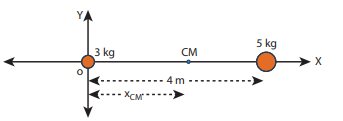
\(
\begin{aligned}
& x_{\mathrm{CM}}=\frac{(3 \times 0)+(5 \times 4)}{3+5} \\
& x_{\mathrm{CM}}=\frac{0+20}{8}=\frac{20}{8}=2.5 \mathrm{~m}
\end{aligned}
\)
The center of mass is located 2.5 m from 3 kg point mass, (and 1.5 m from the 5 kg point mass) on X -axis. This result shows that the center of mass is located closer to larger mass.
Explain the principle of moments with the shifted origin:
When the origin is shifted to the center of mass ( 6.5 m ), the relative positions are \(x_1=6.5-4.0=2.5 \mathrm{~m}\) (or -2.5 m if we consider direction relative to CM ) and \(x_2=8.0-6.5=1.5 \mathrm{~m}\). The principle of moments states that the sum of moments about the CM is zero: \(\sum m_i x_i=0\), which means \(m_1 x_1=m_2 x_2\) in magnitude. The user’s calculation verifies this:
\(
m_1 x_1=m_2 x_2 \Longrightarrow 3 \times 2.5=5 \times 1.5 \Longrightarrow 7.5=7.5
\)
Position of centre of mass for a system of two particles
Consider two particles of masses \(m_1\) and \(m_2\) located at position vectors \(\mathbf{r}_1\) and \(\mathbf{r}_2\).
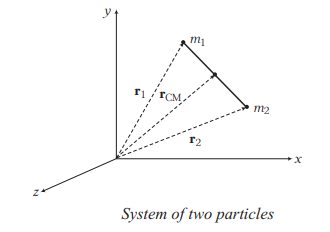
Then, position of centre of mass \(\mathbf{r}_{\mathrm{CM}}\) is given as
\(
\begin{aligned}
\mathbf{r}_{\mathrm{CM}} & =\frac{m_1 \mathbf{r}_1+m_2 \mathbf{r}_2}{m_1+m_2} \\
\mathbf{r}_{\mathrm{CM}} & =\frac{m_1 \mathbf{r}_1+m_2 \mathbf{r}_2}{M}=\frac{\Sigma m_i \mathbf{r}_i}{M}
\end{aligned}
\)
where, \(M=m_1+m_2=\) total mass of system.
The \(x\) and \(y\)-coordinates of centre of mass can be written as
\(
\begin{aligned}
& x_{\mathrm{CM}}=\frac{m_1 x_1+m_2 x_2}{m_1+m_2} \\
& y_{\mathrm{CM}}=\frac{m_1 y_1+m_2 y_2}{m_1+m_2}
\end{aligned}
\)
Hence, the centre of mass of two particles system lies between the two particles on the line joining them and the distance of the centre of mass from masses is in inverse ratio of masses of the particles.
Example 2: Prove that the centre of mass from masses is in inverse ratio of masses of the particles. i.e. \(r \propto \frac{1}{m} \Rightarrow \frac{r_1}{r_2}=\frac{m_2}{m_1}\)
Solution: Step 1: Establish a Coordinate System
To demonstrate this, we place the first particle, \(m_1\), at the origin \((0,0)\) and the second particle, \(m_2\), along the positive x -axis at ( \(r, 0\) ), where \(r\) is the distance between the two particles.
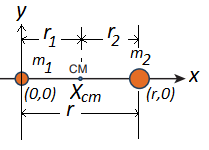
Step 2: Calculate the Center of Mass Coordinates
Using the provided formulas for the center of mass (CM) coordinates:
\(
\begin{gathered}
x_{\mathrm{CM}}=\frac{m_1 x_1+m_2 x_2}{m_1+m_2}=\frac{m_1(0)+m_2(r)}{M}=\frac{m_2 r}{M} \\
y_{\mathrm{CM}}=\frac{m_1 y_1+m_2 y_2}{m_1+m_2}=\frac{m_1(0)+m_2(0)}{M}=0
\end{gathered}
\)
Since the \(y\)-coordinate of the center of mass is \({y}_{{C M}}=\mathbf{0}\), the center of mass lies entirely on the \(x\)-axis, which is the line connecting the two particles.
Step 3: Determine Distances and Their Ratio
The distance of the CM from \(m_1\left(r_1\right)\) is the distance from \((0,0)\) to \(\left(x_{\mathrm{CM}}, 0\right)\) :
\(
r_1=\left|x_{\mathrm{CM}}\right|=\frac{m_2 r}{M}
\)
The distance of the CM from \(m_2\left(r_2\right)\) is the distance from ( \(x_{\mathrm{CM}}, 0\) ) to ( \(r, 0\) ):
\(
r_2=\left|r-x_{\mathrm{CM}}\right|=\left|r-\frac{m_2 r}{M}\right|=\left|\frac{M r-m_2 r}{M}\right|=\left|\frac{\left(m_1+m_2\right) r-m_2 r}{M}\right|=\left|\frac{m_1 r}{M}\right|=\frac{m_1 r}{M}
\)
Finally, forming the ratio of these distances:
\(
\frac{r_1}{r_2}=\frac{m_2 r / M}{m_1 r / M}=\frac{m_2}{m_1}
\)
Conclusion: The ratio of the distances of the particles from the center of mass ( \(r_1 / r_2\) ) is equal to the inverse ratio of their masses \(\left(m_2 / m_1\right)\). This shows the COM is always closer to the heavier mass, balancing the system like a see-saw.
Remark: If the two particles have the same mass, i.e. \(m_1=m_2=m\), then
\(
r_{\mathrm{CM}}=\frac{m r_1+m r_2}{2 m}=\frac{r_1+r_2}{2}
\)
Thus, for a system of two particles of equal mass, the centre of mass lies exactly midway between them.
If \(m_1 \neq m_2\), centre of mass is nearer to the particle of larger mass.
Example 3: Four particles \(A, B, C\) and \(D\) having masses \(m, 2 m\), \(3 m\) and \(4 m\) respectively are placed in order at the corners of a square of side \(a\). Locate the centre of mass.
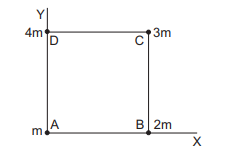
Solution: Take the axes as shown in figure above. The coordinates of the four particles are as follows:
\(
\begin{array}{cccc}
\text { Particle } & \text { mass } & x \text {-coordinate } & y \text {-coordinate } \\
A & m & 0 & 0 \\
B & 2 m & a & 0 \\
C & 3 m & a & a \\
D & 4 m & 0 & a
\end{array}
\)
Hence, the coordinates of the centre of mass of the four-particle system are
\(
\begin{aligned}
& X_{cm}=\frac{m \cdot 0+2 m a+3 m a+4 m \cdot 0}{m+2 m+3 m+4 m}=\frac{a}{2} \\
& Y_{cm}=\frac{m \cdot 0+2 m \cdot 0+3 m a+4 m a}{m+2 m+3 m+4 m}=\frac{7 a}{10}
\end{aligned}
\)
The centre of mass is at \(\left(\frac{a}{2}, \frac{7 a}{10}\right)\).
Example 4: Two bodies of masses 1 kg and 2 kg are located at \((1,2)\) and \((-1,3)\), respectively. Calculate the coordinates of centre of mass.
Solution: Let the coordinates of centre of mass be \((x, y)\).
Given, mass, \(m_1=1 \mathrm{~kg}, m_2=2 \mathrm{~kg}\)
Coordinates, \(x_1=1, x_2=-1, y_1=2\) and \(y_2=3\)
\(
\begin{aligned}
\because & x \\
\Rightarrow & =\frac{m_1 x_1+m_2 x_2}{m_1+m_2} \\
\Rightarrow & x=\frac{1 \times 1+(2)(-1)}{1+2} \\
& =\frac{1-2}{3}=\frac{-1}{3}
\end{aligned}
\)
Similarly,
\(
y=\frac{m_1 y_1+m_2 y_2}{m_1+m_2}=\frac{(1)(2)+(2)(3)}{1+2}=\frac{2+6}{3}=\frac{8}{3}
\)
Therefore, the coordinates of centre of mass will be \(\left(\frac{-1}{3}, \frac{8}{3}\right)\).
Example 5: Two particles of masses 1 kg and 2 kg are located at \(x=0\) and \(x=3 \mathrm{~m}\). Find the position of their centre of mass.
Solution: Since, both the particles lie on \(X\)-axis, so the CM will also lie on \(X\)-axis. Let the CM be located at \(x\) from 1 kg mass, then \(r_1=\) distance of CM from the particle of mass \(1 \mathrm{~kg}=x\) and \(r_2=\) distance of CM from the particle of mass 2 kg
\(
=(3-x)
\)
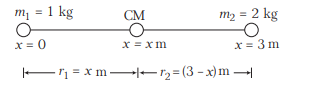
Using \(\frac{r_1}{r_2}=\frac{m_2}{m_1}\), we get
\(
\frac{x}{3-x}=\frac{2}{1} \text { or } x=2 \mathrm{~m}
\)
Thus, the CM of the two particles is located at \(x=2 \mathrm{~m}\).
Example 6: Two point objects of masses \(1.5 g\) and \(2.5 g\) respectively are 16 cm apart, the centre of mass is at a distance \(x\) from the object of mass 1.5 g. Find the value of \(x\).
Solution: As, centre of mass of two particles system lies between the two particles on the line joining them.
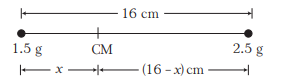
∴ From \(\quad \frac{r_1}{r_2}=\frac{m_2}{m_1} \Rightarrow \frac{x}{16-x}=\frac{2.5}{1.5} \Rightarrow x=10 \mathrm{~cm}\)
Position of centre of mass for a system of large number of particles
If we have a system consisting of \(n\) particles of masses \(m_1, m_2, \ldots, m_n\) with \(\mathbf{r}_1, \mathbf{r}_2, \ldots, \mathbf{r}_n\) as their position vectors at a given instant of time. The position vector \(\mathbf{r}_{\mathrm{CM}}\) of the centre of mass of the system at that instant is given by
\(
\mathbf{r}_{\mathrm{CM}}=\frac{m_1 \mathbf{r}_1+m_2 \mathbf{r}_2+\ldots+m_n \mathbf{r}_n}{m_1+m_2+\ldots+m_n}=\frac{\sum_{i=1}^n m_i \mathbf{r}_i}{\sum_{i=1}^n m_i}
\)
or \(\mathbf{r}_{\mathrm{CM}}=\frac{\sum_{i=1}^n m_i \mathbf{r}_i}{M}\)
Here, \(\quad M=m_1+m_2+\ldots+m_n\) and \(\Sigma m_i \mathbf{r}_i\) is called the first moment of the mass.
Further,
\(
\mathbf{r}_i=x_i \hat{\mathbf{i}}+y_i \hat{\mathbf{j}}+z_i \hat{\mathbf{k}}
\)
and \(\mathbf{r}_{\mathrm{CM}}=x_{\mathrm{CM}} \hat{\mathbf{i}}+y_{\mathrm{CM}} \hat{\mathbf{j}}+z_{\mathrm{CM}} \hat{\mathbf{k}}\)
So, the cartesian coordinates of the CM will be
\(
x_{\mathrm{CM}}=\frac{m_1 x_1+m_2 x_2+\ldots+m_n x_n}{m_1+m_2+\ldots+m_n}=\frac{\sum_{i=1}^n m_i x_i}{\sum m_i}
\)
\(
x_{\mathrm{CM}}=\frac{\sum_{i=1}^n m_i x_i}{M}
\)
Similarly, \(y_{\mathrm{CM}}=\frac{\sum_{i=1}^n m_i y_i}{M}\) and \(z_{\mathrm{CM}}=\frac{\sum_{i=1}^n m_i z_i}{M}\)
Example 7: The position vectors of three particles of masses \(m_1=1 \mathrm{~kg}, m_2=2 \mathrm{~kg}\) and \(m_3=3 \mathrm{~kg}\) are \(\mathbf{r}_1=(\hat{\mathbf{i}}+4 \hat{\mathbf{j}}+\hat{\mathbf{k}}) \mathrm{m}\), \(\mathbf{r}_2=(\hat{\mathbf{i}}+\hat{\mathbf{j}}+\hat{\mathbf{k}}) m\) and \(\mathbf{r}_3=(2 \hat{\mathbf{i}}-\hat{\mathbf{j}}-2 \hat{\mathbf{k}}) m\), respectively. Find the position vector of their centre of mass.
Solution: The position vector of CM of the three particles will be given by
\(
\mathbf{r}_{\mathrm{CM}}=\frac{m_1 \mathbf{r}_1+m_2 \mathbf{r}_2+m_3 \mathbf{r}_3}{m_1+m_2+m_3}
\)
Substituting the given values in above equation, we get
\(
\begin{aligned}
\mathbf{r}_{C M} & =\frac{1(\hat{\mathbf{i}}+4 \hat{\mathbf{j}}+\hat{\mathbf{k}})+2(\hat{\mathbf{i}}+\hat{\mathbf{j}}+\hat{\mathbf{k}})+3(2 \hat{\mathbf{i}}-\hat{\mathbf{j}}-2 \hat{\mathbf{k}})}{1+2+3} \\
& =\frac{9 \hat{\mathbf{i}}+3 \hat{\mathbf{j}}-3 \hat{\mathbf{k}}}{6} \Rightarrow \mathbf{r}_{C M}=\frac{1}{2}(3 \hat{\mathbf{i}}+\hat{\mathbf{j}}-\hat{\mathbf{k}}) \mathrm{m}
\end{aligned}
\)
Example 8: Three point masses \(m_1=2 \mathrm{~kg}, m_2=4 \mathrm{~kg}\) and \(m_3=6 \mathrm{~kg}\) are kept at the three corners of an equilateral triangle of side 1 m. Find the location of their centre of mass.
Solution: Assume \(m_1\) to be at the origin and \(X\)-axis along the line joining \(m_1\) and \(m_2\) as shown in figure.
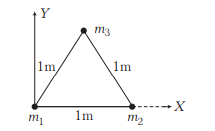
From the figure, it is clear that the coordinates of \(m_1\) are \(\left(x_1, y_1\right)=(0,0)\) that of \(m_2\) are \(\left(x_2, y_2\right)=(1,0)\) and that of \(m_3\) are
\(
\left(x_3, y_3\right)=\left(\frac{1}{2}, \frac{\sqrt{3}}{2}\right)
\)
Coordinates of centre of mass are
\(
x_{\mathrm{CM}}=\frac{2 \times 0+4 \times 1+6 \times 1 / 2}{2+4+6}=\frac{7}{12} \mathrm{~m}
\)
and \(y_{\mathrm{CM}}=\frac{2 \times 0+4 \times 0+6 \times \sqrt{3} / 2}{2+4+6}=\frac{3 \sqrt{3}}{12}=\frac{\sqrt{3}}{4} \mathrm{~m}\)
∴ Centre of mass is at \(\left(x_{\mathrm{CM}}, y_{\mathrm{CM}}\right)=\left(\frac{7}{12}, \frac{\sqrt{3}}{4}\right)\).
Example 9: Two identical uniform rods \(A B\) and \(C D\), each of length \(L\) are jointed to form a \(T\)-shaped frame as shown in figure below. Locate the centre of mass of the frame. The centre of mass of a uniform rod is at the middle point of the rod.
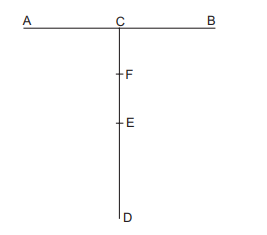
Solution: Give,
Rod AB: horizontal, length \(L\)
Rod CD: vertical, length \(L\)
The rods are jointed at the midpoint of \(A B\), which is the top end of \(C D\)
Both rods are identical and uniform
Because the frame is symmetric left-right, the centre of mass must lie on the vertical rod CD.
Step 1: Choose origin and axes
Take the junction point (midpoint of AB and top of CD ) as the origin.
\(x\)-axis: horizontal
\(y\)-axis: vertically downward
Step 2: Centre of mass of each rod
Rod AB (horizontal)
Centre of mass is at its midpoint
This midpoint is exactly at the junction
\(
y_{A B}=0
\)
Rod CD (vertical)
Centre of mass is at its midpoint
Distance from the top end:
\(
y_{C D}=\frac{L}{2}
\)
Step 3: Combine the two rods
Let the mass of each rod be \(m\).
\(
y_{\mathrm{CM}}=\frac{m y_{A B}+m y_{C D}}{m+m}=\frac{0+\frac{L}{2}}{2}=\frac{L}{4}
\)
The centre of mass lies on the vertical rod, at a distance \(\frac{L}{4}\) below the junction point.
Example 10: Find the centre of mass of a triangular lamina.
Solution: The center of mass (or centroid) of a uniform triangular lamina is the point where its three medians intersect, dividing each median in a 2:1 ratio from the vertex.
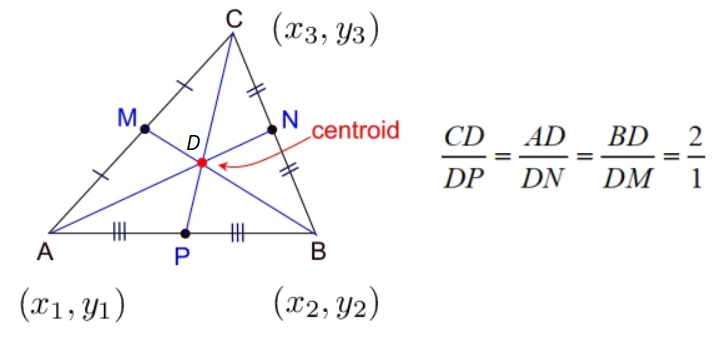
Using Vertex Coordinates (Simplest):
This is the easiest method for a lamina with known vertex coordinates.
Identify Vertices: Let the triangle’s vertices be \(A\left(x_1, y_1\right), B\left(x_2, y_2\right)\), and \(C\left(x_3, y_3\right)\).
Apply Formula: Calculate the centroid \(D\left(x_c, y_c\right)\) as:
\(
\begin{aligned}
& x_c=\frac{x_1+x_2+x_3}{3} \\
& y_c=\frac{y_1+y_2+y_3}{3} .
\end{aligned}
\)
Example 11: Find the centre of mass of a uniform L-shaped lamina (a thin flat plate) with dimensions as shown. The mass of the lamina is 3 kg.
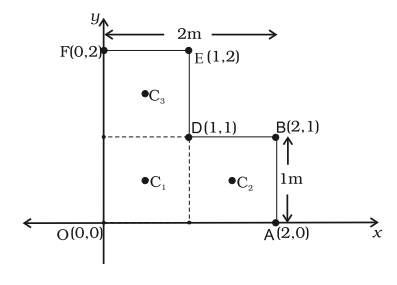
Solution: Choosing the \(X\) and \(Y\) axes. We have the coordinates of the vertices of the \(L\). shaped lamina as given in the figure. We can think of the \(L\)-shape to be constant of 3 squares each of length 1 m. The mass of each square is 1 Kg. Since the lamina is uniform.
The center of mass of each square in X,Y coordinate \(C_1(1 / 2,1 / 2), C_2(3 / 2,1 / 2)\) and \(C_3(1 / 2,3 / 2)\) of the square are by,
Formula for center of mass,
\(
\Rightarrow X_{cm}=\frac{m_a x_a+m_b x_b+m_c x_c}{m_a+m_b+m_c} \dots(1)
\)
And, \(Y_{cm}=\frac{m_a y_a+m_b y_b+m_c y_c}{m_a+m_b+m_c} \dots(2)\)
Now put the values in the equation 1 and 2 we get,
\(
\Rightarrow X_{cm}=\frac{[1(1 / 2)+1(3 / 2)+1(1 / 2)]}{(1+1+1)}=\frac{5}{6} \mathrm{~m}
\)
Now continuing the equation 2
\(
\Rightarrow Y_{cm}=\frac{[1(1 / 2)+1(1 / 2)+1(3 / 2)]}{(1+1+1)}=\frac{5}{6} \mathrm{~m}
\)
So, the center of mass for the \(L\) shape is \(\left(\frac{5}{6}, \frac{5}{6}\right)\).
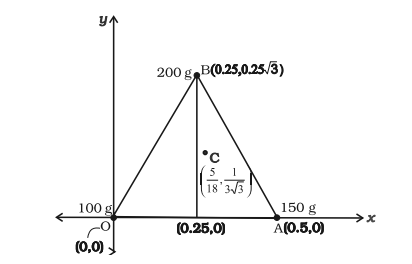
Example 12: Find the centre of mass of three particles at the vertices of an equilateral triangle. The masses of the particles are \(100 \mathrm{~g}, 150 \mathrm{~g}\), and 200 g respectively. Each side of the equilateral triangle is 0.5 m long.
Solution: With the \(X\) and \(Y\) axes chosen as shown in Figure below, the coordinates of points \(\mathrm{O}, \mathrm{A}\) and B forming the equilateral triangle are respectively \((0,0)\), \((0.5,0),(0.25,0.25 \sqrt{3})\). Let the masses 100 g, 150 g and 200 g be located at O, A and B be respectively.
\(
\begin{aligned}
& X_{cm}=\frac{m_1 x_1+m_2 x_2+m_3 x_3}{m_1+m_2+m_3} \\
& =\frac{[100(0)+150(0.5)+200(0.25)] \mathrm{g} \mathrm{~m}}{(100+150+200) \mathrm{g}} \\
& \quad=\frac{75+50}{450} \mathrm{~m}=\frac{125}{450} \mathrm{~m}=\frac{5}{18} \mathrm{~m} \\
& Y_{cm}=\frac{[100(0)+150(0)+200(0.25 \sqrt{3})] \mathrm{g} \mathrm{~m}}{450 \mathrm{~g}} \\
& \quad=\frac{50 \sqrt{3}}{450} \mathrm{~m}=\frac{\sqrt{3}}{9} \mathrm{~m}=\frac{1}{3 \sqrt{3}} \mathrm{~m}
\end{aligned}
\)
The centre of mass C is shown in the figure.
Note that it is not the geometric centre of the triangle OAB, because the masses at the vertices ( \(m_1, m_2\), and \(m_3\) ) are not equal.
Remark:
Centroid Formula: The geometric center (centroid) is simply the arithmetic mean of the coordinates of the vertices: \(G=\left(\frac{x_1+x_2+x_3}{3}, \frac{y_1+y_2+y_3}{3}\right)\). This formula implicitly assumes equal weighting (or equal masses) for each vertex.
Position of centre of mass of continuous bodies
If we consider the body to have continuous distribution of matter, the summation in the formula of centre of mass should be replaced by integration. So, we do not talk of the \(i\) th particle, rather we talk of a small element of the body having a mass \(d m\). If \(x, y, z\) are the coordinates of this small mass \(d m\), we write the coordinates of the centre of mass as
\(
\begin{aligned}
& x_{\mathrm{CM}}=\frac{\int x d m}{\int d m}=\frac{\int x d m}{M} \\
& y_{\mathrm{CM}}=\frac{\int y d m}{\int d m}=\frac{\int y d m}{M} \\
& z_{\mathrm{CM}}=\frac{\int z d m}{\int d m}=\frac{\int z d m}{M}
\end{aligned}
\)
where, \(M\) is total mass of that real body.
Case-I: Centre of Mass of a Uniform Straight Rod
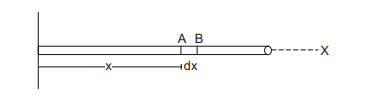
For a formal proof using calculus, consider a uniform rod of total mass \(M\) and length \(L\) , placed along the \(x\)-axis with one end at the origin \((x=0)\) and the other at \(x=L\)
The general formula for the x -coordinate of the center of mass \(\left(x_{c m}\right)\) for a continuous object is:
\(
x_{c m}=\frac{\int x d m}{\int d m}=\frac{\int x d m}{M}
\)
Define Linear Mass Density:
For a uniform rod, the linear mass density ( \(\lambda\), or mass per unit length) is constant and given by:
\(
\lambda=\frac{\text { Total Mass }}{\text { Total Length }}=\frac{M}{L}
\)
Express the Infinitesimal Mass Element (\(dm\)):
Consider a small element of length \(d x\) at a distance \(x\) from the origin. The mass of this small element is:
\(
d m=\lambda d x=\left(\frac{M}{L}\right) d x
\)
Substitute \(d m\) into the Center of Mass Equation:
Substitute the expression for \(d m\) into the numerator of the \(x_{c m}\) formula. The integral limits are from \(\boldsymbol{x} \boldsymbol{=} \mathbf{0}\) to \(\boldsymbol{x} \boldsymbol{=} \boldsymbol{L}\) :
\(
x_{c m}=\frac{\int_0^L x\left(\frac{M}{L}\right) d x}{M}
\)
Evaluate the Integral
Since \(\frac{M}{L}\) is a constant, it can be moved outside the integral:
\(x_{c m}=\frac{M / L}{M} \int_0^L x d x=\frac{1}{L} \int_0^L x d x=\frac{1}{L}\left(\frac{L^2}{2}\right)=\frac{L}{2}\)
The result \(x_{c m}=\frac{L}{2}\) shows that the center of mass is located at a distance of half the length from the chosen origin (one end of the rod), which is exactly the midpoint.
The \(y\)-coordinate is
\(
Y_{cm}=\frac{1}{M} \int y d m=0
\)
and similarly \(Z_{cm}=0\). The centre of mass is at \(\left(\frac{L}{2}, 0,0\right)\), i.e., at the middle point of the rod.
Example 13: The linear density of a thin rod of length 1 m varies as \(\lambda=(1+2 x)\), where \(x\) is the distance from its one end. Find the distance of its centre of mass from this end.
Solution: Let the \(X\)-axis be along the length of the rod and origin at one of its end as shown in figure.
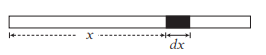
As, rod is along \(X\)-axis, for all points on it \(Y\) and \(Z\) will be zero, so \(y_{\mathrm{CM}}=0\) and \(z_{\mathrm{CM}}=0\), i.e. centre of mass will be on the rod. Now, consider an element of rod of length \(d x\) at a distance \(x\) from the origin.
Mass of this element, \(d m=\lambda d x=(1+2 x) d x\)
\(
\begin{aligned}
x_{\mathrm{CM}} & =\frac{\int x d m}{\int d m}=\frac{\int_0^1 x(1+2 x) d x}{\int_0^1(1+2 x) d x} \\
& =\frac{\left[\frac{x^2}{2}+\frac{2 x^3}{3}\right]_0^1}{\left[x+x^2\right]_0^1} \\
& =\left[\frac{\frac{(1)^2}{2}+\frac{2(1)^3}{3}-0-0}{1+(1)^2-0-0}\right]=\frac{\frac{1}{2}+\frac{2}{3}}{2}=\frac{7}{12} \mathrm{~m}
\end{aligned}
\)
Example 14: A straight rod of length \(L\) has one of its ends at the origin and the other at \(x=L\). If the mass per unit length of the rod is given by \(A x\), where \(A\) is constant, where is its centre of mass?
Solution: Let the mass of an element of length \(d x\) of the rod located at a distance \(x\) away from left end be \(A x d x\).
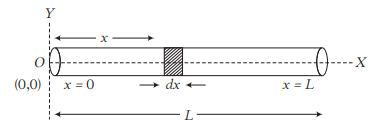
The \(x\)-coordinate of the centre of mass is given by
\(
\begin{aligned}
x_{\mathrm{CM}} & =\frac{1}{M} \int x d m=\frac{1}{M} \int_0^L x(A x d x) \\
& =\frac{\int_0^L x \cdot A x d x}{\int_0^L A x d x}=\frac{\left[A x^3 / 3\right]_0^L}{\left[A x^2 / 2\right]_0^L}=\frac{2}{3} L
\end{aligned}
\)
The \(y\)-coordinate is \(y_{\mathrm{CM}}=\frac{1}{M} \int y d m=0\) and similarly, \(z_{\mathrm{CM}}=0\)
Hence, the centre of mass is at \(\left(\frac{2}{3} L, 0,0\right)\) or at \(\frac{2}{3} L\) from one end.
Case-II: Centre of Mass of a Uniform Semicircular Wire
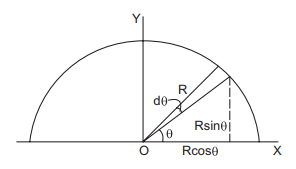
Let \(M\) be the mass and \(R\) the radius of a uniform semicircular wire. Take its centre as the origin, the line joining the ends as the \(X\)-axis, and the \(Y\)-axis in the plane of the wire (figure above). The centre of mass must be in the plane of the wire i.e., in the \(X-Y\) plane.
Setup & Symmetry: Due to symmetry across the y -axis, the x -coordinate of the center of mass ( \(x_{C M}\) ) is 0.
We only need to find \(y_{C M}\).
Define Mass & Length:
Let \(\lambda\) be the uniform linear mass density (mass per unit length).
Total length \(L=\pi R\) (half the circumference).
Total mass \(M=\lambda L=\lambda \pi R\).
Differential Elements:
Consider a small arc element \(\boldsymbol{d} \boldsymbol{L}\) at angle \(\boldsymbol{\theta}\) from the x -axis.
\(\boldsymbol{d} \boldsymbol{L} \boldsymbol{=} \boldsymbol{R} \boldsymbol{d} \boldsymbol{\theta}\) (arc length formula).
The mass of this element is \(d m=\lambda d L=\lambda R d \theta\).
The coordinates of this element are \((x, y)=(R \cos \theta, R \sin \theta)\).
Integrate for \(y_{C M}\):
Use the formula: \(y_{C M}=\frac{\int y d m}{\int d m}\).
The denominator, \(\int d m\), is the total mass \(M=\lambda L=\lambda \pi R \)
The numerator, \(\int y d m\) :
\(\int_0^\pi(R \sin \theta)(\lambda R d \theta)=\lambda R^2 \int_0^\pi \sin \theta d \theta\).
\(\int_0^\pi \sin \theta d \theta=[-\cos \theta]_0^\pi=(-\cos \pi)-(-\cos 0)=(-(-1))-(-1)=1+1=2\)
So, \(\int y d m=\lambda R^2(2)=2 \lambda R^2\).
\(
y_{C M}=\frac{2 \lambda R^2}{\lambda \pi R}=\frac{2 R}{\pi} .
\)
The center of mass of a uniform semicircular wire of radius \(R\) is located at \(\left(0, \frac{2 R}{\pi}\right)\).
Example 15: Find the CM of a semicircular wire with radius 10 cm.
Solution: \(R=10 \mathrm{~cm} . y_{\mathrm{cm}}=\frac{2(10)}{\pi}=\frac{20}{\pi} \approx 6.37 \mathrm{~cm}\). The CM is at \((0,6.37 \mathrm{~cm})\)
Case-III: Centre of Mass of a Uniform Semicircular Plate
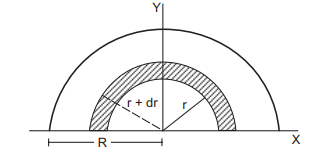
Figure (above) shows the semicircular plate. We take the origin at the centre of the semicircular plate, the \(X\)-axis along the straight edge and the \(Y\)-axis in the plane of the plate. Let \(M\) be the mass and \(R\) be its radius. Let us draw a semicircle of radius \(r\) on the plate with the centre at the origin. We increase \(r\) to \(r+d r\) and draw another semicircle with the same centre. Consider the part of the plate between the two semicircles of radii \(r\) and \(r+d r\). This part, shown shaded in figure (above), may be considered as a semicircular wire.
Setup: Place the semicircle’s center at the origin \((0,0)\), with the flat diameter along the x -axis and the curved part in the upper half-plane \(({y}>0)\).
Symmetry: Due to symmetry, the center of mass will lie on the y -axis, so \(\boldsymbol{x}_{c m}=\mathbf{0}\).
Mass Density \((\sigma)\) : Total Mass \((M) /\) Total Area \((A)=M /\left(\pi R^2 / 2\right)=2 M / \pi R^2\).
\(\begin{aligned} & \text { Area of the element (shaded region) is } =1 / 2\left[\pi(r+d r)^2-\pi r^2\right] \\ & =\pi r d r\left(\because(d r)^2 \ll 0\right)\end{aligned}\)
Infinitesimal Element ( \(d m\) ): The mass of the semicircular element \(d m=(\pi r d r) \sigma=(\pi r d r)\left(2 M / \pi R^2\right)=\left(2 M r / R^2\right) d r\).
If we take \(r=0\), the part will be formed near the centre and if \(r=R\), it will be formed near the edge of the plate. Thus, if \(r\) is varied from 0 to \(R\), the elemental parts will cover the entire semicircular plate. Thus, if \(r\) is varied from 0 to \(R\), the elemental parts will cover the entire semicircular plate. The \(y\)-coordinate of the centre of mass of this wire is \(y=2 r / \pi\) (Case-II derivation). The \(y\)-coordinate of the centre of mass of the plate is, therefore,
\(
y_{C M}=\frac{1}{M}{\int_0^R y d m}=\frac{1}{M} \int_0^R\left(\frac{2 r}{\pi}\right)\left(\frac{2 M r}{R^2} d r\right)=\frac{1}{M} \cdot \frac{4 M}{\pi R^2} \frac{R^3}{3}=\frac{4 R}{3 \pi}
\)
Case-IV: Find the centre of mass of a solid hemisphere of radius \(R\).
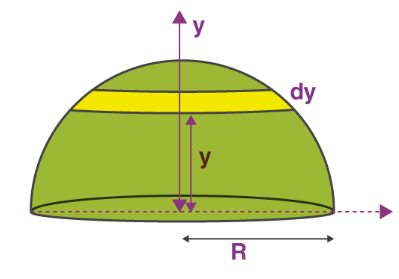
We are considering a solid hemisphere of mass \(M\) and has the radius \(R\) . The centre of mass will lie on the vertical line passing through the centre of the hemisphere, the vertical line is also the normal to the base. In order to find the centre of mass, we have to consider an element.
We are taking an elemental disc at a height \(y\) from the base of the hemisphere. The mass of the elemental disc is \(dM\) and the width is \(dy\).
Elemental Disc: A thin disc at height \(y\) with thickness \(d y\) and radius \(r=\sqrt{R^2-y^2}\):
For any point on the circumference of this elemental disc, it must also lie on the surface of the sphere. The distance from the center of the disc (which is on the \(y\)-axis at height \(y\) ) to the origin is \(|y|\). The radius of the disc is \(r\). The distance from any point on the circumference of the disc to the origin is the sphere’s radius, \(R\).
These three lengths form a right-angled triangle where \(\boldsymbol{r}\) and \(\boldsymbol{y}\) are the legs and \(\boldsymbol{R}\) is the hypotenuse. According to the Pythagorean theorem:
\(
r^2+y^2=R^2
\)
This relationship holds true for any disc cut horizontally through the sphere at a vertical distance \(y\) from the origin (center).
Mass of Disc (\(dM\)): Calculated as density ( \(\rho\) ) times volume \((dV)\). For a uniform hemisphere, \(\rho=M\left(\frac{2}{3} \pi R^3\right)\), so
\(
d M=\rho \cdot \pi r^2 d y=\frac{3 M}{2 \pi R^3} \cdot \pi\left(R^2-y^2\right) d y=\frac{3 M}{2 R^3}\left(R^2-y^2\right) d y
\)
Center of Mass Formula: \(y_c=\frac{1}{M} \int y d M\).
Integration: \(y_c=\frac{1}{M} \int_0^R y \cdot \frac{3 M}{2 R^3}\left(R^2-y^2\right) d y=\frac{3}{2 R^3} \int_0^R\left(R^2 y-y^3\right) d y\).
\(y_{cm}=\frac{3}{2 R^3}\left[\frac{R^2 y^2}{2}-\frac{y^4}{4}\right]_0^R=\frac{3}{2 R^3}\left(\frac{R^4}{2}-\frac{R^4}{4}\right)=\frac{3}{2 R^3}\left(\frac{R^4}{4}\right)=\frac{3 R}{8}\)
Case-V: Find the centre of mass of a uniform hollow hemisphere of radius \(R\).
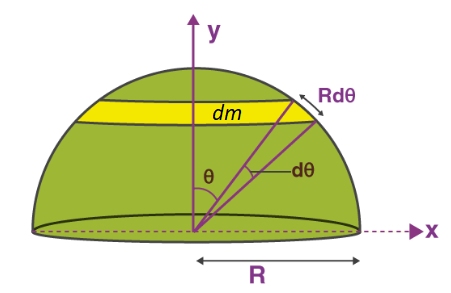
We are having a hollow hemisphere of mass \(M\) and radius \(R\). The centre of mass of the hollow hemisphere will lie on the \(y\)-axis, which is the line passing through the centre of the base of the hollow hemisphere.
Define elemental mass:
The surface mass density \((\sigma)\) of the hollow hemisphere is \(\sigma=M /\left(2 \pi R^2\right)\). An elemental ring of width \({Rd} \theta\) at an angle \(\theta\) has a radius \(r=R \sin \theta\) (\(
\sin \theta=\frac{\text { Opposite }}{\text { Hypotenuse }}=\frac{r}{R}
\)) and a surface area \({dA}=2 \pi r \cdot {Rd} \theta=2 \pi R^2 \sin \theta {~d} \theta\). The elemental mass ( \({d} m\) ) is:
\(
{d} m=\sigma \cdot {dA}=\frac{M}{2 \pi R^2}\left(2 \pi R^2 \sin \theta \mathrm{~d} \theta\right)=M \sin \theta \mathrm{~d} \theta
\)
The \(y\)-coordinate of this element is \(y=R \cos \theta\).
Integrate to find the center of mass:
The \(y\)-coordinate of the center of mass \(\left(y_{cm}\right)\) is found by integrating the product of the position \(y\) and the elemental mass \(dm\) over the entire hemisphere (from \({\theta}={0}\) to \(\theta=\pi / 2\) ) and dividing by the total mass \(M\) :
\(
y_{cm}=\frac{1}{M} \int y \mathrm{~d} m=\frac{1}{M} \int_0^{\pi / 2}(R \cos \theta)(M \sin \theta \mathrm{~d} \theta)=R \int_0^{\pi / 2} \cos \theta \sin \theta \mathrm{~d} \theta
\)
Using the trigonometric identity \(\sin (2 \theta)=2 \sin \theta \cos \theta\), or \(\sin \theta \cos \theta=\frac{1}{2} \sin (2 \theta)\) :
\(
y_{cm}=\frac{R}{2} \int_0^{\pi / 2} \sin (2 \theta) \mathrm{d} \theta=\frac{R}{2}\left[-\frac{\cos (2 \theta)}{2}\right]_0^{\pi / 2}=\frac{R}{2}
\)
The center of mass of the hollow hemisphere will be at a distance of \(R/2\) from the center of its base along the axis of symmetry. Due to symmetry, the \(x_{cm}\) coordinate of the centre of mass of this surface will be zero. Therefore, the centre of mass of the hollow hemisphere is \(\left(0, \frac{R}{2}\right)\).
Position of centre of mass of symmetrical bodies
Given below are three points which are very important regarding the centre of mass of symmetrical bodies
- For the bodies symmetrical about both the axes ( \(X\) or \(Y)\) or all the three axes \((X, Y, Z)\), the centre of mass will lie at point of intersection of symmetrical axes. There is no need to determine centre of mass.
- The bodies which are symmetrical about one axis, centre of mass will lie on that axis. Determine only that coordinate about which there is symmetry.
- If an arrangement or body is not symmetrical about any axis, then determine all the required coordinates.
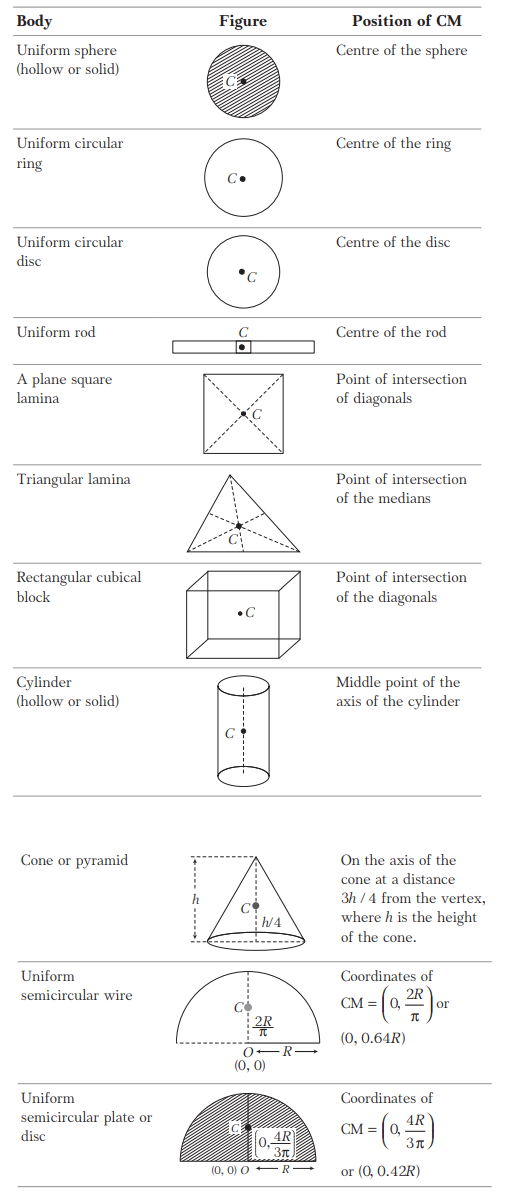
Centre of mass of some symmetric bodies are given in a table below:
Example 16: Find the position of centre of mass of the uniform lamina as shown in figure, if small disc of radius \(a/ 2\) is cut from disc of radius \(a\).
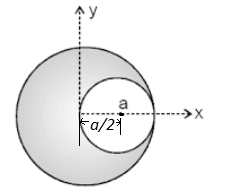
Solution: Let \(\sigma\) be the uniform mass per unit area.
Area of the large disc, \(A_1=\pi a^2\)
Mass of the large disc, \(M_1=\sigma A_1=\sigma \pi a^2\)
Area of the small disc, \(A_2=\pi(a / 2)^2=\pi a^2 / 4\)
Mass of the small disc, \(M_2=\sigma A_2=\sigma \pi a^2 / 4\)
Apply the Centre of Mass Formula:
The center of mass of the remaining system can be found by treating the cut-out disc as a negative mass added to the large disc. The formula for the \(x\)-coordinate of the center of mass ( \(x_{\mathrm{CM}}\) ) is:
\(
x_{\mathrm{CM}}=\frac{M_1 x_1-M_2 x_2}{M_1-M_2}
\)
where \(x_1\) and \(x_2\) are the \(x\)-coordinates of the centers of the large and small discs, respectively.
\(x_1=0\)
\(x_2=a / 2\)
Calculate the Position:
Substitute the values into the formula:
\(
x_{\mathrm{CM}}=\frac{\left(\sigma \pi a^2\right)(0)-\left(\sigma \pi a^2 / 4\right)(a / 2)}{\sigma \pi a^2-\sigma \pi a^2 / 4}
\)
We can cancel out \(\sigma \pi a^2\) from all terms:
\(
\begin{gathered}
x_{\mathrm{CM}}=\frac{0-(1 / 4)(a / 2)}{1-1 / 4}=\frac{-a / 8}{3 / 4} \\
x_{\mathrm{CM}}=\frac{-a}{8} \times \frac{4}{3}=\frac{-a}{6}
\end{gathered}
\)
The y -coordinate is \(y_{\mathrm{CM}}=0\) as both centers are on the x -axis.
The \(y\)-coordinate remains \(y_{C M}=0\).
Therefore, coordinates of CM of the lamina as shown in figure are \(\left(-\frac{a}{6}, 0\right)\).
Alternate:
Step 1: Define parameters and coordinate system
Let the uniform surface mass density of the lamina be \(\sigma\). Assume the center of the large disc (radius \(a\) ) is at the origin ( 0,0 ). The small disc (radius \(a / 2\) ) is cut from the larger one, and based on the standard problem associated with this query, its center is located at \(\left(\frac{a}{2}, 0\right)\). The \(y\)-coordinate of the center of mass for both individual discs is 0, so the final COM will also have a \(y\)-coordinate of 0.
Step 2: Calculate areas and effective masses
The areas are proportional to the masses for a uniform lamina.
Area of the large disc \(A_1=\pi a^2\). The center of mass is \(\left(x_1, y_1\right)=(0,0)\).
Area of the small disc \(A_2=\pi\left(\frac{a}{2}\right)^2=\frac{\pi a^2}{4}\). The center of mass is \(\left(x_2, y_2\right)=\left(\frac{a}{2}, 0\right)\)
Step 3: Use the center of mass formula for composite bodies
The \(\boldsymbol{x}\)-coordinate of the center of mass \(\left(\boldsymbol{x}_{\boldsymbol{C M}}\right)\) for the remaining part is calculated using the formula for the center of mass with the subtraction method:
\(
x_{C M}=\frac{A_1 x_1-A_2 x_2}{A_1-A_2}
\)
Substitute the values into the equation:
\(
x_{C M}=\frac{\left(\pi a^2\right)(0)-\left(\frac{\pi a^2}{4}\right)\left(\frac{a}{2}\right)}{\pi a^2-\frac{\pi a^2}{4}}
\)
\(
x_{C M}=-\frac{a}{6}
\)
The \(y\)-coordinate remains \(y_{C M}=0\).
Therefore, coordinates of CM of the lamina as shown in figure are \(\left(-\frac{a}{6}, 0\right)\).
Example 17: A small disc of radius 2 cm is cut from a disc of radius 6 cm. If the distance between their centres is 3.2 cm, what is the shift in the centre of mass of the disc?
Solution: Let radius of complete disc be \(a\) and that of small disc be \(b\). Also, let centre of mass now shifts to \(O_2\) at a distance \(l\) from original centre.
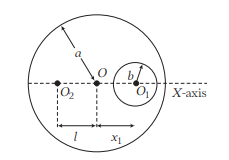
The position of new centre of mass is given by
\(
x_{\mathrm{CM}}=\frac{M_2 x_2-M_1 x_1}{M_2-M_1}=\frac{-\sigma \pi b^2 x_1}{\sigma \pi a^2-\sigma \pi b^2} \quad\left(\because x_2=0\right)
\)
Note: Simplification: By setting the center of mass of the large, initial object ( \(x_2\) ) at the origin, its position vector becomes zero ( \({x}_2={0}\) ).
where, \(\sigma=\) mass per unit area.
The center of mass of the remaining portion \(\left({X}_{{CM}}\right)\) is calculated using the principle of superposition (treating the removed mass as negative mass):
Here, \(a=6 \mathrm{~cm}, b=2 \mathrm{~cm}, x_{\mathrm{l}}=3.2 \mathrm{~cm}\)
Hence,
\(
\begin{aligned}
x_{\mathrm{CM}} & =\frac{-\sigma \times \pi(2)^2 \times 3.2}{\sigma \times \pi \times(6)^2-\sigma \times \pi \times(2)^2} \\
& =-\frac{12.8 \pi}{32 \pi}=-0.4 \mathrm{~cm}
\end{aligned}
\)
Negative sign indicates the left side shift from the centre.
Example 18: Two identical rods each of mass \(m\) and length \(L\) are connected as shown in the figure. Locate the centre of
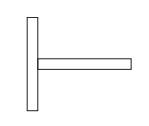
Solution: This system is symmetrical about the \(X\)-axis. Hence, we need to find \(x_{\mathrm{CM}}\). Here, we will take coordinates of centre of mass of rods.
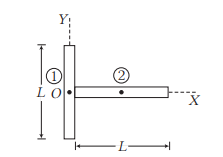
Rod (1) (vertical):
Uniform, length \(L\)
Centered at point \(O\)
Lies along the \(y\)-axis
Its center of mass is at
\(
\left(x_1, y_1\right)=(0,0)
\)
Rod 2 (horizontal):
Uniform, length \(L\)
Attached at its left end to point \(O\)
Lies along the \(x\)-axis to the right
Its center of mass is at
\(
\left(x_2, y_2\right)=\left(\frac{L}{2}, 0\right)
\)
Both rods have equal mass \(m\).
\(
\therefore \quad x_{\mathrm{CM}}=\frac{m_1 x_1+m_2 x_2}{m_1+m_2}
\)
\(
x_{\mathrm{CM}}=\frac{m \times 0+m \times \frac{L}{2}}{m+m}=\frac{m \frac{L}{2}}{2 m}=\frac{L}{4}
\)
Similarly,
\(
y_{\mathrm{CM}}=0
\)
∴ Centre of mass \(=\left(\frac{L}{4}, 0\right)\)
Example 19: Find the coordinates of centre of mass of a quarter ring of radius \(r\) placed in the first quadrant of a cartesian coordinate system with centre at origin.
Solution: Given, A uniform quarter ring (thin circular arc) with Radius \(r\), Lies in the first quadrant and Center of the full circle at the origin.
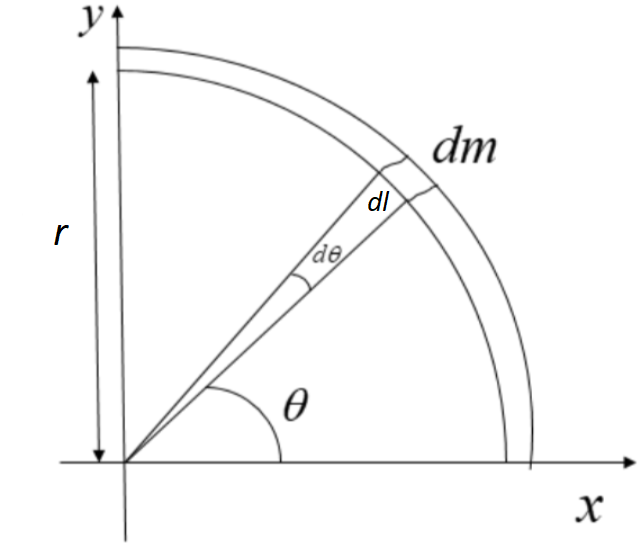
By symmetry:
\(
x_{\mathrm{CM}}=y_{\mathrm{CM}}
\)
So we only need to find one coordinate.
Element of mass
Let the arc subtend angle \(\theta\) at the center.
Angle range:
\(
0 \leq \theta \leq \frac{\pi}{2}
\)
Arc length element:
\(
d l=r d \theta
\)
Linear mass density:
\(
\lambda=\frac{M}{\text { total length }}=\frac{M}{\frac{\pi r}{2}}=\frac{2 M}{\pi r}
\)
Mass element:
\(
d m=\lambda d l=\frac{2 M}{\pi r} \cdot r d \theta=\frac{2 M}{\pi} d \theta
\)
Coordinates of mass element
\(
x=r \cos \theta, \quad y=r \sin \theta
\)
\(x\)-coordinate of centre of mass
\(
\begin{gathered}
x_{\mathrm{CM}}=\frac{1}{M} \int x d m \\
x_{\mathrm{CM}}=\frac{1}{M} \int_0^{\pi / 2} r \cos \theta \cdot \frac{2 M}{\pi} d \theta
\end{gathered}
\)
\(
\begin{gathered}
x_{\mathrm{CM}}=\frac{2 r}{\pi} \int_0^{\pi / 2} \cos \theta d \theta \\
\text { As we know } \int_0^{\pi / 2} \cos \theta d \theta=1 \\
x_{\mathrm{CM}}=\frac{2 r}{\pi}
\end{gathered}
\)
\(y\)-coordinate of centre of mass, By symmetry (or same integration):
\(
y_{\mathrm{CM}}=\frac{2 r}{\pi}
\)
\(
\left(x_{\mathrm{CM}}, y_{\mathrm{CM}}\right)=\left(\frac{2 r}{\pi}, \frac{2 r}{\pi}\right)
\)
Example 20: Half of the rectangular plate shown in figure below is made of a material of density \(\rho_1\) and the other half of density \(\rho_2\). The length of the plate is \(L\). Locate the centre of mass of the plate.
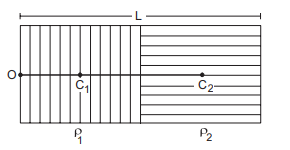
Solution: Step 1: Define the system and parameters
The rectangular plate is assumed to have its length \({L}\) along the \({x}\)-axis, from \({x}{=} {0}\) to \(x=L\). The first half (from \(x=0\) to \(x=L / 2\) ) has density \(\rho_1\), and the second half (from \(x=L / 2\) to \(x=L\) ) has density \(\rho_2\). Let the width of the plate be \(W\) and the thickness be \(t\).
Step 2: Calculate mass and center of mass for each half
The mass of each half is calculated using the formula \(m=\rho \times V=\rho \times\) (Area × thickness).
Mass of the first half: \(m_1=\rho_1 \times\left(\frac{L}{2} \times W \times t\right)\)
Mass of the second half: \(m_2=\rho_2 \times\left(\frac{L}{2} \times W \times t\right)\)
The center of mass of each uniform half-plate is at its geometric center.
Center of the first half (C1): \(x_1=\frac{\boldsymbol{L}}{\mathbf{4}}\)
Center of the second half (C2): \(x_2=\frac{L}{2}+\frac{L}{4}=\frac{3 L}{4}\)
Step 3: Use the center of mass formula for a two-body system
The \(x\)-coordinate of the center of mass of the combined system is given by the formula:
\(
X_{C M}=\frac{m_1 x_1+m_2 x_2}{m_1+m_2}
\)
Substituting the calculated values:
\(
\begin{gathered}
X_{C M}=\frac{\left(\rho_1 \frac{L W t}{2}\right)\left(\frac{L}{4}\right)+\left(\rho_2 \frac{L W t}{2}\right)\left(\frac{3 L}{4}\right)}{\rho_1 \frac{L W t}{2}+\rho_2 \frac{L W t}{2}} \\
X_{C M}=\frac{\frac{\rho_1 L^2 W t}{8}+\frac{3 \rho_2 L^2 W t}{8}}{\frac{\left(\rho_1+\rho_2\right) L W t}{2}}
\end{gathered}
\)
\(
\begin{aligned}
&\text { Simplifying the expression by canceling the common term } \frac{L W t}{2} \text { : }\\
&\begin{aligned}
& X_{C M}=\frac{\frac{\rho_1 L}{4}+\frac{3 \rho_2 L}{4}}{\rho_1+\rho_2} \\
& X_{C M}=\frac{L\left(\rho_1+3 \rho_2\right)}{4\left(\rho_1+\rho_2\right)}
\end{aligned}
\end{aligned}
\)
The center of mass of the plate is located at a distance of \(\frac{L\left(\rho_1+3 \rho_2\right)}{4\left(\rho_1+\rho_2\right)}\).
Example 21: The density of a linear rod of length \(L\) varies as \(\rho=A+B x\) where \(x\) is the distance from the left end. Locate the centre of mass.
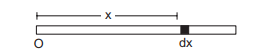
Solution : Let the cross-sectional area be \(\alpha\). The mass of an element \(dm\) of length \(d x\) located at a distance \(x\) away from the left end is \((A+B x) \alpha d x\). The \(x\)-coordinate of the centre of mass is given by
\(
\begin{aligned}
X_{C M} & =\frac{\int x d m}{\int d m}=\frac{\int_0^L x(A+B x) \alpha d x}{\int_0^L(A+B x) \alpha d x} \\
& =\frac{A \frac{L^2}{2}+B \frac{L^3}{3}}{A L+B \frac{L^2}{2}}=\frac{3 A L+2 B L^2}{3(2 A+B L)} .
\end{aligned}
\)
Example 22: A cubical block of ice of mass \(m\) and edge \(L\) is placed in a large tray of mass \(M\). If the ice melts, how far does the centre of mass of the system “ice plus tray” come down?
Solution: Consider figure below. Suppose the centre of mass of the tray is a distance \(x_1\) above the origin and that of the ice is a distance \(x_2\) above the origin. The height of the centre of mass of the ice-tray system is
\(
x=\frac{m x_2+M x_1}{m+M}
\)
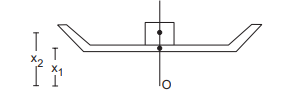
When the ice melts, the water of mass \(m\) spreads on the surface of the tray. As the tray is large, the height of water is negligible. The centre of mass of the water is then on the surface of the tray and is at a distance \(x_2-L / 2\) above the origin. The new centre of mass of the ice-tray system will be at the height
\(
x^{\prime}=\frac{m\left(x_2-\frac{L}{2}\right)+M x_1}{m+M}
\)
The shift in the centre of mass \(=x-x^{\prime}=\frac{m L}{2(m+M)}\)
Example 23: Consider a two-particle system with the particles having masses \(m_1\) and \(m_2\). If the first particle is pushed towards the centre of mass through a distance \(d\), by what distance should the second particle be moved so as to keep the centre of mass at the same position?
Solution: Consider figure below. Suppose the distance of \(m_1\) from the centre of mass \(C\) is \(x_1\) and that of \(m_2\) from \(C\) is \(x_2\). Suppose the mass \(m_2\) is moved through a distance \(d^{\prime}\) towards \(C\) so as to keep the centre of mass at \(C\).
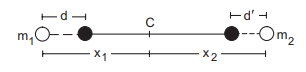
Then, \(m_1 x_1=m_2 x_2 \dots(i)\)
and \(m_1\left(x_1-d\right)=m_2\left(x_2-d^{\prime}\right) \dots(ii)\)
Subtracting (ii) from (i)
\(
m_1 d=m_2 d^{\prime}
\)
or,\(d^{\prime}=\frac{m_1}{m_2} d\)