14.6 Reflection of waves
In wave motion, a hard boundary is a fixed end where the wave reflects inverted (180-degree phase shift) because the medium cannot move. A soft boundary is a free end where the wave reflects without inversion (no phase change) because the medium can move freely up and down.
Hard Boundary (Fixed/Rigid):
Definition: The end of the medium is rigidly fixed to a wall, post, or heavy, rigid object. The medium cannot move at this point.
Reflection: The reflected wave is inverted (polarity changes). An upward pulse reflects as a downward pulse.
Phase: There is a phase reversal (phase shift of \(\pi\) or \(180^{\circ}\)).
Standing Wave: Forms a node (zero displacement) at the boundary.
Example: A string tied to a wall, a pipe closed at one end.
Soft Boundary (Free/Open):
Definition: The end of the medium is free to move up and down, often attached to a frictionless sliding ring or moving in an open space.
Reflection: The reflected wave is upright (same polarity). An upward pulse reflects as an upward pulse.
Phase: No phase change (in-phase reflection).
Standing Wave: Forms an antinode (maximum displacement) at the boundary.
Example: A string tied to a loose ring on a pole, an open-ended pipe.
Resonance in waves
Resonance in waves is a phenomenon that occurs when an object or system is subjected to an external force (a forced vibration) that matches its natural frequency, causing it to vibrate with a significantly increased amplitude.
Essentially, it’s a way for a system to absorb energy efficiently from an external source when the timing of that energy matches its own internal rhythm.
Key Aspects of Resonance
Natural Frequency: Every object has a frequency at which it prefers to vibrate (e.g., a swing, a guitar string, a wine glass).
Forced Vibration: An external force acts on the object.
Resonant Frequency: When the forced vibration matches the natural frequency, resonance happens.
Amplitude Increase: The amplitude of the oscillation builds up because the energy added is in phase with the motion.
Reflection of Waves
When a progressive wave travelling through a medium reaches a rigid boundary, it gets reflected and this phenomenon is called reflection of waves. If the wave is reflected from a free end (In the study of wave mechanics, a free end refers to a boundary where the medium is not restricted and is allowed to move or vibrate freely. Imagine a string tied to a pole. If the string is looped around the pole using a light, frictionless ring that can slide up and down without resistance, that is a free end boundary), then the reflected wave has the same phase as that of the incident wave and in the case of a hard boundary, the reflected wave is out of phase (\(\text { phase change of } \pi\)) with respect to the incident wave. A hard boundary (also known as a fixed end) is a termination point for a medium where the particles are strictly prohibited from moving. At this point, the displacement of the wave must always be zero. Think of a string nailed firmly to a wall or a heavy metal rod bolted to a concrete base. Because the boundary is “immovable,” it exerts a massive restoring force on the incoming wave. If the equation of incident travelling wave is
\(
y_i(x, t)=a \sin (k x-\omega t)
\)
At a rigid boundary, the reflected wave is given by
\(
\begin{aligned}
y_r(x, t) & =a \sin (k x-\omega t+\pi) . \\
& =-a \sin (k x-\omega t)
\end{aligned}
\)
At an open boundary, the reflected wave is given by
\(
\begin{aligned}
y_r(x, t) & =a \sin (k x-\omega t+0) . \\
& =a \sin (k x-\omega t)
\end{aligned}
\)
Clearly, at the rigid boundary, \(y=y_i+y_r=0\) at all times. The reflection of waves travelling along a stretched string and reflected by a rigid boundary is shown below.

A soft boundary (also known as a free end) is the opposite of a hard boundary. It is a termination point where the medium is under no constraint and is completely free to move or vibrate. In wave mechanics, this occurs when a wave reaches the end of a medium that is not attached to anything rigid.
Echo
An echo is a phenomenon where a wave is reflected off a surface and returns to the source (or the observer) with sufficient delay to be perceived as a distinct, separate repetition of the original wave. Multiple reflection of sound is called an echo. e.g. Reflection of sound from hill (A hill is a naturally raised area of land, usually rounded and less steep than a mountain or a cliff) or cliff (A cliff is a steep, often vertical, rock face. In the study of echoes, a cliff is the “ideal” reflector). In case of hill because the surface is curved or slanted, the sound waves are often reflected at various angles.

If the distance of the reflector from the source is \(d\), then
\(
2 d=v t
\)
Hence, \(v=\) speed of sound and \(t=\) the time of echo.
\(
\therefore \quad d=\frac{v t}{2}
\)
Example 1: The echo of a gunshot is heard \(5 s\) after it is fired. Calculate the distance of the surface which reflects the sound. (Take, velocity of sound is \(332 \mathrm{~ms}^{-1}\) )
Solution: Distance of the surface which reflects the sound,
\(
d=\frac{v \times t}{2}=\frac{332 \times 5}{2}=166 \times 5=830 \mathrm{~m}
\)
Example 2: (i) An engine approaches a hill with a constant speed. When it is at a distance of 0.8 km, it blows a whistle whose echo is heard by the driver after 4 s.
If the speed of the engine in the air is \(330 \mathrm{~m} / \mathrm{s}\). Calculate the speed of the engine. (ii) A person standing between two parallel hills fires a gun. He hears the first echo after 1.5 s and the second after 2.5 s. If the speed of sound is \(332 \mathrm{~m} / \mathrm{s}\), calculate the distance between the hills. When will he hear the third echo?
Solution: (i) The given situation is shown in the following figure.

Distance travelled by sound when it again meets the person
\(
\begin{aligned}
& =800+(800-x) \\
& =1600-u t=1600-u \times 4
\end{aligned}
\)
Now, \(\frac{1600-4 u}{v}=4\)
\(
\begin{aligned}
\Rightarrow \quad 1600-4 u & =4 v \Rightarrow 1600-4 u=4 \times 330 \\
4 u & =1600-1320 \\
4 u & =280 \Rightarrow u=70 \mathrm{~ms}^{-1}
\end{aligned}
\)
(ii) The given situation is shown in the following figure.

where \(d\) is the distance between two parallel hills and \(x\) is the distance between the man and the hill in front of it (ie. hill 1).
\(\because\) The person hears the first echo after 1.5 s,
\(
1.5=\frac{2 x}{v} \dots(i)
\)
For second echo, \(\quad 2.5=\frac{2(d-x)}{v} \dots(ii)\)
From Eqs. (i) and (ii), we get
\(
4=\frac{2 d}{v} \Rightarrow d=2 v=2 \times 332=664 \mathrm{~m}
\)

For the third echo, the sound will be reflected by one hill and then by another hill, and then to person
\(
=\frac{2 d}{v}=\frac{2 \times 664}{332}=4 \mathrm{~s}
\)
Alternate: (ii) Person Between Two Parallel Hills
Part A: Distance between the hills
The person is between two hills (\(H_1\) and \(H_2\)). The echoes come from sound traveling to each hill and back.
Given:
\(t_1=1.5 \mathrm{~s}\)
\(\boldsymbol{t}_2=2.5 \mathrm{~s}\)
\(v=332 \mathrm{~m} / \mathrm{s}\)
Calculations:
Distance to Hill \(1\left(d_1\right)\) :
\(
d_1=\frac{v \times t_1}{2}=\frac{332 \times 1.5}{2}=166 \times 1.5=249 \mathrm{~m}
\)
Distance to Hill \(2\left(d_2\right)\) :
\(
d_2=\frac{v \times t_2}{2}=\frac{332 \times 2.5}{2}=166 \times 2.5=415 \mathrm{~m}
\)
Total Distance:
\(
D=d_1+d_2=249+415=664 \mathrm{~m}
\)
Part B: When will he hear the third echo?
The third echo is produced by the sound reflecting off one hill, passing the person, reflecting off the second hill, and then returning to the person.
The time for the third echo \(\left(t_3\right)\) is simply the sum of the times of the first two echoes:
\(
\begin{gathered}
t_3=t_1+t_2 \\
t_3=1.5+2.5=4.0 \mathrm{~s}
\end{gathered}
\)
Standing/stationary waves
When two harmonic waves of equal frequency and amplitude travelling through a medium (say, string) in opposite directions superimpose each other, we get stationary waves. Suppose the two waves are (assume \(\phi=0\))
\(
\begin{aligned}
& y_1(x, t)=A \sin (k x-\omega t) \\
& y_2(x, t)=A \sin (k x+\omega t)
\end{aligned}
\)
By the principle of superposition, the resultant wave will be
\(
y(x, t)=y_1(x, t)+y_2(x, t)
\)
\(
=A[\sin (k x-\omega t)+\sin (k x+\omega t)]
\)
Using the familiar trigonometric identity \(\operatorname{Sin}(A+B)+\operatorname{Sin}(A-B)=2 \sin A \cos B\) we get,
\(
y(x, t)=2 A \sin k x \cos \omega t \dots(i)
\)
Or \(y(x, t)=2 A \sin \left(\frac{2 \pi x}{\lambda}\right) \cos \left(\frac{2 \pi t}{T}\right) \dots(ii)\)
From Eqs. (i) and (ii), it is clear that the amplitude of the resultant wave depends on the position \(x\) (resultant amplitude \(=2 A \sin k x\) ).
Nodes
The points at which the amplitude is zero are called nodes. At nodes, there is no motion.
Antinodes
The points at which the amplitude is maximum are called antinodes.
Also, the distance between successive nodes or antinodes is \(\frac{\lambda}{2}\), whereas the distance between adjacent node and antinode is \(\frac{\lambda}{4}\).

Distance between Successive Nodes
To understand why these specific distances exist, we look at the mathematical positions of the nodes and antinodes derived from your stationary wave equation:
\(
y(x, t)=[2 A \sin (k x)] \cos (\omega t)
\)
The term in the brackets, \(2 A \sin (k x)\), is the amplitude function. It tells us how much a particle at position \(x\) will vibrate.
Nodes occur where the amplitude is zero. This happens when \(\sin (k x)=0\).
The values of \(k x\) that satisfy this are \(0, \pi, 2 \pi, 3 \pi, \ldots, n \pi\).
Since \(k=\frac{2 \pi}{\lambda}\), we can find the positions (\(x\)):
First Node \((n=0): \frac{2 \pi}{\lambda} x_1=0 \Longrightarrow x_1=0\)
Second Node \((n=1): \frac{2 \pi}{\lambda} x_2=\pi \Longrightarrow x_2=\frac{\lambda}{2}\)
Third Node \((n=2): \frac{2 \pi}{\lambda} x_3=2 \pi \Longrightarrow x_3=\lambda\)
The distance between any two successive nodes is:
\(
\Delta x=x_2-x_1=\frac{\lambda}{2}-0=\frac{\lambda}{2}
\)
Distance between Successive Antinodes
Antinodes occur where the amplitude is maximum \((|2 A|)\). This happens when \(|\sin (k x)|=1\). The values of \(k x\) that satisfy this are \(\frac{\pi}{2}, \frac{3 \pi}{2}, \frac{5 \pi}{2}, \ldots,(2 n+1) \frac{\pi}{2}\).
Solving for \(x\) :
First Antinode: \(\frac{2 \pi}{\lambda} x_1=\frac{\pi}{2} \Longrightarrow x_1=\frac{\lambda}{4}\)
Second Antinode: \(\frac{2 \pi}{\lambda} x_2=\frac{3 \pi}{2} \Longrightarrow x_2=\frac{3 \lambda}{4}\)
The distance between two successive antinodes is:
\(
\Delta x=\frac{3 \lambda}{4}-\frac{\lambda}{4}=\frac{2 \lambda}{4}=\frac{\lambda}{2}
\)
Distance between Adjacent Node and Antinode
Now, let’s look at the gap between a node and the very next antinode:
Position of 1st Node: \(x=0\)
Position of 1st Antinode: \(x=\frac{\lambda}{\mathbf{4}}\)
The distance between them is:
\(
\Delta x=\frac{\lambda}{4}-0=\frac{\lambda}{4}
\)
Position of nodes:
Nodes are the points on the string, where the amplitude of the oscillation of constituents is zero.
i.e. \(\sin k x=0\)
\(
k x=n \pi \quad(\text { where }, n=0,1, \ldots)
\)
\(
\frac{2 \pi}{\lambda} x=n \pi \quad x=\frac{n \lambda}{2}
\)
Position of antinodes
Antinodes are the points on the string, where the amplitude of oscillation of the constituents is maximum.
For maximum amplitude,
\(
\sin k x= \pm 1 \Rightarrow k x=(2 n+1) \frac{\pi}{2}
\)
where, \(n=0,1,2, \ldots\)
\(
\begin{array}{r}
\frac{2 \pi}{\lambda} x=(2 n+1) \frac{\pi}{2} \\
x=(2 n+1) \frac{\lambda}{4}
\end{array}
\)
Note:
(i) The following equations also represent stationary waves
\(
\begin{aligned}
& y=2 a \sin (k x) \sin (\omega t) \quad \text { – } y=2 a \cos (k x) \sin (\omega t) \\
& y=2 a \cos (k x) \cos (\omega t)
\end{aligned}
\)
(ii) In stationary waves, the system cannot oscillate with any arbitrary frequency but frequencies are characterised by a set of natural frequencies called normal modes of oscillation.
(iii) The standing wave ratio (SWR) is defined as
\(
\frac{A_{\max }}{A_{\min }}=\frac{A_i+A_r}{A_i-A_r}
\)
where, \(A_i\) and \(A_r\) are the amplitudes of incident and reflected rays, respectively.
For \(100 \%\) reflection, \(\mathrm{SWR}=\infty\) and for no reflection, \(S W R=1\).
(iv) If the amplitude of the incident wave in medium- 1 is \(A_i\), it is partly reflected and partly transmitted at the boundary of two media-1 and 2. Wave speeds in two media are \(v_1\) and \(v_2\). If amplitudes of reflected and transmitted waves are \(A_r\) and \(A_t\), then
\(
A_r=\left(\frac{v_2-v_1}{v_2+v_1}\right) A_i \text { and } A_t=\left(\frac{2 v_2}{v_1+v_2}\right) A_i
\)
From the above two expressions, we can make the following conclusions :
Conclusion 1: If \(v_1=v_2\), then \(A_r=0\) and \(A_t=A_i\)
Basically \(v_1=v_2\) means both media are same from wave point of view. So, in this case there is no reflection \(\left(A_r=0\right)\), only transmission \(\left(A_t=A_i\right)\) is there.
Conclusion 2: If \(v_2<v_1\), then \(A_r\) comes out to be negative. Now, \(v_2<v_1\) means the second medium is denser. \(A_r\) in this case is negative means, there is a phase change of \(\pi\).
Conclusion 3: If \(v_2>v_1\), then \(A_t>A_i\). This implies that amplitude always increases as the wave travels from a denser medium to rarer medium (as \(v_2>v_1\), so second medium is rarer).
(v) Power At the boundary of two media, energy incident per second = energy reflected per second + energy transmitted per second.
or Power incident = power reflected + power transmitted or \(P_i=P_r+P_t\)
(vi) The intensity of a travelling wave is given by
\(
I=\frac{1}{2} \rho A^2 \omega^3 v
\)
i.e.\(I \propto A^2\)
So, we can write, \(\frac{I_1}{I_2}=\left(\frac{A_1}{A_2}\right)^2\), if \(\rho, \omega\) and \(v\) are same for two waves.
e.g. When an incident travelling wave is partly reflected and partly transmitted from a boundary, we can write
\(
\frac{I_i}{I_r}=\left(\frac{A_i}{A_r}\right)^2
\)
The incident and reflected waves are in the same medium, hence they have same values of \(\rho\) and \(v\).
Example 3: The equation given below represents \(a\) stationary wave set up in a medium
\(
y=12 \sin (4 \pi x) \sin (40 \pi t)
\)
where, \(y\) and \(x\) are in cm and \(t\) is in second. Calculate the amplitude, wavelength and velocity of the component waves.
Solution: Comparing the given equation with the stationary wave equation, \(y=2 A \sin k x \sin \omega t\), we get
\(
2 A=12 \mathrm{~cm}, k=4 \pi \mathrm{~cm}^{-1}
\)
and \(\omega=40 \pi \mathrm{rad} \mathrm{~s}^{-1}\)
Therefore, amplitude of the component wave \(=6 \mathrm{~cm}\)
As, \(k=4 \pi \Rightarrow \frac{2 \pi}{\lambda}=4 \pi\)
\(
\Rightarrow \quad \lambda=\frac{1}{2}=0.5 \mathrm{~cm}
\)
Further, the velocity of the wave,
\(
v=\frac{\omega}{k}=\frac{40 \pi}{4 \pi}=10 \mathrm{~cm} \mathrm{~s}^{-1}
\)
Example 4: The vibrations of a string fixed at both ends are described by the equation
\(
y=(5.00 \mathrm{~mm}) \sin \left[\left(1.57 \mathrm{~cm}^{-1}\right) x\right] \sin \left[\left(314 \mathrm{~s}^{-1}\right) t\right]
\)
If the length of the string is 10.0 cm, locate the nodes and the antinodes. How many loops are formed in the vibration?
Solution: The given equation can be written as
\(
\begin{aligned}
y & =5 \sin (1.57 x) \sin (314 t) \\
& =5 \sin \left(\frac{\pi x}{2}\right) \sin (100 \pi t) \dots(i)
\end{aligned}
\)
General equation of standing wave,
\(
y=2 A \sin (k x) \sin (\omega t) \dots(ii)
\)
Comparing both the equations, we get
\(
k=\frac{\pi}{2} \mathrm{~cm}^{-1}, \omega=100 \pi \mathrm{rad} \mathrm{~s}^{-1}
\)
\(
\begin{aligned}
\therefore \quad k & =\frac{2 \pi}{\lambda}=\frac{\pi}{2} \Rightarrow \lambda=4 \mathrm{~cm} \\
v & =\frac{\omega}{k}=\frac{100 \pi}{\pi / 2}=200 \mathrm{~cm} \mathrm{~s}^{-1}=2 \mathrm{~m} \mathrm{~s}^{-1}
\end{aligned}
\)
\(\therefore\) Length, \(L=n \frac{\lambda}{2} \Rightarrow 10=n \times \frac{4}{2} \Rightarrow n=5\)
Hence, the string is vibrating in 5 loops.

Nodes are formed at \(L=\frac{n \lambda}{2}\), whereas antinodes are formed at \((2 n+1) \frac{\lambda}{2}\).
\(\therefore\) Nodes, \(x=0,2,4,6,8,10 \mathrm{~cm}\)
and antinodes, \(x=1,3,5,7,9 \mathrm{~cm}\)
Terms related to standing waves
Few important terms related to standing waves are given below: Fundamental tones, overtones, and harmonics of a sound source
Fundamental tone: When a sound source produces sound waves, it consists of mixture of many frequencies. This mixture of sound is called note. If produced sound contains only one frequency, then it is called tone. Tone of minimum frequency is called fundamental tone.
Overtones: The tones which are having frequencies greater than fundamental tones are called overtones.
Harmonics: Sound produced from a source consists of frequencies which contain fundamental frequency as well as frequencies which are multiples of the fundamental frequency, called harmonics.
Odd multiples of the fundamental frequency are called odd harmonics. Even multiples of the fundamental frequency are called even harmonics.
VIBRATIONS OF AIR COLUMNS IN ORGAN PIPES
Organ pipes are musical instruments which are used to produce musical sound by blowing air into the pipe. This pipe is a cylindrical tube which may be open at one end called closed organ pipe [Fig(a)] or open at both ends called open organ pipe [Fig(b)].

If the air in the pipe at its open end is made to vibrate, the longitudinal wave is produced. This wave travels along the pipe towards its far end and is reflected back. Thus, due to the superposition of incident and reflected waves, stationary waves are formed in pipe.
Standing waves in a closed organ pipe
Closed organ pipes are those which are closed at one end and open at the other. A glass tube partially filled with water is an example of such a system. A node formed is at closed end and an antinode is formed at open end. If the length of air column is \(L\), then the closed end can be denoted by \(x=0\), while the open end can be taken as \(x=L\).
Position of Nodes
We know standing wave equation \(y=2 A \sin (k x) \cos (\omega t)\)
Nodes are the points of zero oscillation.
\(
\begin{aligned}
\sin k x & =0 \\
k x & =n \pi \\
\frac{2 \pi}{\lambda} x & =n \pi \\
x & =\frac{n \lambda}{2}
\end{aligned}
\)
where,\(n=0,1,2, \ldots\)
Position of antinodes
Antinodes are the points of maximum displacement.
\(
\therefore \quad \sin k x= \pm 1 \Rightarrow k x=(2 n-1) \frac{\pi}{2}
\)
\(
x=(2 n-1) \frac{\lambda}{4} \quad\left(\because k=2 \frac{\pi}{\lambda}\right)
\)
where, \(\quad n=1,2, \ldots\)
Explanation: The choice between \((2 n-1)\) and \((2 n+1)\) depends entirely on what value you choose for your starting integer \(n\). Both can be mathematically correct, but (\(2 n-1\)) is generally preferred for \(n=1,2,3 \ldots\) because it aligns the first antinode with the first index.
Here is the breakdown of why both work and which one is technically “cleaner”:
The General Solution:
For an antinode to occur, the spatial part of the standing wave equation must satisfy:
\(
\sin (k x)= \pm 1
\)
This happens when the argument \(k x\) is an odd multiple of \(\frac{\pi}{2}\) :
\(
k x=\frac{\pi}{2}, \frac{3 \pi}{2}, \frac{5 \pi}{2}, \ldots
\)
Sumary:
\(
\begin{array}{lll}
\text { Formula } & \text { Starting Value } & \text { Resulting Sequence } \\
\hline(2 n-1) \frac{\pi}{2} & n=1,2,3 \ldots & \frac{\pi}{2}, \frac{3 \pi}{2}, \frac{5 \pi}{2} \ldots \\
\hline(2 n+1) \frac{\pi}{2} & n=0,1,2 \ldots & \frac{\pi}{2}, \frac{3 \pi}{2}, \frac{5 \pi}{2} \ldots \\
\hline
\end{array}
\)
Modes of vibration of air columns in a closed organ pipe
At the open end \(x=L\), an antinode is formed
\(
\begin{array}{ll}
\therefore & L=(2 n-1) \frac{\lambda}{4} \Rightarrow \lambda=\frac{4 L}{(2 n-1)} \\
\text { where, } & n=1,2, \ldots
\end{array}
\)
The corresponding frequencies are given by
\(
f=\frac{v}{\lambda} \Rightarrow f=\frac{(2 n-1) v}{4 L}
\)
(i) First mode
For \(\quad n=1, \quad \lambda=4 L\)
or \(\quad L=\frac{\lambda}{4}\) and \(f_1=\frac{v}{4 L}\)
where, \(f_1=\) fundamental frequency,
\(v=\) speed of sound in air and \(\quad L=\) length of pipe.

This mode is called fundamental mode or 1st harmonic.
(ii) Second mode
For \(n=2, L=\frac{3 \lambda}{4} \Rightarrow f_2=\frac{3 v}{4 L}\) or \(f_2=3 f_1\)

This mode is called 3rd harmonic or 1st overtone.
(iii) Third mode
For \(n=3, L=\frac{5 \lambda}{4}, f_3=\frac{5 v}{4 L} \Rightarrow f_3=5 f_1\)

This mode is called 5th harmonic or 2nd overtone.
From the above discussion, we can say that in a closed organ pipe, only odd harmonics are present.
Ratio of harmonics is \(f_1: f_2: f_3 \ldots=1: 3: 5 \ldots\)
Ratio of overtones \(=3: 5: 7\)…….
For the \(m\)-th Harmonic :
Since only odd numbers are allowed, the frequency of the \(m\)-th harmonic (where \(m= 1,3,5 \ldots\)) is:
\(
f_m=m f_1
\)
Note: (\(m=2 n+1\)) where \(n\) =0, 1, 2 etc…
For the \(n\)-th Overtone:
The \(n\)-th overtone corresponds to the (\(2 n+1\)) harmonic (starting at \(n=1\) for the 1st overtone):
1st Overtone \((n=1): f=(2(1)+1) f_1=3 f_1\)
2nd Overtone \((n=2): f=(2(2)+1) f_1=5 f_1\)
General Formula:
\(
f_n=(2 n+1) f_1
\)
Note on \(2 n-1\) vs \(2 n+1\) : If you define \(n\) as the “number of the node/mode” starting from 1, you use ( \(2 n-1\)). If you define \(n\) specifically as the “overtone” (where the first overtone is \(n=1\)), you use \((2 n+1)\).
Example 5: Calculate the fundamental frequency of a closed organ pipe of length 66.4 cm at \(0^{\circ} \mathrm{C}\), if the velocity of sound at \(0^{\circ} \mathrm{C}\) is \(332 \mathrm{~ms}^{-1}\).
Solution: Fundamental frequency of a closed organ pipe,
\(
f_1=\frac{v}{4 L}=\frac{332}{4 \times 66.4} \times 100=125 \mathrm{~Hz}
\)
Example 6: For a certain organ pipe, three successive resonance frequencies are observed at 425, 595 and 765 Hz , respectively. Taking the speed of sound in air to be \(340 \mathrm{~ms}^{-1}\).
(i) Explain whether the pipe is closed at one end or open at both ends.
(ii) Determine the fundamental frequency and length of the pipe.
Solution: (i) The given frequencies are in the ratio \(5: 7: 9\). As the frequencies are odd multiples of 85 Hz , the pipe must be closed at one end.
(ii) Now, the fundamental frequency is the lowest one, i.e. 85 Hz.
\(
\therefore \quad 85=\frac{v}{4 l} \Rightarrow l=\frac{340}{4 \times 85}=1 \mathrm{~m}
\)
Standing waves in an open organ pipe
Open organ pipes are those which are open at both ends. Therefore, a displacement antinode or pressure node is formed at each end. To explain the standing wave in an open organ pipe, we must look at how the boundary conditions (the open ends) dictate the mathematical form of the wave.
The Physical Boundary Condition:
At an open end, the air is in direct contact with the atmosphere. This means the air molecules are completely free to move back and forth with maximum longitudinal displacement.
Displacement Antinode: Created because the air moves with maximum amplitude.
Pressure Node: Created because the pressure at the opening is “clamped” to the constant atmospheric pressure; it cannot increase or decrease.
The standing wave in an open organ pipe is given by
\(
y(x, t)=2 A \cos k x \cos \omega t
\)
If the length of air column is \(L\), then \(y=\) maximum at \(x=0\) and at \(x=L\).
Position of antinodes
For position of antinodes,
\(
\begin{gathered}
\cos k x= \pm 1 \Rightarrow k x=n \pi, \text { where } n=0,1,2,3, \ldots \\
\frac{2 \pi}{\lambda} x=n \pi \Rightarrow x=\frac{n \lambda}{2}
\end{gathered}
\)
Further at \(x=L\), an antinode is formed
\(
\Rightarrow \quad L=\frac{n \lambda}{2} \Rightarrow \lambda=\frac{2 L}{n}
\)
Position of nodes
There are absolutely nodes in an open organ pipe! Even though both ends are antinodes (places of maximum movement), the wave must “turn around” or pass through a zero point somewhere inside the pipe to form a standing wave.
Where are the nodes?
In an open pipe, the nodes are located in the interior of the air column. The number of nodes depends on which harmonic (mode of vibration) the pipe is currently producing:
\(
y(x, t)=2 A \cos (k x) \cos (\omega t)
\)
Nodes occur where the amplitude is zero. This happens when:
\(
\cos (k x)=0
\)
The solutions for \(k x\) are odd multiples of \(\pi / 2\) :
\(
k x=\frac{\pi}{2}, \frac{3 \pi}{2}, \frac{5 \pi}{2}, \ldots
\)
Substituting \(k=\frac{2 \pi}{\lambda}\) :
\(
\begin{gathered}
\frac{2 \pi}{\lambda} x=\frac{\pi}{2} \Longrightarrow x=\frac{\lambda}{4} \\
\frac{2 \pi}{\lambda} x=\frac{3 \pi}{2} \Longrightarrow x=\frac{3 \lambda}{4}
\end{gathered}
\)
Since the fundamental wavelength for an open pipe is \(\lambda=2 L\), the first node is at:
\(
x=\frac{2 L}{4}=\frac{L}{2}
\)
Modes of vibrations of air column in an open organ pipe
The corresponding frequencies are given by
\(
f=\frac{v}{\lambda} \Rightarrow f=\frac{n v}{2 L}
\)
where, \(n=1,2,3\),
(i) First mode
For \(n=1, \lambda_1=2 L \Rightarrow L=\frac{\lambda_1}{2} \Rightarrow f_1=\frac{v}{2 L}\)

This mode is called fundamental mode or 1st harmonic.
(ii) Second mode
For \(n=2, \quad \lambda_2=\frac{2 L}{2} \Rightarrow L=\frac{2 \lambda_2}{2}\)
\(\Rightarrow f_2=\frac{2 v}{2 L} \quad\) or \(\quad f_2=2 f_1\)

This is called 2nd harmonic or 1st overtone.
(iii) Third mode
For \(n=3, \quad \lambda_3=\frac{2 L}{3} \Rightarrow L=\frac{3 \lambda_3}{2}\)
\(\Rightarrow \quad f_3=\frac{3 v}{2 L}\) or \(f_3=3 f_1\)

This is called 3rd harmonic or 2nd overtone.
On generalising, \(f_n=n f_1\)
From the above discussion, we can say that in open organ pipe, all (even and odd) harmonics are present.
Ratio of harmonics is \(f_1: f_2: f_3 \ldots=1: 2: 3 \ldots\) and ratio of overtones \(=2: 3: 4: 5 \ldots \ldots\).
Frequency of \(n\)th over tone is \(f_n=(n+1) f_1\).
Example 7: Calculate the frequency of 2nd harmonic in an open organ pipe of length 34 cm , if the velocity of sound is \(340 \mathrm{~ms}^{-1}\).
Solution: In an open organ pipe, the frequency of the second harmonic, \(f_2=2 \times \frac{v}{2 L}=\frac{2 \times 340}{2 \times 0.34}=1000 \mathrm{~Hz}\)
Example 8: Third overtone of a closed organ pipe is in unison with fourth harmonic of an open organ pipe. Find the ratio of the lengths of the pipes.
Solution: The third overtone of the closed organ pipe means the seventh harmonic.
Given,
\(
\begin{aligned}
& \left(f_7\right)_{\text {closed }}=\left(f_4\right)_{\text {open }} \\
& 7\left(\frac{v}{4 l_c}\right)=4\left(\frac{v}{2 l_o}\right) \quad \therefore \quad \frac{l_c}{l_o}=\frac{7}{8}
\end{aligned}
\)
Example 9: Consider the situation shown in the figure. The wire which has a mass of 5 g oscillates in its second harmonic and sets the air column in the tube into vibrations in its fundamental mode. Assuming that the speed of sound in air is 340 \(\mathrm{ms}^{-1}\), find the tension in the wire.

Solution: Frequency of wire, \(f_2=\frac{2}{2 l} \sqrt{\frac{T}{\mu}}=\frac{1}{l} \sqrt{\frac{T}{M / l}}\)
\(
\begin{aligned}
& =\frac{1}{0.5} \sqrt{\frac{T}{5 \times 10^{-3} / 0.5}} \\
& =2 \sqrt{100 T}=20 \sqrt{T}
\end{aligned}
\)
\(
\begin{aligned}
&\text { Fundamental frequency of closed pipe, }\\
&\begin{array}{ll}
& f=\frac{v}{4 L}=\frac{340}{4 \times 1}=85 \\
\because & f_2=f_1 \Rightarrow 20 \sqrt{T}=85 \\
\text { Therefore, } & T=(4.25)^2=18.06 \mathrm{~N}
\end{array}
\end{aligned}
\)
Vibration of Stretched String (Normal Modes of a String)
In an unbounded continuous medium, there is no restriction on the frequencies or wavelengths of the standing waves. However, if the waves are confined in space, (e.g. when a string is tied at both ends) standing waves can be set up for a discrete set of frequencies or wavelengths. The system cannot oscillate with any arbitrary frequency (contrast this with a harmonic travelling wave) but is characterised by a set of natural frequencies or normal modes of oscillation.
Consider a string of definite length \(l\), rigidly held at both ends. When we set up a sinusoidal wave on such a string, it gets reflected from the fixed ends. By the superposition of two identical waves travelling in opposite directions, standing waves are established on the string. Here, the only requirement we have to satisfy is that the endpoints should be nodes, as these points cannot oscillate.
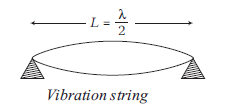
The nodes are permanently at rest. There may be any number of nodes in between or none at all, so that the wavelength associated with the standing waves can take many different values. The distance between adjacent nodes is \(\lambda / 2\), so that in a string of length \(l\) there must be exactly an integral number \(n\) of half wavelengths, \(\lambda / 2\). That is,
\(
\frac{n \lambda}{2}=l \text { or } \lambda=\frac{2 l}{n} \quad(\text { where }, n=1,2,3, \ldots)
\)
But \(\lambda=\frac{v}{f}\) and \(v=\sqrt{\frac{T}{\mu}}\), so that the natural frequencies of oscillation of the system are
\(
f=n\left(\frac{v}{2 l}\right)=\frac{n}{2 l} \sqrt{\frac{T}{\mu}}
\)

The smallest frequency \(f_1\) corresponds to the largest wavelength \((n=1), \lambda_1=2 l\).
\(
f_1=\frac{v}{2 l}
\)
This is called the fundamental frequency. The other standing wave frequencies are
\(
\begin{aligned}
& f_2=\frac{2 v}{2 l}=2 f_1 \\
& f_3=\frac{3 v}{2 l}=3 f_1 \text { and so on }
\end{aligned}
\)
These frequencies are called harmonics. Musicians sometimes call them overtones. Students are advised to remember these frequencies by name.
For example,
\(
\begin{aligned}
& f_1=\text { fundamental tone or first harmonic } \\
& f_2=2 f_1=\text { first overtone or second harmonic } \\
& f_3=3 f_1=\text { second overtone or third harmonic and so on. }
\end{aligned}
\)
Laws of transverse vibration of a stretched string
(i) Law of length:
For a given string under a tension \((T)\), the frequency of the vibrating string is inversely proportional to the vibrating length \((L)\) of the string.
i.e. \(f \propto \frac{1}{L} \Rightarrow f L=\) constant \(\Rightarrow f_1 L_1=f_2 L_2\)
(ii) Law of tension
The frequency of the uniform string of a given length is proportional to the square root of the tension \((T)\) in the string.
i.e. \(f \propto \sqrt{T} \Rightarrow \frac{f}{\sqrt{T}}=\) constant \(\Rightarrow \frac{f_1}{f_2}=\sqrt{\frac{T_1}{T_2}}\)
(iii) Law of mass
For a given vibrating length and tension of the string, the frequency of the vibrating string is inversely proportional to the square root of the mass per unit length of the string.
i.e.
\(
f \propto \frac{1}{\sqrt{\mu}}
\)
Therefore, with an increase in mass of the string frequency decreases.
As, Mass per unit length of the string \(=\) Volume of unit length \(\times\) Density or
\(
\mu=\pi r^2 \rho
\)
where, \(\rho=\) density of the wire, \(r\) = radius of the wire
\(
\therefore \quad f \propto \frac{1}{\sqrt{\pi r^2 \rho}}
\)
Now, the law of mass can be categorised in two parts as follows
(a) Law of radius: If length \((L)\), density \((\rho)\), and tension \((T)\) of a vibrating wire are fixed, thenthe frequency of vibration root of the wire is inversely proportional to its radius.
i.e.
\(
f \propto \frac{1}{r}
\)
(b) Law of density: If length \((L)\), radius \((r)\), and tension \((T)\) of a vibrating wire are fixed, then the frequency of vibration of the wire is inversely proportional to the square root of its density.
i.e.
\(
f \propto \frac{1}{\sqrt{\rho}}
\)
Example 10: A wire stretched between two rigid supports vibrates in its fundamental mode with a frequency of 45 Hz . The mass of the wire is \(3.5 \times 10^{-2} \mathrm{~kg}\) and its linear mass density is \(4 \times 10^{-2} \mathrm{kgm}^{-1}\). What is the speed of transverse wave on the string and tension in the wire?
Solution: Length of wire \(=\frac{\text { Mass of wire }}{\text { Linear density }}=\frac{3.5 \times 10^{-2}}{4 \times 10^{-2}}=0.875 \mathrm{~m}\)
Now, \(f=\frac{1}{2 l} \sqrt{\frac{T}{\mu}}\)
\(\therefore\) Tension in the wire, \(T=4 f^2 l^2 \mu\)
\(
=4(45)^2(0.875)^2\left(4 \times 10^{-2}\right)=248.1 \mathrm{~N}
\)
Speed of transverse wave, \(v=f \lambda=f(2 l)\)
\(
=45 \times 2 \times 0.875=78.75 \mathrm{~ms}^{-1}
\)
Example 11: A string on a musical instrument is 50 cm long and its fundamental frequency is 270 Hz. Calculate the length of the string, if the desired frequency of 1000 Hz is to be produced.
Solution: As, \(\Rightarrow \quad l_2=l_1\left(\frac{f_1}{f_2}\right)\)
\(
\begin{aligned}
f & \propto \frac{1}{l} \Rightarrow \frac{l_2}{l_1}=\frac{f_1}{f_2} \\
l_2 & =l_1\left(\frac{f_1}{f_2}\right) \\
& =50 \times\left(\frac{270}{1000}\right)=13.5 \mathrm{~cm}
\end{aligned}
\)
Example 12: The tension in a piano wire is 10 N. What should be the tension in the wire to produce a note of double the frequency.
Solution:
\(
\begin{array}{rlrl}
\text { As, } & & f \propto \sqrt{T} \\
\therefore & \frac{f_1}{f_2}=\frac{\sqrt{T_1}}{\sqrt{T_2}}
\end{array}
\)
\(
\begin{array}{ll}
\Rightarrow & \frac{f}{2 f}=\sqrt{\frac{10}{T_2}} \\
\Rightarrow & T_2=40 \mathrm{~N}
\end{array}
\)
Standing waves in a string fixed at both ends
Consider a stretched string having length \(L\) fixed at both ends. Let the one end be fixed at \(x=0\) while the other one at \(x=L\), and at \(x=0\) and \(x=L\), nodes will be obtained as these ends are fixed.
As,
\(
L=\frac{n \lambda}{2}, n=1,2,3, \ldots
\)
\(\Rightarrow\) Possible wavelengths of stationary waves,
\(
\lambda=\frac{2 L}{n}, n=1,2,3, \ldots
\)
and corresponding frequencies are
\(
f=\frac{n v}{2 L}, n=1,2,3, \ldots
\)
Here, \(v\) is the speed of the wave in the givens medium. This relation gives the expression for the natural frequency of vibration.
Modes of vibration
The manner in which the string vibrates and gives rise to a standing wave is known as the mode of vibration of the string.
First mode of vibration
The mode of vibration in which string will vibrate in one segment or the lowest possible natural frequency [as shown in Fig. (a)] is called fundamental mode or first harmonic.
As, \(\quad L=\frac{n \lambda}{2}\)
For first harmonic, put \(n=1\)
\(
\therefore \quad L=\frac{\lambda_1}{2} \text { and } f_1=\frac{v}{2 L}
\)
Second mode of vibration
The mode of vibration in which string will vibrate in two segments [as shown in Fig. (b)] is called second harmonic or first overtone.
For the second harmonic, put
\(
\begin{array}{ll}
& n=2 \text { in } L=\frac{n \lambda}{2} . \\
\therefore & L=\lambda_2 \\
\text { and } & f_2=\frac{2 v}{2 L} \\
\text { or } & f_2=2 f_1 \\
\text { As, } & f=\frac{n v}{2 L}
\end{array}
\)
If \(n=3\), the frequency, \(f=\frac{3 v}{2 L}\) or \(f=3 f_1\) is called third harmonic and so on.
The figure below shows the first four harmonics of a stretched string fixed at both ends.

The vibration of a string will be a superposition of different modes. In this case, \(f_1: f_2: f_3=1: 2: 3 \ldots\), i.e. all harmonics (odd as well as even) can be produced.
Note: Musical instruments like sitar or violin are based on this principle.
Example 13: A string fixed at both ends has consecutive standing wave modes for which the distances between adjacent nodes are 18 cm and 16 cm respectively.
(i) What is the minimum possible length of the string?
(ii) If the tension is 10 N and the linear mass density is \(4 \mathrm{gm}^{-1}\), what is the fundamental frequency?
Solution:

Let \(l\) be the length of the string. Then,
\(
\begin{array}{r}
18 n=l \dots(i) \\
16(n+1)=l \dots(ii)
\end{array}
\)
From Eqs. (i) and (ii), we get
\(
n=8 \text { and } l=144 \mathrm{~cm}
\)
Therefore, the minimum possible length of the string can be 144 cm
(ii) For fundamental frequency, \(l=\lambda / 2\) or
\(
\lambda=2 l=288 \mathrm{~cm}=2.88 \mathrm{~m}
\)

Vibration of a string fixed at one end
Standing waves can also be produced on a string or rod which is fixed at one end and whose other end is free to move in a transverse direction. Here, in this case, we will have antinode at the free end and node at the fixed end.
Now, consider the equation of standing wave,
\(
y(x, t)=2 a \sin k x \cos \omega t
\)
As, we are having antinode at the end \(x=L\)
\(
\sin k L= \pm 1 \Rightarrow k L=(2 n+1)(\pi / 2)
\)
where, \(n=0,1,2, \ldots\)
\(
\begin{array}{rlrl}
& \frac{2 \pi}{\lambda} \times L =(2 n+1) \frac{\pi}{2} \\
\Rightarrow & \frac{2 L}{\lambda} =(2 n+1) \times \frac{1}{2} \\
& \text { or } \frac{2 L f}{v} =(2 n+1) \frac{1}{2}
\end{array}
\)
\(\therefore\) Frequency of the vibration,
\(
f=\frac{(2 n+1)}{4 L} v
\)
where, \(f\) is frequency and \(v\) is the speed of the wave.
The above frequencies are the normal frequencies of vibration. The fundamental frequency is obtained when \(n=0\).
\(
\therefore \quad f_0=\frac{v}{4 L} \quad \text { (first harmonic) }
\)
\(
\begin{array}{rlr}
f_1 =\frac{3 v}{4 L}=3 f_0 & \text { (third harmonic) } \\
f_2 =\frac{5 v}{4 L}=5 f_0 & \text { (fifth harmonic) } \\
f_3 =\frac{7 v}{4 L}=7 f_0 & \text { (seventh harmonic) } \\
f_0: f_1: f_2: f_3 \ldots=1: 3: 5: 7: \ldots &
\end{array}
\)
Here, we see that only odd harmonics are present (i.e. contains odd multiples of the fundamental frequency). The figure below shows shapes of the string.

Vibration of composite strings
Suppose two strings of different materials and lengths are joined end-to-end and tied between clamps as shown in the figure.

When two strings of different materials are joined together and fixed at both ends, they form a composite string system. To derive the relationship for the frequencies of stationary waves, we have to look at the physics of the junction and the boundary conditions.
Fundamental Physics of the System:
When a composite string is plucked, a wave travels through both segments. For a stationary wave to be established across the entire system:
Frequency (\(f\)) must be identical in both strings. If the frequencies differed, the junction point would have a chaotic motion rather than a stable node or antinode.
Tension (\(T\)) is uniform throughout the string (assuming the string is in equilibrium and the junction is massless).
Boundary Conditions: The two outer ends are clamped (nodes), and for a stable standing wave, the junction itself must typically act as a node.
Frequency of Independent Harmonics:
The frequency of the \(n\)-th harmonic for a string of length \(L\), tension \(T\), and linear mass density \(\mu\) is given by:
\(
f=\frac{n}{2 L} \sqrt{\frac{T}{\mu}}
\)
For our two segments, \(S_1\) and \(S_2\), let:
\(x\) be the harmonic number for string 1 (\(x=1,2,3\)…)
\(y\) be the harmonic number for string \(2(y=1,2,3 \ldots)\)
The frequencies for each segment are:
\(
f_1=\frac{x}{2 l_1} \sqrt{\frac{T}{\mu_1}} \quad \text { and } \quad f_2=\frac{y}{2 l_2} \sqrt{\frac{T}{\mu_2}}
\)
Step-by-Step Derivation:
Step 1: Equate the frequencies
Since the strings are joined, they must vibrate at a common frequency (\(f_1=f_2=f\)) to maintain a stable standing wave pattern.
\(
\frac{x}{2 l_1} \sqrt{\frac{T}{\mu_1}}=\frac{y}{2 l_2} \sqrt{\frac{T}{\mu_2}}
\)
Step 2: Simplify the equation
The constant 2 and the common tension \(T\) cancel out from both sides:
\(
\frac{x}{l_1 \sqrt{\mu_1}}=\frac{y}{l_2 \sqrt{\mu_2}}
\)
Step 3: Rearrange for the ratio \(x / y\)
Move \(y\) to the left side and the length/density terms for \(S_1\) to the right side:
\(
\frac{x}{y}=\frac{l_1 \sqrt{\mu_1}}{l_2 \sqrt{\mu_2}} \Longrightarrow \frac{x}{y}=\frac{l_1}{l_2} \sqrt{\frac{\mu_1}{\mu_2}}
\)
Step 4: Incorporate Volumetric Density
Linear mass density \(\mu\) is defined as mass per unit length. For a string with cross-sectional area \(A\) and density \(\rho\) :
\(
\mu=\frac{\text { Mass }}{\text { Length }}=\frac{\rho \times \text { Volume }}{\text { Length }}=\frac{\rho(A \cdot L)}{L}=\rho A
\)
Substituting \(\mu_1=\rho_1 A_1\) and \(\mu_2=\rho_2 A_2\) into our ratio:
\(
\frac{x}{y}=\frac{l_1}{l_2} \sqrt{\frac{\rho_1 A_1}{\rho_2 A_2}}
\)
Summary of Results: The ratio \(\frac{x}{y}\) must be a ratio of two integers for a common stationary wave to exist. This means that a frequency will only produce a standing wave on the composite string if it happens to be an integer multiple of the fundamental frequency of both individual segments simultaneously.
Note: If the strings have the same diameter (same material or just same \(A\)), the equation simplifies further to \(\frac{x}{y}=\frac{l_1}{l_2} \sqrt{\frac{\rho_1}{\rho_2}}\).
Example 14: Figure shows an aluminium wire of length 60 cm joined to a steel wire of length 80 cm and stretched between two fixed supports. The tension produced is 40 N. The cross-sectional area of the steel wire is \(1.0 \mathrm{~mm}^2\) and that of the aluminium wire is \(3.0 \mathrm{~mm}^2\). What could be the minimum frequency of a tuning fork which can produce standing waves in the system with the joint as a node? The density of aluminium is \(2.6 \mathrm{~g} / \mathrm{cm}^3\) and that of steel is \(7.8 \mathrm{~g} / \mathrm{cm}^3\).

Solution: Let \(p\) th harmonic of steel wire coincide with \(q\) th harmonic of aluminium wire.
\(
\begin{aligned}
& n=\frac{p}{2 L_s} \sqrt{\frac{T}{\rho_s A_s}}=\frac{q}{2 L_a} \sqrt{\frac{T}{\rho_a A_a}} \\
& \frac{p}{q}=\frac{L_s}{L_a} \sqrt{\frac{\rho_s A_s}{\rho_a A_a}}=\frac{80}{60} \sqrt{\frac{7.8 \times 1}{2.6 \times 3}}=\frac{4}{3}
\end{aligned}
\)
4th harmonic of steel wire coincides with 3rd harmonic of aluminium wire, the minimum frequency of tuning fork can be determined by taking \(p=4\) or \(q=3\)
\(
\begin{aligned}
n_{\min } & =\frac{p}{2 L_s} \sqrt{\frac{T}{\rho_s A_s}} \\
& =\frac{4}{2 \times 0.8} \sqrt{\frac{40}{7.8 \times 10^3 \times 1 \times 10^{-6}}} \\
& =2.5 \times 71.6=179 \mathrm{~Hz}
\end{aligned}
\)
Doppler’s effect in sound
The Doppler Effect is the apparent change in the frequency of a wave caused by the relative motion between the source of the wave and the observer. In sound, when the source moves toward you, the sound waves are “compressed,” leading to a higher pitch. When it moves away, the waves are “stretched,” leading to a lower pitch.
Perhaps you might have noticed how the sound of a vehicle’s horn changes as the vehicle moves past you. The frequency (pitch) of the sound you hear as the vehicle approaches you is higher than the frequency you hear as it moves away from you. This happens because of Doppler’s effect. Generally, the Doppler’s effect applies to waves.
Physical Intuition:
Imagine a stationary source emitting sound waves at a constant frequency \(f\). The waves spread out in concentric circles. If the source moves, it “chases” the waves it just emitted in the front, making the distance between wave crests (wavelength) smaller. If the observer moves, they encounter more wave crests per second (if moving toward the source) or fewer (if moving away).
Mathematical Derivation:
Let:
\(v=\) Speed of sound in the medium.
\(v_s=\) Velocity of the source.
\(v_o=\) Velocity of the observer.
\(f=\) Actual frequency of the source.
\(T=\) Time period of the source \((T=1 / f)\).
Case A: Source moving, Observer stationary (\(v_s \neq 0, v_o=0\))
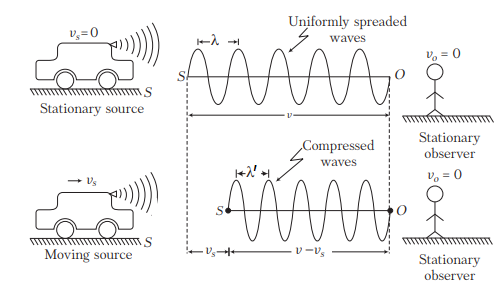
In one period \(T\), the sound travels a distance \(d=v T\). In that same time, the source moves a distance \(d_s=v_s T\).
The “apparent” wavelength \(\lambda^{\prime}\) in the direction of motion is the distance the sound traveled minus the distance the source moved:
\(
\lambda^{\prime}=v T-v_s T=\left(v-v_s\right) T
\)
Since \(T=1 / f\), the observed frequency (apparent frequency) \(f^{\prime}\) is:
\(
\begin{aligned}
f^{\prime} & =\frac{v}{\lambda^{\prime}}=\frac{v}{\left(v-v_s\right) \frac{1}{f}} \\
f^{\prime} & =f\left(\frac{v}{v-v_s}\right)
\end{aligned}
\)
(Note: If moving away, \(v_s\) becomes negative, making the denominator \(v+v_s\) and decreasing the frequency.)
Case B: Observer moving, Source stationary (\(v_s=0, v_o \neq 0\))
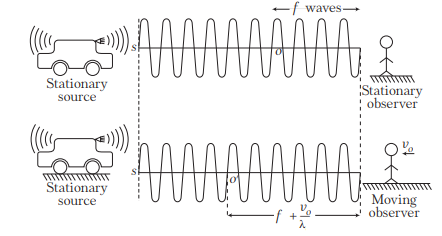
The wavelength \(\lambda\) remains unchanged \((\lambda=v / f)\). However, the relative velocity of the sound waves with respect to the observer changes.
If moving toward the source, the relative speed is \(v_{r e l}=v+v_o\).
The observed frequency is:
\(
\begin{aligned}
& f^{\prime}=\frac{v_{r e l}}{\lambda}=\frac{v+v_o}{v / f} \\
& f^{\prime}=f\left(\frac{v+v_o}{v}\right)
\end{aligned}
\)
General Doppler Formula:
By combining both cases, we get the universal equation for a source and observer moving along the same line:
\(
f^{\prime}=f\left(\frac{v \pm v_o}{v \mp v_s}\right)
\)
Sign Convention:
To keep it simple, use the signs that match the physical logic:
Approaching: The frequency must increase. Use + in the numerator or – in the denominator.
Receding: The frequency must decrease. Use – in the numerator or + in the denominator.
Key Observations:
Medium Motion: If the wind is blowing with velocity \(v_w\) in the direction of sound, replace \(v\) with \(\left(v+v_w\right)\).
Supersonic Speed: If \(v_s>v\), the source outruns its own waves, creating a Shock Wave or Sonic Boom. The Doppler formula no longer applies in the standard way as the wavefronts overlap to form a cone.
Example 15: An ambulance is moving with blowing horn towards a person standing on the road with a speed of \(54 \mathrm{kmh}^{-1}\). What frequency does the person hear, if the velocity of sound in air is \(330 \mathrm{~ms}^{-1}\) and frequency of horn is 450 Hz ?
Solution: Given, frequency of horn, \(f=450 \mathrm{~Hz}\)
Speed of ambulance, \(v_s=54 \mathrm{kmh}^{-1}=15 \mathrm{~ms}^{-1}, v_o=0\) and speed of sound in air, \(v=330 \mathrm{~ms}^{-1}\)
As source is moving towards a stationary observer, therefore frequency heard by the observer,
\(
\begin{aligned}
f^{\prime} & =\left(\frac{v}{v-v_s}\right) f=\left(\frac{330}{330-15}\right) 450 \mathrm{~Hz} \\
& =\frac{330}{315} \times 450 \mathrm{~Hz}=471.43 \mathrm{~Hz}
\end{aligned}
\)
Example 16: A listener is at rest and a police siren is moving away from the listener at \(60 \mathrm{~ms}^{-1}\). What frequency does the listener hear, given that the velocity of sound in air is \(340 \mathrm{~ms}^{-1}\) and frequency of siren is 500 Hz ?
Solution: In this case, observer is at rest and source is moving away from observer.
Therefore, observed frequency,
\(
\begin{aligned}
f^{\prime} & =\left(\frac{v}{v+v_s}\right) f=\left(\frac{340}{340+60}\right) 500 \\
& =\frac{340}{400} \times 500=\frac{1700}{4}=425 \mathrm{~Hz}
\end{aligned}
\)
Example 17: A man is travelling in a train towards the station with a speed of \(50 \mathrm{~ms}^{-1}\). Calculate the apparent frequency heard by him of a whistle which is blown at the station with a frequency 200 Hz. Velocity of sound in air is \(350 \mathrm{~ms}^{-1}\).
Solution: In this case, observer is moving and source is at rest. Therefore, apparent frequency heard by the observer,
\(
\begin{aligned}
f^{\prime} & =\left(\frac{v+v_o}{v}\right) f=\left(\frac{350+50}{350}\right) \times 200 \\
& =\frac{400}{350} \times 200=228.57 \mathrm{~Hz}
\end{aligned}
\)
Example 18: An observer moves away from a stationary source of sound with a velocity one-fifth of the velocity of sound. Find the percentage decrease in the apparent frequency. (Take, sound in air \(=320 \mathrm{~ms}^{-1}\))
Solution: Given, \(v_o=\frac{v}{5}\)
\(
\Rightarrow \quad v_o=\frac{320}{5}=64 \mathrm{~ms}^{-1}
\)
When observer moves away from the stationary source, then
\(
\begin{array}{ll}
& f^{\prime}=\left(\frac{v-v_o}{v}\right) f \\
\Rightarrow & f^{\prime}=\left(\frac{320-64}{320}\right) f \\
\Rightarrow & f^{\prime}=\left(\frac{256}{320}\right) f \\
\Rightarrow & \frac{f^{\prime}}{f}=\frac{256}{320}
\end{array}
\)
Hence, percentage decrease in frequency,
\(
\begin{aligned}
\left(\frac{f^{\prime}-f}{f}\right) & =\left(\frac{320-256}{320} \times 100\right) \% \\
f & =\left(\frac{64}{320} \times 100\right) \%=20 \%
\end{aligned}
\)
Example 19: A policeman is chasing a thief from behind, while riding on a bike which is moving with a speed of \(54 \mathrm{kmh}^{-1}\). The thief is also riding on a bike moving with a speed of \(72 \mathrm{kmh}^{-1}\). When the policeman blows horn of the bike having frequency of 200 Hz. Find the apparent frequency heard by the thief. (Take, speed of sound \(=330 \mathrm{~ms}^{-1}\)).
Solution: Given, \(v_s=54 \mathrm{kmh}^{-1}=15 \mathrm{~ms}^{-1}, v_o=72 \mathrm{kmh}^{-1}=20 \mathrm{~ms}^{-1}\), \(v=330 \mathrm{~ms}^{-1}\) and \(f=200 \mathrm{~Hz}\)
∴ Apparent frequency observed by the thief,
\(
\begin{aligned}
f^{\prime} & =\left(\frac{v-v_o}{v-v_s}\right) f=\left(\frac{330-20}{330-15}\right) \times 200 \\
& =\frac{310}{315} \times 200=196.82 \mathrm{~Hz}
\end{aligned}
\)
Example 20: A source of sound and an observer are moving away from each other with a speed of \(20 \mathrm{~ms}^{-1}\). Find the apparent frequency heard by the observer, if original frequency of the source is 100 Hz. (Take, speed of sound in air \(=330 \mathrm{~ms}^{-1}\))
Solution: Given, \(v_0=v_s=20 \mathrm{~ms}^{-1}\)
Apparent frequency heard by the observer,
\(
\begin{aligned}
f^{\prime} & =\left(\frac{v-v_o}{v+v_s}\right) f=\left(\frac{330-20}{330+20}\right) 100 \mathrm{~Hz} \\
& =\left(\frac{310}{350}\right) 100 \mathrm{~Hz}=88.57 \mathrm{~Hz}
\end{aligned}
\)
Example 21: \(A\) source of sound is approaching an observer with speed of \(30 \mathrm{~ms}^{-1}\) and the observer is approaching the source with a speed of \(50 \mathrm{~ms}^{-1}\). Find the fractional change in the frequency of sound (speed of sound in air \(=330 \mathrm{~ms}^{-1}\)).
Solution: Given, \(v_s=30 \mathrm{~ms}^{-1} \Rightarrow v_0=50 \mathrm{~ms}^{-1}\)
Apparent frequency, \(f^{\prime}=f\left[\frac{v+v_o}{v-v_s}\right]\)
\(
\begin{array}{ll}
\Rightarrow & f^{\prime}=f\left[\frac{330+50}{330-30}\right] \\
\Rightarrow & f^{\prime}=f\left[\frac{380}{300}\right] \\
\Rightarrow & f^{\prime}=f\left[\frac{38}{30}\right]
\end{array}
\)
∴ Fractional change in frequency,
\(
\left(\frac{f^{\prime}-f}{f}\right)=\frac{38-30}{30}=\frac{8}{30}=\frac{4}{15}
\)
Sonometer
A sonometer is a laboratory apparatus used to study the transverse vibrations of stretched strings. It allows for the verification of the laws of strings by adjusting the length, tension, and linear mass density.
Function and Construction:
The sonometer consists of a hollow wooden soundbox (which amplifies the sound via resonance) with two fixed bridges at either end. A wire is stretched over these bridges; one end is fixed, and the other passes over a frictionless pulley to a weight hanger.
Bridges: Two movable “knife-edge” bridges are used to change the vibrating length (\(L\)) of the wire.
Weights: Adding or removing weights changes the tension (\(T\)) in the wire.
Paper Rider: A small V-shaped paper is placed on the wire. When a vibrating tuning fork touches the box and its frequency matches the wire’s natural frequency, the wire vibrates with maximum amplitude (resonance), throwing the rider off.
Mathematical Derivation of Frequency:
The velocity of a transverse wave in a stretched string depends on the tension and the mass distribution.
Step 1: Velocity of the Wave
The speed (\(v\)) of a transverse wave on a string is:
\(
v=\sqrt{\frac{T}{\mu}}
\)
Where:
\(T\) is the Tension (Newtons).
\(\mu\) is the Linear Mass Density (mass per unit length, \(\mathrm{kg} / \mathrm{m}\)).
Step 2: Standing Wave Condition
When the wire is plucked, waves travel to the bridges and reflect back, creating standing waves. For the fundamental mode (the simplest vibration), there are nodes at the bridges and one antinode in the center.
The length of the wire (\(L\)) is equal to half a wavelength:
\(
L=\frac{\lambda}{2} \Longrightarrow \lambda=2 L
\)
Step 3: Frequency Formula
Using the wave equation \(v=f \lambda\), where \(f\) is the frequency:
\(
f=\frac{v}{\lambda}
\)
Substitute \(v=\sqrt{\frac{T}{\mu}}\) and \(\lambda=2 L\) :
\(
f=\frac{1}{2 L} \sqrt{\frac{T}{\mu}}
\)
The Laws of Transverse Vibrations:
From the derivation above, we can state three laws that the sonometer is used to verify:
\(
\begin{array}{|l|l|l|}
\hline \text { Law } & \text { Relationship } & \text { Condition } \\
\hline \text { Law of Length } & f \propto \frac{1}{L} & T \text { and } \mu \text { are constant. } \\
\hline \text { Law of Tension } & f \propto \sqrt{T} & L \text { and } \mu \text { are constant. } \\
\hline \text { Law of Mass } & f \propto \frac{1}{\sqrt{\mu}} & L \text { and } T \text { are constant. } \\
\hline
\end{array}
\)
Practical Application (Calculating Density):
If you know the frequency of the tuning fork (\(f\)), the length at resonance (\(L\)), and the tension (\(T=M g\)), you can rearrange the formula to find the linear density:
\(
\mu=\frac{T}{4 L^2 f^2}
\)
Since \(\mu=\rho \times\) Area \(=\rho \times \pi r^2\), the volume density (\(\rho\)) of the wire’s material is:
\(
\rho=\frac{T}{4 L^2 f^2 \pi r^2}
\)