7.6 Acceleration due to gravity below and above the surface of earth
Variation in \(g\) due to height above the surface of earth
Consider a body of mass \(m\) lying on the surface of the earth of mass \(M\) and radius \(R\). Acceleration due to gravity at the surface of the earth, \(g=\frac{G M}{R^2}\)
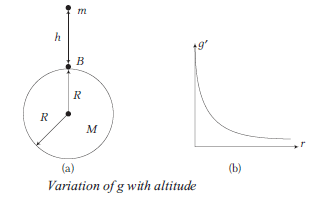
The force of gravity on an object of mass \(m\) at a height \(h\) above the surface of the earth is
\(
F=\frac{G M m}{(R+h)^2}
\)
∴ Acceleration due to gravity at this height will be
\(
g^{\prime}=\frac{F}{m}=\frac{G M}{(R+h)^2}
\)
This can also be written as
\(
g^{\prime}=\frac{G M}{R^2\left(1+\frac{h}{R}\right)^2} \Rightarrow g^{\prime}=\frac{g}{\left(1+\frac{h}{R}\right)^2} \quad\left(\because \frac{G M}{R^2}=g\right)
\)
Thus, \(g^{\prime}<g\)
i.e. The value of acceleration due to gravity \(\boldsymbol{g}\) goes on decreasing as we go above the surface of the earth.
Also, if \((R+h)=r\)
\(
g^{\prime}=\frac{G M}{(R+h)^2}=\frac{g R^2}{r^2} ; \quad g^{\prime} \propto \frac{1}{r^2}
\)
Further, by using Binomial theorem, we get (\((1+x)^n \approx 1+n x\) when \(|x| \ll 1\). Here, \(x=\frac{h}{R}\) and \(n=-2\).)
\(
g^{\prime}=g\left(1+\frac{h}{R}\right)^{-2} \Rightarrow g^{\prime} \approx g\left(1-\frac{2 h}{R}\right) \quad(\because h \ll R)
\)
Note:
With height \(h\), the decrease in the value of \(g\) is \(g-g^{\prime}=\frac{2 g h}{R}\)
∴ Fractional decreases in the value of \(g\) is \(\frac{g-g^{\prime}}{g}=\frac{2 h}{R}\)
∴ Percentage decreases in the value of \(g=\left(\frac{g-g^{\prime}}{g}\right) \times 100 =\frac{2 h}{R} \times 100 \%\)
Example 1: At what altitude, the acceleration due to gravity reduces to one-fourth of its value as that on the surface of the earth? (Take, radius of earth as \(6.4 \times 10^6 \mathrm{~m}\) and \(g\) on the surface of the earth as \(9.8 \mathrm{~ms}^{-2}\) )
Solution: Acceleration due to gravity at height \(h, g^{\prime}=\frac{g}{\left(1+\frac{h}{R}\right)^2}\)
If acceleration due to gravity reduced to one-fourth of its value, then
\(
\begin{aligned}
& \Rightarrow \quad \frac{g}{4}=\frac{g}{\left(1+\frac{h}{R}\right)^2} \Rightarrow\left(1+\frac{h}{R}\right)^2=4 \Rightarrow 1+\frac{h}{R}=2 \\
& \Rightarrow \quad \frac{h}{R}=1 \Rightarrow h=R=6.4 \times 10^6 \mathrm{~m}
\end{aligned}
\)
∴ Acceleration due to gravity is reduced to one-fourth of its value on the earth’s surface at an altitude of \(6.4 \times 10^6 \mathrm{~m}\).
Example 2: At what height, the acceleration due to gravity decreases by \(51 \%\) of its value on the surface of the earth?
Solution: As, \(g_h=g\left(\frac{R}{R+h}\right)^2\) and \(g_h=g-51 \%\) of \(g=g-\frac{51}{100} g\)
\(
\begin{array}{rlrl}
& \Rightarrow & g_h & =\frac{49}{100} g \\
& & \frac{49}{100} g & =g\left(\frac{R}{R+h}\right)^2 \\
& \Rightarrow & \frac{7}{10} & =\frac{R}{R+h} \\
& \therefore & 7 R+7 h & =10 R \\
& 7 h & =3 R \Rightarrow h=\frac{3 R}{7}
\end{array}
\)
Variation in \(g\) due to depth below the surface of earth
Let an object of mass \(m\) is situated at a depth \(d\) below the earth’s surface. Its distance from the centre of the earth is \((R-d)\). This mass is situated at the outer surface of the inner solid sphere. The gravitational force of attraction on a mass inside a spherical shell is always zero. Therefore, the object experiences gravitational attraction only due to inner solid sphere.
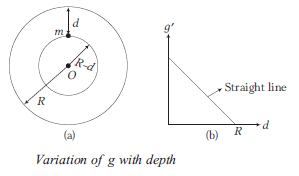
The mass of this sphere is \(M^{\prime}=\left\{\frac{M}{(4 / 3) \pi R^3}\right\} \frac{4}{3} \pi(R-d)^3\)
Here, \(M\) being the mass of whole sphere of radius \(R\).
Therefore, \(\quad M^{\prime}=\frac{(R-d)^3}{R^3} M\)
The force of gravity on an object of mass \(M\) at a depth \(d\) below the surface of earth,
\(
F=\frac{G M^{\prime} m}{(R-d)^2}=\frac{G M m(R-d)}{R^3} \text { and } g^{\prime}=\frac{F}{m}=\frac{G M}{R^3}(R-d) \dots(i)
\)
Since, \(g=\frac{G M}{R^2}\)
Substituting the values in Eq. (i), we get
\(
g^{\prime}=g\left(1-\frac{d}{R}\right)
\)
Since, \(g\) is a constant at a given place of the earth and \(R\) is also a constant.
\(
\therefore \quad\left(g-g^{\prime}\right) \propto d
\)
Hence, the acceleration due to gravity decreases as we move down from the surface of the earth.
Note:
Decrease in the value of \(g\) with depth \(d\) is \(g-g^{\prime}=\frac{g}{R} d\)
∴ Fractional decrease in the value of \(g\) with depth \(=\frac{g-g^{\prime}}{g}=\frac{d}{R}\)
∴ Percentage decrease in the value of \(g=\frac{g-g^{\prime}}{g} \times 100\)
\(
=\frac{d}{R} \times 100
\)
We can see from this equation that \(g^{\prime}=0\) at \(d=R\), i.e. acceleration due to gravity is zero (minimum value) at the centre of the earth.
If \(r\) is distance from the centre of earth.
For \(r \leq R\), \(g^{\prime}=g\left(1-\frac{d}{R}\right)=\frac{g r}{R} \quad(\because R-d=r)\)
or \(\quad g^{\prime} \propto r\)
For \(r>R\), \(g^{\prime}=\frac{g}{\left(1+\frac{h}{R}\right)^2}=\frac{g R^2}{r^2} \text { or } g^{\prime} \propto \frac{1}{r^2}\)
The graphical representation of change in the value of \(g^{\prime}\) with height and depth is as follows:
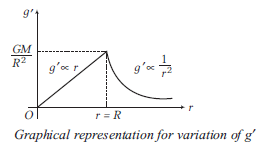
Note: The acceleration due to gravity is maximum (having standard value of \(9.8 \mathrm{~ms}^{-2}\) ) at the earth’s surface. It decreases either when we go at higher altitudes or we move below the surface.
Example 3: At what depth from the surface of the earth, the acceleration due to gravity will be half the value of \(g\) on the surface of the earth?
Solution: As, \(g^{\prime}=g\left(1-\frac{d}{R_e}\right)\)
According to the question,
\(
\begin{array}{ll}
& g^{\prime}=\frac{g}{2} \\
\Rightarrow & \frac{g}{2}=g\left(1-\frac{d}{R_e}\right) \\
\therefore & \frac{1}{2}=1-\frac{d}{R_e} \\
\Rightarrow & \frac{d}{R_e}=1-\frac{1}{2} \\
\Rightarrow & d=0.5 R_e
\end{array}
\)
Example 4: At what depth from earth’s surface, acceleration due to gravity is decreased by \(1 \%\) ?
Solution: Fractional decrease in the value of \(g\) with depth,
\(
\begin{array}{rlrl}
& & \frac{\Delta g_d}{g} & =\frac{d}{R_e} \\
\Rightarrow & & \frac{1}{100} & =\frac{d}{6400} \\
\Rightarrow & & d=64 \mathrm{~km}
\end{array}
\)
Example 5: Assuming earth to be a sphere of uniform mass density, how much would a body weigh half-way down the centre of the earth, if it weighed \(100 N\) on the surface?
Solution: Given, \(w=m g=100 \mathrm{~N}\)
As, \(g^{\prime}=g\left(1-\frac{d}{R}\right)\)
It is also given that, \(\frac{d}{R}=\frac{1}{2}\)
\(
\therefore \quad g^{\prime}=g\left(1-\frac{1}{2}\right)=\frac{g}{2}
\)
Weight of body half-way down the centre of the earth,
\(
w^{\prime}=m g^{\prime}=\frac{m g}{2}=\frac{100}{2}=50 \mathrm{~N}
\)
Example 6: Determine the decrease in the weight of a body when it is taken 32 km below the earth’s surface. (Take, radius of the earth as 6400 km )
Solution: Given, \(R=6400 \mathrm{~km}, d=32 \mathrm{~km}\)
\(
\begin{aligned}
& \because \quad g^{\prime}=g\left(1-\frac{d}{R}\right)=g\left(1-\frac{32}{6400}\right)=\left(\frac{199}{200}\right) g \\
& \therefore \quad g-g^{\prime}=g-\frac{199}{200} g=\frac{g}{200}
\end{aligned}
\)
The percentage decrease in the weight of the body
\(
\begin{aligned}
& =\frac{m g-m g^{\prime}}{m g} \times 100 \\
& =\frac{g-g^{\prime}}{g} \times 100 \\
& =\frac{\frac{g}{200}}{g} \times 100 \\
& =\frac{1}{200} \times 100=0.5 \%
\end{aligned}
\)
Variation in \(g\) due to the shape of the earth
The earth is not a perfect sphere. It is somewhat flat at the two poles. The equitorial radius ( \(R_{\text {eq }}\) ) is approximately 21 km more than the polar radius \(\left(R_p\right)\).
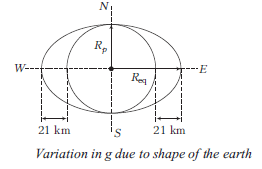
Now, acceleration due to gravity at poles,
\(
g_p=\frac{G M}{R_p^2}
\)
Acceleration due to gravity at equator,
\(
\begin{array}{rlr}
& g_{\mathrm{eq}} =\frac{G M}{R_{\mathrm{eq}}^2} \\
\because & R_p<R_{\mathrm{eq}} \\
\therefore & g_p>g_{\mathrm{eq}}
\end{array}
\)
Difference in \(g\) at poles and equator due to shape,
\(
(\Delta g)=g_p-g_{\mathrm{eq}}=0.02 \mathrm{~ms}^{-2}
\)
The value of \(\boldsymbol{g}\) is minimum at the equator and maximum at the poles. So, this is the reason why the weight of the body increases when it is taken from equator to the pole.
Note:
If weight \(=\) constant, i.e. \(m g=\) constant, then \(m \propto \frac{1}{g}\).
It means that, it will be profitable to buy sugar at the equator in comparison to poles because more mass (amount) will be obtained there.
Example 7: Imagine a new planet having the same density as that of earth but it is 3 times bigger than the earth in size. If the acceleration due to gravity on the surface of earth is \(g\) and that on the surface of the new planet is \(g^{\prime}\), then find the relation between \(g\) and \(g^{\prime}\).
Solution: The acceleration due to gravity on the new planet can be written using the relation,
\(
g=\frac{G M}{R^2} \dots(i)
\)
But \(M=(4 / 3) \pi R^3 \rho\), where \(\rho\) be the density.
Thus, Eqn. (i) becomes
\(
g=\frac{G \times(4 / 3) \pi R^3 \rho}{R^2}=G \times \frac{4}{3} \pi R \rho
\)
\(\Rightarrow \quad g \propto R \quad(\because \rho=\) constant \()\)
\(
\begin{array}{ll}
\therefore & \frac{g^{\prime}}{g}=\frac{R^{\prime}}{R} \Rightarrow \frac{g^{\prime}}{g}=\frac{3 R}{R} \\
\Rightarrow & \frac{g^{\prime}}{g}=3 \Rightarrow g^{\prime}=3 g
\end{array}
\)
Variation in \(g\) due to axial rotation of the earth
Suppose the earth is rotating on its axis with angular velocity \(\omega\). Consider a particle \(P\) at rest on the surface of the earth, at latitude \(\phi\), then the pseudo force acting on the particle is \(m r \omega^2\) in outward direction. The acceleration due to gravity \(g\) is acting towards the centre \(O\) of the earth. Thus, the effective acceleration due to gravity \(g^{\prime}\) is the resultant of \(g\) and \(r \omega^2\).
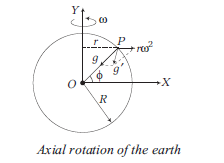
Step 1: Identify the Forces
Consider a particle \(P\) of mass \(m\) at a latitude \(\phi\). Two primary forces act on it:
(i) Gravitational Force ( \(F_g\) ): Directed towards the center of the Earth ( \(O\) ).
\(
F_g=m g
\)
(ii) Centrifugal Force ( \(F_c\) ): Directed outward, perpendicular to the Earth’s axis of rotation.
\(
F_c=m r \omega^2
\)
Where \(r\) is the radius of the circular path the particle takes as it rotates around the axis.
Step 2: Relate the Radii
The distance \(r\) from the axis is related to the Earth’s radius \(R\) and the latitude \(\phi\) by simple trigonometry:
\(
r=R \cos \phi
\)
Substituting this into the centrifugal force equation:
\(
F_c=m(R \cos \phi) \omega^2
\)
After derivation, we can find the following relation
\(
g^{\prime}=g-R \omega^2 \cos ^2 \phi
\)
Step 3: The Vector Resultant (Effective Gravity)
The effective force \(m g^{\prime}\) is the vector sum of the gravitational force and the centrifugal force. Using the Law of Cosines for vectors:
\(
\left(m g^{\prime}\right)^2=(m g)^2+\left(m r \omega^2\right)^2+2(m g)\left(m r \omega^2\right) \cos \left(180^{\circ}-\phi\right)
\)
Note: The angle between \(F_g\) (pointing to center) and \(F_c\) (pointing outward from the axis) is \(180^{\circ}-\phi\).
Since \(\cos \left(180^{\circ}-\phi\right)=-\cos \phi\), the expression becomes:
\(
\left(m g^{\prime}\right)^2=(m g)^2+\left(m R \omega^2 \cos \phi\right)^2-2(m g)\left(m R \omega^2 \cos \phi\right) \cos \phi
\)
Cancel \(m^2\) from all terms:
\(
g^{\prime 2}=g^2+R^2 \omega^4 \cos ^2 \phi-2 g R \omega^2 \cos ^2 \phi
\)
Step 4: Simplification and Approximation
In reality, the Earth’s rotation is relatively slow, meaning the term \(R \omega^2\) is much smaller than \(g\) (approx. \(0.034 \mathrm{~m} / \mathrm{s}^2\) vs \(9.8 \mathrm{~m} / \mathrm{s}^2\) ). Therefore, the term containing \(\omega^4\) is negligibly small and can be ignored.
\(
\begin{aligned}
& g^2 \approx g^2-2 g R \omega^2 \cos ^2 \phi \\
& g^{\prime} \approx \sqrt{g^2-2 g R \omega^2 \cos ^2 \phi}
\end{aligned}
\)
Factor out \(g^2\) from inside the square root:
\(
g^{\prime} \approx g\left(1-\frac{2 R \omega^2 \cos ^2 \phi}{g}\right)^{1 / 2}
\)
Using the Binomial Approximation \((1-x)^n \approx 1-n x\) for small \(x\) :
\(
\begin{gathered}
g^{\prime} \approx g\left(1-\frac{1}{2} \cdot \frac{2 R \omega^2 \cos ^2 \phi}{g}\right) \\
g^{\prime}=g-R \omega^2 \cos ^2 \phi
\end{gathered}
\)
Key Conclusions
- At the Equator \(\left(\phi=0^{\circ}\right)\) : \(\cos 0^{\circ}=1\), so \(g^{\prime}=g-R \omega^2\). Gravity is at its minimum.
- At the Poles \(\left(\phi=90^{\circ}\right)\) : \(\cos 90^{\circ}=0\), so \(g^{\prime}=g\). Gravity is at its maximum.
Note:
- If the angular velocity of earth increases, the value of \(g\) will decrease at all places except at poles.
- Since, earth rotates west to east, we also project our rockets from west to east, so that effective acceleration due to gravity ( \(g^{\prime}=g-R \omega^2\) ) on the rocket is less.
Example 8: Find the imaginary angular velocity of the earth for which the effective acceleration due to gravity at the equator shall be zero. (Take, \(g=10 \mathrm{~m} / \mathrm{s}^2\) for the acceleration due to gravity, if the earth were at rest and radius of earth equal to 6400 km and \(\phi=60^{\circ}\) )
Solution: Acceleration due to gravity, \(g^{\prime}=g-\omega^2 R \cos ^2 \phi\)
\(
\begin{aligned}
& 0=g-\omega^2 R \cos ^2 60^{\circ} \quad\left(\because g^{\prime}=0\right) \\
& 0=g-\frac{\omega^2 R}{4} \\
& \omega=2 \sqrt{\frac{g}{R}}=2 \sqrt{\frac{10}{6400 \times 1000}} \\
& \omega=\frac{1}{400}=2.5 \times 10^{-3} \mathrm{rad} / \mathrm{s}
\end{aligned}
\)
Example 9: Calculate the angular speed of rotation of the earth, so that the apparent \(g\) at the equator becomes half of its value at the surface. Also, calculate the length of the day in this situation.
Solution: The apparent acceleration due to gravity,
\(
\begin{aligned}
& g=g_0-\omega^2 R=g_0 / 2 \\
\Rightarrow \quad & \omega=\sqrt{\frac{g_0}{2 R}}=\sqrt{\frac{9.8}{6.4 \times 10^6 \times 2}}=8.75 \times 10^{-4} \mathrm{rads}^{-1}
\end{aligned}
\)
The length of the day \(=\) Time period of rotation of the earth
\(
\begin{aligned}
& =\frac{2 \pi}{\omega}=2 \pi \sqrt{\frac{2 R}{g_0}}=2 \pi \sqrt{\frac{2 \times 6.4 \times 10^6}{9.8}} \\
& =7180 \mathrm{~s} \approx 2 \mathrm{~h}
\end{aligned}
\)
Example 10: Find the value of angular velocity of axial rotation of the earth, such that weight of a person at equator becomes (3/4)th of its weight at pole. Radius of the earth at equator is 6400 km.
Solution: Let acceleration due to gravity at pole is \(g\) and at equator, it is \(g^{\prime}\). If mass of the person is \(m\) and angular velocity of rotation of the earth is \(\omega\), then
\(
\begin{aligned}
& & g^{\prime} & =g-\omega^2 R \Rightarrow m g^{\prime}=m g-m \omega^2 R \\
\Rightarrow & & \frac{3}{4} m g & =m g-m \omega^2 R \\
\Rightarrow & & \omega^2 R & =\frac{1}{4} g \\
\Rightarrow & & \omega & =\sqrt{\frac{g}{4 R}}=\sqrt{\frac{9.8}{4 \times 6400 \times 10^3}} \\
& \therefore & \omega & =\frac{1}{2} \times \frac{1}{80} \times \frac{1}{10^2} \times \sqrt{98}=6.18 \times 10^{-4} \mathrm{rads}^{-1}
\end{aligned}
\)
Example 11: Suppose the earth increases its speed of rotation. At what new time period, will the weight of a body on the equator becomes zero? (Take, \(g=10 \mathrm{~ms}^{-2}\) and radius of earth \(R=6400 \mathrm{~km}\) )
Solution: The weight will become zero, when
\(
g^{\prime}=0 \text { or } g-R \omega^2=0 \text { (On the equator, } g^{\prime}=g-R \omega^2 \text { ) }
\)
or \(\omega=\sqrt{\frac{g}{R}}\)
\(
\therefore \quad \frac{2 \pi}{T}=\sqrt{\frac{g}{R}} \text { or } T=2 \pi \sqrt{\frac{R}{g}}
\)
Substituting the given values in above expression, we get
\(
T=\frac{2 \pi \sqrt{\frac{6400 \times 10^3}{10}}}{3600} \mathrm{~h} \text { or } T \approx 1.4 \mathrm{~h}
\)
Thus, the new time period should be 1.4 h instead of 24 h for the weight of a body to be zero at the equator.