4.10 Circular motion
We know acceleration of a body moving in a circle of radius \(R\) with uniform speed \(v\) is \(v^2 / R\) directed towards the centre. According to the second law, the force \(f_c\) providing this acceleration is :
\(
f_c=\frac{m v^2}{R} \dots(i)
\)
where \(m\) is the mass of the body. This force directed forwards the centre is called the centripetal force. For a stone rotated in a circle by a string, the centripetal force is provided by the tension in the string. The centripetal force for motion of a planet around the sun is the gravitational force on the planet due to the sun. For a car taking a circular turn on a horizontal road, the centripetal force is the force of friction.
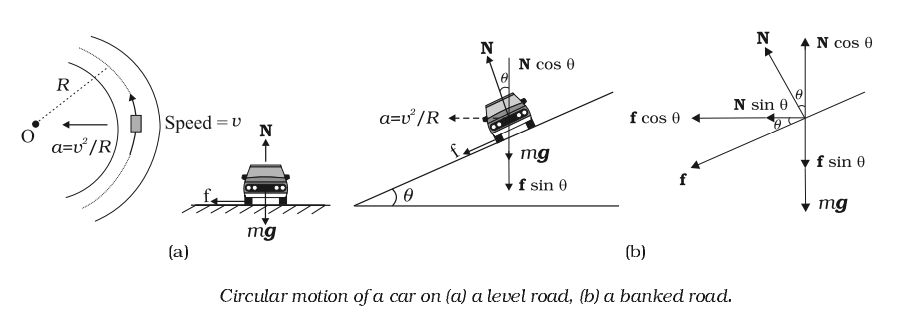
The circular motion of a car on a flat and banked road give interesting application of the laws of motion.
Motion of a car on a level road
Three forces act on the car. (Figure (a) below)
(i) The weight of the car, \(m g\)
(ii) Normal reaction, \(N\)
(iii) Frictional force, \(f=f_s\)
As there is no acceleration in the vertical direction
\(
\begin{aligned}
& N-m g=0 \\
& N=m g \dots(ii)
\end{aligned}
\)
The maximum speed a car can take a turn is determined by the static friction \(\left(f_s\right)\) between the tires and the road, which provides the necessary centripetal force ( \(f_c\) ). The relationship is derived from \(f_s \leq \mu_s N\) and \(f_c=\frac{m v^2}{R}\), where \(\mu_s\) is the coefficient of static friction, \(N\) is the normal force, \(m\) is the mass, \(v\) is the velocity, and \(R\) is the radius of the turn. By setting the maximum static friction equal to the centripetal force and substituting \(N=m g\), the maximum speed is found to be \(v_{\max }=\sqrt{\mu_s R g}\), which is independent of the car’s mass.
Derivation of maximum speed
Centripetal force: For a car to move in a circular path, a centripetal force ( \(f_c\) ) is required, which is provided by the static friction ( \(f_s\) ) between the tires and the road.
\(f_c=\frac{m v^2}{R}\)
Static friction: The static friction force must be less than or equal to the maximum possible static friction, which is determined by the coefficient of static friction ( \(\mu_s\) ) and the normal force ( \(\boldsymbol{N}\) ).
\(f_s \leq \mu_s N\)
Set forces equal: The centripetal force must be equal to or less than the static friction to stay on the circular path. For the maximum speed, we set them equal.
\(f_c=f_s\)
\(\frac{m v^2}{R}=\mu_s N\)
Substitute and simplify: Assuming the road is flat, the normal force is equal to the car’s weight ( \(N=m g\) ).
\(\frac{m v^2}{R}=\mu_s(m g)\)
The mass ( \(m\) ) cancels out, showing the maximum speed is independent of the car’s mass.
\(\frac{v^2}{R}=\mu_s g\)
Solve for maximum speed: Rearrange the equation to solve for the maximum velocity ( \(v_{\text {max }}\) ).
\(v^2=\mu_s R g\)
\(v_{\max }=\sqrt{\mu_s R g} \dots(iii)\)
Motion of a car on a banked road
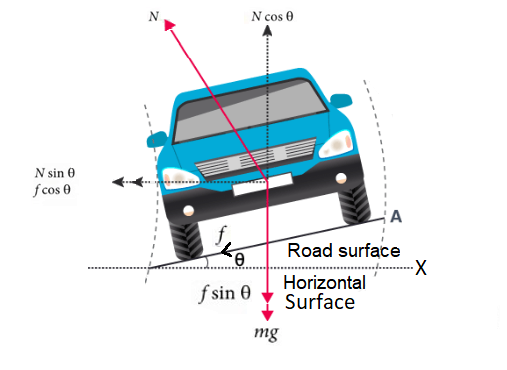
We can reduce the contribution of friction to the circular motion of the car if the road is banked (Figure(b)). Since there is no acceleration along the vertical direction, the net force along this direction must be zero. Hence,
\(N \cos \theta=m g+f \sin \theta \dots(iv)\)
The centripetal force is provided by the horizontal components of \(N\) and \(f\).
\(
N \sin \theta+f \cos \theta=\frac{m v^2}{R} \dots(v)
\)
But \(f \leq \mu_{\mathrm{s}} N\)
Thus to obtain \(v_{\text {max }}\) we put
\(
f=\mu_{\mathrm{s}} N .
\)
Then Eqs. (iv) & (v) become
\(
N \cos \theta=m g+\mu_s N \sin \theta \dots(vi)
\)
\(N \sin \theta+\mu_{\mathrm{s}} N \cos \theta=m v^2 / R \dots(vii)\)
We obtain
\(
N=\frac{m g}{\cos \theta-\mu_{\mathrm{s}} \sin \theta}
\)
Substituting value of N in Eqn. (vii), we get \(\frac{m g\left(\sin \theta-\mu_{\mathrm{s}} \cos \theta\right)}{\cos \theta-\mu_{\mathrm{s}} \sin \theta}=\frac{m v_{\max }^2}{R}\)
or \(v_{\max }=\left(R g \frac{\mu_{\mathrm{s}}+\tan \theta}{1-\mu_{\mathrm{s}} \tan \theta}\right)^{\frac{1}{2}} \dots(viii)\)
This speed is greater than the maximum speed on a flat road because the banking angle ( \(\theta\) ) helps provide the necessary centripetal force in addition to friction ( \(\mu_s\) ).
If the vehicle is moving upward on inclined road, then we can find maximum speed for no skidding from the above formula.
Derivation of Minimum speed
If the vehicle is moving downward on inclined road, then minimum velocity for no skidding is
\(
v_{\min }=\left[R g \frac{\left(\tan \theta-\mu_s\right)}{1+\mu_s \tan \theta}\right]^{1 / 2}
\)
Note: Friction’s role: To prevent the car from sliding down the incline, static friction \(\left(f\right)\) must act up the slope.
Centripetal force: The horizontal component of the normal force and the horizontal component of friction both provide the necessary centripetal force to keep the car moving in a circle.
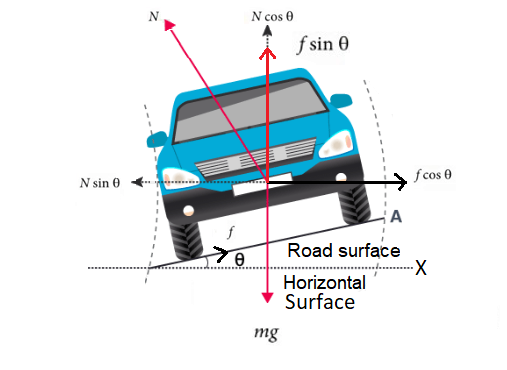
Proof: Forces involved: The forces acting on the vehicle of mass \(m\) are:
Weight (\(mg\)): Acting vertically downwards.
Normal Force ( \(N\) ): Acting perpendicular to the banked road surface, upwards.
Static Friction Force ( \(f\) ): At the minimum velocity, the car tends to slide down the incline, so the static friction force acts up the incline, parallel to the road surface.
In the vertical (\(y\)) direction, there is no acceleration, so the net force is zero:
\(
\Sigma F_y=N \cos \theta+f \sin \theta-m g=0
\)
\(N \cos \theta+f \sin \theta=m g \dots(1)\)
In the horizontal ( \(x\) ) direction, the net force provides the centripetal force (\(\left.f_c=\frac{m v_{\min }^2}{R}\right)\)
\(
\Sigma F_x=N \sin \theta-f \cos \theta=\frac{m v_{\min }^2}{R} \dots(2)
\)
Use the friction relationship: The maximum static friction force is \(f=\mu_s N\). Substitute this into Equations 1 and 2:
Equation 1 becomes:
\(
\begin{aligned}
& N \cos \theta+\mu_s N \sin \theta=m g \\
& N\left(\cos \theta+\mu_s \sin \theta\right)=m g \dots(3)
\end{aligned}
\)
Equation 2 becomes:
\(
\begin{aligned}
& N \sin \theta-\mu_s N \cos \theta=\frac{m v_{\min }^2}{R} \\
& N\left(\sin \theta-\mu_s \cos \theta\right)=\frac{m v_{\min }^2}{R} \dots(4)
\end{aligned}
\)
\(
\begin{aligned}
&\text { Eliminate } N \text { and } m \text { : Divide Equation } 4 \text { by Equation } 3 \text { to eliminate } N \text { and } m \text { : }\\
&\begin{aligned}
& \frac{N\left(\sin \theta-\mu_s \cos \theta\right)}{N\left(\cos \theta+\mu_s \sin \theta\right)}=\frac{\frac{m v_{\min }^2}{R}}{m g} \\
& \frac{\sin \theta-\mu_s \cos \theta}{\cos \theta+\mu_s \sin \theta}=\frac{v_{\min }^2}{R g}
\end{aligned}
\end{aligned}
\)
Simplify the expression: Divide the numerator and denominator of the left side by \(\cos \theta\) :
\(
\begin{aligned}
& \frac{\frac{\sin \theta}{\cos \theta}-\frac{\mu_s \cos \theta}{\cos \theta}}{\frac{\cos \theta}{\cos \theta}+\frac{\mu_s \sin \theta}{\cos \theta}}=\frac{v_{\min }^2}{R g} \\
& \frac{\tan \theta-\mu_s}{1+\mu_s \tan \theta}=\frac{v_{\min }^2}{R g}
\end{aligned}
\)
Solve for \(\boldsymbol{v}_{\text {min }}\) : Rearrange the equation to solve for \(\boldsymbol{v}_{\text {min }}\) :
\(
\begin{aligned}
& v_{\min }^2=R g \frac{\left(\tan \theta-\mu_s\right)}{1+\mu_s \tan \theta} \\
& v_{\min }=\sqrt{R g \frac{\left(\tan \theta-\mu_s\right)}{1+\mu_s \tan \theta}}
\end{aligned}
\)
Ideal Speed ( \(\boldsymbol{v}_{\boldsymbol{o}}\) ): When the coefficient of static friction ( \(\boldsymbol{\mu}_{\boldsymbol{s}}\) ) is zero (or the car is moving at a specific ideal speed), the formula simplifies to:
\(
v_{\mathrm{o}}=(R g \tan \theta)^{1 / 2}
\)
\(
\tan \theta=\frac{v_0^2}{R g} \quad \text { or } \quad v_0=\sqrt{R g \tan \theta}
\)
At this ideal speed, the horizontal component of the normal force provides all the required centripetal force. The text highlights that driving at this speed is optimal as it requires no frictional force, thus causing minimal wear and tear on the tires.
Angle of Banking
The Angle of Banking is the angle by which the surface (road) is elevated on the outer edge. The angle of banking does not depend upon the weight of the vehicle. Instead, it is determined by the speed of the vehicle, radius of curvature of the road, and acceleration due to gravity.
\(\tan \theta={v_0}^2 /{Rg}\)
\(
\theta=\tan ^{-1}\left(v_0^2 /R g\right)
\)
Note:
(i) For no slipping or skidding, we have \(v_{\text {min }}<v \leq v_{\text {max }}\)
This speed is greater than the maximum possible speed of a car on level road \((v=\sqrt{\mu_s g R})\).
(ii) If \(\mu_s=0, v_o=(g R \tan \theta)^{1 / 2}\)
This speed is known as optimum speed.
Frictional Force Direction:
At the ideal speed ( \(v_o\) ), no friction is needed.
If the car’s speed is less than \(v_o\left(v<v_o\right)\), the text states that the frictional force will be directed up the slope to prevent the car from sliding down.
Parking on a Banked Road:
A car can only be successfully parked on a banked road (i.e., remain stationary) if the angle of the bank is shallow enough, specifically if \(\tan \theta \leq \mu_s\). This condition ensures that the static friction can counteract the component of gravity pulling the car down the slope.
There are two conditions possible:
Safe Turn:
If \(\frac{m v^2}{R} \leq \mu_s m g\), or \(\mu_s \geq \frac{v^2}{R g}\) or \(\sqrt{\mu_s R g} \geq v\) or \(v \leq \sqrt{\mu_s R g}\)
The static friction would be able to provide necessary centripetal force to bend the car on the road. So the coefficient of static friction between the tyre and the surface of the road determines what maximum speed the car can have for safe turn.
Skid:
If \(\frac{m v^2}{R}>\mu_s m g\), or \(\mu_s<\frac{v^2}{R g}\) (skid)
If the static friction is not able to provide enough centripetal force to turn, the vehicle will start to skid.
Example 1: A cyclist speeding at 18 \(\mathrm{km} / \mathrm{h}\) on a level road takes a sharp circular turn of radius 3 m without reducing the speed. The co-efficient of static friction between the tyres and the road is 0.1. Will the cyclist slip while taking the turn ?
Solution: On an unbanked road, frictional force alone can provide the centripetal force needed to keep the cyclist moving on a circular turn without slipping. If the speed is too large, or if the turn is too sharp (i.e. of too small a radius) or both, the frictional force is not sufficient to provide the necessary centripetal force, and the cyclist slips. The condition for the cyclist not to slip is given by the equation:
\(
v^2 \leq \mu_s R g
\)
Now, \(R=3 \mathrm{~m}, g=9.8 \mathrm{~m} \mathrm{~s}^{-2}, \mu_s=0.1\). That is, \(\mu_s R g=2.94 \mathrm{~m}^2 \mathrm{~s}^{-2} \cdot v=18 \mathrm{~km} / \mathrm{h}=5 \mathrm{~m} \mathrm{~s}^{-1}\); i.e., \(v^2=25 \mathrm{~m}^2 \mathrm{~s}^{-2}\). The condition is not obeyed. The cyclist will slip while taking the circular turn.
Example 2: A circular racetrack of radius 300 m is banked at an angle of \(15^{\circ}\). If the coefficient of friction between the wheels of a race-car and the road is 0.2, what is the (a) optimum speed of the racecar to avoid wear and tear on its tyres, and (b) maximum permissible speed to avoid slipping?
Solution: On a banked road, the horizontal component of the normal force and the frictional force contribute to provide centripetal force to keep the car moving on a circular turn without slipping. At the optimum speed, the normal reaction’s component is enough to provide the needed centripetal force, and the frictional force is not needed. The optimum speed \(v_o\) is given by:
\(
v_o=(R g \tan \theta)^{1 / 2}
\)
Here \(R=300 \mathrm{~m}, \theta=15^{\circ}, g=9.8 \mathrm{~m} \mathrm{~s}^{-2}\); we have
\(
v_o=28.1 \mathrm{~m} \mathrm{~s}^{-1} .
\)
The maximum permissible speed \(v_{\text {max }}\) is given by:
\(
v_{\max }=\left(R \mathrm{~g} \frac{\mu_{\mathrm{s}}+\tan \theta}{1-\mu_{\mathrm{s}} \tan \theta}\right)^{1 / 2}=38.1 \mathrm{~m} \mathrm{~s}^{-1}
\)
Example 3: Determine the maximum speed at which a car can turn round a curve of \(30 m\) radius on a level road, if the coefficient of friction between the tyres and the road is 0.4. (Take, \(g=10 \mathrm{~ms}^{-2}\) )
Solution:
\(
\begin{aligned}
& \text { Given, } \mu=0.4, r=30 \mathrm{~m}, g=10 \mathrm{~ms}^{-2} \\
& \text { Maximum speed, } v_{\max }=\sqrt{\mu g r} \\
& \Rightarrow \quad v_{\max }=\sqrt{0.4 \times 10 \times 30}=10.95 \approx 11 \mathrm{~ms}^{-1}
\end{aligned}
\)
Example 4: A cyclist speeding at \(4.5 \mathrm{~km} \mathrm{~h}^{-1}\) on a level road takes a sharp circular turn of radius \(3 m\) without reducing the speed. The coefficient of static friction between the road and the tyres is 0.1. Will the cyclist slip while taking the turn (i) with a speed of \(4.5 \mathrm{~km} \mathrm{~h}^{-1}\) and (ii) with a speed of \(9 \mathrm{~km} \mathrm{~h}^{-1}\) ?
Solution: Frictional force provides the necessary centripetal force. He will slip, if the turn is too sharp (i.e. too small a radius) or if his speed is too large.
Maximum speed for no slipping is
\(
v_{\max }=\sqrt{\mu_s r g}=\sqrt{0.1 \times 3 \times 9.8}=1.72 \mathrm{~ms}^{-1}
\)
(i) If \(v=4.5 \mathrm{~km} \mathrm{~h}^{-1}=4.5 \times \frac{5}{18}=\frac{5}{4} \mathrm{~ms}^{-1} =1.25 \mathrm{~ms}^{-1}<1.72 \mathrm{~ms}^{-1}\), hence he will not slip.
(ii) If \(v=9 \mathrm{~km} \mathrm{~h}^{-1}=9 \times \frac{5}{18}=\frac{5}{2} \mathrm{~ms}^{-1}=2.5 \mathrm{~ms}^{-1}>1.72 \mathrm{~ms}^{-1}\), hence he will slip.
Example 5: A turn of radius \(600 m\) is banked for a vehicle of mass 200 kg going with a speed of \(180 \mathrm{kmh}^{-1}\). Determine the banking angle of its path.
Solution: The turn is banked for speed,
\(
v=180 \mathrm{kmh}^{-1}=180 \times \frac{5}{18} \mathrm{~ms}^{-1}=50 \mathrm{~ms}^{-1}
\)
and radius, \(r=600 \mathrm{~m}\)
\(
\begin{array}{lc}
\because & \tan \theta=\frac{v^2}{r g}=\frac{50 \times 50}{600 \times 10} \\
\Rightarrow & \tan \theta=\frac{25}{60}=0.4167 \\
\Rightarrow & \text { Banking angle, } \theta=\tan ^{-1}(0.4167) \Rightarrow \theta=22.62^{\circ}
\end{array}
\)
Example 6: \(A\) train has to describe a curve of radius \(2000 m\). By how much should the outer rail be raised with respect to inner rail for a speed of \(72 \mathrm{~km} \mathrm{~h}^{-1}\). The distance between the rails is 1 m. (Take, \(g=10 \mathrm{~ms}^{-2}\) )
Solution: Given, \(v=72 \mathrm{~km} \mathrm{~h}^{-1}\)
\(
\begin{array}{r}
=72 \times \frac{5}{18}=20 \mathrm{~ms}^{-1} \\
l=1 \mathrm{~m}, r=2000 \mathrm{~m}, g=10 \mathrm{~ms}^{-2}
\end{array}
\)
We have, \(\tan \theta=\frac{v^2}{r g}\)
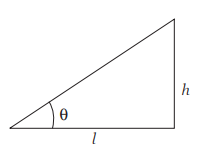
Also, \(\quad \tan \theta=\frac{h}{l} \Rightarrow \frac{v^2}{r g}=\frac{h}{l}\)
\(
\begin{aligned}
h & =\frac{v^2 l}{r g} \\
h & =\frac{(20)^2 \times 1}{2000 \times 10}=\frac{1}{50} \mathrm{~m} \\
& =\frac{100}{50}=2 \mathrm{~cm}
\end{aligned}
\)
Example 7: A cyclist speeding at \(6 \mathrm{~ms}^{-1}\) in a circle of radius \(18 m\) makes an angle \(\theta\) with the vertical. Determine the value of \(\theta\). Also, determine the minimum possible value of coefficient of friction between the tyres and the ground.
Solution: Given, \(v=6 \mathrm{~ms}^{-1}, r=18 \mathrm{~m}, g=9.8 \mathrm{~ms}^{-2}\)
\(
\begin{aligned}
& \text { Since, } \tan \theta=\frac{v^2}{r g} \Rightarrow \tan \theta=\frac{6 \times 6}{18 \times 9.8}=0.2041 \\
& \Rightarrow \quad \theta=\tan ^{-1}(0.2041) \Rightarrow \theta=11^{\circ} 53^{\prime}
\end{aligned}
\)
Also, minimum possible value of coefficient of friction,
\(
\mu=\tan \theta=\frac{v^2}{r g}=0.2041 \Rightarrow \mu=0.2041
\)
Conical pendulum
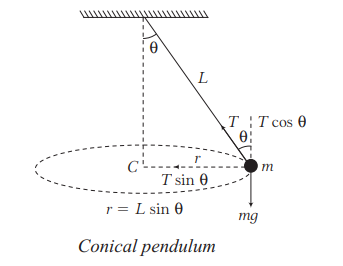
If a small particle of mass \(m\) tied to a string is whirled in a horizontal circle as shown in figure. The arrangement is called the conical pendulum. In case of conical pendulum, the vertical component of tension balances the weight while its horizontal component provides the necessary centripetal force. Thus, \(\quad T \sin \theta=\frac{m v^2}{r} \dots(i)\)
\(
T \cos \theta=m g \dots(ii)
\)
From these two equations, we can find \(v=\sqrt{r g \tan \theta}\)
\(\therefore\) Angular speed, \(\omega=\frac{v}{r}=\sqrt{\frac{g \tan \theta}{r}}\)
So, the time period of pendulum is
\(
\begin{gathered}
T=\frac{2 \pi}{\omega}=2 \pi \sqrt{\frac{r}{g \tan \theta}}=2 \pi \sqrt{\frac{L \cos \theta}{g}} \\
{[\text { since, } r=L \sin \theta]}
\end{gathered}
\)
\(
T=2 \pi \sqrt{\frac{L \cos \theta}{g}}
\)
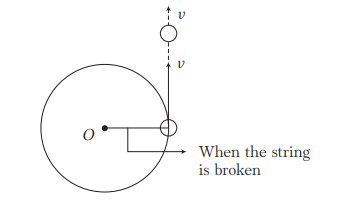
Example 8: A particle of mass \(200 g\) tied to one end of string is revolved in a horizontal circle of radius 50 cm about a vertical axis passing through the point of suspension, with angular speed 60 rev per minute (rpm). Find (i) linear speed, (ii) the acceleration and (iii) horizontal component of tension in the string. What will happen, if string is broken?
(Take, \(\pi^2=10\) )
Solution: Angular speed,
\(
\begin{aligned}
\omega=\frac{2 \pi n}{60} & =\frac{2 \pi \times 60}{60} \\
& =2 \pi \mathrm{rad} \mathrm{~s}^{-1}=6.28 \mathrm{rad} \mathrm{~s}^{-1}
\end{aligned}
\)
Horizontal component of the tension, \(T_H=T \sin \theta\)
Vertical component of tension, \(T_V=T \cos \theta=m g\)
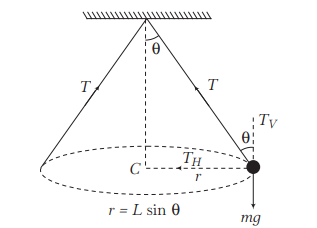
(i) Linear speed, \(v=r \omega=0.5 \times 2 \pi=\pi \mathrm{ms}^{-1}=3.14 \mathrm{~ms}^{-1}\)
(ii) Acceleration, \(a_c=\frac{v^2}{r}=\frac{(\pi)^2}{0.5} \approx \frac{10}{0.5}=20 \mathrm{~ms}^{-2}\)
(iii) Horizontal component of tension,
\(
T_H=\frac{m v^2}{r}=0.2 \times 20=4 \mathrm{~N}
\)
When the string is broken, tension \(T_H\) (i.e. centripetal force) vanishes and body moves along the tangent in a straight line with speed \(3.14 \mathrm{~ms}^{-1}\).
Example 9: A ball of mass (m) 0.5 kg is attached to the end of a string having length ( \(L\) ) 0.5 m. The ball is rotated on a horizontal circular path about vertical axis. The maximum tension that the string can bear is 324 N. Find the maximum possible value of angular velocity of ball (in rads \({ }^{-1}\) ).
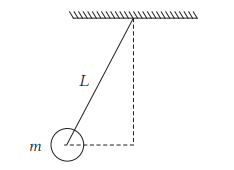
Solution: Consider the forces acting on the ball as shown in the figure.
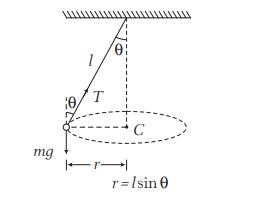
The component \(T \cos \theta\) will cancel \(m g\).
The component \(T \sin \theta\) will provide necessary centripetal force to the ball towards centre \(C\).
\(
\begin{aligned}
& \therefore \quad T \sin \theta=m r \omega^2=m(l \sin \theta) \omega^2 \text { or } T=m l \omega^2 \\
& \text { Angular velocity, } \omega=\sqrt{\frac{T}{m l}} \\
& \text { or } \quad \omega_{\max }=\sqrt{\frac{T_{\max }}{m l}}=\sqrt{\frac{324}{0.5 \times 0.5}}=36 \mathrm{rads}^{-1}
\end{aligned}
\)
Example 10: \(A\) boy whirls a stone of mass 2 kg in a horizontal circle of radius 1.5 m, which is attached to a string having length 1 m. What is the time period of the given system of stone and string? (Take, \(\cos 15^{\circ}=0.96\) )
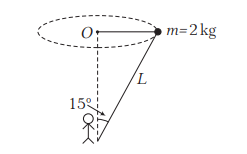
Solution: Given, \(m=2 \mathrm{~kg}, r=1.5 \mathrm{~m}\),
\(
L=1 \mathrm{~m}, \theta=15^{\circ}, g=10 \mathrm{~ms}^{-2}
\)
Time period of the given system of stone and string is given as
\(
\begin{aligned}
T & =2 \pi \sqrt{\frac{L \cos \theta}{g}}=2 \pi \sqrt{\frac{1 \times \cos 15^{\circ}}{10}}=2 \pi \sqrt{\frac{0.96}{10}} \\
& =2 \times 3.14 \times 0.31=1.95 \simeq 2 \mathrm{~s}
\end{aligned}
\)
Thus, the time period is 2 s (approx).
‘Death well’ or rotor
In case of death well, a person drives a bicycle on a vertical surface of a large wooden well, while in case of a rotor, at its certain angular speed, a person hangs resting against the wall without any support from the bottom. In death well, walls are at rest and person revolves while in case of rotor, person is at rest and the walls rotate.
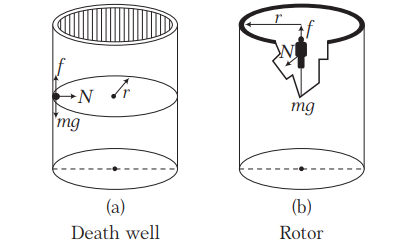
In both cases, friction balances the weight of person while reaction provides the centripetal force for circular motion,
i.e. \(\quad f=m g\) and \(N=\frac{m v^2}{r}=m r \omega^2 \quad(\because v=r \omega)\)
\(
f \leq \mu N \Rightarrow m g \leq \mu m v^2 / r \Rightarrow v^2 \geq \frac{g r}{\mu}
\)
\(\therefore \quad\) Safe speed, \(v=\sqrt{\frac{g r}{\mu}}\)
Example 11: In a rotor, a hollow vertical cylinder rotates about its axis and a person rest against the inner wall. At a particular speed of the rotor, the floor below the person is removed and the person hangs resting against the wall without any floor. If the radius of the rotor is 2 m and the coefficient of static friction between the wall and the person is 0.2 . Find the minimum speed at which the floor may be removed.
Solution: The situation is shown in figure below.
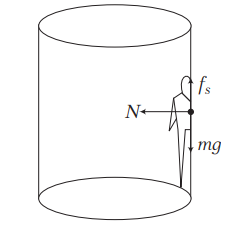
When the floor is removed, the forces on the person are
(i) weight \(m g\) downward.
(ii) normal force \(N\) due to the wall towards the centre.
(iii) frictional force \(f_s\) parallel to the wall, upwards.
The person is moving in a circle with a uniform speed, so its acceleration is \(v^2 / r\) towards the centre.
For the minimum speed when the floor may be removed, the friction is limiting one and so equals \(\mu_s N\).
This gives,
\(
\mu_s N=m g
\)
\(
\frac{\mu_s m v^2}{r}=m g \quad\left[\because N=\frac{m v^2}{r}\right]
\)
\(
v=\sqrt{\frac{r g}{\mu_s}}=\sqrt{\frac{2 \times 10}{0.2}}=10 \mathrm{~ms}^{-1}
\)
Motion of a particle tied to a string in vertical circle
Suppose a particle of mass \(m\) is attached to an inextensible light string of length \(R\). This particle is moving in a vertical circle of radius \(R\) about a fixed point \(O\). It is imparted a velocity \(u\) in horizontal direction at lowest point \(A\). Let \(v\) be its velocity at point \(B\) of the circle as shown in Figure below.
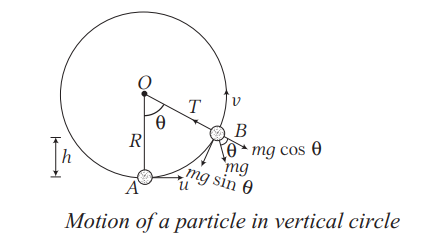
Here, we have
\(
h=R(1-\cos \theta)
\)
Now, from conservation of mechanical energy, we have
\(
\frac{1}{2} m\left(u^2-v^2\right)=m g h \dots(i)
\)
The necessary centripetal force is provided by the resultant of tension \(T\) and \(m g \cos \theta\).
\(
\therefore \quad T-m g \cos \theta=\frac{m v^2}{R} \dots(ii)
\)
As speed of the particle decreases with height, tension in the string is maximum at the bottom. The particle will complete the circle, if the string does not slack even at the highest point.
Now, following conclusions can be made using above Eqs. (i) and (ii)
(i) Minimum velocity at highest point, so that particle complete the circle \(v_{\text {min }}=\sqrt{g R}\), at this velocity, tension in the string is zero.
(ii) Minimum velocity at lowest point, so that particle complete the circle \(v_{\text {min }}=\sqrt{5 g R}\), at this velocity, tension in the string is 6 mg .
(iii) When string is horizontal, then minimum velocity is \(\sqrt{3 R g}\) and tension in this condition is 3 mg.
(iv) If velocity at lowest point is less than \(\sqrt{5 g R}\), then tension in the string becomes zero before reaching the highest point, now the particle will leave the circle and will move on parabolic path.
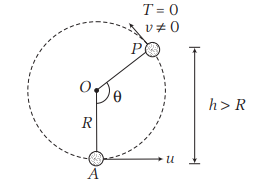
In this condition, if \(\sqrt{2 g R}<v<\sqrt{5 g R}\), then tension in the string becomes zero but velocity is not zero, the particle will leave circle at \(90^{\circ}<\theta<180^{\circ}\) or \(h>R\).
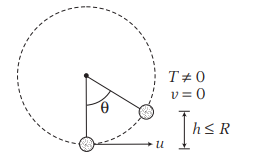
(v) If velocity at lowest point is \(0<v \leq \sqrt{2 g R}\), the particle will oscillate. In this condition, velocity becomes zero but tension is not zero. The particle will oscillate in lower half of circle, i.e. \(0^{\circ}<\theta<90^{\circ}\).
Note The above points have been derived for a particle moving in a vertical circle attached to a string. The same conditions apply, if a particle moves inside a smooth spherical shell of radius \(R\). The only difference is that the tension is replaced by the normal reaction \(N\).
Example 12: One end of a string of length \(1 m\) is tied to a body of mass 0.5 kg. It is whirled in a vertical circle with angular velocity \(4 \mathrm{rad} \mathrm{s}{ }^{-1}\). Find the tension in the string when the body is at the lower most point of its motion. (Take, \(g=10 m s^{-2}\) )
Solution: At lower most point, the tension in the string,
\(
\begin{aligned}
T & =m \omega^2 r+m g=0.5 \times(4)^2 \times 1+0.5 \times 10 \\
& =13 \mathrm{~N}
\end{aligned}
\)
Example 13: A ball of mass 0.6 kg attached to a light inextensible string rotates in a vertical circle of radius \(0.75 m\) such that it has speed of \(5 \mathrm{~ms}^{-1}\) when the string is horizontal. Tension in string when it is horizontal on other side is (Take, \(g=10 \mathrm{~ms}^{-2}\) )
Solution: Tension in the string when it makes angle \(\theta\) with the vertical,
\(
T=\frac{m v^2}{r}+m g \cos \theta
\)
When the string is horizontal, \(\theta=90^{\circ}\)
\(
\therefore \quad \begin{aligned}
T & =\frac{m v^2}{r}+m g \times 0=\frac{m v^2}{r} \\
& =\frac{0.6 \times(5)^2}{0.75}=20 \mathrm{~N}
\end{aligned}
\)
Example 14: A simple pendulum is constructed by attaching a bob of mass \(m\) to a string of length \(L\) fixed at its upper end. The bob oscillates in a vertical circle. It is found that the speed of the bob is \(v\) when the string makes an angle \(\alpha\) with the vertical. Find the tension in the string and the magnitude of net force on the bob at that instant.
Solution: (i) The force acting on the bob are
(a) the tension \(T\)
(b) the weight \(m g\)
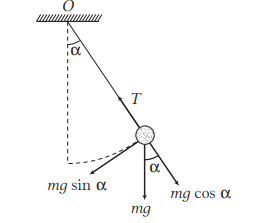
As the bob moves in a circle of radius \(L\) with centre at \(O\). A centripetal force of magnitude \(\frac{m v^2}{L}\) is required towards \(O\). This force will be provided by the resultant of \(T\) and \(m g \cos \alpha\). Thus,
\(
T-m g \cos \alpha=\frac{m v^2}{L}
\)
or \(\quad T=m\left(g \cos \alpha+\frac{v^2}{L}\right)\)
(ii)
\(
\begin{aligned}
\left|\mathbf{F}_{\mathrm{net}}\right| & =\sqrt{(m g \sin \alpha)^2+\left(\frac{m v^2}{L}\right)^2} \\
& =m \sqrt{g^2 \sin ^2 \alpha+\frac{v^4}{L^2}}
\end{aligned}
\)
Example 15: A heavy particle hanging from a fixed point by a light inextensible string of length \(l\) is projected horizontally with speed \(\sqrt{\text { gl }}\). Find the speed of the particle and the inclination of the string to the vertical at the instant of the motion when the tension in the string is equal to the weight of the particle.
Solution: Let \(T=m g\) at angle \(\theta\) as shown in figure.
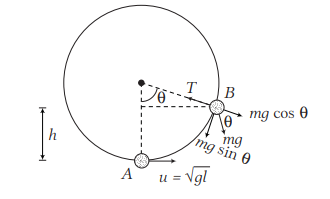
\(
h=l(1-\cos \theta) \dots(i)
\)
Applying conservation of mechanical energy between points \(A\) and \(B\), we get
\(
\frac{1}{2} m\left(u^2-v^2\right)=m g h
\)
Here, \(u^2=g l \dots(ii)\)
and \(\quad v=\) speed of particle in position \(B\)
\(
\therefore \quad v^2=u^2-2 g h \dots(iii)
\)
Further, \(T-m g \cos \theta=\frac{m v^2}{l}\)
\(m g-m g \cos \theta=\frac{m v^2}{l} (\because T=m g)\)
\(
v^2=g l(1-\cos \theta) \dots(iv)
\)
Substituting the values of \(v^2, u^2\) and \(h\) from Eqs. (iv), (ii) and
(i) in Eq. (iii), we get
\(
\begin{aligned}
g l(1-\cos \theta) & =g l-2 g l(1-\cos \theta) \\
\cos \theta & =\frac{2}{3} \text { or } \theta=\cos ^{-1}\left(\frac{2}{3}\right)
\end{aligned}
\)
Substituting \(\cos \theta=\frac{2}{3}\) in Eq. (iv), we get
\(
v=\sqrt{\frac{g l}{3}}
\)
Example 16: \(A\) particle of mass \(m\) is attached to a string of length \(L\) and given velocity \(\sqrt{10 g L}\) in the horizontal direction at the lowest point. Find tension in the string when the particle is at (i) (a) lowest position (b) highest position; (ii) when the string makes an angle \(60^{\circ}\) with (a) lower vertical and (b) upper vertical.
Solution: (i)
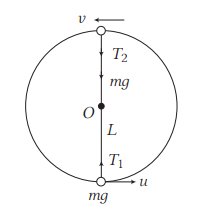
(a) At the lowest position,
\(
T_1-m g=\frac{m u^2}{L}=\frac{m}{L} \times 10 g L \Rightarrow T_1=11 m g
\)
(b) At the highest position,
\(
\begin{aligned}
v^2 & =u^2-2 g h=u^2-2 g \times 2 L \\
& =10 g L-4 g L=6 g L
\end{aligned}
\)
Also, \(T_2+m g=\frac{m v^2}{L}=\frac{m}{L} \times 6 g L=6 m g\)
\(
\Rightarrow \quad T_2=5 \mathrm{mg}
\)
(ii) (a)
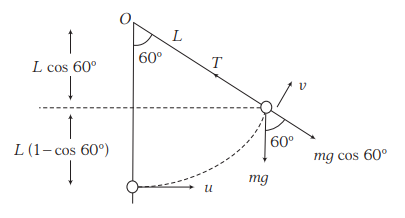
In this situation, we can write
\(
\begin{aligned}
v^2 & =u^2-2 g h=u^2-2 g L\left(1-\cos 60^{\circ}\right) \\
& =10 g L-2 g L\left(1-\frac{1}{2}\right)=9 g L
\end{aligned}
\)
\(
\text { Also, } T-m g \cos 60^{\circ}=\frac{m v^2}{L}=\frac{m}{L} \times 9 g L=9 m g
\)
\(
\begin{aligned}
T-\frac{m g}{2} & =9 m g \\
T & =\frac{19}{2} m g
\end{aligned}
\)
(b)
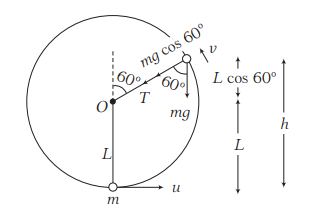
In this situation, we have
\(
v^2=u^2-2 g h=10 g L-2 g L\left(1+\cos 60^{\circ}\right)=7 g L
\)
\(
\begin{aligned}
& \text { Also, } \quad T+m g \cos 60^{\circ}=\frac{m v^2}{L} \\
& \Rightarrow \quad T+\frac{m g}{2}=\frac{m}{L} \times 7 g L=7 m g \\
& \Rightarrow \quad T=\frac{13 m g}{2}
\end{aligned}
\)
Example 17: \(A\) hemispherical bowl of radius \(R\) is rotating about its axis of symmetry which is kept vertical. A small ball kept in the bowl rotates with the bowl without slipping on its surface. If the surface of the bowl is smooth and the angle made by the radius through the ball with the vertical is \(\alpha\). Find the angular speed at which the bowl is rotating.
Solution: Let \(\omega\) be the angular speed of rotation of the bowl. Two forces are acting on the ball
(i) normal reaction \(N\)
(ii) weight \(m q\)
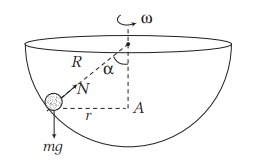
The ball is rotating in a circle of radius \(r(=R \sin \alpha)\) with centre at \(A\) at an angular speed \(\omega\). Thus,
\(
\begin{aligned}
& & N \sin \alpha & =m r \omega^2=m R \omega^2 \sin \alpha \\
\Rightarrow & & N & =m R \omega^2 \dots(i)
\end{aligned}
\)
and \(\quad N \cos \alpha=m g \dots(ii)\)
\(
\begin{aligned}
&\text { On dividing Eq. (i) by Eq. (ii), we get }\\
&\frac{1}{\cos \alpha}=\frac{\omega^2 R}{g} \Rightarrow \omega=\sqrt{\frac{g}{R \cos \alpha}}
\end{aligned}
\)