4.11 Solving problems in mechanics
Q1. A body of mass \(m\) is suspended by two strings making angles \(\alpha\) and \(\beta\) with the horizontal. Find the tensions in the strings.
Solution: Take the body of mass \(m\) as the system. The forces acting on the system are
(i) \(m g\) downwards (by the earth),
(ii) \(T_1\) along the first string (by the first string) and
(iii) \(T_2\) along the second string (by the second string).
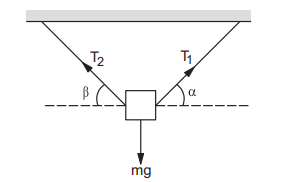
These forces are shown in figure (5-W1). As the body is in equilibrium, these forces must add to zero. Taking horizontal components,
\(
\begin{aligned}
T_1 \cos \alpha-T_2 \cos \beta+m g \cos \frac{\pi}{2} & =0 \\
T_1 \cos \alpha & =T_2 \cos \beta \dots(i)
\end{aligned}
\)
Taking vertical components,
\(
T_1 \sin \alpha+T_2 \sin \beta-m g=0 \dots(ii)
\)
Eliminating \(T_2\) from (i) and (ii),
\(
T_1 \sin \alpha+T_1 \frac{\cos \alpha}{\cos \beta} \sin \beta=m g
\)
\(
T_1=\frac{m g}{\sin \alpha+\frac{\cos \alpha}{\cos \beta} \sin \beta}=\frac{m g \cos \beta}{\sin (\alpha+\beta)} .
\)
From (i),
\(
T_2=\frac{m g \cos \alpha}{\sin (\alpha+\beta)}
\)
Q2. A bullet moving at \(250 \mathrm{~m} / \mathrm{s}\) penetrates 5 cm into a tree limb before coming to rest. Assuming that the force exerted by the tree limb is uniform, find its magnitude. Mass of the bullet is 10 g.
Solution: The tree limb exerts a force on the bullet in the direction opposite to its velocity. This force causes deceleration and hence the velocity decreases from \(250 \mathrm{~m} / \mathrm{s}\) to zero in 5 cm. We have to find the force exerted by the tree limb on the bullet. If \(a\) be the deceleration of the bullet, we have,
\(
u=250 \mathrm{~m} / \mathrm{s}, v=0, x=5 \mathrm{~cm}=0.05 \mathrm{~m}
\)
giving, \(\quad a=\frac{(250 \mathrm{~m} / \mathrm{s})^2-0^2}{2 \times 0.05 \mathrm{~m}}=625000 \mathrm{~m} / \mathrm{s}^2\).
The force on the bullet is \(F=m a=6250 \mathrm{~N}\).
Q3. The force on a particle of mass 10 g is \((\vec{i} 10+\vec{j} 5) \mathrm{N}\). If it starts from rest what would be its position at time \(t=5 \mathrm{~s}\) ?
Solution: We have \(F_x=10 \mathrm{~N}\) giving
\(
a_x=\frac{F_x}{m}=\frac{10 \mathrm{~N}}{0.01 \mathrm{~kg}}=1000 \mathrm{~m} / \mathrm{s}^2 .
\)
As this is a case of constant acceleration in \(x\)-direction,
\(
\begin{aligned}
x & =u_x t+\frac{1}{2} a_x t^2=\frac{1}{2} \times 1000 \mathrm{~m} / \mathrm{s}^2 \times(5 \mathrm{~s})^2 \\
& =12500 \mathrm{~m}
\end{aligned}
\)
Similarly, \(a_y=\frac{F_y}{m}=\frac{5 \mathrm{~N}}{0 \cdot 01 \mathrm{~kg}}=500 \mathrm{~m} / \mathrm{s}^2\)
and \(\quad y=6250 \mathrm{~m}\).
Thus, the position of the particle at \(t=5 \mathrm{~s}\) is,
\(
\vec{r}=(\vec{i} 12500+\vec{j} 6250) \mathrm{m} .
\)
Q4. With what acceleration ‘\(a\)‘ should the box of figure below descend so that the block of mass \(M\) exerts a force Mg/4 on the floor of the box?
Solution: The block is at rest with respect to the box which is accelerated with respect to the ground. Hence, the acceleration of the block with respect to the ground is ‘ \(a\) ‘ downward. The forces on the block are
(i) \(M g\) downward (by the earth) and
(ii) \(N\) upward (by the floor).
The equation of motion of the block is, therefore
\(
M g-N=M a .
\)
If \(N=M g / 4\), the above equation gives \(a=3 g / 4\). The block and hence the box should descend with an acceleration \(3 g / 4\).
Q5. A block ‘ \(A\) ‘ of mass \(m\) is tied to a fixed point \(C\) on a horizontal table through a string passing round a massless smooth pulley \(B\) (figure below). A force \(F\) is applied by the experimenter to the pulley. Show that if the pulley is displaced by a distance \(x\), the block will be displaced by \(2 x\). Find the acceleration of the block and the pulley.
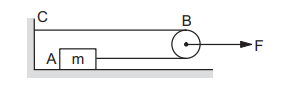
Solution: The vertical forces, if any, add to zero as there is no vertical motion.
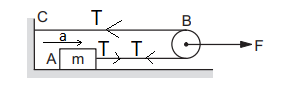
As the mass of the pulley is zero, the equation of motion is
\(F-2 T=0\) giving \(T=F / 2\).
Now consider the block as the system. The only horizontal force acting on the block is the tension \(T\) towards right. The acceleration of the block is, therefore, \(a=T / m=\frac{F}{2 m}\). The acceleration of the pulley is \(a / 2=\frac{F}{4 m}\).
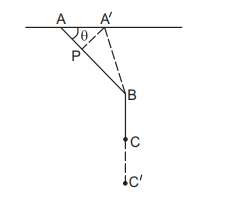
Q6. A smooth ring \(A\) of mass \(m\) can slide on a fixed horizontal rod. A string tied to the ring passes over a fixed pulley \(B\) and carries a block \(C\) of mass \(M(=2 m)\) as shown in figure below. At an instant the string between the ring and the pulley makes an angle \(\theta\) with the rod. (a) Show that, if the ring slides with a speed \(v\), the block descends with speed \(v \cos \theta\). (b) With what acceleration will the ring start moving if the system is released from rest with \(\theta=30^{\circ}\) ?
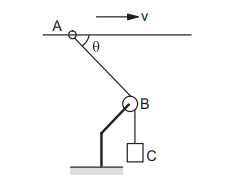
Solution: (a) Suppose in a small time interval \(\Delta t\) the ring is displaced from \(A\) to \(A^{\prime}\) (figure below) and the block from \(C\) to \(C^{\prime}\). Drop a perpendicular \(A^{\prime} P\) from \(A^{\prime}\) to \(A B\). For small displacement \(A^{\prime} B \approx P B\). Since the length of the string is constant, we have
\(
\begin{aligned}
A B+B C & =A^{\prime} B+B C^{\prime} \\
A P+P B+B C & =A^{\prime} B+B C^{\prime} \\
A P=B C^{\prime}-B C & =C C^{\prime} \quad\left(\text { as } A^{\prime} B \approx P B\right) \\
A A^{\prime} \cos \theta & =C C^{\prime} \\
\frac{A A^{\prime} \cos \theta}{\Delta t} & =\frac{C C^{\prime}}{\Delta t}
\end{aligned}
\)
or, (velocity of the ring) \(\cos \theta=\) (velocity of the block).
(b) If the initial acceleration of the ring is \(a\), that of the block will be \(a \cos \theta\). Let \(T\) be the tension in the string at this instant. Consider the block as the system. The forces acting on the block are
(i) Mg downward due to the earth, and
(ii) \(T\) upward due to the string.
The equation of motion of the block is
\(
M g-T=M a \cos \theta \dots(i)
\)
Now consider the ring as the system. The forces on the ring are
(i) \(M g\) downward due to gravity,
(ii) \(N\) upward due to the rod,
(iii) \(T\) along the string due to the string.
Taking components along the rod, the equation of motion of the ring is
\(
T \cos \theta=m a \dots(ii)
\)
From (i) and (ii)
\(
M g-\frac{m a}{\cos \theta}=M a \cos \theta
\)
\(
a=\frac{M g \cos \theta}{m+M \cos ^2 \theta} .
\)
Putting \(\theta=30^{\circ}, M=2 m\) and \(g=9 \cdot 8 \mathrm{~m} / \mathrm{s}^2\); therefore
\(
a=6.78 \mathrm{~m} / \mathrm{s}^2 .
\)
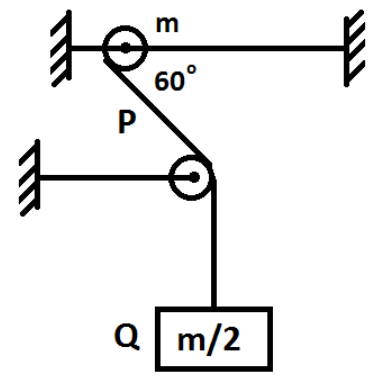
Q7. A smooth ring \(\mathbf{P}\) of mass \(m\) can slide on a fixed horizontal rod. A string tied to the ring passes over a fixed pulley and carries a block \(Q\) of mass \(\frac{m}{2}\) as shown in the figure. At an instant, the string between the ring and the pulley makes an angle \(60^{\circ}\) with the rod. The initial acceleration of the ring is:
Solution: Tension is a kind of force that is applied to a string. If we have an object of mass \(m\) hanging on a string with a downward acceleration due to gravity, \(g\), on that object, the tension on the string, is equal to the force of gravity on the object, \(F=m g\).
For mass not to be in equilibrium, the net force will be equal to the acceleration of the mass
\(
F-m g=m a
\)
We are given that a smooth ring of mass \(m\) can slide on a fixed horizontal rod. At an instant, the string between the ring and the pulley makes an angle \(60^{\circ}\) with the rod. We need to calculate the initial acceleration of the ring.
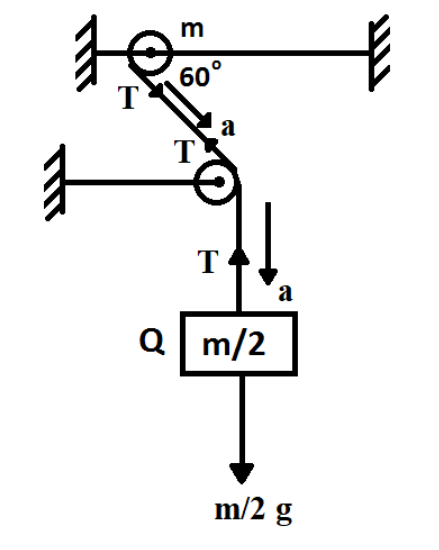
Consider \(a^{\prime}\) be the initial acceleration of the ring,
Applying the equation for newton’s second law on the ring
\(
T \cos \left(60^{\circ}\right)=m a^{\prime}=m a \cos \left(60^{\circ}\right)
\)
We get,
\(
T=m a \dots(1)
\)
Applying the equation for newton’s second law on the block,
\(
\left(\frac{m}{2}\right) a=\frac{m g}{2}-T
\)
From equation 1, we have, \(T=m a\)
Therefore,
\(
\begin{aligned}
& \left(\frac{m}{2}\right) a=\frac{m g}{2}-m a \\
& \frac{3 m a}{2}=\frac{m g}{2} \\
& a=\frac{g}{3}
\end{aligned}
\)
Acceleration of the ring is given by,
\(
a^{\prime}=a \cos 60^{\circ}
\)
Put \(a=\frac{g}{3}\)
We get,
\(
\begin{aligned}
& a^{\prime}=\frac{g}{3} \times \frac{1}{2} \\
& \left(\because \cos 60^{\circ}=\frac{1}{2}\right) \\
& a^{\prime}=\frac{g}{6}
\end{aligned}
\)
The initial acceleration of the ring is \(\frac{g}{6}\)
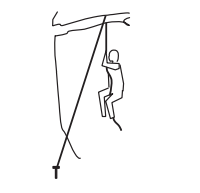
Q8. A light rope fixed at one end of a wooden clamp on the ground passes over a tree branch and hangs on the other side (figure below). It makes an angle of \(30^{\circ}\) with the ground. A man weighing \((60 \mathrm{~kg})\) wants to climb up the rope. The wooden clamp can come out the ground if an upward force greater than 360 N is applied to it. Find the maximum acceleration in the upward direction with which the man can climb safely. Neglect friction at the tree branch. Take \(g=10 \mathrm{~m} / \mathrm{s}^2\).
Solution:
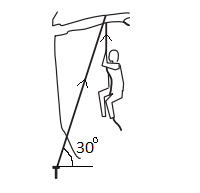
Let \(T\) be the tension in the rope. The upward force on the clamp is \(T \sin 30^{\circ}=T / 2\). The maximum tension that will not detach the clamp from the ground is, therefore, given by
\(
\begin{aligned}
& \frac{T}{2}=360 \mathrm{~N} \\
& T=720 \mathrm{~N} .
\end{aligned}
\)
If the acceleration of the man in the upward direction is \(a\), the equation of motion of the man is
\(T-M_g=M a\)
\(
T-600 \mathrm{~N}=(60 \mathrm{~kg}) a
\)
The maximum acceleration of the man for safe climbing is, therefore
\(
a=\frac{720 \mathrm{~N}-600 \mathrm{~N}}{60 \mathrm{~kg}}=2 \mathrm{~m} / \mathrm{s}^2 .
\)
Q9. Three blocks of masses \(m_1, m_2\) and \(m_3\) are connected as shown in the figure below. All the surfaces are frictionless and the string and the pulleys are light. Find the acceleration of \(m_1\).
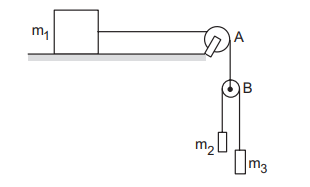
Solution: Suppose the acceleration of \(m_1\) is \(a_0\) towards right. That will also be the downward acceleration of the pulley \(B\) because the string connecting \(m_1\) and \(B\) is constant in length. Also the string connecting \(m_2\) and \(m_3\) has a constant length. This implies that the decrease in the separation between \(m_2\) and \(B\) equals the increase in the separation between \(m_3\) and \(B\). So, the upward acceleration of \(m_2\) with respect to \(B\) equals the downward acceleration of \(m_3\) with respect to \(B\). Let this acceleration be \(a\).
The acceleration of \(m_2\) with respect to the ground \(=a_0-a\) (downward) and the acceleration of \(m_3\) with respect to the ground \(=a_0+a\) (downward).
These accelerations will be used in Newton’s laws. Let the tension be \(T\) in the upper string and \(T^{\prime}\) in the lower string. Consider the motion of the pulley \(B\).
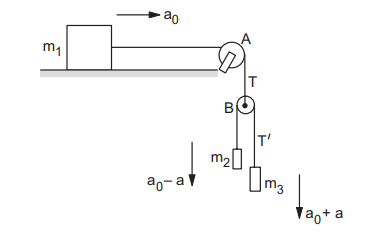
The forces on this light pulley are
(a) \(T\) upwards by the upper string and
(b) \(2 T^{\prime}\) downwards by the lower string.
As the mass of the pulley is negligible,
\(
2 T^{\prime}-T=0
\)
giving
\(
T^{\prime}=T / 2 \dots(i)
\)
Motion of \(m_1\) :
The acceleration is \(a_0\) in the horizontal direction. The forces on \(m_1\) are
(a) \(T\) by the string (horizontal).
(b) \(m_1 g\) by the earth (vertically downwards) and
(c) \(\propto \mathrm{V}\) by the table (vertically upwards).
In the horizontal direction, the equation is
\(
T=m_1 a_0 \dots(ii)
\)
Motion of \(m_2:\) acceleration is \(a_0-a\) in the downward direction. The forces on \(m_2\) are
(a) \(m_2 g\) downward by the earth and
(b) \(T^{\prime}=T / 2\) upward by the string.
Thus,
\(
m_2 g-T / 2=m_2\left(a_0-a\right) \dots(iii)
\)
Motion of \(m_3\) : The acceleration is \(\left(a_0+a\right)\) downward. The forces on \(m_3\) are
(a) \(m_3 g\) downward by the earth and
(b) \(T^{\prime}=T / 2\) upward by the string. Thus,
\(
m_3 g-T / 2=m_3\left(a_0+a\right) \dots(iv)
\)
We want to calculate \(a_0\), so we shall eliminate \(T\) and \(a\) from (ii), (iii) and (iv).
Putting \(T\) from (ii) in (iii) and (iv),
\(
a_0-a=\frac{m_2 g-m_1 a_0 / 2}{m_2}=g-\frac{m_1 a_0}{2 m_2}
\)
and
\(
a_0+a=\frac{m_3 g-m_1 a_0 / 2}{m_3}=g-\frac{m_1 a_0}{2 m_3} .
\)
Adding, \(\quad 2 a_0=2 g-\frac{m_1 a_0}{2}\left(\frac{1}{m_2}+\frac{1}{m_3}\right)\)
\(
\begin{aligned}
& a_0=g-\frac{m_1 a_0}{4}\left(\frac{1}{m_2}+\frac{1}{m_3}\right) \\
& a_0\left[1+\frac{m_1}{4}\left(\frac{1}{m_2}+\frac{1}{m_3}\right)\right]=g \\
& a_0=\frac{g}{1+\frac{m_1}{4}\left(\frac{1}{m_2}+\frac{1}{m_3}\right)} .
\end{aligned}
\)
Q10. A particle slides down a smooth inclined plane of elevation \(\theta\), fixed in an elevator going up with an acceleration \(a_0\) (figure below). The base of the incline has a length \(L\). Find the time taken by the particle to reach the bottom.
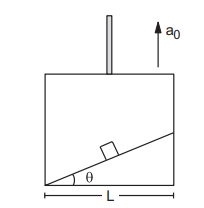
Solution: Let us work in the elevator frame. A pseudo force \(m a_0\) in the downward direction is to be applied on the particle of mass \(m\) together with the real forces. Thus, the forces on \(m\) are (figure below)
(i) \(N\) normal force,
(ii) \(m g\) downward (by the earth),
(iii) \(m a_0\) downward (pseudo).
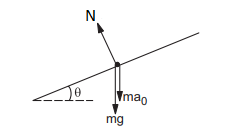
Let \(a\) be the acceleration of the particle with respect to the incline. Taking components of the forces parallel to the incline and applying Newton’s law,
\(
\begin{aligned}
m g \sin \theta+m a_0 \sin \theta & =m a \\
a & =\left(g+a_0\right) \sin \theta .
\end{aligned}
\)
This is the acceleration with respect to the elevator. In this frame, the distance travelled by the particle is \(L / \cos \theta\). Hence,
\(
\begin{aligned}
& \frac{L}{\cos \theta}=\frac{1}{2}\left(g+a_0\right) \sin \theta \cdot t^2 \\
t= & {\left[\frac{2 L}{\left(g+a_0\right) \sin \theta \cos \theta}\right]^{1 / 2} . }
\end{aligned}
\)
Q11. All the surfaces shown in figure below are assumed to be frictionless. The block of mass \(m\) slides on the prism which in turn slides backward on the horizontal surface. Find the acceleration of the smaller block with respect to the prism.
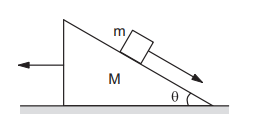
Solution: Let the acceleration of the prism be \(a_0\) in the backward direction. Consider the motion of the smaller block from the frame of the prism.
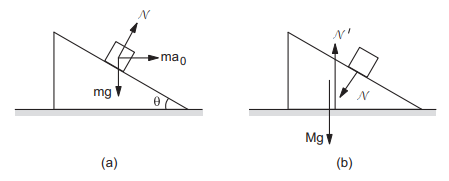
The forces on the block are (figure a)
(i) \(N\) normal force,
(ii) \(m g\) downward (gravity),
(iii) \(m a_0\) forward (pseudo).
The block slides down the plane. Components of the forces parallel to the incline give
\(
m a_0 \cos \theta+m g \sin \theta=m a
\)
\(
a=a_0 \cos \theta+g \sin \theta \dots(i)
\)
Components of the force perpendicular to the incline give
\(
N+m a_0 \sin \theta=m g \cos \theta \dots(ii)
\)
Now consider the motion of the prism from the lab frame. No pseudo force is needed as the frame used is inertial. The forces are (figure b)
(i) \(M g\) downward,
(ii) \(N\) normal to the incline (by the block),
(iii) \(N^{\prime}\) upward (by the horizontal surface).
Horizontal components give,
\(
N \sin \theta=M a_0 \quad \text { or, } N=M a_0 / \sin \theta .
\)
Putting in (ii)
\(
\begin{aligned}
\frac{M a_0}{\sin \theta}+m a_0 \sin \theta & =m g \cos \theta \\
a_0 & =\frac{m g \sin \theta \cos \theta}{M+m \sin ^2 \theta} .
\end{aligned}
\)
From (i),
\(
\begin{aligned}
a & =\frac{m g \sin \theta \cos ^2 \theta}{M+m \sin ^2 \theta}+g \sin \theta \\
& =\frac{(M+m) g \sin \theta}{M+m \sin ^2 \theta}
\end{aligned}
\)
Q12. A block of mass 0.2 kg is suspended from the ceiling by a light string. A second block of mass 0.3 kg is suspended from the first block through another string. Find the tensions in the two strings. Take \(g=10 \mathrm{~m} / \mathrm{s}^2\).
Solution:
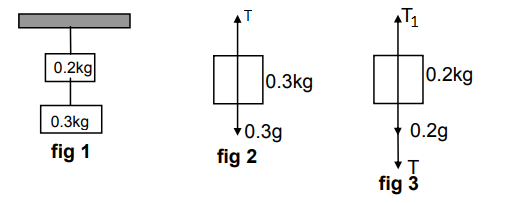
\(
\mathrm{T}-0.3 \mathrm{~g}=0 \Rightarrow \mathrm{~T}=0.3 \mathrm{~g}=0.3 \times 10=3 \mathrm{~N} \quad \mathrm{g}=10 \mathrm{~m} / \mathrm{s}^2
\)
\(
\begin{aligned}
&T_1-(0.2 g+T)=0 \Rightarrow T_1=0.2 g+T=0.2 \times 10+3=5 N\\
&\text { ∴ Tension in the two strings are } 5 \mathrm{~N} \text { & } 3 \mathrm{~N} \text { respectively. }
\end{aligned}
\)
Q13. Raindrops of radius 1 mm and mass 4 mg are falling with a speed of \(30 \mathrm{~m} / \mathrm{s}\) on the head of a bald person. The drops splash on the head and come to rest. Assuming equivalently that the drops cover a distance equal to their radii on the head, estimate the force exerted by each drop on the head.
Solution: Step 1: Find the acceleration of the raindrop
The raindrop’s initial velocity is \(v_i=30 \mathrm{~m} / \mathrm{s}\) and its final velocity is \(v_f=0 \mathrm{~m} / \mathrm{s}\). The distance it travels while stopping is given as its radius, \(d=1 \mathrm{~mm}=1 \times 10^{-3} \mathrm{~m}\).
We can use the kinematic equation \(v_f^2=v_i^2+2 a d\) to find the acceleration \((a)\).
\(
\begin{gathered}
0^2=(30)^2+2 a\left(1 \times 10^{-3}\right) \\
0=900+\left(2 \times 10^{-3}\right) a \\
-900=\left(2 \times 10^{-3}\right) a \\
a=\frac{-900}{2 \times 10^{-3}} \\
a=-450000 \mathrm{~m} / \mathrm{s}^2
\end{gathered}
\)
The negative sign indicates that the acceleration is in the opposite direction of the initial velocity, which is expected for deceleration.
Step 2: Calculate the force
Now we can use Newton’s second law, \(F=m a\), to find the force exerted by the drop. The mass of the drop is \(m=4 \mathrm{mg}=4 \times 10^{-6} \mathrm{~kg}\). We use the magnitude of the acceleration.
\(
\begin{gathered}
F=\left(4 \times 10^{-6} \mathrm{~kg}\right)\left(450000 \mathrm{~m} / \mathrm{s}^2\right) \\
F=1.8 \mathrm{~N}
\end{gathered}
\)
The force exerted by each drop on the head is 1.8 N.
Q14. A particle of mass 0.3 kg is subjected to a force \(F=-k x\) with \(k=15 \mathrm{~N} / \mathrm{m}\). What will be its initial acceleration if it is released from a point \(x=20 \mathrm{~cm}\) ?
Solution: First, convert the initial position from centimeters to meters to maintain consistency with SI units.
Given position: \(x=20 \mathrm{~cm}=0.20 \mathrm{~m}\)
The force is given by Hooke’s Law: \(\boldsymbol{F}=-\boldsymbol{k} \boldsymbol{x}\).
The acceleration is related to the force by Newton’s Second Law: \(\boldsymbol{F}=m a\).
Step 2: Combine the Formulas and Solve for Acceleration
By equating the two expressions for the force, we can solve for the acceleration (\(a\)).
\(
\begin{array}{r}
m a=-k x \\
a=\frac{-k x}{m}
\end{array}
\)
Now, substitute the given values into the equation for acceleration.
\(k=15 \mathrm{~N} / \mathrm{m}\)
\(x=0.20 \mathrm{~m}\)
\(m=0.3 \mathrm{~kg}\)
\(a=\frac{-(15 \mathrm{~N} / \mathrm{m})(0.20 \mathrm{~m})}{0.3 \mathrm{~kg}}\)
\(a=\frac{-3 \mathrm{~N}}{0.3 \mathrm{~kg}}\)
\(a=-10 \mathrm{~m} / \mathrm{s}^2\)
The initial acceleration of the particle is \(a=-10 \mathrm{~m} / \mathrm{s}^2\). The negative sign indicates that the acceleration is in the opposite direction of the displacement.
Q15. Both the springs shown in figure below are unstretched. If the block is displaced by a distance \(x\) and released, what will be the initial acceleration?
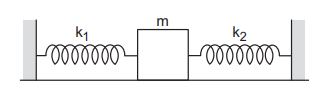
Solution:
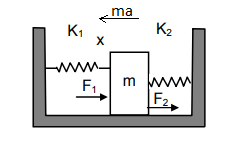
Let, the block \(m\) towards left through displacement \(x\).
\({F}_1=-{k}_1 x\) (compressed)
\({F}_2=-{k}_2 x\) (expanded)
They are in same direction.
Resultant \(F=F_1+F_2 \Rightarrow F=-k_1 x-k_2 x \Rightarrow F=-x\left(k_1+k_2\right)\)
So, \({a}=\) acceleration \(=-\frac{{F}}{{m}}=-\frac{{x}\left({k}_1+{k}_2\right)}{{m}}\) i.e. \(\left(k_1+k_2\right) \frac{x}{m}\) opposite the displacement or towards the mean position.
Q16. A small block \(B\) is placed on another block \(A\) of mass 5 kg and length 20 cm. Initially the block \(B\) is near the right end of block \(A\) (figure below). A constant horizontal force of 10 N is applied to the block \(A\). All the surfaces are assumed frictionless. Find the time elapsed before the block \(B\) separates from \(A\).
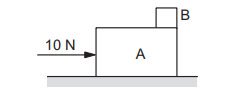
Solution: Step 1: Analyze the motion of the blocks
Since all surfaces are frictionless, a constant horizontal force of 10 N is applied to block A, and no horizontal force is applied to block B. Therefore, block A accelerates, while block B remains at rest horizontally. Block B will eventually fall off the left end of block A.
Step 2: Calculate the acceleration of block A
Using Newton’s second law, the acceleration of block A can be calculated. The mass of block A is \(m_A=5 \mathrm{~kg}\) and the applied force is \(F=10 \mathrm{~N}\).
\(
\begin{gathered}
F=m_A a_A \\
a_A=\frac{F}{m_A}=\frac{10 \mathrm{~N}}{5 \mathrm{~kg}}=2 \mathrm{~m} / \mathrm{s}^2
\end{gathered}
\)
The acceleration of block B is \(\boldsymbol{a}_{\boldsymbol{B}} \boldsymbol{=} \mathbf{0}\) because no horizontal force is acting on it.
Step 3: Find the relative acceleration and time to separation
The separation of block B from block A is determined by the relative motion between the two blocks. The relative acceleration of block B with respect to block A is:
\(
a_{B A}=a_B-a_A=0-2 \mathrm{~m} / \mathrm{s}^2=-2 \mathrm{~m} / \mathrm{s}^2
\)
The initial distance between the blocks is the length of block A, which is \(\boldsymbol{L}=20 \mathrm{~cm}=0.20 \mathrm{~m}\). The block \(B\) is initially near the right end, so it needs to travel the full length of block A relative to block A to separate. Using the kinematic equation for displacement:
\(
L=v_0 t+\frac{1}{2} a_{B A} t^2
\)
The initial relative velocity is \(v_0=0\). Plugging in the values:
\(
\begin{gathered}
0.20 \mathrm{~m}=0 \cdot t+\frac{1}{2}\left(2 \mathrm{~m} / \mathrm{s}^2\right) t^2 \\
0.20=t^2 \\
t=\sqrt{0.20} \mathrm{~s} \approx 0.45 \mathrm{~s}
\end{gathered}
\)
The time elapsed before the block B separates from A is approximately 0.45s.
Q17. A man has fallen into a ditch of width \(d\) and two of his friends are slowly pulling him out using a light rope and two fixed pulleys as shown in figure below. Show that the force (assumed equal for both the friends) exerted by each friend on the rope increases as the man moves up. Find the force when the man is at a depth \(h\).
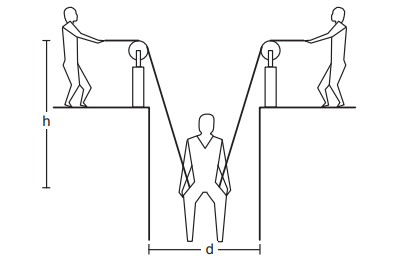
Solution: The force each friend exerts increases as the man moves up because the angle the rope makes with the vertical grows, causing the tension in the rope to be distributed across a larger vertical distance.
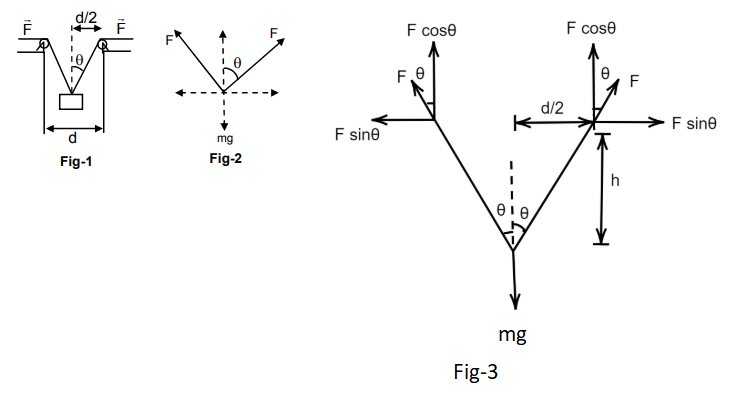
On observing the free body diagram, we can conclude that:
\(
\begin{aligned}
& F \cos \theta+F \cos \theta=m g \\
& \Rightarrow 2 F \cos \theta=m g \\
& \Rightarrow F=\frac{m g}{2 \cos \theta}
\end{aligned}
\)
As the man’s friends pull him up, the angle that the rope makes with the vertical will increase and thus \(\cos \theta\) will decrease.
We know that \(\cos \theta\) is the length of the base of a right-angle triangle divided by the length of the hypotenuse, hence in this case we will consider the depth of the ditch as the base of the triangle and the length of the rope as the length of the hypotenuse, and hence we will get the following value:
\(
\cos \theta=\frac{h}{\sqrt{\left(\frac{d}{2}\right)+h^2}}
\)
Substituting this value in equation of force, we get:
\(
\begin{aligned}
& F=\frac{m g}{2 \frac{h}{\sqrt{\left(\frac{d}{2}\right)^2+h^2}}} \\
& \Rightarrow F=\frac{m g}{2 \frac{h}{\sqrt{\frac{d^2+4 h^2}{4}}}} \\
& \Rightarrow F=\frac{m g}{\frac{h}{4 \frac{\sqrt{d^2+4 h^2}}{4 h}}} \\
& \therefore F=\frac{m g}{d^2+4 h^2}
\end{aligned}
\)
Hence, the force exerted by each of the friends increases as the man moves up.
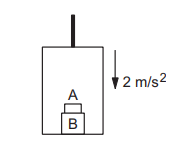
Q18. The elevator shown in figure below is descending with an acceleration of \(2 \mathrm{~m} / \mathrm{s}^2\). The mass of the block \(A\) is 0.5 kg. What force is exerted by the block \(A\) on the block \(B\) ?
Solution:
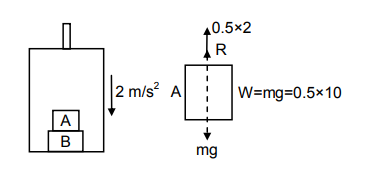
As block \(A\) is resting on top of block B inside the descending elevator, the force exerted by block A on block B is the normal force, which can be found by analyzing the forces on block A.
From the free body diagram
\(
\begin{aligned}
& \therefore R+0.5 \times 2-w=0 \\
& \Rightarrow R=w-0.5 \times 2 \\
& =0.5(10-2)=4 N.
\end{aligned}
\)
So, the force exerted by the block A on the block B, is 4 N.
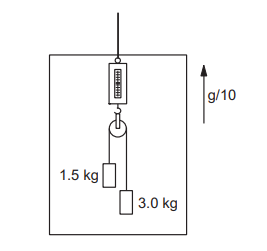
Q19. Find the reading of the spring balance shown in figure below. The elevator is going up with an acceleration of \(g / 10\), the pulley and the string are light and the pulley is smooth.
Solution:
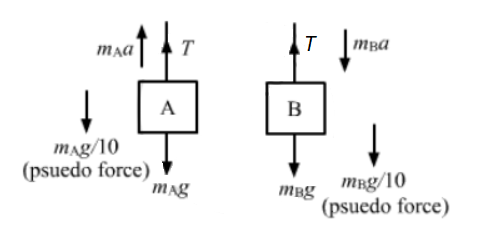
Let the acceleration of the 3 kg mass relative to the elevator is ‘ \(a\) ‘ in the downward direction.
As, shown in the free body diagram
\(
\begin{aligned}
& m_A a=T-m_A g-\frac{m_A g}{10} \ldots(1) \\
& m_B a=m_B g+\frac{m_B g}{10}-T \ldots(2)
\end{aligned}
\)
Adding both the equations, we get:
\(
a\left(m_A+m_B\right)=\left(m_B-m_A\right) g+\left(m_B-m_A\right) \frac{g}{10}
\)
Putting value of the masses, we get:
\(
\begin{aligned}
& 9 a=\frac{33 g}{10} \\
& \Rightarrow \frac{a}{g}=\frac{11}{30} \ldots(3)
\end{aligned}
\)
Now, using equation (1), we get:
\(
T=m_A\left(a+g+\frac{g}{10}\right)
\)
The reading of the spring balance \(=\frac{2 T}{g}=\frac{2}{g} m_A\left(a+g+\frac{g}{10}\right)\)
\(
\begin{aligned}
& \Rightarrow 2 \times 1.5\left(\frac{a}{g}+1+\frac{1}{10}\right)=3\left(\frac{11}{30}+1+\frac{1}{10}\right) \\
& =4.4 \mathrm{~kg}
\end{aligned}
\)
Q20. A force \(\vec{F}=\vec{v} \times \vec{A}\) is exerted on a particle in addition to the force of gravity, where \(\vec{v}\) is the velocity of the particle and \(\vec{A}\) is a constant vector in the horizontal direction. With what minimum speed a particle of mass \(m\) be projected so that it continues to move undeflected with a constant velocity?
Solution:
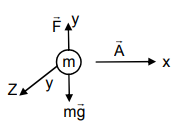
For the particle to move without being deflected and with constant velocity, the net force on the particle should be zero.
\(
\begin{aligned}
& \vec{F}+m \vec{g}=0 \\
& \Rightarrow(\vec{v} \times \vec{A})+\vec{m} g=0 \\
& \Rightarrow(\vec{v} \times \vec{A})=-\vec{m} g \\
& |v A \sin \theta|=|m g| \\
& \therefore v=\frac{m g}{A \sin \theta}
\end{aligned}
\)
\(v\) will be minimum when \(\sin \theta=1\).
\(
\begin{aligned}
& \Rightarrow \theta=90^{\circ} \\
& \therefore v_{\min }=\frac{m g}{A}
\end{aligned}
\)
Q21. In the figure, pulleys are smooth and strings are massless, \(m_1=1 \mathrm{~kg}\) and \(m_2=\frac{1}{3} \mathrm{~kg}\). To keep \(m_3\) at rest, mass \(m_3\) should be
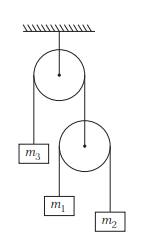
Solution: \(m_3\) is at rest. Therefore,
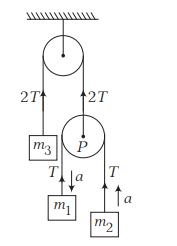
\(
2 T=m_3 g \dots(i)
\)
Further, if \(m_3\) is at rest, then pulley \(P\) is also at rest.
Writing equations of motion, \(m_1 g-T=m_1 a \dots(ii)\)
\(
T-m_2 g=m_2 a \dots(iii)
\)
Solving Eqs. (i), (ii) and (iii), we get
\(
m_3=1 \mathrm{~kg}
\)
Q22. Find the acceleration of the block of mass \(M\) in the situation shown in figure below. All the surfaces are frictionless and the pulleys and the string are light.
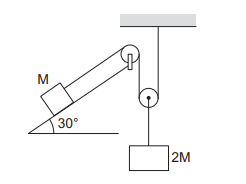
Solution: The free-body diagram of the system is shown below:
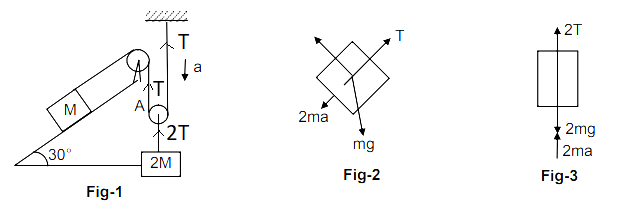
Let acceleration of the block of mass 2 M be a.
So, acceleration of the block of mass M will be 2a.
\(
\begin{aligned}
& \mathrm{M}(2 \mathrm{a})+\mathrm{Mg} \sin \theta-\mathrm{T}=0 \\
& \Rightarrow \mathrm{~T}=2 \mathrm{Ma}+\mathrm{Mgsin} \theta \dots(i) \\
& 2 \mathrm{~T}+2 \mathrm{Ma}-2 \mathrm{Mg}=0
\end{aligned}
\)
From equation (i),
\(
\begin{aligned}
& 2(2 \mathrm{Ma}+\mathrm{Mg} \sin \theta)+2 \mathrm{Ma}-2 \mathrm{Mg}=0 \\
& 4 \mathrm{Ma}+2 \mathrm{Mgs} \sin \theta+2 \mathrm{Ma}-\mathrm{Mg}=0 \\
& 6 \mathrm{Ma}+2 \mathrm{Mgs} \sin 30^{\circ}+2 \mathrm{Mg}=0 \\
& 6 \mathrm{Ma}=\mathrm{Mg} \\
& \Rightarrow a=\frac{g}{6}
\end{aligned}
\)
Hence, the acceleration of mass
\(
M=2 a=2 \times \frac{g}{6}=\frac{g}{3}(\text { up the plane }) .
\)
Q23. Find the acceleration of the 500 g block in figure below.
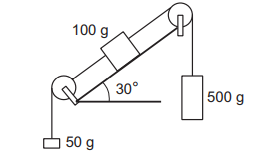
Solution: Given,
\(
\begin{aligned}
& \mathrm{m}_1=100 \mathrm{~g}=0.1 \mathrm{~kg} \\
& \mathrm{~m}_2=500 \mathrm{~g}=0.5 \mathrm{~kg} \\
& \mathrm{~m}_3=50 \mathrm{~g}=0.05 \mathrm{~kg}
\end{aligned}
\)
The free-body diagram for the system is shown below:
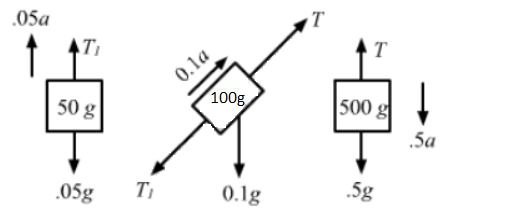
From the free-body diagram of the 500 g block,
\(
\mathrm{T}+0.5 \mathrm{a}-0.5 \mathrm{~g}=0 \dots(i)
\)
From the free-body diagram of the 50 g block,
\(
\mathrm{T}_1+0.05 \mathrm{~g}-0.05 \mathrm{a}=\mathrm{a} \dots(ii)
\)
From the free-body diagram of the 100 g block,
\(
\mathrm{T}_1+0.1 \mathrm{a}-\mathrm{T}+0.5 \mathrm{~g}=0 \dots(iii)
\)
From equation (ii),
\(
\mathrm{T}_1=0.05 \mathrm{~g}+0.05 \mathrm{a} \dots(iv)
\)
From equation (i),
\(
\mathrm{T}_1=0.5 \mathrm{~g}-0.5 \mathrm{a} \dots(v)
\)
Equation (iii) becomes
\(
\mathrm{T}_1+0.1 \mathrm{a}-\mathrm{T}+0.05 \mathrm{~g}=0
\)
From equations (iv) and (v), we get:
\(
\begin{aligned}
& 0.05 \mathrm{~g}+0.05 \mathrm{a}+0.1 \mathrm{a}-0.5 \mathrm{~g}+0.5 \mathrm{a}+0.05 \mathrm{~g}=0 \\
& 0.65 \mathrm{a}=0.4 \mathrm{~g} \\
& \Rightarrow a=\frac{0.4}{0.65} g \\
& =\frac{40}{65} g=\frac{8}{13} g(\text { downward })
\end{aligned}
\)
So, the acceleration of the 500 gm block is \(\frac{8 g}{13}\) downward.
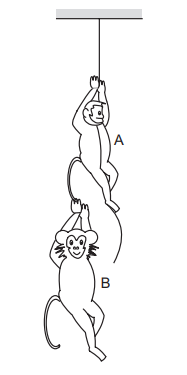
Q24. The monkey \(B\) shown in figure below is holding on to the tail of the monkey \(A\) which is climbing up a rope. The masses of the monkeys \(A\) and \(B\) are 5 kg and 2 kg respectively. If \(A\) can tolerate a tension of 30 N in its tail, what force should it apply on the rope in order to carry the monkey \(B\) with it? Take \(g=10 \mathrm{~m} / \mathrm{s}^2\).
Solution: Let the acceleration of monkey A upwards be a, so that a maximum tension of 30 N is produced in its tail.
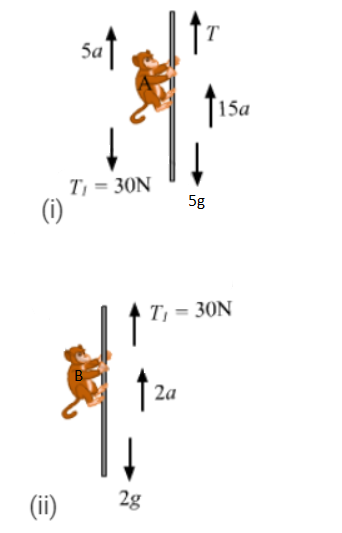
\(
\begin{aligned}
& T-5 g-30-5 a=0 \dots(i)\\
& 30-2 g-2 a=0 \dots(ii)
\end{aligned}
\)From equations (i) and (ii), we have:
\(
\mathrm{T}=105 \mathrm{~N} \quad(\max .)
\)
and \(\mathrm{a}=5 \mathrm{~m} / \mathrm{s}^2\)
So, A can apply a maximum force of 105 N on the rope to carry monkey B with it.
For minimum force, there is no acceleration of A and B.
\(
\mathrm{T}_1=\text { weight of monkey } \mathrm{B}
\)
\(
\Rightarrow \mathrm{T}_1=20 \mathrm{~N}
\)
Rewriting equation (i) for monkey A, we get:
\(
\begin{aligned}
& \mathrm{T}-5 \mathrm{~g}-20=0 \\
& \Rightarrow \mathrm{~T}=70 \mathrm{~N}
\end{aligned}
\)
To carry monkey B with it, monkey A should apply a force of magnitude between 70 N and 105 N.
Q25. Find the acceleration of the blocks \(A\) and \(B\) in the figure below.
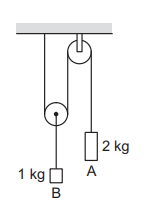
Solution:
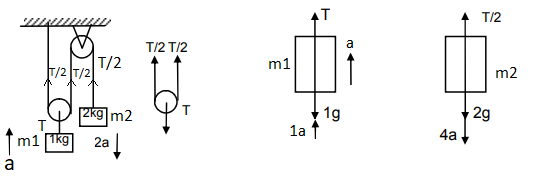
For Block \(m_1\) (FBD):
\(
T-1 g= -1 a \dots(i)
\)
For block \(m_2\) FBD:
\(
\frac{T}{2}-2 g-4 a=0 \Rightarrow T-4 g-8 a=0 \dots(ii)
\)
Put eqn (i) in (ii)
\(
\Rightarrow \mathrm{a}=-(\mathrm{g} / 3) \text { downward } \text {. }
\)
Acceleration of mass \(1 \mathrm{~kg}\) is \(\mathrm{g} / 3(\mathrm{up})\)
Acceleration of mass \(2 \mathrm{~kg}\) is \(2 \mathrm{~g} / 3\) (downward).
Q26. A block is kept on the floor of an elevator at rest. The elevator starts descending with an acceleration of \(12 \mathrm{~m} / \mathrm{s}^2\). Find the displacement of the block during the first \(0 \cdot 2 \mathrm{~s}\) after the start. Take \(g=10 \mathrm{~m} / \mathrm{s}^2\).
Solution: Step 1: Determine the acceleration of the block
The elevator is descending with an acceleration of \(a_{\text {elevator }}=12 \mathrm{~m} / \mathrm{s}^2\). The acceleration due to gravity is \(g=10 \mathrm{~m} / \mathrm{s}^2\). Since the elevator’s downward acceleration is greater than the acceleration due to gravity ( \(a_{\text {elevator }}>g\) ), the floor of the elevator moves away from the block faster than gravity can pull the block down. This means the block loses contact with the floor and falls freely under the influence of gravity. Therefore, the acceleration of the block is equal to the acceleration due to gravity.
\(
a=g=10 \mathrm{~m} / \mathrm{s}^2
\)
Step 2: Calculate the displacement
The elevator starts from rest, so the initial velocity of the block is \(\boldsymbol{v}_0=\mathbf{0}\). The displacement ( \(\boldsymbol{\Delta} \boldsymbol{y}\) ) of the block can be found using the kinematic equation for displacement.
\(
\Delta y=v_0 t+\frac{1}{2} a t^2
\)
Plugging in the given values:
\(
\begin{gathered}
t=0.2 \mathrm{~s} \\
a=10 \mathrm{~m} / \mathrm{s}^2 \\
v_0=0 \mathrm{~m} / \mathrm{s} \\
\Delta y=(0)(0.2)+\frac{1}{2}(10)(0.2)^2 \\
\Delta y=0+\frac{1}{2}(10)(0.04) \\
\Delta y=5(0.04) \\
\Delta y=0.2 \mathrm{~m}
\end{gathered}
\)
The displacement of the block during the first 0.2 s is 0.2 m.
Q27. A boy ( 30 kg ) sitting on his horse whips it. The horse speeds up at an average acceleration of \(2.0 \mathrm{~m} / \mathrm{s}^2\). (a) If the boy does not slide back, what is the force of friction exerted by the horse on the boy ? (b) If the boy slides back during the acceleration, what can be said about the coefficient of static friction between the horse and the boy. Take \(g=10 \mathrm{~m} / \mathrm{s}^2\).
Solution: (a) The forces acting on the boy are
(i) the weight \(M g\).
(ii) the normal contact force \(N\) and
(iii) the static friction \(f_s\).
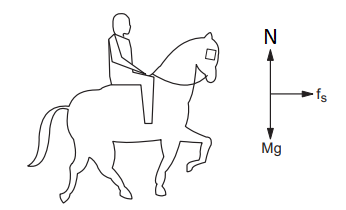
As the boy does not slide back, its acceleration \(a\) is equal to the acceleration of the horse. As friction is the only horizontal force, it must act along the acceleration and its magnitude is given by Newton’s second law
\(
f_s=M a=(30 \mathrm{~kg})\left(2 \cdot 0 \mathrm{~m} / \mathrm{s}^2\right)=60 \mathrm{~N} .
\)
(b) If the boy slides back, the horse could not exert a friction of 60 N on the boy. The maximum force of static friction that the horse may exert on the boy is
\(
\begin{aligned}
f_s & =\mu_s N=\mu_s M g \\
& =\mu_s(30 \mathrm{~kg})\left(10 \mathrm{~m} / \mathrm{s}^2\right)=\mu_s 300 \mathrm{~N}
\end{aligned}
\)
where \(\mu_s\) is the coefficient of static friction. Thus,
\(
\begin{aligned}
& \mu_s(300 \mathrm{~N})<60 \mathrm{~N} \\
& \mu_s<\frac{60}{300}=0 \cdot 20
\end{aligned}
\)
Q28. The coefficient of static friction between the block of 2 kg and the table shown in figure below is \(\mu_s=0 \cdot 2\). What should be the maximum value of \(m\) so that the blocks do not move? Take \(g=10 \mathrm{~m} / \mathrm{s}^2\). The string and the pulley are light and smooth.
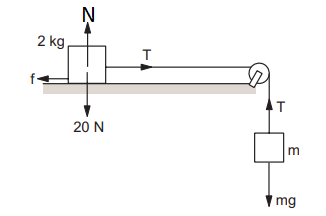
Solution: Consider the equilibrium of the block of mass \(m\). The forces on this block are
(a) \(m g\) downward by the earth and
(b) \(T\) upward by the string.
Hence,
\(
T-m g=0 \quad \text { or }, \quad T=m g \dots(i)
\)
Now consider the equilibrium of the 2 kg block. The forces on this block are
(a) \(T\) towards right by the string,
(b) \(f\) towards left (friction) by the table,
(c) 20 N downward (weight) by the earth and
(d) \(N\) upward (normal force) by the table.
For vertical equilibrium of this block,
\(
N=20 \mathrm{~N} \dots(ii)
\)
As \(m\) is the largest mass which can be used without moving the system, the friction is limiting.
Thus,
\(
f=\mu_s N \dots(iii)
\)
For horizontal equilibrium of the 2 kg block,
\(
f=T \dots(iv)
\)
Using equations (i), (iii) and (iv)
\(
\mu_s N=m g
\)
\(
0.2 \times 20 \mathrm{~N}=m g
\)
\(
m=\frac{0.2 \times 20}{10} \mathrm{~kg}=0.4 \mathrm{~kg} .
\)
Q29. The coefficient of static friction between the two blocks shown in figure below is \(\mu\) and the table is smooth. What maximum horizontal force \(F\) can be applied to the block of mass \(M\) so that the blocks move together?
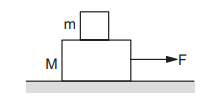
Solution: When the maximum force \(F\) is applied, both the blocks move together towards right. The only horizontal force on the upper block of mass \(m\) is that due to the friction by the lower block of mass \(M\). Hence this force on \(m\) should be towards right. The force of friction on \(M\) by \(m\) should be towards left by Newton’s third law. As we are talking of the maximum possible force \(F\) that can be applied, the friction is limiting and hence \(f=\mu N\), where \(N\) is the normal force between the blocks.
Consider the motion of \(m\). The forces on \(m\) are (figure a)
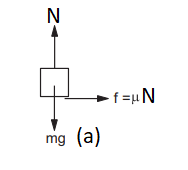
(a) \(m g\) downward by the earth (gravity),
(b) \(N\) upward by the block \(M\) (normal force) and
(c) \(f=\mu N\) (friction) towards right by the block \(M\).
In the vertical direction, there is no acceleration. This gives
\(
N=m g \dots(i)
\)
In the horizontal direction, let the acceleration be \(a\), then
\(
\mu N=m a
\)
\(
\mu m g=m a
\)
\(
a=\mu g \dots(ii)
\)
Next, consider the motion of \(M\) (figure b).
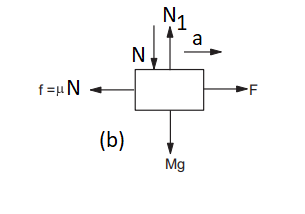
The forces on \(M\) are
(a) \(M g\) downward by the earth (gravity),
(b) \(N_1\) upward by the table (normal force),
(c) \(N\) downward by \(m\) (normal force),
(d) \(f=\mu N\) (friction) towards left by \(m\) and
(e) \(F\) (applied force) by the experimenter.
The equation of motion is
\(
F-\mu N=M a
\)
\(
F-\mu m g=M \mu g \text { [Using (i) and (ii)] }
\)
\(
F=\mu g(M+m)
\)
Q30. A block slides down an incline of angle \(30^{\circ}\) with an acceleration g/4. Find the kinetic friction coefficient.
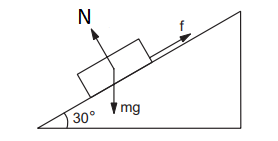
Solution: (a) \(m g\) downward by the earth (gravity),
(b) \(N\) normal force by the incline and
(c) \(f\) up the plane, (friction) by the incline.
Taking components parallel to the incline and writing Newton’s second law,
\(
m g \sin 30^{\circ}-f=m g / 4
\)
\(
f=m g / 4
\)
There is no acceleration perpendicular to the incline. Hence,
\(
N=m g \cos 30^{\circ}=m g \cdot \frac{\sqrt{ } 3}{2}
\)
As the block is slipping on the incline, friction is \(f=\mu_k N\).
So, \(\quad \mu_k=\frac{f}{N}=\frac{m g}{4 m g \sqrt{ } 3 / 2}=\frac{1}{2 \sqrt{ } 3}\).
Q31. A block of mass \(2 \cdot 5 \mathrm{~kg}\) is kept on a rough horizontal surface. It is found that the block does not slide if a horizontal force less than 15 N is applied to it. Also it is found that it takes 5 seconds to slide through the first 10 m if a horizontal force of 15 N is applied and the block is gently pushed to start the motion. Taking \(g=10 \mathrm{~m} / \mathrm{s}^2\), calculate the coefficients of static and kinetic friction between the block and the surface.
Solution: The forces acting on the block are shown in figure below. Here \(M=2.5 \mathrm{~kg}\) and \(F=15 \mathrm{~N}\).
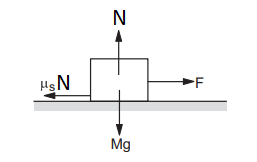
When \(F=15 \mathrm{~N}\) is applied to the block, the block remains in limiting equilibrium. The force of friction is thus \(f=\mu_s N\). Applying Newton’s first law,
\(
f=\mu_s N \text { and } N=m g
\)
so that \(\quad F=\mu_s M g\)
or, \(\quad \mu_s=\frac{F}{m g}=\frac{15 \mathrm{~N}}{(2.5 \mathrm{~kg})\left(10 \mathrm{~m} / \mathrm{s}^2\right)}=0.60\).
When the block is gently pushed to start the motion, kinetic friction acts between the block and the surface. Since the block takes 5 second to slide through the first 10 m, the acceleration \(a\) is given by
\(
\begin{aligned}
10 \mathrm{~m} & =\frac{1}{2} a(5 \mathrm{~s})^2 \\
a & =\frac{20}{25} \mathrm{~m} / \mathrm{s}^2=0.8 \mathrm{~m} / \mathrm{s}^2
\end{aligned}
\)
The frictional force is
\(
f=\mu_k N=\mu_k M g
\)
Applying Newton’s second law
\(
F-\mu_k M g=M a
\)
\(
\begin{aligned}
\mu_k & =\frac{F-M a}{M g} \\
& =\frac{15 \mathrm{~N}-(2.5 \mathrm{~kg})\left(0.8 \mathrm{~m} / \mathrm{s}^2\right)}{(2.5 \mathrm{~kg})\left(10 \mathrm{~m} / \mathrm{s}^2\right)}=0.52 .
\end{aligned}
\)
Note: Static friction opposes the start of motion between two surfaces, while kinetic friction opposes motion between two surfaces that are already moving relative to each other. Static friction’s magnitude can change up to a maximum value to match an applied force, whereas kinetic friction’s magnitude is generally constant and is typically lower than the maximum static friction.
Q32. Find the maximum value of \(M / m\) in the situation shown in figure below so that the system remains at rest. Friction coefficient at both the contacts is \(\mu\). Discuss the situation when \(\tan \theta<\mu\).
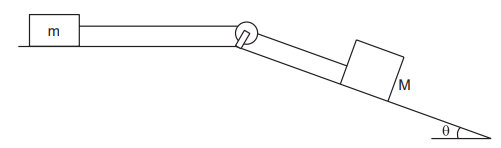
Solution: Figure below shows the forces acting on the two blocks. As we are looking for the maximum value of \(M / m\), the equilibrium is limiting. Hence, the frictional forces are equal to \(\mu\) times the corresponding normal forces.
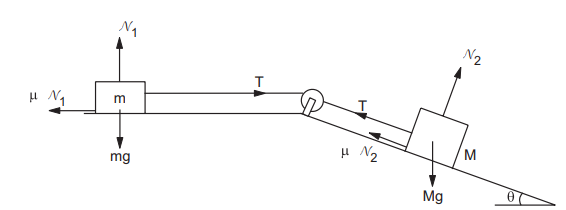
Equilibrium of the block \(m\) gives
\(T=\mu N_1 \quad\) and \(\quad N_1=m g\)
which gives
\(
T=\mu m g \dots(i)
\)
Next, consider the equilibrium of the block \(M\). Taking components parallel to the incline
\(
T+\mu N_2=M g \sin \theta
\)
Taking components normal to the incline
\(
\begin{aligned}
N_2 & =M g \cos \theta . \\
T & =M g(\sin \theta-\mu \cos \theta) \dots(ii)
\end{aligned}
\)
From (i) and (ii), \(\mu m g=M g(\sin \theta-\mu \cos \theta)\)
\(
M / m=\frac{\mu}{\sin \theta-\mu \cos \theta}
\)
If \(\tan \theta<\mu,(\sin \theta-\mu \cos \theta)<0\) and the system will not slide for any value of \(M / m\).
Q33. A particle travels in a circle of radius 20 cm at a speed that uniformly increases. If the speed changes from \(5.0 \mathrm{~m} / \mathrm{s}\) to \(6.0 \mathrm{~m} / \mathrm{s}\) in 2.0 s, find the angular acceleration.
Solution: The tangential acceleration is given by
\(
\begin{aligned}
a_t & =\frac{d v}{d t}=\frac{v_2-v_1}{t_2-t_1} \\
& =\frac{6.0-5.0}{2.0} \mathrm{~m} / \mathrm{s}^2=0.5 \mathrm{~m} / \mathrm{s}^2
\end{aligned}
\)
The relationship between tangential acceleration \(a_t\) and angular acceleration \(\alpha\) is \(a_t=r \alpha\).
\(
\alpha=\frac{a_t}{r}
\)
\(
=\frac{0.5 \mathrm{~m} / \mathrm{s}^2}{20 \mathrm{~cm}}=2.5 \mathrm{rad} / \mathrm{s}^2
\)
Q34. A body weighs 98 N on a spring balance at the north pole. What will be its weight recorded on the same scale if it is shifted to the equator? Use \(g=G M / R^2=9.8 \mathrm{~m} / \mathrm{s}^2\) and the radius of the earth \(R=6400 \mathrm{~km}\).
Solution: Step 1: Calculate the mass of the body
At the North Pole, the effect of Earth’s rotation is negligible, so the measured weight is the true gravitational force. The mass \((m)\) is calculated using the given weight \(\left(W_p\right)\) and acceleration due to gravity \(\left(g_p\right)\) at the pole:
\(
m=\frac{W_p}{g_p}=\frac{98 \mathrm{~N}}{9.8 \mathrm{~m} / \mathrm{s}^2}=10 \mathrm{~kg}
\)
Step 2: Calculate the angular velocity of the Earth
The Earth completes one rotation in approximately 24 hours (a mean solar day is often used in such problems, \(T=86400 \mathrm{~s}\) ). The angular velocity ( \(\omega\) ) is given by:
\(
\omega=\frac{2 \pi}{T}=\frac{2 \pi}{24 \times 60 \times 60 \mathrm{~s}} \approx 7.272 \times 10^{-5} \mathrm{rad} / \mathrm{s}
\)
Step 3: Calculate the effective acceleration due to gravity at the equator
At the equator, the apparent acceleration due to gravity ( \(g_e^{\prime}\) ) is less than the value at the poles due to the centrifugal acceleration \(\left(\omega^2 R\right)\) acting outwards. The formula for \(g_e^{\prime}\) is:
\(
g_e^{\prime}=g_p-\omega^2 R
\)
Substitute the values: \(R=6400 \mathrm{~km}=6.4 \times 10^6 \mathrm{~m}\).
\(
\begin{gathered}
\omega^2 R=\left(7.272 \times 10^{-5} \mathrm{rad} / \mathrm{s}\right)^2 \times\left(6.4 \times 10^6 \mathrm{~m}\right) \\
\omega^2 R \approx 5.288 \times 10^{-9} \mathrm{rad}^2 / \mathrm{s}^2 \times 6.4 \times 10^6 \mathrm{~m} \approx 0.0338 \mathrm{~m} / \mathrm{s}^2
\end{gathered}
\)
So, \(g_e^{\prime}\) is:
\(
g_e^{\prime} \approx 9.8 \mathrm{~m} / \mathrm{s}^2-0.0338 \mathrm{~m} / \mathrm{s}^2 \approx 9.7662 \mathrm{~m} / \mathrm{s}^2
\)
Step 4: Calculate the weight at the equator
The weight at the equator ( \(W_e\) ) is the product of the body’s mass and the effective acceleration due to gravity at the equator:
\(
\begin{gathered}
W_e=m \times g_e^{\prime} \\
W_e \approx 10 \mathrm{~kg} \times 9.7662 \mathrm{~m} / \mathrm{s}^2 \approx 97.662 \mathrm{~N}
\end{gathered}
\)
The weight recorded on the same scale if it is shifted to the equator will be approximately 97.66 N.
Q34. A car has to move on a level turn of radius 45 m. If the coefficient of static friction between the tyre and the road is \(\mu_s=2.0\), find the maximum speed the car can take without skidding.
Solution: The given values are the radius \(r=45 \mathrm{~m}\) and the coefficient of static friction \(\mu_s=2.0\). The acceleration due to gravity is approximated as \(g=10 \mathrm{~m} / \mathrm{s}^2\). The maximum speed \(\boldsymbol{v}_{\text {max }}\) is determined by equating the maximum static friction force ( \(\boldsymbol{\mu}_{\boldsymbol{s}} \boldsymbol{N}\), where \(\boldsymbol{N}=\boldsymbol{m g}\) ) to the centripetal force \(\left(\frac{m v^2}{r}\right)\), which yields the formula:
\(
\mu_s m g=m v^2 / r
\)
\(
v_{\max }=\sqrt{\mu_s g r}
\)
Substitute the given values into the formula to calculate the maximum speed:
\(
v_{\max }=\sqrt{2.0 \times 10 \mathrm{~m} / \mathrm{s}^2 \times 45 \mathrm{~m}}=30 \mathrm{~m} / \mathrm{s}=108 \mathrm{~km} / \mathrm{hr} .
\)
The maximum speed the car can take without skidding is approximately 30 m/s (or about \(\mathbf{1 0 8 ~ k m} / \mathbf{h}\) )
Q35. A circular track of radius 600 m is to be designed for cars at an average speed of \(180 \mathrm{~km} / \mathrm{hr}\). What should be the angle of banking of the track?
Solution: Let the angle of banking be \(\theta\). The forces on the car are (figure below)
(a) weight of the car \(M g\) downward and
(b) normal force \(N\).
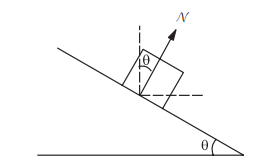
For proper banking, static frictional force is not needed. For vertical direction the acceleration is zero. So,
\(
N \cos \theta=M g \dots(i)
\)
For horizontal direction, the acceleration is \(v^2 / r\) towards the centre, so that
\(
N \sin \theta=M v^2 / r \dots(ii)
\)
From (i) and (ii),
\(
\tan \theta=v^2 / r g
\)
Putting the values, \(\tan \theta=\frac{(180 \mathrm{~km} / \mathrm{hr})^2}{(600 \mathrm{~m})\left(10 \mathrm{~m} / \mathrm{s}^2\right)}=0.4167\)
\(
\theta=22 \cdot 6^{\circ}
\)
Q36. One end of a massless spring of spring constant \(100 \mathrm{~N} / \mathrm{m}\) and natural length 0.5 m is fixed and the other end is connected to a particle of mass 0.5 kg lying on a frictionless horizontal table. The spring remains horizontal. If the mass is made to rotate at an angular velocity of \(2 \mathrm{rad} / \mathrm{s}\), find the elongation of the spring.
Solution: The particle is moving in a horizontal circle, so it is accelerated towards the centre with magnitude \(v^2 / r\). The horizontal force on the particle is due to the spring and equals \(k l\), where \(l\) is the elongation and \(k\) is the spring constant. Thus,
\(
k l=m v^2 / r=m \omega^2 r=m \omega^2\left(l_0+l\right) .
\)
Here \(\omega\) is the angular velocity, \(l_0\) is the natural length \((0.5 \mathrm{~m})\) and \(l_0+l\) is the total length of the spring which is also the radius of the circle along which the particle moves.
Thus, \(\left(k-m \omega^2\right) l=m \omega^2 l_0\)
\(
l=\frac{m \omega^2 l_0}{k-m \omega^2} .
\)
Putting the values,
\(
l=\frac{0.5 \times 4 \times 0.5}{100-0.5 \times 4} \mathrm{~m} \approx \frac{1}{100} \mathrm{~m}=1 \mathrm{~cm}
\)
Q37. A fighter plane is pulling out for a dive at a speed of \(900 \mathrm{~km} / \mathrm{hr}\). Assuming its path to be a vertical circle of radius 2000 m and its mass to be 16000 kg , find the force exerted by the air on it at the lowest point. Take \(g=9.8 \mathrm{~m} / \mathrm{s}^2\).
Solution: First, convert the plane’s speed from kilometers per hour (km/hr) to meters per second \((\mathrm{m} / \mathrm{s})\) by multiplying by \(\frac{1000 \mathrm{~m}}{1 \mathrm{~km}}\) and \(\frac{1 \mathrm{hr}}{3600 \mathrm{~s}}\).
\(
v=900 \mathrm{~km} / \mathrm{hr} \times \frac{1000}{3600}=250 \mathrm{~m} / \mathrm{s}
\)
At the lowest point of the vertical circle, two main forces act on the plane:
The upward force exerted by the air ( \(F_{a i r}\) ).
The downward force of gravity (weight, \(m g\) ).
The net force provides the required centripetal force \(\left(F_c=\frac{m v^2}{r}\right)\), which is directed towards the center of the circle (upward). The equation for forces in the vertical direction is:
\(
F_{a i r}-m g=\frac{m v^2}{r}
\)
\(
\begin{aligned}
&\text { Rearranging to solve for the force exerted by the air: }\\
&F_{a i r}=m\left(g+\frac{v^2}{r}\right)
\end{aligned}
\)
Substitute the given values into the equation: mass \(m=16000 \mathrm{~kg}\), speed \(v=250 \mathrm{~m} / \mathrm{s}\), radius \(r=2000 \mathrm{~m}\), and gravity \(g=9.8 \mathrm{~m} / \mathrm{s}^2\).
\(
F_{\text {air }}=16000\left(9.8+\frac{250^2}{2000}\right)=6.568 \times 10^5 \mathrm{~N}
\)
The force exerted by the air on the plane at the lowest point is \(6.568 \times 10^{\mathbf{5}} \mathrm{N}\) (or 656800 N ) in the upward direction.
Q38. Figure below shows a rod of length 20 cm pivoted near an end and which is made to rotate in a horizontal plane with a constant angular speed. A ball of mass \(m\) is suspended by a string also of length 20 cm from the other end of the rod. If the angle \(\theta\) made by the string with the vertical is \(30^{\circ}\), find the angular speed of the rotation. Take \(g=10 \mathrm{~m} / \mathrm{s}^2\).
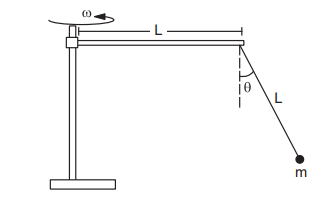
Solution: Let the angular speed be \(\omega\). As is clear from the figure, the ball moves in a horizontal circle of radius \(L+L \sin \theta\), where \(L=20 \mathrm{~cm}\). Its acceleration is, therefore, \(\omega^2(L+L \sin \theta)\) towards the centre. The forces on the bob are (figure above)
(a) the tension \(T\) along the string and
(b) the weight \(m g\).
Resolving the forces along the radius and applying Newton’s second law,
\(
T \sin \theta=m \omega^2 L(1+\sin \theta) \dots(i)
\)
Applying Newton’s first law in the vertical direction,
\(
T \cos \theta=m g \dots(ii)
\)
Dividing (i) by (ii),
\(
\tan \theta=\frac{\omega^2 L(1+\sin \theta)}{g}
\)
\(\omega^2=\frac{g \tan \theta}{L(1+\sin \theta)}=\frac{\left(10 \mathrm{~m} / \mathrm{s}^2\right)(1 / \sqrt{ } 3)}{(0 \cdot 20 \mathrm{~m})(1+1 / 2)}\)
\(
\omega=4 \cdot 4 \mathrm{rad} / \mathrm{s}
\)
Q39. Two blocks each of mass \(M\) are connected to the ends of a light frame as shown in figure (below). The frame is rotated about the vertical line of symmetry. The rod breaks if the tension in it exceeds \(T_0\). Find the maximum frequency with which the frame may be rotated without breaking the rod.
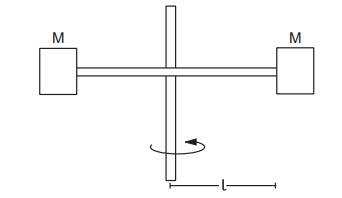
Solution: Consider one of the blocks. If the frequency of revolution is \(f\), the angular velocity is \(\omega=2 \pi f\). The acceleration towards the centre is \(v^2 / l=\omega^2 l=4 \pi^2 f^2 l\). The only horizontal force on the block is the tension of the rod. At the point of breaking, this force is \(T_0\). So from Newton’s second law,
\(
\begin{aligned}
T_0 & =M \cdot 4 \pi^2 f^2 l \\
f & =\frac{1}{2 \pi}\left[\frac{T_0}{M l}\right]^{1 / 2}
\end{aligned}
\)
Q40. A simple pendulum is suspended from the ceiling of a car taking a turn of radius 10 m at a speed of \(36 \mathrm{~km} / \mathrm{h}\). Find the angle made by the string of the pendulum with the vertical if this angle does not change during the turn. Take \(g=10 \mathrm{~m} / \mathrm{s}^2\).
Solution: \(v=36 \mathrm{~km} / \mathrm{h} \times \frac{1000 \mathrm{~m}}{3600 \mathrm{~s}}=10 \mathrm{~m} / \mathrm{s}\)
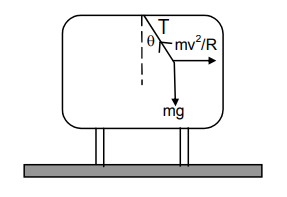
When the car turns at a constant speed, the pendulum bob experiences a centripetal acceleration \(\left(a_c\right)\) directed towards the center of the turn. In the non-inertial frame of the car, we consider the forces acting on the bob: tension ( \(\boldsymbol{T}\) ), gravity ( \(\boldsymbol{m g}\) ), and a horizontal centrifugal force ( \(F_c\) ). At a constant angle \(\theta\), these forces are in equilibrium in the car’s frame of reference.
Resolving the forces vertically and horizontally gives:
\(
\begin{gathered}
T \cos \theta=m g \\
T \sin \theta=F_c=\frac{m v^2}{r}
\end{gathered}
\)
To find the angle \(\theta\), divide the horizontal force equation by the vertical force equation to eliminate the tension \((T)\) and mass \((m)\) :
\(
\begin{gathered}
\frac{T \sin \theta}{T \cos \theta}=\frac{m v^2 / r}{m g} \\
\tan \theta=\frac{v^2}{r g}
\end{gathered}
\)
Substitute the known values \(\left(v=10 \mathrm{~m} / \mathrm{s}, r=10 \mathrm{~m}, g=10 \mathrm{~m} / \mathrm{s}^2\right)\) into the equation:
\(
\tan \theta=\frac{(10 \mathrm{~m} / \mathrm{s})^2}{(10 \mathrm{~m})\left(10 \mathrm{~m} / \mathrm{s}^2\right)}=\frac{100 \mathrm{~m}^2 / \mathrm{s}^2}{100 \mathrm{~m}^2 / \mathrm{s}^2}=1
\)
\(
\theta=45^{\circ}
\)
Q41. A mosquito is sitting on an L.P. record disc rotating on a turn table at \(33 \frac{1}{3}\) revolutions per minute. The distance of the mosquito from the centre of the turn table is 10 cm. Show that the friction coefficient between the record and the mosquito is greater than \(\pi^2 / 81\). Take \(g=10 \mathrm{~m} / \mathrm{s}^2\).
Solution: Step 1: Convert rotational speed to angular velocity
First, convert the rotational speed from revolutions per minute (rpm) to radians per second ( \(\omega\) ). The frequency \(f\) in Hz is:
\(
f=\frac{33 \frac{1}{3} \mathrm{rpm}}{60 \mathrm{~s} / \mathrm{min}}=\frac{100 / 3}{60} \mathrm{~Hz}=\frac{100}{180} \mathrm{~Hz}=\frac{5}{9} \mathrm{~Hz}
\)
The angular velocity \(\omega\) is given by \(\omega=2 \pi f\) :
\(
\omega=2 \pi \times \frac{5}{9} \mathrm{rad} / \mathrm{s}=\frac{10 \pi}{9} \mathrm{rad} / \mathrm{s}
\)
Step 2: Determine the condition for no slipping
For the mosquito (mass \(m\), distance \(r=10 \mathrm{~cm}=0.1 \mathrm{~m}\) ) to remain on the rotating disc, the static friction force ( \(F_s\) ) must provide the necessary centripetal force ( \(F_c\) ). The condition for no slipping is that the centripetal force required is less than or equal to the maximum possible static friction force ( \(\mu_s N\), where \(N=m g\) is the normal force).
\(
\begin{gathered}
F_c \leq F_{s, \max } \\
m \omega^2 r \leq \mu_s m g
\end{gathered}
\)
Step 3: Solve for the minimum coefficient of friction
The mass \(m\) cancels out, allowing us to find the minimum value the static friction coefficient \(\mu_s\) must exceed:
\(
\mu_s \geq \frac{\omega^2 r}{g}
\)
Step 4: Substitute values and calculate
Substitute the calculated values for \(\omega, r\), and the given value for \(g=10 \mathrm{~m} / \mathrm{s}^2\) :
\(
\mu_s \geq \frac{\left(\frac{10 \pi}{9}\right)^2 \times 0.1}{10}
\)
\(
\begin{aligned}
&\mu_s \geq \frac{\pi^2}{81}\\
&\text { Thus, the coefficient of static friction must be greater than or equal to } \pi^2 / 81 \text {. }
\end{aligned}
\)
The minimum friction coefficient required to keep the mosquito from slipping is \(\mu_s \geq \frac{\pi^2}{81}\).
Q42. The bob of a simple pendulum of length 1 m has mass 100 g and a speed of \(1.4 \mathrm{~m} / \mathrm{s}\) at the lowest point in its path. Find the tension in the string at this instant.
Solution: First, convert the mass from grams to kilograms to use SI units consistently. The other values are already in SI units. The acceleration due to gravity, \(g\), is assumed to be \(9.8 \mathrm{~m} / \mathrm{s}^2\).
Mass, \(m=100 \mathrm{~g}=0.1 \mathrm{~kg}\)
Length (radius of circle), \(r=1 \mathrm{~m}\)
Speed, \(v=1.4 \mathrm{~m} / \mathrm{s}\)
Acceleration due to gravity, \(g=9.8 \mathrm{~m} / \mathrm{s}^2\)
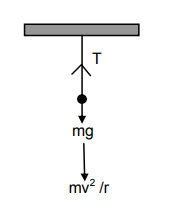
At the lowest point, two forces act on the bob: the upward tension ( \(T\) ) and the downward gravitational force ( \(m g\) ). The net upward force provides the centripetal force required for the circular path.
The equation for the net force is:
\(
T-m g=\frac{m v^2}{r}
\)
\(
\begin{aligned}
&T=m g+\frac{m v^2}{r}\\
&T=(0.1 \mathrm{~kg})\left(9.8 \mathrm{~m} / \mathrm{s}^2\right)+\frac{(0.1 \mathrm{~kg})(1.4 \mathrm{~m} / \mathrm{s})^2}{1 \mathrm{~m}}=1.176 \mathrm{~N}
\end{aligned}
\)
The tension in the string at this instant is \(\mathbf{1 . 1 7 6 ~ N}\).
Q43. A particle is projected with a speed \(u\) at an angle \(\theta\) with the horizontal. Consider a small part of its path near the highest position and take it approximately to be a circular arc. What is the radius of this circle? This radius is called the radius of curvature of the curve at the point.
Solution: Velocity at the highest point: The initial velocity is \(\boldsymbol{u}\) at an angle \(\boldsymbol{\theta}\). The horizontal component of the velocity, \(\boldsymbol{u} \boldsymbol{\operatorname { c o s }} \boldsymbol{\theta}\), remains constant throughout the motion, while the vertical component becomes zero at the highest point. Therefore, the velocity at the highest point is \(\boldsymbol{v}=\boldsymbol{u} \boldsymbol{\operatorname { c o s }} \boldsymbol{\theta}\).
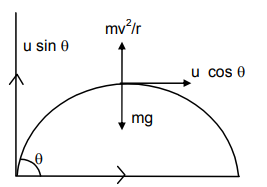
Centripetal force: At the highest point, the particle is momentarily moving in a circular arc. The centripetal force needed for this circular motion is directed downwards, and it is provided by gravity. The centripetal force is given by the formula \(F_c=\frac{m v^2}{R}\), where \(m\) is the mass of the particle, \(v\) is its velocity, and \(R\) is the radius of curvature.
Gravitational force: The gravitational force acting on the particle is its weight, \(F_g=m g\).
Equating forces: At the highest point, the centripetal force is equal to the gravitational force, so we can set them equal to each other:
\(\circ F_c=F_g\)
\(\frac{m v^2}{R}=m g\)
Solving for \(R\) : Substitute \(\boldsymbol{v}=\boldsymbol{u} \boldsymbol{\operatorname { c o s }} \boldsymbol{\theta}\) into the equation and solve for \(\boldsymbol{R}\) :
\(\frac{m(u \cos \theta)^2}{R}=m g\)
\(\frac{m u^2 \cos ^2 \theta}{R}=m g\)
\(\boldsymbol{R}=\frac{m u^2 \cos ^2 \theta}{m g}\)
\(\boldsymbol{R}=\frac{u^2 \cos ^2 \theta}{g}\)
Q44. A car moving at a speed of \(36 \mathrm{~km} / \mathrm{hr}\) is taking a turn on a circular road of radius 50 m . A small wooden plate is kept on the seat with its plane perpendicular to the radius of the circular road (figure below). A small block of mass 100 g is kept on the seat which rests against the plate. The friction coefficient between the block and the plate is \(\mu=0.58\). (a) Find the normal contact force exerted by the plate on the block. (b) The plate is slowly turned so that the angle between the normal to the plate and the radius of the road slowly increases. Find the angle at which the block will just start sliding on the plate.
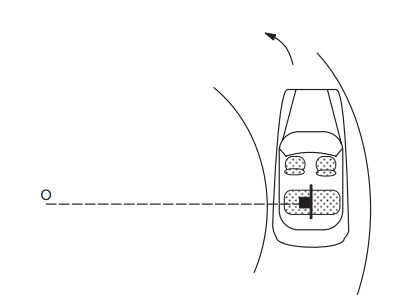
Solution: \({v}=\) Velocity of car \(=36 \mathrm{~km} / \mathrm{hr}=10 \mathrm{~m} / \mathrm{s}\)
\({r}=\) Radius of circular path \(=50 \mathrm{~m}\)
\({m}=\) mass of small body \(=100 \mathrm{~g}=0.1 \mathrm{~kg}\).
\(\mu=\) Friction coefficient between plate & body \(=0.58\)
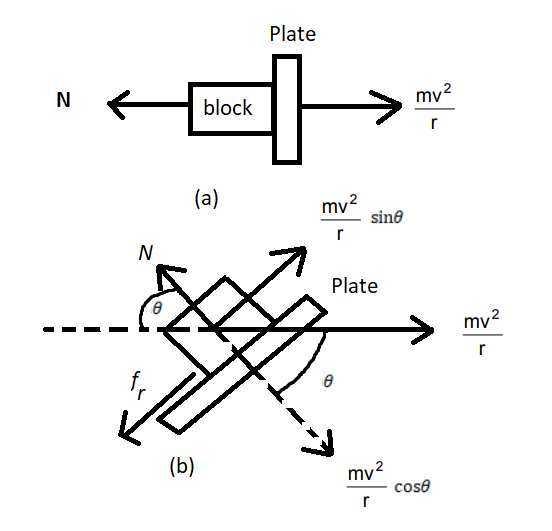
(a) The normal contact force exerted by the plate on the block (Figure(a))
In the initial configuration, the plate is perpendicular to the radius, so the normal force \(N\) provides the entire centripetal force \(F_c\) required for circular motion.
\(
N=F_c=\frac{m v^2}{r}
\)
\(
N=0.1 \mathrm{~kg} \times 2 \mathrm{~m} / \mathrm{s}^2=0.2 \mathrm{~N}
\)
(b) When the plate is slowly turned by an angle \(\theta\), (Figure(b)) the normal force \(N\) and friction force \(f\) components must balance the centripetal force \(\boldsymbol{F}_{\boldsymbol{c}}\) to prevent sliding. The condition for the block to just start sliding is when the friction force reaches its maximum value, \(f_{\text {max }}=\mu N\).
At the point of just sliding, the friction force acts along the plate to counteract the component of the “centrifugal force” or the component that would cause sliding.
\(
\begin{aligned}
&\begin{aligned}
& N=\frac{m v^2}{r} \cos \theta \dots(i) \\
& \mu N=\frac{m v^2}{r} \sin \theta \dots(ii)
\end{aligned}\\
&\text { Putting value of } \mathrm{N} \text { from (i) }
\end{aligned}
\)
\(
\mu \frac{m v^2}{r} \cos \theta=\frac{m v^2}{r} \sin \theta \Rightarrow \mu=\tan \theta \Rightarrow \theta=\tan ^{-1} \mu=\tan ^{-1}(0.58)=30^{\circ}
\)
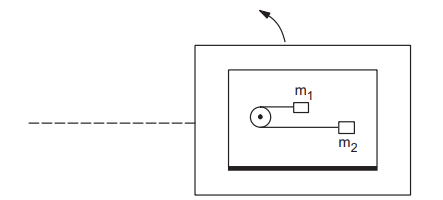
Q45. A table with smooth horizontal surface is placed in a cabin which moves in a circle of a large radius \(R\) (figure below). A smooth pulley of small radius is fastened to the table. Two masses \(m\) and \(2 m\) placed on the table are connected through a string going over the pulley. Initially the masses are held by a person with the strings along the outward radius and then the system is released from rest (with respect to the cabin). Find the magnitude of the initial acceleration of the masses as seen from the cabin and the tension in the string.
Solution:
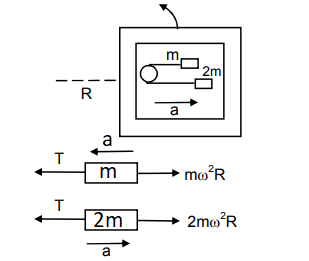
Step 1: Analyze forces on mass \(m\)
In the non-inertial frame of the cabin, the mass \(m\) experiences a centrifugal force \(F_m=m \omega^2 R\) acting radially outward. The tension \(T\) in the string also acts on mass \(m\), pulling it towards the pulley (inward direction relative to the string’s length but along the radius). Let the acceleration of mass \(m\) relative to the cabin be \(a\). The equation of motion is:
\(
T-m \omega^2 R=m a
\)
Step 2: Analyze forces on mass \(2 m\)
The mass \(2 m\) experiences a centrifugal force \(F_{2 m}=2 m \omega^2 R\) acting radially outward. The tension \(T\) acts on mass \(2 m\), pulling it towards the pulley (inward direction along the radius). Assuming mass \(2 m\) accelerates with the same magnitude \(a\) as mass \(m\) (but in the opposite direction along the string, i.e., radially inward), the equation of motion is:
\(
2 m \omega^2 R-T=2 m a
\)
Step 3: Solve for acceleration a
Add the two equations from Step 1 and Step 2 to eliminate \(T\):
\(
\begin{gathered}
\left(T-m \omega^2 R\right)+\left(2 m \omega^2 R-T\right)=m a+2 m a \\
m \omega^2 R=3 m a \\
a=\frac{\omega^2 R}{3}
\end{gathered}
\)
The magnitude of the initial acceleration of the masses as seen from the cabin is \(\frac{\omega^2 R}{3}\)
Step 4: Solve for tension \(T\)
Substitute the expression for \(a\) into the first equation \(\left(T-m \omega^2 R=m a\right)\) :
\(
\begin{gathered}
T-m \omega^2 R=m\left(\frac{\omega^2 R}{3}\right) \\
T=m \omega^2 R+\frac{m \omega^2 R}{3} \\
T=\frac{4 m \omega^2 R}{3}
\end{gathered}
\)
The tension in the string is \(\frac{4 m \omega^2 R}{3}\).