4.2 Aristotle’s fallacy
Aristotle’s fallacy is the mistaken belief that a continuous force is needed to keep an object in uniform motion. He observed that moving objects eventually stop and concluded this happened because the force was no longer being applied. This is a fallacy because it fails to account for friction, which is the external force that actually opposes and slows down motion; in the absence of friction, an object in motion would stay in motion indefinitely.
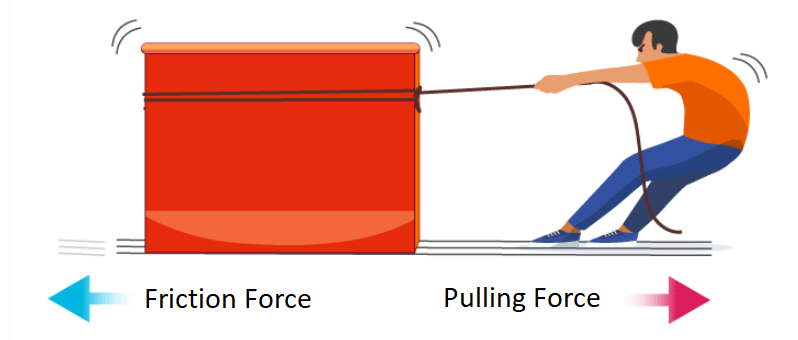
The observation: When you push a box, it eventually stops. Aristotle concluded that you must keep pushing it to maintain its motion.
The error: Aristotle’s mistake was not considering friction. The box stops because the friction between the box and the surface is an opposing force.
The correction: Isaac Newton’s first law of motion correctly states that an object in motion will stay in motion with the same speed and in the same direction unless acted upon by an unbalanced external force. Therefore, a force is only needed to change an object’s motion (to start it, stop it, or change its direction), not to maintain it.
Friction
Friction is a force that opposes the motion of an object when two surfaces are in contact. It occurs in the direction opposite to movement, slowing things down, and can exist between solids, liquids, and gases. The amount of friction depends on the roughness of the surfaces and the force pressing them together, and it comes in different types, like static (between stationary objects) and kinetic (between moving objects).
Types of friction
Static friction:
This force prevents objects from starting to move. For example, it’s the static friction between your shoes and the ground that allows you to walk without slipping.
Kinetic (or sliding) friction:
This force acts on objects that are already in motion, slowing them down. For example, a rolling ball eventually stops because of kinetic friction with the ground.
Fluid friction:
This occurs when an object moves through a fluid (a liquid or gas). Air resistance on a car is an example of fluid friction.
Rolling friction:
This is the resistance a rolling object experiences, like a ball rolling on a surface.
Factors affecting friction
Surface properties:
The rougher the surfaces, the more friction there is. Smoother surfaces have less friction.
Normal force:
The force pushing the surfaces together. A greater force results in more friction.
Molecular adhesion:
At a microscopic level, molecular forces of attraction can bond the surfaces together, contributing to friction.
Effects of friction
Useful effects:
Friction is essential for many daily activities, like walking, driving, and holding objects.
Unwanted effects:
Friction can cause energy loss, generate heat, and lead to wear and tear on materials. To reduce these effects, lubricants are often used.