1.5 Work done by a variable force
Work done by a variable force
The force is said to be variable force, if it changes its direction or magnitude or both.
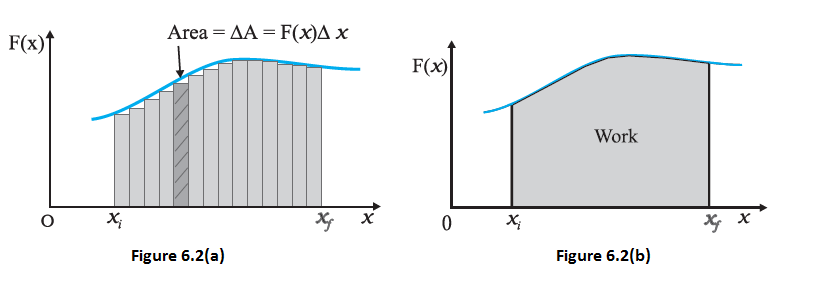
The most common force is the variable force, which is more commonly encountered. Figure 6.2 is a plot of a varying force in one dimension. If the displacement \(\Delta x\) is small, we can take the force \(F(x)\) as approximately constant and the work done is then
\(\Delta W=F(x) \Delta x\)
This is illustrated in Figure 6.2(a). Adding successive rectangular areas in Figure 6.2(a) we get the total work done as
\(W \cong \sum_{x_{i}}^{x_{f}} F(x) \Delta x\)
where the summation is from the initial position \(x_{i}\) to the final position \(x_{f}\)
If the displacements are allowed to approach zero, then the number of terms in the sum increases without limit, but the sum approaches a definite value equal to the area under the curve in Figure 6.2(b). Then the work done is
\(
\begin{aligned}
W &=\lim _{\Delta x \rightarrow 0} \sum_{x_{i}}^{x_{f}} F(x) \Delta x \\
&=\int_{x_{i}}^{x_{f}} F(x) \mathrm{d} x \dots (1)
\end{aligned}
\)
where ‘lim’ stands for the limit of the sum when \(\Delta x\) tends to zero. Thus, for a varying force the work done can be expressed as a definite integral of force over displacement.
If the particle moves from \(\mathbf{r}_1\left(x_1, y_1, z_1\right)\) to \(\mathbf{r}_2\left(x_2, y_2, z_2\right)\), i.e. when the magnitude and direction of the force vary in three dimensions, then the work done by force \(\mathbf{F}\), is given by
\(
W=\int d W=\int_{x_1}^{x_2} F_x d x+\int_{y_1}^{y_2} F_y d y+\int_{z_1}^{z_2} F_z d z
\)
where, \(F_x, F_y\) and \(F_z\) are the rectangular components of force in \(x, y\) and \(z\)-directions, respectively.
If the motion is one dimensional, \(W=\int_{x_i}^{x_f} F_x d x\)
Here, \(F_x\) is the component of force along motion.
Example 1: A woman pushes a trunk on a railway platform that has a rough surface. She applies a force of \(100 \mathrm{~N}\) over a distance of \(10 \mathrm{~m}\). Thereafter, she gets progressively tired and her applied force reduces linearly with distance to \(50 \mathrm{~N}\). The total distance through which the trunk has been moved is \(20 \mathrm{~m}\). Plot the force applied by the woman and the frictional force, which is \(50 \mathrm{~N}\) versus displacement. Calculate the work done by the two forces over \(20 \mathrm{~m}\).
Solution: The plot of the applied force is shown in the Figure below. At \(x=20 \mathrm{~m}, F=50 \mathrm{~N}(\neq 0)\). We are glven that the frictional force \(f\) is \(|\vec{f}|=50 \mathrm{~N}\). It opposes motion and acts in a direction opposite to \(\vec{F}\). It is, therefore, shown on the negative side of the force axis.
The work done by the woman is
\(W_{F} \rightarrow\) area of the rectangle \(\mathrm{ABCD}+\) area of the trapezium CEID
\(
\begin{aligned}
W_{F} &=100 \times 10+\frac{1}{2}(100+50) \times 10 \\
=& 1000+750 \\
&=1750 \mathrm{~J}
\end{aligned}
\)
The work done by the frictional force is
\(
\begin{array}{c}
W_{f} \rightarrow \text { area of the rectangle AGHI } \\
W_{f}=(-50) \times 20 \\
=-1000 \mathrm{~J}
\end{array}
\)
The area on the negative side of the force axis has a negative sign.
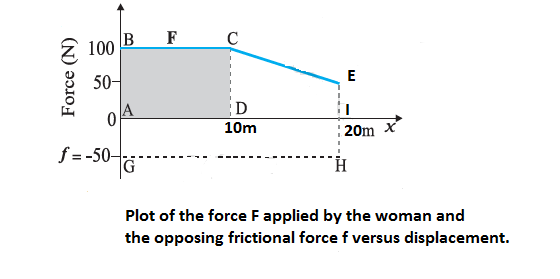 Figure 6.3
Example 2: A position dependent force \(F=\left(7-2 x+3 x^2\right) N\) acts on a small body of mass 2 kg and displaces it from \(x=0\) to \(x=5 m\). Calculate the work done (in joule).
Solution: Work done, \(W=\int_{x_1}^{x_2} F d x=\int_0^5\left(7-2 x+3 x^2\right) d x\)
Here, the body changes its position from \(x=0\) to \(x=5 \mathrm{~m}\)
\(
\Rightarrow W=\left[7 x-\frac{2 x^2}{2}+\frac{3 x^3}{3}\right]_0^5=\left[7(5)-(5)^2+(5)^3-0\right]=135 \mathrm{~J}
\)
Example 3: A force \(F=(2+x)\) acts on a particle in \(x\)-direction, where \(F\) is in newton and \(x\) in metre. Find the work done by this force during a displacement from \(x=1 m\) to \(x=2 m\).
Solution: As the force is variable, we shall find the work done in a small displacement from \(x\) to \(x+d x\) and then integrate it to find the total work. The work done in this small displacement is
Thus,
\(
\begin{aligned}
d W & =F d x=(2+x) d x \\
W & =\int_1^2 d W=\int_1^2(2+x) d x \\
& =\left[2 x+\frac{x^2}{2}\right]_1^2=\left[\left(4+\frac{4}{2}\right)-\left(2+\frac{1}{2}\right)\right]=3.5 \mathrm{~J}
\end{aligned}
\)
Example 4: \(A\) force \(F=-\frac{k}{x^2}(x \neq 0)\) acts on a particle in \(x\)-direction. Find the work done by this force in displacing the particle from \(x=+a\) to \(x=+2 a\). Here, \(k\) is a positive constant.
Solution: Given, \(F=-\frac{k}{x^2}\), where \(x\) is the position of particle.
Work done by this force, \(W=\int F d x=\int_{+a}^{+2 a}\left(\frac{-k}{x^2}\right) d x\)
\(
=\left[\frac{k}{x}\right]_{+a}^{+2 a}=\frac{k}{2 a}-\frac{k}{a}=-\frac{k}{2 a}
\)
Note: It is important to note that work comes out to be negative which is quite obvious as the force acting on the particle is in negative \(x\)-direction \(\left(F=-\frac{k}{x^2}\right)\) while displacement is along positive \(x\)-direction (from \(x=a\) to \(x=2 a\) ).
Calculation of work done by force-displacement graph
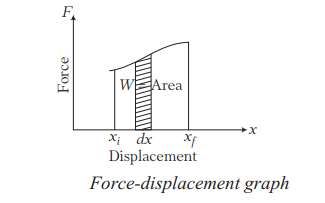
The area under force-displacement curve gives work done.
\begin{aligned}
&W=\int_{x_i}^{x_f} d W=\int_{x_i}^{x_f} F \cdot d x\\
&\text { where, } x_i \text { and } x_f \text { are the initial and final position, respectively. }\\
&\begin{aligned}
& \therefore \quad W=\int_{x_i}^{x_f} \text { (Area under curve) } \\
& \Rightarrow W=\text { Area under curve between } x_i \text { and } x_f .
\end{aligned}
\end{aligned}
\)
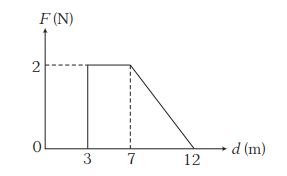
Example 5: Force \(F\) acting on a particle moving in a straight line varies with distance \(d\) as shown in the figure. Find the work done on the particle during its displacement of 12 m.
Solution:
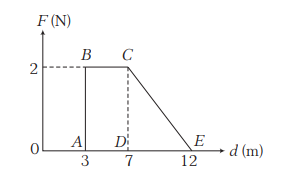
\(
\begin{aligned}
\text { Work done } & =\text { Area under force-displacement graph } \\
& =\text { Area of rectangle } A B C D+\text { Area of } \triangle D C E \\
& =\text { Length × Breadth }+\frac{1}{2} \times \text { Base × Height } \\
& =(A B \times A D)+\frac{1}{2} \times D E \times C D
\end{aligned}
\)
\(
\begin{aligned}
& =2 \times(7-3)+\frac{1}{2} \times(12-7) \times 2 \\
& =8+\frac{1}{2} \times 10=8+5=13 \mathrm{~J}
\end{aligned}
\)
Example 6: A force \(F\) acting on a particle varies with the position \(x\) as shown in figure. Find the work done by this force in displacing the particle from
(i) \(x=-2 m\) to \(x=0\)
(ii) \(x=0\) to \(x=2 m\).
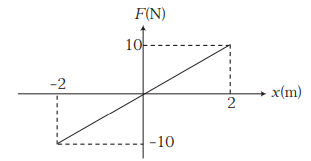
Solution: (i) From \(x=-2 \mathrm{~m}\) to \(x=0\), displacement of the particle is along positive \(x\)-direction while force acting on the particle is along negative \(x\)-direction. Therefore, work done is negative and is given by the area under \(F-x\) graph.
\(
\therefore \quad W=-\frac{1}{2}(2)(10)=-10 \mathrm{~J}
\)
(ii) From \(x=0\) to \(x=2 \mathrm{~m}\), displacement of particle and force acting on the particle both are along positive \(x\)-direction. Therefore, work done is positive and is given by the area under \(F-x\) graph.
\(
\therefore \quad W=\frac{1}{2}(2)(10)=10 \mathrm{~J}
\)
Spring block system
Consider an elastic spring of negligibly small mass having spring constant \(k\) with its one end attached to a rigid support and its other end is attached to a block of mass \(m\) that can slide over a smooth horizontal surface.
Suppose a force \(F\) is applied on the spring to stretch it from natural length to produce an elongation \(x\) in it.
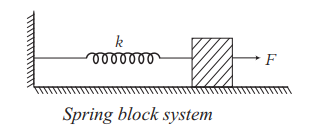
The work done in stretching the spring by external applied force, \(W=\int_0^x F d x=\int_0^x k x d x\)
\(
W=\frac{1}{2} k x^2
\)
The work done by stretching or compressing force is positive.
But the work done by the spring is negative because the force exerted by the spring is always opposite to elongation or contraction.
\(
\therefore \quad \text { Work done by the spring, } W=-\frac{1}{2} k x^2
\)
When length of spring changes from \(x=x_i\) to \(x=x_f\)
\(
W=-\int_{x_i}^{x_f} F d x=-\int_{x_i}^{x_f} k x d x=\frac{1}{2} k\left(x_i^2-x_f^2\right)
\)
Example 7: The work done in extending a spring by \(x_0\) is \(W_0\). Find the work done in further extension \(x_0\)
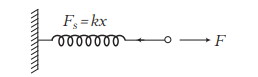
Solution: Force, \(F=F_s=k x\)
\(
W_0=\int F d x=\int_0^{x_0} k x d x=\frac{k x_0^2}{2}
\)
Let \(W\) be the work done in extending a spring by \(2 x_0\).
\(
\begin{aligned}
W & =\int F d x=\int_{x_0}^{2 x_0} k x d x \\
& =\frac{k}{2}\left[\left(2 x_0\right)^2-x_0^2\right]=\frac{3}{2} k x_0^2 \\
\Rightarrow W & =3 W_0
\end{aligned}
\)
Example 8: Consider a block connected to a light spring of spring constant \(100 \mathrm{Nm}^{-1}\). Now, the block is displaced by applying a constant force \(F\) which gives zero resultant force when spring is stretched through \(10 c m\).
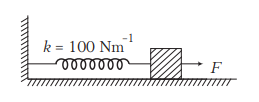
Evaluate
(i) work done by the spring force when the block attains equilibrium.
(ii) net work done on the block when it attains maximum speed.
Solution: (i) Work done by the spring force, \(W_S=-\frac{1}{2} k x^2\) Here, \(k=100 \mathrm{Nm}^{-1}\) and \(x=10 \mathrm{~cm}=0.1 \mathrm{~m}\)
\(
\therefore \quad W_S=-\frac{1}{2} \times 100(0.1)^2=-0.5 \mathrm{~J}
\)
Negative sign indicates that the work done by the spring force is negative.
(ii) When the block attains equilibrium, its speed is maximum.
∴ Work done on the block by external force \(F\),
\(
\begin{aligned}
W=F \cdot x=(10)\left(\frac{10}{100}\right)=1 \mathrm{~J} \\
& {[\because F=k x=100 \times 0.1=10 \mathrm{~N}] }
\end{aligned}
\)
Thus, net work done on the block,
\(
W_N=W_S+W=-0.5+1=0.5 \mathrm{~J}
\)
Dependence of work done on frame of reference
Work depends on frame of reference. With change of frame of reference, inertial force does not change while displacement may change.
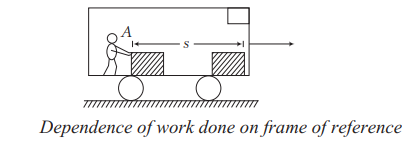
So, the work done by a force will be different in different frames. e.g. If a person \(A\) is pushing a box inside a moving bus, then work done as seen by him from the frame of reference of bus is \(\mathbf{F} \cdot \mathbf{s}\) while as seen by a person on the ground it is \(\mathbf{F} \cdot\left(\mathbf{s}+\mathbf{s}_0\right)\). Here, \(\mathbf{s}_0\) is the displacement of bus relative to ground.
Example 9: A train is moving with a speed of \(90 \mathrm{kmh}^{-1} . A\) passenger \(X\) inside the train displaces his 40 kg luggage slowly on the floor through 1 m in 10 s. Coefficient of friction of the floor of the train is 0.2. Find the work done by this passenger \(X\) and the luggage as seen by
(i) a fellow passenger \(Y\)
(ii) a person on the ground [Take, \(g=10 \mathrm{~ms}^{-2}\) ].
Solution: Given, speed of the train,
\(
v=90 \mathrm{kmh}^{-1}=\frac{90 \times 1000}{60 \times 60}=25 \mathrm{~ms}^{-1}
\)
(i) Displacement of the luggage with respect to the train, \(s=1 \mathrm{~m}\). As luggage is displaced slowly, the force applied on it must be same as frictional force on it by the floor,
\(
f=\mu m g=(0.2) \times 40 \times 10=80 \mathrm{~N}
\)
Work done by the passenger \(X\) as seen by fellow passenger \(Y\),
\(
W=f s=(80)(1)=80 \mathrm{~J}
\)
(ii) The luggage is displaced for 10 s. Therefore, distance moved by train with respect to ground during this interval is
\(
s_0=25 \times 10=250 \mathrm{~m}
\)
Therefore, work done by passenger \(X\) on the luggage as seen by a person on the ground,
\(
\begin{aligned}
W_G & =f\left(s+s_0\right)=(80)(1+250) \\
& =(251)(80)=20.08 \mathrm{~kJ}
\end{aligned}
\)
Conservative Forces
A force is said to be conservative, if the work done by or against the force on a body is independent of path followed by the body and depends only on initial and final positions.
e.g. Gravitational force, spring force, coulomb force, etc.
Work done by conservative forces
One of the following two equivalent conditions on work done must be satisfied by conservative forces:
(i) Work done by or against a conservative force in moving a body from one position to another depends only on the initial and final positions of the body. It does not depend upon the nature of the path followed by the body in going from initial position to the final position.
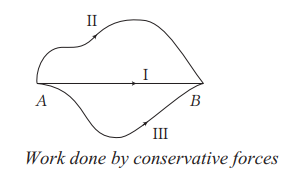
Let \(W_1, W_2\) and \(W_3\) denote the net work done in moving a body from \(A\) to \(B\) along three different paths I, II and III respectively, as shown in figure If the force is conservative, then
\(
W_{\mathrm{I}}=W_{\mathrm{II}}=W_{\mathrm{III}}=\int \mathrm{F} \cdot d \mathrm{~L}
\)
(ii) Work done by or against a conservative force in moving a particle along a closed path (round trip) is zero.
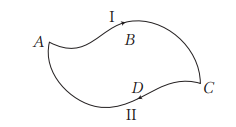
Assume that a particle is moving along a closed path \(A B C D A\) as shown in figure.
\(
\begin{aligned}
&\text { If the force acting on the particle is conservative, then }\\
&W_{A B C D A}=\int_{A B C D A} \mathbf{F} \cdot d \mathbf{L}=\int_{A B C} \mathbf{F} \cdot d \mathbf{L}+\int_{C D A} \mathbf{F} \cdot d \mathbf{L}=0
\end{aligned}
\)
\(
\begin{aligned}
W_{A B C}+W_{C D A} & =0 \\
W_{A B C} & =-W_{C D A} \\
W_{\mathrm{I}} & =-W_{\mathrm{II}}
\end{aligned}
\)
Example 10: An object is displaced from point \(A(2 m, 3 m, 4 m)\) to a point \(B(1 m, 2 m, 3 m)\) under a constant force \(\mathbf{F}=(2 \hat{\mathbf{i}}+3 \hat{\mathbf{j}}+4 \mathbf{k}) N\). Find the work done by this force in this process.
Solution: Work done by force \(F\),
\(
\begin{aligned}
W=\int_{\mathrm{r}_i}^{\mathrm{r}_f} \mathbf{F} \cdot d \mathbf{s} & =\int_{(2 \mathrm{~m}, 3 \mathrm{~m}, 4 \mathrm{~m})}^{(1 \mathrm{~m}, 2 \mathrm{~m}, 3 \mathrm{~m})}(2 \hat{\mathbf{i}}+3 \hat{\mathbf{j}}+4 \hat{\mathbf{k}}) \cdot(d x \hat{\mathbf{i}}+d \hat{\mathbf{j}}+d \hat{\mathbf{k}}) \\
& =[2 x+3 y+4 z]_{(2 \mathrm{~m}, 3 \mathrm{~m}, 4 \mathrm{~m})}^{(1 \mathrm{~m}, 2 \mathrm{~m}, 3 \mathrm{~m})}=-9 \mathrm{~J}
\end{aligned}
\)
Alternate Solution
Since, \(\quad \boldsymbol{F}=\) constant, we can also use
\(
W=\mathbf{F} \cdot \mathbf{s}
\)
Here, \(\quad \mathbf{s}=\mathbf{s}_f-\mathbf{s}_i=(\hat{\mathbf{i}}+2 \hat{\mathbf{j}}+3 \hat{\mathbf{k}})-(2 \hat{\mathbf{i}}+3 \hat{\mathbf{j}}+4 \hat{\mathbf{k}})\)
\(
=(-\hat{\mathbf{i}}-\hat{\mathbf{j}}-\hat{\mathbf{k}}) \mathrm{m}
\)
\(
\begin{aligned}
\therefore \quad W & =(2 \hat{\mathbf{i}}+3 \hat{\mathbf{j}}+4 \hat{\mathbf{k}}) \cdot(-\hat{\mathbf{i}}-\hat{\mathbf{j}}-\hat{\mathbf{k}}) \\
& =-2-3-4=-9 \mathbf{J}
\end{aligned}
\)
Example 11: An object is displaced from position vector
\(\mathbf{r}_1=(2 \hat{\mathbf{i}}+3 \hat{\mathbf{j}}) m\) to \(\mathbf{r}_2=(4 \hat{\mathbf{i}}+6 \hat{\mathbf{j}}) m\) under a force
\(\mathbf{F}=\left(3 x^2 \hat{\mathbf{i}}+2 y \hat{\mathbf{j}}\right) N\). Find the work done by this force.
Solution: Work done, \(W=\int_{\mathbf{r}_1}^{\mathbf{r}_2} \mathbf{F} \cdot d \mathbf{r}=\int_{\mathbf{r}_1}^{\mathbf{r}_2}\left(3 x^2 \hat{\mathbf{i}}+2 y \hat{\mathbf{j}}\right) \cdot(d x \hat{\mathbf{i}}+d y \hat{\mathbf{j}}+d z \hat{\mathbf{k}})\)
\(
=\int_{\mathbf{r}_1}^{\mathbf{r}_2}\left(3 x^2 d x+2 y d y\right)=\left[x^3+y^2\right]_{(2,3)}^{(4,6)}=83 \mathrm{~J}
\)
Non-Conservative Forces
A force is said to be non-conservative, if work done by or against the force in moving a body depends upon the path between initial and final positions.
e.g. Frictional force, viscous force, air resistance, etc.
Work done by non-conservative forces
Let \(W_1, W_2\) and \(W_3\) denote the net work done in moving a body from \(A\) to \(B\) along three different paths 1, 2 and 3 respectively, as shown in Fig. (a). If the force is non-conservative, then \(W_1 \neq W_2 \neq W_3\)
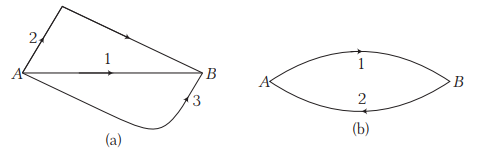
Work done by a non-conservative force in a round trip as shown in Fig. (b) is not zero.
i.e. \(W_1+W_2 \neq 0\)
Example 12: A body of mass 0.3 kg is taken up an inclined plane of length \(10 m\) and height \(5 m\), and then allowed to slide down the bottom again. The coefficient of friction between the body and the plane is 0.15. What is the
(i) work done by the applied force over the upward journey?
(ii) work done by the gravitational force over the round trip?
(iii) work done by the frictional force over the round trip?
Which of the above forces (except applied force) is/are conservative forces?
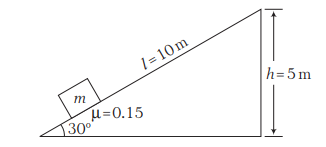
Solution: Upward journey: Let us calculate work done by different forces over upward journey.
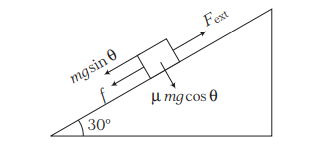
Work done by gravitational force,
\(
W_1=(m g \sin \theta) s \cos 180^{\circ}
\)
\(
\begin{aligned}
W_1 & =0.3 \times 10 \sin 30^{\circ} \times 10(-1) \quad[\because s=l=10 \mathrm{~m}] \\
W_1 & =-15 \mathrm{~J}
\end{aligned}
\)
Work done by force of friction,
\(
\begin{aligned}
W_2 & =(\mu m g \cos \theta) s \cos 180^{\circ} \\
W_2 & =0.15 \times 0.3 \times 10 \cos 30^{\circ} \times 10(-1) \\
W_2 & =-3.897 \mathrm{~J}
\end{aligned}
\)
Work done by external force, \(W_3=F_{\text {ext }} \times s \times \cos 0^{\circ}\)
\(
\begin{aligned}
& W_3=(m g \sin \theta+\mu m g \cos \theta) \times 10 \times 1 \\
& W_3=18.897 \mathrm{~J}
\end{aligned}
\)
Downward journey:
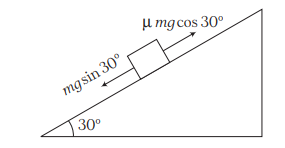
\(
m g \sin 30^{\circ}>\mu m g \cos 30^{\circ}
\)
Work done by the gravitational force,
\(
\begin{gathered}
W_4=m g \sin 30^{\circ} \times s \cos 0^{\circ} \\
W_4=0.3 \times 10 \times \frac{1}{2} \times 10 \times 1=+15 \mathrm{~J}
\end{gathered}
\)
Work done by the frictional force,
\(
\begin{aligned}
& W_5=\mu m g \cos 30^{\circ} \times s \cos 180^{\circ} \\
& =0.15 \times 0.3 \times 10 \times \frac{\sqrt{3}}{2} \times 10 \times(-1)=-3.897 \mathrm{~J}
\end{aligned}
\)
(i) Work done by applied force over upward journey,
\(
W_3=18.897 \mathrm{~J}
\)
(ii) Work done by gravitational force over the round trip,
\(
W_1+W_4=-15+15=0 \mathrm{~J}
\)
(iii) Work done by frictional force over the round trip,
\(
W_2+W_5=-3.897+(-3.897)=-7.794 \mathrm{~J}
\)
Work done by gravitational force over a closed path is zero but due to frictional force, it is non-zero.
Therefore, gravitational force is conservative and frictional force is non-conservative.