6.10 Theorems of perpendicular and parallel axes
Theorems on moment of inertia
There are two important theorems on moment of inertia, which enable calculation of the moment of inertia of a body about an axis, if its moment of inertia about some other axis is known. Let us now discuss both of them.
Theorem of parallel axes
The parallel axis theorem is the method to find the moment of inertia of the object about any axis parallel to the axis passing through the centroid.
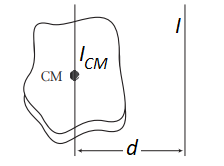
Definition: “The mass moment of inertia about the axis parallel to the axis passing through the center of mass is given by the sum of mass moment of inertia about an axis passing through the center of mass \(\left(I_{\mathrm{CM}}\right)\) and product of mass \((\mathrm{M})\) and square of perpendicular distance between two axes (\(d\))”.
Mathematically, it can be expressed as,
\(
I=I_{\mathrm{CM}}+M d^2
\)
Remark
Since the term \({M} {d}^2\) is always non-negative, the moment of inertia \({I}\) about any parallel axis is always greater than or equal to \({I}_{{C M}}\left({I} \geq {I}_{{C M}}\right)\). The absolute minimum value for \(I\) is reached exclusively when the distance \(d\) is zero (\(d=0\)), which makes the \(M d^2\) term vanish. This minimum possible value is precisely \(\boldsymbol{I}_{{C M}}\).
Example 1: What is the moment of inertia of a rod of mass \(M\), length \(l\) about an axis perpendicular to it through one end?
Solution: For a uniform rod of mass \(M\) and length \(l\), the moment of inertia about its center is
\(
I_{\mathrm{cm}}=\frac{M l^2}{12}
\)
Using the parallel axis theorem to find the moment of inertia about one end of the rod:
\(
\begin{gathered}
I=I_{\mathrm{cm}}+M d^2 \quad \text { with } \quad d=\frac{l}{2} \\
I=\frac{M l^2}{12}+M\left(\frac{l}{2}\right)^2=\frac{M l^2}{12}+\frac{M l^2}{4}=\frac{M l^2}{3}
\end{gathered}
\)
Independent check:
A rod of mass \(2 M\) and length \(2 l\) has moment of inertia about its midpoint
\(
I=\frac{(2 M)(2 l)^2}{12}=\frac{8 M l^2}{12}
\)
Half of this corresponds to one half of the rod (mass \(M\), length \(l\) ) about the midpoint of the full rod, which coincides with the end of the half-rod:
\(
I=\frac{1}{2} \cdot \frac{8 M l^2}{12}=\frac{M l^2}{3}
\)
Example 2: What is the moment of inertia of a ring about a tangent to the circle of the ring?
Solution:
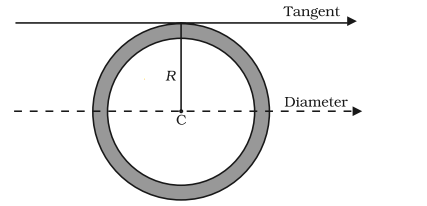
For a thin ring, the moment of inertia about any diameter is
\(
I_{\text {dia }}=\frac{1}{2} M R^2
\)
The tangent to the ring in the plane of the ring is parallel to one of the diameters of the ring. The distance between these two parallel axes is \(R\), the radius of the ring. Using the parallel axes theorem,
\(
I_{\text {tangent }}=I_{\text {dia }}+M R^2=\frac{M R^2}{2}+M R^2=\frac{3}{2} M R^2
\)
Example 3: Find the moment of inertia of a solid cylinder of mass \(M\) and radius \(R\) about a line parallel to the axis of the cylinder and on the surface of the cylinder.
Solution: The moment of inertia of the cylinder about its axis \(=\frac{M R^2}{2}\).
Using parallel axes theorem
\(
I=I_{CM}+M R^2=\frac{M R^2}{2}+M R^2=\frac{3}{2} M R^2
\)
Example 4: Find the moment of inertia of a sphere about a tangent to the sphere, while the mass of the sphere is \(M\) and the radius of the sphere is \(R\).
Solution: The moment of inertia of a sphere about its own axis \(\left(Y Y^{\prime}\right)\) is \(\frac{2 M R^2}{5}\).
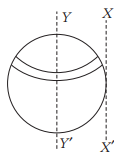
Applying the theorem of parallel axes, the moment of inertia of the sphere about tangent \(\left(X X^{\prime}\right)\),
\(
\begin{aligned}
& I_t=I+M R^2 \\
& I_t=\frac{2}{5} M R^2+M R^2=\frac{7}{5} M R^2
\end{aligned}
\)
Example 5: The mass of the cylinder is 25 kg and radius of cylinder is 5 m. Find the moment of inertia of a solid cylinder about a tangent to the cylinder.
Solution: The moment of inertia of a cylinder about its own axis ( \(Y Y^{\prime}\) )
\(
=\frac{1}{2} M R^2
\)
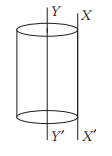
Applying the theorem of parallel axes, the moment of inertia of the cylinder about tangent \(\left(X X^{\prime}\right)\),
\(
\begin{aligned}
I_t & =I+M R^2=\frac{1}{2} M R^2+M R^2 \\
\Rightarrow \quad I_t & =\frac{3}{2} M R^2
\end{aligned}
\)
Here, \(M=25 \mathrm{~kg}\) and \(R=5 \mathrm{~m}\)
\(
\begin{aligned}
\therefore \quad I_t & =\frac{3}{2}(25)(5)^2 \\
& =937.5 \mathrm{~kg}-\mathrm{m}^2
\end{aligned}
\)
Example 6: Calculate the moment of inertia of a rod of mass 2 kg and length \(5 m\) about an axis perpendicular to it and passing through one of its ends.
Solution: For the rod of mass \(M\) and length \(l\), the moment of inertia of the rod about an axis \(A B\) passing through its centre of mass,
\(
I_{A B}=\frac{M l^2}{12}
\)
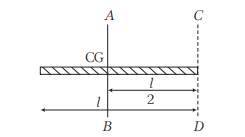
According to the parallel axes theorem,
\(
I_{C D}=I_{A B}+M\left(\frac{l}{2}\right)^2=\frac{M l^2}{12}+\frac{M l^2}{4}
\)
\(
\begin{aligned}
& =\frac{M l^2+3 M l^2}{12}=\frac{4 M l^2}{12}=\frac{M l^2}{3} \\
I_{C D} & =\frac{M l^2}{3}=\frac{2(5)^2}{3}=\frac{50}{3} \mathrm{~kg}-\mathrm{m}^2
\end{aligned}
\)
Example 7: Consider a uniform rod of mass \(m\) and length \(2 l\) with two particles of mass \(m\) each at its ends. Let \(A B\) be a line perpendicular to the length of the rod and passing through its centre. Find the moment of inertia of the system about \(A B\).
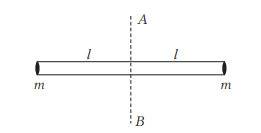
Solution: Moment of inertia of the system about \(A B\),
\(
\begin{aligned}
I_{A B} & =I_{\text {rod }}+I_{\text {both particles }} \\
& =\frac{m(2 l)^2}{12}+2\left(m l^2\right)=\frac{7}{3} m l^2
\end{aligned}
\)
Explanation: Moment of inertia of the rod:
The formula for the moment of inertia of a uniform rod of mass \(M\) and length \(L\) about an axis perpendicular to its length and passing through its center is
\(
I=\frac{1}{12} M L^2
\)
Given:
Mass of the rod \(=m\)
Length of the rod \(=2 l\)
Substituting these values into the formula:
\(
I_{\mathrm{rod}}=\frac{1}{12} m(2 l)^2=\frac{1}{12} m\left(4 l^2\right)=\frac{1}{3} m l^2
\)
Moment of inertia of the particles:
The moment of inertia of a single point mass about an axis is given by \(I=m r^2\), where \({r}\) is the perpendicular distance from the mass to the axis of rotation.
Given:
Mass of each particle \(=m\)
Each particle is located at a distance \(l\) from the center of the rod (axis \(A B\) ). The moment of inertia for both particles is the sum of their individual moments of inertia:
\(
I_{\text {particles }}=m(l)^2+m(l)^2=2 m l^2
\)
Total moment of inertia of the system:
Summing the moments of inertia of the rod and the particles:
\(
\begin{aligned}
& I_{\text {total }}=\frac{1}{3} m l^2+2 m l^2 \\
& I_{\text {total }}=\frac{1}{3} m l^2+\frac{6}{3} m l^2 \\
& I_{\text {total }}=\frac{7}{3} m l^2
\end{aligned}
\)
Example 7: Three rods each of mass \(m\) and length \(l\) are joined together to form an equilateral triangle as shown in figure. Find the moment of inertia of the system about an axis passing through its centre of mass and perpendicular to the plane of the triangle.
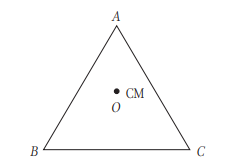
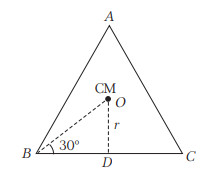
Solution: Moment of inertia of rod \(B C\) about an axis perpendicular to plane of triangle \(A B C\) and passing through the mid-point of rod \(B C\) (i.e. \(D\) ) is
\(
\begin{aligned}
& I_1=\frac{m l^2}{12}, \text { in } \triangle B D O, A D=\sqrt{l^2-\frac{l^2}{4}}=\frac{\sqrt{3}}{2} l \\
& r=O D=\frac{A D}{3}=\frac{\sqrt{3} l}{3 \times 2}=\frac{l}{2 \sqrt{3}}
\end{aligned}
\)
From theorem of parallel axes, moment of inertia of this rod about the axis passing through CM and perpendicular to plane \(A B C\) is
\(
I_2=I_1+m r^2=\frac{m l^2}{12}+m\left(\frac{l}{2 \sqrt{3}}\right)^2=\frac{m l^2}{6}
\)
∴ Moment of inertia of all the three rods,
\(
I=3 I_2=3\left(\frac{m l^2}{6}\right)=\frac{m l^2}{2}
\)
Example 8: Two thin uniform rods \(A(M, L)\) and \(B(3 M, 3 L)\) are joined as shown in figure. Find the moment of inertia about an axis passing through the centre of mass of the system of rods and perpendicular to the length.
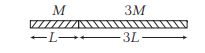
Solution: Taking origin at \(O\), lets calculate CM.
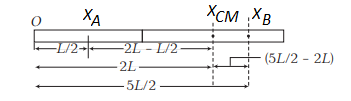
Given, Rod A: mass \(M\), length \(L\)
Rod B: mass \(3 M\), length \(3 L\)
Rods are collinear and joined end-to-end
Axis: through the centre of mass of the system, perpendicular to the rods
Centres of individual rods:
Determining \({x}_{{A}}\):
Assuming Rod A starts at the origin of the coordinate system ( \({x}=0\) ) and extends to \({x}={L}\), its center of mass position is calculated as half its length:
\(
x_A=\frac{L}{2}
\)
Determining \({x}_{{B}}\):
Rod’s CM: Rod B has a length of \({3 L}\). Since it is uniform, its center of mass is halfway along its own length, which is \(3 L / 2\) from its left end.
Position in System: The problem specifies that the left end of Rod B is located at the system coordinate \({x}={L}\). To find its absolute position \({x}_{{B}}\) within the entire system’s coordinate system, we add the position of its starting point to its internal center of mass position:
\(
x_B=(\text { System start position })+(\mathrm{CM} \text { from left end })=L+\frac{3 L}{2}=\frac{2 L+3 L}{2}=\frac{5 L}{2}
\)
Centre of mass of the system:
\(
x_{\mathrm{CM}}=\frac{M\left(\frac{L}{2}\right)+3 M\left(\frac{5 L}{2}\right)}{M+3 M}=\frac{\frac{M L}{2}+\frac{15 M L}{2}}{4 M}=\frac{16 M L / 2}{4 M}=2 L
\)
So the system CM is at \(x_{CM}=2 L\).
Distances from system CM:
Rod A:
\(
d_A=2 L-\frac{L}{2}=\frac{3 L}{2}
\)
Rod B:
\(
d_B=\frac{5 L}{2}-2 L=\frac{L}{2}
\)
Moment of inertia of each rod about system CM:
About its own CM:
\(
I_{\mathrm{cm}}=\frac{1}{12} m L^2
\)
Use parallel axis theorem:
\(
I=I_{\mathrm{cm}}+m d^2
\)
Rod A:
\(
I_A=\frac{1}{12} M L^2+M\left(\frac{3 L}{2}\right)^2=\frac{1}{12} M L^2+\frac{9}{4} M L^2=\frac{7}{3} M L^2
\)
Rod B:
\(
I_B=\frac{1}{12}(3 M)(3 L)^2+3 M\left(\frac{L}{2}\right)^2=\frac{27}{12} M L^2+\frac{3}{4} M L^2=3 M L^2
\)
Total moment of inertia
\(
I_{\text {total }}=I_A+I_B=\frac{7}{3} M L^2+3 M L^2=\frac{16}{3} M L^2
\)
Example 9: Two thin uniform rings made of same material and of radii \(R\) and \(4 R\) are joined as shown in figure. The mass of smaller ring is \(m\). Find the moment of inertia about an axis passing through the centre of mass of system of rings and perpendicular to the plane.
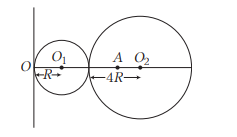
Solution: Here, \(m_1=m\) and \(m_2=4 m \quad(\because m \propto\) radius \()\)
Centre of small ring is at distance
\(
x_1=R
\)
Centre of large ring is at distance
\(
x_2=2 R+4 R=6 R
\)
Masses:
Small ring: \(m\)
Large ring: \(4 m\)
Centre of mass location from \(O\)
\(
x_{\mathrm{CM}}=\frac{m(R)+4 m(6 R)}{m+4 m}=\frac{m R+24 m R}{5 m}=5 R
\)
So CM is at point \(A, 5 R\) from \(O\)
Moment of inertia about CM:
Small ring:
Radius \(=R\)
Distance of its centre from CM:
\(
\begin{gathered}
d_1=5 R-R=4 R \\
I_1=m R^2+m(4 R)^2=m R^2(1+16) \text { (so using theorem of parallel axes) }
\end{gathered}
\)
Large ring:
Radius \(=4 R\)
Distance of its centre from CM:
\(
\begin{gathered}
d_2=6 R-5 R=R \\
I_2=4 m(4 R)^2+4 m(R)^2=m R^2(64+4)
\end{gathered}
\)
Total moment of inertia
\(
I_A=m R^2[(1+16)+(64+4)]=85 m R^2
\)
Theorem of perpendicular axes
It states that the moment of inertia of a plane lamina about an axis perpendicular to its plane is equal to the sum of the moments of inertia of the lamina about any two mutually perpendicular axes in its plane and intersecting each other at the point, where the perpendicular axis passes through it.
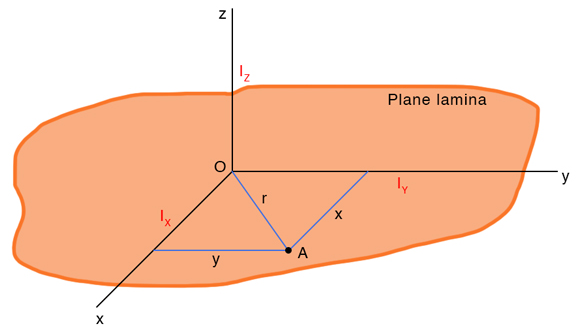
Let \(X\) and \(Y\)-axes be chosen in the plane of the body and \(Z\)-axis perpendicular to this plane, three axes being mutually perpendicular, then according to the theorem,
\(
I_Z=I_X+I_Y
\)
where, \(I_X, I_Y\) and \(I_Z\) are the moments of inertia about the \(X, Y\) and \(Z\)-axes respectively.
Remark
- Theorem of parallel axes is applicable for any type of rigid body whether it is a two dimensional or three dimensional, while the theorem of perpendicular axes is applicable for laminar type or two dimensional bodies only.
- In theorem of perpendicular axes, the point of intersection of the three axes ( \(X, Y\) and \(Z\) ) may be any point on the plane of body (it may even lie outside the body). This point may or may not be the centre of mass of the body.
Example 10: What is the moment of inertia of a disc about one of its diameters?
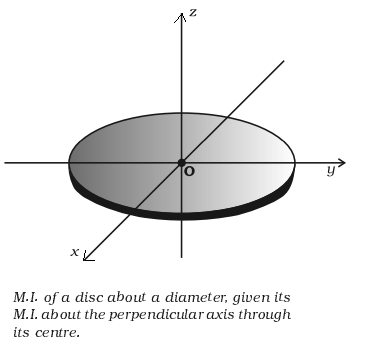
Solution: We assume the moment of inertia of the disc about an axis perpendicular to it and through its centre to be known; it is \(M R^2 / 2\), where M is the mass of the disc and \(R\) is its radius.
The disc can be considered to be a planar body. Hence the theorem of perpendicular axes is applicable to it. As shown in figure, we take three concurrent axes through the centre of the disc, \(O\) as the \(x, y, z\) axes; \(x\) and \(y\)-axes lie in the plane of the disc and \(z\) is perpendicular to it. By the theorem of perpendicular axes,
\(
I_z=I_x+I_y
\)
Now, \(x\) and \(y\) axes are along two diameters of the disc, and by symmetry the moment of inertia of the disc is the same about any diameter. Hence
\(
I_x=I_y
\)
and \(I_z=2 I_x\)
But \(I_{\mathrm{z}}=M R^2 / 2\)
So finally, \(\quad I_x=I_z / 2=M R^2 / 4\)
Thus the moment of inertia of a disc about any of its diameter is \(M R^2 / 4\).
Example 11: Find the moment of inertia of a uniform ring of mass \(M\) and radius \(R\) about a diameter.
Solution: Let \(A B\) and \(C D\) be two mutually perpendicular diameters of the ring. Take them as \(X\) and \(Y\)-axes and the line perpendicular to the plane of the ring through the centre as the \(Z\)-axis. The moment of inertia of the ring about the \(Z\)-axis is \(I=M R^2\). As the ring is uniform, all of its diameters are equivalent and so \(I_x=I_y\).
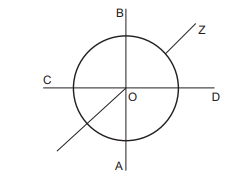
From perpendicular axes theorem,
\(
I_z=I_x+I_y . \text { Hence } I_x=\frac{I_z}{2}=\frac{M R^2}{2}
\)
Example 12: Two identical rods each of mass \(M\) and length \(L\) are kept according to figure. Find the moment of inertia of rods about an axis passing through \(O\) and perpendicular to the plane of rods.
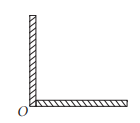
Solution: Moment of inertia of each rod about an axis passing through an end \(=\frac{M L^2}{3}\)
According to perpendicular axes theorem,
\(
\therefore \quad I_{\text {system }}=\frac{M L^2}{3}+\frac{M L^2}{3}=\frac{2 M L^2}{3}
\)
Example 13: Four particles each of mass \(m\) are kept at the four corners of a square of edge \(a\). Find the moment of inertia of the system about a line perpendicular to the plane of the square and passing through the centre of the square.
Solution:
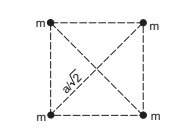
The perpendicular distance of every particle from the given line is \(\frac{a}{\sqrt{2}}\).
The moment of inertia of one particle is, therefore, \(m(\frac{a}{\sqrt{2}})^2=\frac{1}{2} m a^2\).
The moment of inertia of the system is, therefore, \(4 \times \frac{1}{2} m a^2=2 m a^2\).
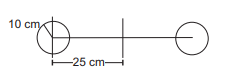
Example 14: Two identical spheres each of mass 1.20 kg and radius 10.0 cm are fixed at the ends of a light rod so that the separation between the centres is 50.0 cm. Find the moment of inertia of the system about an axis perpendicular to the rod passing through its middle point.
Solution:
Step 1: Define variables and units
The given variables are mass \(m=1.20 \mathrm{~kg}\), radius \(R=10.0 \mathrm{~cm}=0.100 \mathrm{~m}\), and separation between centers \(d=50.0 \mathrm{~cm}=0.500 \mathrm{~m}\). The distance from the center of each sphere to the axis of rotation is half the separation, \(D=d / 2=0.250 \mathrm{~m}\).
Step 2: Calculate moment of inertia for one sphere
The moment of inertia of a solid sphere about an axis through its center of mass is given by the formula \(I_{C M}=\frac{2}{5} m R^2\). The moment of inertia of one sphere about the system’s central axis is found using the parallel axis theorem: \(I_{\text {sphere }}=I_{C M}+m D^2\)
Step 3: Apply parallel axis theorem and sum
Substituting the values into the equations:
\(
\begin{aligned}
& I_{C M}=\frac{2}{5}(1.20 \mathrm{~kg})(0.100 \mathrm{~m})^2=0.00480 \mathrm{~kg} \mathrm{~m}^2 \\
& m D^2=(1.20 \mathrm{~kg})(0.250 \mathrm{~m})^2=0.0750 \mathrm{~kg} \mathrm{~m}^2 \\
& I_{\text {sphere }}=0.00480+0.0750=0.07980 \mathrm{~kg} \mathrm{~m}^2
\end{aligned}
\)
The total moment of inertia for the system of two identical spheres is
\(
I_{\text {total }}=2 \times I_{\text {sphere }}
\)
\(
I_{\text {total }}=2 \times 0.07980 \mathrm{~kg} \mathrm{~m}^2=0.1596 \mathrm{~kg} \mathrm{~m}^2
\)
Example 15: Two uniform identical rods each of mass \(M\) and length \(l\) are joined to form a cross as shown in figure below. Find the moment of inertia of the cross about a bisector as shown dotted in the figure.
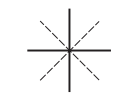
Solution: Consider the line perpendicular to the plane of the figure through the centre of the cross. The moment of inertia of each rod about this line is \(\frac{M l^2}{12}\) and hence the moment of inertia of the cross is \(\frac{M l^2}{6}\). The moment of inertia of the cross about the two bisectors are equal by symmetry and according to the theorem of perpendicular axes, the moment of inertia of the cross about the bisector is \(\frac{M l^2}{12}\).
Explanation: Axis Perpendicular to the Plane \(\left({I}_{{z}}\right)\) :
For one rod, the moment of inertia about its center (where they join) is
\(
I_{C M}=\frac{1}{12} Ml^2
\)
For the two rods together, about the axis perpendicular to the cross,
\(
I_z=I_{C M 1}+I_{C M 2}=\frac{1}{12} Ml^2+\frac{1}{12} Ml^2=\frac{1}{6} Ml^2 .
\)
Perpendicular Axis Theorem:
For a planar object, \(I_z=I_x+I_y\), where \(I_x\) and \(I_y\) are moments of inertia about perpendicular axes in the plane.
Here, the bisector is one of these axes (say, \({I}_{\boldsymbol{x}}\) ), and the other axis through the center (perpendicular to the bisector, within the plane) is \({I}_{{y}}\).
Calculate the Bisector’s Moment of Inertia \(\left({I}_{\text {bisector }}\right)\) :
\(I_Z=I_{\text {bisector }}+I_{\text {other_bisector }}\)
\(\frac{1}{6} Ml^2=I_{\text {bisector }}+I_{\text {bisector }}\left(\right.\) since \(\left.I_x=I_y\right)\)
\(\frac{1}{6} Ml^2=2 \times I_{\text {bisector }}\)
\(I_{\text {bisector }}=\frac{1}{12} Ml^2\).