4.12 Entrace Corner
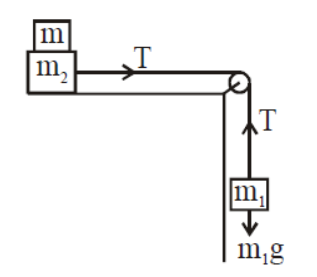
Q1. Two masses \(m_1=5 \mathrm{~kg}\) and \(m_2=10 \mathrm{~kg}\), connected by an inextensible string over a frictionless pulley, are moving as shown in the figure. The coefficient of friction of horizontal surface is 0.15. The minimum weight \(m\) that should be put on top of \(m_2\) to stop the motion is : [JEE 2018]
(a) 10.3 Kg (b) 18.3 Kg (c) 27.3 Kg (d) 43.3 Kg
Solution: (c) Moving block will stop when the friction force between \(\mathrm{m}_2\) and surface is \(\geq\) tension force.
So condition for stopping the moving block,
\(
\begin{aligned}
& f \geq T \\
& \Rightarrow \mu N \geq T \\
& \Rightarrow \mu\left(m+m_2\right) g \geq m_1 g
\end{aligned}
\)
When \(m\) is minimum then,
\(
\begin{aligned}
& \mu\left(m+m_2\right) g=m_1 g \\
& \Rightarrow m=\frac{m_1-\mu m_2}{\mu} \\
& \Rightarrow m=\frac{5-0.15 \times 10}{0.15}=23.33 \mathrm{~kg}
\end{aligned}
\)
So if \(m \geq 23.33 \mathrm{~kg}\) then the motion will stop. From option the minimum possible \(m\) is 27.3 kg.
Q2. A body of mass 2 kg slides down with an acceleration of \(3 \mathrm{~m} / \mathrm{s}^2\) on a rough inclined plane having a slope of \(30^{\circ}\). The external force required to take the same body up the plane with the same acceleration will be : \(\left(\mathrm{g}=10 \mathrm{~m} / \mathrm{s}^2\right)\) [JEE 2018]
(a) 14 N (b) 20 N (c) 6 N (d) 4 N
Solution: (b)
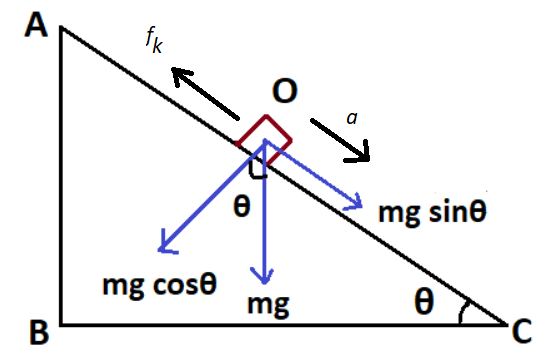
Step 1: Calculate the force of friction
First, we analyze the motion of the body as it slides down the inclined plane. The net force acting on the body is the component of gravity parallel to the plane minus the force of friction. This is equal to the mass times acceleration.
\(
F_{\text {net }, \text { down }}=m g \sin \theta-f_k=m a
\)
We are given:
\(m=2 \mathrm{~kg}\)
\(g=10 \mathrm{~m} / \mathrm{s}^2\)
\(\theta=30^{\circ}\)
\(a=3 \mathrm{~m} / \mathrm{s}^2\)
Plugging in the values:
\(
\begin{gathered}
(2)(10) \sin \left(30^{\circ}\right)-f_k=(2)(3) \\
20(0.5)-f_k=6 \\
10-f_k=6 \\
f_k=10-6=4 \mathrm{~N}
\end{gathered}
\)
Step 2: Calculate the external force required to move the body up the plane
Next, we analyze the motion as the body is pushed up the plane. The external force must overcome the component of gravity parallel to the plane and the force of friction, and also provide the net force for acceleration. In this case, the friction force acts down the plane, in the same direction as the gravity component.
\(
F_{n e t, u p}=F_{e x t}-m g \sin \theta-f_k=m a
\)
We can now solve for the external force \(F_{\text {ext }}\) :
\(
F_{e x t}=m a+m g \sin \theta+f_k
\)
Using the values we have:
\(m a=(2)(3)=6 \mathrm{~N}\)
\(m g \sin \theta=10 \mathrm{~N}\)
\(f_k=4 \mathrm{~N}\)
\(
F_{e x t}=6+10+4=20 \mathrm{~N}
\)
Q3. A particle of mass m is acted upon by a force F given by the empirical law \(\mathrm{F}=\frac{R}{t^2} v(t)\). If this law is to be tested experimentally by observing the motion starting from rest, the best way is to plot : [JEE 2016]
(a) \(v(\mathrm{t})\) against \(\mathrm{t}^2\)
(b) \(\log v(\mathrm{t})\) against \(\frac{1}{t^2}\)
(c) \(\log v(\mathrm{t})\) against \(t\)
(d) \(\log v(\mathrm{t})\) against \(\frac{1}{t}\)
Solution: Step 1: Formulate the governing differential equation
According to Newton’s Second Law, the force on a particle of mass \(\boldsymbol{m}\) is given by \(\boldsymbol{F}=\boldsymbol{m} a\), where \(\boldsymbol{a}\) is the acceleration. We also know that acceleration is the rate of change of velocity with respect to time, \(a=\frac{d v}{d t}\).
The given empirical law for the force is \(F=\frac{R}{t^2} v(t)\).
By equating these two expressions for the force, we get the differential equation describing the motion:
\(
m \frac{d v}{d t}=\frac{R}{t^2} v(t)
\)
Step 2: Solve the differential equation
To find a relationship between velocity \(v(t)\) and time \(t\), we can separate the variables and integrate.
\(
\frac{d v}{v}=\frac{R}{m} \frac{d t}{t^2}
\)
Integrating both sides of the equation gives:
\(
\begin{aligned}
& \int \frac{d v}{v}=\int \frac{R}{m} \frac{1}{t^2} d t \\
& \ln (v)=-\frac{R}{m} \frac{1}{t}+C
\end{aligned}
\)
where \(C\) is the constant of integration. This equation shows a linear relationship.
The equation \(\ln (v)=-\frac{R}{m} \frac{1}{t}+C\) is in the form of a straight-line equation, \(y=m x+b\)
Plotting \(\ln (v)\) against \(\frac{1}{t}\) would yield a straight line.
Q4. A rocket is fired vertically from the earth with an acceleration of 2 g, where g is the gravitational acceleration. On an inclined plane inside the rocket, making an angle \(\theta\) with the horizontal, a point object of mass \(m\) is kept. The minimum coefficient of friction \(\mu_{\min }\) between the mass and the inclined surface such that the mass does not move is : [JEE 2016]
(a) \(\tan \theta\)
(b) \(2 \tan \theta\)
(c) \(3 \tan \theta\)
(d) \(\tan 2 \theta\)
Solution: (a) Coefficient of static friction is a dimensionless quantity. \(\mu_s\) is the maximum resistive force applied on any given body such that there is no change in state of the motion. Also, \(\mu_s\) is the maximum resistive force applied on any given body such that there is no change in state of the motion. It is given as \(\mu_s=\frac{F_s}{F_n}\), where \(F_s\) is the applied force and \(F_n\) is the normal force acting on the given body. Consider the free body diagram of the rocket at the inclined slope \(\theta\). Given that the mass of the rocket \(m\) experiences an acceleration of \(2 g\), where \(g\) is the gravitational acceleration.
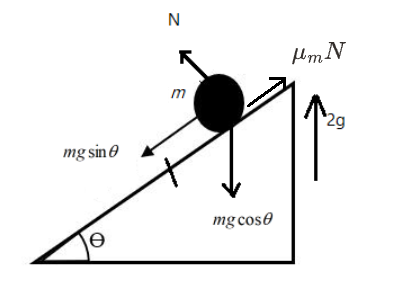
Then the normal force is given as \(N=2 m g \cos \theta+m g \cos \theta=3 m g \cos \theta\), similarly, the frictional force is given as \(F=2 m g \sin \theta+m g \sin \theta=3 m g \sin \theta\)
Let the minimum coefficient of friction be \(\mu_m\). Then the friction force \(F\) is given as \(F=\mu_m N\)
\(
\Longrightarrow F=3 \mu_m m g \cos \theta
\)
For the rocket to be in rest, both the frictional forces must be equal to each other, then we have
\(
\begin{gathered}
3 \mu_m m g \cos \theta=3 m g \sin \theta \\
\Longrightarrow \mu_m=\tan \theta
\end{gathered}
\)
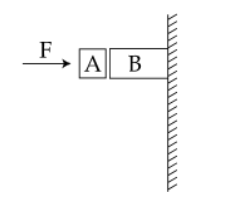
Q5. Given in the figure are two blocks \(A\) and \(B\) of weight 20 N and 100 N, respectively. These are being pressed against a wall by a force \(F\) as shown. If the coefficient of friction between the blocks is 0.1 and between block \(B\) and the wall is 0.15, the frictional force applied by the wall on block \(B\) is : [JEE 2015]
(a) 120 N (b) 150 N (c) 100 N (d) 80 N
Solution: (a) Step 1: Analyze the forces acting on the combined block system
The system consists of blocks \(\boldsymbol{A}\) and \(\boldsymbol{B}\). The total downward force acting on the combined system is the sum of the weights of block \(\boldsymbol{A}\) and block \(\boldsymbol{B}\). The frictional force from the wall on block \(\boldsymbol{B}\) must counteract this total downward force to keep the blocks in static equilibrium.
The total weight of the blocks is the sum of the weight of block \(\mathrm{A}\left(W_A\right)\) and the weight of block \(\mathrm{B}\left(W_B\right)\).
\(
\begin{gathered}
W_{\text {total }}=W_A+W_B \\
W_{\text {total }}=20 \mathrm{~N}+100 \mathrm{~N} \\
W_{\text {total }}=120 \mathrm{~N}
\end{gathered}
\)
Step 2: Determine the frictional force from the wall on block B
For the blocks to be in equilibrium, the upward frictional force exerted by the wall on block \(B\) must be equal to the total downward force, which is the combined weight of the blocks. This is because the problem implies the blocks are stationary, and the static frictional force will be exactly what is needed to prevent motion, provided it does not exceed the maximum possible static friction.
The frictional force ( \(\boldsymbol{F}_{\text {wall }}\) ) is therefore:
\(
\begin{aligned}
& F_{\text {wall }}=W_{\text {total }} \\
& F_{\text {wall }}=120 \mathrm{~N}
\end{aligned}
\)
The frictional force applied by the wall on block \(B\) is 120 N.
Q6. A block of mass \(m\) is placed on a surface with a vertical cross section given by \(y=\frac{x^3}{6}\). If the coefficient of friction is 0.5, the maximum height above the ground at which the block can be placed without slipping is: [JEE 2014]
(a) \(\frac{1}{6} m\)
(b) \(\frac{2}{3} m\)
(c) \(\frac{1}{3} m\)
(d) \(\frac{1}{2} m\)
Solution: (a) Step 1: Find the slope of the surface
The vertical cross section of the surface is given by the equation \(y=\frac{x^3}{6}\). The slope of the surface at any point \((x, y)\) is the first derivative of \(y\) with respect to \(x\).
\(
\frac{d y}{d x}=\frac{d}{d x}\left(\frac{x^3}{6}\right)=\frac{3 x^2}{6}=\frac{x^2}{2}
\)
Let \(\theta\) be the angle of the surface with the horizontal. The tangent of this angle is equal to the slope.
\(
\tan \theta=\frac{x^2}{2}
\)
Step 2: Set up the condition for no slipping
For the block to not slip, the component of the gravitational force parallel to the surface must be less than or equal to the maximum static friction force.
The gravitational force pulling the block down the incline is \(\boldsymbol{F}_{\text {parallel }}=m g \sin \theta\). The normal force is \(N=m g \cos \theta\).
The maximum static friction force is \(f_{s, \max }=\mu N=\mu m g \cos \theta\).
The condition for no slipping is:
\(
m g \sin \theta \leq \mu m g \cos \theta
\)
Dividing both sides by \(m g \cos \theta\) (assuming \(\cos \theta \neq 0\) ), we get:
\(
\tan \theta \leq \mu
\)
Step 3: Solve for x
We are given that the coefficient of friction is \(\boldsymbol{\mu} \boldsymbol{=} \mathbf{0 . 5}\). Substituting this into our condition, we find the maximum value of \(\tan \theta\) :
\(
\tan \theta_{\max }=0.5
\)
Now we can equate this to our expression for the slope:
\(
\begin{aligned}
& \frac{x^2}{2}=0.5 \\
& x^2=1 \\
& x= \pm 1
\end{aligned}
\)
Since the height \(y\) is defined as \(y=x^3 / 6\), we can take \(x=1\) to find the corresponding height.
Step 4: Calculate the maximum height
Substitute the value of \(x=1\) into the equation for the surface to find the maximum height \(h\).
\(
h=y=\frac{x^3}{6}=\frac{(1)^3}{6}=\frac{1}{6}
\)
The maximum height above the ground at which the block can be placed without slipping is \(\frac{1}{6}\).
Q7. A particle of mass \(m\) is at rest at the origin at time \(t=0\). It is subjected to a force \(F(t)=F_0 e^{-b t}\) in the \(x\) direction. Its speed \(v(t)\) is depicted by which of the following curves? [JEE 2012]
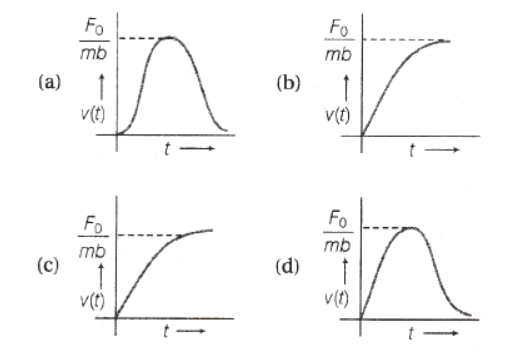
Solution: (c)
\(\begin{aligned}
&\text { Given that } F(t)=F_0 e^{-b t}\\
&\begin{aligned}
& \Rightarrow m \frac{d v}{d t}=F_0 e^{-b t} \\
& \frac{d v}{d t}=\frac{F_0}{m} e^{-b t} \\
& \Rightarrow \int_0^v d v=\frac{F_0}{m} \int_0^t e^{-b t} d t \\
& v=\frac{F_0}{m}\left[\frac{e^{-b t}}{-b}\right]_0^t=\frac{F_0}{m b}\left[-\left(e^{-b t}-e^{-0}\right)\right] \\
& \Rightarrow v=\frac{F_0}{m b}\left[1-e^{-b t}\right] \\
& \Rightarrow v_{\max }=\frac{F_0}{m b}
\end{aligned}
\end{aligned}
\)
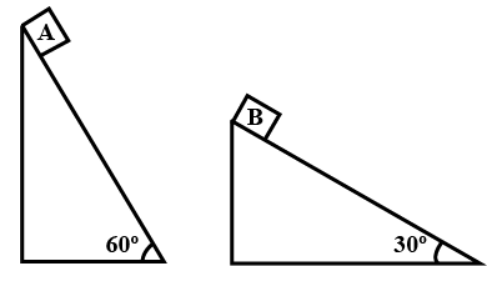
Q8. Two fixed frictionless inclined planes making an angle \(30^{\circ}\) and \(60^{\circ}\) with the vertical are shown in the figure. Two blocks \(A\) and \(B\) are placed on the two planes. What is the relative vertical acceleration of \(A\) with respect to \(B\) ? [JEE 2010]
(a) \(4.9 m s^{-2}\) in horizontal direction
(b) \(9.8 m s^{-2}\) in vertical direction
(c) Zero
(d) \(4.9 m s^{-2}\) in vertical direction
Solution: (d) Each plane makes angles \(30^{\circ}\) and \(60^{\circ}\) with the vertical.
Let those angles be
\(
\alpha_A=30^{\circ}, \quad \alpha_B=60^{\circ} .
\)
Acceleration of each block down its incline:
On a frictionless incline, acceleration along the plane is
\(
a_{\text {incline }}=g \sin (\text { angle with horizontal })
\)
But each plane is given by angle with vertical, so its angle with horizontal is:
\(
\theta=90^{\circ}-\alpha
\)
Thus,
\(
a_{\text {incline }}=g \sin \left(90^{\circ}-\alpha\right)=g \cos \alpha .
\)
Vertical component of each acceleration:
If the plane makes angle \(\alpha\) with vertical, then the motion direction makes the same angle \(\alpha\) with vertical when projected downward.
Thus,
\(
a_{\text {vertical }}=a_{\text {incline }} \cos \alpha=(g \cos \alpha) \cos \alpha=g \cos ^2 \alpha .
\)
Compute for each block:
Block A ( \(\alpha_A=30^{\circ}\) ):
\(
a_{A, v}=g \cos ^2 30^c \downarrow g\left(\frac{\sqrt{3}}{2}\right)^2=\frac{3 g}{4}
\)
Block B ( \(\alpha_B=60^{\circ}\) ):
\(
a_{B, v}=g \cos ^2 60^{\circ}=g\left(\frac{1}{2}\right)^2=\frac{g}{4}
\)
Relative vertical acceleration:
\(
a_{\mathrm{rel}}=a_{A, v}-a_{B, v}=\frac{3 g}{4}-\frac{g}{4}=\frac{g}{2}
\)
Q9. A block of mass \(m\) is connected to another block of mass \(M\) by a spring (massless) of spring constant \(k\). The block are kept on a smooth horizontal plane. Initially the blocks are at rest and the spring is unstretched. Then a constant force \(F\) starts acting on the block of mass \(M\) to pull it. Find the force of the block of mass \(m\). [JEE 2007]
(a) \(\frac{M F}{(m+M)}\)
(b) \(\frac{m F}{M}\)
(c) \(\frac{(M+m) F}{m}\)
(d) \(\frac{m F}{(m+M)}\)
Solution: (d) From free body-diagram of \(m\)
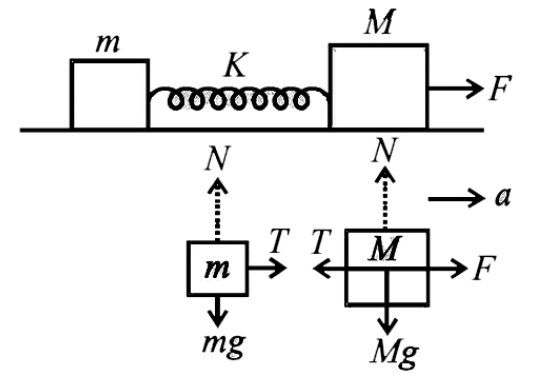
we get \(T=m a\)
From free body-diagram of \(M\)
we get \(F-T=M a\)
where \(T\) is force due to spring
\(
\begin{aligned}
& \Rightarrow F-m a=M a \\
& \Rightarrow F=M a+m a \\
& \therefore a=\frac{F}{M+m}
\end{aligned}
\)
Now, force acting on the block of mass \(m\) is
\(
m a=m\left(\frac{F}{M+m}\right)=\frac{m F}{m+M} .
\)
Q10. Consider a car moving on a straight road with a speed of \(100 \mathrm{~m} / \mathrm{s}\). The distance at which car can be stopped is \(\left[\mu_k=0.5\right]\) [JEE 2005]
(a) \(1000 m\)
(b) \(800 m\)
(c) \(400 m\)
(d) \(100 m\)
Solution: Calculate the deceleration due to friction:
The force of kinetic friction acting on the car is given by \(F_k=\mu_k N\), where \(N\) is the normal force. On a horizontal road, the normal force is equal to the car’s weight, \(N=m g\).
The net force causing the deceleration is the friction force. Using Newton’s second law ( \(F=m a\) ), we get:
\(
\begin{gathered}
-F_k=m a \\
-\mu_k m g=m a
\end{gathered}
\)
The mass of the car ( \(m\) ) cancels out, and the acceleration ( \(a\) ) is:
\(
a=-\mu_k g
\)
\(
\begin{aligned}
&\text { We know, } v^2=u^2+2 a s\\
&\begin{aligned}
& \Rightarrow 0^2=u^2+2\left(-\mu_k g\right) s \\
& \Rightarrow 2 \mu_k g s=u^2 \\
& \Rightarrow s=\frac{100^2}{2 \times 0.5 \times 10} \\
& \Rightarrow s=1000 \mathrm{~m}
\end{aligned}
\end{aligned}
\)
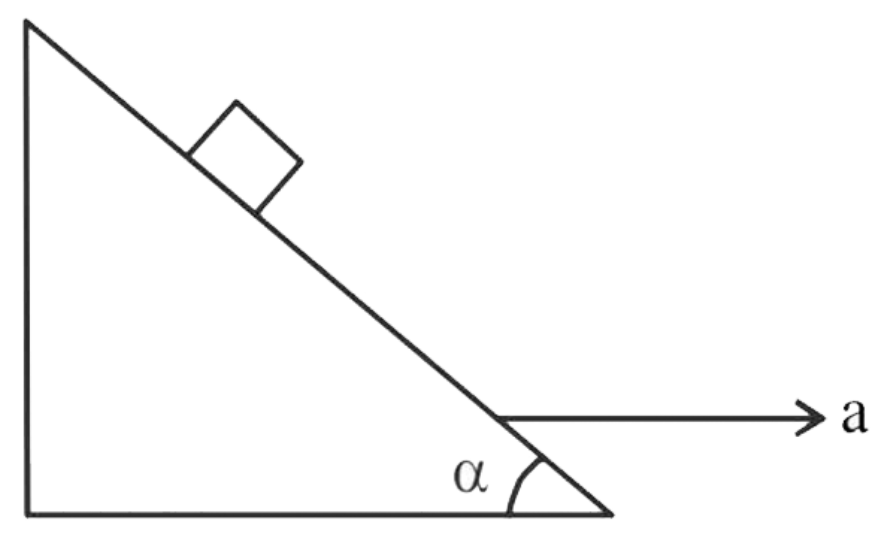
Q11. A block is kept on a frictionless inclined surface with angle of inclination ‘ \(\alpha^{\prime}\). The incline is given an acceleration \(a\) to keep the block stationary. Then \(a\) is equal to [JEE 2005]
(a) \(g \operatorname{cosec} \alpha\)
(b) \(g / \tan \alpha\)
(c) \(g \tan \alpha\)
(d) \(g\)
Solution: (c)
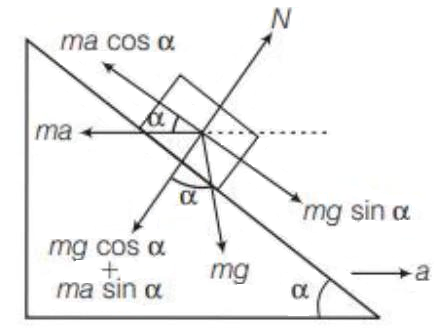
Set up the equation: For the block to remain stationary, the forces along the incline must be balanced.
\(m a \cos \alpha=m g \sin \alpha\).
Solve for acceleration: Cancel out the mass ( \(m\) ) from both sides and rearrange the equation to solve for \(a\).
\(a \cos \alpha=g \sin \alpha\)
\(a=g \frac{\sin \alpha}{\cos \alpha}\)
\(a=g \tan \alpha\)
Q12. A smooth block is released at rest on a \(45^{\circ}\) incline and then slides a distance ‘ \(d\) ‘. The time taken to slide is ‘ \(n\) ‘ times as much to slide on rough incline than on a smooth incline. The coefficient of friction is [JEE 2005]
(a) \(\mu_k=\sqrt{1-\frac{1}{n^2}}\)
(b) \(\mu_k=1-\frac{1}{n^2}\)
(c) \(\mu_k=\sqrt{1-\frac{1}{n^2}}\)
(d) \(\mu_s=1-\frac{1}{n^2}\)
Solution: (b) Analyze the motion on a smooth incline:
For a smooth incline, the only force component causing the block to accelerate is the component of gravity parallel to the incline.
The acceleration of the block down the smooth incline ( \(a_{\text {smooth }}\) ) is given by:
\(
a_{\text {smooth }}=g \sin \theta
\)
We are given that the angle of the incline is \(\boldsymbol{\theta}=45^{\circ}\), so:
\(
a_{\text {smooth }}=g \sin \left(45^{\circ}\right)=g \frac{\sqrt{2}}{2}
\)
The block starts from rest ( \(v_0=0\) ) and slides a distance ‘\(d\)‘. Using the kinematic equation \(d=v_0 t+\frac{1}{2} a t^2\), the time taken to slide on the smooth incline \(t_1\) is:
\(
\begin{gathered}
d=\frac{1}{2} a_{\text {smooth }} t_1^2 \\
t_1^2=\frac{2 d}{a_{\text {smooth }}}=\frac{2 d}{g \sin \theta}
\end{gathered}
\)
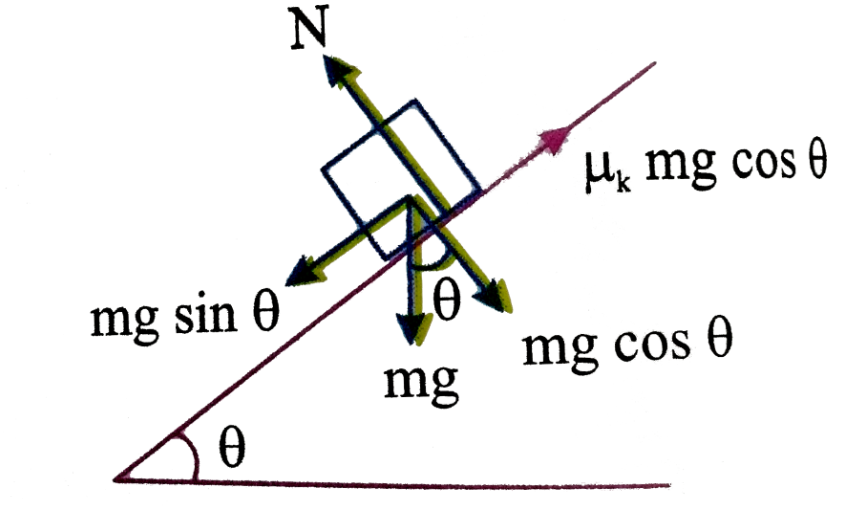
For rough plane,
Frictional retardation up the plane \(=\mu_{\mathrm{k}}(g \cos \theta)\)
\(
\begin{aligned}
& d=\frac{1}{2}(g \sin \theta-\mu g \cos \theta) t_2^2 \\
& t_2=\sqrt{\frac{2 d}{g \sin \theta-\mu_k g \cos \theta}}
\end{aligned}
\)
According to question, \(t_2=n t_1\)
\(
\begin{aligned}
& n \sqrt{\frac{2 d}{g \sin \theta}}=\sqrt{\frac{2 d}{g \sin \theta-\mu g \cos \theta}} \\
& n=\frac{1}{\sqrt{1-\mu_k}}\left(\text { as } \cos 45^{\circ}=\sin 45^{\circ}=\frac{1}{\sqrt{2}}\right) \\
& n^2=\frac{1}{1-\mu_k}
\end{aligned}
\)
or \(1-\mu_k=\frac{1}{n^2}\)
or \(\mu_k=1-\frac{1}{n^2}\)
Q13. A particle of mass 0.3 kg subjected to a force \(F=-k x\) with \(k=15 N / m\). What will be its initial acceleration if it is released from a point 20 cm away from the origin? [JEE 2005]
(a) \(15 \mathrm{~m} / \mathrm{s}^2\)
(b) \(3 \mathrm{~m} / \mathrm{s}^2\)
(c) \(10 \mathrm{~m} / \mathrm{s}^2\)
(d) \(5 \mathrm{~m} / \mathrm{s}^2\)
Solution: Step 1: Identify the given values and relevant physical principles
The problem provides the following values:
Mass of the particle, \(\boldsymbol{m}=\mathbf{0 . 3 ~ k g}\).
Force on the particle, \(F=-k x\).
Spring constant, \(k=15 \mathrm{~N} / \mathrm{m}\).
Initial displacement from the origin, \(x=20 \mathrm{~cm}\).
We will use Newton’s Second Law of Motion, which states that the net force on an object is equal to its mass times its acceleration: \(\boldsymbol{F}=m a\).
Step 2: Convert units and set up the equation
First, convert the initial displacement from centimeters to meters to maintain consistent units:
\(
x=20 \mathrm{~cm}=0.20 \mathrm{~m}
\)
Next, we equate the given force with Newton’s Second Law to solve for acceleration (\(a\)):
\(
m a=-k x
\)
Solving for acceleration, we get:
\(
a=\frac{-k x}{m}
\)
Step 3: Calculate the initial acceleration
Now, substitute the given values into the equation:
\(
\begin{gathered}
a=\frac{-(15 \mathrm{~N} / \mathrm{m})(0.20 \mathrm{~m})}{0.3 \mathrm{~kg}} \\
a=\frac{-3 \mathrm{~N}}{0.3 \mathrm{~kg}} \\
a=-10 \mathrm{~m} / \mathrm{s}^2
\end{gathered}
\)
The question asks for the magnitude of the initial acceleration, so we take the absolute value.
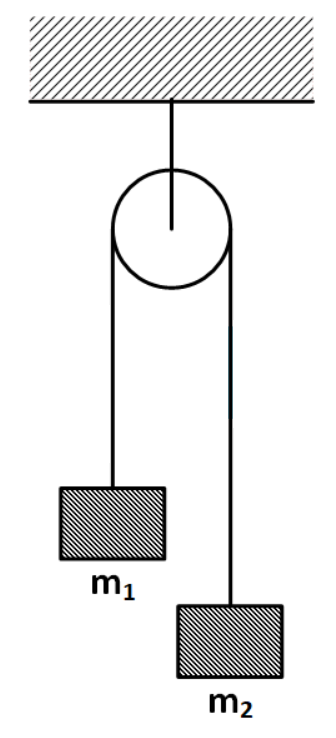
Q14. Two masses \(m_1=5 \mathrm{~kg}\) and \(m_2=4.8 \mathrm{~kg}\) tied to a string are hanging over a light frictionless pulley. What is the acceleration of the masses when left free to move? \(\left(g=9.8 m / s^2\right)\) [JEE 2004]
(a) \(5 \mathrm{~m} / \mathrm{s}^2\)
(b) \(9.8 \mathrm{~m} / \mathrm{s}^2\)
(c) \(0.2 \mathrm{~m} / \mathrm{s}^2\)
(d) \(4.8 \mathrm{~m} / \mathrm{s}^2\)
Solution: (c)
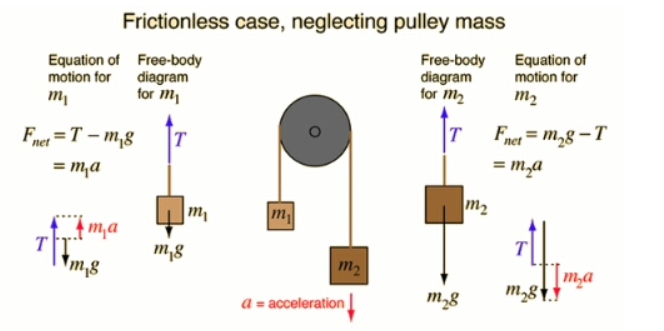
Equation of motion for \(m_1\)
\(
F_{n e t}=T-m_1 g=m_1 a
\)
Equation of Motion for \(m_2\)
\(
F_{n e t}=m_2 g-T=m_2 a
\)
wherein
\(
\begin{aligned}
& a=\frac{\left[m_2-m_1\right] g}{m_1+m_2} \\
& T=\frac{2 m_1 m_2 g}{m_1+m_2}
\end{aligned}
\)
\(
\begin{aligned}
& \frac{a}{g}=\frac{\left(m_1-m_2\right)}{\left(m_1+m_2\right)}=\frac{(5-4.8)}{(5+4.8)}=\frac{0.2}{9.8} \\
& \text { or } \quad a=g \times \frac{0.2}{9.8}=\frac{9.8 \times 0.2}{9.8}=0.2 m s^{-2}
\end{aligned}
\)
Q15. A block rests on a rough inclined plane `making an angle of \(30^{\circ}\) with the horizontal. The coefficient of static friction between the block and the plane is 0.8. If the frictionless force on the block is \(10 N\), the mass of the block (in \(k g\) ) is (take \(g=10 m / s^2\) ) [JEE 2004]
(a) 2.0 (b) 4.0 (c) 1.6 (d) 2.5
Solution: (a)
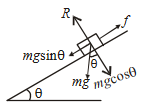
\begin{aligned}
& f=m g \sin \theta \\
& \therefore \quad 10=m \times 10 \times \sin 30^{\circ} \\
& \text { or } \quad m=2 \mathrm{~kg} .
\end{aligned}
\)
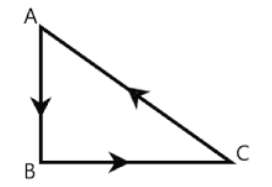
Q16. Three forces start acting simultaneously on a particle moving with velocity, \(\vec{v}\). These forces are represented in magnitude and direction by the three sides of a triangle \(A B C\). The particle will now move with velocity [JEE 2003]
(a) less than \(\vec{v}\)
(b) greater than \(\vec{v}\)
(c) \(|v|\) in the direction of the largest force \(B C\)
(d) \(\vec{v}\), remaining unchanged
Solution: (d) Step 1: Analyze the forces acting on the particle
The problem states that three forces are represented in magnitude and direction by the three sides of a triangle \(\boldsymbol{A} \boldsymbol{B} \boldsymbol{C}\). According to the triangle law of vector addition, if three vectors form a closed triangle when taken in order, their vector sum is zero.
Let the three forces be \(\vec{F}_1, \vec{F}_2\), and \(\vec{F}_3\), corresponding to the sides \(\overrightarrow{A B}, \overrightarrow{B C}\), and \(\overrightarrow{C A}\) of the triangle. The resultant force \(\vec{F}_{\text {net }}\) is the sum of these three forces.
\(
\vec{F}_{n e t}=\vec{F}_1+\vec{F}_2+\vec{F}_3=\overrightarrow{A B}+\overrightarrow{B C}+\overrightarrow{C A}
\)
The sum of the vectors representing the sides of a closed triangle is the zero vector.
\(
\overrightarrow{A B}+\overrightarrow{B C}+\overrightarrow{C A}=\overrightarrow{A C}+\overrightarrow{C A}=\overrightarrow{A C}-\overrightarrow{A C}=\overrightarrow{0}
\)
Therefore, the net force acting on the particle is zero ( \(\vec{F}_{\text {net }}=\overrightarrow{0}\) ).
Step 2: Apply Newton’s First Law of Motion
Newton’s First Law of Motion states that an object in motion will stay in motion with the same speed and in the same direction unless acted upon by an unbalanced force. Since the net force on the particle is zero, there is no acceleration.
According to Newton’s Second Law, the acceleration \(\overrightarrow{\boldsymbol{a}}\) is related to the net force \(\overrightarrow{\boldsymbol{F}}_{\text {net }}\) by the equation \(\vec{F}_{\text {net }}=m \vec{a}\), where \(m\) is the mass of the particle.
Since \(\vec{F}_{\text {net }}=\overrightarrow{0}\), it follows that \(m \vec{a}=\overrightarrow{0}\). Assuming the mass \(m\) is non-zero, the acceleration \(\overrightarrow{\boldsymbol{a}}\) must be zero.
A zero acceleration means that the velocity of the particle does not change. The particle will continue to move with its initial velocity.
The particle will now move with a velocity of \(\vec{v}\).
Q17. A horizontal force of \(10 N\) is necessary to just hold a block stationary against a wall. The coefficient of friction between the block and the wall is 0.2. The weight of the block is [JEE 2003]
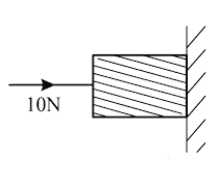
(a) 20 N (b) 50 N (c) 100 N (d) 2 N
Solution:
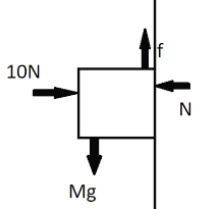
Force of friction is given by:
\(f=\mu N\)
\(f\) is the frictional force
\(\mu\) is the coefficient of friction
\(N\) is the normal force.
As the block is stationary it is in equilibrium.
Hence,
We know, \(m g=f\)
\(
m g=\mu N=0.2 \times 10=2 N
\)
Q18. A spring balance is attached to the ceiling of a lift. A man hangs his bag on the spring and the spring reads \(49 N\), when the lift is stationary. If the lift moves downward with an acceleration of \(5 \mathrm{~m} / \mathrm{s}^2\), the reading of the spring balance will be [JEE 2003]
(a) 24 N (b) 74 N (c) 15 N (d) 49 N
Solution: (a)
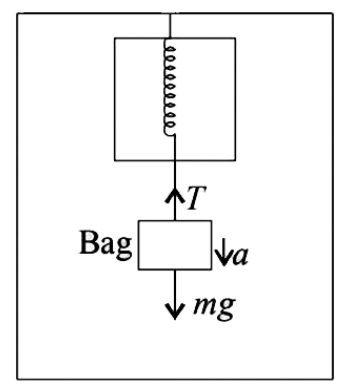
When lift is stationary then,
\(
\begin{aligned}
& \mathrm{T}=m g=49 \mathrm{~N} \\
& m=5
\end{aligned}
\)
For the bag accelerating down
\(
\begin{aligned}
& m g-T=m a \\
& \therefore T=m(g-a) \\
& =5(9.8-5)=24 N
\end{aligned}
\)
Q19. A rocket with a lift-off mass \(3.5 \times 10^4 \mathrm{~kg}\) is blasted upwards with an initial acceleration of \(10 \mathrm{~m} / \mathrm{s}^2\). Then the initial thrust of the blast is [JEE 2003]
(a) \(3.5 \times 10^5 N\)
(b) \(7.0 \times 10^5 N\)
(c) \(14.0 \times 10^5 \mathrm{~N}\)
(d) \(1.75 \times 10^5 \mathrm{~N}\)
Solution: (b) From the figure given, we can see that the force due to gravity mg acts on the rocket in the downward direction while the thrust \(F\) acts in the upward direction.
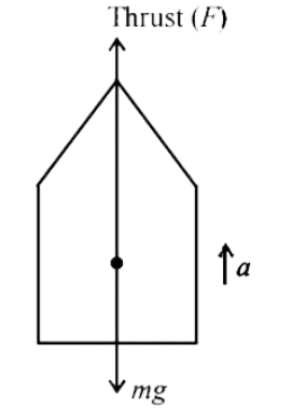
\(
F-m g=m a
\)
By solving the above equation, we get,
\(
\therefore F=m(g+a)
\)
Given,
Mass of rocket while lift-off (m) \(=3.5 \times 10^4 \mathrm{~kg}\)
The initial acceleration of rocket while lift-off is \(10 \mathrm{~m} / \mathrm{s}^2\)
Therefore, the thrust can be calculated with the equation given which evaluates to:
\(
\begin{aligned}
& =3.5+10^4(10+10) \\
& =7 \times 10^5 \mathrm{~N}
\end{aligned}
\)
Q20. A marble block of mass 2 kg lying on ice when given a velocity of \(6 \mathrm{~m} / \mathrm{s}\) is stopped by friction in 10 s. Then the coefficient of friction is [JEE 2003]
(A) 0.02
(B) 0.03
(C) 0.04
(D) 0.06
Solution: (d)
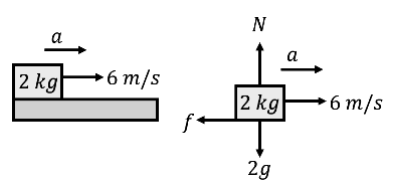
Let the coefficient of the friction be \(\mu\)
Therefore, friction force acting on block, \(f=\mu {mg}=2 \mu {~g}\)
So, from the FBD we have
\(
a=\frac{f}{m}=-\frac{2 \mu g}{2}=-\mu g
\)
Since, retardation takes place here, we have taken acceleration \(a\) as -ve
So, from the equation of motion we have
\(
{v}={u}+{at}
\)
Since the blocks finally comes to rest,
\(
\begin{aligned}
& \Rightarrow 0={u}-\mu {gt} \\
& \therefore \mu=\frac{u}{g t}=\frac{6}{10 \times 10}=0.06
\end{aligned}
\)
Q21. A block of mass \(M\) is pulled along a horizontal frictionless surface by a rope of mass \(m\). If a force \(P\) is applied at the free end of the rope, the force exerted by the rope on the block is [JEE 2003]
(a) \(\frac{P m}{M+m}\)
(b) \(\frac{P m}{M-m}\)
(c) \(P\)
(d) \(\frac{P M}{M+m}\)
Solution: (d) Let acceleration of system (rope + block) be a along the direction of applied force. Then,
\(
a=\frac{P}{M+m}
\)
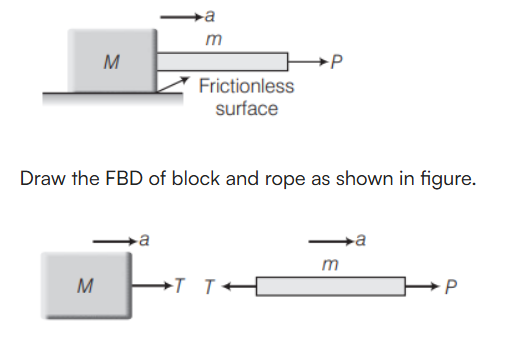
where, \(T\) is the required parameter
For block, \(T=M a\)
\(
\Rightarrow \quad T=\frac{M P}{M+m}
\)
Q22. A light spring balance hangs from the hook of the other light spring balance and a block of mass \(M k g\) hangs from the former one. Then the true statement about the scale reading is [JEE 2003]
(a) Both the scales read \(M k g\) each
(b) The scale of the lower one reads \(M k g\) and of the upper one zero
(c) The reading of the two scales can be anything but the sum of the reading will be \(M k g\)
(d) Both the scales read \(M / 2 \mathrm{~kg}\) each
Solution: (a)
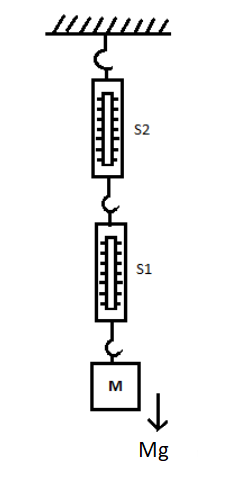
Now here the force acting on the mass block \(M\) is \(Mg\) (its weight) in a downward direction. As both of the spring balances are massless then the reading of the lower spring balance will be \(S 1\) (due to mass block) and the reading of upper spring balance will be \(S 2\) (due to \(S 1\) and mass block). But spring balances are massless so the reading of both of the springs should be the same , that is \(M\). Here, whatever force is experienced by \(S 1\) the same amount of force is experienced by \(S 2\) because the net force on the system should be zero. Therefore, \(S 1=S 2\). So when forces on both of the spring balances are equal then the reading will also be equal ( \(M k g\) ).
Q23. When forces \(F_1, F_2, F_3\) are acting on a particle of mass \(m\) such that \(F_2\) and \(F_3\) are mutually perpendicular, then the particle remains stationary. If the force \(F_1\) is now removed then the acceleration of the particle is [JEE 2002]
(a) \(F_1 / m\)
(b) \(F_2 F_3 / m F_1\)
(c) \(\left(F_2-F_3\right) / m\)
(d) \(F_2 / m\)
Solution: (a) Step 1: Analyze the initial state of the particle
When the three forces \(\vec{F}_1, \vec{F}_2\), and \(\vec{F}_3\) are acting on the particle, it remains stationary. According to Newton’s First Law, this means the net force on the particle is zero.
\(
\vec{F}_1+\vec{F}_2+\vec{F}_3=0
\)
This can be rearranged to express the relationship between the forces:
\(
\vec{F}_1=-\left(\vec{F}_2+\vec{F}_3\right)
\)
The magnitude of force \(\vec{F}_1\) is equal to the magnitude of the resultant of forces \(\vec{F}_2\) and \(\vec{F}_3\). Since \(\vec{F}_2\) and \(\vec{F}_3\) are mutually perpendicular, we can use the Pythagorean theorem to find their resultant’s magnitude.
\(
\left|\vec{F}_1\right|=\left|\vec{F}_2+\vec{F}_3\right|=\sqrt{\left|\vec{F}_2\right|^2+\left|\vec{F}_3\right|^2}
\)
Let’s denote the magnitudes of the forces as \(F_1, F_2\), and \(F_3\).
\(
F_1=\sqrt{F_2^2+F_3^2}
\)
Step 2: Analyze the final state of the particle
When force \(\vec{F}_1\) is removed, the only forces acting on the particle are \(\vec{F}_2\) and \(\vec{F}_3\). The new net force is \(\vec{F}_{\text {net }}=\vec{F}_2+\vec{F}_3\).
According to Newton’s Second Law, the acceleration \(\vec{a}\) of the particle is given by:
\(
\vec{F}_{n e t}=m \vec{a} \Longrightarrow \vec{F}_2+\vec{F}_3=m \vec{a}
\)
The magnitude of the acceleration is therefore:
\(
a=\frac{\left|\vec{F}_2+\vec{F}_3\right|}{m}
\)
As established in Step 1, the magnitude of the resultant of \(\vec{F}_2\) and \(\vec{F}_3\) is equal to the magnitude of \(\vec{F}_1\).
\(
\left|\vec{F}_2+\vec{F}_3\right|=F_1
\)
Substituting this back into the acceleration equation gives us the final acceleration:
\(
a=\frac{F_1}{m}
\)
Q24. A lift is moving down with acceleration \(a\). A man in the lift drops a ball inside the lift. The acceleration of the ball as observed by the man in the lift and a man standing stationary on the ground are respectively [JEE 2002]
(a) \(g, g\)
(b) \(g-a, g-a\)
(c) \(g-a, g\)
(d) \(a, g\)
Solution: (c) \(g-a, g\). For the man in the lift, the relative acceleration of the ball is \(g-a\) because the man and the ball are both accelerating downwards with \(a\) and \(g\) respectively, and their relative acceleration is the difference between their accelerations. For the man on the ground, the ball’s acceleration is simply \(g\) because it is only subject to the Earth’s gravity.
Acceleration observed by the man in the lift:
The man in the lift is moving downwards with acceleration \(a\).
The ball is dropped, and its acceleration due to gravity is \(g\).
The relative acceleration is the acceleration of the ball with respect to the man.
Since both are accelerating in the same direction (downwards), the relative acceleration is the difference between their accelerations: \(g-a\).
Acceleration observed by the man on the ground:
A stationary observer on the ground sees the ball falling under the sole influence of gravity.
Therefore, the acceleration of the ball as observed from the ground is simply \(g\).
Q25. One end of a mass-less rope, which passes over a mass-less and friction-less pulley \(P\) is tied to a hook \(C\) while the other end is free. Maximum tension that the rope can bear is 360 N. With what value of maximum safe acceleration (in \(\mathrm{ms}^{-2}\) ) can a man of 60 kg climb on the rope? [JEE 2002]
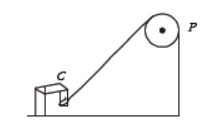
(a) 16 (b) 6 (c) 4 (d) 8
Solution: (c) If \(a\) is acceleration of man climbing down the rope then as is clear from
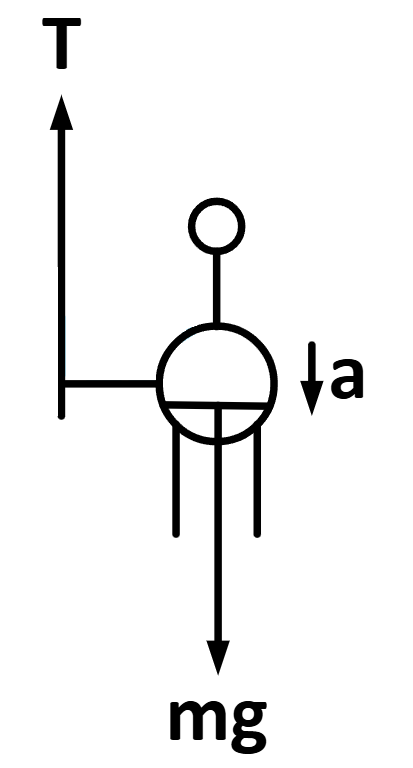
\(
\begin{aligned}
& m a=m g-T \\
& 60 a=60 \times 10-360=240 \\
& a=\frac{240}{60}=4 m / s^2
\end{aligned}
\)
So the maximum acceleration of man is \(4 \mathrm{~m} / \mathrm{s}^2\) downwards.
Q26. Three identical blocks of masses \(m=2 k g\) are drawn by a force \(F=10.2 N\) with an acceleration of \(0.6 m s^{-2}\) on a frictionless surface, then what is the tension (in \(N\) ) in the string between the blocks \(B\) and \(C\) ? [JEE 2002]

(a) 9.2 (b) 3.4 (c) 4 (d) 7.8
Solution: (d)

\begin{aligned}
&\text { Since, } \text { Force }=\text { mass } \times \text { acceleration }\\
&\begin{aligned}
& \therefore F-T_{A B}=m a \text { and } T_{A B}-T_{B C}=m a \\
& \therefore T_{B C}=F-2 m a \\
& \text { or } T_{B C}=10.2-(2 \times 2 \times 0.6) \\
& \text { or } T_{B C}=7.8 \mathrm{~N}
\end{aligned}
\end{aligned}
\)
Q27. Two forces are such that the sum of their magnitudes is \(18 N\) and their resultant is \(12 N\) which is perpendicular to the smaller force. Then the magnitudes of the forces are [JEE 2002]
(a) \(12 N, 6 N\)
(b) \(13 N, 5 N\)
(c) \(10 N, 8 N\)
(d) \(16 N, 2 N\)
Solution: (b)
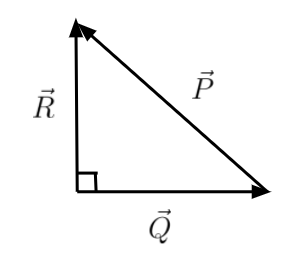
Resultant \(R\) is perpendicular to smaller force \(Q\) and \((P+Q)=18 \mathrm{~N}\).
\(
\therefore P^2=\left(Q^2-R^2)\right.
\)
\(
P^2-Q^2=R^2 \text { or }(P+Q) (P-Q)=R^2
\)
\(
18 \times (P-Q)={12}^2 \text { or } (P-Q)=8
\)
\(
\begin{aligned}
& \because P+Q=18 \\
& \therefore P+Q=18 N
\end{aligned}
\)
\(
P-Q =8 N
\)
\(
P =13 N, Q= 5 N
\)
Q28. A light string passing over a smooth light pulley connects two blocks of masses \(m_1\) and \(m_2\) (vertically). If the acceleration of the system is \(g / 8\), then the ratio of the masses is [JEE 2002]
(A) 8 : 1
(B) 9 : 7
(C) 4 : 3
(D) 5 : 3
Solution: (B)
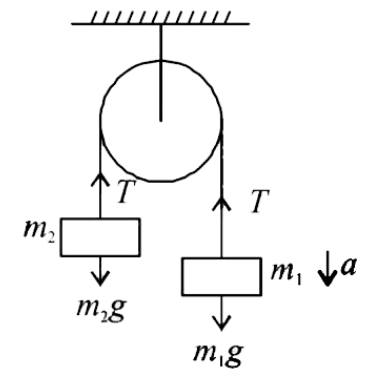
For mass \(m_1\)
\(
m_1 g-T=m_1 a
\)
For mass \(m_2\)
\(
T-m_2 g=m_2 a
\)
Adding the equations we get
\(
\begin{aligned}
& a=\frac{\left(m_1-m_2\right) g}{m_1+m_2} \\
& \therefore \frac{1}{8}=\frac{\frac{m_1}{m_2}-1}{\frac{m_1}{m_2}+1} \Rightarrow \frac{m_1}{m_2}+1=8 \frac{m_1}{m_2}-8 \Rightarrow \frac{m_1}{m_2}=\frac{9}{7}
\end{aligned}
\)