JEE PYQs Integer Type
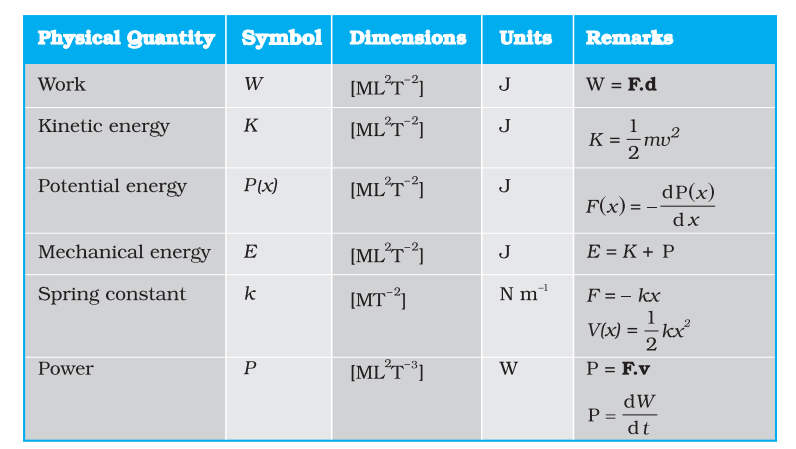
- Work done is a scalar or dot product of \(\mathbf{F}\) and \(\mathbf{s}\). \(W=(F \cos \theta)(s)\).
- The area under force-displacement curve gives work done.
- The work-energy theorem states that the change in kinetic energy of a body is the work done by the net force on the body.
\(
K_f-K_i=W_{n e t}
\) - A force is conservative if (i) work done by it on an object is path independent and depends only on the end points \(\left\{x_i, x_j\right\}\), or (ii) the work done by the force is zero for an arbitrary closed path taken by the object such that it returns to its initial position.
- For a conservative force in one dimension, we may define a potential energy function \(P(x)\) such that
\(
\begin{aligned}
& F(x)=-\frac{\mathrm{d} P(x)}{\mathrm{d} x} \\
& P_i-P_f=\int_{x_i}^{x_f} F(x) \mathrm{d} x
\end{aligned}
\) - The principle of conservation of mechanical energy states that the total mechanical energy of a body remains constant if the only forces that act on the body are conservative.
- The gravitational potential energy of a particle of mass \(m\) at a height \(x\) about the earth’s surface is
\(
P(x)=m g x
\)
where the variation of \(g\) with height is ignored. - The elastic potential energy of a spring of force constant \(k\) and extension \(x\) is
\(
P(x)=U=\frac{1}{2} k x^2
\) - The work done in stretching the spring by external applied force, \(W=\frac{1}{2} k x^2\)
Work done by the spring, \(W=-\frac{1}{2} k x^2\) - The scalar or dot product of two vectors \(\mathbf{A}\) and \(\mathbf{B}\) is written as \(\mathbf{A} . \mathbf{B}\) and is a scalar quantity given by \(: \mathbf{A} \cdot \mathbf{B}=A B \cos \theta\), where \(\theta\) is the angle between \(\mathbf{A}\) and \(\mathbf{B}\). It can be positive, negative or zero depending upon the value of \(\theta\). The scalar product of two vectors can be interpreted as the product of magnitude of one vector and component of the other vector along the first vector. For unit vectors :
\(
\hat{\mathbf{i}} \cdot \hat{\mathbf{i}}=\hat{\mathbf{j}} \cdot \hat{\mathbf{j}}=\hat{\mathbf{k}} \cdot \hat{\mathbf{k}}=1 \text { and } \hat{\mathbf{i}} \cdot \hat{\mathbf{j}}=\hat{\mathbf{j}} \cdot \hat{\mathbf{k}}=\hat{\mathbf{k}} \cdot \hat{\mathbf{i}}=0
\)
Scalar products obey the commutative and the distributive laws. - The work done by a variable force
\(
W=\int_{r_1}^{r_2} \mathbf{F} \cdot d \mathbf{r}
\)
where, integration is performed along the path of particle and \(d \mathbf{r}\) is the position vector of the particle. - Work done by or against a conservative force in moving a body from one position to another depends only on the initial and final positions of the body. It does not depend upon the nature of the path followed by the body in going from initial position to the final position.
- Work done by or against a conservative force in moving a particle along a closed path (round trip) is zero.
- If the force is non-conservative, then \(W_1 \neq W_2 \neq W_3\).
Work done by a non-conservative force in a round trip is not zero. i.e. \(W_1+W_2 \neq 0\). - Linear momentum, \(p=\sqrt{2 m \mathrm{KE}}\).
- \(W_{\text {net }}=\Delta \mathrm{KE}=K_f-K_i\), \(W_{\mathrm{net}}=\frac{1}{2} m\left(v_f^2-v_i^2\right)\).
- Potential energy of a body or system is the negative of work done by the conservative forces in bringing it from infinity to the present position.
\(U=-\int_{\infty}^{\mathbf{r}} \mathbf{F} \cdot d \mathbf{r}=-W\). - If the forces acting on the object are conservative and it is in equilibrium, then \(F_{\text {net }}=0 \Rightarrow-\frac{d U}{d r}=0 \text { or } \frac{d U}{d r}=0\)
- Average power \(\left(P_{\mathrm{av}}\right)=\frac{\text { Work done }}{\text { Time taken }}=\frac{W}{t}\).
- The instantaneous power \(P=\mathbf{F} \cdot \frac{d \mathbf{r}}{d t}=\mathbf{F} \cdot \mathbf{v}=F v \cos \theta\).
POINTS TO PONDER
- The phrase ‘calculate the work done’ is incomplete. We should refer (or imply clearly by context) to the work done by a specific force or a group of forces on a given body over a certain displacement.
- Work done is a scalar quantity. It can be positive or negative unlike mass and kinetic energy which are positive scalar quantities. The work done by the friction or viscous force on a moving body is negative.
- For two bodies, the sum of the mutual forces exerted between them is zero from Newton’s Third Law,
\(
\mathbf{F}_{12}+\mathbf{F}_{21}=0
\)
But the sum of the work done by the two forces need not always cancel, i.e.
\(
W_{12}+W_{21} \neq 0
\)
However, it may sometimes be true.
- The work done by a force can be calculated sometimes even if the exact nature of the force is not known.
- The WE theorem is not independent of Newton’s Second Law. The WE theorem may be viewed as a scalar form of the Second Law. The principle of conservation of mechanical energy may be viewed as a consequence of the WE theorem for conservative forces.
- The WE theorem holds in all inertial frames. It can also be extended to noninertial frames provided we include the pseudoforces in the calculation of the net force acting on the body under consideration.
- The potential energy of a body subjected to a conservative force is always undetermined upto a constant. For example, the point where the potential energy is zero is a matter of choice. For the gravitational potential energy mgh, the zero of the potential energy is chosen to be the ground. For the spring potential energy \(k x^2 / 2\), the zero of the potential energy is the equilibrium position of the oscillating mass.
- Every force encountered in mechanics does not have an associated potential energy. For example, work done by friction over a closed path is not zero and no potential energy can be associated with friction.
- During a collision : (a) the total linear momentum is conserved at each instant of the collision ; (b) the kinetic energy conservation (even if the collision is elastic) applies after the collision is over and does not hold at every instant of the collision. In fact the two colliding objects are deformed and may be momentarily at rest with respect to each other.
Quiz Summary
0 of 41 Questions completed
Questions:
Information
You have already completed the quiz before. Hence you can not start it again.
Quiz is loading…
You must sign in or sign up to start the quiz.
You must first complete the following:
Results
Results
0 of 41 Questions answered correctly
Your time:
Time has elapsed
You have reached 0 of 0 point(s), (0)
Earned Point(s): 0 of 0, (0)
0 Essay(s) Pending (Possible Point(s): 0)
Categories
- Not categorized 0%
- 1
- 2
- 3
- 4
- 5
- 6
- 7
- 8
- 9
- 10
- 11
- 12
- 13
- 14
- 15
- 16
- 17
- 18
- 19
- 20
- 21
- 22
- 23
- 24
- 25
- 26
- 27
- 28
- 29
- 30
- 31
- 32
- 33
- 34
- 35
- 36
- 37
- 38
- 39
- 40
- 41
- Current
- Review
- Answered
- Correct
- Incorrect
- Question 1 of 41
1. Question
In a hydraulic lift, the surface area of the input piston is \(6 \mathrm{~cm}^2\) and that of the output piston is \(1500 \mathrm{~cm}^2\). If 100 N force is applied to the input piston to raise the output piston by 20 cm, then the work done is _____ kJ. [JEE Main 2025 (Online) 29th January Morning Shift]
CorrectIncorrectHint
(a) Step 1: Calculate the force on the output piston
According to Pascal’s principle, the pressure exerted on the input piston is transmitted undiminished to the output piston.
\(
P_{\text {in }}=P_{\text {out }} \Longrightarrow \frac{F_{\text {in }}}{A_{\text {in }}}=\frac{F_{\text {out }}}{A_{\text {out }}}
\)
We rearrange the formula to find the output force \(\mathbf{F}_{\text {out }}\) :
\(
F_{\text {out }}=F_{\text {in }} \times \frac{A_{\text {out }}}{A_{\text {in }}}
\)
Substituting the given values into the equation:
\(
F_{\text {out }}=100 \mathrm{~N} \times \frac{1500 \mathrm{~cm}^2}{6 \mathrm{~cm}^2}=25000 \mathrm{~N}
\)
Step 2: Calculate the work done
The work done \(\mathbf{W}\) by the output piston is the product of the output force \(\mathbf{F}_{\text {out }}\) and the distance moved \(\mathbf{d}_{\text {out }}\). We must first convert the distance to meters:
\(
d_{\text {out }}=20 \mathrm{~cm}=0.2 \mathrm{~m} .
\)
\(
W=F_{\text {out }} \times d_{\text {out }}
\)
Substituting the values:
\(
W=25000 \mathrm{~N} \times 0.2 \mathrm{~m}=5000 \mathrm{~J}
\)
Step 3: Convert the work to kilojoules
To convert Joules (J) to kilojoules (kJ), we divide by 1000:
\(
W(\mathrm{~kJ})=\frac{5000 \mathrm{~J}}{1000}=5 \mathrm{~kJ}
\) - Question 2 of 41
2. Question
A force \(\mathrm{f}=\mathrm{x}^2 \mathrm{y} \hat{\mathrm{i}}+\mathrm{y}^2 \hat{\mathrm{j}}\) acts on a particle in a plane \(\mathrm{x}+\mathrm{y}=10\). The work done by this force during a displacement from \((0,0)\) to \((4 \mathrm{~m}, 2 \mathrm{~m})\) is ____ J (round off to the nearest integer) [JEE Main 2025 (Online) 23rd January Morning Shift]
CorrectIncorrectHint
(d) Step 1: Define the line integral for work
The work done by a variable force \(\mathbf{f}\) along a path \(C\) is given by the line integral:
\(
W=\int_C \mathbf{f} \cdot d \mathbf{r}
\)
where \(\mathbf{f}=F_x \hat{i}+F_y \hat{j}=x^2 y \hat{i}+y^2 \hat{j}\) and \(d \mathbf{r}=d x \hat{i}+d y \hat{j}\). The dot product is \(\mathbf{f} \cdot d \mathbf{r}=x^2 y d x+y^2 d y\). The particle moves in a plane defined by \(x+y=10\).
Step 2: Use the path constraint to set up the integral
The path of the particle is along the plane \(x+y=10\).
\(
y=10-x
\)
The work done integral is often interpreted as:
\(
W=\int F_x d x+\int F_y d y
\)
The specific solution integrates \(\boldsymbol{F}_{\boldsymbol{x}}\) with \(\boldsymbol{y}\) expressed as \(10-\boldsymbol{x}\), and integrates \(\boldsymbol{F}_{\boldsymbol{y}}\) independently from 0 to 2.
Step 3: Evaluate the integrals
We calculate the work done by evaluating the two integrals:
\(
W=\int_0^4 x^2(10-x) d x+\int_0^2 y^2 d y
\)
Evaluate the first integral:
\(\int_0^4\left(10 x^2-x^3\right) d x=\left[\frac{10 x^3}{3}-\frac{x^4}{4}\right]_0^4=\left(\frac{10(4)^3}{3}-\frac{(4)^4}{4}\right)-(0)=\left(\frac{640}{3}-\frac{256}{4}\right)=\frac{640}{3}-64\)
Evaluate the second integral:
\(
\int_0^2 y^2 d y=\left[\frac{y^3}{3}\right]_0^2=\frac{2^3}{3}-0=\frac{8}{3}
\)
Sum the results:
\(
\begin{gathered}
W=\left(\frac{640}{3}-64\right)+\frac{8}{3}=\frac{640+8}{3}-64=\frac{648}{3}-64 \\
W=216-64=152 \text { Joules }
\end{gathered}
\)
The work done is 152 Joules.
The work done by this force during a displacement from \((0,0)\) to \((4 \mathrm{~m}, 2 \mathrm{~m})\) is 152 Joule (round off to the nearest integer). - Question 3 of 41
3. Question
A force \(\left(3 x^2+2 x-5\right) \mathrm{N}\) displaces a body from \(x=2 \mathrm{~m}\) to \(x=4 \mathrm{~m}\). Work done by this force is ____ J. [JEE Main 2024 (Online) 9th April Evening Shift]
CorrectIncorrectHint
(c) Step 1: Define the work done formula
The work \(\mathbf{W}\) done by a variable force \(\mathbf{F}(\boldsymbol{x})\) displacing a body from position \(\boldsymbol{x}_{\mathbf{1}}\) to \(\boldsymbol{x}_{\mathbf{2}}\) is given by the definite integral:
\(
W=\int_{x_1}^{x_2} F(x) d x
\)
Step 2: Substitute the given values
The given force function is \(F(x)=\left(3 x^2+2 x-5\right) \mathrm{N}\). The body is displaced from \(x_1=2 \mathrm{~m}\) to \(x_2=4 \mathrm{~m}\).
Substituting these into the formula:
\(
W=\int_2^4\left(3 x^2+2 x-5\right) d x
\)
Step 3: Integrate the force function
We integrate the function with respect to \(x\) :
\(
\int\left(3 x^2+2 x-5\right) d x=3 \frac{x^3}{3}+2 \frac{x^2}{2}-5 x+C=x^3+x^2-5 x+C
\)
Step 4: Evaluate the definite integral
We evaluate the integral using the limits of integration from 2 to 4:
\(
\begin{gathered}
W=\left[x^3+x^2-5 x\right]_2^4 \\
W=\left[(4)^3+(4)^2-5(4)\right]-\left[(2)^3+(2)^2-5(2)\right] \\
W=[64+16-20]-[8+4-10] \\
W=[60]-[2] \\
W=58 \mathrm{~J}
\end{gathered}
\)
Therefore, the work done by the force as the body displaces from \(x=2 \mathrm{~m}\) to \(x=4 \mathrm{~m}\) is 58 J. - Question 4 of 41
4. Question
A block of mass 10 kg is moving along x -axis under the action of force \(F=5 x N\). The work done by the force in moving the block from \(x=2 m\) to \(4 m\) will be _____ J. [JEE Main 2023 (Online) 15th April Morning Shift]
CorrectIncorrectHint
(a) The given force is \(F=5 x \mathrm{~N}\).
The block moves from \(x_1=2 \mathrm{~m}\) to \(x_2=4 \mathrm{~m}\).
The formula for work done ( \(W\) ) by a variable force is:
\(
W=\int_{x_1}^{x_2} F d x
\)
Substituting the given values into the integral:
\(
W=\int_2^4 5 x d x
\)
To solve the integral:
\(
\begin{gathered}
W=5 \int_2^4 x d x \\
W=5\left[\frac{x^2}{2}\right]_2^4
\end{gathered}
\)
Now, evaluate the definite integral:
\(
\begin{gathered}
W=5\left(\frac{4^2}{2}-\frac{2^2}{2}\right) \\
W=5\left(\frac{16}{2}-\frac{4}{2}\right) \\
W=5(8-2) \\
W=5 \times 6 \\
W=30 \mathrm{~J}
\end{gathered}
\)
The work done by the force in moving the block from \(x=2 \mathrm{~m}\) to 4 m is 30 J. - Question 5 of 41
5. Question
A car accelerates from rest to \(u \mathrm{~m} / \mathrm{s}\). The energy spent in this process is \(E\) J. The energy required to accelerate the car from \(u \mathrm{~m} / \mathrm{s}\) to \(2 \mathrm{~um} / \mathrm{s}\) is \(nE\) J. The value of \(n\) is _____ . [JEE Main 2023 (Online) 13th April Evening Shift]
CorrectIncorrectHint
(c) Step 1: Calculate the energy for the first process
The energy spent to accelerate the car from rest \(\left(v_i=0\right)\) to speed \(u\) is the change in kinetic energy ( \(\Delta \mathrm{KE}_1\) ). The kinetic energy (KE) is given by KE \(=\frac{1}{2} m v^2\), where \(m\) is the mass and \(v\) is the velocity.
\(
\Delta \mathrm{KE}_1=\frac{1}{2} m u^2-\frac{1}{2} m(0)^2=\frac{1}{2} m u^2
\)
We are given that this energy is \(E\), so \(E=\frac{1}{2} m u^2\).
Step 2: Calculate the energy for the second process
The energy required to accelerate the car from speed \(u\) to speed \(2 u\) is the change in kinetic energy for the second process ( \(\Delta \mathrm{KE}_2\) ).
\(
\Delta \mathrm{KE}_2=\frac{1}{2} m(2 u)^2-\frac{1}{2} m u^2=\frac{1}{2} m\left(4 u^2\right)-\frac{1}{2} m u^2=\frac{4}{2} m u^2-\frac{1}{2} m u^2=\frac{3}{2} m u^2
\)
We are given that this energy is \(n E\).
Step 3: Determine the value of \(\mathbf{n}\)
We substitute the value of \(E\) from Step 1 into the equation for \(\Delta \mathrm{KE}_2\) :
\(
\begin{gathered}
n E=\frac{3}{2} m u^2 \\
n\left(\frac{1}{2} m u^2\right)=\frac{3}{2} m u^2
\end{gathered}
\)
By canceling the common terms \(\left(\frac{1}{2} m u^2\right)\) on both sides, we find the value of \(n\).
\(
n=3
\) - Question 6 of 41
6. Question
To maintain a speed of \(80 \mathrm{~km} / \mathrm{h}\) by a bus of mass 500 kg on a plane rough road for 4 km distance, the work done by the engine of the bus will be ____ KJ. [The coefficient of friction between tyre of bus and road is 0.04.] [JEE Main 2023 (Online) 12th April Morning Shift]
CorrectIncorrectHint
(b) Step 1: Calculate the force of friction
Since the bus maintains a constant speed, the force produced by the engine is equal to the force of friction opposing the motion. The normal force on the level road is \(N=m g\). The force of friction is calculated using the coefficient of friction \(\mu\) and the normal force, taking the standard value of acceleration due to gravity \(g\) as \(9.8 \mathrm{~m} / \mathrm{s}^2\)
\(
\begin{gathered}
F_{\text {friction }}=\mu N=\mu m g \\
F_{\text {friction }}=0.04 \times 500 \mathrm{~kg} \times 9.8 \mathrm{~m} / \mathrm{s}^2=196 \mathrm{~N}
\end{gathered}
\)
Step 2: Calculate the work done by the engine
The work done by the engine is equal to the force it exerts multiplied by the distance traveled in the direction of the force. The engine force \(F_{\text {engine }}\) equals the friction force \(F_{\text {friction }}\) for constant speed. The distance \(d\) is 4 km , which is 4000 m .
\(
W_{\text {engine }}=F_{\text {engine }} \times d=196 \mathrm{~N} \times 4000 \mathrm{~m}=784000 \mathrm{~J}
\)
Step 3: Convert the work to kilojoules
To convert the work from Joules (J) to Kilojoules (KJ), divide by 1000.
\(
W_{\text {engine }}=\frac{784000 \mathrm{~J}}{1000}=784 \mathrm{KJ}
\)
The work done by the engine of the bus will be \(\mathbf{7 8 4 ~ K J}\). - Question 7 of 41
7. Question
A block of mass 5 kg starting from rest pulled up on a smooth incline plane making an angle of \(30^{\circ}\) with horizontal with an affective acceleration of \(1 \mathrm{~ms}^{-2}\). The power delivered by the pulling force at \(t=10 \mathrm{~s}\) from the start is _____ W. [use \(\mathrm{g}=10 \mathrm{~ms}^{-2}\) ] (calculate the nearest integer value) [JEE Main 2023 (Online) 11th April Evening Shift]
CorrectIncorrectHint
(b) Step 1: Calculate the pulling force
We apply Newton’s second law along the incline, where the net force is the pulling force ( \(F_{\text {pull }}\) ) minus the component of gravity parallel to the incline ( \(m g \sin (\theta)\) ), resulting in the given acceleration ( \(a\) ). The equation is \(F_{\text {pull }}-m g \sin (\theta)=m a\).
Rearranging for the pulling force gives \(F_{\text {pull }}=m(a+g \sin (\theta))\).
Substituting the given values \(m=5 \mathrm{~kg}, a=1 \mathrm{~ms}^{-2}, g=10 \mathrm{~ms}^{-2}\), and \(\theta=30^{\circ}\) (so \(\sin (\theta)=0.5)\), we get \(F_{\text {pull }}=5 \mathrm{~kg} \times\left(1 \mathrm{~ms}^{-2}+10 \mathrm{~ms}^{-2} \times 0.5\right)=30 \mathrm{~N}\).
Step 2: Calculate the velocity
The block starts from rest \(\left(\boldsymbol{u}=0 \mathrm{~ms}^{-1}\right)\) and moves with constant acceleration \(a=1 \mathrm{~ms}^{-2}\). Using the kinematic equation \(v=u+a t\), the velocity at \(t=10 \mathrm{~s}\) is \(v=0+1 \mathrm{~ms}^{-2} \times 10 \mathrm{~s}=10 \mathrm{~ms}^{-1}\).
Step 3: Calculate the power
The power delivered by the pulling force is the product of the force and the velocity in the direction of the force, which is \(P=F_{\text {pull }} v\) since the force and velocity are parallel. Substituting the calculated values \(F_{\text {pull }}=30 \mathrm{~N}\) and \(v=10 \mathrm{~ms}^{-1}\), we find the power \(P=30 \mathrm{~N} \times 10 \mathrm{~ms}^{-1}=300 \mathrm{~W}\).
The power delivered by the pulling force at \(t=10 \mathrm{~s}\) is 300 W. - Question 8 of 41
8. Question
A force \(\vec{F}=(2+3 x) \hat{i}\) acts on a particle in the \(x\) direction where \(F\) is in newton and \(x\) is in meter. The work done by this force during a displacement from \(x=0\) to \(x=4 \mathrm{~m}\), is _____ J. [JEE Main 2023 (Online) 11th April Morning Shift]
CorrectIncorrectHint
(d) Step 1: Set up the work integral
The work done ( \(W\) ) by a variable force \(F(x)\) acting in the \(x\)-direction over a displacement from \(x_1\) to \(x_2\) is calculated using the integral formula:
\(
W=\int_{x_1}^{x_2} F(x) d x
\)
Given \(F(x)=2+3 x, x_1=0 \mathrm{~m}\), and \(x_2=4 \mathrm{~m}\), the integral is set up as:
\(
W=\int_0^4(2+3 x) d x
\)
Step 2: Integrate the force function
Integrate the force function with respect to \(x\) :
\(
\int(2+3 x) d x=2 x+\frac{3 x^2}{2}
\)
Step 3: Evaluate the definite integral
Evaluate the definite integral from \(x=0\) to \(x=4\) :
\(
\begin{gathered}
W=\left[2 x+\frac{3 x^2}{2}\right]_0^4=\left(2(4)+\frac{3(4)^2}{2}\right)-\left(2(0)+\frac{3(0)^2}{2}\right) \\
W=\left(8+\frac{3 \times 16}{2}\right)-(0)=8+\frac{48}{2}=8+24 \\
W=32 \mathrm{~J}
\end{gathered}
\)
The work done by this force during a displacement from \(x=0\) to \(x=4 \mathrm{~m}\) is 32 J. - Question 9 of 41
9. Question
If the maximum load carried by an elevator is 1400 kg ( 600 kg – Passengers +800 kg – elevator), which is moving up with a uniform speed of \(3 \mathrm{~m} \mathrm{~s}^{-1}\) and the frictional force acting on it is 2000 N, then the maximum power used by the motor is ____ \(\mathrm{kW}\left(\mathrm{g}=10 \mathrm{~m} / \mathrm{s}^2\right)\) [JEE Main 2023 (Online) 10th April Evening Shift]
CorrectIncorrectHint
(a) Step 1: Calculate Total Force Required
The elevator moves at a uniform speed, so the total upward force generated by the motor must balance both the downward gravitational force and the downward frictional force.
The total mass \(m\) is 1400 kg.
The gravitational force \(F_g\) is calculated using \(F_g=m \cdot g\), where \(g=10 \mathrm{~m} / \mathrm{s}^2\).
\(
F_g=1400 \mathrm{~kg} \times 10 \mathrm{~m} / \mathrm{s}^2=14000 \mathrm{~N}
\)
The frictional force \(F_f\) is given as 2000 N.
The total force required by the motor \(F_m\) is:
\(
F_m=F_g+F_f=14000 \mathrm{~N}+2000 \mathrm{~N}=16000 \mathrm{~N}
\)
Step 2: Calculate Power Output
The power \(\boldsymbol{P}\) used by the motor is the product of the force it exerts and the uniform velocity \(v\), where \(v=3 \mathrm{~m} / \mathrm{s}\).
\(
P=F_m \cdot v=16000 \mathrm{~N} \times 3 \mathrm{~m} / \mathrm{s}=48000 \mathrm{~W}
\)
Step 3: Convert Power to Kilowatts
To express the power in kilowatts (kW), divide the value in watts by 1000 :
\(
P_{\mathrm{kW}}=\frac{48000 \mathrm{~W}}{1000}=48 \mathrm{~kW}
\)
The maximum power used by the motor is \(\mathbf{4 8 ~ k W}\). - Question 10 of 41
10. Question
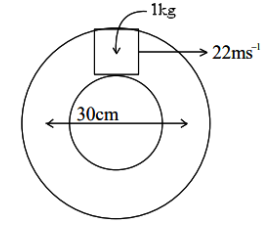
A closed circular tube of average radius 15 cm, whose inner walls are rough, is kept in vertical plane. A block of mass 1 kg just fit inside the tube. The speed of block is \(22 \mathrm{~m} / \mathrm{s}\), when it is introduced at the top of tube. After completing five oscillations, the block stops at the bottom region of tube. The work done by the tube on the block is ____ J. (Given \(\mathrm{g}=10 \mathrm{~m} / \mathrm{s}^2\) ). [JEE Main 2023 (Online) 10th April Morning Shift]
 CorrectIncorrect
Hint
(c) Step 1: Define Energy Conservation
The work-energy theorem states that the net work done on an object equals the change in its kinetic energy. The forces acting on the block are gravity and the force exerted by the tube (normal force and friction force). The normal force does no work as it is perpendicular to the displacement. Therefore, the work done by the tube ( \(W_{\text {tube }}\) ) is entirely due to friction.
The work-energy equation for all forces is:
\(
W_{\text {gravity }}+W_{\text {tube }}=\Delta K
\)
Rearranging to find the work done by the tube:
\(
W_{\text {tube }}=\Delta K-W_{\text {gravity }}
\)
The work done by gravity over a change in vertical position from \(h_{\text {initial }}\) to \(h_{\text {final }}\) is \(W_{\text {gravity }}=-\Delta U=m g h_{\text {initial }}-m g h_{\text {final }}\). The initial position is the top of the tube, and the final position is the bottom, so the height difference is the diameter, \(2 R\).
Step 2: Calculate Initial and Final Energies
Given values: mass \(m=1 \mathrm{~kg}\), initial speed \(v_i=22 \mathrm{~m} / \mathrm{s}\), radius \(R=0.15 \mathrm{~m}\), gravitational acceleration \(g=10 \mathrm{~m} / \mathrm{s}^2\), final speed \(v_f=0 \mathrm{~m} / \mathrm{s}\). The initial height relative to the bottom is \(h_{\text {initial }}=2 R=0.3 \mathrm{~m}\).
The initial kinetic energy is:
\(
\begin{gathered}
K_i=\frac{1}{2} m v_i^2=\frac{1}{2}(1 \mathrm{~kg})(22 \mathrm{~m} / \mathrm{s})^2 \\
K_i=242 \mathrm{~J}
\end{gathered}
\)
The final kinetic energy is:
\(
K_f=\frac{1}{2} m v_f^2=0 \mathrm{~J}
\)
The work done by gravity is:
\(
\begin{gathered}
W_{\text {gravity }}=m g(2 R)=(1 \mathrm{~kg})\left(10 \mathrm{~m} / \mathrm{s}^2\right)(0.3 \mathrm{~m}) \\
W_{\text {gravity }}=3 \mathrm{~J}
\end{gathered}
\)
Step 3: Calculate the Work Done by the Tube
Using the rearranged work-energy theorem from Step 1:
\(
\begin{gathered}
W_{\text {tube }}=K_f-K_i-W_{\text {gravity }} \\
W_{\text {tube }}=0 \mathrm{~J}-242 \mathrm{~J}-3 \mathrm{~J} \\
W_{\text {tube }}=-245 \mathrm{~J}
\end{gathered}
\)
The work done by the tube is negative, as expected for friction acting to slow the block.
The work done by the tube on the block is -245 J. - Question 11 of 41
11. Question
A body of mass 5 kg is moving with a momentum of \(10 \mathrm{~kg} \mathrm{~ms}^{-1}\). Now a force of 2 N acts on the body in the direction of its motion for 5 s. The increase in the Kinetic energy of the body is ____ J. [JEE Main 2023 (Online) 8th April Evening Shift]
CorrectIncorrectHint
(d) Step 1: Calculate Initial Velocity and Kinetic Energy
First, we calculate the initial velocity \(\left(v_i\right)\) from the given initial momentum \(\left(P_i\right)\) and mass ( \(m\) ), and then the initial kinetic energy (K.E. \({ }_{\boldsymbol{i}}\) ). The formulas used are \(P=m v\) and \(K . E .=\frac{1}{2} m v^2\).
\(
\begin{gathered}
v_i=\frac{P_i}{m}=\frac{10 \mathrm{~kg} \mathrm{~ms}}{5 \mathrm{~kg}}=2 \mathrm{~ms}^{-1} \\
K . E_{\cdot i}=\frac{1}{2} m v_i^2=\frac{1}{2} \cdot 5 \mathrm{~kg} \cdot\left(2 \mathrm{~ms}^{-1}\right)^2=10 \mathrm{~J}
\end{gathered}
\)
Step 2: Calculate Impulse and Final Momentum
The force acting on the body for a given time results in an impulse ( \(J\) ), which equals the change in momentum ( \(\Delta P\) ). The force is in the direction of motion, so the impulse is positive.
\(
J=F \cdot t=2 \mathrm{~N} \cdot 5 \mathrm{~s}=10 \mathrm{~N} \mathrm{~s}
\)
The final momentum ( \(\boldsymbol{P}_{\boldsymbol{f}}\) ) is the sum of the initial momentum and the impulse.
\(
P_f=P_i+J=10 \mathrm{~kg} \mathrm{~ms}^{-1}+10 \mathrm{~kg} \mathrm{~ms}^{-1}=20 \mathrm{~kg} \mathrm{~ms}^{-1}
\)
Step 3: Calculate Final Velocity and Kinetic Energy Change
Next, we determine the final velocity \(\left(v_f\right)\) from the final momentum and mass, and then calculate the final kinetic energy (K.E. \({ }_{\boldsymbol{f}}\) ).
\(
\begin{gathered}
v_f=\frac{P_f}{m}=\frac{20 \mathrm{~kg} \mathrm{~ms}^{-1}}{5 \mathrm{~kg}}=4 \mathrm{~ms}^{-1} \\
K . E_{\cdot f}=\frac{1}{2} m v_f^2=\frac{1}{2} \cdot 5 \mathrm{~kg} \cdot\left(4 \mathrm{~ms}^{-1}\right)^2=40 \mathrm{~J}
\end{gathered}
\)
The increase in kinetic energy ( \(\boldsymbol{\Delta} \boldsymbol{K} \boldsymbol{.} \boldsymbol{E}\).) is the difference between the final and initial kinetic energies.
\(
\Delta K . E .=K . E_{\cdot f}-K . E_{\cdot i}=40 \mathrm{~J}-10 \mathrm{~J}=30 \mathrm{~J}
\)
The increase in the kinetic energy of the body is 30 J. - Question 12 of 41
12. Question
A body is dropped on ground from a height ‘ \(h_1\) ‘ and after hitting the ground, it rebounds to a height ‘ \(h_2\) ‘. If the ratio of velocities of the body just before and after hitting ground is 4, then percentage loss in kinetic energy of the body is \(\frac{x}{4}\). The value of \(x\) is ____. [JEE Main 2023 (Online) 6th April Evening Shift]
CorrectIncorrectHint
(c) Step 1: Define initial kinetic energy and use the given velocity ratio
The kinetic energy just before hitting the ground is \(K E_1=\frac{1}{2} m v_1^2\), where \(m\) is mass and \(v_1\) is velocity. The kinetic energy just after hitting the ground is \(K E_2=\frac{1}{2} m v_2^2\). The problem states the ratio of velocities just before and after hitting the ground is \(v_1 / v_2=4\), which implies \(v_2 / v_1=1 / 4\).
Step 2: Calculate the percentage loss in kinetic energy
The percentage loss in kinetic energy is calculated using the formula:
\(
\begin{aligned}
& \text { Percentage Loss }=\left(1-\frac{K E_2}{K E_1}\right) \times 100 \%=\left(1-\frac{\frac{1}{2} m v_2^2}{\frac{1}{2} m v_1^2}\right) \times 100 \% \\
& \text { Percentage Loss }=\left(1-\frac{v_2^2}{v_1^2}\right) \times 100 \%=\left(1-\left(\frac{v_2}{v_1}\right)^2\right) \times 100 \%
\end{aligned}
\)
Substituting the ratio \(v_2 / v_1=1 / 4\) :
\(
\begin{gathered}
\text { Percentage Loss }=\left(1-\left(\frac{1}{4}\right)^2\right) \times 100 \%=\left(1-\frac{1}{16}\right) \times 100 \% \\
\text { Percentage Loss }=\frac{15}{16} \times 100 \%=93.75 \%
\end{gathered}
\)
The problem states this loss is equal to \(\frac{x}{4} \%\).
\(
\begin{aligned}
93.75=\frac{x}{4} & \Longrightarrow x=93.75 \times 4 \\
x & =375
\end{aligned}
\) - Question 13 of 41
13. Question
A particle of mass 10 g moves in a straight line with retardation \(2 x\), where \(x\) is the displacement in Sl units. Its loss of kinetic energy for above displacement is \(\left(\frac{10}{x}\right)^{-n} \mathrm{~J}\). The value of \(n\) will be _____. [JEE Main 2023 (Online) 6th April Morning Shift]
CorrectIncorrectHint
(b) Step 1: Calculate the force
The mass of the particle is \(m=10 \mathrm{~g}=0.01 \mathrm{~kg}\). The retardation is \(a=2 x\). The magnitude of the retarding force is \(F=m a\), and because it opposes motion, we can write it as \(F=-m a=-0.01(2 x)=-0.02 x\) in the direction of increasing \(x\).
Step 2: Calculate the work done by the retarding force
The work \(W\) done by the retarding force as the particle undergoes a displacement from \(x=0\) to \(x=x\) is calculated using the integral:
\(
\begin{aligned}
& W=\int_0^x F d s=\int_0^x-0.02 s d s \\
& W=-0.02\left[\frac{s^2}{2}\right]_0^x=-0.01 x^2 \mathrm{~J}
\end{aligned}
\)
Step 3: Relate work done to loss of kinetic energy
According to the work-energy theorem, the work done by the net force equals the change in kinetic energy, \(\triangle K E=W\). The loss of kinetic energy is \(-\triangle K E=-W\).
\(
\text { Loss of } \mathrm{KE}=-\left(-0.01 x^2\right)=0.01 x^2 \mathrm{~J}
\)
Step 4: Equate the calculated loss to the given expression to find \(\boldsymbol{n}\)
We are given that the loss of kinetic energy is \(\left(\frac{10}{x}\right)^{-n} \mathrm{~J}\). We equate our derived expression to the given one:
\(
\begin{aligned}
& 0.01 x^2=\left(\frac{10}{x}\right)^{-n} \\
& 10^{-2} x^2=10^{-n} x^n
\end{aligned}
\)
By comparing the powers of \(x\) and 10 on both sides of the equation, we find that \(n=2\). - Question 14 of 41
14. Question
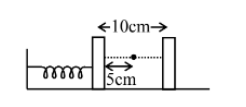
A block is fastened to a horizontal spring. The block is pulled to a distance \(x=10 \mathrm{~cm}\) from its equilibrium position (at \(x=0\) ) on a frictionless surface from rest. The energy of the block at \(x=5 \mathrm{~cm}\) is 0.25 J. The spring constant of the spring is ____ \(\mathrm{Nm}^{-1}\) [JEE Main 2023 (Online) 1st February Evening Shift]
CorrectIncorrectHint
(a)

Step 1: Understand Energy Conservation
In a frictionless spring-mass system, the total mechanical energy ( \(E\) ) is conserved. The total energy is the sum of the potential energy ( \(U\) ) and kinetic energy ( \(K\) ) at any point \(x\). The potential energy is given by \(U=\frac{1}{2} k x^2\), where \(k\) is the spring constant and \(x\) is the displacement from equilibrium. At the maximum displacement (amplitude, \(\boldsymbol{A}\) ), the velocity is zero, so all the energy is potential energy: \(E=\frac{1}{2} k A^2\).
Step 2: Calculate the Spring Constant
The problem states that the energy of the block at \(x=5 \mathrm{~cm}\) is 0.25 J. Since energy is conserved, this is the total energy ( \(\boldsymbol{E}_{\text {total }}\) ) of the system. The maximum displacement (amplitude, \(\boldsymbol{A}\) ) is given as \(\mathbf{1 0 ~ c m}\). We convert these values to SI units:
\(E_{\text {total }}=0.25 \mathrm{~J}\)
\(A=10 \mathrm{~cm}=0.1 \mathrm{~m}\)
Using the formula for total energy at maximum amplitude, we can solve for the spring constant \(k\) :
\(
\begin{gathered}
E_{\text {total }}=\frac{1}{2} k A^2 \\
k=\frac{2 E_{\text {total }}}{A^2}
\end{gathered}
\)
Substituting the values:
\(
\begin{aligned}
k & =\frac{2 \times 0.25 \mathrm{~J}}{(0.1 \mathrm{~m})^2} \\
k & =\frac{0.5}{0.01} \mathrm{Nm}^{-1} \\
k & =50 \mathrm{Nm}^{-1}
\end{aligned}
\)
The spring constant of the spring is \(50 \mathrm{Nm}^{-1}\). - Question 15 of 41
15. Question
A force \(\mathrm{F}=\left(5+3 y^2\right)\) acts on a particle in the \(y\)-direction, where F is in newton and \(y\) is in meter. The work done by the force during a displacement from \(y=2 \mathrm{~m}\) to \(y=5 \mathrm{~m}\) is ____ J. [JEE Main 2023 (Online) 1st February Evening Shift]
CorrectIncorrectHint
(d) Step 1: Define Work Formula
The work done (\(\mathbf{W}\)) by a variable force \(\mathbf{F}\) acting in the direction of displacement along the \(y\)-axis from an initial position \(y_1\) to a final position \(y_2\) is given by the definite integral:
\(
W=\int_{y_1}^{y_2} F(y) d y
\)
Step 2: Substitute Values and Integrate
Given the force function \(F(y)=5+3 y^2\), the initial position \(y_1=2 \mathrm{~m}\), and the final position \(y_2=5 \mathrm{~m}\), the integral becomes:
\(
W=\int_2^5\left(5+3 y^2\right) d y
\)
Integrating the expression yields:
\(
W=\left[5 y+y^3\right]_2^5
\)
Step 3: Evaluate the Definite Integral
Evaluating the antiderivative at the upper and lower limits:
\(
\begin{gathered}
W=\left(5(5)+5^3\right)-\left(5(2)+2^3\right) \\
W=(25+125)-(10+8) \\
W=150-18 \\
W=132 \mathrm{~J}
\end{gathered}
\)
The work done by the force is \(\mathbf{1 3 2 ~ J}\). - Question 16 of 41
16. Question
A small particle moves to position \(5 \hat{i}-2 \hat{j}+\hat{k}\) from its initial position \(2 \hat{i}+3 \hat{j}-4 \hat{k}\) under the action of force \(5 \hat{i}+2 \hat{j}+7 \hat{k} \mathrm{~N}\). The value of work done will be _____ J. [JEE Main 2023 (Online) 1st February Morning Shift]
CorrectIncorrectHint
(c) Step 1: Determine the Displacement Vector
The displacement vector \(\mathbf{d}\) is the difference between the final position vector \(\mathbf{r}_2\) and the initial position vector \(\mathbf{r}_1\) :
\(
\mathbf{d}=\mathbf{r}_2-\mathbf{r}_1
\)
Substituting the given values:
\(
\begin{gathered}
\mathbf{d}=(5 \hat{i}-2 \hat{j}+\hat{k})-(2 \hat{i}+3 \hat{j}-4 \hat{k}) \\
\mathbf{d}=(5-2) \hat{i}+(-2-3) \hat{j}+(1-(-4)) \hat{k}
\end{gathered}
\)
The displacement vector is \(\mathbf{d}=3 \hat{i}-5 \hat{j}+5 \hat{k}\).
Step 2: Calculate the Work Done
Work done \(W\) by a constant force \(F\) is calculated using the dot product of the force and displacement vectors:
\(
W=\mathbf{F} \cdot \mathbf{d}
\)
Substituting the force \(\mathbf{F}=5 \hat{i}+2 \hat{j}+7 \hat{k} \mathrm{~N}\) and the displacement \(\mathbf{d}=3 \hat{i}-5 \hat{j}+5 \hat{k}\) :
\(
\begin{gathered}
W=(5 \hat{i}+2 \hat{j}+7 \hat{k}) \cdot(3 \hat{i}-5 \hat{j}+5 \hat{k}) \\
W=(5)(3)+(2)(-5)+(7)(5) \\
W=15-10+35 \\
W=40 \mathrm{~J}
\end{gathered}
\) - Question 17 of 41
17. Question
A lift of mass \(\mathrm{M}=500 \mathrm{~kg}\) is descending with speed of \(2 \mathrm{~ms}^{-1}\). Its supporting cable begins to slip thus allowing it to fall with a constant acceleration of \(2 \mathrm{~ms}^{-2}\). The kinetic energy of the lift at the end of fall through to a distance of 6 m will be _______ kJ. [JEE Main 2023 (Online) 31st January Morning Shift]
CorrectIncorrectHint
(d) Step 1: Calculate the final velocity squared
The final velocity squared of the lift can be determined using the kinematic equation \(v^2=u^2+2 a s\).
\(
\begin{gathered}
v^2=\left(2 \mathrm{~ms}^{-1}\right)^2+2\left(2 \mathrm{~ms}^{-2}\right)(6 \mathrm{~m}) \\
v^2=4 \mathrm{~m}^2 \mathrm{~s}^{-2}+24 \mathrm{~m}^2 \mathrm{~s}^{-2} \\
v^2=28 \mathrm{~m}^2 \mathrm{~s}^{-2}
\end{gathered}
\)
Step 2: Calculate the kinetic energy in Joules
The kinetic energy (KE) is calculated using the formula \(\boldsymbol{K E}=\frac{1}{2} \boldsymbol{M} \boldsymbol{v}^2\).
\(
\begin{gathered}
K E=\frac{1}{2}(500 \mathrm{~kg})\left(28 \mathrm{~m}^2 \mathrm{~s}^{-2}\right) \\
K E=7000 \mathrm{~J}
\end{gathered}
\)
Step 3: Convert the kinetic energy to kilojoules
Convert the energy from Joules (J) to kilojoules (KJ) by dividing by 1000.
\(
\begin{gathered}
K E(\mathrm{~kJ})=\frac{7000 \mathrm{~J}}{1000} \\
K E(\mathrm{~kJ})=7 \mathrm{~kJ}
\end{gathered}
\)
The kinetic energy of the lift at the end of the fall through a distance of 6 m will be 7 kJ. - Question 18 of 41
18. Question
A body of mass 2 kg is initially at rest. It starts moving unidirectionally under the influence of a source of constant power \(P\). Its displacement in 4 s is \(\frac{1}{3} \alpha^2 \sqrt{P} m\). The value of \(\alpha\) will be ____. [JEE Main 2023 (Online) 30th January Evening Shift]
CorrectIncorrectHint
(b)
\(
\begin{aligned}
&\begin{aligned}
& P=F v \\
& m \frac{v d v}{d t}=P \\
& m \int_0^v v d v=\int_0^t P d t \\
& \frac{m v^2}{2}=P t \\
& v=\sqrt{\frac{2 P}{m}} t^{1 / 2} \\
& \int_0^s d x=\sqrt{\frac{2 P}{m}} \int_0^t t^{1 / 2} d t \\
& s=\frac{2}{3} \sqrt{\frac{2 P}{m}} t^{3 / 2} \\
& \text { or } s=\frac{2}{3} \sqrt{\frac{2 P}{2}} \times 4^{3 / 2} \\
& =\frac{16}{3} \sqrt{P} m
\end{aligned}\\
&\text { So, } \alpha=4
\end{aligned}
\) - Question 19 of 41
19. Question
A 0.4 kg mass takes 8s to reach ground when dropped from a certain height ‘ \(P\) ‘ above surface of earth. The loss of potential energy in the last second of fall is ____ J. (Take \(\mathrm{g}=10 \mathrm{~m} / \mathrm{s}^2\) ) [JEE Main 2023 (Online) 29th January Morning Shift]
CorrectIncorrectHint
(a) Step 1: Calculate Total Height ( \(P\) )
The total height \(\boldsymbol{P}\) from which the mass is dropped can be calculated using the formula for distance fallen under constant acceleration: \(P=\frac{1}{2} g t^2\).
\(
P=\frac{1}{2} \times 10 \mathrm{~m} / \mathrm{s}^2 \times(8 \mathrm{~s})^2=320 \mathrm{~m}
\)
Step 2: Calculate Distance Fallen
The distance fallen in the first 7 seconds is calculated similarly: \(h_7=\frac{1}{2} g t_7^2\).
\(
h_7=\frac{1}{2} \times 10 \mathrm{~m} / \mathrm{s}^2 \times(7 \mathrm{~s})^2=245 \mathrm{~m}
\)
The distance fallen in the last second \((\Delta h)\) is the difference between the total height and the height fallen in the first 7 seconds.
\(
\Delta h=P-h_7=320 \mathrm{~m}-245 \mathrm{~m}=75 \mathrm{~m}
\)
Step 3: Calculate Potential Energy Loss
The loss of potential energy ( \(\triangle P E\) ) in the last second is given by the formula \(\boldsymbol{\Delta} \boldsymbol{P E}=\boldsymbol{m} \boldsymbol{g} \boldsymbol{\Delta} \boldsymbol{h}\).
\(
\triangle P E=0.4 \mathrm{~kg} \times 10 \mathrm{~m} / \mathrm{s}^2 \times 75 \mathrm{~m}=300 \mathrm{~J}
\)
The loss of potential energy in the last second of fall is \(\mathbf{3 0 0 ~ J}\). - Question 20 of 41
20. Question
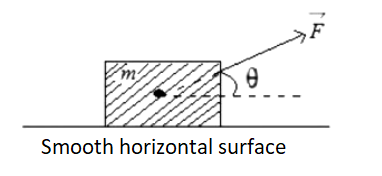
An object of mass ‘ \(m\) ‘ initially at rest on a smooth horizontal plane starts moving under the action of force \(F=2 \mathrm{~N}\). In the process of its linear motion, the angle \(\theta\) (as shown in figure) between the direction of force and horizontal varies as \(\theta=\mathrm{k} x\), where k is a constant and \(x\) is the distance covered by the object from its initial position. The expression of kinetic energy of the object will be \(E=\frac{n}{k} \sin \theta\). The value of \(n\) is ____ . [JEE Main 2023 (Online) 25th January Morning Shift]
 CorrectIncorrect
Hint
(b) Step 1: Apply Work-Energy Theorem
The work done by the net force on an object is equal to the change in its kinetic energy. The object starts from rest, so the initial kinetic energy is zero. The kinetic energy \(E\) after covering distance \(x\) is equal to the work done \(W\).
\(
E=W=\int \vec{F} \cdot d \vec{s}
\)
Step 2: Formulate the Work Integral
The force \(\vec{F}\) is constant in magnitude ( \(F=2 \mathrm{~N}\) ) and acts at an angle \(\theta\) to the horizontal direction of displacement \(\vec{s}(d x)\). The component of the force in the direction of motion is \(F_x=F \cos \theta\).
\(
W=\int_0^x F \cos \theta d x
\)
We are given the relationship \(\theta=k x\).
\(
W=\int_0^x 2 \cos (k x) d x
\)
\(
\begin{aligned}
&\begin{gathered}
W=2\left[\frac{\sin (k x)}{k}\right]_0^x \\
W=\frac{2}{k}(\sin (k x)-\sin (0)) \\
W=\frac{2}{k} \sin (k x)
\end{gathered}\\
&\text { Thus, the kinetic energy expression is } E=\frac{2}{k} \sin (k x) \text {. }
\end{aligned}
\)
We are given that the kinetic energy expression has the form \(E=\frac{n}{k} \sin \theta\).
Substituting \(\theta=k x\) into the given form:
\(
E=\frac{n}{k} \sin (k x)
\)
Comparing our derived expression \(E=\frac{2}{k} \sin (k x)\) with the given form, we find the value of \(n\).
\(
\begin{aligned}
\frac{2}{k} \sin (k x) & =\frac{n}{k} \sin (k x) \\
n & =2
\end{aligned}
\) - Question 21 of 41
21. Question
A body of mass 1 kg begins to move under the action of a time dependent force \(\vec{F}=\left(t \hat{i}+3 t^2 \hat{j}\right) \mathrm{N}\), where \(\hat{i}\) and \(\hat{j}\) are the unit vectors along \(x\) and \(y\) axis. The power developed by above force, at the time \(t=2 s\), will be _____ W. [JEE Main 2023 (Online) 24th January Evening Shift]
CorrectIncorrectHint
(c) Step 1: Determine the velocity vector
The force \(\vec{F}\) is related to acceleration \(\vec{a}\) by Newton’s second law, \(\vec{F}=m \vec{a}\). Given \(m=1 \mathrm{~kg}\) and \(\vec{F}=\left(t \hat{i}+3 t^2 \hat{j}\right) \mathrm{N}\), the acceleration is \(\vec{a}=\left(t \hat{i}+3 t^2 \hat{j}\right) \mathrm{m} / \mathrm{s}^2\). The velocity \(\vec{v}\) is found by integrating the acceleration with respect to time \(t\).
\(
\vec{v}=\int \vec{a} d t=\int\left(t \hat{i}+3 t^2 \hat{j}\right) d t
\)
Assuming the body starts from rest at \(t=0\), the integration constants are zero, resulting in the velocity vector:
\(
\vec{v}=\frac{t^2}{2} \hat{i}+t^3 \hat{j}
\)
Step 2: Calculate the power developed by the force
The power \(\boldsymbol{P}\) developed by a force \(\overrightarrow{\boldsymbol{F}}\) acting on a body moving with velocity \(\vec{v}\) is given by the dot product:
\(
P=\vec{F} \cdot \vec{v}
\)
Substituting the expressions for \(\vec{F}\) and \(\vec{v}\) :
\(
P=\left(t \hat{i}+3 t^2 \hat{j}\right) \cdot\left(\frac{t^2}{2} \hat{i}+t^3 \hat{j}\right)=\frac{t^3}{2}+3 t^5
\)
At time \(t=2 \mathrm{~s}\), the power is:
\(
P(2 s)=\frac{2^3}{2}+3\left(2^5\right)=\frac{8}{2}+3(32)=4+96=100 \mathrm{~W}
\) - Question 22 of 41
22. Question
A spherical body of mass 2 kg starting from rest acquires a kinetic energy of 10000 J at the end of \(5^{\text {th }}\) second. The force acted on the body is ______ N. [JEE Main 2023 (Online) 24th January Morning Shift]
CorrectIncorrectHint
(a) Step 1: Define variables and formulas
The key variables and relationships are defined as acceleration \(a=\frac{F}{m}\), displacement \(S=\frac{1}{2} a t^2\), work done \(W=F \cdot S\), and the work-energy theorem \(\triangle K E=W\).
Step 2: Substitute and derive work equation
Substituting the expression for \(a\) into the displacement formula yields \(S=\frac{F t^2}{2 m}\). Then, substituting this into the work formula gives the expression for work done:
\(
W=\frac{F^2 t^2}{2 m}
\)
Step 3: Set Work equal to given value and solve for \(F\)
Using the given work value \(W=10000\) (implied value from the user’s steps, assuming \(m=2 \mathrm{~kg}\) and \(t=5 \mathrm{~s}\) ), the equation becomes:
\(
\frac{F^2 t^2}{2 m}=10000
\)
Solving for \(F\) results in:
\(
F=\sqrt{\frac{10000 \times 2 m}{t^2}}=\sqrt{\frac{10000 \times 2 \times 2}{5^2}}=\sqrt{1600}=40
\) - Question 23 of 41
23. Question
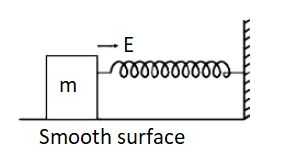
A block of mass ‘ \(m\) ‘ (as shown in figure) moving with kinetic energy E compresses a spring through a distance 25 cm when, its speed is halved. The value of spring constant of used spring will be \(\mathrm{nE} \mathrm{Nm}^{-1}\) for \(\mathrm{n}=\) ____. [JEE Main 2022 (Online) 28th July Morning Shift]
 CorrectIncorrect
Hint
(a) Step 1: Define Variables and Principle
Let the initial speed of the block be \(v\) and the initial kinetic energy be \(E\), such that \(E=\frac{1}{2} m v^2\). The final speed after compressing the spring by \(x=25 \mathrm{~cm}=0.25 \mathrm{~m}\) is \(v / 2\), so the final kinetic energy is \(E_f=\frac{1}{2} m(v / 2)^2=\frac{1}{4} E\). Assuming a smooth surface and conservation of mechanical energy, the initial total energy equals the final total energy:
\(
E=E_f+P E_s
\)
Step 2: Formulate Energy Equation and Solve
Substitute the expressions for the energies into the conservation equation:
\(
E=\frac{1}{4} E+\frac{1}{2} k x^2
\)
Rearrange to solve for the spring constant \(k\) :
\(
\begin{gathered}
E-\frac{1}{4} E=\frac{1}{2} k x^2 \\
\frac{3}{4} E=\frac{1}{2} k x^2 \\
k=\frac{3 E}{2 x^2}
\end{gathered}
\)
Substitute the value for \(x=0.25 \mathrm{~m}=1 / 4 \mathrm{~m}\) :
\(
k=\frac{3 E}{2(1 / 4)^2}=\frac{3 E}{2 / 16}=\frac{3 E}{1 / 8}=24 E
\)
The problem states that \(k=n E \mathrm{Nm}^{-1}\), where the units are consistent if \(n\) is a dimensionless value of 24. - Question 24 of 41
24. Question
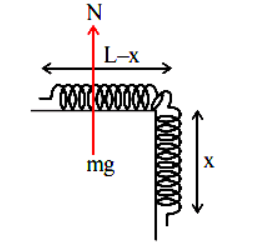
A uniform chain of 6 m length is placed on a table such that a part of its length is hanging over the edge of the table. The system is at rest. The co-efficient of static friction between the chain and the surface of the table is 0.5, the maximum length of the chain hanging from the table is ____ m. [JEE Main 2022 (Online) 25th June Morning Shift]
CorrectIncorrectHint
(b)

Step 1: Define Variables and Conditions
Let the total length of the chain be \(L\) and the maximum hanging length be \(x\). The length of the chain remaining on the table is \(\boldsymbol{L} \boldsymbol{-} \boldsymbol{x}\). The system is in limiting static equilibrium, meaning the pulling force due to the hanging part equals the maximum static friction force on the part on the table. The coefficient of static friction is \(\mu_s\).
Step 2: Formulate the Equilibrium Equation
The weight of the hanging part, which provides the pulling force ( \(F_{\text {pull }}\) ), is proportional to its length: \(F_{\text {pull }} \propto \boldsymbol{x}\).
The mass on the table is proportional to \(L-x\), and the maximum static friction force ( \(\left.f_s^{\text {max }}\right)\) is \(f_s^{\text {max }}=\mu_s \cdot N\), where \(N\) is the normal force equal to the weight of the part on the table. Thus, \(f_s^{\max } \propto \mu_s(L-x)\).
At equilibrium:
\(
F_{\mathrm{pull}}=f_s^{\max }
\)
This leads to the relationship:
\(
x=\mu_s(L-x)
\)
\(
\begin{aligned}
&\text { We solve the equation for } x \text { : }\\
&\begin{gathered}
x=\mu_s L-\mu_s x \\
x+\mu_s x=\mu_s L \\
x\left(1+\mu_s\right)=\mu_s L \\
x=\frac{\mu_s L}{1+\mu_s}
\end{gathered}
\end{aligned}
\)
Step 3: Substitute Given Values
Given \(L=6 \mathrm{~m}\) and \(\mu_s=0.5\), we substitute these values into the formula:
\(
\begin{gathered}
x=\frac{0.5 \times 6}{1+0.5} \\
x=\frac{3}{1.5} \\
x=2 \mathrm{~m}
\end{gathered}
\)
The maximum length of the chain hanging from the table is 2 m. - Question 25 of 41
25. Question
A 0.5 kg block moving at a speed of \(12 \mathrm{~ms}^{-1}\) compresses a spring through a distance 30 cm when its speed is halved. The spring constant of the spring will be ____ \(\mathrm{Nm}^{-1}\). [JEE Main 2022 (Online) 25th June Morning Shift]
CorrectIncorrectHint
(c) Step 1: Define Variables and Principle
The problem involves a conversion between kinetic energy and spring potential energy. We apply the principle of conservation of mechanical energy as non-conservative forces are ignored. The variables are:
Mass \(\boldsymbol{m}=0.5 \mathrm{~kg}\)
Initial speed \(v_1=12 \mathrm{~ms}^{-1}\)
Final speed \(v_2=v_1 / 2=6 \mathrm{~ms}^{-1}\)
Compression distance \(x=30 \mathrm{~cm}=0.3 \mathrm{~m}\)
The energy conservation equation is \(\frac{1}{2} m v_1^2=\frac{1}{2} m v_2^2+\frac{1}{2} k x^2\), where \(k\) is the spring constant.
Step 2: Rearrange the Equation and Substitute Values
We rearrange the energy conservation equation to solve for the spring constant \(k\) :
\(
\begin{gathered}
k x^2=m v_1^2-m v_2^2 \\
k=\frac{m\left(v_1^2-v_2^2\right)}{x^2}
\end{gathered}
\)
Substitute the given values into the equation:
\(
k=\frac{0.5 \mathrm{~kg} \times\left(\left(12 \mathrm{~ms}^{-1}\right)^2-\left(6 \mathrm{~ms}^{-1}\right)^2\right)}{(0.3 \mathrm{~m})^2}
\)
\(
\begin{gathered}
k=\frac{0.5 \times(144-36)}{0.09} \\
k=\frac{0.5 \times 108}{0.09} \\
k=\frac{54}{0.09} \\
k=600 \mathrm{Nm}^{-1}
\end{gathered}
\)
The spring constant of the spring will be \(600 \mathrm{Nm}^{-1}\). - Question 26 of 41
26. Question
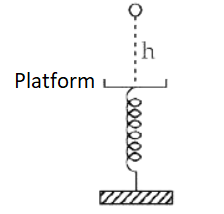
A ball of mass 100 g is dropped from a height \(\mathrm{h}=10 \mathrm{~cm}\) on a platform fixed at the top of a vertical spring (as shown in figure). The ball stays on the platform and the platform is depressed by a distance \(\frac{h}{2}\). The spring constant is ____ \(\mathrm{Nm}^{-1}\). [JEE Main 2022 (Online) 24th June Morning Shift]
\(\left(\text { Use } \mathrm{g}=10 \mathrm{~ms}^{-2}\right)\) CorrectIncorrect
Hint
(d) Step 1: Convert all given values to SI units
Mass \(m=100 \mathrm{~g}=0.1 \mathrm{~kg}\)
Height \(h=10 \mathrm{~cm}=0.1 \mathrm{~m}\)
Depression distance \(x=\frac{h}{2}=5 \mathrm{~cm}=0.05 \mathrm{~m}\)
Acceleration due to gravity \(g=10 \mathrm{~ms}^{-2}\)
Step 2: Apply the principle of conservation of energy
The total loss in gravitational potential energy of the ball is converted into the elastic potential energy stored in the spring. The total vertical distance the ball falls is the initial height plus the spring’s compression, \(h+x\).
The equation for conservation of energy is:
\(
\begin{gathered}
\triangle P E_{\text {gravitational }}=\Delta P E_{\text {elastic }} \\
m g(h+x)=\frac{1}{2} k x^2
\end{gathered}
\)
Step 3: Substitute the values and solve for the spring constant (\(k\)
We rearrange the equation to solve for \(k\) :
\(
k=\frac{2 m g(h+x)}{x^2}
\)
Substitute the values:
\(
\begin{gathered}
k=\frac{2 \times 0.1 \mathrm{~kg} \times 10 \mathrm{~ms}^{-2} \times(0.1 \mathrm{~m}+0.05 \mathrm{~m})}{(0.05 \mathrm{~m})^2} \\
k=\frac{2 \times 0.1 \times 10 \times 0.15}{0.0025} \\
k=\frac{0.3}{0.0025} \\
k=120 \mathrm{Nm}^{-1}
\end{gathered}
\) - Question 27 of 41
27. Question
An engine is attached to a wagon through a shock absorber of length 1.5 m. The system with a total mass of \(40,000 \mathrm{~kg}\) is moving with a speed of \(72 \mathrm{kmh}^{-1}\) when the brakes are applied to bring it to rest. In the process of the system being brought to rest, the spring of the shock absorber gets compressed by 1.0 m. If \(90 \%\) of energy of the wagon is lost due to friction, the spring constant is _____ \(\times 10^5 \mathrm{~N} / \mathrm{m}\). [JEE Main 2021 (Online) 1st September Evening Shift]
CorrectIncorrectHint
(d) Step 1: Unit Conversion and Initial Energy Calculation
First, convert the speed from \(\mathrm{kmh}^{-1}\) to \(\mathrm{m} / \mathrm{s}\) :
\(
v=72 \mathrm{~km} / \mathrm{h}=72 \times \frac{1000}{3600} \mathrm{~m} / \mathrm{s}=20 \mathrm{~m} / \mathrm{s}
\)
The initial kinetic energy ( \(K E_i\) ) of the system is calculated using the formula
\(
K E_i=\frac{1}{2} m v^2 .
\)
\(
K E_i=\frac{1}{2} \times 40000 \mathrm{~kg} \times(20 \mathrm{~m} / \mathrm{s})^2=8,000,000 \mathrm{~J}
\)
Step 2: Energy Distribution and Spring Constant Calculation
Ninety percent of this energy is lost to friction, meaning the remaining 10\% is stored as potential energy in the spring ( \(E_{\text {spring }}\) ).
\(
E_{\text {spring }}=0.10 \times K E_i=0.10 \times 8,000,000 \mathrm{~J}=800,000 \mathrm{~J}
\)
The potential energy stored in the spring is given by the formula \(E_{\text {spring }}=\frac{1}{2} k x^2\), where \(k\) is the spring constant and \(x\) is the compression distance \((1.0 \mathrm{~m})\).
\(
\begin{gathered}
\frac{1}{2} k x^2=800,000 \mathrm{~J} \\
k=\frac{2 \times 800,000}{x^2}=\frac{1,600,000}{(1.0 \mathrm{~m})^2}=1,600,000 \mathrm{~N} / \mathrm{m}
\end{gathered}
\)
To express this in the required format ( \(\times 10^5 \mathrm{~N} / \mathrm{m}\) ), we write:
\(
k=16 \times 10^5 \mathrm{~N} / \mathrm{m}
\) - Question 28 of 41
28. Question
A block moving horizontally on a smooth surface with a speed of \(40 \mathrm{~ms}^{-1}\) splits into two equal parts. If one of the parts moves at \(60 \mathrm{~ms}^{-1}\) in the same direction, then the fractional change in the kinetic energy will be \(\mathrm{x}: 4\) where \(\mathrm{x}=\) _____. [JEE Main 2021 (Online) 31st August Morning Shift]
CorrectIncorrectHint
(a)

Step 1: Analyze momentum conservation
The problem can be solved using the principle of conservation of linear momentum, as the surface is smooth and there are no external horizontal forces. Let the original mass be \(M\) and the initial velocity be \(v_i=40 \mathrm{~ms}^{-1}\). After splitting, the two equal parts have mass \(m_1=m_2=M / 2\). One part moves with \(v_1=60 \mathrm{~ms}^{-1}\) in the same direction. We use conservation of momentum to find the velocity of the second part, \(v_2\).
\(
\begin{aligned}
M v_i & =m_1 v_1+m_2 v_2 \\
M(40) & =\frac{M}{2}(60)+\frac{M}{2} v_2
\end{aligned}
\)
Solving for \(v_2\) gives \(v_2=20 \mathrm{~ms}^{-1}\).
Step 2: Calculate kinetic energies
Next, we calculate the initial and final kinetic energies of the system using the formula for kinetic energy, \(K=\frac{1}{2} m v^2\).
The initial kinetic energy is \(K_i=\frac{1}{2} M v_i^2=\frac{1}{2} M(40)^2=800 M\).
The final kinetic energy is the sum of the kinetic energies of the two parts:
\(
\begin{gathered}
K_f=\frac{1}{2} m_1 v_1^2+\frac{1}{2} m_2 v_2^2 \\
K_f=\frac{1}{2}\left(\frac{M}{2}\right)(60)^2+\frac{1}{2}\left(\frac{M}{2}\right)(20)^2 \\
K_f=\frac{M}{4}(3600)+\frac{M}{4}(400)=900 M+100 M=1000 M
\end{gathered}
\)
Step 3: Determine the fractional change in kinetic energy
The fractional change in kinetic energy is given by \(\frac{\Delta K}{K_i}=\frac{K_f-K_i}{K_i}\).
\(
\frac{\Delta K}{K_i}=\frac{1000 M-800 M}{800 M}=\frac{200 M}{800 M}=\frac{1}{4}
\)
The problem states this fractional change is \(\mathrm{x}: 4\), which means \(\frac{\Delta K}{K_i}=\frac{\mathrm{x}}{4}\). Comparing our result \(\frac{1}{4}\) to \(\frac{\mathrm{x}}{4}\), we find \(\mathrm{x}=1\). - Question 29 of 41
29. Question
Two persons A and B perform same amount of work in moving a body through a certain distance \(d\) with application of forces acting at angle \(45^{\circ}\) and \(60^{\circ}\) with the direction of displacement respectively. The ratio of force applied by person A to the force applied by person B is \(\frac{1}{\sqrt{x}}\). The value of \(x\) is _____. [JEE Main 2021 (Online) 27th August Morning Shift]
CorrectIncorrectHint
(b) Work done ( \(W\) ) by a force ( \(F\) ) acting at an angle ( \(\theta\) ) to the displacement ( \(d\) ) is given by the formula \(W=F d \cos (\theta)\).
For person A , the work done \(W_A\) is:
\(
W_A=F_A d \cos \left(45^{\circ}\right)
\)
For person B , the work done \(W_B\) is:
\(
W_B=F_B d \cos \left(60^{\circ}\right)
\)
Since both persons perform the same amount of work, \(W_A=W_B\) :
\(
F_A d \cos \left(45^{\circ}\right)=F_B d \cos \left(60^{\circ}\right)
\)
The distance \(\boldsymbol{d}\) cancels out:
\(
F_A \cos \left(45^{\circ}\right)=F_B \cos \left(60^{\circ}\right)
\)
Rearrange the equation to find the ratio \(\frac{F_A}{F_B}\) :
\(
\frac{F_A}{F_B}=\frac{\cos \left(60^{\circ}\right)}{\cos \left(45^{\circ}\right)}
\)
Substitute the known values \(\cos \left(60^{\circ}\right)=\frac{1}{2}\) and \(\cos \left(45^{\circ}\right)=\frac{1}{\sqrt{2}}\) :
\(
\frac{F_A}{F_B}=\frac{1 / 2}{1 / \sqrt{2}}=\frac{\sqrt{2}}{2}
\)
To express the ratio in the required form \(\frac{1}{\sqrt{x}}\), simplify the expression:
\(
\frac{\sqrt{2}}{2}=\frac{\sqrt{2}}{\sqrt{4}}=\sqrt{\frac{2}{4}}=\sqrt{\frac{1}{2}}=\frac{1}{\sqrt{2}}
\)
Comparing the result \(\frac{F_A}{F_B}=\frac{1}{\sqrt{2}}\) with the given ratio \(\frac{1}{\sqrt{x}}\), we find \(x=2\). - Question 30 of 41
30. Question
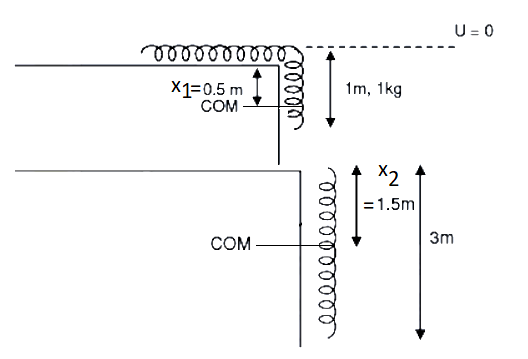
A uniform chain of length 3 meter and mass 3 kg overhangs a smooth table with 2 meter lying on the table. If \(k\) is the kinetic energy of the chain in joule as it completely slips off the table, then the value of \(k\) is ____ (Take \(\mathrm{g}=10 \mathrm{~m} / \mathrm{s}^2\) ) [JEE Main 2021 (Online) 26th August Morning Shift]
CorrectIncorrectHint
(a)

When the chain collapses, the centre of mass shifts from \(x_1=\frac{1}{2} \mathrm{~m}\) to \(x_2=\frac{3}{2} \mathrm{~m}\).
\(
\begin{aligned}
&\text { Based on mechanical energy conservation, }\\
&\begin{aligned}
& \Delta k=U_f-U_i \\
& =\left(3 \times g \times \frac{3}{2}\right)-\left(1 \times g \times \frac{1}{2}\right) \\
& =45-5=40 \mathrm{~J}
\end{aligned}
\end{aligned}
\)Alternate: Step 1: Define Parameters and System
The total length of the chain is \(L=3 \mathrm{~m}\) and total mass is \(M=3 \mathrm{~kg}\). The linear mass density is \(\lambda=M / L=1 \mathrm{~kg} / \mathrm{m}\). Initially, a length of \(l_0=3 \mathrm{~m}-2 \mathrm{~m}=1 \mathrm{~m}\) hangs off the table. The final state has the entire length \(L=3 \mathrm{~m}\) hanging off the table.
Step 2: Calculate Work Done by Gravity
The work done by gravity is equal to the change in potential energy of the system. This can be calculated by integrating the force of the hanging part as the length increases from \(l_0\) to \(L\). The force is \(F(y)=\lambda g y\).
The work \(W\) done by gravity is:
\(
W=\int_{l_0}^L \lambda g y d y=\frac{\lambda g}{2}\left(L^2-l_0^2\right)
\)
Substitute the given values \(\lambda=1 \mathrm{~kg} / \mathrm{m}, g=10 \mathrm{~m} / \mathrm{s}^2, L=3 \mathrm{~m}, l_0=1 \mathrm{~m}\) :
\(
W=\frac{1 \cdot 10}{2}\left(3^2-1^2\right)=5(9-1)=5 \cdot 8=40 \mathrm{~J}
\)
Step 3: Relate Work to Kinetic Energy
According to the work-energy theorem, the net work done on the chain (only gravity does work here) equals the change in kinetic energy. Assuming the chain starts from rest, the initial kinetic energy \(K_i\) is zero. The final kinetic energy is \(k\).
\(
W=\Delta K=k-K_i \Longrightarrow k=W
\)
Therefore, \(k=40 \mathrm{~J}\). - Question 31 of 41
31. Question
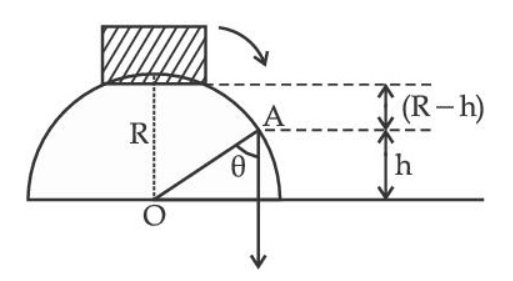
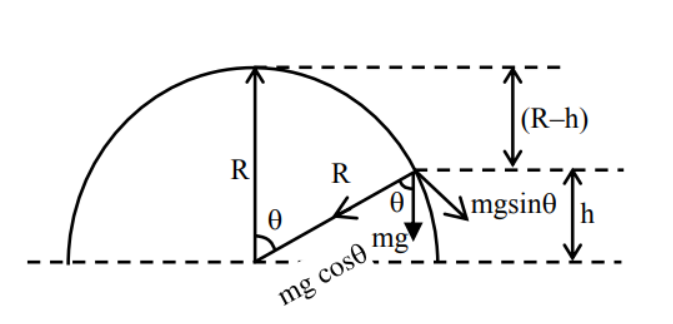
A small block slides down from the top of hemisphere of radius \(\mathrm{R}=3 \mathrm{~m}\) as shown in the figure. The height ‘ \(h\) ‘ at which the block will lose contact with the surface of the sphere is ____ \(m\). [JEE Main 2021 (Online) 27th July Evening Shift] (Assume there is no friction between the block and the hemisphere)
 CorrectIncorrect
Hint
(b)

\(
m g \cos \theta=\frac{m v^2}{R} \dots(1)
\)
\(
\cos \theta=\frac{h}{R}
\)
Energy conservation
\(
m g\{R-h\}=\frac{1}{2} m v^2 \dots(2)
\)
from (1) & (2)
\(
\begin{aligned}
& \Rightarrow m g\left\{\frac{h}{R}\right\}=\frac{2 m g\{R-h\}}{R} \\
& h=\frac{2 R}{3}=2 \mathrm{~m}
\end{aligned}
\)Explanation:
Step 1: Apply the principle of conservation of energy
The block starts from rest at the top of the hemisphere. As it slides down to height \(\boldsymbol{h}\), its potential energy is converted into kinetic energy. Assuming the top of the hemisphere ( \(R\) above the base) is the starting point, the potential energy lost is \(m g(R-h)\).
The conservation of energy equation is:
\(
m g R=m g h+\frac{1}{2} m v^2
\)
Rearranging to find the velocity squared \(\left(v^2\right)\) at height \(h\) :
\(
v^2=2 g(R-h)
\)
Step 2: Apply Newton’s second law in the radial direction
When the block is at height \(\boldsymbol{h}\), at an angle \(\boldsymbol{\theta}\) from the vertical, the forces acting on it in the radial direction are the component of gravity ( \(m g \cos \theta\) ) and the normal force ( \(N\) ). These provide the centripetal force \(\frac{m v^2}{R}\).
\(
m g \cos \theta-N=\frac{m v^2}{R}
\)
From geometry, \(\cos \theta=\frac{h}{R}\). Substituting this into the force equation:
\(
\frac{m g h}{R}-N=\frac{m v^2}{R}
\)
Step 3: Determine the condition for losing contact
The block loses contact with the surface when the normal force \(N\) becomes zero.
Setting \(\boldsymbol{N}=\mathbf{0}\) in the force equation:
\(
\begin{aligned}
\frac{m g h}{R} & =\frac{m v^2}{R} \\
v^2 & =g h
\end{aligned}
\)
Step 4: Solve for the height \(\boldsymbol{h}\)
Substitute the expression for \(\boldsymbol{v}^2\) from the energy equation into the equation from the contact condition:
\(
\begin{gathered}
g h=2 g(R-h) \\
h=2 R-2 h \\
3 h=2 R \\
h=\frac{2}{3} R
\end{gathered}
\)
Step 5: Calculate the final numerical value
Given that the radius \(R=3 \mathrm{~m}\) :
\(
\begin{gathered}
h=\frac{2}{3} \times 3 \mathrm{~m} \\
h=2 \mathrm{~m}
\end{gathered}
\)
The height ‘ \(h\) ‘ at which the block will lose contact with the surface of the sphere is 2 m. - Question 32 of 41
32. Question
A force of \(\mathrm{F}=(5 \mathrm{y}+20) \hat{j} \mathrm{~N}\) acts on a particle. The work done by this force when the particle is moved from \(\mathrm{y}=0 \mathrm{~m}\) to \(\mathrm{y}=10 \mathrm{~m}\) is ____ J. [JEE Main 2021 (Online) 25th July Evening Shift]
CorrectIncorrectHint
(c)
\(
\begin{aligned}
& \mathrm{F}=(5 \mathrm{y}+20) \hat{j} \\
& W=\int F d y=\int_0^{10}(5 y+20) d y \\
& =\left(\frac{5 y^2}{2}+20 y\right)_0^{10} \\
& =\frac{5}{2} \times 100+20 \times 10 \\
& =250+200=450 \mathrm{~J}
\end{aligned}
\)AExplanation: The work done ( \(W\) ) by a variable force \(F\) is calculated using the line integral of the force over the displacement. Since the force and displacement are both in the \(y\) direction, the formula simplifies to:
\(
W=\int_{y_1}^{y_2} F_y d y
\)
where \(\boldsymbol{F}_{\boldsymbol{y}}\) is the component of the force in the \(\boldsymbol{y}\)-direction, and \(\boldsymbol{y}_1\) and \(\boldsymbol{y}_2\) are the initial and final positions, respectively.
Given the force \(F_y=5 y+20 \mathrm{~N}\), initial position \(y_1=0 \mathrm{~m}\), and final position \(y_2=10 \mathrm{~m}\). Substituting these into the formula:
\(
W=\int_0^{10}(5 y+20) d y
\)
\(
W=\left[\frac{5 y^2}{2}+20 y\right]_0^{10}
\)
\(
\begin{aligned}
&\text { Substitute the upper limit }(y=10) \text { and the lower limit }(y=0) \text { : }\\
&\begin{gathered}
W=\left(\frac{5(10)^2}{2}+20(10)\right)-\left(\frac{5(0)^2}{2}+20(0)\right) \\
W=\left(\frac{500}{2}+200\right)-(0+0) \\
W=(250+200)-0 \\
W=450 \mathrm{~J}
\end{gathered}
\end{aligned}
\)
The work done by the force when the particle is moved from \(y=0 \mathrm{~m}\) to \(y=10 \mathrm{~m}\) is 450 J. - Question 33 of 41
33. Question
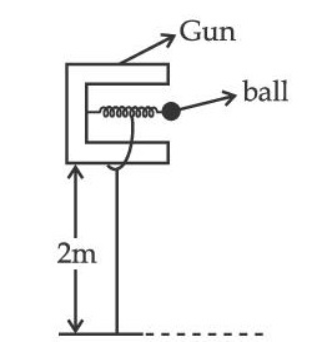
In a spring gun having spring constant \(100 \mathrm{~N} / \mathrm{m}\) a small ball ‘ B ‘ of mass 100 g is put in its barrel (as shown in figure) by compressing the spring through 0.05 m. There should be a box placed at a distance ‘ \(d\) ‘ on the ground so that the ball falls in it. If the ball leaves the gun horizontally at a height of 2 m above the ground. The value of \(d\) is ____ \(\mathrm{m} \cdot\left(\mathrm{g}=10 \mathrm{~m} / \mathrm{s}^2\right)\). [JEE Main 2021 (Online) 20th July Morning Shift]
 CorrectIncorrect
Hint
(a) Step 1: Calculate initial velocity
The potential energy stored in the spring is converted into the kinetic energy of the ball.
\(
\frac{1}{2} k x^2=\frac{1}{2} m v^2
\)
Solving for the velocity \(v\) :
\(
v=\sqrt{\frac{k x^2}{m}}
\)
Substituting the given values ( \(k=100 \mathrm{~N} / \mathrm{m}, x=0.05 \mathrm{~m}, m=0.1 \mathrm{~kg}\) ):
\(
v=\sqrt{\frac{100 \cdot(0.05)^2}{0.1}}=\sqrt{2.5} \mathrm{~m} / \mathrm{s}
\)
Step 2: Calculate time of flight
The time \(t\) it takes for the ball to fall from a height \(h\) can be found using the equation of motion for vertical displacement, assuming zero initial vertical velocity:
\(
h=\frac{1}{2} g t^2
\)
Solving for \(t\) :
\(
t=\sqrt{\frac{2 h}{g}}
\)
Substituting the given values ( \(h=2 \mathrm{~m}, g=10 \mathrm{~m} / \mathrm{s}^2\) ):
\(
t=\sqrt{\frac{2 \cdot 2}{10}}=\sqrt{0.4} \mathrm{~s}
\)
Step 3: Calculate horizontal distance
The horizontal distance \(\boldsymbol{d}\) is calculated by multiplying the constant horizontal velocity \(\boldsymbol{v}\) by the time of flight \(t\) :
\(
d=v \cdot t
\)
Substituting the calculated values for \(v\) and \(t\) :
\(
d=\sqrt{2.5} \cdot \sqrt{0.4}=\sqrt{2.5 \cdot 0.4}=\sqrt{1.0} \mathrm{~m}={1.0} \mathrm{~m}
\) - Question 34 of 41
34. Question
A ball of mass 4 kg, moving with a velocity of \(10 \mathrm{~ms}^{-1}\), collides with a spring of length 8 m and force constant \(100 \mathrm{Nm}^{-1}\). The length of the compressed spring is \(x \mathrm{~m}\). The value of \(x\), to the nearest integer, is ____. [JEE Main 2021 (Online) 18th March Evening Shift]
CorrectIncorrectHint
(d) Step 1: Apply the principle of conservation of energy
The kinetic energy of the ball is converted into the potential energy of the spring. We use the equation:
\(
\frac{1}{2} m v^2=\frac{1}{2} k(\Delta L)^2
\)
where \(m\) is mass, \(v\) is velocity, \(k\) is spring constant, and \(\Delta L\) is the maximum compression.
Step 2: Calculate the maximum compression
We rearrange the formula to solve for \(\boldsymbol{\Delta} \boldsymbol{L}\) :
\(
\Delta L=\sqrt{\frac{m v^2}{k}}
\)
Substitute the given values \(m=4 \mathrm{~kg}, v=10 \mathrm{~ms}^{-1}\), and \(k=100 \mathrm{Nm}^{-1}\) :
\(
\Delta L=\sqrt{\frac{4 \times 10^2}{100}}=\sqrt{\frac{400}{100}}=\sqrt{4}=2 \mathrm{~m}
\)
Step 3: Determine the length of the compressed spring
The original length of the spring is \(L=8 \mathrm{~m}\). The length of the compressed spring \(x\) is the original length minus the maximum compression:
\(
\begin{gathered}
x=L-\Delta L \\
x=8 \mathrm{~m}-2 \mathrm{~m}=6 \mathrm{~m}
\end{gathered}
\)
The value of \(x\), to the nearest integer, is 6 m. - Question 35 of 41
35. Question
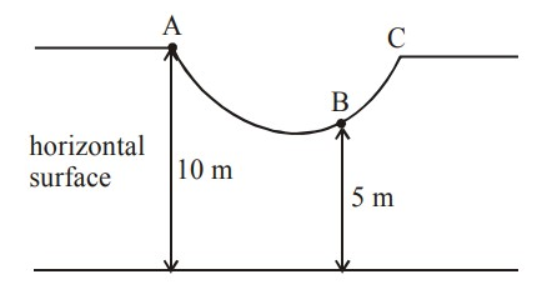
As shown in the figure, a particle of mass 10 kg is placed at a point A . When the particle is slightly displaced to its right, it starts moving and reaches the point B. The speed of the particle at \(B\) is \(x \mathrm{~m} / \mathrm{s}\). (Take \(g=10 \mathrm{~m} / \mathrm{s}^2\) )
The value of ‘ \(x\) ‘ to the nearest integer is _____. [JEE Main 2021 (Online) 18th March Morning Shift] CorrectIncorrect
Hint
(d) Step 1: Apply Conservation of Mechanical Energy
The total mechanical energy at point \(\mathrm{A}\left(\boldsymbol{T E}_{\boldsymbol{A}}\right)\) is equal to the total mechanical energy at point \(\mathrm{B}\left(\boldsymbol{T E}_{\boldsymbol{B}}\right)\), assuming no non-conservative forces like friction are present. The particle starts from rest (slightly displaced), so its initial kinetic energy at A is 0.
The equation for conservation of energy is:
\(
\begin{gathered}
T E_A=T E_B \\
P E_A+K E_A=P E_B+K E_B \\
m g h_A+0=m g h_B+\frac{1}{2} m v_B^2
\end{gathered}
\)
Step 2: Substitute values and solve for \(\boldsymbol{v}_{\boldsymbol{B}}\)
Given:
Mass \(m=10 \mathrm{~kg}\)
Height at \(\mathrm{A}, h_A=10 \mathrm{~m}\)
Height at \(\mathrm{B}, \boldsymbol{h}_{\boldsymbol{B}}=5 \mathrm{~m}\)
Acceleration due to gravity \(g=10 \mathrm{~m} / \mathrm{s}^2\)
Speed at \(\mathrm{B}, v_B=x \mathrm{~m} / \mathrm{s}\)
Substitute these values into the energy equation:
\(
\begin{aligned}
&m g(10)=m g(5)+\frac{1}{2} m v_B^2\\
&\text { We can cancel the mass ‘ } m \text { ‘ from all terms: }\\
&\begin{aligned}
g(10) & =g(5)+\frac{1}{2} v_B^2 \\
10 \times 10 & =10 \times 5+\frac{1}{2} v_B^2 \\
100 & =50+\frac{1}{2} v_B^2
\end{aligned}
\end{aligned}
\)
Step 3: Calculate the speed ‘ \(x\) ‘
Rearrange the equation to solve for \(\boldsymbol{v}_{\boldsymbol{B}}^2\) :
\(
\begin{gathered}
100-50=\frac{1}{2} v_B^2 \\
50=\frac{1}{2} v_B^2 \\
v_B^2=100 \\
v_B=\sqrt{100} \\
v_B=10 \mathrm{~m} / \mathrm{s}
\end{gathered}
\)
Thus, the value of \(x\) is 10. The value to the nearest integer is also 10. - Question 36 of 41
36. Question
The potential energy \((U)\) of a diatomic molecule is a function dependent on \(r\) (interatomic distance) as
\(
U=\frac{\alpha}{r^{10}}-\frac{\beta}{r^5}-3
\)
where, \(\alpha\) and \(\beta\) are positive constants. The equilibrium distance between two atoms will be \(\left(\frac{2 \alpha}{\beta}\right)^{\frac{a}{b}}\), where \(\mathrm{a}=\) _____. [JEE Main 2021 (Online) 25th February Morning Shift]CorrectIncorrectHint
(a) The equilibrium distance occurs where the force is zero, meaning the derivative of potential energy with respect to distance is zero ( \(\frac{d U}{d r}=0\) ).
The derivative of \(U\) is:
\(
\frac{d U}{d r}=-\frac{10 \alpha}{r^{11}}+\frac{5 \beta}{r^6}
\)
Setting \(\frac{d U}{d r}=0\) and solving for \(\boldsymbol{r}\) yields the equilibrium distance:
\(
r=\left(\frac{2 \alpha}{\beta}\right)^{\frac{1}{5}}
\)
The value of a in the expression \(\left(\frac{2 \alpha}{\beta}\right)^{\frac{a}{b}}\) is 1. - Question 37 of 41
37. Question
A body of mass 2 kg is driven by an engine delivering a constant power of \(1 \mathrm{~J} / \mathrm{s}\). The body starts from rest and moves in a straight line. After 9 seconds, the body has moved a distance (in m) ______. [JEE Main 2020 (Online) 5th September Evening Slot]
CorrectIncorrectHint
(c)
Step 1: Relate Power to Velocity
The engine delivers constant power \(\boldsymbol{P}\), which is the rate of change of kinetic energy \(\boldsymbol{K}\).
\(
\frac{d K}{d t}=P
\)
Since the body starts from rest, the kinetic energy at time \(t\) is \(K=P t\). The kinetic energy is also given by \(K=\frac{1}{2} m v^2\).
\(
P t=\frac{1}{2} m v^2
\)
We solve for velocity \(v\) as a function of time:
\(
v=\sqrt{\frac{2 P t}{m}}
\)
Step 2: Relate Velocity to Distance and Integrate
Velocity is the rate of change of distance \(x, v=\frac{d x}{d t}\).
\(
\frac{d x}{d t}=\sqrt{\frac{2 P}{m}} t^{12}
\)
To find the total distance moved, we integrate from \(t=0\) to \(t=9 \mathrm{~s}\) :
\(
\begin{aligned}
\int_0^x d x & =\int_0^t \sqrt{\frac{2 P}{m}} t^{1 / 2} d t \\
x & =\sqrt{\frac{2 P}{m}}\left[\frac{t^{3 / 2}}{3 / 2}\right]_0^t \\
x & =\frac{2}{3} \sqrt{\frac{2 P}{m}} t^{3 / 2}
\end{aligned}
\)
Step 3: Substitute Values and Calculate
Given values are \(P=1 \mathrm{~W}, m=2 \mathrm{~kg}\), and \(t=9 \mathrm{~s}\).
\(
\begin{gathered}
x=\frac{2}{3} \sqrt{\frac{2 \cdot 1}{2}} 9^{3 / 2} \\
x=\frac{2}{3} \sqrt{1}(\sqrt{9})^3 \\
x=\frac{2}{3} \cdot 1 \cdot 27 \\
x=18 \mathrm{~m}
\end{gathered}
\)
The distance moved after 9 seconds is 18 m. - Question 38 of 41
38. Question
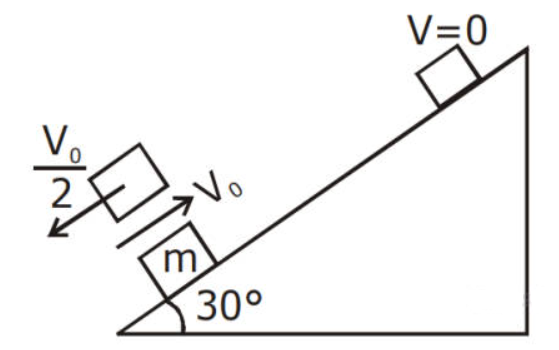
A block starts moving up an inclined plane of inclination \(30^{\circ}\) with an initial velocity of \(\mathrm{v}_0\). It comes back to its initial position with velocity \(\frac{v_0}{2}\). The value of the coefficient of kinetic friction between the block and the inclined plane is close to \(\frac{I}{1000}\). The nearest integer to \(I\) is _____. [JEE Main 2020 (Online) 3rd September Evening Slot]
CorrectIncorrectHint
(b)

Step 1: Analyze motion upwards and downwards:
The block moves up an inclined plane with inclination \(\theta=30^{\circ}\) and initial velocity \(v_0\), coming to rest momentarily at a distance \(d\) up the plane. It then slides back down the same distance \(d\), reaching the starting point with a final velocity \(v_f=v_0 / 2\). The forces acting on the block along the incline include the component of gravity, \(m g \sin \theta\), and the kinetic friction force, \(f_k=\mu_k N=\mu_k m g \cos \theta\).
Step 2: Formulate equations for acceleration and distance
Using the work-energy theorem for the upward and downward motions, we can establish two equations relating the distance \(d\), velocities, and the coefficient of kinetic friction, \(\boldsymbol{\mu}_{\boldsymbol{k}}\).
For upward motion, the total work done by gravity and friction equals the change in kinetic energy:
\(
-m g d \sin \theta-\mu_k m g d \cos \theta=-\frac{1}{2} m v_0^2
\)
Which simplifies to:
\(
v_0^2=2 g d\left(\sin \theta+\mu_k \cos \theta\right)
\)
For downward motion, gravity does positive work and friction does negative work, equal to the change in kinetic energy from rest to \(v_f\) :
\(
m g d \sin \theta-\mu_k m g d \cos \theta=\frac{1}{2} m v_f^2
\)
Which simplifies to:
\(
v_f^2=2 g d\left(\sin \theta-\mu_k \cos \theta\right)
\)
Step 3: Solve for the coefficient of kinetic friction
Substitute \(v_f=v_0 / 2\) into the second equation and divide the first equation by the modified second equation to eliminate \(v_0^2, g\), and \(d\) :
\(
\begin{gathered}
\frac{v_0^2}{v_f^2}=\frac{2 g d\left(\sin \theta+\mu_k \cos \theta\right)}{2 g d\left(\sin \theta-\mu_k \cos \theta\right)} \Longrightarrow \frac{v_0^2}{\left(v_0 / 2\right)^2}=\frac{\sin \theta+\mu_k \cos \theta}{\sin \theta-\mu_k \cos \theta} \\
4=\frac{\sin \theta+\mu_k \cos \theta}{\sin \theta-\mu_k \cos \theta}
\end{gathered}
\)
Solving for \(\mu_k\) :
\(
\begin{gathered}
4 \sin \theta-4 \mu_k \cos \theta=\sin \theta+\mu_k \cos \theta \\
3 \sin \theta=5 \mu_k \cos \theta \\
\mu_k=\frac{3}{5} \tan \theta
\end{gathered}
\)
Substitute \(\theta=30^{\circ}\left(\tan 30^{\circ}=1 / \sqrt{3}\right)\) :
\(
\mu_k=\frac{3}{5 \sqrt{3}}=\frac{\sqrt{3}}{5}
\)
To find \(I\), we use the relation \(\mu_k \approx I / 1000\) :
\(
I \approx 1000 \mu_k=1000 \times \frac{\sqrt{3}}{5}=200 \sqrt{3} \approx 346.41
\)
The nearest integer to \(\boldsymbol{I}\) is 346. - Question 39 of 41
39. Question
A cricket ball of mass 0.15 kg is thrown vertically up by a bowling machine so that it rises to a maximum height of 20 m after leaving the machine. If the part pushing the ball applies a constant force \(F\) on the ball and moves horizontally a distance of 0.2 m while launching the ball, the value of \(F\) (in N ) is ( \(\mathrm{g}=10 \mathrm{~ms}^{-2}\) ) ____. [JEE Main 2020 (Online) 3rd September Morning Slot]
CorrectIncorrectHint
(d) Step 1: Calculate the initial kinetic energy of the ball
When the ball leaves the machine, it has an initial kinetic energy that is entirely converted into potential energy as it rises to its maximum height of 20 m . We can find the potential energy (PE) at the maximum height using the formula \(P E=m g h\).
The mass of the ball is \(m=0.15 \mathrm{~kg}\), the height is \(h=20 \mathrm{~m}\), and \(g=10 \mathrm{~ms}^{-2}\). The potential energy is:
\(
P E=m g h=0.15 \mathrm{~kg} \times 10 \mathrm{~ms}^{-2} \times 20 \mathrm{~m}=30 \mathrm{~J}
\)
By the principle of conservation of energy, the kinetic energy (KE) of the ball just after leaving the machine is equal to this potential energy:
\(
K E=30 \mathrm{~J}
\)
Step 2: Relate kinetic energy to the work done by the force F
The work done ( \(W\) ) by the constant force \(F\) over the horizontal distance \(d=0.2 \mathrm{~m}\) inside the machine is what gives the ball its initial kinetic energy.
The work done is given by:
\(
W=F \times d
\)
Equating the work done to the kinetic energy:
\(
\begin{gathered}
F \times d=K E \\
F \times 0.2 \mathrm{~m}=30 \mathrm{~J}
\end{gathered}
\)
Step 3: Solve for the force \(F\)
Rearrange the equation to solve for \(F\) :
\(
F=\frac{30 \mathrm{~J}}{0.2 \mathrm{~m}}=150 \mathrm{~N}
\) - Question 40 of 41
40. Question
A small block starts slipping down from a point B on an inclined plane AB , which is making an angle \(\theta\) with the horizontal section BC is smooth and the remaining section CA is rough with a coefficient of friction \(\mu\). It is found that the block comes to rest as it reaches the bottom (point A) of the inclined plane. If \(\mathrm{BC}=2 \mathrm{AC}\), the coefficient of friction is given by \(\mu=\mathrm{k} \tan \theta\). The value of \(k\) is _____. [JEE Main 2020 (Online) 2nd September Morning Slot]
 CorrectIncorrect
Hint
(c)

Step 1: Define parameters and apply the work-energy theorem
Let the length of section AC be \(L\). Then the length of BC is \(2 L\), and the total length AB is \(3 L\). The vertical height of point B above A is \(h=3 L \sin \theta\).
We apply the work-energy theorem from point B to point A. The change in kinetic energy is zero, as the block starts from rest and comes to rest at the bottom. The work done is due to gravity ( \(W_g\) ) and friction ( \(W_f\) ).
\(
W_{\text {net }}=\Delta K=0
\)
The work done by gravity is \(W_g=m g h=m g(3 L \sin \theta)\).
Friction only acts along section CA of length \(\boldsymbol{L}\). The normal force on the incline is \(N=m g \cos \theta\), and the friction force is \(f=\mu N=\mu m g \cos \theta\).
The work done by friction is \(W_f=-f \times L=-\mu m g L \cos \theta\).
Step 2: Solve for the coefficient of friction \(\boldsymbol{\mu}\)
Setting the net work to zero:
\(
\begin{gathered}
W_g+W_f=0 \\
m g(3 L \sin \theta)-\mu m g L \cos \theta=0
\end{gathered}
\)
We can cancel out the common terms \(m g L\) :
\(
3 \sin \theta-\mu \cos \theta=0
\)
Solving for \(\mu\) :
\(
\mu=\frac{3 \sin \theta}{\cos \theta}=3 \tan \theta
\)
Comparing this result with the given expression \(\mu=k \tan \theta\), the value of \(k\) is 3. - Question 41 of 41
41. Question
A particle ( \(m=1 \mathrm{~kg}\) ) slides down a frictionless track (AOC) starting from rest at a point A (height 2 m ). After reaching C, the particle continues to move freely in air as a projectile. When it reaching its highest point \(P\) (height 1 m ), the kinetic energy of the particle (in)) is : (Figure drawn is schematic and not to scale; take \(\mathrm{g}=10 \mathrm{~ms}^{-2}\) ) [JEE Main 2020 (Online) 7th January Morning Slot]
 CorrectIncorrect
Hint
(c) Step 1: Calculate the total mechanical energy at point A
The particle starts from rest at point A, so its initial kinetic energy is zero. The total mechanical energy at point A is purely potential energy, given by \(E_A=m g h_A\).
\(
E_A=(1 \mathrm{~kg})\left(10 \mathrm{~ms}^{-2}\right)(2 \mathrm{~m})=20 \mathrm{~J}
\)
Step 2: Calculate the potential energy at point P
Point P is the highest point reached during the projectile motion, with a given height of \(\boldsymbol{h}_{\boldsymbol{P}} \boldsymbol{=} \mathbf{1 m}\). The potential energy at P is \(\boldsymbol{P} \boldsymbol{E}_{\boldsymbol{P}} \boldsymbol{=} \boldsymbol{m g} \boldsymbol{h}_{\boldsymbol{P}}\).
\(
P E_P=(1 \mathrm{~kg})\left(10 \mathrm{~ms}^{-2}\right)(1 \mathrm{~m})=10 \mathrm{~J}
\)
Step 3: Apply the conservation of mechanical energy
Since the track is frictionless and air resistance is ignored (free movement in air as a projectile implies using standard projectile motion assumptions where energy is conserved if only gravity works), mechanical energy is conserved throughout the motion (from A to P ). The total energy at P is the sum of its potential energy \(\boldsymbol{P E}_{\boldsymbol{P}}\) and kinetic energy \(\boldsymbol{K} \boldsymbol{E}_{\boldsymbol{P}}\).
\(
\begin{gathered}
E_A=E_P \\
E_A=P E_P+K E_P \\
20 \mathrm{~J}=10 \mathrm{~J}+K E_P \\
K E_P=20 \mathrm{~J}-10 \mathrm{~J}=10 \mathrm{~J}
\end{gathered}
\)
The kinetic energy of the particle at point P is \(\mathbf{1 0 ~ J}\).