3.4 Addition and subtraction of vectors — graphical method
Vectors cannot be added by simple laws of algebra, which are applicable to scalars. To add two vectors, we must follow certain laws. These laws are described below.
Triangle law of addition of two vectors
It states that, if two vectors acting on a particle at the same time are represented with magnitude and direction by the two sides of a triangle taken in same order, then their sum or resultant is represented in magnitude and direction by the third side of the triangle taken in opposite order.
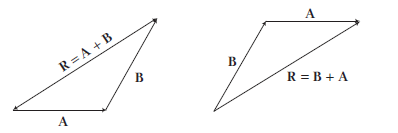
As is evident from the figure that the resultant \(\mathbf{R}\) is the same irrespective of the order in which the vectors \(\mathbf{A}\) and \(\mathbf{B}\) are taken.
Thus, \(\mathbf{R}=\mathbf{A}+\mathbf{B}=\mathbf{B}+\mathbf{A}\)
This is the geometrical (or graphical) method of vector addition.
Parallelogram law of vector addition
It states that, if two vectors acting on a particle at the same time can be represented with magnitude and direction by the two adjacent sides of a parallelogram drawn from a point, then their resultant vector is represented in magnitude and direction by the diagonal of the parallelogram drawn from the same point.
Magnitude of resultant vector:
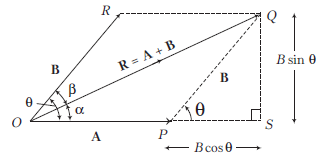
Let \(\mathbf{R}\) be the resultant of two vectors \(\mathbf{A}\) and \(\mathbf{B}\). According to parallelogram law of vector addition, the resultant \(\mathbf{R}\) is the diagonal of the parallelogram of which \(\mathbf{A}\) and \(\mathbf{B}\) are the adjacent sides as shown in figure below.
\(
\begin{aligned}
OS^2 & =OP+PS)^2+(QS)^2 \\
& =(A+B \cos \theta)^2+(B \sin \theta)^2 \\
& =A^2+2 A B \cos \theta+B^2
\end{aligned}
\)
Magnitude of \(\mathbf{R}\) is given by
\(
\mathbf{R}=\sqrt{A^2+B^2+2 A B \cos \theta} \dots(i)
\)
Here, \(\theta=\) angle between \(\mathbf{A}\) and \(\mathbf{B}\).
Eq. (i) is also known as law of cosines.
Also, \(\frac{R}{\sin \theta}=\frac{A}{\sin \beta}=\frac{B}{\sin \alpha}\) is known as law of sines.
Special cases:
- Resultant of two vectors will be maximum when they are parallel, i.e. angle between them is zero.
\(
R_{\max }=A+B
\) - Resultant of two vectors will be minimum when they are anti-parallel, i.e. angle between them is \(180^{\circ}\).
\(
R_{\min }=A-B
\) - Resultant of two vectors of unequal magnitude can never be zero.
Direction of resultant vector:
Let \(\theta\) be the angle between \(\mathbf{A}\) and \(\mathbf{B}\), then
\(
|\mathbf{A}+\mathbf{B}|=\sqrt{A^2+B^2+2 A B \cos \theta}
\)
If \(R\) makes an angle \(\alpha\) and \(\beta\) with \(\mathbf{A}\) and \(\mathbf{B}\) respectively, then
\(
\begin{aligned}
& \tan \alpha=\frac{B \sin \theta}{A+B \cos \theta} \\
& \tan \beta=\frac{A \sin \theta}{B+A \cos \theta}
\end{aligned}
\)
Note
- Resultant of two vectors is always located in their common plane.
- Vector addition is commutative, i.e. \(\mathbf{A}+\mathbf{B}=\mathbf{B}+\mathbf{A}\)
- Vector addition is associative
i.e. \(\mathbf{A}+(\mathbf{B}+\mathbf{C})=(\mathbf{A}+\mathbf{B})+\mathbf{C}\) - If vectors are of unequal magnitude, then minimum three coplanar vectors are required for zero resultant.
Example 1: Rain is falling vertically with a speed of \(35 \mathrm{~m} \mathrm{~s}^{-1}\). Winds start blowing after some time with a speed of \(12 \mathrm{~m} \mathrm{~s}^{-1}\) in the east-to-west direction. In which direction should a boy waiting at a bus stop hold his umbrella?
Solution:
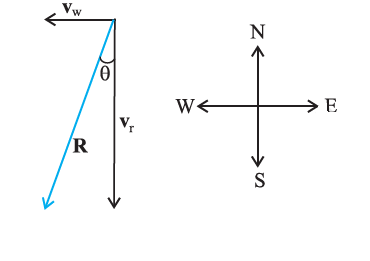 figure 4d
The velocity of the rain and the wind are represented by the vectors \(\mathbf{v}_{\mathbf{r}}\) and \(\mathbf{v}_{\mathbf{w}}\) in the above figure 4d and are in the direction specified by the problem. Using the rule of vector addition, we see that the resultant of \(\mathbf{v}_{\mathbf{r}}\) and \(\mathbf{v}_{\mathbf{w}}\) is \(\mathbf{R}\) as shown in the figure. The magnitude of \(\mathbf{R}\) is
\(
R=\sqrt{v_{r}^{2}+v_{w}^{2}}=\sqrt{35^{2}+12^{2}} \mathrm{~m} \mathrm{~s}^{-1}=37 \mathrm{~m} \mathrm{~s}^{-1}
\)
The direction \(\theta\) that \(R\) makes with the vertical is given by
\(
\tan \theta=\frac{v_{w}}{v_{r}}=\frac{12}{35}=0.343
\)
Or, \(\quad \theta=\tan ^{-1}(0.343)=19^{\circ}\)
Therefore, the boy should hold his umbrella in the vertical plane at an angle of about \(19^{\circ}\) with the vertical towards the east.
Example 2: Two vectors having equal magnitudes A make an angle \(\theta\) with each other. Find the magnitude and direction of the resultant.
Solution: The magnitude of the resultant will be
\(
\begin{aligned}
B & =\sqrt{A^2+A^2+2 A A \cos \theta} \\
& =\sqrt{2 A^2(1+\cos \theta)}=\sqrt{4 A^2 \cos ^2 \frac{\theta}{2}} \\
& =2 A \cos \frac{\theta}{2} .
\end{aligned}
\)
The resultant will make an angle \(\alpha\) with the first vector where
\(
\tan \alpha=\frac{A \sin \theta}{A+A \cos \theta}=\frac{2 A \sin \frac{\theta}{2} \cos \frac{\theta}{2}}{2 A \cos ^2 \frac{\theta}{2}}=\tan \frac{\theta}{2}
\)
or, \(\quad \alpha=\frac{\theta}{2}\)
Thus, the resultant of two equal vectors bisects the angle between them.
Example 3: Two vectors of equal magnitude 5 unit have an angle \(60^{\circ}\) between them. Find the magnitude of (a) the sum of the vectors and (b) the difference of the vectors.
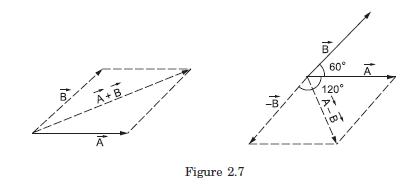
Solution: Figure (2.7) shows the construction of the sum \(\vec{A}+\vec{B}\) and the difference \(\vec{A}-\vec{B}\).
(a) \(\vec{A}+\vec{B}\) is the sum of \(\vec{A}\) and \(\vec{B}\). Both have a magnitude of 5 unit and the angle between them is \(60^{\circ}\). Thus, the magnitude of the sum is
\(
\begin{aligned}
|\vec{A}+\vec{B}| & =\sqrt{5^2+5^2+2 \times 5 \times 5 \cos 60^{\circ}} \\
& =2 \times 5 \cos 30^{\circ}=5 \sqrt{3} \text { unit. }
\end{aligned}
\)
(b) \(\vec{A}-\vec{B}\) is the sum of \(\vec{A}\) and \((-\vec{B})\). As shown in the figure, the angle between \(\vec{A}\) and \((-\vec{B})\) is \(120^{\circ}\). The magnitudes of both \(\vec{A}\) and \((-\vec{B})\) is 5 unit. So,
\(
\begin{aligned}
|\vec{A}-\vec{B}| & =\sqrt{5^2+5^2+2 \times 5 \times 5 \cos 120^{\circ}} \\
& =2 \times 5 \cos 60^{\circ}=5 \text { unit. }
\end{aligned}
\)
Example 4: Two forces whose magnitude are in the ratio \(3: 5\) give a resultant of 28 N. If the angle of their inclination is \(60^{\circ}\), find the magnitude of each force.
Solution: Let \(A\) and \(B\) be the two forces, then \(A=3 x, B=5 x\)
\(
\begin{array}{ll}
\because & R=28 \mathrm{~N} \text { and } \theta=60^{\circ} \\
\text { Now, } & R=\sqrt{A^2+B^2+2 A B \cos \theta} \\
\therefore & 28=\sqrt{(3 x)^2+(5 x)^2+2(3 x)(5 x) \cos 60^{\circ}} \\
& 28=\sqrt{9 x^2+25 x^2+15 x^2}=7 x \text { or } x=4 \\
\therefore & A=3 \times 4=12 \mathrm{~N} \\
\text { and } & B=5 \times 4=20 \mathrm{~N}
\end{array}
\)
Example 5: If \(\mathbf{A}=\mathbf{B}+\mathbf{C}\) have scalar magnitudes of \(5,4,3\) units respectively, then find the angle between \(\mathbf{A}\) and \(\mathbf{C}\).
Solution: Here, triangle \(O M N\) is given with vectors \(\mathbf{A}, \mathbf{B}\) and \(\mathbf{C}\) are its adjacent sides.
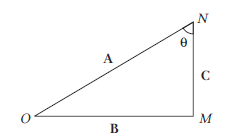
As, \(\quad \cos \theta=\frac{M N}{O N} \Rightarrow \theta=\cos ^{-1}\left(\frac{|\mathbf{C}|}{|\mathbf{A}|}\right)=\cos ^{-1}\left(\frac{3}{5}\right)\)
Subtraction Of Two Vectors
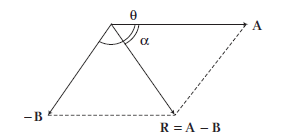
Negative of a vector say – \(\mathbf{A}\) is a vector of the same magnitude as vector \(\mathbf{A}\) but pointing in a direction opposite to that of \(\mathbf{A}\).
Thus, \(\mathbf{A}-\mathbf{B}\) can be written as \(\mathbf{A}+(-\mathbf{B})\) or \(\mathbf{A}-\mathbf{B}\) is the vector addition of \(\mathbf{A}\) and \(-\mathbf{B}\).
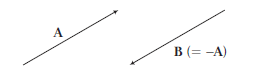
Suppose angle between two vectors \(\mathbf{A}\) and \(\mathbf{B}\) is \(\boldsymbol{\theta}\) shown in Figure(a). Then, angle between \(\mathbf{A}\) and \(-\mathbf{B}\) will be \(180^{\circ}-\theta\) as shown in Figure (b).
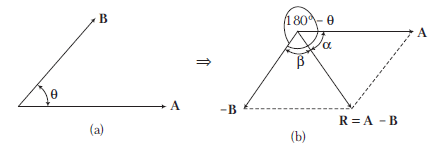
Magnitude of resultant vector \(\mathbf{R}=\mathbf{A}-\mathbf{B}\) will be thus given by
\(
\begin{aligned}
|\mathbf{R}| & =|\mathbf{A}-\mathbf{B}|=\sqrt{A^2+B^2+2 A B \cos \left(180^{\circ}-\theta\right)} \\
\text { or } \quad|\mathbf{R}| & =\sqrt{A^2+B^2-2 A B \cos \theta} \dots(i)
\end{aligned}
\)
For direction of resultant vector \(\mathbf{R}\), we will either calculate angle \(\alpha\) or \(\beta\), where
\(
\tan \alpha=\frac{B \sin \left(180^{\circ}-\theta\right)}{A+B \cos \left(180^{\circ}-\theta\right)}=\frac{B \sin \theta}{A-B \cos \theta} \dots(ii)
\)
or \(\tan \beta=\frac{A \sin \left(180^{\circ}-\theta\right)}{B+A \cos \left(180^{\circ}-\theta\right)}=\frac{A \sin \theta}{B-A \cos \theta} \dots(iii)\)
Special cases:
- If two vectors have equal magnitudes, i.e. \(|\mathbf{A}|=|\mathbf{B}|=a\) and \(\boldsymbol{\theta}\) is the angle between them, then
\(
|\mathbf{A}-\mathbf{B}|=\sqrt{a^2+a^2-2 a^2 \cos \theta}=2 a \sin \left(\frac{\theta}{2}\right)
\)
If \(\theta=60^{\circ}\), then \(2 a \sin \left(\frac{\theta}{2}\right)=a\)
i.e. \(|\mathbf{A}-\mathbf{B}|=|\mathbf{A}|=|\mathbf{B}|=a\) at \(\boldsymbol{\theta}=60^{\circ}\) - If two vectors are such that their sum and difference have equal magnitude, then angle between the given vectors \(\theta=90^{\circ}\).
i.e. \(|\mathbf{A}+\mathbf{B}|=|\mathbf{A}-\mathbf{B}|\)
then \(\cos \theta=0\) or \(\theta=90^{\circ}\) - If \(\mathbf{A}+\mathbf{B}=\mathbf{A}-\mathbf{B}\)
then \(\quad \mathbf{B}=\mathbf{0}\) (a null vector)
Note:
- The vector subtraction does not follow commutative law, i.e. \(\mathbf{A}-\mathbf{B} \neq \mathbf{B}-\mathbf{A}\).
- The vector subtraction does not follow associative law, i.e. \(\mathbf{A}-(\mathbf{B}-\mathbf{C}) \neq(\mathbf{A}-\mathbf{B})-\mathbf{C}\)
Example 6: Find the subtraction of vector \(\mathbf{A}\) and \(\mathbf{B}\) as shown in the figure, also find the direction of subtraction vector. Given, \(A=4\) unit and \(B=3\) unit.
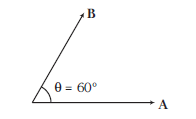
Solution: According to the question, we draw the following figure.
Magnitude of resultant of the vectors \(\mathbf{A}\) and \(\mathbf{B}\),
\(
\begin{aligned}
R & =\sqrt{A^2+B^2-2 A B \cos \theta} \\
& =\sqrt{16+9-2 \times 4 \times 3 \cos 60^{\circ}} \\
& =\sqrt{13} \text { unit }
\end{aligned}
\)
and direction is
\(
\begin{aligned}
\tan \alpha & =\frac{B \sin \theta}{A-B \cos \theta} \\
& =\frac{3 \sin 60^{\circ}}{4-3 \cos 60^{\circ}}=1.04 \\
\therefore \quad \alpha & =\tan ^{-1}(1.04)=46.1^{\circ}
\end{aligned}
\)
Thus, \(\mathbf{A}-\mathbf{B}\) is \(\sqrt{13}\) unit at \(46.1^{\circ}\) from \(\mathbf{A}\) in the direction shown in figure.
Example 7: Two vectors \(\mathbf{P}\) and \(\mathbf{Q}\) have equal magnitudes. If the magnitude of \((P+Q)\) is ‘ \(k\) ‘ times the magnitude of \((P-Q)\), then calculate the angle between \(P\) and \(Q\).
Solution: Given, \(|\mathbf{P}|=|\mathbf{Q}|\)
\(
P=Q \dots(i)
\)
Let magnitude of \((P+Q)\) is \(R\) and for \((P-Q)\) is \(R^{\prime}\)
Now,
\(
\mathbf{R}=\mathbf{P}+\mathbf{Q}
\)
and
\(
\begin{aligned}
& R^2=P^2+Q^2+2 P Q \cos \theta \\
& R^2=2 P^2+2 P^2 \cos \theta \dots(ii)
\end{aligned}
\)
Again,
\(
\begin{aligned}
\mathbf{R}^{\prime} & =\mathbf{P}-\mathbf{Q} \\
\left(R^{\prime}\right)^2 & =P^2+Q^2-2 P Q \cos \theta \\
\left(R^{\prime}\right)^2 & =2 P^2-2 P^2 \cos \theta \dots(iii)
\end{aligned}
\)
Given, \(R=k R^{\prime}\) or \(\left(\frac{R}{R^{\prime}}\right)^2=k^2\)
Dividing Eq. (ii) by Eq. (iii), we get
\(
\begin{array}{rlrl}
& & \frac{k^2}{1} & =\frac{1+\cos \theta}{1-\cos \theta} \\
& \text { or } & \frac{k^2-1}{k^2+1} & =\frac{(1+\cos \theta)-(1-\cos \theta)}{(1+\cos \theta)+(1-\cos \theta)} \\
& & =\frac{2 \cos \theta}{2}=\cos \theta \\
& & \cos \theta & =\left(\frac{k^2-1}{k^2+1}\right) \text { or } \theta=\cos ^{-1}\left(\frac{k^2-1}{k^2+1}\right)
\end{array}
\)