9.4 Bernoulli’s principle
Bernoulli’s Principle
Bernoulli’s theorem is based on the law of conservation of energy and applied to ideal fluids.
It states that the sum of pressure energy per unit volume, kinetic energy per unit volume and potential energy per unit volume of an incompressible, non-viscous fluid in a streamlined irrotational flow remains constant at every cross-section throughout the liquid flow.
Mathematically, it can be expressed as
\(
p+\frac{1}{2} \rho v^2+\rho g h=\text { constant }
\)
where, \(p\) represents the pressure energy per unit volume (or pressure), \(\frac{1}{2} \rho v^2\) the kinetic energy per unit volume and \(\rho g h\) the potential energy per unit volume.
Proof: Consider an ideal fluid having streamline flow through a pipe of varying area of cross-section as shown in figure.

Assumptions: The density of the incompressible fluid remains constant at both points. The energy of the fluid is conserved (no loss of fluid) as there are no viscous forces in the fluid.
If \(p_1\) and \(p_2\) are the pressures at two ends of the tube respectively, the work done by pressure difference in pushing the volume \(\Delta V\) of fluid from the points \(1\) to \(2\) through the tube is given by:
\(
\begin{aligned}
& W=F_1 d x_1-F_2 d x_2 \\
& W=p_1 A_1 d x_1-p_2 A_2 d x_2 \\
& W=p_1 d V-p_2 d V=\left(p_1-p_2\right) \Delta V \dots(i)
\end{aligned}
\)
We know that the work done on the fluid was due to the conservation of change in gravitational potential energy and change in kinetic energy.
The change in potential energy of mass \(\Delta m\) (of volume \(\Delta V\) ),
\(
\Delta U=\Delta m g\left(h_2-h_1\right) \dots(ii)
\)
The change in kinetic energy of the fluid is given as:
\(
\Delta K=\frac{1}{2} \Delta m\left(v_2^2-v_1^2\right) \dots(iii)
\)
By conservation of energy, \(W=\Delta K+\Delta U\)
Putting the values from Eqs. (i), (ii) and (iii), we get
\(
\left(p_1-p_2\right) \Delta V=\frac{1}{2} \Delta m\left(v_2^2-v_1^2\right)+\Delta m g\left(h_2-h_1\right) \dots(iv)
\)
We know that \(\rho=\frac{\Delta m}{\Delta V}\)
Replacing \(\Delta m=\rho \times \Delta V\) in the equation (iv) we see\(\Delta V\) gets cancelled and finally, we get
\(
p_1+\frac{1}{2} \rho v_1^2+\rho g h_1=p_2+\frac{1}{2} \rho v_2^2+\rho g h_2
\)
\(
p+\frac{1}{2} \rho v^2+\rho g h=\text { constant } \dots(v)
\)
This is called Bernoulli’s equation.
On dividing both sides of Eq. (v) by \(\rho g\), we get
\(
\frac{p}{\rho g}+h+\frac{v^2}{2 g}=\frac{\text { constant }}{\rho g}=\text { new constant } \dots(vi)
\)
Here, \(p / \rho g\) is called pressure head, \(h\) is called gravitational head and \(v^2 / 2 g\) is called velocity head.
Note: Bernoulli’s equation for the fluid at rest When a fluid is at rest, i.e. the velocity is zero everywhere, then the Bernoulli’s equation becomes
\(
p_1+\rho g h_1=p_2+\rho g h_2 \Rightarrow p_1-p_2=\rho g\left(h_2-h_1\right)
\)
Example 1: Calculate the rate of flow of glycerine of density \(1.25 \times 10^3 \mathrm{kgm}^{-3}\) through the conical section of a horizontal pipe, if the radii of its ends are 0.1 m and 0.04 m and the pressure drop across its length is \(10 \mathrm{Nm}^{-2}\).
Solution: According to the question, we draw the following diagram.

From the continuity equation,
\(
\begin{aligned}
& A_1 v_1=A_2 v_2 \text { or } \frac{v_1}{v_2}=\frac{A_2}{A_1}=\frac{\pi r_2^2}{\pi r_1^2} \\
& \frac{v_1}{v_2}=\left(\frac{r_2}{r_1}\right)^2=\left(\frac{0.04}{0.1}\right)^2=\frac{4}{25} \dots(i)
\end{aligned}
\)
\(
\text { From Bernoulli’s equation, } p_1+\frac{1}{2} \rho v_1^2=p_2+\frac{1}{2} \rho v_2^2\left(\text { As } h_1=h_2\right)
\)
\(
\begin{aligned}
v_2^2-v_1^2 & =\frac{2\left(p_1-p_2\right)}{\rho} \\
v_2^2-v_1^2 & =\frac{2 \times 10}{1.25 \times 10^3}=1.6 \times 10^{-2} \mathrm{~m}^2 \mathrm{~s}^{-2} \dots(ii)
\end{aligned}
\)
Solving Eqs. (i) and (ii), we get
\(
v_2=\sqrt{\frac{1.6 \times 10^{-2} \times 625}{(625-16)}} \approx 0.128 \mathrm{~ms}^{-1}
\)
\(\therefore\) Rate of volume flow through the tube,
\(
\begin{aligned}
Q & =A_2 v_2=\left(\pi r_2^2\right) v_2=\pi(0.04)^2(0.128) \\
& =6.43 \times 10^{-4} \mathrm{~m}^3 \mathrm{~s}^{-1}
\end{aligned}
\)
Example 2: Figure below shows a liquid of density \(1200 \mathrm{~kg} \mathrm{~m}^{-3}\) flowing steadily in a tube of varying cross section. The cross section at a point \(A\) is \(1.0 \mathrm{~cm}^2\) and that at \(B\) is \(20 \mathrm{~mm}^2\), the points \(A\) and \(B\) are in the same horizontal plane. The speed of the liquid at \(A\) is \(10 \mathrm{~cm} \mathrm{~s}^{-1}\). Calculate the difference in pressures at \(A\) and \(B\).
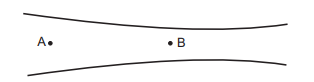
Solution: From equation of continuity, the speed \(v_2\) at \(B\) is given by,
\(
A_1 v_1=A_2 v_2
\)
or, \(\quad\left(1.0 \mathrm{~cm}^2\right)\left(10 \mathrm{~cm} \mathrm{~s}^{-1}\right)=\left(20 \mathrm{~mm}^2\right) v_2\)
or, \(\quad v_2=\frac{1.0 \mathrm{~cm}^2}{20 \mathrm{~mm}^2} \times 10 \mathrm{~cm} \mathrm{~s}^{-1}=50 \mathrm{~cm} \mathrm{~s}^{-1}\).
By Bernoulli equation,
\(
P_1+\rho g h_1+\frac{1}{2} \rho v_1^2=P_2+\rho g h_2+\frac{1}{2} \rho v_2^2 .
\)
Here \(h_1=h_2\). Thus,
\(
\begin{aligned}
P_1-P_2 & =\frac{1}{2} \rho v_2^2-\frac{1}{2} \rho v_1^2 \\
& =\frac{1}{2} \times\left(1200 \mathrm{~kg} \mathrm{~m}^{-3}\right)\left(2500 \mathrm{~cm}^2 \mathrm{~s}^{-2}-100 \mathrm{~cm}^2 \mathrm{~s}^{-2}\right) \\
& =600 \mathrm{~kg} \mathrm{~m}^{-3} \times 2400 \mathrm{~cm}^2 \mathrm{~s}^{-2}=144 \mathrm{~Pa} .
\end{aligned}
\)
Applications based on Bernoulli’s theorem
Speed of Efflux: Torricelli’s Law
The word efflux means fluid outflow. Torricelli discovered that the speed of efflux from an open tank is given by a formula identical to that of a freely falling body. Consider a tank containing a liquid of density \(\rho\) with a small hole in its side at a height \(y_l\) from the bottom (see Figure below). The air above the liquid, whose surface is at height \(y_2\), is at pressure \(P\). From the equation of continuity, we have
\(
\begin{aligned}
& v_1 A_1=v_2 A_2 \\
& v_2=\frac{A_1}{A_2} v_1
\end{aligned}
\)

If the cross-sectional area of the tank \(A_2\) is much larger than that of the hole \(\left(A_2 \gg A_1\right)\), then we may take the fluid to be approximately at rest at the top, i.e., \(v_2=0\). Now, applying the Bernoulli equation at points 1 and 2 and noting that at the hole \(P_1=P_a\), the atmospheric pressure, we have from Eqn (\(P_1+\frac{1}{2} \rho V_1^2+\rho g h_1=P_2+\frac{1}{2} \rho V_2^2+\rho g h_2\))
\(
P_a+\frac{1}{2} \rho v_1^2+\rho g y_1=P+\rho g y_2
\)
Taking \(y_2-y_1=h\) we have
\(
v_1=\sqrt{2 g h+\frac{2\left(P-P_a\right)}{\rho}}
\)
When \(P \gg P_a\) and \(2 g h\) may be ignored, the speed of efflux is determined by the container pressure. Such a situation occurs in rocket propulsion. On the other hand, if the tank is open to the atmosphere, then \(P=P_a\) and
\(
v_1=\sqrt{2 g h} \dots(1)
\)
This is also the speed of a freely falling body. Equation (1) represents Torricelli’s law.
From the above formula, it is clear that “The velocity of efflux of a liquid issuing out of an orifice is the same as it would attain, if allowed to fall freely through the vertical height between the liquid surface and orifice.” The above statement is also known as Torricelli’s theorem.
Horizontal range of liquid (R)
The outflow of a fluid is called efflux and the speed of the liquid coming out is called speed of efflux.
Consider a closed vessel filled with a liquid upto height \(H\) and a small hole is made in the wall of the vessel at a depth \(h\) below the surface of liquid.

Horizontal range: The escaping liquid flows in the form of a parabola. Let \(t\) be the time taken by the liquid to fall through a height \(h^{\prime}=(H-h)\).
Now, \({h}^{\prime}=0 \times {t}+\frac{1}{2} {gt}^2, \quad\) Initial velocity in the vertically downward direction is zero.
\(
{h}^{\prime}=\frac{1}{2} {gt}^2
\)
\(
{t}=\sqrt{\frac{2 {~h}^{\prime}}{{g}}}
\)
Let \(R\) be the horizontal range. In order to calculate \(R\), we shall consider the horizontal motion of the projectile. The horizontal motion takes place with constant velocity \(v\).
\(
\therefore {R}=v \times {t} \quad[\text { Distance }=\text { Speed } \times \text { Time }]
\)
\(
\text { or } {R}=\sqrt{2 g h} \times \sqrt{\frac{2 h^{\prime}}{g}}=2 \sqrt{{hh}^{\prime}}=2 \sqrt{h(H-h)}
\)
\(
R^2=4\left(H h-h^2\right)
\)
For \(R\) to be maximum, \(\frac{d R^2}{d h}=0\)
or \(H-2 h=0\) or \(h=\frac{H}{2}\)
i.e. \(R\) is maximum at \(h=\frac{H}{2}\)
\(
\begin{aligned}
& R_{\max }=2 \sqrt{\frac{H}{2}\left(H-\frac{H}{2}\right)} \\
& R_{\max }=H
\end{aligned}
\)
i.e. The maximum horizontal distance covered by liquid coming out of a hole is equal to the height of the liquid column.
Time taken to empty a tank is given by the formula
Let A: Area of the tank’s cross-section.
\(a\) : Area of the orifice.
\(\boldsymbol{H}\) : Initial height of the liquid in the tank.
\(g:\) Acceleration due to gravity.
Torricelli’s Law: \(v=\sqrt{2 g h}\), where \(v\) is the velocity of efflux and \(h\) is the height of the fluid.
Volume flow rate: \(Q=A v\), where \(Q\) is the flow rate, \(A\) is the area, and \(v\) is the velocity.
The volume flow rate out of the orifice is given by:
\(Q_{\text {out }}=a v=a \sqrt{2 g h}\)
The rate of change of volume in the tank is:
If the tank has a constant cross-sectional area \(A\), then the volume is simply \(V=A \cdot h\). Since \(A\) is constant, we can rewrite the derivative:
\(
\frac{d(V)}{d t}=\frac{d(A h)}{d t}=A \frac{d h}{d t}
\)
The volumetric flow rate entering the tank = \(Q_{\text {in }}=A \frac{d h}{d t}\)
The fundamental principle is that the change in volume ( \(V\) ) over time equals the flow in minus the flow out:
\(
\frac{d V}{d t}=Q_{\text {in }}-Q_{\text {out }}
\)
Since we know the tank is draining, the change in height must be a “loss.” To make the math match reality, we add the negative sign to show that the volume is being subtracted from the tank:
\(
\underbrace{A \frac{d h}{d t}}_{\text {Negative Change }}=\underbrace{-}_{\text {Direction }} \underbrace{a \sqrt{2 g h}}_{\text {Positive Flow Out }}
\)
Equating the outflow and the change in volume:
\(A \frac{d h}{d t}=-a \sqrt{2 g h}\)
The negative sign indicates that the height is decreasing.
Integrate both sides:
\(
\int_H^0 \frac{d h}{\sqrt{h}}=-\frac{a}{A} \sqrt{2 g} \int_0^t d t
\)
Evaluate the integrals:
\([2 \sqrt{h}]_H^0=-\frac{a}{A} \sqrt{2 g}[t]_0^t\)
\(0-2 \sqrt{H}=-\frac{a}{A} \sqrt{2 g} t\)
Rearrange the equation to solve for \(t\) :
\(
t=\frac{2 \sqrt{H}}{\frac{a}{A} \sqrt{2 g}}
\)
\(
t=\frac{A}{a} \sqrt{\frac{2 H}{g}}
\)
The time taken to empty the tank is \(t=\frac{A}{a} \sqrt{\frac{2 H}{g}}\)
Example 2: If the water emerge from an orifice in a tank in which the gauge pressure is \(4 \times 10^5 \mathrm{Nm}^{-2}\) before the flow starts, then what will be the velocity of the water emerging out? (Take, density of water is \(1000 \mathrm{kgm}^{-3}\) )
Solution: Here, \(p=4 \times 10^5 \mathrm{Nm}^{-2}\) and \(\rho=1000 \mathrm{~kg} \mathrm{~m}^{-3}, g=10 \mathrm{~m} \mathrm{~s}^{-2}\)
Apply, \(p=h \rho g \Rightarrow h=\frac{p}{\rho g}=\frac{4 \times 10^5}{1000 \times 10}\)
Velocity of efflux, \(v=\sqrt{2 g h}=\sqrt{\frac{2 \times 10 \times 4 \times 10^5}{1000 \times 10}}\)
\(=\sqrt{800}=28.28 \mathrm{~ms}^{-1}\)
Dynamic Lift
Dynamic lift is the force that acts on a body, such as airplane wing, a hydrofoil or a spinning ball, by virtue of its motion through a fluid. In many games such as cricket, tennis, baseball, or golf, we notice that a spinning ball deviates from its parabolic trajectory as it moves through air. This deviation can be partly explained on the basis of Bernoulli’s principle.
- Ball moving without spin: Figure (a) shows the streamlines around a non-spinning ball moving relative to a fluid. From the symmetry of streamlines, it is clear that the velocity of fluid (air) above and below the ball at corresponding points is the same resulting in zero pressure difference. The air, therefore, exerts no upward or downward force on the ball.

- Ball moving with spin: A ball which is spinning drags air along with it. If the surface is rough more air will be dragged. Figure(b) shows the streamlines of air for a ball which is moving and spinning at the same time. The ball is moving forward and relative to it the air is moving backwards. Therefore, the velocity of air above the ball relative to the ball is larger and below it is smaller. The stream lines, thus, get crowded above and rarified below. This difference in the velocities of air results in the pressure difference between the lower and upper faces and there is a net upward force on the ball. This dynamic lift due to spining is called Magnus effect.

- Aerofoil or lift on aircraft wing: Figure (c) shows an aerofoil, which is a solid piece shaped to provide an upward dynamic lift when it moves horizontally through air. The cross-section of the wings of an aeroplane looks somewhat like the aerofoil shown in Figure (c) with streamlines around it. When the aerofoil moves against the wind, the orientation of the wing relative to flow direction causes the streamlines to crowd together above the wing more than those below it. The flow speed on top is higher than that below it. There is an upward force resulting in a dynamic lift of the wings and this balances the weight of the plane. The following example illustrates this.

Example 3: A fully loaded Boeing aircraft has a mass of \(3.3 \times 10^5 \mathrm{~kg}\). Its total wing area is \(500 \mathrm{~m}^2\). It is in level flight with a speed of \(960 \mathrm{~km} / \mathrm{h}\). (a) Estimate the pressure difference between the lower and upper surfaces of the wings (b) Estimate the fractional increase in the speed of the air on the upper surface of the wing relative to the lower surface. [The density of air is \(\rho\) \(\left.=1.2 \mathrm{~kg} \mathrm{~m}^{-3}\right]\)
Solution: (a) The weight of the Boeing aircraft is balanced by the upward force due to the pressure difference
\(
\begin{aligned}
& \Delta P A=3.3 \times 10^5 \mathrm{~kg} \times 9.8 \\
& \begin{aligned}
\Delta P & =\left(3.3 \times 10^5 \mathrm{~kg} \times 9.8 \mathrm{~m} \mathrm{~s}^{-2}\right) / 500 \mathrm{~m}^2 \\
& =6.5 \times 10^3 \mathrm{Nm}^{-2}
\end{aligned}
\end{aligned}
\)
(b) We ignore the small height difference between the top and bottom sides in Bernoulli Eqn. The pressure difference between them is then
\(
\Delta P=\frac{\rho}{2}\left(v_2^2-v_1^2\right)
\)
where \(v_2\) is the speed of air over the upper surface and \(v_1\) is the speed under the bottom surface.
\(
\left(v_2-v_1\right)=\frac{2 \Delta P}{\rho\left(v_2+v_1\right)}
\)
Taking the average speed (the solution assumes that the aircraft’s cruising speed (\(v\)) is the arithmetic mean of the air speeds directly touching the upper and lower surfaces.)
\(
v_{\mathrm{av}}=\left(v_2+v_1\right) / 2=960 \mathrm{~km} / \mathrm{h}=267 \mathrm{~m} \mathrm{~s}^{-1}
\)
we have
\(
\left(v_2-v_1\right) / v_{\mathrm{av}}=\frac{\Delta P}{\rho v_{\mathrm{av}}^2} \approx 0.08
\)
The speed above the wing needs to be only 8 % higher than that below.
Example 4: A water tank is constructed on the top of a building. With what speed will the water come out of a tap 6.0 m below the water level in the tank? Assume steady flow and that the pressure above the water level is equal to the atmospheric pressure.
Solution: The velocity is given by Torricelli’s theorem
\(
\begin{aligned}
v & =\sqrt{2 g h} \\
& =\sqrt{2 \times\left(9.8 \mathrm{~m} \mathrm{~s}^{-2}\right) \times(6.0 \mathrm{~m})} \approx 11 \mathrm{~m} \mathrm{~s}^{-1}
\end{aligned}
\)
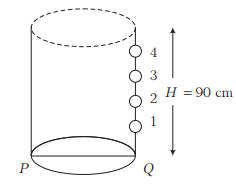
Example 5: A cylindrical vessel of 90 cm height is kept filled with water upto the rim. It has four holes \(1,2,3,4\) which are respectively at heights of \(10 \mathrm{~cm}, 20 \mathrm{~cm}, 45 \mathrm{~cm}\) and 50 cm from the horizontal floor \(P Q\). Through which of the holes water is falling at the maximum horizontal distance?
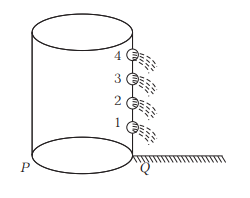
Solution: To find the hole through which water falls at the maximum horizontal distance, we use the principles of Torricelli’s Theorem and Projectile Motion.
Step 1: The Formula for Horizontal Range
Consider a cylindrical vessel of total height \(H\) filled with water. If a hole is made at a height \(h\) from the ground (the bottom of the vessel), the depth of the hole from the top water surface is \((H-h)\).
Velocity of efflux (\(v\)): According to Torricelli’s law, \(v=\sqrt{2 g(H-h)}\).
Time of flight \((t)\) : The time it takes for water to reach the ground from height \(h\) is \(t= \sqrt{\frac{2 h}{g}}\).
Horizontal Range \((R)\) : The distance is calculated as \(R=v \times t\).
\(
R=\sqrt{2 g(H-h)} \times \sqrt{\frac{2 h}{g}}=2 \sqrt{h(H-h)}
\)
Step 2: Condition for Maximum Range
The term inside the square root, \(f(h)=h(H-h)\), represents a parabola that opens downward. To find the maximum value, we can use the midpoint of its roots (\(h=0\) and \(h=H\)):
\(
h_{\max }=\frac{H}{2}
\)
In other words, the horizontal range is maximum when the hole is exactly at the halfway point of the total height of the water column.
Step 3: Calculation for the Given Problem
Total Height \((H): 90 \mathrm{~cm}\)
Optimal Height for Max Range: \(H / 2=90 / 2=45 \mathrm{~cm}\)
Analyzing the given holes:
Hole 1: 10 cm from floor
Hole 2: 20 cm from floor
Hole 3:45 cm from floor
Hole 4:50 cm from floor
Conclusion:
Since Hole 3 is located at 45 cm , which is exactly half the total height of the vessel (\(H / 2\)), water falling from this hole will reach the maximum horizontal distance.
Interestingly, holes equidistant from the center (like one at 40 cm and one at 50 cm ) would result in the same horizontal range, but the center hole always travels the furthest.
Example 6: A tank is filled with a liquid upto a height \(H\). A small hole is made at the bottom of this tank. Let \(t_1\) be the time taken to empty first half of the tank and \(t_2\) the time taken to empty rest half of the tank. Then, find the value of \(\frac{t_1}{t_2}\).
Solution: To find the ratio of the times \(t_1\) and \(t_2\), we need to determine how the height of the liquid changes over time as it drains through a small hole at the bottom.
Step 1: The Physics of Draining
According to Torricelli’s Law, the velocity of efflux \(v\) from a hole at the bottom when the liquid height is \(h\) is:
\(
v=\sqrt{2 g h}
\)
If the area of the tank is \(\boldsymbol{A}\) and the area of the hole is \(\boldsymbol{a}\), the rate of change of volume is:
\(
\boldsymbol{A}\left(-\frac{d h}{d t}\right)=a \sqrt{2 g h}
\)
Rearranging to solve for \(d t\) :
\(
d t=-\frac{A}{a \sqrt{2 g}} \frac{d h}{\sqrt{h}}
\)
Step 2: Calculating the Time Intervals
To find the total time \(t\) taken for the liquid level to fall from \(h_1\) to \(h_2\), we integrate:
\(
\begin{gathered}
t=-\int_{h_1}^{h_2} \frac{A}{a \sqrt{2 g}} h^{-1 / 2} d h=\frac{A}{a \sqrt{2 g}}[2 \sqrt{h}]_{h_2}^{h_1} \\
t=\frac{2 A}{a \sqrt{2 g}}\left(\sqrt{h_1}-\sqrt{h_2}\right)
\end{gathered}
\)
Let \(K=\frac{2 A}{a \sqrt{2 g}}\) (a constant). The formula simplifies to:
\(
t=K\left(\sqrt{h_{\text {initial }}}-\sqrt{h_{\text {final }}}\right)
\)
Step 3: Finding \(\boldsymbol{t}_{\mathbf{1}}\) and \(\boldsymbol{t}_{\mathbf{2}}\)
The tank starts at height \(H\).
For the first half (\(t_1\)): The height changes from \(\boldsymbol{H}\) to \(\boldsymbol{H} / \mathbf{2}\).
\(
t_1=K\left(\sqrt{H}-\sqrt{\frac{H}{2}}\right)
\)
For the second half (\(t_2\)): The height changes from \(H / 2\) to 0.
\(
t_2=K\left(\sqrt{\frac{H}{2}}-\sqrt{0}\right)=K \sqrt{\frac{H}{2}}
\)
Step 4: Calculating the Ratio \(\frac{t_1}{t_2}\)
Divide the two expressions:
\(
\begin{gathered}
\frac{t_1}{t_2}=\frac{K\left(\sqrt{H}-\sqrt{\frac{H}{2}}\right)}{K \sqrt{\frac{H}{2}}} \\
\frac{t_1}{t_2}=\frac{\sqrt{H}-\frac{\sqrt{H}}{\sqrt{2}}}{\frac{\sqrt{H}}{\sqrt{2}}}
\end{gathered}
\)
Cancel \(\sqrt{H}\) from the numerator and denominator:
\(
\frac{t_1}{t_2}=\frac{1-\frac{1}{\sqrt{2}}}{\frac{1}{\sqrt{2}}}
\)
Multiply the top and bottom by \(\sqrt{2}\) :
\(
\frac{t_1}{t_2}=\sqrt{2}-1
\)
Conclusion: The ratio of the time taken to empty the first half to the second half is:
\(
\frac{t_1}{t_2}=\sqrt{2}-1 \approx 0.414
\)
This shows that \(t_2\) is significantly longer than \(t_1\). As the height decreases, the pressure at the bottom drops, which slows down the exit velocity, causing the “empty” half of the tank to take more time to drain.