1.5 Dimensional formulae and dimensional equations
Dimensional formula and dimensional equation
The expression of a physical quantity in terms of its dimensions is called its dimensional formula. e.g. Dimensional formula for density is \(\left[\mathrm{ML}^{-3} \mathrm{~T}^0\right]\), the dimensional formula of force is \(\left[\mathrm{MLT}^{-2}\right]\) and that for acceleration is \(\left[\mathrm{M}^0 \mathrm{LT}^{-2}\right]\).
An equation which contains a physical quantity on one side and its dimensional formula on the other side, is called the dimensional equation of that quantity.
Dimensional equations for a few physical quantities are given below
\(
\begin{array}{ll}
\text { Speed } & {[v]=\left[\mathrm{M}^0 \mathrm{LT}^{-1}\right]} \\
\text { Area } & {[A]=\left[\mathrm{M}^0 \mathrm{~L}^2 \mathrm{~T}^0\right]} \\
\text { Force } & {[F]=\left[\mathrm{MLT}^{-2}\right], \text { etc. }}
\end{array}
\)
The physical quantities having same derived units have same dimensions.
Example 1: Calculate the dimensional formula of energy from the equation \(E=\frac{1}{2} m v^2\).
Solution: Dimensionally, \(E=\) mass × \((\text { velocity })^2\), since \(\frac{1}{2}\) is a number and has no dimension.
\(
\therefore \quad[E]=\mathrm{M} \times\left(\frac{\mathrm{L}}{\mathrm{~T}}\right)^2=\mathrm{ML}^2 \mathrm{~T}^{-2}
\)
Important dimensions and units
| Physical Quantity | Dimension | SI Unit |
| Force (F) | \(\left[M^{1} L^{1} T^{-2}\right]\) | Newton |
| Work (W) | \(\left[M^{1} L^{2} T^{-2}\right]\) | joule |
| Power (P) | \(\left[M^{1} L^{2} T^{-3}\right]\) | Watt |
| Gravitational constant (G) | \(\left[M^{-1} L^{3} T^{-2}\right]\) | \(N-m^{2} / k g^{2}\) |
| Angular velocity (ω) | \(\left[T^{-1}\right]\) | radian/s |
| Angular momentum (L) | \(\left[M^{1} L^{2} T^{-1}\right]\) | \(\mathrm{kg}-\mathrm{m}^{2} / \mathrm{s}\) |
| Moment of Inertia (I) | \(\left[M^{1} L^{2}\right]\) | \(\mathrm{kg}-\mathrm{m}^{2}\) |
| Torque \((\tau)\) | \(\left[M^{1} L^{2} T^{-2}\right]\) | N-m |
| Young’s modulus (Υ) | \(\left[M^{1} L^{-1} T^{-2}\right]\) | \(\mathrm{N} / \mathrm{m}^{2}\) |
| Surface Tension (S) | \(\left[M^{1} T^{-2}\right]\) | N/m |
| Co-efficient of Viscocity (η) | \(\left[M^{1} L^{-1} T^{-1}\right]\) | \(\mathrm{N}-\mathrm{s} / \mathrm{m}^{2}\) |
| Pressure (P) | \(\left[M^{1} L^{-1} T^{-2}\right]\) | \(\mathrm{N} / \mathrm{m}^{2}\) (Pascal) |
| Electric Field (E) | \(\left[M^{1} L^{1} I^{-1} T^{-3}\right]\) | V/m |
| Electrical Potential (V) | \(\left[M^{1} L^{2} I^{-1} T^{-3}\right]\) | volt |
| Electric Flux (Ψ) | \(\left[M^{1} T^{3} I^{-1} L^{-3}\right]\) | volt/m |
| Capacitance (C) | \(\left[I^{2} T^{4} M^{-1} L^{-2}\right]\) | farad (F) |
| Permittivity (ε) | \(\left[I^{2} T^{4} M^{-1} L^{-3}\right]\) | \(C^{2} / N-m^{2}\) |
| Permeability (µ) | \(\left[M^{1} L^{1} I^{-2} T^{-3}\right]\) | Newton/A \({ }^{2}\) |
| Magnetic Dipole moment (M) | \(\left[I^{1} L^{2}\right]\) | N-m/T |
| Magnetic Fux (Φ) | \(\left[M^{1} L^{2} I^{-1} T^{-2}\right]\) | Weber (Wb) |
| Magnetic Field (B) | \(\left[M^{1} I^{-1} T^{-2}\right]\) | tesla |
| Inductance (L) | \(\left[M^{1} L^{2} I^{-2} T^{-2}\right]\) | henry |
| Resistance (R) | \(\left[M^{1} L^{2} I^{-2} T^{-3}\right]\) | ohm (Ω) |
| Intensity of wave (I) | \(\left[M^{1} T^{-3}\right]\) | watt \(/ m^{2}\) |
| Specific heat capacity (c) | \(\left[L^{2} T^{-2} K^{-1}\right]\) | \(\mathrm{J} / \mathrm{kg}-\mathrm{K}\) |
| Stephan’s Constant (σ) | \(\left[M^{1} T^{-3} K^{-4}\right]\) | watt \(/ m^{2}-k^{4}\) |
| Electric dipole moment (p) | \(\left[L^{1} I^{1} T^{1}\right]\) | C-m |
| Thermal conductivity (k) | \(\left[M^{1} L^{1} T^{-3} K^{-1}\right]\) | watt \(/ m-k\) |
| Current Density (j) | \(\left[I^{1} L^{-2}\right]\) | ampere \(/ \mathrm{m}^{2}\) |
| Electrical conductivity (σ) | \(\left[I^{2} T^{3} M^{-1} L^{-3}\right]\) | \(\Omega^{-1} m^{-1}\) |
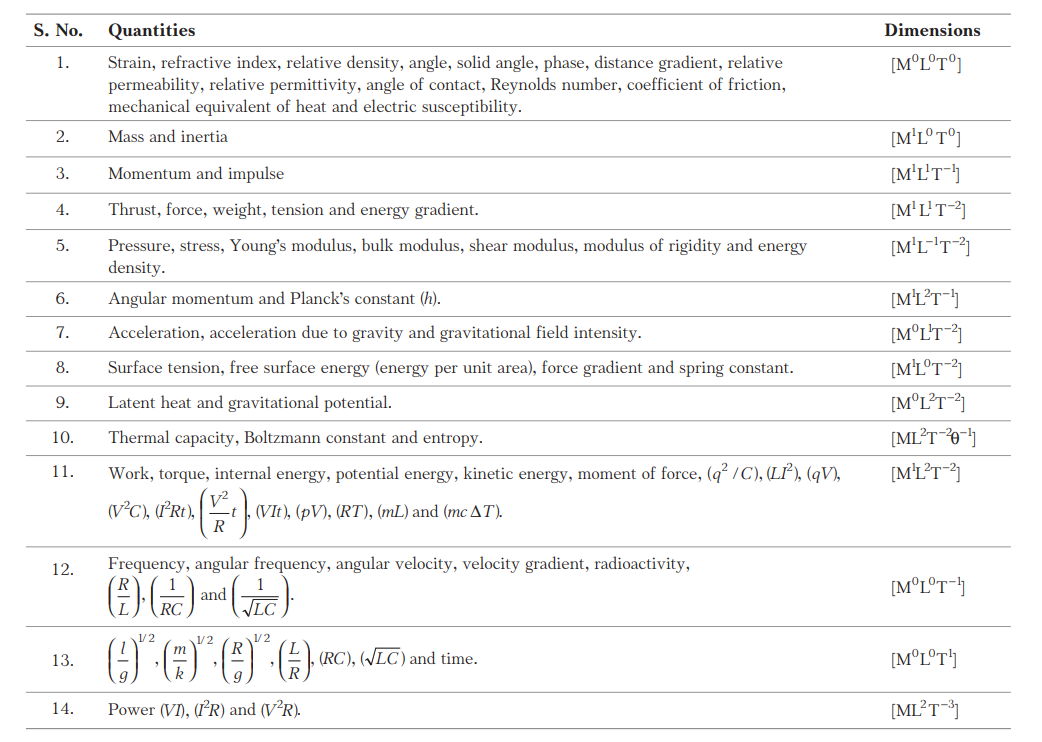
Quantities having same dimensions
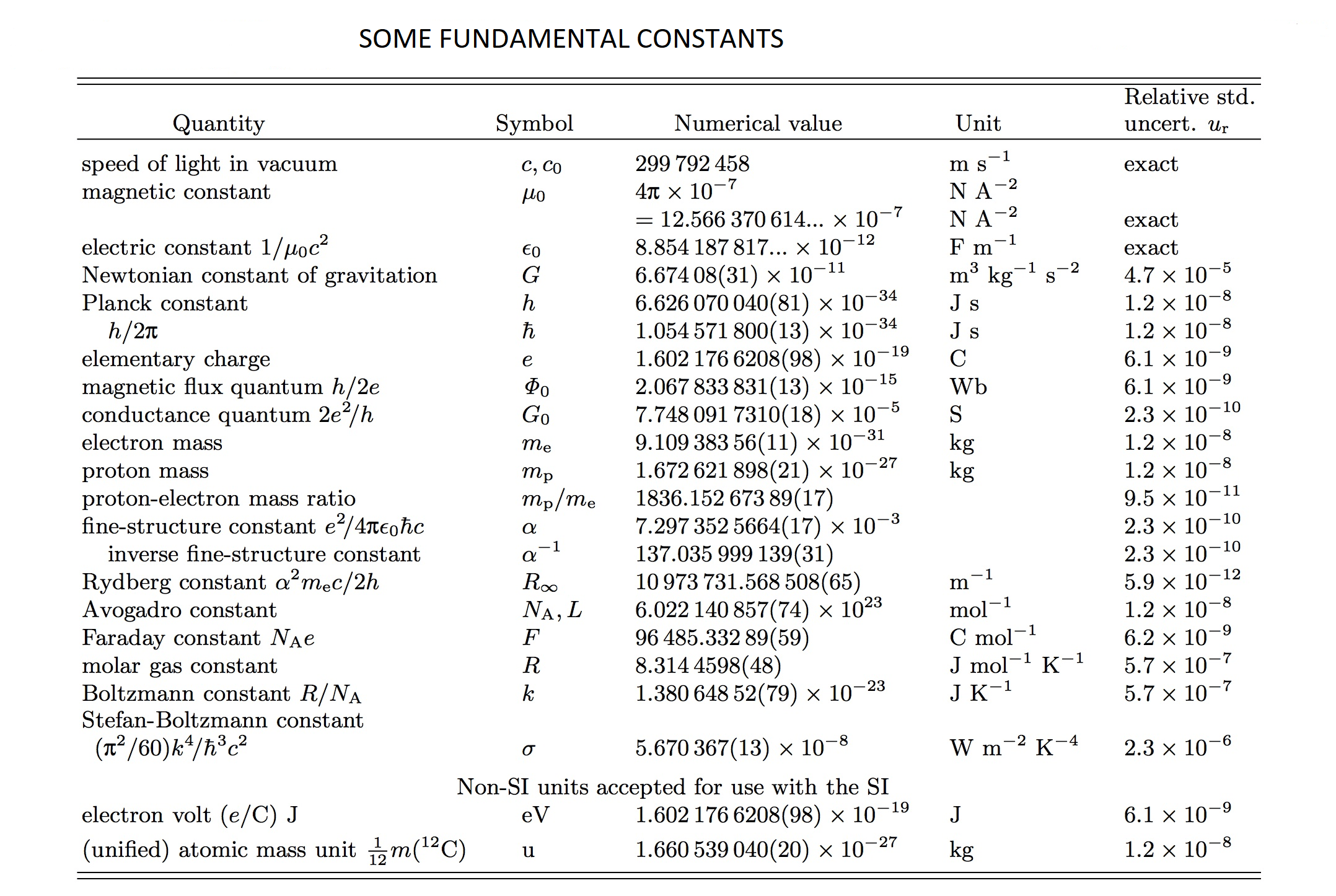
Some Fundamental Constants
Example 2: Find the dimensional formulae of
(i) coefficient of viscosity, \(\eta\)
(ii) charge, \(q\)
(iii) potential, \(V\)
(iv) capacitance, \(C\) and
(v) resistance, \(R\)
Some of the equations containing above quantities are
\(
\begin{aligned}
F & =-\eta A\left(\frac{\Delta v}{\Delta l}\right), & & q=I t, \quad U=V I t, \\
q & =C V \quad \text { and } & & V=I R
\end{aligned}
\)
where, \(A\) is the area, \(v\) is the velocity, \(l\) is the length, \(I\) is the electric current, \(t\) is the time and \(U\) is the energy.
Solution: (i)
\(
\begin{aligned}
\eta & =-\frac{F}{A} \frac{\Delta l}{\Delta v} \\
\therefore[\eta] & =\frac{[F][l]}{[A][v]}=\frac{\left[\mathrm{MLT}^{-2}\right][\mathrm{L}]}{\left[\mathrm{L}^2\right]\left[\mathrm{LT}^{-1}\right]}=\left[\mathrm{ML}^{-1} \mathrm{~T}^{-1}\right] \\
\end{aligned}
\)
(ii)
\(
\begin{aligned}
q & =I t \\
\therefore[q] & =[I][t]=[\mathrm{AT}]
\end{aligned}
\)
(iii)
\(
\begin{aligned}
& U =V I t \\
\therefore & V =\frac{U}{I t} \\
\text { or } & V] =\frac{[U]}{[I][t]}=\frac{\left[\mathrm{ML}^2 \mathrm{~T}^{-2}\right]}{[\mathrm{A}][\mathrm{T}]}=\left[\mathrm{ML}^2 \mathrm{~T}^{-3} \mathrm{~A}^{-1}\right]
\end{aligned}
\)
(iv)
\(
\begin{aligned}
q & =C V \\
\therefore \quad C & =\frac{q}{V} \\
\text { or } \quad[C] & =\frac{[q]}{V]}=\frac{[\mathrm{AT}]}{\left[\mathrm{ML}^2 \mathrm{~T}^{-3} \mathrm{~A}^{-1}\right]}=\left[\mathrm{M}^{-1} \mathrm{~L}^{-2} \mathrm{~T}^4 \mathrm{~A}^2\right]
\end{aligned}
\)
(v)
\(
\begin{aligned}
& V=I R \\
& \therefore \quad R=\frac{V}{I} \\
& \text { or }[R]=\frac{[V]}{[I]}=\frac{\left[\mathrm{ML}^2 \mathrm{~T}^{-3} \mathrm{~A}^{-1}\right]}{[\mathrm{A}]}=\left[\mathrm{ML}^2 \mathrm{~T}^{-3} \mathrm{~A}^{-2}\right]
\end{aligned}
\)
Example 3: If \(C\) and \(R\) denote capacitance and resistance, then find the dimensions of \(C R\).
Solution: The capacitance of a conductor is defined as the ratio of the charge given to the rise in the potential of the conductor,
\(
\begin{array}{rlr}
C & =\frac{q}{V}=\frac{q^2}{W} & \left(\because V=\frac{W}{q}\right) \\
C & =\frac{\text { ampere }^2-\mathrm{s}^2}{\text { kg- metre }^2 / \mathrm{s}^2} &
\end{array}
\)
Hence, dimensions of \(C\) are \(\left[\mathrm{M}^{-1} \mathrm{~L}^{-2} \mathrm{~T}^4 \mathrm{~A}^2\right]\).
From Ohm’s law, \(V=i R\), therefore dimensions of resistance,
\(
\begin{aligned}
R= & \frac{V}{i}=\frac{\text { Volt }}{\text { Ampere }} \\
& =\mathrm{kg}-\text { metre }^2 \mathrm{~s}^{-3} \text { ampere }^{-2}
\end{aligned}
\)
Dimensions of \(R=\left[\mathrm{ML}^2 \mathrm{~T}^{-3} \mathrm{~A}^{-2}\right]\)
\(
\begin{aligned}
\therefore \text { Dimensions of } R C & =\left[\mathrm{ML}^2 \mathrm{~T}^{-3} \mathrm{~A}^{-2}\right]\left[\mathrm{M}^{-1} \mathrm{~L}^{-2} \mathrm{~T}^4 \mathrm{~A}^2\right] \\
& =\left[\mathrm{M}^0 \mathrm{~L}^0 \mathrm{TA}^0\right]
\end{aligned}
\)
Example 4: Which amongst the following quantities is (are) dimensionless?
(i) \(\frac{\text { Work }}{\text { Energy }}\)
(ii) \(\sin \theta\)
(iii) \(\frac{\text { Momentum }}{\text { Time }}\)
Solution: (i) Since, work and energy both have the same dimensions [ \(\mathrm{ML}^2 \mathrm{~T}^{-2}\) ], therefore their ratio is a dimensionless quantity.
(ii) \(\sin \theta\), here \(\theta\) represents an angle. An angle is the ratio of two lengths, i.e. arc length and radius. Therefore, \(\theta\) is dimensionless, hence \(\sin \theta\) is dimensionless.
(iii) \(\left[\frac{\text { Momentum }}{\text { Time }}\right]=\left[\frac{\mathrm{MLT}^{-1}}{\mathrm{~T}}\right]=\left[\mathrm{MLT}^{-2}\right]\)
Hence, the given ratio is not dimensionless.
Example 5: In the formula \(x=3 y z^2, x\) and \(y\) have dimensions of capacitance and magnetic induction respectively, then find the dimensions of \(y\).
Solution: Given, \(x=3 y z^2\)
\(
\Rightarrow \quad \begin{aligned}
y & =\frac{x}{3 z^2}=\frac{\text { Capacitance }}{(\text { Magnetic induction })^2} \\
{[y] } & =\frac{\left[\mathrm{M}^{-1} \mathrm{~L}^{-2} \mathrm{~T}^4 \mathrm{~A}^2\right]}{\left[\mathrm{M} \mathrm{~T}^{-2} \mathrm{~A}^{-1}\right]^2} \\
& =\left[\mathrm{M}^{-3} \mathrm{~L}^{-2} \mathrm{~T}^8 \mathrm{~A}^4\right]
\end{aligned}
\)