2.6 Kinematic equations for uniformly accelerated motion
Uniform Motion
As we have discussed earlier also, in uniform motion velocity of the particle is constant and acceleration is zero. Velocity is constant means its magnitude (called speed) is constant and direction is fixed. Therefore, motion is 1-D in same direction. If velocity is along positive direction, then displacement is also along positive direction. Therefore, distance travelled ( \(d\) ) is equal to the displacement \((s)\). If velocity is along negative direction then displacement is also negative and distance travelled in this case is the magnitude of displacement. Equations involved in this motion are
- Velocity (may be positive or negative) \(=\) constant
- Speed, \(v=\) constant
- Acceleration \(=0\)
- Displacement (may be positive or negative) \(=\) velocity \(\times\) time
- Distance \(=\) speed \(\times\) time or \(d=v t\)
- Distance and speed are always positive, whereas displacement and velocity may be positive or negative.
Kinematic Equations For Uniformly Accelerated Motion
When a body is moving along a straight line with uniform acceleration, then its motion is called uniformly accelerated motion. For this motion, we can establish the relation between velocity, acceleration and the distance travelled by the body in a particular time interval by a set of equations. These equations are known as kinematic equations or equations of motion. The three equations of motion on a straight line are
- \(v=u+a t\)
- \(s=u t+\frac{1}{2} a t^2\)
- \(v^2-u^2=2 a s\)
where, \(u\) is the initial velocity of the body, \(a\) is the uniform acceleration of the body, \(v\) is the final velocity of the body after \(t\) second and \(s\) is the distance travelled in this time.
Derive \(v=u+a t\) Using calculus
The definition of acceleration is the rate of change of velocity with respect to time.
\(
a=\frac{d v}{d t}
\)
Rearranging this to solve for \(d v\) gives:
\(
d v=a d t
\)
Next, integrate both sides. At time \(\boldsymbol{t}=0\), the velocity is \(\boldsymbol{u}\). At time \(\boldsymbol{t}\), the velocity is \(\boldsymbol{v}\).
\(
\int_u^v d v=\int_0^t a d t
\)
Since acceleration \(\boldsymbol{a}\) is constant, it can be taken out of the integral on the right side:
\(
\int_u^v d v=a \int_0^t d t
\)
Evaluating the integrals:
\(
\begin{gathered}
{[v]_u^v=a[t]_0^t} \\
v-u=a(t-0) \\
v-u=a t
\end{gathered}
\)
Rearranging the terms, we get the first equation of motion:
\(
v=u+a t \dots(1)
\)
Derive \(s=u t+\frac{1}{2} a t^2\) Using Calculus
The definition of velocity is the rate of change of displacement with respect to time.
\(
v=\frac{d s}{d t}
\)
From the first equation, we know that \(v=u+a t\). Substitute this expression for \(v\) :
\(
\frac{d s}{d t}=u+a t
\)
Rearranging to solve for \(d s\) :
\(
d s=(u+a t) d t
\)
Next, integrate both sides. At time \(\boldsymbol{t}=0\), the displacement is \(s=0\) (assuming the object starts at the origin). At time \(\boldsymbol{t}\), the displacement is \(\boldsymbol{s}\).
\(
\int_0^s d s=\int_0^t(u+a t) d t
\)
Split the integral on the right side and evaluate:
\(
\begin{gathered}
{[s]_0^s=\int_0^t u d t+\int_0^t a t d t} \\
s-0=u[t]_0^t+a\left[\frac{1}{2} t^2\right]_0^t \\
s=u(t-0)+\frac{1}{2} a\left(t^2-0^2\right) \\
s=u t+\frac{1}{2} a t^2 \dots(2)
\end{gathered}
\)
Derive \(v^2-u^2=2 a s\)
From Eqn(1), We get \(v=u+a t\)
\(
\begin{aligned}
v^2 & =(u+a t)^2 \\
& =u^2+2 u a t+a^2 t^2 \\
& =u^2+2 a\left(u t+\frac{1}{2} a t^2\right) \\
& =u^2+2 a s
\end{aligned}
\)
\(
v^2=u^2+2 a s
\)
Example 1: Show that displacement by a body in \(n\)th second is \(s_n=u+\frac{1}{2} a(2 n-1)\)
Solution: Find the displacement of the body in \(n\) seconds:
The position of the body under uniform acceleration is given by the kinematic equation:
\(
S=u t+\frac{1}{2} a t^2
\)
The position of the body in \(\boldsymbol{n}\) seconds, we set \(\boldsymbol{t}=\boldsymbol{n}\) :
\(
S_n=u n+\frac{1}{2} a n^2
\)
The position of the body in ( \(n-1\) ) seconds:
Similarly, the position of the body in ( \(n-1\) ) seconds, we set \(t=(n-1)\) :
\(
S_{n-1}=u(n-1)+\frac{1}{2} a(n-1)^2
\)
Expanding this equation, we get:
\(
\begin{gathered}
S_{n-1}=u n-u+\frac{1}{2} a\left(n^2-2 n+1\right) \\
S_{n-1}=u n-u+\frac{1}{2} a n^2-\frac{1}{2} a(2 n)+\frac{1}{2} a \\
S_{n-1}=u n-u+\frac{1}{2} a n^2-a n+\frac{1}{2} a
\end{gathered}
\)
Displacement by the body in \(n\)th second is \(s_n=S_n-S_{n-1}\)
\(
s_n=\left(u n+\frac{1}{2} a n^2\right)-\left(u n-u+\frac{1}{2} a n^2-a n+\frac{1}{2} a\right)
\)
\(
s_n=u+a n-\frac{1}{2} a
\)
\(
\begin{aligned}
& s_n=u+a\left(\frac{2 n}{2}-\frac{1}{2}\right) \\
& s_n=u+a\left(\frac{2 n-1}{2}\right) \\
& s_n=u+\frac{1}{2} a(2 n-1)
\end{aligned}
\)
Remarks
- If initial position of a particle is \(\mathrm{r}_\alpha\) then position at time \(t\) can be written as
\(
r=r_0+s=r_0+u t+\frac{1}{2} a t^2
\) - Stopping distance: When brakes are applied to a moving vehicle, the distance it travels before stopping is called stopping distance. It is an important factor for road safety. It is given by
\(
v^2=u^2+2 a s
\)
When the vehicle stops, its final velocity \((v)\) is 0 . The equation becomes: \(0^2=u^2+2 a s\).
\(
s=\frac{-u^2}{2 a}
\)
Since \(a\) is deceleration (a negative value), the negative signs cancel out, resulting in a positive stopping distance. This can also be expressed as
\(
s=\frac{u^2}{2 a}
\)
where, \(u\) is initial velocity and \(a\) is the retardation produced by brakes. - Distance travelled by a body in \(n\)th second, \(s_n=u+\frac{1}{2} a(2 n-1)\)
Key points regarding kinematic equations
Following are the important points in case of one dimensional motion with constant acceleration
- If the motion starts from rest, then initial velocity is taken as zero, i.e. \(u=0\).
- If the object comes to rest after the motion, then final velocity is taken as zero, i.e. \(v=0\).
- If velocity of moving object increases with time, then acceleration is taken as positive and if velocity decreases with time, acceleration is taken as negative.
- If velocity and acceleration both have same sign like \(v>0 ; a>0\) or \(v<0 ; a<0\), then object is speeding up. Similarly, if velocity and acceleration both have opposite sign like \(v<0 ; a>0\) or \(v>0 ; a<0\). Then, the object is speeding down.
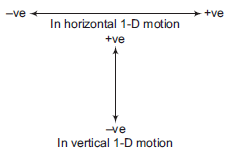
- For motion of an object along a straight line, normally we take vertically upward direction positive (and downward negative) and horizontally rightwards positive (or leftwards negative). Sign convention for (a) motion in vertical direction (b) motion in horizontal direction is shown in figure.
Example 2: A particle starts with an initial velocity \(2.5 \mathrm{~m} / \mathrm{s}\) along the positive \(x\) direction and it accelerates uniformly at the rate \(0.50 \mathrm{~m} / \mathrm{s}^2\). (a) Find the distance travelled by it in the first two seconds. (b) How much time does it take to reach the velocity \(7.5 \mathrm{~m} / \mathrm{s}\)? (c) How much distance will it cover in reaching the velocity \(7.5 \mathrm{~m} / \mathrm{s}\)?
Solution: (a) We have,
\(
\begin{aligned}
x & =u t+\frac{1}{2} a t^2 \\
& =(2.5 \mathrm{~m} / \mathrm{s})(2 \mathrm{~s})+\frac{1}{2}\left(0.50 \mathrm{~m} / \mathrm{s}^2\right)(2 \mathrm{~s})^2 \\
& =5.0 \mathrm{~m}+1.0 \mathrm{~m}=6.0 \mathrm{~m}
\end{aligned}
\)
Since the particle does not turn back it is also the distance travelled.
(b) We have,
\(
v=u+a t
\)
or, \(7.5 \mathrm{~m} / \mathrm{s}=2.5 \mathrm{~m} / \mathrm{s}+\left(0.50 \mathrm{~m} / \mathrm{s}^2\right) t\)
or, \(t=\frac{7.5 \mathrm{~m} / \mathrm{s}-2.5 \mathrm{~m} / \mathrm{s}}{0.50 \mathrm{~m} / \mathrm{s}^2}=10 \mathrm{~s}\)
(c) We have,
\(
v^2=u^2+2 a x
\)
or, \((7.5 \mathrm{~m} / \mathrm{s})^2=(2.5 \mathrm{~m} / \mathrm{s})^2+2\left(0.50 \mathrm{~m} / \mathrm{s}^2\right) x\)
or, \(x=\frac{(7.5 \mathrm{~m} / \mathrm{s})^2-(2.5 \mathrm{~m} / \mathrm{s})^2}{2 \times 0.50 \mathrm{~m} / \mathrm{s}^2}=50 \mathrm{~m}\)
Example 3: A particle having initial velocity \(u\) moves with a constant acceleration a for a time \(t\). (a) Find the displacement of the particle in the last 1 second. (b) Evaluate it for \(u=5 \mathrm{~m} / \mathrm{s}, a=2 \mathrm{~m} / \mathrm{s}^2\) and \(t=10 \mathrm{~s}\).
Solution: (a) Step 1: Determine the displacement in the last second
The displacement of a particle with constant acceleration is given by the kinematic equation \(s=u t+\frac{1}{2} a t^2\).
To find the displacement in the last 1 second, we can subtract the displacement at time \((t-1)\) from the total displacement at time \(t\).
The displacement at time \(\boldsymbol{t}\) is:
\(
s_t=u t+\frac{1}{2} a t^2
\)
The displacement at time ( \(t-1\) ) is:
\(
\begin{gathered}
s_{t-1}=u(t-1)+\frac{1}{2} a(t-1)^2 \\
s_{t-1}=u t-u+\frac{1}{2} a\left(t^2-2 t+1\right) \\
s_{t-1}=u t-u+\frac{1}{2} a t^2-a t+\frac{1}{2} a
\end{gathered}
\)
The displacement in the last second, \(\Delta s\), is the difference between these two displacements:
\(
\begin{gathered}
\Delta s=s_t-s_{t-1} \\
\Delta s=\left(u t+\frac{1}{2} a t^2\right)-\left(u t-u+\frac{1}{2} a t^2-a t+\frac{1}{2} a\right) \\
\Delta s=u t+\frac{1}{2} a t^2-u t+u-\frac{1}{2} a t^2+a t-\frac{1}{2} a \\
\Delta s=u+a t-\frac{1}{2} a=u+\frac{a}{2}(2 t-1)
\end{gathered}
\)
(b) Step 2: Evaluate the displacement for the given values
Using the formula derived in Step 1, substitute the given values:
Initial velocity, \(u=5 \mathrm{~m} / \mathrm{s}\)
Acceleration, \(a=2 \mathrm{~m} / \mathrm{s}^2\)
Time, \(t=10 \mathrm{~s}\)
Substitute these values into the equation:
\(
\begin{gathered}
\Delta s=u+a t-\frac{1}{2} a \\
\Delta s=5+(2)(10)-\frac{1}{2}(2) \\
\Delta s=5+20-1 \\
\Delta s=24 ~m
\end{gathered}
\)
Note: Displacement in the “\(t\)-th second” is \(s_t=u+\frac{a}{2}(2 t-1)\)
Example 4: Two cars start off a race with velocities \(2 \mathrm{~ms}^{-1}\) and \(4 \mathrm{~ms}^{-1}\) travel in straight line with uniform accelerations \(2 \mathrm{~ms}^{-2}\) and \(1 \mathrm{~ms}^{-2}\), respectively. What is the length of the path, if they reach the final point at the same time?
Solution: Let both cars reach at same position in same time \(t\), then
from \(s=u t+\frac{1}{2} a t^2\)
For 1st car, \(s=4(t)+\frac{1}{2}(1) t^2=4 t+\frac{t^2}{2} \dots(i)\)
For 2nd car, \(s=2(t)+\frac{1}{2}(2) t^2=2 t+t^2\)
Equating above equations, we get
\(
4 t+\frac{t^2}{2}=2 t+t^2 \Rightarrow t=4 \mathrm{~s}
\)
Substituting the value of \(t\) in Eq. (i), we get
\(
s=4(4)+\frac{1}{2}(1)(4)^2=16+8=24 \mathrm{~m}
\)
Example 5: A car was moving at a rate of \(18 k m h^{-1}\).
When the brakes were applied, it comes to rest at a distance of 100 m . Calculate the retardation produced by the brakes.
Solution: Given, \(v=0, u=18 \mathrm{kmh}^{-1}=5 \mathrm{~ms}^{-1}, s=100 \mathrm{~m}\)
Using the equation of motion,
\(
\begin{aligned}
& & v^2-u^2 & =2 a s \dots(i) \\
\Rightarrow & & -u^2 & =2 a s \quad (\because v=0)\\
\Rightarrow & & a & =-\frac{u^2}{2 s} \\
\Rightarrow & & a & =\frac{-5 \times 5}{2 \times 100}=-\frac{1}{8}=-0.125 \mathrm{~ms}^{-2}
\end{aligned}
\)
So, the retardation produced by the brakes is \(0.125 \mathrm{~ms}^{-2}\).
Example 6: Two car travelling towards each other on a straight road at velocity \(10 \mathrm{~ms}^{-1}\) and \(12 \mathrm{~ms}^{-1}\), respectively. When they are \(150 m\) apart, both the drivers apply their brakes and each car decelerates at \(2 \mathrm{~ms}^{-2}\) until it stops. How far apart will they be when both of them come to rest?
Solution: Let \(x_1\) and \(x_2\) be the distance travelled by the car before they stop under deceleration.
From third equation of motion,
\(
\begin{array}{ll}
& v^2=u^2+2 a s \\
\Rightarrow & 0=(10)^2-2 \times 2 x_1 \Rightarrow x_1=25 \mathrm{~m} \\
\text { and } & 0=(12)^2-2 \times 2 x_2 \Rightarrow x_2=36 \mathrm{~m}
\end{array}
\)
Total distance covered by the two cars
\(
=x_1+x_2=25+36=61 \mathrm{~m}
\)
Distance between the two cars when they stop
\(
=150-61=89 \mathrm{~m}
\)
Example 7: A train travelling at \(20 \mathrm{kmh}^{-1}\) is approaching a platform. A bird is sitting on a pole on the platform. When the train is at a distance of 2 km from pole, brakes are applied which produce a uniform deceleration in it. At that instant, the bird flies towards the train at \(60 \mathrm{kmh}^{-1}\) and after touching the nearest point on the train flies back to the pole and then flies towards the train and continues repeating itself. Calculate how much distance the bird covers before the train stops?
Solution: For retardation of train, \(v^2=u^2+2 a s\)
\(
\begin{array}{ll}
\Rightarrow & 0=(20)^2+2(a)(2) \\
\Rightarrow & a=-100 \mathrm{kmh}^{-2}
\end{array}
\)
Time required to stop the train, \(v=u+at\)
\(
\Rightarrow \quad 0=20-100 t \Rightarrow t=\frac{1}{5} \mathrm{~h}
\)
For bird, speed \(=\frac{\text { distance }}{\text { time }}\)
\(
\Rightarrow \quad s_B=v_B \times t=60 \times \frac{1}{5}=12 \mathrm{~km}
\)
Example 8: In a car race, car \(A\) takes a time \(t\) less than car \(B\) at the finish point and passes the finishing point with speed \(v\) more than that of the car B. Assuming that both the cars starts from rest and travel with constant acceleration \(a_1\) and \(a_2\), respectively. Show that \(v=\sqrt{a_1 a_2} t\).
Solution: Let \(A\) takes \(t_1\) second, then according to the given problem \(B\) will take ( \(t_1+t\) ) seconds. Further, let \(v_1\) be the velocity of \(B\) at finishing point, then velocity of \(A\) will be \(\left(v_1+v\right)\). Writing equations of motion for \(A\) and \(B\),
\(
\begin{aligned}
v_1+v & =a_1 t_1 \dots(i) \\
v_1 & =a_2\left(t_1+t\right) \dots(ii)
\end{aligned}
\)
From these two equations, we get
\(
v=\left(a_1-a_2\right) t_1-a_2 t \dots(iii)
\)
Total distance travelled by both the cars is equal.
or \(s_A=s_B\)
or \(\frac{1}{2} a_1 t_1^2=\frac{1}{2} a_2\left(t_1+t\right)^2\)
or \(t_1=\frac{\sqrt{a_2} t}{\sqrt{a_1}-\sqrt{a_2}}\)
Substituting this value of \(t_1\) in Eq. (iii), we get
\(
v=\left(\sqrt{a_1 a_2}\right) t
\)
Example 9: A body starting from rest has an acceleration of \(4 \mathrm{~ms}^{-2}\). Calculate distance travelled by it in 5th second.
Solution: Given, \(u=0, a=4 \mathrm{~ms}^{-2}\)
Distance travelled by the body in 5th second is
\(
\begin{aligned}
s_n & =u+\frac{1}{2} a(2 n-1) \\
s_5 & =0+\frac{1}{2} \times 4(2 \times 5-1) \\
& =\frac{1}{2} \times 4(9)=\frac{36}{2}=18 \mathrm{~m}
\end{aligned}
\)
Example 10: A particle starts from rest and moves under constant acceleration in a straight line. Find the ratio of displacement (i) in successive second and (ii) in successive time interval \(t_0\).
Solution: (i) Displacement in 1s or 1 st second,
\(
\begin{aligned}
& s_1=u t+\frac{1}{2} a t^2=0+\frac{1}{2} a(1)^2=\frac{1}{2} a \\
& s_1=u+\frac{1}{2} a(2 t-1)=0+\frac{1}{2} a(2 \times 1-1)=\frac{1}{2} a
\end{aligned}
\)
Displacement in the 2nd second,
\(
s_2=u+\frac{1}{2} a(2 t-1)=0+\frac{1}{2} a(2 \times 2-1)=\frac{3}{2} a
\)
Displacement in the 3rd second,
\(
\begin{gathered}
s_3=0+\frac{1}{2} a(2 \times 3-1)=\frac{5}{2} a \\
s_1: s_2: s_3: \ldots=\frac{1}{2} a: \frac{3}{2} a: \frac{5}{2} a: \ldots=1: 3: 5: \ldots
\end{gathered}
\)
(ii)

\(A\) to \(B\) : Displacement in the first \(t_0\) second,
\(
s=u t+\frac{1}{2} a t^2 \Rightarrow s_1=0+\frac{1}{2} a t_0^2=\frac{1}{2} a t_0^2
\)
\(A\) to \(C\),
\(
\begin{aligned}
t & =t_0+t_0=2 t_0 \\
s_1+s_2 & =0+\frac{1}{2} a\left(t_0+t_0\right)^2=2 a t_0^2
\end{aligned}
\)
Displacement in the next \(t_0\) second,
\(s_2=2 a t_0^2-s_1=2 a t_0^2-\frac{1}{2} a t_0^2\)
\(
s_2=\frac{3}{2} a t_0^2
\)
\(A\) to \(D\),
\(
\begin{aligned}
t & =t_0+t_0+t_0=3 t_0 \\
s_1+s_2+s_3 & =0+\frac{1}{2} a\left(t_0+t_0+t_0\right)^2=\frac{9}{2} a t_0^2
\end{aligned}
\)
Displacement in the next \(t_0\) second,
\(
s_3=\frac{5}{2} a t_0^2 \Rightarrow s_1: s_2: s_3=1: 3: 5
\)
Motion Under Gravity (Freely Falling Bodies)
The objects falling towards the earth under the influence of gravitational force alone, are called freely falling objects and such fall is called free fall.
Whenever an object falls towards the earth, an acceleration is involved, this acceleration is due to the earth’s gravitational pull and is called acceleration due to gravity. The value of acceleration due to gravity near the earth surface is \(9.8 \mathrm{~ms}^{-2}\). It is independent of the mass of freely falling objects and is denoted by \(g\).
Though the value of \(g\) is independent of freely falling mass, a feather falls much slowly than a coin when released from a height. This is due to the resistance offered by air to the falling mass. If both the bodies were released at the same time in vacuum (no air resistance), they would reach the earth surface within the same duration of time.
Equations for motion under gravity
When the objects fall under the influence of gravity, its motion is uniformly accelerated motion. Hence, equations of motion are applicable in this case also. Equation for motion under gravity are given below:
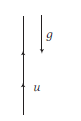
Case-I: If particle is thrown vertically upwards In this case, applicable kinematics relations are
\(
\begin{aligned}
v & =u-g t \dots(i) \\
h & =u t-\frac{1}{2} g t^2 \dots(ii) \\
v^2 & =u^2-2 g h \dots(iii)
\end{aligned}
\)
Here, \(h\) is the vertical height of the particle in upward direction.
In this case, acceleration due to gravity is taken as negative.
Time of ascent:
At maximum height (say \(h\) ), \(v=0\)
( \(\because\) at maximum height, the particle stops moving upwards that means its velocity becomes zero)
\(\therefore\) From the Eq. (i), \(u=g t\)
or \(t=\frac{u}{g}\), which is called time of ascent.
For motion under gravity, for the same distance, the time taken to go up is same as time taken to fall down.
\(\therefore\) Time of ascent \(=\) Time of descent
Total flight time \((T)\):
Total flight time, \(T=2 \times\) Time of ascent or descent
\(
\text { Total flight time }(T)=\frac{2 u}{g}
\)
From Eqs. (ii) and (iii), we get
\(
h=\frac{1}{2} g t^2
\)
and \(\quad u^2=2 g h\) or \(h=\frac{u^2}{2 g}\)
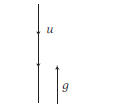
Case-II: If particle is thrown vertically downward with some velocity from some height.
In this case, \(\quad v=u+g t \dots(i)\)
\(
\begin{aligned}
h & =u t+\frac{1}{2} g t^2 \dots(ii)\\
v^2 & =u^2+2 g h \dots(iii)
\end{aligned}
\)
Here, \(h\) is the vertical height of particle in downward direction.
In this case, acceleration due to gravity is taken as positive.
Case-III: If a particle is dropped from some height.
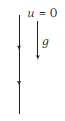
In this case, initial velocity is taken zero ( \(u=0\) ), so equations of motion are
\(
\begin{aligned}
v & =g t \dots(i) \\
h & =\frac{1}{2} g t^2 \dots(ii) \\
v^2 & =2 g h \dots(iii)
\end{aligned}
\)
Important Points to Remember
Maximum height attained by a particle, thrown upwards from ground:
At the maximum height, the particle’s velocity is momentarily zero. So, the final velocity \((v)\) is \(0 \mathrm{~m} / \mathrm{s}\).
The acceleration (\(a\)) is the acceleration due to gravity, acting downwards, so \(a=-g=-9.8 \mathrm{~m} / \mathrm{s}^2\).
The initial velocity \((u)\) is the velocity with which the particle was thrown upwards.
Use the kinematic equation \(v^2=u^2+2 a s\). Substituing \((v)=0\) and \(a=-g\), we get
\(
h_{max}=\frac{u^2}{2 g}
\)
Velocity of particle at the time of striking the ground when released \((u=0)\) from a height \(h\):
We know, \(v^2=u^2+2 a s \dots(1)\)
In this scenario, the particle is released from rest, so the initial velocity is \(\boldsymbol{u}=0\). The acceleration is the acceleration due to gravity, which is \(a=g\). The displacement is the height from which the particle is released, so \(s=\boldsymbol{h}\).
Substituting these values into the equation (1) gives:
\(
\begin{gathered}
v^2=0^2+2 g h \\
v^2=2 g h
\end{gathered}
\)
\(
v=\sqrt{2 g h}
\)
Time of collision of particle with ground:
The second equation of motion relates displacement \((s)\), initial velocity \((u)\), acceleration ( \(a\) ), and time ( \(t\) )
\(
s=u t+\frac{1}{2} a t^2
\)
The particle is in free-fall, meaning the only significant force acting on it is gravity. Air resistance is ignored.
The particle is dropped from rest, so its initial velocity (\(u\) is zero.
The acceleration is constant and equal to the acceleration due to gravity, \(g\).
The displacement, \(s\), is the height the particle falls, which is \(h\).
Substitute the variables into the kinematic equation:
\(h=(0) t+\frac{1}{2} g t^2\)
\(
\text { Time of collision } =t=\sqrt{\frac{2 h}{g}}
\)
Example 11: A ball is thrown up at a speed of \(4.0 \mathrm{~m} / \mathrm{s}\). Find the maximum height reached by the ball. Take \(g=10 \mathrm{~m} / \mathrm{s}^2\).
Solution: Let us take vertically upward direction as the positive \(Y\)-axis. We have \(u=4.0 \mathrm{~m} / \mathrm{s}\) and \(a=-10 \mathrm{~m} / \mathrm{s}^2\). At the highest point the velocity becomes zero. Using the formula.
\(
\begin{aligned}
v^2 & =u^2+2 a h, \\
0 & =(4.0 \mathrm{~m} / \mathrm{s})^2+2\left(-10 \mathrm{~m} / \mathrm{s}^2\right) h \\
h_{max} & =\frac{16 \mathrm{~m}^2 / \mathrm{s}^2}{20 \mathrm{~m} / \mathrm{s}^2}=0.80 \mathrm{~m} .
\end{aligned}
\)
Example 12: A ball is thrown upwards from the top of a tower \(40 \mathrm{~m}\) high with a velocity of \(10 \mathrm{~m} / \mathrm{s}\). Find the time when it strikes the ground. (Take, \(g=10 \mathrm{~m} / \mathrm{s}^2\) )
Solution: According to the question, the condition is as shown below.
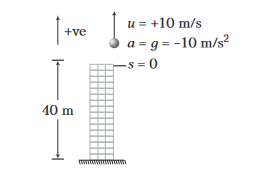
Given, \(u=+10 \mathrm{~m} / \mathrm{s}, \quad a=-10 \mathrm{~m} / \mathrm{s}^2\) and \(s=-40 \mathrm{~m}\) (at the point, where stone strikes the ground)
Substituting in \(s=u t+\frac{1}{2} a t^2\), we get
\(
-40=10 t-5 t^2 \text { or } 5 t^2-10 t-40=0
\)
or \(\quad t^2-2 t-8=0\)
Solving this, we have
\(t=4 \mathrm{~s}\) and \(-2 \mathrm{~s}\). Taking the positive value \(t=4 \mathrm{~s}\).
Example 13: A rocket is fired vertically up from the ground with a resultant vertical acceleration of \(10 \mathrm{~ms}^{-2}\). The fuel is finished in 1 min and it contiues to move up.
(i) What is the maximum height reached?
(ii) After finishing fuel, calculate the time for which it continues its upwards motion. (Take, \(g=10 \mathrm{~ms}^{-2}\) )
Solution: (i) The distance travelled by the rocket during burning of fuel \((1\) minute \(=60 \mathrm{~s})\) in which resultant acceleration is vertically upwards and is \(10 \mathrm{~ms}^{-2}\) will be \(h_1=u t+\frac{1}{2} g t^2\) \(=0 \times 60+(1 / 2) \times 10 \times 60^2=18000 \mathrm{~m}=18 \mathrm{~km}\) and velocity acquired by it will be \(v=u+a t=0+10 \times 60=600 \mathrm{~ms}^{-1}\)
Now, after \(1 \mathrm{~min}\), the rocket moves vertically up with initial velocity of \(600 \mathrm{~ms}^{-1}\) and acceleration due to gravity opposes its motion.
So, it will go to a height \(h_2\) from this point, till its velocity becomes zero such that
\(
v^2-u^2=-2 g h \Rightarrow 0-(600)^2=-2 g h_2\left(g=10 \mathrm{~ms}^{-2}\right)
\)
or \(h_2=18000 \mathrm{~m}=18 \mathrm{~km}\)
So, the maximum height reached by the rocket from the ground, \(H=h_1+h_2=18+18=36 \mathrm{~km}\)
(ii) As after burning of fuel, the initial velocity attained will be \(600 \mathrm{~ms}^{-1}\) and gravity opposes the motion of rocket, so from first equation of motion time taken by it till its velocity \(v=0\) is given as,
\(
0=600-g t \Rightarrow t=60 \mathrm{~s}
\)
Example 14: A juggler throws balls into air. He throws one ball whenever the previous one is at its highest point. How high does the balls rise, if he throws \(n\) balls each second? Acceleration due to gravity is \(g\).
Solution: Juggler throws \(n\) balls in one second, so time interval between two consecutive throws is \(t=\frac{1}{n} \mathrm{~s}\)
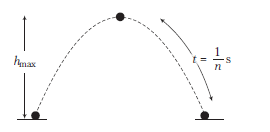
Each ball takes \(\frac{1}{n} \mathrm{~s}\) to reach maximum height.
So, \(\quad h_{\max }=\frac{1}{2} \times g t^2=\frac{1}{2} \times g\left(\frac{1}{n}\right)^2 \Rightarrow h_{\max }=\frac{g}{2 n^2}\)
Example 15: From an elevated point \(A\), a stone is projected vertically upwards. When the stone reaches a distance \(h\) below \(A\), its velocity is double of what it was at a height \(h\) above \(A\). Show that the greatest height attained by the stone is \(\frac{5}{3} h\).
Solution: Let \(u\) be the velocity with which the stone is projected vertically upwards.
Given, \(\quad v_{-h}=2 v_h\) or \(\left(v_{-h}\right)^2=4 v_h^2\)
According to the kinematic equation,
\(
v_h^2=u^2-2 g h
\)
and
\(
v_{-h}^2=u^2-2 g(-h)
\)
\(
\begin{aligned}
& \Rightarrow & u^2-2 g(-h) & =4\left(u^2-2 g h\right) \\
& \therefore & u^2 & =\frac{10 g h}{3}
\end{aligned}
\)
Now, maximum height, \(h_{\max }=\frac{u^2}{2 g}=\frac{5 h}{3}\)
Example 16: \(A\) ball is thrown vertically upwards with a velocity of \(20 \mathrm{~ms}^{-1}\) from the top of a multistorey building. The height of the point from where the ball is thrown is \(25 \mathrm{~m}\) from the ground. How long it will take before the ball hits the ground? (Take, \(g=10 \mathrm{~ms}^{-2}\) )
Solution: Let us take the positive \(Y\)-axis in the vertically upward direction with zero at the ground.
Now, \(v_0=+20 \mathrm{~ms}^{-1}, a=-g=-10 \mathrm{~ms}^{-2}, v=0 \mathrm{~ms}^{-1}\)
The total time taken can also be calculated by noting the coordinates of initial and final positions of the ball with respect to the origin chosen and using equation
\(
y=y_0+v_0 t+\frac{1}{2} a t^2
\)
Now, \(y_0=25 \mathrm{~m}, y=0 \mathrm{~m}\),
\(
\begin{array}{rlrl}
v_0 & =20 \mathrm{~ms}^{-1}, a=-10 \mathrm{~ms}^{-2} \\
& \therefore 0 & =25+20 t+\left(\frac{1}{2}\right)(-10) t^2 \\
\Rightarrow & 5 t^2-20 t-25 & =0
\end{array}
\)
Solving this quadratic equation for \(t\), we get
\(
t=5 \mathrm{~s}
\)
Example 17: A ball is thrown upwards from the ground with an initial speed \(u\). The ball is at a height of \(80 \mathrm{~m}\) at two times, for the time interval of \(6 s\). Find the value of \(u\).
Solution:
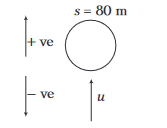
Here, \(a=g=-10 \mathrm{~ms}^{-2}\) and \(s=80 \mathrm{~m}\) Substituting the values in \(s=u t+\frac{1}{2} a t^2\), we get \(80=u t-5 t^2\)
or, \(5 t^2-u t+80=0\)
and
\(
\begin{array}{r}
t=\frac{u+\sqrt{u^2-1600}}{10} \\
t=\frac{u-\sqrt{u^2-1600}}{10}
\end{array}
\)
Now, it is given that
\(
\frac{u+\sqrt{u^2-1600}}{10}-\frac{u-\sqrt{u^2-1600}}{10}=6
\)
\(
\begin{array}{l}
\Rightarrow \quad \frac{\sqrt{u^2-1600}}{5}=6 \\
\Rightarrow \sqrt{u^2-1600}=30 \\
\Rightarrow \quad u^2-1600=900 \\
\therefore \quad u^2=2500 \\
\Rightarrow \quad u= \pm 50 \mathrm{~ms}^{-1} \\
\end{array}
\)
Ignoring the negative sign, we get
\(
u=50 \mathrm{~ms}^{-1}
\)
Example 18: A particle is thrown vertically upwards from the surface of the earth. Let \(T_P\) be the time taken by the particle to travel from a point \(P\) above the earth to its highest point and back to the point \(P\).
Similarly, let \(T_Q\) be the time taken by the particle to travel from another point \(Q\) above the earth to its highest point and back to the same point \(Q\). If the distance between the points \(P\) and \(Q\) is \(H\), find the expression for acceleration due to gravity in terms of \(T_P, T_Q\) and \(H\).
Solution:
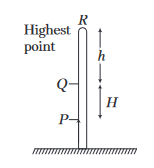
Time taken by the particle to travel from point \(P\) back to point \(P\),
\(
T_P=T_{P R}+T_{R P}
\)
Here, \(T_{P R}=T_{R P}\), then \(T_P=2 T_{P R}\)
Using second equation of motion,
\(
(H+h)=\frac{1}{2} g T_{P R}^2
\)
\(
\begin{array}{l}
\Rightarrow \quad T_{P R}=\sqrt{2 \frac{(H+h)}{g}} \\
\Rightarrow \quad T_P=2 \sqrt{\frac{2(H+h)}{g}}
\end{array}
\)
Then, similarly time taken by the particle to travel from point \(Q\) back to point \(Q\),
\(
\begin{aligned}
T_Q & =2 \sqrt{\frac{2 h}{g}} \\
T_P^2 & =\frac{8(h+H)}{g} \\
\text { and } \quad T_Q^2 & =\frac{8 h}{g} \\
\Rightarrow \quad T_P^2 & =T_Q^2+\frac{8 H}{g} \Rightarrow g=\frac{8 H}{T_P^2-T_Q^2}
\end{aligned}
\)
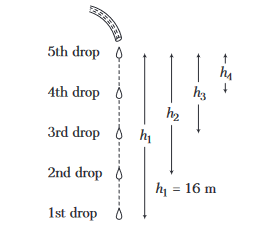
Example 19: From the top of a building, \(16 \mathrm{~m}\) high water drops are falling at equal intervals of time such that when the first drop reaches the ground, the fifth drop just starts. Find the distance between the successive drops at that instant.
Solution: Let the interval of time be \(t_0\).
First drop is released at \(t=0\), second drop at \(t=t_0\), third drop at \(t=2 t_0\), fourth drop at \(t=3 t_0\), fifth drop at \(t=4 t_0\).
Therefore, first drop has fallen for time \(4 t_0\), second drop for \(3 t_0\), third drop for \(2 t_0\), fourth drop for \(t_0\) when fifth drop is about to fall. The location of drops are as shown in the figure.
For 1st drop,
\(
\begin{aligned}
h_1 & =\frac{1}{2} g\left(4 t_0\right)^2, \quad 16=\frac{1}{2} g \times 16 t_0^2 \\
\frac{1}{2} g t_0^2 & =1 \mathrm{~m}
\end{aligned}
\)
For 2nd drop, \(h_2=\frac{1}{2} g\left(3 t_0\right)^2=9 \mathrm{~m}\)
For 3rd drop, \(h_3=\frac{1}{2} g\left(2 t_0\right)^2=4 \mathrm{~m}\)
For 4th drop, \(h_4=\frac{1}{2} g t_0^2=1 \mathrm{~m}\)
For 5th drop, \(h_5=0\)
Separation between drops
1st and \(2 \mathrm{nd}: h_1-h_2=7 \mathrm{~m}\)
2nd and 3rd : \(h_2-h_3=5 \mathrm{~m}\)
3rd and 4th : \(h_3-h_4=3 \mathrm{~m}\)
4th and 5th : \(h_4-h_5=1 \mathrm{~m}\)
Note: If the 1st drop is at the ground and the 5th drop is about to fall, the time for which the first drop has fallen \((5-1) t_0=4 t_0\) where \(t_0\) is the regular interval of time.
Example 20: A ball is dropped from the top of a tower. After \(2 s\) another ball is thrown vertically downwards with a speed of \(40 \mathrm{~ms}^{-1}\). After how much time and at what distance below the top of tower the balls meet?
Solution: Let the balls meet at distance \(h\) below the top of tower at \(t\) second after dropping of first ball. The second ball takes time \((t-2)\) seconds.
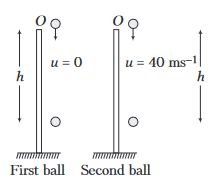
For first ball, \(h=\frac{1}{2} g t^2 \dots(i)\)
For second ball, \(h=40(t-2)+\frac{1}{2} g(t-2)^2 \dots(ii)\)
From Eqs. (i) and (ii), we get
\(
\begin{array}{c}
40(t-2)+\frac{1}{2} g(t-2)^2=\frac{1}{2} g t^2 \\
40(t-2)=\frac{1}{2} g\left[t^2-(t-2)^2\right] \\
40(t-2)=\frac{1}{2} \times 10(2 t-2) \times 2 \\
4 t-8=2 t-2 \Rightarrow t=3 \mathrm{~s}
\end{array}
\)
Distance below the top of tower, where the balls meet,
\(
h=\frac{1}{2} g t^2=\frac{1}{2} \times 10 \times 3^2=45 \mathrm{~m}
\)
Non-Uniformly Accelerated One Dimensional Motion
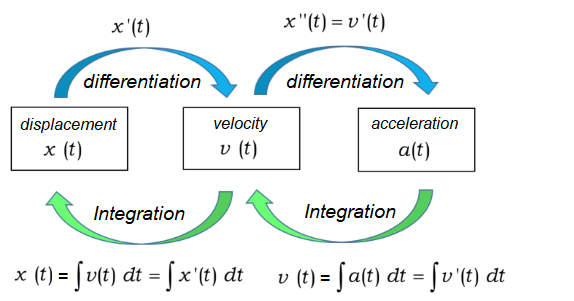
When acceleration of particle is not constant, motion is known as non-uniformly accelerated motion. For one dimensional motion, above relations can be written as under
- \(v=\frac{d s}{d t}\)
- \(a=\frac{d v}{d t}=v \frac{d v}{d s}\)
- \(d s=v d t\) and
- \(d v=a d t \quad\) or \(\quad v d v=a d s\)
When acceleration of a particle is not constant (non-uniform) we take help of differentiation or integration.
Example 21: Velocity-time equation of a particle moving in a straight line is
\(
v=\left(10+2 t+3 t^2\right) \text { (SI units) }
\)
Find
(i) displacement of particle from the mean position at time \(t=1 \mathrm{~s}\), if it is given that displacement is 20 m at time \(t=0\).
(ii) and acceleration-time equation.
Solution: (i) The given equation can be written as
\(
v=\frac{d s}{d t}=\left(10+2 t+3 t^2\right) \dots(i)
\)
\(
\begin{aligned}
d s & =\left(10+2 t+3 t^2\right) d t \\
\int_{20}^s d s & =\int_0^1\left(10+2 t+3 t^2\right) d t \\
s-20 & =\left[10 t+t^2+t^3\right]_0^1 \\
s & =20+12=32 \mathrm{~m}
\end{aligned}
\)
(ii) Acceleration-time equation can be obtained by differentiating Eq. (i) w.r.t. time. Thus,
\(
\begin{aligned}
& a=\frac{d v}{d t}=\frac{d}{d t}\left(10+2 t+3 t^2\right) \\
& a=2+6 t
\end{aligned}
\)
Example 22: Displacement-time equation of a particle moving along \(X\)-axis is
\(
x=20+t^3-12 t \text { (SI units) }
\)
(i) Find position and velocity of particle at time \(t=0\).
(ii) State whether the motion is uniformly accelerated or not.
(iii) Find position of particle when velocity of particle is zero.
Solution: (i) Given, displacement-time equation of a particle
\(
x=20+t^3-12 t \dots(i)
\)
At \(t=0 \quad x=20+0-0=20 \mathrm{~m}\)
Velocity of particle at time \(t\) can be obtained by differentiating Eq. (i) w.r.t. time, ie.
\(
v=\frac{d x}{d t}=3 t^2-12 \dots(ii)
\)
At \(t=0, v=0-12=-12 \mathrm{~m} / \mathrm{s}\)
(ii) Differentiating Eq. (ii) w.r.t. time \(t\), we get the acceleration,
\(
a=\frac{d v}{d t}=6 t
\)
As acceleration is a function of time, the motion is non-uniformly accelerated motion.
(iii) Substituting \(v=0\) in Eq. (ii), we get
\(
0=3 t^2-12
\)
Positive value of \(t\) comes out to be 2 s from this equation. Substituting \(t=2 \mathrm{~s}\) in Eq. (i), we get
\(
x=20+(2)^3-12(2) \text { or } x=4 \mathrm{~m}
\)
Example 23: The velocity of particle moving in the positive direction of \(X\)-axis varies as \(v=\alpha \sqrt{x}\), where \(\alpha\) is a positive constant. Assuming that at moment \(t=0\), the particle was located at the point \(x=0\).
Find
(i) the time dependence of the velocity of the particle.
(ii) the mean velocity of the particle averaged over the time that the particle takes to cover first s metres of the path.
Solution: (i) Given, the velocity of the particle moving in the positive direction of \(X\)-axis,
\(
\begin{aligned}
& & v & =\alpha \sqrt{x} \\
\Rightarrow & & \frac{d x}{d t} & =\alpha \sqrt{x}
\end{aligned}
\)
By integrating \(\int_0^x \frac{d x}{\sqrt{x}}=\alpha \int_0^t d t\)
\(
\begin{aligned}
&\begin{aligned}
\Rightarrow & \frac{x^{-1 / 2+1}}{-(1 / 2)+1} & =\alpha t \\
\Rightarrow & x & =\frac{\alpha^2 t^2}{4}
\end{aligned}\\
&\text { Time dependence of the velocity of the particle, }\\
&v=\frac{d x}{d t}=\frac{2 \alpha^2 t}{4}=\frac{1}{2} \alpha^2 t
\end{aligned}
\)
(ii) Distance, \(x=\frac{\alpha^2 t^2}{4}\); for \(s\) distance \(s=\frac{\alpha^2 t^2}{4}\)
Time taken to cover first \(s\) distance, \(t=\sqrt{\frac{4 s}{\alpha^2}}\)
The mean velocity of the particle,
\(
v_{\mathrm{av}}=\frac{s}{t}=\frac{s}{\sqrt{4 s / \alpha^2}}=\frac{\alpha \sqrt{s}}{2}
\)
Example 24: A particle starts from rest with a constant acceleration. At a time \(t\) second, the speed is found to be \(100 \mathrm{~m} / \mathrm{s}\) and one second later the speed becomes \(150 \mathrm{~m} / \mathrm{s}\). Find (a) the acceleration and (b) the distance travelled during the \((t+1)^{t h}\) second.
Solution: Solution : (a) Velocity at time \(t\) second is
\(
100 \mathrm{~m} / \mathrm{s}=a \cdot(t \text { second }) \dots(1)
\)
and velocity at time \((t+1)\) second is
\(
150 \mathrm{~m} / \mathrm{s}=a \cdot(t+1) \text { second. } \dots(2)
\)
Subtracting (1) from (2), \(a=50 \mathrm{~m} / \mathrm{s}^2\)
(b) Consider the interval \(t\) second to \((t+1)\) second, time elapsed \(=1 \mathrm{~s}\)
initial velocity \(=100 \mathrm{~m} / \mathrm{s}\)
final velocity \(=150 \mathrm{~m} / \mathrm{s}\).
Thus, \((150 \mathrm{~m} / \mathrm{s})^2=(100 \mathrm{~m} / \mathrm{s})^2+2\left(50 \mathrm{~m} / \mathrm{s}^2\right) x\)
\(
x=125 \mathrm{~m}
\)
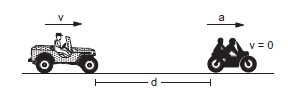
Example 25: A police inspector in a jeep is chasing a pickpocket on a straight road. The jeep is going at its maximum speed \(v\) (assumed uniform). The pickpocket rides on the motorcycle of a waiting friend when the jeep is at a distance \(d\) away, and the motorcycle starts with a constant acceleration \(a\). Show that the pickpocket will be caught if \(v \geq \sqrt{2 a d}\).
Solution: Suppose the pickpocket is caught at a time \(t\) after the motorcycle starts. The distance travelled by the motorcycle during this interval is
\(
s=\frac{1}{2} a t^2 \dots(i)
\)
During this interval the jeep travels a distance
\(
s+d=v t \dots(ii)
\)
By (i) and (ii),
\(
\frac{1}{2} a t^2-v t+d=0
\)
\(
t=\frac{v \pm \sqrt{v^2-2 a d}}{a} .
\)
The pickpocket will be caught if \(t\) is real and positive. This will be possible if
\(
v^2 \geq 2 a d \text { or, } v \geq \sqrt{2 a d}
\)
Example 26: From the velocity-time graph of a particle given in figure below, describe the motion of the particle qualitatively in the interval 0 to 4 s. Find (a) the distance travelled during first two seconds, (b) during the time 2 s to 4 s , (c) during the time 0 to 4 s, (d) displacement during 0 to \(4 \mathrm{~s},(e)\) acceleration at \(t=1 / 2 \mathrm{~s}\) and (\(f\)) acceleration at \(t=2 \mathrm{~s}\).
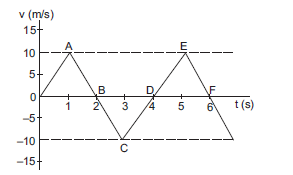
Solution: At \(t=0\), the particle is at rest, say at the origin. After that the velocity is positive, so that the particle moves in the positive \(x\) direction. Its speed increases till 1 second when it starts decreasing. The particle continues to move further in positive \(x\) direction. At \(t=2 \mathrm{~s}\), its velocity is reduced to zero, it has moved through a maximum positive \(x\) distance. Then it changes its direction, velocity being negative, but increasing in magnitude. At \(t=3 \mathrm{~s}\) velocity is maximum in the negative \(x\) direction and then the magnitude starts decreasing. It comes to rest at \(t=4 \mathrm{~s}\).
(a) Distance during 0 to \(2 \mathrm{~s}=\) Area of \(O A B\)
\(
=\frac{1}{2} \times 2 \mathrm{~s} \times 10 \mathrm{~m} / \mathrm{s}=10 \mathrm{~m}
\)
(b) Distance during 2 to \(4 \mathrm{~s}=\) Area of \(B C D=10 \mathrm{~m}\). The particle has moved in negative \(x\) direction during this period.
(c) The distance travelled during 0 to \(4 \mathrm{~s}=10 \mathrm{~m}+10 \mathrm{~m}\)
\(
=20 \mathrm{~m} .
\)
(d) displacement during 0 to \(4 \mathrm{~s}=10 \mathrm{~m}+(-10 \mathrm{~m})=0\).
(e) at \(t=1 / 2 \mathrm{~s}\) acceleration \(=\) slope of line \(O A=10 \mathrm{~m} / \mathrm{s}^2\).
(f) at \(t=2 \mathrm{~s}\) acceleration = slope of line \(A B C=-10 \mathrm{~m} / \mathrm{s}^2\).
Example 27: A stone is dropped from a balloon going up with a uniform velocity of \(5.0 \mathrm{~m} / \mathrm{s}\). If the balloon was 50 m high when the stone was dropped, find its height when the stone hits the ground. Take \(g=10 \mathrm{~m} / \mathrm{s}^2\).
Solution: At \(t=0\), the stone was going up with a velocity of \(5.0 \mathrm{~m} / \mathrm{s}\). After that it moved as a freely falling particle with downward acceleration \(g\). Take vertically upward
as the positive \(X\)-axis. If it reaches the ground at time \(t\),
\(
x=-50 \mathrm{~m}, \quad u=5 \mathrm{~m} / \mathrm{s}, \quad a=-10 \mathrm{~m} / \mathrm{s}^2 .
\)
We have
\(
x=u t+\frac{1}{2} a t^2
\)
\(
-50 \mathrm{~m}=(5 \mathrm{~m} / \mathrm{s}) \cdot t+\frac{1}{2} \times\left(-10 \mathrm{~m} / \mathrm{s}^2\right) t^2
\)
\(
t=\frac{1 \pm \sqrt{41}}{2} \mathrm{~s}
\)
\(
t=-2.7 \mathrm{~s} \quad \text { or, } 3.7 \mathrm{~s}
\)
Negative \(t\) has no significance in this problem. The stone reaches the ground at \(t=3.7 \mathrm{~s}\). During this time the balloon has moved uniformly up. The distance covered by it is
\(
5 \mathrm{~m} / \mathrm{s} \times 3.7 \mathrm{~s}=18.5 \mathrm{~m} .
\)
Hence, the height of the balloon when the stone reaches the ground is \(50 \mathrm{~m}+18.5 \mathrm{~m}=68.5 \mathrm{~m}\).
Graphical representation of Motion
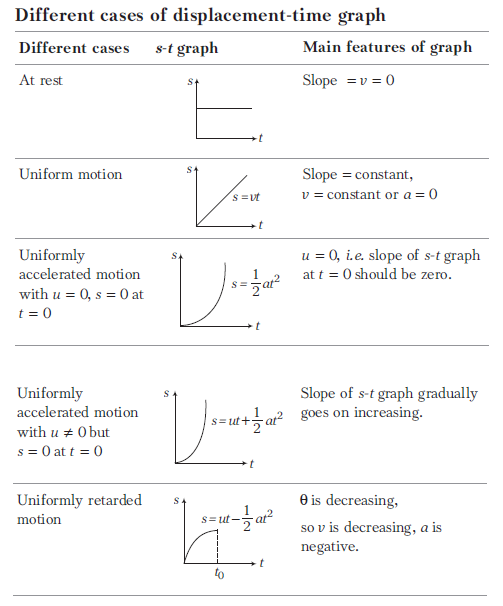
Motion of a body or a particle in all aspects can be shown with the help of the graph, such as displacement-time graph, velocity-time graph, and acceleration-time graph, etc. Displacement-time and velocity-time graphs for one dimensional motion are shown in tabular forms.
Displacement-time graph
- Displacement-time graph gives instantaneous value of displacement at any instant.
- The slope of tangent drawn to the graph at any instant of time gives the instantaneous velocity at that instant.
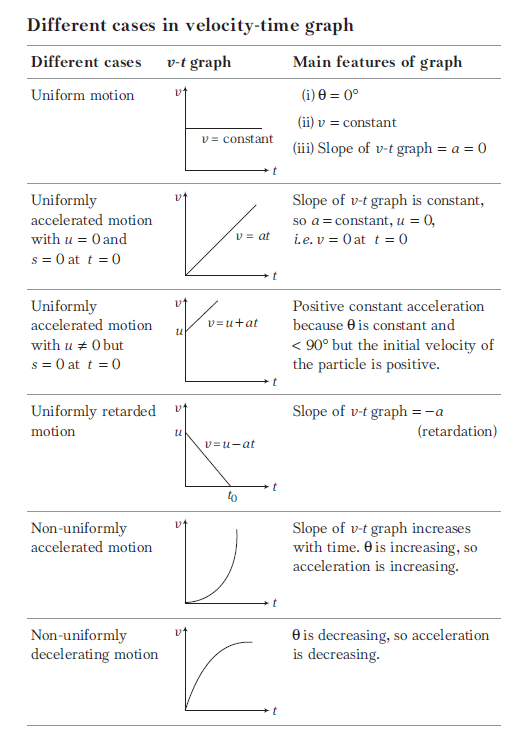
Velocity-time graph
- Velocity-time graph gives the instantaneous value of velocity at any instant.
- The slope of tangent drawn on graph gives instantaneous acceleration.
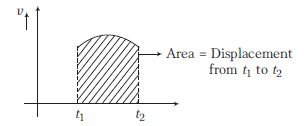
- Area under \(v\) – \(t\) graph with time axis gives the value of displacement covered in given time.
Acceleration-time graph
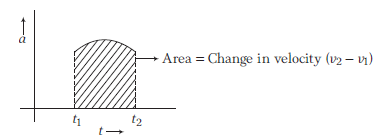
The area of the \(a\)–\(t\) graph between time \(t_1\) to \(t_2\) gives the change in velocity.
\(
\begin{array}{rlrl}
& \text { As, } & & a \\
& & =\frac{d v}{d t} \\
& \Rightarrow & d v & =a d t \\
& & \int_{v_1}^{v_2} d v & =\int_{t_1}^{t_2} a d t \\
& & v_2-v_1 & =\int_{t_1}^{t_2} a d t
\end{array}
\)
Change in velocity \(=\) Area of the \(a-t\) graph.
Example 28: A particle is moving along the \(X\)-axis and its position-time graph is shown. Determine the sign of acceleration.
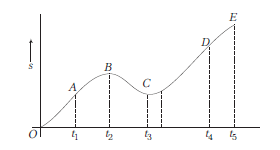
Solution: By observing the \(s-t\) graph, we can determine the sign of acceleration. Recall, if the graph is concave upwards, the slope is increasing; if it is concave downward, the slope is decreasing; and if the graph is straight line, the slope is constant.
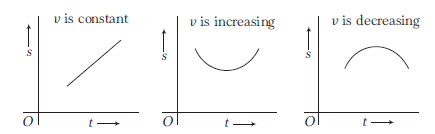
\(O A\) : Slope is increasing, \(v\) is increasing and \(a\) is positive.
\(A B\) : Slope is constant, \(v\) is constant and \(a=0\).
\(B C\) : Slope is decreasing, \(v\) is decreasing and \(a\) is negative.
\(C D\) : Slope is increasing, \(v\) is increasing and \(a\) is positive.
\(D E\) : Slope is constant, \(v\) is constant and \(a=0\).
Example 29: With the help of the given velocity-time graph, find the
(i) displacement in first three seconds and
(ii) acceleration
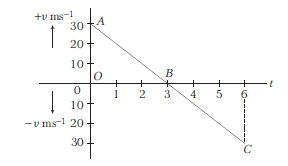
Solution: (i) Displacement in first three seconds \(=\) Area of triangle \(O A B\)
\(
=\frac{1}{2}(O B) \times(O A)=\frac{1}{2}(3) \times(30)=+45 \mathrm{~m}
\)
(ii) Acceleration \(=\) Slope of \(v-t\) graph
As, \(v-t\) graph is a straight line. So, consider the slope of line \(A B\).
\(\therefore\) Slope of line \(A B=\frac{y_2-y_1}{x_2-x_1}=\frac{0-30}{3}=-10 \mathrm{~ms}^{-2}\)
So, the acceleration is negative.
Example 30: Velocity-time graph of a particle moving in a straight line is shown in figure.
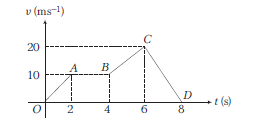
Plot the corresponding displacement-time graph of the particle, if at time \(t=0\), displacement \(s=0\).
Solution: Displacement \(=\) Area under velocity-time graph
Hence, \(\quad s_{O A}=\frac{1}{2} \times 2 \times 10=10 \mathrm{~m}\)
\(
\begin{aligned}
& s_{A B}=2 \times 10=20 \mathrm{~m} \\
& s_{O A B}=10+20=30 \mathrm{~m}
\end{aligned}
\)
\(
s_{B C}=\frac{1}{2} \times 2(10+20)=30 \mathrm{~m}
\)
\(
s_{O A B C}=30+30=60 \mathrm{~m}
\)
\(
s_{C D}=\frac{1}{2} \times 2 \times 20=20 \mathrm{~m}
\)
\(
s_{O A B C D}=60+20=80 \mathrm{~m}
\)
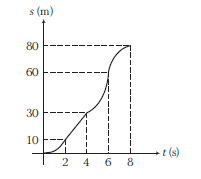
Between 0 s to 2 s and 4 s to 6 s , motion is accelerated, hence displacement-time graph is a parabola. Between 2 s to 4 s , motion is uniform, so displacement-time graph will be a straight line. Between 6 s to 8 s , motion is decelerated, hence displacement-time graph is again a parabola but inverted in shape.
At the end of 8 s velocity is zero, therefore slope of displacement-time graph should be zero. The corresponding graph is shown in figure.
Example 31: A rocket is fired vertically upwards with a net acceleration of \(4 \mathrm{~ms}^{-2}\) and initial velocity zero. After 5 s, its fuel is finished and it decelerates with \(g\). At the highest point, its velocity becomes zero. Then, it accelerates downwards with acceleration \(g\) and return back to ground. Plot velocity-time and displacement-time graphs for the complete journey. (Take, \(g=10 \mathrm{~ms}^{-2}\) )
Solution: In the graphs, \(v_A=a t_{O A}=(4)(5)=20 \mathrm{~ms}^{-1}\)
\(
\begin{array}{ll}
\Rightarrow & v_B=0=v_A-g t_{A B} \\
\Rightarrow & t_{A B}=\frac{v_A}{g}=\frac{20}{10}=2 \mathrm{~s} \\
\therefore & t_{O A B}=(5+2) \mathrm{s}=7 \mathrm{~s}
\end{array}
\)
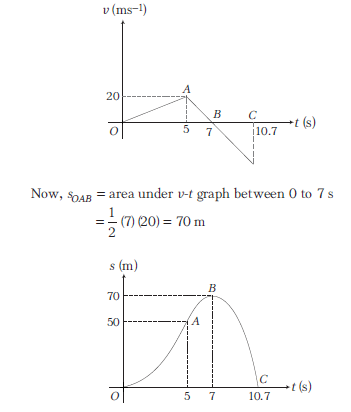
Now, \(\left|s_{O A B}\right|=\left|s_{B C}\right|=\frac{1}{2} g t_{B C}^2\)
\(
\therefore \quad 70=\frac{1}{2}(10) t_{B C}^2
\)
\(
\begin{array}{lc}
\Rightarrow & t_{B C}=\sqrt{14}=3.7 \mathrm{~s} \\
\therefore & t_{O A B C}=7+3.7=10.7 \mathrm{~s}
\end{array}
\)
Also, \(s_{O A}=\) area under \(v-t\) graph between \(O A\)
\(
=\frac{1}{2}(5)(20)=50 \mathrm{~m}
\)
Example 32: Acceleration-time graph of a particle moving in a straight line is shown in figure. Velocity of particle at time \(t=0\) is \(2 \mathrm{~ms}^{-1}\). Find velocity at the end of fourth second.
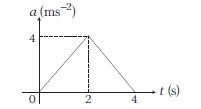
Solution: According to acceleration time-graph, \(d v=a d t\) or change in velocity \(=\) area under \(a-t\) graph
Hence, \(v_f-v_i=\frac{1}{2}(4)(4)=8 \mathrm{~ms}^{-1}\)
\(\therefore \quad v_f=v_i+8=(2+8) \mathrm{ms}^{-1}=10 \mathrm{~ms}^{-1}\)
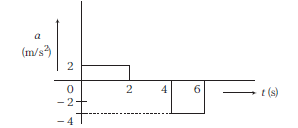
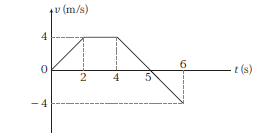
Example 33: The acceleration versus time graph of a particle moving along a straight line is shown in the figure. Draw the respective velocity-time graph.
Assume at \(t=0, v=0\).
Solution: From \(t=0\) to \(t=2 \mathrm{~s}, a=+2 \mathrm{~m} / \mathrm{s}^2 \Rightarrow v=a t=2 t\)
or \(v-t\) graph is a straight line passing through origin with slope \(2 \mathrm{~m} / \mathrm{s}^2\).
At the end of \(2 \mathrm{~s}, v=2 \times 2=4 \mathrm{~m} / \mathrm{s}\)
From \(t=2\) to \(4 \mathrm{~s}, a=0\).
Hence, \(v=4 \mathrm{~m} / \mathrm{s}\) will remain constant.
From \(t=4\) to \(6 \mathrm{~s}, a=-4 \mathrm{~m} / \mathrm{s}^2\).
Hence, \(\quad v=u-a t=4-4 t\)
\(v=0\) at \(t=1 \mathrm{~s}\) or at 5 s from origin.
At the end of 6 s (or \(t=2 \mathrm{~s}) v=-4 \mathrm{~m} / \mathrm{s}\).
Corresponding \(v-t\) graph as shown below.
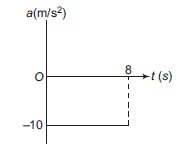
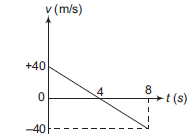
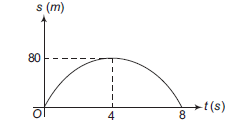
Example 34: A particle is projected upwards with velocity \(40 \mathrm{~m} / \mathrm{s}\). Taking the value of \(g=10 \mathrm{~m} / \mathrm{s}^2\) and upward direction as positive, plot \(a-t\), \(v-t\) and \(s-t\) graphs of the particle from the starting point till it further strikes the ground.
Solution: Upward journey time \(=\) downward journey time \(=\frac{u}{g}=\frac{40}{10}=4 \mathrm{~s}\)
\(\therefore\) Total time of journey \(=8 \mathrm{~s}\)
Maximum height attained by the particle \(=\frac{u^2}{2 g}=\frac{(40)^2}{2 \times 10}=80 \mathrm{~m}\)
\(a-t\) graph During complete journey \(a=g=-10 \mathrm{~m} / \mathrm{s}^2\)
Corresponding \(a-t\) graph is as shown below.
\(v-t\) graph In upward journey velocity first decreases from \(+40 \mathrm{~m} / \mathrm{s}\) to 0. Then, in downward journey it increases from 0 to \(-40 \mathrm{~m} / \mathrm{s}\). Negative sign just signifies its downward direction. Corresponding \(v-t\) graph is as shown below.
\(s-t\) graph In upward journey displacement first increases from 0 to +80 m. Then, it decreases from +80 m to 0. Corresponding \(s-t\) graph is as shown below.
Example 35: A car accelerates from rest at a constant rate \(\alpha\) for some time, after which it decelerates at a constant rate \(\beta\), to come to rest. If the total time elapsed is \(t\) seconds, then evaluate (a) the maximum velocity reached and (b) the total distance travelled.
Solution: (a) Let the car accelerates for time \(t_1\) and decelerates for time \(t_2\). Then,
\(
t=t_1+t_2 \dots(i)
\)
and corresponding velocity-time graph will be as shown in Figure below.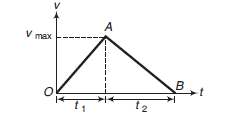
From the graph,
\(
\alpha=\text { slope of line } O A=\frac{v_{\max }}{t_1} \text { or } t_1=\frac{v_{\max }}{\alpha} \dots(ii)
\)
and \(\beta=- \text { slope of line } A B=\frac{v_{\max }}{t_2}\)
\(
t_2=\frac{v_{\max }}{\beta} \dots(iii)
\)
From Eqs. (i), (ii) and (iii), we get
\(
\begin{aligned}
& \frac{v_{\max }}{\alpha}+\frac{v_{\max }}{\beta}=t \\
& v_{\max }\left(\frac{\alpha+\beta}{\alpha \beta}\right)=t
\end{aligned}
\)
\(
v_{\max }=\frac{\alpha \beta t}{\alpha+\beta}
\)
(b)
\(
\begin{aligned}
& \text { Total distance }=\text { total displacement }=\text { area under } v-t \text { graph } \\
& =\frac{1}{2} \times t \times v_{\max } \\
& =\frac{1}{2} \times t \times \frac{\alpha \beta t}{\alpha+\beta} \\
& \text { or } \quad \begin{aligned}
\text { Distance } & =\frac{1}{2}\left(\frac{\alpha \beta t^2}{\alpha+\beta}\right)
\end{aligned}
\end{aligned}
\)