14.4 The speed of a travelling wave
To determine the speed of propagation of a travelling wave, we can fix our attention on any particular point on the wave (characterised by some value of the phase) and see how that point moves in time. It is convenient to look at the motion of the crest of the wave. Figure below gives the shape of the wave at two instants of time, which differ by a small time internal \(\Delta t\). The entire wave pattern is seen to shift to the right (positive direction of \(x\)-axis) by a distance \(\Delta x\). In particular, the crest shown by a \(\operatorname{dot}(\bullet)\) moves a distance \(\Delta x\) in time \(\Delta t\). The speed of the wave is then \(\Delta x / \Delta t\). We can put the \(\operatorname{dot}(\bullet)\) on a point with any other phase. It will move with the same speed \(v\) (otherwise the wave pattern will not remain fixed).
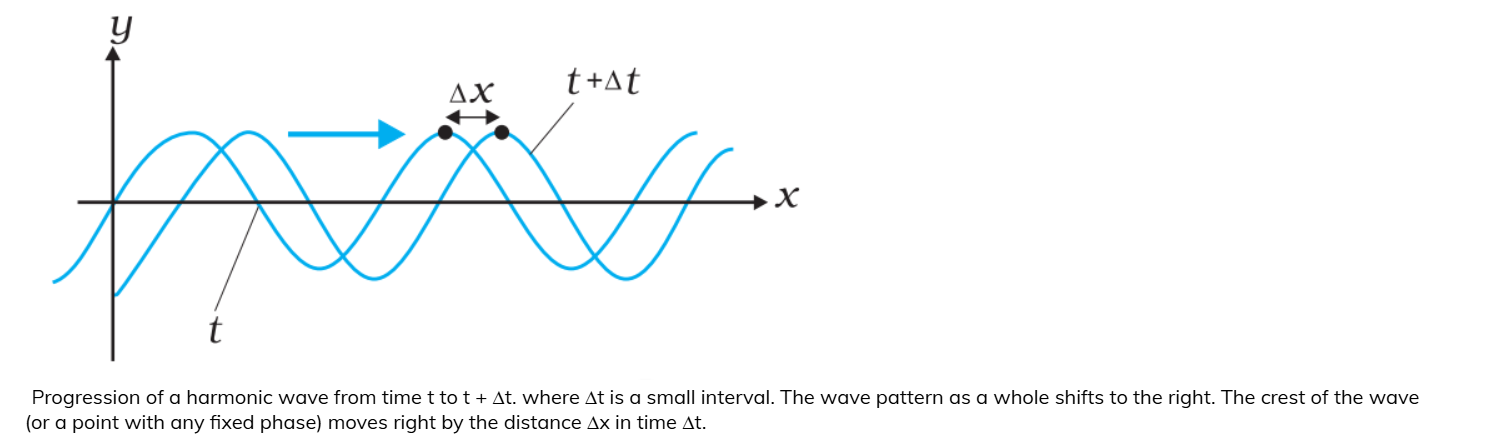
The motion of a fixed phase point on the wave is given by
\(
k x-\omega t=\mathrm{constant}
\)
Thus, as time \(t\) changes, the position \(x\) of the fixed phase point must change so that the phase remains constant. Thus,
\(
k x-\omega t=k(x+\Delta x)-\omega(t+\Delta t)
\)
or \(k \Delta x-\omega \Delta t=0\)
Taking \(\Delta x, \Delta t\) vanishingly small, this gives
\(
\frac{d x}{\mathrm{~d} t}=\frac{\omega}{k}=v
\)
Relating \(\omega\) to \(T\) and \(k\) to \(\lambda\), we get
\(
v=\frac{2 \pi f}{2 \pi / \lambda}=\lambda f=\frac{\lambda}{T}
\)
General Derivation (Kinematic Method):
A harmonic wave travelling in the positive \(x\)-direction is represented by:
\(
y(x, t)=A \sin (k x-\omega t+\phi)
\)
To find the speed of the wave \((v)\), we track a point of constant phase. For example, if you “ride” on a wave crest, the value inside the sine function stays the same even as \(x\) and \(t\) change.
Set the phase to a constant:
\(
k x-\omega t+\phi=\text { constant }
\)
Take the derivative with respect to time (\(t\)):
\(
\begin{gathered}
\frac{d}{d t}(k x-\omega t+\phi)=0 \\
k \frac{d x}{d t}-\omega=0
\end{gathered}
\)
Since \(\frac{d x}{d t}\) is the velocity of the wave \((v)\) :
\(
k v=\omega \Longrightarrow v=\frac{\omega}{k}
\)
Substituting \(\omega=2 \pi f\) and \(k=\frac{2 \pi}{\lambda}\) :
\(
v=\frac{2 \pi f}{2 \pi / \lambda}=f \lambda
\)
Speed of Different Waves
Normally, two wave speeds are required at this stage.
- Transverse wave speed on a string.
- Longitudinal wave speed in all three states: solid, liquid, and gas.
Transverse Wave Speed on a Stretched String
Suppose a wave \(y=f\left(t-\frac{x}{v}\right)\) is travelling on the string in the positive \(x\)-direction with a speed \(v\). Consider a small element \(A B\) of the string of length \(\Delta l\) at the highest point of a crest. Any small curve may be approximated by a circular arc. Suppose the small element \(\Delta l\) forms an arc of radius \(R\). The particles of the string in this element go in this circle with a speed \(v\) as the string slides through this part. The general situation is shown in figure below and the expanded view of the part near \(\Delta l\) is shown in figure below.
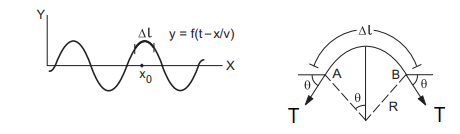
The speed of a mechanical wave depends on the elasticity and inertia of the medium. For a string, these are Tension \((T)\) and Linear Mass Density \((\mu)\).
The Setup:
Imagine a small segment of the string of length \(\Delta l\) that forms an arc as a wave pulse passes through it. Let \(\mu\) be the mass per unit length (\(\mu=m / L\)).
The Derivation
Mass of the segment: \(\Delta m=\mu \Delta l\).
Centripetal Force: If the pulse has a radius of curvature \(R\) and the wave moves at speed \(v\), the segment experiences a downward centripetal force:
\(
F_c=\frac{(\Delta m) v^2}{R}=\frac{(\mu \Delta l) v^2}{R}
\)
Restoring Force (Tension): The tension \(T\) acts at both ends of the segment. If the angle subtended is \(2 \theta\), the vertical components of tension add up:
\(
F_{n e t}=2 T \sin \theta
\)
For very small angles, \(\sin \theta \approx \theta\), so \(F_{\text {net }} \approx 2 T \theta\).
Relating Geometry: The arc length \(\Delta l=R(2 \theta)\), so \(2 \theta=\frac{\Delta l}{R}\). Substituting this into the force equation:
\(
F_{n e t}=T \frac{\Delta l}{R}
\)
Equating the Forces:
\(
\frac{\mu \Delta l v^2}{R}=\frac{T \Delta l}{R}
\)
Solving for \(v\) :
\(
\begin{aligned}
\mu v^2=T & \Longrightarrow v^2=\frac{T}{\mu} \\
v & =\sqrt{\frac{T}{\mu}}
\end{aligned}
\)
Alternate Way:
The speed of transverse wave on a string is given by \(v=\sqrt{\frac{T}{\mu}}\)
Here, \(\mu=\) mass per unit length of the string \(=\frac{m}{l}=\frac{m A}{l A} \quad(A=\) area of cross-section of the string \()\), (\(T\)) is the tension in the string (the stronger the tension in the string, the faster the wave travels).
\(=\left(\frac{m}{V}\right) A \quad(V=\) volume of string \()\)
\(=\rho A \quad(\rho=\) density of string \()\)
Hence, the above expression can also be written as \(v=\sqrt{\frac{T}{\rho A}}\)
If radius of the string is \(r\) having volume \(V\) and the density of the material of the string is \(\rho\), then
\(
\begin{aligned}
& \mu=\frac{V}{L} \times \rho=\pi r^2 \rho \\
& v=\sqrt{\frac{T}{\pi r^2 \rho}}
\end{aligned}
\)
When a block of mass \(M\) is suspended from the string, then
\(
T=M g
\)
The speed of the wave along a stretched ideal string depends only on the tension and the linear mass density of the string and does not depend on the frequency of the wave.
The frequency of the wave is determined by the source that generates the wave. The wavelength is given by
\(
\lambda=\frac{v}{f}
\)
Derivation: Speed \(v\) of a transverse wave depends upon tension in the string and linear mass density \(\mu\) (mass/length)
\(
\begin{aligned}
& v \propto T^a \mu^b \\
& \Rightarrow v=C T^a \mu^b \\
& \Rightarrow\left[L T^{-1}\right]=C\left[M L T^{-2}\right]^a\left[M L^{-1}\right]^b \\
& \Rightarrow\left[L T^{-1}\right]=C\left[M^{a+b} L^{a-b} T^{-2 a}\right] \\
& a+b=0, a-b=1, \\
& \therefore a=\frac{1}{2}, b=-\frac{1}{2}
\end{aligned}
\)
\(
\begin{aligned}
& v=C T^{1 / 2} \mu^{-1 / 2} \\
& v=C \frac{T^{1 / 2}}{\mu^{1 / 2}} \\
& v=C \sqrt{\frac{T}{\mu}}
\end{aligned}
\)
\(C\) is a dimensionless constant that cannot be determined with dimensional analysis (\(C=1\)).
\(
v=\sqrt{\frac{T}{\mu}}
\)
Example 1: A steel wire 0.72 m long has a mass of \(5.0 \times 10^{-3} \mathrm{~kg}\). If the wire is under a tension of 60 N , what is the speed of transverse waves on the wire?
Solution: Mass per unit length of the wire,
\(
\begin{aligned}
\mu & =\frac{5.0 \times 10^{-3} \mathrm{~kg}}{0.72 \mathrm{~m}} \\
& =6.9 \times 10^{-3} \mathrm{~kg} \mathrm{~m}^{-1}
\end{aligned}
\)
Tension, \(T=60 \mathrm{~N}\)
The speed of wave on the wire is given by
\(
v=\sqrt{\frac{T}{\mu}}=\sqrt{\frac{60 \mathrm{~N}}{6.9 \times 10^{-3} \mathrm{~kg} \mathrm{~m}^{-1}}}=93 \mathrm{~m} \mathrm{~s}^{-1}
\)
Speed in a medium (Solid, Liquid and Gas)
The General Formula:
For any mechanical wave, the speed \(v\) is determined by the ratio of an elastic property to an inertial property:
\(
v=\sqrt{\frac{\text { Elastic Property }}{\text { Inertial Property }}}
\)
Elastic Property (The “Snap-Back” Force)
The Elastic Property describes a material’s ability to resist deformation and return to its original shape or position after being stretched or compressed.
Role: It acts as the restoring force. In a wave, the elastic property is what pulls the particles of the medium back toward their equilibrium (resting) position.
Common Examples:
Tension \((T)\) : In a guitar string, the tightness of the string is the elastic property.
Bulk Modulus (\(B\)): In fluids (like air or water), this represents how much the fluid resists being squeezed.
Spring Constant (\(k\)): In a simple mechanical spring, this is the “stiffness” of the spring.
Inertial Property (The “Resistance” Force)
The Inertial Property describes a material’s tendency to resist changes in its state of motion. It is essentially the “sluggishness” of the medium.
Role: It determines how much energy is required to get the particles moving and how much they will “overshoot” their resting position once they start moving.
Common Examples:
Mass (\(m\)): In a simple pendulum or mass-on-a-spring.
Linear Mass Density (\(\mu\)): How heavy a string is per unit of length. A thick, heavy bass string has more inertia than a thin treble string.
Volume Density (\(\rho\)): The mass per unit volume of a gas or solid (e.g., sound travels differently in humid air vs. dry air because the density changes).
In Solids (Extended Medium):
In a solid, the speed of sound depends on the Young’s Modulus (\(Y\)), which represents the medium’s resistance to linear strain, and its density (\(\rho\)).
\(
v=\sqrt{\frac{Y}{\rho}}
\)
In Liquids and Gases:
Since fluids do not have a fixed shape, we use the Bulk Modulus (\(B\)), which measures resistance to compression.
\(
v=\sqrt{\frac{B}{\rho}}
\)
Common Applications
Depending on the physical system you are looking at, these properties take different forms:
\(
\begin{array}{|l|l|l|l|}
\hline \text { System } & \text { Elastic Property } & \text { Inertial Property } & \text { Resulting Speed (v) } \\
\hline \text { String } & \text { Tension }(T) & \begin{array}{l}
\text { Linear mass } \\
\text { density }(\mu)
\end{array} & \mathrm{v}=\sqrt{\frac{T}{\mu}} \\
\hline \text { Solid Rod } & \text { Young’s Modulus }(Y) & \text { Density }(\rho) & \mathrm{v}=\sqrt{\frac{Y}{\rho}} \\
\hline \text { Fluid/Gas } & \text { Bulk Modulus (B) } & \text { Density }(\rho) & \mathrm{v}=\sqrt{\frac{B}{\rho}} \\
\hline
\end{array}
\)
Speed of a longitudinal wave (sound wave) in a medium
In a longitudinal wave, the constituents of the medium oscillate forward and backward in the direction of wave propagation. Speed of longitudinal waves in a medium is
\(
v=\sqrt{\frac{B}{\rho}}
\)
where, bulk modulus of the medium,
\(
B=-\frac{\Delta p}{\Delta V / V}
\)
where, \(\Delta p=\) change in pressure, \(\Delta V=\) change in volume and \(\quad V=\) initial volume. \(\rho=\text { density. }\)
The speed of a longitudinal wave (sound wave) in a medium depends on its elastic properties and inertial properties.
For a linear medium like a solid bar, the modulus of elasticity will be Young’s modulus \((Y)\).
Derivation: Speed \(v\) of a transverse wave depends upon bulk modulus \(B\) of the medium and density of the medium \(\rho\)
\(
\begin{aligned}
& v \propto B^a \rho^b \\
& \Rightarrow v=C B^a \rho^b \\
& \Rightarrow\left[L T^{-1}\right]=C\left[M L^{-1} T^{-2}\right]^a\left[M L^{-3}\right]^b \\
& \Rightarrow\left[L T^{-1}\right]=C\left[M^{a+b} L^{-a-3 b} T^{-2 a}\right] \\
& a+b=0,-a-3 b=1,
\end{aligned}
\)
\(
\begin{aligned}
& \therefore a=\frac{1}{2}, b=-\frac{1}{2} \\
& \therefore v=C \sqrt{\frac{B}{\rho}}
\end{aligned}
\)
As \(C=1\), \(v=\sqrt{\frac{B}{\rho}}\)
Note: The speed of sound is greater in solids and liquids than in gases even though they are denser than gases. This happens because they are much more difficult to compress than gases and hence, have much higher values of bulk modulus. This factor compensates for their higher densities than gases.
Example 2: The volumetric strain of water at a pressure of \(10^5 \mathrm{Nm}^{-2}\) is \(5 \times 10^{-5}\). Determine the speed of sound in water. Density of water is \(10^3 \mathrm{~kg} \mathrm{~m}^{-3}\).
Solution: Bulk modulus of water, \(B=\frac{\text { Normal stress }}{\text { Volumetric strain }}=\frac{10^5}{5 \times 10^{-5}}\)
\(
=2 \times 10^9 \mathrm{Nm}^{-2}
\)
\(\because\) Density of water, \(\rho=10^3 \mathrm{~kg} \mathrm{~m}^{-3} \quad \text { (Given) }\)
\(\therefore\) Speed of sound in water, \(v=\sqrt{\frac{B}{\rho}}\)
\(
\Rightarrow \quad v=\sqrt{\frac{2 \times 10^9}{10^3}}=1.41 \times 10^3 \mathrm{~ms}^{-1}
\)
Speed of longitudinal waves in a solid bar (thin rod or wire)
So, the speed of longitudinal waves in a solid bar is given by
\(
v=\sqrt{\frac{Y}{\rho}}
\)
where, \(Y\) is the Young’s modulus of the material of the bar and \(\rho\) is density. Also, the speed of a longitudinal wave through a solid of bulk modulus \(B\), modulus of rigidity \(\eta\) and density \(\rho\) is given by
\(
v=\sqrt{\frac{B+(4 / 3) \eta}{\rho}}
\)
Example 3: If the Young’s modulus of elasticity for a steel rod is \(2.9 \times 10^{11} \mathrm{Nm}^{-2}\) and density is \(8 \times 10^3 \mathrm{~kg} \mathrm{~m}^{-3}\). Determine the velocity of longitudinal waves in the steel rod.
Solution: Given, Young’s modulus, \(Y=2.9 \times 10^{11} \mathrm{Nm}^{-2}\)
Density, \(\rho=8 \times 10^3 \mathrm{~kg} \mathrm{~m}^{-3}\)
\(\therefore\) Velocity of longitudinal waves in steel,
\(
\begin{aligned}
v & =\sqrt{\frac{Y}{\rho}}=\sqrt{\frac{2.9 \times 10^{11}}{8 \times 10^3}} \\
& =6.02 \times 10^3 \mathrm{~ms}^{-1}
\end{aligned}
\)
Example 4: The bulk modulus and modulus of rigidity for aluminium are \(7.5 \times 10^{10} \mathrm{Nm}^{-2}\) and \(2.1 \times 10^{10} \mathrm{Nm}^{-2}\), respectively. Determine the velocity of the waves in the medium. Density of aluminium is \(2.7 \times 10^3 \mathrm{~kg} \mathrm{~m}^{-3}\).
Solution: Given, bulk modulus, \(B=7.5 \times 10^{10} \mathrm{Nm}^{-2}\)
Modulus of rigidity, \(\eta=2.1 \times 10^{10} \mathrm{Nm}^{-2}\)
Density, \(\rho=2.7 \times 10^3 \mathrm{~kg} \mathrm{~m}^{-3}\)
The velocity of longitudinal waves in aluminium,
\(
\begin{aligned}
& v=\sqrt{\frac{B+\frac{4}{3} \eta}{\rho}}=\sqrt{\frac{7.5 \times 10^{10}+\frac{4}{3} \times 2.1 \times 10^{10}}{2.7 \times 10^3}} \\
& v=6.18 \times 10^3 \mathrm{~ms}^{-1}
\end{aligned}
\)
Example 5: Determine the speed of sound waves in water and find the wavelength of a wave having a frequency of 242 Hz. (Take, \(B_{\text {water }}=2 \times 10^9 \mathrm{~Pa}\) )
Solution: Speed of sound wave in water,
\(
v=\sqrt{\frac{B_{\text {water }}}{\rho}}=\sqrt{\frac{\left(2 \times 10^9\right)}{10^3}}=1414 \mathrm{~ms}^{-1}
\)
Wavelength, \(\lambda=\frac{v}{f}=\frac{1414}{242}=5.84 \mathrm{~m}\)
Speed of longitudinal waves in gas
Speed of longitudinal waves in gases,
\(
v=\sqrt{\frac{p}{\rho}}
\)
where, \(p\) is the pressure exerted by gas.
For gases, the bulk modulus is equal to the pressure of the gas. This formula is known as Newton’s formula. Newton assumed that when sound waves are propagated through a gas, the temperature variations in the layers of compression and rarefaction are negligible (isothermal process).
Example 6: The speed of sound in air at NTP is \(332 \mathrm{~ms}^{-1}\). Calculate the percentage error in the speed of sound as calculated from Newton’s formula. Given that the density of air at 1 atm pressure is \(1.293 \mathrm{kgm}^{-3}\).
Solution: From Newton’s formula, \(v=\sqrt{\frac{p}{\rho}}\)
At NTP, \(p=1.01 \times 10^5 \mathrm{~Pa} \Rightarrow v=\sqrt{\frac{1.01 \times 10^5}{1.293}}=280 \mathrm{~ms}^{-1}\)
Difference in speed \(=332-280=52 \mathrm{~ms}^{-1}\)
\(
\% \text { error }=\frac{52}{332} \times 100=15.7 \%
\)
Laplace correction
The result obtained for the speed of sound in air at STP from the above formula is \(280 \mathrm{~ms}^{-1}\), which is about \(15 \%\) smaller as compared to the experimental value, i.e. \(331 \mathrm{~ms}^{-1}\).
The mistake in the formula was pointed out by Laplace and he told that the changes in pressure and volume of a gas, when sound waves are propagated through it, are not isothermal, but adiabatic.
He modified the formula as
\(
\text { Speed of sound in gases, } v=\sqrt{\frac{\gamma p}{\rho}}
\)
This modification in Newton’s formula is referred to as the Laplace correction.
For air, \(\gamma=7 / 5\).
By this formula, the speed of sound comes out to be \(331.3 \mathrm{~ms}^{-1}\), which agrees with the practical value.
Example 7: At normal temperature and pressure, the speed of sound in air is \(332 \mathrm{~m} / \mathrm{s}\). What will be the speed of sound in hydrogen at normal temperature and pressure? (Air is 16 times heavier than hydrogen)
Solution: The speed sound in a gas is given by
\(
\begin{aligned}
& v=\sqrt{\gamma p / \rho} \Rightarrow \frac{v_a}{v_H}=\sqrt{\frac{\rho_H}{\rho_a}} \\
& \frac{\rho_H}{\rho_a}=1 / 16 \Rightarrow \frac{v_a}{v_H}=\sqrt{\frac{1}{16}}=\frac{1}{4} \\
& v_H=4 v_a=4 \times 332=1328 \mathrm{~m} / \mathrm{s}
\end{aligned}
\)
Example 8: Find speed of sound in hydrogen gas at \(27^{\circ} \mathrm{C}\), if \(C_p / C_V\) for \(\mathrm{H}_2\) is 1.4. Gas constant, \(R=8.31 \mathrm{Jmol}^{-1} \mathrm{~K}^{-1}\).
Solution: The speed sound in a gas, \(v=\sqrt{\gamma p / \rho}\)
\(
\therefore \quad v=\sqrt{\frac{\gamma R T}{M}} \quad\left(\because p V=R T \text { and } \rho=\frac{M}{V}\right)
\)
Here,
\(
\begin{aligned}
T & =27+273=300 \mathrm{~K}, \gamma=\frac{C_p}{C_V}=1.4 \\
R & =8.31 \mathrm{~J} \mathrm{~mol}^{-1} \mathrm{~K}^{-1} \\
M & =2 \times 10^{-3} \mathrm{~kg} \mathrm{~mol}^{-1}
\end{aligned}
\)
\(\therefore \quad v=\sqrt{\frac{1.4 \times 8.31 \times 300}{2 \times 10^{-3}}}=1321 \mathrm{~ms}^{-1}\)
Example 9: One end of 12.0 m long rubber tube with a total mass of 0.9 kg is fastened to a fixed support. A cord attached to the other end passes over a pulley and supports an object with a mass of 5.0 kg . The tube is struck a transverse blow at one end. Find the time required for the pulse to reach the other end. \(\left(g=9.8 \mathrm{~m} / \mathrm{s}^2\right)\)
Solution: Tension in the rubber tube \(A B, T=m g\)

\(
T=(5.0)(9.8)=49 \mathrm{~N}
\)
Mass per unit length of rubber tube, \(\mu=\frac{0.9}{12}=0.075 \mathrm{~kg} / \mathrm{m}\)
Speed of wave on the tube, \(v=\sqrt{\frac{T}{\mu}}=\sqrt{\frac{49}{0.075}}=25.56 \mathrm{~m} / \mathrm{s}\)
The required time is, \(t=\frac{A B}{v}=\frac{12}{25.56}=0.47 \mathrm{~s}\)
Factors affecting the speed of sound in air
The following factors affect the speed of sound in air (or gas)
Case-I: Effect of temperature
As, \(v=\sqrt{\frac{\gamma p}{\rho}}\)
We can write
\(
v=\sqrt{\frac{\gamma R T}{M}} \quad(\because p V=R T)
\)
where, \(M=\) molecular mass of gas, \(T\) is absolute temperature and \(R\) is gas constant.
\(
\begin{array}{lc}
\Rightarrow & v \propto \sqrt{T} \\
\text { or } & \frac{v_1}{v_2}=\sqrt{\frac{T_1}{T_2}}
\end{array}
\)
Example 10: In given gaseous medium, at what temperature, the velocity of sound will be double that of velocity at \(27^{\circ} \mathrm{C}\).
Solution: Given, the velocity of sound, \(v_2=2 v_1\)
Temperature, \(T_1=27^{\circ} \mathrm{C}=(27+273)=300 \mathrm{~K}\)
As,\(v \propto \sqrt{T}\)
\(
\begin{array}{ll}
\Rightarrow & \frac{v_1}{v_2}=\sqrt{\frac{T_1}{T_2}} \Rightarrow \frac{v_1}{2 v_1}=\sqrt{\frac{300}{T_2}} \\
\Rightarrow & T_2=1200 \mathrm{~K} \text { or } T_2=927^{\circ} \mathrm{C}
\end{array}
\)
Example 11: A wire of uniform cross-section is stretched between two points 100 cm apart. The wire is fixed at one end and a weight is hung over a pulley at the other end. A weight of 9 kg produces a fundamental frequency of 750 Hz .
(a) What is the velocity of the wave in the wire?
(b) If the weight is reduced to 4 kg, what is the velocity of the wave?
Solution: Fundamental frequency is given by
\(
f=\frac{v}{2 L}
\)
(a) \(L=100 \mathrm{~cm}, \quad \begin{aligned} f_1 & =750 \mathrm{~Hz} \\ v_1 & =2 L f_1=2 \times 100 \times 750 \\ & =150000 \mathrm{cms}^{-1}=1500 \mathrm{~ms}^{-1}\end{aligned}\)
(b) \(\quad v_1=\sqrt{\frac{T_1}{\mu}}\) and \(\quad v_2=\sqrt{\frac{T_2}{\mu}}\)
\(
\begin{aligned}
\frac{v_2}{v_1} & =\sqrt{\frac{T_2}{T_1}} \\
\frac{v_2}{1500} & =\sqrt{\frac{4}{9}} \\
v_2 & =1000 \mathrm{~ms}^{-1}
\end{aligned}
\)
Case-II: Effect of pressure
The speed of sound in a gas, \(v=\sqrt{\frac{\gamma p}{\rho}}\). From this formula, it appears that \(v \propto \sqrt{p}\). But actually, it is not so.
Because \(\frac{p}{\rho}=\frac{R T}{M}=\) constant at constant temperature.
Hence, if the temperature of a gas remains constant, then there is no effect of pressure change on the speed of sound in the gas.
Example 12: A sample of oxygen at NTP has volume \(V\) and a sample of hydrogen at NTP has volume \(4 V\). Both the gases are mixed and the mixture is maintained at NTP. If the speed of sound in hydrogen at NTP is \(1270 \mathrm{~ms}^{-1}\), then calculate the speed of sound in the mixture.
Solution: \(\quad p_{\text {mix }}=\frac{p_{\mathrm{O}_2} V_{\mathrm{O}_2}+p_{\mathrm{H}_2} V_{\mathrm{H}_2}}{V_{\mathrm{O}_2}+V_{\mathrm{H}_2}}=\frac{16 \times V+1 \times 4 V}{V+4 V}=4\)
As the temperature remains the same, therefore pressure will remain constant.
\(
\begin{array}{ll}
\therefore & \frac{v_{\text {mix }}}{v_{\mathrm{H}_2}}=\sqrt{\frac{p_{\mathrm{H}_2}}{p_{\text {mix }}}}=\sqrt{\frac{1}{4}}=\frac{1}{2} \\
\Rightarrow & v_{\text {mix }}=\frac{v_{\mathrm{H}_2}}{2}=\frac{1270}{2}=635 \mathrm{~ms}^{-1}
\end{array}
\)
Case-III: Effect of humidity
The density of moist air (i.e. air mixed with water vapour) is less than the density of dry air. It is clear from the formula, \(v=\sqrt{\gamma \rho / \rho}\) that the speed of sound in moist air is slightly greater than that in dry air. So, speed of sound increases with an increase in humidity.
Case-IV: Effect of frequency
The speed of sound in air is independent of its frequency. Sound waves of different frequencies travel with the same speed in air but their wavelengths in air are different.
Example 13: A sound wave propagating in air has a frequency of 4000 Hz. Calculate the percentage change in wavelength when the wavefront initially in a region, where \(T=27^{\circ} \mathrm{C}\), enters a region, where the temperature decreases to \(10^{\circ} \mathrm{C}\).
Solution: \(\frac{v_2}{v_1}=\sqrt{\frac{T_2}{T_1}}=\sqrt{\frac{273+10}{273+27}}=\sqrt{\frac{283}{300}}=0.97\)
As, frequency remains unchanged, so
\(
\frac{v_2}{v_1}=\frac{f \lambda_2}{f \lambda_1}=\frac{\lambda_2}{\lambda_1}=0.97 \quad(\because v=f \lambda)
\)
Percentage change in wavelength,
\(
\frac{\lambda_1-\lambda_2}{\lambda_1} \times 100=\left(1-\frac{\lambda_2}{\lambda_1}\right) \times 100=(1-0.97) \times 100=3 \%
\)
Relation between speed of sound in a gas and root mean square speed of molecules
If sound travels in a gaseous medium, then the velocity of sound in gas will be \(v_{\text {sound }}=\sqrt{\frac{\gamma R T}{M}}=\sqrt{\frac{\gamma p}{\rho}}\)
where, \(M\) is the molecular mass of the gas.
rms speed of gas molecule is given by, \(v_{\mathrm{rms}}=\sqrt{\frac{3 R T}{M}}\) or \(\sqrt{\frac{3 p}{\rho}}\)
So, \(\frac{v_{\text {rms }}}{v_{\text {sound }}}=\sqrt{\frac{3}{\gamma}} \text { or } v_{\text {sound }}=[\gamma / 3]^{1 / 2} v_{\text {rms }}\)
\(\because \quad \sqrt{\frac{\gamma}{3}}<1 \quad \Rightarrow \quad v_{\text {sound }}<v_{\text {rms }}\)
Hence, the speed of sound in a gas is less than its rms speed of molecules.
Example 14: Compute the ratio of the speed of sound in hydrogen gas to the rms speed of hydrogen molecules.
Solution: As hydrogen is a diatomic gas, \(\gamma=\frac{7}{5}\)
Speed of sound in hydrogen, \(\left(v_{\text {sound }}\right)_{\mathrm{H}}=\sqrt{\frac{\gamma_p}{\rho}}\)
rms speed of hydrogen molecules, \(\left(v_{\mathrm{rms}}\right)_{\mathrm{H}}=\sqrt{\frac{3 p}{\rho}}\)
\(
\therefore \quad \frac{\left(v_{\text {sound }}\right)_H}{\left(v_{\mathrm{rms}}\right)_{\mathrm{H}}}=\sqrt{\frac{\gamma}{3}}=\sqrt{\frac{7 / 5}{3}}=\sqrt{\frac{7}{15}}
\)
Example 15: Equation of a transverse wave travelling in a rope is given by \(y=5 \sin (4.0 t-0.02 x)\), where \(y\) and \(x\) are expressed in cm and time in seconds. Calculate
(i) the amplitude, frequency, velocity and wavelength of the wave.
(ii) the maximum transverse velocity speed and acceleration of a particle in the rope.
Solution: (i) Comparing the given equation with the standard equation of wave motion, \(y=A \sin \left(2 \pi f t-\frac{2 \pi}{\lambda} x\right)\)
where, \(A, f\) and \(\lambda\) are amplitude, frequency and wavelength, respectively.
Thus, amplitude, \(A=5 \mathrm{~cm}, 2 \pi f=4\)
\(\Rightarrow\) Frequency, \(f=\frac{4}{2 \pi}=0.637 \mathrm{~Hz}\)
Again, \(\frac{2 \pi}{\lambda}=0.02\)
\(\Rightarrow\) Wavelength, \(\lambda=\frac{2 \pi}{0.02}=100 \pi \mathrm{~cm}\)
Velocity of the wave, \(v=f \lambda=\frac{4}{2 \pi} \frac{2 \pi}{0.02}=200 \mathrm{~cm} \mathrm{~s}^{-1}\)
(ii) Transverse velocity of the particle,
\(
\begin{aligned}
u & =\frac{d y}{d t}=5 \times 4 \cos (4.0 t-0.02 x) \\
& =20 \cos (4.0 t-0.02 x)
\end{aligned}
\)
Maximum velocity of the particle \(=20 \mathrm{~cm} \mathrm{~s}^{-1}\)
Particle acceleration,
\(
a=\frac{d^2 y}{d t^2}=-20 \times 4 \sin (4.0 t-0.02 x)
\)
Maximum particle acceleration \(=80 \mathrm{~cm} \mathrm{~s}^{-2}\).
Example 16: Figure shows a snapshot of a sinusoidal travelling wave taken at \(t=0.3 \mathrm{~s}\). The wavelength is 7.5 cm and the amplitude is 2 cm. If the crest \(P\) was at \(x=0\) at \(t=0\), write the equation of travelling wave.

Solution: Given, \(A=2 \mathrm{~cm}, \lambda=7.5 \mathrm{~cm}\)
\(
\therefore \quad k=\frac{2 \pi}{\lambda}=0.84 \mathrm{~cm}^{-1}
\)
The wave has travelled a distance of 1.2 cm in 0.3 s. Hence, the speed of the wave,
\(
v=\frac{1.2}{0.3}=4 \mathrm{~cm} \mathrm{~s}^{-1}
\)
\(\therefore\) Angular frequency, \(\omega=(v)(k)=3.36 \mathrm{rad} \mathrm{s}^{-1}\)
Since the wave is travelling along positive \(x\)-direction and crest (maximum displacement) is at \(x=0\) at \(t=0\), we can write the wave equation as
\(
\begin{aligned}
& y(x, t)=A \cos (k x-\omega t) \\
& y(x, t)=A \cos (\omega t-k x) \quad[\because \cos (-\theta)=\cos \theta]
\end{aligned}
\)
Therefore, the desired equation is
\(
y(x, t)=2 \cos (0.84 x-3.36 t) \mathrm{cm}
\)
Example 17: The displacement of a standing wave on a string is given by
\(
y(x, t)=0.4 \sin (0.5 x) \cos (30 t)
\)
where, \(x\) and \(y\) are in centimetres.
(i) Find the frequency, amplitude and wave speed of the component waves.
(ii) What is the particle velocity at \(x=2.4 \mathrm{~cm}\) and \(t=0.8 \mathrm{~s}\) ?
Solution: (i) The given wave can be written as the sum of two component waves as
\(
y(x, t)=0.2 \sin (0.5 x-30 t)+0.2 \sin (0.5 x+30 t)
\)
The two-component waves are
\(
y_1(x, t)=0.2 \sin (0.5 x-30 t)
\)
(Travelling in positive \(x\)-direction)
and \(y_2(x, t)=0.2 \sin (0.5 x+30 t)\)
(Travelling in negative \(x\)-direction)
Now, \(\omega=30 \mathrm{rad} / \mathrm{s} \text { and } k=0.5 \mathrm{~cm}^{-1}\)
\(\therefore\) Frequency, \(f=\frac{\omega}{2 \pi}=\frac{15}{\pi} \mathrm{~Hz}\)
Amplitude, \(A=0.2 \mathrm{~cm}\)
and wave speed, \(v=\frac{\omega}{k}=\frac{30}{0.5}=60 \mathrm{~cm} \mathrm{~s}^{-1}\)
(ii) Particle velocity,
\(
\begin{aligned}
v_P(x, t) & =\frac{d y}{d t}=-12 \sin (0.5 x) \sin (30 t) \\
\therefore \quad v_p(x & =2.4 \mathrm{~cm}, t=0.8 \mathrm{~s}) \\
& =-12 \sin (1.2) \sin (24) \\
& =10.12 \mathrm{~cm} \mathrm{~s}^{-1}
\end{aligned}
\)
Relation between the phase difference and path difference of a plane progressive wave
At any instant \(t\), if \(\phi_1\) and \(\phi_2\) are the phases of two particles whose distances from the origin are \(x_1\) and \(x_2\) respectively, then
\(
\begin{aligned}
\phi_1 & =\left(\omega t-k x_1\right) \text { and } \phi_2=\left(\omega t-k x_2\right) \\
\Rightarrow \quad \phi_1-\phi_2 & =k\left(x_2-x_1\right)
\end{aligned}
\)
Phase difference, \(\Delta \phi=\frac{2 \pi}{\lambda}\) (Path difference, \(\Delta x\) )
Example 18: If the phase difference between two waves is \(60^{\circ}\), then find the value of the path difference between them.
Solution: Given, \(\Delta \phi=60^{\circ}=\frac{\pi}{3}\)
As,\(\Delta \phi=\frac{2 \pi}{\lambda} \times \Delta x\)
\(
\Rightarrow \quad \Delta x=\frac{\Delta \phi}{2 \pi} \times \lambda=\frac{\lambda \times \pi}{3 \times 2 \pi} \Rightarrow \Delta x=\frac{\lambda}{6}
\)
Relation between phase difference and time difference of a plane progressive wave
If the phase of a particle distance \(x\) from the origin is \(\phi_1\) at time \(t_1\) and \(\phi_2\) at time \(t_2\), then \(\phi_1=\left(\omega t_1-k x\right)\) and
\(
\phi_2=\left(\omega t_2-k x\right) \Rightarrow \phi_1-\phi_2=\omega\left(t_1-t_2\right)
\)
Phase difference, \(\Delta \phi=\frac{2 \pi}{T}\) (time difference, \(\Delta t\) )
Example 19: The frequency of a progressive wave travelling in a medium is 40 Hz. Calculate the change in phase at a given place at 0.02 s.
Solution: Given, \(\Delta t=0.02 \mathrm{~s}, {f}=40 \mathrm{~Hz}\) and \(\Delta t=0.02 \mathrm{~s}\)
Time period, \(\quad T=\frac{1}{f}=\frac{1}{40} \mathrm{~s}\)
Phase difference, \(\Delta \phi=\frac{2 \pi}{T} \times \Delta t=\frac{2 \pi}{\left(\frac{1}{40}\right)} \times 0.02\)
\(
=2 \pi \times 40 \times \frac{2}{100}=\frac{8 \pi}{5} \mathrm{rad}
\)
Energy in Wave Motion
In a wave, many particles oscillate. In a sinusoidal wave, these oscillations are simple harmonic in nature. Each particle has some energy of oscillation. At the same time, energy transfer also takes place. Related to the energy of oscillation and energy transfer, there are three terms, namely, energy density \((u)\), power \((P)\) and intensity \((I)\).
Derivation of Energy Density (\(u\)):
A sinusoidal wave consists of particles executing Simple Harmonic Motion (SHM). For any single particle of mass \(m\) oscillating with amplitude \(A\) and angular frequency \(\omega\), its total mechanical energy \(E\) (the sum of kinetic and potential energy) is:
\(
E=\frac{1}{2} m \omega^2 A^2
\)
To find the Energy Density (\(u\)), which is energy per unit volume, we consider a small volume \(V\) of the medium with mass \(m\) :
\(
u=\frac{E}{V}=\frac{\frac{1}{2} m \omega^2 A^2}{V}
\)
Since density \(\rho=\frac{m}{V}\), we substitute this into the equation:
\(
u=\frac{1}{2} \rho \omega^2 A^2
\)
This tells us that the energy stored in the medium depends on the square of the amplitude and the square of the frequency.
Derivation of Power (\(P\)):
Power is the rate at which energy is transferred (\(P=\frac{\Delta E}{\Delta t}\)).
Imagine a wave moving with velocity \(v\) through a string with cross-sectional area \(S\). In a small time interval \(\boldsymbol{\Delta}\), the wave covers a distance:
\(
\Delta x=v \cdot \Delta t
\)
The volume of the medium that the wave “energizes” in that time is the area times the distance:
\(
\Delta V=S \cdot \Delta x=S(v \cdot \Delta t)
\)
The total energy contained in this volume is:
\(
\Delta E=u \cdot \Delta V=\left(\frac{1}{2} \rho \omega^2 A^2\right) \cdot(S \cdot v \cdot \Delta t)
\)
Now, to find the power, we divide by \(\Delta t\) :
\(
\begin{gathered}
P=\frac{\Delta E}{\Delta t}=\frac{\frac{1}{2} \rho \omega^2 A^2 S v \Delta t}{\Delta t} \\
P=\frac{1}{2} \rho \omega^2 A^2 S v
\end{gathered}
\)
Derivation of Intensity (\(I\)):
Intensity is defined as the power per unit area, or the energy passing through a unit area perpendicular to the direction of travel per unit time.
\(
I=\frac{P}{S}
\)
Substituting our derived expression for Power (\(P\)):
\(
\begin{aligned}
I & =\frac{\frac{1}{2} \rho \omega^2 A^2 S v}{S} \\
I & =\frac{1}{2} \rho \omega^2 A^2 v
\end{aligned}
\)
Note: \(\text { The intensity of sound waves is given by } I=\frac{p_{\max }^2}{2 \rho v}\)
where \(p_{\max }\) is the maximum change of pressure in the medium.
The intensity of waves emitting in all directions due to a point source varies inversely as the square of the distance \((r)\).
i.e. \(\quad I=\frac{P}{4 \pi r^2} \quad\) or \(\quad l \propto \frac{1}{r^2}\)
The intensity of waves from a linear source varies inversely as the distance \((r)\) perpendicular to the source, i.e. \(l \propto \frac{1}{r}\)
Example 20: The faintest sound that the human ear can detect at a frequency of 1 kHz corresponds to an intensity of about \(10^{-12} \mathrm{Wm}^{-2}\). Determine the pressure amplitude and the maximum displacement associated with this sound, assuming the density of the air \(=1.3 \mathrm{~kg} \mathrm{~m}^{-3}\) and velocity of sound in the air \(=332 \mathrm{~ms}^{-1}\).
Solution: Intensity of sound wave, \(I=\frac{p^2}{2 \rho v}\)
\(
\begin{aligned}
\Rightarrow \quad p & =\sqrt{I \times 2 \rho v}=\sqrt{10^{-12} \times 2 \times 1.3 \times 332} \\
& =2.94 \times 10^{-5} \mathrm{Nm}^{-2}
\end{aligned}
\)
Now, \(\quad p=\rho v \omega A\)
\(
\begin{aligned}
\Rightarrow \quad A & =\frac{p}{\rho v \omega}=\frac{2.94 \times 10^{-5}}{1.3 \times 332 \times 2 \pi \times 10^3} \\
& =1.1 \times 10^{-11} \mathrm{~m}
\end{aligned}
\)
Example 21: For a person with normal hearing, the faintest sound that can be heard at a frequency of 400 Hz has a pressure amplitude of about \(6.0 \times 10^{-5} \mathrm{~Pa}\). Calculate the corresponding intensity (in \(\mathrm{Wm}^{-2}\) ). (Take, speed of sound in air is \(344 \mathrm{~m} / \mathrm{s}\) and density of air is \(1.2 \mathrm{kgm}^{-3}\) )
Solution: Intensity, \(I=\frac{p_m^2}{2 \rho v}\) where, \(p_m\) is the pressure amplitude.
\(
I=\frac{\left(6.0 \times 10^{-5}\right)^2}{2 \times 1.2 \times 344}=4.4 \times 10^{-12} \mathrm{Wm}^{-2}
\)
Example 22: A stretched string is forced to transmit transverse waves by means of an oscillator coupled to one end. The string has a diameter of 4 mm . The amplitude of the oscillation is \(10^{-4} \mathrm{~m}\) and the frequency is 10 Hz . Tension in the string is 100 N and the mass density of wire is \(4.2 \times 10^3 \mathrm{~kg} / \mathrm{m}^3\). Find
(i) the equation of the waves along the string,
(ii) the energy per unit volume of the wave,
(iii) the average energy flow per unit time across any section of the string, and
(iv) power required to drive the oscillator.
Solution: (i) Speed of transverse waves in the string, \(v=\sqrt{\frac{T}{\rho S}}\)
\(
(\mathrm{As}, \mu=\rho S)
\)
Substituting the given values in above equation, we get
\(
\begin{aligned}
v & =\sqrt{\frac{100}{\left(4.2 \times 10^3\right)(\pi / 4)\left(4.0 \times 10^{-3}\right)^2}}=43.53 \mathrm{~m} / \mathrm{s} \\
\omega & =2 \pi f=20 \pi \mathrm{rad} / \mathrm{s}=62.83 \mathrm{rad} / \mathrm{s} \quad(\because f=10 \mathrm{~Hz}) \\
k & =\omega / v=1.44 \mathrm{~m}^{-1}
\end{aligned}
\)
\(\therefore\) Equation of the waves along the string,
\(
y(x, t)=A \sin (k x-\omega t)=10^{-4} \sin (1.44 x-62.83 t) \mathrm{m}
\)
(ii) Energy per unit volume of the string,
\(
u=\text { energy density }=\frac{1}{2} \rho \omega^2 A^2
\)
Substituting all the values in above equation, we get
\(
\begin{aligned}
u & =\left(\frac{1}{2}\right)\left(4.2 \times 10^3\right)(62.83)^2\left(10^{-4}\right)^2 \\
& =8.29 \times 10^{-2} \mathrm{Jm}^{-3}
\end{aligned}
\)
(iii) Average energy flow per unit time,
\(
P=\text { Power }=\left(\frac{1}{2} \rho \omega^2 A^2\right)(S v)=(u)(S v)
\)
Substituting the values, we get
\(
\begin{aligned}
P & =\left(8.29 \times 10^{-2}\right)\left(\frac{\pi}{4}\right)\left(4.0 \times 10^{-3}\right)^2 \\
& =4.53 \times 10^{-5} \mathrm{Js}^{-1}
\end{aligned}
\)
(iv) The power required to drive the oscillator is obviously \(4.53 \times 10^{-5} \mathrm{~W}\).