JEE PYQs MCQs
Summary
- Newton’s law of universal gravitation states that the gravitational force of attraction between any two particles of masses \(m_1\) and \(m_2\) separated by a distance \(r\) has the magnitude
\(
F=G \frac{m_1 m_2}{r^2}
\) - If we have to find the resultant gravitational force acting on the particle \(m\) due to a number of masses \(M_1, M_2, \ldots . M_n\) etc. we use the principle of superposition. Let \(F_1, F_2, \ldots . F_n\) be the individual forces due to \(M_l, M_2, \ldots . M_{n .}\) each given by the law of gravitation. From the principle of superposition each force acts independently and uninfluenced by the other bodies. The resultant force \(F_R\) is then found by vector addition
\(
F_R=F_1+F_2+\ldots \ldots+F_n=\sum_{i=1}^n F_i
\) - Kepler’s laws of planetary motion state that
(a) All planets move in elliptical orbits with the Sun at one of the focal points
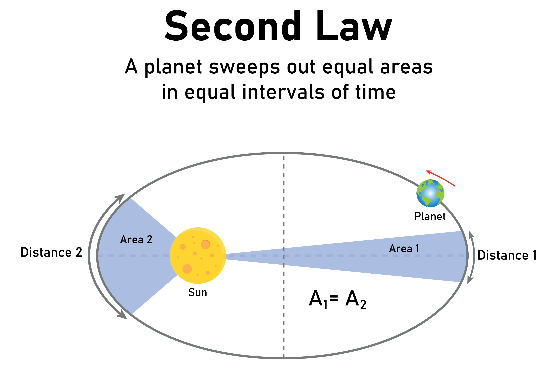
(b) The radius vector drawn from the Sun to a planet sweeps out equal areas in equal time intervals. This follows from the fact that the force of gravitation on the planet is central and hence angular momentum is conserved.
(c) The square of the orbital period of a planet is proportional to the cube of the semi-major axis of the elliptical orbit of the planet
The period \(T\) and radius \(R\) of the circular orbit of a planet about the Sun are related by
\(
T^2=\left(\frac{4 \pi^2}{G M_s}\right) R^3
\)
where \(M_s\) is the mass of the Sun. Most planets have nearly circular orbits about the Sun. For elliptical orbits, the above equation is valid if \(R\) is replaced by the semi-major axis, \(a\). - The acceleration due to gravity.
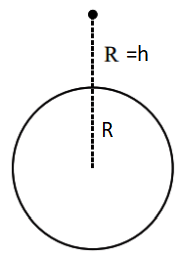
(a) at a height \(h\) above the earth’s surface
\(
\begin{aligned}
& g(h)=\frac{G M_E}{\left(R_E+h\right)^2} \\
& \approx \frac{G M_E}{R_E^2}\left(1-\frac{2 h}{R_E}\right) \text { for } h \ll R_E
\end{aligned}
\)
\(
\begin{aligned}
&g(h)=g(0)\left(1-\frac{2 h}{R_E}\right) \text { where } g(0)=\frac{G M_E}{R_E^2}\\
&\text { (b) at depth } d \text { below the earth’s surface is }\\
&g(d)=\frac{G M_E}{R_E^2}\left(1-\frac{d}{R_E}\right)=g(0)\left(1-\frac{d}{R_E}\right)
\end{aligned}
\) - The gravitational force is a conservative force, and therefore a potential energy function can be defined. The gravitational potential energy associated with two particles separated by a distance \(r\) is given by
\(
V=-\frac{G m_1 m_2}{r}
\)
where \(V\) is taken to be zero at \(r \rightarrow \infty\). The total potential energy for a system of particles is the sum of energies for all pairs of particles, with each pair represented by a term of the form given by above equation. This prescription follows from the principle of superposition. - If an isolated system consists of a particle of mass \(m\) moving with a speed \(v\) in the vicinity of a massive body of mass \(M\), the total mechanical energy of the particle is given by
\(
E=\frac{1}{2} m v^2-\frac{G M m}{r}
\)
That is, the total mechanical energy is the sum of the kinetic and potential energies. The total energy is a constant of motion. - If \(m\) moves in a circular orbit of radius a about \(M\), where \(M \gg m\), the total energy of the system is
\(
E=-\frac{G M m}{2 a}
\)
with the choice of the arbitrary constant in the potential energy given in the point 5., above. The total energy is negative for any bound system, that is, one in which the orbit is closed, such as an elliptical orbit. The kinetic and potential energies are
\(
\begin{aligned}
K & =\frac{G M m}{2 a} \\
V & =-\frac{G M m}{a}
\end{aligned}
\) - The escape speed from the surface of the earth is
\(
v_e=\sqrt{\frac{2 G M_E}{R_E}}=\sqrt{2 g R_E}
\)
and has a value of \(11.2 \mathrm{~km} \mathrm{~s}^{-1}\). - If a particle is outside a uniform spherical shell or solid sphere with a spherically symmetric internal mass distribution, the sphere attracts the particle as though the mass of the sphere or shell were concentrated at the centre of the sphere.
- If a particle is inside a uniform spherical shell, the gravitational force on the particle is zero. If a particle is inside a homogeneous solid sphere, the force on the particle acts toward the centre of the sphere. This force is exerted by the spherical mass interior to the particle.
Quiz Summary
0 of 92 Questions completed
Questions:
Information
You have already completed the quiz before. Hence you can not start it again.
Quiz is loading…
You must sign in or sign up to start the quiz.
You must first complete the following:
Results
Results
0 of 92 Questions answered correctly
Your time:
Time has elapsed
You have reached 0 of 0 point(s), (0)
Earned Point(s): 0 of 0, (0)
0 Essay(s) Pending (Possible Point(s): 0)
Categories
- Not categorized 0%
- 1
- 2
- 3
- 4
- 5
- 6
- 7
- 8
- 9
- 10
- 11
- 12
- 13
- 14
- 15
- 16
- 17
- 18
- 19
- 20
- 21
- 22
- 23
- 24
- 25
- 26
- 27
- 28
- 29
- 30
- 31
- 32
- 33
- 34
- 35
- 36
- 37
- 38
- 39
- 40
- 41
- 42
- 43
- 44
- 45
- 46
- 47
- 48
- 49
- 50
- 51
- 52
- 53
- 54
- 55
- 56
- 57
- 58
- 59
- 60
- 61
- 62
- 63
- 64
- 65
- 66
- 67
- 68
- 69
- 70
- 71
- 72
- 73
- 74
- 75
- 76
- 77
- 78
- 79
- 80
- 81
- 82
- 83
- 84
- 85
- 86
- 87
- 88
- 89
- 90
- 91
- 92
- Current
- Review
- Answered
- Correct
- Incorrect
- Question 1 of 92
1. Question
Given below are two statements: one is labelled as Assertion (A) and the other is labelled as Reason (R).
Assertion (A): The radius vector from the Sun to a planet sweeps out equal areas in equal intervals of time and thus areal velocity of planet is constant.
Reason (R): For a central force field the angular momentum is a constant.
In the light of the above statements, choose the most appropriate answer from the options given below: [JEE Main 2025 (Online) 7th April Evening Shift]CorrectIncorrectHint
(c) Step 1: Analysis of Assertion (A)
The assertion describes Kepler’s Second Law. It states that as a planet moves in its elliptical orbit, the line connecting it to the Sun (the radius vector) sweeps out equal areas over equal time periods. Mathematically, this means the areal velocity ( \(\frac{d A}{d t}\) ) is constant.
Status: Correct
Step 2: Analysis of Reason (R)
A central force is a force that is always directed toward or away from a fixed point (the center) and whose magnitude depends only on the distance from that center. Gravity is a classic example of a central force. Since the force is always parallel to the radius vector, the torque ( \(\tau=r \times F\) ) is zero. Because torque is the rate of change of angular momentum ( \(\tau=\frac{d L}{d t}\) ), if torque is zero, the angular momentum \((L)\) must be constant.
Status: Correct
Why (R) explains (A)?
The relationship between areal velocity and angular momentum is defined by the following equation:
\(
\frac{d A}{d t}=\frac{L}{2 m}
\)
Where:
\(d A / d t\) is the areal velocity.
\(L\) is the angular momentum.
\(m\) is the mass of the planet.
Since the gravitational force from the Sun is a central force, the angular momentum \(L\) is conserved (remains constant). Because \(L\) and \(m\) are constant, the areal velocity \(\frac{d A}{d t}\) must also be constant. Therefore, the reason provided directly explains why the assertion is true. - Question 2 of 92
2. Question
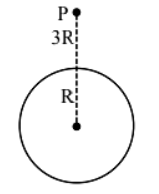
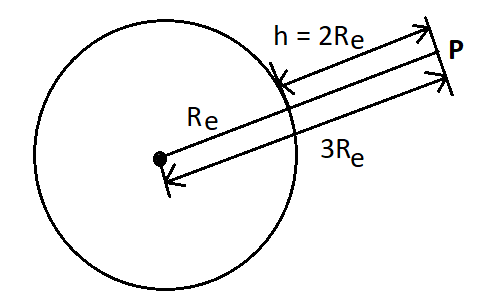
An object is kept at rest at a distance of \(3 R\) above the earth’s surface where \(R\) is earth’s radius. The minimum speed with which it must be projected so that it does not return to earth is : (Assume \(\mathbf{M}=\) mass of earth, \(\mathbf{G}=\) Universal gravitational constant) [JEE Main 2025 (Online) 4th April Evening Shift]
CorrectIncorrectHint
(c)

The Physics Logic:
To ensure the object “does not return to Earth,” we must project it with its escape velocity from its current position. This means the object’s total mechanical energy must be at least zero (\(E_{\text {total }} \geq 0\)) so that it can reach “infinity” with zero or more kinetic energy.
Step-by-Step Derivation
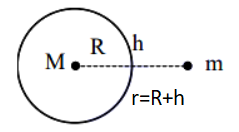
Step 1: Determine the Distance ( \(r\) ) The object is at a height \(h=3 R\) above the surface. The distance from the center of the Earth is:
\(
r=R+h=R+3 R=4 R
\)
Step 2: Apply Conservation of Energy For the object to just escape, its total energy at the launch point must equal its total energy at infinity (which is 0 ).
\(
K_i+U_i=0
\)
Where:
\(K_i\) is initial kinetic energy: \(\frac{1}{2} m v^2\)
\(U_i\) is initial gravitational potential energy: \(-\frac{G M m}{r}\)
Step 3: Solve for Projection Speed ( \(v\) ) Substitute \(r=4 R\) into the energy equation:
\(
\frac{1}{2} m v^2-\frac{G M m}{4 R}=0
\)
Rearrange to solve for \(v\) :
\(
\begin{gathered}
\frac{1}{2} m v^2=\frac{G M m}{4 R} \\
v^2=\frac{2 G M}{4 R} \\
v=\sqrt{\frac{G M}{2 R}}
\end{gathered}
\) - Question 3 of 92
3. Question
Given below are two statements : one is labelled as Assertion A and the other is labelled as Reason \(\mathbf{R}\)
Assertion A: The kinetic energy needed to project a body of mass \(m\) from earth surface to infinity is \(\frac{1}{2} \mathrm{mgR}\), where \(R\) is the radius of earth.
Reason R: The maximum potential energy of a body is zero when it is projected to infinity from earth surface.
In the light of the above statements, choose the correct answer from the options given below: [JEE Main 2025 (Online) 4th April Morning Shift]CorrectIncorrectHint
(a) Step 1: Analysis of Assertion (A)
The assertion claims the kinetic energy needed to project a body to infinity is \(\frac{1}{2} m g R\). Let’s calculate the actual energy required using the principle of conservation of energy.
Initial Energy at Surface (\(r=R\)):
Potential Energy \(\left(U_i\right)=-\frac{G M m}{R}\)
Kinetic Energy \(\left(K_i\right)=K\)
Final Energy at Infinity ( \(r=\infty\) ):
Potential Energy \(\left(U_f\right)=0\)
Kinetic Energy \(\left(K_f\right)=0\) (for minimum energy required)
By Conservation of Energy:
\(
\begin{gathered}
K_i+U_i=K_f+U_f \\
K-\frac{G M m}{R}=0 \\
K=\frac{G M m}{R}
\end{gathered}
\)
We know that acceleration due to gravity \(g=\frac{G M}{R^2}\), which implies \(G M=g R^2\). Substituting this into the energy equation:
\(
K=\frac{\left(g R^2\right) m}{R}=m g R
\)
Since the calculated kinetic energy needed is \(m g R\) and the assertion states \(\frac{1}{2} m g R\), the assertion is false.
Step 2: Analysis of Reason (R)
In gravitational physics, the potential energy \(U\) between two masses is defined as:
\(
U=-\frac{G M m}{r}
\)
As the distance \(r\) increases, the value of \(U\) becomes less negative (increases). When the body reaches infinity (\(r \rightarrow \infty\)), the potential energy reaches its maximum value, which is:
\(
U_{\max }=-\frac{G M m}{\infty}=0
\)
Status: True - Question 4 of 92
4. Question
Match the List-I with List-II
\(
\begin{array}{|l|l|l|l|}
\hline & \text { List-I } & & \text { List-II } \\
\hline \text { (A) } & \text { Gravitational constant } & \text { (I) } & \left[\mathrm{LT}^{-2}\right] \\
\hline \text { (B) } & \text { Gravitational potential energy } & \text { (II) } & \left[\mathrm{L}^2 \mathrm{~T}^{-2}\right] \\
\hline \text { (C) } & \text { Gravitational potential } & \text { (III) } & \left[\mathrm{ML}^2 \mathrm{~T}^{-2}\right] \\
\hline \text { (D) } & \text { Acceleration due to gravity } & \text { (IV) } & \left[\mathrm{M}^{-1} \mathrm{~L}^3 \mathrm{~T}^{-2}\right] \\
\hline
\end{array}
\)
Choose the correct answer from the options given below: [JEE Main 2025 (Online) 3rd April Morning Shift]CorrectIncorrectHint
(a) (A) Gravitational constant \((G)\) : From Newton’s law of gravitation \(F=G \frac{m_1 m_2}{r^2}\), the formula for \(G\) is \(G=\frac{F r^2}{m_1 m_2}\).
Dimensions: \(\frac{\left[\mathrm{MLT}^{-2}\right]\left[\mathrm{L}^2\right]}{[\mathrm{M}][\mathrm{M}]}=\left[\mathrm{M}^{-1} \mathrm{~L}^3 \mathrm{~T}^{-2}\right]\). (Matches IV)
(B) Gravitational potential energy \((\boldsymbol{U}): \boldsymbol{U}=-\frac{G M m}{r}\), which is energy.
Dimensions: \(\left[\mathrm{ML}^2 \mathrm{~T}^{-2}\right]\). (Matches III)
(C) Gravitational potential \((V): V=\frac{U}{m}=-\frac{G M}{r}\), which is energy per unit mass. Dimensions: \(\frac{\left[\mathrm{ML}^2 \mathrm{~T}^{-2}\right]}{[\mathrm{M}]}=\left[\mathrm{L}^2 \mathrm{~T}^{-2}\right]\). (Matches II)
(D) Acceleration due to gravity \((g): g=\frac{G M}{R^2}\), which is acceleration. Dimensions: \(\left[\mathrm{LT}^{-2}\right]\). (Matches I) - Question 5 of 92
5. Question
Earth has mass 8 times and radius 2 times that of a planet. If the escape velocity from the earth is \(11.2 \mathrm{~km} / \mathrm{s}\), the escape velocity in \(\mathrm{km} / \mathrm{s}\) from the planet will be: [JEE Main 2025 (Online) 28th January Evening Shift]
CorrectIncorrectHint
(c) Step 1: Define the escape velocity formula and variables
The escape velocity ( \(V_{\text {esc }}\) ) for a body with mass \(M\) and radius \(R\) is given by the formula:
\(
V_{\mathrm{esc}}=\sqrt{\frac{2 G M}{R}}
\)
where \(\boldsymbol{G}\) is the universal gravitational constant. We are given the relationship between Earth (\(E\)) and the planet (\(P\)):
\(
M_E=8 M_P \text { and } R_E=2 R_P
\)
Step 2: Express the planet’s escape velocity in terms of Earth’s values
We write the escape velocity for the planet \(V_P\) using its mass \(\boldsymbol{M}_P\) and radius \(\boldsymbol{R}_P\) then substitute the given relationships to connect it to \(V_E\) :
\(
V_P=\sqrt{\frac{2 G M_P}{R_P}}=\sqrt{\frac{2 G\left(M_E / 8\right)}{\left(R_E / 2\right)}}=\sqrt{\frac{2 G M_E}{8 R_E / 2}}=\sqrt{\frac{2 G M_E}{4 R_E}}
\)
Step 3: Simplify the expression and calculate the final value
We can factor out the known escape velocity of Earth \(\left(V_E=\sqrt{\frac{2 G M_E}{R_E}}\right)\) from the planet’s expression:
\(
V_P=\sqrt{\frac{1}{4} \times \frac{2 G M_E}{R_E}}=\frac{1}{\sqrt{4}} \sqrt{\frac{2 G M_E}{R_E}}=\frac{1}{2} V_E
\)
Using the given value \(V_E=11.2 \mathrm{~km} / \mathrm{s}\) :
\(
V_P=\frac{1}{2} \times 11.2 \mathrm{~km} / \mathrm{s}=5.6 \mathrm{~km} / \mathrm{s}
\)
The escape velocity in \(\mathrm{km} / \mathrm{s}\) from the planet will be \(5.6 \mathrm{~km} / \mathrm{s}\). - Question 6 of 92
6. Question
A satellite is launched into a circular orbit of radius ‘ \(R\) ‘ around the earth. A second satellite is launched into an orbit of radius \(1.03 R\). The time period of revolution of the second satellite is larger than the first one approximately by [JEE Main 2025 (Online) 24th January Morning Shift]
CorrectIncorrectHint
(c) To solve this, we use Kepler’s Third Law of Planetary Motion (the Law of Periods), which relates the time period of a satellite to its orbital radius.
Step 1: The Relationship
Kepler’s Third Law states that the square of the time period (\(T\)) is proportional to the cube of the orbital radius \((R)\) :
\(
T^2 \propto R^3 \Longrightarrow T \propto R^{3 / 2}
\)
Step 2: Using Proportional Errors
When dealing with small percentage changes (typically less than \(10 \%\) ), we can use the binomial approximation or the power rule from dimensional analysis:
\(
\frac{\Delta T}{T}=\frac{3}{2}\left(\frac{\Delta R}{R}\right)
\)
Step 3: Calculating the Change
We are given:
Initial radius \(=R\)
New radius \(=1.03 R\)
The change in radius \((\triangle R)=1.03 R-R=0.03 R\)
The percentage change in radius \(=\frac{0.03 R}{R} \times 100=3 \%\)
Now, plug the 3% change into our proportionality formula:
\(
\% \text { change in } T=\frac{3}{2} \times(3 \%)
\)
\(\%\) change in \(T=1.5 \times 3 \%=4.5 \%\) - Question 7 of 92
7. Question
If a satellite orbiting the Earth is 9 times closer to the Earth than the Moon, what is the time period of rotation of the satellite? Given rotational time period of Moon \(=27\) days and gravitational attraction between the satellite and the moon is neglected. [JEE Main 2025 (Online) 23rd January Evening Shift]
CorrectIncorrectHint
(d) To solve this, we again apply Kepler’s Third Law, which relates the orbital period ( \(T\) ) of a satellite to its average distance from the center of the Earth (\(R\)).
Step 1: The Relationship
Kepler’s Third Law states:
\(
T^2 \propto R^3 \text { or } T \propto R^{3 / 2}
\)
This means we can set up a ratio between the satellite ( \(s\) ) and the Moon ( \(m\) ):
\(
\frac{T_s}{T_m}=\left(\frac{R_s}{R_m}\right)^{3 / 2}
\)
Step 2: Given Data
Time period of the Moon \(\left(T_m\right): 27\) days
Distance relationship: The satellite is 9 times closer than the Moon, so \(R_s=\frac{R_m}{9}\).
This gives us the ratio: \(\frac{R_s}{R_m}=\frac{1}{9}\)
Step 3: Calculation
Substitute the ratio into the formula:
\(
\frac{T_s}{27}=\left(\frac{1}{9}\right)^{3 / 2}
\)
To solve \((1 / 9)^{3 / 2}\) easily:
Take the square root of \(1 / 9\), which is \(1 / 3\).
Cube the result: \((1 / 3)^3=1 / 27\).
So:
\(
\begin{gathered}
\frac{T_s}{27}=\frac{1}{27} \\
T_s=1 \text { day }
\end{gathered}
\) - Question 8 of 92
8. Question
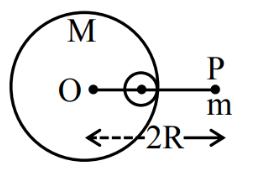
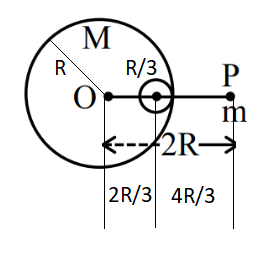
A small point of mass \(m\) is placed at a distance \(2 R\) from the centre ‘ \(O\) ‘ of a big uniform solid sphere of mass \(M\) and radius \(R\). The gravitational force on ‘ \(m\) ‘ due to \(M\) is \(\mathrm{F}_1\). A spherical part of radius \(\mathrm{R} / 3\) is removed from the big sphere as shown in the figure and the gravitational force on m due to remaining part of \(M\) is found to be \(F_2\). The value of ratio \(F_1: F_2\) is [JEE Main 2025 (Online) 22nd January Morning Shift]
 CorrectIncorrect
Hint
(b)

To find the ratio \(F_1: F_2\), we use the principle of superposition. This principle states that the gravitational force of the remaining part is equal to the force of the original full sphere minus the force that would have been exerted by the removed part.
Step 1: Calculate the Initial Force ( \(F_1\) )
For a point mass \(m\) outside a uniform solid sphere of mass \(M\), the sphere behaves as if all its mass is concentrated at its center.
Distance from center \(O\) to mass \(m\) is \(r_1=2 R\).
\(
F_1=\frac{G M m}{(2 R)^2}=\frac{G M m}{4 R^2}
\)
Step 2: Properties of the Removed Part
The removed sphere has a radius \(r=R / 3\). Since the sphere is uniform, its mass \(M^{\prime}\) is proportional to its volume \(\left(V \propto r^3\right)\).
Mass of original sphere \(M \propto R^3\)
Mass of removed part \(M^{\prime}=M\left(\frac{R / 3}{R}\right)^3=\frac{M}{27}\)
Distance of the removed part’s center from \(m\) : Looking at the geometry (assuming the cavity is on the side closest to \(m\) as per standard JEE problems of this type), the center of the cavity is at a distance \(R-R / 3=2 R / 3\) from the center \(O\).
The distance from \(O\) to \(m\) is \(2 R\).
The distance from the center of the cavity to \(m\) is \(r_2=2 R-\frac{2 R}{3}=\frac{4 R}{3}\).
Step 3: Calculate Force from the Removed Part (\(F_{\text {removed }}\))
\(
\begin{aligned}
& F_{\text {removed }}=\frac{G M^{\prime} m}{\left(r_2\right)^2}=\frac{G(M / 27) m}{(4 R / 3)^2} \\
& F_{\text {removed }}=\frac{G M m}{27} \cdot \frac{9}{16 R^2}=\frac{G M m}{48 R^2}
\end{aligned}
\)
Step 4: Calculate the Remaining Force (\(F_2\))
\(
\begin{gathered}
F_2=F_1-F_{\text {removed }} \\
F_2=\frac{G M m}{4 R^2}-\frac{G M m}{48 R^2}
\end{gathered}
\)
To subtract, find a common denominator (48):
\(
F_2=\frac{12 G M m}{48 R^2}-\frac{1 G M m}{48 R^2}=\frac{11 G M m}{48 R^2}
\)
Step 5: Find the Ratio \(F_1: F_2\)
\(
\frac{F_1}{F_2}=\frac{\frac{G M m}{4 R^2}}{\frac{11 G M m}{48 R^2}}=\frac{1}{4} \cdot \frac{48}{11}=\frac{12}{11}
\)
The value of the ratio \(F_1: F_2\) is \(12: 11\). - Question 9 of 92
9. Question
A satellite of \(10^3 \mathrm{~kg}\) mass is revolving in circular orbit of radius \(2 R\). If \(\frac{10^4 R}{6} \mathrm{~J}\) energy is supplied to the satellite, it would revolve in a new circular orbit of radius (use \(g=10 \mathrm{~m} / \mathrm{s}^2, R=\) radius of earth) [JEE Main 2024 (Online) 9th April Evening Shift]
CorrectIncorrectHint
(b)

Step 1: Calculate the initial total energy of the satellite
The total energy \(E\) of a satellite in a circular orbit of radius \(r\) is given by the formula \(E=-\frac{G M m}{2 r}\), where \(G\) is the gravitational constant, \(M\) is the mass of the Earth, and \(m\) is the mass of the satellite.
Using the relationship \(g=\frac{G M}{R^2}\), we can express \(G M=g R^2\).
The initial orbital radius is \(r_1=2 R\). The initial energy \(E_1\) is:
\(
E_1=-\frac{G M m}{2 r_1}=-\frac{g R^2 m}{2(2 R)}=-\frac{g R m}{4}
\)
Substitute the given values \(g=10 \mathrm{~m} / \mathrm{s}^2\) and \(m=10^3 \mathrm{~kg}\) :
\(
E_1=-\frac{\left(10 \mathrm{~m} / \mathrm{s}^2\right) R\left(10^3 \mathrm{~kg}\right)}{4}=-\frac{10^4 R}{4} \mathrm{~J}
\)
Step 2: Calculate the final total energy of the satellite
The energy supplied to the satellite is \(\Delta E=\frac{10^4 R}{6} \mathrm{~J}\). The final energy \(E_2\) is the sum of the initial energy and the supplied energy:
\(
\begin{gathered}
E_2=E_1+\Delta E \\
E_2=-\frac{10^4 R}{4}+\frac{10^4 R}{6}=10^4 R\left(-\frac{1}{4}+\frac{1}{6}\right)=10^4 R\left(-\frac{3}{12}+\frac{2}{12}\right) \\
E_2=10^4 R\left(-\frac{1}{12}\right)=-\frac{10^4 R}{12} \mathrm{~J}
\end{gathered}
\)
Step 3: Determine the new orbital radius
The final energy \(E_2\) is related to the new orbital radius \(r_2\) by the same energy formula:
\(
E_2=-\frac{g R^2 m}{2 r_2}
\)
Substitute the values for \(g\) and \(m\) into this expression:
\(
E_2=-\frac{\left(10 \mathrm{~m} / \mathrm{s}^2\right) R^2\left(10^3 \mathrm{~kg}\right)}{2 r_2}=-\frac{10^4 R^2}{2 r_2} \mathrm{~J}
\)
Now equate the two expressions for \(E_2\) :
\(
\begin{aligned}
-\frac{10^4 R^2}{2 r_2} & =-\frac{10^4 R}{12} \\
\frac{R^2}{2 r_2} & =\frac{R}{12}
\end{aligned}
\)
Solve for \(\boldsymbol{r}_2\) :
\(
\begin{gathered}
12 R^2=2 r_2 R \\
r_2=\frac{12 R^2}{2 R}=6 R
\end{gathered}
\)
The new circular orbit radius is \(\mathbf{6 R}\). - Question 10 of 92
10. Question
An astronaut takes a ball of mass \(m\) from earth to space. He throws the ball into a circular orbit about earth at an altitude of 318.5 km . From earth’s surface to the orbit, the change in total mechanical energy of the ball is \(x \frac{\mathrm{GM}_{\mathrm{e}} \mathrm{m}}{21 \mathrm{R}_{\mathrm{e}}}\). The value of \(x\) is (take \(\mathrm{R}_{\mathrm{e}}=6370 \mathrm{~km}\)): [JEE Main 2024 (Online) 9th April Morning Shift]
CorrectIncorrectHint
(b) To find the value of \(x\), we need to calculate the change in total mechanical energy between the ball’s initial state on the Earth’s surface and its final state in a circular orbit.
Step 1: Initial Total Energy (\(\boldsymbol{E}_{\mathbf{1}}\))
On the Earth’s surface, the ball is at rest (relative to the Earth). Its energy is purely gravitational potential energy:
Distance from center: \(r_1=R_e\)
Total Energy ( \(E_1\) ):
\(
E_1=-\frac{G M_e m}{R_e}
\)
Step 2: Final Total Energy (\(E_2\))
In a circular orbit, the ball has both kinetic and potential energy. The total mechanical energy of a satellite in a circular orbit of radius \(r\) is given by \(E=-\frac{G M_e m}{2 r}\).
Altitude (h): 318.5 km
Earth’s Radius \(\left(R_e\right): 6370 \mathrm{~km}\)
Orbital Radius \(\left(r_2\right): R_e+h=6370+318.5=6688.5 \mathrm{~km}\)
Let’s express \(r_2\) in terms of \(R_e\) :
\(
\frac{r_2}{R_e}=\frac{6688.5}{6370}=1.05=\frac{21}{20}
\)
So, \(r_2=\frac{21}{20} R_e\).
Total Energy (\(E_2\)):
\(
E_2=-\frac{G M_e m}{2\left(\frac{21}{20} R_e\right)}=-\frac{20 G M_e m}{42 R_e}=-\frac{10 G M_e m}{21 R_e}
\)
Step 3: Change in Mechanical Energy (\(\Delta E\))
\(
\begin{gathered}
\Delta E=E_2-E_1 \\
\Delta E=\left(-\frac{10 G M_e m}{21 R_e}\right)-\left(-\frac{G M_e m}{R_e}\right)
\end{gathered}
\)
To subtract, we use a common denominator of \(21 R_e\) :
\(
\begin{gathered}
\Delta E=-\frac{10 G M_e m}{21 R_e}+\frac{21 G M_e m}{21 R_e} \\
\Delta E=\frac{11 G M_e m}{21 R_e}
\end{gathered}
\)
Step 4: Finding \(x\)
The problem states the change is \(x \frac{G M_e m}{21 R_e}\). Comparing this to our result:
\(
\begin{aligned}
\frac{11 G M_e m}{21 R_e} & =x \frac{G M_e m}{21 R_e} \\
x & =11
\end{aligned}
\)
The value of \(x\) is 11. - Question 11 of 92
11. Question
Two satellite \(A\) and \(B\) go round a planet in circular orbits having radii \(4R\) and \(R\) respectively. If the speed of \(A\) is \(3 v\), the speed of \(B\) will be : [JEE Main 2024 (Online) 8th April Evening Shift]
CorrectIncorrectHint
(a) To find the speed of satellite \(B\), we use the relationship between orbital velocity and the radius of a circular orbit.
Step 1: The Formula
The orbital speed \(\left(v_{\text {orb }}\right)\) of a satellite revolving around a planet is given by:
\(
v_{o r b}=\sqrt{\frac{G M}{r}}
\)
Where:
\(G\) is the universal gravitational constant.
\(M\) is the mass of the planet.
\(r\) is the radius of the orbit.
Step 2: Establishing the Relationship
From the formula, we can see that the orbital speed is inversely proportional to the square root of the orbital radius:
\(
v \propto \frac{1}{\sqrt{r}}
\)
We can set up a ratio between satellite \(A\) and satellite \(B\) :
\(
\frac{v_B}{v_A}=\sqrt{\frac{r_A}{r_B}}
\)
Step 3: Substituting the Values
Given in the problem:
Radius of \(A\left(r_A\right)=4 R\)
Radius of \(B\left(r_B\right)=R\)
Speed of \(A\left(v_A\right)=3 v\)
Plugging these into our ratio:
\(
\begin{gathered}
\frac{v_B}{3 v}=\sqrt{\frac{4 R}{R}} \\
\frac{v_B}{3 v}=\sqrt{4} \\
\frac{v_B}{3 v}=2
\end{gathered}
\)
Step 4: Final Calculation
\(
v_B=2 \times 3 v=6 v
\)
The speed of satellite \(B\) is \(6 v\). - Question 12 of 92
12. Question
Two planets \(A\) and \(B\) having masses \(m_1\) and \(m_2\) move around the sun in circular orbits of \(r_1\) and \(r_2\) radii respectively. If angular momentum of \(A\) is \(L\) and that of \(B\) is \(3 L\) , the ratio of time period \(\left(\frac{T_A}{T_B}\right)\) is: [JEE Main 2024 (Online) 8th April Morning Shift]
CorrectIncorrectHint
(d) Step 1: Kepler’s Third Law
Kepler’s Third Law states that for any object orbiting a central mass (like the Sun), the square of the orbital period \((T)\) is directly proportional to the cube of the radius \((r)\) of its orbit:
\(
T^2 \propto r^3
\)
Step 2: Setting up the Ratio
For Planet A: \(T_A^2 \propto r_1^3\) For Planet B: \(T_B^2 \propto r_2^3\)
Dividing the two proportions gives us:
\(
\left(\frac{T_A}{T_B}\right)^2=\left(\frac{r_1}{r_2}\right)^3
\)
Taking the square root of both sides:
\(
\frac{T_A}{T_B}=\left(\frac{r_1}{r_2}\right)^{3 / 2}
\)
Step 3: Analyzing the Options
Looking at the provided options, none of them match \(\left(\frac{r_1}{r_2}\right)^{3 / 2}\) directly. However, we must check if the angular momentum information allows us to express the ratio differently.
Angular momentum is given by \(L=m v r\). For a circular orbit, orbital velocity \(v=\sqrt{\frac{G M_{\text {sum }}}{r}}\).
Substituting \(v\) :
\(
L=m \sqrt{\frac{G M_{\text {sun }}}{r}} \cdot r=m \sqrt{G M_{\text {sun }} r}
\)
For the two planets:
\(L=m_1 \sqrt{G M_{\text {sun }} r_1} \dots(1) \)
\(3 L=m_2 \sqrt{G M_{\text {sun }} r_2} \dots(2)\)
Divide equation (2) by equation (1):
\(
3=\frac{m_2}{m_1} \sqrt{\frac{r_2}{r_1}}
\)
Squaring both sides:
\(
9=\left(\frac{m_2}{m_1}\right)^2 \frac{r_2}{r_1} \Longrightarrow \frac{r_1}{r_2}=\frac{1}{9}\left(\frac{m_2}{m_1}\right)^2
\)
\(
\begin{aligned}
&\text { Now, substitute this back into our time period ratio: }\\
&\begin{gathered}
\frac{T_A}{T_B}=\left[\frac{1}{9}\left(\frac{m_2}{m_1}\right)^2\right]^{3 / 2} \\
\frac{T_A}{T_B}=\left(\frac{1}{9}\right)^{3 / 2}\left[\left(\frac{m_2}{m_1}\right)^2\right]^{3 / 2} \\
\frac{T_A}{T_B}=\frac{1}{27}\left(\frac{m_2}{m_1}\right)^3
\end{gathered}
\end{aligned}
\) - Question 13 of 92
13. Question
Assuming the earth to be a sphere of uniform mass density, a body weighed 300 N on the surface of earth. How much it would weigh at R/4 depth under surface of earth? [JEE Main 2024 (Online) 6th April Evening Shift]
CorrectIncorrectHint
(d) To find the weight of the body at a certain depth, we need to determine how the acceleration due to gravity (\(g\)) changes as we move toward the center of the Earth.
Step 1: The Formula for Gravity at Depth
For a sphere of uniform density, the acceleration due to gravity at a depth \(d\) below the surface is given by:
\(
g_d=g\left(1-\frac{d}{R}\right)
\)
Where:
\(g\) is the acceleration due to gravity at the surface.
\(d\) is the depth from the surface.
\(R\) is the radius of the Earth.
Step 2: Weight Relationship
Weight (\(W\)) is the product of mass (\(m\)) and acceleration due to gravity (\(g\)). Since mass remains constant, the weight at depth \(d\left(W_d\right)\) is proportional to \(g_d\) :
\(
W_d=W_{\text {surface }}\left(1-\frac{d}{R}\right)
\)
Step 3: Calculation
Given:
Weight on surface \(\left(W_{\text {surface }}\right)=300 \mathrm{~N}\)
Depth \((d)=R / 4\)
Substitute these values into the formula:
\(
\begin{gathered}
W_d=300\left(1-\frac{R / 4}{R}\right) \\
W_d=300\left(1-\frac{1}{4}\right) \\
W_d=300\left(\frac{3}{4}\right) \\
W_d=75 \times 3=225 \mathrm{~N}
\end{gathered}
\) - Question 14 of 92
14. Question
To project a body of mass \(m\) from earth’s surface to infinity, the required kinetic energy is (assume, the radius of earth is \(R_E\), \(g=\) acceleration due to gravity on the surface of earth): [JEE Main 2024 (Online) 6th April Morning Shift]
CorrectIncorrectHint
(c) To project a body to infinity, the required kinetic energy must be equal to the magnitude of the gravitational binding energy on the Earth’s surface.
Step-by-Step Derivation
Step 1: Conservation of Energy Principle For the body to just reach infinity, its total energy at the surface must be at least zero (\(E_{\text {total }} \geq 0\)).
\(
K_{\text {surface }}+U_{\text {surface }}=0
\)
Step 2: Potential Energy on the Surface The gravitational potential energy (\(U\)) of a mass \(m\) at the surface of the Earth is:
\(
U_{\text {surface }}=-\frac{G M_e m}{R_E}
\)
Step 3: Expressing \(G M_e\) in terms of \(g\) We know that the acceleration due to gravity on the surface is:
\(
g=\frac{G M_e}{R_E^2} \Longrightarrow G M_e=g R_E^2
\)
Step 4: Calculating Required Kinetic Energy (\(K\)) Substitute the value of \(G M_e\) back into the potential energy equation:
\(
U_{\text {surface }}=-\frac{\left(g R_E^2\right) m}{R_E}=-m g R_E
\)
Now, using the conservation of energy:
\(
\begin{gathered}
K-m g R_E=0 \\
K=m g R_E
\end{gathered}
\) - Question 15 of 92
15. Question
A satellite revolving around a planet in stationary orbit has time period 6 hours. The mass of planet is one-fourth the mass of earth. The radius orbit of planet is \(\left(\right.\) Given \(=\) Radius of geo-stationary orbit for earth is \(\left.4.2 \times 10^4 \mathrm{~km}\right)\) [JEE Main 2024 (Online) 5th April Evening Shift]
CorrectIncorrectHint
(d)
\(
\begin{aligned}
& \frac{T_1}{T_2}=\left(\frac{r_1}{r_2}\right)^{3 / 2} \sqrt{\frac{m_2}{m_1}} \\
& \Rightarrow \quad \frac{24}{6}=\left(\frac{4.2 \times 10^4}{r_2}\right)^{3 / 2} \sqrt{\frac{m / 4}{m}} \\
& \Rightarrow r_2=1.05 \times 10^4 \mathrm{~km}
\end{aligned}
\)Explanation: To find the orbital radius of the satellite, we use the generalized version of Kepler’s Third Law, which accounts for both the orbital period and the mass of the central body.
Step 1: The Relationship
The square of the orbital period ( \(T\) ) is proportional to the cube of the orbital radius (\(r\)) and inversely proportional to the mass of the planet (\(M\)):
\(
T^2=\frac{4 \pi^2 r^3}{G M} \Longrightarrow r^3 \propto T^2 M
\)
Step 2: Setting up the Ratio
We can compare the satellite of the unknown planet (\(p\)) to a geo-stationary satellite around Earth (e):
\(
\frac{r_p^3}{r_e^3}=\frac{T_p^2}{T_e^2} \times \frac{M_p}{M_e}
\)
Step 3: Given Data
Earth’s geo-stationary orbit radius \(\left(r_e\right): 4.2 \times 10^4 \mathrm{~km}\)
Earth’s geo-stationary period \(\left(T_e\right)\) : 24 hours
Planet’s satellite period \(\left(T_p\right)\) : 6 hours
Mass of planet \(\left(M_p\right): \frac{1}{4} M_e \Longrightarrow \frac{M_p}{M_e}=\frac{1}{4}\)
Step 4: Calculation
Substitute the ratios into the equation:
\(
\begin{gathered}
\left(\frac{r_p}{r_e}\right)^3=\left(\frac{6}{24}\right)^2 \times\left(\frac{1}{4}\right) \\
\left(\frac{r_p}{r_e}\right)^3=\left(\frac{1}{4}\right)^2 \times \frac{1}{4} \\
\left(\frac{r_p}{r_e}\right)^3=\frac{1}{16} \times \frac{1}{4}=\frac{1}{64}
\end{gathered}
\)
Now, take the cube root of both sides:
\(
\frac{r_p}{r_e}=\sqrt[3]{\frac{1}{64}}=\frac{1}{4}
\)
Finally, solve for \(r_p\) :
\(
\begin{aligned}
& r_p=\frac{r_e}{4}=\frac{4.2 \times 10^4}{4} \\
& r_p=1.05 \times 10^4 \mathrm{~km}
\end{aligned}
\) - Question 16 of 92
16. Question
If \(G\) be the gravitational constant and \(u\) be the energy density then which of the following quantity have the dimensions as that of the \(\sqrt{u G}\) : [JEE Main 2024 (Online) 5th April Morning Shift]
CorrectIncorrectHint
(d) To find the physical quantity with the same dimensions as \(\sqrt{u G}\), we will derive the dimensional formulas for each component and compare them with the given options.
Step 1: Dimensional Formula of Energy Density ( \(u\) )
Energy density is defined as energy per unit volume.
Energy ( \(E\) ): \(\left[M L^2 T^{-2}\right]\)
Volume ( \(V\) ): \(\left[L^3\right]\)
Energy Density \((u): \frac{\left[M L^2 T^{-2}\right]}{\left[L^3\right]}=\left[M L^{-1} T^{-2}\right]\)
Step 2:Dimensional Formula of Gravitational Constant (\(G\))
From Newton’s Law of Gravitation, \(F=\frac{G m_1 m_2}{r^2}\) :
\(G=\frac{F r^2}{m^2}\)
Force \((F):\left[M L T^{-2}\right]\)
\(G\) Dimensions: \(\frac{\left[M L T^{-2}\right]\left[L^2\right]}{\left[M^2\right]}=\left[M^{-1} L^3 T^{-2}\right]\)
Step 3: Dimensional Formula of \(\sqrt{u G}\)
Multiply the dimensions of \(u\) and \(G\) :
\(
u \cdot G=\left[M L^{-1} T^{-2}\right] \cdot\left[M^{-1} L^3 T^{-2}\right]
\)
\(
u \cdot G=\left[M^{1-1} L^{-1+3} T^{-2-2}\right]=\left[M^0 L^2 T^{-4}\right]
\)
Now, take the square root:
\(
\sqrt{u G}=\sqrt{\left[L^2 T^{-4}\right]}=\left[L T^{-2}\right]
\)
The dimensions of \(\sqrt{u G}\) are \(\left[L T^{-2}\right]\), which are the dimensions of acceleration.
Force per unit mass: According to Newton’s Second Law (\(F=m a \Longrightarrow a=F / m\)):
Dimensions: \(\frac{\left[M L T^{-2}\right]}{[M]}=\left[L T^{-2}\right]\) (Correct) - Question 17 of 92
17. Question
Match the List-I with List-II
\(
\begin{array}{|l|l|l|l|}
\hline & \text { List-I } & & \text { List-II } \\
\hline \text { (A) } & \text { Kinetic energy of planet } & \text { (I) } & -\mathrm{GMm} / \mathrm{a} \\
\hline \text { (B) } & \text { Gravitation Potential energy of sunplanet system } & \text { (II) } & \mathrm{GMm} / 2 \mathrm{a} \\
\hline \text { (C) } & \text { Total mechanical energy of planet } & \text { (III) } & \frac{\mathrm{Gm}}{\mathrm{r}} \\
\hline \text { (D) } & \text { Escape energy at the surface of planet for unit mass object } & \text { (IV) } & -\mathrm{GMm} / 2 \mathrm{a} \\
\hline
\end{array}
\)
(Where \(\mathbf{a}=\) radius of planet orbit, \(\mathbf{r}=\) radius of planet, \(\mathbf{M}=\) mass of Sun, \(\mathbf{m}=\) mass of planet)
Choose the correct answer from the options given below: [JEE Main 2024 (Online) 5th April Morning Shift]CorrectIncorrectHint
(a) Analysis of the Physics Concepts
For a planet of mass \(m\) orbiting a Sun of mass \(M\) at an orbital radius \(a\) :
Kinetic Energy (K): In a stable circular orbit, the centripetal force is provided by gravity (\(m v^2 / a=G M m / a^2\)). This leads to the kinetic energy:
\(
K=\frac{G M m}{2 a}
\)
Gravitational Potential Energy (U): By definition, the potential energy between two masses \(M\) and \(m\) at distance \(a\) is:
\(
U=-\frac{G M m}{a}
\)
Total Mechanical Energy (E): The total energy is the sum of kinetic and potential energy \((E=K+U)\) :
\(
E=\frac{G M m}{2 a}+\left(-\frac{G M m}{a}\right)=-\frac{G M m}{2 a}
\)
Escape Energy (per unit mass): To escape the surface of a planet with radius \(r\) and mass \(m\), an object (unit mass \(=1\)) must overcome its potential energy. The energy required to move from the surface (\(U=-G m / r\)) to infinity (\(U=0\)) is:
\(
\text { Escape Energy }=\frac{G m}{r}
\) - Question 18 of 92
18. Question
A 90 kg body placed at \(2 R\) distance from surface of earth experiences gravitational pull of : (\(\mathrm{R}=\) Radius of earth, \(\mathrm{g}=10 \mathrm{~m} \mathrm{~s}^{-2}\)) [JEE Main 2024 (Online) 4th April Evening Shift]
CorrectIncorrectHint
(c) Step 1: Determine the total distance from the center of Earth
The distance from the surface is given as \(2 R\). The total distance from the center of the Earth \((r)\) is the sum of the radius of the Earth \((R)\) and the distance from the surface:
\(
r=R+2 R=3 R
\)
Step 2: Calculate the acceleration due to gravity at that distance
The acceleration due to gravity \(\left(\mathrm{g}^{\prime}\right)\) at a distance \(\boldsymbol{r}\) from the center of the Earth is related to the surface gravity (\(g\)) by the inverse square law:
\(
\frac{g^{\prime}}{g}=\left(\frac{R}{r}\right)^2
\)
Substituting \(r=3 R\) into the equation:
\(
\frac{g^{\prime}}{g}=\left(\frac{R}{3 R}\right)^2=\left(\frac{1}{3}\right)^2=\frac{1}{9}
\)
Therefore, the acceleration due to gravity at that distance is \(g^{\prime}=\frac{g}{9}=\frac{10 \mathrm{~m} / \mathrm{s}^2}{9}\).
Step 3: Calculate the gravitational force
The gravitational force (\(F\)) experienced by the 90 kg body is calculated using Newton’s second law with the local acceleration due to gravity:
\(
\begin{gathered}
F=m \cdot g^{\prime} \\
F=90 \mathrm{~kg} \cdot \frac{10}{9} \mathrm{~m} / \mathrm{s}^2=100 \mathrm{~N}
\end{gathered}
\)
The gravitational pull experienced by the body is \(\mathbf{1 0 0 ~ N}\). - Question 19 of 92
19. Question
Correct formula for height of a satellite from earths surface is : [JEE Main 2024 (Online) 4th April Evening Shift]
CorrectIncorrectHint
(a)

Step 1: Equate gravitational and centripetal forces
For a satellite of mass \(m\) orbiting the Earth (mass \(M\)) at a distance \(r\) from the center:
Orbital Radius: \(r=R+h\) (where \(R\) is the Earth’s radius and \(h\) is the height from the surface).
Gravitational Force = Centripetal Force: (A satellite in a circular orbit maintains its path because the gravitational force exerted by the Earth provides the necessary centripetal force. We equate these two forces.)
\(
\frac{G M m}{r^2}=m \omega^2 r=m \frac{v^2}{r}
\)
Since \(\omega=\frac{2 \pi}{T}\), we substitute to get:
\(
\frac{G M}{r^2}=\left(\frac{2 \pi}{T}\right)^2 r \Longrightarrow \frac{G M}{r^2}=\frac{4 \pi^2 r}{T^2}
\)
Rearranging for \(r^3\) :
\(
r^3=\frac{G M T^2}{4 \pi^2}
\)
Step 2: Relate gravitational constant to surface gravity.Substituting \(g\) for \(G\) and \(M\)
On the Earth’s surface, the acceleration due to gravity is \(g=\frac{G M}{R^2}\). Therefore, we can replace \(G M\) with \(g R^2\) :
\(
r^3=\frac{\left(g R^2\right) T^2}{4 \pi^2}
\)
Step 3: Solving for Height (\(h\))
Take the cube root of both sides to find \(r\) :
\(
r=\left(\frac{g R^2 T^2}{4 \pi^2}\right)^{1 / 3}
\)
Since \(r=R+h\), the height \(h\) is:
\(
h=\left(\frac{T^2 R^2 g}{4 \pi^2}\right)^{1 / 3}-R
\) - Question 20 of 92
20. Question
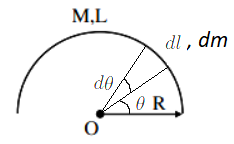
A metal wire of uniform mass density having length \(L\) and mass \(M\) is bent to form a semicircular arc and a particle of mass \(m\) is placed at the centre of the arc. The gravitational force on the particle by the wire is : [JEE Main 2024 (Online) 4th April Morning Shift]
CorrectIncorrectHint
(d)

To solve this, we need to find the gravitational force exerted by a continuous mass distribution (the semicircular wire) on a point mass \(m\).
Step 1: Geometry of the Wire
The wire of length \(L\) is bent into a semicircle.
The length of a semicircle is \(L=\pi R\), where \(R\) is the radius.
Therefore, the radius is \(R=\frac{L}{\pi}\).
The linear mass density of the wire is \(\lambda=\frac{M}{L}\).
Step 2: Force from a Small Element
Consider a small element of the wire of length \(d l\) at an angle \(\theta\).
The mass of this element is \(d m=\lambda d l=\lambda(R d \theta)\).
The gravitational force \(d F\) exerted by this element on mass \(m\) at the center is:
\(
d F=\frac{G m(d m)}{R^2}=\frac{G m(\lambda R d \theta)}{R^2}=\frac{G m \lambda d \theta}{R}
\)
Step 3: Resolving Components
By symmetry, the force components parallel to the base of the semicircle cancel out. We only need to integrate the vertical components (perpendicular to the diameter):
\(d F_y=d F \sin \theta\)
Integrating from \(\theta=0\) to \(\pi\) :
\(
\begin{gathered}
F_{n e t}=\int_0^\pi \frac{G m \lambda}{R} \sin \theta d \theta \\
F_{n e t}=\frac{G m \lambda}{R}[-\cos \theta]_0^\pi=\frac{G m \lambda}{R}[1-(-1)]=\frac{2 G m \lambda}{R}
\end{gathered}
\)
Step 4: Final Substitution
Now, substitute the values of \(\lambda\) and \(\boldsymbol{R}\) back into the equation:
\(\lambda=\frac{M}{L}\)
\(\boldsymbol{R}=\frac{\boldsymbol{L}}{\pi}\)
\(
F_{n e t}=\frac{2 G m(M / L)}{(L / \pi)}=\frac{2 G m M \pi}{L^2}
\) - Question 21 of 92
21. Question
A light planet is revolving around a massive star in a circular orbit of radius R with a period of revolution \(T\). If the force of attraction between planet and star is proportional to \(\mathrm{R}^{-3 / 2}\) then choose the correct option : [JEE Main 2024 (Online) 1st February Evening Shift]
CorrectIncorrectHint
(c) Step 1: Setting up the Force Equation
For a planet of mass \(m\) revolving around a star of mass \(M\), the centripetal force required for circular motion is provided by the gravitational force of attraction \((F)\).
According to the problem:
\(
F \propto R^{-3 / 2} \Longrightarrow F=\frac{k}{R^{3 / 2}}
\)
(where \(k\) is a constant).
Step 2: Relating Force to Circular Motion
The centripetal force is given by \(F=m \omega^2 R\). We can substitute \(\omega=\frac{2 \pi}{T}\) into this expression:
\(
\begin{gathered}
F=m\left(\frac{2 \pi}{T}\right)^2 R \\
F=\frac{4 \pi^2 m R}{T^2}
\end{gathered}
\)
Step 3: Establishing the Proportionality
Now, we equate the two expressions for the force:
\(
\frac{4 \pi^2 m R}{T^2} \propto R^{-3 / 2}
\)
To find the relationship between \(T\) and \(R\), we rearrange the equation:
\(
\begin{aligned}
\frac{1}{T^2} & \frac{R^{-3 / 2}}{R} \\
\frac{1}{T^2} & \propto R^{-3 / 2-1} \\
\frac{1}{T^2} & \propto R^{-5 / 2}
\end{aligned}
\)
\(
T^2 \propto R^{5 / 2}
\) - Question 22 of 92
22. Question
If \(R\) is the radius of the earth and the acceleration due to gravity on the surface of earth is \(g=\pi^2 \mathrm{~m} / \mathrm{s}^2\), then the length of the second’s pendulum at a height \(\mathrm{h}=2 R\) from the surface of earth will be : [JEE Main 2024 (Online) 1st February Morning Shift]
CorrectIncorrectHint
(a) Step 1: Calculate acceleration due to gravity at height \(\boldsymbol{h}\)
The acceleration due to gravity at a height \(h\) from the Earth’s surface, \(g^{\prime}\), is given by the formula \(g^{\prime}=g\left(\frac{R}{R+h}\right)^2\), where \(g\) is the gravity at the surface and \(R\) is the Earth’s radius.
Given \(h=2 R\) and \(g=\pi^2 \mathrm{~m} / \mathrm{s}^2\) :
\(
g^{\prime}=\pi^2\left(\frac{R}{R+2 R}\right)^2=\pi^2\left(\frac{R}{3 R}\right)^2=\pi^2\left(\frac{1}{3}\right)^2=\frac{\pi^2}{9} \mathrm{~m} / \mathrm{s}^2
\)
Step 2: Calculate the length of the second’s pendulum
The time period \(T\) of a simple pendulum of length \(L\) under acceleration \(g^{\prime}\) is given by \(T=2 \pi \sqrt{\frac{L}{g^{\prime}}}\). A second’s pendulum has a time period \(T=2\) seconds.
\(
2=2 \pi \sqrt{\frac{L}{g^{\prime}}}
\)
Substituting the value of \(g^{\prime}\) :
\(
2=2 \pi \sqrt{\frac{L}{\pi^2 / 9}}
\)
Solving for \(L\) :
\(
\begin{gathered}
1=\pi \sqrt{\frac{9 L}{\pi^2}} \Rightarrow 1=\pi \frac{3 \sqrt{L}}{\pi} \Rightarrow 1=3 \sqrt{L} \\
\sqrt{L}=\frac{1}{3} \Rightarrow L=\left(\frac{1}{3}\right)^2=\frac{1}{9} \mathrm{~m}
\end{gathered}
\)
The length of the second’s pendulum at a height \(h=2 R\) is \(\frac{1}{9} \mathrm{~m}\). - Question 23 of 92
23. Question
The mass of the moon is \(\frac{1}{144}\) times the mass of a planet and its diameter is \(\frac{1}{16}\) times the diameter of a planet. If the escape velocity on the planet is \(v\), the escape velocity on the moon will be : [JEE Main 2024 (Online) 31st January Evening Shift]
CorrectIncorrectHint
(d) To find the escape velocity on the moon relative to the planet, we use the standard formula for escape velocity (\(v_e\)):
\(
v_e=\sqrt{\frac{2 G M}{R}}
\)
Where:
\(G\) is the gravitational constant.
\(M\) is the mass of the celestial body.
\(R\) is the radius of the celestial body.
Step 1: Identify the Ratios
Let the mass and radius of the planet be \(M_p\) and \(R_p\) and for the moon be \(M_m\) and \(R_m\).
Based on the problem:
Mass: \(M_m=\frac{1}{144} M_p\)
Radius: Since diameter is proportional to radius, \(R_m=\frac{1}{16} R_p\)
Step 2: Set up the Proportion
The escape velocity on the planet is \(v\). We can write the ratio of the escape velocity of the moon \(\left(v_m\right)\) to the planet \((v)\) :
\(
\frac{v_m}{v}=\frac{\sqrt{\frac{2 G M_m}{R_m}}}{\sqrt{\frac{2 G M_p}{R_p}}}
\)
Simplifying the constants \(2 G\) :
\(
\frac{v_m}{v}=\sqrt{\frac{M_m}{M_p} \cdot \frac{R_p}{R_m}}
\)
Step 3: Substitute the Values
Plug in the given ratios:
\(
\begin{gathered}
\frac{v_m}{v}=\sqrt{\left(\frac{1}{144}\right) \cdot\left(\frac{16}{1}\right)} \\
\frac{v_m}{v}=\sqrt{\frac{16}{144}}
\end{gathered}
\)
\(
\begin{aligned}
&\frac{v_m}{v}=\sqrt{\frac{1}{9}}=\frac{1}{3}\\
&v_m=\frac{v}{3}
\end{aligned}
\) - Question 24 of 92
24. Question
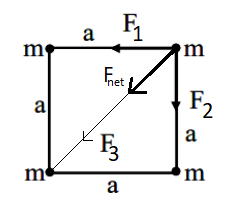
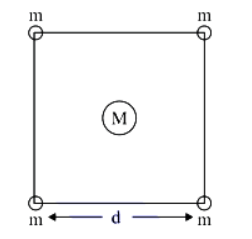
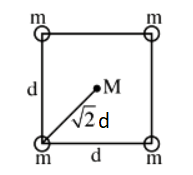
Four identical particles of mass \(m\) are kept at the four corners of a square. If the gravitational force exerted on one of the masses by the other masses is \(\left(\frac{2 \sqrt{2}+1}{32}\right) \frac{\mathrm{Gm}^2}{L^2}\), the length of the sides of the square is [JEE Main 2024 (Online) 31st January Morning Shift]
CorrectIncorrectHint
(a)

Step 1: Define the gravitational forces
The total gravitational force on one mass is the vector sum of forces from the other three masses. Let the side length of the square be \(a\). The distances are \(a, a\), and \(a \sqrt{2}\).
The magnitudes of the individual forces are \(F_1=F_2=\frac{G m^2}{a^2}\) and
\(
F_3=\frac{G m^2}{(a \sqrt{2})^2}=\frac{G m^2}{2 a^2} .
\)
Step 2: Calculate the total force
The two forces of magnitude \(F_1\) and \(F_2\) are perpendicular, and their resultant magnitude \(F_{12}\) points along the diagonal, in the same direction as \(F_3\). The total force \(F_{\text {total }}\) is the sum of magnitudes along the diagonal:
\(
\begin{gathered}
F_{\text {total }}=F_{12}+F_3=\sqrt{F_1^2+F_2^2}+F_3 \\
F_{\text {total }}=\sqrt{2\left(\frac{G m^2}{a^2}\right)^2}+\frac{G m^2}{2 a^2}=\sqrt{2} \frac{G m^2}{a^2}+\frac{G m^2}{2 a^2} \\
F_{\text {total }}=\frac{G m^2}{a^2}\left(\sqrt{2}+\frac{1}{2}\right)=\frac{G m^2}{a^2}\left(\frac{2 \sqrt{2}+1}{2}\right)
\end{gathered}
\)
Step 3: Equate the calculated force to the given force and solve for the side length
We are given that the gravitational force exerted on one of the masses is \(\left(\frac{2 \sqrt{2}+1}{32}\right) \frac{\mathbf{G m}^2}{\boldsymbol{L}^2}\). Equating the expressions:
\(
\begin{aligned}
&\frac{G m^2}{a^2}\left(\frac{2 \sqrt{2}+1}{2}\right)=\left(\frac{2 \sqrt{2}+1}{32}\right) \frac{\mathrm{Gm}^2}{L^2}\\
&\text { Canceling common terms ( } \mathrm{Gm}^2 \text { and } 2 \sqrt{2}+1 \text { ): }\\
&\frac{1}{2 a^2}=\frac{1}{32 L^2}
\end{aligned}
\)
\(
a=4 L
\) - Question 25 of 92
25. Question
Escape velocity of a body from earth is \(11.2 \mathrm{~km} / \mathrm{s}\). If the radius of a planet be onethird the radius of earth and mass be one-sixth that of earth, the escape velocity from the planet is : [JEE Main 2024 (Online) 30th January Evening Shift]
CorrectIncorrectHint
(a) Step 1: Understand the escape velocity formula
The escape velocity \(\left(v_e\right)\) of a body from a celestial object is determined by the formula:
\(
v_e=\sqrt{\frac{2 G M}{R}}
\)
where \(\boldsymbol{G}\) is the gravitational constant, \(\boldsymbol{M}\) is the mass, and \(\boldsymbol{R}\) is the radius of the object.
Step 2: Establish the relationship between the two velocities
We can write the formula for both Earth (\(v_{\text {earth }}, M_{\text {earth }}, R_{\text {earth }}\)) and the planet (\(v_{\text {planet, }} \left.M_{\text {planet }}, R_{\text {planet }}\right):\)
\(v_{\text {earth }}=\sqrt{\frac{2 G M_{\text {earth }}}{R_{\text {earth }}}}\)
\(v_{\text {planet }}=\sqrt{\frac{2 G M_{\text {planet }}}{R_{\text {planet }}}}\)
To find the relationship, we can take the ratio of the planet’s escape velocity to Earth’s:
\(
\frac{v_{\text {planet }}}{v_{\text {earth }}}=\frac{\sqrt{\frac{2 G M_{\text {planet }}}{R_{\text {planet }}}}}{\sqrt{\frac{2 G M_{\text {earth }}}{R_{\text {earth }}}}}=\sqrt{\frac{M_{\text {planet }}}{M_{\text {earth }}} \times \frac{R_{\text {earth }}}{R_{\text {planet }}}}
\)
Step 3: Substitute the given values and calculate
The problem provides the following relationships:
\(M_{\text {planet }}=\frac{1}{6} M_{\text {earth }}\)
\(R_{\text {planet }}=\frac{1}{3} R_{\text {earth }}\)
Substitute these into the ratio equation:
\(
\frac{v_{\text {planet }}}{v_{\text {earth }}}=\sqrt{\frac{1 / 6 M_{\text {earth }}}{M_{\text {earth }}} \times \frac{R_{\text {earth }}}{1 / 3 R_{\text {earth }}}}=\sqrt{\frac{1 / 6}{1 / 3}}=\sqrt{\frac{3}{6}}=\sqrt{\frac{1}{2}}
\)
Now, solve for \(v_{\text {planet }}\) using \(v_{\text {earth }}=11.2 \mathrm{~km} / \mathrm{s}\) :
\(
v_{\text {planet }}=v_{\text {earth }} \times \frac{1}{\sqrt{2}}=11.2 \mathrm{~km} / \mathrm{s} \times \frac{1}{\sqrt{2}} \approx 7.9 \mathrm{~km} / \mathrm{s}
\)
The escape velocity from the planet is approximately \(7.9 \mathrm{~km} / \mathrm{s}\). - Question 26 of 92
26. Question
The gravitational potential at a point above the surface of earth is \(-5.12 \times 10^7 \mathrm{~J} / \mathrm{kg}\) and the acceleration due to gravity at that point is \(6.4 \mathrm{~m} / \mathrm{s}^2\). Assume that the mean radius of earth to be 6400 km . The height of this point above the earth’s surface is : [JEE Main 2024 (Online) 30th January Morning Shift]
CorrectIncorrectHint
(a) To solve for the height \(h\), we need to use the relationship between gravitational potential (\(V\)) and acceleration due to gravity (\(g^{\prime}\)) at a point outside the Earth.
Step 1: Fundamental Formulas
At a distance \(r\) from the center of the Earth:
Gravitational Potential ( \(V\) ): \(V=-\frac{G M}{r}\)
Acceleration due to gravity \(\left(g^{\prime}\right): g^{\prime}=\frac{G M}{r^2}\)
Step 2: Relationship between \(V\) and \(g^{\prime}\)
By dividing the magnitude of the potential by the acceleration, we can find the distance \(r\) :
\(
\frac{|V|}{g^{\prime}}=\frac{G M / r}{G M / r^2}=r
\)
Now, substitute the given values:
\(|V|=5.12 \times 10^7 \mathrm{~J} / \mathrm{kg}\)
\(g^{\prime}=6.4 \mathrm{~m} / \mathrm{s}^2\)
\(
\begin{gathered}
r=\frac{5.12 \times 10^7}{6.4} \\
r=0.8 \times 10^7 \mathrm{~m} \\
r=8000 \times 10^3 \mathrm{~m}=8000 \mathrm{~km}
\end{gathered}
\)
Step 3: Calculating the Height (\(h\))
The distance \(r\) is the sum of the Earth’s radius (\(R\)) and the height (h) above the surface:
\(
r=R+h
\)
Given that \(R=6400 \mathrm{~km}\) :
\(
\begin{gathered}
8000 \mathrm{~km}=6400 \mathrm{~km}+h \\
h=8000-6400 \\
h=1600 \mathrm{~km}
\end{gathered}
\) - Question 27 of 92
27. Question
A planet takes 200 days to complete one revolution around the Sun. If the distance of the planet from Sun is reduced to one fourth of the original distance, how many days will it take to complete one revolution : [JEE Main 2024 (Online) 29th January Evening Shift]
CorrectIncorrectHint
(d) To find the new orbital period, we use Kepler’s Third Law of Planetary Motion, which describes the relationship between a planet’s distance from the Sun and its period of revolution.
Step 1: Kepler’s Third Law
The square of the time period (\(T\)) of a planet is directly proportional to the cube of the semimajor axis (orbital radius, \(R\)) of its orbit:
\(
T^2 \propto R^3
\)
This can be written as a ratio for two different orbital states:
\(
\left(\frac{T_2}{T_1}\right)^2=\left(\frac{R_2}{R_1}\right)^3
\)
Step 2: Identifying the Given Values
Initial Period ( \(T_1\) ): 200 days
Initial Distance \(\left(R_1\right): R\)
New Distance \(\left(R_2\right): \frac{1}{4} R\) (since it is reduced to one-fourth)
New Period \(\left(T_2\right)\) : ?
Step 3: Calculating the New Period
Substitute the values into the ratio:
\(
\begin{aligned}
\left(\frac{T_2}{200}\right)^2 & =\left(\frac{\frac{1}{4} R}{R}\right)^3 \\
\left(\frac{T_2}{200}\right)^2 & =\left(\frac{1}{4}\right)^3 \\
\left(\frac{T_2}{200}\right)^2 & =\frac{1}{64}
\end{aligned}
\)
Take the square root of both sides:
\(
\begin{gathered}
\frac{T_2}{200}=\sqrt{\frac{1}{64}} \\
\frac{T_2}{200}=\frac{1}{8}
\end{gathered}
\)
Now, solve for \(T_2\) :
\(
\begin{gathered}
T_2=\frac{200}{8} \\
T_2=25 \text { days }
\end{gathered}
\)
The planet will take \(\mathbf{2 5}\) days to complete one revolution. - Question 28 of 92
28. Question
At what distance above and below the surface of the earth a body will have same weight. (take radius of earth as \(R\).) [JEE Main 2024 (Online) 29th January Morning Shift]
CorrectIncorrectHint
(c)

\(
\begin{aligned}
&\begin{aligned}
& g_p=\frac{g R^2}{(R+h)^2} \\
& g_q=g\left(1-\frac{h}{R}\right) \\
& g_p=g_q \\
& \frac{g}{\left(1+\frac{h}{R}\right)^2}=g\left(1-\frac{h}{R}\right) \\
& \left(1-\frac{h^2}{R^2}\right)\left(1+\frac{h}{R}\right)=1
\end{aligned}\\
&\text { Take } \frac{\mathrm{h}}{\mathrm{R}}=\mathrm{x}
\end{aligned}
\)
\(
\begin{aligned}
&\text { So }\\
&\begin{aligned}
& x^3-x+x^2=0 \\
& x=\frac{\sqrt{5}-1}{2} \\
& h=\frac{R}{2}(\sqrt{5}-1)
\end{aligned}
\end{aligned}
\)Explanation:
To find the point where the weight is the same above and below the surface, we must equate the formulas for acceleration due to gravity at a height (\(h\)) and at a depth (\(d\)).
Step 1: Gravity at Depth (\(d\))
The acceleration due to gravity at a depth \(d\) below the surface is given by:
\(
g_d=g\left(1-\frac{d}{R}\right)
\)
This formula is linear, meaning gravity decreases steadily as you move toward the center of the Earth.
Step 2: Gravity at Height (\(h\))
The acceleration due to gravity at a height \(h\) above the surface is:
\(
g_h=g\left(\frac{R}{R+h}\right)^2
\)
Note: We cannot use the approximation \(g(1-2 h / R)\) here because that is only valid for \(h \ll R\), and the options suggest \(h\) is a significant fraction of \(R\).
Step 3: Equating the Two
For the weight to be the same, \(g_d\) must equal \(g_h\). The problem asks for the distance above and below to be the same, so we set \(d=h=x\) :
\(
g\left(1-\frac{x}{R}\right)=g\left(\frac{R}{R+x}\right)^2
\)
Cancel \(g\) and solve for \(x\) :
\(
\begin{gathered}
\frac{R-x}{R}=\frac{R^2}{(R+x)^2} \\
(R-x)(R+x)^2=R^3 \\
(R-x)\left(R^2+x^2+2 R x\right)=R^3 \\
R^3+R x^2+2 R^2 x-x R^2-x^3-2 R x^2=R^3
\end{gathered}
\)
Subtract \(R^3\) from both sides and simplify:
\(
-x^3-R x^2+R^2 x=0
\)
Since \(x \neq 0\), we can divide by \(-x\) :
\(
x^2+R x-R^2=0
\)
Step 4: Solving the Quadratic Equation
Using the quadratic formula \(x=\frac{-b \pm \sqrt{b^2-4 a c}}{2 a}\) :
\(a=1\)
\(b=R\)
\(c=-R^2\)
\(
\begin{gathered}
x=\frac{-R \pm \sqrt{R^2-4(1)\left(-R^2\right)}}{2} \\
x=\frac{-R \pm \sqrt{5 R^2}}{2} \\
x=\frac{\sqrt{5} R-R}{2}
\end{gathered}
\)
(We ignore the negative result as distance must be positive). - Question 29 of 92
29. Question
Given below are two statements : one is labelled as Assertion (A) and the other is labelled as Reason (R).
Assertion (A) : The angular speed of the moon in its orbit about the earth is more than the angular speed of the earth in its orbit about the sun.
Reason (R) : The moon takes less time to move around the earth than the time taken by the earth to move around the sun.
In the light of the above statements, choose the most appropriate answer from the options given below: [JEE Main 2024 (Online) 27th January Evening Shift]CorrectIncorrectHint
(c) To determine the correct answer, we need to analyze the relationship between angular speed and the time period of revolution for both the Moon and the Earth.
Step 1: Analyzing the Reason (R)
The Reason states that the Moon takes less time to move around the Earth than the Earth takes to move around the Sun.
Time period of Moon \(\left(T_m\right)\) : Approximately 27.3 days (sidereal month).
Time period of Earth \(\left(T_e\right)\) : Approximately 365.25 days (one year). Since \(27.3<365.25\), the statement in Reason (R) is correct.
Step 2: Analyzing the Assertion (A)
The Assertion discusses angular speed (\(\omega\)). The formula for angular speed is:
\(
\omega=\frac{2 \pi}{T}
\)
This shows that angular speed is inversely proportional to the time period (\(T\)).
Angular speed of the Moon \(\left(\omega_m\right): \frac{2 \pi}{27.3}\) radians/day.
Angular speed of the Earth \(\left(\omega_e\right): \frac{2 \pi}{365.25}\) radians/day.
Because the Moon has a much smaller time period (\(T_m<T_e\)), it must have a much higher angular speed \(\left(\omega_m>\omega_e\right)\). Therefore, the statement in \(\mathbf{A s s e r t i o n}(\mathbf{A})\) is correct.
Step 3: Evaluating the Connection
The reason why the Moon’s angular speed is higher is precisely because it completes its revolution in a shorter amount of time. Since \(\omega=2 \pi / T\), the shorter period directly explains the higher angular speed.
Correct Option: ( C ) Both ( A ) and ( R ) are correct and ( R ) is the correct explanation of ( A ) - Question 30 of 92
30. Question
The acceleration due to gravity on the surface of earth is \(g\). If the diameter of earth reduces to half of its original value and mass remains constant, then acceleration due to gravity on the surface of earth would be : [JEE Main 2024 (Online) 27th January Morning Shift]
CorrectIncorrectHint
(d) Step 1: Define the formula for acceleration due to gravity
The acceleration due to gravity (\(g\)) on the surface of a planet is given by the universal law of gravitation formula:
\(
g=\frac{G M}{R^2}
\)
where \(\boldsymbol{G}\) is the universal gravitational constant, \(\boldsymbol{M}\) is the mass of the planet, and \(R\) is its radius.
Step 2: Establish the initial and new conditions
The initial acceleration \(g_1\) is given as \(g\), with an initial radius \(R_1=R\). The mass \(M\) remains constant. The new diameter is half the original, which means the new radius \(R_2\) is also half the original radius:
\(
R_2=\frac{R}{2}
\)
Step 3: Calculate the new acceleration due to gravity
Substitute the new radius into the formula to find the new acceleration due to gravity, \(g_2\) :
\(
g_2=\frac{G M}{R_2^2}=\frac{G M}{(R / 2)^2}=\frac{G M}{R^2 / 4}=4 \frac{G M}{R^2}
\)
Since the original acceleration is \(g=\frac{G M}{R^2}\), we can express \(g_2\) in terms of \(g\).
The new acceleration due to gravity would be \(\mathbf{4 g}\). - Question 31 of 92
31. Question
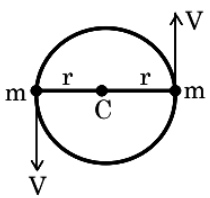
Two identical particles each of mass ‘ \(m\) ‘ go round a circle of radius \(a\) under the action of their mutual gravitational attraction. The angular speed of each particle will be : [JEE Main 2023 (Online) 15th April Morning Shift]
CorrectIncorrectHint
(d)

To find the angular speed of the particles, we must balance the gravitational force of attraction with the centripetal force required for circular motion.
Step 1: Identify the Forces
Since the two identical particles (mass \(m\)) are moving in a circle of radius \(a\), they are always diametrically opposite to each other to maintain a stable orbit.
Radius of orbit: \(a\)
Distance between the two particles (\(r\)): \(2 a\) (the diameter)
Step 2: Gravitational Force ( \(F_g\) )
The mutual gravitational attraction between the two particles is:
\(
F_g=\frac{G m \cdot m}{r^2}=\frac{G m^2}{(2 a)^2}=\frac{G m^2}{4 a^2}
\)
Step 3: Centripetal Force (\(F_c\))
The centripetal force acting on one particle to keep it in a circular orbit of radius \(a\) is:
\(
F_c=m \omega^2 a
\)
(where \(\omega\) is the angular speed).
Step 4: Solve for Angular Speed ( \(\omega\) )
For the orbit to be stable, the gravitational force must provide the necessary centripetal force (\(F_g=F_c\)):
\(
\frac{G m^2}{4 a^2}=m \omega^2 a
\)
Cancel one mass (\(m\)) from both sides:
\(
\frac{G m}{4 a^2}=\omega^2 a
\)
Rearrange to solve for \(\omega^2\) :
\(
\omega^2=\frac{G m}{4 a^3}
\)
Take the square root:
\(
\omega=\sqrt{\frac{G m}{4 a^3}}
\) - Question 32 of 92
32. Question
A body is released from a height equal to the radius \((R)\) of the earth. The velocity of the body when it strikes the surface of the earth will be (Given \(g=\) acceleration due to gravity on the earth.) [JEE Main 2023 (Online) 15th April Morning Shift]
CorrectIncorrectHint
(d)

Step 1: Apply the principle of conservation of energy
The total mechanical energy of the body is conserved as it falls. The initial position is at a height \(h=R\) from the surface (or \(\boldsymbol{r}_i=2 R\) from the center of the Earth), and the final position is at the Earth’s surface (or \(\boldsymbol{r}_{\boldsymbol{f}} \boldsymbol{=} \boldsymbol{R}\) from the center). The body is released from rest, so the initial kinetic energy is zero.
\(
\begin{gathered}
E_{\text {initial }}=E_{\text {final }} \\
K E_i+P E_i=K E_f+P E_f \\
0+P E_i=\frac{1}{2} m v^2+P E_f
\end{gathered}
\)
Step 2: Use the universal law of gravitation potential energy formula
The gravitational potential energy at a distance \(\boldsymbol{r}\) from the center of the Earth is given by \(P E=-\frac{G m M}{r}\), where \(G\) is the universal gravitational constant, \(m\) is the mass of the body, and \(M\) is the mass of the Earth.
Initial potential energy (at \(r_i=2 R\)): \(P E_i=-\frac{G m M}{2 R}\)
Final potential energy (at \(r_f=R\)): \(P E_f=-\frac{G m M}{R}\)
Substitute these into the energy conservation equation:
\(
-\frac{G m M}{2 R}=\frac{1}{2} m v^2-\frac{G m M}{R}
\)
Step 3: Solve for velocity ( \(v\) )
Rearrange the equation to solve for \(v\) :
\(
\begin{gathered}
\frac{1}{2} m v^2=\frac{G m M}{R}-\frac{G m M}{2 R} \\
\frac{1}{2} m v^2=\frac{2 G m M-G m M}{2 R} \\
\frac{1}{2} m v^2=\frac{G m M}{2 R} \\
m v^2=\frac{G m M}{R} \\
v^2=\frac{G M}{R} \\
v=\sqrt{\frac{G M}{R}}
\end{gathered}
\)
Step 4: Express the velocity in terms of \(g\) and \(\boldsymbol{R}\)
The acceleration due to gravity on the Earth’s surface (\(g\) ) is given by the formula \(g=\frac{G M}{R^2}\). Therefore, \(G M=g R^2\).
Substitute this into the expression for \(v\) :
\(
\begin{gathered}
v=\sqrt{\frac{g R^2}{R}} \\
v=\sqrt{g R}
\end{gathered}
\)
The velocity of the body when it strikes the surface of the earth will be \(\sqrt{{gR}}\). - Question 33 of 92
33. Question
Given below are two statements:
Statement I : For a planet, if the ratio of mass of the planet to its radius increases, the escape velocity from the planet also increases.
Statement II : Escape velocity is independent of the radius of the planet.
In the light of above statements, choose the most appropriate answer form the options given below [JEE Main 2023 (Online) 13th April Evening Shift]CorrectIncorrectHint
(b) To evaluate these statements, we look at the fundamental formula for escape velocity \(\left(v_e\right)\) from the surface of a planet:
\(
v_e=\sqrt{\frac{2 G M}{R}}
\)
Where:
\(G\) is the universal gravitational constant.
\(M\) is the mass of the planet.
\(R\) is the radius of the planet.
Analysis of Statements
Statement I: “For a planet, if the ratio of mass of the planet to its radius increases, the escape velocity from the planet also increases.”
From the formula, we can see that \(v_e \propto \sqrt{\frac{M}{R}}\).
If the ratio \(\frac{M}{R}\) increases, the value under the square root increases, which directly causes the escape velocity to increase.
Statement I is correct.
Statement II: “Escape velocity is independent of the radius of the planet.”
As shown in the formula, the radius \(R\) is in the denominator. This means the escape velocity is inversely proportional to the square root of the radius (\(v_e \propto \frac{1}{\sqrt{R}}\)).
Therefore, the escape velocity is very much dependent on the radius.
Statement II is incorrect.
Conclusion: Since Statement I is true and Statement II is false, the most appropriate answer is:
Correct Option: (B) Statement I is correct but statement II is incorrect. - Question 34 of 92
34. Question
Two planets A and B of radii \(R\) and \(1.5 R\) have densities \(\rho\) and \(\rho / 2\) respectively. The ratio of acceleration due to gravity at the surface of B to A is: [JEE Main 2023 (Online) 13th April Evening Shift]
CorrectIncorrectHint
(d) Step 1: Define the formula for gravity using density
The acceleration due to gravity \(g\) is given by \(g=\frac{G M}{R^2}\). The mass \(M\) of a planet with uniform density \(\rho\) and radius \(R\) is \(M=\frac{4}{3} \pi R^3 \rho\).
Substituting the mass into the gravity equation gives us a simplified formula relating gravity, density, and radius:
\(
g=\frac{4}{3} \pi G \rho R
\)
Step 2: Calculate gravity for each planet
Using the formula from Step 1, we find the expression for the acceleration due to gravity for both Planet A and Planet B:
For Planet A ( \(\boldsymbol{R}_{\boldsymbol{A}}=\boldsymbol{R}, \boldsymbol{\rho}_{\boldsymbol{A}}=\boldsymbol{\rho}\) ):
\(
g_A=\frac{4}{3} \pi G \rho R
\)
For Planet \(\mathrm{B}\left(\boldsymbol{R}_{\boldsymbol{B}}=1.5 \boldsymbol{R}=\frac{3}{2} \boldsymbol{R}, \rho_{\boldsymbol{B}}=\frac{\boldsymbol{\rho}}{2}\right)\) :
\(
g_B=\frac{4}{3} \pi G\left(\frac{\rho}{2}\right)\left(\frac{3}{2} R\right)=\frac{3}{4}\left(\frac{4}{3} \pi G \rho R\right)=\pi G \rho R
\)
Step 3: Determine the ratio of \(\boldsymbol{g}_B\) to \(\boldsymbol{g}_A\)
To find the ratio of \(g_B\) to \(g_A\), we divide the expressions calculated in Step 2:
\(
\frac{g_B}{g_A}=\frac{\pi G \rho R}{\frac{4}{3} \pi G \rho R}=\frac{1}{\frac{4}{3}}=\frac{3}{4}
\)
The ratio of acceleration due to gravity at the surface of \(B\) to \(A\) is \(3: 4\). - Question 35 of 92
35. Question
A planet having mass 9 Me and radius \(4 R_e\), where Me and Re are mass and radius of earth respectively, has escape velocity in \(\mathrm{km} / \mathrm{s}\) given by: [JEE Main 2023 (Online) 13th April Morning Shift]
(Given escape velocity on earth \(\mathrm{V}_{\mathrm{e}}=11.2 \times 10^3 \mathrm{~m} / \mathrm{s}\) )CorrectIncorrectHint
(c) To find the escape velocity of the planet, we use the relationship between escape velocity (\(v_e\)), mass \((M)\), and radius \((R)\).
Step 1: The Escape Velocity Proportionality
The escape velocity from the surface of a celestial body is defined as:
\(
v_e=\sqrt{\frac{2 G M}{R}}
\)
From this formula, we can establish a ratio between the escape velocity of the planet (\(v_p\)) and that of the Earth \(\left(v_e\right)\) :
\(
\frac{v_p}{v_e}=\sqrt{\frac{M_p}{M_e} \times \frac{R_e}{R_p}}
\)
Step 2: Substituting the Given Ratios
We are given the following values for the planet:
Mass of planet \(\left(M_p\right): 9 M_e\)
Radius of planet \(\left(R_p\right): 4 R_e\)
Plugging these into our ratio:
\(
\begin{gathered}
\frac{v_p}{v_e}=\sqrt{\frac{9 M_e}{M_e} \times \frac{R_e}{4 R_e}} \\
\frac{v_p}{v_e}=\sqrt{\frac{9}{4}} \\
\frac{v_p}{v_e}=\frac{3}{2}=1.5
\end{gathered}
\)
Step 3: Final Calculation
The escape velocity of the Earth is given as \(11.2 \times 10^3 \mathrm{~m} / \mathrm{s}\), which is \(11.2 \mathrm{~km} / \mathrm{s}\).
\(
\begin{gathered}
v_p=1.5 \times 11.2 \mathrm{~km} / \mathrm{s} \\
v_p=16.8 \mathrm{~km} / \mathrm{s}
\end{gathered}
\)
The escape velocity of the planet is \(16.8 \mathrm{~km} / \mathrm{s}\). - Question 36 of 92
36. Question
The ratio of escape velocity of a planet to the escape velocity of earth will be: Given: Mass of the planet is 16 times mass of earth and radius of the planet is 4 times the radius of earth. [JEE Main 2023 (Online) 12th April Morning Shift]
CorrectIncorrectHint
(d) To find the ratio of the escape velocities, we will use the relationship between escape velocity, mass, and radius.
Step 1 State the formula for escape velocity. The escape velocity (\(v_e\)) from the surface of a planet is given by:
\(
v_e=\sqrt{\frac{2 G M}{R}}
\)
From this, we can see that \(v_e \propto \sqrt{\frac{M}{R}}\).
Step 2: Identify the given ratios for the planet and Earth.
Mass of the planet \(\left(M_p\right): 16 M_e\)
Radius of the planet \(\left(R_p\right): 4 R_e\)
Step 3: Set up the ratio of escape velocities (\(v_p / v_e\)).
\(
\frac{v_p}{v_e}=\sqrt{\frac{M_p}{M_e} \times \frac{R_e}{R_p}}
\)
\(
\begin{aligned}
&\text { Step 4:} \text { Substitute the values into the ratio and solve. }\\
&\begin{gathered}
\frac{v_p}{v_e}=\sqrt{\frac{16 M_e}{M_e} \times \frac{R_e}{4 R_e}} \\
\frac{v_p}{v_e}=\sqrt{\frac{16}{4}} \\
\frac{v_p}{v_e}=\sqrt{4}=\frac{2}{1}
\end{gathered}
\end{aligned}
\) - Question 37 of 92
37. Question
Two satellites A and B move round the earth in the same orbit. The mass of A is twice the mass of B . The quantity which is same for the two satellites will be [JEE Main 2023 (Online) 12th April Morning Shift]
CorrectIncorrectHint
(d) To determine which quantity remains the same for both satellites, we need to look at how mass affects orbital mechanics.
Step 1: Identify the orbital parameters. Both satellites are in the same orbit, which means they have the same orbital radius \(r\).
Mass of satellite A \(\left(m_A\right)=2 m\)
Mass of satellite B \(\left(m_B\right)=m\)
Step 2: Analyze Potential, Kinetic, and Total Energy. All three of these quantities are directly proportional to the mass of the satellite (\(m\)):
Potential Energy: \(U=-\frac{G M m}{r}\)
Kinetic Energy: \(K=\frac{G M m}{2 r}\)
Total Mechanical Energy: \(E=-\frac{G M m}{2 r}\) Since \(m_A=2 m_B\), all these energy values for satellite A will be double those of satellite B.
Step 3: Analyze the Speed. The orbital speed (\(v\)) required to maintain a circular orbit is determined by balancing gravitational force and centripetal force:
\(
\frac{G M m}{r^2}=\frac{m v^2}{r}
\)
Solving for \(v\), the mass of the satellite (\(m\)) cancels out:
\(
v=\sqrt{\frac{G M}{r}}
\)
This shows that orbital speed depends only on the mass of the central body (Earth) and the radius of the orbit.
Step 4: Conclusion. Since both satellites are in the same orbit (same \(r\)), they must travel at the same speed to stay in that orbit, regardless of their individual masses. - Question 38 of 92
38. Question
A space ship of mass \(2 \times 10^4 \mathrm{~kg}\) is launched into a circular orbit close to the earth surface. The additional velocity to be imparted to the space ship in the orbit to overcome the gravitational pull will be (if \(g=10 \mathrm{~m} / \mathrm{s}^2\) and radius of earth \(=6400 \mathrm{~km}\)): [JEE Main 2023 (Online) 11th April Evening Shift]
CorrectIncorrectHint
(d) Step 1: Calculate the orbital velocity
The orbital velocity \(\left(\boldsymbol{v}_{\boldsymbol{o}}\right)\) for a satellite in a circular orbit close to the Earth’s surface is given by the formula \(v_o=\sqrt{g R}\), where \(g\) is the acceleration due to gravity and \(R\) is the radius of the Earth.
\(
\begin{gathered}
v_o=\sqrt{g R}=\sqrt{10 \mathrm{~m} / \mathrm{s}^2 \times 6400 \times 10^3 \mathrm{~m}} \\
v_o=\sqrt{64 \times 10^6 \mathrm{~m}^2 / \mathrm{s}^2}=8000 \mathrm{~m} / \mathrm{s} \\
v_o=8 \mathrm{~km} / \mathrm{s}
\end{gathered}
\)
Step 2: Calculate the escape velocity
The escape velocity \(\left(\boldsymbol{v}_{\boldsymbol{e}}\right)\) from the Earth’s surface (or a close orbit) is given by the formula \(v_e=\sqrt{2 g R}\). This is also related to the orbital velocity by \(v_e=\sqrt{2} v_o\).
\(
v_e=\sqrt{2} \times 8 \mathrm{~km} / \mathrm{s}=8 \sqrt{2} \mathrm{~km} / \mathrm{s}
\)
Step 3: Determine the additional velocity
The additional velocity \((\Delta v)\) needed to overcome the gravitational pull from the orbit is the difference between the escape velocity and the orbital velocity.
\(
\begin{gathered}
\Delta v=v_e-v_o=8 \sqrt{2} \mathrm{~km} / \mathrm{s}-8 \mathrm{~km} / \mathrm{s} \\
\Delta v=8(\sqrt{2}-1) \mathrm{km} / \mathrm{s}
\end{gathered}
\) - Question 39 of 92
39. Question
If \(V\) is the gravitational potential due to sphere of uniform density on it’s surface, then it’s value at the center of sphere will be: [JEE Main 2023 (Online) 11th April Evening Shift]
CorrectIncorrectHint
(a) To find the gravitational potential at the center of a uniform solid sphere, we must compare the potential formula for the surface with the formula for the interior.
Step 1: Identify the potential at the surface (\(V\)). For a solid sphere of mass \(M\) and radius \(R\), the gravitational potential at any point on or outside the surface is:
\(
V=-\frac{G M}{R}
\)
Step 2: Identify the potential formula for the interior of the sphere. The gravitational potential \(V_{\text {in }}\) at a distance \(r\) from the center \((r \leq R)\) is given by the formula:
\(
V_{i n}=-\frac{G M}{2 R^3}\left(3 R^2-r^2\right)
\)
Step 3: Calculate the potential at the center. At the center of the sphere, the distance \(r=0\). Substituting this into the interior potential formula:
\(
\begin{gathered}
V_{\text {center }}=-\frac{G M}{2 R^3}\left(3 R^2-0^2\right) \\
V_{\text {center }}=-\frac{G M \cdot 3 R^2}{2 R^3} \\
V_{\text {center }}=-\frac{3 G M}{2 R}
\end{gathered}
\)
Step 4: Relate the center potential to the surface potential (\(V\)). Since we know from Step 1 that \(V=-\frac{G M}{R}\), we can substitute it into our result from Step 3:
\(
\begin{gathered}
V_{\text {center }}=\frac{3}{2}\left(-\frac{G M}{R}\right) \\
V_{\text {center }}=\frac{3}{2} V
\end{gathered}
\) - Question 40 of 92
40. Question
The radii of two planets ‘ A ‘ and ‘ B ‘ are ‘ \(R\) ‘ and ‘ \(4 R\) ‘ and their densities are \(\rho\) and \(\rho / 3\) respectively. The ratio of acceleration due to gravity at their surfaces \(\left(g_A: g_B\right)\) will be: [JEE Main 2023 (Online) 11th April Morning Shift]
CorrectIncorrectHint
(d) To find the ratio of acceleration due to gravity between two planets using their density and radius, we use the derived form of the gravity equation.
Step 1: Express acceleration due to gravity (\(g\)) in terms of density (\(\rho\)). The standard formula for gravity is \(g=\frac{G M}{R^2}\). Since mass \(M\) is volume times density, for a spherical planet:
\(
M=\frac{4}{3} \pi R^3 \rho
\)
Substituting this into the gravity formula:
\(
g=\frac{G\left(\frac{4}{3} \pi R^3 \rho\right)}{R^2}=\frac{4}{3} \pi G R \rho
\)
This shows that \(g \propto R \rho\).
Step 2: List the given values for Planet A and Planet B.
Planet A: Radius \(=R\), Density \(=\rho\)
Planet B: Radius \(=4 R\), Density \(=\rho / 3\)
Step 3: Set up the ratio \(g_A: g_B\).
\(
\frac{g_A}{g_B}=\frac{R_A \cdot \rho_A}{R_B \cdot \rho_B}
\)
Step 4: Substitute the values and calculate.
\(
\begin{gathered}
\frac{g_A}{g_B}=\frac{R \cdot \rho}{4 R \cdot(\rho / 3)} \\
\frac{g_A}{g_B}=\frac{1}{4 / 3} \\
\frac{g_A}{g_B}=\frac{3}{4}
\end{gathered}
\) - Question 41 of 92
41. Question
The time period of a satellite, revolving above earth’s surface at a height equal to \(R\) will be (Given \(g=\pi^2 \mathrm{~m} / \mathrm{s}^2, \mathrm{R}=\) radius of earth) [JEE Main 2023 (Online) 10th April Evening Shift]
CorrectIncorrectHint
(a)

To find the time period of the satellite at a specific height, we utilize the relationship between the orbital radius and the acceleration due to gravity.
Step 1: Determine the orbital radius (\(r\)). The satellite is at a height \(h=R\) above the Earth’s surface. Therefore, the total distance from the center of the Earth is:
\(
r=R+h=R+R=2 R
\)
Step 2: Relate the orbital period to gravity. The time period ( \(T\) ) for a satellite in a circular orbit is given by:
\(
T=2 \pi \sqrt{\frac{r^3}{G M}}
\)
We know that at the surface, \(G M=g R^2\). Substituting this into the formula:
\(
T=2 \pi \sqrt{\frac{r^3}{g R^2}}
\)
Step 3: Substitute the value of \(r\). Since \(r=2 R\), we have:
\(
\begin{aligned}
T & =2 \pi \sqrt{\frac{(2 R)^3}{g R^2}} \\
T & =2 \pi \sqrt{\frac{8 R^3}{g R^2}}
\end{aligned}
\)
\(T =2 \pi \sqrt{\frac{8 R}{g}}\)
Step 4: Simplify using the given value of \(g\). The problem gives \(g=\pi^2\). Substituting this into the expression:
\(
\begin{aligned}
T & =2 \pi \sqrt{\frac{8 R}{\pi^2}} \\
T & =\frac{2 \pi}{\pi} \sqrt{8 R} \\
T & =2 \sqrt{8 R} \\
T & =4 \sqrt{2 R}=\sqrt{32 R}
\end{aligned}
\)
Final Answer: The time period of the satellite is \(4 \sqrt{2 R}=\sqrt{32 R}\) seconds. - Question 42 of 92
42. Question
Given below are two statements:
Statement I : Rotation of the earth shows effect on the value of acceleration due to gravity (\(g\))
Statement II : The effect of rotation of the earth on the value of ‘ \(g\) ‘ at the equator is minimum and that at the pole is maximum.
In the light of the above statements, choose the correct answer from the options given below [JEE Main 2023 (Online) 10th April Evening Shift]CorrectIncorrectHint
(b) To determine the correct answer, we need to analyze how the Earth’s rotation influences the effective acceleration due to gravity (\(g^{\prime}\)).
Step 1: Analyze Statement I. The Earth’s rotation creates a centrifugal force that acts outward, away from the axis of rotation. This force opposes the gravitational pull toward the center of the Earth, thereby changing the “effective” value of \(g\). The formula for effective gravity at a latitude \(\phi\) is:
\(
g^{\prime}=g-\omega^2 R \cos ^2 \phi
\)
Since \(g^{\prime}\) depends on the angular velocity \(\omega\), rotation definitely shows an effect. Statement \(I\) is true.
Step 2: Analyze Statement II. We look at the two extreme cases using the formula \(g^{\prime}=g\) \(\omega^2 R \cos ^2 \phi:\)
At the Equator \(\left(\phi=0^{\circ}\right)\) : \(\cos 0^{\circ}=1\), so \(g^{\prime}=g-\omega^2 R\). Here, the subtraction from \(g\) is at its maximum, making the effective gravity the minimum.
At the Poles \(\left(\phi=90^{\circ}\right)\) : \(\cos 90^{\circ}=0\), so \(g^{\prime}=g-0=g\). Here, there is no effect from rotation.
Step 3: Evaluate the wording of Statement II. Statement II says the effect is minimum at the equator and maximum at the poles.
The effect (the reduction \(\omega^2 R \cos ^2 \phi\)) is actually maximum at the equator (reduction of \(\omega^2 R\)) and minimum at the poles (reduction of 0).
Statement II claims the opposite. Statement II is false. - Question 43 of 92
43. Question
Two satellites of masses \(m\) and \(3 m\) revolve around the earth in circular orbits of radii \(r\) & \(3r\) respectively. The ratio of orbital speeds of the satellites respectively is [JEE Main 2023 (Online) 10th April Morning Shift]
CorrectIncorrectHint
(b) To find the ratio of orbital speeds, we need to analyze how mass and radius affect the velocity of a satellite in a circular orbit.
Step 1: State the formula for orbital speed \(\left(v_o\right)\). The orbital speed required to maintain a circular orbit around Earth (mass \(M\)) at a radius \(r\) is derived by balancing the gravitational force with the centripetal force:
\(
\frac{G M m}{r^2}=\frac{m v^2}{r}
\)
Solving for \(v\), we get:
\(
v=\sqrt{\frac{G M}{r}}
\)
From this, we see that the orbital speed is independent of the mass of the satellite (\(m\)) and is inversely proportional to the square root of the orbital radius \((r)\) :
\(
v \propto \frac{1}{\sqrt{r}}
\)
Step 2: Identify the given values for both satellites.
Satellite A: Mass \(=m\), Radius \(=r\)
Satellite B: Mass \(=3 m\), Radius \(=3 r\)
Step 3: Set up the ratio of orbital speeds (\(v_A: v_B\)). Since the mass of the satellites does not affect the speed, we only consider the radii:
\(
\frac{v_A}{v_B}=\frac{\sqrt{\frac{G M}{r_A}}}{\sqrt{\frac{G M}{r_B}}}=\sqrt{\frac{r_B}{r_A}}
\)
Step 4: Substitute the radii and solve.
\(
\begin{gathered}
\frac{v_A}{v_B}=\sqrt{\frac{3 r}{r}} \\
\frac{v_A}{v_B}=\sqrt{3} \\
\frac{v_A}{v_B}=\frac{\sqrt{3}}{1}
\end{gathered}
\) - Question 44 of 92
44. Question
Assuming the earth to be a sphere of uniform mass density, the weight of a body at a depth \(d=\frac{R}{2}\) from the surface of earth, if its weight on the surface of earth is 200 N , will be: (Given R = radius of earth) [JEE Main 2023 (Online) 10th April Morning Shift]
CorrectIncorrectHint
(a) To find the weight of a body at a specific depth, we calculate the change in the acceleration due to gravity (\(g\)) as one moves toward the center of the Earth.
Step 1: State the formula for acceleration due to gravity at a depth (d). For a sphere of uniform density, the gravity at a depth \(d\) from the surface is given by:
\(
g_d=g\left(1-\frac{d}{R}\right)
\)
where \(g\) is the acceleration due to gravity at the surface and \(R\) is the radius of the Earth.
Step 2: Relate gravity to weight. Weight (\(W\)) is the product of mass (\(m\)) and acceleration due to gravity (\(g\)). Therefore:
\(
W_d=m g_d=m g\left(1-\frac{d}{R}\right)
\)
Since \(m g=W_{\text {surface }}\), we can write:
\(
W_d=W_{\text {surface }}\left(1-\frac{d}{R}\right)
\)
Step 3: Substitute the given values into the equation.
Weight on surface ( \(W_{\text {surface }}\) ): 200 N
Depth (d): \(\frac{R}{2}\)
\(
W_d=200\left(1-\frac{R / 2}{R}\right)
\)
Step 4: Solve for the weight at depth.
\(
\begin{gathered}
W_d=200\left(1-\frac{1}{2}\right) \\
W_d=200\left(\frac{1}{2}\right) \\
W_d=100 \mathrm{~N}
\end{gathered}
\)
The weight of the body at a depth \(R / 2\) will be \(\mathbf{1 0 0} \mathbf{N}\). - Question 45 of 92
45. Question
The acceleration due to gravity at height \(h\) above the earth if \(h \ll \mathrm{R}\) (Radius of earth) is given by [JEE Main 2023 (Online) 8th April Evening Shift]
CorrectIncorrectHint
(a) Step 1: Establish the general formula
The acceleration due to gravity \(g\) at the Earth’s surface \((r=R)\) is given by \(g=\frac{G M}{R^2}\), where \(\boldsymbol{G}\) is the gravitational constant and \(\boldsymbol{M}\) is the mass of the Earth. At a height \(h\) above the surface (radius \(r=R+h\)), the gravity \(g^{\prime}\) is given by \(g^{\prime}=\frac{G M}{(R+h)^2}\).
Step 2: Relate \(\boldsymbol{g}^{\prime}\) to \(\boldsymbol{g}\)
We can rewrite the expression for \(g^{\prime}\) by factoring out \(R^2\) from the denominator:
\(
g^{\prime}=\frac{G M}{R^2(1+h / R)^2}=\frac{G M}{R^2}\left(1+\frac{h}{R}\right)^{-2}
\)
Substituting \(g=\frac{G M}{R^2}\) into the equation gives:
\(
g^{\prime}=g\left(1+\frac{h}{R}\right)^{-2}
\)
Step 3: Apply the binomial approximation
Since the problem states that \(h \ll R\), the ratio \(\frac{h}{R}\) is much less than 1. We can use the binomial expansion approximation \((1+x)^n \approx 1+n x\) for small \(x\). In this case, \(x=\frac{h}{R}\) and \(n=-2\) :
\(
\left(1+\frac{h}{R}\right)^{-2} \approx 1+(-2) \frac{h}{R}=1-\frac{2 h}{R}
\)
Substituting this approximation back into the equation for \(g^{\prime}\) :
\(
g^{\prime} \approx g\left(1-\frac{2 h}{R}\right)
\) - Question 46 of 92
46. Question
The orbital angular momentum of a satellite is \(L\), when it is revolving in a circular orbit at height \(h\) from earth surface. If the distance of satellite from the earth centre is increased by eight times to its initial value, then the new angular momentum will be [JEE Main 2023 (Online) 8th April Evening Shift]
CorrectIncorrectHint
(d) To find the new angular momentum of the satellite, we need to look at how the orbital radius affects both the orbital velocity and the angular momentum.
Step 1: Define the initial orbital radius. The satellite is revolving at a height \(h\) from the Earth’s surface. Let the Earth’s radius be \(R\). The initial distance from the Earth’s center (\(r_1\)) is:
\(
r_1=R+h
\)
Step 2: Express angular momentum (\(L\)) in terms of orbital parameters. Angular momentum for a circular orbit is given by:
\(
L=m v r
\)
Where \(m\) is the mass of the satellite, \(v\) is the orbital velocity, and \(r\) is the distance from the center.
Step 3: Substitute the formula for orbital velocity \((v)\). The orbital velocity is \(v=\sqrt{\frac{G M}{r}}\). Substituting this into the angular momentum formula:
\(
\begin{gathered}
L=m\left(\sqrt{\frac{G M}{r}}\right) r \\
L=m \sqrt{G M \cdot r}
\end{gathered}
\)
This shows that for a specific satellite, the angular momentum is directly proportional to the square root of the orbital radius:
\(
L \propto \sqrt{r}
\)
Step 4: Calculate the change in distance. The problem states that the distance from the Earth’s center is increased by eight times its initial value. This is a common phrasing trap in physics problems.
“Increased to 8 times” means \(r_2=8 r_1\).
“Increased by 8 times” means \(r_2=r_1+8 r_1=9 r_1\).
Given the options provided, the intent is likely that the new distance is \(9 r_1\).
Step 5: Calculate the new angular momentum (\(L^{\prime}\)).
\(
\begin{gathered}
\frac{L^{\prime}}{L}=\sqrt{\frac{r_2}{r_1}} \\
\frac{L^{\prime}}{L}=\sqrt{\frac{9 r_1}{r_1}} \\
\frac{L^{\prime}}{L}=\sqrt{9}=3 \\
L^{\prime}=3 L
\end{gathered}
\) - Question 47 of 92
47. Question
Given below are two statements:
Statement I: If \(E\) be the total energy of a satellite moving around the earth, then its potential energy will be \(\frac{E}{2}\).
Statement II: The kinetic energy of a satellite revolving in an orbit is equal to the half the magnitude of total energy \(E\).
In the light of the above statements, choose the most appropriate answer from the options given below [JEE Main 2023 (Online) 8th April Morning Shift]CorrectIncorrectHint
(a) To determine the correct answer, we need to look at the relationship between Kinetic Energy ( \(K)\), Potential Energy ( \(U\) ), and Total Mechanical Energy (\(E\)) for a satellite in a circular orbit.
Step 1: Define the energy formulas for a satellite. For a satellite of mass \(m\) orbiting a planet of mass \(M\) at a radius \(r\) :
Potential Energy ( \(U\) ): \(-\frac{G M m}{r}\)
Kinetic Energy ( \(K\) ): \(\frac{G M m}{2 r}\)
Total Energy ( \(E\) ): \(K+U=\frac{G M m}{2 r}-\frac{G M m}{r}=-\frac{G M m}{2 r}\)
Step 2: Analyze the relationship between \(U\) and \(E\). From Step 1, we can see that:
\(
E=-\frac{G M m}{2 r} \quad \text { and } \quad U=-\frac{G M m}{r}
\)
This means \(U=2 E\). Statement I claims that \(U=\frac{E}{2}\), which is mathematically incorrect.
Statement I is incorrect.
Step 3: Analyze the relationship between \(K\) and \(E\). From Step 1, we can see that:
\(
E=-\frac{G M m}{2 r} \quad \text { and } \quad K=\frac{G M m}{2 r}
\)
This means \(K=|E|\) (Kinetic energy is equal to the magnitude of the total energy). Statement II claims that \(K=\frac{|E|}{2}\), which is mathematically incorrect. Statement II is incorrect.
Step 4: Conclusion. Since both statements provide incorrect ratios for the energy components of a satellite, we select the corresponding option.
Correct Option: (A) Both Statement I and Statement II are incorrect. - Question 48 of 92
48. Question
The weight of a body on the earth is 400 N. Then weight of the body when taken to a depth half of the radius of the earth will be: [JEE Main 2023 (Online) 8th April Morning Shift]
CorrectIncorrectHint
(b) To find the weight of a body at a specific depth, we need to understand how the acceleration due to gravity changes as you move inside the Earth.
Step 1: State the formula for acceleration due to gravity at a depth. For a planet of uniform density, the acceleration due to gravity at a depth \(d\left(g_d\right)\) is given by:
\(
g_d=g\left(1-\frac{d}{R}\right)
\)
where \(g\) is the acceleration at the surface and \(R\) is the radius of the Earth.
Step 2: Relate gravity to weight. Since weight (\(W\)) is the product of mass (\(m\)) and gravity (\(g\)), we can multiply both sides of the gravity formula by \(m\) :
\(
W_d=W_{\text {surface }}\left(1-\frac{d}{R}\right)
\)
Step 3: Substitute the given values.
Initial weight ( \(W_{\text {surface }}\) ): 400 N
Depth \((d): \frac{R}{2}\) (half of the radius)
\(
W_d=400\left(1-\frac{R / 2}{R}\right)
\)
Step 4: Solve for the new weight.
\(
\begin{gathered}
W_d=400\left(1-\frac{1}{2}\right) \\
W_d=400\left(\frac{1}{2}\right) \\
W_d=200 \mathrm{~N}
\end{gathered}
\)
The weight of the body at a depth equal to half the radius of the Earth will be 200 N. - Question 49 of 92
49. Question
The weight of a body on the surface of the earth is 100 N. The gravitational force on it when taken at a height, from the surface of earth, equal to one-fourth the radius of the earth is: [JEE Main 2023 (Online) 6th April Evening Shift]
CorrectIncorrectHint
(b) To find the gravitational force (weight) at a specific height above the Earth’s surface, we use the formula for the variation of acceleration due to gravity (\(g\)) with altitude.
The Formula
The acceleration due to gravity at a height \(h\) from the surface of the Earth is given by:
\(
g^{\prime}=g\left(\frac{R}{R+h}\right)^2
\)
Where:
\(g\) is the acceleration due to gravity on the surface.
R is the radius of the Earth.
his the height above the surface.
Since Weight (\(W\)) is equal to \(m \times g\), the weight at height \(h\) (\(W^{\prime}\)) follows the same ratio:
\(
W^{\prime}=W\left(\frac{R}{R+h}\right)^2
\)
Step 1: Identify the given values.
Initial weight \((W)=100 \mathrm{~N}\)
Height \((h)=\frac{1}{4} R\) (or \(0.25 R\))
Step 2: Substitute the height into the ratio.
\(
W^{\prime}=100\left(\frac{R}{R+\frac{R}{4}}\right)^2
\)
Step 3: Simplify the denominator.
\(
R+\frac{R}{4}=\frac{5 R}{4}
\)
Step 4: Solve the equation.
\(
\begin{aligned}
W^{\prime} & =100\left(\frac{R}{\frac{5 R}{4}}\right)^2 \\
W^{\prime} & =100\left(\frac{4}{5}\right)^2
\end{aligned}
\)
\(
W^{\prime}=100\left(\frac{16}{25}\right)
\)
Step 5: Final Result.
\(
W^{\prime}=4 \times 16=64 \mathrm{~N}
\)
The gravitational force on the body at a height equal to one-fourth the radius of the Earth is 64 N. - Question 50 of 92
50. Question
Choose the incorrect statement from the following: [JEE Main 2023 (Online) 6th April Evening Shift]
CorrectIncorrectHint
(a)

(a) The linear speed of a planet revolving around the sun remains constant (Incorrect): According to Kepler’s Second Law (the Law of Areas), planets move in elliptical orbits. Because the angular momentum of the planet is conserved, the planet moves faster when it is closer to the sun (perihelion) and slower when it is farther away (aphelion). Therefore, the linear speed is variable, not constant.
(b) When a body falls towards earth, the displacement of earth towards the body is negligible (Correct): While Newton’s Third Law states the Earth and the body exert equal and opposite forces on each other, Earth’s mass ( \(M\) ) is significantly larger than the body’s mass ( \(m\) ). Since \(a=F / m\), the Earth’s acceleration is so infinitesimally small that its displacement is practically zero.
(c) The speed of satellite in a given circular orbit remains constant (Correct): In a perfectly circular orbit, the distance from the center of mass remains constant. Since the gravitational potential energy is constant, the kinetic energy (and thus the speed) must also remain constant to conserve total energy.
(d) For a planet revolving around the sun in an elliptical orbit, the total energy of the planet remains constant (Correct): In an isolated system (Sun + Planet), there are no external work-performing forces. While kinetic energy and potential energy exchange values as the planet moves, their sum-the Total Mechanical Energy-remains constant throughout the orbit. - Question 51 of 92
51. Question
Given below are two statements : one is labelled as Assertion \(\mathbf{A}\) and the other is labelled as Reason \(\mathbf{R}\).
Assertion A : Earth has atmosphere whereas moon doesn’t have any atmosphere.
Reason R : The escape velocity on moon is very small as compared to that on earth.
In the light of the above statements, choose the correct answer from the options given below: [JEE Main 2023 (Online) 6th April Morning Shift]CorrectIncorrectHint
(c) Analysis of Assertion (A)
It is a well-established fact that Earth has a thick atmosphere (composed mainly of Nitrogen and Oxygen), while the Moon has no functional atmosphere (it has a negligible exosphere that is nearly a vacuum).
Analysis of Reason (R)
The escape velocity (\(v_e\)) is the minimum speed an object must reach to break free from a celestial body’s gravitational pull. It is calculated as:
\(
v_e=\sqrt{\frac{2 G M}{R}}
\)
On Earth: The escape velocity is approximately \(\mathbf{1 1 . 2 ~ k m} / \mathbf{s}\).
On the Moon: Because of its smaller mass and radius, the escape velocity is only about \(\mathbf{2 . 3 8 ~ k m} \boldsymbol{/} \mathbf{s}\). The statement in \(\mathbf{R}\) is therefore scientifically correct.
Why R explains A?
An atmosphere is maintained when the gravitational pull of a planet is strong enough to hold onto gas molecules.
Thermal Speed: Gas molecules in an atmosphere move at a “root mean square” (rms) speed, which depends on the temperature \((T)\).
The Comparison: At the Moon’s surface temperature, the rms speed of many gas molecules (like Hydrogen or Helium) often exceeds 2.38 km/s.
The Result: Because the Moon’s escape velocity is so small, these gas molecules easily fly off into space rather than being held down. On Earth, however, the escape velocity (\(11.2 \mathrm{~km} / \mathrm{s}\)) is much higher than the average speed of most gas molecules, allowing the atmosphere to stay trapped.
Conclusion: Since the low escape velocity of the Moon is the primary reason it cannot retain gas particles, Reason R is the correct explanation for Assertion A. - Question 52 of 92
52. Question
A planet has double the mass of the earth. Its average density is equal to that of the earth. An object weighing W on earth will weigh on that planet: [JEE Main 2023 (Online) 6th April Morning Shift]
CorrectIncorrectHint
(d) To find the weight of an object on another planet, we first need to determine the planet’s radius based on the given mass and density, then use the formula for gravitational acceleration.
Step 1: Establish the relationship between Mass, Density, and Radius
Density \((\rho)\) is defined as mass divided by volume. Assuming the planets are spherical:
\(
\rho=\frac{M}{V}=\frac{M}{\frac{4}{3} \pi R^3}
\)
Since the average density of the planet \(\left(\rho_p\right)\) is equal to the density of Earth \(\left(\rho_e\right)\) :
\(
\frac{M_p}{R_p^3}=\frac{M_e}{R_e^3}
\)
Step 2: Find the Radius of the planet
We are given that the mass of the planet is double the mass of Earth \(\left(M_p=2 M_e\right)\) :
\(
\begin{gathered}
\frac{2 M_e}{R_p^3}=\frac{M_e}{R_e^3} \\
R_p^3=2 R_e^3 \\
R_p=2^{1 / 3} R_e
\end{gathered}
\)
Step 3: Calculate the acceleration due to gravity (\(g\))
The formula for \(g\) is:
\(
g=\frac{G M}{R^2}
\)
Let \(g_p\) be the gravity on the planet and \(g_e\) be the gravity on Earth:
\(
\frac{g_p}{g_e}=\left(\frac{M_p}{M_e}\right)\left(\frac{R_e}{R_p}\right)^2
\)
Substitute the values \(M_p=2 M_e\) and \(R_p=2^{1 / 3} R_e\) :
\(
\begin{gathered}
\frac{g_p}{g_e}=(2)\left(\frac{R_e}{2^{1 / 3} R_e}\right)^2 \\
\frac{g_p}{g_e}=2 \times \frac{1}{2^{2 / 3}} \\
\frac{g_p}{g_e}=2^{1-2 / 3}=2^{1 / 3}
\end{gathered}
\)
Step 4: Final Result
Weight ( \(W\) ) is proportional to \(g\) (\(W=m g\)). Therefore:
\(
\begin{gathered}
W_p=W \times 2^{1 / 3} \\
W_p=\sqrt[3]{2} W
\end{gathered}
\)
The object will weigh \(2^{1 / 3} W\) (or approximately \(1.26 W\)) on that planet. - Question 53 of 92
53. Question
The escape velocities of two planets A and B are in the ratio \(1: 2\). If the ratio of their radii respectively is \(1: 3\), then the ratio of acceleration due to gravity of planet \(A\) to the acceleration of gravity of planet \(B\) will be : [JEE Main 2023 (Online) 1st February Evening Shift]
CorrectIncorrectHint
(c) To solve this, we need to find the relationship between escape velocity \(\left(v_e\right)\), radius \((R)\), and acceleration due to gravity (\(g\)).
The Formulae:
The escape velocity is given by:
\(
v_e=\sqrt{2 g R}
\)
From this, we can express the acceleration due to gravity \((g)\) in terms of \(v_e\) and \(R\) :
\(
v_e^2=2 g R \Longrightarrow g=\frac{v_e^2}{2 R}
\)
Step-by-Step Calculation:
Step 1: Identify the given ratios.
Ratio of escape velocities: \(\frac{v_A}{v_B}=\frac{1}{2}\)
Ratio of radii: \(\frac{R_A}{R_B}=\frac{1}{3}\)
Step 2: Set up the ratio for acceleration due to gravity ( \(g\) ). Using the derived formula \(g \propto \frac{v_e^2}{R}\), we get:
\(
\frac{g_A}{g_B}=\left(\frac{v_A}{v_B}\right)^2 \times\left(\frac{R_B}{R_A}\right)
\)
Step 3: Substitute the values into the ratio.
\(
\frac{g_A}{g_B}=\left(\frac{1}{2}\right)^2 \times\left(\frac{3}{1}\right)
\)
Step 4: Simplify the expression.
\(
\begin{gathered}
\frac{g_A}{g_B}=\frac{1}{4} \times 3 \\
\frac{g_A}{g_B}=\frac{3}{4}
\end{gathered}
\)
The ratio of the acceleration due to gravity of planet A to planet B is \(3: 4\). - Question 54 of 92
54. Question
For a body projected at an angle with the horizontal from the ground, choose the correct statement. [JEE Main 2023 (Online) 1st February Evening Shift]
CorrectIncorrectHint
(a) At the highest point in projectile motion, the body reaches its maximum vertical height (\(\boldsymbol{h}_{\text {max }}\)) from the ground. Gravitational potential energy is given by the formula \(\boldsymbol{U}=\boldsymbol{m} \boldsymbol{g} \boldsymbol{h}\) . Since \(h\) is maximum at the peak of the trajectory, the gravitational potential energy is also maximum at this point.
Why other options are incorrect
(b) The vertical component of momentum is maximum at the highest point. This is incorrect. At the highest point, the vertical component of velocity (\(v_{\boldsymbol{y}}\)) is momentarily zero, meaning the vertical component of momentum (mass \(\times v_y\) ) is also zero. It is maximum at the beginning and end of the flight (at the same height).
(c) The horizontal component of velocity is zero at the highest point. This is incorrect. In the absence of air resistance, the horizontal component of velocity remains constant throughout the entire flight path.
(d) The Kinetic Energy (K.E.) is zero at the highest point of projectile motion. This is incorrect. Because the body still has a horizontal component of velocity, it still possesses some kinetic energy (specifically, the kinetic energy due to horizontal motion: \(\left.K E=\frac{1}{2} m v_x^2\right)\). - Question 55 of 92
55. Question
If earth has a mass nine times and radius twice to that of a planet P. Then \(\frac{v_e}{3} \sqrt{x} \mathrm{~ms}^{-1}\) will be the minimum velocity required by a rocket to pull out of gravitational force of P, where \(v_e\) is escape velocity on earth. The value of \(x\) is [JEE Main 2023 (Online) 1st February Morning Shift]
CorrectIncorrectHint
(c) To solve for the value of \(x\), we need to compare the escape velocity of the planet \(\left(v_P\right)\) with the escape velocity of Earth \(\left(v_e\right)\).
The Formula:
The escape velocity of a celestial body is given by:
\(
v=\sqrt{\frac{2 G M}{R}}
\)
From this, we can see that escape velocity is proportional to the square root of mass divided by radius:
\(
v \propto \sqrt{\frac{M}{R}}
\)
Step-by-Step Calculation:
Step 1: Identify the relationship between Earth and Planet P. The problem states:
\(M_e=9 M_P \Longrightarrow M_P=\frac{M_e}{9}\)
\(R_e=2 R_P \Longrightarrow R_P=\frac{R_e}{2}\)
Step 2: Set up the ratio for the escape velocities.
\(
\frac{v_P}{v_e}=\sqrt{\frac{M_P}{M_e} \times \frac{R_e}{R_P}}
\)
Step 3: Substitute the given values into the ratio.
\(
\begin{gathered}
\frac{v_P}{v_e}=\sqrt{\frac{1}{9} \times \frac{2}{1}} \\
\frac{v_P}{v_e}=\sqrt{\frac{2}{9}}
\end{gathered}
\)
Step 4: Express \(v_P\) in terms of \(v_e\).
\(
\begin{aligned}
& v_P=v_e \sqrt{\frac{2}{9}} \\
& v_P=\frac{v_e}{3} \sqrt{2}
\end{aligned}
\)
Step 5: Compare with the given expression. The problem provides the escape velocity for planet P as:
\(
v_P=\frac{v_e}{3} \sqrt{x}
\)
By comparing \(v_P=\frac{v_e}{3} \sqrt{2}\) with \(v_P=\frac{v_e}{3} \sqrt{x}\), we find:
\(
x=2
\) - Question 56 of 92
56. Question
Given below are two statements:
Statement I: Acceleration due to gravity is different at different places on the surface of earth.
Statement II: Acceleration due to gravity increases as we go down below the earth’s surface.
In the light of the above statements, choose the correct answer from the options given below [JEE Main 2023 (Online) 1st February Morning Shift]CorrectIncorrectHint
(d) To evaluate these statements, we need to look at how the acceleration due to gravity (\(g\)) behaves across the Earth’s surface and within its interior.
Analysis of Statement I
Statement I: Acceleration due to gravity is different at different places on the surface of earth.
This statement is Correct. There are two primary reasons why \(g\) varies on the surface:
Shape of the Earth: The Earth is an oblate spheroid (bulging at the equator and flattened at the poles). Since \(g=\frac{G M}{R^2}\), and the polar radius is smaller than the equatorial radius, \(g\) is maximum at the poles and minimum at the equator.
Rotation of the Earth: Centrifugal force due to rotation acts outward, reducing the effective value of \(g\) most significantly at the equator.
Analysis of Statement II
Statement II: Acceleration due to gravity increases as we go down below the earth’s surface.
This statement is Incorrect. The formula for acceleration due to gravity at a depth \(d\) below the surface is:
\(
g_d=g\left(1-\frac{d}{R}\right)
\)
As you go deeper (increase \(d\)), the term ( \(1-\frac{d}{R}\)) decreases. Therefore, \(g\) decreases linearly with depth until it becomes zero at the center of the Earth.
Conclusion
Based on the analysis:
Statement I is true.
Statement II is false.
The correct answer is typically listed as: Statement I is correct but Statement II is incorrect. - Question 57 of 92
57. Question
A body weight \(W\) , is projected vertically upwards from earth’s surface to reach a height above the earth which is equal to nine times the radius of earth. The weight of the body at that height will be : [JEE Main 2023 (Online) 31st January Evening Shift]
CorrectIncorrectHint
(c) To determine the weight of the body at a specific altitude, we use the inverse-square law relationship for gravitational acceleration.
The Formula:
The weight of a body at a height \(h\) from the surface of the Earth is given by:
\(
W^{\prime}=W\left(\frac{R}{R+h}\right)^2
\)
Where:
\(W\) is the weight on the Earth’s surface.
\(R\) is the radius of the Earth.
\(h\) is the height above the surface.
Step-by-Step Calculation:
Step 1: Identify the given values.
Height \((h)=9 R\)
Step 2: Substitute the height into the formula.
\(
W^{\prime}=W\left(\frac{R}{R+9 R}\right)^2
\)
Step 3: Simplify the denominator.
\(
R+9 R=10 R
\)
Step 4: Solve the equation.
\(
\begin{aligned}
W^{\prime} & =W\left(\frac{R}{10 R}\right)^2 \\
W^{\prime} & =W\left(\frac{1}{10}\right)^2
\end{aligned}
\)
Step 5: Final Result.
\(
W^{\prime}=\frac{W}{100}
\)
The weight of the body at a height equal to nine times the radius of the Earth will be \(\frac{W}{100}\). - Question 58 of 92
58. Question
At a certain depth ” \(d\) ” below surface of earth, value of acceleration due to gravity becomes four times that of its value at a height \(3 R\) above earth surface. Where R is Radius of earth (Take \(\mathrm{R}=6400 \mathrm{~km}\)). The depth d is equal to [JEE Main 2023 (Online) 31st January Morning Shift]
CorrectIncorrectHint
(d) To solve for the depth \(d\), we need to equate the formula for acceleration due to gravity at a depth with four times the value of gravity at the specified height.
Gravity at height \(h=3 R\):
The formula for acceleration due to gravity at a height \(h\) is:
\(
g_h=g\left(\frac{R}{R+h}\right)^2
\)
Substituting \(h=3 R\) :
\(
\begin{gathered}
g_h=g\left(\frac{R}{R+3 R}\right)^2=g\left(\frac{1}{4}\right)^2 \\
g_h=\frac{g}{16}
\end{gathered}
\)
Gravity at depth \(d\):
The formula for acceleration due to gravity at a depth \(d\) is:
\(
g_d=g\left(1-\frac{d}{R}\right)
\)
Step-by-Step Calculation:
Step 1: Set up the equation based on the problem statement (\(g_d=4 \times g_h\)).
\(
g\left(1-\frac{d}{R}\right)=4 \times\left(\frac{g}{16}\right)
\)
Step 2: Simplify the equation.
\(
\begin{aligned}
& 1-\frac{d}{R}=\frac{4}{16} \\
& 1-\frac{d}{R}=\frac{1}{4}
\end{aligned}
\)
Step 3: Solve for the ratio \(\frac{d}{R}\).
\(
\begin{gathered}
\frac{d}{R}=1-\frac{1}{4} \\
\frac{d}{R}=\frac{3}{4}
\end{gathered}
\)
Step 4: Calculate the numerical value of \(d\) using \(R=6400 \mathrm{~km}\).
\(
\begin{aligned}
& d=\frac{3}{4} \times 6400 \\
& d=3 \times 1600 \\
& d=4800 \mathrm{~km}
\end{aligned}
\)
Conclusion: The depth \(d\) at which the condition is satisfied is \(\mathbf{4 8 0 0 ~ k m}\). - Question 59 of 92
59. Question
An object is allowed to fall from a height \(R\) above the earth, where \(R\) is the radius of earth. Its velocity when it strikes the earth’s surface, ignoring air resistance, will be [JEE Main 2023 (Online) 30th January Evening Shift]
CorrectIncorrectHint
(b) To find the velocity of an object falling from a great height, we cannot use the standard equations of motion \(\left(v^2=u^2+2 g h\right)\) because the acceleration due to gravity \((g)\) is not constant over such a large distance. Instead, we must use the Law of Conservation of Mechanical Energy.
Energy at the Initial Point (Height \(h=R\)):
The object starts from rest at a distance of \(2 R\) from the center of the Earth ( \(R\) from the surface \(+R\) radius).
Kinetic Energy \(\left(K_i\right): 0\) (starts from rest)
Potential Energy \(\left(U_i\right):-\frac{G M m}{2 R}\)
Energy at the Final Point (Earth’s Surface):
When the object strikes the surface, it is at a distance \(R\) from the center.
Kinetic Energy \(\left(K_f\right): \frac{1}{2} m v^2\)
Potential Energy \(\left(U_f\right):-\frac{G M m}{R}\)
Step-by-Step Calculation:
Step 1: Apply the Conservation of Energy (\(K_i+U_i=K_f+U_f\)).
\(
0+\left(-\frac{G M m}{2 R}\right)=\frac{1}{2} m v^2+\left(-\frac{G M m}{R}\right)
\)
Step 2: Rearrange to solve for kinetic energy.
\(
\begin{gathered}
\frac{1}{2} m v^2=\frac{G M m}{R}-\frac{G M m}{2 R} \\
\frac{1}{2} m v^2=\frac{G M m}{2 R}
\end{gathered}
\)
Step 3: Simplify and solve for \(v^2\).
\(
v^2=\frac{G M}{R}
\)
Step 4: Substitute \(g=\frac{G M}{R^2}\) (which means \(G M=g R^2\)).
\(
\begin{aligned}
v^2 & =\frac{g R^2}{R} \\
v^2 & =g R
\end{aligned}
\)
Step 5: Final Result.
\(
v=\sqrt{g R}
\)
Conclusion: The velocity of the object when it strikes the Earth’s surface is \(\sqrt{g R}\). - Question 60 of 92
60. Question
If the gravitational field in the space is given as \(\left(-\frac{K}{r^2}\right)\). Taking the reference point to be at \(\mathrm{r}=2 \mathrm{~cm}\) with gravitational potential \(\mathrm{V}=10 \mathrm{~J} / \mathrm{kg}\). Find the gravitational potential at \(\mathrm{r}=3 \mathrm{~cm}\) in Sl unit (Given, that \({K}=6 \mathrm{Jcm} / \mathrm{kg}\)) [JEE Main 2023 (Online) 30th January Morning Shift]
CorrectIncorrectHint
(b) To find the gravitational potential at a specific point when the gravitational field is given, we use the relationship between the gravitational field (\(E\)) and the gravitational potential (\(V\)).
The Formula:
The relationship between the gravitational field and potential is:
\(
d V=-E \cdot d r
\)
Given the gravitational field \(E=-\frac{K}{r^2}\), the change in potential is:
\(
d V=-\left(-\frac{K}{r^2}\right) d r=\frac{K}{r^2} d r
\)
Step-by-Step Calculation:
Step 1: Set up the definite integral. We integrate from the reference point (\(r_1=2 \mathrm{~cm}, V_1= 10 \mathrm{~J} / \mathrm{kg}\)) to the target point (\(r_2=3 \mathrm{~cm}, V_2\)):
\(
\int_{V_1}^{V_2} d V=\int_{r_1}^{r_2} \frac{K}{r^2} d r
\)
Step 2: Perform the integration.
\(
\begin{gathered}
V_2-V_1=K\left[-\frac{1}{r}\right]_{r_1}^{r_2} \\
V_2-V_1=-K\left[\frac{1}{r_2}-\frac{1}{r_1}\right]
\end{gathered}
\)
Step 3: Substitute the given values.
\(K=6 \mathrm{~J} \cdot \mathrm{~cm} / \mathrm{kg}\)
\(r_1=2 \mathrm{~cm}\)
\(r_2=3 \mathrm{~cm}\)
\(V_1=10 \mathrm{~J} / \mathrm{kg}\)
\(
V_2-10=-6\left[\frac{1}{3}-\frac{1}{2}\right]
\)
\(
V_2=11 \mathrm{~J} / \mathrm{kg}
\)
Conclusion: The gravitational potential at \(r=3 \mathrm{~cm}\) is \(11 \mathrm{~J} / \mathrm{kg}\). - Question 61 of 92
61. Question
The time period of a satellite of earth is 24 hours. If the separation between the earth and the satellite is decreased to one fourth of the previous value, then its new time period will become. [JEE Main 2023 (Online) 29th January Evening Shift]
CorrectIncorrectHint
(b) To solve for the new time period of the satellite, we use Kepler’s Third Law of Planetary Motion (the Law of Periods).
The Formula:
Kepler’s Third Law states that the square of the orbital period \((T)\) is directly proportional to the cube of the radius (\(r\)) of the orbit:
\(
T^2 \propto r^3 \Longrightarrow \frac{T_1^2}{T_2^2}=\frac{r_1^3}{r_2^3}
\)
Step 1: Identify the given values.
Initial time period \(\left(T_1\right)=24\) hours
Initial separation \(\left(r_1\right)=r\)
New separation \(\left(r_2\right)=\frac{r}{4}\)
Step 2: Set up the ratio for the time periods.
\(
\left(\frac{T_2}{T_1}\right)^2=\left(\frac{r_2}{r_1}\right)^3
\)
Step 3: Substitute the values into the ratio.
\(
\left(\frac{T_2}{24}\right)^2=\left(\frac{r / 4}{r}\right)^3
\)
\(
T_2=\frac{24}{8}
\)
\(T_2=3\) hours
The new time period of the satellite will be \(\mathbf{3}\) hours. - Question 62 of 92
62. Question
Two particles of equal mass ‘ \(m\) ‘ move in a circle of radius ‘ \(r\) ‘ under the action of their mutual gravitational attraction. The speed of each particle will be : [JEE Main 2023 (Online) 29th January Morning Shift]
CorrectIncorrectHint
(a) To solve this, we must recognize that the mutual gravitational force between the two particles provides the necessary centripetal force required for them to maintain their circular motion.

Step 1: Analyze the Geometry
Since the particles have equal mass (\(m\)) and move in a circle of radius \(r\), they must be located at opposite ends of a diameter to maintain a stable circular orbit around their common center of mass.
The distance between the two particles is the diameter: \(d=2 r\).
Step-by-Step Calculation:
Step 1: Determine the Gravitational Force (\(F_g\)): Using Newton’s Law of Gravitation, where the distance between the masses is \(2 r\) :
\(
\begin{gathered}
F_g=\frac{G \cdot m \cdot m}{(2 r)^2} \\
F_g=\frac{G m^2}{4 r^2}
\end{gathered}
\)
Step 2: Determine the Centripetal Force (\(F_c\)): The centripetal force required for a particle of mass \(m\) to move in a circle of radius \(r\) at speed \(v\) is:
\(
F_c=\frac{m v^2}{r}
\)
Step 3: Equate the forces \(\left(F_g=F_c\right)\) : The gravitational pull is the only force acting on the particles, so it must equal the centripetal force:
\(
\frac{m v^2}{r}=\frac{G m^2}{4 r^2}
\)
Step 4: Solve for \(v\) : Cancel one \(m\) and one \(r\) from both sides:
\(
\begin{aligned}
& v^2=\frac{G m}{4 r} \\
& v=\sqrt{\frac{G m}{4 r}}
\end{aligned}
\)
Conclusion: The speed of each particle is \(\sqrt{\frac{G m}{4 r}}\). - Question 63 of 92
63. Question
Every planet revolves around the sun in an elliptical orbit :-
A. The force acting on a planet is inversely proportional to square of distance from sun.
B. Force acting on planet is inversely proportional to product of the masses of the planet and the sun.
C. The Centripetal force acting on the planet is directed away from the sun.
D. The square of time period of revolution of planet around sun is directly proportional to cube of semi-major axis of elliptical orbit.
Choose the correct answer from the options given below : [JEE Main 2023 (Online) 25th January Evening Shift]CorrectIncorrectHint
(c) To solve this, we need to evaluate each statement based on Newton’s Law of Universal Gravitation and Kepler’s Laws of Planetary Motion.
A: The force acting on a planet is inversely proportional to square of distance from sun (Correct): According to Newton’s Law of Gravitation, the force (\(F\)) between two bodies is given by:
\(
F=G \frac{M m}{r^2}
\)
This confirms that \(F \propto \frac{1}{r^2}\), known as the inverse-square law.
B: Force acting on planet is inversely proportional to product of the masses (Incorrect): The formula \(F=G \frac{M m}{r^2}\) shows that the force is directly proportional to the product of the masses (\(M \times m\)), not inversely.
C: The Centripetal force acting on the planet is directed away from the sun (Incorrect): Centripetal force is a “center-seeking” force. In planetary motion, the gravitational pull of the Sun provides the centripetal force, which is always directed toward the Sun, not away from it.
D: The square of time period of revolution is directly proportional to cube of semimajor axis (Correct): This is Kepler’s Third Law (The Law of Periods). For an elliptical orbit with semi-major axis \(a\) :
\(
T^2 \propto a^3
\)
Step-by-Step Evaluation:
Step 1: Verify Statement A. It matches the inverse-square law of gravity. (True)
Step 2: Verify Statement B. Gravity increases with mass, so inverse proportionality is wrong. (False)
Step 3: Verify Statement C. Centripetal force must point toward the center of the orbit. (False)
Step 4: Verify Statement D. It is a direct statement of Kepler’s Third Law. (True)
Conclusion: Since only statements A and D are correct, the correct option is C. - Question 64 of 92
64. Question
A body of mass is taken from earth surface to the height \(h\) equal to twice the radius of earth \(\left(\mathrm{R}_e\right)\), the increase in potential energy will be : (\(\mathrm{g}=\) acceleration due to gravity on the surface of Earth) [JEE Main 2023 (Online) 25th January Evening Shift]
CorrectIncorrectHint
(d)

To calculate the increase in potential energy when a body is moved to a significant height, we must use the general formula for gravitational potential energy rather than the simplified \(m g h\), as \(g\) varies with distance.
Initial Potential Energy (\(U_i\)):
At the Earth’s surface, the distance from the center is \(R_e\).
\(
U_i=-\frac{G M m}{R_e}
\)
Final Potential Energy (\(U_f\)):
At a height \(h=2 R_e\), the total distance from the center is \(R_e+2 R_e=3 R_e\).
\(
U_f=-\frac{G M m}{3 R_e}
\)
Step-by-Step Calculation:
Step 1: Define the increase in potential energy (\(\triangle U\)).
\(
\Delta U=U_f-U_i
\)
\(
\Delta U=\left(-\frac{G M m}{3 R_e}\right)-\left(-\frac{G M m}{R_e}\right)
\)
Step 2: Simplify the expression.
\(
\begin{gathered}
\Delta U=\frac{G M m}{R_e}-\frac{G M m}{3 R_e} \\
\Delta U=\frac{G M m}{R_e}\left(1-\frac{1}{3}\right) \\
\Delta U=\frac{G M m}{R_e}\left(\frac{2}{3}\right)
\end{gathered}
\)
Step 3: Substitute \(g\) for \(G\) and \(M\). On the surface, \(g=\frac{G M}{R_e^2}\), which means \(G M=g R_e^2\).
\(
\Delta U=\frac{\left(g R_e^2\right) m}{R_e} \times \frac{2}{3}
\)
Step 4: Final Result.
\(
\Delta U=\frac{2}{3} m g R_e
\)
Conclusion: The increase in potential energy is \(\frac{2}{3} m g R_e\). - Question 65 of 92
65. Question
Assume that the earth is a solid sphere of uniform density and a tunnel is dug along its diameter throughout the earth. It is found that when a particle is released in this tunnel, it executes a simple harmonic motion. The mass of the particle is 100 g . The time period of the motion of the particle will be (approximately) [JEE Main 2023 (Online) 25th January Morning Shift]
(Take \(\mathrm{g}=10 \mathrm{~m} \mathrm{~s}^{-2}\), radius of earth \(=6400 \mathrm{~km}\))CorrectIncorrectHint
(b) To solve this, we need to analyze the forces acting on a particle inside a tunnel dug through the center of the Earth.
The Physics of the Motion
When a particle is at a distance \(x\) from the center of the Earth (where \(x<R\)), the gravitational force acting on it is only due to the mass of the Earth contained within a sphere of radius \(x\). The acceleration due to gravity at depth is:
\(
g_x=\frac{g}{R} x
\)
The restoring force \((F)\) acting on the particle of mass \(m\) is:
\(
F=-m g_x=-\left(\frac{m g}{R}\right) x
\)
Since the force is directly proportional to the displacement (\(F=-k x\)) and directed towards the center, the particle executes Simple Harmonic Motion (SHM).
Step-by-Step Calculation:
Step 1: Identify the force constant \((k)\). From the force equation \(F=-\left(\frac{m g}{R}\right) x\), we find:
\(
k=\frac{m g}{R}
\)
Step 2: Use the formula for the Time Period (\(T\)) of SHM.
\(
T=2 \pi \sqrt{\frac{m}{k}}
\)
Substitute \(k=\frac{m g}{R}\) :
\(
T=2 \pi \sqrt{\frac{m}{m g / R}}=2 \pi \sqrt{\frac{R}{g}}
\)
Step 3: Substitute the given values.
\(R=6400 \mathrm{~km}=6.4 \times 10^6 \mathrm{~m}\)
\(g=10 \mathrm{~m} / \mathrm{s}^2\)
\(
\begin{gathered}
T=2 \pi \sqrt{\frac{6.4 \times 10^6}{10}} \\
T=2 \pi \sqrt{640000}=2 \pi \times 800 \\
T \approx 2 \times 3.14 \times 800 \approx 5024 \text { seconds }
\end{gathered}
\)
Step 4: Convert the time to hours and minutes. To find the minutes:
\(
5024 \div 60 \approx 83.73 \text { minutes }
\)
Converting 83.73 minutes into hours: 1 hour and 23.73 minutes, which is approximately 1 hour 24 minutes.
The time period of the motion is approximately \(\mathbf{1}\) hour \(\mathbf{2 4}\) minutes. Interestingly, the mass of the particle \((100 \mathrm{~g})\) does not affect the time period. - Question 66 of 92
66. Question
Given below are two statements: one is labelled as Assertion A and the other is labelled as Reason R.
Assertion A : A pendulum clock when taken to Mount Everest becomes fast.
Reason R : The value of \(g\) (acceleration due to gravity) is less at Mount Everest than its value on the surface of earth.
In the light of the above statements, choose the most appropriate answer from the options given below [JEE Main 2023 (Online) 24th January Evening Shift]CorrectIncorrectHint
(d) To determine the correct answer, we need to analyze the relationship between the time period of a pendulum and the acceleration due to gravity.
Analysis of Reason (R)
The acceleration due to gravity ( \(g\) ) at a height \(h\) is given by:
\(
g^{\prime}=g\left(\frac{R}{R+h}\right)^2
\)
Since Mount Everest is at a significant altitude above sea level, the distance from the center of the Earth increases, which causes the value of \(g\) to decrease.
Reason R is correct.
Analysis of Assertion (A)
The time period ( \(T\) ) of a simple pendulum is given by the formula:
\(
T=2 \pi \sqrt{\frac{L}{g}}
\)
This formula shows that the time period is inversely proportional to the square root of \(g\) (\(\left.T \propto \frac{1}{\sqrt{g}}\right)\).
Step 1: At Mount Everest, \(g\) decreases. Step 2: When \(g\) decreases, the time period \(T\) increases.
Step 3: A longer time period means the pendulum takes more time to complete one oscillation.
Step 4: If a clock takes more time to complete a second, it “loses time” and becomes slow, not fast.
Assertion A is incorrect.
Conclusion
Assertion A is false because the clock becomes slow.
Reason R is true because gravity is indeed lower at higher altitudes.
Correct Option: (D) A is not correct but R is correct. - Question 67 of 92
67. Question
If the distance of the earth from Sun is \(1.5 \times 10^6 \mathrm{~km}\). Then the distance of an imaginary planet from Sun, if its period of revolution is 2.83 years is : [JEE Main 2023 (Online) 24th January Evening Shift]
CorrectIncorrectHint
(d) To solve for the distance of the imaginary planet, we use Kepler’s Third Law of Planetary Motion (the Law of Periods).
The Formula:
Kepler’s Third Law states that the square of the orbital period (\(T\)) is directly proportional to the cube of the semi-major axis (average distance \(R\)) of the orbit:
\(
T^2 \propto R^3 \Longrightarrow\left(\frac{T_2}{T_1}\right)^2=\left(\frac{R_2}{R_1}\right)^3
\)
Step-by-Step Calculation:
Step 1: Identify the known values for Earth and the imaginary planet.
Earth’s period \(\left(T_1\right)=1\) year
Earth’s distance \(\left(R_1\right)=1.5 \times 10^6 \mathrm{~km}\)
Planet’s period \(\left(T_2\right)=2.83\) years
Planet’s distance \(\left(R_2\right)=\) ?
Step 2: Set up the ratio for the distances.
\(
\begin{aligned}
& \left(\frac{R_2}{R_1}\right)^3=\left(\frac{T_2}{T_1}\right)^2 \\
& \left(\frac{R_2}{R_1}\right)^3=(2.83)^2
\end{aligned}
\)
Step 3: Calculate the square of the period ratio. Note that \(2.83 \approx 2 \sqrt{2}=\sqrt{8}\).
\(
(2.83)^2 \approx 8
\)
Step 4: Solve for the distance ratio by taking the cube root.
\(
\begin{gathered}
\left(\frac{R_2}{R_1}\right)^3=8 \\
\frac{R_2}{R_1}=\sqrt[3]{8}=2
\end{gathered}
\)
Step 5: Calculate the final distance \(R_2\).
\(
\begin{gathered}
R_2=2 \times R_1 \\
R_2=2 \times\left(1.5 \times 10^6 \mathrm{~km}\right) \\
R_2=3.0 \times 10^6 \mathrm{~km}
\end{gathered}
\)
The distance of the imaginary planet from the Sun is \(3 \times 10^6 \mathrm{~km}\). - Question 68 of 92
68. Question
Given below are two statements:
Statement I : Acceleration due to earth’s gravity decreases as you go ‘up’ or ‘down’ from earth’s surface.
Statement II : Acceleration due to earth’s gravity is same at a height ‘ \(h\) ‘ and depth ‘ \(d\) ‘ from earth’s surface, if \(h=d\).
In the light of above statements, choose the most appropriate answer from the options given below [JEE Main 2023 (Online) 24th January Evening Shift]CorrectIncorrectHint
(a) To evaluate these statements, we need to look at the mathematical models for how gravity (\(g\)) changes relative to the Earth’s surface.
Analysis of Statement I
Statement I: Acceleration due to earth’s gravity decreases as you go ‘up’ or ‘down’ from earth’s surface.
This statement is Correct.
Going ‘Up’ (Altitude): As you move away from the Earth, the distance from the center of mass increases. Since \(g \propto \frac{1}{r^2}\), the value of gravity decreases.
Going ‘Down’ (Depth): As you go below the surface, although you are closer to the center, the mass of the Earth “above” you no longer exerts a net gravitational pull toward the center. The effective mass decreases faster than the distance squared, resulting in a linear decrease in gravity (\(g \propto r\)).
Gravity is at its maximum value on the Earth’s surface.Analysis of Statement II
Statement II: Acceleration due to earth’s gravity is same at a height ‘ \(h\) ‘ and depth ‘ \(d\) ‘ from earth’s surface, if \(h=d\).
This statement is Incorrect. Let’s compare the formulas for small changes near the surface:
At height \(h: g_h \approx g\left(1-\frac{2 h}{R}\right)\)
At depth \(d\) : \(g_d=g\left(1-\frac{d}{R}\right)\)
If we set \(h=d\), we can see that:
The rate of decrease for height is \(\frac{2}{R}\).
The rate of decrease for depth is \(\frac{1}{R}\).
Gravity decreases twice as fast as you go up compared to as you go down (for small distances). Therefore, \(g_h\) will be less than \(g_d\) even if the numerical distance from the surface is the same.
Conclusion:
Statement I is correct.
Statement II is incorrect. - Question 69 of 92
69. Question
The weight of a body at the surface of earth is 18 N. The weight of the body at an altitude of 3200 km above the earth’s surface is (given, radius of earth \(\mathrm{R}_{\mathrm{e}}=6400 \mathrm{~km}\)) : [JEE Main 2023 (Online) 24th January Morning Shift]
CorrectIncorrectHint
(d) To find the weight of the body at a specific altitude, we use the formula for the variation of gravitational acceleration (and thus weight) with height.
The Formula:
The weight ( \(W^{\prime}\) ) at a height \(h\) from the surface of the Earth is related to the weight (\(W\)) on the surface by:
\(
W^{\prime}=W\left(\frac{R_e}{R_e+h}\right)^2
\)
Where:
\(W\) is the weight on the surface.
\(R_e\) is the radius of the Earth.
his the altitude above the surface.
Step-by-Step Calculation:
Step 1: Identify the given values.
Weight on surface \((W)=18 \mathrm{~N}\)
Radius of Earth \(\left(R_e\right)=6400 \mathrm{~km}\)
Altitude \((h)=3200 \mathrm{~km}\)
Step 2: Express the denominator \(\left(R_e+h\right)\).
\(
R_e+h=6400+3200=9600 \mathrm{~km}
\)
Step 3: Substitute the values into the weight formula.
\(
W^{\prime}=18\left(\frac{6400}{9600}\right)^2
\)
Step 4: Simplify the fraction inside the brackets.
\(
\frac{6400}{9600}=\frac{64}{96}=\frac{2}{3}
\)
Step 5: Calculate the final weight.
\(
\begin{gathered}
W^{\prime}=18\left(\frac{2}{3}\right)^2 \\
W^{\prime}=18 \times \frac{4}{9} \\
W^{\prime}=2 \times 4=8 \mathrm{~N}
\end{gathered}
\)
Conclusion: The weight of the body at an altitude of 3200 km is \(\mathbf{8 ~ N}\). - Question 70 of 92
70. Question
An object of mass 1 kg is taken to a height from the surface of earth which is equal to three times the radius of earth. The gain in potential energy of the object will be [If, \(\mathrm{g}=10 \mathrm{~ms}^{-2}\) and radius of earth \(=6400 \mathrm{~km}\)] [JEE Main 2022 (Online) 29th July Evening Shift]
CorrectIncorrectHint
(a) To calculate the gain in gravitational potential energy, we must use the general formula for potential energy because the height is a significant fraction of the Earth’s radius, meaning the acceleration due to gravity (\(g\)) is not constant.
The Formulae:
Gravitational Potential Energy: \(U=-\frac{G M m}{r}\)
Relationship with \(g\) : \(G M=g R^2\)
Step-by-Step Calculation:
Step 1: Identify the initial and final distances from the center of the Earth.
Initial distance \(\left(r_i\right): R\) (at the surface)
Final distance \(\left(r_f\right): R+h=R+3 R=4 R\)
Step 2: Set up the equation for the gain in potential energy (\(\Delta U\)).
\(
\begin{gathered}
\Delta U=U_f-U_i \\
\Delta U=\left(-\frac{G M m}{4 R}\right)-\left(-\frac{G M m}{R}\right) \\
\Delta U=\frac{G M m}{R}-\frac{G M m}{4 R}
\end{gathered}
\)
\(
\Delta U=\frac{G M m}{R}\left(1-\frac{1}{4}\right)=\frac{3}{4} \frac{G M m}{R}
\)
Step 3: Substitute \(G M=g R^2\) into the equation.
\(
\begin{gathered}
\Delta U=\frac{3}{4} \frac{\left(g R^2\right) m}{R} \\
\Delta U=\frac{3}{4} m g R
\end{gathered}
\)
Step 4: Substitute the numerical values.
\(m=1 \mathrm{~kg}\)
\(g=10 \mathrm{~ms}^{-2}\)
\(R=6400 \mathrm{~km}=6.4 \times 10^6 \mathrm{~m}\)
\(
\begin{gathered}
\Delta U=\frac{3}{4} \times 1 \times 10 \times 6.4 \times 10^6 \\
\Delta U=3 \times 10 \times 1.6 \times 10^6 \\
\Delta U=48 \times 10^6 \text { Joules }
\end{gathered}
\)
Step 5: Convert to Megajoules (MJ). Since \(1 \mathrm{MJ}=10^6 \mathrm{~J}\) :
\(
\Delta U=48 \mathrm{MJ}
\)
The gain in potential energy of the object is \(\mathbf{4 8 ~ M J}\). - Question 71 of 92
71. Question
If the radius of earth shrinks by \(2 \%\) while its mass remains same. The acceleration due to gravity on the earth’s surface will approximately: [JEE Main 2022 (Online) 28th July Morning Shift]
CorrectIncorrectHint
(d) To find the approximate change in acceleration due to gravity, we use the relationship between gravity, mass, and radius.
The Formula:
The acceleration due to gravity (\(g\)) on the surface of the Earth is given by:
\(
g=\frac{G M}{R^2}
\)
Since the mass ( \(M\) ) remains constant, we can see that:
\(
g \propto R^{-2}
\)
Step-by-Step Calculation:
Step 1: Use the method of fractional errors/logarithmic differentiation for small percentage changes. For a relation \(y=x^n\), the fractional change is approximately:
\(
\frac{\Delta y}{y}=n \frac{\Delta x}{x}
\)
Step 2: Apply this to the gravity formula \(\left(g=G M R^{-2}\right)\).
\(
\frac{\Delta g}{g}=-2 \frac{\Delta R}{R}
\)
Step 3: Substitute the given change in radius. The radius shrinks by \(2 \%\), so the change is negative:
\(
\frac{\Delta R}{R}=-2 \%
\)
Step 4: Calculate the change in \(g\).
\(
\begin{gathered}
\frac{\Delta g}{g}=-2 \times(-2 \%) \\
\frac{\Delta g}{g}=+4 \%
\end{gathered}
\)
Conclusion:
Because the result is positive, the acceleration due to gravity will increase. Since the radius is in the denominator and squared, a decrease in radius leads to a larger proportional increase in gravity.
(d) increase by 4% - Question 72 of 92
72. Question
A body of mass m is projected with velocity \(\lambda v_{\mathrm{e}}\) in vertically upward direction from the surface of the earth into space. It is given that \(v_{\mathrm{e}}\) is escape velocity and \(\lambda<1\). If air resistance is considered to be negligible, then the maximum height from the centre of earth, to which the body can go, will be: [JEE Main 2022 (Online) 27th July Evening Shift] (\(R\) : radius of earth)
CorrectIncorrectHint
(b) To find the maximum height reached by the body, we use the Law of Conservation of Mechanical Energy. Since the body is projected with a velocity less than the escape velocity (\(\lambda<1\)), it will reach a maximum height where its velocity becomes zero.
Energy at the Surface of Earth:
The body is at a distance \(R\) from the center of the Earth.
Kinetic Energy \(\left(K_s\right): \frac{1}{2} m\left(\lambda v_e\right)^2\)
Potential Energy \(\left(U_s\right):-\frac{G M m}{R}\)
We know that the square of the escape velocity is \(v_e^2=\frac{2 G M}{R}\). Substituting this into the kinetic energy:
\(
K_s=\frac{1}{2} m \lambda^2\left(\frac{2 G M}{R}\right)=\frac{\lambda^2 G M m}{R}
\)
Energy at Maximum Height (\(r\)):
Let \(r\) be the maximum distance from the center of the Earth. At this point, the velocity is zero.
Kinetic Energy (\(K_r\)): 0
Potential Energy \(\left(U_r\right):-\frac{G M m}{r}\)
Step-by-Step Calculation:
Step 1: Apply the Conservation of Energy (\(K_s+U_s=K_r+U_r\)).
\(
\frac{\lambda^2 G M m}{R}-\frac{G M m}{R}=0-\frac{G M m}{r}
\)
Step 2: Cancel out the common terms \((G, M, m)\).
\(
\frac{\lambda^2}{R}-\frac{1}{R}=-\frac{1}{r}
\)
Step 3: Rearrange the equation to solve for \(\frac{1}{r}\).
\(
\begin{aligned}
& \frac{1}{r}=\frac{1}{R}-\frac{\lambda^2}{R} \\
& \frac{1}{r}=\frac{1-\lambda^2}{R}
\end{aligned}
\)
Step 4: Invert the equation to find \(r\).
\(
r=\frac{R}{1-\lambda^2}
\)
Conclusion: The maximum height from the centre of the earth is \(\frac{R}{1-\lambda^2}\). - Question 73 of 92
73. Question
Two satellites A and B , having masses in the ratio \(4: 3\), are revolving in circular orbits of radii \(3 r\) and \(4 r\) respectively around the earth. The ratio of total mechanical energy of \(A\) to \(B\) is : [JEE Main 2022 (Online) 27th July Morning Shift]
CorrectIncorrectHint
(b) To find the ratio of the total mechanical energy of two satellites, we must first establish the formula for the total energy of an object in a stable circular orbit.
The Formula
The total mechanical energy (\(E\)) of a satellite of mass \(m\) orbiting a planet of mass \(M\) at a radius \(r\) is the sum of its kinetic energy (\(K\)) and potential energy (\(U\)).
For a circular orbit:
Potential Energy: \(U=-\frac{G M m}{r}\)
Kinetic Energy: \(K=\frac{G M m}{2 r}\)
Total Energy \((E=K+U): E=-\frac{G M m}{2 r}\)
From this, we can see that the total energy is proportional to the mass of the satellite and inversely proportional to the orbital radius:
\(
E \propto \frac{m}{r}
\)
Step-by-Step Calculation:
Step 1: Identify the given ratios.
Ratio of masses: \(\frac{m_A}{m_B}=\frac{4}{3}\)
Ratio of radii: \(\frac{r_A}{r_B}=\frac{3 r}{4 r}=\frac{3}{4}\)
Step 2: Set up the ratio for total mechanical energy. Using the proportionality \(E \propto \frac{m}{r}\), we get:
\(
\frac{E_A}{E_B}=\left(\frac{m_A}{m_B}\right) \times\left(\frac{r_B}{r_A}\right)
\)
Step 3: Substitute the given values into the ratio.
\(
\frac{E_A}{E_B}=\left(\frac{4}{3}\right) \times\left(\frac{4}{3}\right)
\)
Step 4: Simplify the expression.
\(
\frac{E_A}{E_B}=\frac{16}{9}
\)
Conclusion: The ratio of the total mechanical energy of satellite \(A\) to satellite \(B\) is \(16: 9\). - Question 74 of 92
74. Question
A body is projected vertically upwards from the surface of earth with a velocity equal to one third of escape velocity. The maximum height attained by the body will be : [JEE Main 2022 (Online) 26th July Evening Shift]
(Take radius of earth \(=6400 \mathrm{~km}\) and \(\mathrm{g}=10 \mathrm{~ms}^{-2}\))CorrectIncorrectHint
(a) To find the maximum height attained by the body, we use the Law of Conservation of Mechanical Energy. Since the height reached will be a significant fraction of the Earth’s radius, we cannot assume the acceleration due to gravity (g) remains constant.
The Energy Equations:
At the Surface (\(r=R\)):
Kinetic Energy \(\left(K_s\right): \frac{1}{2} m v^2=\frac{1}{2} m\left(\frac{1}{3} v_e\right)^2=\frac{1}{18} m v_e^2\)
Potential Energy \(\left(U_s\right):-\frac{G M m}{R}\)
At Maximum Height \((r=R+h)\) :
Kinetic Energy \(\left(K_h\right): 0\) (the body stops momentarily)
Potential Energy \(\left(U_h\right):-\frac{G M m}{R+h}\)
We know the escape velocity squared is \(v_e^2=\frac{2 G M}{R}\). Substituting this into the surface kinetic energy:
\(
K_s=\frac{1}{18} m\left(\frac{2 G M}{R}\right)=\frac{G M m}{9 R}
\)
Step-by-Step Calculation:
Step 1: Apply Conservation of Energy (\(K_s+U_s=K_h+U_h\)).
\(
\frac{G M m}{9 R}-\frac{G M m}{R}=0-\frac{G M m}{R+h}
\)
Step 2: Cancel out the common terms (\(G, M, m\)).
\(
\frac{1}{9 R}-\frac{1}{R}=-\frac{1}{R+h}
\)
Step 3: Simplify the left side of the equation.
\(
\begin{aligned}
& \frac{1-9}{9 R}=-\frac{1}{R+h} \\
& -\frac{8}{9 R}=-\frac{1}{R+h}
\end{aligned}
\)
Step 4: Solve for \(h\).
\(
\begin{gathered}
8(R+h)=9 R \\
8 R+8 h=9 R \\
8 h=R \\
h=\frac{R}{8}
\end{gathered}
\)
Step 5: Substitute the value of \(R=6400 \mathrm{~km}\).
\(
h=\frac{6400}{8}
\)
\(
h=800 \mathrm{~km}
\)
Conclusion: The maximum height attained by the body is \(\mathbf{8 0 0 ~ k m}\). - Question 75 of 92
75. Question
The percentage decrease in the weight of a rocket, when taken to a height of 32 km above the surface of earth will be : [JEE Main 2022 (Online) 26th July Morning Shift]
(Radius of earth \(=6400 \mathrm{~km}\))CorrectIncorrectHint
(a)
\(
\begin{aligned}
& \because g=\frac{G M}{r^2} \\
& \Rightarrow \frac{\Delta g}{g}=2 \frac{\Delta r}{r} \\
& \Rightarrow \frac{\Delta g}{g} \times 100=2 \times \frac{32}{6400} \times 100 \%=1 \% \\
& \Rightarrow \% \text { decrease in weight }=1 \%
\end{aligned}
\)A Quick Note on Accuracy:
This approximation is valid only when \(h \ll R\). If the height were significantly larger (for example, \(h=3200 \mathrm{~km}\)), you would need to use the exact formula:
\(
g^{\prime}=g\left(\frac{R}{R+h}\right)^2
\) - Question 76 of 92
76. Question
The length of a seconds pendulum at a height \(h=2 R\) from earth surface will be:
(Given \(\mathrm{R}=\) Radius of earth and acceleration due to gravity at the surface of earth, \(\mathrm{g}=\pi^2 \mathrm{~ms}^{-2}\)) [JEE Main 2022 (Online) 25th July Evening Shift]CorrectIncorrectHint
(d) To solve for the length of a seconds pendulum at a specific height, we need to combine the formula for the time period of a pendulum with the formula for the variation of gravity with altitude.
Key Concepts:
Seconds Pendulum: A pendulum whose time period (\(T\)) is exactly 2 seconds (it takes 1 second for each swing).
Time Period Formula: \(T=2 \pi \sqrt{\frac{L}{g^{\prime}}}\)
Gravity at Height \(h: g^{\prime}=g\left(\frac{R}{R+h}\right)^2\)
Step-by-Step Calculation:
Step 1: Calculate the acceleration due to gravity (\(g^{\prime}\)) at height \(h=2 R\). Using the formula:
\(
\begin{aligned}
& g^{\prime}=g\left(\frac{R}{R+2 R}\right)^2 \\
& g^{\prime}=g\left(\frac{R}{3 R}\right)^2=\frac{g}{9}
\end{aligned}
\)
Step 2: Substitute the given value of \(g\) on the surface. Given \(g=\pi^2 \mathrm{~ms}^{-2}\) :
\(
g^{\prime}=\frac{\pi^2}{9} \mathrm{~ms}^{-2}
\)
Step 3: Use the time period formula for a seconds pendulum (\(T=2\)).
\(
2=2 \pi \sqrt{\frac{L}{g^{\prime}}}
\)
Step 4: Simplify and solve for \(L\). Divide both sides by 2 :
\(
1=\pi \sqrt{\frac{L}{g^{\prime}}}
\)
Square both sides:
\(
\begin{gathered}
1=\pi^2\left(\frac{L}{g^{\prime}}\right) \\
L=\frac{g^{\prime}}{\pi^2}
\end{gathered}
\)
Step 5: Substitute the value of \(g^{\prime}\) from Step 2.
\(
\begin{aligned}
L & =\frac{\frac{\pi^2}{9}}{\pi^2} \\
L & =\frac{1}{9} \mathrm{~m}
\end{aligned}
\)
Conclusion: The length of the seconds pendulum at a height of \(2 R\) is \(\frac{1}{9} \mathrm{~m}\). - Question 77 of 92
77. Question
An object is taken to a height above the surface of earth at a distance \(\frac{5}{4} \mathrm{R}\) from the centre of the earth. Where radius of earth, \(\mathrm{R}=6400 \mathrm{~km}\). The percentage decrease in the weight of the object will be : [JEE Main 2022 (Online) 25th July Evening Shift]
CorrectIncorrectHint
(a) To solve this, we need to compare the weight of the object on the surface of the Earth to its weight at the given distance from the center.
Key Concepts:
Weight \((W)\) : The gravitational force acting on an object, given by \(W=\frac{G M m}{r^2}\).
Surface distance: \(r_1=R\)
Height distance: \(r_2=\frac{5}{4} R\) (as measured from the center).
Step-by-Step Calculation:
Step 1: Determine the ratio of weights. Since \(W \propto \frac{1}{r^2}\), the ratio of the new weight (\(W^{\prime}\)) to the original weight (\(W\)) is:
\(
\frac{W^{\prime}}{W}=\left(\frac{r_1}{r_2}\right)^2
\)
Step 2: Substitute the distances.
\(
\begin{gathered}
\frac{W^{\prime}}{W}=\left(\frac{R}{\frac{5}{4} R}\right)^2 \\
\frac{W^{\prime}}{W}=\left(\frac{4}{5}\right)^2=\frac{16}{25}
\end{gathered}
\)
Step 3: Calculate the percentage of the original weight remaining.
\(
\frac{16}{25} \times 100 \%=64 \%
\)
This means the weight at the new location is \(64 \%\) of the weight at the surface.
Step 4: Calculate the percentage decrease. The percentage decrease is the difference between the original weight (\(100 \%\)) and the final weight (\(64 \%\)):
\(
\text { Percentage Decrease }=100 \%-64 \%=\mathbf{3 6 \%}
\)
Conclusion: The weight of the object decreases by \(36 \%\). - Question 78 of 92
78. Question
Three identical particles \(\mathrm{A}, \mathrm{B}\) and C of mass 100 kg each are placed in a straight line with \(\mathrm{AB}=\mathrm{BC}=13 \mathrm{~m}\). The gravitational force on a fourth particle P of the same mass is F , when placed at a distance 13 m from the particle B on the perpendicular bisector of the line AC . The value of F will be approximately : [JEE Main 2022 (Online) 25th July Morning Shift]
CorrectIncorrectHint
(b)

Three identical masses ( \(A\), \(B\), and \(C\) ) are placed on a straight line, and the fourth mass (\(P\)) is located on the perpendicular bisector of the line AC.
The symmetry of the setup helps in simplifying the calculation of the net gravitational force.
Vector Addition:
The horizontal components of \(F_{P A}\) and \(F_{P C}\) cancel out due to symmetry. We only sum the vertical components. The angle \(\theta\) between the vertical and the line \(A P\) is \(45^{\circ}\) (since \(A B= B P=13)\).
\(
\begin{aligned}
& \mathrm{m}=100 \mathrm{~kg} \\
& \Rightarrow F_{A P}=\frac{G m^2}{(13 \sqrt{2})^2} \\
& \Rightarrow F_{B P}=\frac{G m^2}{13^2} \\
& \Rightarrow F_{C P}=\frac{G m^2}{(13 \sqrt{2})^2} \\
& \Rightarrow \mathrm{~F}_{\mathrm{net}}=\mathrm{F}_{\mathrm{PB}}+\mathrm{F}_{\mathrm{PA}} \cos 45^{\circ}+\mathrm{F}_{\mathrm{PC}} \cos 45^{\circ} \\
& \Rightarrow \frac{G m^2}{13^2}\left(1+\frac{1}{\sqrt{2}}\right) \\
& \Rightarrow \frac{G 100^2}{169}(1+0.707) \simeq 100 G
\end{aligned}
\) - Question 79 of 92
79. Question
The radii of two planets A and B are in the ratio \(2: 3\). Their densities are \(3 \rho\) and \(5 \rho\) respectively. The ratio of their acceleration due to gravity is : [JEE Main 2022 (Online) 30th June Morning Shift]
CorrectIncorrectHint
(d) To find the ratio of acceleration due to gravity for the two planets, we need to express \(g\) in terms of radius and density.
The Formula:
The standard formula for acceleration due to gravity is \(g=\frac{G M}{R^2}\). Since mass \(M\) is the product of volume and density (\(M=V \times \rho\)), and the volume of a sphere is \(V=\frac{4}{3} \pi R^3\), we can substitute:
\(
\begin{gathered}
g=\frac{G\left(\frac{4}{3} \pi R^3 \rho\right)}{R^2} \\
g=\frac{4}{3} \pi G R \rho
\end{gathered}
\)
From this, we see that \(g\) is directly proportional to both the radius \((R)\) and the density \((\rho)\) :
\(
g \propto R \cdot \rho
\)
Step-by-Step Calculation:
Step 1: Identify the given ratios.
Ratio of radii: \(\frac{R_A}{R_B}=\frac{2}{3}\)
Ratio of densities: \(\frac{\rho_A}{\rho_B}=\frac{3 \rho}{5 \rho}=\frac{3}{5}\)
Step 2: Set up the ratio for acceleration due to gravity. Using the proportionality \(g \propto R \rho\) :
\(
\frac{g_A}{g_B}=\left(\frac{R_A}{R_B}\right) \times\left(\frac{\rho_A}{\rho_B}\right)
\)
Step 3: Substitute the values into the equation.
\(
\frac{g_A}{g_B}=\left(\frac{2}{3}\right) \times\left(\frac{3}{5}\right)
\)
Step 4: Simplify. The factor of 3 in the numerator and denominator cancels out:
\(
\frac{g_A}{g_B}=\frac{2}{5}
\)
Conclusion: The ratio of their acceleration due to gravity is \(2: 5\). - Question 80 of 92
80. Question
The time period of a satellite revolving around earth in a given orbit is 7 hours. If the radius of orbit is increased to three times its previous value, then approximate new time period of the satellite will be [JEE Main 2022 (Online) 29th June Evening Shift]
CorrectIncorrectHint
(b) To find the new time period of the satellite, we use Kepler’s Third Law of Planetary Motion (the Law of Periods).
The Formula:
Kepler’s Third Law states that the square of the orbital period (\(T\)) is directly proportional to the cube of the radius (\(r\)) of the orbit:
\(
T^2 \propto r^3 \Longrightarrow\left(\frac{T_2}{T_1}\right)^2=\left(\frac{r_2}{r_1}\right)^3
\)
Step-by-Step Calculation:
Step 1: Identify the given values.
Initial time period \(\left(T_1\right)=7\) hours
Initial radius \(\left(r_1\right)=r\)
New radius \(\left(r_2\right)=3 r\)
Step 2: Set up the ratio.
\(
\left(\frac{T_2}{T_1}\right)^2=\left(\frac{3 r}{r}\right)^3 =
\)
\(
T_2 \approx 36.37 \text { hours }
\)
The approximate new time period of the satellite is \(\mathbf{3 6}\) hours. - Question 81 of 92
81. Question
The escape velocity of a body on a planet ‘ \(A\) ‘ is \(12 \mathrm{kms}^{-1}\). The escape velocity of the body on another planet ‘ \(B\) ‘, whose density is four times and radius is half of the planet ‘ \(A\) ‘, is : [JEE Main 2022 (Online) 29th June Morning Shift]
CorrectIncorrectHint
(a) To solve this, we need to express the escape velocity \(\left(v_e\right)\) in terms of density \((\rho)\) and radius ( \(R)\).
The Formula:
The standard escape velocity formula is:
\(
v_e=\sqrt{\frac{2 G M}{R}}
\)
Since mass \(M\) is the product of volume and density (\(M=\frac{4}{3} \pi R^3 \rho\)), we can substitute this into the equation:
\(
v_e=\sqrt{\frac{2 G\left(\frac{4}{3} \pi R^3 \rho\right)}{R}}=\sqrt{\frac{8}{3} \pi G R^2 \rho}
\)
Taking the constants out, we see the proportionality:
\(
v_e \propto \sqrt{R^2 \rho} \Longrightarrow v_e \propto R \sqrt{\rho}
\)
Step-by-Step Calculation:
Step 1: Identify the given ratios between Planet B and Planet A.
Radius of \(\mathrm{B}\left(R_B\right)=\frac{1}{2} R_A \Longrightarrow \frac{R_B}{R_A}=\frac{1}{2}\)
Density of \(\mathrm{B}\left(\rho_B\right)=4 \rho_A \Longrightarrow \frac{\rho_B}{\rho_A}=4\)
Step 2: Set up the ratio for escape velocities. Using the proportionality \(v_e \propto R \sqrt{\rho}\) :
\(
\frac{v_{e B}}{v_{e A}}=\left(\frac{R_B}{R_A}\right) \times \sqrt{\frac{\rho_B}{\rho_A}}
\)
Step 3: Substitute the values.
\(
\begin{aligned}
& \frac{v_{e B}}{v_{e A}}=\left(\frac{1}{2}\right) \times \sqrt{4} \\
& \frac{v_{e B}}{v_{e A}}=\frac{1}{2} \times 2=1
\end{aligned}
\)
Step 4: Find the final velocity.
\(
\begin{aligned}
& \frac{v_{e B}}{12 \mathrm{~km} / \mathrm{s}}=1 \\
& v_{e B}=12 \mathrm{~km} / \mathrm{s}
\end{aligned}
\)
Conclusion: The escape velocity on planet \(B\) is the same as on planet \(A\) because the decrease in radius is exactly compensated by the increase in density. - Question 82 of 92
82. Question
Water falls from a 40 m high dam at the rate of \(9 \times 10^4 \mathrm{~kg}\) per hour. Fifty percentage of gravitational potential energy can be converted into electrical energy. Using this hydroelectric energy number of 100 W lamps, that can be lit, is : [JEE Main 2022 (Online) 28th June Evening Shift]
(Take \(\mathrm{g}=10 \mathrm{~ms}^{-2}\) )CorrectIncorrectHint
(b) Step 1: Calculate the mass flow rate in standard units
The mass flow rate \((\dot{m})\) is given as \(9 \times 10^4 \mathrm{~kg}\) per hour. To use standard SI units for power calculation, we convert this to kilograms per second:
\(
\dot{m}=\frac{9 \times 10^4 \mathrm{~kg}}{3600 \mathrm{~s}}=25 \mathrm{~kg} / \mathrm{s}
\)
Step 2: Calculate the total gravitational power
The total power (\(P_{\text {total }}\)) generated by the falling water’s potential energy is the rate of potential energy change, given by the formula \(\dot{m} g h\) :
\(
\begin{gathered}
P_{\text {total }}=\dot{m} g h=(25 \mathrm{~kg} / \mathrm{s})\left(10 \mathrm{~ms}^{-2}\right)(40 \mathrm{~m}) \\
P_{\text {total }}=10000 \mathrm{~W}
\end{gathered}
\)
Step 3: Calculate the usable electrical power
Only fifty percentage (\(\boldsymbol{\eta}=\mathbf{0 . 5 0}\)) of the gravitational potential energy is converted into usable electrical power \(\left(\boldsymbol{P}_{\text {electrical }}\right)\) :
\(
\begin{gathered}
P_{\text {electrical }}=\eta \times P_{\text {total }}=0.50 \times 10000 \mathrm{~W} \\
P_{\text {electrical }}=5000 \mathrm{~W}
\end{gathered}
\)
Step 4: Determine the number of lamps
To find the number of 100 W lamps ( \(N\) ) that can be lit, divide the total usable electrical power by the power consumed by a single lamp (\(P_{\text {lamp }}=100 \mathrm{~W}\)):
\(
\begin{gathered}
N=\frac{P_{\text {electrical }}}{P_{\text {lamp }}}=\frac{5000 \mathrm{~W}}{100 \mathrm{~W}} \\
N=50
\end{gathered}
\)
The number of 100 W lamps that can be lit is 50. - Question 83 of 92
83. Question
Two objects of equal masses placed at certain distance from each other attracts each other with a force of \(F\). If one-third mass of one object is transferred to the other object, then the new force will be : [JEE Main 2022 (Online) 28th June Evening Shift]
CorrectIncorrectHint
(c) To find the new gravitational force, we need to look at how the product of the two masses changes when mass is transferred from one to the other.
Initial State:
The initial force \(F\) between two objects of equal mass \(m\) at a distance \(r\) is:
\(
F=G \frac{m \cdot m}{r^2}=G \frac{m^2}{r^2}
\)
Final State (After Transfer):
According to the problem, one-third of the mass of the first object is transferred to the second object.
New mass of Object \(1\left(m_1\right)\) : \(m-\frac{1}{3} m=\frac{2}{3} m\)
New mass of Object \(2\left(m_2\right)\) : \(m+\frac{1}{3} m=\frac{4}{3} m\)
The new force \(F^{\prime}\) is:
\(
\begin{gathered}
F^{\prime}=G \frac{m_1 \cdot m_2}{r^2} \\
F^{\prime}=G \frac{\left(\frac{2}{3} m\right) \cdot\left(\frac{4}{3} m\right)}{r^2}
\end{gathered}
\)
\(
F^{\prime}=\frac{8}{9}\left(G \frac{m^2}{r^2}\right)
\)
Comparison:
Substituting the initial force \(F\) into our equation for \(F^{\prime}\) :
\(
F^{\prime}=\frac{8}{9} F
\)
Conclusion: The new gravitational force is \(\frac{8}{9} F\). - Question 84 of 92
84. Question
Two planets \(A\) and \(B\) of equal mass are having their period of revolutions \(T_A\) and \(T_B\) such that \(T_A=2 T_B\). These planets are revolving in the circular orbits of radii \(r_A\) and \(r_B\) respectively. Which out of the following would be the correct relationship of their orbits? [JEE Main 2022 (Online) 28th June Morning Shift]
CorrectIncorrectHint
(c) To find the relationship between the orbital radii of the two planets, we use Kepler’s Third Law of Planetary Motion (the Law of Periods).
The Formula:
Kepler’s Third Law states that for any object in a circular orbit around a central body, the square of the time period \((T)\) is directly proportional to the cube of the radius \((r)\) of the orbit:
\(
T^2 \propto r^3
\)
Step-by-Step Calculation:
Step 1: Set up the ratio for the two planets. Using the proportionality \(T^2 \propto r^3\), we can write:
\(
\frac{r_A^3}{r_B^3}=\frac{T_A^2}{T_B^2}
\)
Step 2: Substitute the given relationship (\(T_A=2 T_B\)).
\(
\begin{gathered}
\frac{r_A^3}{r_B^3}=\frac{\left(2 T_B\right)^2}{T_B^2} \\
\frac{r_A^3}{r_B^3}=\frac{4 T_B^2}{T_B^2} \\
\frac{r_A^3}{r_B^3}=4
\end{gathered}
\)
\(
r_A^3=4 r_B^3
\)
Conclusion:
The correct relationship between their orbits is \(r_A^3=4 r_B^3\) - Question 85 of 92
85. Question
The distance of the Sun from earth is \(1.5 \times 10^{11} \mathrm{~m}\) and its angular diameter is \((2000) \mathrm{s}\) when observed from the earth. The diameter of the Sun will be : [JEE Main 2022 (Online) 27th June Evening Shift]
CorrectIncorrectHint
(c) To find the diameter of the Sun, we use the relationship between distance, angular size, and linear size. For very small angles, the arc length formula provides a highly accurate approximation.
Solution Steps:
Step 1: Identify the given values:
Distance \((r): 1.5 \times 10^{11} \mathrm{~m}\)
Angular diameter (\(\theta\)): 2000 s (arcseconds)
Step 2: Convert the angular diameter from arcseconds to radians:
Since 1 radian \(=\frac{180 \times 3600}{\pi}\) arcseconds:
\(\theta=\frac{2000}{3600} \times \frac{\pi}{180}\) radians
\(\theta \approx 9.696 \times 10^{-3}\) radians
Step 3: Apply the small-angle formula:
The linear diameter ( \(D\) ) is calculated as: \(D=r \times \theta\)
\(D=\left(1.5 \times 10^{11} \mathrm{~m}\right) \times\left(\frac{2000}{3600} \times \frac{\pi}{180}\right)\)
Step 4: Perform the final calculation:
\(D \approx 1.5 \times 10^{11} \times 0.009696 \times 10^{-2}\)
\(D \approx 1.454 \times 10^9 \mathrm{~m}\)
Conclusion: The diameter of the Sun is approximately \(1.45 \times 10^9 \mathrm{~m}\), which corresponds to option (C). - Question 86 of 92
86. Question
Four spheres each of mass \(m\) from a square of side \(d\) (as shown in figure). A fifth sphere of mass \(M\) is situated at the centre of square. The total gravitational potential energy of the system is : [JEE Main 2022 (Online) 27th June Evening Shift]
 CorrectIncorrect
Hint
(a) To find the total gravitational potential energy (\(U_{\text {total }}\)) of this system, we sum the potential energies of all possible pairs of masses.

Solution Steps:
Step 1: Identify the total number of mass pairs: With 5 masses in the system (4 at the corners and 1 at the center), there are 10 unique pairs that interact gravitationally. These pairs are categorized by their separation distance.
Step 2: Calculate the distances for each pair type:
Adjacent corner pairs: The distance is the side of the square, which is \(d\).
Diagonal corner pairs: Using the Pythagorean theorem, the distance is
\(
\sqrt{d^2+d^2}=\sqrt{2} d
\)
Corner-to-center pairs: The distance is half of the diagonal, which is \(\frac{\sqrt{2} d}{2}=\frac{d}{\sqrt{2}}\).
Step 3: Calculate the potential energy for each category:
4 Adjacent corner pairs (\(m\) and \(m\)): \(U_{a d j}=4 \times\left(-\frac{G m^2}{d}\right)\)
2 Diagonal corner pairs (\(m\) and \(m\)): \(U_{\text {diag }}=2 \times\left(-\frac{G m^2}{\sqrt{2 d}}\right)=-\frac{\sqrt{2} G m^2}{d}\)
4 Corner-to-center pairs ( \(m\) and \(M\)): \(U_{\text {center }}=4 \times\left(-\frac{G m M}{d / \sqrt{2}}\right)=-\frac{4 \sqrt{2} G m M}{d}\)
Step 4: Sum the energies to find the total:
\(U_{\text {total }}=-\frac{G}{d}\left[4 m^2+\sqrt{2} m^2+4 \sqrt{2} m M\right]\)
Step 5: Factor the final expression:
By taking common terms out, we get:
\(U_{\text {total }}=-\frac{G m}{d}[m(4+\sqrt{2})+4 \sqrt{2} M]\)
Final Result: The total gravitational potential energy of the system is:
\(
U_{t o t a l}=-\frac{G m}{d}[(4+\sqrt{2}) m+4 \sqrt{2} M]
\) - Question 87 of 92
87. Question
Given below are two statements :
Statement I : The law of gravitation holds good for any pair of bodies in the universe.
Statement II : The weight of any person becomes zero when the person is at the centre of the earth.
In the light of the above statements, choose the correct answer from the options given below. [JEE Main 2022 (Online) 27th June Morning Shift]CorrectIncorrectHint
(a) Analysis of Statements:
Statement I: The law of gravitation holds good for any pair of bodies in the universe.
Newton’s Law of Universal Gravitation states that every particle of matter in the universe attracts every other particle with a force.
This law is “universal” because it applies to all objects with mass, regardless of their size or location, from subatomic particles to giant galaxies.
Status: True
Statement II: The weight of any person becomes zero when the person is at the centre of the earth.
Weight is defined as the gravitational force exerted on an object (\(W=m g\)).
The acceleration due to gravity (\(g\)) inside a spherical body like Earth decreases as you move toward the center. At the exact center, the mass of the Earth surrounds the person uniformly in all directions.
Because the gravitational pulls from all directions cancel each other out, the net gravitational field \(g\) at the center is zero.
Since \(g=0\), the weight \(W\) also becomes zero.
Status: True
Conclusion: Since both Statement I and Statement II are scientifically accurate: - Question 88 of 92
88. Question
Given below are two statements: One is labelled as Assertion A and the other is labelled as Reason R.
Assertion A: If we move from poles to equator, the direction of acceleration due to gravity of earth always points towards the center of earth without any variation in its magnitude.
Reason R : At equator, the direction of acceleration due to the gravity is towards the center of earth.
In the light of above statements, choose the correct answer from the options given below: [JEE Main 2022 (Online) 26th June Evening Shift]CorrectIncorrectHint
(d) Analysis of the Assertion (A):
Magnitude: The acceleration due to gravity (\(g\)) is not constant from the poles to the equator. It is greater at the poles \(\left(\approx 9.83 \mathrm{~m} / \mathrm{s}^2\right)\) and smaller at the equator \((\approx 9.78 \mathrm{~m} / \mathrm{s}^2\)). This variation is due to two factors:
Earth’s Shape: Earth is an oblate spheroid; the radius at the equator is larger than at the poles.
Centrifugal Force: At the equator, the rotation of the Earth creates a centrifugal effect that acts outward, reducing the net value of \(g\).
Direction: Because of the centrifugal force, the effective acceleration due to gravity (\(g^{\prime}\)) does not point exactly toward the center of the Earth at latitudes between the poles and the equator.
Status: False.
Analysis of the Reason (R):
At the Poles: The centrifugal force is zero, so gravity points exactly toward the center.
At the Equator: The centrifugal force acts directly opposite to the gravitational pull (radially outward). Therefore, the resultant vector (the net acceleration due to gravity) still points directly toward the center of the Earth along the equatorial radius.
Status: True.
Conclusion:
Assertion A: False (because magnitude varies and direction isn’t always perfectly central due to rotation).
Reason R: True (at the equator specifically, the direction is central).
Correct Option: (d) A is false but R is true. - Question 89 of 92
89. Question
The variation of acceleration due to gravity \((\mathrm{g})\) with distance \((\mathrm{r})\) from the center of the earth is correctly represented by : [JEE Main 2022 (Online) 26th June Morning Shift] (Given \(\mathrm{R}=\) radius of earth)
 CorrectIncorrect
Hint
(a) To determine the correct graph for the variation of \(g\) with distance \(r\), we must look at how gravity behaves both inside and outside the Earth.
Solution Steps:
Step 1: Analyze gravity inside the Earth (\(r<R\)): Inside a uniform sphere, the acceleration due to gravity is directly proportional to the distance from the center.
Formula: \(g_{\text {in }}=\frac{G M r}{R^3}\)
This means the graph is a straight line passing through the origin (\(g \propto r\)).
Step 2: Analyze gravity at the surface \((r=R)\) : At the surface, the distance is equal to the radius of the Earth.
Formula: \(g_s=\frac{G M}{R^2}\)
This is the maximum value of \(g\).
Step 3: Analyze gravity outside the Earth \((r>R)\) : Outside the Earth, the entire mass is treated as a point mass at the center, and gravity follows the inverse square law.
Formula: \(g_{\text {out }}=\frac{G M}{r^2}\)
This means the graph is a hyperbolic curve \(\left(g \propto \frac{1}{r^2}\right)\) that approaches zero as \(r\) increases. - Question 90 of 92
90. Question
The height of any point P above the surface of earth is equal to diameter of earth. The value of acceleration due to gravity at point P will be : (Given \(\mathrm{g}=\) acceleration due to gravity at the surface of earth). [JEE Main 2022 (Online) 25th June Morning Shift]
CorrectIncorrectHint
(d) Solution Steps:
Step 1: Identify the given values:
The height (h) of point P above the surface is equal to the diameter of the Earth (\(D\)).
Since \(D=2 R\) (where \(R\) is the radius of the Earth), we have: \(h=2 R\).
Step 2: Determine the total distance from the center (\(r\)):
The distance from the center of the Earth to point P is the sum of the Earth’s radius and the height above the surface:
\(r=R+h\)
\(r=R+2 R=3 R\)
Step 3: Apply the formula for acceleration due to gravity (\(g^{\prime}\)):
The formula for gravity at a distance \(r\) from the center is: \(g^{\prime}=\frac{G M}{r^2}\)
We know that at the surface \((r=R), g=\frac{G M}{R^2}\), so we can use the ratio:
\(g^{\prime}=g\left(\frac{R}{R+h}\right)^2\)
Step 4: Perform the final calculation:
Substitute \(h=2 R\) into the formula:
\(g^{\prime}=g\left(\frac{R}{R+2 R}\right)^2\)
\(g^{\prime}=g\left(\frac{R}{3 R}\right)^2\)
\(g^{\prime}=g\left(\frac{1}{3}\right)^2=\frac{g}{9}\) - Question 91 of 92
91. Question
The distance between Sun and Earth is \(R\). The duration of year if the distance between Sun and Earth becomes 3R will be : [JEE Main 2022 (Online) 24th June Evening Shift]
CorrectIncorrectHint
(d) To solve this, we use Kepler’s Third Law of Planetary Motion, which describes the relationship between the orbital period of a planet and its distance from the Sun.
Solution Steps:
Step 1: Identify the relevant law: Kepler’s Third Law states that the square of the time period (\(T\)) of a planet is directly proportional to the cube of the semi-major axis (distance \(R\)) of its orbit:
\(
T^2 \propto R^3
\)
Step 2: Set up the ratio for the two cases: Let \(T_1\) and \(R_1\) be the initial period and distance, and \(T_2\) and \(R_2\) be the new period and distance.
\(
\left(\frac{T_2}{T_1}\right)^2=\left(\frac{R_2}{R_1}\right)^3
\)
Step 3: Plug in the given values:
Initial distance \(\left(R_1\right)=R\)
Initial time period \(\left(T_1\right)=1\) year
New distance \(\left(R_2\right)=3 R\)
\(
\begin{aligned}
\left(\frac{T_2}{1}\right)^2 & =\left(\frac{3 R}{R}\right)^3 \\
T_2^2 & =(3)^3 \\
T_2^2 & =27
\end{aligned}
\)
Step 4: Solve for \(T_2\) : To find \(T_2\), take the square root of both sides:
\(
\begin{gathered}
T_2=\sqrt{27} \\
T_2=\sqrt{9 \times 3} \\
T_2=3 \sqrt{3} \text { years }
\end{gathered}
\)
Conclusion: The new duration of the year will be \(3 \sqrt{3}\) years. - Question 92 of 92
92. Question
The approximate height from the surface of earth at which the weight of the body becomes \(\frac{1}{3}\) of its weight on the surface of earth is : [JEE Main 2022 (Online) 24th June Morning Shift]
[Radius of earth \(\mathrm{R}=6400 \mathrm{~km}\) and \(\sqrt{3}=1.732\)]CorrectIncorrectHint
(b) To find the height at which the weight (and thus the acceleration due to gravity) becomes a fraction of its surface value, we use the inverse square relationship of gravity.
Solution Steps:
Step 1: Relate weight to acceleration due to gravity: The weight of a body is \(W=m g\). Since mass \((m)\) is constant, if weight becomes \(\frac{1}{3} W\), then the acceleration due to gravity (\(g^{\prime}\)) at height \(h\) must be \(\frac{g}{3}\).
Step 2: Use the formula for gravity at a height (h): The formula for acceleration due to gravity at a distance \(r=R+h\) from the center is:
\(
g^{\prime}=g\left(\frac{R}{R+h}\right)^2
\)
Substituting \(g^{\prime}=\frac{g}{3}\) :
\(
\frac{g}{3}=g\left(\frac{R}{R+h}\right)^2
\)
Step 3: Solve for \(h\) : Cancel \(g\) from both sides and take the square root:
\(
\begin{gathered}
\frac{1}{3}=\left(\frac{R}{R+h}\right)^2 \\
\frac{1}{\sqrt{3}}=\frac{R}{R+h}
\end{gathered}
\)
\(
R+h=\sqrt{3} R h=R(\sqrt{3}-1)
\)
Step 4: Plug in the numerical values: Given \(R=6400 \mathrm{~km}\) and \(\sqrt{3}=1.732: h=\)
\(
6400 \times(1.732-1) h=6400 \times 0.732 h=4684.8 \mathrm{~km}
\)
Conclusion: The approximate height is 4685 km.