JEE PYQs MCQs
- Aristotle’s view that a force is necessary to keep a body in uniform motion is wrong. A force is necessary in practice to counter the opposing force of friction.
- Galileo extrapolated simple observations on motion of bodies on inclined planes, and arrived at the law of inertia. Newton’s first law of motion is the same law rephrased thus: “Everybody continues to be in its state of rest or of uniform motion in a straight line, unless compelled by some external force to act otherwise”. In simple terms, the First Law is “If external force on a body is zero, its acceleration is zero”.
- Momentum ( \(\mathbf{p}\) ) of a body is the product of its mass ( \(m\) ) and velocity ( \(\boldsymbol{v}\) ) :
\(
\mathbf{p}=m \boldsymbol{v}
\) - Newton’s second law of motion :
The rate of change of momentum of a body is proportional to the applied force and takes place in the direction in which the force acts. Thus
\(
\mathbf{F}=k \frac{\mathrm{~d} \mathbf{p}}{\mathrm{~d} t}=k m \mathbf{a}
\)
where \(\mathbf{F}\) is the net external force on the body and \(\mathbf{a}\) its acceleration. We set the constant of proportionality \(k=1\) in S.I. Then
\(
\mathbf{F}=\frac{\mathrm{d} \mathbf{p}}{\mathrm{~d} t}=m \mathbf{a}
\)
The SI unit of force is newton : \(1 \mathrm{~N}=1 \mathrm{~kg} \mathrm{~m} \mathrm{~s}^{-2}\).
(a) The second law is consistent with the First Law ( \(\mathbf{F}=0\) implies \(\mathbf{a}=0\) )
(b) It is a vector equation
(c) It is applicable to a particle, and also to a body or a system of particles, provided \(\mathbf{F}\) is the total external force on the system and \(\mathbf{a}\) is the acceleration of the system as a whole.
(d) \(\mathbf{F}\) at a point at a certain instant determines \(\mathbf{a}\) at the same point at that instant. That is the Second Law is a local law; a at an instant does not depend on the history of motion. - Impulse is the product of force and time which equals change in momentum. The notion of impulse is useful when a large force acts for a short time to produce a measurable change in momentum. Since the time of action of the force is very short, one can assume that there is no appreciable change in the position of the body during the action of the impulsive force.
- Newton’s third law of motion:
To every action, there is always an equal and opposite reaction
In simple terms, the law can be stated thus:
Forces in nature always occur between pairs of bodies. Force on a body \(A\) by body \(B\) is equal and opposite to the force on the body \(B\) by \(A\).
Action and reaction forces are simultaneous forces. There is no cause-effect relation between action and reaction. Any of the two mutual forces can be called action and the other reaction. Action and reaction act on different bodies and so they cannot be cancelled out. The internal action and reaction forces between different parts of a body do, however, sum to zero. - Law of Conservation of Momentum:
The total momentum of an isolated system of particles is conserved. The law follows from the second and third law of motion. - Friction:
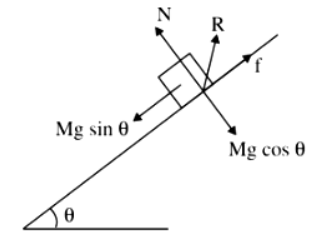
Frictional force opposes (impending or actual) relative motion between two surfaces in contact. It is the component of the contact force along the common tangent to the surface in contact. Static friction \(f_s\) opposes impending relative motion; kinetic friction \(f_k\) opposes actual relative motion. They are independent of the area of contact and satisfy the following approximate laws:
\(
\begin{aligned}
& f_s \leq\left(f_s\right)_{\max }=\mu_s N \\
& f_{\mathrm{k}}=\mu_{\mathrm{k}} N
\end{aligned}
\)
\(\mu_s\) (co-efficient of static friction) and \(\mu_k\) (co-efficient of kinetic friction) are constants characteristic of the pair of surfaces in contact. It is found experimentally that \(\mu_k\) is less than \(\mu_s\).
Quiz Summary
0 of 88 Questions completed
Questions:
Information
You have already completed the quiz before. Hence you can not start it again.
Quiz is loading…
You must sign in or sign up to start the quiz.
You must first complete the following:
Results
Results
0 of 88 Questions answered correctly
Your time:
Time has elapsed
You have reached 0 of 0 point(s), (0)
Earned Point(s): 0 of 0, (0)
0 Essay(s) Pending (Possible Point(s): 0)
Categories
- Not categorized 0%
- 1
- 2
- 3
- 4
- 5
- 6
- 7
- 8
- 9
- 10
- 11
- 12
- 13
- 14
- 15
- 16
- 17
- 18
- 19
- 20
- 21
- 22
- 23
- 24
- 25
- 26
- 27
- 28
- 29
- 30
- 31
- 32
- 33
- 34
- 35
- 36
- 37
- 38
- 39
- 40
- 41
- 42
- 43
- 44
- 45
- 46
- 47
- 48
- 49
- 50
- 51
- 52
- 53
- 54
- 55
- 56
- 57
- 58
- 59
- 60
- 61
- 62
- 63
- 64
- 65
- 66
- 67
- 68
- 69
- 70
- 71
- 72
- 73
- 74
- 75
- 76
- 77
- 78
- 79
- 80
- 81
- 82
- 83
- 84
- 85
- 86
- 87
- 88
- Current
- Review
- Answered
- Correct
- Incorrect
- Question 1 of 88
1. Question
A body of mass 2 kg moving with velocity of \(\vec{v}_{i n}=3 \hat{i}+4 \hat{j} \mathrm{~ms}^{-1}\) enters into a constant force field of 6 N directed along positive z-axis. If the body remains in the field for a period of \(\frac{5}{3}\) seconds, then velocity of the body when it emerges from force field is. [JEE Main 2025 (Online) 8th April Evening Shift]
CorrectIncorrectHint
(d) Step 1: Calculate the acceleration of the body
To find the acceleration, we use Newton’s second law, \(\vec{F}=m \vec{a}\). The force \(\vec{F}\) is 6 N directed along the positive z-axis, which can be written as \(\vec{F}=6 \hat{k} \mathrm{~N}\). The mass \(m\) is 2 kg.
The acceleration is given by:
\(
\vec{a}=\frac{\vec{F}}{m}=\frac{6 \hat{k}}{2}=3 \hat{k} \mathrm{~ms}^{-2}
\)
Step 2: Calculate the final velocity
The change in velocity \(\Delta \vec{v}\) is the product of acceleration \(\vec{a}\) and the time interval \(\Delta t\).
\(
\Delta \vec{v}=\vec{a} \Delta t=(3 \hat{k}) \times \frac{5}{3}=5 \hat{k} \mathrm{~ms}^{-1}
\)
The final velocity \(\vec{v}_{\text {out }}\) is the sum of the initial velocity \(\vec{v}_{\text {in }}\) and the change in velocity \(\Delta \vec{v}\). The initial velocity is given as \(\vec{v}_{\text {in }}=3 \hat{i}+4 \hat{j} \mathrm{~ms}^{-1}\).
\(
\vec{v}_{\text {out }}=\vec{v}_{\text {in }}+\Delta \vec{v}=(3 \hat{i}+4 \hat{j})+5 \hat{k}=3 \hat{i}+4 \hat{j}+5 \hat{k} \mathrm{~ms}^{-1}
\)
The velocity of the body when it emerges from the force field is \(3 \hat{i}+4 \hat{j}+5 \hat{k} \mathrm{~ms}^{-1}\). - Question 2 of 88
2. Question
An object with mass 500 g moves along x -axis with speed \(v=4 \sqrt{x} \mathrm{~m} / \mathrm{s}\). The force acting on the object is: [JEE Main 2025 (Online) 7th April Evening Shift]
CorrectIncorrectHint
(b) Step 1: Convert mass to standard units and find acceleration
First, convert the mass of the object from grams to kilograms:
\(
m=500 \mathrm{~g}=\frac{500}{1000} \mathrm{~kg}=0.5 \mathrm{~kg}
\)
Next, determine the acceleration of the object. Since the velocity \(v\) is a function of position \(x\), we use the chain rule to find the acceleration \(a\) :
\(
a=\frac{d v}{d t}=\frac{d v}{d x} \frac{d x}{d t}=v \frac{d v}{d x}
\)
The velocity is given as \(v=4 \sqrt{x}\). We need to find its derivative with respect to \(x\) :
\(
\frac{d v}{d x}=\frac{d}{d x}\left(4 x^{1 / 2}\right)=4 \cdot \frac{1}{2} x^{-1 / 2}=\frac{2}{\sqrt{x}}
\)
Now, substitute this back into the acceleration equation:
\(
a=v \frac{d v}{d x}=(4 \sqrt{x})\left(\frac{2}{\sqrt{x}}\right)=8 \mathrm{~m} / \mathrm{s}^2
\)
Step 2: Calculate the force
Using Newton’s Second Law, the force \(\boldsymbol{F}\) is the product of the object’s mass \(\boldsymbol{m}\) and its acceleration \(\boldsymbol{a}\) :
\(
F=m a
\)
Substitute the values for mass and acceleration:
\(
F=(0.5 \mathrm{~kg})\left(8 \mathrm{~m} / \mathrm{s}^2\right)=4 \mathrm{~N}
\)
The force acting on the object is \(\mathbf{4} \mathbf{N}\). - Question 3 of 88
3. Question
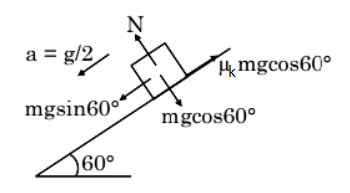
A cubic block of mass \(m\) is sliding down on an inclined plane at \(60^{\circ}\) with an acceleration of \(\frac{g}{2}\), the value of coefficient of kinetic friction is [JEE Main 2025 (Online) 7th April Morning Shift]
CorrectIncorrectHint
(d)

Step 1: Set up the equations of motion
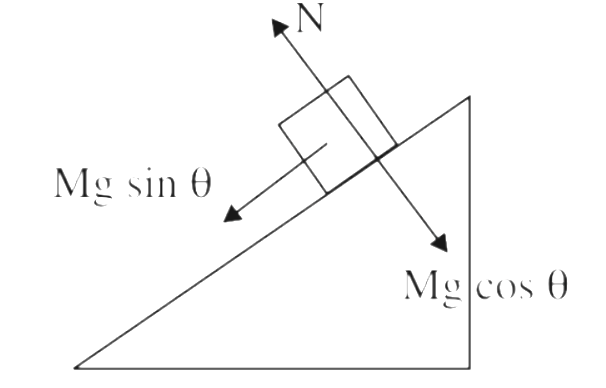
First, we analyze the forces acting on the block. The force of gravity ( \(m g\) ) can be resolved into two components: one perpendicular to the inclined plane, \(m g \cos \theta\), and one parallel to it, \(m g \sin \theta\). The normal force ( \(N\) ) acts perpendicular to the plane, and the force of kinetic friction ( \(f_k\) ) acts parallel to the plane, opposing the motion.
The net force perpendicular to the plane is zero, so we have:
\(
N=m g \cos \theta
\)
The net force parallel to the plane is equal to the mass times the acceleration:
\(
m g \sin \theta-f_k=m a
\)
Step 2: Solve for the coefficient of kinetic friction
The force of kinetic friction is given by \(f_k=\mu_k N\), where \(\mu_k\) is the coefficient of kinetic friction. Substituting the expression for the normal force, we get \(f_k=\mu_k(m g \cos \theta)\)Now we can substitute this into the equation for the parallel forces:
\(
m g \sin \theta-\mu_k(m g \cos \theta)=m a
\)
We can divide the entire equation by \(m g\) to simplify:
\(
\sin \theta-\mu_k \cos \theta=\frac{a}{g}
\)
We are given that the angle \(\theta=60^{\circ}\) and the acceleration \(a=\frac{g}{2}\). Plugging these values into the equation:
\(
\sin \left(60^{\circ}\right)-\mu_k \cos \left(60^{\circ}\right)=\frac{g / 2}{g}
\)
We know that \(\sin \left(60^{\circ}\right)=\frac{\sqrt{3}}{2}\) and \(\cos \left(60^{\circ}\right)=\frac{1}{2}\).
\(
\frac{\sqrt{3}}{2}-\mu_k\left(\frac{1}{2}\right)=\frac{1}{2}
\)
Now, we solve for \(\mu_k\) :
\(
\begin{aligned}
\mu_k\left(\frac{1}{2}\right) & =\frac{\sqrt{3}}{2}-\frac{1}{2} \\
\mu_k\left(\frac{1}{2}\right) & =\frac{\sqrt{3}-1}{2} \\
\mu_k & =\sqrt{3}-1
\end{aligned}
\)
The value of the coefficient of kinetic friction is \(\sqrt{3}-1\). - Question 4 of 88
4. Question
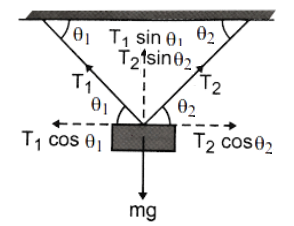
A body of mass \(m\) is suspended by two strings making angles \(\theta_1\) and \(\theta_2\) with the horizontal ceiling with tensions \(T_1\) and \(T_2\) simultaneously. \(T_1\) and \(T_2\) are related by \(T_1=\sqrt{3} T_2\), the angles \(\theta_1\) and \(\theta_2\) are [JEE Main 2025 (Online) 4th April Morning Shift]
CorrectIncorrectHint
(d)

Vertical components of \(T_1\) and \(T_2\) balance the weight of the body.
\(
\therefore T_1 \sin \theta_1+T_2 \sin \theta_2=m g
\)
Given, \(\mathrm{T}_1=\sqrt{3} \mathrm{~T}_2\)
For \(\theta_1=60^{\circ} \& \theta_2=30^{\circ}\)
\(
\mathrm{T}_2\left[\sqrt{3} \sin \theta_1+\sin \theta_2\right]=\mathrm{mg}
\)
\(
\mathrm{T}_2=\frac{\mathrm{mg}}{2}
\) - Question 5 of 88
5. Question
A block of mass 1 kg , moving along \(x\) with speed \(v_i=10 \mathrm{~m} / \mathrm{s}\) enters a rough region ranging from \(x=0.1 \mathrm{~m}\) to \(x=1.9 \mathrm{~m}\). The retarding force acting on the block in this range is \(\mathrm{F}_{\mathrm{r}}=-\mathrm{krN}\), with \(\mathrm{k}=10 \mathrm{~N} / \mathrm{m}\). Then the final speed of the block as it crosses rough region is. [JEE Main 2025 (Online) 3rd April Evening Shift]
CorrectIncorrectHint
(c) Step 1: Apply the Work-Energy Theorem
The Work-Energy Theorem states that the work done on an object by the net force is equal to the change in the object’s kinetic energy.
\(
W_{n e t}=\Delta K=K_f-K_i
\)
The work done by a variable force \(F(x)\) over a displacement from \(x_i\) to \(x_f\) is given by the integral:
\(
W=\int_{x_i}^{x_f} F(x) d x
\)
In this problem, the only force doing work is the retarding force, \(F_r=-k x\). We will use the given values to solve for the final speed, \(v_f\).
Step 2: Calculate the work done by the retarding force
The retarding force is \(F_r=-k x\), with \(k=10 \mathrm{~N} / \mathrm{m}\). The block moves from \(x_i=0.1 \mathrm{~m}\) to \(x_f=1.9 \mathrm{~m}\).
\(
\begin{gathered}
W_r=\int_{0.1}^{1.9}-10 x d x \\
W_r=-10\left[\frac{x^2}{2}\right]_{0.1}^{1.9} \\
W_r=-10\left(\frac{(1.9)^2}{2}-\frac{(0.1)^2}{2}\right) \\
W_r=-5(3.61-0.01) \\
W_r=-5(3.6)=-18 \mathrm{~J}
\end{gathered}
\)
Step 3: Solve for the final speed
Now, we set the work done equal to the change in kinetic energy.
\(
W_r=\frac{1}{2} m v_f^2-\frac{1}{2} m v_i^2
\)
We are given \(m=1 \mathrm{~kg}\) and \(v_i=10 \mathrm{~m} / \mathrm{s}\).
\(
-18=\frac{1}{2}(1) v_f^2-\frac{1}{2}(1)(10)^2
\)
\(
v_f=8 \mathrm{~m} / \mathrm{s}
\)
\(
\text { The final speed of the block is } 8 \mathrm{~m} / \mathrm{s} \text {. }
\) - Question 6 of 88
6. Question
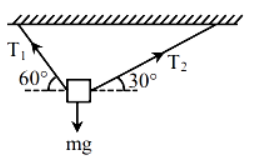
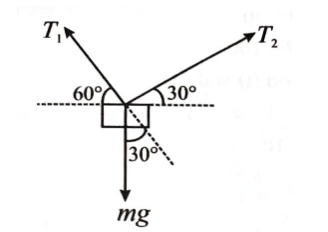
A body of mass 1 kg is suspended with the help of two strings making angles as shown in figure. Magnitudes of tensions \(\mathrm{T}_1\) and \(\mathrm{T}_2\), respectively, are (in N ):
(Take acceleration due to gravity \(10 \mathrm{~m} / \mathrm{s}^2\) ) [JEE Main 2025 (Online) 2nd April Evening Shift] CorrectIncorrect
Hint
(a) Using Lami’s theorem

\(
\begin{aligned}
& \frac{T_1}{\sin (90+30)}=\frac{T_2}{\sin (90+60)}=\frac{m g}{\sin 90} \\
& \Rightarrow T_1=m g \frac{\sqrt{3}}{2} \\
& T_2=\frac{M g}{2}=5 \\
& T_1=5 \sqrt{3}
\end{aligned}
\)Alternate:
\(
T_1 \sin 60^{\circ}+T_2 \sin 30^{\circ}=m g \dots(i)
\)
\(
T_1 \cos 60^{\circ}=T_2 \cos 30^{\circ} \dots(ii)
\)
\(
T_1=\sqrt{3} T_2 \dots(iii)
\)
From (i) and (iii)
\(
\sqrt{3} T_2 \times \frac{\sqrt{3}}{2}+\frac{T_2}{2}=m g
\)
\(
T_2=\frac{m g}{2}=5 \mathrm{~N}
\)
and \(T_1=\frac{\sqrt{3} m g}{2}=5 \sqrt{3} \quad \mathrm{~N}\) - Question 7 of 88
7. Question
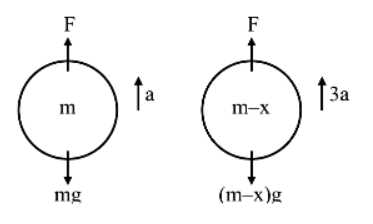
A balloon and its content having mass \(M\) is moving up with an acceleration ‘ \(a\) ‘. The mass that must be released from the content so that the balloon starts moving up with an acceleration ‘\(3a\)’ will be [JEE Main 2025 (Online) 28th January Evening Shift]
(Take ‘ \(g\) ‘ as acceleration due to gravity)CorrectIncorrectHint
(b)

\(
\begin{aligned}
& F-m g=m a \\
& F=m a+m g \dots(i) \\
& F-(m-x) g=(m-x) 3 a \dots(ii)
\end{aligned}
\)
Put Eqn. (i) in Eqn.(ii)
\(
{ma}+{mg}-{mg}+{xg}=3 {ma}-3 {xa}
\)
\(
{x}=\frac{2 {ma}}{{~g}+3 {a}}
\) - Question 8 of 88
8. Question
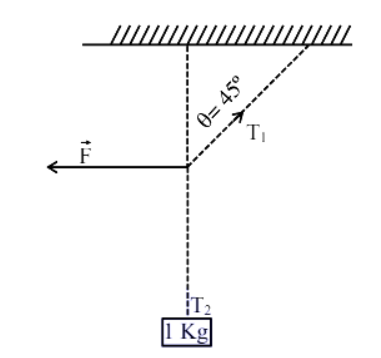
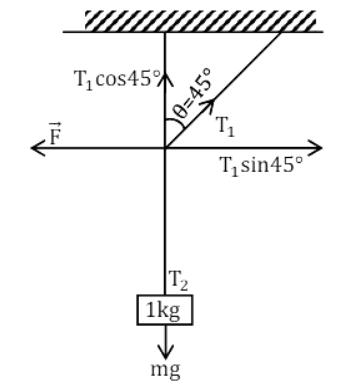
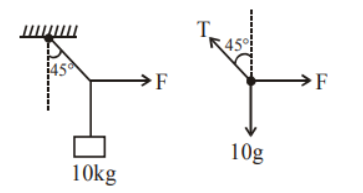
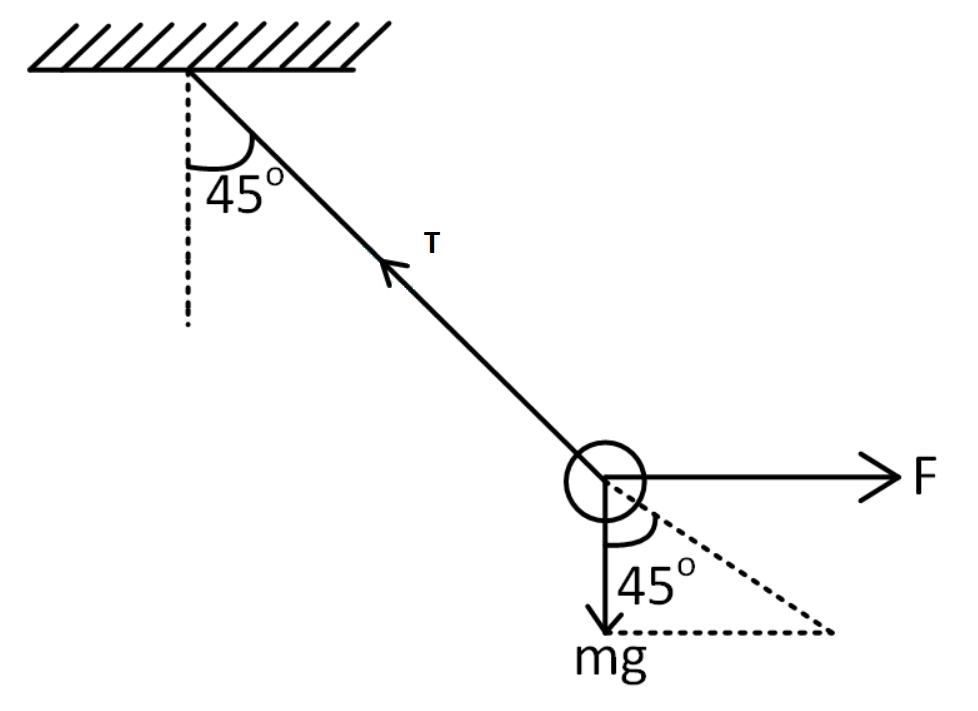
A 1 kg mass is suspended from the ceiling by a rope of length 4 m. A horizontal force ‘ \(F\) ‘ is applied at the mid point of the rope so that the rope makes an angle of \(45^{\circ}\) with respect to the vertical axis as shown in figure. The magnitude of \(F\) is : [JEE Main 2024 (Online) 9th April Evening Shift]
(Assume that the system is in equilibrium and \(g=10 \mathrm{~m} / \mathrm{s}^2\) ) CorrectIncorrect
Hint
(b)

\(
\begin{aligned}
&\text { AS system is in equilibrium, therefore }\\
&\begin{aligned}
& \mathrm{T}_1 \cos 45^{\circ}=\mathrm{mg} \\
& \mathrm{~T}_1 \sin 45^{\circ}=\mathrm{F} \\
& \therefore \tan 45^{\circ}=\frac{\mathrm{F}}{\mathrm{mg}} \\
& \Rightarrow \mathrm{~F}=\mathrm{mg} \\
& \mathrm{~F}=10 \mathrm{~N}
\end{aligned}
\end{aligned}
\) - Question 9 of 88
9. Question
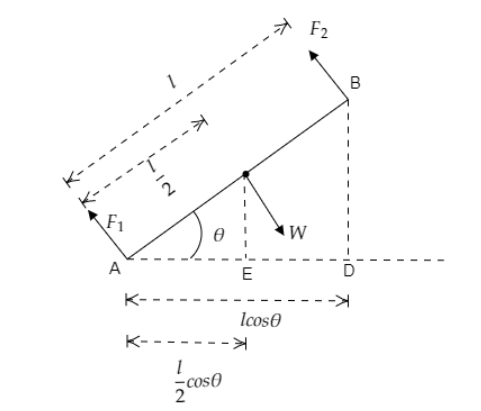
A heavy iron bar, of weight \(W\) is having its one end on the ground and the other on the shoulder of a person. The bar makes an angle \(\theta\) with the horizontal. The weight experienced by the person is : [JEE Main 2024 (Online) 9th April Morning Shift]
CorrectIncorrectHint
(c)

Step 1:
In the above figure, point \(A\) corresponds to the end of the bar on the ground and point \(B\) corresponds to the end of the bar on the shoulder of the man. AB represents the length of the bar \(l\)
Here, the weight experienced by the man is the force \(F_2\). The corresponding reaction on the ground is \(F_1\).
Both \(F_1\) and \(F_2\) are directed upwards while the weight of the bar \(W\) is directed downwards.
The net forces acting on the system can be expressed as \(F_1+F_2=W\).
The distance AE will be equal to \(\frac{l}{2} \cos \theta\) and the distance AD represents the horizontal component of the length of the bar i.e., \(l \cos \theta\).
Step 2: Use the principle of moments to find the weight experienced by the man.
Here, the weight of the bar \(W\) tries to rotate the bar in the clockwise direction while the force \(F_2\) tries to rotate the bar in the anticlockwise direction.
The principle fo moments gives the sum of the moments as zero.
i.e., \(F_2(A D)-W(A E)=0\)
\(\Rightarrow F_2(A D)=W(A E) \dots(1)\)
Substituting for \(A E=\frac{l}{2} \cos \theta\) and \(A D=l \cos \theta\) in equation (1) we get,
\(F_2(l \cos \theta)=W\left(\frac{l}{2} \cos \theta\right)\)
On simplifying the above expression we get, \(F_2=\frac{W}{2}\) - Question 10 of 88
10. Question
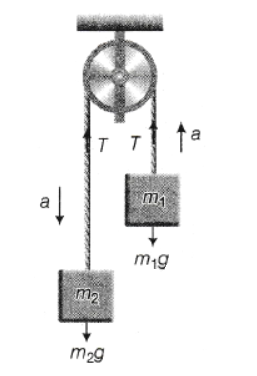
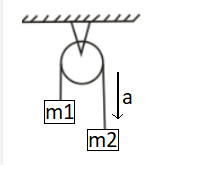
A light un-stretchable string passing over a smooth light pulley connects two blocks of masses \(m_1\) and \(m_2\). If the acceleration of the system is \(\frac{g}{8}\), then the ratio of the masses \(\frac{m_2}{m_1}\) is : [JEE Main 2024 (Online) 9th April Morning Shift]
CorrectIncorrectHint
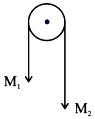
(c) As the string is inextensible, both masses have the same acceleration \(a\). Also, the pulley is massless and frictionless, hence the tension at both ends of the string is the same. Suppose, the mass \(m_2\) is greater than mass \(m_1\) so the heavier mass \(m_2\) is accelerating downward and the lighter mass \(m_1\) is accelerating upwards. Therefore, by Newton’s 2nd law

\(
\begin{gathered}
T-m_1 g=m_1 a \dots(i)\\
m_2 g-T=m_2 a \dots(ii)
\end{gathered}
\)
After solving Eqs. (i) and (ii), we get
\(
a=\frac{\left(m_2-m_1\right)}{\left(m_1+m_2\right)} \cdot g=\frac{g}{8} \text { [given] }
\)
So, \(\frac{g}{8}=\frac{m_2\left(1-m_1 / m_2\right)}{m_2\left(1+m_1 / m_2\right)} \cdot g \dots(iii)\)
Let \(\frac{m_1}{m_2}=x\)
Thus, Eq. (iii) becomes
\(
\frac{1-x}{1+x}=\frac{1}{8} \text { or } x=\frac{7}{9} \text { or } \frac{m_2}{m_1}=\frac{9}{7}
\)
So, the ratio of the masses is \(9: 7\). - Question 11 of 88
11. Question
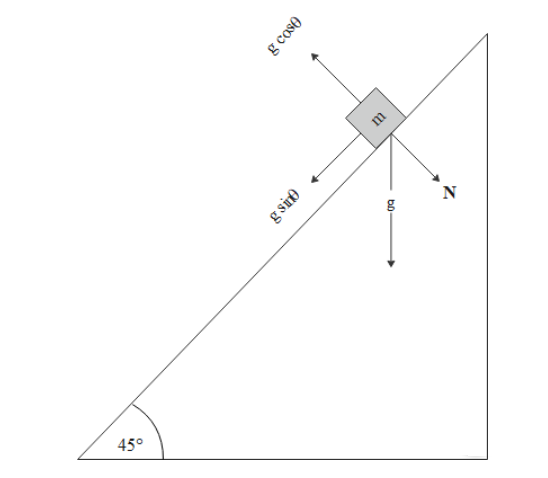
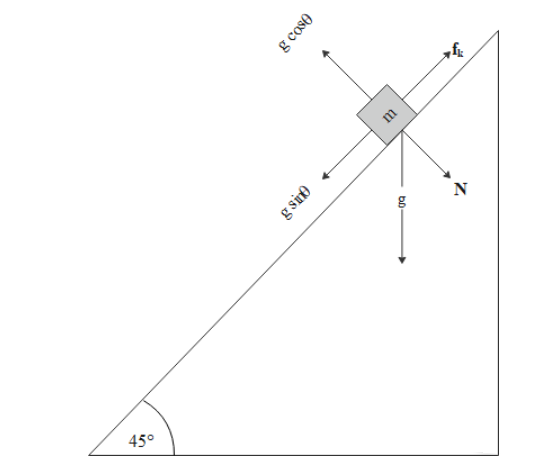
A given object takes \(n\) times the time to slide down \(45^{\circ}\) rough inclined plane as it takes the time to slide down an identical perfectly smooth \(45^{\circ}\) inclined plane. The coefficient of kinetic friction between the object and the surface of inclined plane is : [JEE Main 2024 (Online) 8th April Evening Shift]
CorrectIncorrectHint
(a) Complete step-by-step answer:
First, we assume that time taken by an object of mass \(m\) to slide down on a smooth inclined plane is \(t\) and a rough inclined plane is \(t^{\prime}\). Since the object takes \(n\) times as much time to slide down rough incline as it takes to slide down a perfectly smooth incline, we have \(t^{\prime}=n t\)
Now we resolve the components acceleration in direction of motion and perpendicular to direction of motion.
For smooth incline, equation of motion:
In direction perpendicular to direction of motion, the normal reaction \(N\) when \(\theta\) is the angle of inclination
\(
N=m g \cos \theta
\)
Along the direction of motion, net force \(F_{n e t}\) when object accelerates with constant acceleration \(a\)
\(
\begin{aligned}
& F_{n e t}=m a \\
& m g \sin \theta=m a \Rightarrow a=g \sin \theta
\end{aligned}
\)
For rough incline, equation of motion:
In direction perpendicular to direction of motion
\(
N=m g \cos \theta
\)
Along the direction of motion net force when object accelerates with acceleration \(a^{\prime}\) is
\(
\begin{aligned}
& F_{n e t}^{\prime}=m a^{\prime} \\
& m g \sin \theta-f_k=m a^{\prime}
\end{aligned}
\)
Where kinetic friction \(f_k=\mu N\)
\(\mu\) is the coefficient of kinetic friction.
\(
\Rightarrow f_k=\mu m g \cos \theta
\)
Therefore we get,
\(
a^{\prime}=g(\sin \theta-\mu \cos \theta)
\)
Since distance travelled by object is same in both cases, we have
\(
\begin{aligned}
& s=s^{\prime} \\
& (g \sin \theta) t^2=g(\sin \theta-\mu \cos \theta)\left(t^{\prime}\right)^2
\end{aligned}
\)
On simplifying this equation and substituting \(t^{\prime}=n t\) and \(\theta=45^{\circ}\) we get
\(
t^2=\left(1-\frac{\mu \cos 45^{\circ}}{\sin 45^{\circ}}\right)(n t)^2
\)
On solving the above equation for coefficient of kinetic friction \(\mu\) we get
\(
\mu=1-\frac{1}{n^2}
\) - Question 12 of 88
12. Question
A player caught a cricket ball of mass 150 g moving at a speed of \(20 \mathrm{~m} / \mathrm{s}\). If the catching process is completed in 0.1 s, the magnitude of force exerted by the ball on the hand of the player is: [JEE Main 2024 (Online) 8th April Morning Shift]
CorrectIncorrectHint
(c) Step 1: Convert units and identify given values
First, convert the mass of the cricket ball from grams to kilograms to use standard SI units.
\(\operatorname{Mass}(m): 150 \mathrm{~g}=0.15 \mathrm{~kg}\)
Initial velocity \(\left(v_i\right): 20 \mathrm{~m} / \mathrm{s}\)
Final velocity \(\left(v_f\right): 0 \mathrm{~m} / \mathrm{s}\) (since the ball is caught)
Time interval \((\Delta t): 0.1 \mathrm{~s}\)
Step 2: Calculate the change in momentum
The change in momentum ( \(\Delta p\) ) is the product of the mass and the change in velocity. The formula for momentum is \(p=m v\).
\(
\begin{gathered}
\Delta p=m\left(v_f-v_i\right) \\
\Delta p=0.15 \mathrm{~kg}(0 \mathrm{~m} / \mathrm{s}-20 \mathrm{~m} / \mathrm{s}) \\
\Delta p=0.15 \times(-20) \mathrm{kg} \cdot \mathrm{~m} / \mathrm{s} \\
\Delta p=-3 \mathrm{~kg} \cdot \mathrm{~m} / \mathrm{s}
\end{gathered}
\)
The magnitude of the change in momentum is \(3 \mathrm{~kg} \cdot \mathrm{~m} / \mathrm{s}\).
Step 3: Calculate the magnitude of the force
According to Newton’s Second Law, the average force ( \(\boldsymbol{F}\) ) is the rate of change of momentum.
\(
\begin{gathered}
F=\frac{|\Delta p|}{\Delta t} \\
F=\frac{3 \mathrm{~kg} \cdot \mathrm{~m} / \mathrm{s}}{0.1 \mathrm{~s}} \\
F=30 \mathrm{~N}
\end{gathered}
\)
The magnitude of the force exerted by the ball on the player’s hand is 30 N. - Question 13 of 88
13. Question
A body of weight 200 N is suspended from a tree branch through a chain of mass 10 kg . The branch pulls the chain by a force equal to (if \(\mathrm{g}=10 \mathrm{~m} / \mathrm{s}^2\) ): [JEE Main 2024 (Online) 6th April Evening Shift]
CorrectIncorrectHint
(a) Let’s restate the problem carefully:
Weight of the body \(=200 \mathrm{~N}\)
Mass of chain \(=10 \mathrm{~kg}\)
\(g=10 \mathrm{~m} / \mathrm{s}^2\)
We are to find the force with which the branch pulls the chain i.e., the tension at the top of the chain.
Step 1: Weight of the chain
\(
W_{\text {chain }}=m g=10 \times 10=100 \mathrm{~N}
\)
Step 2: What does the branch have to support?
The branch supports:
1. The entire weight of the chain ( 100 N )
2. The weight of the body (200 N), which is transmitted through the chain
Therefore, the total force the branch must exert (the tension at the top of the chain) is:
\(
T_{\text {top }}=200+100=300 \mathrm{~N}
\) - Question 14 of 88
14. Question
A light string passing over a smooth light pulley connects two blocks of masses \(m_1\) and \(m_2\left(\right.\) where \(\left.m_2>m_1\right)\). If the acceleration of the system is \(\frac{g}{\sqrt{2}}\), then the ratio of the masses \(\frac{m_1}{m_2}\) is: [JEE Main 2024 (Online) 6th April Morning Shift]
CorrectIncorrectHint
(c)
\(
\begin{aligned}
&T-m_1 g=m_1 a \dots(i)\\
&m_2 g-T=m_2 a \dots(ii)\\
&\text { After solving Eqs. (i) and (ii), we get }
\end{aligned}
\)
The acceleration of the system is given by:
\(
a=\frac{m_2-m_1}{m_1+m_2} g
\)
Given \(a=\frac{g}{\sqrt{2}}\), substitute in the equation:
\(
\frac{g}{\sqrt{2}}=\frac{m_2-m_1}{m_1+m_2} g
\)
Simplifying:
\(
\frac{1}{\sqrt{2}}=\frac{m_2-m_1}{m_1+m_2}
\)
Cross-multiplying:
\(
\sqrt{2}\left(m_2-m_1\right)=m_1+m_2
\)
Rearranging:
\(
m_1(\sqrt{2}+1)=m_2(\sqrt{2}-1)
\)
The ratio of masses is:
\(
\frac{m_1}{m_2}=\frac{\sqrt{2}-1}{\sqrt{2}+1}
\) - Question 15 of 88
15. Question
A particle moves in \(x-y\) plane under the influence of a force \(\vec{F}\) such that its linear momentum is \(\overrightarrow{\mathrm{p}}(\mathrm{t})=\hat{i} \cos (\mathrm{kt})-\hat{j} \sin (\mathrm{kt})\). If k is constant, the angle between \(\overrightarrow{\mathrm{F}}\) and \(\overrightarrow{\mathrm{p}}\) will be : [JEE Main 2024 (Online) 5th April Evening Shift]
CorrectIncorrectHint
(a) Step 1: Find the force vector \(\vec{F}\)
The force \(\vec{F}\) is the time derivative of the linear momentum \(\vec{p}\). The linear momentum is given as \(\vec{p}(t)=\hat{i} \cos (\mathrm{kt})-\hat{j} \sin (\mathrm{kt})\).
\(
\vec{F}=\frac{d \vec{p}}{d t}
\)
Differentiating the components of \(\overrightarrow{\boldsymbol{p}}\) with respect to time \(t\) :
\(
\begin{aligned}
\vec{F} & =\frac{d}{d t}(\hat{i} \cos (k t)-\hat{j} \sin (k t)) \\
\vec{F} & =\hat{i} \frac{d}{d t}(\cos (k t))-\hat{j} \frac{d}{d t}(\sin (k t))
\end{aligned}
\)
Using the chain rule, we get:
\(
\begin{gathered}
\vec{F}=\hat{i}(-\sin (k t) \cdot k)-\hat{j}(\cos (k t) \cdot k) \\
\vec{F}=-k \sin (k t) \hat{i}-k \cos (k t) \hat{j}
\end{gathered}
\)
Step 2: Calculate the angle between \(\overrightarrow{\boldsymbol{F}}\) and \(\overrightarrow{\boldsymbol{p}}\)
The angle \(\boldsymbol{\theta}\) between two vectors can be found using the dot product formula:
\(
\vec{F} \cdot \vec{p}=|\vec{F}||\vec{p}| \cos (\theta)
\)
Let’s first calculate the dot product \(\vec{F} \cdot \vec{p}\) :
\(
\begin{gathered}
\vec{F} \cdot \vec{p}=(-k \sin (k t))(\cos (k t))+(-k \cos (k t))(-\sin (k t)) \\
\vec{F} \cdot \vec{p}=-k \sin (k t) \cos (k t)+k \sin (k t) \cos (k t) \\
\vec{F} \cdot \vec{p}=0
\end{gathered}
\)
Since the dot product of \(\vec{F}\) and \(\vec{p}\) is zero, the vectors are orthogonal. This means the angle \(\theta\) between them is \(90^{\circ}\) or \(\frac{\pi}{2}\) radians. - Question 16 of 88
16. Question
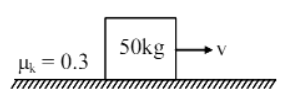
A heavy box of mass 50 kg is moving on a horizontal surface. If co-efficient of kinetic friction between the box and horizontal surface is 0.3 then force of kinetic friction is : [JEE Main 2024 (Online) 5th April Evening Shift]
CorrectIncorrectHint
(b)

Step 1: Calculate the Normal Force
The normal force ( \(\boldsymbol{N}\) ) on a horizontal surface is equal to the gravitational force, which is the mass \((m)\) multiplied by the acceleration due to gravity \((g)\). We assume the standard value for \(g\) is \(9.8 \mathrm{~m} / \mathrm{s}^2\).
\(
\begin{gathered}
N=m g \\
N=(50 \mathrm{~kg})\left(9.8 \mathrm{~m} / \mathrm{s}^2\right) \\
N=490 \mathrm{~N}
\end{gathered}
\)
Step 2: Calculate the Force of Kinetic Friction
The force of kinetic friction \(\left(\boldsymbol{F}_{\boldsymbol{k}}\right)\) is the product of the coefficient of kinetic friction \(\left(\boldsymbol{\mu}_{\boldsymbol{k}}\right)\) and the normal force ( \(N\) ).
\(
\begin{gathered}
F_k=\mu_k N \\
F_k=(0.3)(490 \mathrm{~N}) \\
F_k=147 \mathrm{~N}
\end{gathered}
\)
The force of kinetic friction is 147 N. - Question 17 of 88
17. Question
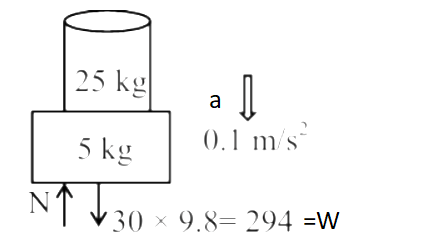
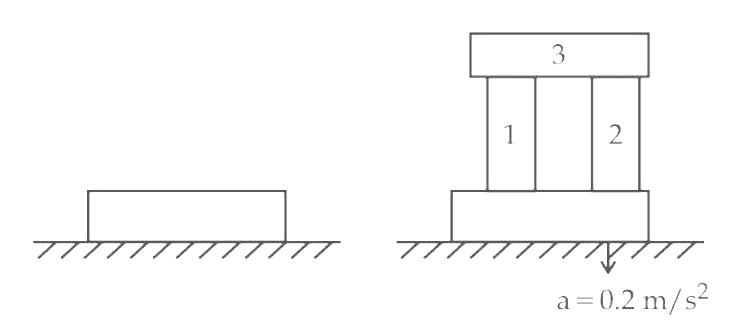
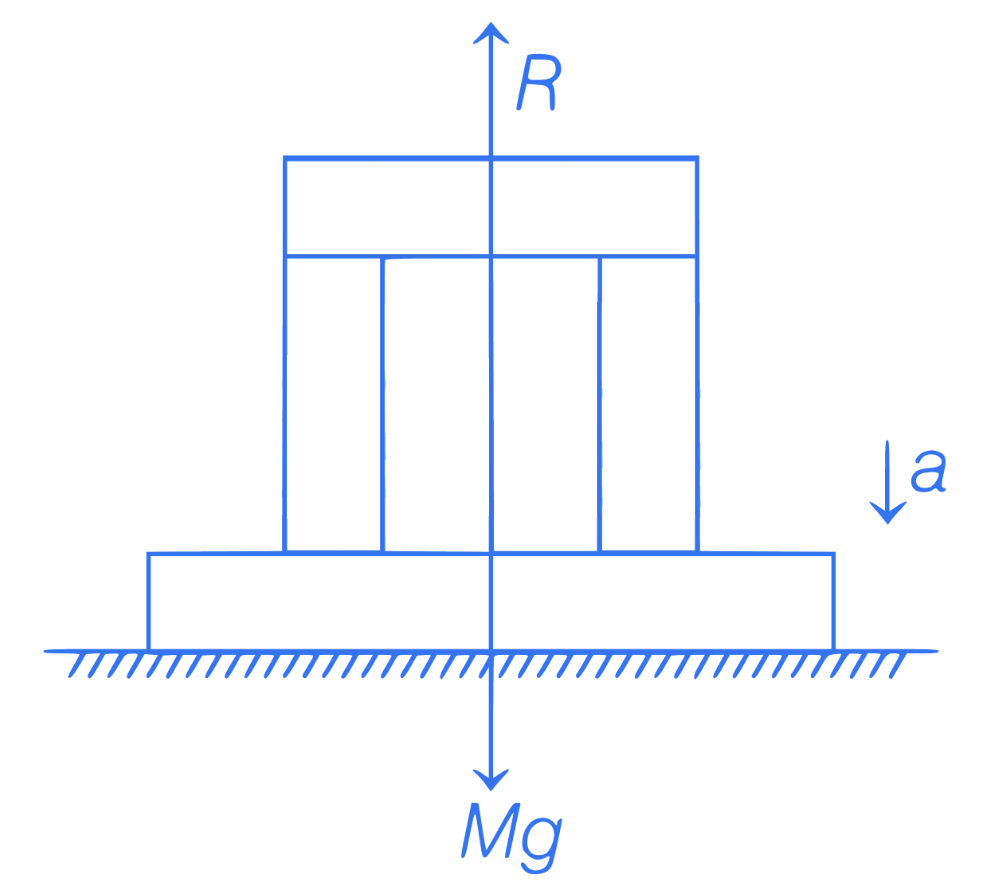
A wooden block of mass 5 kg rests on a soft horizontal floor. When an iron cylinder of mass 25 kg is placed on the top of the block, the floor yields and the block and the cylinder together go down with an acceleration of \(0.1 \mathrm{~ms}^{-2}\). The action force of the system on the floor is equal to: [JEE Main 2024 (Online) 5th April Morning Shift]
CorrectIncorrectHint
(b)

Step 1: Calculate the total mass of the system
The system consists of the wooden block and the iron cylinder.
The mass of the wooden block is \(m_b=5 \mathrm{~kg}\).
The mass of the iron cylinder is \(m_c=25 \mathrm{~kg}\).
The total mass of the system is the sum of their masses:
\(
M=m_b+m_c=5 \mathrm{~kg}+25 \mathrm{~kg}=30 \mathrm{~kg}
\)
Step 2: Apply Newton’s Second Law
According to Newton’s Second Law, the net force acting on the system is equal to its total mass multiplied by its acceleration ( \(F_{\text {net }}=m a\) ).
The forces acting on the system are:
1. The total weight of the system acting downwards, \(W=m g\).
2. The normal force from the floor acting upwards, \(N\).
Since the system is accelerating downwards with an acceleration \(a=0.1 \mathrm{~m} / \mathrm{s}^2\), we can write the equation of motion as:
\(
F_{n e t}=W-N=M a
\)
Using \(g=9.8 \mathrm{~m} / \mathrm{s}^2\) :
\(
(30 \mathrm{~kg})\left(9.8 \mathrm{~m} / \mathrm{s}^2\right)-N=(30 \mathrm{~kg})\left(0.1 \mathrm{~m} / \mathrm{s}^2\right)
\)
\(
\begin{gathered}
N=294 \mathrm{~N}-3 \mathrm{~N} \\
N=291 \mathrm{~N}
\end{gathered}
\) - Question 18 of 88
18. Question
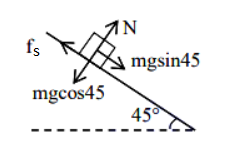
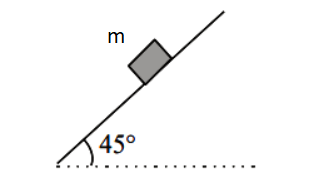
A 2 kg brick begins to slide over a surface which is inclined at an angle of \(45^{\circ}\) with respect to horizontal axis. The co-efficient of static friction between their surfaces is: [JEE Main 2024 (Online) 4th April Evening Shift]
CorrectIncorrectHint
(a)

Step 1: Analyze the forces acting on the brick
The brick is on the verge of sliding down the inclined surface. At this point, the component of gravity pulling the brick down the slope is exactly balanced by the maximum force of static friction.
The force of gravity acting on the brick is \(\boldsymbol{F}_{\boldsymbol{g}}=\boldsymbol{m}\).
The component of gravity parallel to the inclined surface is \(F_{\|}=m g \sin \theta\).
The component of gravity perpendicular to the inclined surface is \(F_{\perp}=m g \cos \theta\).
The normal force is equal in magnitude to the perpendicular component of gravity, so \(N=m g \cos \theta\).
The maximum force of static friction is given by \(f_{s, \max }=\mu_s N=\mu_s m g \cos \theta\).
Step 2: Set up the equation for the moment the brick begins to slide
When the brick begins to slide, the parallel component of gravity is equal to the maximum static friction force.
\(
\begin{gathered}
F_{\|}=f_{s, \max } \\
m g \sin \theta=\mu_s m g \cos \theta
\end{gathered}
\)
Step 3: Solve for the coefficient of static friction
We can cancel out \(m g\) from both sides of the equation and then solve for \(\mu_s\) :
\(
\begin{gathered}
\sin \theta=\mu_s \cos \theta \\
\mu_s=\frac{\sin \theta}{\cos \theta}=\tan \theta
\end{gathered}
\)
Given that the angle of inclination \(\theta\) is \(45^{\circ}\), we can find the value of \(\mu_s\) :
\(
\begin{gathered}
\mu_s=\tan \left(45^{\circ}\right) \\
\mu_s=1
\end{gathered}
\) - Question 19 of 88
19. Question
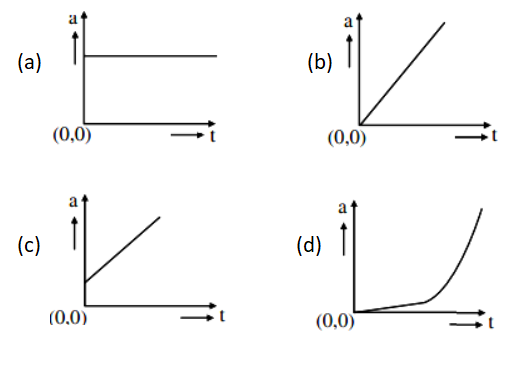
A wooden block, initially at rest on the ground, is pushed by a force which increases linearly with time \(t\). Which of the following curve best describes acceleration of the block with time : [JEE Main 2024 (Online) 4th April Morning Shift]
 CorrectIncorrect
Hint
(b) Force-time relationship: The force applied to the block increases linearly with time, meaning \(F=k t\) where \(k\) is a constant.
Newton’s Second Law: \(\boldsymbol{F}=m a\), which relates force to mass and acceleration.
Result: By solving for \(a\) in \(F=m a\), we get \(a=\frac{F}{m}=\frac{k t}{m}\), which shows that acceleration is directly proportional to time (will vary linearly with time). - Question 20 of 88
20. Question
A body of mass 4 kg experiences two forces \(\vec{F}_1=5 \hat{i}+8 \hat{j}+7 \hat{k}\) and \(\vec{F}_2=3 \hat{i}-4 \hat{j}-3 \hat{k}\). The acceleration acting on the body is : [JEE Main 2024 (Online) 1st February Evening Shift]
CorrectIncorrectHint
(a) Step 1: Calculate the net force
To find the net force ( \(\vec{F}_{\text {net }}\) ) acting on the body, add the two force vectors \(\vec{F}_1\) and \(\vec{F}_2\).
\(
\begin{gathered}
\vec{F}_{n e t}=\vec{F}_1+\vec{F}_2 \\
\vec{F}_{n e t}=(5 \hat{i}+8 \hat{j}+7 \hat{k})+(3 \hat{i}-4 \hat{j}-3 \hat{k}) \\
\vec{F}_{n e t}=(5+3) \hat{i}+(8-4) \hat{j}+(7-3) \hat{k} \\
\vec{F}_{n e t}=8 \hat{i}+4 \hat{j}+4 \hat{k}
\end{gathered}
\)
Step 2: Calculate the acceleration
Use Newton’s Second Law of Motion, \(\vec{F}_{\text {net }}=m \vec{a}\), to find the acceleration ( \(\vec{a}\) ) by dividing the net force by the mass ( \(m=4 \mathrm{~kg}\) ).
\(
\begin{gathered}
\vec{a}=\frac{\vec{F}_{\text {net }}}{m} \\
\vec{a}=\frac{8 \hat{i}+4 \hat{j}+4 \hat{k}}{4} \\
\vec{a}=\frac{8}{4} \hat{i}+\frac{4}{4} \hat{j}+\frac{4}{4} \hat{k} \\
\vec{a}=2 \hat{i}+1 \hat{j}+1 \hat{k} \\
\vec{a}=2 \hat{i}+\hat{j}+\hat{k}
\end{gathered}
\) - Question 21 of 88
21. Question
A cricket player catches a ball of mass 120 g moving with \(25 \mathrm{~m} / \mathrm{s}\) speed. If the catching process is completed in 0.1 s then the magnitude of force exerted by the ball on the hand of player will be (in SI unit) : [JEE Main 2024 (Online) 1st February Evening Shift]
CorrectIncorrectHint
(a) Step 1: Identify given values and convert to SI units
The mass of the ball needs to be converted from grams to kilograms to be in SI units.
Mass, \(m=120 \mathrm{~g}=0.12 \mathrm{~kg}\)
Initial velocity, \(u=25 \mathrm{~m} / \mathrm{s}\)
Final velocity, \(v=0 \mathrm{~m} / \mathrm{s}\) (since the ball is caught and comes to a stop)
Time taken, \(\Delta t=0.1 \mathrm{~s}\)
Step 2: Calculate the change in momentum
The force is related to the change in momentum over time, as described by Newton’s Second Law: \(F=\frac{\Delta p}{\Delta t}\), where \(\Delta p\) is the change in momentum \((p=m v)\).
First, we calculate the initial and final momentum.
Initial momentum: \(p_{\text {initial }}=m u=(0.12 \mathrm{~kg})(25 \mathrm{~m} / \mathrm{s})=3 \mathrm{~kg} \cdot \mathrm{~m} / \mathrm{s}\)
Final momentum: \(p_{\text {final }}=m v=(0.12 \mathrm{~kg})(0 \mathrm{~m} / \mathrm{s})=0 \mathrm{~kg} \cdot \mathrm{~m} / \mathrm{s}\)
Next, we find the change in momentum, \(\Delta p\) :
\(\Delta p=p_{\text {final }}-p_{\text {initial }}=0-3=-3 \mathrm{~kg} \cdot \mathrm{~m} / \mathrm{s}\)
Step 3: Calculate the magnitude of the force
Now we use the formula for force:
\(F=\frac{\Delta p}{\Delta t}=\frac{-3 \mathrm{~kg} \cdot \mathrm{~m} / \mathrm{s}}{0.1 \mathrm{~s}}=-30 \mathrm{~N}\)
The question asks for the magnitude of the force, so we take the absolute value.
\(|F|=|-30|=30 \mathrm{~N}\) (Here, negative sign shows the direction of force is opposite to motion.)
The magnitude of the force exerted by the ball on the hand of the player is 30 N. - Question 22 of 88
22. Question
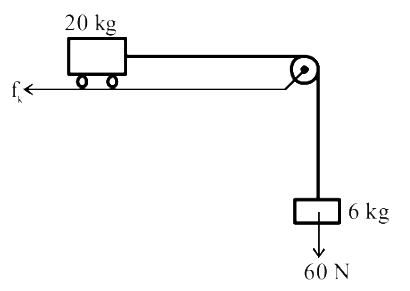
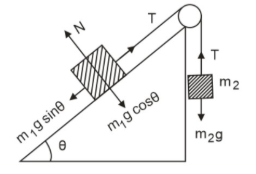
Consider a block and trolley system as shown in figure. If the coefficient of kinetic friction between the trolley and the surface is 0.04, the acceleration of the system in \(\mathrm{ms}^{-2}\) is : [JEE Main 2024 (Online) 1st February Morning Shift]
(Consider that the string is massless and un-stretchable and the pulley is also massless and frictionless) : CorrectIncorrect
Hint
(d) Step 1: Identify given values and forces
Mass of the trolley \(\left(m_1\right)=20 \mathrm{~kg}\)
Mass of the hanging block \(\left(m_2\right)=6 \mathrm{~kg}\)
Coefficient of kinetic friction \(\left(\boldsymbol{\mu}_{\boldsymbol{k}}\right)=\mathbf{0 . 0 4}\)
Acceleration due to gravity \((g)=10 \mathrm{~ms}^{-2}\)
The forces acting on the system are tension in the string ( \(\boldsymbol{T}\) ), the gravitational force on the block \(\left(m_2 g\right)\), and the kinetic friction force on the trolley \(\left(f_k\right)\)
Step 2: Apply Newton’s Second Law
We can set up two equations of motion for the system, one for the trolley and one for the block, since they move together with the same acceleration (\(a\)).
1. For the trolley: The net horizontal force is the tension minus the friction. The friction force is \(f_k=\mu_k N\), where the normal force \(N\) equals the trolley’s weight ( \(m_1 g\) ).
\(
T-f_k=m_1 a \quad \Longrightarrow \quad T-\mu_k m_1 g=m_1 a
\)
Plugging in the values:
\(
\begin{aligned}
& T-(0.04)(20)(10)=20 a \\
& T-8=20 a \quad \dots(1)
\end{aligned}
\)
2. For the block: The net vertical force is the gravitational force on the block minus the tension.
\(
m_2 g-T=m_2 a
\)
Plugging in the values:
\(
\begin{aligned}
& (6)(10)-T=6 a \\
& 60-T=6 a \quad \dots(2)
\end{aligned}
\)
Step 3: Solve the system of equations
Now, we can solve the two equations simultaneously for the acceleration \(a\). From Equation 2, we can express the tension \(T\) as \(T=60-6 a\). Substituting this into Equation 1:
\(
\begin{gathered}
(60-6 a)-8=20 a \\
52=26 a \\
a=\frac{52}{26} \\
a=2
\end{gathered}
\)
The acceleration of the system is \(2 \mathrm{~ms}^{-2}\). - Question 23 of 88
23. Question
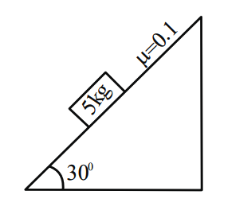
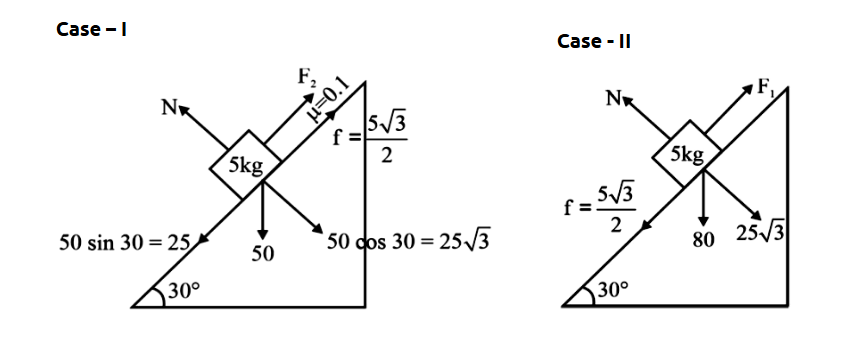
A block of mass 5 kg is placed on a rough inclined surface as shown in the figure. If \(\overrightarrow{F_1}\) is the force required to just move the block up the inclined plane and \(\overrightarrow{F_2}\) is the force required to just prevent the block from sliding down, then the value of \(\left|\overrightarrow{F_1}\right|-\left|\overrightarrow{F_2}\right|\) is : [Use \(\mathrm{g}=10 \mathrm{~m} / \mathrm{s}^2\) ] [JEE Main 2024 (Online) 31st January Evening Shift]
 CorrectIncorrect
Hint
(a)

Case-I:
\(
\begin{aligned}
& f_{\max }=\mu N \\
& f_{\max }=2.5 \sqrt{3} \\
& f_{\max }=\frac{5 \sqrt{3}}{2} \\
& F_2=25-\frac{5 \sqrt{3}}{2}
\end{aligned}
\)
Case-II:
\(
\begin{aligned}
& F_1=25+\frac{5 \sqrt{3}}{2} \\
& \left|F_1\right|-\left|F_2\right|=\frac{10 \sqrt{3}}{2} \\
& =5 \sqrt{3}
\end{aligned}
\) - Question 24 of 88
24. Question
A light string passing over a smooth light fixed pulley connects two blocks of masses \(m_1\) and \(m_2\). If the acceleration of the system is \(g / 8\), then the ratio of masses is: [JEE Main 2024 (Online) 31st January Evening Shift]
CorrectIncorrectHint
(b)
\(
\begin{aligned}
&T-m_1 g=m_1 a \dots(i)\\
&m_2 g-T=m_2 a \dots(ii)\\
&\text { After solving Eqs. (i) and (ii), we get }
\end{aligned}
\)
The acceleration of the system is given by:
\(
a=\frac{m_2-m_1}{m_1+m_2} g
\)
\(
\begin{aligned}
& a=\frac{\left(m_1-m_2\right) g}{\left(m_1+m_2\right)}=\frac{g}{8} \\
& 8 m_1-8 m_2=m_1+m_2 \\
& 7 m_1=9 m_2 \\
& \frac{m_1}{m_2}=\frac{9}{7}
\end{aligned}
\) - Question 25 of 88
25. Question
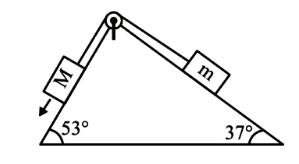
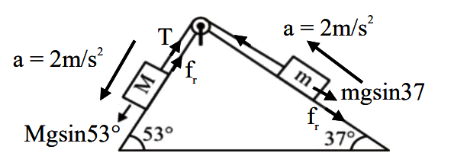
In the given arrangement of a doubly inclined plane two blocks of masses \(M\) and \(m\) are placed. The blocks are connected by a light string passing over an ideal pulley as shown. The coefficient of friction between the surface of the plane and the blocks is 0.25. The value of \(m\), for which \(M=10 \mathrm{~kg}\) will move down with an acceleration of \(2 \mathrm{~m} / \mathrm{s}^2\), is: (take \(\mathrm{g}=10 \mathrm{~m} / \mathrm{s}^2\) and \(\tan 37^{\circ}=3 / 4\) ) [JEE Main 2024 (Online) 31st January Morning Shift]
 CorrectIncorrect
Hint
(a)

For \(M\) block:
\(
\begin{aligned}
& 10 \mathrm{~g} \sin 53^{\circ}-\mu(10 \mathrm{~g}) \cos 53^{\circ}-\mathrm{T}=10 \times 2 \\
& \mathrm{~T}=80-15-20 \\
& \mathrm{~T}=45 \mathrm{~N}
\end{aligned}
\)
For \(m\) block:
\(
\begin{aligned}
& \mathrm{T}-\mathrm{mg} \sin 37^{\circ}-\mu \mathrm{mg} \cos 37^{\circ}=\mathrm{m} \times 2 \\
& 45=10 \mathrm{~m} \\
& \mathrm{~m}=4.5 \mathrm{~kg}
\end{aligned}
\) - Question 26 of 88
26. Question
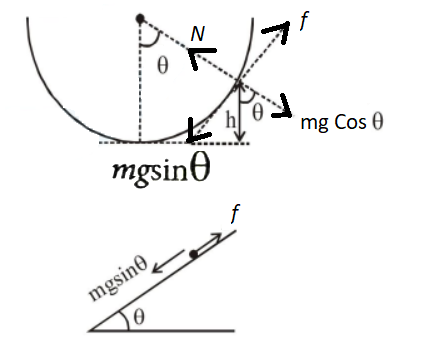
A block of mass \(m\) is placed on a surface having vertical crossection given by \(y=x^2 / 4\). If coefficient of friction is 0.5, the maximum height above the ground at which block can be placed without slipping is: [JEE Main 2024 (Online) 30th January Evening Shift]
CorrectIncorrectHint
(d) Step 1: Find the angle of the tangent to the curve
The condition for a block to be on the verge of slipping on an inclined surface is that the tangent of the angle of inclination, \(\theta\), is equal to the coefficient of static friction, \(\mu\). That is, \(\tan \theta=\mu\). The angle of inclination at any point on the curve is given by the slope of the tangent line, which is the first derivative of the function describing the curve.
The equation of the curve is given by \(y=\frac{x^2}{4}\).
First, find the derivative of the function with respect to \(x\) :
\(
\frac{d y}{d x}=\frac{d}{d x}\left(\frac{x^2}{4}\right)=\frac{2 x}{4}=\frac{x}{2}
\)
The slope of the tangent is given by \(m_{\text {slope }}=\frac{d y}{d x}=\tan \theta\).
Step 2: Relate the slope to the coefficient of friction
The maximum angle without slipping occurs when the tangent of the angle of the surface is equal to the coefficient of static friction.
\(
\tan \theta=\mu
\)
Given the coefficient of friction \(\boldsymbol{\mu} \boldsymbol{=} \mathbf{0 . 5}\), we can set the slope equal to this value:
\(
\frac{x}{2}=0.5
\)
Step 3: Solve for the coordinate \(\boldsymbol{x}\)
Solve the equation from Step 2 for \(x\) :
\(
x=2 \times 0.5=1
\)
This is the \(x\)-coordinate where the block is on the verge of slipping.
Step 4: Calculate the maximum height \(y\)
Substitute the value of \(x=1\) back into the original equation for the curve to find the corresponding height \(y\) :
\(
y=\frac{x^2}{4}=\frac{(1)^2}{4}=\frac{1}{4} \mathrm{~m}
\)
The maximum height at which the block can be placed without slipping is \(\frac{1}{4} \mathrm{~m}\) - Question 27 of 88
27. Question
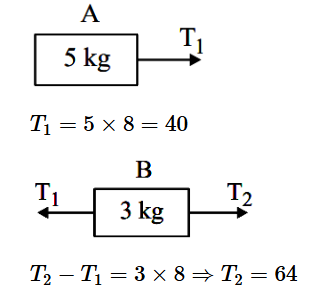
Three blocks \(A, B\) and \(C\) are pulled on a horizontal smooth surface by a force of 80 N as shown in figure

The tensions \(T_1\) and \(T_2\) in the string are respectively: [JEE Main 2024 (Online) 30th January Evening Shift]
CorrectIncorrectHint
(a)

Step 1: Calculate the total mass of all three blocks
\(
m_{\text {total }}=m_A+m_B+m_C=5+3+2=10 \mathrm{~kg}
\)
Step 2: Calculate the acceleration of the system
Using Newton’s second law, \(F=m_{\text {total }} \times a\)
\(
a=\frac{F}{m_{\text {total }}}=\frac{80}{10}=8 \mathrm{~m} / \mathrm{s}^2
\)
\(
\mathrm{T}_1=5 \times 8=40
\)
\(
\mathrm{T}_2-\mathrm{T}_1=3 \times 8 \Rightarrow \mathrm{~T}_2=64
\) - Question 28 of 88
28. Question
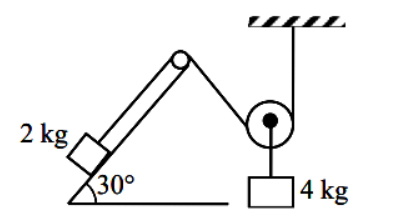
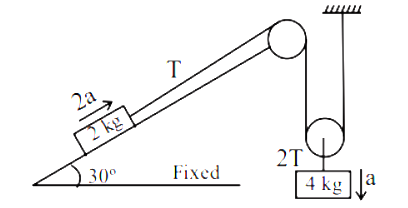
All surfaces shown in figure are assumed to be frictionless and the pulleys and the string are light. The acceleration of the block of mass 2 kg is : [JEE Main 2024 (Online) 30th January Morning Shift]
 CorrectIncorrect
Hint
(d)

\(
\begin{aligned}
& 40-2 T=4 a \\
& T-10=4 a \Rightarrow 20=12 a \\
& \Rightarrow a=\frac{5}{3} \Rightarrow 2 a=\frac{g}{3}
\end{aligned}
\) - Question 29 of 88
29. Question
Given below are two statements:
Statement (I) : The limiting force of static friction depends on the area of contact and independent of materials.
Statement (II) : The limiting force of kinetic friction is independent of the area of contact and depends on materials.
In the light of the above statements, choose the most appropriate answer from the options given below: [JEE Main 2024 (Online) 27th January Evening Shift]CorrectIncorrectHint
(a) Statement (I): The limiting force of static friction depends on the area of contact and independent of materials.
This statement is incorrect. The limiting force of static friction is given by the formula \(F_{s, \max }=\mu_s N\), where \(\mu_s\) is the coefficient of static friction and \(N\) is the normal force.
The value of \(\boldsymbol{\mu}_{\boldsymbol{s}}\) depends on the nature and materials of the surfaces in contact.
The limiting force of static friction is, to a good approximation, independent of the apparent area of contact (provided the normal force remains the same).Statement (II): The limiting force of kinetic friction is independent of the area of contact and depends on materials.
This statement is correct. The force of kinetic friction is given by the formula \(F_k=\mu_k N\), where \(\mu_k\) is the coefficient of kinetic friction.
Similar to static friction, the kinetic friction force is generally independent of the area of contact.
The value of \(\mu_k\) depends on the materials and nature of the surfaces in contact. \(\theta\)
Therefore, Statement I is false, and Statement II is true. - Question 30 of 88
30. Question
The position vector of a particle related to time \(t\) is given by \(\vec{r}=\left(10 t \hat{i}+15 t^2 \hat{j}+7 \hat{k}\right) m\)
The direction of net force experienced by the particle is : [JEE Main 2023 (Online) 15th April Morning Shift]CorrectIncorrectHint
(b) Step 1: Differentiate the position vector to find the velocity vector
The position vector is given by \(\vec{r}=\left(10 t \hat{i}+15 t^2 \hat{j}+7 \hat{k}\right)\). To find the velocity vector \(\vec{v}\), we differentiate the position vector with respect to time \(t\)
\(
\vec{v}=\frac{d \vec{r}}{d t}=\frac{d}{d t}\left(10 t \hat{i}+15 t^2 \hat{j}+7 \hat{k}\right)=10 \hat{i}+30 t \hat{j}
\)
Step 2: Differentiate the velocity vector to find the acceleration vector
To find the acceleration vector \(\vec{a}\), we differentiate the velocity vector with respect to time \(t\).
\(
\vec{a}=\frac{d \vec{v}}{d t}=\frac{d}{d t}(10 \hat{i}+30 t \hat{j})=0 \hat{i}+30 \hat{j}
\)
The acceleration vector is therefore \(\vec{a}=30 \hat{j} \mathrm{~m} / \mathrm{s}^2\).
Step 3: Determine the direction of the net force
According to Newton’s Second Law of Motion, the net force \(\vec{F}_{\text {net }}\) is directly proportional to the acceleration \(\vec{a}\left(\vec{F}_{\text {net }}=m \vec{a}\right)\). This means the direction of the net force is the same as the direction of the acceleration.
The acceleration vector \(\vec{a}\) is \(30 \hat{j}\), which has a magnitude only in the positive \(y\) direction. - Question 31 of 88
31. Question
Three forces \(F_1=10 \mathrm{~N}, F_2=8 \mathrm{~N}, \mathrm{~F}_3=6 \mathrm{~N}\) are acting on a particle of mass 5 kg. The forces \(\mathrm{F}_2\) and \(\mathrm{F}_3\) are applied perpendicularly so that particle remains at rest. If the force \(F_1\) is removed, then the acceleration of the particle is: [JEE Main 2023 (Online) 12th April Morning Shift]
CorrectIncorrectHint
(c) Step 1: Calculate the resultant of forces \(\boldsymbol{F}_{\mathbf{2}}\) and \(\boldsymbol{F}_{\mathbf{3}}\)
The forces \(F_2\) and \(F_3\) are applied perpendicularly. We can find the magnitude of their resultant force, \(\mathrm{F}_{23}\), using the Pythagorean theorem.
\(
F_{23}=\sqrt{F_2^2+F_3^2}
\)
Given \(F_2=8 \mathrm{~N}\) and \(F_3=6 \mathrm{~N}\) :
\(
F_{23}=\sqrt{(8 \mathrm{~N})^2+(6 \mathrm{~N})^2}=\sqrt{64 \mathrm{~N}^2+36 \mathrm{~N}^2}=\sqrt{100 \mathrm{~N}^2}=10 \mathrm{~N}
\)
Step 2: Determine the net force after \(F_1\) is removed
Initially, with all three forces acting, the particle is at rest. This means the net force is zero. The resultant of \(\mathbf{F}_{\mathbf{2}}\) and \(\mathbf{F}_{\mathbf{3}}\) is \(10 \mathbf{N}\), and since the particle is at rest, the third force \(\mathbf{F}_{\mathbf{1}}\) must have an equal magnitude ( 10 N ) and act in the opposite direction to the resultant of \(\mathrm{F}_2\) and \(\mathrm{F}_3\).
When force \(\mathbf{F}_{\mathbf{1}}\) is removed, the remaining net force on the particle is the resultant of \(\mathbf{F}_{\mathbf{2}}\) and \(\mathbf{F}_{\mathbf{3}}\), which we calculated in Step 1.
\(
F_{n e t}=F_{23}=10 \mathrm{~N}
\)
Step 3: Calculate the acceleration of the particle
Using Newton’s second law of motion, the acceleration (\(a\)) of the particle can be found by dividing the net force ( \(F_{n e t}\) ) by the mass ( \(m\) ).
\(
a=\frac{F_{\text {net }}}{m}
\)
Given \(F_{\text {net }}=10 \mathrm{~N}\) and \(m=5 \mathrm{~kg}\) :
\(
a=\frac{10 \mathrm{~N}}{5 \mathrm{~kg}}=2 \mathrm{~ms}^{-2}
\) - Question 32 of 88
32. Question
A body of mass 500 g moves along \(x\) -axis such that it’s velocity varies with displacement \(x\) according to the relation \(v=10 \sqrt{x} \mathrm{~m} / \mathrm{s}\) the force acting on the body is: [JEE Main 2023 (Online) 11th April Evening Shift]
CorrectIncorrectHint
(c) Step 1: Find the acceleration of the body
First, convert the mass from grams to kilograms:
\(
m=500 \mathrm{~g}=0.5 \mathrm{~kg}
\)
The velocity of the body is given by the relation \(v=10 \sqrt{x}\).
To find the acceleration, we need to differentiate the velocity with respect to time, which can be done using the chain rule since velocity is a function of displacement \(x\) :
\(
a=\frac{d v}{d t}=\frac{d v}{d x} \cdot \frac{d x}{d t}
\)
Since \(\frac{d x}{d t}=v\), the acceleration can be written as:
\(
a=v \frac{d v}{d x}
\)
Now, we find \(\frac{d v}{d x}\) :
\(
\frac{d v}{d x}=\frac{d}{d x}\left(10 x^{1 / 2}\right)=10 \cdot \frac{1}{2} x^{1 / 2-1}=5 x^{-1 / 2}=\frac{5}{\sqrt{x}}
\)
Substitute this back into the acceleration equation:
\(
a=v \frac{d v}{d x}=(10 \sqrt{x})\left(\frac{5}{\sqrt{x}}\right)=50
\)
The acceleration of the body is constant and equal to \(50 \mathrm{~m} / \mathrm{s}^2\).
Step 2: Calculate the force using Newton’s Second Law
According to Newton’s Second Law of Motion, the force acting on the body is given by:
\(
F=m a
\)
Substitute the values of mass and acceleration:
\(
F=(0.5 \mathrm{~kg})\left(50 \mathrm{~m} / \mathrm{s}^2\right)=25 \mathrm{~N}
\)
The force acting on the body is 25 N. - Question 33 of 88
33. Question
At any instant the velocity of a particle of mass 500 g is \(\left(2 t \hat{i}+3 t^2 \hat{j}\right) \mathrm{ms}^{-1}\). If the force acting on the particle at \(t=1 \mathrm{~s}\) is \((\hat{i}+x \hat{j}) \mathrm{N}\). Then the value of \(x\) will be: [JEE Main 2023 (Online) 8th April Morning Shift]
CorrectIncorrectHint
(d) Step 1: Find the acceleration
The acceleration \(\vec{a}\) is the time derivative of the velocity \(\vec{v}\).
Given the velocity \(\vec{v}(t)=\left(2 t \hat{i}+3 t^2 \hat{j}\right) \mathrm{ms}^{-1}\), the acceleration is:
\(
\vec{a}(t)=\frac{d \vec{v}}{d t}=\frac{d}{d t}\left(2 t \hat{i}+3 t^2 \hat{j}\right)=(2 \hat{i}+6 t \hat{j}) \mathrm{ms}^{-2}
\)
Step 2: Calculate acceleration at \(t=1 \mathrm{~s}\)
Substitute \(t=1 \mathrm{~s}\) into the acceleration equation:
\(
\vec{a}(1)=(2 \hat{i}+6(1) \hat{j})=(2 \hat{i}+6 \hat{j}) \mathrm{ms}^{-2}
\)
Step 3: Use Newton’s second law to find the force
According to Newton’s second law, the force \(\vec{F}\) is the product of mass \(m\) and acceleration \(\vec{a}\). The mass is given as 500 g, which is 0.5 kg.
\(
\begin{gathered}
\vec{F}=m \vec{a} \\
\vec{F}=0.5 \mathrm{~kg} \times(2 \hat{i}+6 \hat{j}) \mathrm{ms}^{-2}=(1 \hat{i}+3 \hat{j}) \mathrm{N}
\end{gathered}
\)
Step 4: Compare the calculated force with the given force
The calculated force is \((1 \hat{i}+3 \hat{j}) \mathrm{N}\). The problem states that the force is \((\hat{i}+x \hat{j}) \mathrm{N}\). By comparing the components of the two vectors, we find:
\(
\begin{aligned}
& \hat{i}: 1=1 \\
& \hat{j}: 3=x
\end{aligned}
\)
Thus, the value of \(x\) is 3. - Question 34 of 88
34. Question
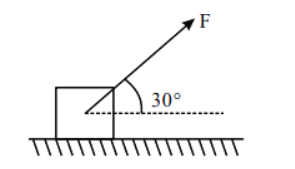
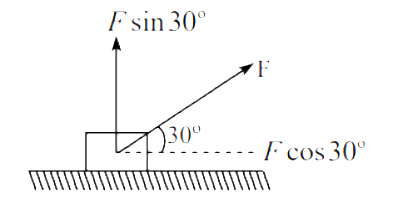
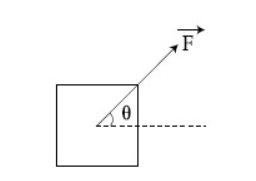
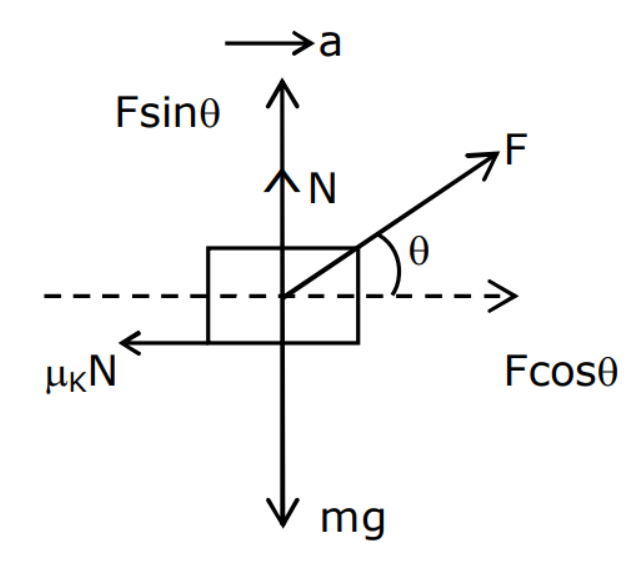
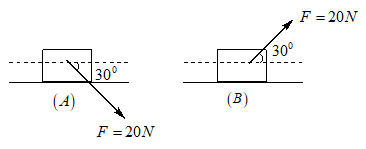
As shown in the figure a block of mass 10 kg lying on a horizontal surface is pulled by a force F acting at an angle \(30^{\circ}\), with horizontal. For \(\mu_s=0.25\), the block will just start to move for the value of F : [Given \(g=10 \mathrm{~ms}^{-2}\) ] [JEE Main 2023 (Online) 1st February Evening Shift]
 CorrectIncorrect
Hint
(a)

\(
\begin{aligned}
&\begin{gathered}
\mathrm{mg}-\mathrm{F} \sin 30^{\circ}=\mathrm{N} \\
\mathrm{f}=\mu(\mathrm{N}) \quad=\mu \mathrm{mg}-\mathrm{F} \sin 30^{\circ} \\
\mu=0.25 \text { given }
\end{gathered}\\
&\text { To start motion, } \mathrm{F} \cos 30^{\circ} \geq \mu \mathrm{N}\\
&\begin{gathered}
\mathrm{F} \cos 30^{\circ} \geq \mu \mathrm{mg}-\mathrm{F} \sin 30^{\circ} \\
\mathrm{F} \frac{\sqrt{3}}{2} \geq \frac{1}{4} 100-\mathrm{F} \frac{1}{2}, \quad \mathrm{~F} \frac{\sqrt{3}}{2}+\mathrm{F} \frac{1}{8} \geq \frac{100}{4} \\
\mathrm{~F} \frac{4 \sqrt{3}+1}{8} \geq 25, \mathrm{~F}=\frac{25 \times 8}{4 \sqrt{3}+1}=25.2 \mathrm{~N}
\end{gathered}
\end{aligned}
\) - Question 35 of 88
35. Question
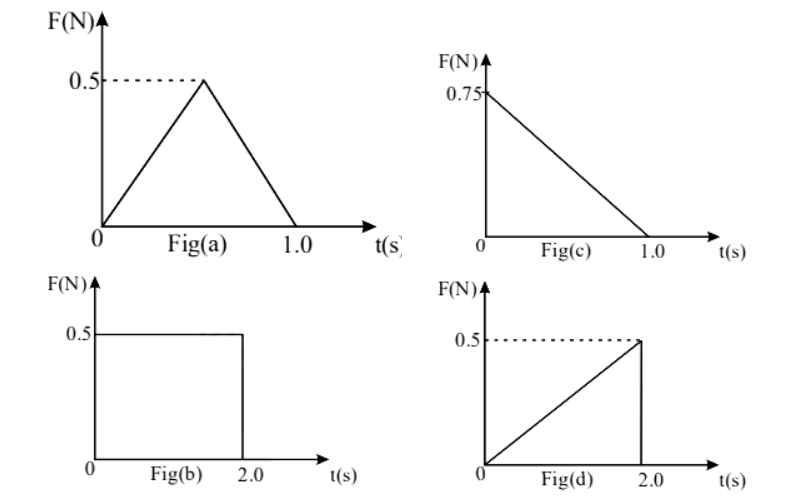
Figures (a), (b), (c) and (d) show variation of force with time. [JEE Main 2023 (Online) 1st February Evening Shift]

The impulse is highest in figure.
CorrectIncorrectHint
(b) As we know that impulse is given by
\(
I=\Delta P=F \times \Delta t
\)
or \(I=\) Area of \(F-t\) graph
(a) \(\frac{1}{2} \times 1 \times 0.5=\frac{1}{4} \mathrm{~N} . \mathrm{s}\)
(b) \(0.5 \times 2=1 \mathrm{~N} . \mathrm{s}\) (maximum)
(c) \(\frac{1}{2} \times 1 \times 0.75=\frac{3}{8} \mathrm{~N} . \mathrm{s}\)
(d) \(\frac{1}{2} \times 2 \times 0.5=\frac{1}{2} \mathrm{~N} . \mathrm{s}\) - Question 36 of 88
36. Question
A block of mass 5 kg is placed at rest on a table of rough surface. Now, if a force of 30 N is applied in the direction parallel to surface of the table, the block slides through a distance of 50 m in an interval of time 10 s. Coefficient of kinetic friction is (given, \(g=10 \mathrm{~ms}^{-2}\) ): [JEE Main 2023 (Online) 1st February Morning Shift]
CorrectIncorrectHint
(d) Step 1: Calculate the acceleration of the block
First, we need to find the acceleration (a) of the block using the given kinematic information. The block starts from rest, so its initial velocity \((u)\) is 0. We can use the following kinematic equation:
\(
s=u t+\frac{1}{2} a t^2
\)
Plugging in the given values for distance ( \(s=50 \mathrm{~m}\) ) and time ( \(t=10 \mathrm{~s}\) ), we get:
\(
\begin{gathered}
50=(0)(10)+\frac{1}{2} a(10)^2 \\
50=\frac{1}{2} a(100) \\
50=50 a \\
a=\frac{50}{50}=1 \mathrm{~ms}^{-2}
\end{gathered}
\)
Step 2: Apply Newton’s Second Law to find the coefficient of kinetic friction
Next, we apply Newton’s Second Law of Motion ( \(\Sigma F=m a\) ) to the block in the horizontal direction. The net force ( \(\boldsymbol{\Sigma} \boldsymbol{F}\) ) acting on the block is the applied force ( \(\boldsymbol{F}_{\text {app }}\) ) minus the force of kinetic friction \(\left(\boldsymbol{F}_{\boldsymbol{k}}\right)\).
\(
F_{n e t}=F_{a p p}-F_k=m a
\)
Now, we can rearrange the equation to solve for \(\mu_k\) :
\(
\begin{gathered}
F_{a p p}-m a=\mu_k m g \\
\mu_k=\frac{F_{a p p}-m a}{m g}
\end{gathered}
\)
Finally, we plug in the known values: mass ( \(m=5 \mathrm{~kg}\) ), applied force ( \(F_{a p p}=30 \mathrm{~N}\) ), acceleration ( \(a=1 \mathrm{~ms}^{-2}\) ), and gravity ( \(g=10 \mathrm{~ms}^{-2}\) ).
\(
\begin{gathered}
\mu_k=\frac{30-(5)(1)}{(5)(10)} \\
\mu_k=\frac{30-5}{50} \\
\mu_k=\frac{25}{50} \\
\mu_k=0.5
\end{gathered}
\)
The coefficient of kinetic friction is \(\mathbf{0 . 5}\). - Question 37 of 88
37. Question
A body of mass 10 kg is moving with an initial speed of \(20 \mathrm{~m} / \mathrm{s}\). The body stops after 5 s due to friction between body and the floor. The value of the coefficient of friction is: [JEE Main 2023 (Online) 31st January Evening Shift]
(Take acceleration due to gravity \(g=10 \mathrm{~ms}^{-2}\) )CorrectIncorrectHint
(d) Step 1: Calculate the acceleration
To find the acceleration of the body, we can use the kinematic equation \(v=u+a t\). The body starts with an initial speed of \(u=20 \mathrm{~m} / \mathrm{s}\) and comes to a stop ( \(v=0\) ) in \(t=5 \mathrm{~s}\).
\(
\begin{gathered}
v=u+a t \\
0=20+a(5) \\
5 a=-20 \\
a=-4 \mathrm{~m} / \mathrm{s}^2
\end{gathered}
\)
The magnitude of the deceleration is \(4 \mathrm{~m} / \mathrm{s}^2\).
Step 2: Find the force of friction
According to Newton’s second law, the net force on the body is equal to its mass times its acceleration ( \(F=m a\) ). In this case, the only horizontal force acting on the body is the force of friction, which causes the deceleration. 0
\(
\begin{gathered}
F_f=m a \\
F_f=(10 \mathrm{~kg})\left(4 \mathrm{~m} / \mathrm{s}^2\right) \\
F_f=40 \mathrm{~N}
\end{gathered}
\)
Step 3: Relate friction to the coefficient of friction
The force of friction ( \(F_f\) ) is related to the coefficient of friction ( \(\mu\) ) and the normal force ( \(N)\) by the formula \(F_f=\mu N\). Since the body is on a horizontal surface, the normal force is equal to the gravitational force ( \(N=m g\) ).
\(
\begin{gathered}
N=m g \\
N=(10 \mathrm{~kg})\left(10 \mathrm{~m} / \mathrm{s}^2\right) \\
N=100 \mathrm{~N}
\end{gathered}
\)
Now we can solve for the coefficient of friction ( \(\mu\) ).
\(
\begin{gathered}
F_f=\mu N \\
40=\mu(100) \\
\mu=\frac{40}{100} \\
\mu=0.4
\end{gathered}
\) - Question 38 of 88
38. Question
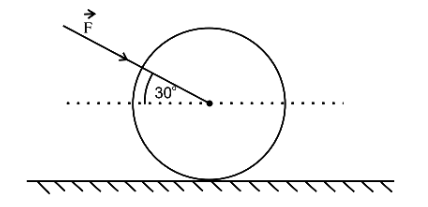
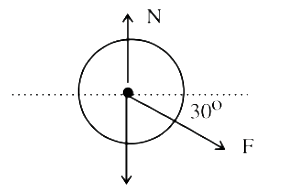
As shown in figure, a 70 kg garden roller is pushed with a force of \(\vec{F}=200 \mathrm{~N}\) at an angle of \(30^{\circ}\) with horizontal. The normal reaction on the roller is (Given \(\mathrm{g}=10 \mathrm{~m} \mathrm{~s}^{-2}\) ) [JEE Main 2023 (Online) 31st January Morning Shift]
 CorrectIncorrect
Hint
(a)

\(
\begin{aligned}
\mathrm{N} & =\mathrm{mg}+\mathrm{F} \sin 30^{\circ} \\
& =700+200 \times \frac{1}{2}=800 \text { newton }
\end{aligned}
\) - Question 39 of 88
39. Question
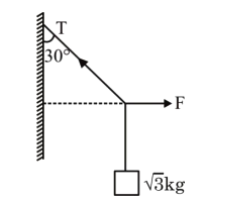
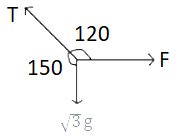
A block of \(\sqrt{3} \mathrm{~kg}\) is attached to a string whose other end is attached to the wall. An unknown force \(F\) is applied so that the string makes an angle of \(30^{\circ}\) with the wall. The tension \(T\) is: (Given \(\mathrm{g}=10 \mathrm{~ms}^{-2}\) ) [JEE Main 2023 (Online) 30th January Evening Shift]
 CorrectIncorrect
Hint
(d)

\(
\frac{\sqrt{3} \mathrm{~g}}{\sin 120^{\circ}}=\frac{\mathrm{T}}{\sin 90^{\circ}} \Rightarrow \mathrm{T}=\frac{\sqrt{3} \mathrm{~g}}{\sqrt{3} / 2}=20 N
\) - Question 40 of 88
40. Question
A force acts for 20 s on a body of mass 20 kg, starting from rest, after which the force ceases and then body describes 50 m in the next 10 s. The value of force will be: [JEE Main 2023 (Online) 29th January Evening Shift]
CorrectIncorrectHint
(c) Step 1: Calculate the velocity of the body after the force ceases
The force ceases and the body moves at a constant velocity for the next 10 s, covering a distance of 50 m . The constant velocity can be calculated using the formula \(v=d / t\).
\(
v=\frac{50 \mathrm{~m}}{10 \mathrm{~s}}=5 \mathrm{~m} / \mathrm{s}
\)
Step 2: Calculate the acceleration of the body
During the first 20 s , the body starts from rest ( \(v_0=0\) ) and accelerates to a final velocity of \(5 \mathrm{~m} / \mathrm{s}\) (from Step 1). The acceleration can be calculated using the formula \(a=\frac{v_f-v_0}{t}\)
\(
a=\frac{5 \mathrm{~m} / \mathrm{s}-0 \mathrm{~m} / \mathrm{s}}{20 \mathrm{~s}}=0.25 \mathrm{~m} / \mathrm{s}^2
\)
Step 3: Calculate the value of the force
The force acting on the body can be found using Newton’s second law of motion, \(F=m a\), where \(m\) is the mass ( 20 kg ) and \(a\) is the acceleration ( \(0.25 \mathrm{~m} / \mathrm{s}^2\) ) calculated in the previous step.
\(
F=(20 \mathrm{~kg})\left(0.25 \mathrm{~m} / \mathrm{s}^2\right)=5 \mathrm{~N}
\) - Question 41 of 88
41. Question
The time taken by an object to slide down \(45^{\circ}\) rough inclined plane is \(n\) times as it takes to slide down a perfectly smooth \(45^{\circ}\) incline plane. The coefficient of kinetic friction between the object and the incline plane is : [JEE Main 2023 (Online) 29th January Evening Shift]
CorrectIncorrectHint
(a) Step 1: Smooth Case Analysis
The acceleration of an object on a frictionless inclined plane is given by \(\boldsymbol{a}=\boldsymbol{g} \boldsymbol{\operatorname { s i n }} \boldsymbol{\theta}\). For \(\theta=45^{\circ}\), the acceleration is \(a=g \sin 45^{\circ}=\frac{g}{\sqrt{2}}\). Using the kinematic equation \(L=\frac{1}{2} a t^2\), where \(L\) is the distance traveled, the time \(t_1\) is found by rearranging the equation:
\(
t_1=\sqrt{\frac{2 L}{a}}=\sqrt{\frac{2 L}{g / \sqrt{2}}}=\sqrt{\frac{2 \sqrt{2} L}{g}}
\)
Step 2: Rough Case Analysis
The acceleration of an object on a rough inclined plane is given by \(a=g \sin \theta-\mu g \cos \theta\). For \(\theta=45^{\circ}\), the acceleration is:
\(
a=g \sin 45^{\circ}-\mu g \cos 45^{\circ}=\frac{g}{\sqrt{2}}-\mu \frac{g}{\sqrt{2}}=\frac{g}{\sqrt{2}}(1-\mu)
\)
Using the same kinematic equation as in the smooth case, the time \(t_2\) is:
\(
t_2=\sqrt{\frac{2 L}{a}}=\sqrt{\frac{2 L}{\frac{g}{\sqrt{2}}(1-\mu)}}=\sqrt{\frac{2 \sqrt{2} L}{g(1-\mu)}}
\)
Step 3: Deriving the Coefficient of Friction \(\boldsymbol{\mu}\)
The problem states that \(t_1=\frac{t_2}{n}\). By substituting the expressions for \(t_1\) and \(t_2\) from the previous steps, we get:
\(
\sqrt{\frac{2 \sqrt{2} L}{g}}=\frac{1}{n} \sqrt{\frac{2 \sqrt{2} L}{g(1-\mu)}}
\)
To solve for \(\mu\), first square both sides of the equation:
\(
\frac{2 \sqrt{2} L}{g}=\frac{1}{n^2} \frac{2 \sqrt{2} L}{g(1-\mu)}
\)
The term \(\frac{2 \sqrt{2} L}{g}\) appears on both sides, so it can be canceled out, leaving:
\(
1=\frac{1}{n^2(1-\mu)}
\)
Rearranging the equation to solve for \(\mu\) :
\(
\begin{aligned}
& n^2(1-\mu)=1 \\
& 1-\mu=\frac{1}{n^2} \\
& \mu=1-\frac{1}{n^2}
\end{aligned}
\)
The coefficient of kinetic friction is \(\boldsymbol{\mu}=\mathbf{1}-\frac{\mathbf{1}}{\mathbf{n}^{\mathbf{2}}}\). - Question 42 of 88
42. Question
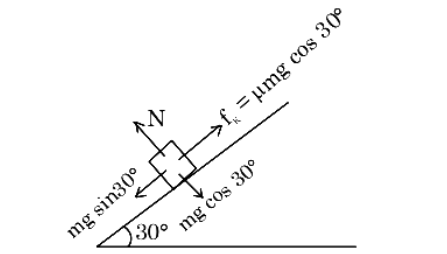
A block of mass \(m\) slides down the plane inclined at angle \(30^{\circ}\) with an acceleration \(\frac{g}{4}\). The value of coefficient of kinetic friction will be: [JEE Main 2023 (Online) 29th January Morning Shift]
CorrectIncorrectHint
(c)

\(
\begin{aligned}
&\mathrm{Mg} \sin 30^{\circ}-\mu \mathrm{mg} \cos 30^{\circ}=\mathrm{ma}\\
&\frac{g}{2}-\frac{\sqrt{3}}{2} \cdot \mu g=\frac{g}{4}\\
&\begin{aligned}
& \frac{\sqrt{3}}{2} \mu=\frac{1}{4} \\
& \mu=\frac{1}{2 \sqrt{3}}
\end{aligned}
\end{aligned}
\) - Question 43 of 88
43. Question
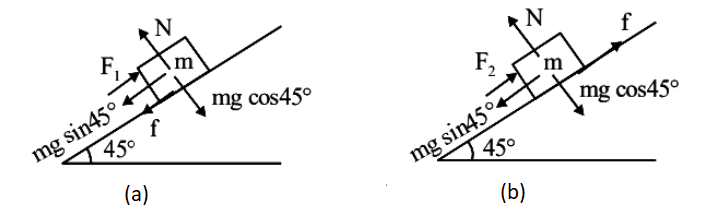
Consider a block kept on an inclined plane (incline at \(45^{\circ}\) ) as shown in the figure. If the force required to just push it up the incline is 2 times the force required to just prevent it from sliding down, the coefficient of friction between the block and inclined plane \((\mu)\) is equal to : [JEE Main 2023 (Online) 25th January Evening Shift]
 CorrectIncorrect
Hint
(a)

From Fig(a)
\(
\begin{aligned}
& \mathrm{F}_1=\mathrm{mg} \sin 45^{\circ}+\mathrm{f}=\mathrm{mg} \sin 45^{\circ}+\mu \mathrm{N} \\
& \mathrm{~F}_1=\frac{\mathrm{mg}}{\sqrt{2}}+\mu \mathrm{mg} \cos 45^{\circ} \\
& \mathrm{F}_1=\frac{\mathrm{mg}}{\sqrt{2}}(1+\mu)
\end{aligned}
\)From Fig(b)
\(
\begin{aligned}
& F_2=m g \sin 45^{\circ}-f=m g \sin 45^{\circ}-\mu N \\
& =\frac{m g}{\sqrt{2}}(1-\mu) \\
& F_1=2 F_2 \\
& \frac{m g}{\sqrt{2}}(1+\mu)=2 \frac{m g}{\sqrt{2}}(1-\mu) \\
& 1+\mu=2-2 \mu \\
& \mu=1 / 3=0.33
\end{aligned}
\) - Question 44 of 88
44. Question
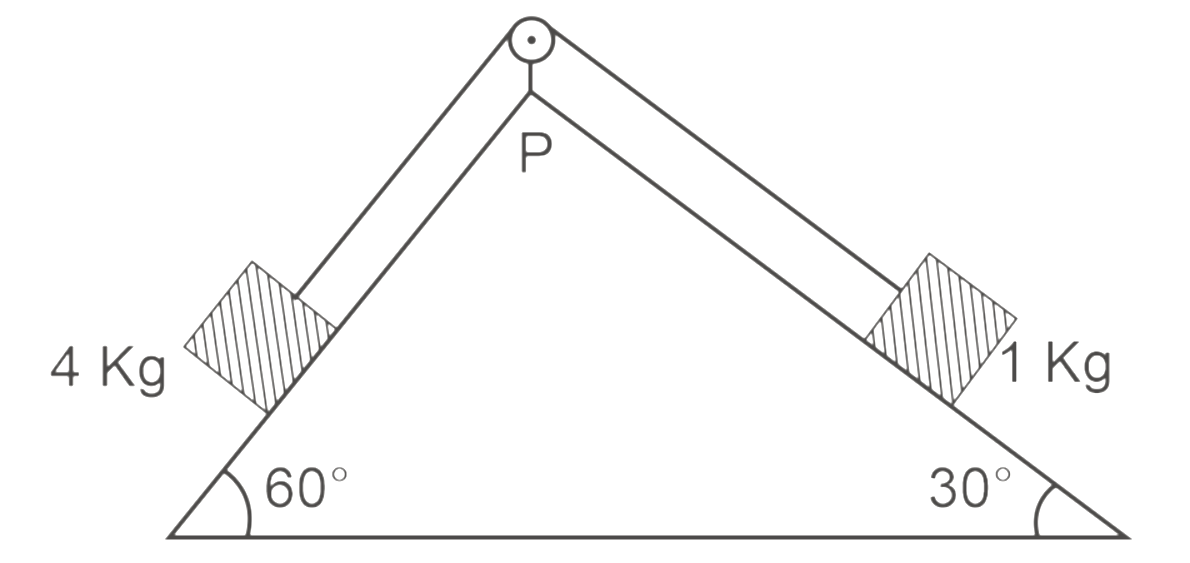
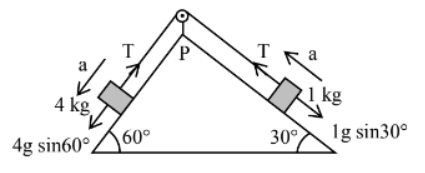
As per given figure, a weightless pulley \(P\) is attached on a double inclined frictionless surfaces. The tension in the string (massless) will be (if \(g=10 \mathrm{~m} / \mathrm{s}^2\) ) [JEE Main 2023 (Online) 24th January Morning Shift]
 CorrectIncorrect
Hint
(d)

\(
\begin{aligned}
& 4 \mathrm{~g} \frac{\sqrt{3}}{2}-\mathrm{T}=4 \mathrm{a} \\
& \mathrm{~T}-\frac{\mathrm{g}}{2}=1 \mathrm{a} \\
& 2 \sqrt{3} \mathrm{~g}-\mathrm{T}=4\left(\mathrm{~T}-\frac{\mathrm{g}}{2}\right) \Rightarrow 5 \mathrm{~T}=(2 \sqrt{3}+2) \mathrm{g} \\
& \mathrm{~T}=\frac{10}{5}(2 \sqrt{3}+2) \Rightarrow \mathrm{T}=4(\sqrt{3}+1) \mathrm{N}
\end{aligned}
\) - Question 45 of 88
45. Question
Given below are two statements :
Statement I : An elevator can go up or down with uniform speed when its weight is balanced with the tension of its cable.
Statement II : Force exerted by the floor of an elevator on the foot of a person standing on it is more than his/her weight when the elevator goes down with increasing speed.
In the light of the above statements, choose the correct answer from the options given below : [JEE Main 2023 (Online) 24th January Morning Shift]CorrectIncorrectHint
(d)
Statement I is true because an elevator moving at a uniform speed (zero acceleration) has a net force of zero, meaning its weight (downward force) is balanced by the tension of its cable (upward force). This condition applies whether the uniform speed is upward or downward.
Statement II is false because when an elevator goes down with increasing speed (accelerating downward), the force exerted by the floor on the person (the normal force, or apparent weight) is less than their actual weight. This is because the net force must be downward to cause the downward acceleration. The equation for the normal force ( \(N\) ) is \(N=m(g-a)\), where \(m\) is the person’s mass, \(g\) is the acceleration due to gravity, and \(a\) is the magnitude of the downward acceleration. Since \(\boldsymbol{a}\) is a positive value, \(\boldsymbol{N}\) is less than the actual weight \(m g\). \(\theta\)
Therefore, the correct answer is that Statement I is true but Statement II is false.
- Question 46 of 88
46. Question
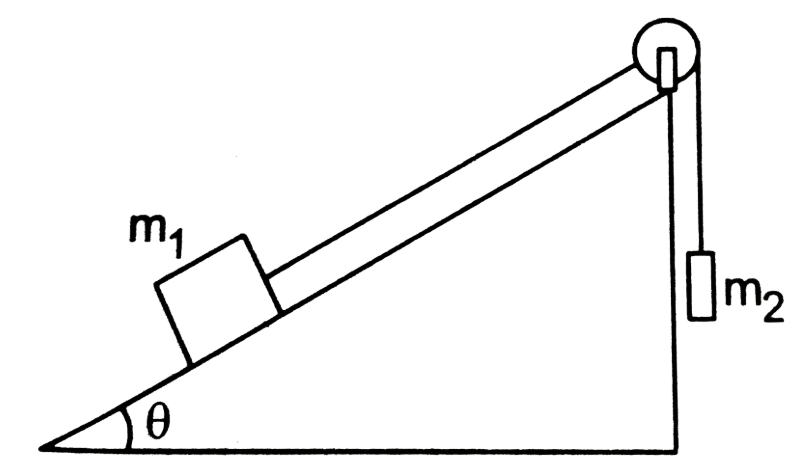
Two bodies of masses \(m_1=5 \mathrm{~kg}\) and \(m_2=3 \mathrm{~kg}\) are connected by a light string going over a smooth light pulley on a smooth inclined plane as shown in the figure. The system is at rest. The force exerted by the inclined plane on the body of mass \(\mathrm{m}_1\) will be : \(\left[\right.\) Take \(\left.\mathrm{g}=10 \mathrm{~ms}^{-2}\right]\) [JEE Main 2022 (Online) 29th July Evening Shift]
 CorrectIncorrect
Hint
(b)

For a system at rest
\(
\mathrm{m}_1 \mathrm{~g} \cos \theta=\mathrm{N} \dots(1)
\)
( \(\mathrm{N} \rightarrow\) Force by inclined plane on the block)
\(
\begin{aligned}
& \mathrm{T}=\mathrm{m}_2 \mathrm{~g}=30 \mathrm{~N} \dots(2) \\
& \mathrm{m}_1 \mathrm{~g} \sin \theta=\mathrm{T} \\
& 50 \sin \theta=30 \\
& \sin \theta=\frac{3}{5} \\
& \theta=37^{\circ} \\
& \mathrm{N}=\mathrm{m}_1 \mathrm{~g} \cos \theta \\
& =50 \times \cos 37^{\circ} \\
& \mathrm{N}=40 \mathrm{~N}
\end{aligned}
\)
The force exerted by the inclined plane on the body of mass \(m_1\) will be 40 N. - Question 47 of 88
47. Question
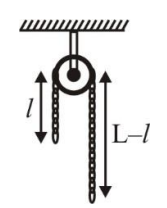
A uniform metal chain of mass \(m\) and length ‘\(L\)’ passes over a massless and frictionless pulley. It is released from rest with a part of its length ‘\(l\)’ is hanging on one side and rest of its length ‘ \(\mathrm{L}-l\) ‘ is hanging on the other side of the pully. At a certain point of time, when \(l=\frac{L}{x}\), the acceleration of the chain is \(\frac{g}{2}\). The value of \(x\) is [JEE Main 2022 (Online) 28th July Evening Shift]
 CorrectIncorrect
Hint
(d)

Let the mass of complete chain be ‘ \(m\) ‘and mass of chain of length’ \(\ell\) ‘ and ‘ \(\mathrm{L}-\ell^{\prime}\) be \(\mathrm{m}_1\) and \(\mathrm{m}_2\) respectively
\(
\begin{aligned}
& \mathrm{m}_1+\mathrm{m}_2=\mathrm{m} \\
& \mathrm{~m}_1=\left(\frac{\mathrm{m}}{\mathrm{~L}}\right) \ell \\
& \mathrm{m}_2=\left(\frac{\mathrm{m}}{\mathrm{~L}}\right)(\mathrm{L}-\ell) \\
& \left(\mathrm{m}_2-\mathrm{m}_1\right)_{\mathrm{g}}=\left(\mathrm{m}_2+\mathrm{m}_1\right) \mathrm{a} \\
& \mathrm{a}=\left(\frac{\mathrm{m}_2-\mathrm{m}_1}{\mathrm{~m}_2+\mathrm{m}_1}\right) \mathrm{g} \\
& \frac{\mathrm{~g}}{2}=\frac{\left(\frac{\mathrm{m}}{\mathrm{~L}}\right)(\mathrm{L}-2 \ell)}{\mathrm{m}} \mathrm{~g}
\end{aligned}
\)
\(
\begin{aligned}
& \frac{1}{2}=\frac{\mathrm{L}-2 \ell}{\mathrm{~L}} \\
& \mathrm{~L}=2 \mathrm{~L}-4 \ell \\
& 4 \ell=\mathrm{L} \\
& \ell=\frac{\mathrm{L}}{4} \\
& \therefore \mathrm{x}=4
\end{aligned}
\) - Question 48 of 88
48. Question
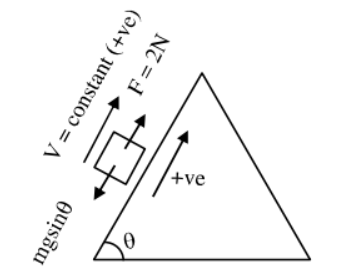
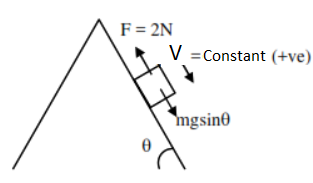
A block of mass M slides down on a rough inclined plane with constant velocity. The angle made by the incline plane with horizontal is \(\theta\). The magnitude of the contact force will be : [JEE Main 2022 (Online) 27th July Evening Shift]
CorrectIncorrectHint
(a)

\(
\begin{aligned}
& \mathrm{N}=\mathrm{Mg} \cos \theta \\
& \mathrm{f}=\mathrm{Mg} \sin \theta \\
& \mathrm{R}=\sqrt{\mathrm{N}^2+\mathrm{f}^2} \\
& \mathrm{R}=\mathrm{Mg}
\end{aligned}
\)Explanation:
The forces are:
Weight (Mg): Acts vertically downward.
Normal force ( \(\boldsymbol{N}\) ): Acts perpendicular to the incline, away from the surface.
Kinetic friction force ( \(f_k\) ): Acts parallel to the incline, opposing the motion.
We need to resolve the weight vector into components along our chosen coordinate system.
The component parallel to the incline is \(M g \sin \theta\).
The component perpendicular to the incline is \(M g \cos \theta . \theta\)
Step 2: Apply Newton’s first law
Since the block slides with constant velocity, its acceleration is zero. According to Newton’s first law, the net force on the block must be zero.
Along the \(\mathbf{y}\)-axis (perpendicular to the incline): The normal force and the perpendicular component of gravity are balanced.
\(
\begin{aligned}
& \sum_N F_y=N-M g \cos \theta=0 \\
& N=M g \cos \theta
\end{aligned}
\)
Along the \(\mathbf{x}\)-axis (parallel to the incline): The kinetic friction force and the parallel component of gravity are balanced.
\(
\sum F_x=M g \sin \theta-f_k=0
\)
\(
f_k=M g \sin \theta
\)
Step 3: Calculate the magnitude of the contact force
The contact force is the resultant vector of the normal force and the friction force. Since the normal force and the friction force are perpendicular to each other, the magnitude of the contact force ( \(\boldsymbol{F}_{\text {contact }}\) ) can be found using the Pythagorean theorem.
\(
F_{c o n t a c t}=\sqrt{N^2+f_k^2}
\)
Substitute the values for \(N\) and \(f_k\) we found in Step 2:
\(
\begin{aligned}
F_{\text {contact }} & =\sqrt{(M g \cos \theta)^2+(M g \sin \theta)^2} \\
F_{\text {contact }} & =\sqrt{M^2 g^2 \cos ^2 \theta+M^2 g^2 \sin ^2 \theta}
\end{aligned}
\)
Factor out the common term \(\boldsymbol{M}^2 \boldsymbol{g}^2\) :
\(
F_{\text {contact }}=\sqrt{M^2 g^2\left(\cos ^2 \theta+\sin ^2 \theta\right)}
\)
Using the trigonometric identity \(\sin ^2 \theta+\cos ^2 \theta=1\) :
\(
\begin{gathered}
F_{\text {contact }}=\sqrt{M^2 g^2(1)} \\
F_{\text {contact }}=M g
\end{gathered}
\) - Question 49 of 88
49. Question
A block ‘ \(A\) ‘ takes 2 s to slide down a frictionless incline of \(30^{\circ}\) and length ‘ \(l\) ‘, kept inside a lift going up with uniform velocity ‘ \(v\) ‘. If the incline is changed to \(45^{\circ}\), the time taken by the block, to slide down the incline, will be approximately : [JEE Main 2022 (Online) 27th July Evening Shift]
CorrectIncorrectHint
(c)

\(
\begin{aligned}
& \mathrm{a}=\mathrm{g} \sin \theta \\
& \ell=\frac{1}{2} \mathrm{~g} \sin 30^{\circ}(2)^2 \\
& \ell=\frac{1}{2} \mathrm{~g} \sin 45^{\circ} \mathrm{t}^2 \\
& \left(\frac{1}{2}\right)(4)=\frac{1}{\sqrt{2}} \mathrm{t}^2 \Rightarrow \mathrm{t}=\sqrt{2 \sqrt{2}}=1.68
\end{aligned}
\)Explanations:
Step 1: Determine the length of the incline
The motion of the block down a frictionless incline is governed by the acceleration component of gravity along the incline, which is \(a=g \sin (\theta)\). Since the lift is moving with a uniform velocity, there is no additional acceleration, so the effective gravity remains \(g\). The distance ‘ \(l\) ‘ is covered in time ‘ \(t\) ‘ with initial velocity \(\boldsymbol{u}=\mathbf{0}\). The equation of motion is \(l=\frac{1}{2} a t^2\).
For the first case, we have:
\(
\begin{gathered}
\theta_1=30^{\circ} \\
t_1=2 \mathrm{~s} \\
a_1=g \sin \left(30^{\circ}\right)=\frac{g}{2}
\end{gathered}
\)
The length of the incline is:
\(
l=\frac{1}{2} a_1 t_1^2=\frac{1}{2}\left(\frac{g}{2}\right)(2)^2=g \text { meters }
\)
Step 2: Calculate the time for the second incline angle
For the second case, the incline angle is changed to \(\theta_2=45^{\circ}\), and the length ‘\(l\)‘ remains the same.
The acceleration is now:
\(
a_2=g \sin \left(45^{\circ}\right)=g\left(\frac{1}{\sqrt{2}}\right)
\)
The time \(t_2\) is found using the same kinematic equation:
\(
l=\frac{1}{2} a_2 t_2^2
\)
We know \(l=g\) from the first step.
\(
\begin{aligned}
&\begin{gathered}
g=\frac{1}{2}\left(g \frac{1}{\sqrt{2}}\right) t_2^2 \\
1=\frac{1}{2 \sqrt{2}} t_2^2 \\
t_2^2=2 \sqrt{2} \\
t_2=\sqrt{2 \sqrt{2}}=\sqrt[4]{8} \mathrm{~s}
\end{gathered}\\
&\text { To find the approximate value: }\\
&t_2 \approx \sqrt{2 \times 1.414}=\sqrt{2.828} \approx 1.68 \mathrm{~s}
\end{aligned}
\)
The time taken by the block to slide down the incline will be approximately 1.68 s. - Question 50 of 88
50. Question
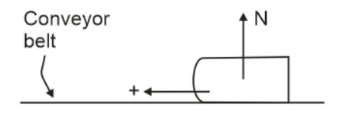
A bag is gently dropped on a conveyor belt moving at a speed of \(2 \mathrm{~m} / \mathrm{s}\). The coefficient of friction between the conveyor belt and bag is 0.4. Initially, the bag slips on the belt before it stops due to friction. The distance travelled by the bag on the belt during slipping motion, is: [Take \(\mathrm{g}=10 \mathrm{~m} / \mathrm{s}^{-2}\) ] [JEE Main 2022 (Online) 27th July Morning Shift]
CorrectIncorrectHint
(b)

Retardation due to friction \(=\frac{\mu M g}{M}=\mu g\)
Now, \(s=\frac{v^2-u^2}{2 a}=\frac{0^2-2^2}{2 x-\mu g}=\frac{2}{0.4 \times 10}=0.5 \mathrm{~m}\)Explanation: Step 1: Calculate the acceleration of the bag
The force of kinetic friction on the bag is given by \(f=\mu N\), where \(\mu\) is the coefficient of friction and \(N\) is the normal force. Since the bag is on a horizontal surface, the normal force is equal to its weight, \(N=m g\).
The force of friction provides the acceleration, so \(m a=f=\mu m g\).
Solving for acceleration, we get \(a=\mu \mathrm{g}\).
Given:
\(
\begin{aligned}
&\begin{aligned}
& \mu=0.4 \\
& g=10 \mathrm{~m} / \mathrm{s}^{-2}
\end{aligned}\\
&a=0.4 \times 10=4 \mathrm{~m} / \mathrm{s}^{-2}
\end{aligned}
\)
Step 2: Calculate the time the bag takes to reach the belt’s speed
The bag starts with an initial velocity of \(\boldsymbol{u}=\mathbf{0}\) and accelerates to the belt’s velocity of \(v=2 \mathrm{~m} / \mathrm{s}\). We can use the kinematic equation \(v=u+a t\).
Given:
\(v=2 \mathrm{~m} / \mathrm{s}\)
\(\boldsymbol{u}=0 \mathrm{~m} / \mathrm{s}\)
\(a=4 \mathrm{~m} / \mathrm{s}^{-2}\)
\(
\begin{gathered}
2=0+4 t \\
t=\frac{2}{4}=0.5 \mathrm{~s}
\end{gathered}
\)
Step 3: Calculate the distance traveled by the belt and the bag
The distance the conveyor belt travels during this time is \(s_{\text {belt }}=v_{\text {belt }} \times t\).
\(
s_{\text {belt }}=2 \mathrm{~m} / \mathrm{s} \times 0.5 \mathrm{~s}=1 \mathrm{~m}
\)
The distance the bag travels during this time is \(s_{\text {bag }}=u t+\frac{1}{2} a t^2\).
\(
s_{\text {bag }}=(0)(0.5)+\frac{1}{2}(4)(0.5)^2=0+2(0.25)=0.5 \mathrm{~m}
\)
Step 4: Calculate the distance the bag slips
The distance the bag slips relative to the belt is the difference between the distance the belt traveled and the distance the bag traveled.
\(
s_{\text {slip }}=s_{\text {belt }}-s_{\text {bag }}=1 \mathrm{~m}-0.5 \mathrm{~m}=0.5 \mathrm{~m}
\)
The distance traveled by the bag on the belt during slipping motion is 0.5 m. - Question 51 of 88
51. Question
Two masses \(M_1\) and \(M_2\) are tied together at the two ends of a light inextensible string that passes over a frictionless pulley. When the mass \(M_2\) is twice that of \(M_1\), the acceleration of the system is \(a_1\). When the mass \(M_2\) is thrice that of \(M_1\), the acceleration of the system is \(a_2\). The ratio \(\frac{a_1}{a_2}\) will be : [JEE Main 2022 (Online) 26th July Evening Shift]
 CorrectIncorrect
Hint
(b)
Case-I:
\(
\begin{aligned}
a & =\frac{m_2 g-m_1 g}{m_1+m_2} \\
M_2=2 m_1 & \\
a_1 & =\frac{2 m_1 g-m_1 g}{3 m_1} \\
a_1 & =g / 3
\end{aligned}
\)
Case-II:
\(
\begin{gathered}
\mathrm{M}_2=3 \mathrm{~m}_1 \\
\mathrm{a}_2=\frac{3 \mathrm{~m}_1 \mathrm{~g}-\mathrm{m}_1 \mathrm{~g}}{4 \mathrm{~m}_1} \\
\mathrm{a}_2=\frac{\mathrm{g}}{2} \\
\frac{\mathrm{a}_1}{\mathrm{a}_2}=\frac{\frac{\mathrm{g}}{3}}{\frac{\mathrm{~g}}{2}}=\frac{2}{3}
\end{gathered}
\) - Question 52 of 88
52. Question
Three masses \(M=100 \mathrm{~kg}, \mathrm{~m}_1=10 \mathrm{~kg}\) and \(\mathrm{m}_2=20 \mathrm{~kg}\) are arranged in a system as shown in figure. All the surfaces are frictionless and strings are inextensible and weightless. The pulleys are also weightless and frictionless. A force \(F\) is applied on the system so that the mass \(\mathrm{m}_2\) moves upward with an acceleration of \(2 \mathrm{~ms}^{-2}\). The value of \(F\) is : [JEE Main 2022 (Online) 26th July Morning Shift]
\(\left(\right.\) Take \(\left.\mathrm{g}=10 \mathrm{~ms}^{-2}\right)\) CorrectIncorrect
Hint
(a)

If \(T\) is the tension in thread and a be acceleration of 100 kg block
For the 10 kg block kept on the 100 kg block (In the 100 kg block frame of reference,
\(
10 a-T=10 \times 2 \dots(1)
\)
For the 20 kg block in vertical direction,
\(
\begin{aligned}
& \mathrm{T}-20 \mathrm{~g}=20 \times 2 \\
& \Rightarrow \mathrm{~T}-20 \times 10=20 \times 2 \dots(2)
\end{aligned}
\)
Adding the above two equations,
\(
\begin{aligned}
& \Rightarrow 10 \mathrm{a}=3 \times 20+20 \times 10=260 \\
& \mathrm{a}=26 \mathrm{~ms}^{-2}, \mathrm{~T}=240 \mathrm{~N}
\end{aligned}
\)
The applied force F will be responsible for the horizontal acceleration of 100 kg and 20 kg block.
Therefore, ((Fig(b))
\(
\begin{aligned}
& \mathrm{F}-\mathrm{T}=120 \mathrm{a} \\
& \Rightarrow \mathrm{~F}=3360 \mathrm{~N}
\end{aligned}
\) - Question 53 of 88
53. Question
A monkey of mass 50 kg climbs on a rope which can withstand the tension ( \(T\) ) of 350 N. If monkey initially climbs down with an acceleration of \(4 \mathrm{~m} / \mathrm{s}^2\) and then climbs up with an acceleration of \(5 \mathrm{~m} / \mathrm{s}^2\). Choose the correct option \(\left(g=10 \mathrm{~m} / \mathrm{s}^2\right)\). [JEE Main 2022 (Online) 26th July Morning Shift]
CorrectIncorrectHint
(c)

When Monkey Moving downward:
Using Newton’s second law
\(
\begin{aligned}
& \mathrm{mg}-\mathrm{T}=\mathrm{ma}_1 \\
& \therefore 500-\mathrm{T}=50 \times 4 \\
& \Rightarrow \mathrm{~T}=300 \mathrm{~N}
\end{aligned}
\)When Monkey Moving upward:
Using Newton’s second law of motion
\(
\begin{aligned}
& \mathrm{T}-\mathrm{mg}=\mathrm{ma}_2 \\
& \Rightarrow \mathrm{~T}-500=50 \times 5 \\
& \Rightarrow \mathrm{~T}=750 \mathrm{~N}
\end{aligned}
\)
Breaking strength of string \(=350 \mathrm{~N}\)
\(\therefore\) String will break while monkey is moving upward. - Question 54 of 88
54. Question
For a free body diagram shown in the figure, the four forces are applied in the ‘ \(x\) ‘ and ‘ \(y\) ‘ directions. What additional force must be applied and at what angle with positive \(x\)-axis so that the net acceleration of body is zero? [JEE Main 2022 (Online) 25th July Evening Shift]
 CorrectIncorrect
Hint
(a) Resultant of already applied forces
\(
F=5 \hat{i}-6 \hat{i}+7 \hat{j}-8 \hat{j}=-\hat{\mathrm{i}}-\hat{\mathrm{j}}
\)
Force required to balance \(=\hat{i}+\hat{j}\)
\(
F=\sqrt{1^2+1^2}=\sqrt{2} ; \tan \quad \theta=\frac{y}{x}=\frac{1}{1} ; \quad \theta=\tan ^{-1} 1=45^{\circ}
\)
Force required \(=\sqrt{2} \mathrm{~N}\) in magnitude at angle \(45^{\circ}\) with + ve \(x\)-axis - Question 55 of 88
55. Question
A 2 kg block is pushed against a vertical wall by applying a horizontal force of 50 N. The coefficient of static friction between the block and the wall is 0.5 A force \(F\) is also applied on the block vertically upward (as shown in figure). The maximum value of \(F\) applied, so that the block does not move upward, will be : [JEE Main 2022 (Online) 30th June Morning Shift]
(Given : \(\mathrm{g}=10 \mathrm{~ms}^{-2}\) ) CorrectIncorrect
Hint
(d)

Step 1: Identify and analyze the forces acting on the block
The forces acting on the block are:
A horizontal force of 50 N pushing the block against the wall.
A normal force \(N\) from the wall, acting horizontally and opposite to the applied force.
The weight of the block \(W\), acting vertically downward.
The upward force \(F\).
A force of static friction \(f_{s^{\prime}}\), acting vertically downward to oppose the potential upward motion.
Step 2: Calculate the normal force and maximum static friction
Since the block is in horizontal equilibrium, the applied horizontal force is balanced by the normal force from the wall.
\(
N=50 \mathrm{~N}
\)
The maximum static friction force is given by the formula \(f_{s, \max }=\mu_s N\).
Given \(\mu_s=0.5\) and \(N=50 \mathrm{~N}\) :
\(
f_{s, \max }=(0.5)(50)=25 \mathrm{~N}
\)
Step 3: Calculate the weight of the block
The weight of the block is given by \(W=m g\).
Given \(m=2 \mathrm{~kg}\) and \(g=10 \mathrm{~ms}^{-2}\) :
\(
W=(2)(10)=20 \mathrm{~N}
\)Step 4: Determine the maximum upward force \(F\)
For the block to be on the verge of moving upward, the sum of the upward forces must be equal to the sum of the downward forces. The upward forces are the applied force \(\boldsymbol{F}\). The downward forces are the weight of the block and the maximum static friction force.
\(
\begin{gathered}
F_{\text {upward }}=F_{\text {downward }} \\
F=W+f_{s, \max }
\end{gathered}
\)
Substituting the values calculated in the previous steps:
\(
\begin{gathered}
F=20 \mathrm{~N}+25 \mathrm{~N} \\
F=45 \mathrm{~N}
\end{gathered}
\)
The block will not move upward as long as \(F \leq 45 \mathrm{~N}\). Therefore, the maximum value of \(F\) is 45 N.
The maximum value of \(\boldsymbol{F}\) applied, so that the block does not move upward, will be \(\mathbf{4 5}\) N. - Question 56 of 88
56. Question
A block of mass 40 kg slides over a surface, when a mass of 4 kg is suspended through an inextensible massless string passing over frictionless pulley as shown below. The coefficient of kinetic friction between the surface and block is 0.02. The acceleration of block is. (Given \(\mathrm{g}=10 \mathrm{~ms}^{-2}\).) [JEE Main 2022 (Online) 29th June Evening Shift]
 CorrectIncorrect
Hint
(d)

For 4 kg block:
\(
4 g-T=4 a \dots(i)
\)
For 40 kg block:
\(
\mathrm{T}-40 \mathrm{~g} \times 0.02=40 \mathrm{a} \dots(ii)
\)
Adding both eq.(i) & (ii)
\(
\begin{aligned}
& 40-8=44 a \\
& a=\frac{32}{44}=\frac{8}{11} m / s^2
\end{aligned}
\) - Question 57 of 88
57. Question
A block of mass M placed inside a box descends vertically with acceleration ‘\(a\)’. The block exerts a force equal to one-fourth of its weight on the floor of the box. The value of ‘ \(a\) ‘ will be [JEE Main 2022 (Online) 29th June Evening Shift]
CorrectIncorrectHint
(c)

\(
\begin{aligned}
&\text { Using Newton’s second law }\\
&\begin{aligned}
& m g-\frac{m g}{4}=m a \\
& \Rightarrow a=\frac{3 g}{4}
\end{aligned}
\end{aligned}
\) - Question 58 of 88
58. Question
A block of mass 2 kg moving on a horizontal surface with speed of \(4 \mathrm{~ms}^{-1}\) enters a rough surface ranging from \(\mathrm{x}=0.5 \mathrm{~m}\) to \(\mathrm{x}=1.5 \mathrm{~m}\). The retarding force in this range of rough surface is related to distance by \(F=-k x\) where \(k=12 \mathrm{Nm}^{-1}\). The speed of the block as it just crosses the rough surface will be : [JEE Main 2022 (Online) 28th June Evening Shift]
CorrectIncorrectHint
(b)
\(
F=-k x=ma
\)
\(
\begin{gathered}
a=\frac{-k x}{2}=\frac{-12 x}{2}=-6 x \\
\frac{d v}{d x}=-6 x \\
\int_4^v v d v=-\int_{\frac{1}{2}}^{3 / 2} 6 x d x \\
\frac{v^2-4^2}{2}=-\frac{63^2}{2}-\frac{1^2}{2} \\
v^2-16=-6 \frac{9}{4}-\frac{1}{4} \\
v^2=16-6 \times 2=4 \\
v=2 m / s
\end{gathered}
\) - Question 59 of 88
59. Question
A system of two blocks of masses \(m=2 \mathrm{~kg}\) and \(M=8 \mathrm{~kg}\) is placed on a smooth table as shown in figure. The coefficient of static friction between two blocks is 0.5. The maximum horizontal force \(F\) that can be applied to the block of mass M so that the blocks move together will be : [JEE Main 2022 (Online) 27th June Morning Shift]
 CorrectIncorrect
Hint
(c)

Step 1: Analyze the forces on the top block ( \(m\) )
The top block of mass \(\boldsymbol{m}\) is accelerated by the static friction force exerted by the bottom block of mass \(M\). The maximum static friction force is given by \(f_{s, \max }=\mu_s N\), where \(N\) is the normal force. In this case, the normal force is the weight of the top block, so \(N=m g\)
The maximum static friction force is:
\(
\begin{gathered}
f_{s, \max }=\mu_s m g \\
f_{s, \max }=(0.5)(2 \mathrm{~kg})\left(9.8 \mathrm{~m} / \mathrm{s}^2\right)=9.8 \mathrm{~N}
\end{gathered}
\)
The maximum acceleration ( \(a_{\max }\) ) of the top block without slipping is found using Newton’s second law:
\(
\begin{gathered}
f_{s, \max }=m a_{\max } \\
10 \mathrm{~N}=(2 \mathrm{~kg}) a_{\max } \\
a_{\max }=\frac{9.8 \mathrm{~N}}{2 \mathrm{~kg}}=4.9 \mathrm{~m} / \mathrm{s}^2
\end{gathered}
\)
Step 2: Analyze the forces on the combined system
For the blocks to move together without slipping, the entire system of mass \(m+M\) must accelerate at this maximum rate, \(a_{\text {max }}\). The total mass of the system is \(m+M=2 \mathrm{~kg}+8 \mathrm{~kg}=10 \mathrm{~kg}\). The external force \(F\) is applied to this combined mass. Since the table is smooth, there is no friction opposing the motion of the entire system.
Using Newton’s second law for the combined system:
\(
\begin{gathered}
F=(m+M) a_{\max } \\
F=(10 \mathrm{~kg})\left(4.9 \mathrm{~m} / \mathrm{s}^2\right)=49 \mathrm{~N}
\end{gathered}
\)
The maximum horizontal force \(F\) is 49 N. - Question 60 of 88
60. Question
In the arrangement shown in figure \(a_1, a_2, a_3\) and \(a_4\) are the accelerations of masses \(m_1, m_2, m_3\) and \(m_4\) respectively. Which of the following relation is true for this arrangement? [JEE Main 2022 (Online) 26th June Evening Shift]
 CorrectIncorrect
Hint
(a) Step 1: Apply the constraint relation
The problem can be solved using the constraint relation for an inextensible string in a pulley system. This principle states that for a system of masses connected by an inextensible string, the sum of the products of the tension in each string segment and the acceleration of the mass it is connected to is zero. This is mathematically expressed as \(\sum_i \boldsymbol{T}_i \cdot a_i=0\).
Step 2: Determine the effective tension on each mass
Based on the standard figure for this problem, the tensions acting on each mass are as follows:
The mass \(m_1\) is connected to a pulley with four segments of the string passing over it, so the effective tension is \(4 T\).
The mass \(m_2\) is connected to a pulley with two segments of the string, so the effective tension is \(2 T\).
The masses \(m_3\) and \(m_4\) are each connected to a single string, so the effective tension for each is \(\boldsymbol{T}\).
Step 3: Formulate the equation
By applying the constraint relation \(\sum \vec{T}_i \cdot \vec{a}_i=0\) and considering the directions of the accelerations, the equation becomes:
\(
4 T a_1+2 T a_2+T a_3+T a_4=0
\)
Step 4: Simplify the equation
By factoring out the tension \(T\) (which is non-zero) and dividing the equation by it, we get the relationship between the accelerations:
\(
4 a_1+2 a_2+a_3+a_4=0
\) - Question 61 of 88
61. Question
A person is standing in an elevator. In which situation, he experiences weight loss? [JEE Main 2022 (Online) 26th June Morning Shift]
CorrectIncorrectHint
(b) When the elevator moves downward with constant acceleration.
Explanation
Apparent Weight: The sensation of “weight” a person feels is actually the normal force exerted on them by the surface they are standing on, not their true weight which is constant (mass x gravity). This is called apparent weight.
Net Force: According to Newton’s Second Law, the net force ( \(\boldsymbol{F}_{\text {net }}\) ) acting on the person is the sum of the downward force of gravity ( \(m g\) ) and the upward normal force ( \(N\) ) from the floor. This net force is equal to the person’s mass times their acceleration ( \(m a\) ).
Downward Acceleration: When the elevator accelerates downward, the direction of acceleration is the same as the force of gravity. The normal force must be less than the gravitational force to allow for this downward acceleration ( \(N=m g-m a\) ). This reduced normal force causes the person to feel lighter, or experience a “weight loss”.Why other options are incorrect
A. When the elevator moves upward with constant acceleration: In this case, the normal force must be greater than the force of gravity to produce an upward acceleration ( \(N=m g+m a\) ). This makes the person feel heavier.
C & D. When the elevator moves with uniform velocity: If the elevator is moving at a constant speed (uniform velocity), there is no acceleration ( \(a=0\) ). The normal force is equal to the person’s true weight ( \(N=m g\) ), so they feel their normal weight and experience no change.Alternate:

\(
\begin{aligned}
&\begin{aligned}
& \mathrm{mg}-\mathrm{N}=\mathrm{ma} \\
& \Rightarrow \mathrm{~N}=\mathrm{mg}(\mathrm{~g}-\mathrm{a})
\end{aligned}\\
&\therefore \text { Person experiences weight loss, when acceleration of lift is downward. }
\end{aligned}
\) - Question 62 of 88
62. Question
An object of mass 5 kg is thrown vertically upwards from the ground. The air resistance produces a constant retarding force of 10 N throughout the motion. The ratio of time of ascent to the time of descent will be equal to: [Use \(\mathrm{g}=10 \mathrm{~ms}^{-2}\) ]. [JEE Main 2022 (Online) 24th June Evening Shift]
CorrectIncorrectHint
(b)
\(
\begin{aligned}
&\text { Let time taken to ascent is } t_1 \text { and that to descent is } t_2 \text {. Height will be same so }\\
&\begin{aligned}
& H=\frac{1}{2} \times 12 t_1^2=\frac{1}{2} \times 8 t_2^2 \\
& \Rightarrow \frac{t_1}{t_1}=\frac{\sqrt{2}}{\sqrt{3}}
\end{aligned}
\end{aligned}
\) - Question 63 of 88
63. Question
A block of mass 10 kg starts sliding on a surface with an initial velocity of \(9.8 \mathrm{~ms}^{-1}\). The coefficient of friction between the surface and block is 0.5 . The distance covered by the block before coming to rest is : [JEE Main 2022 (Online) 24th June Morning Shift]
[use \(\mathrm{g}=9.8 \mathrm{~ms}^{-2}\) ]CorrectIncorrectHint
(b) Step 1: Calculate the force of friction
The normal force ( \(N\) ) is equal to the weight of the block ( \(m g\) ). The force of friction ( \(F_f\) ) is the product of the coefficient of friction ( \(\mu\) ) and the normal force.
\(
\begin{gathered}
N=m g \\
N=(10 \mathrm{~kg})\left(9.8 \mathrm{~ms}^{-2}\right)=98 \mathrm{~N} \\
F_f=\mu N \\
F_f=(0.5)(98 \mathrm{~N})=49 \mathrm{~N}
\end{gathered}
\)
Step 2: Calculate the acceleration
According to Newton’s second law, the net force on the block ( \(\boldsymbol{F}_{\boldsymbol{f}}\) ) is equal to its mass ( \(m\) ) times its acceleration ( \(a\) ). Since the force of friction opposes the motion, the acceleration is negative.
\(
\begin{gathered}
F_f=m a \\
49 \mathrm{~N}=(10 \mathrm{~kg}) a \\
a=\frac{49 \mathrm{~N}}{10 \mathrm{~kg}}=4.9 \mathrm{~ms}^{-2}
\end{gathered}
\)
The acceleration is \(-4.9 \mathrm{~ms}^{-2}\).
Step 3: Calculate the distance
Using the kinematic equation \(v^2=u^2+2 a s\), where \(v\) is the final velocity, \(u\) is the initial velocity, \(a\) is the acceleration, and \(s\) is the distance. The final velocity \(v\) is \(0 \mathrm{~ms}^{-1}\) since the block comes to rest.
\(
\begin{gathered}
0^2=\left(9.8 \mathrm{~ms}^{-1}\right)^2+2\left(-4.9 \mathrm{~ms}^{-2}\right) s \\
0=96.04-9.8 s \\
9.8 s=96.04 \\
s=\frac{96.04}{9.8}=9.8 \mathrm{~m}
\end{gathered}
\)
The distance covered by the block before coming to rest is 9.8 m. - Question 64 of 88
64. Question
A block of mass \(m\) slides on the wooden wedge, which in turn slides backward on the horizontal surface. The acceleration of the block with respect to the wedge is : Given \(m=8 \mathrm{~kg}, M=16 \mathrm{~kg}\) Assume all the surfaces shown in the figure to be frictionless. [JEE Main 2021 (Online) 1st September Evening Shift]
 CorrectIncorrect
Hint
(d) Let acceleration of wedge is \(a_1\) and acceleration of block w.r.t. wedge is \(a_2\)

\(
\begin{aligned}
&\begin{aligned}
& N \cos 60^{\circ}=M a_1=16 a_1 \\
& \Rightarrow \mathrm{~N}=32 \mathrm{a}_1
\end{aligned}\\
&\text { F.B.D. of block w.r.t wedge }
\end{aligned}
\)
\(\perp\) to incline
\(
\begin{aligned}
& \mathrm{N}=8 \mathrm{~g} \cos 30^{\circ}-8 \mathrm{a}_1 \sin 30^{\circ} \Rightarrow 32 \mathrm{a}_1=4 \sqrt{3} \mathrm{~g}-4 \mathrm{a}_1 \\
& \Rightarrow \mathrm{a}_1=\frac{\sqrt{3}}{9} \mathrm{~g}
\end{aligned}
\)
Along incline
\(
\begin{aligned}
& 8 g \sin 30^{\circ}+8 \mathrm{a}_1 \cos 30^{\circ}=m \mathrm{a}_2=8 \mathrm{a}_2 \\
& \mathrm{a}_2=\mathrm{g} \times \frac{1}{2}+\frac{\sqrt{3}}{9} \mathrm{~g} \cdot \frac{\sqrt{3}}{2}=\frac{2 \mathrm{~g}}{3}
\end{aligned}
\) - Question 65 of 88
65. Question
An object of mass ‘ \(m\) ‘ is being moved with a constant velocity under the action of an applied force of 2 N along a frictionless surface with following surface profile. [JEE Main 2021 (Online) 1st September Evening Shift]
 CorrectIncorrect
Hint
(b) During upward motion
\(
F=m g \sin \theta=2N
\)
As velocity need to be constant, acceleration will be 0. So Net Force has to be 0.
\(
F_{net} =0
\)
\(
\mathrm{F}=2 \mathrm{~N}=(+\mathrm{ve}) \text { constant }
\)During downward motion

\(
F=m g \sin \theta=-2N
\)
As velocity need to be constant, acceleration will be 0. So Net Force has to be 0.
\(
F_{net}=0
\)\(
\Rightarrow \mathrm{F}=-2 \mathrm{~N}=(-\mathrm{ve}) \text { constant }
\) - Question 66 of 88
66. Question
Statement I: If three forces \(\overrightarrow{F_1}, \overrightarrow{F_2}\) and \(\overrightarrow{F_3}\) are represented by three sides of a triangle and \(\overrightarrow{F_1}+\overrightarrow{F_2}=-\overrightarrow{F_3}\), then these three forces are concurrent forces and satisfy the condition for equilibrium.
Statement II: A triangle made up of three forces \(\vec{F}_1, \vec{F}_2\) and \(\vec{F}_3\) as its sides taken in the same order, satisfy the condition for translatory equilibrium.
In the light of the above statements, choose the most appropriate answer from the options given below: [JEE Main 2021 (Online) 31st August Evening Shift]CorrectIncorrectHint
(a)

\(
\begin{aligned}
& \overrightarrow{\mathrm{F}}_1+\overrightarrow{\mathrm{F}}_2=-\overrightarrow{\mathrm{F}}_3 \\
& \text { Here } \overrightarrow{\mathrm{F}}_1+\overrightarrow{\mathrm{F}}_2+\overrightarrow{\mathrm{F}}_3=0 \\
& \text { Since } \overrightarrow{\mathrm{F}}_{\mathrm{net}}=0 \text { (equilibrium) }
\end{aligned}
\) - Question 67 of 88
67. Question
The boxes of masse 2 kg and 8 kg are connected by a massless string passing over smooth pulleys. Calculate the time taken by box of mass 8 kg to strike the ground starting from rest. (use \(\mathrm{g}=10 \mathrm{~m} / \mathrm{s}^2\) ) [JEE Main 2021 (Online) 27th August Evening Shift]
 CorrectIncorrect
Hint
(d)

\(
\begin{aligned}
& \left(m_1 g-2 T\right)=m_1 a \dots(1) \\
& T-m_2 g=m_2(2 a) \\
& 2 T-2 m_2 g=4 m_2 a \dots(2) \\
& \text { Adding eqn (1) & eqn (2), we get }
& m_1 g-2 m_2 g=\left(m_1+4 m_2\right) a \\
& a=\frac{(8-4) g}{(8+8)}=\frac{4}{16} g=\frac{g}{4} \\
& a=\frac{10}{4} m / s^2 \\
& S=\frac{1}{2} a t^2 \\
& \frac{0.2 \times 2 \times 4}{10}=t^2 \\
& t=0.4 s e c
\end{aligned}
\) - Question 68 of 88
68. Question
The initial mass of a rocket is 1000 kg . Calculate at what rate the fuel should be burnt so that the rocket is given an acceleration of \(20 \mathrm{~ms}^{-2}\). The gases come out at a relative speed of \(500 \mathrm{~ms}^{-1}\) with respect to the rocket : [Use \(\mathrm{g}=10 \mathrm{~m} / \mathrm{s}^2\) ] [JEE Main 2021 (Online) 26th August Morning Shift]
CorrectIncorrectHint
(d)

Step 1: Identify the forces acting on the rocket
The net force on the rocket is the difference between the upward thrust and the downward force of gravity. The total mass of the rocket at any time is the initial mass ( \(m_0\) ) plus the remaining fuel. At the initial moment, the total mass is \(m=1000 \mathrm{~kg}\).
Thrust force ( \(\boldsymbol{F}_{\text {thrust }}\) ): This is the force created by the expulsion of exhaust gases. It is given by the product of the relative exhaust velocity and the rate of change of the rocket’s mass:
\(
F_{t h r u s t}=v_{r e l} \frac{d m}{d t}
\)
Gravitational force ( \(\mathrm{W}^{\prime}\) ): This is the weight of the rocket, which is its mass multiplied by the acceleration due to gravity:
\(
W=m g
\)
Net force ( \(\boldsymbol{F}_{\text {net }}\) ): According to Newton’s Second Law, the net force is equal to the mass of the rocket times its acceleration:
\(
F_{n e t}=m a
\)
Step 2: Set up the equation and solve for the rate of fuel burn
The net force is the thrust minus the gravitational force, so we can write the equation:
\(
\begin{aligned}
& F_{\text {net }}=F_{\text {thrust }}-W \\
& m a=v_{\text {rel }} \frac{d m}{d t}-m g
\end{aligned}
\)
\(
\begin{aligned}
&\text { We can rearrange this equation to solve for the rate of fuel burn, } \frac{d m}{d t} \text { : }\\
&\begin{gathered}
m a+m g=v_{\text {rel }} \frac{d m}{d t} \\
m(a+g)=v_{\text {rel }} \frac{d m}{d t} \\
\frac{d m}{d t}=\frac{m(a+g)}{v_{\text {rel }}}
\end{gathered}
\end{aligned}
\)
Step 3: Substitute the given values and calculate the result
Initial mass \((m)=1000 \mathrm{~kg}\)
Acceleration \((a)=20 \mathrm{~ms}^{-2}\)
Gravitational acceleration \((\mathrm{g})=10 \mathrm{~ms}^{-2}\)
Relative speed of gases \(\left(v_{r e l}\right)=500 \mathrm{~ms}^{-1}\)
Substituting these values into the equation:
\(
\begin{gathered}
\frac{d m}{d t}=\frac{1000 \mathrm{~kg}\left(20 \mathrm{~ms}^{-2}+10 \mathrm{~ms}^{-2}\right)}{500 \mathrm{~ms}^{-1}} \\
\frac{d m}{d t}=\frac{1000 \mathrm{~kg}^{-1}\left(30 \mathrm{~ms}^{-2}\right)}{500 \mathrm{~ms}^{-1}} \\
\frac{d m}{d t}=\frac{30000 \mathrm{~kg} \mathrm{~ms}^{-2}}{500 \mathrm{~ms}^{-1}} \\
\frac{d m}{d t}=60 \mathrm{~kg} \mathrm{~s}^{-1}
\end{gathered}
\)
The rate at which the fuel should be burnt is \(60 \mathbf{~ k g ~ s}^{-\mathbf{1}}\). - Question 69 of 88
69. Question
A particle of mass \(M\) originally at rest is subjected to a force whose direction is constant but magnitude varies with time according to the relation \(F=F_0\left[1-\left(\frac{t-T}{T}\right)^2\right]\) [JEE Main 2021 (Online) 27th July Evening Shift] Where \(\mathrm{F}_0\) and \(T\) are constants. The force acts only for the time interval \(2 T\). The velocity v of the particle after time \(2 T\) is :
CorrectIncorrectHint
(c)
\(
\begin{aligned}
&\text { At } {t}=0, {u}=0\\
&\begin{aligned}
& a=\frac{F_0}{M}-\frac{F_0}{M T^2}(t-T)^2=\frac{d v}{d t} \\
& \int_0^v d v=\int_{t=0}^{2 T}\left(\frac{F_0}{M}-\frac{F_0}{M T^2}(t-T)^2\right) d t \\
& V=\left[\frac{F_0}{M} t\right]_0^{2 T}-\frac{F_0}{M T^2}\left[\frac{t^3}{3}-t^2 T+T^2 t\right]_0^{2 T} \\
& \Rightarrow V=\frac{4 F_0 T}{3 M}
\end{aligned}
\end{aligned}
\) - Question 70 of 88
70. Question
A force \(\vec{F}=(40 \hat{i}+10 \hat{j}) N\) acts on a body of mass 5 kg. If the body starts from rest, its position vector \(\vec{r}\) at time \(\mathrm{t}=10 \mathrm{~s}\), will be : [JEE Main 2021 (Online) 25th July Evening Shift]
CorrectIncorrectHint
(c) Step 1: Calculate the acceleration vector
According to Newton’s second law, the acceleration vector \(\vec{a}\) is given by \(\vec{a}=\frac{\vec{F}}{m}\).
Given the force vector \(\vec{F}=(40 \hat{i}+10 \hat{j}) N\) and mass \(m=5 \mathrm{~kg}\), we can find the acceleration:
\(
\vec{a}=\frac{40 \hat{i}+10 \hat{j}}{5}=(8 \hat{i}+2 \hat{j}) \frac{m}{\mathrm{~s}^2}
\)
Step 2: Calculate the position vector
The position vector \(\vec{r}\) of a body starting from rest ( \(\vec{v}_0=0\) ) and an initial position of \(\overrightarrow{r_0}=0\) is given by the kinematic equation:
\(
\vec{r}=\vec{r}_0+\vec{v}_0 t+\frac{1}{2} \vec{a} t^2=0+0+\frac{1}{2} \vec{a} t^2
\)
Substituting the acceleration vector \(\vec{a}=(8 \hat{i}+2 \hat{j}) \frac{m}{s^2}\) and time \(t=10 \mathrm{~s}\) :
\(
\begin{gathered}
\vec{r}=\frac{1}{2}(8 \hat{i}+2 \hat{j})(10)^2=\frac{1}{2}(8 \hat{i}+2 \hat{j})(100) \\
\vec{r}=(4 \hat{i}+1 \hat{j})(100)=(400 \hat{i}+100 \hat{j}) m
\end{gathered}
\)
The position vector of the body at time \(t=10 \mathrm{~s}\) will be \((400 \hat{i}+100 \hat{j}) m\). - Question 71 of 88
71. Question
A steel block of 10 kg rests on a horizontal floor as shown. When three iron cylinders are placed on it as shown, the block and cylinders go down with an acceleration \(0.2 \mathrm{~m} / \mathrm{s}^2\). The normal reaction \(\mathrm{R}^{\prime}\) by the floor if mass of the iron cylinders are equal and of 20 kg each, is _____ N. [Take \(\mathrm{g}=10 \mathrm{~m} / \mathrm{s}^2\) and \(\mu_{\mathrm{s}}=\) 0.2]
 CorrectIncorrect
Hint
(a)

\(M=\) collective mass of block and all three iron cylinders \(=10+3 \times 20=70 \mathrm{~kg}\)
\(\mathrm{a}=\) acceleration of block \(=0.2 \mathrm{~ms}^{-2}\)
\(\mathrm{g}=10 \mathrm{~ms}^{-2}\) and \(\mu_{\mathrm{s}}=0.2\)
and \(\mathrm{R}=\) normal reaction
Force along vertical axis \(\mathrm{Mg}-\mathrm{R}=\mathrm{Ma}\)
\(
\begin{aligned}
& \therefore 70 \mathrm{~g}-\mathrm{R}=70 \times 0.2 \\
& \Rightarrow \mathrm{R}=70 \times 10-14 \\
& =700-14=686 \mathrm{~N}
\end{aligned}
\) - Question 72 of 88
72. Question
A block of mass \(m\) slides along a floor while a force of magnitude \(F\) is applied to it at an angle \(\theta\) as shown in figure. The coefficient of kinetic friction is \(\mu_k\). then, the block’s acceleration ‘\(a\)’ is given by : [JEE Main 2021 (Online) 16th March Morning Shift]
( \(g\) is acceleration due to gravity) CorrectIncorrect
Hint
(b)

\(
\begin{aligned}
&\Rightarrow \mathrm{N}=\mathrm{mg}-\mathrm{F} \sin \theta \dots(1)\\
&\text { Also, } F \cos \theta-\mu_k N=m a \dots(2)\\
&\text { Substituting the value of } \mathrm{N} \text { from eq. (1) in eq. (2) }\\
&\begin{aligned}
& \Rightarrow \mathrm{F} \cos \theta-\mu_{\mathrm{k}}(\mathrm{mg}-\mathrm{F} \sin \theta)=\mathrm{m} \cdot \mathrm{a} \\
& \Rightarrow \mathrm{a}=\frac{F}{m} \cos \theta-\mu_{\mathrm{k}}\left(g-\frac{F}{m} \sin \theta\right)
\end{aligned}
\end{aligned}
\) - Question 73 of 88
73. Question
Two masses \(A\) and \(B\), each of mass \(M\) are fixed together by a massless spring. \(A\) force acts on the mass \(B\) as shown in the figure. If the mass \(A\) starts moving away from mass \(B\) with acceleration ‘ \(a\) ‘, then the acceleration of mass \(B\) will be : [JEE Main 2021 (Online) 26th February Evening Shift]
 CorrectIncorrect
Hint
(d)
As we can see from the diagram that the only force here is due to the force applied on B. But due to F there will be some tension T in the spring and this tension is for both A and B as both are attached to spring.
Let us consider the body of mass A , it is given that when force is applied on mass B then mass A has acceleration, \(a\) and the only force which is experienced by mass \(A\) is due to tension in spring.
Hence we can write
\(
T=M a \dots(i)
\)
Here \(M\) is the mass of \(A\).
Now for the mass B there will be force F applied on it and the tension in the spring, if the acceleration of B is \(\mathrm{a}^{\prime}\), then by balancing the forces we get
\(
F-T=M a^{\prime}
\)
Substituting value of \(T\) from equation (i) we get
\(
\begin{aligned}
& F-M a=M a^{\prime} \\
& \Rightarrow a^{\prime}=\frac{F-M a}{M} \\
& \Rightarrow a^{\prime}=\frac{F}{M}-a
\end{aligned}
\)
Hence acceleration of B in terms of force, mass and acceleration of A is \(\frac{F}{M}-a\). - Question 74 of 88
74. Question
A particle is projected with velocity \(v_0\) along \(x\)-axis. A damping force is acting on the particle which is proportional to the square of the distance from the origin i.e. \(\mathrm{ma}=-\alpha \mathrm{x}^2\). The distance at which the particle stops: [JEE Main 2021 (Online) 24th February Evening Shift]
CorrectIncorrectHint
(a) Step 1: Setting up the differential equation
The damping force is given as \(\boldsymbol{F}=m a=-\alpha x^2\). From this, the acceleration is \(a=-\frac{\alpha}{m} x^2\). Using the kinematic identity \(a=v \frac{d v}{d x}\), we get:
\(
v \frac{d v}{d x}=-\frac{\alpha}{m} x^2
\)
Step 2: Integration
Separating the variables gives \(v d v=-\frac{\alpha}{m} x^2 d x\). To find the position \(x\) where the body comes to a stop ( \(v=0\) ), we integrate with the limits from the initial velocity \(v_0\) at position \(x=0\) to the final velocity 0 at position \(x\).
\(
\begin{aligned}
\int_{v_0}^0 v d v & =\int_0^x-\frac{\alpha}{m} x^2 d x \\
{\left[\frac{v^2}{2}\right]_{v_0}^0 } & =-\frac{\alpha}{m}\left[\frac{x^3}{3}\right]_0^x \\
\left(0-\frac{v_0^2}{2}\right) & =-\frac{\alpha}{m}\left(\frac{x^3}{3}-0\right) \\
-\frac{v_0^2}{2} & =-\frac{\alpha}{3 m} x^3
\end{aligned}
\)
Solving for \(x\), we find the maximum distance the object travels is:
\(
\begin{gathered}
x^3=\frac{v_0^2}{2} \cdot \frac{3 m}{\alpha} \\
x=\left(\frac{3 m v_0^2}{2 \alpha}\right)^{1 / 3}
\end{gathered}
\) - Question 75 of 88
75. Question
A particle moving in the xy plane experiences a velocity dependent force \(\vec{F}=k\left(v_y \hat{i}+v_x \hat{j}\right)\), where \(\mathrm{v}_{\mathrm{x}}\) and \(\mathrm{v}_{\mathrm{y}}\) are the \(x\) and y components of its velocity \(\vec{v}\). If \(\vec{a}\) is the acceleration of the particle, then which of the following statements is true for the particle? [JEE Main 2020 (Online) 6th September Evening Slot]
CorrectIncorrectHint
(b) Given \(\vec{F}=k\left(v_y \hat{i}+v_x \hat{j}\right)\)
\(
\begin{aligned}
& \Rightarrow \overrightarrow{m a}=k\left(v_y \hat{i}+v_x \hat{j}\right) \\
& \Rightarrow \vec{a}=\frac{k}{m}\left(v_y \hat{i}+v_x \hat{j}\right)
\end{aligned}
\)
Also \(\frac{d v_x}{d t}=\frac{k}{m} v_x\)
and \(\frac{d v_y}{d t}=\frac{k}{m} v_y\)
\(
\begin{aligned}
& \frac{d v_x}{d v_y}=\frac{v_y}{v_x} \\
& \Rightarrow \int v_x d v_x=\int v_y d v_y \\
& \Rightarrow v_x^2=v_y^2+C \\
& \Rightarrow v_x^2-v_y^2=C=\text { Constant }
\end{aligned}
\)
\(
\begin{aligned}
& \vec{v} \times \vec{a} \\
& =\left(v_x \hat{i}+v_y \hat{j}\right) \times \frac{k}{m}\left(v_y \hat{i}+v_x \hat{j}\right) \\
& =\left(v_x^2 \widehat{k}-v_y^2 \widehat{k}\right) \times \frac{k}{m} \\
& =\left(v_x^2-v_y^2\right) \times \frac{k}{m} \widehat{k} \\
& =\text { Constant }
\end{aligned}
\) - Question 76 of 88
76. Question
An insect is at the bottom of a hemispherical ditch of radius 1 m. It crawls up the ditch but starts slipping after it is at height \(h\) from the bottom. If the coefficient of friction between the ground and the insect is 0.75, then \(h\) is : [JEE Main 2020 (Online) 6th September Morning Slot]
\(\left(\mathrm{g}=10 \mathrm{~ms}^{-2}\right)\)CorrectIncorrectHint
(c)

\(
\begin{aligned}
&\text { At a point where slipping just starts, }\\
&\begin{aligned}
f= & m g \sin \theta \\
\Rightarrow \quad & \mu m g \cos \theta=m g \sin \theta \\
\tan \theta=\frac{3}{4}
\end{aligned}
\end{aligned}
\)
\(
\begin{aligned}
& h=N-N \cos \theta \\
& =\mathrm{N}-\mathrm{N}\left(\frac{4}{5}\right)=\frac{\mathrm{N}}{5} \\
& \mathrm{~h}=\frac{\mathrm{N}}{5}=0.2 \mathrm{~m}
\end{aligned}
\) - Question 77 of 88
77. Question
A spaceship in space sweeps stationary interplanetary dust. As a result, its mass increases at a rate \(\frac{d M(t)}{d t}=\mathrm{bv}^2(\mathrm{t})\), where \(\mathrm{v}(\mathrm{t})\) is its instantaneous velocity. The instantaneous acceleration of the satellite is : [JEE Main 2020 (Online) 5th September Evening Slot]
CorrectIncorrectHint
(c) Step 1:
The momentum of the spaceship is given by \(p=M(t) v(t)\). According to Newton’s second law, the external force on the system is the rate of change of momentum. Since there are no external forces acting on the spaceship (the dust is stationary and being “swept up,” which is an internal process for the system of spaceship+dust), the total external force, \(F_{\text {ext }}\), is zero.
\(
F_{e x t}=\frac{d p}{d t}=\frac{d(M v)}{d t}=0
\)
Step 2: Differentiate the momentum equation
Using the product rule for differentiation, we expand the expression for the time derivative of momentum:
\(
\frac{d(M v)}{d t}=M \frac{d v}{d t}+v \frac{d M}{d t}
\)
Since \(a=\frac{d v}{d t}\) (instantaneous acceleration) and \(\frac{d M}{d t}=b v^2(t)\) (given rate of mass increase), we can substitute these into the equation.
\(
\begin{aligned}
& M(t) a(t)+v(t)\left(\frac{d M}{d t}\right)=0 \\
& M(t) a(t)+v(t)\left(b v^2(t)\right)=0
\end{aligned}
\)
Step 3: Solve for acceleration
Now, we can rearrange the equation to solve for the acceleration, \(a(t)\).
\(
\begin{gathered}
M(t) a(t)=-v(t)\left(b v^2(t)\right) \\
M(t) a(t)=-b v^3(t) \\
a(t)=-\frac{b v^3(t)}{M(t)}
\end{gathered}
\)
The instantaneous acceleration of the satellite is \(-\frac{\mathbf{b v}^{\mathbf{3}}}{\mathbf{M}(\mathbf{t})}\). - Question 78 of 88
78. Question
A small ball of mass \(m\) is thrown upward with velocity \(u\) from the ground. The ball experiences a resistive force \(m k v^2\) where \(v\) is its speed. The maximum height attained by the ball is : [JEE Main 2020 (Online) 4th September Evening Slot]
CorrectIncorrectHint
(c) Step 1: Set up the equation of motion
The forces acting on the ball as it travels upward are gravity ( \(m g\) ) and the resistive force ( \(m k v^2\) ). Both forces act in the downward direction. According to Newton’s second law, the net force is equal to mass times acceleration. Let the upward direction be positive. The net force is:
\(
F_{n e t}=-m g-m k v^2=-m\left(g+k v^2\right)
\)
The acceleration \(a\) can be expressed as \(a=v \frac{d v}{d y}\), where \(v\) is the velocity and \(y\) is the height. Substituting this into the force equation gives:
\(
\begin{aligned}
m v \frac{d v}{d y} & =-m\left(g+k v^2\right) \\
v \frac{d v}{d y} & =-\left(g+k v^2\right)
\end{aligned}
\)
Step 2: Separate variables and integrate
To find the maximum height, \(\boldsymbol{H}\), we can separate the variables \(v\) and \(y\) and integrate. The velocity changes from its initial value \(\boldsymbol{u}\) at \(\boldsymbol{y}=\mathbf{0}\) to \(\mathbf{0}\) at the maximum height \(\boldsymbol{H}\).
\(
\frac{v}{g+k v^2} d v=-d y
\)
Integrating both sides with the appropriate limits:
\(
\int_u^0 \frac{v}{g+k v^2} d v=\int_0^H-d y
\)
Step 3: Solve the integral
To solve the integral on the left side, we can use a substitution. Let \(\mathrm{z}=g+k v^2\). Then the differential is \(d \mathrm{z}=2 k v d v\), which means \(v d v=\frac{1}{2 k} d z\).
The limits for \(\boldsymbol{z}\) are:
When \(v=u, \mathrm{z}=g+k u^2\).
When \(v=0, \mathrm{z}=\mathrm{g}\).
The integral becomes:
\(
\begin{gathered}
\int_{g+k u^2}^g \frac{1}{z}\left(\frac{1}{2 k}\right) d z=-\int_0^H d y \\
\frac{1}{2 k}[\ln |z|]_{g+k u^2}^g=-[y]_0^H \\
\frac{1}{2 k}\left(\ln (g)-\ln \left(g+k u^2\right)\right)=-H
\end{gathered}
\)
Using the properties of logarithms, \(\ln (a)-\ln (b)=\ln (a / b)\) :
\(
\frac{1}{2 k} \ln \left(\frac{g}{g+k u^2}\right)=-H
\)
To get a positive height, we can multiply both sides by -1 and use the property \(-\ln (x)=\ln (1 / x)\) :
\(
\begin{gathered}
H=-\frac{1}{2 k} \ln \left(\frac{g}{g+k u^2}\right)=\frac{1}{2 k} \ln \left(\frac{g+k u^2}{g}\right) \\
H=\frac{1}{2 k} \ln \left(1+\frac{k u^2}{g}\right)
\end{gathered}
\)
The maximum height attained by the ball is \(\frac{1}{2 k} \ln \left(1+\frac{k u^2}{g}\right)\). - Question 79 of 88
79. Question
A mass of 10 kg is suspended by a rope of length 4 m , from the ceiling. A force \(F\) is applied horizontally at the mid point of the rope such that the top half of the rope makes an angle of \(45^{\circ}\) with the vertical. Then \(F\) equal : (Take \(\mathrm{g}=10 \mathrm{~ms}^{-2}\) and the rope to be massless) [JEE Main 2020 (Online) 7th January Evening Slot]
CorrectIncorrectHint
(a)

For equilibrium,
\(
\mathrm{T} \sin 45^{\circ}=\mathrm{F} \dots(1)
\)
\(
\text { and } \mathrm{T} \cos 45^{\circ}=10 \mathrm{~g} \dots(2)
\)
Equation (1)/(2)
we get \(\mathrm{F}=10 \mathrm{~g}\)
\(
\text { = } 100 \mathrm{~N}
\) - Question 80 of 88
80. Question
A spring whose unstretched length is \(l\) has a force constant \(k\). The spring is cut into two pieces of unstretched lengths \(\mathrm{l}_1\) and \(\mathrm{l}_2\) where, \(\mathrm{l}_1=\mathrm{n} \mathrm{l}_2\) and n is an integer. The ratio \(k_1 / k_2\) of the corresponding force constant, \(k_1\) and \(k_2\) will be : [JEE Main 2019 (Online) 12th April Evening Slot]
CorrectIncorrectHint
(b) Step 1: Establish the relationship between spring constant and length
The force constant \(\boldsymbol{k}\) of a spring is inversely proportional to its unstretched length \(\boldsymbol{l}\). This means the product of the force constant and the length is a constant for a given spring material. Let’s call this constant \(C\).
\(
k l=C
\)
For the original spring, we have \(k l=C\).
After cutting, the two new pieces will have force constants \(k_1\) and \(k_2\) and lengths \(l_1\) and \(l_2\). The constant \(C\) remains the same for both pieces.
\(
k_1 l_1=C \quad \text { and } \quad k_2 l_2=C
\)
Step 2: Express the force constants in terms of the constant and lengths
From the equations in Step 1, we can express the new force constants as:
\(
k_1=\frac{C}{l_1} \quad \text { and } \quad k_2=\frac{C}{l_2}
\)
Step 3: Determine the ratio of the force constants
To find the ratio \(k_1 / k_2\), we divide the two expressions from Step 2:
\(
\frac{k_1}{k_2}=\frac{C / l_1}{C / l_2}=\frac{l_2}{l_1}
\)
The problem states that \(l_1=n l_2\). We can substitute this into the ratio:
\(
\frac{k_1}{k_2}=\frac{l_2}{n l_2}=\frac{1}{n}
\)
The ratio of the corresponding force constants, \(k_1 / k_2\), will be \(\frac{1}{n}\). - Question 81 of 88
81. Question
A block of mass 5 kg is (i) pushed in case (A) and (ii) pulled in case (B), by a force \(\mathrm{F}=20 \mathrm{~N}\), making an angle of \(30^{\circ}\) with the horizontal, as shown in the figures. The coefficient of friction between the block and floor is \(\mu=0.2\). The difference between the accelerations of the blocks, in case (B) and case (A) will be : ( \(\mathrm{g}= 10 \mathrm{~ms}^{-2}\) ) [JEE Main 2019 (Online) 12th April Evening Slot]
 CorrectIncorrect
Hint
(b)

Case I:
\(
\begin{aligned}
& \mathrm{N}_1=\mathrm{mg}+10=60 \\
& (\mathrm{fs})_{\max }=0.2 \times(60)=12 \mathrm{~N}
\end{aligned}
\)
Case-II:
\(
\begin{aligned}
& \mathrm{N}_2=\mathrm{mg}-10 \\
& \quad=50-10=40 \mathrm{~N} \\
& (\mathrm{fs})_{\text {max }}=0.2 \times 40=8 \mathrm{~N}
\end{aligned}
\)
\(
\begin{aligned}
&\begin{array}{rl|rl}
\mathrm{a}_{\mathrm{A}} & =\frac{10 \sqrt{3}-12}{5} & & \mathrm{a}_{\mathrm{B}}=\frac{10 \sqrt{3}-8}{5} \\
& =\frac{17.32-12}{5} & & =\frac{17.32-8}{5} \\
\mathrm{a}_{\mathrm{A}} & =\frac{5.32}{5} & & \mathrm{a}_{\mathrm{B}}=\frac{9.32}{5}
\end{array}\\
&\text { difference between acceleration }\\
&\begin{aligned}
a_B-a_A & =\frac{1}{5}(9.32-5.32)=\frac{4}{5} \\
\Delta a & =0.8 m / s^2
\end{aligned}
\end{aligned}
\) - Question 82 of 88
82. Question
Two blocks \(A\) and \(B\) of masses \(m_A=1 \mathrm{~kg}\) and \(m_B=3 \mathrm{~kg}\) are kept on the table as shown in figure. The coefficient of friction between \(A\) and \(B\) is 0.2 and between \(B\) and the surface of the table is also 0.2. The maximum force \(F\) that can be applied on \(B\) horizontally, so that the block \(A\) does not slide over the block \(B\) is : [Take \(\mathrm{g}=10 \mathrm{~m} / \mathrm{s}^2\) ] [JEE Main 2019 (Online) 10th April Evening Slot]
 CorrectIncorrect
Hint
(b) You have been given the following data
\(
\begin{aligned}
& \mu=0.2 \\
& m_A=1 \mathrm{~kg} \\
& m_B=3 \mathrm{~kg}
\end{aligned}
\)
Acceleration \(\mathrm{a}=\mu g=2 m s^{-2}\)
So you can calculate frictional force using the following formula:
\(
\text { Frictional force }=\mu m g=0.2 \times 4 \times 10=8 N
\)
Let us assume F is the force applied on the system,
\(
\begin{aligned}
& \Rightarrow F-\mu m g=m a \\
& F-8=4 \times 2 \\
& F=16N
\end{aligned}
\)Explanation: Step 1: Analyze the motion of block A
For block A not to slide over block B, both blocks must have the same acceleration, \(a\). The force causing this acceleration on block A is the static friction force, \(f_s\), from block B. The maximum static friction force is given by \(f_{s, \max }=\mu_{A B} N_A\), where \(\mu_{A B}\) is the coefficient of friction between A and B , and \(N_A\) is the normal force on A.
From the free-body diagram of block A, the vertical forces are the weight \(m_A g\) and the normal force from \(\mathrm{B}, N_A\). Since there is no vertical motion, \(N_A=m_A g\).
The maximum acceleration, \(a_{\text {max }}\), of block A without sliding is given by Newton’s second law in the horizontal direction:
\(
\begin{gathered}
f_{s, \max }=m_A a_{\max } \\
\mu_{A B} m_A g=m_A a_{\max } \\
a_{\max }=\mu_{A B} g
\end{gathered}
\)
Given \(\mu_{A B}=0.2\) and \(g=10 \mathrm{~m} / \mathrm{s}^2\) :
\(
a_{\max }=(0.2)\left(10 \mathrm{~m} / \mathrm{s}^2\right)=2 \mathrm{~m} / \mathrm{s}^2
\)
This is the maximum acceleration the system can have before block A starts to slip.
Step 2: Analyze the motion of the combined system
Now, consider blocks A and B as a single system with a total mass \(m_{\text {total }}=m_A+m_B\). The external horizontal forces acting on this system are the applied force \(F\) and the kinetic friction force between block B and the table, \(f_{\text {table }}\).
The normal force on the combined system from the table is \(N_{\text {total }}=\left(m_A+m_B\right) g\). The kinetic friction force is \(f_{\text {table }}=\mu_{\text {table }} N_{\text {total }}=\mu_{\text {table }}\left(m_A+m_B\right) g\). Given \(\mu_{\text {table }}=0.2, m_A=1 \mathrm{~kg}, m_B=3 \mathrm{~kg}\), and \(g=10 \mathrm{~m} / \mathrm{s}^2\) :
\(
f_{\text {table }}=(0.2)(1 \mathrm{~kg}+3 \mathrm{~kg})\left(10 \mathrm{~m} / \mathrm{s}^2\right)=(0.2)(4 \mathrm{~kg})\left(10 \mathrm{~m} / \mathrm{s}^2\right)=8 \mathrm{~N}
\)
The maximum applied force \(F_{\text {max }}\) corresponds to the maximum acceleration \(a_{\text {max }}\) calculated in the previous step. Applying Newton’s second law to the combined system:
\(
\begin{gathered}
F_{\max }-f_{\text {table }}=m_{\text {total }} a_{\max } \\
F_{\max }-f_{\text {table }}=\left(m_A+m_B\right) a_{\max } \\
F_{\max }=\left(m_A+m_B\right) a_{\max }+f_{\text {table }}
\end{gathered}
\)
Using the values calculated:
\(
\begin{gathered}
F_{\max }=(1 \mathrm{~kg}+3 \mathrm{~kg})\left(2 \mathrm{~m} / \mathrm{s}^2\right)+8 \mathrm{~N} \\
F_{\max }=(4 \mathrm{~kg})\left(2 \mathrm{~m} / \mathrm{s}^2\right)+8 \mathrm{~N}=8 \mathrm{~N}+8 \mathrm{~N}=16 \mathrm{~N}
\end{gathered}
\) - Question 83 of 88
83. Question
A bullet of mass 20 g has an initial speed of \(1 \mathrm{~ms}^{-1}\), just before it starts penetrating a mud wall of thickness 20 cm. If the wall offers a mean resistance of 2.5 \(\times 10^{-2} \mathrm{~N}\), the speed of the bullet after emerging from the other side of the wall is close to : [JEE Main 2019 (Online) 10th April Evening Slot]
CorrectIncorrectHint
(c) Given, resistance offered by the wall
\(
=F=-25 \times 10^{-2} \mathrm{~N}
\)
So, deacceleration of bullet,
\(
\begin{aligned}
a=\frac{F}{m}=\frac{-2.5 \times 10^{-2}}{20 \times 10^{-3}} & =-\frac{5}{4} \mathrm{~ms}^{-2} \\
& \left(\because m=20 \mathrm{~g}=20 \times 10^{-3} \mathrm{~kg}\right)
\end{aligned}
\)
Now, using the equation of motion,
\(
v^2-u^2=2 a s
\)
We have,
\(
\begin{aligned}
& v^2=1+2\left(-\frac{5}{4}\right)\left(20 \times 10^{-2}\right) \\
& \left(\because u=1 \mathrm{~ms}^{-1} \text { and } s=20 \mathrm{~cm}=20 \times 10^{-2} \mathrm{~m}\right) \\
& \Rightarrow v^2=\frac{1}{2} \\
& \therefore v=\frac{1}{\sqrt{2}} \approx 0.7 \mathrm{~ms}^{-1}
\end{aligned}
\) - Question 84 of 88
84. Question
A ball is thrown upward with an initial velocity \(V_0\) from the surface of the earth. The motion of the ball is affected by a drag force equal to \(m \gamma u^2\) (where \(m\) is mass of the ball, \(u\) is its instantaneous velocity and \(\gamma\) is a constant). Time taken by the ball to rise to its zenith is : [JEE Main 2019 (Online) 10th April Morning Slot]
CorrectIncorrectHint
(a) Step 1: Set up the equation of motion
The forces acting on the ball as it travels upward are gravity and the drag force. Both forces act in the downward direction, opposing the upward motion of the ball.
Force of gravity: \(F_g=m g\) (downward)
Drag force: \(F_d=m \gamma u^2\) (downward, since \(u\) is upward)
According to Newton’s second law, the net force is equal to mass times acceleration ( \(\boldsymbol{F}_{\text {net }}=\boldsymbol{m} \boldsymbol{a}\) ). Since both forces are in the same direction, we can sum their magnitudes. Taking the upward direction as positive, the net force is:
\(
F_{n e t}=-m g-m \gamma u^2
\)
The acceleration is given by \(a=\frac{d u}{d t}\), so we have:
\(
m \frac{d u}{d t}=-m g-m \gamma u^2
\)
Dividing by \(m\) :
\(
\frac{d u}{d t}=-g-\gamma u^2=-\left(g+\gamma u^2\right)
\)
Step 2: Separate variables and integrate to find time
To find the time taken for the ball to reach its zenith, we need to integrate the equation of motion. At the zenith, the velocity of the ball is \(\boldsymbol{u}=\mathbf{0}\). The initial velocity is \(\boldsymbol{V}_{\mathbf{0}}\). We can separate the variables \(u\) and \(t\) :
\(
d t=-\frac{d u}{g+\gamma u^2}
\)
To find the total time \(\boldsymbol{T}\) to reach the zenith, we integrate from the initial conditions ( \(t=0, u=V_0\) ) to the final conditions ( \(t=T, u=0\) ):
\(
\int_0^T d t=-\int_{V_0}^0 \frac{d u}{g+\gamma u^2}
\)
Step 3: Solve the integral
We can rewrite the integral on the right side by factoring out \(g\) :
\(
\int_0^T d t=-\int_{V_0}^0 \frac{d u}{g\left(1+\frac{\gamma}{g} u^2\right)}
\)
Let’s use a substitution to simplify the integral. Let \(k^2=\frac{\gamma}{g}\), which means \(k=\sqrt{\frac{\gamma}{g}}\). The integral becomes:
\(
T=-\frac{1}{g} \int_{V_0}^0 \frac{d u}{1+k^2 u^2}
\)
We know that the integral of \(\frac{1}{1+x^2}\) is \(\arctan (x)\). The form of our integral is \(\int \frac{d x}{a^2+b^2 x^2}=\frac{1}{a b} \arctan \left(\frac{b x}{a}\right)\). In our case, \(a=1\) and \(b=k\).
\(
\begin{gathered}
T=-\frac{1}{g}\left[\frac{1}{k} \arctan (k u)\right]_{V_0}^0 \\
T=-\frac{1}{g}\left[\frac{1}{k} \arctan (0)-\frac{1}{k} \arctan \left(k V_0\right)\right] \\
T=-\frac{1}{g k}\left[0-\arctan \left(\sqrt{\frac{\gamma}{g}} V_0\right)\right] \\
T=\frac{1}{g k} \arctan \left(\sqrt{\frac{\gamma}{g}} V_0\right)
\end{gathered}
\)
Substitute \(k=\sqrt{\frac{\gamma}{g}}\) back into the equation:
\(
\begin{aligned}
T & =\frac{1}{g_{\sqrt{g}}} \arctan \left(V_0 \sqrt{\frac{\gamma}{g}}\right) \\
T & =\frac{1}{\sqrt{g \gamma}} \arctan \left(V_0 \sqrt{\frac{\gamma}{g}}\right)
\end{aligned}
\)
The time taken by the ball to rise to its zenith is \(\boldsymbol{T}=\frac{1}{\sqrt{g r}} \arctan \left(\boldsymbol{V}_{\mathbf{0}} \sqrt{\frac{\boldsymbol{\gamma}}{\boldsymbol{g}}}\right)\). - Question 85 of 88
85. Question
A block kept on a rough inclined plane, as shown in the figure, remains at rest upto a maximum force 2 N down the inclined plane. The maximum external force up the inclined plane that does not move the block is 10 N. The coefficient of static friction between the block and the plane is: [Take g=10 m/s²] [JEE Main 2019 (Online) 12th January Evening Slot]
 CorrectIncorrect
Hint
(c)
\(
\begin{aligned}
& \sum \mathrm{F}=0 \\
& 2+\mathrm{mg} \sin 30=\mu \mathrm{mg} \cos 30^{\circ} \dots(i) \\
& 10=\mathrm{mg} \sin 30+\mu \mathrm{mg} \cos 30^{\circ} \dots(ii)
\end{aligned}
\)
Adding eq (i) and (ii), we get
\(
12=2 \mu \mathrm{mg} \cos 30
\)
\(6=\mu \mathrm{mg} \cos 30 \dots(iii)\)
\(
4 \text { = mgsin30 } \dots(iv)
\)
From eq (iii) and (iv), we get
\(
3 / 2=\mu \times \cot 30^{\circ}
\)
\(
3 / 2=\mu \times \sqrt{3}
\)
\(
\mu=\frac{\sqrt{3}}{2}
\) - Question 86 of 88
86. Question
Two forces P and Q, of magnitude 2 F and 3 F, respectively, are at an angle \(\theta\) with each other. If the force Q is doubled, then their resultant also gets doubled. Then, the angle \(\theta\) is [JEE Main 2019 (Online) 10th January Evening Slot]
CorrectIncorrectHint
(d) Step 1: Set up the initial resultant force equation
The magnitude of the resultant force, R, of two forces P and Q with an angle \(\theta\) between them is given by the formula:
\(
R^2=P^2+Q^2+2 P Q \cos \theta
\)
Given that \(P=2 F\) and \(Q=3 F\), the initial resultant force squared is:
\(
\begin{gathered}
R^2=(2 F)^2+(3 F)^2+2(2 F)(3 F) \cos \theta \\
R^2=4 F^2+9 F^2+12 F^2 \cos \theta \\
R^2=13 F^2+12 F^2 \cos \theta
\end{gathered}
\)
Step 2: Set up the second resultant force equation
When force \(Q\) is doubled, its new magnitude is \(Q^{\prime}=2 Q=2(3 F)=6 F\). The new resultant force, \(R^{\prime}\), is also doubled, so \(R^{\prime}=2 R\). Substituting these into the resultant force formula:
\(
\begin{gathered}
\left(R^{\prime}\right)^2=P^2+\left(Q^{\prime}\right)^2+2 P\left(Q^{\prime}\right) \cos \theta \\
(2 R)^2=(2 F)^2+(6 F)^2+2(2 F)(6 F) \cos \theta \\
4 R^2=4 F^2+36 F^2+24 F^2 \cos \theta \\
4 R^2=40 F^2+24 F^2 \cos \theta
\end{gathered}
\)
Step 3: Solve for \(\cos \theta\)
Now we have a system of two equations. Substitute the expression for \(R^2\) from Step 1 into the equation from Step 2:
\(
4\left(13 F^2+12 F^2 \cos \theta\right)=40 F^2+24 F^2 \cos \theta
\)
Divide the entire equation by \(F^2\) (since \(F \neq 0\) ):
\(
\begin{gathered}
4(13+12 \cos \theta)=40+24 \cos \theta \\
52+48 \cos \theta=40+24 \cos \theta
\end{gathered}
\)
Rearrange the terms to solve for \(\cos \theta\) :
\(
\begin{gathered}
48 \cos \theta-24 \cos \theta=40-52 \\
24 \cos \theta=-12 \\
\cos \theta=-\frac{12}{24}=-\frac{1}{2}
\end{gathered}
\)
The angle \(\theta\) whose cosine is \(-1 / 2\) is \(120^{\circ}\). - Question 87 of 88
87. Question
A mass of 10 kg is suspended vertically by a rope from the roof. When a horizontal force is applied on the rope at some point. the rope deviated at an angle of \(45^{\circ}\) at the roof point. If the suspended mass is at equilibrium, the magnitude of the force applied is \(\left(\mathrm{g}=10 \mathrm{~ms}^{-2}\right.\) [JEE Main 2019 (Online) 9th January Evening Slot]
CorrectIncorrectHint
(d)

\(
\begin{aligned}
& \tan 45^{\circ}=\frac{F}{m g} \\
& \therefore \mathrm{~F}=\mathrm{mg} \\
& =10 \times 10 \\
& =100 \mathrm{~N}
\end{aligned}
\) - Question 88 of 88
88. Question
A block of mass 10 kg is kept on a rough inclined plane as shown in the figure. A force of 3 N is applied on the block. The coefficient of static friction between the plane and the block is 0.6. What should be the minimum value of force P, such that the block does not move downward? (take \(\mathrm{g}=10 \mathrm{~ms}^{-2}\) ) [JEE Main 2019 (Online) 9th January Morning Slot]
 CorrectIncorrect
Hint
(a)

\(
\begin{aligned}
&\begin{aligned}
& \text { Limiting friction } f_s=\mu m g \cos 45^{\circ} \\
& =0.6 \times 10 \times 10 \times \frac{1}{\sqrt{2}}=30 \sqrt{2} \mathrm{~N}=42.43 \mathrm{~N}
\end{aligned}\\
&\text { When block starts to slide downward, the downward force on the block is }\\
&\begin{aligned}
& F=3+m g \sin 45^0=3+10 \times 10 \times \frac{1}{\sqrt{2}}=3+50 \sqrt{2}=73.71 \mathrm{~N}>f_{\mathrm{s}} \\
& \text { Block will not move if } P=F-f_s=73.71-42.43=31.38 \mathrm{~N} \simeq 32 \mathrm{~N}
\end{aligned}
\end{aligned}
\)