7.2 Kepler’s laws
Kepler’s Laws of Planetary Motion
Kepler’s laws of planetary motion consist of three scientific laws describing motion of planets around the sun, which are as given below:
Kepler’s first law of orbits
According to this law, “all planets move in elliptical orbits around the sun, situated at one of the foci of the ellipse” (Each planet orbits the Sun in an elliptical path, not a perfect circle, with the Sun located at one of the two foci of the ellipse).
This law identifies that the distance between the sun \((S)\) and planet \((P)\) is constantly changing as the earth revolve around its orbit as shown in figure.
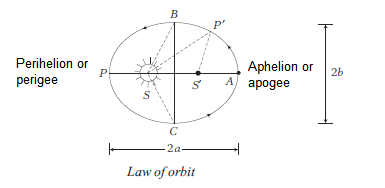
Above figure shows an ellipse traced out by a planet around the sun \(S\). The closest point \(P\) is called perihelion (perigee) and the farthest point \(A\) is called aphelion (apogee).
It is the characteristics of an ellipse that the sum of the distances of any point \(\left(P^{\prime}\right)\) on it from its two foci \(\left(S\right.\) and \(\left.S^{\prime}\right)\) is constant, i.e. \(S P^{\prime}+S^{\prime} P^{\prime}=\) constant.
Note: Shorter the orbit of the planet around the sun, shorter is the time to cover one complete revolution.
Kepler’s second law of areas
According to this law, “the line joining the planet sweeps out equal areas in equal interval of time.” It means that areal velocity is constant. This means the planet moves faster when it is closer to the Sun (perihelion) and slower when it is farther away (aphelion).
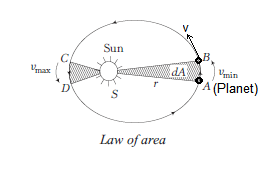
Areal velocity is the rate at which the radius vector (line from a central point to a moving object) sweeps out an area over time, essentially the area covered per unit of time, often seen in orbits where it relates to angular momentum and Kepler’s Second Law (Law of Areas). In the given figure, if the line joining the sun and the planet swept out area \(d A\) in a small time interval \(d t\), then
\(
\begin{aligned}
\text { Areal velocity } & =\frac{d A}{d t}=\frac{d}{d t}\left[\frac{1}{2} r(v d t)\right]=\frac{1}{2} r v \\
& =\frac{m v r}{2 m}=\frac{L}{2 m}
\end{aligned}
\)
where, \(L=\) angular momentum of the earth-planet system \(=\) constant (for gravitational force between the sun and the planet)
\(
\therefore \quad \text { Areal velocity }=\frac{d A}{d t}=\text { constant }
\)
Also, if the planet moves from \(A\) to \(B\) in some time interval \(t\) and from \(C\) to \(D\) in the same time interval \(t\), then
\(
\text { area }(A S B)=\text { area }(C S D)
\)
In simple terms, this law states that the planet will move slowly ( \(v_{\text {min }}\) ) only when it is farthest from the sun and move rapidly ( \(v_{\text {max }}\) ) when it is nearest to the sun. This law is similar to law of conservation of angular momentum.
In Vector Form
Step 1: Definition of Areal Velocity
Areal velocity, denoted as \(\frac{d A}{d t}\), is the rate at which the position vector of a particle sweeps out an area \(A\) over time \(t\).
Step 2: Relating Area to Position and Velocity:
The area \(\Delta \mathbf{A}\) swept out by a particle with position vector \(\mathbf{r}\) moving with velocity \(\mathbf{v}\) in a small time interval \(\Delta t\) can be approximated as the area of a small triangle formed by the vectors \(\mathbf{r}\) and \(\mathbf{r} + \mathbf{v} \Delta t\). The magnitude of this area is approximately \(\frac{1}{2}| \mathbf{r} \times( \mathbf{v} \Delta t)|=\frac{1}{2}| \mathbf{r} \times \mathbf{v} | \Delta t\). In the limit as \(\Delta t \rightarrow 0\), this becomes exact, leading to the expression:
\(
\frac{d A}{d t}=\frac{1}{2}| \mathbf{r} \times \mathbf{v} |
\)
In the specific case where the velocity \(\mathbf{v}\) is tangential to the position vector’s sweep (e.g., circular motion, or at the perigee/apogee of an elliptical orbit), the magnitude simplifies to \(\frac{1}{2} r v\). The provided expression uses this simplified magnitude: \(\frac{d A}{d t}=\frac{1}{2} r v\)
Step 3: Introducing Angular Momentum
Angular momentum \(L\) for a particle of mass \(m\) is defined as the cross product of the position vector \(\mathbf{r}\) and the linear momentum \(\mathbf{p} = m \mathbf{v}\), i.e., \(\mathbf{L} = \mathbf{r} \times \mathbf{p} = \mathbf{r} \times m \mathbf{v}\).
Step 4: Connecting Areal Velocity and Angular Momentum
The magnitude of the angular momentum \(L\) is \(| \mathbf{L} |=| \mathbf{r} \times m \mathbf{v} |= m | \mathbf{r} \times \mathbf{v} |\). If we consider magnitude from step 2:
\(
\frac{d A}{d t}=\frac{1}{2}| \mathbf{r} \times \mathbf{v} |
\)
We can express \(| \mathbf{r} \times \mathbf{v} |\) in terms of \(L\) and \(m\) :
\(
| r \times v |=\frac{L}{m}
\)
Substituting this into the areal velocity equation:
\(
\frac{d A}{d t}=\frac{1}{2}\left(\frac{L}{m}\right)=\frac{L}{2 m}
\)
This shows how the areal velocity is equal to the angular momentum divided by twice the mass of the particle.
Example 1: A planet moving around sun sweeps area \(A_1\) in 2 days, \(A_2\) in 3 days and \(A_3\) in 6 days, then find the relation between \(A_1, A_2\) and \(A_3\).
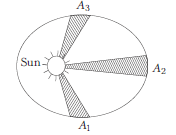
Solution: According to Kepler’s second law, when a planet revolves around the sun, its areal velocity is constant.
\(
\begin{array}{ll}
\therefore & \frac{d A}{d t}=\text { constant } \\
\text { Hence, } & \frac{A_1}{t_1}=\frac{A_2}{t_2}=\frac{A_3}{t_3}
\end{array}
\)
Given, \(t_1=2\) days, \(t_2=3\) days and \(t_3=6\) days
\(
\therefore \quad \frac{A_1}{2}=\frac{A_2}{3}=\frac{A_3}{6} \Rightarrow 3 A_1=2 A_2=A_3
\)
This is the relation between \(A_1, A_2\) and \(A_3\).
Example 2: The figure shows an elliptical orbit of a planet \(P\) about the sun \(S\). The shaded area CSD is twice the shaded area ASB. If \(t_1\) is the time taken by the planet to move from \(C\) to \(D\) and \(t_2\) is the time to move from \(A\) to \(B\), determine the ratio \(t_1 / t_2\).
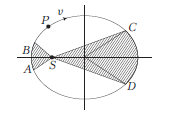
Solution: According to Kepler’s second law, the areal velocity of the planet remains constant.
\(
\therefore \quad \frac{A_1}{t_1}=\frac{A_2}{t_2}
\)
Hence, \(\frac{t_1}{t_2}=\frac{A_1}{A_2}=\frac{\text { Area } C S D}{\text { Area } A S B}=2\)
Kepler’s third law of period
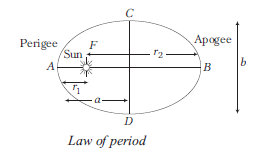
According to this law, “the square of the time period ( \(T\) ) of revolution of a planet around the sun is proportional to the cube of the semi-major axis ( \(a\) ) of its elliptical orbit.”
\(
T^2 \propto a^3 \dots(i)
\)
As shown in figure, we have
\(
\begin{aligned}
& & A B & =A F+F B \Rightarrow 2 a=r_1+r_2 \\
\therefore & & a & =\frac{r_1+r_2}{2}
\end{aligned}
\)
So, substituting the value of \(a\) in Eq. (i), we get
\(
T^2 \propto\left(\frac{r_1+r_2}{2}\right)^3
\)
where, \(r_1=\) shortest distance of planet from sun (perigee) and \(r_2=\) longest distance of planet from sun (apogee).
Eccentricity (\(e\)): The eccentricity, which measures how much the orbit deviates from a perfect circle, is related to the perigee and apogee distances by:
\(\frac{r_2}{r_1}=\frac{1+e}{1-e}\).
Alternatively, eccentricity can be calculated as \(e=\frac{r_2-r_1}{r_2+r_1}\). For an elliptical orbit, \(e\) is between 0 (circle) and 1 (parabola).
Note: Kepler’s laws are applicable not only to the solar system but also to artificial satellites as well as to the moon revolving around the planets.
Example 3: The planet neptune travels around the sun with a period of 165 yr. What is the radius of the orbit approximately, if the orbit is considered as circular?
Solution: As, \(T_1=T_{\text {earth }}=1 yr\) and \(T_2=T_{\text {neptune }}=165 yr\)
Let \(R_1\) and \(R_2\) be the radii of the circular orbits of the earth and neptune, respectively.
According to Kepler’s third law,
\(
\begin{array}{ll}
& \frac{T_1^2}{T_2^2}=\frac{R_1^3}{R_2^3} \\
\Rightarrow & R_2^3=\frac{R_1^3 T_2^2}{T_1^2} \\
\Rightarrow & R_2^3=\frac{R_1^3 \times(165)^2}{1^2} \\
\Rightarrow & R_2^3=165^2 R_1^3 \Rightarrow R_2 \approx 30 R_1
\end{array}
\)
Example 4: A satellite of time period 24 h is orbiting the earth at a height \(6 R\) above the surface of earth, where \(R\) is radius of earth. What will be the time period of another satellite at a height \(2.5 R\) from the surface of earth?
Solution: By Kepler’s third law, \(T^2 \propto R^3\)
\(
\therefore \quad \frac{T_1^2}{T_2^2}=\frac{R_1^3}{R_2^3} \text { or }\left(\frac{T_2}{T_1}\right)^2=\left(\frac{R_2}{R_1}\right)^3
\)
\(
\begin{array}{ll}
\Rightarrow & T_2^2=T_1^2\left(\frac{3.5 R}{7 R}\right)^3 \\
& \quad\left(\because R_2=R+2.5 R \text { and } R_1=R+6 R\right) \\
\text { or } & T_2^2=\frac{T_1^2}{8} \Rightarrow T_2=\frac{T_1}{2 \sqrt{2}} \\
\Rightarrow & T_2=\frac{24}{2 \sqrt{2}} \\
\therefore & T_2=6 \sqrt{2} h
\end{array} \quad\left(\because T_1=24 h\right)
\)