8.2 Stress and strain
Stress
When an external force is applied to a body, then at each cross-section of the body, an internal restoring force is developed which tends to restore the body back to its original position. The internal restoring force acting per unit area of cross-section of the deformed body is called stress.
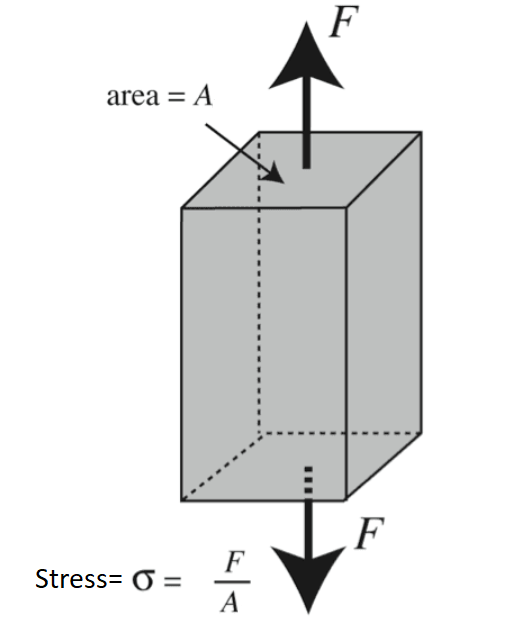
Thus, \(\text { Stress }(\sigma)=\frac{\text { Restoring force }}{\text { Area }}\)
If \(F\) is the force applied normal to the cross-section and \(A\) is the area of cross section of the body,
Magnitude of the stress \(=F / A\)
The SI unit of stress is \(\mathrm{N} \mathrm{m}^{-2}\) or pascal (Pa) and its dimensional formula is \(\left[\mathrm{ML}^{-1} \mathrm{~T}^{-2}\right]\).
Note: The minimum value of stress required to break a wire is called breaking stress. It depends on nature of material, temperature and impurities.
Example 1: A load of 4.0 kg is suspended from a ceiling through a steel wire of radius 2.0 mm. Find the tensile stress developed in the wire when equilibrium is achieved. Take \(g=3 \cdot 1 \pi \mathrm{~m} \mathrm{~s}^{-2}\).
Solution: Tension in the wire is
\(
F=4.0 \times 3.1 \pi \mathrm{~N} .
\)
The area of cross section is
\(
\begin{aligned}
A & =\pi r^2=\pi \times\left(2.0 \times 10^{-3} \mathrm{~m}\right)^2 \\
& =4.0 \pi \times 10^{-6} \mathrm{~m}^2
\end{aligned}
\)
Thus, the tensile stress developed
\(
\begin{aligned}
& =\frac{F}{A}=\frac{4.0 \times 3.1 \pi}{4.0 \pi \times 10^{-6}} \mathrm{~N} \mathrm{~m}^{-2} \\
& =3.1 \times 10^6 \mathrm{~N} \mathrm{~m}^{-2}
\end{aligned}
\)
Strain
Due to external force, shape of the body changes and it is said to have strain. Strain is the measure of the deformation of a material. It represents the fractional change in the dimensions (length, volume, or shape) of the object relative to its original size.
Strain is defined as the ratio of change in shape of an object to the original shape.
\(
\text { Strain }(\varepsilon)=\frac{\text { Change in configuration of the object }}{\text { Original configuration of the object }}
\)
Strain is a pure number, it has no unit. There are three types of stress resulting in three types of strain:
Longitudinal stress
When the stress is normal to the surface of an object, then it is known as longitudinal stress. It is of two types:
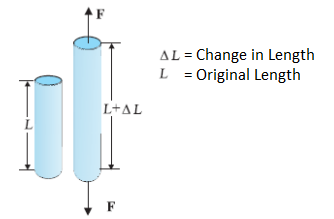
Tensile stress
If the stress produced in an object is due to increase in its length, then it is called tensile stress.
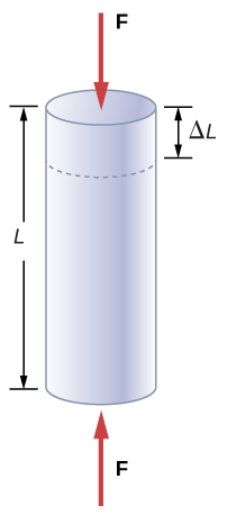
Compressive stress
If the stress produced in an object is due to decrease in its length, then it is called compressive stress.
Longitudinal strain
It is defined as the change in length per unit length of the object on application of deforming force.
\(
\text { Longitudinal strain }=\frac{\text { Change in length }(\Delta L)}{\text { Original length }(L)}
\)
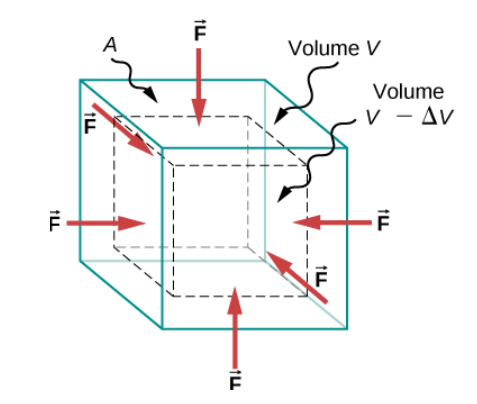
Volumetric stress
If equal normal forces are applied on an object all over its surface, then its volume changes. The restoring force acting per unit area inside the object opposing change in volume is called volumetric stress. The effect of these forces is to decrease the volume of the object by an amount \(\Delta V\) compared with the volume \(V\) of the object in the absence of bulk stress.
Volumetric strain
It is defined as the change in volume per unit volume of the object on application of deforming force.
\(
\text { Volumetric strain }=\frac{\text { Change in volume }(\Delta V)}{\text { Original volume }(V)}
\)
Shearing stress
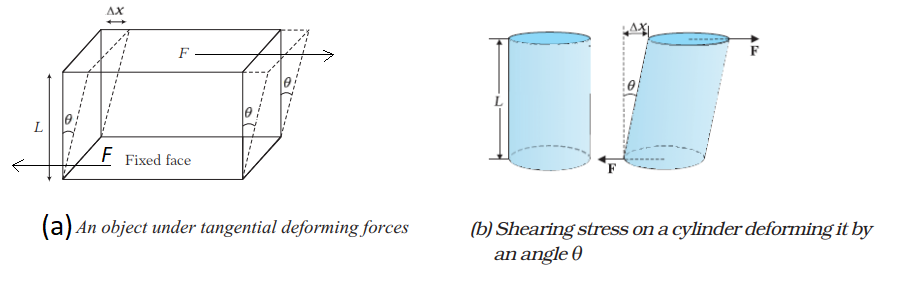
When a force is applied on an object along the tangential direction of the surface of the object, then stress produced in the object is called shearing stress. Such force tends to change the shape of object. For this, the opposite surface is kept fixed. As a result of applied tangential force, there is a relative displacement \(\Delta x\) between opposite faces of the cylinder as shown in the Fig (b).
Tangential or shearing strain
It is defined as the ratio of displacement ( \(x\) ) of the upper surface to the distance \((L)\) between two faces on the application of deforming force.
\(
\text { Shearing strain }=\frac{\text { Displacement }(\Delta x)}{\text { Distance }(L)}
\)
Example 2: \(A\) rod has a radius of 100 mm and a length of \(10 \mathrm{~cm}. A~ 100 ~N\) force compresses along its length. Calculate the longitudinal stress developed in the rod.
Solution: Given, radius of the rod, \(r=100 \mathrm{~mm}=100 \times 10^{-3} \mathrm{~m}\)
Length of the rod, \(l=10 \mathrm{~cm}=10 \times 10^{-2} \mathrm{~m}\)
Force, \(F=100 \mathrm{~N}\)
Longitudinal stress developed in the rod
\(
=\frac{F}{A}=\frac{100}{\pi\left(100 \times 10^{-3}\right)^2} \approx 3185 \mathrm{Nm}^{-2}
\)
Example 3: Find the greatest length of steel wire that can remain hanged vertically without breaking. Breaking stress of steel \(=8 \times 10^8 \mathrm{Nm}^{-2}\). Density of steel \(=8 \times 10^3 \mathrm{kgm}^{-3}\). (Take, \(g=10 \mathrm{~ms}^{-2}\))
Solution: Let \(l\) be the length of the wire that can hang vertically without breaking. The stretching force on it is equal to its own weight.
If \(A\) is the area of cross-section and \(\rho\) is the density, then maximum stress or breaking stress \(\left(S_m\right)=\frac{\text { weight }}{A} \quad \left(\because \text { Stress }=\frac{\text { Force }}{\text { Area }}\right)\)
\(
\begin{aligned}
\text { Weight } & =m g=V \rho g \quad(\because \text { Mass }=\text { Volume × Density }) \\
& =A l \rho g \\
& (\because \text { Volume }=\text { Area of cross-section × Length }) \\
S_m & =\frac{( { Al \rho}) g}{A}
\end{aligned}
\)
∴ Length of the steel wire, \(l=\frac{S_m}{\rho g}=\frac{8 \times 10^8}{\left(8 \times 10^3\right)(10)}=10^4 \mathrm{~m}\).
Example 4: If the angle of shear is \(30^{\circ}\) for a cubical body and the change in length is 250 cm, then what must be the volume of this cubical body?
Solution: Given, angle of shear, \(\theta=30^{\circ}\)
and change in length, \(\Delta L=250 \mathrm{~cm}=2.5 \mathrm{~m}\)
∴ Shear strain, \(\tan \theta=\frac{\Delta L}{L} \Rightarrow \tan 30^{\circ}=\frac{2.5}{L}\)
\(
\Rightarrow \quad L=\frac{2.5}{\tan 30^{\circ}}=\frac{2.5}{0.577}=4.332
\)
Volume of cubical body, \(V=L^3=81.295 \mathrm{~m}^3\)
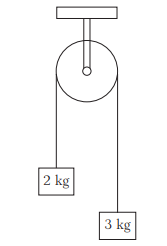
Example 5: Two blocks of masses 2 kg and 3 kg are connected by a metal wire going over a smoother pulley as shown in figure. The breaking stress of the metal is \(2 \times 10^9 \mathrm{Nm}^{-2}\). What would be the minimum radius of the wire used, if it is not to break? (Take, \(g=10 \mathrm{~ms}^{-2}\))
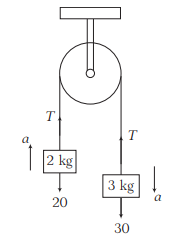
Solution: Equation of motion for 3 kg mass,
\(
30-T=3 a \dots(i)
\)
Equation of motion for 2 kg mass,
\(
T-20=2 a \dots(ii)
\)
On dividing Eq. (i) by Eq. (ii), we get
\(
\frac{30-T}{T-20}=3 / 2
\)
\(
\begin{array}{lrl}
\Rightarrow & 2(30-T) & =3(T-20) \\
\Rightarrow & 60-2 T & =3 T-60 \\
& 5 T & =120 \Rightarrow T=24 \mathrm{~N}
\end{array}
\)
Breaking stress, \(S=\frac{T}{A}\)
\(
\left(\because \text { Stress }=\frac{\text { Force }}{\text { Area }}\right)
\)
\(
\Rightarrow \quad 2 \times 10^9=\frac{24}{A}
\)
Area, \(A=12 \times 10^{-9} \mathrm{~m}^2 \Rightarrow \pi r^2=12 \times 10^{-9} \quad\left(\because A=\pi r^2\right)\)
∴ Minimum radius of the wire,
\(
r=\left(\frac{12 \times 10^{-9}}{3.14}\right)^{1 / 2}=6.18 \times 10^{-5} \mathrm{~m}
\)
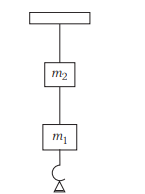
Example 6: The two wires shown in figure are made of the same material which has a breaking stress of \(8 \times 10^8 \mathrm{Nm}^{-2}\). The area of cross-section of the upper wire is \(0.006 \mathrm{~cm}^2\) and that of the lower wire is \(0.003 \mathrm{~cm}^2\). The mass \(m_1=10 \mathrm{~kg}, m_2=20 \mathrm{~kg}\) and the hanger is light. Find the maximum load that can be put on the hanger without breaking a wire. Which wire will break first, if the load is increased?
Solution:
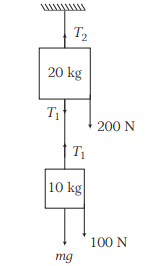
To solve this, we need to determine the maximum tension each wire can withstand before reaching its breaking stress and then analyze the actual tension in each wire based on the weights and the added load.
Step 1: Breaking Strengths of the Wires
The maximum force a wire can handle is given by \(F_b=\) Breaking Stress × Area.
Wire 1 (Lower):
Area \(A_1=0.003 \mathrm{~cm}^2=3 \times 10^{-7} \mathrm{~m}^2\)
\(F_{b 1}=\left(8 \times 10^8 \mathrm{~N} / \mathrm{m}^2\right) \times\left(3 \times 10^{-7} \mathrm{~m}^2\right)=240 \mathrm{~N}\)
Wire 2 (Upper):
Area \(A_2=0.006 \mathrm{~cm}^2=6 \times 10^{-7} \mathrm{~m}^2\)
\(F_{b 2}=\left(8 \times 10^8 \mathrm{~N} / \mathrm{m}^2\right) \times\left(6 \times 10^{-7} \mathrm{~m}^2\right)=480 \mathrm{~N}\)
Step 2: Tension Equations with Load (\(M\))
Let \(M\) be the additional load on the hanger. Using \(g=10 \mathrm{~m} / \mathrm{s}^2\) as indicated by the weight labels \((10 \mathrm{~kg} \rightarrow 100 \mathrm{~N})\) :
Lower Wire Tension \(\left(T_1\right): T_1=\) Weight of \(10 \mathrm{~kg}+\) Load \(M=100+10 M\)
Upper Wire Tension \(\left(T_2\right): T_2=\) Weight of \(20 \mathrm{~kg}+\) Weight of \(10 \mathrm{~kg}+\) Load \(M= 300+10 M\)
Step 3: Maximum Load and Breaking Order:
We check which wire reaches its breaking limit first as \(M\) increases.
For Wire 1 (Lower) to break: \(100+10 M=240 \Longrightarrow 10 M=140 \Longrightarrow \mathrm{M}=14 \mathrm{~kg}\)
For Wire 2 (Upper) to break: \(300+10 M=480 \Longrightarrow 10 M=180 \Longrightarrow \mathbf{M}=\mathbf{1 8 ~ k g}\)
Final Answer:
Maximum load: The system can support a maximum load of 14 kg before the first wire snaps.
Which wire breaks first: The lower wire \(\left(T_1\right)\) will break first because it reaches its breaking strength at a lower additional load ( 14 kg ) than the upper wire ( 18 kg ).
Example 7: Consider a solid cube which is subjected to a pressure of \(6 \times 10^5 \mathrm{Nm}^{-2}\). Due to this pressure, the each side of the cube is shortened by \(2 \%\). Find out the volumetric strain of the cube.
Solution: Let \(L\) be the initial length of the each side of the cube. Volume, \(V=L \times L \times L=L^3=\) Initial volume (\(V_i\) say)
If each side of the cube is shortened by \(2 \%\), then final length of the cube \(=L-2 \%\) of \(L\)
\(
=\left(L-\frac{2 L}{100}\right)=L\left(1-\frac{2}{100}\right)
\)
∴ Final volume, \(V_f=L^3\left(1-\frac{2}{100}\right)^3=V\left(1-\frac{2}{100}\right)^3\)
Change in volume, \(\Delta V=V_f-V_i\)
\(
\begin{aligned}
& \quad=V\left(1-\frac{2}{100}\right)^3-V=V\left[\left(1-\frac{2}{100}\right)^3-1\right] \\
& \Rightarrow \quad \frac{\Delta V}{V}=\left(1-\frac{2}{100}\right)^3-1 \simeq\left[1-\frac{2 \times 3}{100}\right]-1 \\
& \quad\left[\because(1-x)^n \simeq 1-n x \text { for } x \ll 1\right] \\
& \therefore \text { Volumetric strain, } \frac{\Delta V}{V}=1-0.06-1=0.06
\end{aligned}
\)
(Take positive sign)