7.10 Energy of an orbiting satellite
Total Energy of Satellite
Assume that a satellite of mass \(m\) moving around the earth with velocity \(v\) in an orbit of radius \(r=R_E+h\) due to gravitational pull of the earth.
The kinetic energy of the satellite in a circular orbit with speed \(v\) is
\(
\begin{aligned}
& K E=\frac{1}{2} m v^2 \\
& =\frac{G m M_E}{2\left(R_E+h\right)},
\end{aligned}
\)
Considering gravitational potential energy at infinity to be zero, the potential energy at distance \((\mathrm{R_E}+\mathrm{h})\) from the center of the earth is
\(
P . E=-\frac{G m M_E}{\left(R_E+h\right)}
\)
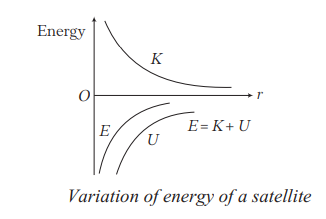
The K.E is positive whereas the P.E is negative. However, in magnitude the K.E. is half the P.E, so that the total \(E\) is
\(
E=K . E+P . E=-\frac{G m M_E}{2\left(R_E+h\right)}
\)
The total energy of an circularly orbiting satellite is thus negative, with the potential energy being negative but twice is magnitude of the positive kinetic energy. We can write this total energy as \(\Rightarrow \quad E=-\frac{G M m}{2 r}\), where \(r=R_E+h\), \(M_E=M\).
This energy is constant and negative, i.e. the system is closed. The farther the satellite from the earth, the greater is its total energy. Variation of energy with distance can be represented by graphs as shown in figure. The total energy, \(E=K(K.E.)+U(P.E.)=-\frac{G M m}{2 r}\).
Important points to be remembered
- The total mechanical energy of a satellite is negative, if the reference level of zero potential energy is taken when separation is infinity.
- For a satellite \(K=-E, E=\frac{U}{2}\) and
\(
U=-2 K
\) - If we consider elliptical path of a satellite, then maximum and minimum energies are as shown in figure.
Example 1: A 400 kg satellite is in a circular orbit of radius \(2 R_E\) about the Earth. How much energy is required to transfer it to a circular orbit of radius \(4 R_E\) ? What are the changes in the kinetic and potential energies?
Solution: Initially,
\(
E_i=-\frac{G M_E m}{4 R_E}
\)
While finally
\(
E_f=-\frac{G M_E m}{8 R_E}
\)
The change in the total energy is
\(
\begin{aligned}
& \Delta E=E_f-E_{\mathrm{i}} \\
& =\frac{G M_E m}{8 R_E}=\left(\frac{G M_E}{R_E^2}\right) \frac{m R_E}{8} \\
\Delta E= & \frac{g m R_E}{8}=\frac{9.81 \times 400 \times 6.37 \times 10^6}{8}=3.13 \times 10^9 \mathrm{~J}
\end{aligned}
\)
The kinetic energy is reduced and it mimics \(\Delta E\), namely, \(\Delta K=K_f \quad K_{\mathrm{i}}=3.13 \times 10^9 \mathrm{~J}\).
The change in potential energy is twice the change in the total energy, namely
\(
\Delta V=V_f-V_i=-6.25 \times 10^9 \mathrm{~J}
\)
Binding energy of a satellite
The energy required by a satellite to leave its orbit around the earth and escape to infinity, is known as binding energy of satellite. From above, we know that, the total energy of the satellite is \(-G M m / 2 r\). So, if the satellite has to leave the earth’s orbit and escape to infinity, then an extra energy equal to \(+G M m / 2 r\) is to be supplied to it, so that its total energy becomes zero.
\(
\therefore \quad \text { Binding energy of a satellite }=\frac{G M m}{2 r}
\)
Note: The total energy of the satellite is negative only when it is bound to the earth. It means that its orbit is an ellipse or circle. It is positive when satellite is not bound to any star or its equivalent. In this case, the path covered by satellite will be hyperbola.
Example 2: If a spaceship orbits the earth at a height of 500 km from its surface, then determine its (i) kinetic energy, (ii) potential energy, (iii) total energy and (iv) binding energy. (Take, mass of the satellite \(=300 \mathrm{~kg}\), mass of the earth \(=6 \times 10^{24} \mathrm{~kg}\), radius of the earth \(=6.4 \times 10^6 \mathrm{~m}\), \(G=6.67 \times 10^{-11} N-m^2 k g^{-2}\)). Will your answer alter, if the earth were to shrink suddenly to half its size?
Solution: Given, height, \(h=500 \mathrm{~km}=500 \times 10^3 \mathrm{~m}\)
Mass of spaceship, \(m=300 \mathrm{~kg}\)
Mass of the earth, \(M=6 \times 10^{24} \mathrm{~kg}\)
Radius of the earth, \(R=6.4 \times 10^6 \mathrm{~m}\)
and \(G=6.67 \times 10^{-11} \mathrm{~N}-\mathrm{m}^2 \mathrm{~kg}^{-2}\)
(i)
\(
\begin{aligned}
\text { Kinetic energy } & =\frac{1}{2} m v^2 \\
& =\frac{1}{2} m \cdot \frac{G M}{R+h} \quad\left(\because v=\sqrt{\frac{G M}{R+h}}\right) \\
& =\frac{1}{2} \times \frac{300 \times 6.67 \times 10^{-11} \times 6 \times 10^{24}}{6.4 \times 10^6+500 \times 10^3} \\
& =8.7 \times 10^9 \mathrm{~J}
\end{aligned}
\)
(ii)
\(
\begin{aligned}
\text { Potential energy } & =-\frac{G M m}{(R+h)} \\
& =-\frac{6.67 \times 10^{-11} \times 6 \times 10^{24} \times 300}{6.4 \times 10^6+500 \times 10^3} \\
& =-17.4 \times 10^9 \mathrm{~J}
\end{aligned}
\)
(iii)
\(
\begin{aligned}
\text { Total energy } & =\mathrm{KE}+\mathrm{PE} \\
& =8.7 \times 10^9-17.4 \times 10^9 \\
& =-8.7 \times 10^9 \mathrm{~J}
\end{aligned}
\)
(iv) Binding energy \(=-(\) Total energy \()=8.7 \times 10^9 \mathrm{~J}\)
No, there is no change in answer, because \(r=R+h\) will remain constant.