3.3 Multiplication of vectors by real numbers
The product of a vector \(\mathbf{A}\) and a scalar \(m\) gives a vector \(m \mathbf{A}\) whose magnitude is \(m\) times the magnitude of \(\mathbf{A}\) and which is in the direction or opposite to A accordingly, if the scalar \(m\) is positive or negative. Thus, \(m(\mathbf{A})=m \mathbf{A}\) Further, if \(m\) and \(n\) are two scalars, then
\(
(m+n) \mathbf{A}=m \mathbf{A}+n \mathbf{A} \text { and } m(n \mathbf{A})=n(m \mathbf{A})=(m n) \mathbf{A}
\)
The division of vector \(\mathbf{A}\) by a non-zero scalar \(m\) is defined as the product of \(\mathbf{A}\) and \(\frac{1}{m}\).
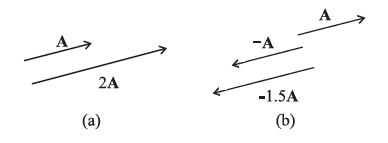
For example, if \(\mathbf{A}\) is multiplied by 2 , the resultant vector \(2 \mathbf{A}\) is in the same direction as \(\mathbf{A}\) and has a magnitude twice of \(|\mathbf{A}|\) as shown in Figure(a).
Multiplying a vector A by a negative number \(-\lambda\) gives another vector whose direction is opposite to the direction of \(\mathbf{A}\) and whose magnitude is \(\lambda\) times \(|\mathbf{A}|\).
Multiplying a given vector \(\mathbf{A}\) by negative numbers, say -1 and -1.5 , gives vectors as shown in Figure(b).