6.3 Motion of centre of mass
If we have a system consisting of \(n\) particles of masses \(m_1, m_2, \ldots, m_n\) with \(\mathbf{r}_1, \mathbf{r}_2, \ldots, \mathbf{r}_n\) as their position vectors at a given instant of time. The position vector \(\mathbf{r}_{\mathrm{CM}}\) of the centre of mass of the system at that instant is given by
\(
\mathbf{r}_{\mathrm{CM}}=\frac{m_1 \mathbf{r}_1+m_2 \mathbf{r}_2+\ldots+m_n \mathbf{r}_n}{m_1+m_2+\ldots+m_n}
\)
\(
\mathbf{r}_{\mathrm{CM}}=\frac{\sum_{i=1}^n m_i \mathbf{r}_i}{M}
\)
We can rewrite the above equation
\(
M \mathbf{r}_{\mathrm{CM}}=\sum m_i \mathbf{r}_i=m_1 \mathbf{r}_1+m_2 \mathbf{r}_2+\ldots+m_n \mathbf{r}_n
\)
Differentiating the two sides of the equation with respect to time we get
\(
M \frac{\mathrm{~d} \mathbf{r}_{\mathrm{CM}}}{\mathrm{~d} t}=m_1 \frac{\mathrm{~d} \mathbf{r}_1}{\mathrm{~d} t}+m_2 \frac{\mathrm{~d} \mathbf{r}_2}{\mathrm{~d} t}+\ldots+m_n \frac{\mathrm{~d} \mathbf{r}_n}{\mathrm{dt}}
\)
\(
M \mathbf{V}_{\mathrm{CM}}=m_1 \mathbf{v}_1+m_2 \mathbf{v}_2+\ldots+m_n \mathbf{v}_n \dots(i)
\)
where \(\mathbf{v}_1\left(=\mathrm{d} \mathbf{r}_1 / \mathrm{d} t\right)\) is the velocity of the first particle \(\mathbf{v}_2\left(=d \mathbf{r}_2 / d t\right)\) is the velocity of the second particle etc. and \(\mathbf{V}_{\mathrm{CM}}=\mathrm{d} \mathbf{r}_{\mathrm{CM}} / \mathrm{d} t\) is the velocity of the centre of mass.
\(
\begin{gathered}
\mathbf{v}_{\mathrm{CM}}=\frac{m_1 \mathbf{v}_1+m_2 \mathbf{v}_2+. .+m_n \mathbf{v}_n}{M} \\
\mathbf{v}_{\mathrm{CM}}=\frac{\sum_{i=1}^n m_i \mathbf{v}_i}{M}
\end{gathered}
\)
Differentiating Eq.(i) with respect to we obtain
\(
M \frac{\mathrm{~d} \mathbf{v}_{\mathrm{CM}}}{\mathrm{~d} t}=m_1 \frac{\mathrm{~d} \mathbf{v}_1}{\mathrm{~d} t}+m_2 \frac{\mathrm{~d} \mathbf{v}_2}{\mathrm{~d} t}+\ldots+m_n \frac{\mathrm{~d} \mathbf{v}_n}{\mathrm{~d} t}
\)
\(
M \mathbf{a}_{\mathrm{CM}}=m_1 \mathbf{a}_1+m_2 \mathbf{a}_2+\ldots+m_n \mathbf{a}_n
\)
Acceleration of centre of mass,
\(
\mathbf{a}_{\mathrm{CM}}=\frac{m_1 \mathbf{a}_1+m_2 \mathbf{a}_2+\ldots+m_n \mathbf{a}_n}{M}
\)
\(
\mathbf{a}_{\mathrm{CM}}=\frac{\sum_{i=1}^n m_i \mathbf{a}_i}{M}
\)
We can rewrite above \(\mathbf{a}_{\mathrm{CM}}\) Eqn. as
\(
M \mathbf{a}_{\mathrm{CM}}={m_1 \mathbf{a}_1+m_2 \mathbf{a}_2+\ldots+m_n \mathbf{a}_n} \dots(ii)
\)
Further, in accordance with Newton’s second law of motion, \(\mathbf{F}=m \mathbf{a}\). Hence, Eqn. (ii) can be written as
\(
\mathbf{F}_{\mathrm{CM}}=\mathbf{F}_1+\mathbf{F}_2+\ldots+\mathbf{F}_n
\)
Force on centre of mass,
\(
\mathbf{F}_{\mathrm{CM}}=\sum_{i=1}^n \mathbf{~F}_i \dots(iii)
\)
From expression (iii), it is clear that the centre of mass of a system of particles moves as though it is a particle of mass equal to that of the whole system with all the external forces acting directly on it.
Thus, the total mass of a system of particles times the acceleration of its centre of mass is the vector sum of all the forces acting on the system of particles.
Note when we talk of the force \(\mathbf{F}_1\) on the first particle, it is not a single force, but the vector sum of all the forces on the first particle; likewise for the second particle etc. Among these forces on each particle there will be external forces exerted by bodies outside the system and also internal forces exerted by the particles on one another. We know from Newton’s third law that these internal forces occur in equal and opposite pairs and in the sum of forces of Eqn. (iii), their contribution is zero. Only the external forces contribute to the equation. We can then rewrite Eqn. (iii) as
\(
\mathbf{F}_{\mathrm{CM}}=M \mathbf{a}_{\mathrm{CM}}=\mathbf{F}_{\text {ext }} \dots(iv)
\)
where \(\mathbf{F}_{\text {ext }}\) represents the sum of all external forces acting on the particles of the system.
Eqn. (iv) states that the centre of mass of a system of particles moves as if all the mass of the system was concentrated at the centre of mass and all the external forces were applied at that point.
There are some important points related to motion of centre of mass
- The motion of the centre of mass of the system is not affected by the internal forces. If the external forces add up to zero, the centre of mass has no acceleration.
- When the external forces do not add up to zero, the centre of mass is accelerated and the acceleration is given by equation \(\mathbf{a}_{\mathrm{CM}}=\frac {\mathbf{F}_{\text {ext }}} {M}\)
- If we have a single particle of mass \(M\) on which a force \(\mathbf{F}_{\text {ext }}\) acts, its acceleration would be the same as \(\frac{\mathbf{F}_{\text {ext }}}{M}\). Thus the motion of the centre of mass of a system is identical to the motion of a single particle of mass equal to the mass of the given system, acted upon by the same external forces that act on the system.
- If two particles of masses \(m_1\) and \(m_2\) are placed on a smooth surface separated by distance \(r\) and they move towards each other due to the mutual attractive force, then
- (a) In the absence of any external force, the acceleration of CM is zero, irrespective of the individual acceleration of particles. Newton’s second law for a system of particles states \(\Sigma \mathbf{F}_{\text {ext }}=M \mathbf{a}_{\mathrm{CM}}\), where \(M\) is the total mass and \(\mathbf{a}_{\mathbf{C M}}\) is the acceleration of the center of mass. If \(\mathbf{\Sigma F}_{\text {ext }}=\mathbf{0}\), then \(\mathbf{a}_{\mathbf{C M}}=\mathbf{0}\). The individual particles accelerate towards each other due to internal forces, but the center of mass does not accelerate.
- (b) In the absence of any external force, the velocity of CM is also constant. This is a direct consequence of zero acceleration. If \(\mathbf{a}_{\mathbf{C M}} \boldsymbol{=} \mathbf{0}\), then the velocity of the center of mass \(\mathbf{v}_{\mathbf{C M}}\) is a constant vector. This is the principle of conservation of linear momentum for the system.
- (c) If initially the centre of mass is at rest, i.e. \(\mathbf{v}_{\mathrm{CM}}=0\) and the external force is absent, i.e. \(\mathbf{F}_{\text {ext }} \mathbf{= 0}\), the location of \(\mathbf{C M}\) is fixed. This is also correct. As established in (b), the velocity of the CM is constant. If the initial velocity is zero, it remains zero for all time ( \(\mathbf{v}_{\mathbf{C M}}=0\) ), meaning the position of the \(\mathbf{C M}\) is fixed in space.
- (d) Under the action of external forces, the CM moves just as all the mass were concentrated at that point, i.e. \(\Sigma \mathbf{F}_{\text {ext }}=M \mathbf{a}_{\text {ext }}\) This is also a correct statement of the center of mass theorem. The net external force on a system equals the total mass times the acceleration of the center of mass. The notation \(\mathbf{a}_{\text {ext }}\) seems to mean the acceleration of the CM due to external forces.
Example 1: Two blocks of masses 5 kg and 2 kg are placed on a frictionless surface and connected by a spring. An external kick gives a velocity of \(14 \mathrm{~ms}^{-1}\) to the heavier block in the direction of lighter one. Calculate the velocity gained by the centre of mass.
Solution: Given, \(m_1=5 \mathrm{~kg}, m_2=2 \mathrm{~kg}, v_1=14 \mathrm{~ms}^{-1}\) and \(v_2=0\)
\(
\begin{aligned}
\therefore \quad v_{\mathrm{CM}} & =\frac{m_1 v_1+m_2 v_2}{m_1+m_2} \\
& =\frac{5 \times 14+2 \times 0}{5+2} \\
& =\frac{70}{7}=10 \mathrm{~ms}^{-1} \text { in the direction of lighter one. }
\end{aligned}
\)
Example 2: Find the velocity of centre of mass of the system shown in the figure.
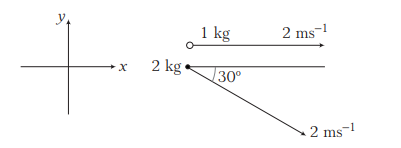
Solution: Here,
\(
\begin{aligned}
m_1 & =1 \mathrm{~kg}, \mathbf{v}_1=2 \hat{\mathbf{i}}, \\
m_2 & =2 \mathrm{~kg}, \mathbf{v}_2=2 \cos 30^{\circ} \hat{\mathbf{i}}-2 \sin 30^{\circ} \hat{\mathbf{j}} \\
\mathbf{v}_{\mathrm{CM}} & =\frac{m_1 \mathbf{v}_1+m_2 \mathbf{v}_2}{m_1+m_2} \\
& =\frac{1 \times 2 \hat{\mathbf{i}}+2\left(2 \cos 30^{\circ} \hat{\mathbf{i}}-2 \sin 30^{\circ} \hat{\mathbf{j}}\right)}{1+2} \\
\mathbf{v}_{\mathrm{CM}} & =\frac{2 \hat{\mathbf{i}}+2 \sqrt{3} \hat{\mathbf{i}}-2 \hat{\mathbf{j}}}{3}=\left(\frac{2+2 \sqrt{3}}{3}\right) \hat{\mathbf{i}}-\frac{2}{3} \hat{\mathbf{j}}
\end{aligned}
\)
Example 3: Two particles of masses 2 kg and 4 kg are approaching each other with acceleration \(1 \mathrm{~ms}^{-2}\) and \(2 \mathrm{~ms}^{-2}\) respectively, on a smooth horizontal surface. Find the acceleration of centre of mass of the system.
Solution: The acceleration of centre of mass of the system,
\(
\mathbf{a}_{\mathrm{CM}}=\frac{m_1 \mathbf{a}_1+m_2 \mathbf{a}_2}{m_1+m_2}=\frac{2 \times 1-4 \times 2}{(2+4)}=-1 \mathrm{~ms}^{-2}
\)
(Negative sign indicates that direction of 4 kg is opposite to that of 2 kg )
Since, \(\left|m_2 a_2\right|>\left|m_1 a_1\right|\), so the direction of acceleration of centre of mass will be directed towards \(m_1\).
Note: The acceleration of the center of mass of the system is \(\mathbf{- 1 m} / \mathbf{s}^{\mathbf{2}}\).
The negative sign indicates that the direction of the acceleration of the center of mass is the same as the direction of the 4 kg mass (towards the 2 kg mass). This is because the magnitude of the force applied to the 4 kg mass \(\left(F_2=m_2 a_2=4 \times 2=8 \mathrm{~N}\right)\) is greater than the magnitude of the force applied to the 2 kg mass (\(\left.F_1=m_1 a_1=2 \times 1=2 \mathrm{~N}\right) .\)
Example 4: Two particles of masses \(m_1\) and \(m_2\) are projected from the top of a tower. The particle \(m_1\) is projected vertically downward with speed \(u\) and \(m_2\) is projected horizontally with same speed. Find acceleration of CM of system of particles by neglecting the effect of air resistance.
Solution: As effect of air is neglected, therefore the only force acting on the particles is the gravitational force in downward direction.
Let the point of projection is taken as origin and downward direction as negative \(Y\)-axis, then acceleration of 1st point mass, \(\mathbf{a}_1=-g \hat{\mathbf{j}}\)
acceleration of 2nd point mass, \(\mathbf{a}_2=-g \hat{\mathbf{j}}\)
\(
\therefore \quad \mathbf{a}_{\mathrm{CM}}=\frac{m_1 \mathbf{a}_1+m_2 \mathbf{a}_2}{m_1+m_2}=\frac{m_1(-g \hat{\mathbf{j}})+m_2(-g \hat{\mathbf{j}})}{m_1+m_2}=-g \hat{\mathbf{j}}
\)
i.e. Acceleration of CM is equal to acceleration due to gravity and is in downward direction.
Note If large number of particles are projected under the effect of gravity only in different directions, then acceleration of CM is equal to the acceleration due to gravity irrespective of directions of projection of particles.
Note: If large number of particles are projected under the effect of gravity only in different directions, then acceleration of CM is equal to the acceleration due to gravity irrespective of directions of projection of particles.
Example 5: Two particles of masses \(2 m\) and \(3 m\) separated by distance \(d\) are placed on a smooth surface. They move towards each other due to mutual attractive force. Find (i) acceleration of CM, (ii) velocity of CM when separation between particles becomes \(d / 3\) and (iii) at what distance from the initial position of mass \(2 m\) will the particles collide?
Solution: The given situation is shown below.
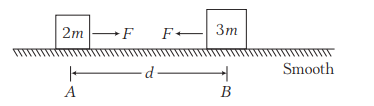
(i) In the absence of any external force, the acceleration of CM is zero, i.e.
\(
\mathbf{F}_{\mathrm{ext}}=0 \Rightarrow \mathbf{a}_{\mathrm{CM}}=0
\)
(ii) Initially, the particles are at rest, i.e. \(v_1=v_2=0\), therefore \(v_{\mathrm{CM}}=0\). Since \(\mathbf{F}_{\text {ext }}=0\), the velocity of CM is constant and hence, \(v_{\mathrm{CM}}\) is always zero whatever be the separation between the particles.
(iii) The position of CM will be
\(
x_{\mathrm{CM}}=\frac{2 m \times 0+3 m \times d}{2 m+3 m}=\frac{3 d}{5}
\)
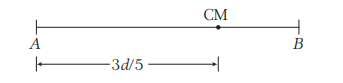
Since, the CM is at rest and its position is fixed, hence particles will meet at CM, i.e. at distance \(3 d / 5\) from \(A\).
Example 6: In the arrangement shown in figure, \(m_A=2 \mathrm{~kg}\) and \(m_B=1 \mathrm{~kg}\). String is light and inextensible. Find the acceleration of centre of mass of both the blocks. Neglect friction everywhere.
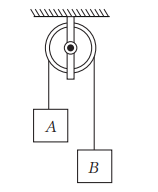
Solution:
\(
\begin{aligned}
& \text { Net pulling force on the system }=\left(m_A-m_B\right) g \\
& =(2-1) g=g
\end{aligned}
\)
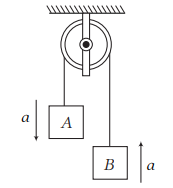
Total mass being pulled \(=m_A+m_B=3 \mathrm{~kg}\)
\(
\therefore \quad a=\frac{\text { Net pulling force }}{\text { Total mass }}=\frac{g}{3}
\)
Now,
\(
\begin{aligned}
\mathbf{a}_{\mathrm{CM}} & =\frac{m_A \mathbf{a}_A+m_B \mathbf{a}_B}{m_A+m_B} \\
& =\frac{2(a)-1(a)}{1+2}=\frac{a}{3}=\frac{g}{9} \text { (downwards) }
\end{aligned}
\)
Example 7: Two particles \(A\) and \(B\) of masses 1 kg and 2 kg respectively are projected in the directions as shown in figure with speeds \(u_A=200 \mathrm{~ms}^{-1}\) and \(u_B=50 \mathrm{~ms}^{-1}\). Initially, they were \(90 m\) apart. Find the maximum height attained by the centre of mass of the particles. Assume acceleration due to gravity to be constant.
(Take, \(g=10 \mathrm{~ms}^{-2}\) )
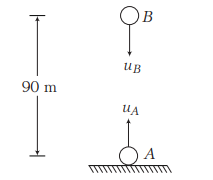
Solution: Step 1: Determine the initial position and velocity of the center of mass
Let’s set the initial position of particle \(A\) as the origin \(\left(y_A=0\right)\). Particle \(B\) is initially 90 m above \(\mathrm{A}\left(y_B=90 \mathrm{~m}\right)\). Particle A is projected upwards ( \(u_A=+200 \mathrm{~m} / \mathrm{s}\) ), and particle \(B\) is projected downwards ( \(u_B=-50 \mathrm{~m} / \mathrm{s}\) ).
The initial position of the center of mass \(\left(y_{C M, i}\right)\) is given by:
\(
y_{C M, i}=\frac{m_A y_A+m_B y_B}{m_A+m_B}=\frac{(1 \mathrm{~kg})(0 \mathrm{~m})+(2 \mathrm{~kg})(90 \mathrm{~m})}{1 \mathrm{~kg}+2 \mathrm{~kg}}=\frac{180 \mathrm{~kg} \cdot \mathrm{~m}}{3 \mathrm{~kg}}=60 \mathrm{~m}
\)
The initial velocity of the center of mass ( \(u_{C M}\) ) is given by:
\(
u_{C M}=\frac{m_A u_A+m_B u_B}{m_A+m_B}=\frac{(1 \mathrm{~kg})(+200 \mathrm{~m} / \mathrm{s})+(2 \mathrm{~kg})(-50 \mathrm{~m} / \mathrm{s})}{1 \mathrm{~kg}+2 \mathrm{~kg}}=\frac{200-100}{3} \mathrm{~m} / \mathrm{s}=\frac{100}{3} \mathrm{~m} / \mathrm{s}
\)
Step 2: Calculate the maximum height attained by the center of mass
The center of mass moves under the constant acceleration of gravity, \(a_{C M}=-g=-10 \mathrm{~m} / \mathrm{s}^2\). The maximum height relative to its initial position \((h)\) can be found using the equation of motion \(v^2=u^2+2 a s\), where the final velocity at the maximum height \(\left(v_{C M, f}\right)\) is 0 :
\(
\begin{gathered}
0^2=u_{C M}^2+2 a_{C M} h \\
h=\frac{-u_{C M}^2}{2 a_{C M}}=\frac{-(100 / 3 \mathrm{~m} / \mathrm{s})^2}{2\left(-10 \mathrm{~m} / \mathrm{s}^2\right)}=\frac{10000 / 9}{20} \mathrm{~m}=\frac{1000}{18} \mathrm{~m} \approx 55.55 \mathrm{~m}
\end{gathered}
\)
The total maximum height attained by the center of mass from the initial position of particle A (ground level) is the sum of its initial height and the additional height gained:
\(
H_{\max }=y_{C M, i}+h=60 \mathrm{~m}+55.55 \mathrm{~m}=115.55 \mathrm{~m}
\)
The maximum height attained by the center of mass of the particles is approximately 115.55 m from the initial position of particle \(A\).
Example 8: A body of mass 2.5 kg is subjected to the forces shown in figure below. Find the acceleration of the centre of mass.
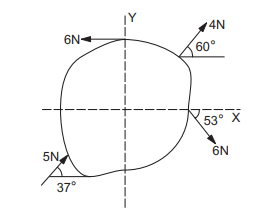
Solution: Solution: Take the \(X\) and \(Y\) axes as shown in the figure.
The \(x\)-component of the resultant force is
\(
\begin{aligned}
F_x & =-6 \mathrm{~N}+(5 \mathrm{~N}) \cos 37^{\circ}+(6 \mathrm{~N}) \cos 53^{\circ}+(4 \mathrm{~N}) \cos 60^{\circ} \\
& =-6 \mathrm{~N}+(5 \mathrm{~N}) \cdot(4 / 5)+(6 \mathrm{~N}) \cdot(3 / 5)+(4 \mathrm{~N}) \cdot(1 / 2)=3 \cdot 6 \mathrm{~N}
\end{aligned}
\)
Similarly, the \(y\)-component of the resultant force is
\(
\begin{aligned}
F_y & =5 \mathrm{~N} \sin 37^{\circ}-(6 \mathrm{~N}) \sin 53^{\circ}+4 \mathrm{~N} \sin 60^{\circ} \\
& =(5 \mathrm{~N}) \cdot(3 / 5)-(6 \mathrm{~N}) \cdot(4 / 5)+(4 \mathrm{~N}) \cdot(\sqrt{ } 3 / 2)=1 \cdot 7 \mathrm{~N}
\end{aligned}
\)
The magnitude of the resultant force is
\(
F=\sqrt{F_x{ }^2+F_y{ }^2}=\sqrt{(3.6 \mathrm{~N})^2+(1.7 \mathrm{~N})^2} \approx 4.0 \mathrm{~N} .
\)
The direction of the resultant force makes an angle \(\theta\) with the \(X\)-axis where
\(
\tan \theta=\frac{F_y}{F_x}=\frac{1.7}{3.6}=0.47
\)
The acceleration of the centre of mass is
\(
a_{C M}=\frac{F}{M}=\frac{4.0 \mathrm{~N}}{2.5 \mathrm{~kg}}=1.6 \mathrm{~m} / \mathrm{s}^2
\)
in the direction of the resultant force.
Example 9: A projectile is fired at a speed of \(100 \mathrm{~m} / \mathrm{s}\) at an angle of \(37^{\circ}\) above the horizontal. At the highest point, the projectile breaks into two parts of mass ratio \(1: 3\), the smaller coming to rest. Find the distance from the launching point to the point where the heavier piece lands.
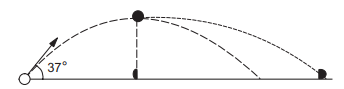
Solution: Initial Horizontal Velocity and Range:
The horizontal component of the initial velocity ( \(v_{0 x}\) ) is constant throughout the flight (neglecting air resistance).
\(
v_{0 x}=v_0 \cos (\theta)=100 \mathrm{~m} / \mathrm{s} \times \cos \left(37^{\circ}\right) \approx 100 \times 0.8=80 \mathrm{~m} / \mathrm{s} .
\)
The total range ( \(R\) ) of the original projectile (where its center of mass lands) is calculated as \(R=\frac{v_0^2 \sin (2 \theta)}{g}\) or by using time of flight. Using \(g=10 \mathrm{~m} / \mathrm{s}^2\) for simplicity, or \(9.8 \mathrm{~m} / \mathrm{s}^2\) if specified, the sources use \(g=10 \mathrm{~m} / \mathrm{s}^2\) to get an exact answer of 1120 m :
\(
R=\frac{100^2 \times \sin \left(74^{\circ}\right)}{10} \approx \frac{10000 \times 0.96}{10}=960 \mathrm{~m}
\)
Position at the Highest Point:
The projectile reaches its highest point at half the total range:
\(
x_{\mathrm{apex}}=\frac{R}{2}=\frac{960 \mathrm{~m}}{2}=480 \mathrm{~m} .
\)
Conservation of Momentum:
At the highest point, the projectile (total mass \(4 m\) if ratio is \(1: 3\) ) has a horizontal velocity of \(v_{0 x}=80 \mathrm{~m} / \mathrm{s}\). It breaks into two parts: smaller mass \(m\) (comes to rest, \(v_1=0\) ) and heavier mass \(3 m\) (velocity \(v_2\) ).
According to the conservation of momentum in the horizontal direction:
\(
\begin{aligned}
& P_{\text {before }}=P_{\text {after }} \\
& (4 m) \times v_{0 x}=m \times v_1+3 m \times v_2 \\
& (4 m) \times 80=m \times 0+3 m \times v_2 \\
& 320 m=3 m \times v_2 \\
& v_2=\frac{320}{3} \mathrm{~m} / \mathrm{s}
\end{aligned}
\)
Landing Point of the Heavier Piece:
The center of mass of the system continues to follow the original parabolic path, landing at \(R=960 \mathrm{~m}\). We can use the center of mass position formula to find the landing point of the heavier piece ( \(x_2\) ):
\(
\begin{aligned}
& x_{c m}=\frac{m_1 x_1+m_2 x_2}{m_1+m_2} \\
& 960 \mathrm{~m}=\frac{m \times x_1+3 m \times x_2}{4 m}
\end{aligned}
\)
The smaller mass ( \(m\) ) falls vertically from the apex, so it lands at \(x_1=x_{\text {apex }}=480\) m.
\(
\begin{aligned}
& 960 \mathrm{~m}=\frac{m \times 480+3 m \times x_2}{4 m} \\
& 960 \times 4=480+3 x_2 \\
& 3840=480+3 x_2 \\
& 3 x_2=3840-480=3360 \\
& x_2=\frac{3360}{3}=1120 \mathrm{~m}
\end{aligned}
\)
The heavier piece lands 1120 m from the launching point.
Example 10: A block of mass \(M\) is placed on the top of a bigger block of mass \(10 M\) as shown in figure below. All the surfaces are frictionless. The system is released from rest. Find the distance moved by the bigger block at the instant the smaller block reaches the ground.
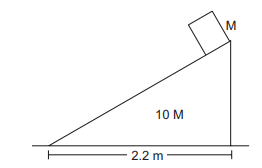
Solution: Step 1: Define variables and system
Let \(M\) be the mass of the smaller block and \(10 M\) be the mass of the bigger block. The system (both blocks) is released from rest, meaning the initial horizontal momentum is zero. Since all surfaces are frictionless, there are no net external horizontal forces acting on the system. Therefore, the horizontal position of the center of mass of the system remains constant throughout the motion.
Step 2: Apply conservation of center of mass position
Let the bigger block move a distance \({X}\) to the right. The smaller block moves a distance of (2.2 – X) to the left relative to the ground (based on the assumption that its relative horizontal displacement on the bigger block is 2.2 m ).
Using the conservation of the center of mass position in the horizontal direction:
\(
M x_1+10 M x_2=\mathrm{constant}
\)
The change in the center of mass position is zero:
\(
M \Delta x_1+10 M \Delta x_2=0
\)
Let the origin be the initial horizontal position of the center of mass. The displacement of the bigger block is \(\Delta x_2=X\) (to the right, positive). The displacement of the smaller block relative to the ground is \(\Delta x_1=-(2.2-X)\) (to the left, negative).
Step 3: Solve for the distance \({X}\)
Substitute the displacements into the equation:
\(
\begin{gathered}
M(-(2.2-X))+10 M(X)=0 \\
-2.2 M+M X+10 M X=0 \\
11 M X=2.2 M
\end{gathered}
\)
Divide by \(11 M\) (assuming \(M \neq 0\) ):
\(
\begin{aligned}
X & =\frac{2.2 M}{11 M} \\
X & =0.2 \mathrm{~m}
\end{aligned}
\)
The distance moved by the bigger block at the instant the smaller block reaches the ground is \(\mathbf{0 . 2 ~ m}\).