4.7 Conservation of momentum
Conservation of Linear Momentum
The total momentum of an isolated system (a system having no external force acting on it) of constant mass remains constant or conserved and does not change with time. This is known as law of conservation of momentum. If the momentum of two particles system of masses \(m_1\) and \(m_2\) are \(p_1\) and \(p_2\) respectively, then the net momentum of whole system is given by
\(
p=p_1+p_2=\text { constant }
\)
This principle is a consequence of Newton’s second and third law of motion.
Conservation of linear momentum for a system of two or more particles
Force applied on particle 1 by particle 2 is \(F_{12}\) and force applied on particle 2 by particle 1 is \(F_{21}\) and their respective momentum are \(p_1\) and \(p_2\).
From Newton’s IInd law,
\(
\mathbf{F}_{12}=\frac{d p_1}{d t} \text { and } \mathbf{F}_{21}=\frac{d p_2}{d t}
\)
From Newton’s 3rd law,
\(
\mathbf{F}_{12}=-\mathbf{F}_{21} \Rightarrow \frac{d \mathbf{p}_1}{d t}=-\frac{d \mathbf{p}_2}{d t}
\)
\(
\text { or } \frac{d \mathbf{p}_1}{d t}+\frac{d \mathbf{p}_2}{d t}=0 \Rightarrow \frac{d}{d t}\left(\mathbf{p}_1+\mathbf{p}_2\right)=0
\)
Thus, \(\mathbf{p}_1+\mathbf{p}_2=\text { constant }\)
For \(n\) number of particles,
\(
\mathbf{p}_1+\mathbf{p}_2+\mathbf{p}_3+\ldots+\mathbf{p}_n=\text { constant }
\)
Conservation of linear momentum for the collision of two bodies
Case-I: Head-on collision (collision in a straight line)
Two bodies of masses \(m_1\) and \(m_2\) collide on frictionless surface moving in the same direction with respective velocities \(u_1\) and \(u_2\). After collision, both the bodies separate with a variation in their velocities, i.e. \(v_1\) and \(v_2\), respectively.
Initial momentum (before collision),
\(
p_{1(\text { initial) }}=m_1 \mathbf{u}_1, p_{2 \text { (initial) }}=m_2 \mathbf{u}_2
\)
Final momentum (after collision),
\(
p_{1(\text { final })}=m_1 \mathbf{v}_1, \quad p_{2(\text { final })}=m_2 \mathbf{v}_2
\)
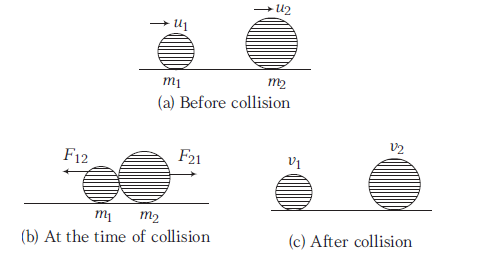
During collision, particle 1 exerts a force \(F_{21}\) on particle 2 and simultaneously particle 2 exerts a force \(F_{12}\) on particle 1.
\(
\begin{aligned}
\mathrm{F}_{12} & =\text { rate of change of momentum of particle } 1 \\
& =\frac{m_1 v_1-m_1 u_1}{t}=\frac{m_1\left(v_1-u_1\right)}{t}
\end{aligned}
\)
Similarly, \(\mathrm{F}_{21}=\) rate of change of momentum of particle 2
\(
=\frac{m_2 v_2-m_2 u_2}{t}=\frac{m_2\left(v_2-u_2\right)}{t}
\)
According to Newton’s 3rd law of motion,
\(
\begin{array}{l}
\mathrm{F}_{12}=-\mathrm{F}_{21} \\
\Rightarrow \quad \frac{m_1\left(v_1-u_1\right)}{t}=-\frac{m_2\left(v_2-u_2\right)}{t} \\
\text { or } \quad m_1 u_1+m_2 u_2=m_1 v_1+m_2 v_2 \\
\end{array}
\)
i.e. Total momentum before collision remains same as total momentum after collision.
Case-II: Oblique collision (collision of ball with wall)
A ball of mass \(m\) strikes a wall with velocity \(u\) at an angle \(\theta\) from the normal of wall and rebounds with the same speed in time \(t\).
Here, initial momentum of the particle,
\(
\mathbf{p}_i=m u \cos \theta \hat{\mathbf{i}}-m u \sin \theta \hat{\mathbf{j}}
\)
Final momentum of the particle,
\(
\mathrm{p}_f=-m u \cos \theta \hat{\mathbf{i}}-m u \sin \theta \hat{\mathbf{j}}
\)
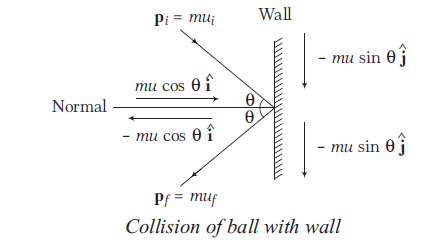
Now, change in momentum, \(\Delta \mathbf{p}=\mathbf{p}_f-\mathbf{p}_i\)
\(
\begin{array}{l}
=-m u \cos \theta \hat{\mathbf{i}}-m u \sin \theta \hat{\mathbf{j}}-m u \cos \theta \hat{\mathbf{i}}+m u \sin \theta \hat{\mathbf{j}} \\
=-2 m u \cos \theta \hat{\mathbf{i}}
\end{array}
\)
It means that momentum changes only along the normal to the wall but not along the wall. This is so because force is acting on the ball only normal to the wall (this force is reaction force of wall) and no force acts parallel to the wall.
\(
|\Delta \mathbf{p}|=2 m u \cos \theta
\)
Force,
\(
\begin{aligned}
\mathbf{F} & =\frac{\Delta \mathbf{p}}{\Delta t}=\frac{-2 m u \cos \theta}{t} \hat{\mathbf{i}} \\
|\mathbf{F}| & =\frac{2 m u \cos \theta}{t}
\end{aligned}
\)
There are two possible cases
Case-I: If \(\theta=0^{\circ}\), means ball is thrown perpendicular to the wall, then \(\Delta \mathbf{p}=-2 m u \cos 0^{\circ} \hat{\mathbf{i}}\)
\(
\begin{array}{ll}
\Rightarrow & \Delta \mathbf{p}=-2 m u \hat{\mathbf{i}} \\
\therefore & \mathbf{F}=\frac{\Delta \mathbf{p}}{\Delta t}=\frac{-2 m u}{t} \hat{\mathbf{i}}
\end{array}
\)
Case-II: If \(\theta\) is the angle measured from the wall, then
\(
\begin{aligned}
\Delta \mathbf{p} & =-2 m u \sin \theta \hat{\mathbf{i}} \Rightarrow|\Delta \mathbf{p}|=2 m u \sin \theta \\
\mathbf{F} & =\frac{-2 m u \sin \theta}{t} \hat{\mathbf{i}} \Rightarrow|\mathbf{F}|=\frac{2 m u \sin \theta}{t}
\end{aligned}
\)
Newton’s 3rd law can be derived from principle of conservation of linear momentum
If two particles of masses \(m_1\) and \(m_2\) are moving under action of their mutually interacting forces with each other, such that no external force acts on the system. Then, momentum of system remains constant.
\(
\begin{array}{l}
\text { i.e. } \quad \Delta \mathbf{p}_1+\Delta \mathbf{p}_2=0 \Rightarrow \Delta \mathbf{p}_1=-\Delta \mathbf{p}_2 \Rightarrow \frac{\Delta \mathbf{p}_1}{\Delta t}=-\frac{\Delta \mathbf{p}_2}{\Delta t} \\
\Rightarrow \quad \mathbf{F}_{12}=-\mathbf{F}_{21} \\
\end{array}
\)
\(
\text { Force on } \text { 1st due to } 2 \mathrm{nd}=- \text { Force on } \text { 2nd due to } \text {1st }
\)
Example 1: An explosion blows a rock into three parts. Two pieces go off at right angles to each other; 1.0 kg piece with a velocity of 12 m/s and other 2.0 kg piece with a velocity 8 m/s. If the third piece flies off with a velocity 40 m/s, compute the mass of third piece.
Solution: When an explosion breaks a rock, by the law of conservation of momentum, initial momentum is zero and for the three pieces,
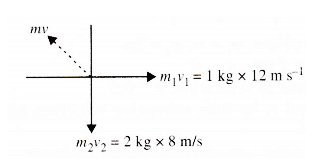
When an explosion breaks a rock, by the law of conservation Total momentum of the two pieces \(1 \mathrm{~kg}\) and \(2 \mathrm{~kg}\)
\(
=\sqrt{12^2+16^2}=20 \mathrm{~kg} \mathrm{~ms}^{-1} \text {. }
\)
The third piece has the same momentum and in the direction opposite to the resultant of these two momenta.
Momentum of the third piece
\(
=20 \mathrm{~kg} \mathrm{~ms}^{-1}
\)
Velocity \(=40 \mathrm{~ms}^{-1}\)
\(\therefore \quad\) Mass of the \(3^{\text {rd }}\) piece
\(
=\frac{m v}{v}=\frac{20}{40}=0.5 \mathrm{~kg}
\)
Example 2: A bullet of mass \(10 g\) is fired from a gun of mass 1 kg. If the recoil velocity is \(5 \mathrm{~ms}^{-1}\). Find the velocity of the muzzle.
Solution: From the law of conservation of momentum,
\(
m_G v_G=m_B v_B
\)
where, \(m_G, v_G=\) mass and velocity of gun
\(
\begin{aligned}
& m_B, v_B=\text { mass and velocity of bullet } \\
\Rightarrow \quad & v_B=\frac{m_G v_G}{m_B}=\frac{1 \times 5}{10 \times 10^{-3}}=500 \mathrm{~ms}^{-1}
\end{aligned}
\)
Note: Yes, the principle of conservation of momentum fully applies when a bullet is fired from a gun. The total momentum of the gun-bullet system before firing (which is zero if both are at rest) is equal to the total momentum of the system immediately after firing.
The high-velocity, forward momentum of the bullet is balanced by the low-velocity, backward momentum of the much heavier gun (this backward motion is known as recoil). The forces experienced by the bullet and the gun are internal to the system, so the net external force is zero, allowing momentum to be conserved.
Example 3: On a mine site a rock is exploded. On explosion, rock breaks into three parts. Two parts go off at right angles to each other. Of these two, 1 kg first part is moving with a velocity of \(12 \mathrm{~ms}^{-1}\) and 2 kg second part is moving with a velocity of \(8 \mathrm{~ms}^{-1}\). If the third part flies off with a velocity \(4 \mathrm{~ms}^{-1}\), what will be its mass?
Solution:
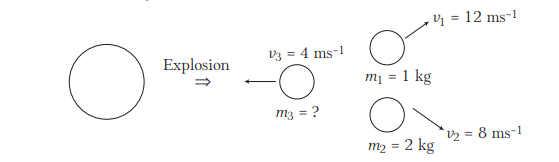
From the law of conservation of momentum,
\(
\begin{aligned}
& & p_3 & =\sqrt{p_1^2+p_2^2} \\
\Rightarrow & & m_3 \times 4 & =\sqrt{(1 \times 12)^2+(2 \times 8)^2}=20 \\
\Rightarrow & & m_3 & =5 \mathrm{~kg}
\end{aligned}
\)
Example 4: Two objects each of mass 5 kg are moving in the same straight line but in the opposite directions towards each other with same speed of \(3 \mathrm{~m} / \mathrm{s}\). They stick to each other after collision. What will be the velocity of the combined object after collision?
Solution: Given, \(m_1=m_2=5 \mathrm{~kg}\),
\(
u_1=3 \mathrm{~m} / \mathrm{s}, u_2=-3 \mathrm{~m} / \mathrm{s}
\)
Before collision,
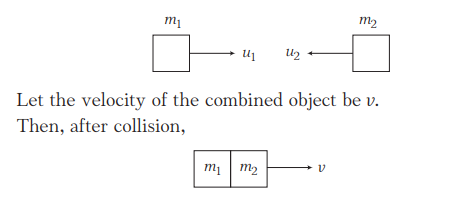
Total momentum of the system before collision is
\(
m_1 u_1+m_2 u_2=5 \times 3+5 \times(-3)=0
\)
Total momentum of the system after collision is
\(
m_1 v+m_2 v=\left(m_1+m_2\right) v=(5+5) v=10 v
\)
According to the law of conservation of momentum, Momentum before collision = Momentum after collision
\(
\therefore \quad 0=10 v \Rightarrow v=0
\)
Hence, the velocity of the combined object after collision is zero.
Example 5: \(A\) ball of mass \(m\) strikes a rigid wall with speed \(v\) and gets reflected without any loss of speed, as shown in the figure.
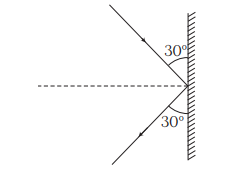
(i) What is the magnitude of the impulse imparted to the ball by the wall?
(ii) What is the direction of the force on the wall due to the ball?
Solution: According to the question,
\(
\begin{aligned}
& \mathbf{p}_i=m v \sin 30^{\circ} \hat{\mathbf{i}}-m v \cos 30^{\circ} \hat{\mathbf{j}}, \mathbf{p}_f=-m v \sin 30^{\circ} \hat{\mathbf{i}}-m v \cos 30^{\circ} \hat{\mathbf{j}} \\
& \therefore \text { Impulse }=\Delta \mathbf{p}=\mathbf{p}_f-\mathbf{p}_i=-2 m v \sin 30^{\circ} \hat{\mathbf{i}}=-m \hat{\mathbf{i}} \\
& \quad \text { Magnitude of impulse }=|\Delta \mathbf{p}|=m v
\end{aligned}
\)
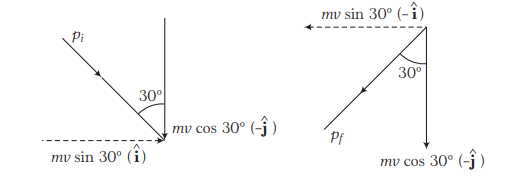
(ii) Negative sign of the impulse shows that it is along negative \(x\)-direction. Since, impulse and force are in the same direction, the force on the ball is along the negative direction of \(X\)-axis. Hence, the force on the wall will be along positive \(X\)-axis.
Friction
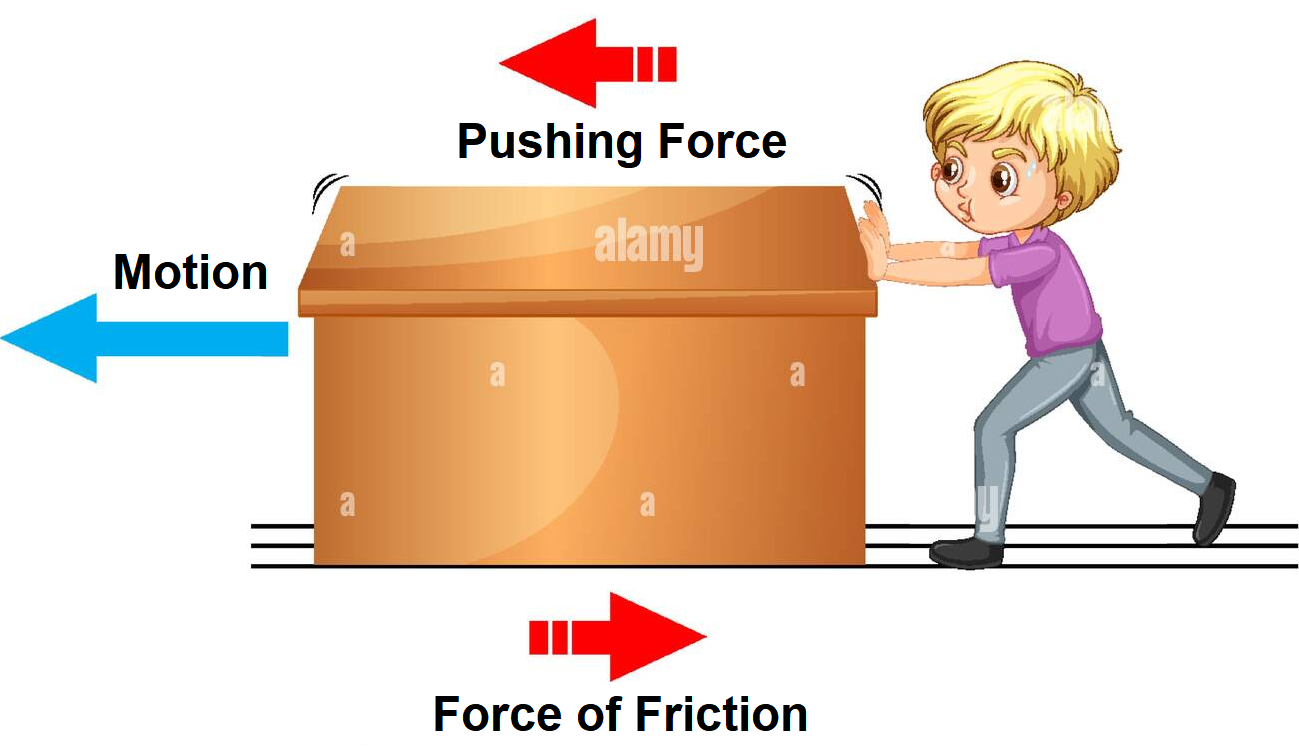
- Whenever a body tends to move over another body’s surface, an opposing force, called force of friction acts (Friction is the force of two surfaces in contact).
- Friction is a contact force that opposes relative motion.
- This force acts tangentially to the interface of two bodies.
- No friction exists till an external force is applied.
The Formula for Calculating Friction
The friction force, denoted as \(F_f\) can be calculated using the following formula:
\(F_f=\mu \cdot N\)
Where:
\(\mu\) represents the coefficient of friction
\(N\) represents the normal force acting on the object.
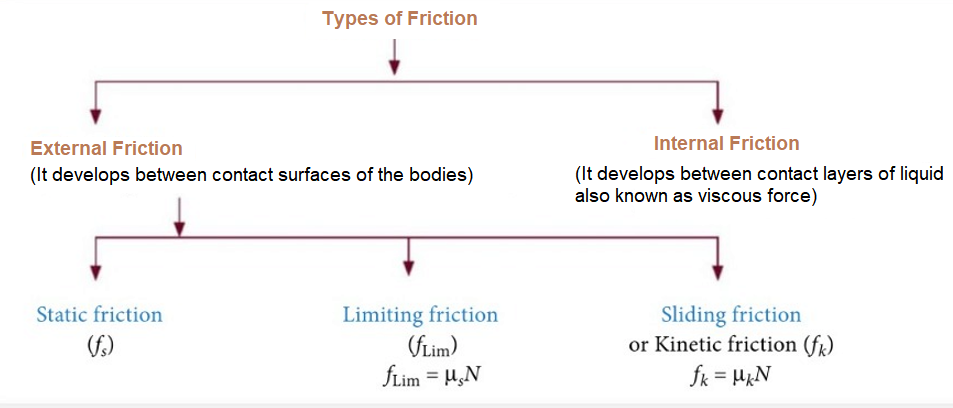
There are three types of frictional force :
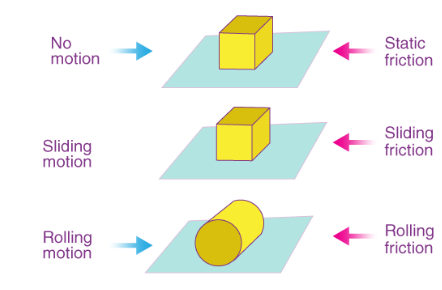
- Static friction (No relative motion between objects)
- Kinetic friction (There is relative motion between objects)
- Rolling friction (When an object is rolled on a surface)
Static Friction
Static friction is a force that keeps an object at rest. Static friction definition can be written as the friction experienced when individuals try to move a stationary object on a surface, without actually triggering any relative motion between the body and the surface on which it is on.
It can be explained as the force of friction which precisely balances the applied force for the duration of the stationary state of the body. The static frictional force is self-regulating, i.e. static friction will at all times be equivalent and opposite to the force applied.
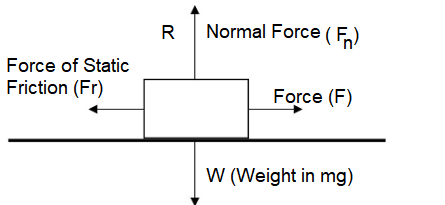
\(R\) is the reaction force (known as normal force \(F_n\)) because of the weight \(W\). The external force is \(F\), and \(F_r\) is the friction. \(F=-F_r\) when no motion takes place.
The coefficient of static friction is denoted as \(\mu_{\mathrm{s}}\). The maximum force of static friction is given as the product of the coefficient of static friction and normal force and force of static friction is less than or equal to the product of the coefficient of static friction and normal force. It is given as:
\(
\mathrm{F}_{\mathrm{s}} \max =\mu_{\mathrm{s}} N \text { and } \mathrm{F}_{\mathrm{s}} \leq \mu_{\mathrm{s}} N
\)
Where,
\(\mathrm{F}_{\mathrm{s}}\) is the force of static friction
\(\mu_{\mathrm{s}}\) is the coefficient of static friction
\(N\) is the normal force
\(\mathrm{F}_{\mathrm{s}} \mathrm{max}\) is the maximum force of static friction
Limiting Friction
The maximum friction force that can be developed at the contact surface, when body is just on the point of moving Is called limiting force of friction.
Maximum value of static friction is called limiting friction i.e., \(f_{\operatorname{Lim}}=\mu_s N\)
Where:
\(\mu_s\) represents the coefficient of limiting friction
\(N\) represents the normal force acting on the object.
Sliding Friction
Sliding friction is defined as the resistance that is created between any two objects when they are sliding against each other. The coefficient of sliding friction is denoted as \(\mu_{\mathrm{s}}\). The force of sliding friction is defined as the product of the coefficient of sliding friction and the normal force. It is given as:
\(
F_s=\mu_s \cdot N
\)
Kinetic Friction
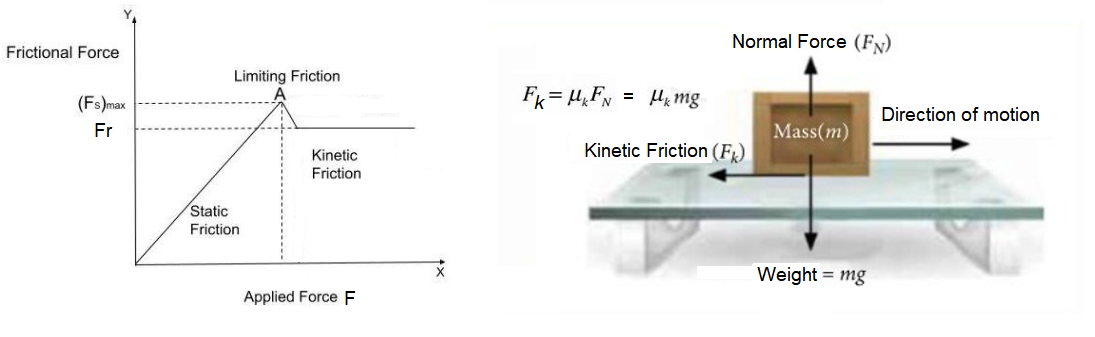
If the body is in motion, the friction opposing its motion is called dynamic or kinetic friction. This is always slightly less than the limiting friction.
Its numerical value is \(f_k=\mu_k N\).
Angle of Friction
Angle of friction \((\lambda)\) : The angle which the resultant of the force of limiting friction \(f\) and normal reaction \(N\) makes with the direction of normal reaction \(N\).
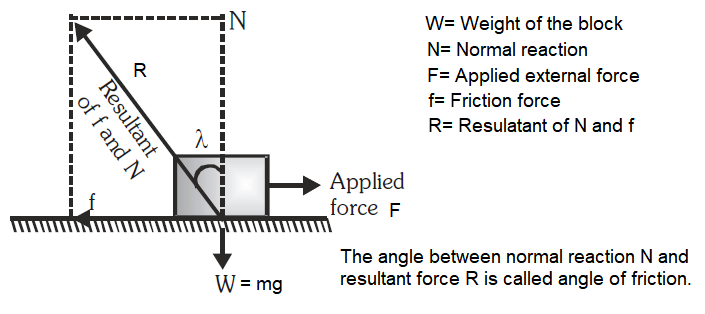
\(
\tan \lambda=\frac{f}{N}=\mu \text { or, } \quad \lambda=\tan ^{-1} \mu
\)
Angle of repose or angle of sliding : It is defined as the maximum angle of inclination of a plane with the horizontal at which a body placed on it just begins to sliding down.
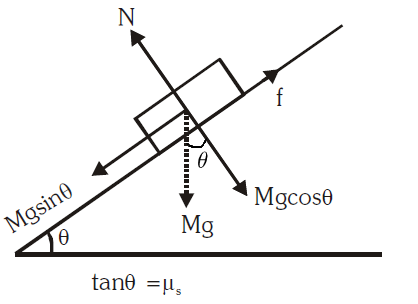
\(
f=M g \sin \theta \text { and } N=M g \cos \theta
\)
Rolling Friction
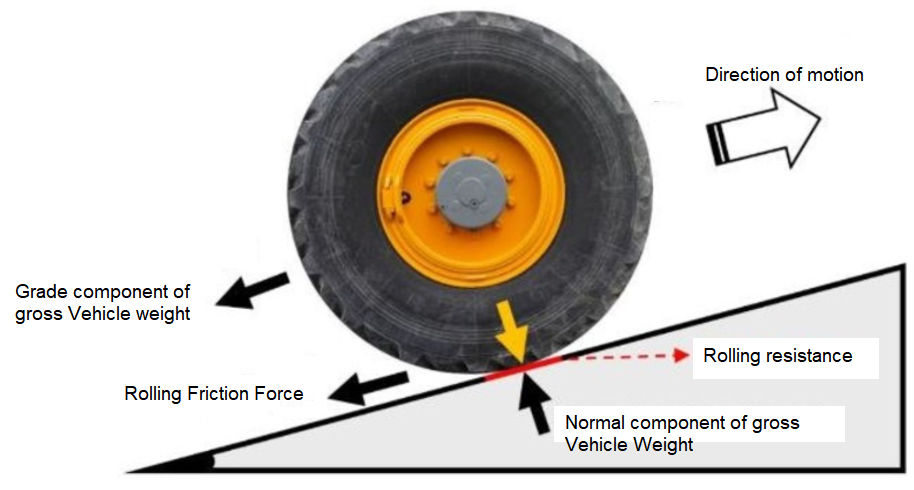
In rolling friction, there is just one point of contact between the body and the plane at every instant and this point is at rest with respect to the plane. There are three laws of rolling friction:
- With the increase in smoothness, the force of rolling friction decreases.
- Rolling friction is expressed as a product of load and constant to the fractional power.
\(
\mathrm{F}=\mathrm{kL}{ }^{\mathrm{n}}
\) - Rolling friction force is directly proportional to load and inversely proportional to the radius of curvature.
\(
F=\mu \times \frac{W}{r}
\)
Coefficient of Rolling Friction is the ratio of the force of rolling friction to the total weight of the object.
In empirical terms, the coefficient of rolling resistance can be expressed as:
\(
F_r=\mu_r W
\)
where,
\(F_r\) is the resistive force of rolling resistance
\(\mu_{\mathrm{r}}\) is the coefficient of rolling resistance
\(\mathrm{W}\) is the weight of the rolling body
Example 6: A block of mass 0.1 kg is held against a wall applying a horizontal force of 5 N on the block. If the coefficient of friction between the block and the wall is 0.5, the magnitude of the frictional force acting on the block is ____.
Solution:
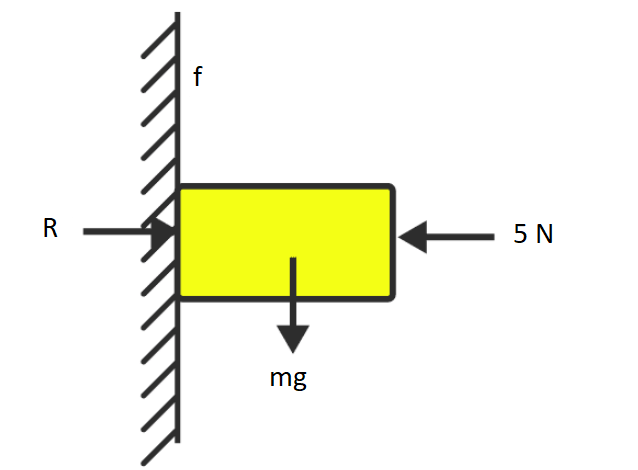
Consider the forces, acting on the block in the vertical direction
Force of friction \(f=\mu R\)
\(
\begin{aligned}
& f=0.5 \times 5 \\
& f=2.5 \mathrm{~N}
\end{aligned}
\)
Example 7: A horizontal force of 10 N is necessary to just hold a block stationary against a wall. The coefficient of friction between the block and the wall is 0.2 . The weight of the block is ____.
Solution: Frictional force balances the weight of the body
Frictional force \(\mathrm{f}=\mu \mathrm{N}=\mathrm{mg}\)
\(
f=0.2 \times 10=2 \mathrm{~N}
\)
Therefore, weight of the block \(\mathrm{mg}=2 \mathrm{~N}\)
Example 8: A marble block of mass 2 kg lying on ice when given a velocity of \(6 \mathrm{~m} / \mathrm{s}\) is stopped by friction in 10 s. Then the coefficient of friction is (consider \(\mathrm{g}=10 \mathrm{~m} / \mathrm{s}\) )
Solution:
\(
\begin{aligned}
& u=6 \mathrm{~m} / \mathrm{s} \\
& v=0 \\
& t=10 \mathrm{~s} \\
& a=-f / \mathrm{m}=-\mu \mathrm{mg} / \mathrm{m}=-\mu \mathrm{g}=-10 \mu
\end{aligned}
\)
Substituting values in \(\mathrm{v}=\mathrm{u}+\mathrm{at}\)
\(
0=6-10 \mu \times 10
\)
Therefore, \(\mu=0.06\)
Example 9: A block rests on a rough inclined plane making an angle of \(30^{\circ}\) with the horizontal. The coefficient of static friction between the block and the plane is 0.8. If the frictional force on the block is 10 N, the mass of the block (in kg ) is : (taken g \(\left.=10 \mathrm{~m} / \mathrm{s}^2\right)\)
Solution:
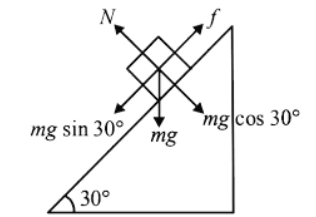
Step 1: Analyze the forces acting on the block:
The forces acting on the block are gravity ( \(m g\) ), the normal force ( \(N\) ), and the frictional force ( \(f\) ). The gravitational force can be resolved into components parallel and perpendicular to the inclined plane. The component of gravity parallel to the plane is \(m g \sin (\theta)\) and the component perpendicular to the plane is \(m g \cos (\theta)\), where \(\theta=30^{\circ}\)
Since the block is at rest, it is in static equilibrium, and the forces parallel to the plane must balance each other. The force pulling the block down the plane is the parallel component of gravity, and the force opposing this motion is the frictional force.
Step 2: Set up the equilibrium equation
The frictional force ( \(f\) ) must be equal to the component of gravity pulling the block down the slope ( \(m g \sin (\theta)\) ).
\(
f=m g \sin (\theta)
\)
Step 3: Solve for the mass of the block
Rearrange the equation to solve for the mass ( \(m\) ).
\(
m=\frac{f}{g \sin (\theta)}
\)
Substitute the given values: \(f=10 \mathrm{~N}, g=10 \mathrm{~m} / \mathrm{s}^2\), and \(\theta=30^{\circ}\). The value for the coefficient of static friction is not needed for this calculation as the actual frictional force is given.
\(
m=\frac{10}{10 \sin \left(30^{\circ}\right)}
\)
Since \(\sin \left(30^{\circ}\right)=0.5\), the equation becomes:
\(
m=\frac{10}{10(0.5)}=\frac{10}{5}=2 \mathrm{~kg}
\)
The mass of the block is \(\mathbf{2} \mathbf{~ k g}\).
Example 10: Determine the maximum acceleration of the train in which a box lying on its floor will remain stationary, given that the co-efficient of static friction between the box and the train’s floor is 0.15.
Solution: Since the acceleration of the box is due to the static friction,
\(
\begin{aligned}
m a & =f_s \leq \mu_s N=\mu_s m g \\
i . e . \quad a & \leq \mu_s g \\
\therefore a_{\max } & =\mu_s g=0.15 \times 10 \mathrm{~m} \mathrm{~s}^{-2} \\
& =1.5 \mathrm{~m} \mathrm{~s}^{-2}
\end{aligned}
\)
Example 11: A mass of 4 kg rests on a horizontal plane as shown in Figure below. The plane is gradually inclined until at an angle \(\theta=15^{\circ}\) with the horizontal, the mass just begins to slide. What is the coefficient of static friction between the block and the surface?
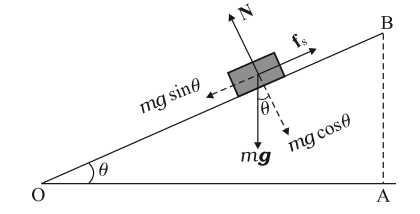
Solution: The forces acting on a block of mass \(m\) at rest on an inclined plane are (i) the weight mg acting vertically downwards (ii) the normal force \(N\) of the plane on the block, and (iii) the static frictional force \(\int_s\) opposing the impending motion. In equilibrium, the resultant of these forces must be zero. Resolving the weight \(m g\) along the two directions shown, we have
\(
m g \sin \theta=f_s, \quad m g \cos \theta=N
\)
As \(\theta\) increases, the self-adjusting frictional force \(f_s\) increases until at \(\theta=\theta_{\text {max }}, f_s\) achieves its maximum value, \(\left(f_s\right)_{\max }=\mu_s N\).
Therefore,
\(
\tan \theta_{\max }=\mu_s \text { or } \theta_{\max }=\tan ^{-1} \mu_s
\)
When \(\theta\) becomes just a little more than \(\theta_{\text {max }}\), there is a small net force on the block and it begins to slide. Note that \(\theta_{\text {max }}\) depends only on \(\mu_s\) and is independent of the mass of the block.
For
\(
\begin{aligned}
\theta_{\max } & =15^{\circ}, \\
\mu_s & =\tan 15^{\circ} \\
& =0.27
\end{aligned}
\)
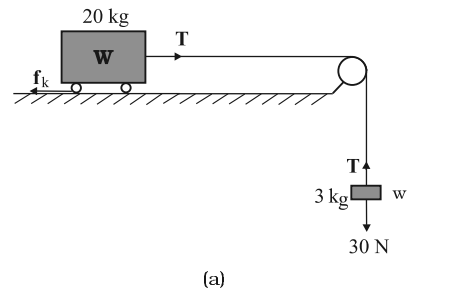
Example 12: What is the acceleration of the block and trolley system shown in a Figure (a), if the coefficient of kinetic friction between the trolley and the surface is 0.04 ? What is the tension in the string? (Take \(\mathrm{g}= \left.10 \mathrm{~m} \mathrm{~s}^{-2}\right)\). Neglect the mass of the string.
Solution:
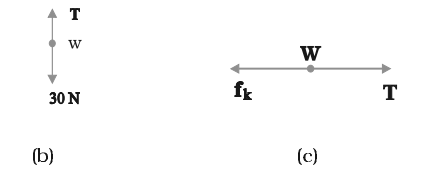
As the string is inextensible, and the pully is smooth, the 3 kg block and the 20 kg trolley both have same magnitude of acceleration. Applying second law to motion of the block (Figure(b)),
\(
30-T=3 a
\)
Apply the second law to motion of the trolley (Figure(c)),
\(
T-f_{\mathrm{k}}=20 a
\)
Now \(\quad f_k=\mu_k N\),
Here \(\quad \mu_k=0.04\),
\(
\begin{aligned}
N & =20 \times 10 \\
& =200 \mathrm{~N} .
\end{aligned}
\)
Thus the equation for the motion of the trolley is
\(
T-0.04 \times 200=20 a \text { or } T-8=20 a .
\)
These equations give \(a=\frac{22}{23} \mathrm{~m} \mathrm{~s}^{-2}=0.96 \mathrm{~m} \mathrm{~s}^{-2}\) and \(T=27.1 \mathrm{~N}\).