4.4 Newton’s first law of motion
Newton’s laws of motion are three fundamental principles of classical physics that describe the relationship between an object and the forces acting upon it. These three laws of motion were first proposed by Sir Isaac Newton.
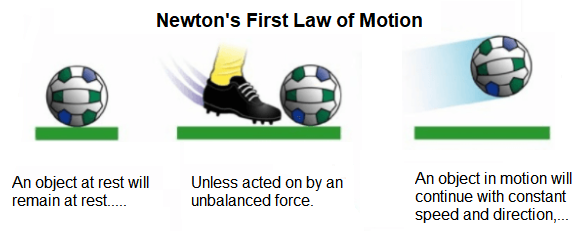
An object at rest will stay at rest, and an object in motion will stay in motion with the same speed and in the same direction unless acted upon by an unbalanced force. This is also known as the law of inertia.
The state of rest or uniform linear motion both imply zero acceleration. The first law of motion can, therefore, be simply expressed as:
If the net external force on a body is zero, its acceleration is zero. Acceleration can be non zero only if there is a net external force on the body.
Example:
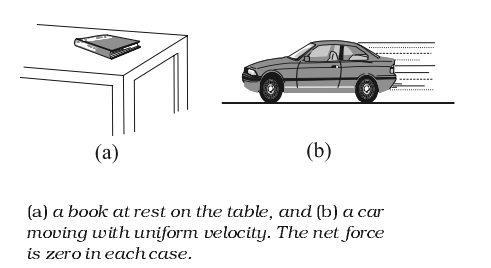
- A book on a table will remain at rest until you push it. “Since the book is observed to be at rest, the net external force on it must be zero, according to the first law. This implies that the normal force \(R(N)\) must be equal and opposite to the weight \(W=mg\) “.
- Consider the motion of a car starting from rest, picking up speed and then moving on a smooth straight road with uniform speed.