2.8 JEE Entrance Corner
Summary
- An object is said to be in motion if its position changes with time. The position of the object can be specified with reference to a conveniently chosen origin. For motion in a straight line, position to the right of the origin is taken as positive and to the left as negative.
- Path length is defined as the total length of the path traversed by an object.
- Displacement is the change in position : \(\Delta x=x_2-x_1\). Path length is greater or equal to the magnitude of the displacement between the same points.
\(v-t\) curve area gives displacement: \(\left[\Delta {x}=\int {vdt}\right]\) - An object is said to be in uniform motion in a straight line if its displacement is equal in equal intervals of time. Otherwise, the motion is said to be non-uniform.
\(\text { Speed }(v)=\frac{\text { Distance travelled }}{\text { Time taken }}\)
\(\text { Average speed }=\frac{\text { Total distance travelled }}{\text { Total time taken }}\) - \(\text { Instantaneous speed }=\lim _{\Delta t \rightarrow 0} \frac{\Delta s}{\Delta t}=\frac{d x}{d t}\)
- \(\text { Velocity }=\frac{\text { Displacement }}{\text { Time }}\)
\(\text { Average velocity }=\frac{\text { Total displacement }(\Delta x)}{\text { Total time }(\Delta t)}\) - Instantaneous velocity =\(v=\lim _{\Delta t \rightarrow 0} \frac{\Delta x}{\Delta t}=\frac{d x}{d t}\) (Instantaneous velocity is the slope of position time curve)
- The time rate of change of velocity of a body is called acceleration.
\(
\therefore \quad \text { Acceleration }=\frac{\text { Change in velocity }(\Delta v)}{\text { Time interval }(\Delta t)}
\)
\(
\text { Average acceleration }=a_{avg}=\frac{\text { Total change in velocity }}{\text { Total time taken }}
\) - The acceleration of an object at a given instant of time or at a given point during the motion, is called its instantaneous acceleration. i.e.
\(
{a}=\lim _{\Delta t \rightarrow 0} \frac{\Delta {v}}{\Delta t}=\frac{d {v}}{d t}=\frac{d^2 {x}}{d t^2}
\)
\(a-t\) curve area gives change in velocity.
\(
\left[\Delta {v}=\int \text { adt }\right]
\) - The three equations of motion on a straight line are
(i) \(v=u+a t\)
(ii) \(s=u t+\frac{1}{2} a t^2\)
(iii) \(v^2-u^2=2 a s\) - The kinematic equation \(x(t)=x_0+v_0 t+\frac{1}{2} a t^2\)
\(x(t)\) : The final position of the object at a specific time \(t\).
\(x_0\) : The initial position of the object, or its starting point at time \(t=0\).
\(v_0\) : The initial velocity of the object, or its speed and direction at time \(t=0\).
\(a\) : The constant acceleration of the object. It can be positive, negative, or zero.
\(t\) : The time interval over which the motion occurs. - Distance travelled by a body in \(n\)th second,
\(
s_n=u+\frac{1}{2} a(2 n-1)
\) - Stopping distance \(s=\frac{u^2}{2 a}\)
- Equation for motion under gravity are given below
(i) If particle is thrown vertically upwards
\(
\begin{aligned}
v & =u-g t \\
h & =u t-\frac{1}{2} g t^2 \\
v^2 & =u^2-2 g h
\end{aligned}
\)
Time of ascent=\(t=\frac{u}{g}\)
Total flight time \((T)=\frac{2 u}{g}\)
(ii) If particle is thrown vertically downward with some velocity from some height.
\(
\begin{aligned}
v & =u+g t \\
h & =u t+\frac{1}{2} g t^2 \\
v^2 & =u^2+2 g h
\end{aligned}
\) - Maximum height attained by a particle, thrown upwards from ground: \(h_{max}=\frac{u^2}{2 g}\)
Velocity of particle at the time of striking the ground when released \((u=0)\) from a height \(h\) is
\(
v=\sqrt{2 g h}
\)
Time of collision of particle with ground,
\(
t=\sqrt{\frac{2 h}{g}}
\) - When acceleration of particle is not constant, motion is known as non-uniformly accelerated motion. In this case problems can be solved either by differentiation or integration (with some boundary conditions).
For one dimensional motion, above relations can be written as under
(i) \(v=\frac{d s}{d t}\)
(ii) \(a=\frac{d v}{d t}=v \frac{d v}{d s}\)
(iii) \(d s=v d t\) and
(iv) \(d v=a d t \quad\) or \(\quad v d v=a d s\) - The time rate of change of relative position of one object with respect to another is called relative velocity.
The displacement of \(B\) relative to \(A\),
\(
\mathbf{x}_{B A}=\mathbf{x}_B-\mathbf{x}_A
\)
Rate of change of relative displacement w.r.t. time is
\(
\begin{array}{ll}
& \frac{d\left(\mathbf{x}_{B A}\right)}{d t}=\frac{d}{d t}\left(\mathbf{x}_B-\mathbf{x}_A\right) \Rightarrow \frac{d \mathbf{x}_{B A}}{d t}=\frac{d \mathbf{x}_B}{d t}-\frac{d \mathbf{x}_A}{d t} \\
\therefore & \mathbf{v}_{B A}=\mathbf{v}_B-\mathbf{v}_A
\end{array}
\)
Similarly, relative acceleration of \(A\) with respect to \(B\) is
\(
\mathbf{a}_{A B}=\mathbf{a}_A-\mathbf{a}_B
\)
Further, we can see that \(\mathbf{v}_{A B}=-\mathbf{v}_{B A}\) or \(\mathbf{a}_{B A}=-\mathbf{a}_{A B}\) - So, in case of a one dimensional motion, the above equations can be written as
\(
\begin{aligned}
& v_{A B}=v_A-v_B \\
& a_{A B}=a_A-a_B
\end{aligned}
\)
Further, we can see that \({v}_{A B}=-{v}_{B A}\) or \({a}_{B A}=-{a}_{A B}\)
Practice Problems
Q1. All the graphs below are intended to represent the same motion. One of them does it incorrectly. Pick it up. [JEE 2018]
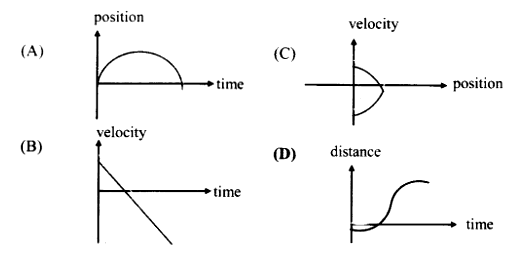
Solution: Complete step by step answer:Consider the choice (A): This graph says that, initially a particle is considered to be at rest, then it reaches the maximum distance. Finally returns back to zero position after a certain time uniformly.
Consider the choice (B): This graph says that, initially velocity at time zero is shown maximum, it decreases and becomes zero. Further becomes negative. Therefore, it shows similar motion as choice A.
Consider the choice (c): This graph says that, initially velocity at position zero is shown maximum, it decreases and becomes zero at maximum distance. Further becomes negative and the particle returns back to its initial position. Therefore, it shows similar motion as choice \(B\) and \(C\).
Consider the choice (D): This graph says that a particle covers a distance in non-uniform motion. And the particle does not reach back to its initial position. Unlike the Choice A, B and C. Therefore, the choice D is incorrect.
Note: Consider the motion of the particle thrown in the vertically upward direction. The motion of the particle will agree with graphs shown in choices A, B and C. And the Choice D doesn’t represent the same motion.
Q2. An automobile, travelling at \(40 \mathrm{~km} / \mathrm{h}\), can be stopped at a distance of 40 m by applying brakes. If the same automobile is travelling at \(80 \mathrm{~km} / \mathrm{h}\), the minimum stopping distance, in metres, is (assume no skidding) : [JEE 2018]
(A) 45 m (B) 100 m (C) 150 m (D) 160 m
Solution: (D) Analyze the relationship between stopping distance and initial velocity:
The problem involves constant deceleration motion. The kinematic equation relating initial velocity \(\left(v_i\right)\), final velocity \(\left(v_f\right)\), acceleration \((a)\), and displacement \((d)\) is \(v_f^2=v_i^2+2 a d\).
In this case, the automobile comes to a stop, so the final velocity \(v_f=0\). The equation becomes:
\(
0=v_i^2+2 a d
\)
Rearranging the equation to solve for the stopping distance \(d\) gives:
\(
d=-\frac{v_i^2}{2 a}
\)
Since the deceleration is constant, the term \(-\frac{1}{2 a}\) is a constant. This shows that the stopping distance is directly proportional to the square of the initial velocity:
\(
d \propto v_i^2
\)
Calculate the new stopping distance:
Using the relationship \(d \propto v_i^2\), we can set up a ratio between the two scenarios:
\(
\frac{d_2}{d_1}=\frac{v_2^2}{v_1^2}
\)
where \(d_1\) is the initial stopping distance, \(v_1\) is the initial velocity, \(d_2\) is the new stopping distance, and \(v_2\) is the new velocity.
Given values are:
\(v_1=40 \mathrm{~km} / \mathrm{h}\)
\(d_1=40 \mathrm{~m}\)
\(v_2=80 \mathrm{~km} / \mathrm{h}\)
Plugging these values into the ratio:
\(
\frac{d_2}{40}=\frac{(80)^2}{(40)^2}
\)
\(
d_2=4 \times 40=160 \mathrm{~m}
\)
The minimum stopping distance is 160 m.
Q3. The velocity-time graphs of a car and a scooter are shown in the figure. (i) The difference between the distance travelled by the car and the scooter in \(15 s\) and (ii) the time at which the car will catch up with the scooter are, respectively. [JEE 2018]
(A) 112.5 m and 22.5 s (B) 337.5 m and 25 s (C) 112.5 m and 15 s (D) 225.5 m and 10 s
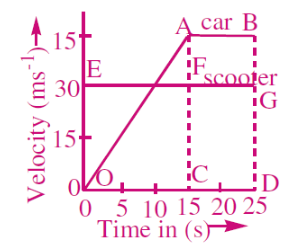
Solution: (A) Calculate the distance travelled in 15 s:
The distance traveled is the area under the velocity-time graph.
Distance by scooter ( \(s_s\) ): The graph is a rectangle.
\(
s_s=\text { velocity } \times \text { time }=30 \mathrm{~m} / \mathrm{s} \times 15 \mathrm{~s}=450 \mathrm{~m}
\)
Distance by car ( \(s_c\) ): The graph is a triangle.
\(
s_c=\frac{1}{2} \times \text { base } \times \text { height }=\frac{1}{2} \times 15 \mathrm{~s} \times 45 \mathrm{~m} / \mathrm{s}=337.5 \mathrm{~m}
\)
Difference in distance:
\(
\Delta s=s_s-s_c=450 \mathrm{~m}-337.5 \mathrm{~m}=112.5 \mathrm{~m}
\)
Determine the time when the car catches up with the scooter:
The car catches up with the scooter when their total distances traveled are equal. This will happen at a time greater than 15 s.
Position of scooter at time \(t\left(s_s(t)\right)\) :
The scooter maintains a constant velocity of \(30 \mathrm{~m} / \mathrm{s}\).
\(
s_s(t)=30 t
\)
Position of car at time \(t\left(s_c(t)\right)\) :
The car accelerates for the first 15 s and then moves at a constant velocity of \(45 \mathrm{~m} / \mathrm{s}\) thereafter.
For \(t>15 \mathrm{~s}\) :
\(
\begin{aligned}
& s_c(t)=(\text { distance in first } 15 \mathrm{~s})+(\text { distance after } 15 \mathrm{~s}) \\
& s_c(t)=337.5+45(t-15)
\end{aligned}
\)
Set the positions equal \(\left(s_c(t)=s_s(t)\right)\) and solve for \(t\) :
\(
\begin{aligned}
& 30 t=337.5+45(t-15) \\
& 30 t=337.5+45 t-675 \\
& 15 t=337.5 \\
& t=\frac{337.5}{15}=22.5 \mathrm{~s}
\end{aligned}
\)
The difference between the distance travelled by the car and the scooter in 15 s is 112.5 m and the time at which the car will catch up with the scooter is 22.5 s.
Q4. A car is standing 200 m behind a bus, which is also at rest. The two start moving at the same instant but with different forward accelerations. The bus has acceleration \(2 \mathrm{~m} / \mathrm{s}^2\) and the car has acceleration \(4 \mathrm{~m} / \mathrm{s}^2\). The car will catch up with the bus after a time of : [JEE 2017]
(A) \(\sqrt{110} s\) (B) \(\sqrt{120} s\) (C) \(10 \sqrt{2} s\) (D) 15 s
Solution: Set up the equations for the position of the car and the bus:
Let’s assume the bus starts at position \(x=0\). Since the car is initially 200 m behind the bus, its initial position is \(x=-200 \mathrm{~m}\). Both vehicles start from rest, so their initial velocities are \(0 \mathrm{~m} / \mathrm{s}\).
The position of an object with constant acceleration is given by the equation:
\(
x(t)=x_0+v_0 t+\frac{1}{2} a t^2
\)
For the bus, with initial position \(x_{0, \text { bus }}=0\), initial velocity \(v_{0, \text { bus }}=0\), and acceleration \(a_{\text {bus }}=2 \mathrm{~m} / \mathrm{s}^2\) :
\(
x_{b u s}(t)=0+0 \cdot t+\frac{1}{2}(2) t^2=t^2
\)
For the car, with initial position \(x_{0, \text { car }}=-200\), initial velocity \(v_{0, \text { car }}=0\), and acceleration \(a_{\text {car }}=4 \mathrm{~m} / \mathrm{s}^2\) :
\(
x_{c a r}(t)=-200+0 \cdot t+\frac{1}{2}(4) t^2=-200+2 t^2
\)
Determine the time when the car catches up with the bus:
The car catches up with the bus when their positions are equal. We can set the two position equations equal to each other and solve for the time \(t\).
\(
\begin{aligned}
& x_{c a r}(t)=x_{b u s}(t) \\
& -200+2 t^2=t^2
\end{aligned}
\)
\(
t=\sqrt{200}=10 \sqrt{2}
\)
The car will catch up with the bus after \(10 \sqrt{2}\) seconds.
Q5. Which graph corresponds to an object moving with a constant negative acceleration and a positive velocity? [JEE 2017]
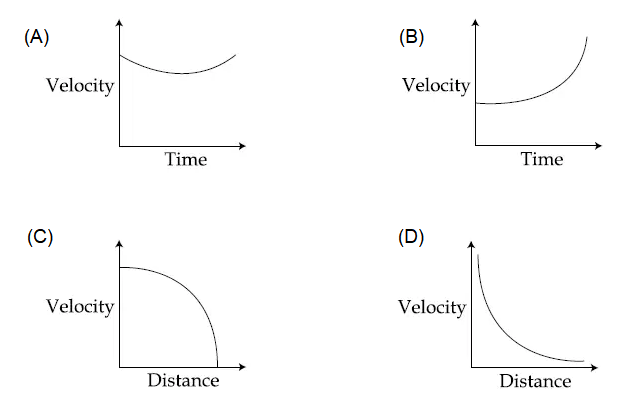
Solution: (C) Given that, \(\text { acceleration }(\mathrm{a})=-\mathrm{C} \text { (constant) }\)
\(
\therefore \quad \frac{d v}{d t}=-\mathrm{c}
\)
\(
\Rightarrow \quad \frac{d v}{d x} \cdot \frac{d x}{d t}=-\mathrm{c}
\)
\(
\Rightarrow \quad v \frac{d v}{d x}=-\mathrm{c}
\)
\(
\Rightarrow \quad \int v d v=-c \int d x
\)
\(
\Rightarrow \quad \frac{v^2}{2}=-c x+k
\)
\(
\Rightarrow \quad \mathrm{X}=-\frac{v^2}{2 c}+\frac{k}{c}
\)
The equation \(x=-\frac{v^2}{2 c}+\frac{k}{c}\) is a quadratic equation in terms of \(v\) and represents a downward-opening parabola.
As \(v\) decreases (due to negative acceleration), \(x\) will also change, indicating that the object is moving in the positive direction but slowing down.
From this equation we can say option (c) is the correct graph.
Q6. A body is thrown vertically upwards. Which one of the following graphs correctly represent the velocity vs time? [JEE 2017]
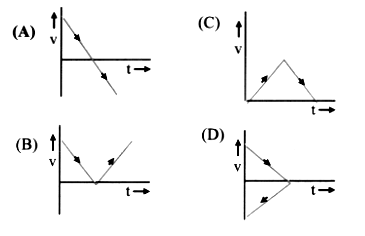
Solution: Initially speed of the particle is maximum \(\left(v_{0}\right)\) and at heigth \(h\) velocity will become zero, then particle will move downward and velocity will increase gradually and become maximum when it reaches the ground. And acceleration in this entire motion will be \(-g\), so slope of \({v}-{t}\) will be same and negative.
\(
\begin{aligned}
&\begin{aligned}
& v=v_0-g t \\
& y=c+m x \\
& m=-g=\text { slope } \\
& c=v_0
\end{aligned}\\
&\text { Velocity becomes negative after some time and the negative slope is constant. }
\end{aligned}
\)
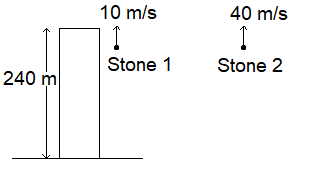
Q7. Two stones are thrown up simultaneously from the edge of a cliff \(240 m\) high with initial speed of \(10 \mathrm{~m} / \mathrm{s}\) and \(40 \mathrm{~m} / \mathrm{s}\) respectively. Which of the following graph best represents the time variation of relative position of the second stone with respect to the first? [JEE 2015]
(Assume stones do not rebound after hitting the ground and neglect air resistance, take \(g=10 \mathrm{~m} / \mathrm{s}^2\) ) (The figures are schematic and not drawn to scale)
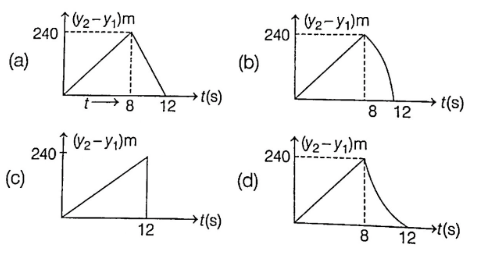
Solution: (b) Concept of relative motion can be applied to predict the nature of motion of one particle with respect to the other:
Consider the stones thrown up simultaneously as shown in the diagram below.
Considering motion of the second particle with respect to the first we have relative acceleration.
\(
\left|\mathbf{a}_{21}\right|=\left|\mathbf{a}_2-\mathbf{a}_1\right|=g-g=0
\)
For the second stone time required to reach the ground is given by:
\(
\begin{aligned}
& y_2=u_2 t-\frac{1}{2} g t^2 \\
& -240=40 t-\frac{1}{2} \times 10 \times t^2 \\
& \therefore 5 t^2-40 t-240=0 \\
& (t-12)(t+8)=0 \\
& \therefore t=12 s
\end{aligned}
\)
For the first stone time required to reach the ground is given by: \(-240=10 t-\frac{1}{2} \times 10 \times t^2\)
\(
\begin{aligned}
& \therefore-240=10 t-5 t^2 \\
& 5 t^2-10 t-240=0 \\
& (t-8)(t+6)=0 \\
& t=8 s
\end{aligned}
\)
Thus, distance covered by second particle with respect to first particle in 8 s is
\(
\begin{aligned}
& s_{12}=\left(v_{21}\right) t=(40-10)(8 s) \\
& =30 \times 8=240 \mathrm{~m}
\end{aligned}
\)
During first 8 seconds both stones are in air :
\(
\therefore y_2-y_1=\left(u_2-u_1\right) t=30 t
\)
So, graph of \(\left(y_2-y_1\right)\) against \(t\) is a straight line, for \(t \leq 8 s\).
when stone 1 reaches the ground then \(y_1=-240 m\), and \(t=8 s\), for \(t>8 s\).
\(
y_2=u_2 t-\frac{1}{2} g t^2-240
\)
\(
y_2=40 t-\frac{1}{2} g t^2-240
\)
So, it will be a parabolic curve till stone 2 reaches the ground. And parabola should opens downward as coefficient of \(t^2\) is negative.
Q8. From a tower of height \(H\) , a particle is thrown vertically upwards with a speed \(u\) . The time taken by the particle, to hit the ground, is \(n\) times that taken by it to reach the highest point of its path. The relation between \({H}, {u}\) and \(n\) is: [JEE 2014]
(A) \(2 g H={nu}^2(n-2)\) (B) \(g H=(n-2) u^2\) (C) \(2 g H=n^2 u^2\) (D) \(g H=(n-2)^2 u^2\)
Solution: (c)
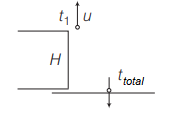
Time to reach the highest point \(\left(t_1\right)\) :
At the highest point, the final velocity is 0 . Using the equation \(v=u+a t\), where \(v=0, a=-g\), we get:
\(0=u-g t_1 \Longrightarrow t_1=\frac{u}{g}\).
Time to hit the ground \(\left(t_{\text {total }}\right)\) :
The problem states that the time to hit the ground is \(n\) times the time to reach the highest point.
\(t_{\text {total }}=n \cdot t_1=n \cdot \frac{u}{g}\).
Apply the second equation of motion:
For the entire journey, the displacement is \(-\boldsymbol{H}\) (since upward is taken as positive). The initial velocity is \(u\), and the total time is \(t_{\text {total }}\).
Using the equation \(s=u t+\frac{1}{2} a t^2\) :
\(-H=u\left(t_{\text {total }}\right)+\frac{1}{2}(-g)\left(t_{\text {total }}\right)^2\).
Substitute and simplify:
Substitute \(t_{\text {total }}=n \cdot \frac{u}{g}\) into the equation:
\(-H=u\left(n \frac{u}{g}\right)-\frac{1}{2} g\left(n \frac{u}{g}\right)^2\).
\(-H=\frac{n u^2}{g}-\frac{1}{2} g\left(\frac{n^2 u^2}{g^2}\right)\).
\(-H=\frac{n u^2}{g}-\frac{n^2 u^2}{2 g}\).
Multiply the entire equation by \(2 g\) :
\(-2 g H=2 n u^2-n^2 u^2\).
\(2 g H=n^2 u^2-2 n u^2\).
\(2 g H=n u^2(n-2)\).
Q9. An object, moving with a speed of \(6.25 \mathrm{~m} / \mathrm{s}\), is decelerated at a rate given by : \(\frac{d v}{d t}=-2.5 \sqrt{v}\) where v is the instantaneous speed. The time taken by the object, to come to rest, would be : [AIEEE 2011]
(A) 2 s (B) 4 s (C) 8 s (D) 1 s
Solution: (A) Separate the variables and set up the integral:
The problem provides the differential equation for deceleration:
\(
\frac{d v}{d t}=-2.5 \sqrt{v}
\)
To find the time taken for the object to come to rest, we need to integrate this equation. First, we separate the variables \(\boldsymbol{v}\) and \(\boldsymbol{t}\) :
\(
\frac{d v}{\sqrt{v}}=-2.5 d t
\)
The object starts with an initial speed of \(v_i=6.25 \mathrm{~m} / \mathrm{s}\) at time \(t=0\) and comes to rest, meaning its final speed is \(v_f=0\) at some time \(\boldsymbol{t}=\boldsymbol{T}\). We can set up the definite integral with these limits:
\(
\int_{6.25}^0 \frac{1}{\sqrt{v}} d v=\int_0^T-2.5 d t
\)
Solve the definite integrals:
The integral of \(\frac{1}{\sqrt{v}}\) is \(2 \sqrt{v}\). The integral of -2.5 is \(-2.5 t\). Applying the limits of integration, we get:
\(
\begin{gathered}
{[2 \sqrt{v}]_{6.25}^0=[-2.5 t]_0^T} \\
(2 \sqrt{0}-2 \sqrt{6.25})=(-2.5 T-(-2.5 \times 0)) \\
(0-2 \times 2.5)=-2.5 T \\
-5=-2.5 T
\end{gathered}
\)
\(
T=2 \mathrm{~s}
\)
The time taken by the object, to come to rest, is \({2 s}\).
Q10. Consider a rubber ball freely falling from a height \(h=4.9 m\) onto a horizontal elastic plate. Assume that the duration of collision is negligible and the collision with the plate is totally elastic. Then the velocity as a function of time and the height as a function of time will be : [AIEEE 2009]
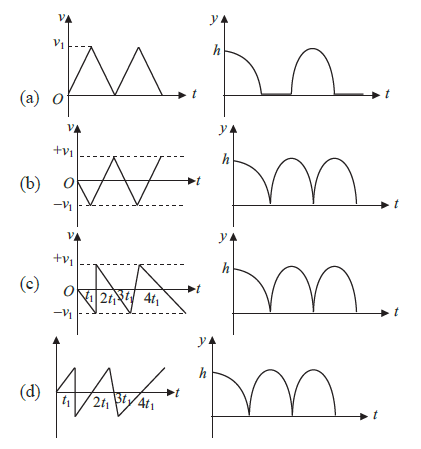
Solution: Velocity as a function of time:
During free fall: \(v=-g t\). The negative sign indicates the velocity is downward.
Immediately after the bounce: The velocity instantly reverses and has the same magnitude, so \(v=+g t\). The ball moves upward.
At the peak of the bounce: The velocity becomes zero.
After the peak: The ball falls again, and its velocity becomes \(v=-g t\) again as it accelerates towards the plate.
Overall: The graph of velocity versus time will be a series of straight lines with negative slopes \((v=-g t)\) and positive slopes \((v=g t)\), forming a sawtooth pattern.
Height as a function of time:
Initial fall: The height can be described by \(\boldsymbol{h}(t)=\boldsymbol{H}_0-\frac{1}{2} g t^2\), where \(\boldsymbol{H}_0\) is the initial height.
After the bounce: The ball’s motion is described by a new parabola starting at the point of collision (height 0 ) with an initial upward velocity. The height is given by \(h(t)=v_{\text {bounce }} t-\frac{1}{2} g t^2\) where \(v_{\text {bounce }}\) is the magnitude of the velocity just after the bounce.
Overall: The graph of height versus time is a series of parabolic segments. Each parabolic segment starts at its vertex (the peak of the bounce) and opens downward. The motion is periodic, with the ball repeatedly going up and down in parabolic arcs, with the maximum height of each arc decreasing in a real-world scenario (though the problem assumes an ideal elastic collision, so the maximum height would theoretically be the same each time).
Q11. A body is at rest at \(x=0\). At \(t=0\), it starts moving in the positive \(x\)-direction with a constant acceleration. At the same instant another body passes through \(x=0\) moving in the positive \(x\) direction with a constant speed. The position of the first body is given by \(x_1(t)\) after time ‘ \(t^{\prime}\); and that of the second body by \(x_2(t)\) after the same time interval. Which of the following graphs correctly describes \(\left(x_1-x_2\right)\) as a function of time ‘ \(t\) ‘? [JEE 2008]
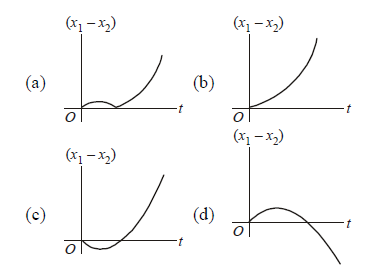
Solution: (c) Step 1: Write the position equation for the first body, \(x_1(t)\)
The first body starts from rest at \(x=0\) at \(t=0\).
It moves with a constant acceleration, let’s call it ‘\(a\)‘.
The kinematic equation for displacement with constant acceleration is
\(
x=x_0+v_0 t+\frac{1}{2} a t^2
\)
Since the initial position \(x_0=0\) and initial velocity \(v_0=0\), the equation for the position of the first body is:
\(
x_1(t)=\frac{1}{2} a t^2
\)
Step 2: Write the position equation for the second body, \(x_2(t)\)
The second body passes through \(x=0\) at \(t=0\).
It moves with a constant speed, let’s call it ‘\(v\)‘.
The equation for position with constant velocity is \(x=x_0+v t\).
Since the initial position \(x_0=0\), the equation for the position of the second body is:
\(
x_2(t)=v t
\)
Step 3: Find the expression for \(\left(x_1-x_2\right)\)
Now, subtract the position of the second body from the first:
\(
x_1(t)-x_2(t)=\frac{1}{2} a t^2-v t
\)
Step 4: Analyze the function \(\left(x_1-x_2\right)\)
The function \(y(t)=x_1(t)-x_2(t)\) can be rewritten as:
\(
y(t)=\frac{1}{2} a t^2-v t
\)
This is a quadratic equation in the variable ‘ \(t\) ‘, of the form \(\boldsymbol{y}=\boldsymbol{A} \boldsymbol{t}^2+\boldsymbol{B} \boldsymbol{t}+\boldsymbol{C}\), with \(A=\frac{1}{2} a, B=-v\), and \(C=0\).
The graph of a quadratic equation is a parabola.
The coefficient of the \(t^2\) term is \(\frac{1}{2} a\). Since the first body moves in the positive \(x-\) direction with constant acceleration, \(a>0\). This means the parabola opens upwards.
The \(y\)-intercept (the value of \(y\) at \(t=0\) ) is \(y(0)=\frac{1}{2} a(0)^2-v(0)=0\). So the graph starts at the origin \((0,0)\).
To find where the parabola crosses the \(t\) -axis (i.e., when \(x_1-x_2=0\) ), we set the function to zero:
\(
\begin{aligned}
& \frac{1}{2} a t^2-v t=0 \\
& t\left(\frac{1}{2} a t-v\right)=0
\end{aligned}
\)
This gives two solutions: \(t=0\) and \(\frac{1}{2} a t-v=0\), which means \(t=\frac{2 v}{a}\).
The two bodies are at the same position at \(t=0\) and again at \(t=\frac{2 v}{a}\).
The vertex of the parabola, which represents the minimum value of \(\left(x_1-x_2\right)\), occurs at \(t=-\frac{B}{2 A}=-\frac{-v}{2\left(\frac{1}{2} a\right)}=\frac{v}{a}\).
For \(t<\frac{v}{a}\), the function has a negative slope and \(\left(x_1-x_2\right)\) becomes negative. This means the second body (with constant speed) is ahead of the first body (accelerating from rest).
For \(t>\frac{v}{a}\), the function has a positive slope and \(\left(x_1-x_2\right)\) becomes positive. This means the first body eventually overtakes the second.
Conclusion: The graph of \(\left(x_1-x_2\right)\) versus time is a parabola opening upwards, starting from the origin, going into the negative region, reaching a minimum, and then crossing the \(t\) -axis again at a later time.
Q12. The velocity of a particle is \(v=v_0+g t+f t^2\). If its position is \(x=0\) at \(t=0\), then its displacement after unit time ( \(t=1\) ) is [AIEEE 2007]
(A) \(v_0+g / 2+f\) (B) \({v}_0+2 {~g}+3 {f}\) (C) \({v}_0+{g} / 2+{f} / 3\) (D) \(v_0+g+f\)
Solution: (c) Find the position function by integrating the velocity function:
The relationship between position \(x\) and velocity \(v\) is given by \(x=\int v d t\).
Given the velocity function \(v=v_0+g t+f t^2\), we can integrate it to find the position function \(x(t)\) :
\(
\begin{gathered}
x(t)=\int\left(v_0+g t+f t^2\right) d t \\
x(t)=v_0 t+\frac{1}{2} g t^2+\frac{1}{3} f t^3+C
\end{gathered}
\)
where \(\boldsymbol{C}\) is the constant of integration.
Use the initial condition to find the constant of integration:
The initial condition states that the position is \(x=0\) at \(t=0\). We can use this to solve for \(\boldsymbol{C}\) :
\(
\begin{gathered}
0=v_0(0)+\frac{1}{2} g(0)^2+\frac{1}{3} f(0)^3+C \\
0=0+0+0+C \\
C=0
\end{gathered}
\)
The position function is therefore:
\(
x(t)=v_0 t+\frac{1}{2} g t^2+\frac{1}{3} f t^3
\)
Calculate the displacement after unit time ( \(t=1\) ):
The displacement is the change in position, which is \(x(1)-x(0)\). Since \(x(0)=0\), the displacement is simply \(x(1)\).
Substitute \(t=1\) into the position function:
\(
\begin{gathered}
x(1)=v_0(1)+\frac{1}{2} g(1)^2+\frac{1}{3} f(1)^3 \\
x(1)=v_0+\frac{g}{2}+\frac{f}{3}
\end{gathered}
\)
Q13. A particle located at \(x=0\) at time \(t=0\), starts moving along the positive \(x\)-direction with a velocity ‘ \(v\) ‘ that varies as \({v}=\alpha \sqrt{x}\). The displacement of the particle varies with time as [AIEEE 2006]
(A) \({t}^2\) (B) \(t\) (C) \({t}^{1 / 2}\) (D) \({t}^3\)
Solution: (A) Given the velocity function: \(v=\alpha \sqrt{x}\)
We know that velocity \(v\) is the rate of change of displacement with respect to time:
\(
\therefore \frac{d x}{d t}=\alpha \sqrt{x}
\)
Rearranging and separating variables, we get:
\(
\Rightarrow \frac{d x}{\sqrt{x}}=\alpha d t
\)
To solve this, we integrate both sides:
\(
\int_0^x \frac{d x}{\sqrt{x}}=\alpha \int_0^t d t
\)
This gives us:
\(
\Rightarrow\left[\frac{2 \sqrt{x}}{1}\right]_0^x=\alpha[t]_0^t
\)
Simplifying, we obtain:
\(
\Rightarrow 2 \sqrt{x}=\alpha t
\)
Squaring both sides:
\(
\Rightarrow x=\frac{\alpha^2}{4} t^2
\)
Thus, the displacement \(x\) varies with time \(t\) as:
\(
x \propto t^2
\)
Q14. A car starting from rest accelerates at the rate \(f\) through a distance \(S\), then continues at constant speed for time \(t\) and then decelerates at the rate \(\frac{f}{2}\) to come to rest. If the total distance traversed is 15 \(S\) , then [AIEEE 2005]
(A) \(S=\frac{1}{6} f t^2\) (B) \(S=f t\) (C) \(S=\frac{1}{4} f t^2\) (D) \(S=\frac{1}{72} f t^2\)
Solution: (D)
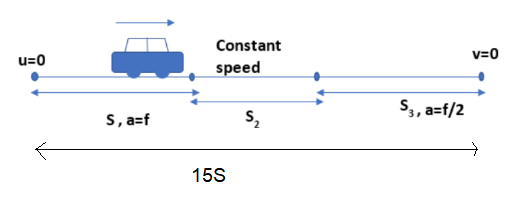
Analyze the acceleration phase:
The car starts from rest \(\left(v_0=0\right)\) and accelerates at a rate of \(f\) over a distance \(S\). We can find the final velocity of this phase, \(v_1\), using the kinematic equation \(v^2=v_0^2+2 a s\)
\(
v_1^2=0^2+2(f)(S)=2 f S
\)
This velocity \(v_1\) is the constant speed for the next phase of motion.
Analyze the deceleration phase:
The car decelerates from the speed \(v_1\) to rest \(\left(v_f=0\right)\) at a rate of \(\frac{f}{2}\). Let the distance covered in this phase be \(S_3\). We use the same kinematic equation:
\(
\begin{gathered}
v_f^2=v_1^2+2 a_3 S_3 \\
0^2=v_1^2+2\left(-\frac{f}{2}\right) S_3 \\
0=v_1^2-f S_3
\end{gathered}
\)
Substituting the value of \(v_1^2\) from the first step:
\(
\begin{gathered}
0=2 f S-f S_3 \\
f S_3=2 f S \\
S_3=2 S
\end{gathered}
\)
Calculate the distance of the constant speed phase:
The total distance traversed is given as \(15 S\). This is the sum of the distances from all three phases: the acceleration distance \((S)\), the constant speed distance \(\left(S_2\right)\), and the deceleration distance \(\left(S_3\right)\).
\(
\begin{gathered}
S_{t o t a l}=S+S_2+S_3 \\
15 S=S+S_2+2 S \\
15 S=3 S+S_2 \\
S_2=12 S
\end{gathered}
\)
Find the relationship between \(\mathrm{S}, \mathrm{f}\), and \(t\):
For the constant speed phase, the distance is equal to the speed multiplied by the time.
\(
S_2=v_1 \times t
\)
Substituting the expressions for \(S_2\) and \(v_1\) :
\(
12 S=\sqrt{2 f S} \times t
\)
To solve for \(\boldsymbol{S}\), we square both sides of the equation:
\(
\begin{gathered}
(12 S)^2=(\sqrt{2 f S} \times t)^2 \\
144 S^2=2 f S t^2
\end{gathered}
\)
Since \(S \neq 0\), we can divide both sides by \(S\) :
\(
144 S=2 f t^2
\)
Now, we solve for \(\boldsymbol{S}\) :
\(
\begin{aligned}
& S=\frac{2 f t^2}{144} \\
& S=\frac{f t^2}{72}
\end{aligned}
\)
Q15. The relation between time \(t\) and distance \(x\) is \(t=a x^2+b x\) where \(a\) and \(b\) are constants. The acceleration is [AIEEE 2005]
(A) \(2 b v^3\) (B) \(-2 a b v^2\) (C) \(2 {av}^2\) (D) \(-2 a v^3\)
Solution: (D) Find the expression for velocity:
The given relation is \(t=a x^2+b x\). To find the velocity, which is \(v=\frac{d x}{d t}\), we can first find \(\frac{d t}{d x}\) and then take its reciprocal.
Differentiating the given equation with respect to \(x\) :
\(
\frac{d t}{d x}=\frac{d}{d x}\left(a x^2+b x\right)=2 a x+b
\)
Since \(v=\frac{d x}{d t}=\frac{1}{\frac{d t}{d x}}\), the velocity is:
\(
v=\frac{1}{2 a x+b} \dots(1)
\)
Find the expression for acceleration:
Acceleration is the rate of change of velocity with respect to time, \(a_c=\frac{d v}{d t}\). We can find this using the chain rule, \(a_c=\frac{d v}{d x} \cdot \frac{d x}{d t}=\frac{d v}{d x} \cdot v\).
First, differentiate the velocity equation with respect to \(x\) :
\(
\frac{d v}{d x}=\frac{d}{d x}\left(\frac{1}{2 a x+b}\right)=-\frac{1}{(2 a x+b)^2} \cdot(2 a)=-\frac{2 a}{(2 a x+b)^2}
\)
Now, substitute the expression for \(v\) from eqn(1) , which is \(v=\frac{1}{2 a x+b}\). This means \((2 a x+b)=\frac{1}{v}\). Substituting this into the equation for \(\frac{d v}{d x}\) :
\(
\frac{d v}{d x}=-2 a\left(\frac{1}{2 a x+b}\right)^2=-2 a v^2
\)
Finally, multiply \(\frac{d v}{d x}\) by \(v\) to find the acceleration:
\(
a_c=\frac{d v}{d x} \cdot v=\left(-2 a v^2\right) \cdot v=-2 a v^3
\)
Q15. A parachutist after bailing out falls \(50 m\) without friction. When parachute opens, it decelerates at \(2 \mathrm{~m} / \mathrm{s}^2\). He reaches the ground with a speed of \(3 \mathrm{~m} / \mathrm{s}\). At what height, did he bail out? [AIEEE 2005]
(A) \(182 m\) (B) \(91 m\) (C) \(111 m\) (D) \(293 m\)
Solution: (D)
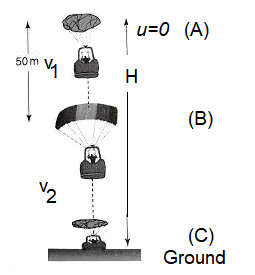
Step 1: Calculate the speed after the initial free fall
During the first phase of the fall, the parachutist falls 50 m without friction. The initial velocity is \(u=0 \mathrm{~m} / \mathrm{s}\), the distance is \(s_1=50 \mathrm{~m}\), and the acceleration is due to gravity, \(g=9.8 \mathrm{~m} / \mathrm{s}^2\). We can use the kinematic equation \(v^2=u^2+2 a s\) to find the velocity \(\left(v_1\right.\) ) at the end of this stage.
\(
\begin{gathered}
v_1^2=0^2+2(9.8)(50) \\
v_1^2=980 \\
v_1=\sqrt{980} \mathrm{~m} / \mathrm{s}
\end{gathered}
\)
Step 2: Calculate the distance fallen during deceleration
In the second phase, the parachutist decelerates at a rate of \(a=-2 \mathrm{~m} / \mathrm{s}^2\) and reaches the ground with a final speed of \(v_2=3 \mathrm{~m} / \mathrm{s}\). The initial speed for this phase is the final speed from the free fall, \(u_2=v_1=\sqrt{980} \mathrm{~m} / \mathrm{s}\). We can use the same kinematic equation to find the distance \(\left(s_2\right)\) covered during this deceleration.
\(
\begin{gathered}
v_2^2=u_2^2+2 a s_2 \\
(3)^2=(\sqrt{980})^2+2(-2) s_2 \\
9=980-4 s_2 \\
4 s_2=980-9 \\
4 s_2=971 \\
s_2=\frac{971}{4}=242.75 \mathrm{~m}\cong 243 \mathrm{~m}
\end{gathered}
\)
Step 3: Calculate the total height
The total height ( \(\boldsymbol{H}\) ) from which the parachutist bailed out is the sum of the distances from both phases of the fall.
\(
\begin{gathered}
\boldsymbol{H}=s_1+s_2 \\
\boldsymbol{H}=50 \mathrm{~m}+242.75 \mathrm{~m} \\
\boldsymbol{H}=292.75 \mathrm{~m}
\end{gathered}
\)
The total height from which the parachutist bailed out is approximately 293 m.
Q16. An automobile travelling with speed of \(60 \mathrm{~km} / \mathrm{h}\), can brake to stop within a distance of 20 m. If the car is going twice as fast, i.e \(120 \mathrm{~km} / \mathrm{h}\), the stopping distance will be [AIEEE 2004]
(A) 60 m (B) 40 m (C) 20 m (D) 80 m
Solution: (D) Step 1: Establish the relationship between stopping distance and initial speed
The stopping distance of a car is determined by the kinematic equation:
\(
v_f^2=v_i^2+2 a d
\)
where \(v_f\) is the final velocity, \(v_i\) is the initial velocity, \(a\) is the constant acceleration (in this case, deceleration due to braking), and \(d\) is the stopping distance. Since the car stops, the final velocity \(v_f\) is zero. The equation can be rewritten as:
\(
0=v_i^2+2 a d
\)
Rearranging to solve for the stopping distance \(d\), we get:
\(
d=\frac{-v_i^2}{2 a}
\)
Here, the acceleration \(a\) is negative, so the stopping distance \(d\) will be a positive value. We can see that the stopping distance is directly proportional to the square of the initial speed, assuming the deceleration \(a\) is constant.
Step 2: Calculate the new stopping distance
Let \(d_1\) be the stopping distance for the initial speed \(v_1=60 \mathrm{~km} / \mathrm{h}\), and \(d_2\) be the stopping distance for the doubled speed \(v_2=120 \mathrm{~km} / \mathrm{h}\).
We are given \(d_1=20 \mathrm{~m}\).
Using the relationship from Step 1, we can write:
\(
\begin{aligned}
& d_1=k v_1^2 \\
& d_2=k v_2^2
\end{aligned}
\)
where \(k=\frac{-1}{2 a}\) is a constant.
To find the ratio of the distances, we can divide the two equations:
\(
\frac{d_2}{d_1}=\frac{k v_2^2}{k v_1^2}=\left(\frac{v_2}{v_1}\right)^2
\)
Since \(v_2\) is twice \(v_1\), we have \(v_2=2 v_1\).
\(
\frac{d_2}{d_1}=\left(\frac{2 v_1}{v_1}\right)^2=(2)^2=4
\)
Solving for \(d_2\) :
\(
d_2=4 d_1
\)
Substituting the given value of \(d_1=20 \mathrm{~m}\) :
\(
d_2=4 \times 20 \mathrm{~m}=80 \mathrm{~m}
\)
The stopping distance will be 80 m.
Q17. A ball is released from the top of a tower of height \(h\) meters. It takes \(T\) seconds to reach the ground. What is the position of the ball in \(\frac{T}{3}\) seconds? [AIEEE 2004]
(A) \(\frac{8 h}{9}\) meters from the ground (B) \(\frac{7 h}{9}\) meters from the ground (C) \(\frac{h}{9}\) meters from the ground (D) \(\frac{7 h}{18}\) meters from the ground
Solution: (A) Step 1: Establish the relationship between height and time
The ball is released from a height \(\boldsymbol{h}\) and takes \(\boldsymbol{T}\) seconds to reach the ground. Using the kinematic equation for distance \(s=v_0 t+\frac{1}{2} a t^2\), with initial velocity \(v_0=0\) and acceleration \(a=g\), we can write:
\(
h=\frac{1}{2} g T^2
\)
From this, we can express the acceleration due to gravity, \(g\), in terms of \(h\) and \(\boldsymbol{T}\).
\(
g=\frac{2 h}{T^2}
\)
Step 2: Calculate the distance the ball has fallen
At time \(t=\frac{T}{3}\), the distance \(s\) the ball has fallen from the top of the tower is:
\(
s=\frac{1}{2} g\left(\frac{T}{3}\right)^2
\)
Substitute the expression for \(g\) from Step 1:
\(
\begin{gathered}
s=\frac{1}{2}\left(\frac{2 h}{T^2}\right)\left(\frac{T^2}{9}\right) \\
s=\frac{h}{9}
\end{gathered}
\)
This is the distance from the top of the tower.
Step 3: Determine the position from the ground
To find the position of the ball from the ground, subtract the distance fallen from the total height of the tower:
\(
\begin{aligned}
\text { Position from ground } & =h-s \\
\text { Position from ground } & =h-\frac{h}{9}
\end{aligned}
\)
\(
\text { Position from ground }=\frac{9 h}{9}-\frac{h}{9}=\frac{8 h}{9}
\)
The position of the ball from the ground is \(\frac{8 h}{9}\) meters.
Q18. A car, moving with a speed of \(50 \mathrm{~km} / \mathrm{hr}\), can be stopped by brakes after at least 6 m. If the same car is moving at a speed of \(100 \mathrm{~km} / \mathrm{hr}\), the minimum stopping distance is [AIEEE 2003]
(A) 12 m (B) 18 m (C) 24 m (D) 6 m
Solution: (C) Step 1: Analyze the problem and establish the governing equation
The problem describes a car slowing down to a stop, which involves constant deceleration. We are given two scenarios with different initial speeds and need to find the stopping distance in the second case. The relevant kinematic equation that relates initial velocity \(\left(v_i\right)\), final velocity \(\left(v_f\right)\), acceleration \((a)\), and displacement \((d)\) is:
\(
v_f^2=v_i^2+2 a d
\)
In both cases, the car comes to a stop, so the final velocity \(v_f=0\). The equation can be rearranged to solve for the stopping distance, \(d\) :
\(
0=v_i^2+2 a d \Longrightarrow d=-\frac{v_i^2}{2 a}
\)
Since the car is the same and the brakes are applied in the same manner, the deceleration (\(a\)) is constant in both scenarios. Therefore, the stopping distance is proportional to the square of the initial velocity \(\left(d \propto v_i^2\right)\).
Step 2: Set up the ratio of stopping distances
Using the relationship \(d \propto v_i^2\), we can write a ratio for the two scenarios:
\(
\frac{d_2}{d_1}=\frac{v_2^2}{v_1^2}=\left(\frac{v_2}{v_1}\right)^2
\)
This approach avoids the need to convert units, as long as the units for both velocities are the same.
Step 3: Calculate the minimum stopping distance for the second scenario
Substitute the given values into the ratio equation:
\(d_1=6 \mathrm{~m}\)
\(v_1=50 \mathrm{~km} / \mathrm{hr}\)
\(v_2=100 \mathrm{~km} / \mathrm{hr}\)
\(
\begin{aligned}
& \frac{d_2}{6 \mathrm{~m}}=\left(\frac{100 \mathrm{~km} / \mathrm{hr}}{50 \mathrm{~km} / \mathrm{hr}}\right)^2 \\
& \frac{d_2}{6 \mathrm{~m}}=(2)^2 \\
& \frac{d_2}{6 \mathrm{~m}}=4 \\
& d_2=4 \times 6 \mathrm{~m}=24 \mathrm{~m}
\end{aligned}
\)
The minimum stopping distance is 24 m.
Q19. The co-ordinates of a moving particle at any time ‘ \(t\) ‘ are given by \(x=\alpha t^3\) and \(y=\beta t^3\). The speed to the particle at time ‘\(t\)‘ is given by [AIEEE 2003]
(A) \(3 t \sqrt{\alpha^2+\beta^2}\) (B) \(3 t^2 \sqrt{\alpha^2+\beta^2}\) (C) \(t^2 \sqrt{\alpha^2+\beta^2}\) (D) \(\sqrt{\alpha^2+\beta^2}\)
Solution: Step 1: Find the components of the velocity vector
The position coordinates of the particle are given by \(x(t)=\alpha t^3\) and \(y(t)=\beta t^3\). The velocity components are the time derivatives of the position components.
\(
\begin{aligned}
& v_x=\frac{d x}{d t}=\frac{d}{d t}\left(\alpha t^3\right)=3 \alpha t^2 \\
& v_y=\frac{d y}{d t}=\frac{d}{d t}\left(\beta t^3\right)=3 \beta t^2
\end{aligned}
\)
The velocity vector is \(\vec{v}=v_x \hat{i}+v_y \hat{j}=3 \alpha t^2 \hat{i}+3 \beta t^2 \hat{j}\).
Step 2: Calculate the speed of the particle
The speed of the particle is the magnitude of the velocity vector, which is given by \(|\vec{v}|=\sqrt{v_x^2+v_y^2}\).
\(
\begin{aligned}
& \text { Speed }=\sqrt{\left(3 \alpha t^2\right)^2+\left(3 \beta t^2\right)^2} \\
& \text { Speed }=\sqrt{9 \alpha^2 t^4+9 \beta^2 t^4} \\
& \text { Speed }=\sqrt{9 t^4\left(\alpha^2+\beta^2\right)} \\
& \text { Speed }=\sqrt{\left(3 t^2\right)^2\left(\alpha^2+\beta^2\right)} \\
& \text { Speed }=3 t^2 \sqrt{\alpha^2+\beta^2}
\end{aligned}
\)
Q20. From a building two balls \(A\) and \(B\) are thrown such that \(A\) is thrown upwards and \(B\) downwards ( both vertically with the same speed). If \(v_A\) and \(v_B\) are their respective velocities on reaching the ground, then [AIEEE 2002]
(A) \(v_B>v_A\) (B) \(v_A=v_B\) (C) \(v_A>v_B\) (D) their velocities depend on their masses.
Solution: (B)
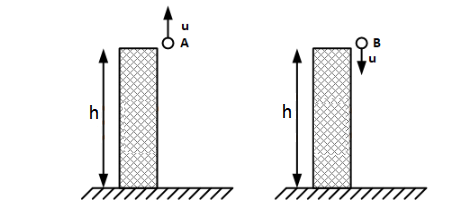
Step 1: Use the third equation of motion
The third equation of motion, which relates final velocity \((v)\), initial velocity \((u)\), acceleration ( \(a\) ), and displacement ( \(s\) ) is given by:
\(
v^2=u^2+2 a s
\)
In this problem, the acceleration is due to gravity, so \(\boldsymbol{a}=\boldsymbol{g}\). The displacement is the height of the building, let’s call it \(\boldsymbol{h}\). We can set the initial position as \(\boldsymbol{y}=\boldsymbol{h}\) and the final position as \(y=0\), so the displacement is \(s=-h\).
Step 2: Analyze the motion of ball A
Ball A is thrown upwards with an initial speed \(\boldsymbol{u}\). When it reaches the maximum height and falls back to the original height, its speed will be the same as the initial speed, \(u\), but in the downward direction. From this point, it is moving downwards from height \(h\) with a speed of \(u\). Using the equation of motion:
\(
v_A^2=u^2+2 g h
\)
Step 3: Analyze the motion of ball B
Ball B is thrown downwards with an initial speed \(\boldsymbol{u}\). Its motion is already in the direction of gravity. Using the same equation of motion:
\(
v_B^2=u^2+2 g h
\)
Step 4: Compare the final velocities
From the equations derived in Step 2 and Step 3, we can see that:
\(
\begin{aligned}
& v_A^2=u^2+2 g h \\
& v_B^2=u^2+2 g h
\end{aligned}
\)
This means that \(v_A^2=v_B^2\). Since the final speeds must be positive, we can conclude that their magnitudes are equal, so \(v_A=v_B\).
The final velocities of the two balls on reaching the ground are equal.
Q21. Speeds of two identical cars are \(u\) and \(4u\) at the specific instant. The ratio of the respective distances in which the two cars are stopped from that instant is : [AIEEE 2002]
(A) 1 : 1 (B) 1 : 4 (C) 1 : 8 (D) 1 : 16
Solution: Step 1: Set up the kinematic equation for stopping distance
The motion of a car stopping can be described using the kinematic equation that relates initial velocity \((u)\), final velocity \((v)\), acceleration \((a)\), and distance \((s)\) :
\(
v^2=u^2+2 a s
\)
In this case, the cars are stopping, so their final velocity \((v)\) is 0. The cars are identical, which means they experience the same constant deceleration (\(a\)) when the brakes are applied. Since it is deceleration, we will use \(-a\). The equation becomes:
\(
0=u^2+2(-a) s
\)
Rearranging the equation to solve for the stopping distance \((s)\), we get:
\(
s=\frac{u^2}{2 a}
\)
This equation shows that the stopping distance is directly proportional to the square of the initial speed, with the deceleration and the factor of 2 being constants.
Step 2: Calculate the stopping distances for each car
Let \(s_1\) be the stopping distance for the first car with initial speed \(u\) and \(s_2\) be the stopping distance for the second car with initial speed \(4 u\).
For the first car:
\(
s_1=\frac{u^2}{2 a}
\)
For the second car:
\(
s_2=\frac{(4 u)^2}{2 a}=\frac{16 u^2}{2 a}
\)
Step 3: Find the ratio of the distances
The ratio of the respective distances is \(\frac{s_1}{s_2}\) :
\(
\frac{s_1}{s_2}=\frac{\frac{u^2}{2 a}}{\frac{16 u^2}{2 a}}
\)
Canceling out the common terms \(\frac{u^2}{2 a}\), we get:
\(
\frac{s_1}{s_2}=\frac{1}{16}
\)
Therefore, the ratio of the distances is \(1: 16\).