13.2 Periodic and oscilatory motions
What is Periodic Motion?
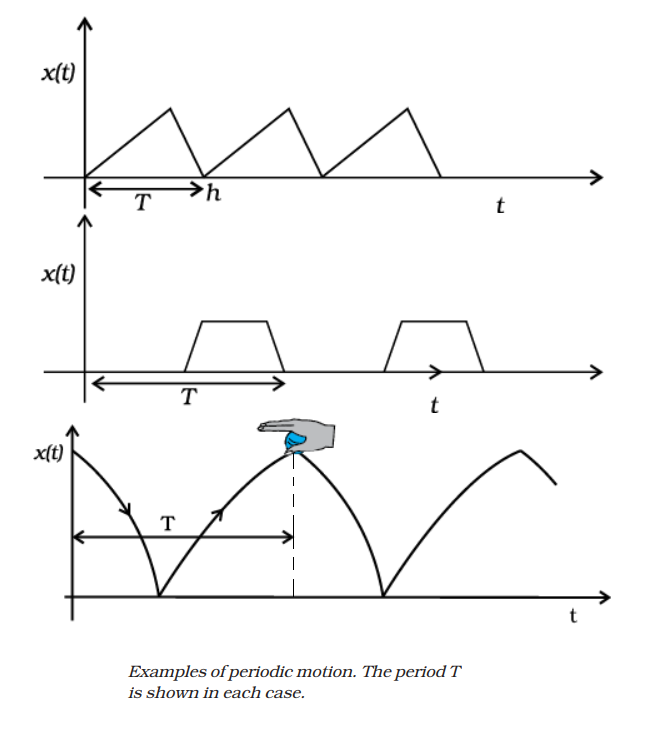
Periodic motion is any motion that repeats itself at regular intervals of time (e.g., a swinging pendulum, the Earth orbiting the Sun). Oscillatory motion is a specific type of periodic motion where an object moves to-and-fro (back and forth) about a central, stable “mean” or equilibrium position (e.g., a child on a swing). A motion that repeats in equal intervals of time is called periodic motion. The fixed time interval is known as the time period (\(T\)), and the number of repetitions per unit time is the frequency (\(f=1 / T\)).
Key Characteristic: Regular repetition
The Rule: It doesn’t matter how the object moves, as long as it returns to its starting point in the same amount of time, every time.
Examples:
- The Earth’s Revolution: Orbits the sun every 365.25 days (Periodic, but not to-and-fro).
- Hands of a Clock: The second hand repeats its position every 60 seconds.
- Uniform Circular Motion: A fan blade rotating at a constant speed.
Some examples of periodic motion are shown in Figure below:
Oscillatory motion
Oscillatory motion is a subset of periodic motion. A body executes oscillatory motion when it moves back and forth repeatedly about a fixed equilibrium position. It is often caused by a “restoring force” that pulls the object back toward the center.

Key Characteristic: To-and-fro movement about a stable mean position.
The Rule: The object must move in one direction, stop, reverse, pass the center, stop on the other side, and repeat.
Examples:
- Simple Pendulum: Swings back and forth around the lowest vertical point.
- Loaded Spring: A mass attached to a spring oscillating up and down.
- Stringed Instruments: Plucked guitar strings vibrating.
Note: All oscillatory motions are periodic, but not all periodic motions are oscillatory.
Note on “Vibration”: If the oscillation is very fast (high frequency), it is usually called vibration (e.g., tuning fork). If it is slow (low frequency), it is called oscillation (e.g., playground swing).
Comparison at a Glance
\(\begin{array}{|l|l|l|}
\hline \text { Feature } & \text { Periodic Motion } & \text { Oscillatory Motion } \\
\hline \text { Definition } & \text { Repeats in fixed intervals. } & \begin{array}{l}
\text { Repeats to-and-fro around a mean } \\
\text { position. }
\end{array} \\
\hline \begin{array}{l}
\text { Mean } \\
\text { Position }
\end{array} & \text { Not necessary. } & \text { Always required. } \\
\hline \text { Nature } & \begin{array}{l}
\text { Can be circular, linear, or } \\
\text { complex. }
\end{array} & \text { Back and forth along a path. } \\
\hline \begin{array}{l}
\text { Restoring } \\
\text { Force }
\end{array} & \text { Not always present. } & \text { Always present (brings it back). } \\
\hline \text { Example } & \text { Planet orbiting the Sun. } & \text { A swinging pendulum. } \\
\hline
\end{array}
\)
Parameters used to define a Periodic Function (Waveform)
To define a periodic function-whether you’re looking at a sound wave, a pendulum’s swing, or a trigonometric graph-you need a specific set of parameters. These tell you how tall the wave is, how fast it repeats, and where it starts.
In mathematics, a periodic function is defined as \(f(x+T)=f(x)\), where \(T\) is the period. Here are the core parameters used to describe it:
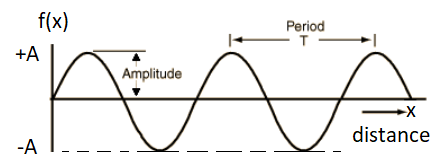
Amplitude (\(A\)):
The Amplitude is the maximum displacement from the center (equilibrium) position.
Visual: It is the height of the “peak” or the depth of the “trough” measured from the center line.
Physical Meaning: In sound, this is volume; in light, it is brightness.
Period (\(T\)):
The Period is the time (or distance) it takes for the function to complete one full cycle before it starts repeating itself.
Unit: Usually measured in seconds (\(s\)) or radians.
Formula: If you know the angular frequency \((\omega)\), the period is \(T=\frac{2 \pi}{\omega}\).
Frequency (\(f\)):
Frequency is the number of cycles the function completes per unit of time. It is the mathematical reciprocal of the period.
Formula: \(f=\frac{1}{T}\)
Unit: Measured in Hertz (Hz), which means “cycles per second.”
Angular Frequency (\(\omega\)):
In physics and engineering, we often use Angular Frequency instead of standard frequency. It measures how many radians the function covers per second.
Formula: \(\omega=2 \pi f=\frac{2 \pi}{T}\)
Unit: Radians per second (rad/s).
Phase Shift (\(\phi\)):
The Phase Shift (or Phase Constant) tells you where the cycle is at \(t=0\). It essentially slides the entire wave left or right on the graph.
If \(\phi=0\), a sine wave starts exactly at the origin \((0,0)\).
If there is a shift, the wave is “ahead” or “behind” its standard starting point.
In the given graph, two SHM in one second having the same amplitude \(A\) and same angular frequency \(\omega\) are shown.

Their phase angle \(\phi\) are different.
Putting it all together:
In a standard mathematical model (like Simple Harmonic Motion), these parameters are combined into one general equation:
\(
y(t)=A \sin (\omega t+\phi)
\)
Example 1: On an average, a human heart is found to beat 75 times in a minute. Calculate its frequency and period.
Solution:
\(
\begin{aligned}
&\text { The beat frequency of heart }=75 /(1 \mathrm{~min})\\
&\begin{aligned}
& =75 /(60 \mathrm{~s}) \\
& =1.25 \mathrm{~s}^{-1} \\
& =1.25 \mathrm{~Hz}
\end{aligned}
\end{aligned}
\)
\(
\text { The time period } ~T \quad\left(\quad=1 /\left(1.25 \mathrm{~s}^{-1}\right)\right.
\)
\(
=0.8 \mathrm{~s}
\)
Simple Harmonic Motion
Simple harmonic motion can be described as an oscillatory motion in which the acceleration of the particle at any position is directly proportional to the displacement from the mean position. It is a special case of oscillatory motion. In this type of oscillatory motion, displacement, velocity and acceleration, and force vary (w.r.t time) in a way that can be described by either sine (or) the cosine functions collectively called sinusoids.

The particle executing simple harmonic motion oscillates such that its acceleration is always directed towards the mean position and magnitude of the acceleration is proportional to the displacement of the particle from the mean position. Mathematically, a simple harmonic motion can be expressed as
\(
\begin{aligned}
& x=A \sin \omega t=A \sin 2 \pi t / T \\
& x=A \cos \omega t=A \cos 2 \pi t / T
\end{aligned}
\)
Here, \(x=\) displacement of body from mean position at any instant \(t\),
\(A=\) amplitude or maximum displacement of the body,
\(\omega=\) angular frequency and \(T=\) time period of SHM.
Types of SHM
SHM are of two types as follows:
Linear SHM
When a particle moves back and forth along a straight line around a fixed point (called the equilibrium position), this is referred to as Linear Simple Harmonic Motion. e.g. Motion of a mass connected to spring.

Conditions for Linear Simple Harmonic Motion
The restoring force or acceleration acting on the particle must always be proportional to the particle’s displacement and directed toward the equilibrium position.
\(
\begin{aligned}
& F \propto-x \\
& a \propto-x
\end{aligned}
\)
where
\(F\) is the Restoring Force
\(x\) is the Displacement of Particle from Equilibrium Position
\({a}\) is the Acceleration
Restoring force \((F)\): The force acting on the particle (executing SHM) which tends to bring it towards its mean position, is called restoring force. Restoring force is always directed towards mean position or acts in the direction opposite to that of displacement. Restoring force, \(F=-k x\) where, \(k\) is a constant and \(x\) is displacement about mean position.
Angular SHM
When a system oscillates angularly with respect to a fixed axis, then its motion is called angular simple harmonic motion. The displacement of the particle in angular simple harmonic motion is measured in terms of angular displacement. e.g. Motion of a bob of simple pendulum.

Another example is the torsional pendulum as shown below is one example of Angular SHM.

Conditions for Angular Simple Harmonic Motion
The restoring torque (or) angular acceleration acting on the particle should always be proportional to the particle’s angular displacement and oriented towards the equilibrium position.
\(
\therefore \quad \quad \tau \propto-\theta \text { or } \alpha \propto-\theta
\)
where
\(\tau\) is Torque
\({\theta}\) is the Angular Displacement
\({\alpha}\) is the Angular Acceleration
Note: The total mechanical energy of the particle should be conserved (Kinetic energy + Potential energy = constant).
Displacement
Displacement (\(x\)) in Simple Harmonic Motion (SHM) is the distance of an oscillating particle from its equilibrium (mean) position at any time \(t\), expressed as \(x(t)=A \sin (\omega t+\phi)\) or \(x(t)=A \cos (\omega t+\phi)\). It varies sinusoidally between maximum positive \((+A)\) and negative (\(-A\)) values, known as amplitude.
The displacement can be represented by a mathematical function of time. In the case of periodic motion, this function is periodic in time. One of the simplest periodic functions is given by
\(
f(t)=A \cos \omega t
\)
If the argument of this function, \(\omega t\), is increased by an integral multiple of \(2 \pi\) radians, the value of the function remains the same. The function \(f(t)\) is then periodic and its period, \(T\), is given by
\(
T=\frac{2 \pi}{\omega}
\)
Thus, the function \(f(t)\) is periodic with period \(T\),
\(
f(t)=f(t+T)
\)
The same result is obviously correct if we consider a sine function, \(f(t)=A \sin \omega t\). Further, a linear combination of sine and cosine functions like.
\(
f(t)=A \sin \omega t+B \cos \omega t \dots(i)
\)
is also a periodic function with the same period T. Taking,
\(
A=D \cos \phi \text { and } B=D \sin \phi
\)
Eq. (i) can be written as,
\(
f(t)=D \sin (\omega t+\phi)
\)
Here \(D\) and \(\phi\) are constant given by
\(
D=\sqrt{A^2+B^2} \text { and } \phi=\tan ^{-1}\left(\frac{B}{A}\right)
\)
The great importance of periodic sine and cosine functions is due to a remarkable result proved by the French mathematician, Jean Baptiste Joseph Fourier (1768-1830): Any periodic function can be expressed as a superposition of sine and cosine functions of different time periods with suitable coefficients.
Example 2: Which of the following functions of time represent (a) simple harmonic motion and (b) periodic but not simple harmonic? Give the period for each case.
(a) \(\sin \omega t-\cos \omega t\)
(b) \(\sin ^2 \omega t\)
Solution: (a)
\(
\begin{aligned}
& \sin \omega t-\cos \omega t \\
& \quad=\sin \omega t-\sin (\pi / 2-\omega t)
\end{aligned}
\)
\(
\begin{aligned}
& =2 \cos (\pi / 4) \sin (\omega t-\pi / 4) \\
= & \sqrt{ } 2 \sin (\omega t-\pi / 4)
\end{aligned}
\)
This function represents a simple harmonic motion having a period \(T=2 \pi / \omega\) and a phase angle \((-\pi / 4)\) or \((7 \pi / 4)\)
(b) \(\sin ^2 \omega t =1 / 2-1 / 2 \cos 2 \omega t\)
The function is periodic having a period \(T=\pi / \omega\). It also represents a harmonic motion with the point of equilibrium occurring at \(1 / 2\) instead of zero.
Example 3: Which of the following functions of time represent (a) periodic and (b) non-periodic motion? Give the period for each case of periodic motion [ \(\omega\) is any positive constant].
(i) \(\sin \omega t+\cos \omega t\)
(ii) \(\sin \omega t+\cos 2 \omega t+\sin 4 \omega t\)
(iii) \(\mathrm{e}^{-\omega t}\)
(iv) \(\log (\omega t)\)
Solution: (i) \(\sin \omega t+\cos \omega t\) is a periodic function, it can also be written as \(\sqrt{2} \sin (\omega t+\pi / 4)\).
Now \(\sqrt{2} \sin (\omega t+\pi / 4)=\sqrt{2} \sin (\omega t+\pi / 4+2 \pi)\) \(=\sqrt{2} \sin [\omega(t+2 \pi / \omega)+\pi / 4]\)
The periodic time of the function is \(2 \pi / \omega\).
(ii) This is an example of a periodic motion. It can be noted that each term represents a periodic function with a different angular frequency. Since period is the least interval of time after which a function repeats its value, \(\sin \omega t\) has a period \(T_0=2 \pi / \omega ; \cos 2 \omega t\) has a period \(\pi / \omega=T_o / 2\); and \(\sin 4 \omega t\) has a period \(2 \pi / 4 \omega=T_o / 4\). The period of the first term is a multiple of the periods of the last two terms. Therefore, the smallest interval of time after which the sum of the three terms repeats is \(T_0\), and thus, the sum is a periodic function with a period \(2 \pi / \omega\).
(iii) The function \(e^{-\omega t}\) is not periodic, it decreases monotonically with increasing time and tends to zero as \(t \rightarrow \infty\) and thus, never repeats its value.
(iv) The function \(\log (\omega t)\) increases monotonically with time \(t\). It, therefore, never repeats its value and is a nonperiodic function. It may be noted that as \(t \rightarrow \infty, \log (\omega t)\) diverges to \(\infty\). It, therefore, cannot represent any kind of physical displacement.