JEE PYQs Integer Type
- Aristotle’s view that a force is necessary to keep a body in uniform motion is wrong. A force is necessary in practice to counter the opposing force of friction.
- Galileo extrapolated simple observations on motion of bodies on inclined planes, and arrived at the law of inertia. Newton’s first law of motion is the same law rephrased thus: “Everybody continues to be in its state of rest or of uniform motion in a straight line, unless compelled by some external force to act otherwise”. In simple terms, the First Law is “If external force on a body is zero, its acceleration is zero”.
- Momentum ( \(\mathbf{p}\) ) of a body is the product of its mass ( \(m\) ) and velocity ( \(\boldsymbol{v}\) ) :
\(
\mathbf{p}=m \boldsymbol{v}
\) - Newton’s second law of motion :
The rate of change of momentum of a body is proportional to the applied force and takes place in the direction in which the force acts. Thus
\(
\mathbf{F}=k \frac{\mathrm{~d} \mathbf{p}}{\mathrm{~d} t}=k m \mathbf{a}
\)
where \(\mathbf{F}\) is the net external force on the body and \(\mathbf{a}\) its acceleration. We set the constant of proportionality \(k=1\) in S.I. Then
\(
\mathbf{F}=\frac{\mathrm{d} \mathbf{p}}{\mathrm{~d} t}=m \mathbf{a}
\)
The SI unit of force is newton : \(1 \mathrm{~N}=1 \mathrm{~kg} \mathrm{~m} \mathrm{~s}^{-2}\).
(a) The second law is consistent with the First Law ( \(\mathbf{F}=0\) implies \(\mathbf{a}=0\) )
(b) It is a vector equation
(c) It is applicable to a particle, and also to a body or a system of particles, provided \(\mathbf{F}\) is the total external force on the system and \(\mathbf{a}\) is the acceleration of the system as a whole.
(d) \(\mathbf{F}\) at a point at a certain instant determines \(\mathbf{a}\) at the same point at that instant. That is the Second Law is a local law; a at an instant does not depend on the history of motion. - Impulse is the product of force and time which equals change in momentum. The notion of impulse is useful when a large force acts for a short time to produce a measurable change in momentum. Since the time of action of the force is very short, one can assume that there is no appreciable change in the position of the body during the action of the impulsive force.
- Newton’s third law of motion:
To every action, there is always an equal and opposite reaction
In simple terms, the law can be stated thus:
Forces in nature always occur between pairs of bodies. Force on a body \(A\) by body \(B\) is equal and opposite to the force on the body \(B\) by \(A\).
Action and reaction forces are simultaneous forces. There is no cause-effect relation between action and reaction. Any of the two mutual forces can be called action and the other reaction. Action and reaction act on different bodies and so they cannot be cancelled out. The internal action and reaction forces between different parts of a body do, however, sum to zero. - Law of Conservation of Momentum:
The total momentum of an isolated system of particles is conserved. The law follows from the second and third law of motion. - Friction:
Frictional force opposes (impending or actual) relative motion between two surfaces in contact. It is the component of the contact force along the common tangent to the surface in contact. Static friction \(f_s\) opposes impending relative motion; kinetic friction \(f_k\) opposes actual relative motion. They are independent of the area of contact and satisfy the following approximate laws:
\(
\begin{aligned}
& f_s \leq\left(f_s\right)_{\max }=\mu_s N \\
& f_{\mathrm{k}}=\mu_{\mathrm{k}} N
\end{aligned}
\)
\(\mu_s\) (co-efficient of static friction) and \(\mu_k\) (co-efficient of kinetic friction) are constants characteristic of the pair of surfaces in contact. It is found experimentally that \(\mu_k\) is less than \(\mu_s\).
Quiz Summary
0 of 23 Questions completed
Questions:
Information
You have already completed the quiz before. Hence you can not start it again.
Quiz is loading…
You must sign in or sign up to start the quiz.
You must first complete the following:
Results
Results
0 of 23 Questions answered correctly
Your time:
Time has elapsed
You have reached 0 of 0 point(s), (0)
Earned Point(s): 0 of 0, (0)
0 Essay(s) Pending (Possible Point(s): 0)
Categories
- Not categorized 0%
- 1
- 2
- 3
- 4
- 5
- 6
- 7
- 8
- 9
- 10
- 11
- 12
- 13
- 14
- 15
- 16
- 17
- 18
- 19
- 20
- 21
- 22
- 23
- Current
- Review
- Answered
- Correct
- Incorrect
- Question 1 of 23
1. Question
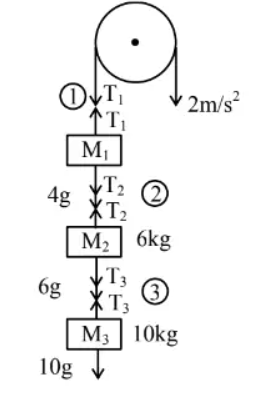
Three blocks \(\mathrm{M}_1, \mathrm{M}_2, \mathrm{M}_3\) having masses \(4 \mathrm{~kg}, 6 \mathrm{~kg}\) and 10 kg respectively are hanging from a smooth pully using rope 1,2 and 3 as shown in figure. The tension in the rope \(1, \mathrm{~T}_1\) when they are moving upward with acceleration of \(2 \mathrm{~ms}^{-2}\) is _____ N (if \(\mathrm{g}=10 \mathrm{~m} / \mathrm{s}^2\) ). [JEE Main 2024 (Online) 5th April Morning Shift]
 CorrectIncorrect
Hint
(b)

\(
\begin{aligned}
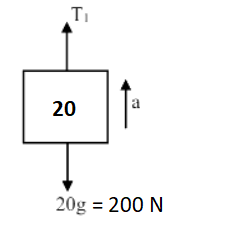
& \mathrm{T}_1-20 \mathrm{~g}=20 \mathrm{a}=20 \times 2 \\
& \mathrm{~T}_1=240 \mathrm{~N}
\end{aligned}
\)Explanation: Let’s analyze the forces acting on each block.
For the system as a whole (masses \(M_1, M_2\), and \(M_3\) together) moving upwards with an acceleration \(a=2 \mathrm{~m} / \mathrm{s}^2\) :
Total mass, \(M=M_1+M_2+M_3=4+6+10=20 \mathrm{~kg}\).
Total weight, \(W=M g=20 \times 10=200 \mathrm{~N}\)
Since the entire system is accelerating upwards, the net force \(F\) required to produce this acceleration is given by:
\(
F=M a=20 \times 2=40 \mathrm{~N}
\)
Thus, the tension \(T_1\) in rope 1 must support both the weight and the additional force required for acceleration:
\(
T_1=W+F=200+40=240 \mathrm{~N}
\) - Question 2 of 23
2. Question
Two forces \(\overline{\mathrm{F}}_1\) and \(\overline{\mathrm{F}}_2\) are acting on a body. One force has magnitude thrice that of the other force and the resultant of the two forces is equal to the force of larger magnitude. The angle between \(\vec{F}_1\) and \(\vec{F}_2\) is \(\cos ^{-1}\left(\frac{1}{n}\right)\). The value of \(|n|\) is _____. [JEE Main 2024 (Online) 4th April Morning Shift]
CorrectIncorrectHint
(c) Step 1: Set up the equation for the resultant force
The magnitude of the resultant force \(\vec{R}\) of two forces \(\vec{F}_1\) and \(\vec{F}_2\) is given by the formula:
\(
|\vec{R}|^2=\left|\vec{F}_1\right|^2+\left|\vec{F}_2\right|^2+2\left|\vec{F}_1\right|\left|\vec{F}_2\right| \cos \theta
\)
Here, \(\theta\) is the angle between the two forces.
Step 2: Substitute the given conditions into the equation
Let the magnitude of the smaller force be \(F\), so \(\left|\vec{F}_1\right|=F\). The problem states that the other force is thrice the magnitude of the first, so \(\left|\vec{F}_2\right|=3 F\). The resultant force is equal to the larger force in magnitude, which is \(3 F\). Therefore, \(|\vec{R}|=3 F\). The angle is given by \(\theta=\cos ^{-1}\left(\frac{1}{n}\right)\), which means \(\cos \theta=\frac{1}{n}\).
Substitute these values into the resultant force equation:
\(
\begin{gathered}
(3 F)^2=(F)^2+(3 F)^2+2(F)(3 F) \cos \theta \\
9 F^2=F^2+9 F^2+6 F^2 \cos \theta
\end{gathered}
\)
Step 3: Solve for \(\cos \theta\) and then for \(n\)
Simplify the equation from the previous step:
\(
\begin{gathered}
9 F^2-9 F^2-F^2=6 F^2 \cos \theta \\
-F^2=6 F^2 \cos \theta
\end{gathered}
\)
Divide both sides by \(F^2\) (since \(F\) is a magnitude, \(F \neq 0\) ):
\(
\begin{aligned}
& -1=6 \cos \theta \\
& \cos \theta=-\frac{1}{6}
\end{aligned}
\)
The problem states that \(\cos \theta=\frac{1}{n}\). By comparing the two equations, we can find the value of \(n\) :
\(
\frac{1}{n}=-\frac{1}{6} \Longrightarrow n=-6
\)
The value of \(|n|\) is 6. - Question 3 of 23
3. Question
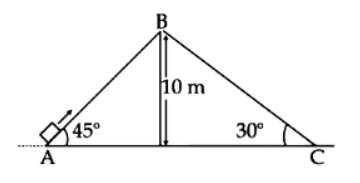
Two inclined planes are placed as shown in figure. A block is projected from the Point A of inclined plane AB along its surface with a velocity just sufficient to carry it to the top Point \(B\) at a height 10 m. After reaching the Point \(B\) the block slides down on inclined plane \(B C\). Time it takes to reach to the point \(C\) from point \(A\) is \(t(\sqrt{2}+1) \mathrm{s}\). The value of \(t\) is _____. [JEE Main 2022 (Online) 27th July Evening Shift]
(use \(\mathrm{g}=10 \mathrm{~m} / \mathrm{s}^2\) ) CorrectIncorrect
Hint
(b) Step 1: The height difference between points A and B is \(h=10 \mathrm{~m}\). Assuming the angle of inclination of plane \(A B\) is \(\theta_1=45^{\circ}\), the length of the inclined plane \(A B\) is \(L_{A B}=\frac{h}{\sin \left(45^{\circ}\right)}=\frac{10}{1 / \sqrt{2}}=10 \sqrt{2} \mathrm{~m}\).
The acceleration of the block as it moves up the plane is
\(
a_{A B}=-g \sin \left(\theta_1\right)=-10 \sin \left(45^{\circ}\right)=-10\left(\frac{1}{\sqrt{2}}\right)=-5 \sqrt{2} \mathrm{~m} / \mathrm{s}^2 .
\)
The block reaches point B with zero velocity, so we can use the kinematic equation \(v=v_0+a t\). The initial velocity \(v_0\) is the velocity at A, and the final velocity \(v\) is zero at B.
\(
0=v_A+(-5 \sqrt{2}) t_{A B}
\)
To find the initial velocity \(v_A\), we can use the equation \(v^2=v_0^2+2 a S\).
\(
\begin{gathered}
0^2=v_A^2+2(-5 \sqrt{2})(10 \sqrt{2}) \\
0=v_A^2-200 \Longrightarrow v_A=\sqrt{200}=10 \sqrt{2} \mathrm{~m} / \mathrm{s}
\end{gathered}
\)
Now we can find the time \(t_{A B}\) :
\(
0=10 \sqrt{2}-5 \sqrt{2} t_{A B} \Longrightarrow 5 \sqrt{2} t_{A B}=10 \sqrt{2} \Longrightarrow t_{A B}=2 \mathrm{~s}
\)
Step 2: Calculate the time taken for the block to slide from B to c.
Assuming the angle of inclination of plane BC is \(\theta_2=30^{\circ}\), the acceleration of the block sliding down the plane is \(a_{B C}=g \sin \left(\theta_2\right)=10 \sin \left(30^{\circ}\right)=10(1 / 2)=5 \mathrm{~m} / \mathrm{s}^2\).
The velocity of the block at B is zero ( \(\boldsymbol{v}_{\boldsymbol{B}}=\mathbf{0}\) ). To find the time \(\boldsymbol{t}_{\boldsymbol{B} \boldsymbol{C}}\), we need the length of the plane \(B C, L_{B C}\). Since the planes are placed as shown (in the presumed figure), the height of point C is the same as point A , which is 0 . The horizontal distance between B and C can be calculated from the geometry. Let the horizontal distance from B to a point directly below it on the horizontal surface be \(x_1\) and the horizontal distance from the same point to C be \(x_2\). Then \(h=10 \mathrm{~m}\), and the lengths of the planes are \(L_{A B}=10 \sqrt{2}\) and \(L_{B C}\). The problem states the total time is \(t(\sqrt{2}+1) \mathrm{s}\), which strongly implies that \(t_{B C}\) is related to \(\sqrt{2}\). Let’s find \(L_{B C}\) with the given angles.
The length of plane BC is \(L_{B C}=\frac{h}{\sin \left(\theta_2\right)}=\frac{10}{\sin \left(30^{\circ}\right)}=\frac{10}{1 / 2}=20 \mathrm{~m}\).
We use the kinematic equation \(S=v_0 t+\frac{1}{2} a t^2\). Here, \(S=L_{B C}, v_0=v_B=0\), and \(a=a_{B C}\).
\(
\begin{gathered}
20=(0) t_{B C}+\frac{1}{2}(5) t_{B C}^2 \\
20=\frac{5}{2} t_{B C}^2 \Longrightarrow t_{B C}^2=\frac{40}{5}=8 \Longrightarrow t_{B C}=\sqrt{8}=2 \sqrt{2} \mathrm{~s}
\end{gathered}
\)
Step 3: Find the value of \(\mathbf{t}\).
The total time from A to C is the sum of the times from A to B and B to C.
\(
T_{\text {total }}=t_{A B}+t_{B C}=2+2 \sqrt{2}=2(1+\sqrt{2}) \mathrm{s}
\)
We are given that the total time is \(t(\sqrt{2}+1) \mathrm{s}\). Comparing the two expressions for the total time:
\(
2(\sqrt{2}+1)=t(\sqrt{2}+1) \Longrightarrow t=2
\) - Question 4 of 23
4. Question
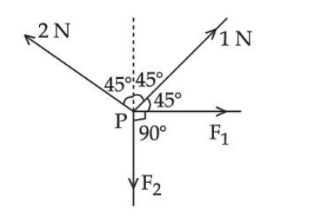
Four forces are acting at a point P in equilibrium as shown in figure. The ratio of force \(\mathrm{F}_1\) to \(\mathrm{F}_2\) is \(1: x\) where \(x=\) ____. [JEE Main 2022 (Online) 25th July Morning Shift]
 CorrectIncorrect
Hint
(a)
\(
\begin{aligned}
&\text { For equilibrium, }\\
&\begin{aligned}
& \Sigma \mathrm{F}_{\mathrm{x}}=0 \& \Sigma \mathrm{~F}_{\mathrm{y}}=0 \\
& \Sigma \mathrm{~F}_{\mathrm{x}}=\mathrm{F}_1+1 \cos 45^{\circ}-2 \cos 45^{\circ} \\
& \mathrm{F}_1=1 \cos 45^{\circ}=\frac{1}{\sqrt{2}} \dots(1)1 \\
& \sum \mathrm{~F}_{\mathrm{y}}=1 \cos 45^{\circ}+2 \cos 45^{\circ}-\mathrm{F}_2 \\
& 0=\frac{3}{\sqrt{2}}-\mathrm{F}_2 \\
& \mathrm{~F}_2=\frac{3}{\sqrt{2}} \dots(2) \\
& \frac{\mathrm{F}_1}{\mathrm{~F}_2}=\frac{1}{3}=\frac{1}{\mathrm{x}} \\
& \therefore \mathrm{x}=3
\end{aligned}
\end{aligned}
\) - Question 5 of 23
5. Question
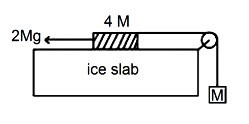
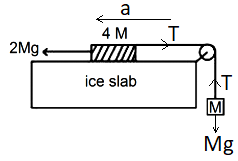
A hanging mass \(M\) is connected to a four times bigger mass by using a string-pulley arrangement, as shown in the figure. The bigger mass is placed on a horizontal ice-slab and being pulled by 2 Mg force. In this situation, tension in the string is \(\frac{x}{5} \mathrm{Mg}\) for \(\mathrm{x}=\) _____. Neglect mass of the string and friction of the block (bigger mass) with ice slab. [JEE Main 2022 (Online) 28th June Morning Shift]
(Given \(\mathrm{g}=\) acceleration due to gravity) CorrectIncorrect
Hint
(d)

For the 4M Block: \(2 m g-T=4 m a \dots(1)\)
For the M Block: \(T-M g=M a \dots(2)\)
Solving Eqn (1) & (2)
\(
a=\frac{q}{5}
\)
Replacing \(a\) in Eqn. (2) we get,
\(
\begin{aligned}
& T-M g=M a \\
& T-M g=M \times \frac{g}{5} \\
& T=\frac{M g}{5}+\frac{5 M}{5} g=\frac{6 M}{5}
\end{aligned}
\)
Comparing with given \(\frac{x}{5} \mathrm{Mg}\) we get \(x=6\) - Question 6 of 23
6. Question
A mass of 10 kg is suspended vertically by a rope of length 5 m from the roof. A force of 30 N is applied at the middle point of rope in horizontal direction. The angle made by upper half of the rope with vertical is \(\theta=\tan ^{-1}\left(x \times 10^{-1}\right)\). The value of \(x\) is ____. [JEE Main 2022 (Online) 27th June Evening Shift]
(Given, \(\mathrm{g}=10 \mathrm{~m} / \mathrm{s}^2\) )CorrectIncorrectHint
(c) The vertical component of the tension, \(T \cos \theta\), balances the weight of the mass:
\(
T \cos \theta=m g
\)
Since \(m g=10 \mathrm{~kg} \times 10 \mathrm{~m} / \mathrm{s}^2=100 \mathrm{~N}\) :
\(
T \cos \theta=100 \mathrm{~N} \dots(i)
\)
The horizontal component of the tension is given by:
\(
T \sin \theta=30 \mathrm{~N} \dots(ii)
\)
Dividing equation (ii) by equation (i):
\(
\frac{T \sin \theta}{T \cos \theta}=\frac{30}{100}
\)
Therefore:
\(
\tan \theta=\frac{3}{10}
\)
Hence, the value of \(x\) is:
\(
\therefore x=3
\) - Question 7 of 23
7. Question
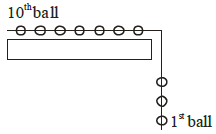
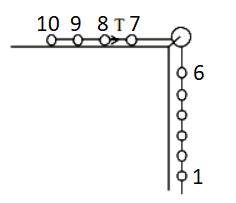
A system to 10 balls each of mass 2 kg are connected via massless and unstretchable string. The system is allowed to slip over the edge of a smooth table as shown in figure. Tension on the string between the \(7^{\text {th }}\) and \(8^{\text {th }}\) ball is ______ \(N\) when \(6{ }^{\text {th }}\) ball just leaves the table. [JEE Main 2022 (Online) 26th June Evening Shift]
 CorrectIncorrect
Hint
(c)

Step 1: Identify the forces and the system’s state
The problem describes a system of 10 balls, each with a mass of \(m=2 \mathrm{~kg}\), connected by a string. The system is sliding over a smooth, frictionless table. The key condition is that the 6th ball just leaves the table.
This means:
The first 6 balls are hanging vertically, pulled down by gravity.
The last 4 balls (7th, 8th, 9th, and 10th) are still on the horizontal table.
The entire system accelerates together because the string is unstretchable.
Step 2: Calculate the acceleration of the system
The net force causing the acceleration is the gravitational force acting on the hanging balls. The total mass of the hanging balls is \(\boldsymbol{M}_{\text {hang }}=6 \times 2 \mathrm{~kg}=12 \mathrm{~kg}\). The total mass of the entire system is \(M_{\text {total }}=10 \times 2 \mathrm{~kg}=20 \mathrm{~kg}\).
Using Newton’s second law, \(\sum F=M_{\text {total }} a\), we can find the acceleration \(a\) :
\(
\begin{gathered}
F_{\text {net }}=M_{\text {hang }} g=M_{\text {total }} a \\
a=\frac{M_{\text {hang }} g}{M_{\text {total }}}
\end{gathered}
\)
Substituting the values ( \(g \approx 10 \mathrm{~m} / \mathrm{s}^2\) ):
\(
a=\frac{(12 \mathrm{~kg})\left(10 \mathrm{~m} / \mathrm{s}^2\right)}{20 \mathrm{~kg}}=6 \mathrm{~m} / \mathrm{s}^2
\)
Step 3: Find the tension between the 7th and 8th balls
To find the tension in the string between the 7th and 8th balls, we need to consider the forces acting on the part of the system that this string is pulling. The tension in this string, \(T_{7-8}\), is responsible for accelerating the balls that follow it, which are the 8th, 9th, and 10th balls.
The total mass being pulled by the string between the 7th and 8th balls is \(M_{\text {pulled }}=3 \times m=3 \times 2 \mathrm{~kg}=6 \mathrm{~kg}\). The force of tension is given by Newton’s second law, \(T_{7-8}=M_{\text {pulled }} a\).
Substituting the acceleration calculated in the previous step:
\(
T_{7-8}=(6 \mathrm{~kg})\left(6 \mathrm{~m} / \mathrm{s}^2\right)=36 \mathrm{~N}
\)
The tension on the string between the 7th and 8th ball is \(\mathbf{3 6} \mathbf{N}\). - Question 8 of 23
8. Question
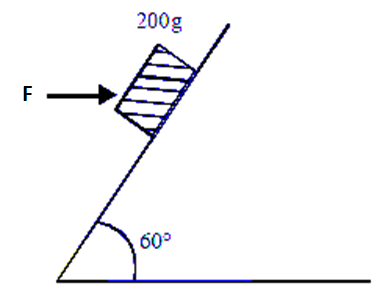
A block of mass 200 g is kept stationary on a smooth inclined plane by applying a minimum horizontal force \(\mathrm{F}=\sqrt{x} \mathrm{~N}\) as shown in figure. The value of \(x=\) _____. [JEE Main 2022 (Online) 25th June Evening Shift]
 CorrectIncorrect
Hint
(a)

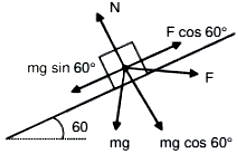
\(
\begin{aligned}
&\text { A long surface }\\
&\begin{aligned}
& \mathrm{F} \cos 60^{\circ}=\mathrm{mg} \sin 60^{\circ} \\
& \mathrm{F}=\mathrm{mg} \tan 60^{\circ} \\
& \quad=200 \times 10 \times \sqrt{3} \times 10^{-3}=2 \sqrt{3}=\sqrt{12} \mathrm{~N}
\end{aligned}
\end{aligned}
\)
\(
\therefore x=12
\) - Question 9 of 23
9. Question
A force on an object of mass 100 g is \((10 \hat{i}+5 \hat{j}) \mathrm{N}\). The position of that object at \(\mathrm{t}=2 \mathrm{~s}\) is \((a \hat{i}+b \hat{j}) \mathrm{m}\) after starting from rest. The value of \(\frac{a}{b}\) will be ____. [JEE Main 2022 (Online) 25th June Morning Shift]
CorrectIncorrectHint
(b) Step 1: Calculate the acceleration vector
First, convert the mass from grams to kilograms to maintain consistent SI units:
\(
m=100 \mathrm{~g}=0.1 \mathrm{~kg}
\)
Use Newton’s second law, \(\vec{F}=m \vec{a}\), to find the acceleration vector.
\(
\vec{a}=\frac{\vec{F}}{m}
\)
Given the force \(\vec{F}=(10 \hat{i}+5 \hat{j}) \mathrm{N}\) and the mass \(m=0.1 \mathrm{~kg}\), the acceleration is:
\(
\vec{a}=\frac{10 \hat{i}+5 \hat{j}}{0.1}=(100 \hat{i}+50 \hat{j}) \mathrm{m} / \mathrm{s}^2
\)
Step 2: Calculate the position of the object
The object starts from rest, so its initial velocity is \(\vec{v}_0=(0 \hat{i}+0 \hat{j})\). Assuming it starts from the origin, its initial position is \(\vec{r}_0=(0 \hat{i}+0 \hat{j})\).
Using the kinematic equation for position:
\(
\vec{r}=\vec{r}_0+\vec{v}_0 t+\frac{1}{2} \vec{a} t^2
\)
Substitute the initial conditions, the acceleration vector from Step 1, and the time \(t=2 \mathrm{~s}\) :
\(
\begin{gathered}
\vec{r}=(0 \hat{i}+0 \hat{j})+(0 \hat{i}+0 \hat{j})(2)+\frac{1}{2}(100 \hat{i}+50 \hat{j})(2)^2 \\
\vec{r}=\frac{1}{2}(100 \hat{i}+50 \hat{j})(4)=(200 \hat{i}+100 \hat{j}) \mathrm{m}
\end{gathered}
\)
Step 3: Find the ratio \(\frac{\boldsymbol{a}}{\boldsymbol{b}}\)
The position of the object is given as \(\vec{r}=(a \hat{i}+b \hat{j}) \mathbf{m}\).
From our calculation, we have \(\vec{r}=(200 \hat{i}+100 \hat{j}) \mathrm{m}\).
By comparing the components, we get:
\(
\begin{aligned}
& a=200 \\
& b=100
\end{aligned}
\)
The value of the ratio is:
\(
\frac{a}{b}=\frac{200}{100}=2
\) - Question 10 of 23
10. Question
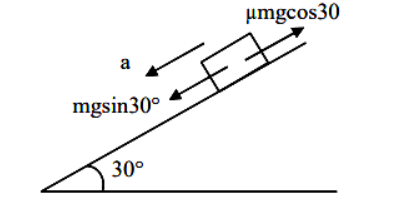
When a body slides down from rest along a smooth inclined plane making an angle of \(30^{\circ}\) with the horizontal, it takes time T. When the same body slides down from the rest along a rough inclined plane making the same angle and through the same distance, it takes time \(\alpha \mathrm{T}\), where \(\alpha\) is a constant greater than 1. The co-efficient of friction between the body and the rough plane is \(\frac{1}{\sqrt{x}}\left(\frac{\alpha^2-1}{\alpha^2}\right)\) where \(\mathrm{x}=\) ______. [JEE Main 2021 (Online) 1st September Evening Shift]
CorrectIncorrectHint
(d)

Step 1: Analyze the motion on the smooth inclined plane
The body starts from rest ( \(\boldsymbol{u}=\mathbf{0}\) ) and slides a distance \(\boldsymbol{s}\) down a smooth inclined plane with an angle of inclination \(\theta=30^{\circ}\). The only force component causing the motion is the component of gravity parallel to the plane. The acceleration ( \(a_{\text {smooth }}\) ) is given by:
\(
a_{\text {smooth }}=g \sin \theta=g \sin \left(30^{\circ}\right)=g\left(\frac{1}{2}\right)=\frac{g}{2}
\)
Using the kinematic equation for displacement, \(s=u t+\frac{1}{2} a t^2\), where \(t=T\).
\(
s=0 \cdot T+\frac{1}{2} a_{\text {smooth }} T^2=\frac{1}{2}\left(\frac{g}{2}\right) T^2=\frac{g T^2}{4}
\)
From this, we can express \(T^2\) as:
\(
T^2=\frac{4 s}{g}
\)
Step 2: Analyze the motion on the rough inclined plane
For the rough inclined plane, the angle and distance are the same. The time taken is \(\alpha T\) . In addition to the gravitational component, there is a kinetic friction force ( \(f_k\) ) opposing the motion. The acceleration ( \(a_{\text {rough }}\) ) is given by:
\(
\begin{gathered}
a_{\text {rough }}=g \sin \theta-\mu g \cos \theta=g \sin \left(30^{\circ}\right)-\mu g \cos \left(30^{\circ}\right) \\
a_{\text {rough }}=g\left(\frac{1}{2}\right)-\mu g\left(\frac{\sqrt{3}}{2}\right)=\frac{g}{2}(1-\mu \sqrt{3})
\end{gathered}
\)
Using the same kinematic equation for displacement, with \(t=\alpha T\).
\(
s=0 \cdot(\alpha T)+\frac{1}{2} a_{\text {rough }}(\alpha T)^2=\frac{1}{2}\left[\frac{g}{2}(1-\mu \sqrt{3})\right](\alpha T)^2=\frac{g \alpha^2 T^2}{4}(1-\mu \sqrt{3})
\)
Step 3: Relate the two scenarios and solve for the coefficient of friction
Equating the expression for \(s\) from Step 1 with the one from Step 2:
\(
\frac{g T^2}{4}=\frac{g \alpha^2 T^2}{4}(1-\mu \sqrt{3})
\)
Dividing both sides by \(\frac{g T^2}{4}\) gives:
\(
\begin{gathered}
1=\alpha^2(1-\mu \sqrt{3}) \\
\frac{1}{\alpha^2}=1-\mu \sqrt{3} \\
\mu \sqrt{3}=1-\frac{1}{\alpha^2}=\frac{\alpha^2-1}{\alpha^2} \\
\mu=\frac{1}{\sqrt{3}}\left(\frac{\alpha^2-1}{\alpha^2}\right)
\end{gathered}
\)
Step 4: Determine the value of \(x\)
The problem states that the coefficient of friction is given by \(\mu=\frac{1}{\sqrt{x}}\left(\frac{\alpha^2-1}{\alpha^2}\right)\)
By comparing our derived expression for \(\mu\) with the given form:
\(
\frac{1}{\sqrt{3}}\left(\frac{\alpha^2-1}{\alpha^2}\right)=\frac{1}{\sqrt{x}}\left(\frac{\alpha^2-1}{\alpha^2}\right)
\)
This implies that \(\frac{1}{\sqrt{3}}=\frac{1}{\sqrt{x}}\), so \(\sqrt{x}=\sqrt{3}\), which means \(x=3\). - Question 11 of 23
11. Question
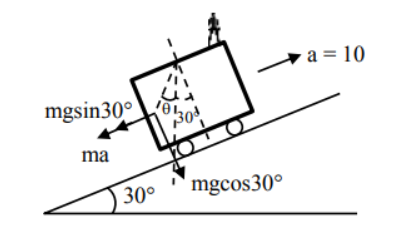
A car is moving on a plane inclined at \(30^{\circ}\) to the horizontal with an acceleration of \(10 \mathrm{~ms}^{-2}\) parallel to the plane upward. A bob is suspended by a string from the roof of the car. The angle in degrees which the string makes with the vertical is ______. (Take \(\mathrm{g}=10 \mathrm{~ms}^{-2}\) ) [JEE Main 2021 (Online) 31st August Morning Shift]
CorrectIncorrectHint
(a)

\(
\begin{aligned}
& \tan (30+\theta)=\frac{m g \sin 30^{\circ}+m a}{m g \cos 30^{\circ}} \\
& \tan (30+\theta)=\frac{5+10}{5 \sqrt{3}}=\frac{1+2}{\sqrt{3}} \\
& \frac{\tan \theta+\frac{1}{\sqrt{3}}}{1-\frac{1}{\sqrt{3}} \tan \theta}=\sqrt{3} \\
& \sqrt{3} \tan \theta+1=3-\sqrt{3} \tan \theta \\
& 2 \sqrt{3} \tan \theta=2 \\
& \tan \theta=\frac{1}{\sqrt{3}} \\
& \theta=30^{\circ}
\end{aligned}
\) - Question 12 of 23
12. Question
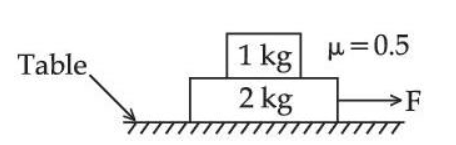
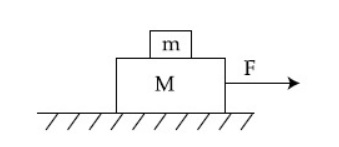
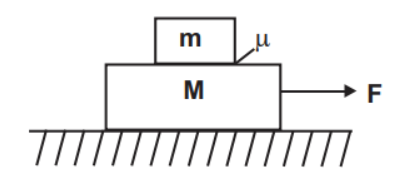
The coefficient of static friction between two blocks is 0.5 and the table is smooth. The maximum horizontal force that can be applied to move the blocks together is _____ N. (take \(\mathrm{g}=10 \mathrm{~ms}^{-2}\) ) [JEE Main 2021 (Online) 26th August Evening Shift]
 CorrectIncorrect
Hint
(d)

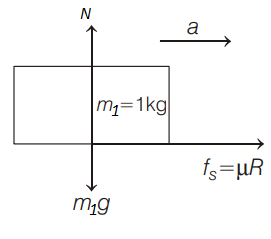
Step 1: Analyze the forces on the top block
The only horizontal force acting on the top block is the static friction force from the bottom block. This friction force is what accelerates the top block. The maximum static friction force is given by \(f_{s, \max }=\mu_s N_1\), where \(N_1\) is the normal force on the top block. Since the block is not accelerating vertically, \(N_1=m_1 g\). Therefore, the maximum static friction force is:
\(
f_{s, \max }=\mu_s m_1 g
\)
This force provides the maximum acceleration for the top block:
\(
a_{\max }=\frac{f_{s, \max }}{m_1}=\frac{\mu_s m_1 g}{m_1}=\mu_s g
\)
Given \(\mu_s=0.5\) and \(g=10 \mathrm{~m} / \mathrm{s}^2\), the maximum acceleration is:
\(
a_{\max }=(0.5)(10)=5 \mathrm{~m} / \mathrm{s}^2
\)
Step 2: Analyze the forces on the system of two blocks
For the blocks to move together without the top block slipping, the entire system must move with this maximum acceleration, \(a_{\text {max }}\). The total mass of the system is \(m_1+m_2\). The total external force applied is \(F_{\text {max }}\).
Using Newton’s second law for the system:
\(
F_{\max }=\left(m_1+m_2\right) a_{\max }
\)
Substituting the value of \(a_{\text {max }}\) :
\(
\begin{gathered}
F_{\max }=\left(m_1+m_2\right)\left(\mu_s g\right) \\
F_{\max }=\left(m_1+m_2\right)(0.5)(10)=5\left(m_1+m_2\right)=15 N
\end{gathered}
\) - Question 13 of 23
13. Question
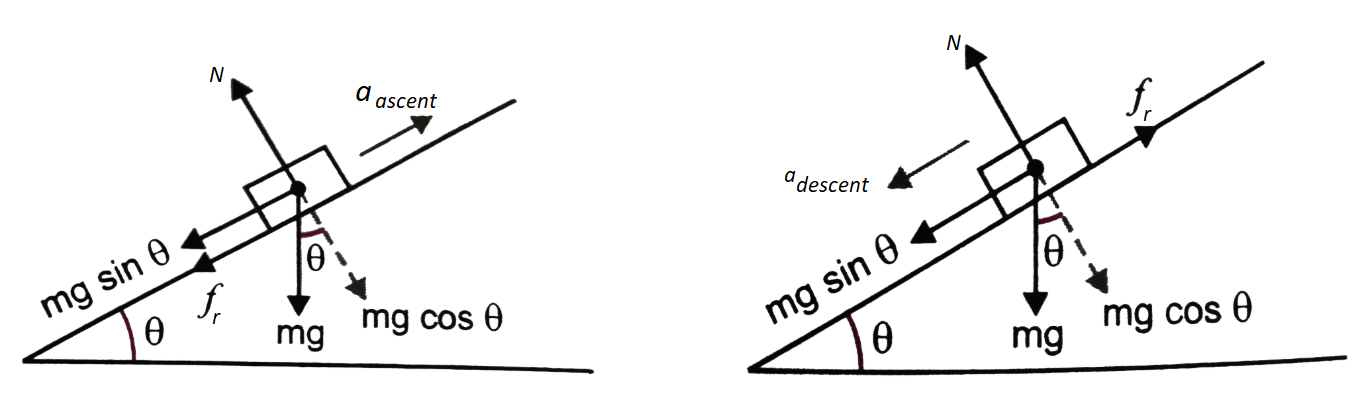
A body of mass ‘ \(m\) ‘ is launched up on a rough inclined plane making an angle of \(30^{\circ}\) with the horizontal. The coefficient of friction between the body and plane is \(\frac{\sqrt{x}}{5}\) if the time of ascent is half of the time of descent. The value of \(x\) is _____. [JEE Main 2021 (Online) 20th July Evening Shift]
CorrectIncorrectHint
(c)

Step 1: Analyze the accelerations during ascent and descent.
When the body is launched up the rough inclined plane, the forces acting on it parallel to the plane are the component of gravity pulling it down and the kinetic friction force also opposing its upward motion.
The acceleration during ascent, \(\boldsymbol{a}_{\text {ascent }}\), is given by:
\(
a_{\text {ascent }}=\frac{-m g \sin \theta-\mu m g \cos \theta}{m}=-g(\sin \theta+\mu \cos \theta)
\)
The magnitude of this acceleration is \(\left|a_{\text {ascent }}\right|=g(\sin \theta+\mu \cos \theta)\).
During the descent, the body slides down the plane. The component of gravity pulls it down, while the kinetic friction force opposes the motion and acts up the plane. The acceleration during descent, \(a_{\text {descent }}\), is given by:
\(
a_{\text {descent }}=\frac{m g \sin \theta-\mu m g \cos \theta}{m}=g(\sin \theta-\mu \cos \theta)
\)
Step 2: Use kinematic equations to relate time and acceleration.
Let the distance traveled up the inclined plane be \(\boldsymbol{L}\).
For the ascent, the body starts with an initial velocity \(\boldsymbol{u}\) and comes to rest ( \(\boldsymbol{v}=\mathbf{0}\) ) at the top. The time of ascent is \(\boldsymbol{t}_{\text {ascent }}\). Using the kinematic equation
\(L=u t_{\text {ascent }}+\frac{1}{2} a_{\text {ascent }} t_{\text {ascent }}^2\) and \(v=u+a_{\text {ascent }} t_{\text {ascent }}\), we can derive the relation between \(L, a_{\text {ascent }}\), and \(t_{\text {ascent }}\).
From \(v=u+a_{\text {ascent }} t_{\text {ascent }}\), we have \(u=-a_{\text {ascent }} t_{\text {ascent }}=\left|a_{\text {ascent }}\right| t_{\text {ascent }}\).
Substituting this into the distance equation gives
\(
\begin{aligned}
& L=\left|a_{\text {ascent }}\right| t_{\text {ascent }}^2-\frac{1}{2}\left|a_{\text {ascent }}\right| t_{\text {ascent }}^2=\frac{1}{2}\left|a_{\text {ascent }}\right| t_{\text {ascent }}^2 . \\
& \text { This gives } t_{\text {ascent }}=\sqrt{\frac{2 L}{\left|a_{\text {ascent }}\right|}} .
\end{aligned}
\)
For the descent, the body starts from rest ( \(\boldsymbol{u}=\mathbf{0}\) ) and travels the same distance \(\boldsymbol{L}\) in time \(\boldsymbol{t}_{\text {descent }}\).
Using the kinematic equation \(L=u t_{\text {descent }}+\frac{1}{2} a_{\text {descent }} t_{\text {descent }}^2\), we get \(L=0+\frac{1}{2} a_{\text {descent }} t_{\text {descent }}^2\).
This gives \(t_{\text {descent }}=\sqrt{\frac{2 L}{a_{\text {descent }}}}\).
Step 3: Solve for the coefficient of friction.
The problem states that the time of ascent is half of the time of descent, which means \(\boldsymbol{t}_{\text {ascent }}=\frac{1}{2} \boldsymbol{t}_{\text {descent }}\).
Substituting the expressions for the times, we get:
\(
\sqrt{\frac{2 L}{\left|a_{\text {ascent }}\right|}}=\frac{1}{2} \sqrt{\frac{2 L}{a_{\text {descent }}}}
\)
Squaring both sides gives:
\(
\begin{gathered}
\frac{2 L}{\left|a_{\text {ascent }}\right|}=\frac{1}{4} \frac{2 L}{a_{\text {descent }}} \\
\frac{1}{\left|a_{\text {ascent }}\right|}=\frac{1}{4 a_{\text {descent }}} \Longrightarrow\left|a_{\text {ascent }}\right|=4 a_{\text {descent }}
\end{gathered}
\)
Now substitute the expressions for the accelerations from Step 1:
\(
\begin{gathered}
g(\sin \theta+\mu \cos \theta)=4 g(\sin \theta-\mu \cos \theta) \\
\sin \theta+\mu \cos \theta=4 \sin \theta-4 \mu \cos \theta \\
5 \mu \cos \theta=3 \sin \theta \\
\mu=\frac{3 \sin \theta}{5 \cos \theta}=\frac{3}{5} \tan \theta
\end{gathered}
\)
Given that the angle \(\theta=30^{\circ}\), we substitute this value:
\(
\mu=\frac{3}{5} \tan \left(30^{\circ}\right)=\frac{3}{5}\left(\frac{1}{\sqrt{3}}\right)=\frac{3}{5 \sqrt{3}}=\frac{\sqrt{3}}{5}
\)
The problem states that the coefficient of friction is \(\mu=\frac{\sqrt{x}}{5}\). Comparing the two expressions for \(\mu\) :
\(
\begin{aligned}
\frac{\sqrt{x}}{5} & =\frac{\sqrt{3}}{5} \\
\sqrt{x} & =\sqrt{3} \\
x & =3
\end{aligned}
\) - Question 14 of 23
14. Question
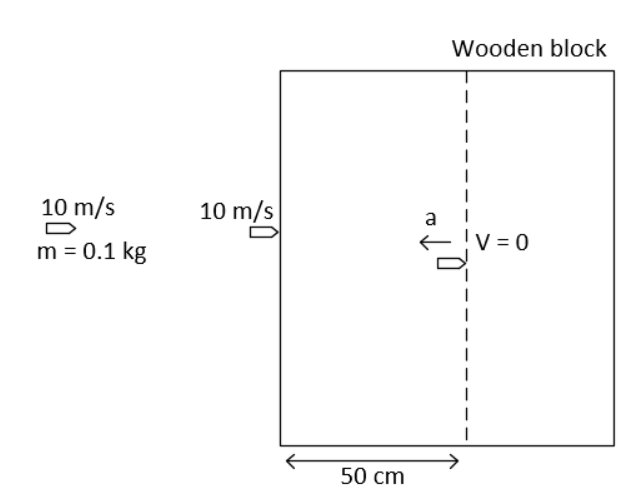
A bullet of mass 0.1 kg is fired on a wooden block to pierce through it, but it stops after moving a distance of 50 cm into it. If the velocity of bullet before hitting the wood is \(10 \mathrm{~m} / \mathrm{s}\) and it slows down with uniform deceleration, then the magnitude of effective retarding force on the bullet is ‘ \(x\) ‘ \(N\). The value of ‘ \(x\) ‘ to the nearest integer is _____. [JEE Main 2021 (Online) 18th March Morning Shift]
CorrectIncorrectHint
(a)

Step 1: Convert units and identify given values
First, convert the distance the bullet travels into the wooden block from centimeters to meters.
The initial velocity of the bullet is \(v_i=10 \mathrm{~m} / \mathrm{s}\).
The final velocity of the bullet is \(v_f=0 \mathrm{~m} / \mathrm{s}\), as it comes to a stop.
The mass of the bullet is \(\boldsymbol{m}=0.1 \mathrm{~kg}\).
The distance traveled is \(s=50 \mathrm{~cm}=0.5 \mathrm{~m}\).
Step 2: Calculate the uniform deceleration
Using the kinematic equation for uniform acceleration, \(v_f^2=v_i^2+2 a s\), we can solve for the acceleration (\(a\)).
\(
\begin{gathered}
0^2=(10)^2+2 a(0.5) \\
0=100+a \\
a=-100 \mathrm{~m} / \mathrm{s}^2
\end{gathered}
\)
The negative sign indicates that the bullet is decelerating, which is expected. The magnitude of the deceleration is \(100 \mathrm{~m} / \mathrm{s}^2\).
Step 3: Calculate the magnitude of the retarding force
Using Newton’s second law, \(F=m a\), we can find the force. The retarding force is the force that causes the deceleration.
\(
\begin{gathered}
F=(0.1 \mathrm{~kg}) \cdot\left(-100 \mathrm{~m} / \mathrm{s}^2\right) \\
F=-10 \mathrm{~N}
\end{gathered}
\)
The magnitude of the force is the absolute value of this result.
\(
|F|=|-10 \mathrm{~N}|=10 \mathrm{~N}
\)
The value of \(x\) is 10. - Question 15 of 23
15. Question
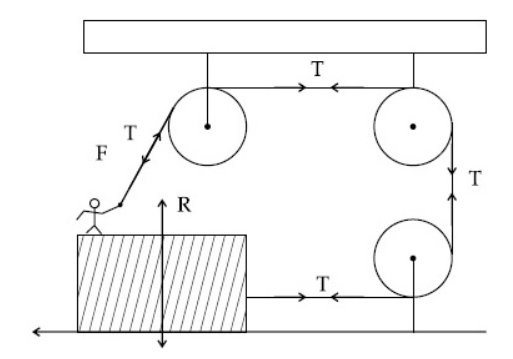
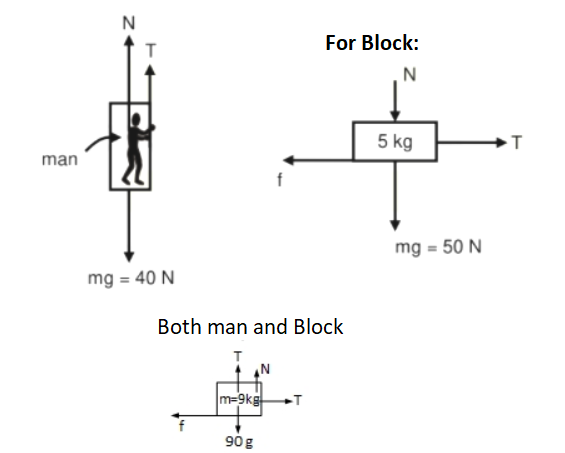
A boy of mass 4 kg is standing on a piece of wood having mass 5 kg. If the coefficient of friction between the wood and the floor is 0.5, the maximum force that the boy can exert on the rope so that the piece of wood does not move from its place is ______ N. (Round off to the Nearest Integer) [Take \(\mathrm{g}=10 \mathrm{~ms}^{-2}\) ]
 CorrectIncorrect
Hint
(b)

The normal force ( \(N\) ) is the sum of the gravitational forces on the boy ( \(m_{\text {boy }} g\) ) and the wood ( \(m_{\text {wood }} g\) ).
\(
N=m_{\text {boy }} g+m_{\text {wood }} g
\)
Given \(m_{\text {boy }}=4 \mathrm{~kg}, m_{\text {wood }}=5 \mathrm{~kg}\), and \(g=10 \mathrm{~m} / \mathrm{s}^2\) :
\(
N=(4 \mathrm{~kg})\left(10 \mathrm{~m} / \mathrm{s}^2\right)+(5 \mathrm{~kg})\left(10 \mathrm{~m} / \mathrm{s}^2\right)=40 \mathrm{~N}+50 \mathrm{~N}=90 \mathrm{~N}
\)
\(
\begin{aligned}
& \mathrm{N}+\mathrm{T}=90 \\
& \mathrm{~T}=\mu \mathrm{N}=0.5(90-\mathrm{T}) \\
& 1.5 \mathrm{~T}=45 \\
& \mathrm{~T}=30
\end{aligned}
\) - Question 16 of 23
16. Question
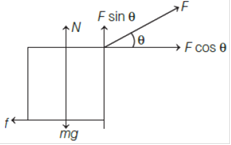
A body of mass 1 kg rests on a horizontal floor with which it has a coefficient of static friction \(\frac{1}{\sqrt{3}}\). It is desired to make the body move by applying the minimum possible force \(F N\). The value of \(F\) will be _____ (Round off to the Nearest Integer) [Take \(\mathrm{g}=10 \mathrm{~ms}^{-2}\) ][JEE Main 2021 (Online) 17th March Evening Shift]
CorrectIncorrectHint
(d)

\(
\begin{aligned}
& F \cos \theta=\mu N \\
& F \sin \theta+N=m g \\
& \Rightarrow F=\frac{\mu m g}{\cos \theta+\mu \sin \theta} \\
& F_{\min }=\frac{\mu m g}{\sqrt{1+\mu^2}} \\
& =\frac{\frac{1}{\sqrt{3}} \times 10}{\frac{2}{\sqrt{3}}}=5
\end{aligned}
\)Explanation:
Step 1: Set up the equations for equilibrium
Let the body of mass \(m\) have a force \(F\) applied at an angle \(\theta\) with the horizontal. We need to find the minimum force \(F\) to initiate motion. The forces acting on the body are:
Weight: \(W=m g\), acting vertically downwards.
Normal Force: \(N\), acting vertically upwards.
Applied Force: \(F\), with horizontal component \(F \cos (\theta)\) and vertical component \(F \sin (\theta)\).
Maximum Static Friction: \(f_{s, \max }=\mu_s N\), acting horizontally, opposing motion.
For vertical equilibrium, the sum of upward forces must equal the sum of downward forces:
\(
\begin{aligned}
& N+F \sin (\theta)=m g \\
& N=m g-F \sin (\theta)
\end{aligned}
\)
To initiate motion, the horizontal component of the applied force must be equal to the maximum static friction force:
\(
F \cos (\theta)=\mu_s N
\)
Step 2: Express the force F as a function of the angle \(\boldsymbol{\theta}\)
Substitute the expression for \(N\) from the first equation into the second equation:
\(
\begin{gathered}
F \cos (\theta)=\mu_s(m g-F \sin (\theta)) \\
F \cos (\theta)=\mu_s m g-\mu_s F \sin (\theta) \\
F \cos (\theta)+\mu_s F \sin (\theta)=\mu_s m g \\
F\left(\cos (\theta)+\mu_s \sin (\theta)\right)=\mu_s m g \\
F=\frac{\mu_s m g}{\cos (\theta)+\mu_s \sin (\theta)}
\end{gathered}
\)
Step 3: Determine the angle for the minimum force
The force \(F\) is minimized when the denominator, \(\cos (\theta)+\mu_s \sin (\theta)\), is maximized. We can maximize this expression by finding its derivative with respect to \(\boldsymbol{\theta}\) and setting it to zero.
\(
\begin{gathered}
\frac{d}{d \theta}\left(\cos (\theta)+\mu_s \sin (\theta)\right)=-\sin (\theta)+\mu_s \cos (\theta)=0 \\
\mu_s \cos (\theta)=\sin (\theta) \\
\tan (\theta)=\mu_s
\end{gathered}
\)
\(
\begin{aligned}
&\text { Given } \mu_s=\frac{1}{\sqrt{3}}, \text { we find the angle } \theta \text { : }\\
&\begin{gathered}
\tan (\theta)=\frac{1}{\sqrt{3}} \\
\theta=30^{\circ}
\end{gathered}
\end{aligned}
\)
Step 4: Calculate the minimum force and round the result Now, we substitute \(\mu_s=\frac{1}{\sqrt{3}}\) and \(\theta=30^{\circ}\) into the equation for \(F\). We know that if \(\tan (\theta)=\frac{1}{\sqrt{3}}\), then \(\sin (\theta)=\frac{1}{2}\) and \(\cos (\theta)=\frac{\sqrt{3}}{2}\).
\(
\begin{gathered}
F_{\min }=\frac{\mu_s m g}{\cos (\theta)+\mu_s \sin (\theta)} \\
F_{\min }=\frac{\left(\frac{1}{\sqrt{3}}\right)(1)(10)}{\frac{\sqrt{3}}{2}+\left(\frac{1}{\sqrt{3}}\right)\left(\frac{1}{2}\right)} \\
F_{\min }=\frac{\frac{10}{\sqrt{3}}}{\frac{\sqrt{3}}{2}+\frac{1}{2 \sqrt{3}}}=\frac{\frac{10}{\sqrt{3}}}{\frac{3+1}{2 \sqrt{3}}}=\frac{\frac{10}{\sqrt{3}}}{\frac{4}{2 \sqrt{3}}}=\frac{\frac{10}{\sqrt{3}}}{\frac{2}{\sqrt{3}}} \\
F_{\min }=\frac{10}{\sqrt{3}} \times \frac{\sqrt{3}}{2}=5 \mathrm{~N}
\end{gathered}
\)
The minimum force required is 5 N. Rounding off to the nearest integer gives 5. - Question 17 of 23
17. Question
Two blocks ( \(\mathrm{m}=0.5 \mathrm{~kg}\) and \(\mathrm{M}=4.5 \mathrm{~kg}\) ) are arranged on a horizontal frictionless table as shown in figure. The coefficient of static friction between the two blocks is \(\frac{3}{7}\). Then the maximum horizontal force that can be applied on the larger block so that the blocks move together is _____ N. (Round off to the Nearest Integer) [Take g as \(9.8 \mathrm{~ms}^{-2}\) ] [JEE Main 2021 (Online) 17th March Morning Shift]
 CorrectIncorrect
Hint
(a)

\(
\begin{aligned}
& \mathrm{a}_{\max }=\mu \mathrm{g}=\frac{3}{7} \times 9.8 \\
& \mathrm{~F}=(\mathrm{M}+\mathrm{m}) \mathrm{a}_{\max }=5 \mathrm{a}_{\max }=21 N
\end{aligned}
\)Explanation: Step 1: Calculate the maximum acceleration
To ensure the blocks move together, the horizontal force of static friction acting on the smaller block ( \(m\) ) must be sufficient to accelerate it at the same rate as the larger block ( \(\boldsymbol{M}\) ). The maximum static friction force is the limiting factor for this acceleration.
The normal force ( \(N\) ) acting on the smaller block is equal to its weight, which is \(N=m g\).
\(
N=(0.5 \mathrm{~kg})\left(9.8 \mathrm{~ms}^{-2}\right)=4.9 \mathrm{~N}
\)
The maximum static friction force ( \(f_{s, \max }\) ) is given by the formula \(f_{s, \max }=\mu_s N\). This force provides the maximum possible acceleration for the smaller block.
\(
f_{s, \max }=\left(\frac{3}{7}\right)(4.9 \mathrm{~N})=2.1 \mathrm{~N}
\)
Using Newton’s Second Law ( \(\boldsymbol{F}=\boldsymbol{m} a\) ) for the smaller block, we can find the maximum acceleration ( \(a_{\text {max }}\) ) for which the blocks will move together.
\(
a_{\max }=\frac{f_{s, \max }}{m}=\frac{2.1 \mathrm{~N}}{0.5 \mathrm{~kg}}=4.2 \mathrm{~ms}^{-2}
\)
Step 2: Calculate the maximum applied force
The maximum horizontal force ( \(\boldsymbol{F}_{\text {max }}\) ) that can be applied to the larger block is the force required to accelerate the entire system (both blocks together) at the maximum acceleration found in the previous step.
The total mass of the system is the sum of the two blocks’ masses ( \(m_{\text {total }}=m+M\) ).
\(
m_{\text {total }}=0.5 \mathrm{~kg}+4.5 \mathrm{~kg}=5.0 \mathrm{~kg}
\)
Using Newton’s Second Law for the entire system, we can find the maximum force.
\(
F_{\max }=m_{\text {total }} a_{\max }=(5.0 \mathrm{~kg})\left(4.2 \mathrm{~ms}^{-2}\right)=21 \mathrm{~N}
\)
The maximum horizontal force is 21 N. - Question 18 of 23
18. Question
A body of mass 2 kg moves under a force of \((2 \hat{i}+3 \hat{j}+5 \hat{k}) \mathrm{N}\). It starts from rest and was at the origin initially. After 4 s , its new coordinates are ( \(8, \mathrm{~b}, 20\) ). The value of \(b\) is _____. (Round off to the Nearest Integer) [JEE Main 2021 (Online) 16th March Evening Shift]
CorrectIncorrectHint
(a)
\(
\begin{aligned}
& \vec{a}=\frac{\vec{F}}{m}=\frac{2 \hat{\imath}+3 \hat{j}+5 \hat{k}}{2}, \quad \vec{r}_f-\vec{r}_i=\vec{u} t+\frac{1}{2} \vec{a} t^2 \\
& \vec{r}_f-(0 \hat{i}+0 \hat{j}+0 \hat{k})=\frac{1}{2} \times\left(\frac{2 \hat{\imath}+3 \hat{\jmath}+5 \hat{k}}{2}\right)(4)^2 \\
& \vec{r}_f=8 \hat{i}+12 \hat{j}+20 \hat{k} \Rightarrow b=12
\end{aligned}
\)Explanation: Step 1: Calculate the acceleration of the body
According to Newton’s second law, the force is equal to the mass times the acceleration, \(\vec{F}=m \vec{a}\). The acceleration vector \(\vec{a}\) can be found by dividing the force vector \(\vec{F}\) by the mass \(m\).
Given:
\(\vec{F}=(2 \hat{i}+3 \hat{j}+5 \hat{k}) \mathrm{N}\)
\(m=2 \mathrm{~kg}\)
The acceleration is:
\(
\vec{a}=\frac{\vec{F}}{m}=\frac{(2 \hat{i}+3 \hat{j}+5 \hat{k})}{2}=(1 \hat{i}+1.5 \hat{j}+2.5 \hat{k}) \mathrm{m} / \mathrm{s}^2
\)
Step 2: Use kinematic equations to find the \(y\)-coordinate
The position of the body can be described by the kinematic equation:
\(
\vec{r}_t=\vec{r}_0+\vec{v}_0 t+\frac{1}{2} \vec{a} t^2
\)
Since the body starts from rest ( \(\vec{v}_0=0\) ) at the origin ( \(\vec{r}_0=0\) ), the equation simplifies to:
\(
\vec{r}_t=\frac{1}{2} \vec{a} t^2
\)
We are interested in the \(y\)-coordinate, which is the \(y\)-component of the position vector. We can extract the \(y\)-component from the full vector equation:
\(
y=y_0+v_{0 y} t+\frac{1}{2} a_y t^2
\)
With \(y_0=0\) and \(v_{0 y}=0\), this becomes:
\(
y=\frac{1}{2} a_y t^2
\)
From Step 1, the y-component of the acceleration is \(a_y=1.5 \mathrm{~m} / \mathrm{s}^2\). The time is given as \(t=4 \mathrm{~s}\).
Substituting the values:
\(
y=\frac{1}{2}(1.5)(4)^2=\frac{1}{2}(1.5)(16)=(1.5)(8)=12
\)
The value of the \(y\)-coordinate is 12. Since the final coordinates are given as \((8, b, 20)\), the value of \(b\) is 12. - Question 19 of 23
19. Question
A person standing on a spring balance inside a stationary lift measures 60 kg. The weight of that person if the lift descends with uniform downward acceleration of \(1.8 \mathrm{~m} / \mathrm{s}^2\) will be _____ N. \(\left[\mathrm{g}=10 \mathrm{~m} / \mathrm{s}^2\right]\) [JEE Main 2021 (Online) 26th February Morning Shift]
CorrectIncorrectHint
(b) Step 1: Identify the forces acting on the person
The person inside the lift experiences two main forces: the gravitational force acting downwards and the normal force (or apparent weight) exerted by the spring balance acting upwards. Since the lift is accelerating downwards, the net force is also directed downwards.
Step 2: Apply Newton’s Second Law
Using Newton’s Second Law, the net force on the person is equal to their mass multiplied by the acceleration. Taking the downward direction as positive, the equation is:
\(
F_{\mathrm{net}}=m g-N=m a
\)
where \(m\) is the mass, \(g\) is the acceleration due to gravity, \(N\) is the normal force (apparent weight), and \(\boldsymbol{a}\) is the downward acceleration of the lift.
Step 3: Calculate the apparent weight
To find the apparent weight ( \(N\) ), rearrange the equation from Step 2:
\(
N=m g-m a
\)
Factor out the mass ( \(m\) ):
\(
N=m(g-a)
\)
Substitute the given values: \(m=60 \mathrm{~kg}, g=10 \mathrm{~m} / \mathrm{s}^2\), and \(a=1.8 \mathrm{~m} / \mathrm{s}^2\) :
\(
\begin{gathered}
N=60 \mathrm{~kg} \times\left(10 \mathrm{~m} / \mathrm{s}^2-1.8 \mathrm{~m} / \mathrm{s}^2\right) \\
N=60 \mathrm{~kg} \times\left(8.2 \mathrm{~m} / \mathrm{s}^2\right) \\
N=492 \mathrm{~N}
\end{gathered}
\)
The apparent weight of the person is \(\mathbf{4 9 2} \mathbf{N}\). - Question 20 of 23
20. Question
A boy pushes a box of mass 2 kg with a force \(\vec{F}=(20 \hat{i}+10 \hat{j}) N\) on a frictionless surface. If the box was initially at rest, then ____ \(m\) is displacement along the \(x\) -axis after 10 s. [JEE Main 2021 (Online) 26th February Morning Shift]
CorrectIncorrectHint
(d)
\(
\begin{aligned}
&\begin{aligned}
& \vec{F}=20 \hat{i}+10 \hat{j} \\
& \vec{a}=\frac{\vec{F}}{m}=\frac{20 \hat{i}+10 \hat{j}}{2}=10 \hat{i}+5 \hat{j} \\
& \therefore \vec{s}=\frac{1}{2} \vec{a} t^2=\frac{1}{2}(10 \hat{i}+5 \hat{j}) \times(10)^2 \\
& =50(10 \hat{i}+5 \hat{j}) m
\end{aligned}\\
&\therefore \text { Displacement along } \mathrm{x} \text {-axis }\\
&=50 \times 10=500 \mathrm{~m}
\end{aligned}
\)Explanation: Step 1: Find the acceleration along the x -axis
The force applied on the box is given by \(\vec{F}=(20 \hat{i}+10 \hat{j}) N\). According to Newton’s second law, \(\vec{F}=m \vec{a}\). We can find the acceleration along the \(x\)-axis ( \(a_x\) ) using the \(x\) component of the force ( \(F_x\) ).
The x -component of the force is \(F_x=20 \mathrm{~N}\). The mass of the box is \(m=2 \mathrm{~kg}\).
\(
\begin{gathered}
F_x=m a_x \\
20 \mathrm{~N}=(2 \mathrm{~kg}) a_x \\
a_x=\frac{20 \mathrm{~N}}{2 \mathrm{~kg}}=10 \mathrm{~m} / \mathrm{s}^2
\end{gathered}
\)
Step 2: Calculate the displacement along the \(x\) -axis
The box starts from rest, so its initial velocity along the \(x\) -axis is \(v_{0 x}=0\). We can use the kinematic equation for displacement:
\(
\Delta x=v_{0 x} t+\frac{1}{2} a_x t^2
\)
We are given the time \(t=10 \mathrm{~s}\) and we found the acceleration \(a_x=10 \mathrm{~m} / \mathrm{s}^2\).
\(
\begin{gathered}
\Delta x=(0)(10 \mathrm{~s})+\frac{1}{2}\left(10 \mathrm{~m} / \mathrm{s}^2\right)(10 \mathrm{~s})^2 \\
\Delta x=\frac{1}{2}\left(10 \mathrm{~m} / \mathrm{s}^2\right)\left(100 \mathrm{~s}^2\right) \\
\Delta x=\frac{1}{2}(1000 \mathrm{~m}) \\
\Delta x=500 \mathrm{~m}
\end{gathered}
\)
The displacement along the \(x\) -axis after 10 s is \(\mathbf{5 0 0 ~ m}\). - Question 21 of 23
21. Question
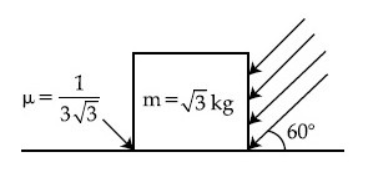
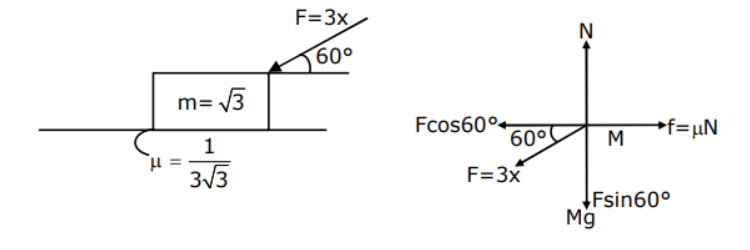
As shown in the figure, a block of mass \(\sqrt{3} \mathrm{~kg}\) is kept on a horizontal rough surface of coefficient of friction \(\frac{1}{3 \sqrt{3}}\). The critical force to be applied on the vertical surface as shown at an angle \(60^{\circ}\) with horizontal such that it does not move, will be \(3 x\). The value of \(x\) will be ____. [JEE Main 2021 (Online) 26th February Morning Shift]
\(
\left[\mathrm{g}=10 \mathrm{~m} / \mathrm{s}^2 ; \sin 60^{\circ}=\frac{\sqrt{3}}{2} ; \cos 60^{\circ}=\frac{1}{2}\right]
\) CorrectIncorrect
Hint
(a)

Step 1: Resolve the forces and apply equilibrium conditions
First, we resolve the applied force \(F\) into its horizontal and vertical components. The vertical component, \(F_y\), points downwards and the horizontal component, \(F_x\), points to the left. The weight of the block, \(W\), also points downwards, while the normal force, \(N\), points upwards. The maximum static friction force, \(f_s\), opposes the motion and points to the right.
The mass of the block is \(m=\sqrt{3} \mathrm{~kg}\), and the acceleration due to gravity is \(g=10 \mathrm{~m} / \mathrm{s}^2\).
The coefficient of friction is \(\mu=\frac{1}{3 \sqrt{3}}\).
The angle of the applied force is \(\theta=60^{\circ}\).
The components of the applied force are:
\(
\begin{gathered}
F_x=F \cos \left(60^{\circ}\right)=F\left(\frac{1}{2}\right)=\frac{F}{2} \\
F_y=F \sin \left(60^{\circ}\right)=F\left(\frac{\sqrt{3}}{2}\right)=\frac{\sqrt{3} F}{2}
\end{gathered}
\)
For the block to be in equilibrium, the sum of the forces in the vertical and horizontal directions must be zero ( \(\sum F_y=0\) and \(\sum F_x=0\) ).
Step 2: Calculate the normal force and friction
Sum of vertical forces:
\(
\begin{gathered}
\sum F_y=N-W-F_y=0 \\
N=W+F_y \\
N=m g+\frac{\sqrt{3} F}{2} \\
N=(\sqrt{3})(10)+\frac{\sqrt{3} F}{2}=10 \sqrt{3}+\frac{\sqrt{3} F}{2}
\end{gathered}
\)
The maximum static friction force is \(f_{s, \max }=\mu N\).
\(
\begin{aligned}
& f_{s, \max }=\frac{1}{3 \sqrt{3}}\left(10 \sqrt{3}+\frac{\sqrt{3} F}{2}\right) \\
& f_{s, \max }=\frac{10 \sqrt{3}}{3 \sqrt{3}}+\frac{\sqrt{3} F}{6 \sqrt{3}}=\frac{10}{3}+\frac{F}{6}
\end{aligned}
\)
Step 3: Determine the critical force
The block is on the verge of moving when the applied horizontal force component equals the maximum static friction force.
\(
\begin{gathered}
\sum F_x=f_{s, \max }-F_x=0 \\
f_{s, \max }=F_x \\
\frac{10}{3}+\frac{F}{6}=\frac{F}{2}
\end{gathered}
\)
To solve for \(\boldsymbol{F}\), multiply the entire equation by 6 to eliminate the fractions:
\(
\begin{gathered}
20+F=3 F \\
20=2 F \\
F=10 \mathrm{~N}
\end{gathered}
\)
The problem states that the critical force is \(3 x\). Therefore, we can set up the equation:
\(
\begin{array}{r}
3 x=10 \\
x=\frac{10}{3}
\end{array}
\) - Question 22 of 23
22. Question
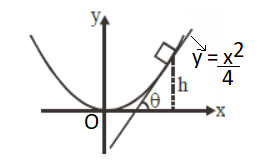
An inclined plane is bent in such a way that the vertical cross-section is given by \(y=\frac{x^2}{4}\) where y is in vertical and \(x\) in horizontal direction. If the upper surface of this curved plane is rough with coefficient of friction \(\mu=0.5\), the maximum height in cm at which a stationary block will not slip downward is _____ cm. [JEE Main 2021 (Online) 24th February Morning Shift]
CorrectIncorrectHint
(c)

At maximum ht. block will experience maximum friction force. Therefore if at this height slope of the tangent is \(\tan \theta\), then \(\theta=\) Angle of repose.
\(
\begin{aligned}
& \tan \theta=\frac{d y}{d x}=\frac{2 x}{4}=\frac{x}{2}=0.5 \\
& \Rightarrow \mathrm{X}=1 \text { and therefore } \mathrm{y}=\frac{x^2}{4}=0.25 \mathrm{~m} \\
& =25 \mathrm{~cm}
\end{aligned}
\)
(Assuming that \(\mathrm{x} \& \mathrm{y}\) in the equation are given in meter) - Question 23 of 23
23. Question
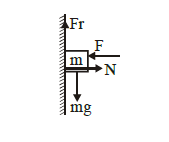
The coefficient of static friction between a wooden block of mass 0.5 kg and a vertical rough wall is 0.2. The magnitude of horizontal force that should be applied on the block to keep it adhere to the wall will be ______ \(\mathrm{N} .\left[\mathrm{g}=10 \mathrm{~ms}^{-2}\right]\) [JEE Main 2021 (Online) 24th February Morning Shift]
CorrectIncorrectHint
(a)

Since block is at rest therefore
\(
\mathrm{fr}-\mathrm{mg}=0 \dots(1)
\)
\(
F-N=0 \dots(2)
\)
\(\mathrm{fr} \leq \mu \mathrm{N}\)
In limiting case
\(
f r=\mu N=\mu F \dots(3)
\)
Using eq. (1) and (3)
\(
\therefore \mu \mathrm{F}=\mathrm{mg}
\)
\(
F=\frac{0.5 \times 10}{0.2}=25 \mathrm{~N}
\)Explanation: Step 1: Set up the equilibrium equations
For the block to remain adhered to the wall, it must be in equilibrium. The net force in both the horizontal and vertical directions must be zero.
Horizontal Equilibrium:
The applied force and the normal force are the only horizontal forces. For equilibrium, their magnitudes must be equal.
\(
N=F_{a p p}
\)
Vertical Equilibrium:
The gravitational force acts downwards, and the static friction force acts upwards. For the block not to slide down, the upward static friction force must be at least equal to the downward gravitational force.
\(
f_s \geq W
\)
The minimum horizontal force is required when the static friction force is at its maximum value.
\(
f_{s, \max }=W
\)
The maximum static friction is given by the formula \(f_{s, \max }=\mu_s N\). Therefore,
\(
\mu_s N=W 0
\)
Step 2: Calculate the required horizontal force
Using the equations from Step 1, we can solve for the minimum horizontal force, \(\boldsymbol{F}_{\boldsymbol{a} \boldsymbol{p} \boldsymbol{p}}\). First, calculate the weight of the block:
\(
W=m g=(0.5 \mathrm{~kg})\left(10 \mathrm{~m} / \mathrm{s}^2\right)=5 \mathrm{~N}
\)
Next, substitute this into the vertical equilibrium equation:
\(
\mu_s N=5 \mathrm{~N}
\)
The coefficient of static friction, \(\boldsymbol{\mu}_{s^{\prime}}\), is \(\mathbf{0 . 2}\).
\(
(0.2) N=5 \mathrm{~N}
\)
Solve for the normal force, \(N\) :
\(
N=\frac{5 \mathrm{~N}}{0.2}=25 \mathrm{~N}
\)
From the horizontal equilibrium, we know that \(F_{a p p}=N\). Therefore, the magnitude of the horizontal force that should be applied is:
\(
F_{a p p}=25 \mathrm{~N}
\)
The magnitude of the horizontal force that should be applied on the block to keep it adhered to the wall will be 25 N.