7.5 Acceleration due to gravity of the earth
The earth can be imagined to be a sphere made of a large number of concentric spherical shells with the smallest one at the centre and the largest one at its surface. A point outside the earth is obviously outside all the shells. Thus,all the shells exert a gravitational force at the point outside just as if their masses are concentrated at their common centre. The total mass of all the shells combined is just the mass of the earth. Hence, at a point outside the earth, the gravitational force is just as if its entire mass of the earth is concentrated at its centre.
For a point inside the earth, the situation is different. This is illustrated in Figure below.
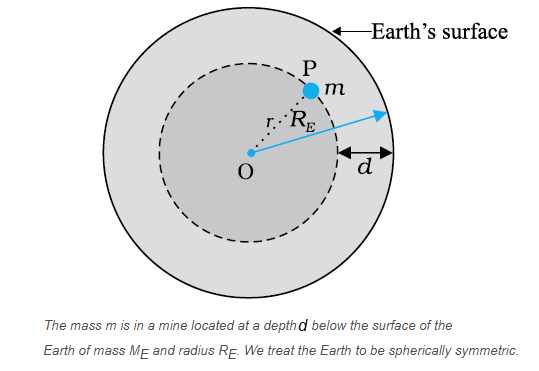
Again consider the earth to be made up of concentric shells as before and a point mass \(m\) situated at a distance \(r\) from the centre. The point \(P\) lies outside the sphere of radius \(r\). For the shells of radius greater than \(r\), the point \(P\) lies inside. Hence according to result stated in the last section, they exert no gravitational force on mass \(m\) kept at \(P\).
Case-I: Outside \(\left(r>R_E\right)\)
” According to the Shell Theorem, the entire mass of the Earth ( \(M_E\) ) acts as if it is concentrated at the center.
Derivation: The force on mass \(m\) at distance \(r\) is simply the standard inverse-square law:
\(
F=\frac{G M_E m}{r^2}
\)
As you move further away ( \(r\) increases), the force decreases.
Case-II: At the Surface ( \(r=R_E\) )
This case is the boundary between the two behaviors. By substituting \(r=R_E\) into the formula above:
\(
F=\frac{G M_E m}{R_E^2}
\)
Using Newton’s Second Law ( \(F=m g\) ), we find the acceleration due to gravity at the surface:
\(
g=\frac{G M_E}{R_E^2}
\)
Case-III: Inside ( \(r<R_E\) )
The Logic: As you noted, the “shells” above you exert zero net force. Only the mass \(M_{\text {in }}\) contained within the radius \(r\) pulls you downward.
The Mathematical Derivation:
Step 1: Enclosed Mass ( \(M_{\text {in }}\) ): Assuming uniform density \(\rho\) :
\(
M_{\text {in }}=\rho \cdot \text { Volume }=\rho \cdot \frac{4}{3} \pi r^3
\)
Step 2: Substitute into Force Law:
\(
F=\frac{G M_{i n} m}{r^2}=\frac{G\left(\rho_{\frac{4}{3}} \pi r^3\right) m}{r^2}
\)
Step 3: Simplify: The \(r^3\) in the numerator and \(r^2\) in the denominator cancel out, leaving:
\(
F=\left(\frac{4}{3} \pi G \rho m\right) \cdot r
\)
Since the terms in the parentheses are constant, \(F \propto r\).
Points Inside the Earth (The Shell Theorem):
Newton’s Shell Theorem simplifies gravity for spherically symmetric objects, stating that outside the object, its gravity acts as if all mass is at the center, while inside, the net gravitational force from the shell itself is zero, though for a solid sphere, the force from the inner mass increases linearly towards the center, explains Wikipedia. It’s crucial for astronomy, allowing
When a point is located at a distance \(r\) from the center such that \(r<R_{\text {E }}\) (as shown in figure Point P), we divide the Earth into two parts relative to that point:
The Inner Sphere:
The shells with radii smaller than \(r\). This “inner core” still acts as a point mass at the center, pulling you inward.
The Outer Shells:
The shells with radii larger than \(r\). According to the Shell Theorem, the net gravitational force exerted by a uniform spherical shell on an object inside it is zero.
Implications for Gravity Inside Earth
Because the outer shells cancel themselves out, only the mass interior to your current radius ( \(M_{\text {interior }}\) ) contributes to the gravitational force.
Mass is lost: As you go deeper, there is less mass “below” you to pull you down.
Distance decreases: You are getting closer to the center.
However, the loss of active mass happens faster than the gain from getting closer to the center. Consequently, gravity decreases linearly as you move toward the center of the Earth, eventually reaching zero at the very core.
Gravity Inside the Earth
To find the gravity at a point inside the Earth at a distance \(r\) from the center, you can imagine the Earth as a series of concentric “shells.”
(i) The Shells Above You: According to the second part of the theorem, all the layers of the Earth that are further from the center than you (the “shells” above your head) exert a net gravitational force of zero. Their pulls in different directions perfectly cancel out.
(ii) The Sphere Below You: You only feel the gravitational pull of the mass that is closer to the center than you are (the sphere with radius \(r\) ). This “inner sphere” acts like a point mass located at the Earth’s center.
Comparision Table:
\(
\begin{array}{|l|l|l|}
\hline \text { Position } & \text { Effective Mass } & \text { Force Calculation } \\
\hline \text { Outside }(r>R_E) & \text { Total Mass }(M) & \text { Follows Inverse Square Law }\left(1 / r^2\right) \\
\hline \begin{array}{l}
\text { At Surface }(r= R_E) \\
\end{array} & \text { Total Mass }(M) & \text { Maximum Gravity }\left(g \approx 9.8 \mathrm{~m} / \mathrm{s}^2\right) \\
\hline \text { Inside }(r<R_E) & \text { Only mass interior to } r & \text { Decreases linearly toward zero }(F \propto r) \\
\hline
\end{array}
\)
Relation between acceleration due to gravity ( \(g\) ) and gravitational constant ( \(G\) )
Suppose that the mass of the earth is \(M\), its radius is \(R\), then the force of attraction acting on a body of mass \(m\) close to the surface of the earth is
\(
F=\frac{G M m}{R^2}
\)
According to Newton’s second law, the acceleration| due to gravity,
\(
g=\frac{F}{m}=\frac{G M}{R^2} \dots(i)
\)
This expression is free from \(m\). It means acceleration due to gravity does not depend on the mass of the object, thus it is same for all. If in Eq. (i), we put the value of \(G\) as \(6.67 \times 10^{-11} \mathrm{~N}-\mathrm{m}^2 \mathrm{~kg}^{-2}, M\) as \(6 \times 10^{24} \mathrm{~kg}\) and \(R\) as \(6.4 \times 10^6 \mathrm{~m}\), then on solving it, we will get the value of \(g\) as \(9.8 \mathrm{~ms}^{-2}\).
If two bodies of different masses are allowed to fall freely, then they will have the same acceleration, i.e. if they are allowed to fall from the same height, then they will reach the earth simultaneously. The dimensions of acceleration due to gravity are \(\left[\mathrm{LT}^{-2}\right]\).
Note:
(i) The value of \(g\) is independent of mass, shape, size, etc., of the body and depends upon the mass and radius of the earth.
(ii) The value of \(g\) (acceleration due to gravity) on the Moon is roughly \(1 / 6\) that of Earth because the Moon has significantly less mass (about 1/81 of Earth) and a smaller radius (about \(1 / 4\) of Earth). According to the formula \(g=\frac{\boldsymbol{G} \boldsymbol{M}}{\boldsymbol{r}^2}\), the combined effect of lower mass and larger radius relative to mass results in a surface gravity of approximately \(1.62 \mathrm{~m} / \mathrm{s}^2\) compared to Earth’s \(9.8 \mathrm{~m} / \mathrm{s}^2\).
Example 1: The acceleration due to gravity at the moon’s surface is \(1.67 \mathrm{~ms}^{-2}\). If the radius of the moon is \(1.74 \times 10^6 \mathrm{~m}\), calculate the mass of the moon.
Solution: The acceleration due to gravity, \(g=\frac{G M}{R^2}\) or \(M=\frac{g R^2}{G}\)
This relation is true not only for the earth but also for any heavenly body which is assumed to be spherical.
Now, \(\quad g=1.67 \mathrm{~ms}^{-2}, R=1.74 \times 10^6 \mathrm{~m}\)
and \(G=6.67 \times 10^{-11} \mathrm{~N}-\mathrm{m}^2 \mathrm{~kg}^{-2}\)
∴ Mass of the moon, \(M=\frac{1.67 \times\left(1.74 \times 10^6\right)^2}{6.67 \times 10^{-11}} \mathrm{~kg}\)
\(
=7.58 \times 10^{22} \mathrm{~kg}
\)
Example 2: Assume that, if the earth were made of lead of relative density 11.3, then what would be the value of acceleration due to gravity on the earth’s surface?
Solution: Since, density of earth can be given as
\(
\rho=\text { Relative density } \text { × } \text { Density of water }=11.3 \times 10^3 \mathrm{kgm}^{-3}
\)
∴ Acceleration due to gravity on the earth’s surface,
\(
\begin{aligned}
g=\frac{G M}{R^2} & =\frac{G}{R^2} \cdot \frac{4}{3} \pi R^3 \cdot \rho=\frac{4}{3} \pi G R \cdot \rho \\
& =\frac{4}{3} \times \frac{22}{7} \times 6.67 \times 10^{-11} \times 6.4 \times 10^6 \times 11.3 \times 10^3 \\
& =20.21 \mathrm{~ms}^{-2}
\end{aligned}
\)
Example 3: What will be the relation between the acceleration due to gravity on the surface of the earth and on a planet respectively, whose mass and radius are four times that of the earth?
Solution: Let the acceleration due to gravity of the planet be \(g_p\).
As, \(g_p=\frac{G M_p}{R_p^2}\)
According to the question,
Mass of planet, \(\quad M_p=4 M_e\)
and radius of planet,
\(
R_p=4 R_e
\)
\(
\therefore \quad g_p=\frac{G 4 M_e}{16 R_e^2}
\)
\(
\therefore \quad g_p=\frac{1}{4} g_e \quad\left(\because g_e=\frac{G M_e}{R_e^2}\right)
\)
Variation in the value of acceleration due to gravity (\(g\))
The value of acceleration due to gravity varies due to following factors
(i) Height above the surface of earth
(ii) Depth below the surface of earth
(iii) Shape of the earth
(iv) Axial rotation of the earth