1.2 Notions of work and kinetic energy : The work-energy theorem
Work-energy theorem
The work-energy theorem states that the net work done on an object is equal to the change in its kinetic energy ( \(W_{\text {net }}=\Delta KE\) ). This means that if you do work on an object, you are changing its energy, and if you calculate the total work done by all forces (conservative or non-conservative, external or internal), you can find the object’s final kinetic energy.
\(
\begin{array}{ll}
\therefore & W_{\text {net }}=\Delta \mathrm{KE}=K_f-K_i \\
& W_{\text {net }}=\frac{1}{2} m\left(v_f^2-v_i^2\right)
\end{array}
\)
\(W_{n e t}\) is the net work done by all forces.
\(K_f\) is the final kinetic energy.
\(K_i\) is the initial kinetic energy.
\(v_f\) is the final velocity.
\({v}_i\) is the initial velocity.
\(
\Rightarrow \quad W_{\text {conservative }}+W_{\text {non-conservative }}+W_{\text {ext.force }}=\Delta \mathrm{KE}
\)
If \(W_{\text {net }}\) is positive, then kinetic energy will increase and vice-versa. Thus, the work done on a particle by the resultant force is equal to the change in its kinetic energy. This is called the work-energy theorem.
Kinetic Energy:
This is the energy an object possesses due to its motion. The formula for kinetic energy is \(K=\frac{1}{2} m v^2\), where ‘ \(m\) ‘ is the mass and ‘ \(v\) ‘ is the velocity.
Derivation Work Energy Theorem Formula:
The work done by the force \(\vec{F}\) on the particle during the small displacement \(d \vec{r}\) is:
\(\vec{F} \cdot d \vec{r}=F d r \cos \theta\)
The work done on the particle by a force \(\vec{F}\) acting on it during a finite displacement is obtained by
\(W_{n e t}=W=\int \vec{F} \cdot d \vec{r}=\int F \cos \theta d r \dots (1)\)
where the integration is to be performed along the path of the particle.
We are now familiar with the concepts of work and kinetic energy to prove the work-energy theorem for a variable force. We confine ourselves to one dimension. The time rate of change of kinetic energy is
\(\frac{d KE}{d t}=\frac{d}{d t}\left(\frac{1}{2} m v^{2}\right)=m v \frac{d v}{d t}=F_{t} v\)
where \(F_{t}\) is the resultant tangential force (the tangential (parallel) force is used because only the component of the force parallel to the direction of velocity can change the object’s speed, and kinetic energy is solely dependent on speed (magnitude of velocity)). If the resultant force \(\vec{F}\) makes an angle \(\theta\) with the velocity,
\(
\begin{array}{l}
F_{t}=F \cos \theta \text { and } \frac{d KE}{d t}=F v \cos \theta=\vec{F} \cdot \vec{v}=\vec{F} \cdot \frac{d \vec{r}}{d t} \\
\text { or, } \quad d KE=\vec{F} \cdot d \vec{r} \dots (2)
\end{array}
\)
If \(\vec{F}\) is the resultant force on the particle we can use equation (2) to get
\(
W_{n e t}=\int \vec{F} \cdot d \vec{r}=\int d KE=K_{f}-K_{i} .
\)
where \(K_{i}\) and \(K_{f}\) are respectively the initial and final kinetic energies of the particle. Thus, the work done on a particle by the resultant force is equal to the change in its kinetic energy. This is called the work-energy theorem.
Let \(\vec{F}_{1}, \vec{F}_{2}, \vec{F}_{3}, \ldots\) be the individual forces acting on a particle. The resultant force is \(\vec{F}=\vec{F}_{1}+\vec{F}_{2}+\vec{F}_{3} \ldots\), and the work done by the resultant force on the particle is
\(
\begin{aligned}
W &=\int \vec{F} \cdot d \vec{r} \\
&=\left(\vec{F}_{1}+\vec{F}_{2}+\vec{F}_{3} \ldots \ldots\right) \cdot d \vec{r} \\
&=\int \vec{F}_{1} \cdot d \vec{r}+\int \vec{F}_{2} \cdot d \vec{r}+\int \vec{F}_{3} \cdot d \vec{r} \ldots
\end{aligned}
\)
where \(\int \vec{F}_{1} \cdot d \vec{r}\) is the work done on the particle by \(\vec{F}_{1}\) and so on. Thus, the work done by the resultant force is equal to the sum of the work done by the individual forces.
Example 1: A block of mass \(m=1 \mathrm{~kg}\), moving on a horizontal surface with speed \(v_{i}=2 \mathrm{~m} \mathrm{~s}^{-1}\) enters a rough patch ranging from \(x=0.10 \mathrm{~m}\) to \(x=2.01 \mathrm{~m}\). The retarding force \(F_{r}\) on the block in this range is inversely proportional to \(x\) over this range,
\(F_{r}=\frac{-k}{x} \text { for } 0.1<x<2.01 \mathrm{~m}\)
\(=0\) for \(x<0.1 \mathrm{~m}\) and \(x>2.01 \mathrm{~m}\) where \(k=0.5 \mathrm{~J}\). What is the final kinetic energy and speed \(v_{f}\) of the block as it crosses this patch?
Solution: From Equation \(K_{f}-K_{i}=\int_{x_{i}}^{x_{f}} F \mathrm{~d} x\)
\(
\begin{array}{l}
K_{f}=K_{i}+\int_{0.1}^{2.01} \frac{(-k)}{x} \mathrm{~d} x \\
=\frac{1}{2} m v_{i}^{2}-\left.k \ln (x)\right|_{0.1} ^{2.01} \\
=\frac{1}{2} m v_{i}^{2}-k \ln (2.01 / 0.1) \\
=2-0.5 \ln (20.1) \\
=2-1.5=0.5 \mathrm{~J} \\
v_{f}=\sqrt{2 K_{f} / m}=1 \mathrm{~m} \mathrm{~s}^{-1}
\end{array}
\)
Example 2: It is well known that a raindrop falls under the influence of the downward gravitational force and the opposing resistive force. The latter is known to be proportional to the speed of the drop but is otherwise undetermined. Consider a drop of mass \(1.00 \mathrm{~g}\) falling from a height \(1.00 \mathrm{~km}\). It hits the ground with a speed of \(50.0 \mathrm{~m} \mathrm{~s}^{-1}\). (a) What is the work done by the gravitational force? What is the work done by the unknown resistive force?
Solution: (a) The change in kinetic energy of the drop is
\(
\begin{aligned}
& \Delta K=\frac{1}{2} m v^2-0 \\
& =\frac{1}{2} \times 10^{-3} \times 50 \times 50 \\
& =1.25 \mathrm{~J}
\end{aligned}
\)
where we have assumed that the drop is initially at rest.
Assuming that \(g\) is a constant with a value \(10 \mathrm{~m} / \mathrm{s}^2\), the work done by the gravitational force is,
\(
\begin{aligned}
W_g & =m g h \\
& =10^{-3} \times 10 \times 10^3 \\
& =10.0 \mathrm{~J}
\end{aligned}
\)
(b) From the work-energy theorem
\(
\Delta K=W_g+W_r
\)
where \(W_r\) is the work done by the resistive force on the raindrop. Thus
\(
\begin{aligned}
W_r & =\Delta K-W_g \\
& =1.25-10 \\
& =-8.75 \mathrm{~J}
\end{aligned}
\)
is negative.
Example 3: A particle of mass 20 g is thrown vertically upwards with a speed of \(10 \mathrm{~m} / \mathrm{s}\). Find the work done by the force of gravity during the time the particle goes up.
Solution: Suppose the particle reaches a maximum height \(h\). As the velocity at the highest point is zero, we have
\(
\begin{aligned}
& 0=u^2-2 g h \\
& h=\frac{u^2}{2 g} .
\end{aligned}
\)
We know \(W=F d \cos (\theta)\)
The force of gravity \(\left(\mathbf{F}_{\mathbf{g}}\right)\) acts vertically downward with a magnitude of \(m g\).
For an object moving upward, the displacement (\(d\)) is vertically upward by a distance \(h\).
Angle Between Vectors: The angle ( \(\boldsymbol{\theta}\) ) between the downward gravitational force ector and the upward displacement vector is \(180^{\circ}\).
\(
W_g=(m g)(h) \cos \left(180^{\circ}\right)=m g h(-1)=-m g h
\)
The work done by the force of gravity is
\(
\begin{aligned}
& -m g h=-m g \frac{u^2}{2 g}=-\frac{1}{2} m u^2 \\
& =-\frac{1}{2}(0.02 \mathrm{~kg}) \times(10 \mathrm{~m} / \mathrm{s})^2=-1.0 \mathrm{~J}
\end{aligned}
\)
The work done by gravity is negative because the force of gravity acts in the opposite direction to the displacement of the particle as it moves upwards. This is a characteristic of a resistive force doing work on an object, which removes kinetic energy from the particle during its ascent.
Note: The work done by the force of gravity is negative because the force of gravity (acting downwards) is in the opposite direction to the object’s upward displacement, causing the object to slow down and lose kinetic energy as it gains height. The equation \(\mathbf{W}_{\mathbf{g}}=-\mathbf{m g h}\) specifically describes the work done by gravity as an object moves upward by a positive height \(h\).
Example 4: The position \((x)\) of a particle of mass 1 kg moving along \(X\)-axis at time \(t\) is given by \(\left(x=\frac{1}{2} t^2\right)\) metre.
Find the work done by force acting on it in time interval \(t=0\) to \(t=3 \mathrm{~s}\).
Solution: Given, \(x=\frac{1}{2} t^2\)
\(
\begin{array}{ll}
\Rightarrow & v=\frac{d x}{d t}=\frac{1}{2}(2 t)=t \\
\therefore & \text { At } t=0, v_i=0 \\
\Rightarrow & \text { At } t=3 \mathrm{~s}, v_f=3 \mathrm{~ms}^{-1}
\end{array}
\)
According to work-energy theorem,
\(
\begin{aligned}
W & =\Delta K=K_f-K_i=\frac{1}{2} m v_f^2-\frac{1}{2} m v_i^2 \\
& =\left(\frac{1}{2} \times 1 \times 3^2\right)-\left(\frac{1}{2} \times 1 \times 0^2\right)=4.5 \mathrm{~J}
\end{aligned}
\)
Example 5: A bullet weighing 10 g is fired with a velocity \(800 \mathrm{~ms}^{-1}\). After passing through a mud wall 1 m thick, its velocity decreases to \(100 \mathrm{~ms}^{-1}\). Find the average resistance offered by the mud wall.
Solution: According to work-energy theorem, work done by the average resistance offered by the wall \(=\) change in kinetic energy of the bullet.
\(
\begin{aligned}
& \therefore \quad W=F \cdot s=\frac{1}{2} m v^2-\frac{1}{2} m u^2 \\
& \Rightarrow \quad F=\frac{m\left(v^2-u^2\right)}{2 s}=\frac{0.01\left(100^2-800^2\right)}{2 \times 1}=-3150 \mathrm{~N} \\
& \Rightarrow \quad \text { Resistance offered }=3150 \mathrm{~N}
\end{aligned}
\)
Example 6: An object of mass 5 kg falls from rest through a vertical distance of 20 m and attains a velocity of \(10 \mathrm{~ms}^{-1}\). How much work is done by the resistance of the air on the object? (Take, \(g=10 \mathrm{~ms}^{-2}\) )
Solution: Applying work-energy theorem, work done by all the forces \(=\) change in kinetic energy
\(
\begin{aligned}
W_{m g}+W_{\text {air }} & =\frac{1}{2} m v^2 \\
W_{\text {air }} & =\frac{1}{2} m v^2-W_{m g}=\frac{1}{2} m v^2-m g h \\
& =\frac{1}{2} \times 5 \times(10)^2-(5) \times(10) \times(20) \\
& =-750 \mathrm{~J}
\end{aligned}
\)
Example 7: A particle of mass \(m\) moves with velocity \(v=a \sqrt{x}\), where \(a\) is a constant. Find the total work done by all the forces during a displacement from \(x=0\) to \(x=d\).
Solution: Work done by all forces,
\(
W=\Delta \mathrm{KE}=\frac{1}{2} m v_2^2-\frac{1}{2} m v_1^2
\)
Here, \(v_1=a \sqrt{0}=0, v_2=a \sqrt{d}\)
So, \(\quad W=\frac{1}{2} m a^2 d-0=\frac{1}{2} m a^2 d\)
Example 8: A vehicle of mass \(m\) is moving in \(x\)-direction with a constant speed. It is subjected to a retarding force \(F=-0.1 x \mathrm{Jm}^{-1}\) during its travel from \(x=20 \mathrm{~m}\) to \(x=30 m\). Evaluate the change in its kinetic energy.
Solution: According to work-energy theorem, work done \(=\) change in kinetic energy of the vehicle
\(
\begin{array}{lc}
\therefore & W=K_f-K_i \text { or } F \cdot d x=K_f-K_i \\
\text { or } & \int_{x=20}^{x=30}(-0.1) x d x=K_f-K_i \\
\text { or } & -0.1\left[\frac{x^2}{2}\right]_{x=20}^{x=30}=K_f-K_i \\
\text { or } & -0.1\left[\frac{(30)^2}{2}-\frac{(20)^2}{2}\right]=K_f-K_i \\
\text { or } & K_f-K_i=-0.1(450-200) \\
\therefore & K_f-K_i=-25 \mathrm{~J}
\end{array}
\)
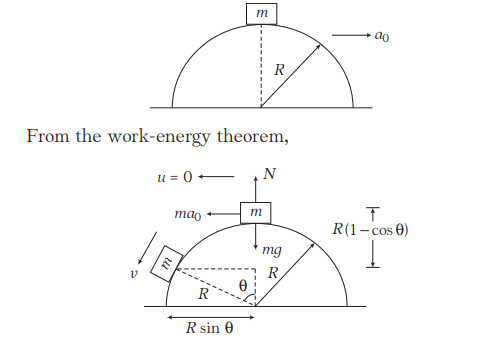
Example 9: A block is placed at the top of a smooth hemisphere of radius \(R\). Now, the hemisphere is given a horizontal acceleration \(a_0\). Find the velocity of the block relative to the hemisphere as a function of \(\theta\) as it slides down.
Solution: Step 1: Analyze forces and motion in the non-inertial frame:
We analyze the motion in the non-inertial frame of the hemisphere, which has a horizontal acceleration \(a_0\). In this frame, a pseudo force \(F_p=m a_0\) acts on the block in the direction opposite to the hemisphere’s acceleration.
The forces acting on the block are the gravitational force \(\boldsymbol{m}\) g (vertically downward), the normal force \(N\) (radially outward from the block’s perspective), and the pseudo force \(m a_0\) (horizontally, opposite to \(a_0\) ). The net force component tangential to the hemisphere’s surface causes the block to accelerate.
Step 2: Apply the work-energy theorem:
The work done by all forces (gravity, pseudo force) is equal to the change in the block’s kinetic energy relative to the hemisphere. The normal force does no work as it is perpendicular to the relative velocity.
The vertical displacement is \(h=R(1-\cos \theta)\) and the horizontal displacement is \(\boldsymbol{x}=\boldsymbol{R} \sin \theta\). The pseudo force \(\boldsymbol{F}_{\boldsymbol{p}}\) acts in the direction of horizontal displacement (assuming \(a_0\) is in the direction opposite to the positive \(x\) -axis used for \(\boldsymbol{\theta}\) measurement, which is a common setup).
Work done by gravity: \(W_g=m g h=m g R(1-\cos \theta)\).
Work done by the pseudo force: \(W_p=F_p x=m a_0 R \sin \theta\).
The change in kinetic energy is \(\Delta KE=\frac{1}{2} m v^2-0\), since the block starts from rest relative to the hemisphere.
Step 3: Solve for the velocity:
Applying the work-energy theorem \(W_{\text {net }}=\Delta KE\) :
\(
W_{g}+W_p=\Delta K
\)
\(
m g R(1-\cos \theta)+m a_0 R \sin \theta=\frac{1}{2} m v^2
\)
We can cancel the mass \(m\) from the equation and solve for \(\boldsymbol{v}^2\) :
\(
\begin{aligned}
v^2 & =2 g R(1-\cos \theta)+2 a_0 R \sin \theta \\
v^2 & =2 R\left(g(1-\cos \theta)+a_0 \sin \theta\right)
\end{aligned}
\)
Taking the square root gives the velocity of the block relative to the hemisphere:
\(
v=\sqrt{\left.2 R\left\{g(1-\cos \theta)+a_0 \sin \theta\right)\right\}}
\)
The work done by normal reaction \(N\) is zero because it is always perpendicular to displacement.