7.8 Escape speed
Binding Energy
The minimum energy required to take a particle to an infinite distance from the earth is called the binding energy of the earth particle system.
Binding energy of a particle on the surface of the earth
Suppose the mass \(m\) is placed on the surface of earth. The radius of the earth is \(R\) and its mass is \(M\). Then, the kinetic energy of the particle, \(KE=0\) (“placed on the surface” implies that the object has no initial velocity, \(v=0\)) and potential energy of the particle is \(U=-\frac{G M m}{R}\).
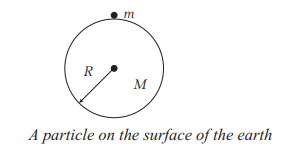
Therefore, the total mechanical energy of the particle,
\(
\begin{aligned}
& E=KE+U=0-\frac{G M m}{R} \\
& E=-\frac{G M m}{R}
\end{aligned}
\)
\(\therefore \quad\) Binding energy, \(\mathrm{BE}=|E|=\frac{G M m}{R}\)
Due to binding energy, the particle is attached to the earth. If this much energy is supplied to the particle in any form (normally kinetic) the particle no longer remains bound to the earth. It goes out of the gravitational field of earth.
Example 1: Find the binding energy of a particle of mass \(m\) on the surface of earth in term of g. (Here, \(R=\) radius of earth and \(g=\) acceleration due to gravity)
Solution: As, binding energy \(=-E=\frac{G M m}{R}\)
But \(g=\frac{G M}{R^2} \Rightarrow \quad G M=g R^2\)
\(
\therefore \quad \text { Binding energy }=|E|=\frac{g m R^2}{R}=m g R
\)
Escape velocity
The minimum velocity with which a body must be projected vertically upwards in order that it may just escape the gravitational field of the earth (i.e. \(v=0\) ) is called escape velocity. The ” \({v}={0}\) ” in escape velocity refers to the object’s final velocity at an infinite distance, meaning it just barely stops, having used all its initial kinetic energy to overcome Earth’s gravity and reach a point where gravity can’t pull it back; it’s the boundary condition where total energy (kinetic + potential) becomes zero, ensuring it reaches “infinity” with no speed left.
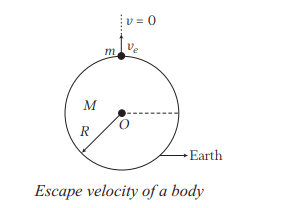
A body projected from the surface of the earth with speed \(v_e\), such that \(v_f=v=0\).
As we have discussed that the binding energy of a particle on the surface of earth kept at rest is \(G M m / R\). If this much energy in the form of kinetic energy is supplied to the particle, it leaves the gravitational field of the earth. So, if \(v_e\) is the escape velocity of the particle, then from conservation of mechanical energy, we have
\(
\frac{1}{2} m v_e^2=\frac{G M m}{R}
\)
\(
v_e=\sqrt{\frac{2 G M}{R}} \dots(i)
\)
\(
\begin{array}{ll}
\text { As, } & g=\frac{G M}{R^2} \\
\Rightarrow & v_e=\sqrt{2 g R}
\end{array}
\)
Substituting the value of \(g\left(=9.8 \mathrm{~ms}^{-2}\right)\) and \(R\left(=6.4 \times 10^6 \mathrm{~m}\right)\), we get
\(
v_e \approx 11.2 \mathrm{kms}^{-1}
\)
Thus, the minimum velocity needed to take a particle infinitely away from the earth is called the escape velocity. On the surface of earth, its value is \(11.2 \mathrm{kms}^{-1}\).
From Eq. (i), \(\quad v_e=\sqrt{\frac{2 G}{R} \times \frac{4}{3} \pi R^3 \times \rho}\) where, \(\rho\) is the mean density of the earth.
Escape velocity, \(v_e=R \sqrt{\frac{8}{3} \pi G \rho}\)
Example 1: Calculate the escape velocity from the surface of a planet of mass \(14.8 \times 10^{22} \mathrm{~kg}\). It is given that radius of the planet is \(3.48 \times 10^6 \mathrm{~m}\).
Solution: Given, mass of planet,
\(
M_p=14.8 \times 10^{22} \mathrm{~kg}
\)
and radius of the planet,
\(
R_p=3.48 \times 10^6 \mathrm{~m}
\)
Escape velocity from the surface of planet,
\(
v_e=\sqrt{\frac{2 G M_p}{R_p}}
\)
Substituting the values, we get
\(
\begin{aligned}
v_e & =\sqrt{\frac{2 \times 6.67 \times 10^{-11} \times 14.8 \times 10^{22}}{3.48 \times 10^6}} \\
& =2.4 \times 10^3 \mathrm{~ms}^{-1} \text { or } 2.4 \mathrm{kms}^{-1}
\end{aligned}
\)
Example 2: The ratio of the masses and radii of two planets are \(4: 6\) and \(8: 18\). What is the ratio of the escape velocity at their surfaces?
Solution: Given, \(\frac{M_1}{M_2}=\frac{4}{6}=\frac{2}{3}\) and \(\frac{R_1}{R_2}=\frac{8}{18}=\frac{4}{9}\)
As we know, escape velocity, \(v=\sqrt{\frac{2 G M}{R}}\)
\(
\begin{aligned}
& \therefore \quad \begin{aligned}
\frac{v_1}{v_2} & =\sqrt{\frac{M_1}{M_2} \times \frac{R_2}{R_1}} \\
& =\sqrt{\frac{2}{3} \times \frac{9}{4}}=\sqrt{\frac{3}{2}} \\
\text { Hence, } \quad v_1 & : v_2=\sqrt{3}: \sqrt{2}
\end{aligned}
\end{aligned}
\)
Example 3: Jupiter has a mass 318 times that of earth, and its radius is 11.2 times the earth’s radius. Estimate the escape velocity of a body from Jupiter’s surface, given that the escape velocity from the earth’s surface is \(11.2 \mathrm{kms}^{-1}\).
Solution: Escape velocity from the earth’s surface is
\(
v_e=\sqrt{\frac{2 G M}{R}}=11.2 \mathrm{kms}^{-1}
\)
Escape velocity from jupiter’s surface will be
\(
v_e=\sqrt{\frac{2 G M^{\prime}}{R^{\prime}}}
\)
Given, \(M^{\prime}=318 M\) and \(R^{\prime}=11.2 R\)
\(
\begin{aligned}
\therefore \quad v_e^{\prime} & =\sqrt{\frac{2 G(318 M)}{11.2 R}}=\sqrt{\frac{2 G M}{R} \times \frac{318}{11.2}} \\
& =v_e^{\prime} \times \sqrt{\frac{318}{11.2}}=11.2 \times \sqrt{\frac{318}{11.2}} \\
\Rightarrow \quad v_e^{\prime} & =59.7 \mathrm{kms}^{-1}
\end{aligned}
\)
Example 4: At what temperature, hydrogen molecules will escape from the earth’s surface? (Take, radius of earth \(R_e=6.4 \times 10^6 \mathrm{~m}\), mass of hydrogen molecule, \(m=0.34 \times 10^{-26} \mathrm{~kg}\), Boltzmann constant \(k=1.38 \times 10^{-23} J K^{-1}\), acceleration due to gravity \(=9.8 m s^{-2}\) and rms speed of gas as \(v_{r m s}=\sqrt{\frac{3 k T}{m}}\))
Solution: The root-mean-square-velocity of gas is \(v_{\text {rms }}=\sqrt{\frac{3 k T}{m}} \dots(i)\)
Escape velocity of gas molecules is \(v_e=\sqrt{2 g R_e} \dots(ii)\)
As the root-mean-square velocity of gas molecules must be equal to the escape velocity.
\(
\begin{aligned}
& \therefore \text { From Eqs. (i) and (ii), } \sqrt{\frac{3 k T}{m}}=\sqrt{2 g R_e} \\
& \Rightarrow \quad T=\frac{2 g R_e m}{3 k} \\
& \Rightarrow \quad T=\frac{2 \times 9.8 \times 6.4 \times 10^6 \times 0.34 \times 10^{-26}}{3\left(1.38 \times 10^{-23}\right)} \approx 10^4 \mathrm{~K}
\end{aligned}
\)
Therefore, \(10^4 \mathrm{~K}\) is the temperature at which hydrogen molecules will escape from earth’s surface.
Escape energy
Minimum energy given to a particle in form of kinetic energy, so that it can escape from earth’s gravitational field, is called escape energy.
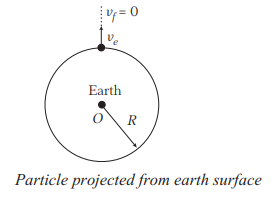
\begin{aligned}
&\text { Escape energy }=\frac{G M m}{R}\\
&\text { If escape velocity is } v_e \text {, then }\\
&\text { Escape energy }=\frac{1}{2} m v_e^2
\end{aligned}
\)
Example 5: A body is projected upwards with a velocity of \(4 \times 11.2 \mathrm{~km} \mathrm{~s}^{-1}\) from the surface of earth. What will be the velocity of the body when it escapes from the gravitational pull of earth?
Solution: To find the final velocity of the body after it escapes Earth’s gravitational pull, we use the principle of Conservation of Energy.
Step 1: Identify the Given Values
Escape Velocity \(\left(v_e\right): 11.2 \mathrm{~km} \mathrm{~s}^{-1}\)
Projection Velocity \(\left(v_i\right): 4 \times 11.2 \mathrm{~km} \mathrm{~s}^{-1}=4 v_e\)
Final Velocity \(\left(v_f\right)\) : The velocity at an infinite distance (once it has escaped).
Step 2: The Physics Principle
The total energy at the Earth’s surface must equal the total energy at infinity.
At the surface, the body has both kinetic energy and negative gravitational potential energy. At infinity (the point of escape), the potential energy is zero.
\(
K_i+U_i=K_f+U_f
\)
Substituting the formulas:
\(
\frac{1}{2} m v_i^2-\frac{G m M}{R}=\frac{1}{2} m v_f^2+0
\)
We know that the energy required to just reach escape velocity is \(\frac{1}{2} m v_e^2=\frac{G m M}{R}\). Substituting this back into the equation:
\(
\frac{1}{2} m v_i^2-\frac{1}{2} m v_e^2=\frac{1}{2} m v_f^2
\)
Step 3: Solving for \(v_f\)
The mass \(m\) cancels out, and we can simplify the equation to:
\(
\begin{gathered}
v_f^2=v_i^2-v_e^2 \\
v_f=\sqrt{v_i^2-v_e^2}
\end{gathered}
\)
Now, substitute \(v_i=4 v_e\) :
\(
\begin{gathered}
v_f=\sqrt{\left(4 v_e\right)^2-v_e^2} \\
v_f=\sqrt{16 v_e^2-v_e^2} \\
v_f=\sqrt{15 v_e^2} \\
v_f=v_e \sqrt{15}
\end{gathered}
\)
Now, plug in the value for \(v_e\) :
\(
v_f=11.2 \times \sqrt{15}
\)
Since \(\sqrt{15} \approx 3.873\) :
\(
v_f \approx 11.2 \times 3.873 \approx 43.38 \mathrm{~km} \mathrm{~s}^{-1}
\)
Example 6: The earth is assumed to be a sphere of radius \(R\). A platform is arranged at a height \(R\) from the surface of the earth. The escape velocity of a body from this platform is \(f v_e\), where \(v_e\) is its escape velocity from the surface of the earth. Find the value of \(f\).
Solution: For a platform at a height \(h\), escape energy = binding energy of platform
\(
\Rightarrow \quad \frac{1}{2} m v_e^{\prime 2}=\frac{G M m}{R+h} \Rightarrow v_e^{\prime}=\sqrt{\frac{2 G M}{R+h}}=\sqrt{\frac{2 G M}{2 R}} \quad(\because h=R)
\)
But at surface of earth, \(v_e=\sqrt{\frac{2 G M}{R}}\)
As given,
\(
v_e^{\prime}=f v_e
\)
Hence,
\(
\sqrt{\frac{2 G M}{2 R}}=f \sqrt{\frac{2 G M}{R}} \text { or } \frac{1}{2 R}=\frac{f^2}{R} \Rightarrow f=\frac{1}{\sqrt{2}}
\)
Maximum height attained by a particle
Suppose a particle of mass \(m\) is projected vertically upwards with a speed \(v\) and we want to find the maximum height \(h\) attained by the particle.
Energy Change: When a conservative force does positive work, the potential energy of the system decreases. Starting from \(U=0\) at infinity and decreasing the energy as the object moves closer means the potential energy \(U_s\) at any finite distance \(R\) (such as the surface) must be a negative value, as described by the general formula \(U=-\frac{G m M}{R}\).
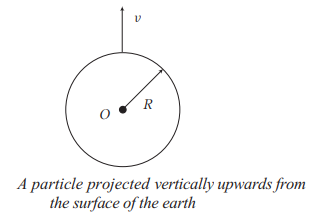
We use the Law of Conservation of Mechanical Energy: (decrease in kinetic energy = increase in gravitational potential energy of particle)
Total Energy at Surface \(=\) Total Energy at Max Height
Step 1: Identify the Energy States
At the Surface \((r=R)\) :
Kinetic Energy: \(K_s=\frac{1}{2} m v^2\)
Potential Energy: \(U_s=-\frac{G m M}{R}\)
At Max Height ( \(r=R+h\) ):
Kinetic Energy: \(K_h=0\) (The particle stops momentarily at the peak)
Potential Energy: \(U_h=-\frac{G m M}{R+h}\)
Step 2: Set Up the Equation
\(
\frac{1}{2} m v^2-\frac{G m M}{R}=0-\frac{G m M}{R+h}
\)
Rearranging to group the potential energy terms:
\(
\frac{1}{2} m v^2=\frac{G m M}{R}-\frac{G m M}{R+h}
\)
Step 3: Simplify Using \(\boldsymbol{g}\)
Recall that the acceleration due to gravity at the surface is \(g=\frac{G M}{R^2}\), which means \(G M= g R^2\). Substituting this:
\(
\frac{1}{2} m v^2=m\left(g R^2\right)\left[\frac{1}{R}-\frac{1}{R+h}\right]
\)
Divide both sides by \(m\) and find a common denominator for the bracket:
\(
\begin{gathered}
\frac{1}{2} v^2=g R^2\left[\frac{(R+h)-R}{R(R+h)}\right] \\
\frac{v^2}{2}=g R^2\left[\frac{h}{R(R+h)}\right] \\
\frac{v^2}{2}=\frac{g R h}{R+h}
\end{gathered}
\)
Step 4: Solve for \(h\)
To isolate \(h\), we can flip the equation or cross-multiply:
\(
\begin{aligned}
& v^2(R+h)=2 g R h \\
& v^2 R+v^2 h=2 g R h \\
& v^2 R=2 g R h-v^2 h \\
& v^2 R=h\left(2 g R-v^2\right)
\end{aligned}
\)
Finally:
\(
h=\frac{v^2 R}{2 g R-v^2}
\)
This can also be written in the form you shared by dividing the numerator and denominator by \(R\) :
\(
h=\frac{v^2}{2 g-\frac{v^2}{R}}
\)
Summary of Trajectories:
\(\begin{array}{|l|l|l|l|l|}
\hline \text { Case } & \begin{array}{l}
\text { Launch } \\
\text { Velocity (v) }
\end{array} & \begin{array}{l}
\text { Total } \\
\text { Energy (E) }
\end{array} & \begin{array}{l}
\text { Trajectory } \\
\text { Shape }
\end{array} & \text { Final Fate } \\
\hline \text { (i) } & v=v_e & E=0 & \text { Parabola } & \begin{array}{l}
\text { Escapes; velocity becomes } \\
\text { zero at infinity. }
\end{array} \\
\hline \text { (ii) } & v<v_e & E<0 & \text { Ellipse } & \begin{array}{l}
\text { Bound; either orbits or falls } \\
\text { back to the surface. }
\end{array} \\
\hline \text { (iii) } & v>v_e & E>0 & \text { Hyperbola } & \begin{array}{l}
\text { Escapes; retains excess } \\
\text { “interstellar” velocity. }
\end{array} \\
\hline
\end{array}
\)
Example 7: A particle is projected from the surface of earth with an initial speed of \(4 \mathrm{~km} / \mathrm{s}\). Find the maximum height attained by the particle. (Take, radius of earth \(=6400 \mathrm{~km}\) and \(\mathrm{g}=9.8 \mathrm{~m} / \mathrm{s}^2\) )
Solution: The maximum height attained by the particle is, \(h=\frac{v^2}{2 g-\frac{v^2}{R}}\)
Substituting the values, we get
\(
h=\frac{\left(4 \times 10^3\right)^2}{2 \times 9.8-\frac{\left(4.0 \times 10^3\right)^2}{6.4 \times 10^6}}=9.35 \times 10^5 \mathrm{~m} \text { or } h \approx 935 \mathrm{~km}
\)
Example 8: A particle is projected vertically upwards from the surface of the earth (radius \(R_e\) ) with a speed equal to one-fourth of escape velocity. What is the maximum height attained by it from the surface of the earth?
Solution: To find the maximum height attained by a particle projected with one-fourth of the escape velocity, we use the principle of Conservation of Mechanical Energy.
Step 1: Identify Initial and Final States
At the Surface ( \(r=R_e\) ):
Velocity: \(v=\frac{1}{4} v_e\)
Escape Velocity Formula: \(v_e=\sqrt{\frac{2 G M}{R_e}}\)
Kinetic Energy \(\left(K_i\right): \frac{1}{2} m v^2=\frac{1}{2} m\left(\frac{v_e}{4}\right)^2=\frac{1}{2} m\left(\frac{2 G M}{16 R_e}\right)=\frac{G m M}{16 R_e}\)
Potential Energy \(\left(U_i\right):-\frac{G m M}{R_e}\)
At Maximum Height \(\left(r=R_e+h\right)\) :
Kinetic Energy \(\left(K_f\right)\) : 0 (The particle momentarily stops at the peak)
Potential Energy \(\left(U_f\right):-\frac{G m M}{R_e+h}\)
The total energy at the surface must equal the total energy at the maximum height:\(K_i+U_i=K_f+U_f\)
\(
\frac{G m M}{16 R_e}-\frac{G m M}{R_e}=0-\frac{G m M}{R_e+h}
\)
Step 3: Simplify and Solve for \(h\)
Divide the entire equation by \(G m M\) :
\(
\frac{1}{16 R_e}-\frac{1}{R_e}=-\frac{1}{R_e+h}
\)
Combine the terms on the left side:
\(
\begin{aligned}
& \frac{1-16}{16 R_e}=-\frac{1}{R_e+h} \\
& -\frac{15}{16 R_e}=-\frac{1}{R_e+h}
\end{aligned}
\)
Take the reciprocal of both sides:
\(
\frac{16 R_e}{15}=R_e+h
\)
Now, isolate \(h\) :
\(
\begin{aligned}
h & =\frac{16 R_e}{15}-R_e \\
h & =\frac{16 R_e-15 R_e}{15}
\end{aligned}
\)
\(
h=\frac{R_e}{15}
\)
The maximum height attained by the particle from the surface of the earth is \(\frac{R_e}{15}\).
Example 9: With what velocity must a body be thrown from earth’s surface, so that it may reach a maximum height of \(4 R_e\) above the earth’s surface? (Take, radius of the earth, \(R_e=6400 \mathrm{~km}, g=9.8 \mathrm{~ms}^{-2}\))
Solution: To find the velocity required to reach a specific height, we must use the Conservation of Mechanical Energy. Since the height (\(4 R_e\)) is significant compared to the Earth’s radius, we cannot assume gravity is constant \(\left(g=9.8 \mathrm{~m} / \mathrm{s}^2\right)\). We must account for the change in gravitational potential energy.
Step 1: Identify the Energy States
At the Surface \(\left(r=R_e\right)\) :
Kinetic Energy: \(K_1=\frac{1}{2} m v^2\)
Potential Energy: \(U_1=-\frac{G m M}{R_e}\)
At Maximum Height \(\left(r=R_e+4 R_e=5 R_e\right)\) :
Kinetic Energy: \(K_2=0\) (The body stops at its peak)
Potential Energy: \(U_2=-\frac{G m M}{5 R_e}\)
Step 2: Set Up the Equation
According to the Law of Conservation of Energy (\(K_1+U_1=K_2+U_2\)):
\(
\frac{1}{2} m v^2-\frac{G m M}{R_e}=0-\frac{G m M}{5 R_e}
\)
Subtract the potential energy term from both sides to isolate the kinetic energy:
\(
\frac{1}{2} m v^2=\frac{G m M}{R_e}-\frac{G m M}{5 R_e}
\)
\(
\begin{gathered}
\frac{1}{2} v^2=\frac{G M}{R_e}\left(1-\frac{1}{5}\right) \\
\frac{1}{2} v^2=\frac{G M}{R_e}\left(\frac{4}{5}\right)
\end{gathered}
\)
Step 3: Simplify using \(\boldsymbol{g}\)
We know that \(g=\frac{G M}{R_e^2}\), which means \(G M=g R_e^2\). Let’s substitute this into our equation:
\(
\begin{gathered}
\frac{1}{2} v^2=\frac{g R_e^2}{R_e}\left(\frac{4}{5}\right) \\
\frac{1}{2} v^2=\frac{4}{5} g R_e \\
v^2=\frac{8}{5} g R_e \\
v=\sqrt{1.6 \times g \times R_e}
\end{gathered}
\)
Step 4: Final Calculation
Now, plug in the given values (\(R_e=6400 \mathrm{~km}=6.4 \times 10^6 \mathrm{~m}\) and \(g=9.8 \mathrm{~ms}^{-2}\)):
\(
\begin{gathered}
v=\sqrt{1.6 \times 9.8 \times 6.4 \times 10^6} \\
v=\sqrt{100.352 \times 10^6} \\
v \approx 10,017.58 \mathrm{~m} \mathrm{~s}^{-1}
\end{gathered}
\)
To convert this to \(\mathrm{km} \mathrm{s}^{-1}\) :
\(
v \approx 10 \mathrm{~km} \mathrm{~s}^{-1}
\)
Example 10: Two uniform solid spheres of equal radii \(R\), but mass \(M\) and \(4 M\) have a center to centre separation \(6 R\), as shown in Figure below. The two spheres are held fixed. A projectile of mass \(m\) is projected from the surface of the sphere of mass \(M\) directly towards the centre of the second sphere. Obtain an expression for the minimum speed v of the projectile so that it reaches the surface of the second sphere.
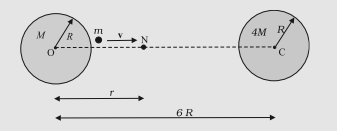
Solution: Step 1: Locating the Neutral Point ( \(N\) )
Let \(r\) be the distance of the neutral point from the center of the sphere of mass \(M\). The distance from the center of the sphere of mass \(4 M\) will then be \(6 R-r\).
At the neutral point, the gravitational fields are equal:
\(
\frac{G M}{r^2}=\frac{G(4 M)}{(6 R-r)^2}
\)
Taking the square root of both sides:
\(
\begin{gathered}
\frac{1}{r}=\frac{2}{6 R-r} \\
6 R-r=2 r \Longrightarrow 3 r=6 R \Longrightarrow r=2 R
\end{gathered}
\)
So, the neutral point \(N\) is at a distance \(2 R\) from the center of \(M\) and \(4 R\) from the center of \(4M\).
Step 2: Energy Conservation
We apply the principle of conservation of energy between the Surface of sphere \(M\) and the Neutral Point \(N\). To reach \(N\) with the minimum speed, the velocity at \(N\) should be essentially zero (\(v_N \approx 0\)).
At the Surface of \(M\) :
Distance from \(M: R\)
Distance from \(4 M: 5 R\) (Total \(6 R-R\) )
Potential Energy \(\left(U_i\right):-\frac{G m M}{R}-\frac{G m(4 M)}{5 R}\)
Kinetic Energy \(\left(K_i\right): \frac{1}{2} m v^2\)
At the Neutral Point \(N\) :
Distance from \(M: 2 R\)
Distance from \(4 M: 4 R\)
Potential Energy \(\left(U_N\right):-\frac{G m M}{2 R}-\frac{G m(4 M)}{4 R}\)
Kinetic Energy \(\left(K_N\right)\) : 0
Step 3: Solving the Equation
\(
K_i+U_i=K_N+U_N
\)
\(
\frac{1}{2} m v^2-\frac{G m M}{R}-\frac{4 G m M}{5 R}=-\frac{G m M}{2 R}-\frac{4 G m M}{4 R}
\)
\(
\begin{gathered}
\frac{v^2}{2}-\frac{G M}{R}\left(1+\frac{4}{5}\right)=-\frac{G M}{R}\left(\frac{1}{2}+1\right) \\
\frac{v^2}{2}-\frac{G M}{R}\left(\frac{9}{5}\right)=-\frac{G M}{R}\left(\frac{3}{2}\right) \\
\frac{v^2}{2}=\frac{G M}{R}\left(\frac{9}{5}-\frac{3}{2}\right) \\
\frac{v^2}{2}=\frac{G M}{R}\left(\frac{18-15}{10}\right) \\
\frac{v^2}{2}=\frac{G M}{R}\left(\frac{3}{10}\right) \\
v^2=\frac{3 G M}{5 R}
\end{gathered}
\)
The minimum speed required is:
\(
v=\sqrt{\frac{3 G M}{5 R}}
\)