1.10 Power
Power
Power is defined as the rate at which work is done or energy is transferred. If a force does work \(W\) in time \(t\), then its average power is given by
Average power \(\left(P_{\mathrm{av}}\right)=\) Rate of doing work
\(
\text { Average power }\left(P_{\mathrm{av}}\right)=\frac{\text { Work done }}{\text { Time taken }}=\frac{W}{t}
\)
Power is a scalar quantity because it is the ratio of two scalar quantities, work \((W)\) and time \((t)\). The dimensional formula of power is \(\left[\mathrm{ML}^2 \mathrm{~T}^{-3}\right]\).
The SI unit of power is watt \((\mathrm{W})\). The power of an agent is one watt, if it does work at the rate of 1 joule per second.
\(
1 \mathrm{watt}=\frac{1 \text { joule }}{1 \text { second }}=1 \mathrm{Js}^{-1}
\)
Another popular units of power are kilowatt and horsepower.
\(\mathbf{1}\) kilowatt \(=1000\) watt or \(1 \mathrm{~kW}=\mathbf{1 0}^{\mathbf{3}} \mathbf{~ W}\)
\(\mathbf{1}\) horsepower \(=746\) watt or \(1 \mathrm{hp}=\mathbf{7 4 6 ~ W}\)
Horsepower is used to describe the output of automobiles, motorbikes, engines, etc.
Note:
- Kilowatt hour (kWh) is the commercial unit of electrical energy.
- Relation between \(k W h\) and joule
\(
\begin{aligned}
1 k W h & =1 k W \times 1 h=1000 \mathrm{~W} \times 1 \mathrm{~h} \\
& =1000 \mathrm{~J}^{-1} \times 3600 \mathrm{~s} \text { or } 1 \mathrm{kWh}=3.6 \times 10^6 \mathrm{~J}
\end{aligned}
\) - Efficiency of an engine, \(\eta=\frac{\text { Output power }}{\text { Input power }}\)
Instantaneous power
The instantaneous power of an agent is defined as the limiting value of the average power of the agent in a small time interval, i.e. when the time interval approaches to zero. When work done by a force \(\mathbf{F}\) for a small displacement \(d \mathbf{r}\) is \(d W=\mathbf{F} \cdot d \mathbf{r}\), then instantaneous power can be given as
\(
P=\lim _{\Delta t \rightarrow 0} \frac{\Delta W}{\Delta t}=\frac{d W}{d t}
\)
Now,
\(
d W=\mathbf{F} \cdot d \mathbf{r}
\)
\(
\therefore \quad P=\mathbf{F} \cdot \frac{d \mathbf{r}}{d t}
\)
Again \(d \mathbf{r} / d t=\mathbf{v}\), instantaneous velocity of the agent. Therefore,
\(
P=\mathbf{F} \cdot \mathbf{v}=F v \cos \theta
\)
where, \(\theta\) is the angle between \(\mathbf{F}\) and \(\mathbf{v}\).
Power is zero, if force is perpendicular to velocity. e.g. Power of a centripetal force is zero in a circular motion.
Example 1: A train has a constant speed of \(40 \mathrm{~ms}^{-1}\) on a level road against resistive force of magnitude \(3 \times 10^4 N\). Find the power of the engine.
Solution: At constant speed, there is no acceleration, so the forces acting on the train are in equilibrium.
For a train to maintain a constant speed against a resistive force, the engine must produce an equal and opposite force to balance it. Therefore, the force produced by the engine \((F)\) is equal to the resistive force.
Therefore, \(F=R=3 \times 10^4 \mathrm{~N}, v=40 \mathrm{~ms}^{-1}\)
Now, power, \(P=F v\)
\(
\begin{aligned}
P & =3 \times 10^4 \times 40 \\
& =1.2 \times 10^6 \mathrm{~W}
\end{aligned}
\)
Note: Here, \(\boldsymbol{\theta}\) is the angle between the applied force vector and the velocity vector. Since the engine pushes the train in the same direction that the train is moving, the angle \(\theta\) is \(0^{\circ}\). The \(\cos (\theta)\) term is technically present but simplifies because \(\cos \left(0^{\circ}\right)=1\), which is why it often appears to be “missing” in these linear motion calculations.
Example 2: A machine gun fires 240 bullets per minute. If the mass of each bullet is 10 g and the velocity of the bullets is \(600 \mathrm{~ms}^{-1}\), then find power (in \(k W\) ) of the gun.
Solution: The given mass of each bullet is 10 g, which converts to 0.01 kg. The rate of fire is 240 bullets per minute, which converts to \(R=\frac{240}{60}=4\) bullets per second. The velocity is already in m/s.
Calculate the kinetic energy of a single bullet
The kinetic energy ( \(K E\) ) of a single bullet is calculated using the formula \(K E=\frac{1}{2} m v^2\).
\(
K E=\frac{1}{2} \times 0.01 \mathrm{~kg} \times(600 \mathrm{~m} / \mathrm{s})^2=1800 \mathrm{~J}
\)
Calculate the total power of the gun
Power ( \(P\) ) is the rate at which energy is transferred or produced. The total power of the gun is the kinetic energy produced per second:
\(
P=R \times K E=4 \mathrm{~s}^{-1} \times 1800 \mathrm{~J}=7200 \mathrm{~W}
\)
Convert power to kilowatts
Convert the power from watts (W) to kilowatts ( kW ) by dividing by 1000.
\(
P=\frac{7200}{1000} \mathrm{~kW}=7.2 \mathrm{~kW}
\)
Example 3: In unloading grain from the hold of a ship, an elevator lifts the grain through a distance of \(12 m\). Grain is discharged at the top of the elevator at a rate of 2 kg each second and the discharge speed of each grain particle is \(3 \mathrm{~ms}^{-1}\). Find the minimum horsepower of the motor that can elevate grain in this way. (Take, \(g=10 \mathrm{~ms}^{-2}\) )
Solution: Step 1: Calculate the power for lifting the grain
The power required to lift the grain against gravity is the rate of increase in potential energy. The mass flow rate is \(\dot{m}=2 \mathrm{~kg} / \mathrm{s}\), the height is \(h=12 \mathrm{~m}\), and \(g=10 \mathrm{~m} / \mathrm{s}^2\). The power for lifting is given by:
\(
\begin{gathered}
P_{\text {gravity }}=\dot{m} g h \\
P_{\text {gravity }}=(2 \mathrm{~kg} / \mathrm{s})\left(10 \mathrm{~m} / \mathrm{s}^2\right)(12 \mathrm{~m}) \\
P_{\text {gravity }}=240 \mathrm{~W}
\end{gathered}
\)
Step 2: Calculate the power for the kinetic energy
The power required to give the grain kinetic energy is the rate of increase in kinetic energy. The mass flow rate is \(\dot{m}=2 \mathrm{~kg} / \mathrm{s}\), and the discharge speed is \(v=3 \mathrm{~m} / \mathrm{s}\). The power for kinetic energy is given by:
\(
\begin{gathered}
P_{\text {kinetic }}=\frac{1}{2} \dot{m} v^2 \\
P_{\text {kinetic }}=\frac{1}{2}(2 \mathrm{~kg} / \mathrm{s})(3 \mathrm{~m} / \mathrm{s})^2 \\
P_{\text {kinetic }}=(1 \mathrm{~kg} / \mathrm{s})\left(9 \mathrm{~m}^2 / \mathrm{s}^2\right) \\
P_{\text {kinetic }}=9 \mathrm{~W}
\end{gathered}
\)
Step 3: Calculate the total power required
The total minimum power required is the sum of the power for lifting and the power for kinetic energy:
\(
\begin{gathered}
P_{\text {total }}=P_{\text {gravity }}+P_{\text {kinetic }} \\
P_{\text {total }}=240 \mathrm{~W}+9 \mathrm{~W} \\
P_{\text {total }}=249 \mathrm{~W}
\end{gathered}
\)
Step 4: Convert total power to horsepower
Using the conversion factor \(1 \mathrm{hp} \approx 746 \mathrm{~W}\) :
\(
\begin{aligned}
\text { Horsepower } & =\frac{P_{\text {total }}}{746 \mathrm{~W} / \mathrm{hp}} \\
\text { Horsepower } & =\frac{249 \mathrm{~W}}{746 \mathrm{~W} / \mathrm{hp}} \\
\text { Horsepower } & \approx 0.334 \mathrm{hp}
\end{aligned}
\)
The minimum horsepower of the motor required is approximately \(\mathbf{0 . 3 3 4 ~ h p}\).
Example 4: A pump can take out 7200 kg of water per hour from a well \(100 m\) deep. Calculate the power of the pump, assuming that its efficiency is \(50 \%\).
(Take, \(g=10 \mathrm{~ms}^{-2}\) )
Solution: Output power \(=\frac{m g h}{t}=\frac{7200 \times 10 \times 100}{3600}=2000 \mathrm{~W}\)
\(
\begin{aligned}
\text { Efficiency, } \eta & =\frac{\text { Output power }}{\text { Input power }} \\
\text { Input power } & =\frac{\text { Output power }}{\eta} \\
& =\frac{2000 \times 100}{50}=4 \mathrm{~kW}
\end{aligned}
\)
Note: The calculation uses the formula for power ( \(P\) ) derived from potential energy or work done \((W=m g h)\) over time \((t): P=\frac{W}{t}=\frac{m g h}{t}\). Here, \(m\) is mass, \(g\) is acceleration due to gravity, and \(h\) is height.
Example 5: A block of mass \(m\) is pulled by a constant power \(P\) placed on a rough horizontal plane. The coefficient of friction between the block and surface is \(\mu\). Find the maximum velocity of the block.
Solution: Step 1: Analyze the forces
Identify the forces acting on the block on the rough horizontal plane. The applied force is \(F_{a p p}\), the friction force is \(F_f\), the normal force is \(N\), and the gravitational force is \(m g\). Since there is no vertical acceleration, the normal force is equal to the gravitational force, \(N=m g\). The friction force is given by \(F_f=\mu N=\mu m g\).
Step 2: Apply Newton’s second law and power equation
The net horizontal force on the block determines its acceleration \(a\) : \(F_{\text {net }}=F_{\text {app }}-F_f=m a\). The constant power \(P\) applied to the block is related to the applied force and velocity \(\boldsymbol{v}\) by \(\boldsymbol{P}=\boldsymbol{F}_{a p p} \boldsymbol{v}\). Therefore, the applied force can be expressed as \(F_{a p p}=\frac{P}{\boldsymbol{v}}\). Substituting this into the net force equation yields
\(
\frac{\boldsymbol{P}}{v}-\mu m g=m a
\)
Step 3: Determine maximum velocity condition
The block reaches its maximum velocity ( \(v_{\text {max }}\) ) when its acceleration \(a\) becomes zero. At this point, the net force is zero, which means the applied force equals the friction force: \(F_{a p p}=F_f\). Using the power equation at this maximum velocity, \(P=F_{a p p} v_{\max }=F_f v_{\max }\).
Step 4: Solve for maximum velocity
Substitute the expression for the friction force \(F_f=\mu m g\) into the equation from the previous step: \(\boldsymbol{P}=\boldsymbol{\mu} \boldsymbol{m} \boldsymbol{g} \boldsymbol{v}_{\text {max }}\). Rearranging this equation to solve for \(\boldsymbol{v}_{\text {max }}\) gives the final expression.
The maximum velocity of the block is \({v}_{{m a x}}=\frac{{P}}{{\mu} {m g}}\).
Example 6: The force required to row a boat at constant velocity is proportional to the speed. If a speed of \(4 \mathrm{kmh}^{-1}\) requires 7.5 kW, how much power does a speed of \(12 \mathrm{kmh}^{-1}\) require?
Solution: Let the force be \(F=\alpha v\), where \(v\) is speed and \(\alpha\) is a constant of proportionality. The power required is
\(
P=F v=\alpha v^2
\)
Let \(P_1\) be the power required for speed \(v_1\) and \(P_2\) be the power required for speed \(v_2\).
\(
\begin{array}{ll}
& P_1=7.5 \mathrm{~kW} \text { and } v_2=3 v_1 \\
\Rightarrow & P_2=\left(\frac{v_2}{v_1}\right)^2 P_1 \\
\Rightarrow & P_2=(3)^2 \times 7.5 \mathrm{~kW}=67.5 \mathrm{~kW}
\end{array}
\)
Example 7: An engine pumps 400 kg of water through height of 10 m in 40 s. Find the power of the engine, if its efficiency is 80%. (Take, \(g=10 \mathrm{~ms}^{-2}\) )
Solution: Work done by engine against gravity,
\(
W=m g h=400 \times 10 \times 10=40 \mathrm{~kJ}
\)
Power used by engine (output power)
\(
=\frac{W}{\Delta t}=\frac{40 \times 10^3}{40} \mathrm{~W}=1 \mathrm{~kW}
\)
If power of the engine is \(P\) (input power), then its efficiency,
\(
\begin{aligned}
\eta & =\frac{\text { Output power }}{\text { Input power }} \\
\because \quad P & =\frac{1 \mathrm{~kW}}{80 \%} \\
\Rightarrow \quad P & =\frac{1000 \times 100}{80} \mathrm{~W} \\
& =\frac{100}{80} \mathrm{~kW} \\
& =1.25 \mathrm{~kW}
\end{aligned}
\)
Example 8: An automobile of mass \(m\) accelerates, starting from rest. The engine supplies constant power \(P\), show that the velocity is given as a function of time by \(v=\left(\frac{2 P t}{m}\right)^{1 / 2}\).
Solution: Power, \(P=\) constant
Work done upto time \(t, W=P t\)
From work-energy theorem, \(W=\Delta \mathrm{KE}\) or \(P t=\frac{1}{2} m v^2\)
\(
\therefore \quad v=\left(\frac{2 P t}{m}\right)^{1 / 2}
\)
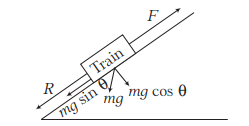
Example 9: A train of mass \(2 \times 10^5 \mathrm{~kg}\) has a constant speed of \(20 \mathrm{~ms}^{-1}\) up a hill inclined at \(\theta=\sin ^{-1}\left(\frac{1}{50}\right)\) to the horizontal when the engine is working at \(8 \times 10^5 W\). Find the resistance to motion of the train. (Take, \(g=9.8 ~ \mathrm{~ms}^{-2}\) )
Solution: Power, \(P=F v\)
\(
\Rightarrow \quad F=\frac{P}{v}=\frac{8 \times 10^5}{20}=4 \times 10^4 \mathrm{~N}
\)
At constant speed, the forces acting on the train are in equilibrium. Resolving the forces parallel to the hill,
\begin{aligned}
&\begin{aligned}
F & =R+m g \sin \theta \\
\Rightarrow \quad F & =R+\left(2 \times 10^5\right) g \times \frac{1}{50} \\
4 \times 10^4 & =R+39200 \text { or } R=800 \mathrm{~N}
\end{aligned}\\
&\text { Therefore, the resistance is } 800 \mathrm{~N} \text {. }
\end{aligned}
\)
Example 10: A small body of mass \(m\) moving with velocity \(v_0\) on rough horizontal surface, finally stops due to friction. Find the mean power developed by the friction force during the motion of the body, if the frictional coefficient, \(\mu=0.27\), \(m=1 \mathrm{~kg}\) and \(v_0=1.5 \mathrm{~ms}^{-1}\).
Solution: The retardation due to friction,
\(
a=\frac{\text { Force of friction }}{\text { Mass }}=\frac{\mu m g}{m}=\mu g
\)
Now, \(\quad v_0=a t\)
Therefore, \(\quad t=\frac{v_0}{a}=\frac{v_0}{\mu g} \dots(i)\)
From work-energy theorem, work done by force of friction \(=\) change in kinetic energy
\(
W=\frac{1}{2} m v_0^2 \dots(ii)
\)
\(
\text { Mean power }=\frac{W}{t}
\)
From Eqs. (i) and (ii), we get
\(
P_{\text {mean }}=\frac{1}{2} \mu m g v_0
\)
Substituting the values in above equation, we get
\(
P_{\text {mean }}=\frac{1}{2} \times 0.27 \times 1.0 \times 9.8 \times 1.5 \approx 2 \mathrm{~W}
\)
Example 11: An elevator can carry a maximum load of \(1800 \mathrm{~kg}\) (elevator + passengers) is moving up with a constant speed of \(2 \mathrm{~m} \mathrm{~s}^{-1}\). The frictional force opposing the motion is \(4000 \mathrm{~N}\). Determine the minimum power delivered by the motor to the elevator in watts as well as in horsepower.
Solution: The downward force on the elevator is
\(F=m g+F_{f}=(1800 \times 10)+4000=22000 \mathrm{~N}\)
The motor must supply enough power to balance this force. Hence,
\(P=\vec{F} . \vec{v}=22000 \times 2=44000 \mathrm{~W}=59 \mathrm{hp}\)
Example 12: Consider a drop of mass \(1.00 \mathrm{~g}\) falling from a height \(1.00 \mathrm{~km}\). It hits the ground with a speed of \(50.0 \mathrm{~m} \mathrm{~s}^{-1}\). (a) What is the work done by the gravitational force? (b) What is the work done by the unknown resistive force?
Solution: The change in kinetic energy of the drop is
\(
\begin{array}{l}
\Delta K=\frac{1}{2} m v^{2}-0 \\
=\frac{1}{2} \times 10^{-3} \times 50 \times 50 \\
=1.25 \mathrm{~J}
\end{array}
\)
where we have assumed that the drop is initially at rest.
Assuming that \(g\) is a constant with a value \(10 \mathrm{~m} / \mathrm{s}^{2}\), the work done by the gravitational force is,
\(
\begin{aligned}
W_{g} &=m g h \\
&=10^{-3} \times 10 \times 10^{3} \\
&=10.0 \mathrm{~J}
\end{aligned}
\)
(b) From the work-energy theorem
\(
\Delta K=W_{g}+W_{r}
\)
where \(W_{r}\) is the work done by the resistive force on the raindrop. Thus
\(
\begin{aligned}
W_{r} &=\Delta K-W_{g} \\
&=1.25-10 \\
&=-8.75 \mathrm{~J}
\end{aligned}
\)
is negative.