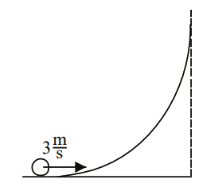
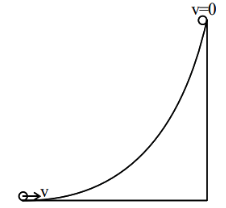
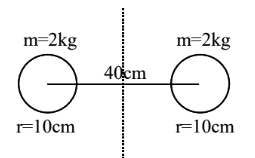
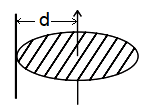
JEE PYQs Integer Type (Rotational Motion)
SUMMARY
- Ideally, a rigid body is one for which the distances between different particles of the body do not change, even though there are forces on them.
- A rigid body fixed at one point or along a line can have only rotational motion. A rigid body not fixed in some way can have either pure translational motion or a combination of translational and rotational motions.
- In rotation about a fixed axis, every particle of the rigid body moves in a circle which lies in a plane perpendicular to the axis and has its centre on the axis. Every Point in the rotating rigid body has the same angular velocity at any instant of time.
- In pure translation, every particle of the body moves with the same velocity at any instant of time.
- Angular velocity is a vector. Its magnitude is \(\omega=d \theta / d t\) and it is directed along the axis of rotation. For rotation about a fixed axis, this vector \(\omega\) has a fixed direction.
- The vector or cross product of two vector \(a\) and \(b\) is a vector written as \(a \times b\). The magnitude of this vector is \(a b \sin \theta\) and its direction is given by the right handed screw or the right hand rule.
- The linear velocity of a particle of a rigid body rotating about a fixed axis is given by \(v = \omega \times r\), where \(r\) is the position vector of the particle with respect to an origin along the fixed axis. The relation applies even to more general rotation of a rigid body with one point fixed. In that case \(r\) is the position vector of the particle with respect to the fixed point taken as the origin.
- The centre of mass of a system of \(n\) particles is defined as the point whose position vector is
\(
R =\frac{\sum m_i r _i}{M}
\) - Velocity of the centre of mass of a system of particles is given by \(V = P / M\), where \(P\) is the linear momentum of the system. The centre of mass moves as if all the mass of the system is concentrated at this point and all the external forces act at it. If the total external force on the system is zero, then the total linear momentum of the system is constant.
- The angular momentum of a system of \(n\) particles about the origin is
\(
L =\sum_{i=1}^n r _i \times p _i
\)
The torque or moment of force on a system of \(n\) particles about the origin is
\(
\tau =\sum_{i=1}^n r _i \times F _i
\)
The force \(F _i\) acting on the \(i^{\text {th }}\) particle includes the external as well as internal forces. Assuming Newton’s third law of motion and that forces between any two particles act along the line joining the particles, we can show \(\tau _{\text {int }}= 0\) and
\(
\frac{d L }{d t}= \tau _{e x t}
\) - A rigid body is in mechanical equilibrium if
(a) it is in translational equilibrium, i.e., the total external force on it is zero : \(\sum F _i= 0\), and
(b) it is in rotational equilibrium, i.e. the total external torque on it is zero :
\(
\sum \tau _i=\sum r _i \times F _i= 0
\) - The centre of gravity of an extended body is that point where the total gravitational torque on the body is zero.
- The moment of intertia of a rigid body about an axis is defined by the formula \(I=\sum m_i r_i^2\) where \(r_i\) is the perpendicular distance of the \(i\) th point of the body from the axis. The kinetic energy of rotation is \(K=\frac{1}{2} I \omega^2\).
- The theorem of parallel axes: \(I_z^{\prime}=I_z+M a^2\), allows us to determine the moment of intertia of a rigid body about an axis as the sum of the moment of inertia of the body about a parallel axis through its centre of mass and the product of mass and square of the perpendicular distance between these two axes.
- Rotation about a fixed axis is directly analogous to linear motion in respect of kinematics and dynamics.
- For a rigid body rotating about a fixed axis (say, \(z\)-axis) of rotation, \(L_{ z }=I \omega\), where \(I\) is the moment of inertia about \(z\)-axis. In general, the angular momentum \(L\) for such a body is not along the axis of rotation. Only if the body is symmetric about the axis of rotation, \(L\) is along the axis of rotation. In that case, \(| L |=L_z=I \omega\). The angular acceleration of a rigid body rotating about a fixed axis is given by \(I \alpha=\tau\). If the external torque \(\tau\) acting on the body is zero, the component of angular momentum about the fixed axis (say, \(z\)-axis), \(L_z(=I \omega)\) of such a rotating body is constant.
- For rolling motion without slipping \(v_{c m}=R \omega\), where \(v_{c m}\) is the velocity of translation (i.e. of the centre of mass), \(R\) is the radius and \(m\) is the mass of the body. The kinetic energy of such a rolling body is the sum of kinetic energies of translation and rotation:
\(
K=\frac{1}{2} m v_{c m}^2+\frac{1}{2} I \omega^2
\)
Quiz Summary
0 of 83 Questions completed
Questions:
Information
You have already completed the quiz before. Hence you can not start it again.
Quiz is loading…
You must sign in or sign up to start the quiz.
You must first complete the following:
Results
Results
0 of 83 Questions answered correctly
Your time:
Time has elapsed
You have reached 0 of 0 point(s), (0)
Earned Point(s): 0 of 0, (0)
0 Essay(s) Pending (Possible Point(s): 0)
Categories
- Not categorized 0%
- 1
- 2
- 3
- 4
- 5
- 6
- 7
- 8
- 9
- 10
- 11
- 12
- 13
- 14
- 15
- 16
- 17
- 18
- 19
- 20
- 21
- 22
- 23
- 24
- 25
- 26
- 27
- 28
- 29
- 30
- 31
- 32
- 33
- 34
- 35
- 36
- 37
- 38
- 39
- 40
- 41
- 42
- 43
- 44
- 45
- 46
- 47
- 48
- 49
- 50
- 51
- 52
- 53
- 54
- 55
- 56
- 57
- 58
- 59
- 60
- 61
- 62
- 63
- 64
- 65
- 66
- 67
- 68
- 69
- 70
- 71
- 72
- 73
- 74
- 75
- 76
- 77
- 78
- 79
- 80
- 81
- 82
- 83
- Current
- Review
- Answered
- Correct
- Incorrect
- Question 1 of 83
1. Question
A thin solid disk of 1 kg is rotating along its diameter axis at the speed of 1800 rpm. By applying an external torque of \(25 \pi Nm\) for 40 s, the speed increases to 2100 rpm. The diameter of the disk is _____ m. [JEE Main 2025 (Online) 8th April Evening Shift]
CorrectIncorrectHint
(a) Step 1: Convert angular velocities
Convert the initial and final rotational speeds from revolutions per minute (rpm) to radians per second ( \(rad / s\) ) using the conversion factor \(1 rpm =\frac{2 \pi}{60} rad / s\).
Initial angular velocity, \(\omega_1\) :
\(
\omega_1=1800 rpm \times \frac{2 \pi}{60} rad / s \text { per } rpm=60 \pi rad / s
\)
Final angular velocity, \(\omega_2\) :
\(
\omega_2=2100 rpm \times \frac{2 \pi}{60} rad / s \text { per } rpm=70 \pi rad / s
\)
Step 2: Calculate angular acceleration
The angular acceleration, \(\alpha\), can be calculated using the formula \(\alpha=\frac{\omega_2-\omega_1}{t}\), where \(t\) is the time interval.
\(
\alpha=\frac{70 \pi rad / s-60 \pi rad / s}{40 s}=\frac{10 \pi rad / s}{40 s}=\frac{\pi}{4} rad / s^2
\)
Step 3: Calculate moment of inertia
Use the torque equation, \(\tau = I \alpha\), to find the moment of inertia, \(I\).
\(
\begin{gathered}
25 \pi Nm=I \times \frac{\pi}{4} rad / s^2 \\
I=\frac{25 \pi}{\pi / 4} kg \cdot m^2=100 kg \cdot m^2
\end{gathered}
\)
Step 4: Determine the diameter
The moment of inertia of a thin solid disk about its diameter axis is given by the formula \(I =\frac{ 1 }{ 4 } M R ^{ 2 }\). The diameter \(D\) is twice the radius \(R\), so \(R = D / 2\).
\(
I=\frac{1}{4} M\left(\frac{D}{2}\right)^2=\frac{1}{4} M \frac{D^2}{4}=\frac{1}{16} M D^2
\)
Rearrange the formula to solve for the diameter, \(D\).
\(
D^2=\frac{16 I}{M}
\)
Substitute the calculated moment of inertia ( \(I=100 kg \cdot m ^2\) ) and the given mass ( \(M=1 kg\) ).
\(
\begin{gathered}
D^2=\frac{16 \times 100 kg \cdot m^2}{1 kg}=1600 m^2 \\
D=\sqrt{1600 m^2}=40 m
\end{gathered}
\)
The diameter of the disk is \(4 0 ~ m\). - Question 2 of 83
2. Question
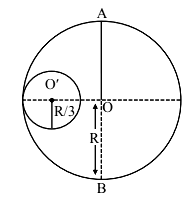
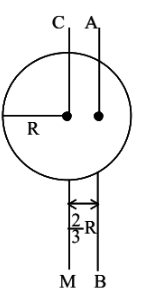
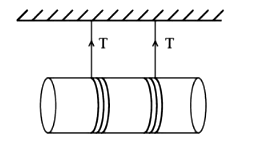
\(M\) and \(R\) be the mass and radius of a disc. A small disc of radius \(R / 3\) is removed from the bigger disc as shown in figure. The moment of inertia of remaining part of bigger disc about an axis \(A B\) passing through the centre \(O\) and perpendicular to the plane of disc is \(\frac{4}{x} MR ^2\). The value of \(x\) is ___. [JEE Main 2025 (Online) 7th April Evening Shift]
 CorrectIncorrect
Hint
(c) Step 1: Define initial parameters and mass distribution
The original disc has mass \(M\) and radius \(R\). The smaller removed disc has radius \(r=R / 3\). Since the mass is uniformly distributed, the mass per unit area \(\sigma\) is constant.
\(
\sigma=\frac{M}{\pi R^2}
\)
The area of the removed disc is \(A_{\text {removed }}=\pi r^2=\pi(R / 3)^2=\pi R^2 / 9\).
The mass of the removed disc ( \(m\) ) is:
\(
m=\sigma \times A_{\text {removed }}=\frac{M}{\pi R^2} \times \frac{\pi R^2}{9}=\frac{M}{9}
\)
The mass of the remaining portion is \(M_{\text {remaining }}=M-m=M-M / 9=8 M / 9\).
Step 2: Calculate moment of inertia of the original disc
The moment of inertia of the complete original disc about an axis through its center \(O\) (axis AB ) and perpendicular to its plane is given by the standard formula:
\(
I_{\text {total }}=\frac{1}{2} M R^2
\)
Step 3: Calculate moment of inertia of the removed disc
The moment of inertia of the small removed disc (mass \(m\), radius \(r=R / 3\) ) about its own center of mass is:
\(
I_{\text {removed }, C M}=\frac{1}{2} m r^2=\frac{1}{2}\left(\frac{M}{9}\right)\left(\frac{R}{3}\right)^2=\frac{1}{2} \frac{M}{9} \frac{R^2}{9}=\frac{M R^2}{162}
\)
To find the moment of inertia of the removed disc about the axis AB (passing through the center O of the original disc), we use the parallel axis theorem, \(I = I _{ C M }+ m d^2\), where \(d\) is the distance between the two parallel axes. Assuming the common problem configuration where the edge of the removed disc touches the center of the large disc, the distance \(d\) is \(R-r=R-R / 3=2 R / 3\) (or other configurations). If we assume the center of the small disc is \(2 R / 3\) from \(O\) (a common configuration for the answer to be in the form \(\frac{4}{x} M R ^2\) ):
\(
\begin{gathered}
I_{\text {removed }, O}=I_{\text {removed }, C M}+m d^2=\frac{M R^2}{162}+\left(\frac{M}{9}\right)\left(\frac{2 R}{3}\right)^2 \\
I_{\text {removed }, O}=\frac{M R^2}{162}+\frac{M}{9} \frac{4 R^2}{9}=\frac{M R^2}{162}+\frac{4 M R^2}{81} \\
I_{\text {removed }, O}=\frac{M R^2}{162}+\frac{8 M R^2}{162}=\frac{9 M R^2}{162}=\frac{M R^2}{18}
\end{gathered}
\)
Step 4: Calculate the moment of inertia of the remaining part
The moment of inertia of the remaining part is the moment of inertia of the total disc minus the moment of inertia of the removed part:
\(
\begin{gathered}
I_{\text {remaining }}=I_{\text {total }}-I_{\text {removed }, O} \\
I_{\text {remaining }}=\frac{1}{2} M R^2-\frac{1}{18} M R^2=\left(\frac{9}{18}-\frac{1}{18}\right) M R^2=\frac{8}{18} M R^2=\frac{4}{9} M R^2
\end{gathered}
\)
The value of \(x\) is 9. - Question 3 of 83
3. Question
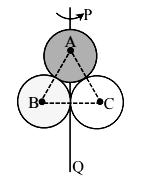
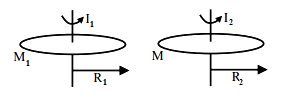
\(A , B\) and C are disc, solid sphere and spherical shell respectively with same radii and masses. These masses are placed as shown in figure.

The moment of inertia of the given system about PQ axis is \(\frac{x}{15} I\), where \(I\) is the moment of inertia of the disc about its diameter. The value of \(x\) is ____. [JEE Main 2025 (Online) 7th April Morning Shift]
CorrectIncorrectHint
(b) Step 1: Define individual moments of inertia and the reference moment \(I\)
The moment of inertia (I) of the disc (A) about its diameter (which is the axis PQ) is given as:
\(
I_A=I=\frac{1}{4} M R^2
\)
The moment of inertia of the solid sphere (B) about its center of mass is \(I _{ B , c m }=\frac{2}{5} M R ^2\).
The moment of inertia of the spherical shell ( C ) about its center of mass is
\(
I_{C, c m}=\frac{2}{3} M R^2 .
\)
Step 2: Apply the parallel axis theorem for objects B and C
Objects B and C have their centers at a distance \(d=R\) from the axis PQ . For the solid sphere (B), the moment of inertia about PQ is:
\(
I_B=I_{B, c m}+M R^2=\frac{2}{5} M R^2+M R^2=\frac{7}{5} M R^2
\)
For the spherical shell ( C ), the moment of inertia about PQ is:
\(
I_C=I_{C, c m}+M R^2=\frac{2}{3} M R^2+M R^2=\frac{5}{3} M R^2
\)
Step 3: Calculate the total moment of inertia and find \(x\)
The total moment of inertia of the system about PQ is the sum of the individual moments:
\(
I_{\text {total }}=I_A+I_B+I_C=\frac{1}{4} M R^2+\frac{7}{5} M R^2+\frac{5}{3} M R^2
\)
To sum these, use the least common multiple of 4,5 , and 3 , which is 60 :
\(
I_{\text {total }}=\frac{15 M R^2}{60}+\frac{84 M R^2}{60}+\frac{100 M R^2}{60}=\frac{199}{60} M R^2
\)
We are given that \(I _{\text {total }}=\frac{ x }{15} I\), and we know \(I =\frac{1}{4} M R ^2\). Substitute \(I\) into the given expression:
\(
I_{\text {total }}=\frac{x}{15}\left(\frac{1}{4} M R^2\right)=\frac{x}{60} M R^2
\)
Equating the two expressions for \(I_{\text {total }}\) :
\(
\frac{199}{60} M R^2=\frac{x}{60} M R^2
\)
\(
x=199
\) - Question 4 of 83
4. Question
A solid sphere with uniform density and radius \(R\) is rotating initially with constant angular velocity ( \(\omega_1\) ) about its diameter. After some time during the rotation its starts loosing mass at a uniform rate, with no change in its shape. The angular velocity of the sphere when its radius become \(R / 2\) is \(x \omega_1\). The value of \(x\) is ____. [JEE Main 2025 (Online) 4th April Evening Shift]
CorrectIncorrectHint
(d) To solve this problem, we must apply the principle of Conservation of Angular Momentum ( \(L\) ). Since the mass loss is described as uniform with no external torque acting on the system, the angular momentum remains constant.
Step 1: Initial State
For a solid sphere of mass \(M_1\) and radius \(R_1=R\), the moment of inertia about its diameter is:
\(
I_1=\frac{2}{5} M_1 R^2
\)
The initial angular momentum is:
\(
L_1=I_1 \omega_1=\left(\frac{2}{5} M_1 R^2\right) \omega_1
\)
Step 2: The sphere loses mass but maintains its shape (remains a uniform solid sphere). The final radius is \(R_2=R / 2\). Since the density ( \(\rho\) ) is uniform and constant:
\(
M=\rho \times \text { Volume }=\rho \times \frac{4}{3} \pi R^3
\)
Therefore, \(M \propto R^3\). We can find the final mass \(M_2\) :
\(
M_2=M_1\left(\frac{R_2}{R_1}\right)^3=M_1\left(\frac{R / 2}{R}\right)^3=\frac{M_1}{8}
\)
The final moment of inertia ( \(I_2\) ) is:
\(
\begin{aligned}
I_2 & =\frac{2}{5} M_2 R_2^2=\frac{2}{5}\left(\frac{M_1}{8}\right)\left(\frac{R}{2}\right)^2 \\
I_2 & =\frac{2}{5} M_1 R^2\left(\frac{1}{8} \times \frac{1}{4}\right)=\frac{1}{32} I_1
\end{aligned}
\)
Step 3: Conservation of Angular Momentum
Since no external torque is applied:
\(
\begin{gathered}
L_1=L_2 \\
I_1 \omega_1=I_2 \omega_2
\end{gathered}
\)
Substitute \(I_2\) :
\(
\begin{gathered}
I_1 \omega_1=\left(\frac{1}{32} I_1\right) \omega_2 \\
\omega_2=32 \omega_1
\end{gathered}
\)
Step 4: Find the Value of \(x\)
The problem states \(\omega_2=x \omega_1\). Comparing the expressions:
\(
x=32
\)
The value of \(x\) is 32. - Question 5 of 83
5. Question
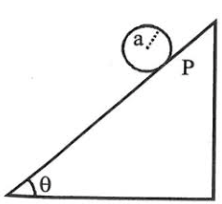
A circular ring and a solid sphere having same radius roll down on an inclined plane from rest without slipping. The ratio of their velocities when reached at the bottom of the plane is \(\sqrt{\frac{x}{5}}\) where \(x=\) ____. [JEE Main 2025 (Online) 4th April Morning Shift]
CorrectIncorrectHint
(a) To find the ratio of the velocities, we use the principle of Conservation of Mechanical Energy. For an object rolling down an inclined plane from height \(h\) without slipping, the potential energy at the top is converted into both translational and rotational kinetic energy at the bottom.
Step 1: General Formula for Velocity ( \(v\) )
The velocity of a rolling body at the bottom of an incline is given by:
\(
v=\sqrt{\frac{2 g h}{1+\frac{k^2}{R^2}}}
\)
where \(\frac{k^2}{R^2}\) is the ratio of the moment of inertia coefficient to the mass (where \(I=\beta M R^2\), so \(\left.\frac{k^2}{R^2}=\beta\right)\).
Step 2: Velocity of the Circular Ring ( \(v_{\text {ring }}\) )
For a circular ring, the moment of inertia about its center is \(I=M R^2\).
Therefore, \(\frac{k^2}{R^2}=1\).
Substituting into the velocity formula:
\(
v_{\text {ring }}=\sqrt{\frac{2 g h}{1+1}}=\sqrt{\frac{2 g h}{2}}=\sqrt{g h}
\)
Step 3: Velocity of the Solid Sphere ( \(v_{\text {sphere }}\) )
For a solid sphere, the moment of inertia about its center is \(I=\frac{2}{5} M R^2\).
Therefore, \(\frac{k^2}{R^2}=\frac{2}{5}\).
Substituting into the velocity formula:
\(
v_{\text {sphere }}=\sqrt{\frac{2 g h}{1+\frac{2}{5}}}=\sqrt{\frac{2 g h}{\frac{7}{5}}}=\sqrt{\frac{10 g h}{7}}
\)
Step 4: Calculate the Ratio
We need the ratio of the velocity of the ring to the velocity of the sphere:
\(
\frac{v_{\text {ring }}}{v_{\text {sphere }}}=\frac{\sqrt{g h}}{\sqrt{\frac{10 g h}{7}}}=\sqrt{\frac{g h \times 7}{10 g h}}=\sqrt{\frac{7}{10}}
\)
To match the form given in the problem, \(\sqrt{\frac{x}{5}}\), we can rewrite the fraction:
\(
\sqrt{\frac{7}{10}}=\sqrt{\frac{3.5}{5}}=\sqrt{\frac{x}{5}}
\)
\(
x=3.5
\)
Rounding off, \(x=4\).Derivation of Formula: Step 1: Apply Conservation of Energy
The potential energy at the top of the incline is entirely converted into translational and rotational kinetic energy at the bottom.
\(
P E_{t o p}=K E_{t r a n s}+K E_{r o t}
\)
Step 2: Express Energy Terms
The potential energy is \(P E = M g h\). The translational kinetic energy is \(K E _{\text {trans }}=\frac{1}{2} M v ^2\). The rotational kinetic energy is \(K E _{\text {rot }}=\frac{1}{2} I \omega ^2\). Equating these gives:
\(
M g h=\frac{1}{2} M v^2+\frac{1}{2} I \omega^2
\)
Step 3: Substitute Moment of Inertia and Angular Velocity
Using the given moment of inertia definition \(I=\beta M R^2\) (where \(\beta=\frac{k^2}{R^2}\) ) and the rolling without slipping condition \(\omega=\frac{v}{R}\), the equation becomes:
\(
\begin{gathered}
M g h=\frac{1}{2} M v^2+\frac{1}{2}\left(\beta M R^2\right)\left(\frac{v}{R}\right)^2 \\
M g h=\frac{1}{2} M v^2+\frac{1}{2} \beta M v^2
\end{gathered}
\)
Step 4: Solve for Final Velocity
Cancel the mass \(M\) from all terms and factor the velocity \(v ^2\) :
\(
\begin{gathered}
g h=\frac{1}{2} v^2(1+\beta) \\
v^2=\frac{2 g h}{1+\beta}
\end{gathered}
\)
Substituting \(\beta=\frac{k^2}{ R ^2}\) and taking the square root yields the formula:
\(
v=\sqrt{\frac{2 g h}{1+\frac{k^2}{R^2}}}
\) - Question 6 of 83
6. Question
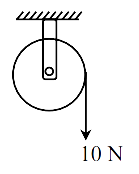
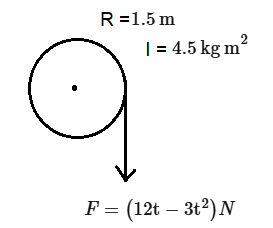
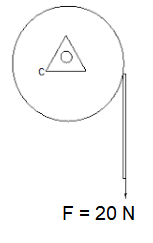
A wheel of radius 0.2 m rotates freely about its center when a string that is wrapped over its rim is pulled by force of 10 N as shown in figure. The established torque produces an angular acceleration of \(2 rad / s ^2\). Moment of intertia of the wheel is _____ \(kg m ^2\). (Acceleration due to gravity \(=10 m / s ^2\) ) [JEE Main 2025 (Online) 2nd April Evening Shift]
 CorrectIncorrect
Hint
(d)

To find the moment of inertia of the wheel, we use the relationship between torque, force, and angular acceleration.
Step 1: Identify Given Data
Radius \((R)\) : 0.2 m
Force ( \(F\) ): 10 N (applied tangentially via the string)
Angular Acceleration \((\alpha): 2 rad / s ^2\)
Acceleration due to gravity \((g): 10 m / s ^2\) (Note: \(g\) is provided but not needed for this specific calculation as the force is directly given).
Step 2: Calculate the Torque ( \(\tau\) )
Torque is produced by the tangential force acting at the distance of the radius from the center of rotation:
\(
\begin{gathered}
\tau=F \times R \\
\tau=10 N \times 0.2 m \\
\tau=2 N \cdot m
\end{gathered}
\)
Step 3: Calculate Moment of Inertia ( \(I\) )
The relationship between torque and angular acceleration is given by:
\(
\tau=I \alpha
\)
Rearranging to solve for \(I\) :
\(
I=\frac{\tau}{\alpha}
\)
Substitute the calculated torque and given angular acceleration:
\(
\begin{aligned}
& I=\frac{2 N \cdot m}{2 rad / s^2} \\
& I=1 kg \cdot m^2
\end{aligned}
\)
The moment of inertia of the wheel is \(1 kg \cdot m ^2\). - Question 7 of 83
7. Question
The coordinates of a particle with respect to origin in a given reference frame is \((1,1,1)\) meters. If a force of \(\vec{F}=\hat{i}-\hat{j}+\hat{k}\) acts on the particle, then the magnitude of torque (with respect to origin) in \(z\)-direction is ____. [JEE Main 2025 (Online) 29th January Morning Shift]
CorrectIncorrectHint
(b) Step 1: Define the position and force vectors
The position vector \(\vec{r}\) and force vector \(\vec{F}\) relative to the origin are given by:
\(\vec{r}=\hat{i}+\hat{j}+\hat{k}\)
\(\vec{F}=\hat{i}-\hat{j}+\hat{k}\)
Step 2: Calculate the torque vector
The torque \(\vec{\tau}\) is calculated using the cross product of the position vector and the force vector, \(\vec{\tau}=\vec{r} \times \vec{F}\).
\(
\vec{\tau}=\left|\begin{array}{lllllllll}
\hat{i} & \hat{j} & \hat{k} & 1 & 1 & 1 & 1 & -1 & 1
\end{array}\right|
\)
Expanding the determinant:
\(
\begin{gathered}
\vec{\tau}=\hat{i}((1)(1)-(1)(-1))-\hat{j}((1)(1)-(1)(1))+\hat{k}((1)(-1)-(1)(1)) \\
\vec{\tau}=\hat{i}(1+1)-\hat{j}(1-1)+\hat{k}(-1-1) \\
\vec{\tau}=2 \hat{i}-0 \hat{j}-2 \hat{k} N \cdot m
\end{gathered}
\)
Step 3: Determine the magnitude of the \(z\) -component of the torque
The \(z\)-component of the torque vector is \(\tau_z=-2 N \cdot m\). The magnitude of this component is the absolute value:
\(
\text { Magnitude }=\left|\tau_z\right|=|-2|=2 N \cdot m
\)
The magnitude of torque in the \(z\)-direction is \(2 N \cdot m\). - Question 8 of 83
8. Question
Two iron solid discs of negligible thickness have radii \(R_1\) and \(R_2\) and moment of intertia \(I_1\) and \(I_2\), respectively. For \(R_2=2 R_1\), the ratio of \(I_1\) and \(I_2\) would be \(1 / x\), where \(x =\) ____. [JEE Main 2025 (Online) 28th January Morning Shift]
CorrectIncorrectHint
(c)

Let surface mass density \(=\sigma\)
\(
\begin{aligned}
&\text { Given } R_2=2 R_1\\
&\begin{aligned}
& M_1=\sigma \times \pi R_1^2=M_0 \\
& M_2=\sigma \times \pi R_2^2=M_0 \\
& M_2=\sigma \times \pi R_2^2=\sigma \times \pi\left[2 R_1\right]^2=\sigma \times 4 \pi R_1^2=4 M_0 \\
& \frac{I_1}{I_2}=\frac{\frac{M_1 R_1^2}{2}}{\frac{M_2 R_2^2}{2}}=\frac{M_1 R_1^2}{M_2 R_2^2}=\frac{1}{4} \times \frac{1}{4}=\frac{1}{16}=1 / x
\end{aligned}
\end{aligned}
\)
\(
\text { Hence, } x=16
\)Explanation: To solve this problem, we need to understand how the moment of inertia of a solid disc depends on its radius when the material (density) and thickness are constant.
Step 1: Express Moment of Inertia in Terms of Radius
The moment of inertia ( \(I\) ) of a solid disc of mass \(M\) and radius \(R\) about its central axis is:
\(
I=\frac{1}{2} M R^2
\)
Since the discs are made of the same material (iron) and have the same negligible thickness \((t)\), their mass \((M)\) depends on their area and density \((\rho)\) :
\(
M=\text { Density } \text { × } \text { Volume }=\rho \times\left(\pi R^2 \times t\right)
\)
Substituting \(M\) into the formula for \(I\) :
\(
\begin{aligned}
& I=\frac{1}{2}\left(\rho \pi R^2 t\right) R^2 \\
& I=\left(\frac{1}{2} \rho \pi t\right) R^4
\end{aligned}
\)
Step 2: Determine the Proportionality
From the equation above, since \(p, \pi\), and \(t\) are constant for both discs:
\(
I \propto R^4
\)
Step 3: Calculate the Ratio
We are given that \(R_2=2 R_1\). Let’s find the ratio \(\frac{I_1}{I_2}\) :
\(
\begin{gathered}
\frac{I_1}{I_2}=\left(\frac{R_1}{R_2}\right)^4 \\
\frac{I_1}{I_2}=\left(\frac{R_1}{2 R_1}\right)^4 \\
\frac{I_1}{I_2}=\left(\frac{1}{2}\right)^4=\frac{1}{16}
\end{gathered}
\)
Step 4: Find the Value of \(x\)
The problem states that the ratio is \(\frac{1}{x}\). Comparing this to our result:
\(
\begin{aligned}
& \frac{1}{x}=\frac{1}{16} \\
& x=16
\end{aligned}
\) - Question 9 of 83
9. Question
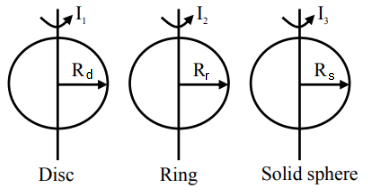
The moment of inertia of a solid disc rotating along its diameter is 2.5 times higher than the moment of inertia of a ring rotating in similar way. The moment of inertia of a solid sphere which has same radius as the disc and rotating in similar way, is \(n\) times higher than the moment of inertia of the given ring. Here, \(n =\) _____ Consider all the bodies have equal masses. [JEE Main 2025 (Online) 28th January Morning Shift]
CorrectIncorrectHint
(a)

Step 1: Identify the Moments of Inertia Formulas
All bodies have the same mass ( \(M\) ). Let \(R_d, R_r\), and \(R_s\) be the radii of the disc, ring, and solid sphere, respectively. The axis of rotation for all is the diameter.
Moment of Inertia of a Solid Disc ( \(I_{\text {disc }}\) ): Rotating about its diameter:
\(
I_{d i s c}=\frac{1}{4} M R_d^2
\)
Moment of Inertia of a Ring ( \(I_{\text {ring }}\) ): Rotating about its diameter:
\(
I_{\text {ring }}=\frac{1}{2} M R_r^2
\)
Moment of Inertia of a Solid Sphere ( \(I_{\text {sphere }}\) ): Rotating about its diameter:
\(
I_{\text {sphere }}=\frac{2}{5} M R_s^2
\)
Step 2: Apply the First Condition
The problem states that the moment of inertia of the solid disc is 2.5 times higher than that of the ring:
\(
\begin{gathered}
I_{\text {disc }}=2.5 \times I_{\text {ring }} \\
\frac{1}{4} M R_d^2=2.5 \times\left(\frac{1}{2} M R_r^2\right)
\end{gathered}
\)
Multiply by 4/M:
\(
R_d^2=4 \times 1.25 \times R_r^2=5 R_r^2
\)
Step 3: Apply the Second Condition
We are given that the solid sphere has the same radius as the disc ( \(R_s=R_d\) ):
\(
R_s^2=R_d^2=5 R_r^2
\)
Step 4: Calculate the Ratio \(n\)
Now, we find \(n\) such that \(I_{\text {sphere }}=n \times I_{\text {ring }}\) :
\(
I_{\text {sphere }}=\frac{2}{5} M R_s^2=\frac{2}{5} M\left(5 R_r^2\right)=2 M R_r^2
\)
We know \(I_{\text {ring }}=\frac{1}{2} M R_r^2=0.5 M R_r^2\).
\(
n=\frac{I_{\text {sphere }}}{I_{\text {ring }}}=\frac{2 M R_r^2}{0.5 M R_r^2}=4
\)
The value of \(n\) is 4. - Question 10 of 83
10. Question
The position vectors of two 1 kg particles, \((A)\) and \((B)\), are given by \(\vec{r}_A=\alpha_1 t^2 \hat{i}+\alpha_2 t \hat{j}+\alpha_3 t \hat{k} ~m\) and \(\vec{r}_B=\beta_1 t \hat{i}+\beta_2 t^2 \hat{j}+\beta_3 t \hat{k} ~m\) respectively \(\left(\alpha_1=1 ~m / s ^2, \alpha_2=3 n ~m / s , \alpha_3=2 ~m / s , \beta_1=2 ~m / s , \beta_2=-1 ~m / s ^2, \beta_3=4 p m / s\right.\), where t is time, \(n\) and \(p\) are constants. At \(t =1 s,\left|\overrightarrow{ V }_{ A }\right|=\left|\overrightarrow{ V }_{ B }\right|\) and velocities \(\overrightarrow{ V }_{ A }\) and \(\overrightarrow{ V }_{ B }\) of the particles are orthogonal to each other. At \(t=1 s\), the magnitude of angular momentum of particle (A) with respect to the position of particle (B) is \(\sqrt{L} kgm ^2 s^{-1}\). The value of \(L\) is ____. [JEE Main 2025 (Online) 22nd January Morning Shift]
CorrectIncorrectHint
(c) Step 1: Define Position and Velocity Vectors
The position vectors for particles A and B are given by \(\vec{r}_A=\alpha_1 t^2 \hat{i}+\alpha_2 t \hat{j}+\alpha_3 t \hat{k}\) and \(\vec{r}_B=\beta_1 t \hat{i}+\beta_2 t^2 \hat{j}+\beta_3 t \hat{k}\). Substituting the given values for the \(\alpha\) and \(\beta\) constants results in \(\vec{r}_A=t^2 \hat{i}+3 n t \hat{j}+2 t \hat{k}\) and \(\vec{r}_B=2 t \hat{i}-t^2 \hat{j}+4 p t \hat{k}\).
The velocity vectors are obtained by differentiating the position vectors with respect to time:
\(
\begin{aligned}
& \vec{V}_A=\frac{d \vec{r}_A}{d t}=2 t \hat{i}+3 n \hat{j}+2 \hat{k} \\
& \vec{V}_B=\frac{d \vec{r}_B}{d t}=2 \hat{i}-2 t \hat{j}+4 p \hat{k}
\end{aligned}
\)
Step 2: Apply Conditions to Find Constants
At time \(t=1 s\), the velocity vectors are \(\vec{V}_A=2 \hat{i}+3 n \hat{j}+2 \hat{k}\) and \(\vec{V}_B=2 \hat{i}-2 \hat{j}+4 p \hat{k}\).
The conditions are \(\left|\vec{V}_A\right|=\left|\vec{V}_B\right|\) and \(\vec{V}_A \cdot \vec{V}_B=0\).
The magnitude condition gives \(2^2+(3 n)^2+2^2=2^2+(-2)^2+(4 p)^2\), which simplifies to \(8+9 n^2=8+16 p^2\), or \(9 n^2=16 p^2\).
The orthogonality condition gives \((2)(2)+(3 n)(-2)+(2)(4 p)=0\), which simplifies to \(4-6 n+8 p=0\), or \(3 n-4 p=2\).
Solving the system of equations yields \(n=1 / 3\) and \(p=-1 / 4\).
Step 3: Calculate Angular Momentum
At \(t=1 s\), the position of A relative to B is
\(
\vec{r}_{A / B}=\vec{r}_A-\vec{r}_B=(\hat{i}+\hat{j}+2 \hat{k})-(2 \hat{i}-\hat{j}-\hat{k})=-\hat{i}+2 \hat{j}+3 \hat{k}
\)
The velocity of A is \(\vec{V}_A=2 \hat{i}+\hat{j}+2 \hat{k}\).
The angular momentum\( A\) with respect to \(B\) is \(L_{A / B}\)=\(\vec{r}_{A / B} \times\left(m_A \vec{V}_A\right)\). With \(m_A=1 kg\), \(L_{A / B}=\vec{r}_{A / B} \times \vec{V}_A\).
Step 4: Calculate Angular Momentum \(L_{A / B}\)
\(
L_{A / B}=\vec{r}_{A / B} \times \vec{V}_A=\left|\begin{array}{ccc}
\hat{i} & \hat{j} & \hat{k} \\
-1 & 2 & 3 \\
2 & 1 & 2
\end{array}\right|
\)
\(
L_{A / B}=\hat{i}(4-3)-\hat{j}(-2-6)+\hat{k}(-1-4)=1 \hat{i}+8 \hat{j}-5 \hat{k}
\)
Magnitude squared ( \(L_{A / B}\) ):
\(
|L_{A / B}|=\sqrt{1^2+8^2+(-5)^2}=\sqrt{1+64+25}=\sqrt{90}
\)
Comparing with \(\sqrt{L}\), we find:
\(
L=90
\) - Question 11 of 83
11. Question
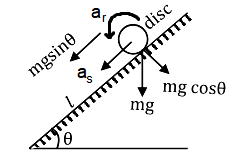
A circular disc reaches from top to bottom of an inclined plane of length \(l\). When it slips down the plane, if takes \(t s\). When it rolls down the plane then it takes \(\left(\frac{\alpha}{2}\right)^{1 / 2} t s\), where \(\alpha\) is ____. [JEE Main 2024 (Online) 9th April Evening Shift]
CorrectIncorrectHint
(c)

To solve this problem, we need to compare the acceleration of the disc in two different scenarios: pure slipping and pure rolling.
Step 1: Case 1: Slipping Down the Plane
When the disc slips down a frictionless inclined plane of angle \(\theta\), the only force acting along the incline is the component of gravity.
Acceleration \(\left(a_s\right)\) : \(a_s=g \sin \theta\)
Time taken \((t)\) : Using the equation of motion \(s=u t+\frac{1}{2} a t^2\) (with \(u=0\) and \(s=l\) ):
\(
l=\frac{1}{2}(g \sin \theta) t^2 \Longrightarrow t=\sqrt{\frac{2 l}{g \sin \theta}}
\)
Case 2: Rolling Down the Plane
When the disc rolls without slipping, part of the potential energy is converted into rotational kinetic energy. The acceleration for a rolling body is given by:
\(
a_r=\frac{g \sin \theta}{1+\frac{k^2}{R^2}}
\)
For a circular disc, the moment of inertia about its center is \(I=\frac{1}{2} M R^2\), so the radius of gyration ratio is \(\frac{k^2}{R^2}=\frac{1}{2}\).
Acceleration \(\left(a_r\right)\) :
\(
a_r=\frac{g \sin \theta}{1+1 / 2}=\frac{g \sin \theta}{3 / 2}=\frac{2}{3} g \sin \theta
\)
Time taken \(\left(t_r\right)\) :
\(
l=\frac{1}{2} a_r t_r^2 \Longrightarrow t_r=\sqrt{\frac{2 l}{a_r}}=\sqrt{\frac{2 l}{\frac{2}{3} g \sin \theta}}=\sqrt{3} \sqrt{\frac{l}{g \sin \theta}}
\)
Step 2: Comparing the Times
We express \(t_r\) in terms of \(t\) :
\(
t_r=\sqrt{\frac{3 l}{g \sin \theta}}
\)
Substitute \(\frac{l}{g \sin \theta}=\frac{t^2}{2}\) from Case 1:
\(
t_r=\sqrt{3 \cdot \frac{t^2}{2}}=\left(\frac{3}{2}\right)^{1 / 2} t
\)
Step 3: Find the Value of \(\alpha\)
The problem states the rolling time is \(\left(\frac{\alpha}{2}\right)^{1 / 2} t\).
Comparing the expressions:
\(
\begin{aligned}
\left(\frac{\alpha}{2}\right)^{1 / 2} t & =\left(\frac{3}{2}\right)^{1 / 2} t \\
\frac{\alpha}{2} & =\frac{3}{2} \\
\alpha & =3
\end{aligned}
\) - Question 12 of 83
12. Question
A string is wrapped around the rim of a wheel of moment of inertia \(0.40 kgm ^2\) and radius 10 cm. The wheel is free to rotate about its axis. Initially the wheel is at rest. The string is now pulled by a force of 40 N. The angular velocity of the wheel after 10 s is \(x ~rad / s\), where \(x\) is ___. [JEE Main 2024 (Online) 9th April Morning Shift]
CorrectIncorrectHint
(b) To solve for the angular velocity, we follow the relationship between force, torque, and rotational motion.
Step 1: Identify Given Data
Moment of Inertia (I): \(0.40 kg \cdot m ^2\)
Radius \((R)\) : \(10 cm=0.1 m\)
Force \((F): 40 N\)
Time \((t): 10 s\)
Initial Angular Velocity ( \(\omega_0\) ): \(0 rad / s\) (at rest)
Step 2: Calculate the Torque ( \(\tau\) )
The force is applied tangentially at the rim of the wheel, creating a torque:
\(
\begin{gathered}
\tau=F \times R \\
\tau=40 N \times 0.1 m=4 N \cdot m
\end{gathered}
\)
Step 3: Calculate Angular Acceleration ( \(\alpha\) )
Using the rotational version of Newton’s second law ( \(\tau= I \alpha\) ):
\(
\begin{gathered}
\alpha=\frac{\tau}{I} \\
\alpha=\frac{4 N \cdot m}{0.40 kg \cdot m^2}=10 rad / s^2
\end{gathered}
\)
Step 4: Find the Final Angular Velocity ( \(\omega\) )
Using the first equation of rotational motion:
\(
\begin{gathered}
\omega=\omega_0+\alpha t \\
\omega=0+\left(10 rad / s^2 \times 10 s\right) \\
\omega=100 rad / s
\end{gathered}
\)
Step 5: Determine the Value of \(x\)
The problem states the angular velocity is \(x rad / s\).
\(
x=100
\) - Question 13 of 83
13. Question
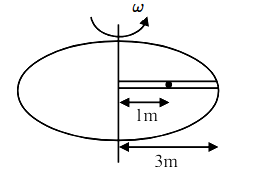
A circular table is rotating with an angular velocity of \(\omega ~rad / s\) about its axis (see figure). There is a smooth groove along a radial direction on the table. A steel ball is gently placed at a distance of 1 m on the groove. All the surfaces are smooth. If the radius of the table is 3 m, the radial velocity of the ball w.r.t. the table at the time ball leaves the table is \(x \sqrt{2} \omega m / s\), where the value of \(x\) is ____. [JEE Main 2024 (Online) 8th April Evening Shift]
 CorrectIncorrect
Hint
(d) To solve this problem, we analyze the motion of the steel ball from the perspective of a noninertial reference frame rotating with the table.
Step 1: Forces in the Rotating Frame
In the rotating frame of the table, the steel ball experiences a centrifugal force directed radially outward. Since the groove is smooth (no friction), the only force acting in the radial direction is this centrifugal force.
The centrifugal force \(F_c\) is given by:
\(
F_c=m \omega^2 r
\)
Step 2: Equation of Motion
Using Newton’s Second Law ( \(F=m a\) ) in the radial direction:
\(
\begin{aligned}
m \frac{d^2 r}{d t^2} & =m \omega^2 r \\
\frac{d^2 r}{d t^2} & =\omega^2 r
\end{aligned}
\)
We can express the radial acceleration in terms of radial velocity \(v_r\) :
\(
a_r=v_r \frac{d v_r}{d r}=\omega^2 r
\)
Step 3: Integration to find Radial Velocity
We integrate the expression from the initial position to the edge of the table:
Initial position \(\left(r_i\right): 1 m\)
Initial radial velocity \(\left(v_{r i}\right): 0 m / s\) (placed gently)
Final position \(\left(r_f\right): 3 m\)
Final radial velocity ( \(v_{r f}\) ): To be determined
\(
\begin{gathered}
\int_0^{v_{r f}} v_r d v_r=\int_1^3 \omega^2 r d r \\
{\left[\frac{v_r^2}{2}\right]_0^{v_{r f}}=\omega^2\left[\frac{r^2}{2}\right]_1^3} \\
\frac{v_{r f}^2}{2}=\frac{\omega^2}{2}\left(3^2-1^2\right) \\
v_{r f}^2=\omega^2(9-1) \\
v_{r f}^2=8 \omega^2
\end{gathered}
\)
Step 4: Solve for \(x\)
Taking the square root to find the radial velocity:
\(
v_{r f}=\sqrt{8 \omega^2}=\sqrt{8} \omega=2 \sqrt{2} \omega m / s
\)
The problem states that the radial velocity is \(x \sqrt{2} \omega\). By comparison:
\(
\begin{aligned}
&x \sqrt{2} \omega=2 \sqrt{2} \omega\\
&x=2
\end{aligned}
\) - Question 14 of 83
14. Question
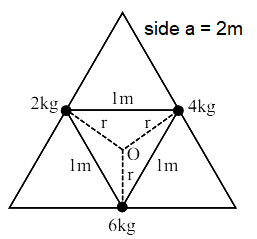
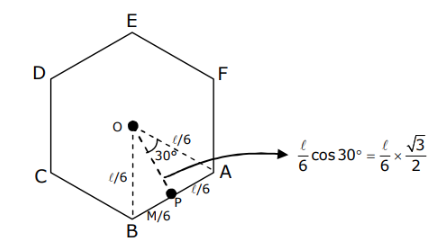
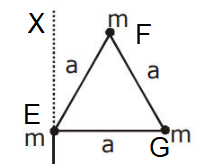
Three balls of masses \(2 kg, 4 kg\) and 6 kg respectively are arranged at centre of the edges of an equilateral triangle of side 2 m. The moment of inertia of the system about an axis through the centroid and perpendicular to the plane of triangle, will be _____ \(kg m ^2\). [JEE Main 2024 (Online) 6th April Evening Shift]
CorrectIncorrectHint
(d)

Moment of inertia about c and perpendicular to the plane is :
\(
I=2 \times\left(\frac{a}{2 \sqrt{3}}\right)^2+4 \times\left(\frac{a}{2 \sqrt{3}}\right)^2+6\left(\frac{a}{2 \sqrt{3}}\right)^2
\)
\(
I=4 kg m^2
\)
Distance between centroid and midpoint of sides
\(
=\frac{a}{2 \sqrt{3}}
\)Explanation:
Step 1: Calculate the distance from the centroid to the edge centers
The height of the equilateral triangle of side \(a=2 m\) is calculated using the formula \(h=\frac{\sqrt{3}}{2} a=\frac{\sqrt{3}}{2} \times 2=\sqrt{3} m\). The centroid is located at one-third of the height from the base. The distance \(r\) from the centroid to the center of each edge is \(r=\frac{1}{3} h=\frac{\sqrt{3}}{3}=\frac{1}{\sqrt{3}} m\). The distance squared is \(r^2=\frac{1}{3} m^2\).
Step 2: Calculate the total moment of inertia
The moment of inertia \(I\) of a system of point masses \(m_i\) at a distance \(r_i\) from the axis is given by the formula \(I=\sum m_i r_i^2\). Since all masses are at the same distance \(r\) from the axis, the total moment of inertia is \(I =\left( m _1+ m _2+ m _3\right) r^2\). The total mass is \(m_1+m_2+m_3=2 kg+4 kg+6 kg=12 kg\).
\(
I=12 kg \times \frac{1}{3} m^2=4 kg m^2
\) - Question 15 of 83
15. Question
A hollow sphere is rolling on a plane surface about its axis of symmetry. The ratio of rotational kinetic energy to its total kinetic energy is \(\frac{x}{5}\). The value of \(x\) is ____. [JEE Main 2024 (Online) 5th April Evening Shift]
CorrectIncorrectHint
(b) To solve this problem, we need to compare the rotational kinetic energy to the total kinetic energy of a rolling hollow sphere.
Step 1: Define Kinetic Energies and Moment of Inertia
The total kinetic energy ( \(K E_{\text {total }}\) ) of a rolling object is the sum of its translational kinetic energy ( \(K E _{\text {trans }}\) ) and rotational kinetic energy ( \(K E _{\text {rot }}\) ).
\(
\begin{gathered}
K E_{\text {total }}=K E_{\text {trans }}+K E_{\text {rot }} \\
K E_{\text {trans }}=\frac{1}{2} m v^2 \\
K E_{\text {rot }}=\frac{1}{2} I \omega^2
\end{gathered}
\)
The moment of inertia ( \(I\) ) for a hollow sphere about an axis through its center is
\(
I=\frac{2}{3} m R^2 .
\)
For rolling without slipping, the linear velocity ( \(v\) ) and angular velocity ( \(\omega\) ) are related by \(v=R \omega\), so \(\omega=\frac{v}{R}\).
Step 2: Calculate Rotational Kinetic Energy
Substitute the moment of inertia and angular velocity into the rotational kinetic energy formula:
\(
K E_{r o t}=\frac{1}{2} I \omega^2=\frac{1}{2}\left(\frac{2}{3} m R^2\right)\left(\frac{v}{R}\right)^2=\frac{1}{3} m v^2
\)
Step 3: Calculate Total Kinetic Energy and Ratio
Calculate the total kinetic energy:
\(
K E_{\text {total }}=K E_{\text {trans }}+K E_{\text {rot }}=\frac{1}{2} m v^2+\frac{1}{3} m v^2=\left(\frac{1}{2}+\frac{1}{3}\right) m v^2=\frac{5}{6} m v^2
\)
The ratio of rotational kinetic energy to total kinetic energy is:
\(
\frac{K E_{\text {rot }}}{K E_{\text {total }}}=\frac{\frac{1}{3} m v^2}{\frac{5}{6} m v^2}=\frac{1}{3} \times \frac{6}{5}=\frac{2}{5}
\)
The problem states the ratio is \(\frac{x}{5}\).
Comparing the calculated ratio with the given format, we find \(x=2\). - Question 16 of 83
16. Question
A solid sphere and a hollow cylinder roll up without slipping on same inclined plane with same initial speed \(v\). The sphere and the cylinder reaches upto maximum heights \(h_1\) and \(h_2\) respectively, above the initial level. The ratio \(h_1: h_2\) is \(\frac{n}{10}\). The value of \(n\) is ____. [JEE Main 2024 (Online) 4th April Morning Shift]
CorrectIncorrectHint
(c) To find the ratio of the maximum heights reached by the solid sphere and the hollow cylinder, we use the principle of Conservation of Mechanical Energy.
When an object rolls up an incline without slipping, its initial total kinetic energy (translational + rotational) is completely converted into gravitational potential energy at the maximum height \(h\).
Step 1: Formulate Energy Conservation
The initial kinetic energy of a rolling object is the sum of translational and rotational kinetic energy, \(K = K _{\text {trans }}+ K _{\text {rot }}=\frac{1}{2} m v ^2+\frac{1}{2} I \omega^2\). Using the rolling condition \(\omega=v / R\), the total initial energy can be written as \(E_{\text {initial }}=\frac{1}{2} m v^2\left(1+\frac{I}{m R^2}\right)\). As the object rolls up the incline, this energy is converted into gravitational potential energy \(U = m g h\) at the maximum height \(h\).
By the principle of conservation of energy, the maximum height reached is given by
\(
h=\frac{v^2}{2 g}\left(1+\frac{I}{m R^2}\right) .
\)
Step 2: Calculate Heights
For a solid sphere, the moment of inertia is \(I_1=\frac{2}{5} m_1 R_1^2\).
\(
h_1=\frac{v^2}{2 g}\left(1+\frac{2}{5}\right)=\frac{v^2}{2 g}\left(\frac{7}{5}\right)
\)
For a hollow cylinder, the moment of inertia is \(I _2= m _2 R _2^2\).
\(
h_2=\frac{v^2}{2 g}(1+1)=\frac{v^2}{2 g}(2)
\)
Step 3: Find the Ratio and \(n\)
The ratio of the heights is calculated as:
\(
\frac{h_1}{h_2}=\frac{\frac{v^2}{2 g}\left(\frac{7}{5}\right)}{\frac{v^2}{2 g}(2)}=\frac{7 / 5}{2}=\frac{7}{10}
\)
The problem states that the ratio \(h_1: h_2\) is \(\frac{n}{10}\). Comparing the derived ratio to the given format, we find that \(n=7\). - Question 17 of 83
17. Question
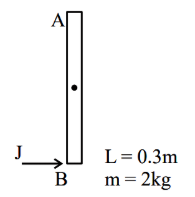
A uniform rod \(A B\) of mass 2 kg and length 30 cm at rest on a smooth horizontal surface. An impulse of force \(0.2 Ns\) is applied to end \(B\). The time taken by the rod to turn through at right angles will be \(\frac{\pi}{x} s\), where \(x=\) ____. [JEE Main 2024 (Online) 1st February Evening Shift]
CorrectIncorrectHint
(d)

To solve this problem, we analyze the effect of the impulse on the rotational motion of the rod about its center of mass.
Step 1: Identify Given Data
Mass of rod ( \(M\) ): 2 kg
Length of rod \((L): 30 cm=0.3 m\)
Impulse ( \(J\) ): 0.2 Ns (applied at one end)
Angle turned ( \(\theta\) ): A right angle \(=\pi / 2\) radians
Step 2: Calculate Angular Velocity ( \(\omega\) )
When an impulse is applied to the end of a rod, it changes both the linear and angular momentum. For rotation about the center of mass ( \(C M\) ): The angular impulse is equal to the change in angular momentum:
\(
\text { Angular Impulse }=\Delta L_{c m}=I_{c m} \omega
\)
The impulse is applied at a distance \(r=L / 2\) from the center:
\(
\text { Angular Impulse }=J \times \frac{L}{2}
\)
The moment of inertia of a uniform rod about its center is:
\(
I_{c m}=\frac{1}{12} M L^2
\)
Equating the two:
\(
J \cdot \frac{L}{2}=\left(\frac{1}{12} M L^2\right) \omega
\)
\(
\omega=\frac{6 J}{M L}
\)
Substitute the values:
\(
\omega=\frac{6 \times 0.2}{2 \times 0.3}=\frac{1.2}{0.6}=2 rad / s
\)
Step 3: Calculate Time Taken ( \(t\) )
Since there is no friction (smooth surface) and no further forces are applied, the rod rotates with constant angular velocity. The time taken to turn through angle \(\theta\) is:
\(
\begin{gathered}
t=\frac{\theta}{\omega} \\
t=\frac{\pi / 2}{2}=\frac{\pi}{4} s
\end{gathered}
\)
Step 4: Find the Value of \(x\)
The problem states the time is \(\frac{\pi}{x} s\). Comparing the two:
\(
\begin{aligned}
&\frac{\pi}{x}=\frac{\pi}{4}\\
&x=4
\end{aligned}
\) - Question 18 of 83
18. Question
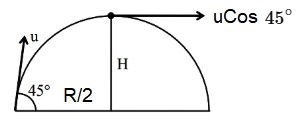
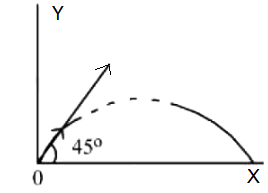
A body of mass ‘ \(m\) ‘ is projected with a speed ‘ \(u\) ‘ making an angle of \(45^{\circ}\) with the ground. The angular momentum of the body about the point of projection, at the highest point is expressed as \(\frac{\sqrt{2} m u^3}{X g}\). The value of ‘ \(X\) ‘ is ____. [JEE Main 2024 (Online) 31st January Evening Shift]
CorrectIncorrectHint
(c)

To find the value of \(X\), we calculate the angular momentum of the projectile at its highest point relative to the point of projection.
Step 1: Identify the Projectile Parameters
Initial velocity \((u): u\)
Angle of projection \((\theta): 45^{\circ}\)
Point of projection: Origin \((0,0)\)
Mass: \(m\)
Step 2: Velocity and Position at the Highest Point
At the maximum height of a projectile:
Velocity (\(v\)): Only the horizontal component remains.
\(
\begin{gathered}
v_x=u \cos \theta=u \cos 45^{\circ}=\frac{u}{\sqrt{2}} \\
v_y=0
\end{gathered}
\)
Position \((r)\) : The vertical distance is the maximum height \((H)\), and the horizontal distance is half the range ( \(R / 2\) ).
\(
H=\frac{u^2 \sin ^2 \theta}{2 g}=\frac{u^2 \sin ^2 45^{\circ}}{2 g}=\frac{u^2(1 / 2)}{2 g}=\frac{u^2}{4 g}
\)
Step 3: Calculate Angular Momentum ( \(L\) )
The angular momentum about the origin is given by \(L=r \times p\), which simplifies to the product of the mass, the horizontal velocity, and the perpendicular distance from the origin to the velocity vector. At the highest point, the velocity is horizontal, so the perpendicular distance to the origin is simply the maximum height ( \(H\) ).
\(
\begin{gathered}
L=m \cdot v_x \cdot H \\
L=m\left(\frac{u}{\sqrt{2}}\right)\left(\frac{u^2}{4 g}\right) \\
L=\frac{m u^3}{4 \sqrt{2} g}
\end{gathered}
\)
Step 4: Rationalize the Expression
The problem asks for the expression in the form \(\frac{\sqrt{2} m u^3}{\lambda g}\). To get \(\sqrt{2}\) in the numerator, we multiply the top and bottom of our result by \(\sqrt{2}\) :
\(
\begin{gathered}
L=\frac{m u^3}{4 \sqrt{2} g} \times \frac{\sqrt{2}}{\sqrt{2}} \\
L=\frac{\sqrt{2} m u^3}{4 \times 2 \times g} \\
L=\frac{\sqrt{2} m u^3}{8 g}
\end{gathered}
\)
Step 5: Find the Value of \(X\)
Comparing our result \(\frac{\sqrt{2} m u^3}{8 g}\) with the given form \(\frac{\sqrt{2} m u^3}{X g}\) :
\(
X=8
\) - Question 19 of 83
19. Question
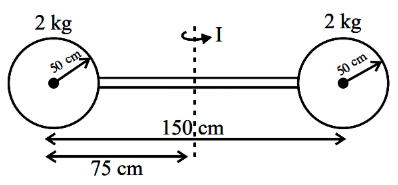
Two identical spheres each of mass 2 kg and radius 50 cm are fixed at the ends of a light rod so that the separation between the centers is 150 cm. Then, moment of inertia of the system about an axis perpendicular to the rod and passing through its middle point is \(\frac{x}{20} kgm ^2\), where the value of \(x\) is ____. [JEE Main 2024 (Online) 31st January Evening Shift]
CorrectIncorrectHint
(d)

\(
\begin{aligned}
& I=\left(\frac{2}{5} m R^2+m d^2\right) \times 2 \\
& I=2\left(\frac{2}{5} \times 2 \times\left(\frac{1}{2}\right)^2+2 \times\left(\frac{3}{4}\right)^2\right)=\frac{53}{20} kg-m^2 \\
& X=53
\end{aligned}
\)Explanation: To find the value of \(x\), we need to calculate the total moment of inertia of the system using the Parallel Axis Theorem.
Step 1: Define variables and formulas
The given values are:
Mass of each sphere \(m =2\) kg
Radius of each sphere \(R =50 cm=0.5 m\)
Separation between centers \(L=150 cm=1.5 m\)
Distance of each sphere’s center from the axis \(D = L / 2=75 cm=0.75 m\)
The moment of inertia of a solid sphere about an axis through its center of mass is given by \(I _{ cm }=\frac{2}{5} m R ^2\).
Step 2: Apply the parallel axis theorem
According to the parallel axis theorem, the moment of inertia of one sphere about the central axis of the system is \(I _{\text {sphere }}= I _{ cm }+ m D ^2\).
\(
I_{\text {sphere }}=\frac{2}{5} m R^2+m D^2
\)
Step 3: Calculate the total moment of inertia
The total moment of inertia \(I _{\text {total }}\) is the sum of the moments of inertia of the two spheres:
\(
I_{\text {total }}=2 \times I_{\text {sphere }}=2\left(\frac{2}{5} m R^2+m D^2\right)
\)
Substitute the values:
\(
\begin{gathered}
I_{\text {total }}=2\left(\frac{2}{5} \times 2 \times(0.5)^2+2 \times(0.75)^2\right) \\
I_{\text {total }}=2\left(\frac{4}{5} \times 0.25+2 \times 0.5625\right) \\
I_{\text {total }}=2(0.2+1.125)=2 \times 1.325 \\
I_{\text {total }}=2.65 kg m^2
\end{gathered}
\)
Step 4: Determine the value of \(x\)
The problem states that \(I_{\text {total }}=\frac{x}{20} kgm ^2\).
\(
\begin{gathered}
2.65=\frac{x}{20} \\
x=2.65 \times 20 \\
x=53
\end{gathered}
\) - Question 20 of 83
20. Question
Two discs of moment of inertia \(I_1=4 kg m ^2\) and \(I_2=2 kg m ^2\), about their central axes & normal to their planes, rotating with angular speeds \(10 ~rad / s~ \& ~4 ~rad / s\) respectively are brought into contact face to face with their axes of rotation coincident. The loss in kinetic energy of the system in the process is _____ J. [JEE Main 2024 (Online) 30th January Evening Shift]
CorrectIncorrectHint
(b) To find the loss in kinetic energy when the two discs are brought into contact, we use the principles of conservation of angular momentum and rotational kinetic energy.
Step 1: Identify Given Data
Disc 1: \(I_1=4 kg \cdot m ^2, \omega_1=10 rad / s\)
Disc 2: \(I_2=2 kg \cdot m ^2, \omega_2=4 rad / s\)
Step 2: Calculate Initial Kinetic Energy ( \(K _{ i }\) )
The total initial kinetic energy is the sum of the individual kinetic energies of the two discs:
\(
\begin{gathered}
K_i=\frac{1}{2} I_1 \omega_1^2+\frac{1}{2} I_2 \omega_2^2 \\
K_i=\frac{1}{2}(4)(10)^2+\frac{1}{2}(2)(4)^2 \\
K_i=200+16=216 J
\end{gathered}
\)
Step 3: Calculate Final Common Angular Velocity ( \(\omega_f\) )
When the discs are brought into contact, they will eventually rotate with a common angular velocity due to friction between the surfaces. Since no external torque acts on the system, the Angular Momentum is conserved:
\(
\begin{gathered}
L_i=L_f \\
I_1 \omega_1+I_2 \omega_2=\left(I_1+I_2\right) \omega_f \\
4(10)+2(4)=(4+2) \omega_f \\
48=6 \omega_f \Longrightarrow \omega_f=8 rad / s
\end{gathered}
\)
Step 4: Calculate Final Kinetic Energy ( \(K_f\) )
\(
\begin{gathered}
K_f=\frac{1}{2}\left(I_1+I_2\right) \omega_f^2 \\
K_f=\frac{1}{2}(6)(8)^2
\end{gathered}
\)
\(
\begin{aligned}
&K_f=3 \times 64=192 J\\
&\text { 5. Calculate the Loss in Kinetic Energy ( } \Delta K \text { ) }\\
&\begin{gathered}
\Delta K=K_i-K_f \\
\Delta K=216-192=24 J
\end{gathered}
\end{aligned}
\)Alternative Shortcut Formula: For two rotating bodies brought together, the loss in energy is given by:
\(
\begin{gathered}
\Delta K=\frac{1}{2} \frac{I_1 I_2}{I_1+I_2}\left(\omega_1-\omega_2\right)^2 \\
\Delta K=\frac{1}{2} \frac{4 \times 2}{4+2}(10-4)^2=\frac{1}{2} \cdot \frac{8}{6} \cdot 6^2=\frac{2}{3} \cdot 36=24 J
\end{gathered}
\)
The loss in kinetic energy of the system is 24 J. - Question 21 of 83
21. Question
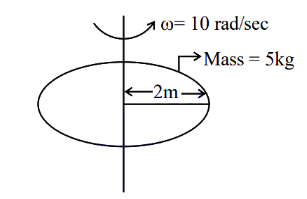
Consider a Disc of mass 5 kg , radius 2 m, rotating with angular velocity of \(\)10 rad / slatex] about an axis perpendicular to the plane of rotation. An identical disc is kept gently over the rotating disc along the same axis. The energy dissipated so that both the discs continue to rotate together without slipping is ____ J. [JEE Main 2024 (Online) 30th January Morning Shift]
 CorrectIncorrect
Hint
(c) To find the energy dissipated, we can use the principle of Conservation of Angular Momentum, as there is no external torque acting on the system.
Step 1: Calculate moment of inertia and initial angular momentum
The moment of inertia for a single disc about the central axis is \(I=\frac{1}{2} M R^2\).
For the given values \(M=5 kg\) and \(R=2 m\) :
\(
I=\frac{1}{2} \times 5 \times 2^2=\frac{1}{2} \times 5 \times 4=10 kg \cdot m^2
\)
The initial angular momentum of the first disc with \(\omega_1=10 rad / s\) is
\(
L_1=I \omega_1=10 \times 10=100 kg \cdot m^2 / s .
\)
Step 2: Apply conservation of angular momentum
When the second identical disc is added, the total moment of inertia of the system becomes \(I_{\text {total }}=2 I=2 \times 10=20 kg \cdot m ^2\).
Angular momentum is conserved during the process.
\(
\begin{gathered}
L_{\text {initial }}=L_{\text {final }} \\
I \omega_1=I_{\text {total }} \omega_2 \\
100=20 \omega_2
\end{gathered}
\)
The final angular velocity is \(\omega_2=\frac{100}{20}=5 rad / s\).
Step 3: Calculate energy dissipated
The energy dissipated \((\Delta K)\) is the difference between the initial kinetic energy \(\left( K _{\text {initial }}\right)\) and the final kinetic energy ( \(K _{\text {final }}\) ).
\(
\begin{gathered}
K_{\text {initial }}=\frac{1}{2} I \omega_1^2=\frac{1}{2} \times 10 \times 10^2=500 J \\
K_{\text {final }}=\frac{1}{2} I_{\text {total }} \omega_2^2=\frac{1}{2} \times 20 \times 5^2=250 J \\
\Delta K=K_{\text {initial }}-K_{\text {final }}=500 J-250 J=250 J
\end{gathered}
\)Short Cut way: Alternatively, you can use the direct formula for energy loss during a rotational collision:
\(
\begin{gathered}
\Delta E=\frac{1}{2} \frac{I_1 I_2}{I_1+I_2}\left(\omega_1-\omega_2\right)^2 \\
\Delta E=\frac{1}{2} \frac{10 \times 10}{10+10}(10-0)^2=\frac{1}{2} \times \frac{100}{20} \times 100=250 J
\end{gathered}
\) - Question 22 of 83
22. Question
A body of mass 5 kg moving with a uniform speed \(3 \sqrt{2} ms^{-1}\) in \(X-Y\) plane along the line \(y=x+4\). The angular momentum of the particle about the origin will be ____ \(kg m ^2 s^{-1}\). [JEE Main 2024 (Online) 29th January Evening Shift]
CorrectIncorrectHint
(d) To find the angular momentum of the particle about the origin, we can use the concept of Moment of Momentum.
Step 1: Identify the Parameters
Mass ( \(m\) ): 5 kg
Speed \((v): 3 \sqrt{2} m / s\)
Linear Momentum ( \(p\) ): \(p=m \times v=5 \times 3 \sqrt{2}=15 \sqrt{2} kg \cdot m / s\)
Line of Motion: \(y=x+4\), which can be rewritten in general form as \(x-y+4=0\).
Step 2: Calculate the Perpendicular Distance ( \(r_{\perp}\) ) from Origin (0, 0)
The angular momentum \((L)\) of a particle moving in a straight line about a fixed point (the origin) is given by:
\(
L = p \times r _{\perp}
\)
where \(r_{\perp}\) is the perpendicular distance from the origin \((0,0)\) to the line of motion.
The perpendicular distance from a point \(\left(x_1, y_1\right)\) to a line \(a x+b y+c=0\) is:
\(
d=\frac{\left|a x_1+b y_1+c\right|}{\sqrt{a^2+b^2}}
\)
For the origin \((0,0)\) and the line \(1 x-1 y+4=0\) :
\(
r_{\perp}=\frac{|1(0)-1(0)+4|}{\sqrt{1^2+(-1)^2}}=\frac{4}{\sqrt{2}}=2 \sqrt{2} m
\)
Step 3: Calculate Angular Momentum
Now, substitute the values of linear momentum and perpendicular distance into the formula:
\(
\begin{gathered}
L=p \times r_{\perp} \\
L=(15 \sqrt{2}) \times(2 \sqrt{2}) \\
L=15 \times 2 \times(\sqrt{2} \times \sqrt{2}) \\
L=30 \times 2=60 kg \cdot m^2 / s
\end{gathered}
\)
The magnitude of the angular momentum of the particle about the origin is 60 units. - Question 23 of 83
23. Question
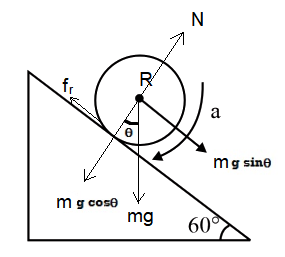
A cylinder is rolling down on an inclined plane of inclination \(60^{\circ}\). It’s acceleration during rolling down will be \(\frac{x}{\sqrt{3}} m / s^2\), where \(x=\) ____ (use \(g =10 m / s ^2\) ). [JEE Main 2024 (Online) 29th January Morning Shift]
CorrectIncorrectHint
(a)
To find the value of \(x\) for the cylinder rolling down the incline, we use the standard formula for the acceleration of a rolling body.
STep 1: The General Formula for Rolling Acceleration
When a body rolls down an inclined plane without slipping, its linear acceleration ( \(a\) ) is given by:
\(
a=\frac{g \sin \theta}{1+\frac{I}{M R^2}}
\)
where:
\(g=10 m / s ^2\)
\(\theta=60^{\circ}\)
\(I\) is the moment of inertia of the body about its central axis.
Step 2: Identify the Moment of Inertia
For a solid cylinder (which is the default assumption in such problems unless “hollow” is specified), the moment of inertia about its axis is:
\(
I=\frac{1}{2} M R^2
\)
Substituting the ratio \(\frac{I}{M R^2}=\frac{1}{2}\) into our acceleration formula:
\(
a=\frac{g \sin 60^{\circ}}{1+\frac{1}{2}}
\)
Step 3: Calculate the Acceleration
Substitute the values for \(g\) and \(\sin 60^{\circ}\) (which is \(\frac{\sqrt{3}}{2}\) ):
\(
a=\frac{10 \times \frac{\sqrt{3}}{2}}{\frac{3}{2}}
\)
The denominators (the “2”s) cancel out:
\(
a=\frac{10 \sqrt{3}}{3}
\)
To match the form \(\frac{x}{\sqrt{3}}\), we rationalize the expression by multiplying and dividing by \(\sqrt{3}\) :
\(
a=\frac{10 \sqrt{3}}{3} \times \frac{\sqrt{3}}{\sqrt{3}}=\frac{10 \times 3}{3 \sqrt{3}}=\frac{10}{\sqrt{3}}
\)
Step 4: Determine the value of \(x\)
Comparing our result \(a=\frac{10}{\sqrt{3}}\) with the given form \(a=\frac{x}{\sqrt{3}}\) :
\(
x=10
\)
The acceleration is \(\frac{10}{\sqrt{3}} m / s ^2\), so the value of \(x\) is 10 .Derivation of Formula:

Also, applying Newton’s third law of motion for the forces acting along the length of the inclined plane,
\(
m g \sin \theta-f=m a
\)
Here \(a\) is the linear acceleration of the cylinder and \(g\) is the acceleration due to gravity.
Substitute \(f_r=\frac{I \alpha}{R}\) in equation above,
\(
m g \sin \theta-\frac{I \alpha}{R}=m a
\)
Substitute \(\alpha=a / R\), in equation \(m g \sin \theta-\frac{I \alpha}{R}=m a\),
\(
\begin{aligned}
m g \sin \theta-\frac{I a}{R^2} & =m a \\
a & =\frac{m g \sin \theta}{m+I / R^2}
\end{aligned}
\) - Question 24 of 83
24. Question
A ring and a solid sphere roll down the same inclined plane without slipping. They start from rest. The radii of both bodies are identical and the ratio of their kinetic energies is \(\frac{7}{x}\), where \(x\) is ____. [JEE Main 2024 (Online) 27th January Evening Shift]
CorrectIncorrectHint
(c) Step 1: Energy Analysis
When a body rolls down an inclined plane without slipping, the work done by static friction is zero. Therefore, the total mechanical energy is conserved. For any object of mass \(m\) starting from rest at a height \(h\) :
Initial Energy: All energy is Potential Energy ( \(P E=m g h\) ).
Final Energy: All energy is converted into Kinetic Energy ( \(K E_{\text {total }}\) ).
According to the law of conservation of energy:
\(
K E_{\text {total }}=m g h
\)
Step 2: Compare the Ring and the Solid Sphere
The problem states that both bodies:
(i) Roll down the same inclined plane (same height \(h\) ).
(ii) Start from rest.
(iii) Have identical radii ( \(R\) ).
For the ratio of their kinetic energies to be \(\frac{7}{x}\), we must consider their masses. In standard JEE problems of this type, if the masses are not specified as different, they are typically assumed to be identical ( \(m_{\text {ring }}=m_{\text {sphere }}=m\) ).
Kinetic Energy of Ring \(\left(K_R\right): K_R=m g h\)
Kinetic Energy of Sphere \(\left(K_S\right): K_S=m g h\)
If the masses are identical, the ratio of their total kinetic energies is:
\(
\frac{K_R}{K_S}=\frac{m g h}{m g h}=1
\)
Given that the ratio is \(\frac{7}{x}\) :
\(
\frac{7}{x}=1 \Longrightarrow x=7
\)
Step 3: Why Moment of Inertia doesn’t change the Total KE
While the distribution of kinetic energy (how much is translational vs. rotational) differs between a ring and a sphere, the total kinetic energy at the bottom depends only on the vertical height descended and the mass of the object.
\(
\begin{array}{lllll}
\text { Body } & \text { Moment of Inertia }(I) & \text { Translational KE } & \text { Rotational KE } & \text { Total KE } \\
\text { Ring } & M R^2 & \frac{1}{2} m g h & \frac{1}{2} m g h & m g h \\
\text { Solid Sphere } & \frac{2}{5} M R^2 & \frac{5}{7} m g h & \frac{2}{7} m g h & m g h
\end{array}
\) - Question 25 of 83
25. Question
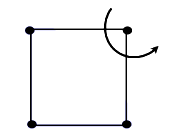
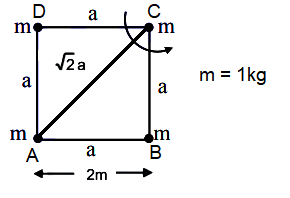
Four particles each of mass 1 kg are placed at four corners of a square of side 2 m. Moment of inertia of system about an axis perpendicular to its plane and passing through one of its vertex is ____ \(kgm ^2\). [JEE Main 2024 (Online) 27th January Morning Shift]
 CorrectIncorrect
Hint
(d)

\(
\begin{aligned}
& I=m a^2+m a^2+m(\sqrt{ } 2a)^2 \\
& =4 m a^2 \\
& =4 \times 1 \times(2)^2 \\
& =16
\end{aligned}
\)Explanation: To find the total moment of inertia \((I)\) of the system, we sum the individual moments of inertia of each of the four particles relative to the specified axis.
Step 1: Identify the Axis and Positions
Let the four corners of the square be \(A, B, C\), and \(D\).
Axis: Perpendicular to the plane and passing through one vertex (let’s pick vertex \(A\) ).
Mass of each particle ( \(m\) ): 1 kg
Side of the square \((a): 2 m\)
Step 2: Determine Distances from the Axis
The moment of inertia for a point mass is \(I=m r^2\), where \(r\) is the perpendicular distance from the mass to the axis.
Particle at \(A\) (the vertex on the axis): \(r_1=0\)
Particle at \(B\) (adjacent corner): \(r_2=a=2 m\)
Particle at \(D\) (adjacent corner): \(r_3=a=2 m\)
Particle at \(C\) (opposite corner): \(r_4=\) diagonal distance \(=a \sqrt{2}=2 \sqrt{2} m\)
Step 3: Calculate Total Moment of Inertia
Summing the contributions of all four particles:
\(
\begin{gathered}
I_{\text {total }}=I_1+I_2+I_3+I_4 \\
I_{\text {total }}=m(0)^2+m(a)^2+m(a)^2+m(a \sqrt{2})^2 \\
I_{\text {total }}=m\left(0+a^2+a^2+2 a^2\right) \\
I_{\text {total }}=4 m a^2
\end{gathered}
\)
Substituting the given values ( \(m=1 kg, a=2 m\) ):
\(
\begin{gathered}
I_{\text {total }}=4 \times 1 \times(2)^2 \\
I_{\text {total }}=4 \times 4 \\
I_{\text {total }}=16 kg \cdot m^2
\end{gathered}
\)
The moment of inertia of the system about an axis perpendicular to its plane and passing through one vertex is 16. - Question 26 of 83
26. Question
A solid sphere and a solid cylinder of same mass and radius are rolling on a horizontal surface without slipping. The ratio of their radius of gyrations respectively \(\left(k_{\text {sph }}: k_{\text {cyl }}\right)\) is \(2: \sqrt{x}\). The value of \(x\) is ____. [JEE Main 2023 (Online) 15th April Morning Shift]
CorrectIncorrectHint
(d) To find the value of \(x\), we need to use the relationship between the moment of inertia ( \(I\) ) and the radius of gyration ( \(k\) ), which is given by the formula:
\(
I=M k^2 \Longrightarrow k=\sqrt{\frac{I}{M}}
\)
Step 1: Calculation for the Solid Sphere
The moment of inertia of a solid sphere about its central axis is:
\(
I_{sph}=\frac{2}{5} M R^2
\)
Setting this equal to \(M k_{\text {sph }}^2\) :
\(
M k_{sph}^2=\frac{2}{5} M R^2 \Longrightarrow k_{sph}=\sqrt{\frac{2}{5}} R
\)
Step 2: Calculation for the Solid Cylinder
The moment of inertia of a solid cylinder about its longitudinal axis is:
\(
I_{cyl}=\frac{1}{2} M R^2
\)
Setting this equal to \(M k_{ cyl }^2\) :
\(
M k_{cyl}^2=\frac{1}{2} M R^2 \Longrightarrow k_{cyl}=\sqrt{\frac{1}{2}} R
\)
Step 3: Finding the Ratio
Now, we find the ratio \(k_{\text {sph }}: k_{\text {cyl }}\) :
\(
\frac{k_{sph}}{k_{cyl}}=\frac{\sqrt{\frac{2}{5}} R}{\sqrt{\frac{1}{2}} R}=\frac{\sqrt{2}}{\sqrt{5}} \cdot \frac{\sqrt{2}}{1}=\frac{2}{\sqrt{5}}
\)
Step 4: Comparison and Result
The problem states the ratio is 2 : \(\sqrt{x}\).
Comparing our result \(\frac{2}{\sqrt{5}}\) with the given ratio \(\frac{2}{\sqrt{x}}\), we find:
\(
\sqrt{x}=\sqrt{5}
\)
\(
x=5
\) - Question 27 of 83
27. Question
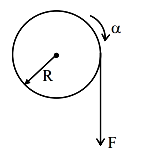
A light rope is wound around a hollow cylinder of mass 5 kg and radius 70 cm. The rope is pulled with a force of 52.5 N. The angular acceleration of the cylinder will be ____ rad \(s ^{-2}\). [JEE Main 2023 (Online) 13th April Evening Shift]
CorrectIncorrectHint
(b) Step 1: Convert units and identify parameters
The mass of the hollow cylinder is \(m=5 kg\), and the radius is \(r=70 cm=0.7 m\). The applied force is \(F=52.5 N\). The moment of inertia for a hollow cylinder is given by \(I=m r^2\).
Step 2: Calculate the moment of inertia
The moment of inertia \(I\) is calculated using the mass and the converted radius.
\(
I=5 \cdot(0.7)^2=2.45 kg \cdot m^2
\)
Step 3: Calculate the torque
The torque \(\tau\) produced by the force \(F\) at radius \(r\) is calculated as:
\(
\tau=F \cdot r=52.5 \cdot 0.7=36.75 N \cdot m
\)
Step 4: Calculate the angular acceleration
The angular acceleration \(\alpha\) is found using the rotational dynamics equation \(\tau=I \alpha\).
\(
\alpha=\frac{\tau}{I}=\frac{36.75}{2.45}=15 rad \cdot s^{-2}
\)
The angular acceleration of the cylinder will be \(15 rad s ^{-2}\). - Question 28 of 83
28. Question
A solid sphere is rolling on a horizontal plane without slipping. If the ratio of angular momentum about axis of rotation of the sphere to the total energy of moving sphere is \(\pi: 22\) then, the value of its angular speed will be _____ \(rad / s\). [JEE Main 2023 (Online) 13th April Morning Shift]
CorrectIncorrectHint
(a) To solve this problem, we need to find the ratio of the angular momentum to the total kinetic energy for a solid sphere rolling without slipping.
Step 1: Identify the Formulas
Moment of Inertia (I): For a solid sphere about its central axis:
\(
I=\frac{2}{5} M R^2
\)
Rolling Condition: Since the sphere is rolling without slipping, its linear velocity ( \(v\) ) and angular speed \((\omega)\) are related by:
\(
v=R \omega
\)
Angular Momentum ( \(L\) ): About the axis of rotation:
\(
L=I \omega=\frac{2}{5} M R^2 \omega
\)
Total Kinetic Energy \((E)\) : This is the sum of translational and rotational kinetic energies:
\(
E=K_{\text {trans }}+K_{\text {rot }}
\)
\(
E=\frac{1}{2} M v^2+\frac{1}{2} I \omega^2
\)
Step 2: Simplify the Expression for Total Energy (E)
Substitute \(v=R \omega\) and \(I=\frac{2}{5} M R^2\) :
\(
\begin{gathered}
E=\frac{1}{2} M(R \omega)^2+\frac{1}{2}\left(\frac{2}{5} M R^2\right) \omega^2 \\
E=\frac{1}{2} M R^2 \omega^2+\frac{1}{5} M R^2 \omega^2
\end{gathered}
\)
To add these, find a common denominator (10):
\(
E=\left(\frac{5}{10}+\frac{2}{10}\right) M R^2 \omega^2=\frac{7}{10} M R^2 \omega^2
\)
Step 3: Calculate the Ratio \((L / E)\)
\(
\frac{L}{E}=\frac{\frac{2}{5} M R^2 \omega}{\frac{7}{10} M R^2 \omega^2}
\)
\(
\begin{gathered}
\frac{L}{E}=\frac{2}{5} \times \frac{10}{7} \times \frac{1}{\omega} \\
\frac{L}{E}=\frac{4}{7 \omega}
\end{gathered}
\)
Step 4: Solve for Angular Speed ( \(\omega\) )
According to the problem, the ratio \(\frac{L}{E}=\frac{\pi}{22}\). Equating the two expressions:
\(
\frac{\pi}{22}=\frac{4}{7 \omega}
\)
Using the approximation \(\pi \approx \frac{22}{7}\) :
\(
\begin{gathered}
\frac{22 / 7}{22}=\frac{4}{7 \omega} \\
\frac{1}{7}=\frac{4}{7 \omega} \\
\omega=4 rad / s
\end{gathered}
\)
The value of the angular speed is 4 rad/s. - Question 29 of 83
29. Question
For a rolling spherical shell, the ratio of rotational kinetic energy and total kinetic energy is \(\frac{x}{5}\). The value of \(x\) is ____. [JEE Main 2023 (Online) 12th April Morning Shift]
CorrectIncorrectHint
(b) To find the value of \(x\), we need to compare the rotational kinetic energy of a rolling spherical shell to its total kinetic energy.
Step 1: Identify the Formulas
Moment of Inertia (\(I\)): For a hollow spherical shell (thin-walled) about its central axis:
\(
I=\frac{2}{3} M R^2
\)
Rolling Condition: For rolling without slipping, the relationship between linear velocity (\(v\)) and angular speed ( \(\omega\) ) is:
\(
v=R \omega \Longrightarrow \omega=\frac{v}{R}
\)
Step 2: Calculate the Energies
Rotational Kinetic Energy ( \(K_{\text {rot }}\) ):
\(
\begin{gathered}
K_{rot}=\frac{1}{2} I \omega^2=\frac{1}{2}\left(\frac{2}{3} M R^2\right)\left(\frac{v}{R}\right)^2 \\
K_{rot}=\frac{1}{3} M v^2
\end{gathered}
\)
Translational Kinetic Energy ( \(K_{\text {trans }}\) ):
\(
K_{trans}=\frac{1}{2} M v^2
\)
Total Kinetic Energy ( \(K_{\text {total }}\) ):
\(
\begin{gathered}
K_{\text {total }}=K_{\text {trans }}+K_{\text {rot }} \\
K_{\text {total }}=\frac{1}{2} M v^2+\frac{1}{3} M v^2=\left(\frac{3+2}{6}\right) M v^2=\frac{5}{6} M v^2
\end{gathered}
\)
Step 3: Find the Ratio and Solve for \(x\)
The ratio of rotational kinetic energy to total kinetic energy is:
\(
\frac{K_{\text {rot }}}{K_{\text {total }}}=\frac{\frac{1}{3} M v^2}{\frac{5}{6} M v^2}=\frac{1}{3} \times \frac{6}{5}=\frac{2}{5}
\)
The problem states the ratio is \(\frac{x}{5}\). Comparing the two:
\(
\frac{x}{5}=\frac{2}{5}
\)
\(
x=2
\) - Question 30 of 83
30. Question
A circular plate is rotating in horizontal plane, about an axis passing through its center and perpendicular to the plate, with an angular velocity \(\omega\). A person sits at the center having two dumbbells in his hands. When he stretches out his hands, the moment of inertia of the system becomes triple. If \(E\) be the initial Kinetic energy of the system, then final Kinetic energy will be \(\frac{E}{x}\). The value of \(x\) is ___. [JEE Main 2023 (Online) 11th April Evening Shift]
CorrectIncorrectHint
(c) To solve this problem, we use the Law of Conservation of Angular Momentum, as there is no external torque acting on the system (the person, the dumbbells, and the plate).
Step 1: Identify the Initial and Final States
Initial State:
Moment of Inertia = \(I\)
Angular Velocity \(= \omega\)
Initial Kinetic Energy \((E)=\frac{1}{2} I \omega^2\)
Final State:
Moment of Inertia = \(3 I\) (as it becomes triple)
Angular Velocity \(=\omega^{\prime}\)
Step 2: Apply Conservation of Angular Momentum ( \(L\) )
Since \(L_{\text {initial }}=L_{\text {final }}\) :
\(
I \omega=(3 I) \omega^{\prime}
\)
Solving for the final angular velocity \(\omega^{\prime}\) :
\(
\omega^{\prime}=\frac{\omega}{3}
\)
Step 3: Calculate Final Kinetic Energy ( \(E ^{ \prime }\) )
The final kinetic energy is given by:
\(
E^{\prime}=\frac{1}{2} I_{\text {final }}\left(\omega^{\prime}\right)^2
\)
Substitute the final values:
\(
E^{\prime}=\frac{1}{2}(3 I)\left(\frac{\omega}{3}\right)^2
\)
\(
\begin{aligned}
& E^{\prime}=\frac{1}{2}(3 I) \frac{\omega^2}{9} \\
& E^{\prime}=\frac{1}{3}\left(\frac{1}{2} I \omega^2\right)
\end{aligned}
\)
Step 4: Determine the value of \(x\)
Since the initial energy \(E=\frac{1}{2} I \omega^2\), we can write:
\(
E^{\prime}=\frac{E}{3}
\)
Comparing this to the given form \(\frac{E}{x}\) :
\(
x=3
\) - Question 31 of 83
31. Question
A solid sphere of mass 500 g and radius 5 cm is rotated about one of its diameter with angular speed of \(10 rad s ^{-1}\). If the moment of inertia of the sphere about its tangent is \(x \times 10^{-2}\) times its angular momentum about the diameter. Then the value of \(x\) will be _____. [JEE Main 2023 (Online) 11th April Morning Shift]
CorrectIncorrectHint
(d) To solve for the value of \(x\), we need to calculate the moment of inertia about the tangent and the angular momentum about the diameter, then find their relationship.
Step 1: Identify the Given Values
Mass( \(M\) ): \(500 g=0.5 kg\)
Radius \((R): 5 cm=0.05 m\)
Angular Speed \((\omega)\) : \(10 rad s ^{-1}\)
Step 2: Moment of Inertia Calculations
For a solid sphere:
About the diameter \(\left(I_d\right)\) :
\(
I_d=\frac{2}{5} M R^2
\)
About the tangent \(\left(I_t\right)\) : Using the Parallel Axis Theorem \(\left(I_t=I_d+M R^2\right)\) :
\(
I_t=\frac{2}{5} M R^2+M R^2=\frac{7}{5} M R^2
\)
Step 3: Angular Momentum Calculation
The angular momentum ( \(L\) ) about the diameter is given by:
\(
L=I_d \omega=\left(\frac{2}{5} M R^2\right) \omega
\)
Step 4: Find the Relationship and Solve for \(x\)
The problem states:
\(
I_t=\left(x \times 10^{-2}\right) \times L
\)
Substitute the expressions for \(I_t\) and \(L\) :
\(
\frac{7}{5} M R^2=\left(x \times 10^{-2}\right) \times\left(\frac{2}{5} M R^2 \omega\right)
\)
Cancel \(M R^2\) and the factor of \(\frac{1}{5}\) from both sides:
\(
7=\left(x \times 10^{-2}\right) \times 2 \omega
\)
Substitute the value of \(\omega=10\) :
\(
7=\left(x \times 10^{-2}\right) \times 2(10)
\)
\(
\begin{aligned}
&\begin{gathered}
7=x \times 10^{-2} \times 20 \\
7=x \times 0.2
\end{gathered}\\
&\text { Solve for } x \text { : }\\
&\begin{gathered}
x=\frac{7}{0.2}=\frac{70}{2} \\
x=35
\end{gathered}
\end{aligned}
\) - Question 32 of 83
32. Question
A force of \(- P \hat{ k }\) acts on the origin of the coordinate system. The torque about the point \((2,-3)\) is \(P (a \hat{i}+b \hat{j})\), The ratio of \(\frac{a}{b}\) is \(\frac{x}{2}\). The value of \(x\) is ____. [JEE Main 2023 (Online) 10th April Evening Shift]
CorrectIncorrectHint
(c) To find the value of \(x\), we need to use the vector definition of torque:
\(
\tau=r \times F
\)
where \(r\) is the position vector from the point of rotation to the point where the force is applied.
Step 1: Identify the Vectors
Force vector \(\left(F^{\prime}\right)\) : The force acts at the origin \((0,0,0)\) and is given as:
\(
F=-P \hat{k}
\)
Point of rotation \(\left(P_{\text {rot }}\right):(2,-3,0)\)
Point of application \(\left(P_{\text {app }}\right):(0,0,0)\)
Position vector \((r)\) : This is the vector from the point \((2,-3,0)\) to the origin:
\(
\begin{gathered}
r=(0-2) \hat{i}+(0-(-3)) \hat{j}+(0-0) \hat{k} \\
r=-2 \hat{i}+3 \hat{j}
\end{gathered}
\)
Step 2: Calculate the Torque ( \(\tau\) )
Using the cross product \(r \times F\) :
\(
\tau=(-2 \hat{i}+3 \hat{j}) \times(-P \hat{k})
\)
Distributing the cross product:
\(
\tau=(-2)(-P)(\hat{i} \times \hat{k})+(3)(-P)(\hat{j} \times \hat{k})
\)
Using unit vector cross product rules \((\hat{i} \times \hat{k}=-\hat{j}\) and \(\hat{j} \times \hat{k}=\hat{i})\) :
\(
\begin{gathered}
\tau=2 P(-\hat{j})-3 P(\hat{i}) \\
\tau=-3 P \hat{i}-2 P \hat{j}
\end{gathered}
\)
\(
\tau=P(-3 \hat{i}-2 \hat{j})
\)
Step 3: Compare and Solve for \(x\)
The problem states the torque is \(P(a \hat{i}+b \hat{j})\). By comparison:
\(a=-3\)
\(b=-2\)
Now, find the ratio \(\frac{a}{b}\) :
\(
\frac{a}{b}=\frac{-3}{-2}=\frac{3}{2}
\)
The problem gives the ratio as \(\frac{x}{2}\) :
\(
\begin{aligned}
& \frac{x}{2}=\frac{3}{2} \\
& x=3
\end{aligned}
\) - Question 33 of 83
33. Question
A hollow spherical ball of uniform density rolls up a curved surface with an initial velocity \(3 m / s\) (as shown in figure). Maximum height with respect to the initial position covered by it will be _____ cm. [JEE Main 2023 (Online) 8th April Evening Shift]
 CorrectIncorrect
Hint
(c)

To find the maximum height reached by the hollow spherical ball, we use the Law of Conservation of Energy. Since the ball rolls without slipping, its initial kinetic energy (translational + rotational) will be entirely converted into gravitational potential energy at the maximum height.
Step 1: Identify the Given Values
Initial velocity (v): \(3 m / s\)
Acceleration due to gravity \((g): 10 m / s ^2\) (standard for JEE calculations unless specified otherwise)
Object Type: Hollow spherical ball (spherical shell)
Step 2: Formulate the Energy Equation
At the bottom (initial position), the total energy is the sum of translational and rotational kinetic energy:
\(
E_{\text {initial }}=\frac{1}{2} m v^2+\frac{1}{2} I \omega^2
\)
For a hollow sphere, the moment of inertia is \(I=\frac{2}{3} m r^2\). Since it rolls without slipping, \(\omega=\frac{v}{r}\).
Substituting these into the energy equation:
\(
\begin{gathered}
E_{\text {initial }}=\frac{1}{2} m v^2+\frac{1}{2}\left(\frac{2}{3} m r^2\right)\left(\frac{v}{r}\right)^2 \\
E_{\text {initial }}=\frac{1}{2} m v^2+\frac{1}{3} m v^2 \\
E_{\text {initial }}=\frac{5}{6} m v^2
\end{gathered}
\)
Step 3: Calculate Maximum Height (\(h\))
At the maximum height, the ball momentarily stops, so all kinetic energy becomes potential energy ( \(m g h\) ):
\(
m g h=\frac{5}{6} m v^2
\)
Cancel the mass ( \(m\) ) from both sides and solve for \(h\) :
\(
g h=\frac{5}{6} v^2
\)
\(
\begin{gathered}
10 \times h=\frac{5}{6} \times(3)^2 \\
10 \times h=\frac{5}{6} \times 9 \\
10 \times h=\frac{45}{6}=7.5 \\
h=\frac{7.5}{10}=0.75 m
\end{gathered}
\)
Step 4: Convert to Centimeters
The question asks for the height in cm:
\(
h=0.75 \times 100=75 cm
\)
The maximum height covered by the ball is \(7 5 ~ c m\). - Question 34 of 83
34. Question
The moment of inertia of a semicircular ring about an axis, passing through the center and perpendicular to the plane of ring, is \(\frac{1}{x} MR ^2\), where \(R\) is the radius and \(M\) is the mass of the semicircular ring. The value of \(x\) will be ____. [JEE Main 2023 (Online) 8th April Morning Shift]
CorrectIncorrectHint
(a) To find the value of \(x\), we evaluate the moment of inertia ( \(I\) ) of a semicircular ring about an axis passing through its center and perpendicular to its plane.
Step 1: Conceptual Breakdown
A semicircular ring is a collection of mass elements, all located at a constant distance \(R\) from the center of the arc.
Mass ( \(M\) ): The total mass of the semicircular ring.
Radius \((R)\) : The distance from the center to any point on the ring.
Axis of Rotation: Through the center, perpendicular to the plane of the ring.
Step 2: Derivation
For any object consisting of small mass elements \(d m\), the moment of inertia is given by:
\(
I=\int r^2 d m
\)
For a semicircular ring:
(i) Every mass element \(d m\) is at the same perpendicular distance \(r=R\) from the axis.
(ii) Therefore, the distance \(r^2\) is constant and can be taken out of the integral:
\(
I=R^2 \int d m
\)
(iii) The integral of all mass elements \(\int d m\) is simply the total mass \(M\) of the semicircular ring.
\(
I=M R^2
\)
Step 3: Comparison and Solving for \(x\)
The problem provides the expression for the moment of inertia as \(\frac{1}{x} M R^2\).
By comparing our derived result with the given expression:
\(
M R^2=\frac{1}{x} M R^2
\)
This implies:
\(
\begin{aligned}
& \frac{1}{x}=1 \\
& x=1
\end{aligned}
\)
Key Insight: The moment of inertia of any part of a ring (whether it’s a full ring, a semicircle, or even a small arc) about an axis through the center and perpendicular to its plane is always \(M R^2\), where \(M\) is the mass of that specific part.
The value of \(x\) is 1. - Question 35 of 83
35. Question
A ring and a solid sphere rotating about an axis passing through their centers have same radii of gyration. The axis of rotation is perpendicular to plane of ring. The ratio of radius of ring to that of sphere is \(\sqrt{\frac{2}{x}}\). The value of \(x\) is ____. [JEE Main 2023 (Online) 6th April Evening Shift]
CorrectIncorrectHint
(d) Step 1: Determine Radii of Gyration
The radius of gyration ( \(k\) ) is defined by \(I=M k^2\).
For a ring with radius \(R _{ r ^{\prime}}\) the moment of inertia is \(I _{\text {ring }}= M R _{ r }^2\), so its radius of gyration is \(k_r=R_r\).
For a solid sphere with radius \(R _s\), the moment of inertia is \(I _{\text {sphere }}=\frac{2}{5} M R _s^2\), so its radius of gyration is \(k_s=\sqrt{\frac{2}{5}} R _s\).
Step 2: Equate and Solve for \(x\)
Given that the radii of gyration are equal, \(k_r=k_s\), we set the expressions equal to each other:
\(
R_r=\sqrt{\frac{2}{5}} R_s
\)
The ratio of the radius of the ring to that of the sphere is \(\frac{R_r}{R_s}=\sqrt{\frac{2}{5}}\).
Comparing this expression with the provided format \(\sqrt{\frac{2}{x}}\), we find the value of \(x\).
The value of \(x\) is \(5\). - Question 36 of 83
36. Question
Two identical solid spheres each of mass 2 kg and radii 10 cm are fixed at the ends of a light rod. The separation between the centres of the spheres is \(4 0 ~ c m\). The moment of inertia of the system about an axis perpendicular to the rod passing through its middle point is _____ \(\times 10^{-3} kg m ^2\) [JEE Main 2023 (Online) 6th April Morning Shift]
CorrectIncorrectHint
(b)

Step 1: Identify given values and goal
The mass of each identical solid sphere is \(m =2 ~ k g\) and the radius of each is \(r=10 cm=0.1 m\). The separation between the centers of the spheres is \(d=40 cm=0.4 m\). The axis of rotation passes through the middle point of the rod, perpendicular to it. The distance of each sphere’s center from the axis of rotation is \(D=d / 2=0.2 m\). We need to find the total moment of inertia.
Step 2: Calculate the moment of inertia for one sphere about the system’s axis
First, calculate the moment of inertia of a single solid sphere about its own center of mass using the formula \(I_{C M}=\frac{2}{5} m r^2\).
\(
I_{C M}=\frac{2}{5} \times 2 kg \times(0.1 m)^2=0.008 kg m^2
\)
Using the parallel axis theorem, \(I = I _{ C M }+ m D ^2\), we find the moment of inertia of one sphere about the required axis.
\(
I=0.008 kg m^2+2 kg \times(0.2 m)^2=0.008 kg m^2+0.08 kg m^2=0.088 kg m^2
\)
Step 3: Calculate the total moment of inertia of the system
Since the system consists of two identical spheres symmetrically placed relative to the axis, the total moment of inertia \(I _{\text {total }}\) is twice the moment of inertia of a single sphere about the axis.
\(
I_{\text {total }}=2 \times I=2 \times 0.088 kg m^2=0.176 kg m^2
\)
To express the result in the required format ( \(\times 10^{-3} kg m ^2\) ), we convert the value.
\(
I_{\text {total }}=176 \times 10^{-3} kg m^2
\)
The moment of inertia of the system about an axis perpendicular to the rod passing through its middle point is \(176 \times 10^{-3} kg m ^2\). - Question 37 of 83
37. Question
Moment of inertia of a disc of mass ‘ \(M\) ‘ and radius ‘ \(R\) ‘ about any of its diameter is \(\frac{M R^2}{4}\). The moment of inertia of this disc about an axis normal to the disc and passing through a point on its edge will be, \(\frac{x}{2} MR ^2\). The value of \(x\) is _____. [JEE Main 2023 (Online) 1st February Evening Shift]
CorrectIncorrectHint
(c)

To find the value of \(x\), we need to use the Perpendicular Axis Theorem to find the moment of inertia about the center, and then the Parallel Axis Theorem to move the axis to the edge.
Step 1: Find \(I\) about the center ( \(I_z\) )
The problem gives the moment of inertia about a diameter ( \(I_d=\frac{1}{4} M R^2\) ). According to the Perpendicular Axis Theorem for a planar object:
\(
I_z=I_x+I_y
\)
Since \(I_x\) and \(I_y\) are both diameters \(\left(I_d\right)\), we have:
\(
I_z=\frac{1}{4} M R^2+\frac{1}{4} M R^2=\frac{1}{2} M R^2
\)
This is the moment of inertia about an axis passing through the center and perpendicular (normal) to the disc.
Step 2: Apply the Parallel Axis Theorem
Now, we need the moment of inertia about an axis normal to the disc passing through a point on its edge. The distance between the center and the edge is the radius \(R\). Using the Parallel Axis Theorem:
\(
I_{\text {edge }}=I_z+M d^2
\)
Where \(d=R\) :
\(
\begin{gathered}
I_{\text {edge }}=\frac{1}{2} M R^2+M(R)^2 \\
I_{\text {edge }}=\frac{1}{2} M R^2+M R^2=\frac{3}{2} M R^2
\end{gathered}
\)
Step 3: Determine the value of \(x\)
The problem states that the moment of inertia about this axis is \(\frac{x}{2} M R^2\). Comparing our result \(\frac{3}{2} M R^2\) to the given expression:
\(
\frac{x}{2}=\frac{3}{2}
\)
\(
x=3
\) - Question 38 of 83
38. Question
A solid cylinder is released from rest from the top of an inclined plane of inclination \(3 0 ^{\circ}\) and length \(6 0 ~ c m\). If the cylinder rolls without slipping, its speed upon reaching the bottom of the inclined plane is ____ \(ms ^{-1}\). (Given \(g =10 ms^{-2}\) ) [JEE Main 2023 (Online) 1st February Morning Shift]
 CorrectIncorrect
Hint
(b) Step 1: Determine the vertical height of the incline
The vertical height ( \(h\) ) of the inclined plane is calculated using the length of the incline ( \(L\) ) and the angle of inclination ( \(\theta\) ).
\(
h=L \sin (\theta)
\)
Substituting the given values, \(L=60 cm=0.6 m\) and \(\theta=30^{\circ}\) :
\(
h=0.6 m \times \sin \left(30^{\circ}\right)=0.6 m \times 0.5=0.3 m
\)
Step 2: Apply conservation of mechanical energy
As the cylinder rolls without slipping from rest, its initial potential energy is converted entirely into translational and rotational kinetic energy at the bottom.
\(
\begin{gathered}
E_{\text {initial }}=E_{\text {final }} \\
M g h=\frac{1}{2} M v^2+\frac{1}{2} I \omega^2
\end{gathered}
\)
The moment of inertia for a solid cylinder is \(I =\frac{1}{2} M r { }^2\), and the rolling without slipping condition gives \(\omega=\frac{v}{r}\).
Substituting \(I\) and \(\omega\) into the energy equation yields the simplified kinetic energy expression:
\(
M g h=\frac{3}{4} M v^2
\)
Step 3: Solve for the final velocity
Canceling the mass ( \(M\) ) from both sides of the equation and solving for the final velocity ( \(v\) ):
\(
\begin{aligned}
& g h=\frac{3}{4} v^2 \\
& v^2=\frac{4}{3} g h \\
& v=\sqrt{\frac{4}{3} g h}
\end{aligned}
\)
Plugging in the calculated height \(h=0.3 m\) and given gravitational acceleration \(g=10 ms^{-2}\) :
\(
v=\sqrt{\frac{4}{3} \times 10 ms^{-2} \times 0.3 m}
\)
\(
v=\sqrt{4 m^2 s^{-2}}=2 ms^{-1}
\)
The speed of the cylinder upon reaching the bottom of the inclined plane is \(2 ~ m s ^{ – 1 }\) - Question 39 of 83
39. Question
Two discs of same mass and different radii are made of different materials such that their thicknesses are 1 cm and 0.5 cm respectively. The densities of materials are in the ratio \(3: 5\). The moment of inertia of these discs respectively about their diameters will be in the ratio of \(\frac{x}{6}\). The value of \(x\) is ____. [JEE Main 2023 (Online) 31st January Evening Shift]
CorrectIncorrectHint
(a) To find the value of \(x\), we need to calculate the ratio of the moments of inertia of the two discs about their diameters and compare it to the given expression.
Step 1: Moment of Inertia of a Disc
The moment of inertia ( \(I\) ) of a disc of mass \(M\) and radius \(R\) about its diameter is:
\(
I=\frac{1}{4} M R^2
\)
Since both discs have the same mass ( \(M_1=M_2=M\) ), the ratio of their moments of inertia is:
\(
\frac{I_1}{I_2}=\frac{\frac{1}{4} M R_1^2}{\frac{1}{4} M R_2^2}=\frac{R_1^2}{R_2^2}
\)
Step 2: Relationship between Radius, Density, and Thickness
The mass of a disc is the product of its density ( \(\rho\) ) and its volume ( \(V\) ):
\(
M=\rho \times\left(\pi R^2 t\right)
\)
where \(t\) is the thickness.
Since the masses are equal:
\(
\rho_1 \pi R_1^2 t_1=\rho_2 \pi R_2^2 t_2
\)
Rearranging this to find the ratio of the radii squared:
\(
\frac{R_1^2}{R_2^2}=\frac{\rho_2 t_2}{\rho_1 t_1}
\)
Step 3: Substituting the Given Values
Density ratio: \(\frac{\rho_1}{\rho_2}=\frac{3}{5} \Longrightarrow \frac{\rho_2}{\rho_1}=\frac{5}{3}\)
Thicknesses: \(t_1=1 cm, t_2=0.5 cm\)
Now, calculate the ratio:
\(
\begin{gathered}
\frac{I_1}{I_2}=\frac{R_1^2}{R_2^2}=\left(\frac{5}{3}\right) \times\left(\frac{0.5}{1}\right) \\
\frac{I_1}{I_2}=\frac{5}{3} \times \frac{1}{2}=\frac{5}{6}
\end{gathered}
\)
Step 4: Solve for \(x\)
The problem states the ratio is \(\frac{x}{6}\). Equating the two:
\(
\begin{aligned}
& \frac{x}{6}=\frac{5}{6} \\
& x=5
\end{aligned}
\) - Question 40 of 83
40. Question
A solid sphere of mass 1 kg rolls without slipping on a plane surface. Its kinetic energy is \(7 \times 10^{-3} J\). The speed of the centre of mass of the sphere is ____ \(cm s ^{-1}\) [JEE Main 2023 (Online) 31st January Morning Shift]
CorrectIncorrectHint
(d) To find the speed of the center of mass \((v)\) for the rolling solid sphere, we use the principle of conservation of energy for a rolling object.
Step 1: Identify the Energy Components
For a solid sphere rolling without slipping, the total kinetic energy ( \(K_{\text {total }}\) ) is the sum of translational kinetic energy ( \(K_{\text {trans }}\) ) and rotational kinetic energy ( \(K_{\text {rot }}\) ).
Translational Kinetic Energy: \(K_{\text {trans }}=\frac{1}{2} M v^2\)
Rotational Kinetic Energy: \(K_{\text {rot }}=\frac{1}{2} I \omega^2\)
Step 2: Formulate the Equation
For a solid sphere, the moment of inertia about its center is \(I=\frac{2}{5} M R^2\). Since it rolls without slipping, we have the condition \(\omega=\frac{v}{R}\).
Substituting these into the expression for total kinetic energy:
\(
\begin{gathered}
K_{\text {total }}=\frac{1}{2} M v^2+\frac{1}{2}\left(\frac{2}{5} M R^2\right)\left(\frac{v}{R}\right)^2 \\
K_{\text {total }}=\frac{1}{2} M v^2+\frac{1}{5} M v^2=\frac{7}{10} M v^2
\end{gathered}
\)
STep 3: Solve for Speed ( \(v\) )
We are given:
\(K_{\text {total }}=7 \times 10^{-3} J\)
\(M=1 kg\)
Substitute these values into the energy equation:
\(
7 \times 10^{-3}=\frac{7}{10} \times(1) \times v^2
\)
\(
v=\sqrt{10^{-2}}=0.1 m / s
\)
Step 4: Convert to \(cm / s\)
The question asks for the speed in cm/s:
\(
v=0.1 m / s \times 100 cm / m=10 cm / s
\)
The speed of the centre of mass of the sphere is 10. - Question 41 of 83
41. Question
A uniform disc of mass 0.5 kg and radius \(r\) is projected with velocity \(18 m / s\) at \(t =0 s\) on a rough horizontal surface. It starts off with a purely sliding motion at \(t =0 s\). After 2 s it acquires a purely rolling motion (see figure). The total kinetic energy of the disc after 2 s will be ____ J (given, coefficient of friction is 0.3 and \(g=10 m / s ^2\) ). [JEE Main 2023 (Online) 30th January Evening Shift]
 CorrectIncorrect
Hint
(b) To solve this problem, we need to determine the velocity of the disc when it transitions from purely sliding to purely rolling motion.
Step 1: Identify the Initial and Final States
Initial State \((t=0)\) : The disc is purely sliding.
Initial velocity \(u=18 m / s\)
Initial angular velocity \(\omega_0=0\)
Intermediate State \((0<t<2)\) : Kinetic friction acts backwards, decreasing linear velocity and providing torque to increase angular velocity.
Final State \((t=2)\) : The disc achieves pure rolling.
Final velocity \(v\) and final angular velocity \(\omega\) satisfy \(v=r \omega\).
Step 2: Calculate Final Velocity (\(v\))
The force of friction acting on the disc is \(f=\mu M g\). The linear acceleration is \(a=-\frac{f}{M}= -\mu g\). Using the first equation of motion:
\(
v=u+a t=u-\mu g t
\)
Substitute the given values ( \(\mu=0.3, g=10, t=2, u=18\) ):
\(
\begin{gathered}
v=18-(0.3 \times 10 \times 2) \\
v=18-6=12 m / s
\end{gathered}
\)
Step 3: Calculate Total Kinetic Energy
For a disc ( \(I=\frac{1}{2} M r^2\) ) in pure rolling motion, the total kinetic energy ( \(K_{\text {total }}\) ) is the sum of translational and rotational kinetic energies:
\(
K_{\text {total }}=\frac{1}{2} M v^2+\frac{1}{2} I \omega^2
\)
Since it is pure rolling, \(\omega=\frac{v}{r}\) :
\(
K_{\text {total }}=\frac{1}{2} M v^2+\frac{1}{2}\left(\frac{1}{2} M r^2\right)\left(\frac{v}{r}\right)^2
\)
\(
K_{\text {total }}=\frac{1}{2} M v^2+\frac{1}{4} M v^2=\frac{3}{4} M v^2
\)
STep 4: Final Calculation
Substitute \(M=0.5 kg\) and \(v=12 m / s\) :
\(
\begin{gathered}
K_{\text {total }}=\frac{3}{4} \times 0.5 \times(12)^2 \\
K_{\text {total }}=\frac{3}{4} \times 0.5 \times 144 \\
K_{\text {total }}=3 \times 0.5 \times 36 \\
K_{\text {total }}=1.5 \times 36=54 J
\end{gathered}
\)
The total kinetic energy of the disc after 2 s is 54 J. - Question 42 of 83
42. Question
A thin uniform rod of length 2 m, cross sectional area ‘ \(A\) ‘ and density ‘ \(d\) ‘ is rotated about an axis passing through the centre and perpendicular to its length with angular velocity \(\omega\). If value of \(\omega\) in terms of its rotational kinetic energy \(E\) is \(\sqrt{\frac{\alpha E}{A d}}\) then value of \(\alpha\) is ____. [JEE Main 2023 (Online) 30th January Morning Shift]
CorrectIncorrectHint
(c) To find the value of \(\alpha\), we need to express the angular velocity \(\omega\) in terms of the rotational kinetic energy \(E\) and the given physical parameters of the rod.
Step 1: Identify the Physical Properties
Length of the rod \((L): 2 m\)
Cross-sectional area: \(A\)
Density: \(d\)
Volume of the rod ( \(V\) ): \(A \times L=2 A\)
Mass of the \(\operatorname{rod}(M): V \times d=(2 A) d=2 A d\)
Step 2: Moment of Inertia (\(I\))
For a thin uniform rod rotating about an axis passing through its center and perpendicular to its length, the moment of inertia is:
\(
I=\frac{1}{12} M L^2
\)
Substitute \(M=2 A d\) and \(L=2\) :
\(
\begin{gathered}
I=\frac{1}{12}(2 A d)(2)^2 \\
I=\frac{1}{12}(2 A d)(4)=\frac{8 A d}{12}=\frac{2}{3} A d
\end{gathered}
\)
Step 3: Rotational Kinetic Energy ( \(E\) )
The rotational kinetic energy is given by:
\(
E=\frac{1}{2} I \omega^2
\)
Substitute the expression for \(I\) :
\(
\begin{gathered}
E=\frac{1}{2}\left(\frac{2}{3} A d\right) \omega^2 \\
E=\frac{1}{3} A d \omega^2
\end{gathered}
\)
Step 4: Solve for \(\omega\)
Rearrange the equation to solve for angular velocity:
\(
\begin{aligned}
& \omega^2=\frac{3 E}{A d} \\
& \omega=\sqrt{\frac{3 E}{A d}}
\end{aligned}
\)
Step 5: Determine the Value of \(\alpha\)
The problem gives the expression for \(\omega\) as:
\(
\omega=\sqrt{\frac{\alpha E}{A d}}
\)
By comparing the two expressions:
\(
\alpha=3
\) - Question 43 of 83
43. Question
A particle of mass 100 g is projected at time \(t =0\) with a speed \(20 ms^{-1}\) at an angle \(45^{\circ}\) to the horizontal as given in the figure. The magnitude of the angular momentum of the particle about the starting point at time \(t=2 s\) is found to be \(\sqrt{ K } kg m ^2 / s\). The value of \(K\) is ____. [JEE Main 2023 (Online) 29th January Evening Shift]
\(\left(\right.\) Take \(\left.g =10 ms^{-2}\right)\) CorrectIncorrect
Hint
(d) To find the angular momentum of the projectile at \(t=2 s\), we use the vector definition of angular momentum about the origin:
\(
L=r \times p=m(r \times v)
\)
Step 1: Identify the Given Values
Mass \((m): 100 g=0.1 kg\)
Initial speed \((u): 20 ms^{-1}\)
Angle ( \(\theta\) ): \(45^{\circ}\)
Time \((t): 2 s\)
Gravity (g): \(10 ms^{-2}\)
Step 2: Determine Velocity and Position Vectors at \(t=2 s\)
Initial velocity components:
\(u_x=u \cos 45^{\circ}=20 \times \frac{1}{\sqrt{2}}=10 \sqrt{2} ms^{-1}\)
\(u_y=u \sin 45^{\circ}=20 \times \frac{1}{\sqrt{2}}=10 \sqrt{2} ms^{-1}\)
Position coordinates \((x, y)\) at \(t=2 s\) :
\(x=u_x t=(10 \sqrt{2})(2)=20 \sqrt{2} m\)
\(y=u_y t-\frac{1}{2} g t^2=(10 \sqrt{2})(2)-\frac{1}{2}(10)(2)^2=20 \sqrt{2}-20 m\)
Velocity components \(\left(v_x, v_y\right)\) at \(t=2 s\) :
\(v_x=u_x=10 \sqrt{2} ms^{-1}\)
\(v_y=u_y-g t=10 \sqrt{2}-20 ms^{-1}\)
Step 3: Calculate Angular Momentum Magnitude
The angular momentum about the origin for a particle in the \(x y\)-plane is:
\(
L=m\left(x v_y-y v_x\right)
\)
Substitute the calculated values:
\(
L=0.1[(20 \sqrt{2})(10 \sqrt{2}-20)-(20 \sqrt{2}-20)(10 \sqrt{2})]=-20 \sqrt{2}
\)
The magnitude of the angular momentum is:
\(
|L|=20 \sqrt{2} kg m^2 / s
\)
Step 4: Solve for \(K\)
The problem states the magnitude is \(\sqrt{K}\) :
\(
\sqrt{K}=20 \sqrt{2}
\)
Squaring both sides:
\(
K=(20 \sqrt{2})^2=400 \times 2=800
\)
The value of \(K\) is 800. - Question 44 of 83
44. Question
A solid sphere of mass 2 kg is making pure rolling on a horizontal surface with kinetic energy 2240 J. The velocity of centre of mass of the sphere will be ____ \(ms ^{-1}\). [JEE Main 2023 (Online) 29th January Morning Shift]
CorrectIncorrectHint
(c) To find the velocity of the center of mass \((v)\) for the rolling solid sphere, we use the total kinetic energy formula for an object undergoing pure rolling.
Step 1: Identify Energy Components
In pure rolling, the total kinetic energy ( \(K_{\text {total }}\) ) is the sum of translational kinetic energy ( \(K_{\text {trans }}\) ) and rotational kinetic energy ( \(K_{\text {rot }}\) ):
\(
K_{\text {total }}=\frac{1}{2} M v^2+\frac{1}{2} I \omega^2
\)
Step 2: Formulate the Equation for a Solid Sphere
Moment of Inertia ( \(I\) ): For a solid sphere, \(I=\frac{2}{5} M R^2\).
Rolling Condition: Since it rolls without slipping, \(\omega=\frac{v}{R}\).
Substituting these into the energy equation:
\(
K_{\text {total }}=\frac{1}{2} M v^2+\frac{1}{2}\left(\frac{2}{5} M R^2\right)\left(\frac{v}{R}\right)^2
\)
\(
K_{\text {total }}=\frac{1}{2} M v^2+\frac{1}{5} M v^2=\frac{7}{10} M v^2
\)
Step 3: Solve for Velocity ( \(v\) )
Given:
\(K_{\text {total }}=2240 J\)
\(M=2 kg\)
Substitute the values:
\(
\begin{gathered}
2240=\frac{7}{10} \times 2 \times v^2 \\
2240=\frac{14}{10} \times v^2 \\
2240=1.4 \times v^2
\end{gathered}
\)
Now, solve for \(v^2\) :
\(
\begin{aligned}
& v^2=\frac{2240}{1.4} \\
& v^2=\frac{22400}{14}
\end{aligned}
\)
\(
v^2=1600
\)
Taking the square root:
\(
v=\sqrt{1600}=40 ms^{-1}
\)
The velocity of the centre of mass of the sphere is 40. - Question 45 of 83
45. Question
If a solid sphere of mass 5 kg and a disc of mass 4 kg have the same radius. Then the ratio of moment of inertia of the disc about a tangent in its plane to the moment of inertia of the sphere about its tangent will be \(\frac{x}{7}\). The value of \(x\) is ____. [JEE Main 2023 (Online) 25th January Evening Shift]
CorrectIncorrectHint
(a) To find the value of \(x\), we need to calculate the moments of inertia for both the disc and the solid sphere about the specific axes mentioned and then find their ratio.
Step 1: Moment of Inertia of the Disc
The disc has mass \(M_d=4 kg\) and radius \(R\). The moment of inertia about a diameter in its plane is \(I_{\text {dia }}=\frac{1}{4} M_d R^2\). Using the Parallel Axis Theorem, the moment of inertia about a tangent in its plane is:
\(
\begin{gathered}
I_{\text {disc }}=I_{\text {dia }}+M_d R^2 \\
I_{\text {disc }}=\frac{1}{4} M_d R^2+M_d R^2=\frac{5}{4} M_d R^2
\end{gathered}
\)
Step 2: Moment of Inertia of the Solid Sphere
The sphere has mass \(M_s=5 kg\) and radius \(R\). The moment of inertia about its diameter is \(I_{ cm }=\frac{2}{5} M_s R^2\). Using the Parallel Axis Theorem, the moment of inertia about its tangent is:
\(
I_{\text {sphere }}=I_{cm}+M_s R^2
\)
\(
I_{\text {sphere }}=\frac{2}{5} M_s R^2+M_s R^2=\frac{7}{5} M_s R^2
\)
Step 3: Calculating the Ratio
We need the ratio of the disc’s moment of inertia to the sphere’s moment of inertia:
\(
\text { Ratio }=\frac{I_{\text {disc }}}{I_{\text {sphere }}}=\frac{\frac{5}{4} M_d R^2}{\frac{7}{5} M_s R^2}
\)
Substitute the given masses ( \(M_d=4\) and \(M_s=5\) ):
\(
\text { Ratio }=\frac{\frac{5}{4}(4)}{\frac{7}{5}(5)}=\frac{5}{7}
\)
Step 4: Comparison and Final Result
The problem states the ratio is \(\frac{x}{7}\). Comparing this to our result:
\(
\frac{x}{7}=\frac{5}{7}
\)
\(
x=5
\) - Question 46 of 83
46. Question
\(I _{ CM }\) is the moment of inertia of a circular disc about an axis (CM) passing through its center and perpendicular to the plane of disc. \(I_{A B}\) is it’s moment of inertia about an axis \(A B\) perpendicular to plane and parallel to axis \(C M\) at a distance \(\frac{2}{3} R\) from center. Where \(R\) is the radius of the disc. The ratio of \(I _{ AB }\) and \(I _{ CM }\) is \(x: 9\). The value of \(x\) is ___. [JEE Main 2023 (Online) 25th January Morning Shift]
 CorrectIncorrect
Hint
(c) To find the value of \(x\), we apply the Parallel Axis Theorem, which relates the moment of inertia about any axis to the moment of inertia about a parallel axis passing through the center of mass.
Step 1: Identify the Moments of Inertia
\(I_{C M}\) : For a circular disc of mass \(M\) and radius \(R\), the moment of inertia about an axis through its center and perpendicular to its plane is:
\(
I_{C M}=\frac{1}{2} M R^2
\)
\(I_{A B}\) : This axis is parallel to the \(C M\) axis and located at a distance \(d=\frac{2}{3} R\). According to the Parallel Axis Theorem:
\(
I_{A B}=I_{C M}+M d^2
\)
Step 2: Calculate \(I_{A B}\)
Substitute the values into the theorem:
\(
\begin{gathered}
I_{A B}=\frac{1}{2} M R^2+M\left(\frac{2}{3} R\right)^2 \\
I_{A B}=\frac{1}{2} M R^2+\frac{4}{9} M R^2
\end{gathered}
\)
To add these, find a common denominator (18):
\(
I_{A B}=\left(\frac{9}{18}+\frac{8}{18}\right) M R^2=\frac{17}{18} M R^2
\)
Step 3: Find the Ratio
Now, calculate the ratio of \(I_{A B}\) to \(I_{C M}\) :
\(
\begin{gathered}
\frac{I_{A B}}{I_{C M}}=\frac{\frac{17}{18} M R^2}{\frac{1}{2} M R^2} \\
\frac{I_{A B}}{I_{C M}}=\frac{17}{18} \times \frac{2}{1}=\frac{17}{9}
\end{gathered}
\)
Step 4: Comparison and Final Result
The problem states the ratio is \(x: 9\). By comparing this with our result \(\frac{17}{9}\) :
\(
\begin{aligned}
& \frac{x}{9}=\frac{17}{9} \\
& x=17
\end{aligned}
\)
The value of \(x\) is 17. - Question 47 of 83
47. Question
A uniform solid cylinder with radius \(R\) and length \(L\) has moment of inertia \(I _1\), about the axis of the cylinder. A concentric solid cylinder of radius \(R^{\prime}=\frac{R}{2}\) and length \(L^{\prime}=\frac{L}{2}\) is carved out of the original cylinder. If \(I _2\) is the moment of inertia of the carved out portion of the cylinder then \(\frac{I_1}{I_2}=\) ____. [JEE Main 2023 (Online) 24th January Evening Shift]
(Both \(I _1\) and \(I _2\) are about the axis of the cylinder)CorrectIncorrectHint
(b)

To find the ratio \(\frac{I_1}{I_2}\), we need to calculate the moment of inertia for both the original cylinder and the carved-out portion based on their dimensions and densities.
Step 1: Define the Properties of Cylinder 1 (Original)
Radius: \(R\)
Length: \(L\)
Density: \(\rho\) (uniform)
Mass \(\left(M_1\right)\) : Volume × Density \(=\left(\pi R^2 L\right) \rho\)
Moment of Inertia ( \(I_1\) ): For a solid cylinder about its axis:
\(
I_1=\frac{1}{2} M_1 R^2=\frac{1}{2}\left(\pi R^2 L \rho\right) R^2=\frac{1}{2} \pi \rho L R^4
\)
Step 2: Define the Properties of Cylinder 2 (Carved-out portion)
Radius \(\left(R^{\prime}\right): \frac{R}{2}\)
Length \(\left(L^{\prime}\right): \frac{L}{2}\)
Density: \(\rho\) (same material)
Mass \(\left(M_2\right):\left(\pi R^{\prime 2} L^{\prime}\right) \rho=\pi\left(\frac{R}{2}\right)^2\left(\frac{L}{2}\right) \rho=\frac{\pi R^2 L \rho}{8}\)
Moment of Inertia ( \(I_2\) ):
\(
\begin{aligned}
& I_2=\frac{1}{2} M_2 R^{\prime 2}=\frac{1}{2}\left(\frac{\pi R^2 L \rho}{8}\right)\left(\frac{R}{2}\right)^2 \\
& I_2=\frac{1}{2}\left(\frac{\pi R^2 L \rho}{8}\right)\left(\frac{R^2}{4}\right)=\frac{\pi \rho L R^4}{64}
\end{aligned}
\)
Step 3: Calculate the Ratio \(\frac{I_1}{I_2}\)
Now, we take the ratio of the two expressions:
\(
\frac{I_1}{I_2}=\frac{\frac{1}{2} \pi \rho L R^4}{\frac{1}{64} \pi \rho L R^4}
\)
The terms \(\pi, \rho, L\), and \(R^4\) cancel out:
\(
\frac{I_1}{I_2}=\frac{1 / 2}{1 / 64}=\frac{64}{2}=32
\) - Question 48 of 83
48. Question
Solid sphere A is rotating about an axis PQ. If the radius of the sphere is 5 cm then its radius of gyration about PQ will be \(\sqrt{x} cm\). The value of \(x\) is _____. [JEE Main 2023 (Online) 24th January Morning Shift]
 CorrectIncorrect
Hint
(b) Step 1: Identify the moment of inertia about the center of mass
The moment of inertia of a solid sphere of mass \(M\) and radius \(R\) about an axis passing through its center is given by:
\(
I_{cm}=\frac{2}{5} M R^2
\)
Given \(R =5 cm\). The moment of inertia about the center of mass is:
\(
I_{cm}=\frac{2}{5} M(5)^2=\frac{2}{5} M \cdot 25=10 M
\)
Step 2: Apply the parallel axis theorem
The problem is a standard exam question where the axis PQ is parallel to the axis through the center and located at a distance \(d=10 cm\) from the center.
According to the parallel axis theorem, the moment of inertia about \(PQ \left(I_{P Q}\right)\) is:
\(
I_{P Q}=I_{cm}+M d^2
\)
Substitute the values \(I _{ cm }= 1 0 M , M\), and \(d=10 cm\) :
\(
I_{P Q}=10 M+M(10)^2=10 M+100 M=110 M
\)
Step 3: Calculate the radius of gyration
The radius of gyration ( \(k\) ) about an axis is defined by the relation \(I=M k^2\), so \(k = \sqrt{ I / M }\).
For the axis PQ , we have:
\(
k=\sqrt{\frac{I_{P Q}}{M}}=\sqrt{\frac{110 M}{M}}=\sqrt{110}
\)
The radius of gyration is \(k=\sqrt{110} cm\).
Step 4: Determine the value of \(x\)
The problem states that the radius of gyration about PQ will be \(\sqrt{x} cm\). Comparing the result from Step 3 with the given expression:
\(
k=\sqrt{110} cm=\sqrt{x} cm
\)
Thus, the value of \(x\) is \(1 1 0\). - Question 49 of 83
49. Question
Four identical discs each of mass ‘ \(M\) ‘ and diameter ‘ \(a\) ‘ are arranged in a small plane as shown in figure. If the moment of inertia of the system about \(OO ^{\prime}\) is \(\frac{x}{4} Ma ^2\). Then, the value of \(x\) will be ___. [JEE Main 2022 (Online) 28th July Morning Shift]
 CorrectIncorrect
Hint
(c)

Step 1: Identify the Configuration
The system consists of four identical discs of mass \(M\) and diameter \(a\) (radius \(R=a / 2\) ). They are arranged such that:
Discs 1 and 2 have their centers lying on the axis \(O O^{\prime}\).
Discs 3 and 4 are placed such that the axis \(O O^{\prime}\) is a tangent to them in their own plane.
Step 2: Calculate Moment of Inertia for Each Disc
For Discs 1 and 2 (Axis through the diameter): The moment of inertia of a disc about its diameter is:
\(
I_{1,2}=\frac{1}{4} M R^2=\frac{1}{4} M\left(\frac{a}{2}\right)^2=\frac{1}{16} M a^2
\)
Total for both: \(I_A=2 \times \frac{1}{16} M a^2=\frac{1}{8} M a^2\)
For Discs 3 and 4 (Axis is a tangent in the plane): Using the Parallel Axis Theorem ( \(I= I_{c m}+M d^2\) ), where \(d\) is the radius ( \(a / 2\) ):
\(
\begin{gathered}
I_{3,4}=I_{\text {diameter }}+M\left(\frac{a}{2}\right)^2 \\
I_{3,4}=\frac{1}{16} M a^2+\frac{1}{4} M a^2=\frac{1+4}{16} M a^2=\frac{5}{16} M a^2
\end{gathered}
\)
Total for both: \(I_B=2 \times \frac{5}{16} M a^2=\frac{10}{16} M a^2=\frac{5}{8} M a^2\)
Step 3: Total Moment of Inertia of the System
Summing the moments of inertia:
\(
\begin{gathered}
I_{\text {total }}=I_A+I_B \\
I_{\text {total }}=\frac{1}{8} M a^2+\frac{5}{8} M a^2=\frac{6}{8} M a^2
\end{gathered}
\)
Simplifying the fraction:
\(
I_{\text {total }}=\frac{3}{4} M a^2
\)
Step 4: Comparison and Result
The problem gives the result in the form \(\frac{x}{4} M a^2\). Comparing this to our calculation:
\(
\begin{aligned}
& \frac{x}{4}=\frac{3}{4} \\
& x=3
\end{aligned}
\) - Question 50 of 83
50. Question
A solid cylinder length is suspended symmetrically through two massless strings, as shown in the figure. The distance from the initial rest position, the cylinder should be unbinding the strings to achieve a speed of \(4 ms^{-1}\), is ____ cm. (take \(g =10 ms^{-2}\) ) [JEE Main 2022 (Online) 27th July Evening Shift]
 CorrectIncorrect
Hint
(b) To find the distance the cylinder descends to reach a speed of \(4 ms^{-1}\), we use the Law of Conservation of Energy. As the cylinder unbinds from the strings, it rotates while descending, meaning its potential energy is converted into both translational and rotational kinetic energy.
Step 1: Identify the Given Values
Initial velocity \((u): 0 ms^{-1}\) (released from rest)
Final velocity \((v): 4 ms^{-1}\)
Acceleration due to gravity (\(g\)): \(10 ms^{-2}\)
Object Type: Solid cylinder
Step 2: Energy Conservation Equation
The loss in gravitational potential energy ( \(M g h\) ) is equal to the gain in total kinetic energy:
\(
M g h=\frac{1}{2} M v^2+\frac{1}{2} I \omega^2
\)
For a solid cylinder rotating about its longitudinal axis:
Moment of Inertia \((I): \frac{1}{2} M R^2\)
Pure Rolling Condition: Since the strings are unwinding, the relationship between linear and angular speed is \(v=R \omega \Longrightarrow \omega=\frac{v}{R}\).
Step 3: Step-by-Step Calculation:
(i) Simplify the Kinetic Energy expression Substitute \(I\) and \(\omega\) into the energy equation:
\(
\begin{gathered}
M g h=\frac{1}{2} M v^2+\frac{1}{2}\left(\frac{1}{2} M R^2\right)\left(\frac{v}{R}\right)^2 \\
M g h=\frac{1}{2} M v^2+\frac{1}{4} M v^2 \\
M g h=\frac{3}{4} M v^2
\end{gathered}
\)
(ii) Solve for height ( \(h\) ) Cancel the mass ( \(M\) ) from both sides:
\(
g h=\frac{3}{4} v^2
\)
Substitute \(g=10\) and \(v=4\) :
\(
\begin{aligned}
10 \times h & =\frac{3}{4} \times(4)^2 \\
10 \times h & =\frac{3}{4} \times 16 \\
10 h & =12 \\
h & =1.2 m
\end{aligned}
\)
Step 4: Convert to Centimeters
The question asks for the distance in cm:
\(
h=1.2 \times 100=120 cm
\)
The distance the cylinder should fall is 120 cm. - Question 51 of 83
51. Question
A pulley of radius 1.5 m is rotated about its axis by a force \(F=\left(12 t -3 t ^2\right) N\) applied tangentially (while t is measured in seconds). If moment of inertia of the pulley about its axis of rotation is \(4.5 kg m ^2\), the number of rotations made by the pulley before its direction of motion is reversed, will be \(\frac{K}{\pi}\). The value of K is _____. [JEE Main 2022 (Online) 27th July Morning Shift]
CorrectIncorrectHint
(d)

Step 1: Calculate the torque
Torque \(\tau\) is the product of the tangential force \(F\) and the radius \(r\).
\(
\tau=F \cdot r=\left(12 t-3 t^2\right) \cdot 1.5=18 t-4.5 t^2
\)
Step 2: Determine the angular acceleration
Angular acceleration \(\alpha\) is given by \(\tau=I \cdot \alpha\), where \(I\) is the moment of inertia.
\(
\alpha=\frac{\tau}{I}=\frac{18 t-4.5 t^2}{4.5}=4 t-t^2
\)
Step 3: Find the time of motion reversal
Integrate angular acceleration \(\alpha\) to find angular velocity \(\omega(t)\). Assuming the pulley starts from rest, the integration constant is zero.
\(
\omega(t)=\int \alpha(t) d t=\int\left(4 t-t^2\right) d t=2 t^2-\frac{t^3}{3}
\)
The motion reverses when \(\omega(t)=0\) (for \(t>0\) ).
\(
2 t^2-\frac{t^3}{3}=0 \Longrightarrow t^2\left(2-\frac{t}{3}\right)=0
\)
The time of reversal is \(t=6 s\).
Step 4: Calculate the angular displacement
Integrate angular velocity \(\omega(t)\) from \(t=0\) to \(t=6 s\) to find the total angular displacement \(\theta\).
\(
\begin{aligned}
\theta & =\int_0^6 \omega(t) d t=\int_0^6\left(2 t^2-\frac{t^3}{3}\right) d t=\left[\frac{2 t^3}{3}-\frac{t^4}{12}\right]_0^6 \\
\theta & =\left(\frac{2(6)^3}{3}-\frac{(6)^4}{12}\right)-(0)=(144-108)=36 \text { radians }
\end{aligned}
\)
Step 5: Convert displacement to rotations and find \(K\)
Convert the angular displacement \(\theta\) from radians to rotations.
\(
\text { Number of rotations }=\frac{\theta}{2 \pi}=\frac{36}{2 \pi}=\frac{18}{\pi}
\)
The problem states the number of rotations is \(\frac{K}{\pi}\). Comparing the expressions, \(K=18\). - Question 52 of 83
52. Question
The radius of gyration of a cylindrical rod about an axis of rotation perpendicular to its length and passing through the center will be _____ m. [JEE Main 2022 (Online) 26th July Evening Shift]
Given, the length of the rod is \(10 \sqrt{3} m\).CorrectIncorrectHint
(b) Step 1: Identify the Moment of Inertia
The moment of inertia ( \(I\) ) of a thin cylindrical rod of length \(L\) about an axis perpendicular to its length and passing through its center is given by the formula.
\(
I=\frac{1}{12} M L^2
\)
Step 2: Relate Moment of Inertia to Radius of Gyration
The moment of inertia ( \(I\) ) of any object is also related to its mass ( \(M\) ) and radius of gyration \((k)\) by the general equation:
\(
I=M k^2
\)
Step 3: Solve for the Radius of Gyration ( \(k\) )
Equating the two expressions for the moment of inertia allows us to solve for \(k\) :
\(
\begin{gathered}
M k^2=\frac{1}{12} M L^2 \\
k^2=\frac{L^2}{12} \\
k=\sqrt{\frac{L^2}{12}}=\frac{L}{\sqrt{12}}=\frac{L}{2 \sqrt{3}}
\end{gathered}
\)
Step 4: Substitute the Given Length
Given the length \(L=10 \sqrt{3} m\), substitute this value into the equation for \(k\) :
\(
\begin{gathered}
k=\frac{10 \sqrt{3}}{2 \sqrt{3}} m \\
k=5 m
\end{gathered}
\) - Question 53 of 83
53. Question
A disc of mass 1 kg and radius R is free to rotate about a horizontal axis passing through its centre and perpendicular to the plane of disc. A body of same mass as that of disc is fixed at the highest point of the disc. Now the system is released, when the body comes to the lowest position, its angular speed will be \(4 \sqrt{\frac{x}{3 R}} \operatorname{rad} s^{-1}\) where \(x=\) ____. \(\left(g=10 ms^{-2}\right)\) [JEE Main 2022 (Online) 26th July Morning Shift]
CorrectIncorrectHint
(d)

To find the value of \(x\), we use the principle of Conservation of Mechanical Energy. The initial potential energy of the system is converted into rotational kinetic energy as the disc rotates and the attached body moves from the highest point to the lowest point.
Step 1: Identify System Properties
Mass of the disc ( \(M\) ): 1 kg
Mass of the body ( \(m\) ): 1 kg (same as the disc)
Radius of the disc: \(R\)
Moment of Inertia of the system ( \(I_{\text {sys }}\) ): The system consists of the disc and the point mass at the edge.
\(I_{\text {disc }}=\frac{1}{2} M R^2\)
\(I_{b o d y}=m R^2\)
\(I_{\text {sys }}=\frac{1}{2}(1) R^2+(1) R^2=\frac{3}{2} R^2\)
Step 2: Energy Conservation
Let the center of the disc be the reference level for potential energy.
Initial Position: The body is at the highest point (height \(+R\) ).
Initial Potential Energy \(\left(U_i\right)=m g R=(1) g R=g R\)
Initial Kinetic Energy \(\left(K_i\right)=0\) (released from rest)
Final Position: The body is at the lowest point (height \(-R\) ).
Final Potential Energy \(\left(U_f\right)=m g(-R)=-g R\)
Final Rotational Kinetic Energy \(\left(K_f\right)=\frac{1}{2} I_{\text {sys }} \omega^2\)
Equation:
\(
\begin{gathered}
U_i+K_i=U_f+K_f \\
g R+0=-g R+\frac{1}{2}\left(\frac{3}{2} R^2\right) \omega^2 \\
2 g R=\frac{3}{4} R^2 \omega^2
\end{gathered}
\)
Step 3: Solve for Angular Speed ( \(\omega\) )
Isolate \(\omega^2\) :
\(
\omega^2=\frac{8 g R}{3 R^2}=\frac{8 g}{3 R}
\)
Substitute \(g=10 ms^{-2}\) :
\(
\begin{aligned}
& \omega^2=\frac{80}{3 R} \\
& \omega=\sqrt{\frac{80}{3 R}}
\end{aligned}
\)
Step 4: Determine the Value of \(x\)
The problem gives the expression for \(\omega\) as \(4 \sqrt{\frac{x}{3 R}}\). We need to rewrite our result to match this format:
\(
\omega=\sqrt{\frac{16 \times 5}{3 R}}=4 \sqrt{\frac{5}{3 R}}
\)
Comparing \(4 \sqrt{\frac{5}{3 R}}\) with \(4 \sqrt{\frac{x}{3 R}}\) :
\(
x=5
\) - Question 54 of 83
54. Question
Four particles with a mass of \(1 kg, 2 kg, 3 kg\) and 4 kg are situated at the corners of a square with side 1 m (as shown in the figure). The moment of inertia of the system, about an axis passing through the point O and perpendicular to the plane of the square, is ______ \(kg m ^2\). [JEE Main 2022 (Online) 30th June Morning Shift]
 CorrectIncorrect
Hint
(d) Step 1: Determine the distance from \(O\) to each mass
Assuming point \(O\) is the center of the square with side length \(s=1 m\), the distance \(r\) from the center to each corner is half the length of the diagonal \(d\). The diagonal length is \(d=s \sqrt{2}\). The distance \(r\) is:
\(
r=\frac{d}{2}=\frac{s \sqrt{2}}{2}=\frac{1 \sqrt{2}}{2}=\frac{\sqrt{2}}{2} m
\)
The square of the distance is \(r^2=\left(\frac{\sqrt{2}}{2}\right)^2=\frac{2}{4}=\frac{1}{2} m^2\).
Step 2: Calculate the total moment of inertia
The moment of inertia for a system of discrete particles about a given axis is given by the formula \(I=\sum_i m_i r_i^2\). Since \(r_i\) is the same for all particles \(\left(r^2=0.5 m^2\right)\), we can calculate the total moment of inertia \(I _{\text {total }}\) by summing the masses and multiplying by \(r^2\) :
\(
I_{\text {total }}=m_1 r^2+m_2 r^2+m_3 r^2+m_4 r^2=\left(m_1+m_2+m_3+m_4\right) r^2
\)
Substitute the given masses ( \(1 kg, 2 kg, 3 kg, 4 kg\) ) and \(r^2\) :
\(
\begin{aligned}
& I_{\text {total }}=(1+2+3+4) kg \times 0.5 m^2 \\
& I_{\text {total }}=10 kg \times 0.5 m^2=5.0 kg m^2
\end{aligned}
\) - Question 55 of 83
55. Question
The moment of inertia of a uniform thin rod about a perpendicular axis passing through one end is \(l _1\). The same rod is bent into a ring and its moment of inertia about a diameter is \(I _2\). If \(\frac{I_1}{I_2}\) is \(\frac{x \pi^2}{3}\), then the value of \(x\) will be ____. [JEE Main 2022 (Online) 29th June Evening Shift]
CorrectIncorrectHint
(c) Step 1: Moment of Inertia of the Rod ( \(I_1\) )
For a uniform thin rod of mass \(M\) and length \(L\), the moment of inertia about an axis perpendicular to its length and passing through one of its ends is:
\(
I_1=\frac{M L^2}{3}
\)
Step 2: Moment of Inertia of the Ring ( \(I_2\) )
When the same rod is bent into a ring, the total length of the rod \(L\) becomes the circumference of the ring. If \(R\) is the radius of the ring:
\(
L=2 \pi R \Longrightarrow R=\frac{L}{2 \pi}
\)
The moment of inertia of a ring about its diameter is:
\(
I_2=\frac{1}{2} M R^2
\)
Substitute the value of \(R\) in terms of \(L\) :
\(
\begin{gathered}
I_2=\frac{1}{2} M\left(\frac{L}{2 \pi}\right)^2 \\
I_2=\frac{1}{2} M\left(\frac{L^2}{4 \pi^2}\right)=\frac{M L^2}{8 \pi^2}
\end{gathered}
\)
Step 3: Calculate the Ratio \(\frac{I_1}{I_2}\)
Now, we find the ratio of the two moments of inertia:
\(
\begin{gathered}
\frac{I_1}{I_2}=\frac{\frac{M L^2}{3}}{\frac{M L^2}{8 \pi^2}} \\
\frac{I_1}{I_2}=\frac{M L^2}{3} \times \frac{8 \pi^2}{M L^2} \\
\frac{I_1}{I_2}=\frac{8 \pi^2}{3}
\end{gathered}
\)
Step 4: Solve for \(x\)
The problem states that the ratio is \(\frac{x \pi^2}{3}\). Comparing this to our result:
\(
\begin{gathered}
\frac{x \pi^2}{3}=\frac{8 \pi^2}{3} \\
x=8
\end{gathered}
\) - Question 56 of 83
56. Question
A uniform disc with mass \(M=4 kg\) and radius \(R=10 cm\) is mounted on a fixed horizontal axle as shown in figure. A block with mass \(m =2 kg\) hangs from a massless cord that is wrapped around the rim of the disc. During the fall of the block, the cord does not slip and there is no friction at the axle. The tension in the cord is _____ N. [JEE Main 2022 (Online) 28th June Evening Shift]
\(\left(\right.\) Take \(\left.g =10 ms^{-2}\right)\) CorrectIncorrect
Hint
(b)

To find the tension in the cord, we must analyze the linear motion of the hanging block and the rotational motion of the disc simultaneously.
Step 1: Identify Given Values
Mass of the disc ( \(M\) ): 4 kg
Radius of the disc \((R)\) : \(10 cm=0.1 m\)
Mass of the block ( \(m\) ): 2 kg
Acceleration due to gravity ( \(g\) ): \(10 ms^{-2}\)
Moment of Inertia of the disc \((I): \frac{1}{2} M R^2\)
Step 2: Equations of Motion
For the hanging block (Linear Motion): The block moves downward with acceleration \(a\). The net force is the difference between its weight and the tension \((T)\) :
\(
m g-T=m a \dots(1)
\)
For the disc (Rotational Motion): The tension in the cord provides a torque \((\tau)\) that causes the disc to rotate with angular acceleration \(\alpha\).
\(
\begin{gathered}
\tau=I \alpha \\
T \cdot R=\left(\frac{1}{2} M R^2\right) \alpha
\end{gathered}
\)
Since the cord does not slip, the linear acceleration of the block is related to the angular acceleration of the disc by \(a=R \alpha\), or \(\alpha=a / R\).
\(
\begin{aligned}
& T \cdot R=\frac{1}{2} M R^2\left(\frac{a}{R}\right) \\
& T=\frac{1}{2} M a \dots(2)
\end{aligned}
\)
Step 3: Solve for Acceleration (\(a\))
Substitute the expression for \(T\) from Eq. 2 into Eq. 1:
\(
\begin{gathered}
m g-\frac{1}{2} M a=m a \\
m g=m a+\frac{1}{2} M a \\
m g=a\left(m+\frac{M}{2}\right) \\
a=\frac{m g}{m+\frac{M}{2}}
\end{gathered}
\)
Substitute the numerical values:
\(
a=\frac{2 \times 10}{2+\frac{4}{2}}=\frac{20}{2+2}=\frac{20}{4}=5 ms^{-2}
\)
Step 4: Calculate Tension ( \(T\) )
Now, substitute the value of \(a\) back into Eq. 2:
\(
\begin{gathered}
T=\frac{1}{2} M a \\
T=\frac{1}{2} \times 4 \times 5 \\
T=2 \times 5=10 N
\end{gathered}
\)
The tension in the cord is 10 N. - Question 57 of 83
57. Question
The position vector of 1 kg object is \(\vec{r}=(3 \hat{i}-\hat{j}) m\) and its velocity \(\vec{v}=(3 \hat{j}+\widehat{k}) m s^{-1}\). The magnitude of its angular momentum is \(\sqrt{x} Nm\) where \(x\) is ____. [JEE Main 2022 (Online) 28th June Morning Shift]
CorrectIncorrectHint
(a) Step 1: Calculate linear momentum
The linear momentum \(\vec{p}\) is the product of mass \(m\) and velocity \(\vec{v}\).
\(
\vec{p}=m \vec{v}
\)
Given \(m=1 kg\) and \(\vec{v}=(3 \hat{j}+\hat{k}) m s ^{-1}\), the momentum is:
\(
\vec{p}=1 kg \times(3 \hat{j}+\hat{k}) m s^{-1}=(3 \hat{j}+\hat{k}) kg m s^{-1}
\)
Step 2: Calculate angular momentum vector
The angular momentum vector \(\overrightarrow{ L }\) is the cross product of the position vector \(\overrightarrow{ r }\) and the linear momentum vector \(\vec{p}\).
\(
\vec{L}=\vec{r} \times \vec{p}
\)
Given \(\vec{r}=(3 \hat{i}-\hat{j}) m\) and \(\vec{p}=(3 \hat{j}+\hat{k}) kg m s ^{-1}\), we use the determinant method for the cross product:
\(
\vec{L}=\left|\begin{array}{ccc}
\hat{i} & \hat{j} & \hat{k} \\
3 & -1 & 0 \\
0 & 3 & 1
\end{array}\right|
\)
\(
\vec{L}=(-\hat{i}-3 \hat{j}+9 \hat{k}) kg m^2 s^{-1}
\)
Step 3: Calculate the magnitude of angular momentum
The magnitude of the angular momentum \(|\vec{L}|\) is calculated using the components of the vector:
\(
\begin{gathered}
|\vec{L}|=\sqrt{L_x^2+L_y^2+L_z^2} \\
|\vec{L}|=\sqrt{(-1)^2+(-3)^2+(9)^2} \\
|\vec{L}|=\sqrt{1+9+81} \\
|\vec{L}|=\sqrt{91} kg m^2 s^{-1}
\end{gathered}
\)
Step 4: Determine the value of \(x\)
The problem states that the magnitude of the angular momentum is \(\sqrt{x} Nm\).
Comparing our result \(\sqrt{91}\) with the given \(\sqrt{x}\), we find:
\(
x=91
\) - Question 58 of 83
58. Question
A rolling wheel of 12 kg is on an inclined plane at position P and connected to a mass of 3 kg through a string of fixed length and pulley as shown in figure. Consider PR as friction free surface. The velocity of centre of mass of the wheel when it reaches at the bottom Q of the inclined plane PQ will be \(\frac{1}{2} \sqrt{x g h} m / s\). The value of x is ____. [JEE Main 2022 (Online) 27th June Evening Shift]
 CorrectIncorrect
Hint
(c) To find the value of \(x\) for the velocity of the center of mass of the wheel, we use the principle of Conservation of Mechanical Energy. The potential energy lost by the system as it moves is converted into total kinetic energy.
Step 1: Potential Energy Lost
In this system, as the 12 kg wheel ( \(m_1\) ) moves down the incline by a vertical height \(h\), the 3 kg mass ( \(m_2\) ) is pulled up. Assuming the 3 kg mass also moves through a vertical height \(h\) (symmetrical setup or specific geometry), the net potential energy lost by the system is:
\(
\Delta U=m_1 g h-m_2 g h=\left(m_1-m_2\right) g h
\)
Substitute \(m_1=12 kg\) and \(m_2=3 kg\) :
\(
\Delta U=(12-3) g h=9 g h
\)
Step 2: Total Kinetic Energy of the System
The total kinetic energy ( \(K_{\text {total }}\) ) consists of the rolling kinetic energy of the wheel and the translational kinetic energy of the 3 kg mass.
(i) Kinetic Energy of the Wheel ( \(K_w\) ): For a solid wheel (disc) rolling without slipping:
\(
K_w=\text { Translational K.E. }+ \text { Rotational K.E. }
\)
\(
K_w=\frac{1}{2} m_1 v^2+\frac{1}{2} I \omega^2
\)
Using \(I=\frac{1}{2} m_1 R^2\) and \(\omega=\frac{v}{R}\) :
\(
K_w=\frac{1}{2} m_1 v^2+\frac{1}{2}\left(\frac{1}{2} m_1 R^2\right)\left(\frac{v}{R}\right)^2=\frac{3}{4} m_1 v^2
\)
(ii) Kinetic Energy of the \(3 ~ k g\) Mass ( \(K_m\) ):
\(
K_m=\frac{1}{2} m_2 v^2
\)
Step 3: Energy Conservation Equation
Equating the potential energy lost to the kinetic energy gained:
\(
\left(m_1-m_2\right) g h=\frac{3}{4} m_1 v^2+\frac{1}{2} m_2 v^2
\)
Substitute \(m_1=12\) and \(m_2=3\) :
\(
\begin{gathered}
9 g h=\frac{3}{4}(12) v^2+\frac{1}{2}(3) v^2 \\
9 g h=9 v^2+1.5 v^2 \\
9 g h=10.5 v^2
\end{gathered}
\)
Step 4: Solve for \(v\) and \(x\)
\(
\begin{gathered}
v^2=\frac{9 g h}{10.5}=\frac{90}{105} g h=\frac{6}{7} g h \\
v=\sqrt{\frac{6}{7} g h}
\end{gathered}
\)
To match the form \(\frac{1}{2} \sqrt{x g h}\), we rewrite the expression:
\(
v=\frac{1}{2} \cdot 2 \sqrt{\frac{6}{7} g h}=\frac{1}{2} \sqrt{4 \cdot \frac{6}{7} g h}=\frac{1}{2} \sqrt{\frac{24}{7} g h}
\)
This gives \(x=24 / 7 = 3.43 \approx 3\). - Question 59 of 83
59. Question
Moment of Inertia (M.I.) of four bodies having same mass ‘ M ‘ and radius ‘ 2 R ‘ are as follows:
\(I _1=\) M.I. of solid sphere about its diameter
\(I _2=\) M.I. of solid cylinder about its axis
\(I _3=\) M.I. of solid circular disc about its diameter
\(l _4=\) M.I. of thin circular ring about its diameter
If \(2\left(I_2+I_3\right)+I_4=x . I_1\), then the value of \(x\) will be ____. [JEE Main 2022 (Online) 25th June Evening Shift]CorrectIncorrectHint
(b) To find the value of \(x\), we first need to determine the moment of inertia (M.I.) for each of the four bodies.
Step 1: Identify the Formulas for Moment of Inertia
Each body has the same mass \(M\) and the same radius \(2 R\). We substitute \(r=2 R\) into the standard formulas:
\(I_1\) (Solid sphere about its diameter):
\(
I_1=\frac{2}{5} M(2 R)^2=\frac{2}{5} M\left(4 R^2\right)=\frac{8}{5} M R^2
\)
\(I_2\) (Solid cylinder about its axis):
\(
I_2=\frac{1}{2} M(2 R)^2=\frac{1}{2} M\left(4 R^2\right)=2 M R^2
\)
\(I_3\) (Solid circular disc about its diameter):
\(
I_3=\frac{1}{4} M(2 R)^2=\frac{1}{4} M\left(4 R^2\right)=M R^2
\)
\(I_4\) (Thin circular ring about its diameter):
\(
I_4=\frac{1}{2} M(2 R)^2=\frac{1}{2} M\left(4 R^2\right)=2 M R^2
\)
Step 2: Substitute into the Given Equation
The problem provides the relationship:
\(
2\left(I_2+I_3\right)+I_4=x \cdot I_1
\)
Substitute the values we calculated:
\(
\begin{gathered}
2\left(2 M R^2+M R^2\right)+2 M R^2=x \cdot\left(\frac{8}{5} M R^2\right) \\
2\left(3 M R^2\right)+2 M R^2=x \cdot \frac{8}{5} M R^2 \\
6 M R^2+2 M R^2=x \cdot \frac{8}{5} M R^2 \\
8 M R^2=x \cdot \frac{8}{5} M R^2
\end{gathered}
\)
\(
x=5
\) - Question 60 of 83
60. Question
A metre scale is balanced on a knife edge at its centre. When two coins, each of mass 10 g are put one on the top of the other at the 10.0 cm mark the scale is found to be balanced at 40.0 cm mark. The mass of the metre scale is found to be \(x \times 10^{-2} kg\). The value of \(x\) is ____. [JEE Main 2022 (Online) 24th June Morning Shift]
CorrectIncorrectHint
(c)

Step 1: Define variables and pivot
The mass of the coins \(m_c\) is \(2 \times 10 g=20 g=0.02 kg\). The original center of mass of the scale is at the 50.0 cm mark. The new balance point (pivot) is at the 40.0 cm mark. The coins are placed at the 10.0 cm mark.
Step 2: Apply the principle of moments
The principle of moments for rotational equilibrium states that the sum of counterclockwise moments about the pivot equals the sum of clockwise moments about the pivot.
The coins produce a moment on one side of the 40.0 cm pivot, and the scale’s mass (acting at the 50.0 cm mark) produces a moment on the other side. The distances from the pivot are \(d_c=40.0 cm-10.0 cm=30.0 cm\) and \(d_s=50.0 cm-40.0 cm=10.0 cm\).
The equation for equilibrium is:
\(
m_c \times d_c=M_{\text {scale }} \times d_s
\)
Step 3: Solve for the mass of the scale
Substitute the known values into the equation, using consistent units (meters and kilograms):
\(
\begin{gathered}
0.02 kg \times 0.3 m=M_{\text {scale }} \times 0.1 m \\
0.006 kg \cdot m=M_{\text {scale }} \times 0.1 m \\
M_{\text {scale }}=\frac{0.006 kg \cdot m}{0.1 m}=0.06 kg=6 \times 10^{-2} kg
\end{gathered}
\)
Comparing this to the given format, the value of \(x\) is 6. - Question 61 of 83
61. Question
A 2 kg steel rod of length 0.6 m is clamped on a table vertically at its lower end and is free to rotate in vertical plane. The upper end is pushed so that the rod falls under gravity, ignoring the friction due to clamping at its lower end, the speed of the free end of rod when it passes through its lowest position is ____ \(ms ^{-1}\). (Take \(g =10 ms^{-2}\) ) [JEE Main 2021 (Online) 1st September Evening Shift]
CorrectIncorrectHint
(d)

To find the speed of the free end of the rod as it passes through its lowest position, we apply the Principle of Conservation of Mechanical Energy. The potential energy lost as the rod falls from its initial vertical position to its final downward position is converted into rotational kinetic energy.
Step 1: Identify the Initial and Final States
Initial State: The rod is vertical (clamped at the bottom). Its center of mass (CM) is at a height of \(L / 2\) above the pivot point.
Final State: The rod has rotated \(180^{\circ}\) and is pointing vertically downward. Its center of mass is now at a distance \(L / 2\) below the pivot point.
Step 2: Calculate the Change in Potential Energy ( \(\Delta U )\)
The total vertical displacement of the center of mass is:
\(
h=\frac{L}{2}-\left(-\frac{L}{2}\right)=L
\)
Therefore, the loss in potential energy is:
\(
\Delta U=M g h=M g L
\)
Step 3: Calculate Rotational Kinetic Energy ( \(K_{\text {rot }}\) )
The rod rotates about an axis passing through its end. The moment of inertia ( \(I\) ) for a rod about its end is:
\(
I=\frac{1}{3} M L^2
\)
The rotational kinetic energy when it passes through the lowest position is:
\(
K_{r o t}=\frac{1}{2} I \omega^2=\frac{1}{2}\left(\frac{1}{3} M L^2\right) \omega^2
\)
Step 4: Apply Energy Conservation
Loss in Potential Energy = Gain in Rotational Kinetic Energy
\(
M g L=\frac{1}{6} M L^2 \omega^2
\)
\(
\omega=\sqrt{\frac{6 g}{L}}
\)
Step 5: Find the Linear Speed of the Free End ( \(v\) )
The linear speed of the free end is given by \(v=L \omega\) :
\(
v=L \sqrt{\frac{6 g}{L}}=\sqrt{6 g L}
\)
Substitute the given values:
\(L=0.6 m\)
\(g=10 ms^{-2}\)
\(
\begin{gathered}
v=\sqrt{6 \times 10 \times 0.6} \\
v=\sqrt{6 \times 6} \\
v=6 ms^{-1}
\end{gathered}
\)
The speed of the free end of the rod is \(6 ms^{-1}\). - Question 62 of 83
62. Question
Consider a badminton racket with length scales as shown in the figure.

If the mass of the linear and circular portions of the badminton racket are same \(( M )\) and the mass of the threads are negligible, the moment of inertia of the racket about an axis perpendicular to the handle and in the plane of the ring at, \(\frac{r}{2}\) distance from the end A of the handle will be ____ \(Mr ^2\). [JEE Main 2021 (Online) 26th August Morning Shift]
CorrectIncorrectHint
(b)

To find the moment of inertia of the badminton racket, we treat it as a composite system consisting of a uniform thin rod (the handle) and a uniform thin ring (the head).
Step 1: Identify the System Parameters
Based on the standard dimensions for this problem:
Handle (Linear portion): Mass \(M\), Length \(L=6 r\).
Head (Circular portion): Mass \(M\), Radius \(r\).
Axis of Rotation: Perpendicular to the handle, in the plane of the ring, located at a distance \(d=\frac{r}{2}\) from end \(A\).
Step 2: Moment of Inertia of the Handle ( \(I_{\text {handle }}\) )
The handle is a uniform rod of length \(6 r\). Its center of mass ( \(C M\) ) is at a distance of \(3 r\) from end \(A\).
Distance from the axis \((r / 2)\) to the handle’s \(C M\) : \(h_1=3 r-0.5 r=2.5 r\).
Moment of inertia about its own \(C M: I_{c m}=\frac{1}{12} M(6 r)^2=3 M r^2\).
Using the Parallel Axis Theorem:
\(
\begin{gathered}
I_{\text {handle }}=I_{c m}+M h_1^2=3 M r^2+M(2.5 r)^2 \\
I_{\text {handle }}=3 M r^2+6.25 M r^2=9.25 M r^2
\end{gathered}
\)
Step 3: Moment of Inertia of the Ring ( \(I_{\text {ring }}\) )
The center of the ring is located at a distance of \(6 r+r=7 r\) from end \(A\).
Distance from the axis \((r / 2)\) to the ring’s center: \(h_2=7 r-0.5 r=6.5 r\).
Moment of inertia about its diameter (axis in the plane): \(I_{\text {dia }}=\frac{1}{2} M r^2\).
Using the Parallel Axis Theorem:
\(
\begin{aligned}
& I_{\text {ring }}=I_{\text {dia }}+M h_2^2=0.5 M r^2+M(6.5 r)^2 \\
& I_{\text {ring }}=0.5 M r^2+42.25 M r^2=42.75 M r^2
\end{aligned}
\)
Step 4: Total Moment of Inertia ( \(I_{\text {total }}\) )
Sum the moments of inertia of both parts:
\(
I_{\text {total }}=I_{\text {handle }}+I_{\text {ring }}
\)
\(
\begin{aligned}
&\begin{gathered}
I_{\text {total }}=9.25 M r^2+42.75 M r^2 \\
I_{\text {total }}=52 M r^2
\end{gathered}\\
&\text { The moment of inertia of the racket is } 52 M r^2 \text {. }
\end{aligned}
\) - Question 63 of 83
63. Question
In the given figure, two wheels \(P\) and \(Q\) are connected by a belt \(B\). The radius of \(P\) is three times as that of \(Q\). In case of same rotational kinetic energy, the ratio of rotational inertias \(\left(\frac{I_1}{I_2}\right)\) will be \(x : 1\). The value of \(x\) will be _____. [JEE Main 2021 (Online) 27th July Evening Shift]
 CorrectIncorrect
Hint
(c)

To find the value of \(x\), we analyze the relationship between the linear speeds, angular velocities, and rotational kinetic energies of the two wheels connected by a belt.
Step 1: Relationship Between Angular Velocities
When two wheels are connected by a belt, the linear speed ( \(v\) ) at their rims must be the same to prevent slipping.
\(
v_P=v_Q
\)
Using the relationship \(v=r \omega\) :
\(
r_P \omega_P=r_Q \omega_Q
\)
Given that the radius of \(P\left(r_P\right)\) is three times that of \(Q\left(r_Q\right)\) :
\(
r_P=3 r_Q
\)
Substituting this into the speed equation:
\(
\left(3 r_Q\right) \omega_P=r_Q \omega_Q
\)
\(
\frac{\omega_Q}{\omega_P}=3 \quad \text { or } \quad \omega_Q=3 \omega_P
\)
Step 2: Rotational Kinetic Energy Equality
The problem states that both wheels have the same rotational kinetic energy ( \(K\) ):
\(
K_P=K_Q
\)
The formula for rotational kinetic energy is \(K=\frac{1}{2} I \omega^2\).
\(
\frac{1}{2} I_P \omega_P^2=\frac{1}{2} I_Q \omega_Q^2
\)
\(
I_P \omega_P^2=I_Q \omega_Q^2
\)
Step 3: Calculate the Ratio of Rotational Inertias
Rearrange the equation to find the ratio \(\frac{I_1}{I_2}\) (where \(I_1\) is for \(P\) and \(I_2\) is for \(Q\) ):
\(
\frac{I_1}{I_2}=\frac{I_P}{I_Q}=\left(\frac{\omega_Q}{\omega_P}\right)^2
\)
Substitute the ratio \(\frac{\omega_Q}{\omega_P}=3\) found in Step 1:
\(
\begin{gathered}
\frac{I_1}{I_2}=(3)^2 \\
\frac{I_1}{I_2}=9
\end{gathered}
\)
The ratio is given as \(x: 1\). Comparing this with \(9: 1\) : - Question 64 of 83
64. Question
A particle of mass ‘ \(m\) ‘ is moving in time ‘ \(t\) ‘ on a trajectory given by
\(
\vec{r}=10 \alpha t^2 \hat{i}+5 \beta(t-5) \hat{j}
\)
Where \(\alpha\) and \(\beta\) are dimensional constants.
The angular momentum of the particle becomes the same as it was for \(t=0\) at time \(t=\) ____ seconds. [JEE Main 2021 (Online) 25th July Morning Shift]CorrectIncorrectHint
(a) To find the time when the angular momentum returns to its initial value, we need to calculate the angular momentum vector \(L\) as a function of time.
Step 1: Identify Velocity and Momentum
The position vector is given as:
\(
r(t)=10 \alpha t^2 \hat{i}+5 \beta(t-5) \hat{j}
\)
The velocity \(v(t)\) is the derivative of the position vector with respect to time:
\(
\begin{gathered}
v(t)=\frac{d r}{d t}=\frac{d}{d t}\left[10 \alpha t^2 \hat{i}+5 \beta(t-5) \hat{j}\right] \\
v(t)=20 \alpha t \hat{i}+5 \beta \hat{j}
\end{gathered}
\)
The linear momentum \(p\) is \(m v\) :
\(
p(t)=m(20 \alpha t \hat{i}+5 \beta \hat{j})
\)
Step 2: Calculate Angular Momentum \(L\)
Angular momentum is defined as \(L=r \times p\). Since we are interested in the cross product, we set up the determinant:
\(
L=m(r \times v)=m\left|\begin{array}{ccc}
\hat{i} & \hat{j} & \hat{k} \\
10 \alpha t^2 & 5 \beta(t-5) & 0 \\
20 \alpha t & 5 \beta & 0
\end{array}\right|
\)
Expanding the cross product along the \(\hat{k}\) direction:
\(
\begin{gathered}
L=m\left[\left(10 \alpha t^2\right)(5 \beta)-(5 \beta(t-5))(20 \alpha t)\right] \hat{k} \\
L=m\left[50 \alpha \beta t^2-100 \alpha \beta t(t-5)\right] \hat{k} \\
L=50 \alpha \beta m\left[t^2-2 t(t-5)\right] \hat{k} \\
L=50 \alpha \beta m\left[t^2-2 t^2+10 t\right] \hat{k} \\
L(t)=50 \alpha \beta m\left[10 t-t^2\right] \hat{k}
\end{gathered}
\)
Step 3: Compare with \(t=0\)
First, find the angular momentum at \(t=0\) :
\(
L(0)=50 \alpha \beta m\left[10(0)-(0)^2\right] \hat{k}=0
\)
Now, find the time \(t\) (where \(t>0\) ) when \(L(t)=L(0)\) :
\(
50 \alpha \beta m\left[10 t-t^2\right]=0
\)
Since \(m, \alpha, \beta\) are non-zero constants:
\(
\begin{aligned}
& 10 t-t^2=0 \\
& t(10-t)=0
\end{aligned}
\)
This gives two solutions: \(t=0\) (initial) and \(t=10\).
The angular momentum becomes the same as it was for \(t=0\) at time \(t=10\) seconds. - Question 65 of 83
65. Question
The centre of a wheel rolling on a plane surface moves with a speed \(v _0\). A particle on the rim of the wheel at the same level as the centre will be moving at a speed \(\sqrt{x} v_0\). Then the value of \(x\) is ___. [JEE Main 2021 (Online) 22th July Evening Shift]
CorrectIncorrectHint
(b)

To solve for the value of \(x\), we need to analyze the velocity of a point on a rolling wheel using the concept of combined translational and rotational motion.
Step 1: Velocity Components of a Point on the Rim
For a wheel of radius \(R\) rolling without slipping:
Translational Velocity ( \(v_{\text {trans }}\) ): Every point on the wheel moves forward with the velocity of the center of mass, which is given as \(v_0\).
Rotational Velocity \(\left(v_{\text {rot }}\right)\) : Every point on the rim moves relative to the center with a speed \(v=R \omega\). Since the wheel is rolling without slipping, \(v_0=R \omega\). Therefore, the rotational speed is also \(v_0\).
Step 2: Identify the Position of the Particle
The problem specifies the particle is on the rim at the same level as the centre. This refers to a point on the “side” of the wheel (either the far left or far right).
At this specific position:
The translational velocity vector \(\left(v_0\right)\) is horizontal (pointing forward).
The rotational velocity vector \(\left(v_0\right)\) is vertical (pointing either straight up or straight down, depending on the side).
Step 3: Calculate the Net Velocity
Since the translational and rotational velocity vectors are perpendicular to each other ( \(90^{\circ}\) ), we use the Pythagorean theorem to find the magnitude of the resultant velocity ( \(v_{\text {net }}\) ):
\(
\begin{gathered}
v_{\text {net }}=\sqrt{v_{\text {trans }}^2+v_{\text {rot }}^2} \\
v_{\text {net }}=\sqrt{v_0^2+v_0^2} \\
v_{\text {net }}=\sqrt{2 v_0^2} \\
v_{\text {net }}=\sqrt{2} v_0
\end{gathered}
\)
Step 4: Determine the Value of \(x\)
The problem states the speed is \(\sqrt{x} v_0\). Comparing this to our result:
\(
\begin{aligned}
\sqrt{x} v_0 & =\sqrt{2} v_0 \\
x & =2
\end{aligned}
\) - Question 66 of 83
66. Question
Two bodies, a ring and a solid cylinder of same material are rolling down without slipping an inclined plane. The radii of the bodies are same. The ratio of velocity of the centre of mass at the bottom of the inclined plane of the ring to that of the cylinder is \(\frac{\sqrt{x}}{2}\). Then, the value of \(x\) is ____. [JEE Main 2021 (Online) 20th July Evening Shift]
CorrectIncorrectHint
(c) Step 1: General velocity formula
We use the conservation of energy principle, where the initial potential energy is converted into translational and rotational kinetic energy at the bottom of the inclined plane. The velocity \(v\) at the bottom is found using the formula:
\(
v=\sqrt{\frac{2 g h}{1+I /\left(M R^2\right)}}
\)
Step 2: Velocity of the ring
For a ring, the moment of inertia about its center of mass is \(I _{\text {ring }}= M R ^2\). The velocity expression simplifies to:
\(
v_{\text {ring }}=\sqrt{\frac{2 g h}{1+M R^2 /\left(M R^2\right)}}=\sqrt{g h}
\)
Step 3: Velocity of the cylinder
For a solid cylinder, the moment of inertia about its center of mass is \(I_{\text {cyl }}=\frac{1}{2} M R^2\).
The velocity expression becomes:
\(
v_{c y l}=\sqrt{\frac{2 g h}{1+\left(\frac{1}{2} M R^2\right) /\left(M R^2\right)}}=\sqrt{\frac{4 g h}{3}}=\frac{2 \sqrt{g h}}{\sqrt{3}}
\)
Step 4: Calculate the ratio and find \(x\)
The ratio of the velocity of the ring to that of the cylinder is:
\(
\frac{v_{\text {ring }}}{v_{\text {cyl }}}=\frac{\sqrt{g h}}{2 \sqrt{g h} / \sqrt{3}}=\frac{\sqrt{3}}{2}
\)
Comparing this to the given ratio \(\frac{\sqrt{x}}{2}\), we determine the value of \(x\).
The value of \(x\) is \(3\). - Question 67 of 83
67. Question
A body rotating with an angular speed of 600 rpm is uniformly accelerated to 1800 rpm in 10 sec. The number of rotations made in the process is ____. [JEE Main 2021 (Online) 20th July Evening Shift]
CorrectIncorrectHint
(b) Step 1: Convert angular speeds to rotations per second
The initial and final angular speeds are converted from rotations per minute (rpm) to rotations per second (rps) by dividing by 60 :
\(
\begin{aligned}
& \omega_i=\frac{600}{60} rps=10 rps \\
& \omega_f=\frac{1800}{60} rps=30 rps
\end{aligned}
\)
Step 2: Calculate the number of rotations using kinematic equation
Using the equation for angular displacement ( \(\theta\) ) during uniform angular acceleration, which is analogous to linear motion \(d=\frac{v_i+v_f}{2} t\), we have:
\(
\theta=\frac{\omega_i+\omega_f}{2} t
\)
Substituting the converted values and the given time \(t=10 s\) :
\(
\begin{gathered}
\theta=\frac{10 rps+30 rps}{2} \times 10 s \\
\theta=\frac{40 rps}{2} \times 10 s \\
\theta=20 rps \times 10 s=200 \text { rotations }
\end{gathered}
\)
The number of rotations made in the process is 200 rotations. - Question 68 of 83
68. Question
A circular disc reaches from top to bottom of an inclined plane of length ‘ \(L\) ‘. When it slips down the plane, it makes time ‘ \(t _1\) ‘. When it rolls down the plane, it takes time \(t_2\). The value of \(\frac{t_2}{t_1}\) is \(\sqrt{\frac{3}{x}}\). The value of \(x\) will be ___. [JEE Main 2021 (Online) 20th July Morning Shift]
CorrectIncorrectHint
(b)

To find the value of \(x\), we compare the acceleration of the disc in two different scenarios: slipping (pure translation) and rolling (translation plus rotation).
Step 1: Case 1: Slipping Down the Plane
When the disc slips down a frictionless inclined plane of angle \(\theta\), it undergoes pure translational motion. The acceleration \(a_1\) is given by:
\(
a_1=g \sin \theta
\)
Using the kinematic equation for distance \(L\) starting from rest ( \(L=\frac{1}{2} a_1 t_1^2\) ):
\(
t_1=\sqrt{\frac{2 L}{a_1}}=\sqrt{\frac{2 L}{g \sin \theta}}
\)
Step 2: Case 2: Rolling Down the Plane
When the disc rolls down the plane without slipping, part of the potential energy is converted into rotational kinetic energy. The acceleration \(a_2\) is given by the formula:
\(
a_2=\frac{g \sin \theta}{1+\frac{I}{M R^2}}
\)
For a circular disc, the moment of inertia about its center is \(I=\frac{1}{2} M R^2\). Substituting this:
\(
a_2=\frac{g \sin \theta}{1+\frac{1}{2}}=\frac{g \sin \theta}{3 / 2}=\frac{2}{3} g \sin \theta
\)
Using the same kinematic equation for time \(t _2\) :
\(
t_2=\sqrt{\frac{2 L}{a_2}}=\sqrt{\frac{2 L}{\frac{2}{3} g \sin \theta}}=\sqrt{\frac{3 L}{g \sin \theta}}
\)
Step 3: Calculate the Ratio \(\frac{t_2}{t_1}\)
Divide the expression for \(t_2\) by \(t_1\) :
\(
\frac{t_2}{t_1}=\frac{\sqrt{\frac{3 L}{g \sin \theta}}}{\sqrt{\frac{2 L}{g \sin \theta}}}=\sqrt{\frac{3}{2}}
\)
Step 4: Determine the Value of \(x\)
The problem states that the ratio is \(\sqrt{\frac{3}{x}}\). By comparing our result:
\(
\begin{aligned}
\sqrt{\frac{3}{2}} & =\sqrt{\frac{3}{x}} \\
x & =2
\end{aligned}
\) - Question 69 of 83
69. Question
The angular speed of truck wheel is increased from 900 rpm to 2460 rpm in 26 seconds. The number of revolutions by the truck engine during this time is ____. (Assuming the acceleration to be uniform). [JEE Main 2021 (Online) 17th March Morning Shift]
CorrectIncorrectHint
(d) Step 1: Convert angular speeds to revolutions per second
The initial ( \(\omega_i\) ) and final ( \(\omega_f\) ) angular speeds are given in revolutions per minute (rpm) and must be converted to revolutions per second (rev/s) by dividing by 60 :
Initial angular speed:
\(
\omega_i=\frac{900 rpm}{60 s / min}=15 rev / s
\)
Final angular speed:
\(
\omega_f=\frac{2460 rpm}{60 s / min}=41 rev / s
\)
Step 2: Calculate the number of revolutions
Assuming uniform acceleration, the average angular speed ( \(\omega_{\text {avg }}\) ) is the arithmetic mean of the initial and final angular speeds. The total number of revolutions \((N)\) is the product of the average speed and the time \((t)\).
Average angular speed:
\(
\omega_{a v g}=\frac{\omega_i+\omega_f}{2}=\frac{15 rev / s+41 rev / s}{2}=28 rev / s
\)
Total number of revolutions:
\(
N=\omega_{\text {avg }} \times t=28 rev / s \times 26 s=728 \text { revolutions }
\) - Question 70 of 83
70. Question
The following bodies,
(1) a ring
(2) a disc
(3) a solid cylinder
(4) a solid sphere,
of same mass ‘ \(m\) ‘ and radius ‘ \(R\) ‘ are allowed to roll down without slipping simultaneously from the top of the inclined plane. The body which will reach first at the bottom of the inclined plane is ____. [Mark the body as per their respective numbering given in the question] [JEE Main 2021 (Online) 17th March Morning Shift] CorrectIncorrect
Hint
(d) To determine which body reaches the bottom of the inclined plane first, we need to compare their linear accelerations.
Step 1: The Physics of Rolling Down an Incline
When a body rolls down an inclined plane without slipping, its acceleration ( \(a\) ) is given by the formula:
\(
a=\frac{g \sin \theta}{1+\frac{I}{m R^2}}
\)
Where:
\(g\) is acceleration due to gravity.
\(\theta\) is the angle of the incline.
I is the moment of inertia about the center of mass.
\(m\) is the mass and \(R\) is the radius.
From this formula, we can see that the body with the smallest moment of inertia ( \(I\) ) will have the largest acceleration (\(a\)). Since the distance to the bottom is the same for all, the body with the highest acceleration will reach the bottom in the shortest time (i.e., it will reach first).
Step 2: Compare Moments of Inertia
All bodies have the same mass ( \(m\) ) and radius ( \(R\) ). Let’s look at their moments of inertia:
\(
\begin{array}{lll}
\text { Body } & \text { Moment of Inertia }(I) & \frac{I}{m R^2} \text { (Shape Factor) } \\
\text { (1) Ring } & m R^2 & 1 \\
\text { (2) Disc } & \frac{1}{2} m R^2 & 0.5 \\
\text { (3) Solid Cylinder } & \frac{1}{2} m R^2 & 0.5 \\
\text { (4) Solid Sphere } & \frac{2}{5} m R^2 & 0.4
\end{array}
\)
Step 3: Conclusion
Comparing the values of the shape factor \(\left(\frac{I}{m R^2}\right)\) :
Ring: 1 (Largest \(I\), Smallest \(a\), Last to reach)
Disc/Solid Cylinder: 0.5
Solid Sphere: 0.4 (Smallest \(I\), Largest \(a\), First to reach)
Because the solid sphere has the smallest moment of inertia, it loses the least amount of potential energy to rotational kinetic energy and retains the most for translational motion.
The body which will reach first is (4). - Question 71 of 83
71. Question
A solid disc of radius ‘ \(a\) ‘ and mass ‘ \(m\) ‘ rolls down without slipping on an inclined plane making an angle \(\theta\) with the horizontal. The acceleration of the disc will be \(\frac{2}{b} g \sin \theta\) where \(b\) is ___. (Round off to the Nearest Integer) ( \(g =\) acceleration due to gravity, \(\theta=\) angle as shown in figure) [JEE Main 2021 (Online) 16th March Evening Shift]
 CorrectIncorrect
Hint
(c) The linear acceleration (\(a\)) of a body of mass \(m\) and radius \(R\) rolling without slipping down an inclined plane of angle \(\theta\) is given by the general formula:
\(
a=\frac{g \sin \theta}{1+I /\left(m R^2\right)}
\)
where \(I\) is the moment of inertia of the body about its center of mass.
For a solid disc (or solid cylinder), the moment of inertia about its central axis is \(I =\frac{1}{2} m R ^2\) (or \(I =\frac{1}{2} m a ^2\), using the given notation).
Substitute this value of \(I\) into the acceleration equation:
\(
a=\frac{g \sin \theta}{1+\left(\frac{1}{2} m R^2\right) /\left(m R^2\right)}
\)
The \(m R ^2\) terms cancel out, leaving:
\(
\begin{aligned}
& a=\frac{g \sin \theta}{1+1 / 2} \\
& a=\frac{g \sin \theta}{3 / 2} \\
& a=\frac{2}{3} g \sin \theta
\end{aligned}
\)
Comparing this derived acceleration formula with the given expression \(a=\frac{2}{b} g \sin \theta\), we find that \(b=3\). - Question 72 of 83
72. Question
A force \(\vec{F}=4 \hat{i}+3 \hat{j}+4 \hat{k}\) is applied on an intersection point of \(x =2\) plane and \(x\) -axis. The magnitude of torque of this force about a point ( \(2,3,4\) ) is _____. (Round off to the Nearest Integer) [JEE Main 2021 (Online) 16th March Evening Shift]
CorrectIncorrectHint
(b) Step 1: Identify the position vectors
The force is applied at the intersection of the \(x=2\) plane and the \(x\)-axis, meaning the coordinates are \((2,0,0)\). The pivot point is \((2,3,4)\).
The position vector from the pivot point to the point of application, \(\vec{r}\), is calculated as:
\(
\vec{r}=(2 \hat{i}+0 \hat{j}+0 \hat{k})-(2 \hat{i}+3 \hat{j}+4 \hat{k})=-3 \hat{j}-4 \hat{k}
\)
Step 2: Calculate the torque vector
The torque vector \(\vec{\tau}\) is the cross product of the position vector \(\vec{r}\) and the force vector \(\vec{F}=4 \hat{i}+3 \hat{j}+4 \hat{k}\) :
\(
\vec{\tau}=\vec{r} \times \vec{F}=\left|\begin{array}{ccc}
\hat{i} & \hat{j} & \hat{k} \\
0 & -3 & -4 \\
4 & 3 & 4
\end{array}\right|
\)
\(
\vec{\tau}=0 \hat{i}-16 \hat{j}+12 \hat{k}
\)
Step 3: Calculate the magnitude of the torque
The magnitude \(|\vec{\tau}|\) of the torque vector \(\vec{\tau}=-16 \hat{j}+12 \hat{k}\) is:
\(
|\vec{\tau}|=\sqrt{(-16)^2+(12)^2}=\sqrt{256+144}=\sqrt{400}=20
\) - Question 73 of 83
73. Question
Consider a 20 kg uniform circular disk of radius 0.2 m. It is pin supported at its center and is at rest initially. The disk is acted upon by a constant force \(F =20 N\) through a massless string wrapped around is periphery as shown in the figure.

Suppose the disk makes \(n\) number of revolutions to attain an angular speed of \(50 ~rad s ^{-1}\).
The value of \(n\), to the nearest integer, is ____ . [JEE Main 2021 (Online) 16th March Morning Shift]
[Given : In one complete revolution, the disk rotates by 6.28 rad ]CorrectIncorrectHint
(a) Step 1: Calculate the Moment of Inertia and Torque
The moment of inertia ( \(I\) ) for a uniform circular disk about its center is given by \(I =\frac{1}{2} M R ^2\). The torque \((\tau)\) produced by the force \(F\) at the periphery is \(\tau = F R\).
\(M=20 kg\)
\(R=0.2 m\)
\(F=20 N\)
\(
\begin{gathered}
I=\frac{1}{2}(20 kg)(0.2 m)^2=\frac{1}{2}(20)(0.04) kg \cdot m^2=0.4 kg \cdot m^2 \\
\tau=(20 N)(0.2 m)=4 N \cdot m
\end{gathered}
\)
Step 2: Calculate the Angular Acceleration
Using Newton’s second law for rotation, \(\tau=I \alpha\), we can find the angular acceleration ( \(\alpha)\).
\(
\alpha=\frac{\tau}{I}=\frac{4 N \cdot m}{0.4 kg \cdot m^2}=10 rad / s^2
\)
Step 3: Calculate the Total Angular Displacement
We use the angular kinematic equation \(\omega_f^2=\omega_0^2+2 \alpha \theta\) to find the total angular displacement \(( \theta )\) required to reach the final angular speed \(\left(\omega_f\right)\). The initial angular speed ( \(\omega_0\) ) is 0.
\(\omega_f=50 rad / s\)
\(\omega_0=0 rad / s\)
\(
\begin{gathered}
\omega_f^2=2 \alpha \theta \\
\theta=\frac{\omega_f^2}{2 \alpha}=\frac{(50 rad / s)^2}{2\left(10 rad / s^2\right)}=\frac{2500 rad^2 / s^2}{20 rad / s^2}=125 rad
\end{gathered}
\)
Step 4: Calculate the Number of Revolutions
The problem specifies that one complete revolution is equal to 6.28 rad. The number of revolutions ( \(n\) ) is \(\theta\) divided by this value.
\(
n=\frac{\theta}{\text { radians per revolution }}=\frac{125 rad}{6.28 rad / \text { revolution }} \approx 19.904 \text { revolutions }
\)
Rounding to the nearest integer, we get \(n=20\). - Question 74 of 83
74. Question
Consider a frame that is made up of two thin massless rods AB and AC as shown in the figure. A vertical force \(\vec{P}_{\text {of magnitude } 100 N}\) is applied at point A of the frame.
Suppose the force is \(\vec{P}\) \({\text {resolved parallel to the arms } AB \text { and } AC \text { of the frame. }}\)
The magnitude of the resolved component along the arm AC is \(xN\) .
The value of \(x\) , to the nearest integer, is ____. [JEE Main 2021 (Online) 16th March Morning Shift]
[Given : \(\sin \left(35^{\circ}\right)=0.573, \cos \left(35^{\circ}\right)=0.819\)
\(
\sin \left(110^{\circ}\right)=0.939, \cos \left(110^{\circ}\right)=-0.342 J
\)CorrectIncorrectHint
(d)

Direct Component Calculation (Common Interpretation of “Component Along”)
A more standard interpretation in physics problems of “component along a direction” when referring to a single component (not a set of basis vectors) is the projection of the force vector onto that direction, using the angle between the two vectors.
1. Identify angle: The angle between the vertical force \(\overrightarrow{ P }\) and the arm AC is given (implicitly from diagram) as \(35^{\circ}\).
2. Calculate component: The magnitude of the component along AC is calculated using the formula \(P \operatorname { c o s } ( \theta )\) :
\(
\begin{aligned}
& P_{A C}=P \cos \left(35^{\circ}\right) \\
& P_{A C}=100 \times 0.819 \\
& P_{A C}=81.9 N
\end{aligned}
\) - Question 75 of 83
75. Question
A uniform thin bar of mass 6 kg and length 2.4 meter is bent to make an equilateral hexagon. The moment of inertia about an axis passing through the centre of mass and perpendicular to the plane of hexagon is ____. \(\times 10^{-1} kg m ^2\). [JEE Main 2021 (Online) 24th February Evening Shift]
CorrectIncorrectHint
(c) To solve for the moment of inertia of the hexagonal frame, we need to calculate the moment of inertia of a single side and then use the Parallel Axis Theorem to find the total moment of inertia about the center of the hexagon.

Step 1: Geometry of the Hexagon
Total Mass(M): 6 kg
Total Length \((L): 2.4 m\)
Number of sides \((n): 6\)
Mass of one side ( \(m\) ): \(m=\frac{M}{6}=\frac{6}{6}=1 kg\)
Length of one side \((l): l=\frac{L}{6}=\frac{2.4}{6}=0.4 m\)
In an equilateral hexagon, the distance ( \(r\) ) from the center of the hexagon to the center of each side is given by:
\(
r=\frac{l}{2} \tan \left(60^{\circ}\right)=\frac{l \sqrt{3}}{2}
\)
Step 2: Moment of Inertia of One Side ( \(I_{\text {side }}\) )
For a single rod of mass \(m\) and length \(l\), the moment of inertia about its own center of mass is \(I_{c m}=\frac{1}{12} m l^2\).
Using the Parallel Axis Theorem, the moment of inertia of one side about the center of the hexagon ( \(I_O\) ) is:
\(
\begin{gathered}
I_O=I_{c m}+m r^2 \\
I_O=\frac{1}{12} m l^2+m\left(\frac{l \sqrt{3}}{2}\right)^2 \\
I_O=\frac{1}{12} m l^2+\frac{3}{4} m l^2 \\
I_O=\left(\frac{1+9}{12}\right) m l^2=\frac{10}{12} m l^2=\frac{5}{6} m l^2
\end{gathered}
\)
Step 3: Total Moment of Inertia ( \(I_{\text {total }}\) )
Since there are 6 identical sides:
\(
I_{\text {total }}=6 \times I_O=6 \times\left(\frac{5}{6} m l^2\right)=5 m l^2
\)
Substitute the values \(m=1 kg\) and \(l=0.4 m\) :
\(
\begin{gathered}
I_{\text {total }}=5 \times 1 \times(0.4)^2 \\
I_{\text {total }}=5 \times 0.16=0.8 kg m^2
\end{gathered}
\)
Step 4: Final Answer Format
The question asks for the value in the form \(x \times 10^{-1} kg m ^2\) :
\(
0.8=8 \times 10^{-1} kg m^2
\) - Question 76 of 83
76. Question
A thin rod of mass 0.9 kg and length 1 m is suspended, at rest, from one end so that it can freely oscillate in the vertical plane. A particle of move 0.1 kg moving in a straight line with velocity \(80 m / s\) hits the rod at its bottom most point and sticks to it (see figure). The angular speed (in rad/s) of the rod immediately after the collision will be ____. [JEE Main 2020 (Online) 5th September Evening Slot]
 CorrectIncorrect
Hint
(c)

To solve for the angular speed of the system immediately after the collision, we use the Principle of Conservation of Angular Momentum about the point of suspension (the pivot). Since the external torque from the pivot is zero during the instant of collision, angular momentum is conserved.
Step 1: Identify System Parameters
Rod: Mass \(M=0.9 kg\), Length \(L=1 m\).
Particle: Mass \(m=0.1 kg\), Velocity \(v=80 m / s\).
Point of Collision: The bottom-most point of the rod \((r=L)\).
Step 2: Initial Angular Momentum ( \(L_i\) )
Before the collision, only the particle has angular momentum relative to the pivot.
\(
\begin{gathered}
L_i=m v r=m v L \\
L_i=0.1 \times 80 \times 1=8 kg m^2 / s
\end{gathered}
\)
Step 3: Final Moment of Inertia ( \(I_{\text {sys }}\) )
After the collision, the particle sticks to the rod. The total moment of inertia of the system about the pivot is the sum of the moment of inertia of the rod and the point mass.
Rod (about one end): \(I_{\text {rod }}=\frac{1}{3} M L^2\)
Particle (at distance \(L\) ): \(I_{\text {part }}=m L^2\)
\(
\begin{gathered}
I_{\text {sys }}=\frac{1}{3} M L^2+m L^2 \\
I_{\text {sys }}=\left(\frac{1}{3} \times 0.9 \times 1^2\right)+\left(0.1 \times 1^2\right) \\
I_{\text {sys }}=0.3+0.1=0.4 kg m^2
\end{gathered}
\)
Step 4: Conservation of Angular Momentum
Equating initial and final angular momentum ( \(L_i=L_f\) ):
\(
\begin{aligned}
& L_i=I_{\text {sys }} \omega \\
& 8=0.4 \times \omega
\end{aligned}
\)
Solving for \(\omega\) :
\(
\begin{gathered}
\omega=\frac{8}{0.4} \\
\omega=20 rad / s
\end{gathered}
\)
The angular speed of the rod immediately after the collision is \(20 rad / s\). - Question 77 of 83
77. Question
A force \(\vec{F}=(\hat{i}+2 \hat{j}+3 \widehat{k}) N\) acts at a point \((4 \hat{i}+3 \hat{j}-\hat{k}) m\). Then the magnitude of torque about the point \((\hat{i}+2 \hat{j}+\hat{k}) m\) will be \(\sqrt{x} N m\). The value of \(x\) is ____. [JEE Main 2020 (Online) 5th September Morning Slot]
CorrectIncorrectHint
(c) Step 1: Identify the force vector ( \(\vec{F}\) ) and position vectors:
(i) Force: \(\overrightarrow{ F }=(\hat{i}+2 \hat{j}+3 \hat{k}) N\).
(ii) Point where the force acts: \(\vec{r}_2=(4 \hat{i}+3 \hat{j}-\hat{k}) m\).
(iii) Point about which the torque is calculated: \(\vec{r}_1=(\hat{i}+2 \hat{j}+\hat{k}) m\).
Step 2: Calculate the relative position vector ( \(\vec{r}\) ):
The position vector \(\vec{r}\) is from the point about which the torque is calculated to the point where the force is applied.
\(
\begin{aligned}
& \vec{r}=\vec{r}_2-\vec{r}_1=(4 \hat{i}+3 \hat{j}-\hat{k})-(\hat{i}+2 \hat{j}+\hat{k}) \\
& \vec{r}=(4-1) \hat{i}+(3-2) \hat{j}+(-1-1) \hat{k} \\
& \vec{r}=(3 \hat{i}+\hat{j}-2 \hat{k}) m .
\end{aligned}
\)
Step 3: Calculate the torque vector \((\vec{\tau})\) :
Torque is the cross product of the position vector and the force vector: \(\vec{\tau}=\vec{r} \times \vec{F}\).
\(
\vec{\tau}=\left|\begin{array}{ccc}
\hat{i} & \hat{j} & \hat{k} \\
3 & 1 & -2 \\
1 & 2 & 3
\end{array}\right|
\)
\(
\vec{\tau}=(7 \hat{i}-11 \hat{j}+5 \hat{k}) N m .
\)
Step 4: Calculate the magnitude of the torque \((|\vec{\tau}|)\) :
The magnitude of the torque vector is given by the square root of the sum of the squares of its components.
\(
\begin{aligned}
& |\vec{\tau}|=\sqrt{7^2+(-11)^2+5^2} \\
& |\vec{\tau}|=\sqrt{49+121+25} \\
& |\vec{\tau}|=\sqrt{195} Nm
\end{aligned}
\)
Step 5: Determine the value of \(x\) :
The problem states the magnitude is \(\sqrt{x} N m\). Comparing this to the calculated magnitude:
\(
\begin{aligned}
& \sqrt{x}=\sqrt{195} \\
& x=195
\end{aligned}
\) - Question 78 of 83
78. Question
A circular disc of mass M and radius R is rotating about its axis with angular speed \(\omega_1\). If another stationary disc having radius \(\frac{R}{2}\) and same mass M is droped co-axially on to the rotating disc. Gradually both discs attain constant angular speed \(\omega_2\) the energy lost in the process is \(p\%\) of the initial energy. Value of \(p\) is _____. [JEE Main 2020 (Online) 4th September Morning Slot]
CorrectIncorrectHint
(b) To solve for the value of \(p\), we use the Principle of Conservation of Angular Momentum, as there is no external torque acting on the system of the two discs.
Step 1: Conservation of Angular Momentum
Since the second disc is dropped co-axially, the total angular momentum before and after the collision remains the same:
\(
\begin{gathered}
L_i=L_f \\
I_1 \omega_1=\left(I_1+I_2\right) \omega_2
\end{gathered}
\)
Where:
First Disc \(\left(I_1\right)\) : Mass \(M\), Radius \(R . I_1=\frac{1}{2} M R^2\)
Second Disc \(\left(I_2\right)\) : Mass \(M\), Radius \(\frac{R}{2} \cdot I_2=\frac{1}{2} M\left(\frac{R}{2}\right)^2=\frac{1}{8} M R^2\)
Substitute the values of \(I_1\) and \(I_2\) in terms of \(I_1\) :
\(I_2=\frac{1}{4}\left(\frac{1}{2} M R^2\right)=\frac{1}{4} I_1\)
Now, find \(\omega_2\) :
\(
I_1 \omega_1=\left(I_1+\frac{1}{4} I_1\right) \omega_2
\)
\(
I_1 \omega_1=\frac{5}{4} I_1 \omega_2 \Longrightarrow \omega_2=\frac{4}{5} \omega_1
\)
Step 2: Energy Analysis
Initial Kinetic Energy \(\left(K_i\right)\) :
\(
K_i=\frac{1}{2} I_1 \omega_1^2
\)
Final Kinetic Energy ( \(K_f\) ):
\(
\begin{gathered}
K_f=\frac{1}{2}\left(I_1+I_2\right) \omega_2^2 \\
K_f=\frac{1}{2}\left(\frac{5}{4} I_1\right)\left(\frac{4}{5} \omega_1\right)^2=\frac{1}{2} \cdot \frac{5}{4} I_1 \cdot \frac{16}{25} \omega_1^2 \\
K_f=\frac{4}{5}\left(\frac{1}{2} I_1 \omega_1^2\right)=\frac{4}{5} K_i
\end{gathered}
\)
Step 3: Calculate Percentage Energy Loss ( \(p\) )
The energy lost ( \(\Delta K\) ) is:
\(
\Delta K=K_i-K_f=K_i-\frac{4}{5} K_i=\frac{1}{5} K_i
\)
To find the percentage loss \(p\) :
\(
\begin{aligned}
p & =\frac{\Delta K}{K_i} \times 100 \\
p & =\frac{1}{5} \times 100=20
\end{aligned}
\)
The value of \(p\) is 20. - Question 79 of 83
79. Question
An massless equilateral triangle EFG of side ‘\(a\)’ (As shown in figure) has three particles of mass m situated at its vertices. The moment of inertia of the system about the line EX perpendicular to EG in the plane of EFG is \(\frac{N}{20} ma ^2\) where N is an integer. The value of N is ____. [JEE Main 2020 (Online) 3rd September Evening Slot]
 CorrectIncorrect
Hint
(a)

Step 1: Define the coordinate system and particle positions
Let the vertex E be the origin \((0,0)\) and the line EG lie along the x -axis. The line EX perpendicular to EG in the plane is therefore the \(y\)-axis. The coordinates of the three masses (each of mass \(m\) ) at the vertices E, F, and G of the equilateral triangle with side \(a\) are:
\(E: (0,0)\)
\(G :(a, 0)\)
\(F :\left(\frac{a}{2}, \frac{\sqrt{3} a}{2}\right)\)
Step 2: Calculate the perpendicular distances from the axis EX The moment of inertia about the axis EX (the y-axis) is \(I=\sum m_i r_i^2\), where \(r_i\) is the perpendicular distance from the axis (which is the \(x\)-coordinate of each point).
Distance for mass at \(E \left( r _E\right): 0\)
Distance for mass at \(F\left( r _F\right): \frac{a}{2}\)
Distance for mass at \(G \left(r_G\right): a\)
Step 3: Calculate the total moment of inertia
The moment of inertia for each particle is \(I_i=m r_i^2\).
\(I_E=m \cdot 0^2=0\)
\(I_F=m\left(\frac{a}{2}\right)^2=\frac{m a^2}{4}\)
\(I_G=m a^2=m a^2\)
The total moment of inertia is the sum:
\(
I=I_E+I_F+I_G=0+\frac{m a^2}{4}+m a^2=\frac{5}{4} m a^2
\)
Step 4: Determine the value of N
The problem states that the moment of inertia is given by \(\frac{N}{20} m a^2\). We equate our result to this expression to find N :
\(
\frac{5}{4} m a^2=\frac{N}{20} m a^2
\)
To make the denominators equal, multiply the left fraction by \(\frac{5}{5}\) :
\(
\frac{5 \times 5}{4 \times 5} m a^2=\frac{25}{20} m a^2
\)
Comparing the fractions, we find that \(N=25\). - Question 80 of 83
80. Question
A person of 80 kg mass is standing on the rim of a circular platform of mass 200 kg rotating about its axis at 5 revolutions per minute (rpm). The person now starts moving towards the centre of the platform. What will be the rotational speed (in rpm) of the platform when the person reaches its centre ____. [JEE Main 2020 (Online) 3rd September Morning Slot]
CorrectIncorrectHint
(a) To solve this problem, we use the Principle of Conservation of Angular Momentum. Since no external torque acts on the system (person + platform), the total angular momentum remains constant as the person moves toward the center.

Step 1: Identify the Initial and Final States
Platform: Mass \(M=200 kg\), Radius \(R\). Treated as a uniform circular disk.
Person: Mass \(m=80 kg\). Treated as a point mass.
Initial angular speed \(\left(n_1\right): 5 rpm\).
Initial State: The person is at the rim (distance \(R\) from the center). Final State: The person is at the center (distance 0 from the center).
Step 2: Calculate Moments of Inertia
The total moment of inertia \(I\) of the system is the sum of the moments of inertia of the platform \(\left(I_p\right)\) and the person \(\left(I_m\right)\).
Moment of inertia of the platform: \(I_p=\frac{1}{2} M R^2\)
Initial moment of inertia of the person: \(I_{m 1}=m R^2\)
Final moment of inertia of the person: \(I_{m 2}=m(0)^2=0\)
Total Initial Moment of Inertia ( \(I_1\) ):
\(
I_1=\frac{1}{2} M R^2+m R^2=R^2\left(\frac{M}{2}+m\right)
\)
Total Final Moment of Inertia ( \(I_2\) ):
\(
I_2=\frac{1}{2} M R^2+0=\frac{1}{2} M R^2
\)
Step 3: Apply Conservation of Angular Momentum
\(
\begin{gathered}
L_1=L_2 \\
I_1 \omega_1=I_2 \omega_2
\end{gathered}
\)
Since \(\omega=2 \pi n\), we can use the rotational speed \(n\) directly in rpm:
\(
R^2\left(\frac{M}{2}+m\right) n_1=\left(\frac{1}{2} M R^2\right) n_2
\)
Cancel \(R^2\) and substitute \(M=200\) and \(m=80\) :
\(
\begin{gathered}
\left(\frac{200}{2}+80\right) \times 5=\left(\frac{200}{2}\right) \times n_2 \\
(100+80) \times 5=100 \times n_2 \\
180 \times 5=100 \times n_2 \\
900=100 \times n_2
\end{gathered}
\)
Step 4: Solve for \(n_2\)
\(
n_2=\frac{900}{100}=9 rpm
\)
The rotational speed of the platform when the person reaches the center is 9 rpm. - Question 81 of 83
81. Question
One end of a straight uniform 1 m long bar is pivoted on horizontal table. It is released from rest when it makes an angle \(30^{\circ}\) from the horizontal (see figure). Its angular speed when it hits the table is given as \(\sqrt{n} s^{-1}\), where n is an integer. The value of \(n\) is _____. [JEE Main 2020 (Online) 9th January Morning Slot]
 CorrectIncorrect
Hint
(b) To find the value of \(n\), we use the Principle of Conservation of Mechanical Energy. As the bar falls, its gravitational potential energy is converted into rotational kinetic energy about the pivot point.
Step 1: Identify System Parameters
Length of the bar \((L): 1 m\).
Initial angle \((\theta)\) : \(30^{\circ}\) with the horizontal.
Mass of the bar ( \(M\) ): Assume \(M\) (it will cancel out).
Moment of Inertia (I): For a uniform bar rotating about one end, \(I=\frac{1}{3} M L^2\).
Step 2: Change in Potential Energy ( \(\Delta U )\)
The potential energy is determined by the height of the Center of Mass (CM).
Initial height of \(CM \left(h_i\right)\) : The CM is at the midpoint of the bar ( \(L / 2\) ). Its vertical height is:
\(
h_i=\frac{L}{2} \sin \left(30^{\circ}\right)=\frac{L}{2} \times \frac{1}{2}=\frac{L}{4}
\)
Step 3: Rotational Kinetic Energy ( \(K_{\text {rot }}\) )
The kinetic energy when the bar hits the table is purely rotational about the pivot:
\(
K_{\text {rot }}=\frac{1}{2} I \omega^2=\frac{1}{2}\left(\frac{1}{3} M L^2\right) \omega^2=\frac{1}{6} M L^2 \omega^2
\)
Step 4: Apply Conservation of Energy
Equate the loss in potential energy to the gain in kinetic energy:
\(
\begin{gathered}
\Delta U=K_{\text {rot }} \\
M g \frac{L}{4}=\frac{1}{6} M L^2 \omega^2
\end{gathered}
\)
Cancel \(M\) and one \(L\), then solve for \(\omega^2\) :
\(
\begin{gathered}
\frac{g}{4}=\frac{L \omega^2}{6} \\
\omega^2=\frac{6 g}{4 L}=\frac{3 g}{2 L}
\end{gathered}
\)
Substitute \(g=10 m / s ^2\) and \(L=1 m\) :
\(
\begin{gathered}
\omega^2=\frac{3 \times 10}{2 \times 1}=15 \\
\omega=\sqrt{15} s^{-1}
\end{gathered}
\)
Step 5: Determine the Value of \(n\)
The problem states the angular speed is \(\sqrt{n} s^{-1}\). Comparing this to our result:
\(
n=15
\)
The value of \(n\) is 15. - Question 82 of 83
82. Question
A body of mass \(m=10 kg\) is attached to one end of a wire of length 0.3 m. The maximum angular speed (in \(rad s ^{-1}\) ) with which it can be rotated about its other end in space station is:
(Breaking stress of wire \(=4.8 \times 10^7 Nm ^{-2}\) and area of cross-section of the wire \(=10^{-2} cm^2\) ) is: [JEE Main 2020 (Online) 9th January Morning Slot]CorrectIncorrectHint
(c) To find the maximum angular speed, we need to balance the centripetal force required to keep the mass in circular motion with the maximum tension the wire can withstand before breaking.
Step 1: Identify Given Parameters
Mass ( \(m\) ): 10 kg
Length of wire ( \(L\) ): 0.3 m (This acts as the radius \(r\) )
Breaking Stress \((\sigma): 4.8 \times 10^7 N m ^{-2}\)
Cross-sectional Area (A): \(10^{-2} cm^2\)
Step 2: Convert Units
The area is given in \(cm ^2\). We must convert it to \(m ^2\) for consistency with the SI units of stress:
\(
A=10^{-2} \times\left(10^{-2} m\right)^2=10^{-2} \times 10^{-4} m^2=10^{-6} m^2
\)
STep 3: Calculate Maximum Tension ( \(T_{\text {max }}\) )
Stress is defined as Force divided by Area ( \(\sigma=F / A\) ). Therefore, the maximum tension the wire can handle is:
\(
\begin{gathered}
T_{\max }=\text { Stress } \text { × } \text { Area } \\
T_{\max }=\left(4.8 \times 10^7 N m^{-2}\right) \times\left(10^{-6} m^2\right) \\
T_{\max }=4.8 \times 10^1=48 N
\end{gathered}
\)
Step 4: Relate Tension to Angular Speed ( \(\omega\) )
In a space station (where we can neglect gravity/weight), the tension in the wire provides the necessary centripetal force for the mass:
\(
T=m \omega^2 L
\)
To find the maximum angular speed, we set the tension to \(T_{\text {max }}\) :
\(
48=(10) \times \omega^2 \times(0.3)
\)
\(
48=3 \omega^2
\)
Step 5: Solve for \(\omega\)
\(
\begin{gathered}
\omega^2=\frac{48}{3} \\
\omega^2=16 \\
\omega=\sqrt{16}=4 rad s^{-1}
\end{gathered}
\)
The maximum angular speed is \(4 rad / s\). - Question 83 of 83
83. Question
Consider a uniform cubical box of side a on a rough floor that is to be moved by applying minimum possible force \(F\) at a point \(b\) above its centre of mass (see figure). If the coefficient of friction is \(\mu=0.4\), the maximum possible value of \(100 \times \frac{b}{a}\) for box not to topple before moving is ____. [JEE Main 2020 (Online) 7th January Evening Slot]
 CorrectIncorrect
Hint
(d)

Step 1: Analyze the conditions for motion
The box will start to slide if the applied force \(F\) overcomes the maximum static friction force, \(f= \mu N\). The normal force \(N\) is equal to the weight \(m\) g as there is no vertical acceleration, so the condition for sliding is:
\(
F=\mu m g
\)
Step 2: Analyze the conditions for toppling
The box will start to topple about the front edge when the torque due to the applied force \(F\) equals the torque due to its weight \(m\) g about that edge. The center of mass is at a distance of \(\frac{a}{2}\) from the edge, and the force is applied at a height of \(b+\frac{a}{2}\) above the edge (or \(b\) above the center of mass, which is \(\frac{a}{2}\) from the bottom).
The condition to prevent toppling is that the restoring torque from gravity is greater than or equal to the toppling torque from the applied force:
\(
F \times\left(b+\frac{a}{2}\right) \leq m g \times \frac{a}{2}
\)
Step 3: Determine the condition for sliding before toppling
For the box to move by sliding before toppling, the sliding condition must be met first. We substitute \(F =\mu m\) into the inequality from Step 2:
\(
\begin{aligned}
\mu m g \times\left(b+\frac{a}{2}\right) & \leq m g \times \frac{a}{2} \\
\mu\left(b+\frac{a}{2}\right) & \leq \frac{a}{2}
\end{aligned}
\)
Step 4: Calculate the limiting value for \(b\)
Substitute the given coefficient of friction \(\mu=0.4\) :
\(
\begin{gathered}
0.4 \times\left(b+\frac{a}{2}\right) \leq \frac{a}{2} \\
0.4 b+0.4 \times \frac{a}{2} \leq 0.5 a \\
0.4 b+0.2 a \leq 0.5 a \\
0.4 b \leq 0.3 a \\
b \leq \frac{0.3 a}{0.4} \\
b \leq 0.75 a
\end{gathered}
\)
However, in a physical cube, the point of application of force \(F\) at height \(b\) above the center of mass must be within the physical limits of the box, meaning \(b\) can be at most \(\frac{a}{2}\) (the distance from the center of mass to the top edge of the cube).
Thus, the maximum possible value for \(b\) is limited by the geometry of the box:
\(
b_{\max }=\frac{a}{2}=0.5 a
\)
Step 5: Calculate the final required value
The maximum possible value of \(100 \times \frac{b}{a}\) is:
\(
100 \times \frac{b_{\max }}{a}=100 \times \frac{0.5 a}{a}=100 \times 0.5=50
\)
The maximum possible value of \(100 \times \frac{b}{a}\) for the box not to topple before moving is 50.