7.7 Gravitational potential energy
Conservative Force
Gravity is a conservative force because the work it does on an object depends only on its starting and ending positions, not the path taken, meaning energy isn’t lost; you can get the same gravitational potential energy by climbing stairs or a ramp, and the energy can be fully recovered as kinetic energy when falling back down. This path independence allows us to define gravitational potential energy, and the total work done by gravity over a closed loop (returning to the start) is zero. Path-Independent Work: Lifting a book straight up or moving it in a zig-zag to the same height involves the same work done by gravity.
Work Done
Potential energy as being the energy stored in the body at its given position. If the position of the particle changes on account of forces acting on it, then the change in its potential energy is just the amount of work done on the body by the force. As we had discussed earlier, forces for which the work done is independent of the path are the conservative forces.
The force of gravity is a conservative force and we can calculate the potential energy of a body arising out of this force, called the gravitational potential energy. Consider points close to the surface of earth, at distances from the surface much smaller than the radius of the earth. In such cases, the force of gravity is practically a constant equal to \(mg\), directed towards the center of the earth. If we consider a point at a height \(h_1\) from the surface of the earth and another point vertically above it at a height \(h_2\) from the surface, the work done in lifting the particle of mass \(m\) from the first (\(h_1\)) to the second position (\(h_2\)) is denoted by \(W_{12}\)
\(
\begin{aligned}
W_{12} & =\text { Force × displacement } \\
& =m g\left(h_2-h_1\right) \dots(i)
\end{aligned}
\)
If we associate a potential energy \(W(h)\) at a point at a height \(h\) above the surface such that
\(
W(h)=m g h+W_0 \dots(ii)
\)
(where \(W_0=\) constant) ; then it is clear that
\(
W_{12}=W\left(h_2\right)-W\left(h_1\right) \dots(iii)
\)
The work done in moving the particle is just the difference of potential energy between its final and initial positions. Observe that the constant \(W_0\) cancels out in Eq. (iii). Setting \(h=0\) in the last equation, we get \(W(h=0)= W_{0}\). \(h=0\) means points on the surface of the earth. Thus, \(W_0\) is the potential energy on the surface of the earth.
Potential Energy Basics
In Motion in Two and Three Dimensions, we analyzed the motion of a projectile, like kicking a football in Figure. For this example, let’s ignore friction and air resistance. As the football rises, the work done by the gravitational force on the football is negative, because the ball’s displacement is positive vertically and the force due to gravity is negative vertically. We also noted that the ball slowed down until it reached its highest point in the motion, thereby decreasing the ball’s kinetic energy. This loss in kinetic energy translates to a gain in gravitational potential energy of the foot-ball-Earth system.
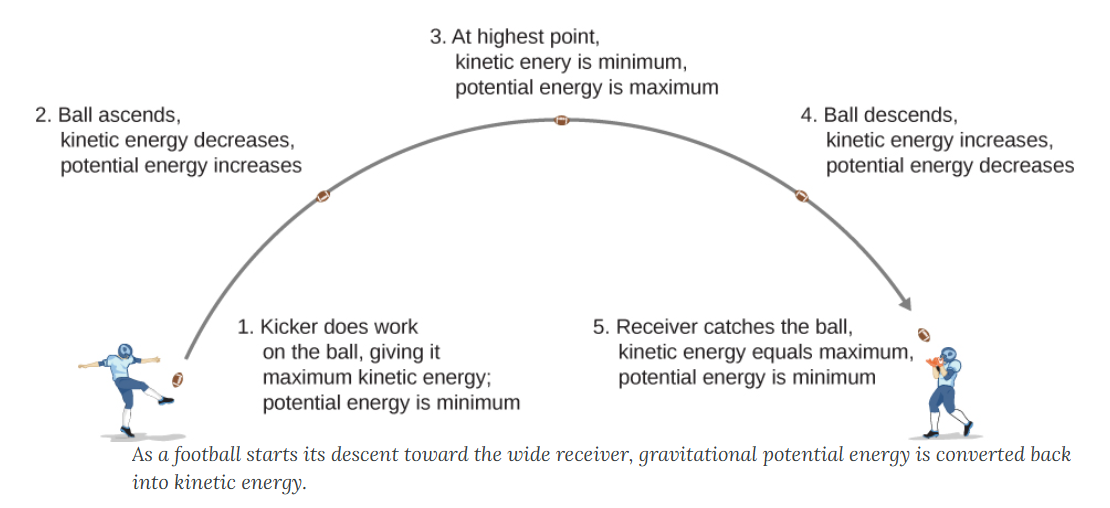
As the football falls toward Earth, the work done on the football is now positive, because the displacement and the gravitational force both point vertically downward. The ball also speeds up, which indicates an increase in kinetic energy. Therefore, energy is converted from gravitational potential energy back into kinetic energy.
Based on this scenario, we can define the difference of potential energy from point \(A\) to point \(B\) as the negative of the work done:
\(
\Delta U_{A B}=U_B-U_A=-W_{A B} .
\)
This formula explicitly states a potential energy difference, not just an absolute potential energy.
Definition’s Purpose: The negative sign in \(\Delta U_{A B}=-W_{A B}\) is necessary to maintain consistency with the principle of energy conservation, ensuring that if \(W_{A B}\) is positive (work is done by the field/force), \(\Delta U_{A B}\) is negative (potential energy decreases). The equation mathematically links positive work with a decrease in the system’s stored potential energy.
Gravitational Potential Energy
Gravitational potential energy of a body at a point is defined as the amount of work done in bringing the given body from infinity to that point against the gravitational force. The change in potential energy ( \(d U\) ) of a system corresponding to a conservative internal force \((\mathbf{F})\) is given by \(d U=-W=-\mathrm{F} \cdot d \mathbf{r}\)
\(
\begin{array}{r}
\int_i^f d U=-\int_{\mathbf{r}_i}^{\mathbf{r}_f} \mathbf{F} \cdot d \mathbf{r} \\
U_f-U_i=-\int_{\mathbf{r}_i}^{\mathbf{r}_f} \mathbf{F} \cdot d \mathbf{r}
\end{array}
\)
We generally choose the reference point at infinity and assume potential energy to be zero there, i.e. if we take \(r_i=\infty\) (infinite) and \(U_i=0\), then expression can be written as
\(
U_f=U=-\int_{\infty}^{\mathrm{r}} \mathrm{~F} \cdot d \mathbf{r}=-W
\)
Hence, potential energy of a body or system is negative of the work done by the conservative forces in bringing it from infinity to the particular position.
Gravitational potential energy of a two particles system
Let a particle of mass \(m_1\) be kept fixed at a point \(A\) (figure below) and another particle of mass \(m_2\) is taken from a point \(B\) to a point \(C\). Initially, the distance between the particles is \(A B=r_1\) and finally it becomes \(A C=r_2\). We have to calculate the change in potential energy of the system of the two particles as the distance changes from \(r_1\) to \(r_2\).
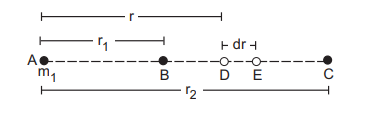
Consider a small displacement when the distance between the particles changes from \(r\) to \(r+d r\). In the figure, this corresponds to the second particle going from \(D\) to \(E\).
The force on the second particle is
\(
F=\frac{G m_1 m_2}{r^2} \text { along } \overrightarrow{D A}
\)
The force is directed along \(\overrightarrow{D A}\) because gravity is an attractive force that pulls the second particle (at \({D}\) or \({E}\) ) directly towards the first particle (at \({A}\)). The fundamental nature of the gravitational force, described by Newton’s law of universal gravitation, dictates that any two masses exert a pull on each other along the line connecting their centers. In the context of your problem setup, the force on the second particle must point toward the location of the first particle (point \({A}\)). The vector \(\overrightarrow{D A}\) represents the direction from the second particle’s position ( \(D\) ) toward the first particle’s position \((A)\), hence the force acts in that direction. The magnitude of
The work done by the gravitational force in the displacement is
\(
d W=-\frac{G m_1 m_2}{r^2} d r
\)
Note: The negative sign is due to the convention that the radial distance \(r\) increases outward while the gravitational force is attractive (inward).
The increase in potential energy of the two-particle system during this displacement is
\(
d U=-d W=\frac{G m_1 m_2}{r^2} d r
\)
The increase in potential energy as the distance between the particles changes from \(r_1\) to \(r_2\) is
\(
\begin{aligned}
& U\left(r_2\right)-U\left(r_1\right)=\int d U \\
& \quad=\int_{r_1}^{r_2} \frac{G m_1 m_2}{r^2} d r=G m_1 m_2 \int_{r_1}^{r_2} \frac{1}{r^2} d r \\
& \quad=G m_1 m_2\left[-\frac{1}{r}\right]_{r_1}^{r_2} \\
& \quad=G m_1 m_2\left(\frac{1}{r_1}-\frac{1}{r_2}\right) \dots(iv)
\end{aligned}
\)
We choose the potential energy of the two-particle system to be zero when the distance between them is infinity. This means that we choose \(U(\infty)=0\). By (iv) the potential energy \(U(r)\), when the separation between the particles is \(r\), is
\(
\begin{aligned}
U(r) & =U(r)-U(\infty) \\
& =G m_1 m_2\left[\frac{1}{\infty}-\frac{1}{r}\right]=-\frac{G m_1 m_2}{r} .
\end{aligned}
\)
The gravitational potential energy of a two-particle system is
\(
U(r)=-\frac{G m_1 m_2}{r} \dots(v)
\)
where \(m_1\) and \(m_2\) are the masses of the particles, \(r\) is the separation between the particles and the potential energy is chosen to be zero when the separation is infinite.
We have proved this result by assuming that one of the particles is kept at rest and the other is displaced. However, as the potential energy depends only on the separation and not on the location of the particles, equation (v) is general.
Remark: This is actually the negative of work done in bringing these masses from infinity to a distance \(r\) apart by the gravitational forces between them.
Gravitational potential energy \(=\left(-\frac{G m_1}{r}\right) \times m_2\)
∴ Gravitational potential energy \(=\)
Gravitational potential × Mass of the body
Gravitational potential energy is a scalar quantity. Its SI unit is joule and dimensional formula is \(\left[\mathrm{ML}^2 \mathrm{~T}^{-2}\right]\).
Conceptual explanation: The equation \(\mathrm{d} W=-\frac{G m_1 m_2}{r^2} \mathrm{~d} r\) defines the differential work ( \(\mathrm{d} W\) ) done by the gravitational force when the separation distance \({r}\) changes by \({d}{r}\).
Force Direction: Gravitational force is always an attractive force, pulling the two masses toward each other. If we define the positive direction as moving outward (increasing \(r\) ), the force vector \(\vec{F}\) points in the negative direction, so
\(
\vec{F}=-\frac{G m_1 m_2}{r^2} \hat{r}
\)
Work Definition: Work is defined as \(\mathrm{d} W=\vec{F} \cdot \mathrm{~d} \vec{r}\).
Example 1: Find the work done in bringing three particles, each having a mass of 100 g, from large distances to the vertices of an equilateral triangle of side 20 cm.
Solution: When the separations are large, the gravitational potential energy is zero. When the particles are brought at the vertices of the triangle \(A B C\), three pairs \(A B, B C\) and \(C A\) are formed. The potential energy of each pair is \(-G m_1 m_2 / r\) and hence the total potential energy becomes
\(
\begin{aligned}
U & =3 \times\left[-\frac{G m_1 m_2}{r}\right] \\
& =3 \times\left[-\frac{6.67 \times 10^{-11} \mathrm{~N}-\mathrm{m}^2 / \mathrm{kg}^2 \times(0.1 \mathrm{~kg}) \times(0.1 \mathrm{~kg})}{0.20 \mathrm{~m}}\right] \\
& =-1.0 \times 10^{-11} \mathrm{~J}
\end{aligned}
\)
The work done by the gravitational forces is \(W=-U=1.0 \times 10^{-11} \mathrm{~J}\). If the particles are brought by some external agency without changing the kinetic energy, the work done by the external agency is equal to the change in potential energy \(=-1.0 \times 10^{-11} \mathrm{~J}\).
Example 2: Find the potential energy of a system of four particles placed at the vertices of a square of side \(l\). Also obtain the potential at the centre of the square.
Solution: Consider four masses each of mass \(m\) at the corners of a square of side \(l\); See Figure below. We have four mass pairs at distance \(l\) and two diagonal pairs at distance \(\sqrt{2} l\)
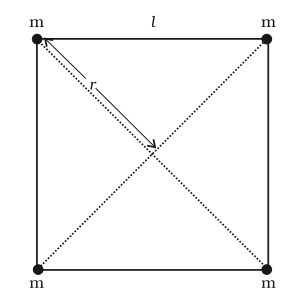
Step 1: Gravitational Potential Energy ( \(U_g\) )
In a system of four identical particles of mass \(m\) at the vertices of a square of side \(l\), we calculate the energy of all 6 interacting pairs.
The formula for gravitational potential energy between two masses is:
\(
U=-\frac{G m_1 m_2}{r}
\)
Step-by-Step Summation:
4 Side Interactions: The distance between adjacent masses is \(l\).
\(
U_{\text {sides }}=4 \times\left(-\frac{G m^2}{l}\right)
\)
2 Diagonal Interactions: The distance across the square is \(\sqrt{2} l\).
\(
U_{\text {diagonals }}=2 \times\left(-\frac{G m^2}{\sqrt{2} l}\right)
\)
Step 2: Gravitational Potential at the Centre (\(V_g\))
The gravitational potential at a point is the potential energy per unit mass. Like the electrostatic version, it is a scalar.
Distance to center \((r)\) : Half of the diagonal, which is \(\frac{l}{\sqrt{2}}\).
Individual Potential: \(V=-\frac{G m}{r}\)
Since there are four identical masses at the same distance from the center:
\(
V_{\text {total }}=4 \times\left(-\frac{G m}{l / \sqrt{2}}\right)=-\frac{4 \sqrt{2} G m}{l}
\)
Example 3: Two point masses 1 kg and 4 kg are separated by a distance of 10 cm . Find gravitational potential energy of the two point masses.
Solution: Given, \(m_1=1 \mathrm{~kg}, m_2=4 \mathrm{~kg}, r=10 \mathrm{~cm}=10 \times 10^{-2} \mathrm{~m}\)
∴ Gravitational potential energy,
\(
\begin{aligned}
U=\frac{-G m_1 m_2}{r} & =\frac{-6.67 \times 10^{-11} \times 1 \times 4}{10 \times 10^{-2}} \\
& =-26.68 \times 10^{-10} \mathrm{~J}
\end{aligned}
\)
Gravitational potential energy for a system of more than two particles
The gravitational potential energy for a system of particles (say \(m_1, m_2, m_3\) and \(m_4\) ) is given by
\(
U=-G\left[\frac{m_4 m_3}{r_{43}}+\frac{m_4 m_2}{r_{42}}+\frac{m_4 m_1}{r_{41}}+\frac{m_3 m_2}{r_{32}}+\frac{m_3 m_1}{r_{31}}+\frac{m_2 m_1}{r_{21}}\right]
\)
Thus, for a \(n\) particle system there are \(\frac{n(n-1)}{2}\) pairs and the potential energy is calculated for each pair and added to get the total potential energy of the system.
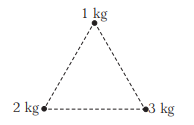
Example 4: Three masses of \(1 \mathrm{~kg}, 2 \mathrm{~kg}\) and 3 kg are placed at the vertices of an equilateral triangle of side 1 m. Find the gravitational potential energy of this system. (Take, \(G=6.67 \times 10^{-11} N-\mathrm{m}^2 \mathrm{~kg}^{-2}\))
Solution: Gravitational potential energy of the three particles system
\(
U=-G\left(\frac{m_3 m_2}{r_{32}}+\frac{m_3 m_1}{r_{31}}+\frac{m_2 m_1}{r_{21}}\right)
\)
Here, \(r_{32}=r_{31}=r_{21}=1 \mathrm{~m}\),
\(m_1=1 \mathrm{~kg}, m_2=2 \mathrm{~kg}\) and \(m_3=3 \mathrm{~kg}\)
Substituting in above, we get
\(
\begin{aligned}
U & =-\left(6.67 \times 10^{-11}\right)\left(\frac{3 \times 2}{1}+\frac{3 \times 1}{1}+\frac{2 \times 1}{1}\right) \\
\text { or } \quad U & =-7.337 \times 10^{-10} \mathrm{~J}
\end{aligned}
\)
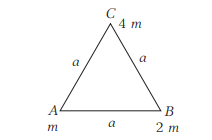
Example 5: Three particles of masses \(m, 2 m\) and \(4 m\) are placed at the corners of an equilateral triangle of side \(a\). Calculate
(i) the potential energy of the system.
(ii) the work done on the system, if the side of the triangle is changed from a to \(2 a\). Assume the potential energy to be zero when the separation is infinity.
Solution: (i) The potential energy of the system = Sum of the potential energies of all the three possible distinct pairs.
\(
\text { i.e. } \begin{aligned}
U & =U_{A B}+U_{B C}+U_{C A} \\
& =\frac{-G(m)(2 m)}{a}+\frac{-G(2 m)(4 m)}{a}+\frac{-G(4 m)(m)}{a} \\
& =\frac{-14 G m^2}{a}
\end{aligned}
\)
(ii) When the side \(a\) is changed to \(2 a\), the potential energy
\(
U^{\prime}=\frac{-14 G m^2}{2 a}
\)
The work done on the system = The work done against the gravitational force \(=\) The work done by the external force
\(
=U^{\prime}-U=\frac{14 G m^2}{2 a}
\)
Gravitational potential energy of an object in different conditions
Case-I: Object at the Earth’s Surface
When an object is sitting right on the crust, its distance from the Earth’s center is simply the radius of the Earth \((R)\). The energy is negative because gravity is an attractive force, and we define the “zero point” of energy to be at an infinite distance away (Let an object of mass \(m\) is placed at a point in the gravitational field of the earth of mass \(M\). Then, gravitational potential energy of an object placed at earth’s surface).
\(
U=-\frac{G M m}{R}
\)
Case-II: Moving Between Two Points
When you move an object from one height to another, you are calculating the Work Done by or against gravity.
If \(r_a>r_b\) : The object is moving closer to Earth. The potential energy becomes “more negative” (decreases), and the kinetic energy typically increases.
The General Formula: For any two points \(r_a\) and \(r_b\) :
\(
\Delta U=-G M m\left(\frac{1}{r_b}-\frac{1}{r_a}\right)
\)
Case-III: Potential Energy at the Center of the Earth
This is a unique case. Unlike the space above the surface, inside the Earth, the gravitational pull changes because only the mass inside your current radius exerts a net pull on you.
As you move toward the center, you are “deeper” in the gravitational well. At the very center ( \(r=0\) ), the potential energy reaches its minimum value:
\(
U_{\text {centre }}=-\frac{3 G M m}{2 R}
\)
This is exactly 1.5 times the potential energy at the surface.
Case-IV: Object placed at a point, above the earth’s surface
Let an object of mass \(m\) is placed at height \(h\) above the surface of earth, then change in gravitational potential energy when the object is taken from the centre of the earth to the height \(h\) is
\(
\Delta U=\frac{m g h}{1+h / R}
\)
\(\Delta U\) is positive, it means the potential energy of a body increases as its height above earth surface increases.
For \(h \ll R, \Delta U \approx m g h\)
Thus, what we observe the \(m g h\) is actually the difference in potential energy (not the absolute potential energy), that too for \(h \ll R\).
Why the Fraction \(\frac{m g h}{1+h / R}\) ?
This specific form is the standard way to express the increase in potential energy when an object is lifted from the surface to a height \(h\).
If we take the difference between the surface \((R)\) and height \(h(R+h)\) :
\(
\Delta U=-\frac{G M m}{R+h}-\left(-\frac{G M m}{R}\right)
\)
Using the relation \(g=\frac{G M}{R^2}\) (which means \(G M=g R^2\)), and simplifying the algebra, we get:
\(
\Delta U=\frac{m g h}{1+\frac{h}{R}}
\)
Note: Gravitational potential energy of a body at height \(x\) from the earth’s surface is
\(
U_x=\frac{-m g R}{1+x / R}
\)
Example 6: The mass of the earth is \(6 \times 10^{24} \mathrm{~kg}\). The constant of gravitation \(G=6.67 \times 10^{-11} \mathrm{~N}-\mathrm{m}^2 \mathrm{~kg}^{-2}\). The potential energy of the earth and moon system is \(-7.79 \times 10^{28} J\). Determine the mean distance between earth and moon. (Mass of moon is \(7.4 \times 10^{22} \mathrm{~kg}\))
Solution: The mass of moon, \(m=7.4 \times 10^{22} \mathrm{~kg}\)
Potential energy of the earth and moon system,
\(
\begin{aligned}
U & =\frac{-G M m}{r} \\
r & =\frac{-G M m}{U}=\frac{-6.67 \times 10^{-11} \times 6 \times 10^{24} \times 7.4 \times 10^{22}}{-7.79 \times 10^{28}} \\
r & =3.8 \times 10^8 \mathrm{~m}
\end{aligned}
\)
Example 7: A body of mass \(m\) is raised to a height \(10 R\) from the surface of the earth, where \(R\) is the radius of the earth. Find the increase in potential energy. (\(G=\) universal constant of gravitation, \(M=\) mass of the earth and \(g=\) acceleration due to gravity)
Solution: Potential energy at the earth’s surface \(=\frac{-G M m}{R}\)
Potential energy at a height \(h\) above the earth’s surface
\(
=\frac{-G M m}{(R+h)}
\)
∴ Change in potential energy \(=\frac{-G M m}{(R+h)}-\left(-\frac{G M m}{R}\right)\)
\(
=\frac{G M m h}{R(R+h)}
\)
Substituting, \(h=10 R\)
\(
\begin{aligned}
\Delta U & =\frac{G M m \times 10 R}{R(R+10 R)} \\
& =\frac{10 \mathrm{GMm}}{11 R}
\end{aligned}
\)
Example 8: Find the change in the gravitational potential energy when a body of mass \(m\) is raised to a height \(n R\) above the surface of the earth. (Here, \(R\) is the radius of the earth).
Solution: Gravitational potential energy of mass \(m\) at earth’s surface,
\(
U_e=-\frac{G M m}{R}
\)
Gravitational potential energy of same mass at a height \(n R\) from the earth’s surface,
\(
U_h=-\frac{G M m}{(R+n R)}=-\frac{G M m}{R(n+1)}
\)
Thus, magnitude of the change in gravitational potential energy,
\(
\begin{array}{rlr}
\Delta U & =U_h-U_e & \\
& =\frac{G M m}{R}\left(1-\frac{1}{(n+1)}\right) & \\
& =\left(\frac{n}{n+1}\right) \frac{G M m}{R} & \\
& =\left(\frac{n}{n+1}\right) m g R & \left(\because G M=g R^2\right)
\end{array}
\)
Example 9: An object is dropped from height \(h=2 R\) on the surface of earth. Find the speed with which it will collide with ground by neglecting effect of air. (where, \(R\) is radius of earth and \(M\) is mass of earth.)
Solution: The initial potential energy of object, \(U_i=-\frac{G M m}{3 R}\) Final potential energy, \(U_f=-\frac{G M m}{R}\)
By law of conservation of energy, \(\Delta \mathrm{KE}=-\Delta \mathrm{PE}\)
\(
\begin{array}{ll}
\Rightarrow & \frac{1}{2} m v^2=-\left(U_f-U_i\right)=U_i-U_f \\
\Rightarrow & \frac{1}{2} m v^2=-\frac{G M m}{3 R}+\frac{G M m}{R} \\
\Rightarrow & \frac{1}{2} v^2=\frac{2 G M}{3 R} \\
\Rightarrow & v=\sqrt{\frac{4 G M}{3 R}}=2 \sqrt{\frac{G M}{3 R}}
\end{array}
\)
Gravitational Potential
Suppose a particle of mass \(m\) is taken from a point \(A\) to a point \(B\) while keeping all other masses fixed. Let \(U_A\) and \(U_B\) denote the gravitational potential energy when the mass \(m\) is at point \(A\) and point \(B\) respectively.
We define the “change in potential” \(V_B-V_A\) between the two points as
\(
V_B-V_A=\frac{U_B-U_A}{m} \dots(1)
\)
The equation defines only the change in potential. We can choose any point to have zero potential. Such a point is called a reference point. If \(A\) be the reference point, \(V_A=0\) and
\(
V_B=\frac{U_B-U_A}{m} \dots(2)
\)
Thus, gravitational potential at a point is equal to the change in potential energy per unit mass, as the mass is brought from the reference point to the given point. If the particle is slowly brought without increasing the kinetic energy, the work done by the external agent equals the change in potential energy. Thus, the potential at a point may also be defined as the work done per unit mass by an external agent in bringing a particle slowly from the reference point to the given point. Generally the reference point is chosen at infinity so that the potential at infinity is zero.
The \(S I\) unit of gravitational potential is \(\mathrm{J} \mathrm{kg}^{-1}\).Its dimensions are \(\left[\mathrm{M}^0 \mathrm{~L}^2 \mathrm{~T}^{-2}\right]\).
Alternately: The work done in bringing a unit mass slowly from reference point (infinity) to a given point in the gravitational field, is called the gravitational potential at that point.
This work is done by the external agent in bringing the mass. The gravitational potential is denoted by \(V\).
Let \(W_{ext}\) joule of work is to be done by external agent in bringing a test mass \(m\) from infinity to some point, then gravitational potential at the point will be
\(
V=\frac{W_{ext}}{m} \dots(3)
\)
Remarks
- Infinity is used as the reference point (zero potential) for gravitational potential because gravity’s force becomes zero at infinite distance, making it a natural, universal baseline, unlike the arbitrary Earth’s surface; this simplifies calculations, ensures potential is always negative (representing attraction), and allows for consistent definitions across vast cosmic scales, avoiding the need for a local “ground”.
- Negative work means force is opposite to displacement.
Key Reasons for Using Infinity:
- Gravity Weakens to Zero: The force of gravity follows an inverse-square law ( \(F \propto 1 / r^2\) ), meaning it approaches zero as distance( \(r\) ) approaches infinity, providing a logical point where no work is done by the field.
- Mathematical Convenience: Setting \(U=0\) at \(r=\infty\) simplifies the gravitational potential energy equation ( \(U=-G M m / r\) ) and its integration, resulting in a single, consistent formula for any distance.
Calculation of Gravitational Potential for different Bodies
Case-I: Potential due to a Point Mass
Suppose a particle of point mass \(M\) is kept at a point \(A\) (figure below) and we have to calculate the potential at a point \(P\) at a distance \(r\) away from \(A\). The reference point is at infinity.
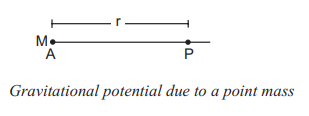
From equation (1), the potential at the point \(P\) is
\(
V(r)=\frac{U(r)-U(\infty)}{m} .
\)
But \(U(r)-U(\infty)=-\frac{G M m}{r}\).
so that, \(V=-\frac{G M}{r} \dots(4)\)
The gravitational potential due to a point mass \(M\) at a distance \(r\) is \(-\frac{G M}{r}\).
Alternate way: Let us find work done in taking the unit mass from infinity to point \(P\). This will be
\(
W=\int_{\infty}^r \frac{G M}{r^2} d r=\left[-\frac{G M}{r}\right]_{\infty}^r=-\frac{G M}{r}
\)
Hence, the work done in bringing unit mass from infinity to \(P\) will be \(-\frac{G M}{r}\). Thus, the gravitational potential at \(P\) will be
\(
V=-\frac{G M}{r}
\)
Gravitational potential at a point is always negative.
Note:
- When \(r=\infty\) from above formula, then \(V=0\), hence gravitational potential is maximum (zero) at infinity.
- At surface of the earth \(r=R\), then \(V=-\frac{G M}{R}\) at the surface of the earth.
Why is Gravitational Potential (\(V\)) Negative?
Potential is negative because of our reference point. In physics, we define the gravitational potential to be zero at infinity.
The “Attraction” Problem: Gravity is an attractive force. If you are at an infinite distance, you have zero potential. As you move closer to a planet, you are being “pulled” in.
Energy Loss: Since you are moving from a state of “zero energy” (infinity) into a state where gravity has pulled you in, you have less energy than you did at infinity.
The Math: Any number less than zero is negative.
Why is “Work Done” sometimes called Positive?
The confusion here usually stems from whether we are talking about the Gravitational Field or an External Agent.
\(
\begin{array}{|l|l|l|l|}
\hline \text { Entity } & \text { Direction of Force } & \text { Direction of Motion } & \text { Work Sign } \\
\hline \begin{array}{l}
\text { Gravitational } \\
\text { Field }
\end{array} & \begin{array}{l}
\text { Inward (towards } \\
\text { planet) }
\end{array} & \begin{array}{l}
\text { Inward (coming from } \\
\text { infinity) }
\end{array} & \begin{array}{l}
\text { Positive (+) }
\end{array} \\
\hline \text { External Agent } & \begin{array}{l}
\text { Outward (holding it } \\
\text { back) }
\end{array} & \begin{array}{l}
\text { Inward (coming from } \\
\text { infinity) }
\end{array} & \begin{array}{l}
\text { Negative (-) } \\
\end{array} \\
\hline
\end{array}
\)
Example 1: A point of mass 15 kg is placed at the origin of coordinate axis. Find the gravitational potential at a point located at \(x=5 \mathrm{~m}\) on \(X\)-axis.
Solution: Given, \(M=15 \mathrm{~kg}\)
Gravitational potential at \(x=5 \mathrm{~m}\),
\(
\begin{aligned}
V & =\frac{-G M}{x}=\frac{-6.67 \times 10^{-11} \times 15}{5} \\
& =-20.01 \times 10^{-11} \mathrm{~J} \mathrm{~kg}^{-1}
\end{aligned}
\)
Gravitational potential due to a system of more than one point mass
Consider a system of point masses \(M_1, M_2, M_3, \ldots, M_n\). A point \(P\) is situated at a distances \(r_1, r_2, r_3, \ldots, r_n\) respectively from these points.
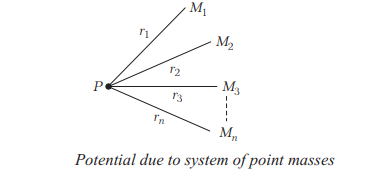
Gravitational potential at this point \(P\) due to these point masses,
\(
V_P=-\left[\frac{G M_1}{r_1}+\frac{G M_2}{r_2}+\frac{G M_3}{r_3}+\ldots+\frac{G M_n}{r_n}\right]
\)
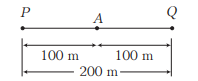
Example 2: Two heavy point masses of mass \(10^3 \mathrm{~kg}\) and \(10^5 \mathrm{~kg}\) are separated by a distance of 200 m. What will be the potential at the mid-point of the line joining them?
Solution: The total potential at \(A\),
\(
V=V_P+V_Q=-\frac{G M_P}{r}-\frac{G M_Q}{r}
\)
\(
\begin{aligned}
&\therefore \quad V=\frac{-6.67 \times 10^{-11}}{100}\left[10^3+10^5\right]\\
&\text { Hence, } V=-6.73 \times 10^{-8} \mathrm{~J} \mathrm{~kg}^{-1}
\end{aligned}
\)
Example 3: Infinite number of bodies, each of mass 2 kg are situated on \(X\)-axis at distance \(1 m, 2 m, 4 m\) and \(8 m\) respectively from the origin. What is the resulting gravitational potential due to this system at the origin?
Solution: The resulting gravitational potential,
\(
\begin{aligned}
V & =-2 G\left(\frac{1}{1}+\frac{1}{2}+\frac{1}{4}+\frac{1}{8} \ldots\right) \\
& =-2 G\left(1+\frac{1}{2}+\frac{1}{2^2}+\frac{1}{2^3} \ldots\right) \\
V & =\frac{-2 G}{\left(1-\frac{1}{2}\right)}=\frac{-2 G}{\frac{1}{2}}=-4 G
\end{aligned}
\)
Case-II: Potential due to a Uniform Ring at A Point on its Axis
Let the mass of the ring be \(M\) and its radius be \(a\). We have to calculate the gravitational potential at a point \(P\) on the axis of the ring (figure below). The centre is at \(O\) and \(O P=r\).
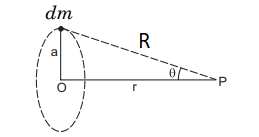
Consider any small part of the ring of mass \(d m\). The point \(P\) is at a distance \(R=\sqrt{a^2+r^2}\) from \(d m\).
The potential at \(P\) due to \(d m\) is
\(
d V=-\frac{G d m}{R}=-\frac{G d m}{\sqrt{a^2+r^2}} .
\)
The potential \(V\) due to the whole ring is obtained by summing the contributions from all the parts. As the potential is a scalar quantity, we have
\(
\begin{aligned}
V & =\int d V \\
& =\int-\frac{G d m}{\sqrt{a^2+r^2}} \\
& =-\frac{G}{\sqrt{a^2+r^2}} \int d m \\
& =-\frac{G M}{\sqrt{a^2+r^2}}
\end{aligned}
\)
In terms of the distance \(R\) between the point \(P\) and any point of the ring, the expression for the potential is given by
\(
V=-\frac{G M}{R}
\)
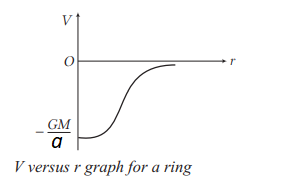
At \(r=0, V=-\frac{G M}{a}\), i.e. at the centre of the ring, gravitational potential is \(-\frac{G M}{a}\).
Thus, \(V\) versus \(r\) graph is as shown in figure below.
Example 4: Mass of 1 kg is distributed uniformly over a ring of radius 1 m. Find the gravitational potential at a point lying on the axis of the ring at a distance of 1 m from the centre.
Solution: Mass of the ring, \(M=1 \mathrm{~kg}\)
Radius of the ring, \(R=1 \mathrm{~m}\)
Distance of the point, \(r=1 \mathrm{~m}\)
∴ Required gravitational potential,
\(
\begin{aligned}
V(r & =1)=\frac{-G M}{\sqrt{R^2+r^2}}=\frac{-G \times 1}{\sqrt{(1)^2+(1)^2}} \\
& =\frac{-G}{\sqrt{2}}=\frac{-6.67 \times 10^{-11}}{\sqrt{2}} \mathrm{Jkg}^{-1} \\
& =-4.716 \times 10^{-11} \mathrm{Jkg}^{-1}
\end{aligned}
\)
Case-III: Potential due to a Uniform Thin Spherical Shell
Consider an elemental ring on the spherical shell with a mass ( \(dm\) ) and an angular thickness \((d \theta)\). The radius of this ring is \((R \sin \theta)\), where \((\mathrm{R})\) is the radius of the spherical shell and \((\theta)\) is the angle from the axis passing through the center.
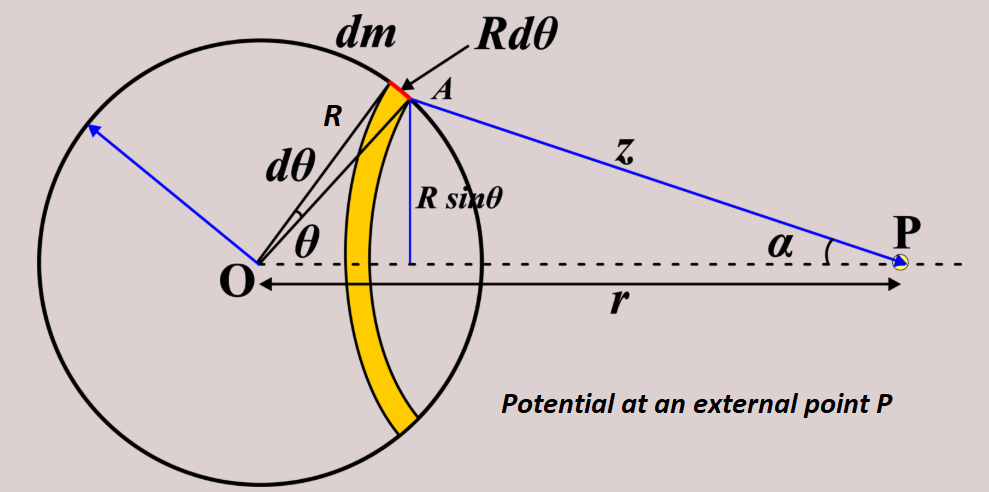
The radius of this ring is \(R \sin \theta\) and hence the perimeter is \(2 \pi R \sin \theta\). The width of the ring is \(R d \theta\). The surface area of the elemental ring is (\(d A=2 \pi R \sin \theta R d \theta\)). The surface mass density ( \(\sigma\) ) of the shell is ( \(\frac{M}{4 \pi R^2}\) ), where ( \(M\) ) is the total mass of the shell. Therefore, the mass of the elemental ring is:
\(
d m=\sigma d A=\frac{M}{4 \pi R^2} \cdot 2 \pi R \sin \theta R d \theta \dots(1)
\)
Simplifying, we get:
\(
d m=\frac{M}{2} \sin \theta d \theta \dots(2)
\)
Let the distance of any point of the ring from \(P\) be \(A P=z\). From the triangle \(O A P\)
\(
z^2=R^2+r^2-2 R r \cos \theta
\)
Differentiating with respect to \((z)\), we obtain:
\(
-2 z d z=2 R r(-\sin \theta d \theta)
\)
This gives us:
\(
\sin \theta d \theta=\frac{z}{R r} d z \dots(3)
\)
Thus, the mass of the ring is
\(
d m=\frac{M}{2} \sin \theta d \theta=\frac{M}{2 R r} z d z
\)
As the distance of any point of the ring from \(P\) is \(z\), the potential at \(P\) due to the ring is
\(
\begin{aligned}
d V & =-\frac{G d m}{z} \\
& =-\frac{G M}{2 R r} d z
\end{aligned}
\)
As we vary \(\theta\) from 0 to \(\pi\), the rings formed on the shell cover up the whole shell. The potential due to the whole shell is obtained by integrating \(d V\) within the limits \(\theta=0\) to \(\theta=\pi\).
Therefore the potential at point P due to the spherical shell is,
\(
V=\int d V=-\int \frac{G M}{2 R r} d z \dots(4)
\)
Case 1 : \(P\) is outside the shell \((r>R)\)
As figure (shown above) shows, when \(\theta=0\), the distance \(z=A P=r-R\). When \(\theta=\pi\), it is \(z=r+R\). Thus, as \(\theta\) varies from 0 to \(\pi\), the distance \(z\) varies from \(r-R\) to \(r+R\). Thus,
\(
\begin{aligned}
V & =\int d V=-\frac{G M}{2 R r} \int_{r-R}^{r+R} d z \\
& =-\frac{G M}{2 R r}[z]_{r-R}^{r+R} \\
& =-\frac{G M}{2 R r}[(r+R)-(r-R)] \\
& =-\frac{G M}{r} \dots(5)
\end{aligned}
\)
Thus, \(V(r)=-\frac{G M}{r}, r \geq R\)
At the surface, \(r=R\) and \(V=-\frac{G M}{R}\)
To calculate the potential at an external point, a uniform spherical shell may be treated as a point particle of equal mass placed at its centre, because the result \(V=-\frac{G M}{r}\) is identical to the formula for a point mass, the shell is mathematically indistinguishable from a point particle for any observer on the outside.
Case 2 : \(P\) is inside the shell \((r<R)\)
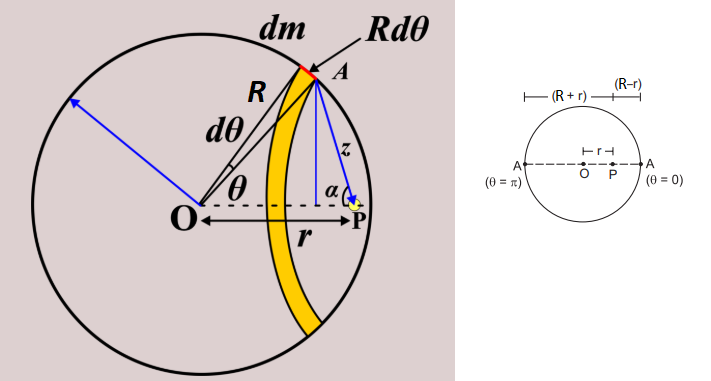
In this case when \(\theta=0\), the distance \(z=A P =R-r\) and when \(\theta=\pi\) it is \(z=R+r\) (figure above). Thus, as \(\theta\) varies from 0 to \(\pi\), the distance \(z\) varies from \(R-r\) to \(R+r\). Thus, the potential due to the shell is
\(
\begin{aligned}
V & =\int d V \\
& =-\frac{G M}{2 R r}[z]_{R-r}^{R+r} \\
& =-\frac{G M}{2 R r}[(R+r)-(R-r)] \\
& =-\frac{G M}{R}
\end{aligned}
\)
This does not depend on \(r\). Thus, the potential due to a uniform spherical shell is constant throughout the cavity of the shell. This is because, according to the shell theorem, there is no net gravitational force experienced by a particle inside a uniform spherical shell, and thus the potential remains the same as on the surface.
Figure (below) shows graphically the variation of potential with the distance from the centre of the shell.
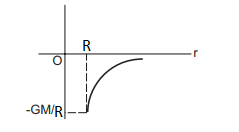
Example 5: A particle of mass 1 kg is kept on the surface of a uniform thin spherical shell of mass 20 kg and radius 1 m. Find the work to be done against the gravitational force between them to take the particle away from the thin spherical shell.
Solution: Potential at the surface of thin spherical shell,
\(
\begin{aligned}
V & =-\frac{G M}{R} \\
& =-\frac{\left(6.67 \times 10^{-11}\right)(20)}{1} \mathrm{~J} \mathrm{~kg}^{-1} \\
& =-1.334 \times 10^{-9} \mathrm{~J} \mathrm{~kg}^{-1}
\end{aligned}
\)
i.e. \(1.334 \times 10^{-9} \mathrm{~J}\) work is obtained to bring a mass of 1 kg from infinity to the surface of spherical shell. Hence, the same amount of work will have to be done to take the particle away from the surface of spherical shell. Thus, \(W=1.334 \times 10^{-9} \mathrm{~J}\).
Example 6: A particle of mass \(M\) is placed at the centre of a uniform spherical shell of equal mass and radius \(a\). Find the gravitational potential at a point \(P\) at a distance \(a / 2\) from the centre.
Solution: The given condition is as shown in figure below.
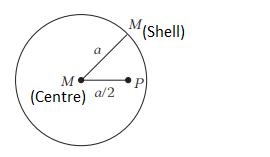
The gravitational potential at the point \(P\) due to the particle at the centre is
\(
V_1=-\frac{G M}{a / 2}=-\frac{2 G M}{a} .
\)
The potential at \(P\) due to the shell is (we just derived above: Refer Case-2)
\(
V_2=-\frac{G M}{a} .
\)
The net potential at \(P\) is \(V_1+V_2=-\frac{3 G M}{a}\).
Note: \(V_P=V_{\text {sphere }}+V_{\text {particle }}=\frac{-G M}{a}-\frac{G M}{a / 2}=\frac{-3 G M}{a}\)
Case-IV: Potential due to a Uniform Solid Sphere
The situation is shown in figure (below). Let the mass of the sphere be \(M\) and its radius \(R\). We have to calculate the gravitational potential at a point \(P\). Let \(O P=r\).
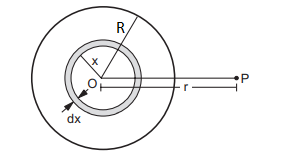
Let us draw two spheres of radii \(x\) and \(x+d x\) concentric with the given sphere. These two spheres enclose a thin spherical shell of volume \(4 \pi x^2 d x\). The volume of the given sphere is \(\frac{4}{3} \pi a^3\). As the sphere is uniform, the mass of the shell is
\(
d m=\frac{M}{\frac{4}{3} \pi a^3} 4 \pi x^2 d x=\frac{3 M}{a^3} x^2 d x .
\)
The potential due to this shell at the point \(P\) is
\(
d V=-\frac{G d m}{r} \text { if } x<r \text { and } d V=-\frac{G d m}{x} \text { if } x>r
\)
Explanation: Spherical shell of volume \(4 \pi x^2 d x\):How? The volume of a spherical shell is the difference between the volume of the outer sphere and the inner sphere.
Inner radius: \(x\)
Outer radius: \(x+d x\)
The volume \(d V\) is:
\(
\begin{gathered}
d V=V_{\text {outer }}-V_{\text {inner }} \\
d V=\frac{4}{3} \pi(x+d x)^3-\frac{4}{3} \pi x^3
\end{gathered}
\)
Now, expand the term \((x+d x)^3\) using the binomial expansion \((a+b)^3=a^3+3 a^2 b+ 3 a b^2+b^3:\)
\(
d V=\frac{4}{3} \pi\left(x^3+3 x^2 d x+3 x(d x)^2+(d x)^3\right)-\frac{4}{3} \pi x^3
\)
When we distribute \(\frac{4}{3} \pi\) and subtract \(\frac{4}{3} \pi x^3\), we are left with:
\(
\begin{aligned}
& d V=\frac{4}{3} \pi\left(3 x^2 d x+3 x(d x)^2+(d x)^3\right) \\
& d V=4 \pi x^2 d x+4 \pi x(d x)^2+\frac{4}{3} \pi(d x)^3
\end{aligned}
\)
In calculus, since \(d x\) is an infinitesimally small change, terms like \((d x)^2\) and \((d x)^3\) are so small that they become negligible (zero). We are left with:
\(
d V=4 \pi x^2 d x
\)
The Geometric Approach: (Volume = Surface Area × Thickness)
Imagine the thin shell as a layer of paint on a ball. If you were to “peel” this layer off and lay it out flat, it would look like a large, very thin rectangular sheet.
Area of the sheet: This is simply the surface area of a sphere of radius \(x\), which is \(4 \pi x^2\).
Thickness of the sheet: This is the small change in radius, \(d x\).
The volume of any thin sheet or “slab” is its Area × Thickness.
\(
\begin{gathered}
\text { Volume }=(\text { Surface Area }) \times(\text { Thickness }) \\
d V=\left(4 \pi x^2\right) \times(d x)
\end{gathered}
\)
Case 1 : Potential at an external point
Potential at an external point To calculate the potential at an external point \(P\), a uniform spherical shell may be treated as a point mass of same magnitude at its centre. Suppose the point \(P\) is outside the sphere (figure above: Case-IV). The potential at \(P\) due to the shell considered is
\(
d V=-\frac{G d m}{r}
\)
Thus, the potential due to the whole sphere is
\(
\begin{aligned}
V & =\int d V=-\frac{G}{r} \int d m \\
& =-\frac{G M}{r} \dots(i)
\end{aligned}
\)
Note: Since \(\int d m\) is simply the total mass \(M\) of the sphere:
\(
\begin{aligned}
V(r) & =\frac{-G M}{r}, \text { where } r \geq R \\
\text { At } r=R, V & =-\frac{G M}{R}
\end{aligned}
\)
The gravitational potential due to a uniform sphere at an external point is same as that due to a single particle of equal mass placed at its centre.
Case 2 : Potential at an internal point
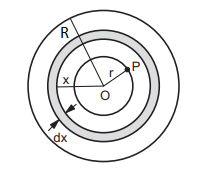
Let us divide the sphere in two parts by imagining a concentric spherical surface passing through \(P\). Let us calculate the inner part mass:
Step A: Define Density \((\rho)\) Since the sphere is uniform, its density (mass per unit volume) is the same everywhere. For the whole sphere:
\(
\rho=\frac{\text { Total Mass }}{\text { Total Volume }}=\frac{M}{\frac{4}{3} \pi R^3}
\)
Step B: Calculate Mass of the Inner Part ( \(M^{\prime}\) ) The mass of the inner sphere of radius \(r\) is simply its volume multiplied by that same density:
\(
\begin{gathered}
M^{\prime}=\text { Volume of inner sphere } \text { × } \rho \\
\qquad M^{\prime}=\left(\frac{4}{3} \pi r^3\right) \times\left(\frac{M}{\frac{4}{3} \pi R^3}\right)
\end{gathered}
\)
Step C: Simplify The constant terms \(\frac{4}{3} \pi\) cancel out:
\(
M^{\prime}=M \times \frac{r^3}{R^3}
\)
The potential at \(P\) due to this inner part is by equation (i)
\(
\begin{aligned}
V_1 & =-\frac{G M^{\prime}}{r} \\
& =-\frac{G M r^2}{R^3} \dots(ii)
\end{aligned}
\)
To get the potential at \(P\) due to the outer part of the sphere, we divide this part in concentric shells. The mass of the shell between radii \(x\) and \(x+d x\) is
\(
d m=\frac{M}{\frac{4}{3} \pi R^3} 4 \pi x^2 d x=\frac{3 M x^2 d x}{R^3} .
\)
The potential at \(P\) due to this shell is,
\(
\frac{-G d m}{x}=-3 \frac{G M}{R^3} x d x
\)
The potential due to the outer part is (for shells outside \(r\) from \(x=r\) to \(x=R\))
\(
V_2=\int_r^R-\frac{3 G M}{R^3} x d x
\)
\(
\begin{aligned}
& =-\frac{3 G M}{R^3}\left[\frac{x^2}{2}\right]_r^R \\
& =\frac{-3 G M}{2 R^3}\left(R^2-r^2\right) \dots(iii)
\end{aligned}
\)
By (ii) and (iii) the total potential at \(P\) is
\(
\begin{aligned}
V & =V_1+V_2 \\
& =-\frac{G M r^2}{R^3}-\frac{3 G M}{2 R^3}\left(R^2-r^2\right) \\
& =-\frac{G M}{2 R^3}\left(3 R^2-r^2\right)
\end{aligned}
\)
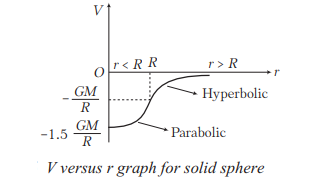
At the centre of the sphere the potential is (\(r=0\))
\(
V=-\frac{3 G M}{2 R}
\)
At the surface \(r=R, \quad V=-\frac{G M}{R}\)
i.e. At the centre of the sphere, the potential is 1.5 times the potential at surface.
The \(V\) versus \(r\) graph is as shown in figure below.
Example 7: The radius of the earth is \(6.37 \times 10^6 \mathrm{~m}\) and its mean density is \(5.5 \times 10^3 \mathrm{~kg} \mathrm{~m}^{-3}\) and \(G=6.67 \times 10^{-11} N-m^2 k g^{-2}\). Find the gravitational potential on the surface of the earth.
Solution: Given, radius of the earth, \(R=6.37 \times 10^6 \mathrm{~m}\)
Density, \(\rho=5.5 \times 10^3 \mathrm{~kg} \mathrm{~m}^{-3}, G=6.67 \times 10^{-11} \mathrm{~N}-\mathrm{m}^2 \mathrm{~kg}^{-2}\)
∵ Mass of the earth, \(M=\) Volume × Density \(=\frac{4}{3} \pi R^3 \rho\)
∴ Gravitational potential on the earth’s surface,
\(
\begin{aligned}
V & =\frac{-G M}{R}=\frac{-G}{R} \times \frac{4}{3} \pi R^3 \rho=\frac{-4}{3} \pi G R^2 \rho \\
& =\frac{-4}{3} \times 3.14 \times 6.67 \times 10^{-11} \times\left(6.37 \times 10^6\right)^2 \times 5.5 \times 10^3 \\
\Rightarrow V & =-6.23 \times 10^7 \mathrm{~J} \mathrm{~kg}^{-1}
\end{aligned}
\)
Example 8: At a point above the surface of the earth, the gravitational potential is \(-5.12 \times 10^7 \mathrm{~J} / \mathrm{kg}\) and the acceleration due to gravity is \(6.4 \mathrm{~m} / \mathrm{s}^2\). Assuming the mean radius of the earth to be 6400 km , calculate the height of the point above the earth’s surface.
Solution: If \(r\) is the distance of the given point from the centre of the earth, then gravitational potential at the point,
\(
V=-\frac{G M}{r}=-5.12 \times 10^7 \mathrm{~J} / \mathrm{kg}
\)
Acceleration due to gravity at this point, \(g=\frac{G M}{r^2}=6.4 \mathrm{~m} / \mathrm{s}^2\)
Clearly, \(\quad \frac{|V|}{g}=\frac{G M / r}{G M / r^2}=r\)
Thus, \(\quad r=\frac{5.12 \times 10^7 \mathrm{~J} / \mathrm{kg}}{6.4 \mathrm{~m} / \mathrm{s}^2}\)
\(
=8 \times 10^6 \mathrm{~m}=8000 \mathrm{~km}
\)
Obviously, height of the point from the earth’s surface
\(
=(r-R)=8000 \mathrm{~km}-6400 \mathrm{~km}=1600 \mathrm{~km}
\)
Gravitational Field
A gravitational field is an invisible influence surrounding any object with mass, extending through space, that causes other masses to be attracted towards it. It’s a vector field, meaning it has both strength and direction at every point, often represented by arrows pointing towards the mass, with length indicating strength. This field is what explains why objects fall to Earth, as any mass entering Earth’s field experiences a force (gravity) pulling it down, calculated as force per unit mass (N/kg or \(\mathrm{m} / \mathrm{s}^2\)).
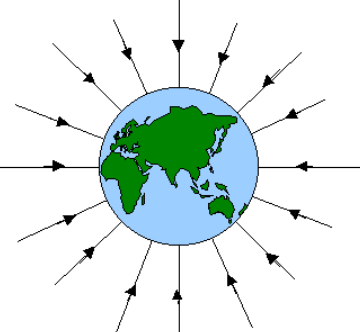
In case of our planet earth, since it is surrounded by a gravitational field, so any body brought in this field experiences a force of attraction towards the centre of earth.
Gravitational field intensity
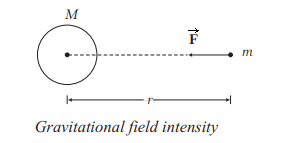
We define the intensity of gravitational field \(\vec{E}\) at a point by the equation
\(
\vec{E}=\frac{\vec{F}}{m}
\)
where \(\vec{F}\) is the force exerted by the field on a body of mass \(m\) placed in the field. Its SI unit is \(\mathrm{N} \mathrm{kg}^{-1}\) and dimensions are \(\left[\mathrm{M}^0 \mathrm{LT}^{-2}\right]\). It is a vector quantity and is always directed towards the centre of gravity of body whose gravitational field intensity is to be considered. Gravitational field adds according to the rules of vector addition. If \(\vec{E}_1\) is the field due to a source \(S_1\) and \(\vec{E}_2\) is the field at the same point due to another source \(S_2\), the resultant field when both the sources are present is \(\vec{E}_1+\vec{E}_2\).
If a mass \(m\) is placed close to the surface of the earth, the force on it is \(m g\). We say that the earth has set up a gravitational field and this field exerts a force on the mass. The intensity of the field is
\(
\vec{E}=\frac{\vec{F}}{m}=\frac{m \vec{g}}{m}=\vec{g}
\)
Thus, the intensity of the gravitational field near the surface of the earth is equal to the acceleration due to gravity. It should be clearly understood that the intensity of the gravitational field and the acceleration due to gravity are two separate physical quantities having equal magnitudes and directions.
Example 9: A particle of mass 50 g experiences a gravitational force of 2.0 N when placed at a particular point. Find the gravitational field at that point.
Solution: The gravitational field has a magnitude
\(
E=\frac{F}{m}=\frac{2.0 \mathrm{~N}}{\left(50 \times 10^{-3} \mathrm{~kg}\right)}=40 \mathrm{~N} \mathrm{~kg}^{-1}
\)
This field is along the direction of the force.
Relation between gravitational field and potential
Suppose the gravitational field at a point \(\vec{r}\) due to a given mass distribution is \(\vec{E}\). By definition, the force on a particle of mass \(m\) when it is at \(\vec{r}\) is
\(
\vec{F}=m \vec{E}
\)
As the particle is displaced from \(\vec{r}\) to \(\vec{r}+d \vec{r}\) the work done by the gravitational force on it is
\(
\begin{aligned}
d W & =\vec{F} \cdot d \vec{r} \\
& =m \vec{E} \cdot d \vec{r}
\end{aligned}
\)
The change in potential energy during this displacement is
\(
d U=-d W=-m \vec{E} \cdot d \vec{r}
\)
The change in potential is, by equation,
\(
d V=\frac{d U}{m}=-\vec{E} \cdot d \vec{r}
\)
Where, \(\vec{E}=E_x \hat{\mathbf{i}}+E_y \hat{\mathbf{j}}+E_z \hat{\mathbf{k}}\)
\(
d \vec{r}=d x \hat{\mathbf{i}}+d y \hat{\mathbf{j}}+d z \hat{\mathbf{k}}
\)
\(
\therefore \quad d V=-E_x d x-E_y d y-E_z d z
\)
Also we can write, \(E_x=\frac{-\partial V}{\partial x}, E_y=\frac{-\partial V}{\partial y}\) and \(E_z=\frac{-\partial V}{\partial z}\)
where, \(\frac{\partial}{\partial x}\) represents partial differentiation with respect to \(x\) considering \(y\) and \(z\) as constants. Similarly, \(\frac{\partial}{\partial y}\) and \(\frac{\partial}{\partial z}\) are partial differentiations with respect to \(y\) and \(z\) respectively considering other variables as constants.
Note: If field is given, the potential can be obtained as
\(
V\left(\vec{r_2}\right)-V\left(\vec{r_1}\right)=-\int_\vec{r_1}^\vec{r_2} \vec{E} \cdot d \vec{r}
\)
Example 10: If gravitational potential is \(V=x y^2\), find the gravitational field at \((2,1)\).
Solution: Given, \(V=x y^2\)
Gravitational field intensity in \(x\)-direction,
\(
E_x=\frac{-\partial V}{\partial x}=\frac{-\partial}{\partial x}\left(x y^2\right)=-y^2
\)
Gravitational field intensity in \(y\)-direction,
\(
\begin{array}{ll}
& E_y=\frac{-\partial V}{\partial y}=\frac{-\partial}{\partial y}\left(x y^2\right)=-2 y x \\
\therefore & \mathrm{E}=E_x \hat{\mathbf{i}}+E_y \hat{\mathbf{j}}=\left(-y^2\right) \hat{\mathbf{i}}+(-2 x y) \hat{\mathbf{j}}
\end{array}
\)
\(
\begin{aligned}
& \therefore \mathrm{E}(x=2, y=1)=-(1)^2 \hat{\mathbf{i}}+(-2 \times 2 \times 1) \hat{\mathbf{j}}=-\hat{\mathbf{i}}-4 \hat{\mathbf{j}} \\
& \Rightarrow \quad|\mathbf{E}|=\sqrt{(-1)^2+(-4)^2} \\
& =\sqrt{17} \text { unit }
\end{aligned}
\)
Example 11: If gravitational field is given by \(\mathbf{E}=-x \hat{\mathbf{i}}-2 y^2 \hat{\mathbf{j}}\). When gravitational potential is zero at \((0,0)\), find potential at \((2,1)\).
Solution: Given, gravitational field,
\(
\mathrm{E}=-x \hat{\mathbf{i}}-2 y^2 \hat{\mathbf{j}}, E_x=-x
\)
and
\(
E_y=-2 y^2
\)
As we know that,
\(
V\left(\mathbf{r}_2\right)-V\left(\mathbf{r}_1\right)=-\int_{\mathbf{r}_1}^{\mathbf{r}_2} \mathbf{E} \cdot d \mathbf{r}
\)
\(
\begin{aligned}
\Rightarrow V(2,1)-V(0,0) & =-\left[\int_0^2 E_x d x+\int_0^1 E_y d y\right] \\
& =-\left[\int_0^2-x d x+\int_0^1-2 y^2 d y\right] \\
& =+\left[\left(\frac{x^2}{2}\right)_0^2+\left(\frac{2 y^3}{3}\right)_0^1\right]=\left[\frac{4}{2}+\frac{2}{3}\right]=\frac{8}{3} \text { unit } \\
\Rightarrow \quad V(2,1) & =\frac{8}{3}+V(0,0)=\frac{8}{3}+0=\frac{8}{3} \text { unit }
\end{aligned}
\)
Example 12: The gravitational field due to a mass distribution is given by \(E=K / x^3\) in \(X\)-direction. Taking the gravitational potential to be zero at infinity, find its value at a distance \(x\).
Solution: The potential at a distance \(x\) is
\(
\begin{aligned}
V(x) & =-\int_{\infty}^x E d x=-\int_{\infty}^x \frac{K}{x^3} d x \\
& =\left[\frac{K}{2 x^2}\right]_{\infty}^x=\frac{K}{2 x^2}
\end{aligned}
\)
Example 13: The gravitational potential due to a mass distribution is \(V=\frac{A}{\sqrt{x^2+a^2}}\). Find the gravitational field.
Solution: \(V=\frac{A}{\sqrt{x^2+a^2}}=A\left(x^2+a^2\right)^{-1 / 2}\)
If the gravitational field is \(E\),
\(
\begin{aligned}
E_x & =-\frac{\partial V}{\partial x}=-A\left(-\frac{1}{2}\right)\left(x^2+a^2\right)^{-3 / 2}(2 x) \\
& =\frac{A x}{\left(x^2+a^2\right)^{3 / 2}} \\
E_y & =-\frac{\partial V}{\partial y}=0 \text { and } E_z=-\frac{\partial V}{\partial z}=0 .
\end{aligned}
\)
The gravitational field is \(\frac{A x}{\left(x^2+a^2\right)^{3 / 2}}\) in the \(x\)-direction.
Gravitational field intensity for different bodies
Case-I: Field due to a point mass
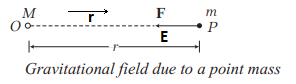
Suppose a point mass \(M\) is placed at point \(O\) (origin) and we want to find the intensity of gravitational field \(E\) at point \(P\), at a distance \(r\) from \(O\). To do this, we place a tiny “test mass” \(m\) at point \(P\).
According to Newton, the magnitude of the gravitational force \((F)\) between the source mass \(M\) and the test mass \(m\) is:
\(
F=\frac{G M m}{r^2}
\)
By definition, the gravitational field strength is the force acting on a unit test mass:
\(
{E}=\frac{{F}}{m}
\)
Substitute the expression for \(F\), we get
\(
E=\frac{\left(\frac{G M m}{r^2}\right)}{m}
\)
\(
E=\frac{G M}{r^2}
\)
In vector form, Since gravity is an attractive force, the field vector always points toward the center of the source mass \(M\). To represent this mathematically, we use a unit vector \(\hat{\mathbf{r}}\) pointing away from the mass:
\(
\mathbf{E}=-\frac{G M}{r^2} \hat{\mathbf{r}}
\)
The negative sign indicates that the field direction is opposite to the radial vector (i.e., it’s directed inward).
The field follows the inverse-square law, meaning if you double the distance, the field strength drops to one-fourth.
Note:
- If \(r=\infty, E=0\). It means the intensity of gravitational field is zero only at infinite distance from the body.
- If a unit mass ( \(m\) ) is placed on the surface of earth, then the gravitational force acting on the rest mass \(m\) will be equal to the weight \(w\) of the test mass.
Now,
\(
E=\frac{w}{m}=\frac{m g}{m}=g \quad \text { or } \quad E=g
\) - We can also apply the principle of superposition to gravitational field intensity in the same way as that of gravitational force.
i.e. \(\boldsymbol{E}=\boldsymbol{E}_1+\boldsymbol{E}_2+\ldots+\boldsymbol{E}_n\)
Example 14: Two point masses of mass 10 kg and 1000 kg are at a distance 1 m apart. At which points on the line joining them, will the gravitational field intensity be zero?
Solution: Let the resultant gravitational intensity be zero at a distance \(x\) from the mass of 10 kg on the line joining the centre of two bodies. At this point, the gravitational intensities due to the two bodies must be equal and opposite.
\(
\begin{array}{lc}
\therefore & \frac{G \times 10}{x^2}=\frac{G \times 1000}{(1-x)^2} \\
\Rightarrow & 100 x^2=(1-x)^2 \\
\Rightarrow & 10 x=1-x \\
\Rightarrow & 11 x=1 \\
\Rightarrow & x=\left(\frac{1}{11}\right) \mathrm{m}
\end{array}
\)
Example 15: Figure shows a system of point masses placed on \(X\)-axis. Find the net gravitational field intensity at the origin.
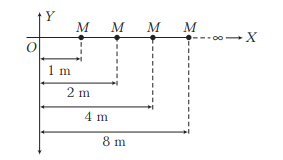
(Take, sum of an infinite GP as \(S=\frac{a}{1-r}\), where \(a=\) first term and \(r=\) least common ratio.)
Solution: Net gravitational field intensity at the origin, \(\mathrm{E}_{\text {net }}=\mathrm{E}_1+\mathrm{E}_2+\mathrm{E}_3+\mathrm{E}_4+\ldots \infty\) terms
\(
\begin{aligned}
& =\frac{G M}{(1)^2} \hat{\mathbf{i}}+\frac{G M}{(2)^2} \hat{\mathbf{i}}+\frac{G M}{(4)^2} \hat{\mathbf{i}}+\ldots \infty \text { terms } \\
& =G M \hat{\mathbf{i}}\left(1+\frac{1}{4}+\frac{1}{16}+\ldots \infty\right)\left(\text { Here, } a=1 \text { and } r=\frac{1}{4}\right)
\end{aligned}
\)
So, \(\mathrm{E}_{\mathrm{net}}=G M\left(\frac{a}{1-r}\right) \hat{\mathbf{i}}\)
\(
=G M \hat{\mathbf{i}}\left(\frac{1}{1-1 / 4}\right)=G M \hat{\mathbf{i}}\left(\frac{1}{3 / 4}\right)
\)
\(
\Rightarrow \mathrm{E}_{\mathrm{net}}=\frac{4}{3} G M \hat{\mathrm{i}}
\)
Case-II: Field due to a Uniform Circular Ring at a Point on its Axis
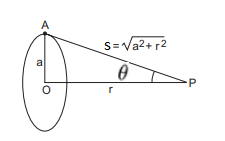
Consider a uniform ring of mass \(M\) and radius \(a\). Let \(P\) be a point on the axis of the ring at a distance \(r\) from its center \(O\).
Mass element ( \(d m\) ): Consider a small element of mass \(d m\) on the circumference.
Distance (s): The distance from \(d m\) to point \(P\) is given by the Pythagorean theorem:
\(
s=\sqrt{a^2+r^2}
\)
Angle ( \(\theta\) ): Let \(\theta\) be the angle between the axis \(O P\) and the line joining \(d m\) to \(P\).
\(
\cos \theta=\frac{r}{s}=\frac{r}{\left(a^2+r^2\right)^{1 / 2}}
\)
Field due to mass element \(dm\):
The magnitude of the gravitational field \(d{E}\) at point \(P\) due to the small mass \(d m\) is:
\(
d E=\frac{G d m}{s^2}=\frac{G d m}{a^2+r^2}
\)
The vector \(d \mathrm{E}\) points from \(P\) toward \(d m\). We can resolve this into two components:
Axial component ( \(d E \cos \theta\) ): Directed along the axis toward the center \(O\).
Perpendicular component ( \(d E \sin \theta\) ): Directed perpendicular to the axis.
Due to the symmetry of the ring, for every mass element \(d m\), there is a diametrically opposite element. Their perpendicular components are equal in magnitude but opposite in direction, so they cancel out.
The net field is the sum of only the axial components:
\(
E_{n e t}=\int d E \cos \theta
\)
Substitute the expressions for \(d E\) and \(\cos \theta\) :
\(
E=\int\left(\frac{G d m}{a^2+r^2}\right)\left(\frac{r}{\sqrt{a^2+r^2}}\right)
\)
Since \(G, r\), and \(a\) are constants for all elements of the ring, we can pull them out of the integral:
\(
E=\frac{G r}{\left(a^2+r^2\right)^{3 / 2}} \int d m
\)
Since the total mass of the ring is \(\int d m=M\), the final expression is:
\(
E=\frac{G M r}{\left(a^2+r^2\right)^{3 / 2}}
\)
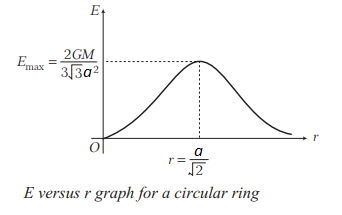
This is directed towards the centre of the ring. It is zero at the centre of the ring and maximum at \(r=a / \sqrt{2}\)
(can be obtained by putting \(d E / d r=0\) ).
The maximum value is \(E_{\text {max }}=\frac{2 G M}{3 \sqrt{3} a^2}\)
Thus, \(E\) versus \(r\) graph is as shown in figure below.
Example 16: Mass of 2 kg is distributed uniformly over a ring of radius \(2 m\). Find the gravitational field at a point lying on the axis of the ring at a distance of \(2 \sqrt{3} m\) from the centre.
Solution: Given, mass of the ring, \(M=2 \mathrm{~kg}\)
Radius of the ring, \(a=2 \mathrm{~m}\)
Distance of the point, \(r=2 \sqrt{3} \mathrm{~m}\)
∴ Required gravitational field,
\(
\begin{aligned}
E(r & =2 \sqrt{3})=\frac{G M r}{\left(a^2+r^2\right)^{3 / 2}}=\frac{G \times 2 \times 2 \sqrt{3}}{(\sqrt{4+12})^3} \\
& =\frac{4 \sqrt{3} G}{64}=\frac{\sqrt{3} G}{16}=\frac{6.67 \times 10^{-11} \times \sqrt{3}}{16} \\
& =0.72 \times 10^{-11}=7.2 \times 10^{-12} \mathrm{Nkg}^{-1}
\end{aligned}
\)
Remarks: Direction and Special Cases
Direction: The field \(\mathbf{E}\) is directed along the axis toward the center of the ring.
At the Center \((r=0)\) : If \(P\) is at the center of the ring, \(E=0\). This makes sense because the gravitational pulls from all sides of the ring cancel each other out.
At Large Distances ( \((r \gg a)\) ): The \(a^2\) term becomes negligible, and the formula simplifies to \(E \approx \frac{G M}{r^2}\). At a great distance, the ring behaves like a simple point mass.
Case-III: Field due to a Uniform Disc at a Point on its Axis
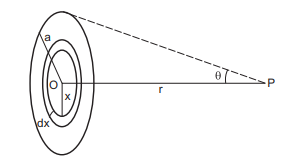
Consider a uniform disc of mass \(M\), radius \(a\), and surface mass density \(\sigma\). Let \(P\) be a point on the axis at a distance \(r\) from the center \(O\).
Surface Mass Density \((\sigma)\) : Since the disc is uniform, \(\sigma=\frac{M}{\pi a^2}\).
The Elemental Ring: Imagine a thin ring of radius \(x\) and infinitesimal width \(d x\) within the disc.
Mass of the element (\(dm\)): The area of this thin ring is \(2 \pi x d x\). Therefore:
\(
d m=\sigma(2 \pi x d x)=\frac{M}{\pi a^2}(2 \pi x d x)=\frac{2 M x d x}{a^2}
\)
Field due to the elemental ring: From our previous derivation, we know the field \(d E\) at point \(P\) due to a ring of mass \(d m\) and radius \(x\) is:
\(
d E=\frac{G d m r}{\left(x^2+r^2\right)^{3 / 2}}
\)
Substitute the expression for \(d m\) into the equation:
\(
\begin{gathered}
d E=\frac{G\left(\frac{2 M x d x}{a^2}\right) r}{\left(x^2+r^2\right)^{3 / 2}} \\
d E=\frac{2 G M r}{a^2} \cdot \frac{x d x}{\left(x^2+r^2\right)^{3 / 2}}
\end{gathered}
\)
To find the total field \(E\), we integrate \(d E\) from \(x=0\) (the center) to \(x=a\) (the edge):
\(
E=\frac{2 G M r}{a^2} \int_0^a \frac{x}{\left(x^2+r^2\right)^{3 / 2}} d x
\)
To solve the integral, use substitution: Let \(u=\left(x^2+r^2\right)\). Then \(d u=2 x d x\), or \(x d x=\frac{d u}{2}\).
The integral becomes:
\(
\int \frac{1}{2} u^{-3 / 2} d u=\frac{1}{2}\left[\frac{u^{-1 / 2}}{-1 / 2}\right]=-\frac{1}{\sqrt{u}}=-\frac{1}{\sqrt{x^2+r^2}}
\)
Applying the limits from 0 to \(a\) :
\(
E=\frac{2 G M r}{a^2}\left[-\frac{1}{\sqrt{x^2+r^2}}\right]_0^a
\)
Distributing the \(r\) into the parentheses gives the standard formula:
\(
E=\frac{2 G M}{a^2}\left(1-\frac{r}{\sqrt{a^2+r^2}}\right)
\)
Equation (above) may be expressed in terms of the angle \(\theta\) subtended by a radius of the disc at \(P\) as,
\(
E=\frac{2 G M}{a^2}(1-\cos \theta)
\)
Remarks
- Case 1: Point P is very close to the disc \((r \rightarrow 0)\)
If the point is extremely close to the center, the term \(\frac{r}{\sqrt{a^2+r^2}}\) approaches zero.
\(
E \approx \frac{2 G M}{a^2}
\)
Substituting \(M=\sigma \pi a^2\), we get \(g \approx 2 \pi G \sigma\). This shows the field near a large sheet of mass is constant. - Case 2: Point P is very far ( \(r \gg a\) )
At large distances, the disc behaves like a point mass, and the formula simplifies back to:
\(
E \approx \frac{G M}{r^2}
\)
Case-IV: Field due to a Uniform Thin Spherical Shell
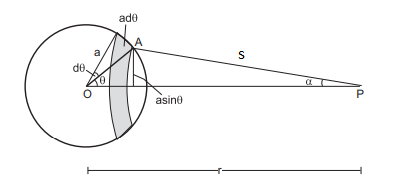
To derive the gravitational field \(E\) due to a uniform thin spherical shell, we consider a shell of mass \(M\) and radius \(a\). We want to find the field at a point \(P\) at a distance \(r\) from the center \(O\).
The standard method involves dividing the shell into thin circular rings and integrating their contributions.
Geometry and Setup:
Surface Mass Density \((\sigma): \sigma=\frac{M}{4 \pi a^2}\).
Consider a small elemental ring on the shell of angular width \(d \theta\).
The radius of this ring is \(a \sin \theta\) and its width is \(a d \theta\).
Area of the ring: \(d A=(2 \pi a \sin \theta) \cdot(a d \theta)=2 \pi a^2 \sin \theta d \theta\).
Mass of the ring \((d m): d m=\sigma d A=\frac{M}{4 \pi a^2}\left(2 \pi a^2 \sin \theta d \theta\right)=\frac{M}{2} \sin \theta d \theta\).
Let \(s\) be the distance from the elemental ring to point \(P\). By the Law of Cosines:
\(
s^2=a^2+r^2-2 a r \cos \theta
\)
Field due to the elemental ring:
From our previous derivation of a ring, the field \(d E\) at point \(P\) (directed toward the center \(O\) ) is:
\(
d E=\frac{G d m}{s^2} \cos \alpha
\)
Where \(\alpha\) is the angle between \(s\) and the axis \(O P\). From the geometry:
\(
\cos \alpha=\frac{r-a \cos \theta}{s}
\)
Substituting \(d m\) and \(\cos \alpha\) :
\(
d E=\frac{G(M / 2) \sin \theta d \theta}{s^2} \cdot \frac{r-a \cos \theta}{s}=\frac{G M}{2 s^2} \sin \theta d \theta \frac{r-a \cos \theta}{s}
\)
To integrate, it is easier to change the variable from \(\theta\) to \(s\). Differentiating \(s^2=a^2+r^2- 2 a r \cos \theta\) :
\(
2 s d s=2 a r \sin \theta d \theta \Longrightarrow \sin \theta d \theta=\frac{s d s}{a r}
\)
Also, from the cosine law: \(\cos \theta=\frac{a^2+r^2-s^2}{2 a r}\). Substituting these into the \(d E\) equation and simplifying:
\(
d E=\frac{G M}{4 r^2 a}\left(1+\frac{r^2-a^2}{s^2}\right) d s
\)
Case 1: Outside the Shell ( \(r>a\) )
The limits for \(s\) are from the nearest point ( \(r-a\) ) to the farthest point ( \(r+a\) ).
\(
E=\int_{r-a}^{r+a} \frac{G M}{4 r^2 a}\left(1+\frac{r^2-a^2}{s^2}\right) d s
\)
Integrating this yields:
\(
E=\frac{G M}{4 r^2 a}\left[s-\frac{r^2-a^2}{s}\right]_{r-a}^{r+a}
\)
After substituting limits and simplifying:
\(
E=\frac{G M}{r^2} \quad(\text { for } r>a)
\)
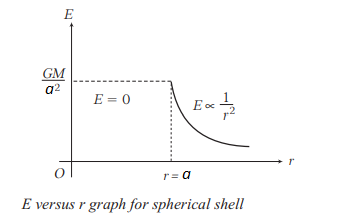
Conclusion: Outside, the shell acts like a point mass at its center.
Case 2: At the surface ( \(r=a\) )
\(
E=\frac{G M}{a^2}
\)
Case 3: Inside the Shell ( \(r<a\) )
The limits for \(s\) are now from \((a-r)\) to \((a+r)\).
\(
E=\frac{G M}{4 r^2 a}\left[s-\frac{r^2-a^2}{s}\right]_{a-r}^{a+r}
\)
When you evaluate this, the terms inside the bracket cancel out to zero.
\(
E=0 \quad(\text { for } r<a)
\)
Conclusion: The gravitational field inside a hollow uniform shell is zero.
Thus, \(E\) versus \(r\) graph is as shown in figure below
Example 17: Two concentric spherical shells have masses \(m_1\) and \(m_2\) and radii \(r_1\) and \(r_2\left(r_2>r_1\right)\). What is the force exerted by this system on a particle of mass \(m_3\), if it is placed at a distance \(r\left(r_1<r<r_2\right)\) from the centre?
Solution: The outer shell will have no contribution in the gravitational field at point \(P\).
\(
\therefore \quad E_P=\frac{G m_1}{r^2}
\)
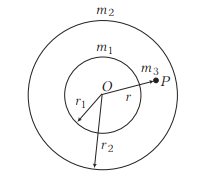
Thus, force on mass \(m_3\) placed at \(P\) is,
\(
F=m_3 E_P \text { or } \quad F=\frac{G m_1 m_3}{r^2}
\)
The field \(E_P\) and the force \(F\) both are towards centre \(O\).
Case-V: Gravitational Field due to a Uniform Solid Sphere
Case I : Field at an external point \((r>a)\)
Let the mass of the sphere be \(M\) and its radius be \(a\). We have to calculate the gravitational field due to the sphere at a point outside the sphere at a distance \(r\) from the centre. Figure (below) shows the situation. The centre of the sphere is at \(O\) and the field is to be calculated at \(P\).
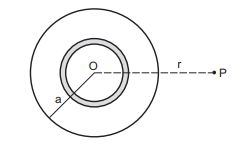
Let us divide the sphere into thin spherical shells each centred at \(O\). Let the mass of one such shell be \(d m\). To calculate the gravitational field at \(P\), we can replace the shell by a single particle of mass \(d m\) placed at the centre of the shell that is at \(O\).
The gravitational field \(E\) is defined as the force per unit mass. The field at \(P\) due to this shell is then
\(
d E=\frac{G d m}{r^2}
\)
towards \(P O\). The field due to the whole sphere may be obtained by summing the fields of all the shells making the solid sphere.
Thus,
\(
\begin{aligned}
E & =\int d E \\
& =\int \frac{G d m}{r^2}=\frac{G}{r^2} \int d m \\
& =\frac{G M}{r^2}
\end{aligned}
\)
Thus, a uniform sphere may be treated as a single particle of equal mass placed at its centre for calculating the gravitational field at an external point.
Since gravity is always attractive, the field vector points toward the center of the sphere. If we use \(\hat{\mathbf{r}}\) as the unit vector pointing radially outward from the center:
\(
\mathbf{E}=-\frac{G M}{r^2} \hat{\mathbf{r}}
\)
Case II : Field at an internal point \((r<a)\)
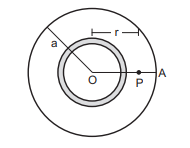
Suppose the point \(P\) is inside the solid sphere (figure above). In this case \(r<a\). Volume Mass Density ( \(\rho\) ): Since the sphere is uniform, \(\rho\) is constant:
\(
\rho=\frac{\text { Total Mass }}{\text { Total Volume }}=\frac{M}{\frac{4}{3} \pi a^3}
\)
The sphere may be divided into thin spherical shells all centered at \(O\). Suppose the mass of such a shell is \(d m\). If the radius of the shell is less than \(r\), the point \(P\) is outside the shell and the field due to the shell is
\(
d E=\frac{G d m}{r^2} \text { along } P O \text {. }
\)
If the radius of the shell considered is greater than \(r\), the point \(P\) is internal and the field due to such a shell is zero.
\(
E_{\text {shell }}=0
\)
The total field due to the whole sphere is obtained by summing the fields due to all the shells. As all these fields are along the same direction, the net field is
\(
\begin{aligned}
E & =\int d E \\
& =\int \frac{G d m}{r^2}=\frac{G}{r^2} \int d m
\end{aligned}
\)
Field due to the Inner Sphere:
Point \(P\) lies on the surface of the inner sphere of radius \(r\). For a point on the surface, the inner mass acts as a point mass concentrated at the center \(O\). Let \(M_r\) be the mass of this inner portion:
\(
E=\frac{G M_r}{r^2}
\)
Calculate Inner Mass ( \(\boldsymbol{M}_{\boldsymbol{r}}\) ):
Since density is uniform, \(M_r\) is the density multiplied by the volume of the inner sphere:
\(
M_r=\rho \times V_r=\rho \times\left(\frac{4}{3} \pi r^3\right)
\)
Substitute the value of \(\rho=\frac{M}{\frac{4}{3} \pi a^3}\) :
\(
M_r=\left(\frac{M}{\frac{4}{3} \pi a^3}\right) \cdot \frac{4}{3} \pi r^3=M \frac{r^3}{a^3}
\)
\(
\begin{aligned}
&\text { Substitute } M_r \text { back into the field equation }\\
&\begin{gathered}
E=\frac{G}{r^2}\left(\frac{M r^3}{a^3}\right) \\
E=\frac{G M r}{a^3}
\end{gathered}
\end{aligned}
\)
Remarks
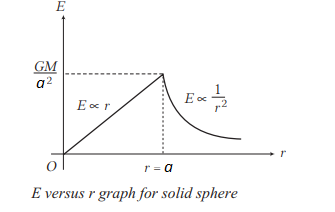
- Inside a uniform solid sphere, the gravitational field intensity \(E\) is directly proportional to the distance from the center:
\(
E \propto r
\) - At the center \((r=0): E=0\)
- At the surface \((r=a): E=\frac{G M}{a^2}\) (Matches the external point formula)
- Note: Field due to the Outer Shell:
From the shell theorem, we know that the gravitational field inside a uniform spherical shell is zero. Therefore, the entire mass of the sphere located at distances greater than \(r\) exerts no net gravitational force on point \(P\).
The gravitational field due to a uniform sphere at an internal point is proportional to the distance of the point from the centre of the sphere. At the centre itself, \(r=0\) and the field is zero. This is also expected from symmetry because any particle at the centre is equally pulled from all sides and the resultant must be zero. At the surface of the sphere, \(r=a\) and
\(
E=\frac{G M}{a^2}
\)
Example 18: Find the gravitational field due to the moon at its surface. The mass of the moon is \(7.36 \times 10^{22} \mathrm{~kg}\) and the radius of the moon is \(1.74 \times 10^6 \mathrm{~m}\). Assume the moon to be a spherically symmetric body.
Solution: To calculate the gravitational field at an external point, the moon may be replaced by a single particle of equal mass placed at its centre. Then the field at the surface is
\(
\begin{aligned}
E & =\frac{G M}{a^2} \\
& =\frac{6.67 \times 10^{-11} \mathrm{~N}-\mathrm{m}^2 / \mathrm{kg}^2 \times 7.36 \times 10^{22} \mathrm{~kg}}{\left(1.74 \times 10^6 \mathrm{~m}\right)^2} \\
& =1.62 \mathrm{~N} \mathrm{~kg}^{-1}
\end{aligned}
\)
This is about one sixth of the gravitational field due to the earth at its surface.
Example 19: Two solid spheres of radius 10 cm and masses 800 kg and 600 kg , are at a distance \(0.25 m\) apart. Calculate the magnitude of the gravitational field intensity at a point distance 0.20 m from the 800 kg sphere and 0.15 m from the 600 kg sphere and does not lie on the line joining their centres. (Take, \(G=6.6 \times 10^{-11} N-m^2 \mathrm{~kg}^{-2}\))
Solution: Let \(E_A\) be the gravitational field intensity at \(P\) due to 800 kg sphere at \(A\).
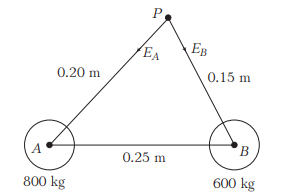
Then, \(E_A=G \frac{800}{(0.2)^2}=2 \times 10^4 G\), along \(P A\)
Let \(E_B\) be the gravitational field intensity at \(P\) due to 600 kg sphere at \(B\).
Then, \(E_B=G \frac{600}{(0.15)^2}=\frac{80000 G}{3}\), along \(P B\)
The angle between \(E_A\) and \(E_B\) is \(90^{\circ} . \quad\left(\because A B^2=A P^2+B P^2\right)\)
If \(E\) be the magnitude of the resultant intensity, then
\(
\begin{aligned}
E & =\sqrt{E_A^2+E_B^2}=\sqrt{\left(2 \times 10^4 G\right)^2+\left(\frac{80000 G}{3}\right)^2} \\
& =G \sqrt{4 \times 10^8+\frac{64}{9} \times 10^8} \\
& =6.67 \times 10^{-11} \times 2 \times 10^4 \sqrt{1+\frac{16}{9}} \\
& =6.67 \times 2 \times \frac{5}{3} \times 10^{-7} \mathrm{~N} \mathrm{~kg}^{-1} \\
\Rightarrow E & =2.22 \times 10^{-6} \mathrm{~N} \mathrm{~kg}^{-1}
\end{aligned}
\)
Example 20: Gravitational field at the surface of a solid sphere is \(1.5 \times 10^{-4} \mathrm{~N} \mathrm{~kg}^{-1}\). Find the gravitational field at a point situated inside the sphere at a distance equal to half of the radius of the solid sphere.
Solution: Let mass of the solid sphere is \(M\) and radius is \(R\).
It is given that,
\(
\begin{aligned}
E_{\text {surface }} & =\frac{G M}{R^2}=1.5 \times 10^{-4} \mathrm{~N} \mathrm{~kg}^{-1} \\
\therefore \quad E(r & =R / 2)=\frac{G M}{R^3}(R / 2) \\
& =\frac{G M}{2 R^2}=\frac{1.5 \times 10^{-4}}{2}=7.5 \times 10^{-5} \mathrm{~N} \mathrm{~kg}^{-1}
\end{aligned}
\)