8.7 Entrance Corner
Q1. One end of a wire 2 m long and \(0.2 \mathrm{~cm}^2\) in cross section is fixed in a ceiling and a load of 4.8 kg is attached to the free end. Find the extension of the wire. Young modulus of steel \(=2.0 \times 10^{11} \mathrm{~N} \mathrm{~m}^{-2}\). Take \(g=10 \mathrm{~m} \mathrm{~s}^{-2}\).
Solution: We have
\(
Y=\frac{\text { stress }}{\text { strain }}=\frac{T / A}{l / L}
\)
with symbols having their usual meanings. The extension is
\(
l=\frac{T L}{A Y}
\)
As the load is in equilibrium after the extension, the tension in the wire is equal to the weight of the load
\(
\begin{aligned}
& =4.8 \mathrm{~kg} \times 10 \mathrm{~m} \mathrm{~s}^{-2}=48 \mathrm{~N} \\
\text { Thus, } l & =\frac{(48 \mathrm{~N})(2 \mathrm{~m})}{\left(0.2 \times 10^{-4} \mathrm{~m}^2\right) \times\left(2.0 \times 10^{11} \mathrm{~N} \mathrm{~m}^{-2}\right)} \\
& =2.4 \times 10^{-5} \mathrm{~m}
\end{aligned}
\)
Q2. One end of a nylon rope of length 4.5 m and diameter 6 mm is fixed to a tree-limb. A monkey weighing 100 N jumps to catch the free end and stays there. Find the elongation of the rope and the corresponding change in the diameter. Young modulus of nylon \(=4.8 \times 10^{11} \mathrm{~N} \mathrm{~m}^{-2}\) and Poisson ratio of nylon \(=0.2\).
Solution: As the monkey stays in equilibrium, the tension in the rope equals the weight of the monkey. Hence,
\(
Y=\frac{\text { stress }}{\text { strain }}=\frac{T / A}{l / L}
\)
\(
l=\frac{T L}{A Y}
\)
or, elongation \(=l=\frac{(100 \mathrm{~N}) \times(4.5 \mathrm{~m})}{\left(\pi \times 9 \times 10^{-6} \mathrm{~m}^2\right) \times\left(4.8 \times 10^{11} \mathrm{~N} \mathrm{~m}^{-2}\right)}\)
\(
=3.32 \times 10^{-5} \mathrm{~m} .
\)
Again, Poisson ratio \(=\frac{\Delta d / d}{l / L}=\frac{(\Delta d) L}{l d}\)
\(
0.2=\frac{\Delta d \times 4.5 \mathrm{~m}}{\left(3.32 \times 10^{-5} \mathrm{~m}\right) \times\left(6 \times 10^{-3} \mathrm{~m}\right)}
\)
\(
\begin{aligned}
\Delta d & =\frac{0.2 \times 6 \times 3.32 \times 10^{-8} \mathrm{~m}}{4.5} \\
& =8.8 \times 10^{-9} \mathrm{~m} .
\end{aligned}
\)
Q3. Two blocks of masses 1 kg and 2 kg are connected by a metal wire going over a smooth pulley as shown in figure below. The breaking stress of the metal is \(2 \times 10^9 \mathrm{~N} \mathrm{~m}^{-2}\). What should be the minimum radius of the wire used if it is not to break? Take \(g=10 \mathrm{~m} \mathrm{~s}^{-2}\).
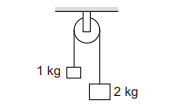
Solution: The stress in the wire \(=\frac{\text { Tension }}{\text { Area of cross section }}\). To avoid breaking, this stress should not exceed the breaking stress.
Let the tension in the wire be \(T\). The equations of motion of the two blocks are,
and
\(
\begin{aligned}
& T-10 \mathrm{~N}=(1 \mathrm{~kg}) a \\
& 20 \mathrm{~N}-T=(2 \mathrm{~kg}) a .
\end{aligned}
\)
Eliminating \(a\) from these equations,
\(
T=(40 / 3) \mathrm{N} .
\)
The stress \(=\frac{(40 / 3) \mathrm{N}}{\pi r^2}\).
If the minimum radius needed to avoid breaking is \(r\),
\(
2 \times 10^9 \frac{\mathrm{~N}}{\mathrm{~m}^2}=\frac{(40 / 3) \mathrm{N}}{\pi r^2}
\)
Solving this,
\(
r=4.6 \times 10^{-5} \mathrm{~m} .
\)
Q4. Two wires of equal cross section but one made of steel and the other of copper, are joined end to end. When the combination is kept under tension, the elongations in the two wires are found to be equal. Find the ratio of the lengths of the two wires. Young modulus of steel \(=2.0 \times 10^{11} \mathrm{~N} \mathrm{~m}^{-2}\) and that of copper \(=1.1 \times 10^{11} \mathrm{~N} \mathrm{~m}^{-2}\).
Solution: As the cross sections of the wires are equal and same tension exists in both, the stresses developed are equal. Let the original lengths of the steel wire and the copper wire be \(L_s\) and \(L_c\) respectively and the elongation in each wire be \(l\).
\(
\frac{l}{L_s}=\frac{\text { stress }}{2.0 \times 10^{11} \mathrm{~N} \mathrm{~m}^{-2}} \dots(i)
\)
and \(\frac{l}{L_c}=\frac{\text { stress }}{1 \cdot 1 \times 10^{11} \mathrm{~N} \mathrm{~m}^{-2}} \dots(ii)\)
Dividing (ii) by (i),
\(
L_s / L_c=2 \cdot 0 / 1 \cdot 1=20: 11 .
\)
Q5. Find the decrease in the volume of a sample of water from the following data. Initial volume \(=1000 \mathrm{~cm}^3\), initial pressure \(=10^5 \mathrm{~N} \mathrm{~m}^{-2}\), final pressure \(=10^6 \mathrm{~N} \mathrm{~m}^{-2}\), compressibility of water \(=50 \times 10^{-11} \mathrm{~m}^2 \mathrm{~N}^{-1}\).
Solution: The change in pressure
\(
\begin{aligned}
&=\Delta P=10^6 \mathrm{~N} \mathrm{~m}^{-2}-10^5 \mathrm{~N} \mathrm{~m}^{-2} \\
&=9 \times 10^5 \mathrm{~N} \mathrm{~m}^{-2} . \\
& \text { Compressibility }=\frac{1}{\text { Bulk modulus }}=-\frac{\Delta V / V}{\Delta P}
\end{aligned}
\)
or, \(\quad 50 \times 10^{-11} \mathrm{~m}^2 \mathrm{~N}^{-1}=-\frac{\Delta V}{\left(10^{-3} \mathrm{~m}^3\right) \times\left(9 \times 10^5 \mathrm{~N} \mathrm{~m}^{-2}\right)}\)
\(
\begin{aligned}
\Delta V & =-50 \times 10^{-11} \times 10^{-3} \times 9 \times 10^5 \mathrm{~m}^3 \\
& =-4.5 \times 10^{-7} \mathrm{~m}^3=-0.45 \mathrm{~cm}^3
\end{aligned}
\)
Thus the decrease in volume is \(0.45 \mathrm{~cm}^3\).
Q6. One end of a metal wire is fixed to a ceiling and a load of 2 kg hangs from the other end. A similar wire is attached to the bottom of the load and another load of 1 kg hangs from this lower wire. Find the longitudinal strain in both the wires. Area of cross section of each wire is \(0.005 \mathrm{~cm}^2\) and Young modulus of the metal is \(2.0 \times 10^{11} \mathrm{~N} \mathrm{~m}^{-2}\). Take \(g=10 \mathrm{~m} \mathrm{~s}^{-2}\).
Solution: The situation is described in figure below. As the 1 kg mass is in equilibrium, the tension in the lower wire equals the weight of the load.
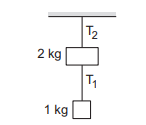
Thus
\(
T_1=10 \mathrm{~N}
\)
\(
\begin{aligned}
\text { Stress } & =10 \mathrm{~N} / 0.005 \mathrm{~cm}^2 \\
& =2 \times 10^7 \mathrm{~N} \mathrm{~m}^{-2} . \\
\text { Longitudinal strain } & =\frac{\text { stress }}{Y}=\frac{2 \times 10^7 \mathrm{~N} \mathrm{~m}^{-2}}{2 \times 10^{11} \mathrm{~N} \mathrm{~m}^{-2}}=10^{-4} .
\end{aligned}
\)
Considering the equilibrium of the upper block, we can write,
\(
\begin{aligned}
T_2 & =20 \mathrm{~N}+T_1, \quad \text { or, } \quad T_2=30 \mathrm{~N} . \\
\text { Stress } & =30 \mathrm{~N} / 0.005 \mathrm{~cm}^2 \\
& =6 \times 10^7 \mathrm{~N} \mathrm{~m}^{-2} .
\end{aligned}
\)
Longitudinal strain \(=\frac{6 \times 10^7 \mathrm{~N} \mathrm{~m}^{-2}}{2 \times 10^{11} \mathrm{~N} \mathrm{~m}^{-2}}=3 \times 10^{-4}\).
Q7. Each of the three blocks \(P, Q\) and \(R\) shown in figure below. has a mass of 3 kg . Each of the wires \(A\) and \(B\) has cross-sectional area \(0.005 \mathrm{~cm}^2\) and Young modulus \(2 \times 10^{11} \mathrm{~N} \mathrm{~m}^{-2}\). Neglect friction. Find the longitudinal strain developed in each of the wires. Take \(g=10 \mathrm{~m} \mathrm{~s}^{-2}\).
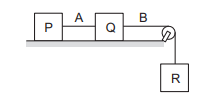
Solution: The block \(R\) will descend vertically and the blocks \(P\) and \(Q\) will move on the frictionless horizontal table. Let the common magnitude of the acceleration be \(a\). Let the tensions in the wires \(A\) and \(B\) be \(T_A\) and \(T_B\) respectively.
Writing the equations of motion of the blocks \(P, Q\) and \(R\), we get,
\(
T_A=(3 \mathrm{~kg}) a \dots(i)
\)
\(
T_B-T_A=(3 \mathrm{~kg}) a \dots(ii)
\)
and \((3 \mathrm{~kg}) g-T_B=(3 \mathrm{~kg}) a \dots(iii)\).
By (i) and (ii),
\(
T_B=2 T_A .
\)
By (i) and (iii),
\(
T_A+T_B=(3 \mathrm{~kg}) g=30 \mathrm{~N}
\)
\(
3 T_A=30 \mathrm{~N}
\)
or, \(T_A=10 \mathrm{~N}\) and \(T_B=20 \mathrm{~N}\).
\(
\text { Longitudinal strain }=\frac{\text { Longitudinal stress }}{\text { Young modulus }}
\)
Strain in wire \(A=\frac{10 \mathrm{~N} / 0.005 \mathrm{~cm}^2}{2 \times 10^{11} \mathrm{~N} \mathrm{~m}^{-2}}=10^{-4}\)
and strain in wire \(B=\frac{20 \mathrm{~N} / 0.005 \mathrm{~cm}^2}{2 \times 10^{11} \mathrm{~N} \mathrm{~m}^{-2}}=2 \times 10^{-4}\).
Q8. A wire of area of cross section \(3.0 \mathrm{~mm}^2\) and natural length 50 cm is fixed at one end and a mass of 2.1 kg is hung from the other end. Find the elastic potential energy stored in the wire in steady state. Young modulus of the material of the wire \(=1.9 \times 10^{11} \mathrm{~N} \mathrm{~m}^{-2}\). Take \(g=10 \mathrm{~m} \mathrm{~s}^{-2}\).
Solution: The volume of the wire is
\(
\begin{aligned}
V & =\left(3.0 \mathrm{~mm}^2\right)(50 \mathrm{~cm}) \\
& =\left(3.0 \times 10^{-6} \mathrm{~m}^2\right)(0.50 \mathrm{~m})=1.5 \times 10^{-6} \mathrm{~m}^3
\end{aligned}
\)
Tension in the wire is
\(
\begin{aligned}
T & =m g \\
& =(2 \cdot 1 \mathrm{~kg})\left(10 \mathrm{~m} \mathrm{~s}^{-2}\right)=21 \mathrm{~N}
\end{aligned}
\)
The stress \(=T / A\)
\(
=\frac{21 \mathrm{~N}}{3.0 \mathrm{~mm}^2}=7.0 \times 10^6 \mathrm{~N} \mathrm{~m}^{-2} .
\)
The strain \(=\) stress \(/ Y\)
\(
=\frac{7.0 \times 10^6 \mathrm{~N} \mathrm{~m}^{-2}}{1.9 \times 10^{11} \mathrm{~N} \mathrm{~m}^{-2}}=3.7 \times 10^{-5}
\)
The elastic potential energy of the wire is
\(
\begin{aligned}
U & =\frac{1}{2}(\text { stress }) \text { (strain) (volume) } \\
& =\frac{1}{2}\left(7.0 \times 10^6 \mathrm{~N} \mathrm{~m}^{-2}\right)\left(3.7 \times 10^{-5}\right)\left(1.5 \times 10^{-6} \mathrm{~m}^3\right) \\
& =1.9 \times 10^{-4} \mathrm{~J}
\end{aligned}
\)
Q9. A block of weight 10 N is fastened to one end of a wire of cross-sectional area \(3 \mathrm{~mm}^2\) and is rotated in a vertical circle of radius 20 cm. The speed of the block at the bottom of the circle is \(2 \mathrm{~m} \mathrm{~s}^{-1}\). Find the elongation of the wire when the block is at the bottom of the circle. Young modulus of the material of the wire \(=2 \times 10^{11} \mathrm{~N} \mathrm{~m}^{-2}\).
Solution: Forces acting on the block are (a) the tension \(T\) and (b) the weight \(W\). At the lowest point, the resultant force is \(T-W\) towards the centre. As the block is going in a circle, the net force towards the centre should be \(m v^2 / r\) with usual symbols. Thus,
\(
T-W=m v^2 / r
\)
\(
\begin{aligned}
T & =W+m v^2 / r \\
& =10 \mathrm{~N}+\frac{(1 \mathrm{~kg})\left(2 \mathrm{~m} \mathrm{~s}^{-1}\right)^2}{0 \cdot 2 \mathrm{~m}}=30 \mathrm{~N}
\end{aligned}
\)
We have
\(
Y=\frac{T / A}{l / L}
\)
\(
\begin{aligned}
l & =\frac{T L}{A Y} \\
& =\frac{30 \mathrm{~N} \times(20 \mathrm{~cm})}{\left(3 \times 10^{-6} \mathrm{~m}^2\right) \times\left(2 \times 10^{11} \mathrm{~N} \mathrm{~m}^{-2}\right)} \\
& =5 \times 10^{-5} \times 20 \mathrm{~cm}=10^{-3} \mathrm{~cm}
\end{aligned}
\)
Q10. A uniform heavy rod of weight \(W\), cross-sectional area \(A\) and length \(L\) is hanging from a fixed support. Young modulus of the material of the rod is \(Y\). Neglect the lateral contraction. Find the elongation of the rod.
Solution: Consider a small length \(d x\) of the rod at a distance \(x\) from the fixed end. The part below this small element has length \(L-x\). The tension \(T\) of the rod at the element equals the weight of the rod below it.
\(
T=(L-x) \frac{W}{L} .
\)
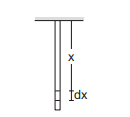
Elongation in the element is given by
\(
\begin{aligned}
\text { elongation } & =\text { original length × stress } / Y \\
& =\frac{T d x}{A Y}=\frac{(L-x) W d x}{L A Y}
\end{aligned}
\)
\(
\begin{aligned}
\text { The total elongation } & =\int_0^L \frac{(L-x) W d x}{L A Y} \\
& =\frac{W}{L A Y}\left(L x-\frac{x^2}{2}\right)_0^L=\frac{W L}{2 A Y}
\end{aligned}
\)
Q11. A uniform cylindrical rod of length \(L\) and radius \(r\), is made from a material whose Young’s modulus of Elasticity equals \(Y\). When this rod is heated by temperature \(T\) and simultaneously subjected to a net longitudinal compressional force \(F\), its length remains unchanged. The coefficient of volume expansion, of the material of the rod, is (nearly) equal to : [JEE 2019]
(A) \(\frac{3 F}{\left(\pi r^2 Y T\right)}\)
(B) \(\frac{6 F}{\left(\pi r^2 Y T\right)}\)
(C) \(\frac{F}{\left(3 \pi r^2 Y T\right)}\)
(D) \(9 F\left(\pi r^2 Y T\right)\)
Solution: (A) Step 1: The Physics Behind the Problem
For the length of the rod to remain unchanged, the expansion caused by heat must be exactly cancelled out by the contraction caused by the compressional force.
Thermal Expansion: When heated by \(T\), the increase in length \(\Delta L_{\text {thermal }}\) is:
\(
\Delta L_{\text {thermal }}=L \alpha T
\)
(where \(\alpha\) is the coefficient of linear expansion)
Mechanical Compression: From the definition of Young’s Modulus \(\left(Y=\frac{\text { Stress }}{\text { Strain }}\right)\), the decrease in length \(\Delta L_{\text {force }}\) due to force \(F\) is:
\(
Y=\frac{F / A}{\Delta L_{\text {force }} / L} \Longrightarrow \Delta L_{\text {force }}=\frac{F L}{A Y}
\)
Step 2: Setting up the Equilibrium
Since the net change in length is zero:
\(
\begin{gathered}
\Delta L_{\text {thermal }}=\Delta L_{\text {force }} \\
L \alpha T=\frac{F L}{A Y}
\end{gathered}
\)
We can cancel \(L\) from both sides and solve for \(\alpha\) :
\(
\alpha=\frac{F}{A Y}
\)
Given the rod is cylindrical, the cross-sectional area \(A=\pi r^2\) :
\(
\alpha=\frac{F}{\pi r^2 Y T}
\)
Step 3: Finding the Coefficient of Volume Expansion
The question asks for the coefficient of volume expansion \((\gamma)\). For isotropic solids, the relationship between linear expansion \((\alpha)\) and volume expansion \((\gamma)\) is:
\(
\gamma=3 \alpha
\)
By substituting our expression for \(\alpha\) :
\(
\begin{gathered}
\gamma=3\left(\frac{F}{\pi r^2 Y T}\right) \\
\gamma=\frac{3 F}{\pi r^2 Y T}
\end{gathered}
\)
Q12. The elastic limit of brass is 379 MPa. What should be the minimum diameter of a brass rod if it is to support a 400 N load without exceeding its elastic limit? [JEE Main 2019 (Online) 10th April Evening Slot]
(A) 1.16 mm
(B) 1.36 mm
(C) 1.00 mm
(D) 0.90 mm
Solution: (A) To solve this, we need to find the diameter where the stress applied by the load is exactly equal to the elastic limit of the material. If the diameter is any smaller, the stress will exceed the limit and the rod will permanently deform.
Step 1: The Core Formula
The definition of tensile stress \((\sigma)\) is force divided by the cross-sectional area:
\(
\sigma=\frac{F}{A}
\)
For a cylindrical rod with diameter \(d\), the area \(A\) is:
\(
A=\pi\left(\frac{d}{2}\right)^2=\frac{\pi d^2}{4}
\)
Step 2: Setting up the Calculation
We are given:
Force (\(F\)): 400 N
Elastic Limit \((\sigma): 379 \mathrm{MPa}=379 \times 10^6 \mathrm{~N} / \mathrm{m}^2\)
Substitute the area formula into the stress formula:
\(
\sigma=\frac{F}{\frac{\pi d^2}{4}}=\frac{4 F}{\pi d^2}
\)
Now, rearrange to solve for \(d\) :
\(
\begin{aligned}
& d^2=\frac{4 F}{\pi \sigma} \\
& d=\sqrt{\frac{4 F}{\pi \sigma}}
\end{aligned}
\)
Step 3: Plugging in the Values
\(
\begin{array}{r}
d=\sqrt{\frac{4 \times 400}{\pi \times 379 \times 10^6}} \\
d=\sqrt{\frac{1600}{1.19 \times 10^9}} \\
d \approx \sqrt{1.34 \times 10^{-6}} \mathrm{~m} \approx 1.16 \mathrm{~mm}
\end{array}
\)
Q13. In an experiment, brass and steel wires of length 1 m each with areas of cross section \(1 \mathrm{~mm}^2\) are used. The wires are connected in series and one end of the combined wire is connected to a rigid support and other end is subjected to elongation. The stress required to produce a net elongation of 0.2 mm is, [Given, the Young’s Modulus for steel and brass are, respectively, \(120 \times 10^9 \mathrm{~N} / \mathrm{m}^2\) and \(60 \times 10^9 \mathrm{~N} / \mathrm{m}^2\)] [JEE 2019]
(A) \(8.0 \times 10^6 \mathrm{~N} / \mathrm{m}^2\)
(B) \(1.2 \times 10^6 \mathrm{~N} / \mathrm{m}^2\)
(C) \(0.2 \times 10^6 \mathrm{~N} / \mathrm{m}^2\)
(D) \(1.8 \times 10^6 \mathrm{~N} / \mathrm{m}^2\)
Solution: (A) Step 1: Identify conditions for wires in series
When two wires are connected in series and subjected to a load, the restoring force \(F\) acting on each wire is the same. Since both wires have the same cross-sectional area \(A=1 \mathrm{~mm}^2\), the stress \((\sigma=F / A)\) is identical for both the brass and steel wires.
Step 2: Relate total elongation to stress
The total elongation \(\Delta L_{\text {net }}\) is the sum of the individual elongations of the steel (\(\Delta L_s\)) and brass \(\left(\Delta L_b\right)\) wires. Using the formula for Young’s Modulus \(Y=\frac{\sigma}{\Delta L / L}\), we can express elongation as \(\Delta L=\frac{\sigma L}{Y}\).
\(
\Delta L_{n e t}=\Delta L_s+\Delta L_b=\frac{\sigma L_s}{Y_s}+\frac{\sigma L_b}{Y_b}
\)
Given \(L_s=L_b=L=1 \mathrm{~m}\), the equation simplifies to:
\(
\Delta L_{n e t}=\sigma L\left(\frac{1}{Y_s}+\frac{1}{Y_b}\right)
\)
Step 3: Calculate the numerical value of stress
Substitute the given values: \(\Delta L_{\text {net }}=0.2 \times 10^{-3} \mathrm{~m}, Y_s=120 \times 10^9 \mathrm{~N} / \mathrm{m}^2\), and \(Y_b=60 \times 10^9 \mathrm{~N} / \mathrm{m}^2\).
\(
\begin{aligned}
& 0.2 \times 10^{-3}=\sigma(1)\left(\frac{1}{120 \times 10^9}+\frac{1}{60 \times 10^9}\right) \\
& 0.2 \times 10^{-3}=\sigma\left(\frac{1+2}{120 \times 10^9}\right)=\sigma\left(\frac{3}{120 \times 10^9}\right) \\
& \sigma=\frac{0.2 \times 10^{-3} \times 120 \times 10^9}{3} \\
& \sigma=0.2 \times 10^{-3} \times 40 \times 10^9=8.0 \times 10^6 \mathrm{~N} / \mathrm{m}^2
\end{aligned}
\)
Q14. Young’s moduli of two wires \(A\) and \(B\) are in the ratio \(7: 4\). Wire \(A\) is 2 m long and has radius \(R\). Wire \(B\) is 1.5 m long and has radius 2 mm. If the two wires stretch by the same length for a given load, then the value of \(R\) is close to : [JEE 2019]
(A) 1.7 mm
(B) 1.9 mm
(C) 1.3 mm
(D) 1.5 mm
Solution: Step 1: Establish the Relationship for Elongation
The Young’s modulus \(Y\) of a wire is given by the formula \(Y=\frac{F / A}{\Delta L / L}\), where \(F\) is the load, \(A\) is the cross-sectional area \(\left(\pi r^2\right), L\) is the length, and \(\Delta L\) is the elongation. Rearranging for elongation:
\(
\Delta L=\frac{F L}{\pi r^2 Y}
\)
Step 2: Set up the Comparison Equation
Since both wires \(A\) and \(B\) undergo the same elongation \(\Delta L\) under the same load \(F\), we can equate their expressions:
\(
\frac{F L_A}{\pi R^2 Y_A}=\frac{F L_B}{\pi r_B^2 Y_B}
\)
By cancelling the common terms \(F\) and \(\pi\), we get:
\(
\frac{L_A}{R^2 Y_A}=\frac{L_B}{r_B^2 Y_B}
\)
Step 3: Substitute Values and Solve for \(\boldsymbol{R}\)
We are given \(L_A=2 \mathrm{~m}, L_B=1.5 \mathrm{~m}, r_B=2 \mathrm{~mm}\), and the ratio \(Y_A: Y_B=7: 4\). Rearranging the equation to solve for \(R^2\) :
\(
\begin{gathered}
R^2=\frac{L_A}{L_B} \cdot \frac{Y_B}{Y_A} \cdot r_B^2 \\
R^2=\frac{2}{1.5} \cdot \frac{4}{7} \cdot(2)^2=\frac{4}{3} \cdot \frac{4}{7} \cdot 4=\frac{64}{21} \approx 3.0476
\end{gathered}
\)
Taking the square root:
\(
R=\sqrt{\frac{64}{21}} \approx 1.7 \mathrm{~mm}
\)
Q15. A steel wire having a radius of 2.0 mm , carrying a load of 4 kg , is hanging from a ceiling. Given that \(\mathrm{g}=3.1 \mathrm{~p} \mathrm{~ms} \mathrm{~c}^{-2}\), what will be the tensile stress that would be developed in the wire? [JEE 2019]
(A) \(3.1 \times 10^6 \mathrm{Nm}^{-2}\)
(B) \(6.2 \times 10^6 \mathrm{Nm}^{-2}\)
(C) \(4.8 \times 10^6 \mathrm{Nm}^{-2}\)
(D) \(5.2 \times 10^6 \mathrm{Nm}^{-2}\)
Solution: (A) Step 1: Identify the Formula for Tensile Stress
Tensile stress is defined as the restoring force per unit cross-sectional area of the wire. For a wire hanging vertically with a load, the force is equal to the weight of the load. The formula is:
\(
\text { Stress }=\frac{F}{A}=\frac{m g}{\pi r^2}
\)
where:
\(m\) is the mass of the load.
\(g\) is the acceleration due to gravity.
\(r\) is the radius of the wire.
Step 2: Convert Units to SI
Before substituting the values into the formula, ensure all units are in the International System of Units (SI):
Mass \((m)=4 \mathrm{~kg}\)
Radius \((r)=2.0 \mathrm{~mm}=2.0 \times 10^{-3} \mathrm{~m}\)
Acceleration due to gravity \((g)=3.1 \pi \mathrm{~ms}^{-2} o\)
Step 3: Calculate the Stress
Substitute the given values into the stress formula:
\(
\text { Stress }=\frac{4 \times 3.1 \pi}{\pi \times\left(2.0 \times 10^{-3}\right)^2}
\)
The \(\pi\) in the numerator and denominator cancel out:
\(
\text { Stress }=\frac{4 \times 3.1}{4 \times 10^{-6}}
\)
The tensile Stress \(=3.1 \times 10^6 \mathrm{Nm}^{-2}\)
Q16. A boy’s catapult is made of rubber cord which is 42 cm long, with 6 mm diameter of cross-section and of negligible mass. The boy keeps a stone weighing 0.02 kg on it and stretches the cord by 20 cm by applying a constant force. When released, the stone flies off with a velocity of \(20 \mathrm{~ms}^{-1}\). Neglect the change in the area of cross-section of the cord while stretched. The Young’s modulus of rubber is closest to: [JEE 2019]
(A) \(10^4 \mathrm{Nm}^{-2}\)
(B) \(10^6 \mathrm{Nm}^{-2}\)
(C) \(10^8 \mathrm{Nm}^{-2}\)
(D) \(10^3 \mathrm{Nm}^{-2}\)
Solution: (B) Step 1: Calculate Kinetic Energy of the Stone
The energy gained by the stone is its kinetic energy (\(K\)) at the moment of release. Given the mass \(m=0.02 \mathrm{~kg}\) and velocity \(v=20 \mathrm{~ms}^{-1}\) :
\(
K=\frac{1}{2} m v^2=\frac{1}{2} \times 0.02 \times(20)^2=4 \mathrm{~J}
\)
Step 2: Determine Elastic Potential Energy of the Cord
Assuming the work done in stretching the cord is stored as elastic potential energy (\(U\)), and neglecting energy losses, \(\boldsymbol{U}=\boldsymbol{K}\). The formula for elastic potential energy in terms of Young’s Modulus \((Y)\), cross-sectional area \((A)\), original length \((L)\), and extension ( \(\Delta L)\) is:
\(
U=\frac{1}{2} \times \text { Stress } \text { × } \text { Strain } \text { × } \text { Volume }=\frac{1}{2} \times\left(Y \frac{\Delta L}{L}\right) \times\left(\frac{\Delta L}{L}\right) \times(A L)=\frac{Y A(\Delta L)^2}{2 L}
\)
Given values:
\(L=42 \mathrm{~cm}=0.42 \mathrm{~m}\)
\(\Delta L=20 \mathrm{~cm}=0.2 \mathrm{~m}\)
Diameter \(d=6 \mathrm{~mm} \Longrightarrow\) radius \(r=3 \times 10^{-3} \mathrm{~m}\)
\(A=\pi r^2=\pi\left(3 \times 10^{-3}\right)^2=9 \pi \times 10^{-6} \mathrm{~m}^2\)
Step 3: Solve for Young’s Modulus (\(Y\))
Equating \(U\) and \(K\) :
\(
\frac{Y A(\Delta L)^2}{2 L}=4 \Longrightarrow Y=\frac{8 L}{A(\Delta L)^2}
\)
Substituting the values:
\(
\begin{gathered}
Y=\frac{8 \times 0.42}{\left(9 \pi \times 10^{-6}\right) \times(0.2)^2}=\frac{3.36}{9 \times 3.14 \times 10^{-6} \times 0.04} \\
Y=\frac{3.36}{1.13 \times 10^{-6}} \approx 2.97 \times 10^6 \mathrm{Nm}^{-2}
\end{gathered}
\)
The value is of the order \(10^6 \mathrm{Nm}^{-2}\).
Q17. A solid sphere of radius \(r\) made of a soft material of bulk modulus \(K\) is surrounded by a liquid in a cylindrical container. A massless piston of area a floats on the surface of the liquid, covering entire cross section of cylindrical container. When a mass \(m\) is placed on the surface of the piston to compress the liquid, the fractional decrement in the radius of the sphere, \(\left(\frac{d r}{r}\right)\) is: [JEE 2018]
(A) \(\frac{m g}{K a}\)
(B) \(\frac{K a}{m g}\)
(C) \(\frac{K a}{3 m g}\)
(D) \(\frac{m g}{3 K a}\)
Solution: (D) Step 1: Calculate the change in pressure
When a mass \(m\) is placed on the piston of area \(a\), the external pressure applied to the liquid increases. According to the definition of pressure, the change in pressure \(\Delta P\) is:
\(
\Delta P=\frac{F}{a}=\frac{m g}{a}
\)
Step 2: Relate volume change to radius change
The volume of a solid sphere is given by the formula \(V=\frac{4}{3} \pi r^3\). To find the relationship between the fractional change in volume and the fractional change in radius, we differentiate the volume with respect to \(r\) :
\(
d V=4 \pi r^2 d r
\)
Dividing by the original volume \(V\):
\(
\frac{d V}{V}=\frac{4 \pi r^2 d r}{\frac{4}{3} \pi r^3}=3 \frac{d r}{r}
\)
Step 3: Apply the definition of Bulk Modulus
The Bulk Modulus \(K\) is defined as the ratio of the change in pressure to the fractional change in volume:
\(
K=\frac{\Delta P}{\frac{d V}{V}}
\)
Rearranging to solve for the fractional volume change:
\(
\frac{d V}{V}=\frac{\Delta P}{K}
\)
Step 4: Solve for the fractional change in radius
Substitute the expressions from Step 1 and Step 2 into the equation from Step 3:
\(
\begin{aligned}
& 3 \frac{d r}{r}=\frac{m g / a}{K} \\
& 3 \frac{d r}{r}=\frac{m g}{K a}
\end{aligned}
\)
Dividing both sides by 3 to isolate the fractional decrement in radius:
\(
\frac{d r}{r}=\frac{m g}{3 K a}
\)
The fractional decrement in the radius of the sphere is \(\frac{m g}{3 K a}\).
Q18. As shown in the figure, forces of \(10^5 \mathrm{~N}\) each are applied in opposite directions, on the upper and lower faces of a cube of side 10 cm, shifting the upper face parallel to itself by 0.5 cm. If the side of another cube of the same material is 20 cm, then under similar conditions as above, the displacement will be : [JEE 2018]
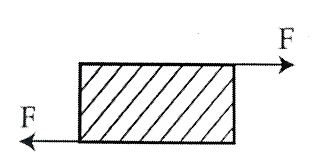
Solution: Step 1: Identify the formula for shear displacement
When a tangential force \(F\) is applied to the surface of a cube, the shear modulus \(\eta\) (modulus of rigidity) is defined as the ratio of shear stress to shear strain:
\(
\eta=\frac{\text { Shear Stress }}{\text { Shear Strain }}=\frac{F / A}{\Delta x / L}
\)
where:
\(F\) is the applied force.
\(A\) is the area of the face ( \(L^2\) for a cube).
\(\Delta x\) is the lateral displacement.
\(L\) is the side length of the cube.
Step 2: Relate displacement to the side length
Rearranging the formula for displacement \(\Delta x\) :
\(
\Delta x=\frac{F \cdot L}{\eta \cdot A}=\frac{F \cdot L}{\eta \cdot L^2}=\frac{F}{\eta \cdot L}
\)
Since the force \(F\) and the material (and thus \(\eta\)) are the same for both cubes, we can see that displacement \(\boldsymbol{\Delta x}\) is inversely proportional to the side length \(\boldsymbol{L}\) :
\(
\Delta x \propto \frac{1}{L}
\)
Step 3: Calculate the new displacement
Using the proportionality \(\Delta x_1 \cdot L_1=\Delta x_2 \cdot L_2\) :
\(L_1=10 \mathrm{~cm}, \Delta x_1=0.5 \mathrm{~cm}\)
\(L_2=20 \mathrm{~cm}, \Delta x_2=\) ?
Substituting the values:
\(
\begin{gathered}
0.5 \cdot 10=\Delta x_2 \cdot 20 \\
\Delta x_2=\frac{0.5 \cdot 10}{20}=\frac{5}{20}=0.25 \mathrm{~cm}
\end{gathered}
\)
The displacement of the upper face for the second cube is \(\mathbf{0 . 2 5 ~ c m}\).
Q19. A man grows into a giant such that his linear dimensions increase by a factor of 9. Assuming that his density remains same, the stress in the leg will change by a factor of: [JEE 2017]
(A) \(\frac{1}{81}\)
(B) 9
(C) \(\frac{1}{9}\)
(D) 81
Solution: (B) To find the factor by which the stress changes, we need to look at how Force (Weight) and Area scale when linear dimensions (height, width, depth) increase.
Step 1: Area Scaling Stress is defined as Stress \(=\frac{\text { Force }}{\text { Area }}\). The cross-sectional area of the leg \((A)\) is proportional to the square of the linear dimension (\(L^2\)). If the linear dimension increases by a factor of \(9\left(L^{\prime}=9 L\right)\) :
\(
A^{\prime} \propto(9 L)^2=81 A
\)
Step 2: Weight (Force) Scaling The force acting on the legs is the man’s weight (\(W\)). Weight is proportional to volume \((V)\), and volume is proportional to the cube of the linear dimension ( \(L^3\)). Assuming density remains the same:
\(
W^{\prime} \propto(9 L)^3=729 W
\)
Step 3: Calculating the New Stress Now, we compare the new stress \(\left(\sigma^{\prime}\right)\) to the original stress \((\sigma)\) :
\(
\begin{gathered}
\sigma^{\prime}=\frac{W^{\prime}}{A^{\prime}}=\frac{729 W}{81 A} \\
\sigma^{\prime}=9 \times\left(\frac{W}{A}\right) \\
\sigma^{\prime}=9 \sigma
\end{gathered}
\)
Thus, the stress in the leg increases by a factor of 9.
Q20. A bottle has an opening of radius \(a\) and length \(b\). A cork of length \(b\) and radius \((a+\Delta a)\) where \((\Delta a \ll a)\) is compressed to fit into the opening completely (See figure). If the bulk modulus of cork is \(B\) and frictional coefficient between the bottle and cork is \(\mu\) then the force needed to push the cork into the bottle is : [JEE 2016]
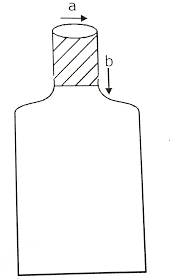
(A) \((\pi \mu \mathrm{B} \mathrm{b}) \Delta \mathrm{a}\)
(B) \((2 \pi \mu \mathrm{~B}\) b) \(\Delta \mathrm{a}\)
(C) \((\pi \mu \mathrm{Bb}) \mathrm{a}\)
(D) \((4 \pi \mu \mathrm{~B}\) b) \(\Delta \mathrm{a}\)
Solution: (D) Step 1: Calculate the Volume Strain
The original volume of the cork is \(V=\pi(a+\Delta a)^2 b\). Since \(\Delta a \ll a\), we can approximate the volume by expanding the square and neglecting the \((\Delta a)^2\) term:
\(
V \approx \pi\left(a^2+2 a \Delta a\right) b
\)
The volume of the compressed cork inside the bottle is \(V^{\prime}=\pi a^2 b\). The change in volume \(\Delta V\) is:
\(
\Delta V=V^{\prime}-V=\pi a^2 b-\pi\left(a^2+2 a \Delta a\right) b=-2 \pi a b \Delta a
\)
The volume strain is then:
\(
\frac{\Delta V}{V} \approx \frac{-2 \pi a b \Delta a}{\pi a^2 b}=-\frac{2 \Delta a}{a}
\)
Step 2: Determine the Radial Pressure
The bulk modulus \(\boldsymbol{B}\) relates the pressure \(\boldsymbol{P}\) to the volume strain:
\(
B=-\frac{P}{\Delta V V V}
\)
Solving for the pressure \(P\) exerted by the cork against the bottle wall:
\(
P=-B\left(-\frac{2 \Delta a}{a}\right)=\frac{2 B \Delta a}{a}
\)
Step 3: Calculate the Normal Force
The normal force \(N\) is the product of the pressure and the contact surface area between the cork and the bottle. The surface area is \(A=2 \pi a b\) :
\(
N=P \cdot A=\left(\frac{2 B \Delta a}{a}\right)(2 \pi a b)=4 \pi B b \Delta a
\)
Step 4: Calculate the Required Pushing Force
The force \(F\) required to push the cork must overcome the maximum static friction \(f=\mu N:\)
\(
F=\mu(4 \pi B b \Delta a)=(4 \pi \mu B b) \Delta a
\)
Q21. A thin 1 m long rod has a radius of 5 mm. A force of \(50 \pi \mathrm{kN}\) is applied at one end to determine its Young’s modulus. Assume that the force is exactly known. If the least count in the measurement of all lengths is 0.01 mm , which of the following statements is false? [JEE 2016]
(A) \(\frac{\Delta \gamma}{\gamma}\) gets minimum contribution from the uncertainty in the length.
(B) The figure of merit is the largest for the length of the rod.
(C) The maximum value of \(\gamma\) that can be determined is \(2 \times 10^{14} \mathrm{~N} / \mathrm{m}^2\)
(D) \(\frac{\Delta \gamma}{\gamma}\) gets its maximum contribution from the uncertainty in strain
Solution: (D) Step 1: Young’s Modulus and Relative Error
Young’s Modulus \((\gamma)\) is defined by the formula:
\(
\gamma=\frac{\text { Stress }}{\text { Strain }}=\frac{F / A}{\Delta L / L}=\frac{F \cdot L}{\pi r^2 \cdot \Delta l}
\)
Where:
\(F=\) applied force \((50 \pi \mathrm{kN})\), known exactly.
\(L=\) original length \((1 \mathrm{~m})\).
\(r=\) radius \((5 \mathrm{~mm})\).
\(\Delta l=\) elongation.
Least count for all lengths \((\Delta L, \Delta r, \delta(\Delta l))=0.01 \mathrm{~mm}=10^{-5} \mathrm{~m}\).
The relative error in \(\gamma\) is given by:
\(
\frac{\Delta \gamma}{\gamma}=\frac{\Delta F}{F}+\frac{\Delta L}{L}+2 \frac{\Delta r}{r}+\frac{\Delta(\Delta l)}{\Delta l}
\)
Since \(F\) is exactly known, \(\Delta F=0\).
Step 2: Evaluating Contributions and Values
Contribution from Length \((L): \frac{\Delta L}{L}=\frac{0.01 \times 10^{-3}}{1}=10^{-5}\).
Contribution from Radius \((r): 2 \frac{\Delta r}{r}=2 \times \frac{0.01 \times 10^{-3}}{5 \times 10^{-3}}=4 \times 10^{-3}\).
Contribution from Strain (\(\Delta l\)): The contribution depends on \(\Delta l\). Since \(10^{-5}<4 \times 10^{-3}\), length contributes less than radius. Usually, \(\Delta l\) is very small, making its contribution \(\frac{\Delta(\Delta l)}{\Delta l}\) the largest.
Maximum measurable \(\gamma: \gamma\) is maximum when elongation \(\Delta l\) is minimum (the least count).
\(
\gamma_{\max }=\frac{\left(50 \pi \times 10^3\right) \cdot 1}{\pi\left(5 \times 10^{-3}\right)^2 \cdot\left(0.01 \times 10^{-3}\right)}=\frac{50 \times 10^3}{25 \times 10^{-6} \cdot 10^{-5}}=2 \times 10^{14} \mathrm{~N} / \mathrm{m}^2
\)
Figure of Merit: Defined as \(1 /\) (relative error). For \(L\), it is \(1 / 10^{-5}=10^5\), which is larger than for \(r(1 / 0.002=500)\).
Statement (D) is false because the maximum contribution to \(\frac{\Delta y}{\gamma}\) comes from the term with the largest relative error. While strain \((\Delta l / L)\) involves \(L\), the term \(\frac{\Delta(\Delta l)}{\Delta l}\) typically dominates if \(\Delta l\) is small, but if we compare the fixed measurement contributions, the radius \(r\) often provides a very high contribution \(\left(4 \times 10^{-3}\right)\) compared to length \(\left(10^{-5}\right)\). The analysis shows (A), (B), and (C) are consistent with the data, while (D) misrepresents the primary source of error relative to the radius or is phrased as a contradiction to the error analysis. Note: The maximum value of \(\gamma\) is indeed \(2 \times 10^{14} \mathrm{~N} / \mathrm{m}^2\).
Q22. A uniformly tapering conical wire is made from a material of Young’s modulus \(Y\) and has a normal, unextended length \(L\). The radii, at the upper and lower ends of this conical wire, have values \(R\) and \(3 R\), respectively. The upper end of the wire is fixed to a rigid support and a mass \(M\) is suspended from its lower end. The equilibrium extended length, of this wire, would equal : [JEE 2016]
(A) \(\mathrm{L}\left(1+\frac{2}{9} \frac{M g}{\pi Y R^2}\right)\)
(B) \(\mathrm{L}\left(1+\frac{1}{3} \frac{M g}{\pi Y R^2}\right)\)
(C) \(\mathrm{L}\left(1+\frac{1}{9} \frac{M g}{\pi Y R^2}\right)\)
(D) \(\mathrm{L}\left(1+\frac{2}{3} \frac{M g}{\pi Y R^2}\right)\)
Solution: (B)
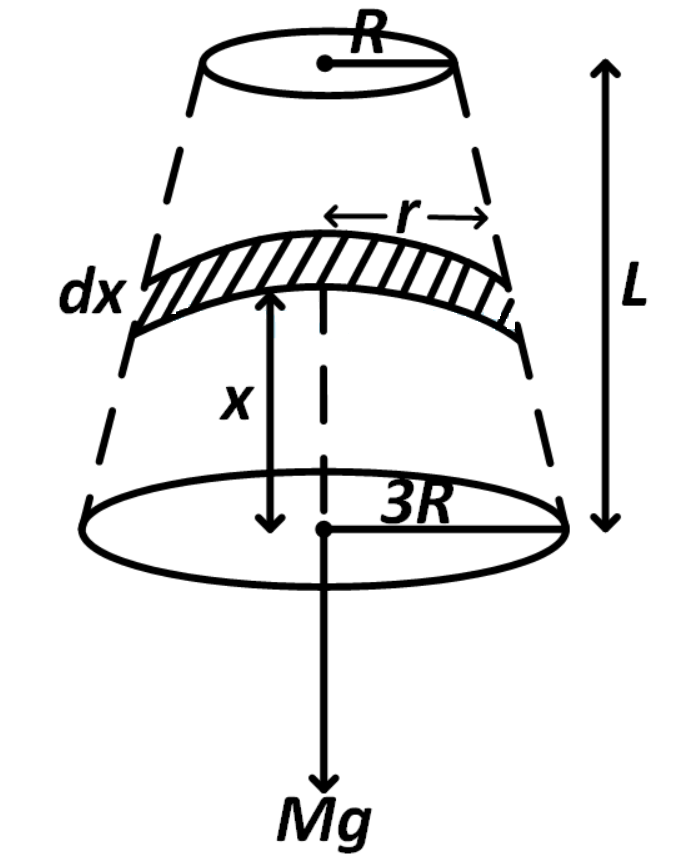
This problem requires us to calculate the total elongation (\(\Delta L\)) of a tapering wire. Since the cross-sectional area changes along the length of the wire, the stress (and therefore the strain) is not constant. We must use integration.
Step 1: Setting up the Geometry
Let’s define a coordinate \(x\) starting from the top (\(x=0\)) to the bottom (\(x=L\)). The radius \(r(x)\) increases linearly from \(R\) to \(3 R\). The formula for the radius at any point \(x\) is:
\(
r(x)=R+\left(\frac{3 R-R}{L}\right) x=R+\frac{2 R}{L} x
\)
Step 2: Finding the Elongation of a Small Element
Consider a small element of length \(d x\) at a distance \(x\) from the support.
Force (\(F\)): The tension throughout the wire is \(M g\) (ignoring the weight of the wire itself).
Area \((A): \pi[r(x)]^2\)
Young’s Modulus \((Y): Y=\frac{\text { Stress }}{\text { Strain }}=\frac{M g / A}{d l / d x}\)
The small elongation \(d l\) for the element \(d x\) is:
\(
d l=\frac{M g}{A Y} d x=\frac{M g}{\pi[r(x)]^2 Y} d x
\)
Step 3: Integration
To find the total elongation \(\Delta L\), we integrate from \(x=0\) to \(x=L\) :
\(
\Delta L=\int_0^L \frac{M g}{\pi Y\left(R+\frac{2 R x}{L}\right)^2} d x
\)
Let \(u=R+\frac{2 R x}{L}\), then \(d u=\frac{2 R}{L} d x\).
\(
\begin{gathered}
\Delta L=\frac{M g}{\pi Y} \cdot \frac{L}{2 R} \int_R^{3 R} \frac{1}{u^2} d u \\
\Delta L=\frac{M g L}{2 \pi Y R}\left[-\frac{1}{u}\right]_R^{3 R} \\
\Delta L=\frac{M g L}{2 \pi Y R}\left(\frac{1}{R}-\frac{1}{3 R}\right)=\frac{M g L}{2 \pi Y R}\left(\frac{2}{3 R}\right) \\
\Delta L=\frac{M g L}{3 \pi Y R^2}
\end{gathered}
\)
Step 4: Final Equilibrium Length
The extended length \(L^{\prime}\) is the original length plus the elongation:
\(
\begin{gathered}
L^{\prime}=L+\Delta L=L+\frac{M g L}{3 \pi Y R^2} \\
L^{\prime}=L\left(1+\frac{1}{3} \frac{M g}{\pi Y R^2}\right)
\end{gathered}
\)
Q23. The pressure that has to be applied to the ends of a steel wire of length 10 cm to keep its length constant when its temperature is raised by \(100^{\circ} \mathrm{C}\) is: (For steel Young’s modulus is \(2 \times 10^{11} \mathrm{Nm}^{-2}\) and coefficient of thermal expansion is \(1.1 \times 10^{-5} \mathrm{~K}^{-1}\)) [JEE 2014]
(A) \(2.2 \times 10^8 P a\)
(B) \(2.2 \times 10^9 \mathrm{~Pa}\)
(C) \(2.2 \times 10^7 \mathrm{~Pa}\)
(D) \(2.2 \times 10^6 \mathrm{~Pa}\)
Solution: (A) This problem deals with Thermal Stress. When a material is heated, it naturally wants to expand. If you apply pressure to keep its length constant, you are essentially providing a compressive strain equal to the thermal expansion it would have experienced.
Step-by-Step Calculation
Step 1: Thermal Expansion Formula If the wire were free to expand, the change in length (\(\Delta L\)) due to a temperature rise \((\Delta T)\) would be:
\(
\Delta L=L \alpha \Delta T
\)
Where:
\(L=10 \mathrm{~cm}\) (Original length)
\(\alpha=1.1 \times 10^{-5} \mathrm{~K}^{-1}\) (Coefficient of thermal expansion)
\(\Delta T=100^{\circ} \mathrm{C}\) (which is a change of 100 K)
Step 2: Thermal Strain To keep the length constant, we must apply a mechanical strain (\(\epsilon\)) equal to the thermal strain:
\(
\begin{gathered}
\operatorname{Strain}(\epsilon)=\frac{\Delta L}{L}=\alpha \Delta T \\
\epsilon=\left(1.1 \times 10^{-5}\right) \times 100=1.1 \times 10^{-3}
\end{gathered}
\)
Step 3: Calculating Pressure (Stress) From Young’s Modulus \((Y)\), we know that Stress \(=Y \times\) Strain. In this context, the pressure \((P)\) applied to the ends is the stress required:
\(
P=Y \cdot(\alpha \Delta T)
\)
Plugging in the given values:
\(
\begin{gathered}
P=\left(2 \times 10^{11} \mathrm{~N} \mathrm{~m}^{-2}\right) \times\left(1.1 \times 10^{-3}\right) \\
P=2.2 \times 10^8 \mathrm{~Pa}
\end{gathered}
\)
Q24. Two wires are made of the same material and have the same volume. However wire 1 has cross-sectional area \(A\) and wire 2 has cross-sectional area \(3 A\). If the length of wire 1 increases by \(\Delta x\) on applying force \(F\), how much force is needed to stretch wire 2 by the same amount? [JEE 2009]
(A) \(4 F\)
(B) \(6 F\)
(C) \(9 F\)
(D) \(F\)
Solution: (C) Step 1: Understanding the Constraints
Since both wires have the same Volume (\(V\)), we can find the relationship between their lengths.
Wire 1: \(V=A \times L_1\)
Wire 2: \(V=(3 A) \times L_2\)
Equating the two:
\(
A \cdot L_1=3 A \cdot L_2 \Longrightarrow L_2=\frac{L_1}{3}
\)
So, wire 2 is three times thicker but only one-third as long as wire 1.
Step 2: Using the Young’s Modulus Formula
Young’s Modulus (\(Y\)) is the same for both wires because they are made of the same material. The formula for the force \(F\) required for an extension \(\Delta x\) is:
\(
F=\frac{Y \cdot A \cdot \Delta x}{L}
\)
Step 3: Comparing the Two Wires
Let \(F_1\) be the force for wire 1 and \(F_2\) be the force for wire 2. Since \(Y\) and \(\Delta x\) are constants for both cases:
\(
F \propto \frac{A}{L}
\)
Now, let’s calculate the ratio:
\(
\frac{F_2}{F_1}=\frac{A_2 / L_2}{A_1 / L_1}
\)
Substitute the values for wire \(2\left(A_2=3 A\right.\) and \(\left.L_2=L_1 / 3\right)\) :
\(
\begin{gathered}
\frac{F_2}{F_1}=\frac{3 A /\left(L_1 / 3\right)}{A / L_1} \\
\frac{F_2}{F_1}=\frac{9 \cdot\left(A / L_1\right)}{A / L_1}=9
\end{gathered}
\)
Therefore:
\(
F_2=9 F_1=9 F
\)
Q25. A wire elongates by \(l ~m m\) when a LOAD \(W\) is hanged from it. If the wire goes over a pulley and two weights \(W\) each are hung at the two ends, the elongation of the wire will be (in \(m m\)) [JEE 2006]
(A) \(l\)
(B) \(2 l\)
(C) zero
(D) \(l / 2\)
Solution: (A)
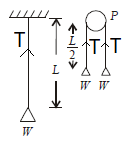
Case-1: Analyze the initial condition
When a wire is fixed at one end and a load \(W\) is hung from the other, the tension \(T\) throughout the wire is W. According to Hooke’s Law and the definition of Young’s Modulus \(Y\), the elongation \(l\) is:
\(
l=\frac{W L}{A Y}
\)
where \(L\) is the original length and \(A\) is the cross-sectional area.
Case-2: When the wire passes over a pulley with weights \(W\) at both ends, the system is in equilibrium. The tension \(T\) in the wire is still \(W\), as each weight is balanced by the tension (\(T=W\)). This is physically identical to the first case; the second weight effectively replaces the fixed support by providing the same reaction force.
In second case \(T=\frac{2 W \times W}{W+W}=W\) As tension in the wire in both the cases are equal therefore elongation in the wire will be equal.
Since the tension \(T\) in the wire remains \(W\) and the physical properties (\(L, A, Y\)) are constant, the elongation \(\Delta L\) is:
\(
\Delta L=\frac{T^{\prime} L}{A Y}=\frac{W L}{A Y}=l
\)
Q26. If \(S\) is stress and \(Y\) is young’s modulus of material of a wire, the energy stored in the wire per unit volume is [JEE 2005]
(A) \(\frac{S^2}{2 Y}\)
(B) \(2 S^2 Y\)
(C) \(\frac{S}{2 Y}\)
(D) \(\frac{2 Y}{S^2}\)
Solution: (A) Step 1: Identify the formula for energy density
The energy stored per unit volume (also known as energy density, \(u\)) in a stretched wire is given by the product of half the stress and the strain:
\(
u=\frac{1}{2} \times \text { stress × strain }
\)
Step 2: Use Hooke’s Law to relate stress and strain
Young’s modulus \((Y)\) is defined as the ratio of tensile stress \((S)\) to tensile strain \((\epsilon)\) :
\(
Y=\frac{S}{\epsilon}
\)
From this, we can express strain in terms of stress and Young’s modulus:
\(
\epsilon=\frac{S}{Y}
\)
Step 3: Substitute and simplify
Substitute the expression for strain back into the energy density formula:
\(
\begin{gathered}
u=\frac{1}{2} \times S \times \frac{S}{Y} \\
u=\frac{S^2}{2 Y}
\end{gathered}
\)
Q27. A wire fixed at the upper end stretches by length \(l\) by applying a force \(F\). The work done in stretching is [JEE 2004]
(A) \(2 F l\)
(B) \(F l\)
(C) \(\frac{F}{2 l}\)
(D) \(\frac{F l}{2}\)
Solution: (D) Work done by constant force in displacing the object by a distance \(l\).
\(
\begin{aligned}
& =\text { Potential energy stored } \\
& =\frac{1}{2} \times \text { Stress × Strain × Volume } \\
& =\frac{1}{2} \times \frac{F}{A} \times \frac{l}{L} \times A L \\
& =\frac{1}{2} F l
\end{aligned}
\)