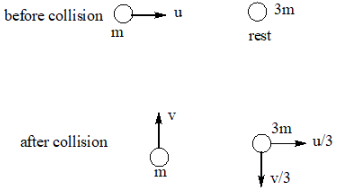
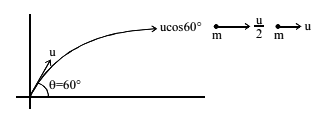
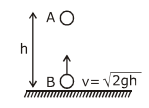
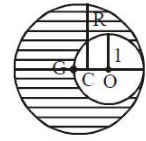
JEE PYQs MCQs (COM & Collision)
SUMMARY
- Ideally, a rigid body is one for which the distances between different particles of the body do not change, even though there are forces on them.
- A rigid body fixed at one point or along a line can have only rotational motion. A rigid body not fixed in some way can have either pure translational motion or a combination of translational and rotational motions.
- In rotation about a fixed axis, every particle of the rigid body moves in a circle which lies in a plane perpendicular to the axis and has its centre on the axis. Every Point in the rotating rigid body has the same angular velocity at any instant of time.
- In pure translation, every particle of the body moves with the same velocity at any instant of time.
- Angular velocity is a vector. Its magnitude is \(\omega=d \theta / d t\) and it is directed along the axis of rotation. For rotation about a fixed axis, this vector \(\omega\) has a fixed direction.
- The vector or cross product of two vector \(a\) and \(b\) is a vector written as \(a \times b\). The magnitude of this vector is \(a b \sin \theta\) and its direction is given by the right handed screw or the right hand rule.
- The linear velocity of a particle of a rigid body rotating about a fixed axis is given by \(v = \omega \times r\), where \(r\) is the position vector of the particle with respect to an origin along the fixed axis. The relation applies even to more general rotation of a rigid body with one point fixed. In that case \(r\) is the position vector of the particle with respect to the fixed point taken as the origin.
- The centre of mass of a system of \(n\) particles is defined as the point whose position vector is
\(
R =\frac{\sum m_i r _i}{M}
\) - Velocity of the centre of mass of a system of particles is given by \(V = P / M\), where \(P\) is the linear momentum of the system. The centre of mass moves as if all the mass of the system is concentrated at this point and all the external forces act at it. If the total external force on the system is zero, then the total linear momentum of the system is constant.
- The angular momentum of a system of \(n\) particles about the origin is
\(
L =\sum_{i=1}^n r _i \times p _i
\)
The torque or moment of force on a system of \(n\) particles about the origin is
\(
\tau =\sum_{i=1}^n r _i \times F _i
\)
The force \(F _i\) acting on the \(i^{\text {th }}\) particle includes the external as well as internal forces. Assuming Newton’s third law of motion and that forces between any two particles act along the line joining the particles, we can show \(\tau _{\text {int }}= 0\) and
\(
\frac{d L }{d t}= \tau _{e x t}
\) - A rigid body is in mechanical equilibrium if
(a) it is in translational equilibrium, i.e., the total external force on it is zero : \(\sum F _i= 0\), and
(b) it is in rotational equilibrium, i.e. the total external torque on it is zero :
\(
\sum \tau _i=\sum r _i \times F _i= 0
\) - The centre of gravity of an extended body is that point where the total gravitational torque on the body is zero.
- The moment of intertia of a rigid body about an axis is defined by the formula \(I=\sum m_i r_i^2\) where \(r_i\) is the perpendicular distance of the \(i\) th point of the body from the axis. The kinetic energy of rotation is \(K=\frac{1}{2} I \omega^2\).
- The theorem of parallel axes: \(I_z^{\prime}=I_z+M a^2\), allows us to determine the moment of intertia of a rigid body about an axis as the sum of the moment of inertia of the body about a parallel axis through its centre of mass and the product of mass and square of the perpendicular distance between these two axes.
- Rotation about a fixed axis is directly analogous to linear motion in respect of kinematics and dynamics.
- For a rigid body rotating about a fixed axis (say, \(z\)-axis) of rotation, \(L_{ z }=I \omega\), where \(I\) is the moment of inertia about \(z\)-axis. In general, the angular momentum \(L\) for such a body is not along the axis of rotation. Only if the body is symmetric about the axis of rotation, \(L\) is along the axis of rotation. In that case, \(| L |=L_z=I \omega\). The angular acceleration of a rigid body rotating about a fixed axis is given by \(I \alpha=\tau\). If the external torque \(\tau\) acting on the body is zero, the component of angular momentum about the fixed axis (say, \(z\)-axis), \(L_z(=I \omega)\) of such a rotating body is constant.
- For rolling motion without slipping \(v_{c m}=R \omega\), where \(v_{c m}\) is the velocity of translation (i.e. of the centre of mass), \(R\) is the radius and \(m\) is the mass of the body. The kinetic energy of such a rolling body is the sum of kinetic energies of translation and rotation:
\(
K=\frac{1}{2} m v_{c m}^2+\frac{1}{2} I \omega^2
\)
Quiz Summary
0 of 55 Questions completed
Questions:
Information
You have already completed the quiz before. Hence you can not start it again.
Quiz is loading…
You must sign in or sign up to start the quiz.
You must first complete the following:
Results
Results
0 of 55 Questions answered correctly
Your time:
Time has elapsed
You have reached 0 of 0 point(s), (0)
Earned Point(s): 0 of 0, (0)
0 Essay(s) Pending (Possible Point(s): 0)
Categories
- Not categorized 0%
- 1
- 2
- 3
- 4
- 5
- 6
- 7
- 8
- 9
- 10
- 11
- 12
- 13
- 14
- 15
- 16
- 17
- 18
- 19
- 20
- 21
- 22
- 23
- 24
- 25
- 26
- 27
- 28
- 29
- 30
- 31
- 32
- 33
- 34
- 35
- 36
- 37
- 38
- 39
- 40
- 41
- 42
- 43
- 44
- 45
- 46
- 47
- 48
- 49
- 50
- 51
- 52
- 53
- 54
- 55
- Current
- Review
- Answered
- Correct
- Incorrect
- Question 1 of 55
1. Question
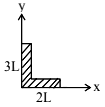
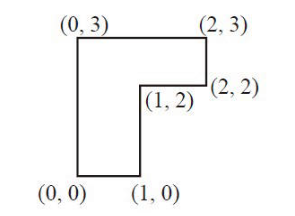
A rod of length 5 L is bent right angle keeping one side length as 2 L. The position of the centre of mass of the system : (Consider \(L =10 cm\) ) [JEE Main 2025 (Online) 7th April Morning Shift]
 CorrectIncorrect
Hint
(a) Step 1: Breakdown of the System:
The total length of the rod is \(5 L\). Since it is bent at a right angle with one side being \(2 L\), the other side must be \(3 L\).
Rod 1 (Vertical): Length \(l_1=2 L\), Mass \(m_1=\frac{M}{5 L} \times 2 L=\frac{2}{5} M\)
Rod 2 (Horizontal): Length \(l_2=3 L\), Mass \(m_2=\frac{M}{5 L} \times 3 L=\frac{3}{5} M\)
Step 2: Coordinate System Setup:
Let’s place the corner (the bend) at the origin \((0,0)\).
Rod 1 lies along the \(y\)-axis from \(y=0\) to \(y=2 L\). Its center of mass is at its geometric center: \(C_1=(0, L)\).
Rod 2 lies along the \(x\)-axis from \(x=0\) to \(x=3 L\). Its center of mass is at: \(C_2=\) (1.5L, 0).
Step 3: Calculating the Center of Mass ( \(X_{c m}, Y_{c m}\) )
We use the formula for the center of mass of a system of particles:
\(
X_{c m}=\frac{m_1 x_1+m_2 x_2}{m_1+m_2}, \quad Y_{c m}=\frac{m_1 y_1+m_2 y_2}{m_1+m_2}
\)
For X-coordinate:
\(
X_{c m}=\frac{\left(\frac{2}{5} M \cdot 0\right)+\left(\frac{3}{5} M \cdot 1.5 L\right)}{M}=\frac{4.5 L}{5}=0.9 L
\)
For Y-coordinate:
\(
Y_{c m}=\frac{\left(\frac{2}{5} M \cdot L\right)+\left(\frac{3}{5} M \cdot 0\right)}{M}=\frac{2 L}{5}=0.4 L
\)
Final Calculation (with \(L=10 cm\) )
Substituting the value of \(L\) :
\(X_{c m}=0.9 \times 10 cm=9 cm\)
\(Y_{c m}=0.4 \times 10 cm=4 cm\)
The position vector of the center of mass is \(r _{ C M }=X_{C M} i +Y_{C M} j\). - Question 2 of 55
2. Question
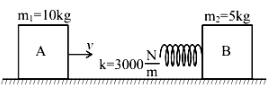
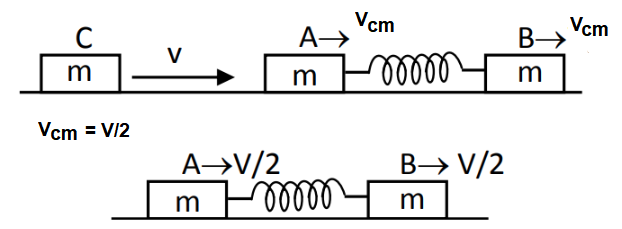
Consider two blocks A and B of masses \(m_1=10 kg\) and \(m _2=5 kg\) that are placed on a frictionless table. The block A moves with a constant speed \(v=3 m / s\) towards the block B kept at rest. A spring with spring constant \(k =3000 N / m\) is attached with the block B as shown in the figure. After the collision, suppose that the blocks A and B, along with the spring in constant compression state, move together, then the compression in the spring is, (Neglect the mass of the spring) [JEE Main 2025 (Online) 29th January Evening Shift]
 CorrectIncorrect
Hint
(b) To solve for the compression of the spring when the blocks move together, we can apply the principles of Conservation of Linear Momentum and Conservation of Mechanical Energy.
Step 1: Conservation of Momentum
When the spring is at “constant compression,” it means both blocks are moving with the same velocity ( \(V\) ). This is because if their velocities were different, the compression would still be changing.
Mass of Block A ( \(m_1\) ): 10 kg
Initial velocity of A ( \(v_1\) ): \(3 m / s\)
Mass of Block B ( \(m_2\) ): 5 kg
Initial velocity of B ( \(v_2\) ): \(0 m / s\) (at rest)
\(
\begin{gathered}
P_{\text {initial }}=P_{\text {final }} \\
m_1 v_1+m_2 v_2=\left(m_1+m_2\right) V \\
(10 \times 3)+(5 \times 0)=(10+5) V \\
30=15 V \Longrightarrow V=2 m / s
\end{gathered}
\)
Step 2: Conservation of Energy
The initial kinetic energy of the system is partially converted into elastic potential energy in the spring, while the rest remains as kinetic energy of the combined mass.
Initial Kinetic Energy \(\left(K_i\right)\) :
\(
K_i=\frac{1}{2} m_1 v_1^2=\frac{1}{2} \times 10 \times(3)^2=45 J
\)
Final Kinetic Energy \(\left(K_f\right)\) :
\(
K_f=\frac{1}{2}\left(m_1+m_2\right) V^2=\frac{1}{2} \times 15 \times(2)^2=30 J
\)
Energy stored in Spring ( \(U_s\) ):
\(
U_s=K_i-K_f=45-30=15 J
\)
Step 3: Calculating Compression ( \(x\) )
The potential energy of a spring is given by \(U_s=\frac{1}{2} k x^2\), where \(k=3000 N / m\).
\(
\begin{gathered}
\frac{1}{2} \times 3000 \times x^2=15 \\
1500 \times x^2=15 \\
x^2=\frac{15}{1500}=\frac{1}{100}=0.01 \\
x=\sqrt{0.01}=0.1 m
\end{gathered}
\)
The compression in the spring is 0.1 m (or 10 cm ). - Question 3 of 55
3. Question
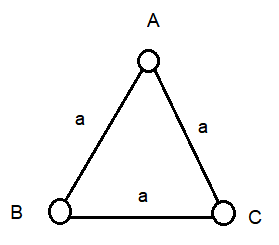
Three equal masses \(m\) are kept at vertices \((A, B, C)\) of an equilateral triangle of side a in free space. At \(t=0\), they are given an initial velocity \(\overrightarrow{V_A}=V_0 \overrightarrow{A C}, \overrightarrow{V_B}=V_0 \overrightarrow{B A}\) and \(\overrightarrow{V_C}=V_0 \overrightarrow{C B}\). Here, \(\overrightarrow{A C}, \overrightarrow{C B}\) and \(\overrightarrow{B A}\) are unit vectors along the edges of the triangle. If the three masses interact gravitationally, then the magnitude of the net angular momentum of the system at the point of collision is : [JEE Main 2025 (Online) 29th January Evening Shift]
 CorrectIncorrect
Hint
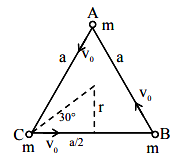
(d)

\(
\begin{aligned}
& \tan 30^{\circ}=\frac{2 r}{a}=\frac{1}{\sqrt{3}} \\
& r=\frac{a}{2 \sqrt{3}} \\
& L=\left(mvr_{\perp}\right) \times 3 \\
& =m v_0 \frac{a}{2 \sqrt{3}} \times 3 \\
& =\frac{\sqrt{3}}{2} mv_0 a
\end{aligned}
\)Alternate: Step 1: Identify the Centroid Distance
For an equilateral triangle of side \(a\), the distance ( \(r\) ) from the center (centroid) to each vertex is:
\(
r=\frac{a}{\sqrt{3}}
\)
Step 2: Determine the Angle for Angular Momentum
The velocity \(V_A\) is along the side \(A C\). The position vector \(r\) from the centroid to vertex \(A\) makes an angle with the side. In an equilateral triangle, the angle between the radius (centroid to vertex) and the side is \(30^{\circ}\).
The magnitude of angular momentum for one mass about the centroid is:
\(
L=m|r \times v|=m r v \sin (\theta)
\)
Since \(v\) is along the side and \(r\) is from the center to the vertex, the angle \(\theta\) between them is \(120^{\circ}\) (or the perpendicular distance is \(r \sin \left(60^{\circ}\right)=\frac{a}{2 \sqrt{3}}\) if looking at the projection).
Using the perpendicular distance \(r_{\perp}\) :
\(
r_{\perp}=r \cos \left(30^{\circ}\right)=\left(\frac{a}{\sqrt{3}}\right) \frac{\sqrt{3}}{2}=\frac{a}{2}
\)
Wait, let’s re-verify the geometry: The perpendicular distance from the centroid to the side \(A C\) is actually \(\frac{a}{2 \sqrt{3}}\). However, the velocity vector \(V_0\) is along the side \(A C\). The angular momentum \(L=m \times\) (perpendicular distance from O to the line of velocity). The distance from the centroid to the side of the triangle is:
\(
d=\frac{a}{2 \sqrt{3}}
\)
Step 3:Since all three masses are moving in a cyclic sense ( A to \(C , C\) to \(B , B\) to A ), their angular momenta add up:
\(
\begin{gathered}
L_{\text {total }}=3 \times\left(m \cdot V_0 \cdot d\right) \\
L_{\text {total }}=3 \times m \times V_0 \times \frac{a}{2 \sqrt{3}} \\
L_{\text {total }}=\frac{3}{\sqrt{3}} \cdot \frac{a m V_0}{2}=\frac{\sqrt{3}}{2} a m V_0
\end{gathered}
\)
Since there are no external torques, angular momentum is conserved. The magnitude at the point of collision is the same as the initial magnitude. - Question 4 of 55
4. Question
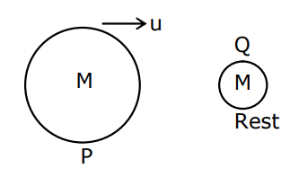
Given below are two statements. One is labelled as Assertion (A) and the other is labelled as Reason (R).
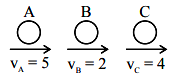
Assertion (A): Three identical spheres of same mass undergo one dimensional motion as shown in figure with initial velocities \(v_{ A }=5 m / s , v_{ B }=2 m / s , v_{ C }=4 m / s\). If we wait sufficiently long for elastic collision to happen, then \(v_{ A }=4 m / s , v_{ B }=2 m / s\), \(v_{ C }=5 m / s\) will be the final velocities.
Reason (R): In an elastic collision between identical masses, two objects exchange their velocities.
In the light of the above statements, choose the correct answer from the options given below: [JEE Main 2025 (Online) 29th January Evening Shift]CorrectIncorrectHint
(c)

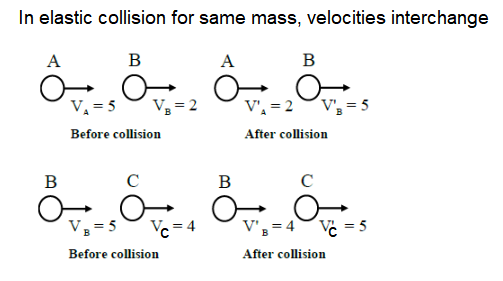
In a one-dimensional system of identical masses undergoing elastic collisions, the standard rule is that the objects exchange velocities upon impact. To find the final state, we track each individual collision in chronological order:
Step-by-Step Collision Analysis
Step 1: Initial State:
\(v_A=5 m / s\)
\(v_B=2 m / s\)
\(v_C=4 m / s\)
Step 2: First Collision (A hits B): Since \(v_A(5)>v_B(2)\), Sphere A will catch up to Sphere B.
After exchange: \(v_A=2 m / s\) and \(v_B=5 m / s\).
Current velocities: \(v_A=2 m / s, v_B=5 m, v_c=4 m\).
Step 3: Second Collision (B hits C): Now \(v_B(5)>v_C(4)\), so Sphere B will catch up to Sphere C.
After exchange: \(v_B=4 m / s\) and \(v_C=5 m / s\).
Current velocities: \(v_A=2 m / s, v_B=4 m / s, v_C=5 m / s\).
Step 4: Final Check: At this stage, \(v_A=2 m / s, v_B=4 m / s, v_C=5 m / s\). Since the velocities are in increasing order (2 m / s < 4 m / s < 5 m / s), no further collisions are possible.
Verifying the Options:
Based on the calculation, the final velocities are \(v_A=2, v_B=4, v_C=5\). However, the Assertion (A) in the question claims the final velocities are \(v_A=4, v_B=2, v_C=5\).
Assertion (A) is False: The numerical values provided in the assertion do not match the result of the physical process.
Reason (R) is True: It is a fundamental law of physics that identical masses exchange velocities in 1D elastic collisions.
Therefore, the correct choice is C: (A) is false but (R) is true. - Question 5 of 55
5. Question
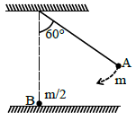
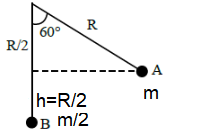
As shown below, bob \(A\) of a pendulum having massless string of length ‘ \(R\) ‘ is released from \(60^{\circ}\) to the vertical. It hits another bob \(B\) of half the mass that is at rest on a frictionless table in the center. Assuming elastic collision, the magnitude of the velocity of bob A after the collision will be (take g as acceleration due to gravity.) [JEE Main 2025 (Online) 23rd January Morning Shift]
 CorrectIncorrect
Hint
(b)

To find the final velocity of bob A after the elastic collision, we need to break the problem into two parts: finding the velocity of A just before the impact and then applying the laws of elastic collision.
Step 1: Velocity of Bob A just before collision
Using conservation of mechanical energy, the initial potential energy of \(\operatorname{bob} A\) is converted into kinetic energy just before the collision. The initial height of \(\operatorname{bob} A\) relative to the lowest point of the swing (collision point) is \(h=R-R \cos \left(60^{\circ}\right)=R(1-0.5)=0.5 R\). The velocity \(v_A\) before the collision is calculated as:
\(
\begin{gathered}
m g H=\frac{1}{2} m v_A^2 \\
g(0.5 R)=\frac{1}{2} v_A^2 \\
v_A=\sqrt{g R}
\end{gathered}
\)
Step 2: Determine the velocity of bob A after collision
For a one-dimensional elastic collision with bob B (mass \(m_B=0.5 m_A\), initially at rest \(v_B=0\) ), we apply conservation of momentum and the relative velocity condition. Let \(v_A^{\prime}\) and \(v_B^{\prime}\) be the final velocities.
Momentum conservation: \(m_A v_A=m_A v_A^{\prime}+m_B v_B^{\prime} \Longrightarrow v_A=v_A^{\prime}+0.5 v_B^{\prime}\).
Relative velocity: \(v_A-v_B=-\left(v_A^{\prime}-v_B^{\prime}\right) \Longrightarrow v_A=v_B^{\prime}-v_A^{\prime}\).
Solving these two equations simultaneously gives:
\(
v_A^{\prime}=\frac{m_A-m_B}{m_A+m_B} v_A
\)
Substituting masses \(m_A=m\) and \(m_B=0.5 m\).
\(
v_A^{\prime}=\frac{m-0.5 m}{m+0.5 m} v_A=\frac{0.5 m}{1.5 m} v_A=\frac{1}{3} v_A
\)
Substituting the value of \(v_A\) :
\(
v_A^{\prime}=\frac{1}{3} \sqrt{g R}
\)
The magnitude of the velocity of bob \(A\) after the collision is \(\frac{ 1 }{ 3 } \sqrt{ g R }\).Alternate: You can also solve this problem using the Coefficient of Restitution (\(e\)), which is a “shortcut” that relates the relative velocities before and after a collision.
Step 1: Understanding the Coefficient of Restitution (\(e\))
For any collision, \(e\) is defined as the ratio of the relative velocity of separation to the relative velocity of approach:
\(
e=\frac{v_B-v_A}{u_A-u_B}
\)
For a perfectly elastic collision, \(e=1\). This means the objects separate at the same relative speed they used to approach each other.
Step 2: Setting Up the Equations
We have two unknowns ( \(v_A\) and \(v_B\) ), so we need two equations:
Equation 1: Conservation of Momentum
\(
m_A u_A+m_B u_B=m_A v_A+m_B v_B
\)
Given \(m_A=m, m_B=m / 2, u_A=\sqrt{g R}\), and \(u_B=0\) :
\(
m \sqrt{g R}+0=m v_A+\frac{m}{2} v_B
\)
Divide by \(m\) :
\(
\sqrt{g R}=v_A+\frac{v_B}{2} \quad \Longrightarrow \quad 2 \sqrt{g R}=2 v_A+v_B \dots(1)
\)
Equation 2: Newton’s Law of Restitution ( \(e=1\) )
\(
\begin{gathered}
1=\frac{v_B-v_A}{u_A-u_B} \\
1=\frac{v_B-v_A}{\sqrt{g R}-0} \\
\sqrt{g R}=v_B-v_A \dots(2)
\end{gathered}
\)
Step 3: Solving for \(v_A\)
Subtract (Eq. 2) from (Eq. 1) to eliminate \(v_B\) :
\(
\begin{aligned}
& \left(2 \sqrt{g R}=2 v_A+v_B\right) \\
& -\left(\sqrt{g R}=-v_A+v_B\right)
\end{aligned}
\)
\(
\begin{gathered}
\sqrt{g R}=3 v_A \\
v_A=\frac{1}{3} \sqrt{g R}
\end{gathered}
\) - Question 6 of 55
6. Question
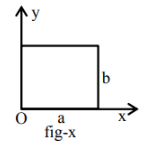
The center of mass of a thin rectangular plate (fig – x ) with sides of length \(a\) and \(b\), whose mass per unit area \((\sigma)\) varies as \(\sigma=\frac{\sigma_0 x}{a b}\) (where \(\sigma_0\) is a constant), would be ____. [JEE Main 2025 (Online) 28th January Morning Shift]
 CorrectIncorrect
Hint
(b) The rectangular plate is placed in the xy -plane with one corner at the origin \((0,0)\), and sides along the positive \(x\) and \(y\) axes (so \(0 \leq x \leq a\) and \(0 \leq y \leq b\) ):
Step 1: Finding the Total Mass ( \(M\) )
The mass of a small element \(d A=d x d y\) is \(d m=\sigma d A\).
\(
M=\int \sigma d A=\int_0^b \int_0^a\left(\frac{\sigma_0 x}{a b}\right) d x d y
\)
Solving the integrals:
Integral w.r.t \(x: \int_0^a x d x=\left[\frac{x^2}{2}\right]_0^a=\frac{a^2}{2}\)
Integral w.r.t \(y\) : \(\int_0^b d y=b\)
\(
M=\frac{\sigma_0}{a b} \cdot \frac{a^2}{2} \cdot b=\frac{\sigma_0 a}{2}
\)
Step 2: Finding the \(x\)-coordinate of the Center of Mass ( \(x_{c m}\) )
The formula is \(x_{c m}=\frac{1}{M} \int x d m\).
\(
x_{c m}=\frac{1}{M} \int_0^b \int_0^a x\left(\frac{\sigma_0 x}{a b}\right) d x d y=\frac{1}{M} \frac{\sigma_0}{a b} \int_0^b d y \int_0^a x^2 d x
\)
Integral w.r.t \(x: \int_0^a x^2 d x=\frac{a^3}{3}\)
Integral w.r.t \(y\) : \(\int_0^b d y=b\)
\(
x_{c m}=\frac{1}{\left(\sigma_0 a / 2\right)} \cdot \frac{\sigma_0}{a b} \cdot \frac{a^3}{3} \cdot b=\frac{2}{\sigma_0 a} \cdot \frac{\sigma_0 a^2}{3}=\frac{2 a }{3}
\)
Step 3: Finding the \(y\)-coordinate of the Center of Mass ( \(y_{c m}\) )
The formula is \(y_{c m}=\frac{1}{M} \int y d m\).
\(
y_{c m}=\frac{1}{M} \int_0^b \int_0^a y\left(\frac{\sigma_0 x}{a b}\right) d x d y=\frac{1}{M} \frac{\sigma_0}{a b} \int_0^a x d x \int_0^b y d y
\)
Integral w.r.t \(x: \frac{a^2}{2}\)
Integral w.r.t \(y\) : \(\int_0^b y d y=\frac{b^2}{2}\)
\(
y_{c m}=\frac{2}{\sigma_0 a} \cdot \frac{\sigma_0}{a b} \cdot \frac{a^2}{2} \cdot \frac{b^2}{2}=\frac{ b }{2}
\)
The coordinates of the center of mass are:
\(
\left(\frac{2 a}{3}, \frac{b}{2}\right)
\) - Question 7 of 55
7. Question
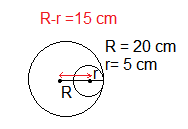
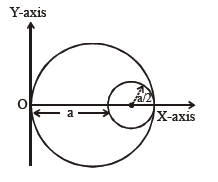
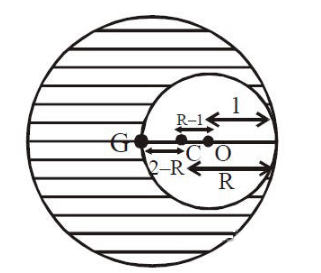
Consider a circular disc of radius 20 cm with centre located at the origin. A circular hole of radius 5 cm is cut from this disc in such a way that the edge of the hole touches the edge of the disc. The distance of centre of mass of residual or remaining disc from the origin will be [JEE Main 2025 (Online) 23rd January Morning Shift]
CorrectIncorrectHint
(d)

To find the center of mass of the remaining disc, we use the principle of negative mass. This involves treating the original full disc as one mass and the removed hole as a “negative mass.”
Step 1: Define the Coordinates
Original Disc (Radius \(R=20 cm\) ): Let its center be at the origin \((0,0)\).
Circular Hole (Radius \(r=5 cm\) ): The edge of the hole touches the edge of the disc. Since it’s along a radius, we can place the center of the hole at \(x_h\).
The distance from the origin to the edge of the disc is 20 cm .
Since the hole’s radius is 5 cm and it touches the edge, its center must be at \(x_h= R-r=20-5=15 cm\).
Center of hole: \((15,0)\).
Step 2: Calculate Masses (using Area)
Since the disc is uniform, mass is proportional to area ( \(M=\sigma A\) ).
Area of original disc \(\left(A_1\right): \pi R^2=\pi(20)^2=400 \pi\)
Area of hole \(\left(A_2\right): \pi r^2=\pi(5)^2=25 \pi\)
Step 3:Apply the Center of Mass Formula
The \(x\)-coordinate of the center of mass ( \(X_{c m}\) ) for the remaining part is given by:
\(
X_{c m}=\frac{A_1 x_1-A_2 x_2}{A_1-A_2}
\)
Where:
\(x_1=0\) (center of the original disc)
\(x_2=15\) (center of the hole)
\(
\begin{gathered}
X_{c m}=\frac{(400 \pi \times 0)-(25 \pi \times 15)}{400 \pi-25 \pi} \\
X_{c m}=\frac{-375 \pi}{375 \pi} \\
X_{c m}=-1 cm
\end{gathered}
\)
The center of mass of the remaining disc is located at \(X_{c m}=-1 cm\) along the x -axis. The distance from the origin is the absolute value of \(X_{c m}\).The distance of the center of mass from the origin is 1 cm. - Question 8 of 55
8. Question
A stationary particle breaks into two parts of masses \(m_A\) and \(m_B\) which move with velocities \(v_A\) and \(v_B\) respectively. The ratio of their kinetic energies \(\left(K_B: K_A\right)\) is : [JEE Main 2024 (Online) 8th April Morning Shift]
CorrectIncorrectHint
(a) Step 1: Conservation of Momentum: Since the initial particle is stationary, the total initial momentum is zero. According to the conservation of momentum, the total final momentum must also be zero.
\(
\begin{aligned}
& p_{\text {initial }}=p_{\text {final }} \\
& 0=m_A v_A+m_B v_B
\end{aligned}
\)
This means the magnitudes of their momenta are equal:
\(
m_A v_A=m_B v_B
\)
Step 2: Kinetic Energy in terms of Momentum
The kinetic energy ( \(K\) ) of an object can be expressed using its momentum ( \(p\) ) and mass ( \(m\) ):
\(
K=\frac{1}{2} m v^2=\frac{(m v)^2}{2 m}=\frac{p^2}{2 m}
\)
Step 3: Calculating the Ratio
Now, we find the ratio of the kinetic energy of part \(B \left(K_B\right)\) to part \(A \left(K_A\right)\) :
\(
\frac{K_B}{K_A}=\frac{\frac{p^2}{2 m_B}}{\frac{p^2}{2 m_A}}
\)
Since \(p\) is the same for both:
\(
\begin{gathered}
\frac{K_B}{K_A}=\frac{p^2}{2 m_B} \times \frac{2 m_A}{p^2} \\
\frac{K_B}{K_A}=\frac{m_A}{m_B}
\end{gathered}
\)
From momentum: \(m_A v_A=m_B v_B \Longrightarrow \frac{m_A}{m_B}=\frac{v_R}{v_A}\).
\(
\frac{K_B}{K_A}=\frac{m_A}{m_B}=\frac{v_B}{v_A}
\) - Question 9 of 55
9. Question
An artillery piece of mass \(M_1\) fires a shell of mass \(M_2\) horizontally. Instantaneously after the firing, the ratio of kinetic energy of the artille and that of the shell is: [JEE Main 2024 (Online) 31st January Morning Shift]
CorrectIncorrectHint
(b)
This problem is another application of the Law of Conservation of Linear Momentum. Since the artillery piece and the shell are initially at rest, the total momentum of the system before firing is zero.
STep 1: Conservation of Momentum
When the shell is fired, the artillery piece recoils in the opposite direction to ensure the total momentum remains zero.
\(
\begin{gathered}
P_{\text {initial }}=P_{\text {final }} \\
0=M_1 v_1+M_2 v_2 \\
M_1 v_1=-M_2 v_2
\end{gathered}
\)
In terms of magnitude, the momentum ( \(p\) ) of the artillery piece ( \(M_1\) ) and the shell ( \(M_2\) ) is equal:
\(
\left|p_1\right|=\left|p_2\right|=p
\)
Elastic Collisions of Identical
Step 2: Kinetic Energy and Mome
Spheres elationship
The kinetic energy ( \(K\) ) can be expressed in terms of momentum ( \(p\) ) as:
\(
K=\frac{p^2}{2 M}
\)
Step 3: Calculating the Ratio
We need the ratio of the kinetic energy of the artillery \(\left(K_1\right)\) to that of the shell \(\left(K_2\right)\) :
\(
\text { Ratio }=\frac{K_1}{K_2}=\frac{\frac{p^2}{2 M_1}}{\frac{p^2}{2 M_2}}
\)
Since the momentum magnitude \(p\) is the same for both:
\(
\begin{gathered}
\frac{K_1}{K_2}=\frac{p^2}{2 M_1} \times \frac{2 M_2}{p^2} \\
\frac{K_1}{K_2}=\frac{M_2}{M_1}
\end{gathered}
\)
The ratio of the kinetic energy of the artillery to that of the shell is \(M_2 / M_1\).Key Takeaway: In an explosion or recoil scenario starting from rest, the lighter object always carries away more kinetic energy because kinetic energy is inversely proportional to mass for a constant momentum.
- Question 10 of 55
10. Question
A spherical body of mass 100 g is dropped from a height of 10 m from the ground. After hitting the ground, the body rebounds to a height of 5 m . The impulse of force imparted by the ground to the body is given by : (given, \(g =9.8 m / s ^2\) ) [JEE Main 2024 (Online) 30th January Morning Shift]
CorrectIncorrectHint
(b) To calculate the impulse imparted by the ground, we use the impulse-momentum theorem, which states that impulse is equal to the change in linear momentum.
Step 1: Identify the Given Data
Mass \((m): 100 g=0.1 kg\)
Initial height \(\left(h_1\right): 10 m\)
Rebound height \(\left(h_2\right): 5 m\)
Acceleration due to gravity \((g): 9.8 m / s ^2\)
Step 2: Calculate Velocities
Velocity just before hitting the ground ( \(v_1\) ): Using the equation \(v^2=u^2+2 g h\) :
\(
v_1=\sqrt{2 g h_1}=\sqrt{2 \times 9.8 \times 10}=\sqrt{196}=14 m / s \text { (downwards) }
\)
Velocity just after rebounding ( \(v_2\) ): Using the same equation for the upward motion:
\(
v_2=\sqrt{2 g h_2}=\sqrt{2 \times 9.8 \times 5}=\sqrt{98} \approx 9.9 m / s \text { (upwards) }
\)
Step 3: Calculate Impulse
Impulse ( \(I\) ) is the change in momentum. Since velocity is a vector, we define upwards as the positive direction.
Initial velocity \(\left(v_{\text {initial }}\right)=-14 m / s\)
Final velocity \(\left(v_{\text {final }}\right)=+9.9 m / s\)
\(
\begin{gathered}
I=\Delta p=m\left(v_{\text {final }}-v_{\text {initial }}\right) \\
I=0.1 \times[9.9-(-14)] \\
I=0.1 \times(9.9+14) \\
I=0.1 \times 23.9 \\
I=2.39 kg ms^{-1}
\end{gathered}
\)
The impulse imparted by the ground is \(2.39 kg ms ^{-1}\). - Question 11 of 55
11. Question
Two bodies of mass 4 g and 25 g are moving with equal kinetic energies. The ratio of magnitude of their linear momentum is : [JEE Main 2024 (Online) 27th January Morning Shift]
CorrectIncorrectHint
(c) To find the ratio of the magnitudes of linear momentum when kinetic energies are equal, we use the mathematical relationship between kinetic energy ( \(K\) ) and momentum ( \(p\) ).
Step 1: The Relationship Formula
The kinetic energy of an object is given by \(K=\frac{1}{2} m v^2\). Since momentum is \(p=m v\), we can rewrite kinetic energy as:
\(
K=\frac{p^2}{2 m} \quad \Longrightarrow \quad p=\sqrt{2 m K}
\)
Step 2: Setting up the Ratio
We are given two bodies with masses \(m_1=4 g\) and \(m_2=25 g\). Their kinetic energies are equal ( \(K_1=K_2=K\) ).
The ratio of their momenta is:
\(
\frac{p_1}{p_2}=\frac{\sqrt{2 m_1 K}}{\sqrt{2 m_2 K}}
\)
Step 3: Calculation
Since 2 and \(K\) are common to both terms, they cancel out in the ratio:
\(
\begin{gathered}
\frac{p_1}{p_2}=\sqrt{\frac{m_1}{m_2}} \\
\frac{p_1}{p_2}=\sqrt{\frac{4}{25}} \\
\frac{p_1}{p_2}=\frac{2}{5}
\end{gathered}
\)
The ratio of the magnitude of their linear momentum is \(2: 5\). - Question 12 of 55
12. Question
A body of mass 1000 kg is moving horizontally with a velocity \(6 m / s\). If 200 kg extra mass is added, the final velocity (in \(m / s\) ) is: [JEE Main 2024 (Online) 27th January Morning Shift]
CorrectIncorrectHint
(d) To find the final velocity when extra mass is added to a moving body, we use the Law of Conservation of Linear Momentum. Since the extra mass is added to the body and no external horizontal force is acting on the system, the total horizontal momentum remains constant.
Step 1: Conservation of Momentum Formula
The initial momentum ( \(P_i\) ) must equal the final momentum ( \(P_f\) ):
\(
m_1 v_1=\left(m_1+m_2\right) v_2
\)
Where:
\(m_1=\) Initial mass of the body
\(v_1=\) Initial velocity of the body
\(m_2=\) Extra mass added
\(v_2=\) Final velocity of the combined mass
Step 2: Given Data
\(m_1=1000 kg\)
\(v_1=6 m / s\)
\(m_2=200 kg\)
Total final mass \((M)=1000+200=1200 Kg\)
Step 3: Calculation
Substitute the values into the momentum equation:
\(
\begin{gathered}
1000 \times 6=1200 \times v_2 \\
6000=1200 \times v_2
\end{gathered}
\)
Now, solve for \(v_2\) :
\(
\begin{gathered}
v_2=\frac{6000}{1200} \\
v_2=\frac{60}{12} \\
v_2=5 m / s
\end{gathered}
\)
The final velocity of the body is \(5 m / s\). - Question 13 of 55
13. Question
A bullet of 10 g leaves the barrel of gun with a velocity of \(600 m / s\). If the barrel of gun is 50 cm long and mass of gun is 3 kg , then value of impulse supplied to the gun will be : [JEE Main 2023 (Online) 13th April Morning Shift]
CorrectIncorrectHint
(c) To find the impulse supplied to the gun, we use the Principle of Conservation of Linear Momentum. Since the gun and the bullet are initially at rest, the total momentum of the system before firing is zero.
Step 1: Conservation of Momentum
When the bullet is fired, the gun recoils in the opposite direction to keep the total momentum at zero.
\(
\begin{gathered}
P_{\text {initial }}=P_{\text {final }} \\
0=m_b v_b+m_g v_g \\
m_g v_g=-m_b v_b
\end{gathered}
\)
The magnitude of the momentum of the gun ( \(p_g\) ) is exactly equal to the magnitude of the momentum of the bullet \(\left(p_b\right)\) :
\(
\left|p_g\right|=\left|p_b\right|
\)
Step 2: Relation Between Impulse and Momentum
Impulse ( \(J\) ) is defined as the change in momentum ( \(\Delta p\) ). For the gun, which starts from rest:
\(
\begin{gathered}
J_g=\Delta p_g=p_{\text {final }}-p_{\text {initial }} \\
J_g=m_g v_g-0
\end{gathered}
\)
Since \(\left|p_g\right|=\left|p_b\right|\), the impulse supplied to the gun is equal to the momentum of the bullet.
Step 3: Calculation
Given:
Mass of bullet \(\left(m_b\right)=10 g=0.01 kg\)
Velocity of bullet \(\left(v_b\right)=600 m / s\)
\(
\begin{gathered}
J_g=m_b \times v_b \\
J_g=0.01 kg \times 600 m / s \\
J_g=6 Ns
\end{gathered}
\)
Summary: The length of the barrel ( 50 cm ) and the mass of the gun ( 3 kg ) are extra information provided in this specific context; the impulse is determined solely by the change in momentum of the bullet. - Question 14 of 55
14. Question
An average force of 125 N is applied on a machine gun firing bullets each of mass 10 g at the speed of \(250 m / s\) to keep it in position. The number of bullets fired per second by the machine gun is : [JEE Main 2023 (Online) 11th April Morning Shift]
CorrectIncorrectHint
(b) To find the number of bullets fired per second, we use the concept of Newton’s Second Law of Motion, which states that the force applied is equal to the rate of change of momentum.
Step 1: Convert Units and Define Variables
First, convert the mass of a single bullet from grams to kilograms to maintain consistency with SI units (Newtons, meters per second).
Force, \(F =125 N\)
Mass per bullet, \(m=10 g=10 \times 10^{-3} kg=0.01 kg\)
Velocity, \(v=250 m / s\)
Number of bullets per second, \(n\) (unknown)
Step 2: Apply the Impulse-Momentum Theorem
The average force applied to keep the machine gun in position is equal to the rate of change of momentum of the bullets. To keep the machine gun in position, the average force applied ( \(F\) ) must balance the rate at which momentum is carried away by the bullets.
\(
F=\frac{\Delta p}{\Delta t}
\)
For \(n\) bullets fired in time \(t\), the total change in momentum is:
\(
\Delta p=n \times m \times v
\)
Where:
\(n=\) number of bullets
\(m=\) mass of one bullet
\(v=\) velocity of the bullet
The rate of change of momentum (Force) is:
\(
F=\left(\frac{n}{t}\right) \times m \times v
\)
Let \(N=\frac{n}{t}\) be the number of bullets fired per second.
Step 3: Calculation
Substitute the values into the formula:
\(
\begin{gathered}
125=N \times 0.01 \times 250 \\
125=N \times 2.5
\end{gathered}
\)
Now, solve for \(N\) :
\(
\begin{aligned}
N & =\frac{125}{2.5} \\
N & =\frac{1250}{25} \\
N & =50
\end{aligned}
\)
The number of bullets fired per second by the machine gun is 50. - Question 15 of 55
15. Question
A particle of mass \(m\) moving with velocity \(v\) collides with a stationary particle of mass \(2 m\). After collision, they stick together and continue to move together with velocity [JEE Main 2023 (Online) 10th April Morning Shift]
CorrectIncorrectHint
(b) This is a classic case of a perfectly inelastic collision, where the two bodies stick together after the impact. To find the final velocity, we apply the Law of Conservation of Linear Momentum.
Step 1: Conservation of Momentum
Since there are no external horizontal forces acting on the system, the total momentum before the collision must equal the total momentum after the collision.
\(
P_{\text {initial }}=P_{\text {final }}
\)
Initial Momentum ( \(P_i\) ): The first particle has mass \(m\) and velocity \(v\). The second particle has mass \(2 m\) and is stationary ( \(u=0\) ).
\(
P_i=(m \times v)+(2 m \times 0)=m v
\)
Final Momentum ( \(P_f\) ): After the collision, the particles stick together, forming a single combined mass of \((m+2 m)=3 m\). Let their common final velocity be \(V\).
\(
P_f=(3 m) \times V
\)
Step 2: Solving for Final Velocity (\(V\))
Equating the initial and final momentum:
\(
m v=3 m V
\)
Divide both sides by \(3 m\) :
\(
\begin{aligned}
V & =\frac{m v}{3 m} \\
V & =\frac{v}{3}
\end{aligned}
\)
The combined particles will move together with a velocity of \(\frac{v}{3}\). - Question 16 of 55
16. Question
100 balls each of mass m moving with speed \(v\) simultaneously strike a wall normally and reflected back with same speed, in time \(t\) s. The total force exerted by the balls on the wall is [JEE Main 2023 (Online) 31st January Morning Shift]
CorrectIncorrectHint
(a) By applying the Impulse-Momentum Theorem, you have correctly identified that the force is the rate of change of momentum. Here is a brief breakdown of why this logic holds:
Step 1: Change in Momentum for One Ball
When a ball of mass \(m\) hits a wall at velocity \(v\) and rebounds elastically (meaning it returns with velocity \(-v\) ), the change in momentum is:
\(
\Delta p=p_{\text {final }}-p_{\text {initial }}=(-m v)-(m v)=-2 m v
\)
The magnitude of the change in momentum for one ball is \(2 m v\).
Step 2: Total Momentum Change
If 100 balls hit the wall within a time interval \(t\), the total change in momentum ( \(\Delta P\) ) is simply the sum of the individual changes:
\(
\Delta P=100 \times(2 m v)=200 m v
\)
Step 3: Average Force Calculation
According to Newton’s Second Law ( \(F=\frac{\Delta P}{\Delta t}\) ), the average force exerted by the wall on the balls (and by the balls on the wall, per Newton’s Third Law) is:
\(
F=\frac{200 m v}{t}
\) - Question 17 of 55
17. Question
A machine gun of mass 10 kg fires 20 g bullets at the rate of 180 bullets per minute with a speed of \(100 m s ^{-1}\) each. The recoil velocity of the gun is [JEE Main 2023 (Online) 30th January Evening Shift]
CorrectIncorrectHint
(d) Step 1: Convert units and rate of fire
First, convert the mass of the bullets from grams to kilograms and the rate of fire from per minute to per second to maintain consistent SI units.
Mass of one bullet, \(m=20 g=0.02 kg\)
Mass of the gun, \(M=10 kg\)
Speed of bullets, \(v=100 m / s\)
Rate of fire, \(n=\frac{180 \text { bullets }}{60 s}=3\) bullets \(/ s\)
Step 2: Calculate the momentum imparted to the bullets per second
The total forward momentum imparted to the bullets per second is the product of the total mass of bullets fired per second and their velocity.
The total mass fired per second is \(m \times n=0.02 kg \times 3 s^{-1}=0.06 kg / s\).
The momentum rate is \(P _{\text {rate }}=( m \times n ) \times v\).
\(
P_{\text {rate }}=0.06 kg / s \times 100 m / s=6 kg \cdot m / s^2
\)
Step 3: Apply the principle of conservation of momentum
According to the principle of conservation of momentum, the total momentum of the system (gun + bullets) remains zero (since no external force acts). The momentum gained by the bullets in the forward direction must be balanced by an equal and opposite momentum gained by the gun in the backward direction (recoil). The recoil momentum of the gun per second is equal in magnitude to the forward momentum of the bullets per second:
\(
M \times V_{\text {recoil }}=P_{\text {rate }}
\)
Step 4: Solve for the recoil velocity
Rearrange the equation to find the recoil velocity, \(V_{\text {recoil }}\) :
\(
\begin{gathered}
V_{\text {recoil }}=\frac{P_{\text {rate }}}{M} \\
V_{\text {recoil }}=\frac{6 kg \cdot m / s^2}{10 kg}=0.6 m / s
\end{gathered}
\)
The velocity is in the opposite direction to the bullets.
The recoil velocity of the gun is \(0 . 6 ~ m / s\). - Question 18 of 55
18. Question
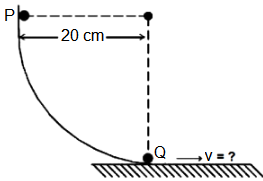
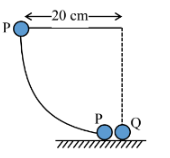
As per the given figure, a small ball P slides down the quadrant of a circle and hits the other ball Q of equal mass which is initially at rest. Neglecting the effect of friction and assume the collision to be elastic, the velocity of ball Q after collision will be : [JEE Main 2023 (Online) 30th January Morning Shift]
\(\left(g=10 m / s^2\right)\) CorrectIncorrect
Hint
(d)

To solve for the velocity of ball Q after the collision, we need to divide the problem into two parts: the motion of ball P before the collision and the physics of the elastic collision between P and Q.
Step 1: Velocity of Ball P Just Before Collision
Ball P starts from rest at the top of the quadrant (height \(h\) ) and slides down to the bottom. Neglecting friction, we use the Law of Conservation of Mechanical Energy:
Potential Energy at top: \(m g h=m g h\)
Kinetic Energy at bottom: \(\frac{1}{2} m v^2\)
Equating the two:
\(
m g R=\frac{1}{2} m v^2 \Longrightarrow v=\sqrt{2 g h}
\)
So, ball P hits ball Q with a horizontal velocity \(v_P=\sqrt{2 g h}\).
Step 2: Elastic Collision Between Equal Masses
The problem states that ball Q is initially at rest ( \(v_Q=0\) ) and has a mass equal to ball P ( \(m_P=m_Q\) ).
In a one-dimensional elastic collision between two identical masses:
a. The objects exchange their velocities.
b. The velocity of the first object (P) becomes the initial velocity of the second (Q).
c. The velocity of the second object (Q) becomes the initial velocity of the first (P).
Step 3: Final Calculation
Initial state: \(u_P=\sqrt{2 g h}, v_Q=0\)
After collision: \(v_P=0\) (Ball P comes to rest)
\(v_Q=\sqrt{2 g h}\) (Ball Q moves off with the velocity P had)
The velocity of ball Q after the collision will be \(\sqrt{2 g h}=\sqrt{2 \times 10 \times 0.2}=2 m / s\). - Question 19 of 55
19. Question
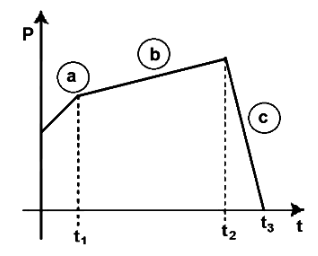
The figure represents the momentum time \(( p – t )\) curve for a particle moving along an axis under the influence of the force. Identify the regions on the graph where the magnitude of the force is maximum and minimum respectively?
\(\text { If }\left(t_3-t_2\right)<t_1\) [JEE Main 2023 (Online) 30th January Morning Shift] CorrectIncorrect
Hint
(d) Step 1: The Physics Principle
According to Newton’s Second Law of Motion, force \((F)\) is the rate of change of momentum ( \(p\) ) with respect to time ( \(t\) ):
\(
F=\frac{d p}{d t}
\)
On a \(p-t\) graph, the slope of the curve at any point represents the magnitude of the force acting on the particle.
Steeper slope = Greater magnitude of force.
Shallower slope = Smaller magnitude of force.
Step 2: Identifying the Maximum Force
Comparing the slopes of the three regions:
Region (a): Has a significant positive slope.
Region (b): Has the gentlest (flattest) slope.
Region (c): Has a very steep negative slope.
To determine if (a) or (c) is steeper, we use the provided condition: \(\left(t_3-t_2\right)<t_1\).
In Region (a), the momentum changes over a time interval \(t_1\).
In Region (c), a similar or larger change in momentum occurs over a much smaller time interval \(\left(t_3-t_2\right)\).
Since the same (or greater) change in momentum happens in less time in region (c), the slope is steepest there.
Therefore, the magnitude of force is maximum in region (c).
Step 3: Identifying the Minimum Force
Region (b) is the flattest part of the graph, meaning the change in momentum per unit of time is the lowest.
Therefore, the magnitude of force is minimum in region (b).
The regions where the magnitude of the force is maximum and minimum respectively are c and b. - Question 20 of 55
20. Question
A ball of mass 200 g rests on a vertical post of height 20 m. A bullet of mass 10 g, travelling in horizontal direction, hits the centre of the ball. After collision both travels independently. The ball hits the ground at a distance 30 m and the bullet at a distance of 120 m from the foot of the post. The value of initial velocity of the bullet will be (if \(g=10 m / s ^2\) ): [JEE Main 2023 (Online) 30th January Morning Shift]
CorrectIncorrectHint
(b) To find the initial velocity of the bullet, we must analyze the problem in two stages: the projectile motion of the ball and bullet after the collision to find their final velocities, and the conservation of momentum during the collision itself.
Step 1: Analysis of Projectile Motion
Both the ball and the bullet are initially at a height \(H=20 m\) and are moving horizontally immediately after the collision. The time \((t)\) taken for both to hit the ground depends only on the vertical height:
\(
\begin{gathered}
H=\frac{1}{2} g t^2 \Longrightarrow 20=\frac{1}{2}(10) t^2 \\
t^2=4 \Longrightarrow t=2 s
\end{gathered}
\)
Now, we can find the horizontal velocities of the ball ( \(v_{b a l l}\) ) and the bullet ( \(v_{b u l l e t}\) ) immediately after the collision using their respective horizontal ranges ( \(R\) ):
For the Ball ( \(R_{\text {ball }}=30 m\) ):
\(
v_{\text {ball }}=\frac{R_{\text {ball }}}{t}=\frac{30 m}{2 s}=15 m / s
\)
For the Bullet \(\left(R_{\text {bullet }}=120 m\right)\) :
\(
v_{\text {bullet }}=\frac{R_{\text {bullet }}}{t}=\frac{120 m}{2 s}=60 m / s
\)
Step 2: Conservation of Linear Momentum
The collision happens horizontally, so we apply the law of conservation of momentum in the horizontal direction.
Mass of ball ( \(m_1\) ): \(200 g=0.2 kg\)
Mass of bullet \(\left(m_2\right): 10 g=0.01 kg\)
Initial velocity of ball ( \(u_1\) ): \(0 m / s\) (at rest)
Initial velocity of bullet \(\left(u_2\right)\) : \(u\) (to be found)
\(
\begin{aligned}
& \text { Initial Momentum }=\text { Final Momentum } \\
& \qquad m_2 u+m_1(0)=m_2 v_{\text {bullet }}+m_1 v_{\text {ball }} \\
& (0.01) u=(0.01)(60)+(0.2)(15)
\end{aligned}
\)
\(
\begin{gathered}
0.01 u=0.6+3.0 \\
0.01 u=3.6
\end{gathered}
\)
Step 3: Solving for \(u\)
\(
\begin{gathered}
u=\frac{3.6}{0.01} \\
u=360 m / s
\end{gathered}
\)
The value of the initial velocity of the bullet is \(360 m / s\). - Question 21 of 55
21. Question
If momentum of a body is increased by \(20 \%\), then its kinetic energy increases by [JEE Main 2022 (Online) 29th July Evening Shift]
CorrectIncorrectHint
(c) To find the percentage increase in kinetic energy when the momentum of a body increases by \(20 \%\), we use the mathematical relationship between kinetic energy ( \(K\) ) and momentum ( \(p\) ).
Step 1: The Relationship Formula
Kinetic energy and momentum are related by the following equation:
\(
K=\frac{p^2}{2 m}
\)
where \(m\) is the constant mass of the body. From this, we can see that kinetic energy is proportional to the square of the momentum:
\(
K \propto p^2
\)
Step 2: Setting Up the Change
Let the initial momentum be \(p_1\) and the initial kinetic energy be \(K_1\).
Initial Momentum: \(p_1\)
Increased Momentum: Since it increases by \(20 \%\), the new momentum \(p_2\) is:
\(
p_2=p_1+0.20 p_1=1.2 p_1
\)
Step 3: Calculating the New Kinetic Energy
The new kinetic energy \(K_2\) is:
\(
\begin{gathered}
K_2=\frac{\left(p_2\right)^2}{2 m}=\frac{\left(1.2 p_1\right)^2}{2 m} \\
K_2=(1.2)^2 \times \frac{p_1^2}{2 m} \\
K_2=1.44 \times K_1
\end{gathered}
\)
Step 4: Finding the Percentage Increase
The fractional increase in kinetic energy is:
\(
\text { Increase }=\frac{K_2-K_1}{K_1}=\frac{1.44 K_1-K_1}{K_1}=0.44
\)
To convert this to a percentage:
\(
\text { Percentage Increase }=0.44 \times 100=44 \%
\)
If the momentum of a body is increased by \(20 \%\), its kinetic energy increases by \(44 \%\). - Question 22 of 55
22. Question
Two bodies of mass 1 kg and 3 kg have position vectors \(\hat{i}+2 \hat{j}+\hat{k}\) and \(-3 \hat{i}-2 \hat{j}+\hat{k}\) respectively. The magnitude of position vector of centre of mass of this system will be similar to the magnitude of vector : [JEE Main 2022 (Online) 29th July Morning Shift]
CorrectIncorrectHint
(a) The position vector of the center of mass ( \(\overrightarrow{ R }_{ C M }\) ) for a system of two point masses \(m _1\) and \(m_2\) with position vectors \(\vec{r}_1\) and \(\vec{r}_2\) is given by the formula:
\(
\vec{R}_{C M}=\frac{m_1 \vec{r}_1+m_2 \vec{r}_2}{m_1+m_2}
\)
Given values:
\(m_1=1 kg\)
\(\vec{r}_1=\hat{i}+2 \hat{j}+\hat{k}\)
\(m_2=3 kg\)
\(\vec{r}_2=-3 \hat{i}-2 \hat{j}+\hat{k}\)
Substitute the values into the equation:
\(
\begin{gathered}
\vec{R}_{C M}=\frac{(1)(\hat{i}+2 \hat{j}+\hat{k})+(3)(-3 \hat{i}-2 \hat{j}+\hat{k})}{1+3} \\
\vec{R}_{C M}=\frac{\hat{i}+2 \hat{j}+\hat{k}-9 \hat{i}-6 \hat{j}+3 \hat{k}}{4} \\
\vec{R}_{C M}=\frac{(1-9) \hat{i}+(2-6) \hat{j}+(1+3) \hat{k}}{4} \\
\vec{R}_{C M}=\frac{-8 \hat{i}-4 \hat{j}+4 \hat{k}}{4} \\
\vec{R}_{C M}=-2 \hat{i}-\hat{j}+\hat{k}
\end{gathered}
\)
Now, calculate the magnitude of the position vector of the center of mass:
\(
\begin{gathered}
\left|\vec{R}_{C M}\right|=\sqrt{(-2)^2+(-1)^2+(1)^2} \\
\left|\vec{R}_{C M}\right|=\sqrt{4+1+1} \\
\left|\vec{R}_{C M}\right|=\sqrt{6}
\end{gathered}
\)
Next, calculate the magnitude of each of the given option vectors to find the one with a magnitude similar to \(\sqrt{6}\) :
(A) \(|\hat{i}+2 \hat{j}+\hat{k}|=\sqrt{1^2+2^2+1^2}=\sqrt{1+4+1}=\sqrt{6}\)
(B) \(|-3 \hat{i}-2 \hat{j}+\hat{k}|=\sqrt{(-3)^2+(-2)^2+1^2}=\sqrt{9+4+1}=\sqrt{14}\)
(C) \(|-2 \hat{i}+2 \hat{k}|=\sqrt{(-2)^2+0^2+2^2}=\sqrt{4+0+4}=\sqrt{8}\)
(D) \(|2 \hat{i}-\hat{j}+2 \hat{k}|=\sqrt{2^2+(-1)^2+2^2}=\sqrt{4+1+4}=\sqrt{9}=3\)
The magnitude of the position vector of the center of mass is \(\sqrt{6}\), which is the same as the magnitude of vector \(( A ) \hat{i}+2 \hat{j}+\hat{k}\). - Question 23 of 55
23. Question
In two different experiments, an object of mass 5 kg moving with a speed of \(25 ms^{-1}\) hits two different walls and comes to rest within (i) 3 second, (ii) 5 seconds, respectively. Choose the correct option out of the following : [JEE Main 2022 (Online) 28th July Morning Shift]
CorrectIncorrectHint
(b) To understand why, we look at the definitions of Impulse and Average Force in the context of the Impulse-Momentum Theorem.
Step 1: Impulse is defined as the change in linear momentum ( \(\Delta p\) ):
\(
I=\Delta p=m\left(v_f-v_i\right)
\)
In both experiments:
Mass (m): 5 kg
Initial Velocity \(\left(v_i\right): 25 m / s\)
Final Velocity \(\left(v_f\right): 0 m / s\) (since the object comes to rest)
Because the mass, initial speed, and final speed are identical in both cases, the change in momentum is the same.
\(
\Delta p=5(0-25)=-125 kg m / s
\)
The magnitude of impulse is given by \(I=|\Delta p|=125 kg m / s\)
Thus, the Impulse is identical for both (i) and (ii).
Step 2: Analysis of Average Force ( \(F_{\text {avg }}\) )
Newton’s Second Law states that the average force is the rate of change of momentum over time:
\(
F_{a v g}=\frac{\Delta p}{\Delta t}
\)
Since \(\Delta p\) is constant, the force is inversely proportional to the time interval \((\Delta t)\) :
Case (i): \(\Delta t=3 s \Longrightarrow F_{\text {avg }}=\frac{-125}{3} \approx-41.67 N\), \(|F_{\text {avg }|\approx 41.67 N\)
Case (ii): \(\Delta t=5 s \Longrightarrow F_{\text {avg }}=\frac{-125}{5}=-25 N\), \(|F_{\text {avg }|\approx 25 N\)
Because the time intervals are different ( \(3 s \neq 5 s\) ), the Average Force is different in each case. - Question 24 of 55
24. Question
A body of mass 10 kg is projected at an angle of \(45^{\circ}\) with the horizontal. The trajectory of the body is observed to pass through a point \((20,10)\). If \(T\) is the time of flight, then its momentum vector, at time \(t =\frac{ T }{\sqrt{2}}\), is ____. [JEE Main 2022 (Online) 27th July Evening Shift]
[Take \(g =10 m / s ^2\) ]CorrectIncorrectHint
(d) To solve for the momentum vector at \(t=\frac{T}{\sqrt{2}}\), we first need to determine the initial velocity \(u\) of the projectile using the given coordinates \((20,10)\).
Step 1: Finding the Initial Velocity ( \(u\) )
The equation of the trajectory for a projectile is:
\(
y=x \tan \theta-\frac{g x^2}{2 u^2 \cos ^2 \theta}
\)
Given:
\((x, y)=(20,10)\)
\(\theta=45^{\circ}\left(\tan 45^{\circ}=1, \cos 45^{\circ}=\frac{1}{\sqrt{2}}\right)\)
\(g=10 m / s ^2\)
Substituting these into the equation:
\(
10=20(1)-\frac{10(20)^2}{2 u^2\left(\frac{1}{\sqrt{2}}\right)^2}
\)
\(
10=20-\frac{4000}{u^2}
\)
\(
\frac{4000}{u^2}=10 \Longrightarrow u^2=400 \Longrightarrow u=20 m / s
\)
Step 2: Finding the Total Time of Flight ( \(T\) )
The formula for the total time of flight is:
\(
T=\frac{2 u \sin \theta}{g}=\frac{2(20) \sin 45^{\circ}}{10}=4\left(\frac{1}{\sqrt{2}}\right)=2 \sqrt{2} s
\)
Step 3: Velocity Components at \(t=\frac{T}{\sqrt{2}}\)
We need the velocity at time \(t=\frac{2 \sqrt{2}}{\sqrt{2}}=2 s\).
Horizontal component \(\left(v_x\right)\) : Remains constant.
\(
v_x=u \cos \theta=20 \cos 45^{\circ}=\frac{20}{\sqrt{2}}=10 \sqrt{2} m / s
\)
Vertical component \(\left(v_y\right)\) :
\(
\begin{gathered}
v_y=u \sin \theta-g t=20 \sin 45^{\circ}-10(2) \\
v_y=10 \sqrt{2}-20 m / s
\end{gathered}
\)
Step 4: Calculating the Momentum Vector ( \(p\) )
Momentum is given by \(p=m v\), where \(m=10 kg\).
\(
\begin{gathered}
p=m\left(v_x \hat{i}+v_y \hat{j}\right) \\
p=10[10 \sqrt{2} \hat{i}+(10 \sqrt{2}-20) \hat{j}] \\
p=100 \sqrt{2} \hat{i}+(100 \sqrt{2}-200) \hat{j}
\end{gathered}
\)
The momentum vector at \(t=\frac{T}{\sqrt{2}}\) is \(100 \sqrt{2} \hat{i}+(100 \sqrt{2}-200) \hat{j}\). - Question 25 of 55
25. Question
A ball of mass 0.15 kg hits the wall with its initial speed of \(12 ms^{-1}\) and bounces back without changing its initial speed. If the force applied by the wall on the ball during the contact is 100 N, calculate the time duration of the contact of ball with the wall. [JEE Main 2022 (Online) 26th July Evening Shift]
CorrectIncorrectHint
(b) To find the time duration of contact, we use the Impulse-Momentum Theorem, which states that the impulse (Force × time) is equal to the change in momentum of the object.
Step 1: Identify the Given Data
Mass( \(m\) ): 0.15 kg
Initial velocity \((u): 12 m / s\) (towards the wall)
Final velocity \((v):-12 m / s\) (away from the wall, since it bounces back with the same speed)
Force (F): 100 N
Step 2: Calculate the Change in Momentum ( \(\Delta p\) )
Momentum is a vector quantity. If we take the direction towards the wall as positive and away from the wall as negative:
\(
\begin{gathered}
\Delta p=m(v-u) \\
\Delta p=0.15 \times(-12-12) \\
\Delta p=0.15 \times(-24)
\end{gathered}
\)
\(
\Delta p=-3.6 kg m / s
\)
The magnitude of the change in momentum is \(3.6 kg m / s\).
Step 3: Calculate the Time Duration ( \(t\) )
According to the formula for Impulse:
\(
\begin{gathered}
\text { Force } \times t=\Delta p \\
100 \times t=3.6
\end{gathered}
\)
Solving for \(t\) :
\(
\begin{gathered}
t=\frac{3.6}{100} \\
t=0.036 s
\end{gathered}
\)
The time duration of the contact of the ball with the wall is 0.036 s. - Question 26 of 55
26. Question
A body of mass 8 kg and another of mass 2 kg are moving with equal kinetic energy. The ratio of their respective momentum will be : [JEE Main 2022 (Online) 26th July Evening Shift]
CorrectIncorrectHint
(b) The kinetic energy ( \(K E\) ) and momentum (p) of a body are related by the formula:
\(
K E=\frac{p^2}{2 m}
\)
where \(m\) is the mass of the body.
This formula can be rearranged to express momentum in terms of kinetic energy and mass:
\(
p=\sqrt{2 m \cdot K E}
\)
Let \(m_1=8 kg\) and \(m_2=2 kg\) be the masses of the two bodies. Since they have equal kinetic energy, let \(K E_1=K E_2=K E\).
The momentum of the first body is:
\(
p_1=\sqrt{2 m_1 \cdot K E}=\sqrt{2(8) \cdot K E}=\sqrt{16 \cdot K E}=4 \sqrt{K E}
\)
The momentum of the second body is:
\(
p_2=\sqrt{2 m_2 \cdot K E}=\sqrt{2(2) \cdot K E}=\sqrt{4 \cdot K E}=2 \sqrt{K E}
\)
The ratio of their respective momentum ( \(p_1: p_2\) ) is:
\(
\frac{p_1}{p_2}=\frac{4 \sqrt{K E}}{2 \sqrt{K E}}=\frac{4}{2}=\frac{2}{1}
\)
Thus, the ratio of their momentum is \(2: 1\). - Question 27 of 55
27. Question
Two billiard balls of mass 0.05 kg each moving in opposite directions with \(10 ms^{-1}\) collide and rebound with the same speed. If the time duration of contact is \(t=0.005 s\), then what is the force exerted on the ball due to each other? [JEE Main 2022 (Online) 25th July Evening Shift]
CorrectIncorrectHint
(b) Step 1: Define variables and physical principles
The problem provides the mass of the billiard balls ( \(m\) ), initial speed ( \(v_i\) ), final speed ( \(\left.v_f\right)\), and contact time \((\Delta t)\). The force exerted \((F)\) can be found using the impulsemomentum theorem, which states that the impulse (force times time duration) is equal to the change in momentum ( \(\Delta p\) ).
\(
F=\frac{\Delta p}{\Delta t}
\)
For one ball, the momentum changes direction during the collision.
Step 2: Calculate the change in momentum
Assuming the initial velocity of one ball is positive, \(v_i\), the final velocity after rebounding with the same speed in the opposite direction is \(v_f=-v_i\).
The change in momentum \((\Delta p)\) for one ball is:
\(
\Delta p=p_f-p_i=m v_f-m v_i=m\left(-v_i\right)-m\left(v_i\right)=-2 m v_i
\)
The magnitude of the change in momentum is \(|\Delta p|=2 m v_i\).
Step 3: Calculate the force exerted
Using the values \(m=0.05 kg, v_i=10 m / s\), and \(\Delta t=0.005 s\), we calculate the force magnitude:
\(
\begin{gathered}
F=\frac{2 m v_i}{\Delta t}=\frac{2 \times 0.05 kg \times 10 m / s}{0.005 s} \\
F=\frac{1 kg \cdot m / s}{0.005 s} \\
F=200 N
\end{gathered}
\)
The force exerted on each ball due to each other is \(2 0 0 ~ N\). - Question 28 of 55
28. Question
Two bodies A and B of masses 5 kg and 8 kg are moving such that the momentum of body B is twice that of the body A. The ratio of their kinetic energies will be : [JEE Main 2022 (Online) 30th June Morning Shift]
CorrectIncorrectHint
(b) To find the ratio of the kinetic energies of the two bodies, we use the relationship between kinetic energy ( \(K\) ) and momentum ( \(p\) ).
Step 1: The Physics Principle
The kinetic energy of an object of mass \(m\) and momentum \(p\) is given by the formula:
\(
K=\frac{p^2}{2 m}
\)
Step 2: Identify the Given Data
Mass of body A \(\left(m_A\right): 5 kg\)
Mass of body B ( \(m_B\) ): 8 kg
Momentum Relationship: The momentum of body B is twice that of body A.
\(
p_B=2 p_A
\)
Step 3: Setting Up the Ratio
The ratio of the kinetic energy of body \(A \left(K_A\right)\) to body \(B \left(K_B\right)\) is:
\(
\frac{K_A}{K_B}=\frac{\left(\frac{p_A^2}{2 m_A}\right)}{\left(\frac{p_B^2}{2 m_B}\right)}
\)
Substitute \(p_B=2 p_A\) into the equation:
\(
\begin{gathered}
\frac{K_A}{K_B}=\frac{p_A^2}{2 m_A} \times \frac{2 m_B}{\left(2 p_A\right)^2} \\
\frac{K_A}{K_B}=\frac{p_A^2}{2 m_A} \times \frac{2 m_B}{4 p_A^2}
\end{gathered}
\)
Step 4: Calculation
Cancel the common terms ( \(p_A^2\) and 2):
\(
\frac{K_A}{K_B}=\frac{m_B}{4 m_A}
\)
Now, substitute the mass values ( \(m_A=5\) and \(m_B=8\) ):
\(
\begin{gathered}
\frac{K_A}{K_B}=\frac{8}{4 \times 5} \\
\frac{K_A}{K_B}=\frac{8}{20} \\
\frac{K_A}{K_B}=\frac{2}{5}
\end{gathered}
\)
The ratio of their kinetic energies \(K_A: K_B\) is \(2: 5\). - Question 29 of 55
29. Question
A body of mass \(M\) at rest explodes into three pieces, in the ratio of masses \(1: 1: 2\). Two smaller pieces fly off perpendicular to each other with velocities of \(30 ms^{-1}\) and \(40 ms^{-1}\) respectively. The velocity of the third piece will be : [JEE Main 2022 (Online) 29th June Morning Shift]
CorrectIncorrectHint
(b) To solve for the velocity of the third piece, we use the Law of Conservation of Linear Momentum. Since the body is initially at rest, the total momentum before the explosion is zero, and it must remain zero after the explosion.
Step 1: Define Momentum Conservation and Masses
The total initial momentum of the system is zero since the body is at rest. The principle of conservation of momentum states that the total final momentum must also be zero:
\(
\overrightarrow{p_{\text {total }}}=\vec{p}_1+\vec{p}_2+\vec{p}_3= 0
\)
The masses are in the ratio \(1: 1: 2\). Let the common factor be \(m\). The masses of the three pieces are \(m_1=m, m_2=m\), and \(m_3=2 m\).
Step 2: Set Up Velocities and Momenta
The two smaller pieces fly off perpendicular to each other. We can place their velocity vectors along the orthogonal x and y axes.
The velocities are \(v_1=30 ms^{-1}\) and \(v_2=40 ms^{-1}\).
\(
\begin{aligned}
& \overrightarrow{v_1}=30 \hat{i} \\
& \overrightarrow{v_2}=40 \hat{j}
\end{aligned}
\)
The momentum vectors for the first two pieces are:
\(
\begin{aligned}
& \vec{p}_1=m_1 \vec{v}_1=30 m \hat{i} \\
& \vec{p}_2=m_2 \vec{v}_2=40 m \hat{j}
\end{aligned}
\)
Step 3: Calculate the Velocity of the Third Piece
Using the conservation of momentum equation from Step 1:
\(
\begin{aligned}
& 30 m \hat{i}+40 m \hat{j}+\vec{p}_3= 0 \\
& \vec{p}_3=-(30 m \hat{i}+40 m \hat{j})
\end{aligned}
\)
The momentum of the third piece is \(\vec{p}_3=m_3 \vec{v}_3=2 m \vec{v}_3\).
\(
\begin{gathered}
2 m \vec{v}_3=-(30 m \hat{i}+40 m \hat{j}) \\
\overrightarrow{v_3}=\frac{-(30 m \hat{i}+40 m \hat{j})}{2 m} \\
\overrightarrow{v_3}=-15 \hat{i}-20 \hat{j}
\end{gathered}
\)
The magnitude of the third piece’s velocity is:
\(
\begin{gathered}
\left|\vec{v}_3\right|=\sqrt{(-15)^2+(-20)^2} \\
\left|\vec{v}_3\right|=\sqrt{225+400} \\
\left|\vec{v}_3\right|=\sqrt{625}=25 ms^{-1}
\end{gathered}
\)
The velocity of the third piece is \(2 5 ~ m s ^{- 1 }\). - Question 30 of 55
30. Question
Two blocks of masses 10 kg and 30 kg are placed on the same straight line with coordinates \((0,0) cm\) and \(( x , 0) cm\) respectively. The block of 10 kg is moved on the same line through a distance of 6 cm towards the other block. The distance through which the block of 30 kg must be moved to keep the position of centre of mass of the system unchanged is : [JEE Main 2022 (Online) 27th June Morning Shift]
CorrectIncorrectHint
(c) To keep the position of the center of mass ( \(x_{c m}\) ) unchanged, the net change in the weighted position of the masses must be zero.
Step 1: Identify the Formula
The change in the center of mass position ( \(\Delta x_{c m}\) ) is given by:
\(
\Delta x_{c m}=\frac{m_1 \Delta x_1+m_2 \Delta x_2}{m_1+m_2}
\)
Since the position of the center of mass must remain unchanged, we set \(\Delta x_{c m}=0\) :
\(
0=m_1 \Delta x_1+m_2 \Delta x_2 \Longrightarrow m_1 \Delta x_1=-m_2 \Delta x_2
\)
Step 2: Plug in the Given Data
Mass of first block \(\left(m_1\right)\) : 10 kg
Mass of second block \(\left(m_2\right): 30 kg\)
Displacement of \(1 0 ~ k g\) block \(\left( \Delta x _1\right)\) : \(+ 6 ~ c m\) (towards the other block)
Displacement of 30 kg block \(\left(\Delta x_2\right)\) : ?
Step 3: Calculation
\(
\begin{gathered}
10 \times 6=-30 \times \Delta x_2 \\
60=-30 \times \Delta x_2 \\
\Delta x_2=\frac{60}{-30}=-2 cm
\end{gathered}
\)
The negative sign indicates that the 30 kg block must move in the opposite direction of the coordinate increase (i.e., towards the 10 kg block).
The block of 30 kg must be moved 2 cm towards the 10 kg block. - Question 31 of 55
31. Question
What percentage of kinetic energy of a moving particle is transferred to a stationary particle when it strikes the stationary particle of 5 times its mass? (Assume the collision to be head-on elastic collision) [JEE Main 2022 (Online) 27th June Morning Shift]
CorrectIncorrectHint
(c) In a one-dimensional (head-on) elastic collision where a moving particle strikes a stationary target, the percentage of kinetic energy transferred is determined by the ratio of their masses.
Step 1: Identify the Formula for Energy Transfer
The fraction of initial kinetic energy ( \(K_1\) ) transferred to a stationary target ( \(K_2\) ) in an elastic collision is given by:
\(
\frac{K_2}{K_1}=\frac{4 m_1 m_2}{\left(m_1+m_2\right)^2}
\)
Where:
\(m_1=\) mass of the moving particle.
\(m_2=\) mass of the stationary particle.
Step 2: Plug in the Given Values
In this problem, the stationary particle has 5 times the mass of the moving particle:
\(m_1=m\)
\(m_2=5 m\)
Substitute these into the formula:
\(
\frac{K_2}{K_1}=\frac{4 \times m \times 5 m}{(m+5 m)^2}=\frac{20 m^2}{(6 m)^2}=\frac{20 m^2}{36 m^2}
\)
Step 3: Calculate the Percentage
Simplify the fraction:
\(
\frac{K_2}{K_1}=\frac{20}{36}=\frac{5}{9} \approx 0.5555 \ldots
\)
To convert this fraction to a percentage:
\(
\text { Percentage }=0.5555 \times 100=55.6 \%
\)
The percentage of kinetic energy transferred to the stationary particle is \(55.6 \%\).Derivation: Step 1: Conservation Laws
Consider a particle of mass \(m_1\) moving with initial velocity \(v_1\) that strikes a stationary target of mass \(m_2\) (initial velocity \(v_2=0\) ).
Conservation of Momentum:
\(
m_1 v_1=m_1 v_1^{\prime}+m_2 v_2^{\prime}
\)
Where \(v_1^{\prime}\) and \(v_2^{\prime}\) are the final velocities of \(m_1\) and \(m_2\) respectively.
Conservation of Kinetic Energy:
\(
\frac{1}{2} m_1 v_1^2=\frac{1}{2} m_1\left(v_1^{\prime}\right)^2+\frac{1}{2} m_2\left(v_2^{\prime}\right)^2
\)
Step 2: Deriving Final Velocity of the Target \(\left(v_2^{\prime}\right)\)
In an elastic collision, the relative velocity of approach is equal to the relative velocity of separation:
\(
v_1-0=v_2^{\prime}-v_1^{\prime} \Longrightarrow v_1^{\prime}=v_2^{\prime}-v_1
\)
Substitute \(v_1^{\prime}\) into the momentum equation:
\(
\begin{gathered}
m_1 v_1=m_1\left(v_2^{\prime}-v_1\right)+m_2 v_2^{\prime} \\
m_1 v_1=m_1 v_2^{\prime}-m_1 v_1+m_2 v_2^{\prime} \\
2 m_1 v_1=\left(m_1+m_2\right) v_2^{\prime} \\
v_2^{\prime}=\frac{2 m_1 v_1}{m_1+m_2}
\end{gathered}
\)
Step 3: Calculating Kinetic Energy Transfer
The kinetic energy transferred to the target ( \(K_2\) ) is its final kinetic energy:
\(
\begin{gathered}
K_2=\frac{1}{2} m_2\left(v_2^{\prime}\right)^2=\frac{1}{2} m_2\left(\frac{2 m_1 v_1}{m_1+m_2}\right)^2 \\
K_2=\frac{1}{2} m_2\left(\frac{4 m_1^2 v_1^2}{\left(m_1+m_2\right)^2}\right) \\
K_2=\frac{2 m_1^2 m_2 v_1^2}{\left(m_1+m_2\right)^2}
\end{gathered}
\)
The initial kinetic energy of the projectile ( \(K_1\) ) is:
\(
K_1=\frac{1}{2} m_1 v_1^2 \Longrightarrow v_1^2=\frac{2 K_1}{m_1}
\)
Substitute \(v_1^2\) back into the expression for \(K_2\) :
\(
\begin{gathered}
K_2=\frac{2 m_1^2 m_2}{\left(m_1+m_2\right)^2} \times\left(\frac{2 K_1}{m_1}\right) \\
K_2=\frac{4 m_1 m_2}{\left(m_1+m_2\right)^2} K_1
\end{gathered}
\)
Dividing both sides by \(K_1\) gives the final proof:
\(
\frac{K_2}{K_1}=\frac{4 m_1 m_2}{\left(m_1+m_2\right)^2}
\) - Question 32 of 55
32. Question
An object is thrown vertically upwards. At its maximum height, which of the following quantity becomes zero? [JEE Main 2022 (Online) 26th June Morning Shift]
CorrectIncorrectHint
(a) When an object is thrown vertically upwards and reaches its maximum height, the correct quantity that becomes zero is Momentum.
Here is a detailed breakdown of why the other quantities do not become zero:
Velocity and Momentum:
Velocity (\(v\)): As the object rises, its vertical velocity decreases due to gravity. At the maximum height, the object momentarily stops, making its vertical velocity zero ( \(v= 0 ~ m / s\) ).
Momentum ( \(p\) ): Momentum is defined as the product of mass and velocity ( \(p=m \times v\) ). Since the velocity is zero at the peak, the momentum also becomes zero.
Why the Other Options are Incorrect?
Potential Energy (B): Potential energy ( \(U=m g h\) ) is directly proportional to height. At the maximum height, the object has its maximum potential energy, not zero.
Acceleration (C): Throughout the entire flight, the object is in free fall. Even at the highest point, the acceleration due to gravity ( \(g \approx 9.8 m / s ^2\) ) continues to act downward; it never becomes zero.
Force (D): The force of gravity ( \(F=m g\) ) acts on the object at all times during its trajectory. This net force is responsible for changing the object’s velocity and is not zero at the peak. - Question 33 of 55
33. Question
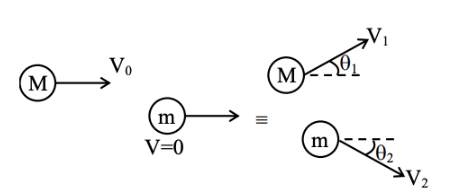
A body of mass \(M\) moving at speed \(V_0\) collides elastically with a mass ‘ \(m\) ‘ at rest. After the collision, the two masses move at angles \(\theta_1\) and \(\theta { }_2\) with respect to the initial direction of motion of the body of mass M . The largest possible value of the ratio \(M / m\), for which the angles \(\theta_1\) and \(\theta_2\) will be equal, is : [JEE Main 2021 (Online) 31st August Morning Shift]
CorrectIncorrectHint
(c)

To find the largest possible value of the ratio \(M / m\) for which the scattering angles \(\theta_1\) and \(\theta_2\) are equal, we analyze the conservation of momentum and energy in a two-dimensional elastic collision.
Step 1: Conservation Laws
Consider a body of mass \(M\) moving with velocity \(V_0\) striking a stationary mass \(m\). After the collision, \(M\) moves with velocity \(v_1\) at angle \(\theta_1\) and \(m\) moves with velocity \(v_2\) at angle \(\theta_2\).
Conservation of Momentum ( \(y\)-axis): Since the initial motion is only along the \(x\)-axis, the net momentum in the y -direction must be zero.
\(
M v_1 \sin \theta_1=m v_2 \sin \theta_2
\)
If \(\theta_1=\theta_2=\theta\), this simplifies to:
\(
M v_1=m v_2 \Longrightarrow v_2=\frac{M}{m} v_1
\)
Conservation of Momentum ( \(x\)-axis):
\(
M V_0=M v_1 \cos \theta+m v_2 \cos \theta
\)
Substituting \(m v_2=M v_1\) :
\(
M V_0=M v_1 \cos \theta+M v_1 \cos \theta=2 M v_1 \cos \theta \Longrightarrow V_0=2 v_1 \cos \theta
\)
Step 2: Conservation of Kinetic Energy
Since the collision is elastic:
\(
\frac{1}{2} M V_0^2=\frac{1}{2} M v_1^2+\frac{1}{2} m v_2^2
\)
Substitute \(V_0=2 v_1 \cos \theta\) and \(v_2=\frac{M}{m} v_1\) :
\(
\begin{gathered}
M\left(2 v_1 \cos \theta\right)^2=M v_1^2+m\left(\frac{M}{m} v_1\right)^2 \\
4 M v_1^2 \cos ^2 \theta=M v_1^2+\frac{M^2}{m} v_1^2
\end{gathered}
\)
Divide both sides by \(M v_1^2\) :
\(
4 \cos ^2 \theta=1+\frac{M}{m}
\)
Step 3: Finding the Largest Ratio
We now have an expression for the ratio in terms of the angle \(\theta\) :
\(
\frac{M}{m}=4 \cos ^2 \theta-1
\)
To find the largest possible value of this ratio, we need to find the maximum value of \(4 \cos ^2 \theta-1\). The maximum value of \(\cos ^2 \theta\) is 1 (which occurs when \(\theta=0^{\circ}\), representing a head-on collision).
\(
\left(\frac{M}{m}\right)_{\max }=4(1)-1=3
\)
The largest possible value of the ratio \(M / m\) for which the scattering angles will be equal is 3. - Question 34 of 55
34. Question
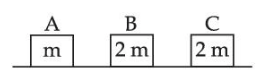
Three objects \(A, B\) and \(C\) are kept in a straight line on a frictionless horizontal surface. The masses of \(A, B\) and \(C\) are \(m, 2 m\) and \(2 m\) respectively. A moves towards B with a speed of \(9 m / s\) and makes an elastic collision with it. Thereafter B makes a completely inelastic collision with C . All motions occur along same straight line. The final speed of C is :[JEE Main 2021 (Online) 27th July Morning Shift]
 CorrectIncorrect
Hint
(d) To find the final speed of object \(C\), we must analyze the process in two distinct stages: the elastic collision between \(A\) and \(B\), and the inelastic collision between \(B\) and \(C\).
Step 1: Elastic Collision between \(A\) and \(B\)
Initially, \(A\) moves with velocity \(u_A=9 m / s\) toward \(B\), which is at rest ( \(u_B=0\) ).
Mass of A ( \(m_A\) ): \(m\)
Mass of B \(\left(m_B\right)\) : \(2 m\)
In a 1-D elastic collision, the final velocity of the second object \(\left(v_B\right)\) is given by:
\(
v_B=\frac{2 m_A u_A+\left(m_B-m_A\right) u_B}{m_A+m_B}
\)
Substituting the values:
\(
\begin{gathered}
v_B=\frac{2(m)(9)+(2 m-m)(0)}{m+2 m} \\
v_B=\frac{18 m}{3 m}=6 m / s
\end{gathered}
\)
After this collision, object \(B\) moves toward \(C\) with a speed of \(6 m / s\).
Step 2: Inelastic Collision between B and C
Now, \(B\) (moving at \(6 m / s\) ) hits \(C\), which is at rest. Since the collision is completely inelastic, they stick together and move with a common final velocity ( \(v_f\) ).
Mass of B \(\left(m_B\right): 2 m\)
Mass of C \(\left(m_C\right)\) : \(2 m\)
Initial velocity of B( \(v_B\) ): \(6 m / s\)
Initial velocity of C: \(0 m / s\)
Applying the Conservation of Linear Momentum:
\(
\begin{aligned}
m_B v_B+m_C(0) & =\left(m_B+m_C\right) v_f \\
(2 m)(6) & =(2 m+2 m) v_f \\
12 m & =4 m \cdot v_f
\end{aligned}
\)
Solving for \(v_f\) :
\(
v_f=\frac{12 m}{4 m}=3 m / s
\)
The final speed of object \(C\) is \(3 m / s\).
Summary of Events:
(i) A hits B (Elastic): A slows down, and B gains a speed of \(6 m / s\).
(ii) B hits C (Inelastic): \(B\) and \(C\) merge to form a mass of \(4 m\) moving at \(3 m / s\). - Question 35 of 55
35. Question
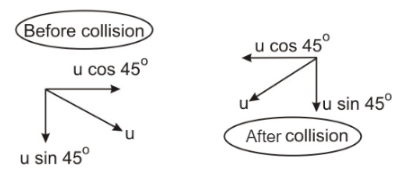
Two billiard balls of equal mass 30 g strike a rigid wall with same speed of 108 kmph (as shown) but at different angles. If the balls get reflected with the same speed then the ratio of the magnitude of impulses imparted to ball ‘ \(a\) ‘ and ball ‘ \(b\) ‘ by the wall along ‘ \(X\) ‘ direction is : [JEE Main 2021 (Online) 25th July Morning Shift]
CorrectIncorrectHint
(a)

\(
\begin{aligned}
& \vec{p_i}=m u \hat{i} \\
& \vec{p_f}=m u(-\hat{i}) \text { (rebounds with same speed) }\\
& \text { Impulse imparted to ball } a \rightarrow \Delta \vec{p}_a=-2 m u(\hat{i}) \dots(1)
\end{aligned}
\)
\(
\begin{aligned}
&\text { For ball b, }\\
&\begin{aligned}
\vec{p_i} & =m u \cos 45^{\circ} i+m u \sin 45^{\circ}(-\hat{j}) \\
\vec{p_f} & =m u \cos 45^{\circ}(-\hat{i})+m u \sin 45^{\circ}(-\hat{j}) \\
\Delta \vec{p} & =2 m u \cos 45^{\circ}(-\hat{i}) \dots(2)
\end{aligned}
\end{aligned}
\)
\(
1 \div 2
\)
\(
\frac{\left|\Delta \vec{p}_a\right|}{\left|\Delta \vec{p}_b\right|}=\frac{2 m u}{2 m u \cos 45^{\circ}}=\sqrt{2}
\) - Question 36 of 55
36. Question
A bullet of ‘ 4 g ‘ mass is fired from a gun of mass 4 kg. If the bullet moves with the muzzle speed of \(50 ms^{-1}\), the impulse imparted to the gun and velocity of recoil of gun are: [JEE Main 2021 (Online) 22th July Evening Shift]
CorrectIncorrectHint
(c) Step 1: Calculate Impulse
The impulse imparted to the gun is equal to the change in momentum of the bullet, which is the product of the bullet’s mass and its muzzle speed. We first convert the bullet’s mass to kilograms: \(4 g=0.004 kg\). The impulse \(I\) is calculated as:
\(
\begin{gathered}
I=m_{\text {bullet }} v_{\text {bullet }} \\
I=0.004 kg \times 50 ms^{-1} \\
I=0.2 kg ms^{-1}
\end{gathered}
\)
Step 2: Calculate Recoil Velocity
According to the principle of conservation of linear momentum, the total momentum of the system (gun and bullet) before firing is zero, and must remain zero after firing. Thus, the momentum of the gun ( \(P _{\text {gun }}\) ) must be equal in magnitude and opposite in direction to the momentum of the bullet ( \(\left.P _{\text {bullet }}\right)\) :
\(
\begin{gathered}
P_{gun}+P_{bullet}=0 \\
M_{gun} V_{gun}+m_{bullet} v_{bullet}=0
\end{gathered}
\)
We can solve for the recoil velocity of the gun \(V _{\text {gun }}\) :
\(
V_{\text {gun }}=-\frac{m_{\text {bullet }} v_{\text {bullet }}}{M_{\text {gun }}}
\)
The magnitude of the recoil velocity is:
\(
\begin{gathered}
\left|V_{\text {gun }}\right|=\frac{0.2 kg ms^{-1}}{4 kg} \\
\left|V_{\text {gun }}\right|=0.05 ms^{-1}
\end{gathered}
\)
The impulse imparted to the gun is \(0 . 2 ~ kg ms ^{- 1 }\) and the velocity of recoil of the gun is \(0.05 ms^{-1}\). - Question 37 of 55
37. Question
If the Kinetic energy of a moving body becomes four times its initial Kinetic energy, then the percentage change in its momentum will be : [JEE Main 2021 (Online) 20th July Evening Shift]
CorrectIncorrectHint
(a) Step 1: Establish the relationship
The relationship between kinetic energy ( \(K E\) ) and momentum ( \(p\) ) is derived from their respective formulas, \(K E =\frac{1}{2} m v ^2\) and \(p = m v\). By substituting velocity \(v =\frac{ p }{ m }\), we get the kinetic energy in terms of momentum:
\(
K E=\frac{p^2}{2 m}
\)
From this, momentum can be expressed as \(p=\sqrt{2 m K E}\).
Step 2: Calculate the final momentum
Let the initial kinetic energy and momentum be \(K E _{ i }\) and \(p _{ i }\). The final kinetic energy \(K E _{ f }\) is four times the initial, \(K E _{ f }= 4 K E _{ i }\). The final momentum \(p _{ f }\) is:
\(
p_f=\sqrt{2 m K E_f}=\sqrt{2 m\left(4 K E_i\right)}=\sqrt{4 \times 2 m K E_i}=2 \sqrt{2 m K E_i}=2 p_i
\)
The final momentum is twice the initial momentum.
Step 3: Determine the percentage change
The change in momentum ( \(\Delta p\) ) is \(p_f-p_i=2 p_i-p_i=p_i\).
The percentage change is calculated as:
\(
\text { Percentage Change }=\left(\frac{\Delta p}{p_i}\right) \times 100 \%=\left(\frac{p_i}{p_i}\right) \times 100 \%=1 \times 100 \%=100 \%
\)
The percentage change in the body’s momentum will be \(100 \%\). - Question 38 of 55
38. Question
An object of mass \(m_1\) collides with another object of mass \(m_2\), which is at rest. After the collision the objects move with equal speeds in opposite direction. The ratio of the masses \(m_2: m_1\) is : [JEE Main 2021 (Online) 18th March Evening Shift]
CorrectIncorrectHint
(b) To solve for the ratio of the masses \(m_2: m_1\), we analyze the collision using the principles of conservation of momentum and the coefficient of restitution (\(e\)).
Step 1: Conservation of Linear Momentum
Let object \(1\left(m_1\right)\) have an initial velocity \(u_1=u\) and object \(2\left(m_2\right)\) be at rest ( \(u_2=0\) ). After the collision, both objects move with equal speeds \(v\) in opposite directions.
Final velocity of \(m_1: v_1=-v\)
Final velocity of \(m_2: v_2=v\)
According to the Law of Conservation of Momentum:
\(
\begin{gathered}
m_1 u_1+m_2 u_2=m_1 v_1+m_2 v_2 \\
m_1 u+m_2(0)=m_1(-v)+m_2(v) \\
m_1 u=v\left(m_2-m_1\right) \quad \dots(1)
\end{gathered}
\)
Step 2: Elastic Collision and Coefficient of Restitution
For the objects to move in opposite directions after a head-on collision, the collision is typically assumed to be elastic ( \(e=1\) ) unless otherwise specified. The coefficient of restitution is defined as the ratio of the velocity of separation to the velocity of approach:
\(
\begin{gathered}
e=\frac{v_2-v_1}{u_1-u_2} \\
1=\frac{v-(-v)}{u-0} \\
1=\frac{2 v}{u} \Longrightarrow u=2 v \quad dots(2)
\end{gathered}
\)
Step 3: Calculating the Mass Ratio
Now, substitute the value of \(u\) from Equation 2 into Equation 1:
\(
m_1(2 v)=v\left(m_2-m_1\right)
\)
Divide both sides by \(v\) :
\(
\begin{gathered}
2 m_1=m_2-m_1 \\
3 m_1=m_2
\end{gathered}
\)
The ratio \(m_2: m_1\) is:
\(
\frac{m_2}{m_1}=\frac{3}{1}
\)
The ratio of the masses \(m_2: m_1\) is \(3: 1\). - Question 39 of 55
39. Question
Two identical blocks \(A\) and \(B\) each of mass \(m\) resting on the smooth horizontal floor are connected by a light spring of natural length \(L\) and spring constant \(K\). A third block C of mass m moving with a speed v along the line joining A and B collides with A. The maximum compression in the spring is [JEE Main 2021 (Online) 17th March Evening Shift]
 CorrectIncorrect
Hint
(d)

Stage 1: Collision between C and A
Since block \(C\) and block \(A\) have equal masses ( \(m\) ) and the collision is elastic, they interchange their velocities.
Before collision: Block \(C\) moves with speed \(v\), and block \(A\) (attached to the spring) is at rest.
Immediately after collision: Block \(C\) comes to rest, and block \(A\) starts moving with speed \(v\). At this instant, the spring is still at its natural length, and block \(B\) is still at rest.
Step 2: Velocity of center of mass
After the collision, block \(A\) moves towards block \(B\) (which is at rest), starting the spring compression. Maximum compression occurs when both blocks move with the same common velocity, which is the velocity of the center of mass ( \(V _{ c m }\) ) of the \(A + B\) system. By conservation of momentum for the \(A + B\) system:
\(
m v=(m+m) V_{c m}
\)
The common velocity is calculated as \(V_{c m}=\frac{v}{2}\).
Step 3: Conservation of energy
The conservation of mechanical energy is applied to the \(A + B\) system from the moment \(A\) starts moving until maximum compression ( \(x _{\text {max }}\) ) is reached:
\(
\frac{1}{2} m v^2=\frac{1}{2}(2 m) V_{c m}^2+\frac{1}{2} K x_{\max }^2
\)
Substituting \(V_{c m}=v / 2\) into the equation:
\(
\begin{gathered}
\frac{1}{2} m v^2=\frac{1}{2}(2 m)\left(\frac{v}{2}\right)^2+\frac{1}{2} K x_{\max }^2 \\
\frac{1}{2} m v^2-\frac{1}{4} m v^2=\frac{1}{2} K x_{\max }^2 \\
\frac{1}{4} m v^2=\frac{1}{2} K x_{\max }^2
\end{gathered}
\)
Solving for \(x _{\text {max }}\) yields:
\(
x_{\max }=v \sqrt{\frac{m}{2 K}}
\)Alternate explanation for step 2:The initial kinetic energy of the \(A-B\) system (immediately after \(C\) hits \(A\) ) is converted into the kinetic energy of the center of mass plus the potential energy of the compressed spring.
Initial K.E. of A-B system: \(\frac{1}{2} m v^2\)
Final K.E. at max compression: \(\frac{1}{2}(2 m) V_{c m}^2=\frac{1}{2}(2 m)\left(\frac{v}{2}\right)^2=\frac{1}{4} m v^2\)
Spring Potential Energy: \(\frac{1}{2} K x^2\)
Applying the energy conservation principle:
\(
\begin{gathered}
\text { Initial Energy }=\text { Final Energy } \\
\frac{1}{2} m v^2=\frac{1}{4} m v^2+\frac{1}{2} K x^2 \\
\frac{1}{4} m v^2=\frac{1}{2} K x^2 \Longrightarrow \frac{1}{2} m v^2=K x^2 \\
x^2=\frac{m v^2}{2 K}
\end{gathered}
\)
\(
x=v \sqrt{\frac{m}{2 K}}
\)
The maximum compression in the spring is \(v \sqrt{\frac{m}{2 R}}\). - Question 40 of 55
40. Question
A large block of wood of mass \(M=5.99 kg\) is hanging from two long massless cords. A bullet of mass \(m =10 g\) is fired into the block and gets embedded in it. The (block + bullet) then swing upwards, their centre of mass rising a vertical distance \(h =9.8 cm\) before the (block + bullet) pendulum comes momentarily to rest at the end of its arc. The speed of the bullet just before collision is: (take \(g =9.8 ms^{-2}\) )
 CorrectIncorrect
Hint
(a) Step 1: Velocity of System Immediately After Collision
First, we analyze the second stage (the swing). After the bullet is embedded (After the bullet embeds in the block, the combined system swings upwards. In this phase, kinetic energy is converted into gravitational potential energy), the combined system (mass \(M+m\) ) moves with a velocity \(v_c\). At the highest point of the swing, all kinetic energy is converted into gravitational potential energy.
Using the Law of Conservation of Mechanical Energy:
\(
\frac{1}{2}(M+m) v_c^2=(M+m) g h
\)
Solving for \(v_c\) :
\(
v_c=\sqrt{2 g h}
\)
Given:
\(g=9.8 m / s ^2\)
\(h=9.8 cm=0.098 m\)
\(
v_c=\sqrt{2 \times 9.8 \times 0.098}=\sqrt{1.9208} \approx 1.386 m / s
\)
Step 2: Speed of the Bullet Just Before Collision
Next, we analyze the first stage (the collision). During the impact, linear momentum is conserved.
Mass of bullet \((m): 10 g=0.01 kg\)
Mass of block (M): 5.99 kg
Total mass \((M+m): 5.99+0.01=6.00 kg\)
Initial velocity of bullet \((u)\) : ?
Using the Law of Conservation of Momentum:
\(
\begin{gathered}
m \cdot u=(M+m) \cdot v_c \\
0.01 \cdot u=(6.00) \cdot 1.386 \\
u=\frac{6.00 \times 1.386}{0.01}=600 \times 1.386 \\
u \approx 831.4 m / s
\end{gathered}
\) - Question 41 of 55
41. Question
Four equal masses, \(m\) each are placed at the comers of a square of length \((I)\) as shown in the figure. The moment of inertia of the system about an axis passing through A and parallel to DB would be : [JEE Main 2021 (Online) 16th March Morning Shift]
 CorrectIncorrect
Hint
(d)

To find the moment of inertia of the system about the specified axis, we need to calculate the perpendicular distance of each mass from that axis and apply the formula \(I=\sum m_i r_i^2\).
Step 1: Understanding the Geometry
The square has four masses, each of mass \(m\), at corners \(A, B, C\), and \(D\). Let the side length of the square be \(l\).
The Axis: Passes through point \(A\) and is parallel to the diagonal \(D B\).
The Diagonal \(D B\) : The length of a diagonal in a square of side \(l\) is \(l \sqrt{2}\).
Step 2: Calculating Perpendicular Distances ( \(r\) )
We need the distance of each mass from the axis passing through \(A\) :
(i) Mass at A : Since the axis passes through \(A\), its distance is \(r_A=0\).
(ii) Masses at B and D: In a square, the diagonals are perpendicular and bisect each other. The distance from \(B\) (or \(D\) ) to the diagonal \(A C\) is half the length of the other diagonal. Since the axis is parallel to \(D B\) and passes through \(A\), the perpendicular distance from \(B\) and \(D\) to this axis is:
\(
r_B=r_D=\frac{\text { Diagonal }}{2}=\frac{l \sqrt{2}}{2}=\frac{l}{\sqrt{2}}
\)
(iii) Mass at C : Point \(C\) is on the opposite corner. The distance from \(C\) to point \(A\) along the diagonal \(A C\) is the full diagonal length. Since the axis is perpendicular to \(A C\) (because it is parallel to \(D B\) ), the distance is:
\(
r_C=\text { Diagonal }=l \sqrt{2}
\)
Step 3: Calculating Total Moment of Inertia ( \(I\) )
Now, we sum the moments of inertia for all four masses:
\(
I=m\left(r_A\right)^2+m\left(r_B\right)^2+m\left(r_C\right)^2+m\left(r_D\right)^2
\)
\(
I=m(0)^2+m\left(\frac{l}{\sqrt{2}}\right)^2+m(l \sqrt{2})^2+m\left(\frac{l}{\sqrt{2}}\right)^2
\)
Substitute the values:
\(
\begin{gathered}
I=0+m\left(\frac{l^2}{2}\right)+m\left(2 l^2\right)+m\left(\frac{l^2}{2}\right) \\
I=\frac{m l^2}{2}+2 m l^2+\frac{m l^2}{2} \\
I=m l^2+2 m l^2=3 m l^2
\end{gathered}
\)
The moment of inertia of the system about the axis passing through \(A\) and parallel to \(D B\) is \(3 m l^2\). - Question 42 of 55
42. Question
Given below are two statements : one is labelled as Assertion A and the other is labelled as Reason R.
Assertion A : Body ‘ \(P\) ‘ having mass \(M\) moving with speed ‘ \(u\) ‘ has head-on collision elastically with another body ‘ \(Q\) ‘ having mass ‘ \(m\) ‘ initially at rest. If \(m \ll M\), body ‘ \(Q\) ‘ will have a maximum speed equal to ‘ \(2 u\) ‘ after collision.
Reason R : During elastic collision, the momentum and kinetic energy are both conserved.
In the light of the above statements, choose the most appropriate answer from the options given below : [JEE Main 2021 (Online) 26th February Morning Shift]CorrectIncorrectHint
(c)

Step 1: Analysis of Assertion (A)
In a one-dimensional (head-on) elastic collision where a body of mass \(M\) strikes a stationary body of mass \(m\), the final velocity of the second body \(\left(v_Q\right)\) is given by the formula:
\(
v_Q=\frac{2 M}{M+m} u+\frac{m-M}{M+m} v_{Q, \text { initial }}
\)
Given that body \(Q\) is initially at rest ( \(v_{Q \text {,initial }}=0\) ), the formula simplifies to:
\(
v_Q=\left(\frac{2 M}{M+m}\right) u
\)
If \(m \ll M\) (meaning \(m\) is negligible compared to \(M\) ), the term ( \(M+m\) ) is approximately equal to \(M\). Thus:
\(
v_Q \approx\left(\frac{2 M}{M}\right) u=2 u
\)
Assertion A is correct.
Step 2: Analysis of Reason (R)
By definition, an elastic collision is one in which:
Linear Momentum is conserved \(\left(p_{\text {initial }}=p_{\text {final }}\right)\).
Kinetic Energy is conserved \(\left(K_{\text {initial }}=K_{\text {final }}\right)\).
Reason R is correct.
Step 3: Relationship between A and R
The formula used to prove Assertion \(A \left(v_Q=2 u\right)\) is derived directly by solving the two simultaneous equations provided by the conservation of momentum and the conservation of kinetic energy.
Specifically:
1. \(M u=M v_P+m v_Q\) (Momentum)
2. \(\frac{1}{2} M u^2=\frac{1}{2} M v_P^2+\frac{1}{2} m v_Q^2\) (Kinetic Energy)
Since Reason R provides the fundamental laws that lead to the result in Assertion A, it serves as the correct explanation.
Both A and R are correct, and R is the correct explanation of A. - Question 43 of 55
43. Question
A circular hole of radius \(\left(\frac{a}{2}\right)\) is cut out of a circular disc of radius ‘ \(a\) ‘ as shown in figure. The centroid of the remaining circular portion with respect to point ‘ O ‘ will be : [JEE Main 2021 (Online) 24th February Evening Shift]
 CorrectIncorrect
Hint
(c) Step 1: Define parameters and coordinate system
Let the large disc (radius \(a\) ) be centered at the origin \(O =(0,0)\) of a coordinate system.
Point \(O\) (Origin): Let’s assume point \(O(0,0)\) is at the left-most edge of the large disc as shown in figure.
Large Disc (Full):
Radius \(R_1=a\).
Center \(C_1\) is at \(x_1=a\).
Area \(A_1=\pi a^2\).
Circular Hole:
Radius \(R_2=a / 2\).
Center \(C_2\) is at \(x_2=a+a / 2=3 a / 2\) (since it is cut out from the other side or touching the edge).
Area \(A_2=\pi(a / 2)^2=\pi a^2 / 4\).
Step 2: Centroid Calculation
We use the formula for the center of mass of a system with a removed part:
\(
X_{c m}=\frac{A_1 x_1-A_2 x_2}{A_1-A_2}
\)
Substitute the values:
\(
\begin{gathered}
X_{c m}=\frac{\left(\pi a^2\right)(a)-\left(\frac{\pi a^2}{4}\right)\left(\frac{3 a}{2}\right)}{\pi a^2-\frac{\pi a^2}{4}} \\
X_{c m}=\frac{\pi a^3-\frac{3 \pi a^3}{8}}{\frac{3 \pi a^2}{4}} \\
X_{c m}=\frac{\frac{5 \pi a^3}{8}}{\frac{3 \pi a^2}{4}}
\end{gathered}
\)
Step 3: Simplifying the Result
\(
X_{c m}=\frac{5 a}{8} \times \frac{4}{3}=\frac{5 a}{6}
\)
The centroid of the remaining circular portion with respect to point \(O\) is \(\frac{5}{6} a\). - Question 44 of 55
44. Question
Particle A of mass \(m _1\) moving with velocity \((\sqrt{3} \hat{i}+\hat{j}) m s^{-1}\) collides with another particle B of mass \(m _2\) which is at rest initially. Let \(\vec{V}_1\) and \(\overrightarrow{V_2}\) be the velocities of particles \(A\) and \(B\) after collision respectively. If \(m_1=2 m_2\) and after collision \(\overrightarrow{V_1}=(\hat{i}+\sqrt{3} \hat{j})\), the angle between \(\overrightarrow{V_1}\) and \(\vec{V}_2\) is : [JEE Main 2020 (Online) 6th September Evening Slot]
CorrectIncorrectHint
(a) To find the angle between the final velocities \(V_1\) and \(V_2\), we apply the Law of Conservation of Linear Momentum in vector form.
Step 1: Identify the Given Data
Masses: \(m_1=2 m_2\)
Initial Velocity of \(A \left(u_1\right):(\sqrt{3 \hat{i}}+\hat{j}) m / s\)
Initial Velocity of B ( \(u_2\) ): 0 (at rest)
Final Velocity of \(A \left(V_1\right):(\hat{i}+\sqrt{3} \hat{j}) m / s\)
Step 2: Conservation of Momentum
The total initial momentum must equal the total final momentum:
\(
m_1 u_1+m_2 u_2=m_1 V_1+m_2 V_2
\)
Substitute \(m_1=2 m_2\) and \(u_2=0\) :
\(
2 m_2(\sqrt{3} \hat{i}+\hat{j})+0=2 m_2(\hat{i}+\sqrt{3} \hat{j})+m_2 V_2
\)
Divide the entire equation by \(m_2\) :
\(
2(\sqrt{3} \hat{i}+\hat{j})=2(\hat{i}+\sqrt{3} \hat{j})+V_2
\)
\(
V_2=(2 \sqrt{3}-2) \hat{i}+(2-2 \sqrt{3}) \hat{j}
\)
Step 3: Calculate the angle using dot product
The angle \(\theta\) is found using the dot product formula \(\cos (\theta)=\frac{\vec{V}_1 \cdot \vec{V}_2}{\left|\vec{V}_1\right|\left|\vec{V}_2\right|}\).
The dot product is \(\vec{V}_1 \cdot \vec{V}_2=(\hat{i}+\sqrt{3} \hat{j}) \cdot((2 \sqrt{3}-2) \hat{i}+(2-2 \sqrt{3}) \hat{j})=4 \sqrt{3}-8\). The magnitudes are \(\left|\vec{V}_1\right|=2\) and \(\left|\vec{V}_2\right|=2 \sqrt{2}(\sqrt{3}-1)\).
\(
\cos (\theta)=\frac{4 \sqrt{3}-8}{2 \times 2 \sqrt{2}(\sqrt{3}-1)}=\frac{\sqrt{2}-\sqrt{6}}{4}
\)
This value of \(\cos (\theta)\) corresponds to \(\theta=105^{\circ}\). - Question 45 of 55
45. Question
Blocks of masses \(m, 2 m, 4 m\) and \(8 m\) are arranged in a line on a frictionless floor. Another block of mass \(m\), moving with speed \(v\) along the same line (see figure) collides with mass \(m\) in perfectly inelastic manner. All the subsequent collisions are also perfectly inelastic. By the time the last block of mass 8 m starts moving the total energy loss is \(p\%\) of the original energy. Value of ‘\(p\)’ is close to : [JEE Main 2020 (Online) 4th September Morning Slot]
 CorrectIncorrect
Hint
(d) To find the value of \(p\), we need to calculate the final kinetic energy of the system after all the blocks have collided and compare it to the original kinetic energy.
Step 1: Conservation of Linear Momentum
In a perfectly inelastic collision, the colliding bodies stick together and move with a common velocity. Since all subsequent collisions are perfectly inelastic, all blocks will eventually move together as a single mass.
Initial Momentum ( \(P_i\) ): Only the first block of mass \(m\) is moving with velocity \(v\).
\(
P_i=m \times v
\)
Final Total Mass ( \(M_{\text {total }}\) ): The sum of all the masses involved in the collisions.
\(
M_{\text {total }}=m+m+2 m+4 m+8 m=16 m
\)
Final Common Velocity ( \(V_f\) ): According to the law of conservation of momentum:
\(
\begin{gathered}
P_i=M_{\text {total }} \times V_f \\
m v=16 m \times V_f \Longrightarrow V_f=\frac{v}{16}
\end{gathered}
\)
Step 2: Energy Loss Calculation
Now, we compare the initial kinetic energy ( \(K_i\) ) with the final kinetic energy ( \(K_f\) ).
Original Energy \(\left(K_i\right)\) :
\(
K_i=\frac{1}{2} m v^2
\)
Final Kinetic Energy \(\left(K_f\right)\) :
\(
\begin{aligned}
K_f=\frac{1}{2}(16 m)\left(\frac{v}{16}\right)^2 & =\frac{1}{2}(16 m) \frac{v^2}{256}=\frac{1}{2} m \frac{v^2}{16} \\
K_f & =\frac{K_i}{16}
\end{aligned}
\)
Step 3: Calculating the Percentage Loss ( \(p\) )
The energy loss is the difference between the initial and final kinetic energies.
Total Energy Loss \((\Delta K)\) :
\(
\Delta K=K_i-K_f=K_i-\frac{K_i}{16}=\frac{15}{16} K_i
\)
Value of ‘ \(p\) ‘:
\(
\begin{aligned}
& p=\frac{\Delta K}{K_i} \times 100=\frac{15}{16} \times 100 \\
& p=0.9375 \times 100=93.75 \%
\end{aligned}
\)
The value of ‘ \(p\) ‘ is approximately 94. - Question 46 of 55
46. Question
A block of mass 1.9 kg is at rest at the edge of a table, of height 1 m. A bullet of mass 0.1 kg collides with the block and sticks to it. If the velocity of the bullet is \(20 m / s\) in the horizontal direction just before the collision then the kinetic energy just before the combined system strikes the floor, is [Take \(g =10 m / s ^2\). Assume there is no rotational motion and loss of energy after the collision is negligable.] [JEE Main 2020 (Online) 3rd September Evening Slot]
CorrectIncorrectHint
(b) Step 1: Calculate the combined velocity after collision
The collision is a perfectly inelastic collision in the horizontal direction. We apply the principle of conservation of linear momentum in the horizontal direction.
The combined velocity \(v_{\text {combined }}\) immediately after the collision is given by:
\(
m v_b+M v_B=(m+M) v_{\text {combined }}
\)
Substituting the given values:
\(
\begin{gathered}
(0.1 kg)(20 m / s)+(1.9 kg)(0 m / s)=(0.1 kg+1.9 kg) v_{\text {combined }} \\
2.0 kg \cdot m / s=(2.0 kg) v_{\text {combined }} \\
v_{\text {combined }}=1.0 m / s
\end{gathered}
\)
Step 2: Calculate final kinetic energy using energy conservation
After the collision, the combined system falls from a height \(h\). The horizontal velocity \(v _{\text {combined }}\) remains constant. We can find the final kinetic energy \(K E _{ f }\) just before striking the floor using the principle of conservation of mechanical energy during the fall (assuming air resistance is negligible).
The initial mechanical energy just after the collision (at height \(h\) ) is equal to the final mechanical energy just before impact (at height 0 ):
\(
\begin{gathered}
K E_i+P E_i=K E_f+P E_f \\
\frac{1}{2}(m+M) v_{\text {combined }}^2+(m+M) g h=K E_f+0
\end{gathered}
\)
We solve for \(K E _{ f }\) :
\(
K E_f=\frac{1}{2}(m+M) v_{\text {combined }}^2+(m+M) g h
\)
Substituting the values:
\(
\begin{gathered}
K E_f=\frac{1}{2}(2.0 kg)(1.0 m / s)^2+(2.0 kg)\left(10 m / s^2\right)(1.0 m) \\
K E_f=1.0 J+20.0 J \\
K E_f=21 J
\end{gathered}
\)
The kinetic energy just before the combined system strikes the floor is \(2 1 J\). - Question 47 of 55
47. Question
A block of mass \(m=1 kg\) slides with velocity \(v=6 m / s\) on a frictionless horizontal surface and collides with a uniform vertical rod and sticks to it as shown. The rod is pivoted about 0 and swings as a result of the collision making angle \(\theta\) before momentarily coming to rest. If the rod has mass \(M =2 kg\), and length \(l=1 m\), the value of \(\theta\) is approximately : [JEE Main 2020 (Online) 3rd September Morning Slot]
(take \(g =10 m / s ^2\) ) CorrectIncorrect
Hint
(a) To find the angle \(\theta\), we analyze this problem in two stages: the collision (conservation of angular momentum) and the swing (conservation of mechanical energy).
Step 1: Conservation of Angular Momentum
Since the rod is pivoted at point \(O\), linear momentum is not conserved due to the pivot force, but angular momentum \((L)\) about point \(O\) is conserved during the collision.
Initial Angular Momentum \(\left(L_i\right)\) : Only the block is moving. Its angular momentum relative to \(O\) is \(m v l\).
Final Angular Momentum ( \(L_f\) ): The block sticks to the rod. The system rotates with an angular velocity \(\omega\).
\(
L_f=I_{\text {total }} \omega
\)
Calculating the Moment of Inertia ( \(I_{\text {total }}\) ):
Moment of inertia of the rod about its end \(O: I_{\text {rod }}=\frac{1}{3} M l^2\)
Moment of inertia of the block (point mass) at the end: \(I_{\text {block }}=m l^2\)
\(
I_{\text {total }}=\frac{1}{3} M l^2+m l^2=\left(\frac{M}{3}+m\right) l^2
\)
Substituting the given values ( \(m=1 kg, M=2 kg, l=1 m, v=6 m / s\) ):
\(
I_{\text {total }}=\left(\frac{2}{3}+1\right)(1)^2=\frac{5}{3} kg \cdot m^2
\)
Solving for \(\omega\) :
\(
L_i=L_f \Longrightarrow m v l=I_{\text {total }} \omega
\)
\(
(1)(6)(1)=\left(\frac{5}{3}\right) \omega \Longrightarrow \omega=\frac{18}{5}=3.6 rad / s
\)
Step 2: Conservation of Mechanical Energy
After the collision, the kinetic energy of the system is converted into gravitational potential energy as it swings to an angle \(\theta\).
Initial Rotational Kinetic Energy ( \(K\) ):
\(
K=\frac{1}{2} I_{\text {total } \omega^2}=\frac{1}{2}\left(\frac{5}{3}\right)(3.6)^2=\frac{1}{2}\left(\frac{5}{3}\right)(12.96)=10.8 J
\)
Gain in Potential Energy ( \(\Delta U\) ): The center of mass of the rod (at \(l / 2\) ) and the block (at \(l\) ) both rise.
\(
\begin{gathered}
\Delta U=M g \frac{l}{2}(1-\cos \theta)+m g l(1-\cos \theta) \\
\Delta U=\left(M g \frac{l}{2}+m g l\right)(1-\cos \theta)
\end{gathered}
\)
Substitute the values:
\(
\begin{gathered}
\Delta U=(2 \times 10 \times 0.5+1 \times 10 \times 1)(1-\cos \theta) \\
\Delta U=(10+10)(1-\cos \theta)=20(1-\cos \theta)
\end{gathered}
\)
Step 3: Calculating \(\theta\)
Set \(K=\Delta U\) :
\(
\begin{gathered}
10.8=20(1-\cos \theta) \\
1-\cos \theta=\frac{10.8}{20}=0.54 \\
\cos \theta=1-0.54=0.46
\end{gathered}
\)
Using the inverse cosine:
\(
\theta=\cos ^{-1}(0.46) \approx 62.6^{\circ}
\)
The value of \(\theta\) is approximately \(63^{\circ}\). - Question 48 of 55
48. Question
A particle of mass \(m\) with an initial velocity \(u \hat{i}\) collides perfectly elastically with a mass 3 m at rest. It moves with a velocity \(v \hat{j}\) after collision, then, \(v\) is given by : [JEE Main 2020 (Online) 2nd September Morning Slot]
CorrectIncorrectHint
(c)

Step 1: Conservation of Linear Momentum
The total momentum before the collision must equal the total momentum after the collision in both the \(x\) and \(y\) directions.
Initial Momentum: \(p_i=m(u \hat{i})+3 m(0)=m u \hat{i}\)
Final Momentum: Let the velocity of the \(3 m\) mass after collision be \(V=V_x \hat{i}+V_y \hat{j}\).
\(
p_f=m(v \hat{j})+3 m\left(V_x \hat{i}+V_y \hat{j}\right)
\)
Equating the components:
X-direction: \(m u=3 m V_x \Longrightarrow V_x=\frac{u}{3}\)
Y-direction: \(0 =m v+3 m V_y \Longrightarrow V_y=-\frac{v}{3}\)
The magnitude of the velocity squared of the 3 m mass is:
\(
V^2=V_x^2+V_y^2=\left(\frac{u}{3}\right)^2+\left(-\frac{v}{3}\right)^2=\frac{u^2+v^2}{9}
\)
Step 2: Conservation of Kinetic Energy
In a perfectly elastic collision, the total kinetic energy is conserved.
\(
\frac{1}{2} m u^2+0=\frac{1}{2} m v^2+\frac{1}{2}(3 m) V^2
\)
Divide by \(\frac{1}{2} m\) :
\(
u^2=v^2+3 V^2
\)
Substitute the value of \(V^2\) calculated in step 1:
\(
\begin{gathered}
u^2=v^2+3\left(\frac{u^2+v^2}{9}\right) \\
u^2=v^2+\frac{u^2+v^2}{3}
\end{gathered}
\)
Step 3: Solving for \(v\)
Multiply the entire equation by 3 to clear the fraction:
\(
\begin{gathered}
3 u^2=3 v^2+u^2+v^2 \\
3 u^2-u^2=4 v^2 \\
2 u^2=4 v^2 \\
v^2=\frac{2 u^2}{4}=\frac{u^2}{2} \\
v=\frac{u}{\sqrt{2}}
\end{gathered}
\)
The value of \(v\) is given by \(v=\frac{u}{\sqrt{2}}\). - Question 49 of 55
49. Question
A particle of mass \(m\) is projected with a speed \(u\) from the ground at an angle \(\theta=\frac{\pi}{3}\) w.r.t. horizontal ( \(x\)-axis). When it has reached its maximum height, it collides completely inelastically with another particle of the same mass and velocity \(u \hat{i}\). The horizontal distance covered by the combined mass before reaching the ground is: [JEE Main 2020 (Online) 9th January Evening Slot]
CorrectIncorrectHint
(b)

To find the horizontal distance covered by the combined mass after the collision, we break the problem into three stages: the motion to maximum height, the inelastic collision, and the projectile motion of the combined mass.
STep 1: Velocity at Maximum Height
The first particle is projected with speed \(u\) at an angle \(\theta=\frac{\pi}{3}\left(60^{\circ}\right)\). At maximum height, its vertical velocity is zero, and it only possesses its horizontal component of velocity.
Horizontal velocity of particle \(1\left(v_1\right): u \cos \left(60^{\circ}\right) \hat{i}=\frac{u}{2} \hat{i}\)
Step 2: The Inelastic Collision
At the maximum height, particle 1 collides with particle 2 , which has mass \(m\) and velocity \(v_2= u \hat{i}\). Since the collision is completely inelastic, they stick together and move with a common velocity \(V\).
Applying Conservation of Linear Momentum:
\(
\begin{aligned}
& m v_1+m v_2=(m+m) V \\
& m\left(\frac{u}{2} \hat{i}\right)+m(u \hat{i})=2 m V
\end{aligned}
\)
\(
\begin{gathered}
\frac{3}{2} m u \hat{i}=2 m V \\
V=\frac{3 u}{4} \hat{i}
\end{gathered}
\)
Step 3: Motion After Collision
The combined mass ( \(2 m\) ) now acts as a projectile launched horizontally from the maximum height \(H\).
Maximum Height (H):
\(
H=\frac{u^2 \sin ^2 \theta}{2 g}=\frac{u^2 \sin ^2\left(60^{\circ}\right)}{2 g}=\frac{u^2(\sqrt{3} / 2)^2}{2 g}=\frac{3 u^2}{8 g}
\)
Time to reach the ground \((t)\) : Since the vertical velocity is zero at the start of this stage, the time to fall from height \(H\) is:
\(
t=\sqrt{\frac{2 H}{g}}=\sqrt{\frac{2\left(3 u^2 / 8 g\right)}{g}}=\sqrt{\frac{3 u^2}{4 g^2}}=\frac{\sqrt{3} u}{2 g}
\)
Step 4: Horizontal Distance Covered
The horizontal distance ( \(x\) ) covered by the combined mass is the product of its horizontal velocity and the time of flight:
\(
\begin{aligned}
x=V \times t & =\left(\frac{3 u}{4}\right)\left(\frac{\sqrt{3} u}{2 g}\right) \\
x & =\frac{3 \sqrt{3} u^2}{8 g}
\end{aligned}
\)
[Image showing the horizontal range of a particle launched from height H]
The horizontal distance covered by the combined mass before reaching the ground is \(\frac{3 \sqrt{3}}{8} \frac{u^2}{g}\). - Question 50 of 55
50. Question
A rod of length \(L\) has non-uniform linear mass density given by \(\rho( x )=a+b\left(\frac{x}{L}\right)^2\), where a and \(b\) are constants and \(0 \leq x \leq L\). The value of x for the centre of mass of the rod is at : [JEE Main 2020 (Online) 9th January Evening Slot]
CorrectIncorrectHint
(c) To find the center of mass ( \(x_{c m}\) ) of a non-uniform rod, we use the continuous distribution formula:
\(
x_{c m}=\frac{\int x d m}{\int d m}
\)
Step 1: Set Up the Integrals
The mass of an infinitesimal element \(d x\) at position \(x\) is \(d m=\rho(x) d x\). Given the linear mass density:
\(
\rho(x)=a+b\left(\frac{x}{L}\right)^2
\)
Step 2: Calculate the Total Mass ( \(M\) )
The denominator of our formula is the total mass of the rod:
\(
M=\int_0^L\left(a+\frac{b}{L^2} x^2\right) d x
\)
\(
\begin{gathered}
M=\left[a x+\frac{b x^3}{3 L^2}\right]_0^L \\
M=a L+\frac{b L^3}{3 L^2}=a L+\frac{b L}{3}=L\left(a+\frac{b}{3}\right)=L\left(\frac{3 a+b}{3}\right)
\end{gathered}
\)
Step 3: Calculate the Moment of Mass ( \(\int x d m\) )
The numerator of our formula is:
\(
\begin{gathered}
\int_0^L x\left(a+\frac{b}{L^2} x^2\right) d x=\int_0^L\left(a x+\frac{b}{L^2} x^3\right) d x \\
\text { Moment }=\left[\frac{a x^2}{2}+\frac{b x^4}{4 L^2}\right]_0^L \\
\text { Moment }=\frac{a L^2}{2}+\frac{b L^4}{4 L^2}=\frac{a L^2}{2}+\frac{b L^2}{4}=L^2\left(\frac{2 a+b}{4}\right)
\end{gathered}
\)
Step 4: Solve for \(x_{c m}\)
\(x_{c m}=\frac{\text { Moment }}{M}\)
\(
\begin{aligned}
&x_{c m}=\frac{L^2\left(\frac{2 a+b}{4}\right)}{L\left(\frac{3 a+b}{3}\right)}\\
&x_{c m}=L\left(\frac{2 a+b}{4}\right)\left(\frac{3}{3 a+b}\right)\\
&x_{c m}=\frac{3}{4}\left(\frac{2 a+b}{3 a+b}\right) L
\end{aligned}
\) - Question 51 of 55
51. Question
Two particles of equal mass \(m\) have respective initial velocities \(u \hat{i}\) and \(u\left(\frac{\hat{i}+\hat{j}}{2}\right)\). They collide completely inelastically. The energy lost in the process is : [JEE Main 2020 (Online) 9th January Morning Slot]
CorrectIncorrectHint
(b) To find the energy lost in a completely inelastic collision, we first determine the final velocity of the combined mass using the conservation of momentum and then calculate the difference between the initial and final kinetic energies.
Step 1: Conservation of Linear Momentum
In a completely inelastic collision, the two particles stick together and move with a common final velocity \(V\).
Masses: \(m_1=m\) and \(m_2=m\).
Initial Velocity of Particle \(1\left(u_1\right)\) : \(u \hat{i}\).
Initial Velocity of Particle \(2\left(u_2\right): u\left(\frac{\hat{i}+\hat{j}}{2}\right)=\frac{u}{2} \hat{i}+\frac{u}{2} \hat{j}\).
\(
\begin{aligned}
&\text { Using the conservation of momentum: }\\
&\begin{gathered}
m_1 u_1+m_2 u_2=\left(m_1+m_2\right) V \\
m(u \hat{i})+m\left(\frac{u}{2} \hat{i}+\frac{u}{2} \hat{j}\right)=(2 m) V \\
m\left(u+\frac{u}{2}\right) \hat{i}+m\left(\frac{u}{2}\right) \hat{j}=2 m V \\
\frac{3 u_i}{2}+\frac{u}{2} \hat{j}=2 V \\
V=\frac{3 u}{4} \hat{i}+\frac{u}{4} \hat{j}
\end{gathered}
\end{aligned}
\)
Step 2: Calculate Initial and Final Kinetic Energies
The energy lost is given by \(\Delta K=K_{\text {initial }}-K_{\text {final }}\).
Initial Kinetic Energy ( \(K _{ i }\) ):
\(
\begin{gathered}
K_i=\frac{1}{2} m\left|u_1\right|^2+\frac{1}{2} m\left|u_2\right|^2 \\
K_i=\frac{1}{2} m\left(u^2\right)+\frac{1}{2} m\left[\left(\frac{u}{2}\right)^2+\left(\frac{u}{2}\right)^2\right] \\
K_i=\frac{1}{2} m u^2+\frac{1}{2} m\left(\frac{u^2}{4}+\frac{u^2}{4}\right)=\frac{1}{2} m u^2+\frac{1}{4} m u^2=\frac{3}{4} m u^2
\end{gathered}
\)
Final Kinetic Energy ( \(K_f\) ):
\(
\begin{gathered}
K_f=\frac{1}{2}(2 m)|V|^2=m\left[\left(\frac{3 u}{4}\right)^2+\left(\frac{u}{4}\right)^2\right] \\
K_f=m\left(\frac{9 u^2}{16}+\frac{u^2}{16}\right)=m\left(\frac{10 u^2}{16}\right)=\frac{5}{8} m u^2
\end{gathered}
\)
Step 3: Energy Lost ( \(\Delta K\) )
\(
\Delta K=K_i-K_f=\frac{3}{4} m u^2-\frac{5}{8} m u^2
\)
To subtract, find a common denominator:
\(
\Delta K=\frac{6}{8} m u^2-\frac{5}{8} m u^2=\frac{1}{8} m u^2
\) - Question 52 of 55
52. Question
A particle of mass \(m\) is dropped from a height \(h\) above the ground. At the same time another particle of the same mass is thrown vertically upwards from the ground with a speed of \(\sqrt{2 g h}\). If they collide head-on completely inelastically, the time taken for the combined mass to reach the ground, in units of \(\sqrt{\frac{h}{g}}\) is : [JEE Main 2020 (Online) 8th January Evening Slot]
CorrectIncorrectHint
(c)

Step 1: Determine collision time and position
We set up equations for the positions of the two particles using \(y=0\) as the ground and the upward direction as positive.
Particle 1 dropped from \(h)\) : \(y_1(t)=h-\frac{1}{2} g t^2\)
Particle 2 (thrown up from ground): \(y_2(t)=\sqrt{2 g h} t-\frac{1}{2} g t^2\).
The collision occurs when \(y_1(t)=y_2(t)\).
\(
\begin{gathered}
h-\frac{1}{2} g t^2=\sqrt{2 g h} t-\frac{1}{2} g t^2 \\
h=\sqrt{2 g h} t
\end{gathered}
\)
The collision time is \(t_{\text {coll }}=\frac{h}{\sqrt{2 g h}}=\frac{1}{\sqrt{2}} \sqrt{\frac{h}{g}}\).
The collision position is \(y_{\text {coll }}=h-\frac{1}{2} g t_{\text {coll }}^2=h-\frac{1}{2} g\left(\frac{h}{2 g}\right)=\frac{3 h}{4}\).
Step 2: Calculate velocities before collision
The velocities before collision at \(t_{\text {coll }}=\sqrt{\frac{h}{2 g}}\) are:
\(
\begin{aligned}
& v_A=-g t_{\text {coll }}=-g \sqrt{\frac{h}{2 g}}=-\sqrt{\frac{g h}{2}} \text { (downwards) } \\
& v_B=\sqrt{2 g h}-g t_{\text {coll }}=\sqrt{2 g h}-g \sqrt{\frac{h}{2 g}}=\sqrt{2 g h}-\sqrt{\frac{g h}{2}}=\sqrt{\frac{g h}{2}} \text { (upwards) }
\end{aligned}
\)
The magnitudes are equal, and the directions are opposite.
Step 3: The Inelastic Collision
The particles collide completely inelastically, meaning they stick together. We use the Conservation of Linear Momentum:
\(
m\left(v_B\right)+m\left(-v_A\right)=(m+m) V
\)
Since \(v_A=v_B=\sqrt{\frac{g h}{2}}\) but in opposite directions:
\(
m \sqrt{\frac{g h}{2}}-m \sqrt{\frac{g h}{2}}=2 m V \Longrightarrow V=0
\)
Immediately after the collision at height \(H=\frac{3 h}{4}\), the combined mass is momentarily at rest.
Step 4:The combined mass now falls freely from rest from a height of \(\frac{3 h}{4}\). Let the time taken to reach the ground be \(T\). Using the equation \(s=\frac{1}{2} g T^2\) :
\(
\begin{gathered}
\frac{3 h}{4}=\frac{1}{2} g T^2 \\
T^2=\frac{3 h}{2 g} \\
T=\sqrt{\frac{3 h}{2 g}}=\sqrt{\frac{3}{2}} \sqrt{\frac{h}{g}}
\end{gathered}
\)
The time taken for the combined mass to reach the ground is \(\sqrt{\frac{3}{2}}\) in units of \(\sqrt{\frac{h}{g}}\). - Question 53 of 55
53. Question
As shown in figure, when a spherical cavity (centered at O ) of radius 1 is cut out of a uniform sphere of radius \(R\) (centered at \(C\) ), the centre of mass of remaining (shaded) part of sphere is at \(G\) , i.e, on the surface of the cavity. \(R\) can be detemined by the equation : [JEE Main 2020 (Online) 8th January Evening Slot]
 CorrectIncorrect
Hint
(d)

Step 1: Geometric Setup and Mass Ratio
Original Sphere (full): Let the center be \(C\) and the radius be \(R\). Its mass ( \(M_1\) ) is proportional to its volume ( \(V \propto R^3\) ).
Cavity (removed): Let the center be \(O\) and the radius be \(r=1\). Its mass ( \(M_2\) ) is proportional to \(1^3=1\).
Configuration: The cavity typically touches the edge of the sphere. Thus, the distance between centers \(C\) and \(O\) is \(R-1\).
Step 2: Locating the Center of Mass ( \(G\) )
We place the center of the full sphere \(C\) at the origin \((0,0)\). The center of the cavity \(O\) is at ( \(R-1,0\) ). The \(x\)-coordinate of the center of mass of the remaining part ( \(G\) ) is calculated as follows:
\(
\begin{gathered}
X_G=\frac{M_1 X_C-M_2 X_O}{M_1-M_2} \\
X_G=\frac{R^3(0)-1(R-1)}{R^3-1} \\
X_G=\frac{-(R-1)}{(R-1)\left(R^2+R+1\right)}=\frac{-1}{R^2+R+1}
\end{gathered}
\)
The negative sign indicates that \(G\) is located to the left of center \(C\), away from the cavity.
Step 3: Applying the Boundary Condition
The problem states that \(G\) lies on the surface of the cavity. Since the cavity has a radius of 1 , the distance from the cavity’s center \((O)\) to point \(G\) must be exactly 1.
\(
O G=\left|X_O-X_G\right|=1
\)
\(
\begin{gathered}
(R-1)-\left(\frac{-1}{R^2+R+1}\right)=1 \\
R-1+\frac{1}{R^2+R+1}=1
\end{gathered}
\)
Step 4: Deriving the Final Equation
Rearrange the terms to isolate the fraction:
\(
R-2=-\frac{1}{R^2+R+1}
\)
Multiply by -1 on both sides:
\(
2-R=\frac{1}{R^2+R+1}
\)
Multiplying both sides by ( \(R^2+R+1\) ) gives:
\(
\left(R^2+R+1\right)(2-R)=1
\)
The equation that determines \(R\) is \(\left(R^2+R+1\right)(2-R)=1\). - Question 54 of 55
54. Question
The coordinates of centre of mass of a uniform flag shaped lamina (thin flat plate) of mass 4 kg. (The coordinates of the same are shown in figure) are : [JEE Main 2020 (Online) 8th January Morning Slot]
 CorrectIncorrect
Hint
(a)

\(
\begin{aligned}
& m_1=\sigma A_1=\sigma \times(1 \times 2)=2 \sigma \\
& m_2=\sigma A_2=\sigma \times(2 \times 1)=2 \sigma \\
& \therefore x_{cm}=\frac{m_1 x_1+m_2 x_2}{m_1+m_2} \\
& =\frac{2 \sigma \times 0.5+2 \sigma \times 1}{2 \sigma+2 \sigma}=0.75 \\
& \text { and } y_{cm}=\frac{m_1 y_1+m_2 y_2}{m_1+m_2} \\
& =\frac{2 \sigma \times 1+2 \sigma \times 2.5}{2 \sigma+2 \sigma}=1.75
\end{aligned}
\) - Question 55 of 55
55. Question
Three point particles of masses \(1.0 kg, 1.5 kg\) and 2.5 kg are placed at three corners of a right angle triangle of sides \(4.0 cm, 3.0 cm\) and 5.0 cm as shown in the figure. The center of mass of the system is at a point: [JEE Main 2020 (Online) 7th January Morning Slot]
 CorrectIncorrect
Hint
(b)
\(
\begin{aligned}
&\text { Let } 1 kg \text { as origin and } x-y \text { axis as shown }\\
&\begin{aligned}
& x_{cm}=\frac{1(0)+1.5(3)+2.5(0)}{5}=0.9 cm \\
& y_{cm}=\frac{1(0)+1.5(0)+2.5(4)}{5}=2 cm
\end{aligned}
\end{aligned}
\)