2.2 Position, path length(distance) and displacement
Position
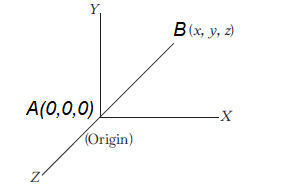
Let us say you moved from point \(A\) to point \(B\). This implies that your position was previously at \(A\) which shifted to \(B\). How exactly would you represent your initial position? In physics, we specify a position with the help of a reference point and a set of three mutually perpendicular axes or the rectangular coordinate system. They are \(X-, Y-\) and \(Z-\)axes. The reference point is taken as the intersection point of the above three axes, called the origin. So we take point \(A\) as the reference point or origin with coordinates \((0,0,0)\) and \(B\) is represented by a set of coordinates on the three axes ( \({x}, {y}, {z}\) ).
Distance (Path Length)
Distance is defined as the total length of the path traveled by an object from one point to another in a given time interval. It is a scalar quantity. The unit of distance is metre in SI or MKS and centimetre in CGS. Its dimensional formula is \(\left[\mathrm{M}^0 \mathrm{LT}^0\right]\). We know that,
\(
\begin{aligned}
&\text { Distance }=\text { Speed } \times \text { Time }\\
&d=s \times t
\end{aligned}
\)
Example 1: \(A\) scooter is moving along a straight line \(A B\) covers a distance of \(360 m\) in \(24 s\) and returns back from \(B\) to \(C\) and covers \(240 m\) in \(18 s\). Find the total distance travelled by the scooter.
Solution: From the above question, we draw the following figure.
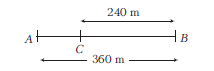
Hence, to find out the total path distance, it does not matter how much time is taken by a scooter to reach at \(B\) and the time taken to return at \(C\).
\(\therefore\) Total distance \(=A B+B C=360+240=600 \mathrm{~m}\)
Displacement
It is the shortest distance between the initial and final position of the moving object.
If \(x_1\) and \(x_2\) are the initial and final positions of an object, respectively. Then, displacement of the object is given by
\(
\Delta x=x_2-x_1
\)
- If \(x_2>x_1\), then \(\Delta x\) is positive.
- If \(x_1>x_2\), then \(\Delta x\) is negative.
- If \(x_1=x_2\), then \(\Delta x\) is zero.
- \(\mid \text { Displacement } \mid \leq \text { Distance }\)
i.e. The displacement of an object in motion can be positive, negative or zero while distance can never be negative or zero.
Displacement has both magnitude and direction. The unit of displacement is metre in SI or MKS and centimetre in CGS. Its dimensional formula is \(\left[\mathrm{M}^0 \mathrm{LT}^0\right]\).
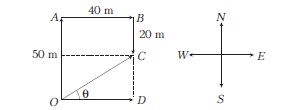
Example 2: A man starts from his home and walks 50 m towards north, then he turns towards east and walks \(40 m\) and then reaches to his office after moving \(20 m\) towards south.
(i) What is the total distance covered by the man from his home to office?
(ii) What is his displacement from his home to office?
Solution: Let \(O\) represents the position of home, then according to the question, the man moves from \(O\) to \(A(50 \mathrm{~m})\) towards north, then from \(A\) to \(B(40 \mathrm{~m})\) towards east and from \(B\) to \(C(20 \mathrm{~m})\) towards south as shown in figure.
(i) Total distance travelled by the man is
\(
O A+A B+B C=50+40+20=110 \mathrm{~m}
\)
(ii) Displacement of the person is \(O C\), which can be calculated by Pythagoras theorem, i.e.
\(
\begin{aligned}
O C^2 & =O D^2+C D^2=(40)^2+(30)^2 \\
& =1600+900=2500 \\
\Rightarrow \quad O C & =50 \mathrm{~m}
\end{aligned}
\)
Position Vector and Displacement Vector
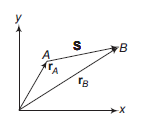
If coordinates of point \(A\) are \(\left(x_1, y_1, z_1\right)\) and \(B\) are \(\left(x_2, y_2, z_2\right)\). Then, position vector of \(A\)
\(
=\mathbf{r}_A=\mathbf{O A}=x_1 \hat{\mathbf{i}}+y_1 \hat{\mathbf{j}}+z_1 \hat{\mathbf{k}}
\)
Position vector of \(B=\mathbf{r}_B=\mathbf{O B}=x_2 \hat{\mathbf{i}}+y_2 \hat{\mathbf{j}}+z_2 \hat{\mathbf{k}}\)
\(
\begin{aligned}
\mathbf{A B} & =\mathbf{O B}-\mathbf{O A}=\mathbf{r}_B-\mathbf{r}_A \\
& =\left(x_2-x_1\right) \hat{\mathbf{i}}+\left(y_2-y_1\right) \hat{\mathbf{j}}+\left(z_2-z_1\right) \hat{\mathbf{k}}
\end{aligned}
\)
Distance and Displacement
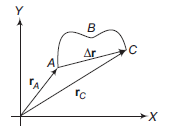
Distance is the actual path length covered by a moving particle or body in a given time interval, while displacement is the change in position vector, i.e. a vector joining initial to final positions. If a particle moves from \(A\) to \(C\) through a path \(A B C\). Then, distance travelled is the actual path length \(A B C\), while the displacement is
\(
\mathbf{s}=\Delta \mathbf{r}=\mathbf{r}_C-\mathbf{r}_A
\)
If a particle moves in a straight line without change in direction, the magnitude of displacement is equal to the distance travelled, otherwise, it is always less than it. Thus,
\(
\mid \text { displacement } \mid \leq \text { distance }
\)
Example 3: An object covers (1/4)th of the circular path. What will be the ratio of the distance and displacement of the object?
Solution: Distance covered by object \(=1 / 4\) th of the circular path
\(
\begin{aligned}
& =A B \text { through path (1) } \\
& =1 / 4 \text { th of circumference of circular path }=\frac{2 \pi r}{4}=\frac{\pi r}{2}
\end{aligned}
\)
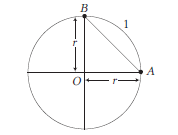
Displacement \(=\) Shortest distance between initial position \((A)\) and final position ( \(B\) )
\(
\begin{aligned}
& A B=\sqrt{O A^2+O B^2}=\sqrt{r^2+r^2}=r \sqrt{2} \\
\therefore \quad & \frac{\text { Distance }}{\text { Displacement }}=\frac{\pi r / 2}{r \sqrt{2}}=\frac{\pi}{2 \sqrt{2}}
\end{aligned}
\)
Example 4: An athlete completes one round of a circular track of diameter 200 m in 40 s. What will be the distance covered and the displacement at the end of \(2 \min 20 s\) ?
Solution: Diameter of circular track, \(D=200 \mathrm{~m}\)
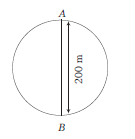
Circumference of circular track
\(
\begin{aligned}
& =2 \pi r=\pi \times(D) \\
& =\frac{22}{7} \times 200=\frac{4400}{7} \mathrm{~m}
\end{aligned}
\)
Time taken by athlete for completing one round \(=40 \mathrm{~s}\)
In 40 s, distance covered by athlete
\(
=\frac{4400}{7} \mathrm{~m}
\)
\(\therefore\) Distance covered by athlete in 2 min and \(20 \mathrm{~s}(=140 \mathrm{~s})\)
\(
=\frac{4400}{7} \times \frac{140}{40}=2200 \mathrm{~m}
\)
As the athlete returns to the initial point \(A\) in 40 s, so his displacement \(=0\)
In 40 s , the number of round, around the track \(=1\)
\(\therefore\) In 140 s, the number of rounds around the track
\(
=\frac{140}{40}=3 \frac{1}{2}
\)
For each complete round, the displacement is 0.
\(\therefore\) For 3 complete rounds, the displacement will be 0.
Hence, the final displacement will be due to \(1 / 2\) round.
Thus, his displacement = diameter of circular track = 200 m
\(\therefore\) Displacement after \(2 \mathrm{~min} ~20 \mathrm{~s}=200 \mathrm{~m}\)