3.2 Scalars and vectors
Scalar quantities
A physical quantity which can be described completely by its magnitude only and does not require a direction is called scalar quantity. Addition, subtraction, multiplication or division of scalar quantities can be done according to the general rules of algebra. Mass, volume, density, etc., are few examples of scalar quantities.
Vector quantities
A physical quantity which has both magnitude and particular direction and obeys the triangle law of vector addition or equivalently the parallelogram law of vector addition is called a vector quantity. Displacement, velocity, acceleration, etc., are few examples of vector quantities.
Note: The physical quantity current has both magnitude and direction but it is still a scalar as it disobeys the laws of vector algebra.
General points regarding vectors
General points regarding vectors are as follows:
Vector notation: Usually a vector is represented by a bold capital letter with an arrow (or without arrow) over it, as \(\overrightarrow{\mathbf{A}}, \overrightarrow{\mathbf{B}}, \overrightarrow{\mathbf{C}}\) or simply \(\mathbf{A}, \mathbf{B}, \mathbf{C}\).
The magnitude of a vector \(\mathbf{A}\) is represented by \(A\) or \(|\mathbf{A}|\).
Graphical representation of a vector
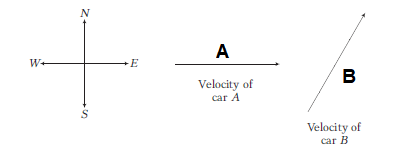
Graphically a vector is represented by an arrow drawn to a chosen scale, parallel to the direction of the vector. The length of the arrow represents the magnitude and the tip of the arrow (arrow-head) represents the direction.
Suppose that a car \(A\) is running with a velocity of \(10 \mathrm{~m} / \mathrm{s}\) towards east; and another car \(B\) is running with a velocity of \(20 \mathrm{~m} / \mathrm{s}\) towards north-east. These velocities can be represented by vectors drawn in Figure below.
Position vector
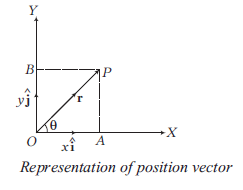
A vector that extends from a reference point to the point at which particle is located is called position vector.
Let \(\mathbf{r}\) be the position vector of a particle \(P\) located in a plane with reference to the origin \(O\) in \(X Y\)-plane as shown in the figure.
\(
\mathbf{OP}=\mathbf{OA}+\mathbf{OB}
\)
Position vector, \(\mathbf{r}=x \hat{\mathbf{i}}+y \hat{\mathbf{j}}\)
Direction of this position vector \(\mathbf{r}\) is given by the angle \(\theta\) with \(X\)-axis, where
\(
\tan \theta=\left(\frac{y}{x}\right)
\)
\(
\begin{aligned}
&\Rightarrow \quad \theta=\tan ^{-1}\left(\frac{y}{x}\right)\\
&\text { In three dimensions, the position vector is represented as }\\
&\mathbf{r}=x \hat{\mathbf{i}}+\hat{\mathbf{j}}+z \hat{\mathbf{k}}
\end{aligned}
\)
Example 1: \(A\) particle moves in a plane such that its coordinates changes with time as \(x=a t\) and \(y=b t\), where a and \(b\) are constants. Find the position vector of the particle and its direction at any time \(t\).
Solution: Coordinates of the particle are \(x=a t\) and \(y=b t\)
\(\therefore\) Position vector of the particle at any time \(t\) is
\(
\begin{gathered}
\mathbf{r}=x \hat{\mathbf{i}}+y \hat{\mathbf{j}}=(a t) \hat{\mathbf{i}}+(b t) \hat{\mathbf{j}} \\
\text { Direction of } \mathbf{r}, \theta=\tan ^{-1}\left(\frac{y}{x}\right)=\tan ^{-1}\left(\frac{b t}{a t}\right)=\tan ^{-1}\left(\frac{b}{a}\right)
\end{gathered}
\)
Displacement vector
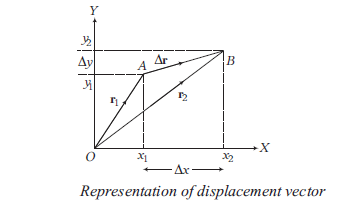
Consider a particle moving in \(X Y\)-plane with a uniform velocity \(\mathbf{v}\) and point \(O\) as an origin for measuring time and position of the particle. Let the particle be at positions \(A\) and \(B\) at timings \(t_1\) and \(t_2\), respectively. The position vectors are \(\mathrm{OA}=\mathrm{r}_1\) and \(\mathrm{OB}=\mathbf{r}_2\).
Then, the displacement of the particle in time interval \(\left(t_2-t_1\right)\) is \(\mathbf{A B}\). From triangle law of vector addition, we get
\(
\Rightarrow \quad \begin{aligned}
\mathbf{OA}+\mathbf{AB} & =\mathbf{OB} \\
\mathbf{AB} & =\mathbf{OB}-\mathbf{OA} \\
\mathbf{AB} & =\mathbf{r}_2-\mathbf{r}_1 \dots(i)
\end{aligned}
\)
If the coordinates of the particle at points \(A\) and \(B\) are \(\left(x_1, y_1\right)\) and \(\left(x_2, y_2\right)\), then
\(
\mathbf{r}_1=x_1 \hat{\mathbf{i}}+y_1 \hat{\mathbf{j}}
\)
and
\(
\mathbf{r}_2=x_2 \hat{\mathbf{i}}+y_2 \hat{\mathbf{j}}
\)
Substituting the values of \(\mathbf{r}_1\) and \(\mathbf{r}_2\) in Eq. (i), we get
\(
\mathbf{A B}=\left(x_2 \hat{\mathbf{i}}+y_2 \hat{\mathbf{j}}\right)-\left(x_1 \hat{\mathbf{i}}+y_1 \hat{\mathbf{j}}\right)
\)
Displacement, \(\mathbf{A B}=\left(x_2-x_1\right) \hat{\mathbf{i}}+\left(y_2-y_1\right) \hat{\mathbf{j}}\)
or Displacement, \(\Delta \mathbf{r}=\Delta x \hat{\mathbf{i}}+\Delta \hat{\mathbf{y}}\)
\(
\begin{aligned}
& \text { Magnitude of displacement, }|\Delta \mathbf{r}|=\sqrt{(\Delta x)^2+(\Delta y)^2} \\
& \qquad=\sqrt{\left(x_2-x_1\right)^2+\left(y_2-y_1\right)^2}
\end{aligned}
\)
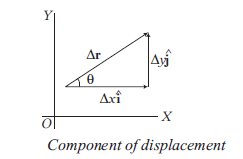
Direction of the displacement vector \(\Delta \mathbf{r}\) is given by
\(
\tan \theta=\frac{\Delta y}{\Delta x} \Rightarrow \theta=\tan ^{-1}\left(\frac{\Delta y}{\Delta x}\right)
\)
where, \(\theta=\) angle made by \(\Delta \mathbf{r}\) with \(X\)-axis.
Similarly, in three dimensions, the displacement vector can be represented as
\(
\Delta \mathbf{r}=\left(x_2-x_1\right) \hat{\mathbf{i}}+\left(y_2-y_1\right) \hat{\mathbf{j}}+\left(z_2-z_1\right) \hat{\mathbf{k}}
\)
Note: Magnitude of displacement ( \(\Delta r\) ) between two points is always less than or equal to distance \((s)\) between corresponding points. i.e.
\(
\Delta r \leq s
\)
Example 2: An object moves from position \((3,4)\) to \((6,5)\) in the \(XY\)-plane. Find the magnitude and direction of displacement vector of the particle.
Solution: Position vectors of the particle are
\(
\mathbf{r}_1=x_1 \hat{\mathbf{i}}+y_1 \hat{\mathbf{j}}=3 \hat{\mathbf{i}}+4 \hat{\mathbf{j}} \text { and } \mathbf{r}_2=x_2 \hat{\mathbf{i}}+y_2 \hat{\mathbf{j}}=6 \hat{\mathbf{i}}+5 \hat{\mathbf{j}}
\)
\(\therefore\) Displacement vector,
\(
\begin{aligned}
& \Delta \mathbf{r}=\left(x_2-x_1\right) \hat{\mathbf{i}}+\left(y_2-y_1\right) \hat{\mathbf{j}} \\
& \quad=(6-3) \hat{\mathbf{i}}+(5-4) \hat{\mathbf{j}}=3 \hat{\mathbf{i}}+\hat{\mathbf{j}}
\end{aligned}
\)
\(\therefore\) Magnitude of displacement vector,
\(
|\Delta \mathbf{r}|=\sqrt{(3)^2+(1)^2}=\sqrt{10}
\)
Direction of \(\Delta \mathbf{r}\) with \(X\)-axis,
\(
\theta=\tan ^{-1}\left(\frac{\Delta y}{\Delta x}\right)=\tan ^{-1}\left(\frac{1}{3}\right) \approx 18.43^{\circ}
\)
Equality Of Vectors
Two vectors \(\mathbf{A}\) and \(\mathbf{B}\) are said to be equal if, and only if, they have the same magnitude and the same direction.
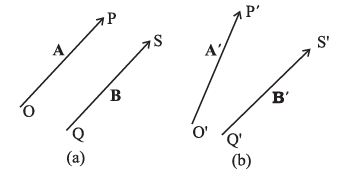
Figure(a) below shows two equal vectors \(\mathbf{A}\) and \(\mathbf{B}\). We can easily check their equality. Shift \(\mathbf{B}\) parallel to itself until its tail \(Q\) coincides with that of \(\mathbf{A}\), i.e. \(Q\) coincides with \(O\) . Then, since their tips \(S\) and \(P\) also coincide, the two vectors are said to be equal. In general, equality is indicated as \(\mathbf{A}=\mathbf{B}\). Note that in Figure (b), vectors \(\mathbf{A}^{\prime}\) and \(\mathbf{B}^{\prime}\) have the same magnitude but they are not equal because they have different directions. Even if we shift \(\mathbf{B}^{\prime}\) parallel to itself so that its tail \(\mathrm{Q}^{\prime}\) coincides with the tail \(\mathrm{O}^{\prime}\) of \(\mathbf{A}^{\prime}\), the tip \(\mathrm{S}^{\prime}\) of \(\mathbf{B}^{\prime}\) does not coincide with the tip \(\mathrm{P}^{\prime}\) of \(\mathbf{A}^{\prime}\).