14.7 Beats
Beats
When two sound waves of the same amplitude travelling in the same direction with slightly different frequencies superimpose, the intensity varies periodically with time, this phenomenon is called beats.
A complete cycle of maximum intensity and minimum intensity is called one beat and the number of beats heard per second is called beat frequency. Beat frequency is equal to the difference of frequencies of two interfering waves.
Let us consider two harmonic waves of nearly equal angular frequencies \(\omega_1\) and \(\omega_2\). Further, let the waves have equal amplitude and zero phase difference.

To derive the expression for beats from the beginning, we follow the physical process of two sound waves of slightly different frequencies overlapping at a specific point in space.
Step 1: Mathematical Representation of the Waves
Assume two sound waves are traveling in the same direction. We observe them at a fixed point, let’s say \(x=0\). Since they are longitudinal waves, we represent their displacement as \(S\).
The waves have equal amplitude \(a\), but slightly different angular frequencies \(\omega_1\) and \(\omega_2\).
\(
\begin{aligned}
& S_1=a \cos \left(\omega_1 t\right) \\
& S_2=a \cos \left(\omega_2 t\right)
\end{aligned}
\)
Step 2: Principle of Superposition
When these waves meet, the resultant displacement \(S\) is the algebraic sum of the individual displacements:
\(
\begin{gathered}
S=S_1+S_2 \\
S=a \cos \left(\omega_1 t\right)+a \cos \left(\omega_2 t\right) \\
S=a\left[\cos \left(\omega_1 t\right)+\cos \left(\omega_2 t\right)\right]
\end{gathered}
\)
Step 3: Using Trigonometric Identity
We apply the identity: \(\cos A+\cos B=2 \cos \left(\frac{A-B}{2}\right) \cos \left(\frac{A+B}{2}\right)\).
Let \(A=\omega_1 t\) and \(B=\omega_2 t\). The equation becomes:
\(
S=2 a \cos \left(\frac{\omega_1-\omega_2}{2}\right) t \cos \left(\frac{\omega_1+\omega_2}{2}\right) t
\)
To simplify this, we define:
Modulation frequency: \(\omega_a=\frac{\omega_1-\omega_2}{2}\)
Average frequency: \(\omega_b=\frac{\omega_1+\omega_2}{2}\)
Substituting these back in:
\(
S=\left[2 a \cos \left(\omega_a t\right)\right] \cos \left(\omega_b t\right)
\)
Step 4: Analyzing the Resultant Amplitude
The term in the square brackets, \(A_{\text {res }}=2 a \cos \left(\omega_a t\right)\), represents the resultant amplitude. Unlike a standard wave where amplitude is constant, here the amplitude varies with time.
Waxing (Loud sound): Intensity is maximum when the amplitude is maximum. This happens when:
\(
\cos \left(\omega_a t\right)= \pm 1
\)
Waning (Faint sound): Intensity is minimum when the amplitude is zero. This happens when:
\(
\cos \left(\omega_a t\right)=0
\)
Step 5: Deriving Beat Frequency
The intensity (loudness) is a function of the square of the amplitude. Because the cosine function reaches a maximum (either +1 or -1 ) twice in one period of the \(\cos \left(\omega_a t\right)\) function, the “throb” or beat we hear happens at twice the frequency of \(\omega_a\).
\(
\begin{gathered}
\omega_{b e a t}=2 \omega_a \\
\omega_{b e a t}=2\left(\frac{\omega_1-\omega_2}{2}\right)=\omega_1-\omega_2
\end{gathered}
\)
Since \(\omega=2 \pi f\) :
\(
\begin{gathered}
2 \pi f_{\text {beat }}=2 \pi f_1-2 \pi f_2 \\
f_{\text {beat }}=f_1-f_2
\end{gathered}
\)
Step 6: Beat Period
The time interval between two successive maximums (one full beat) is the Beat Period (\(T_{\text {beat }}\)):
\(
T_{\text {beat }}=\frac{1}{f_{\text {beat }}}=\frac{1}{f_1-f_2}
\)
Essential condition for hearing beats
For beats to be audible, the difference in the frequency of the two sound waves should not exceed 10. If the difference is more than 10, we shall hear more than 10 beats per second. But due to the persistence of hearing, our ear is not able to distinguish between two sounds as separate, if the time interval between them is less than \((1 / 10)\) th of a second.
Hence, beats heard will not be distinct, if the number of beats produced per second is more than 10.
Example 1: Consider the two identical piano strings, each tuned exactly to the 420 Hz. The tension in any one of the strings is increased by \(2.0 \%\). If they are now struck, what is the beat frequency between the fundamentals of the two strings? (Take, length of the strings \(=65 \mathrm{~cm})\)
Solution: If \(f_1, v_1, T_1\) and \(f_2, v_2\) and \(T_2\) are the frequencies, velocities, and tensions in the first and second strings respectively, then
\(
\frac{v_2}{v_1}=\frac{v_2 / 2 L}{v_1 / 2 L}=\frac{f_2}{f_1}
\)
\(
\frac{f_2}{f_1}=\frac{\frac{1}{2 L} \sqrt{T_2 / \mu}}{\frac{1}{2 L} \sqrt{T_1 / \mu}}=\sqrt{\frac{T_2}{T_1}}
\)
Since, it is given that the tension in one string is \(2 \%\) larger than the other.
\(
\begin{aligned}
& T_2=T_1+\frac{2 T_1}{100}=1.02 T_1 \\
& \frac{f_2}{f_1}=\sqrt{\frac{1.02 T_1}{T_1}}=1.01
\end{aligned}
\)
Now, the frequency of the tightened string,
\(
\begin{aligned}
f_2 & =f_1(1.01)=1.01 \times 420 \\
& =424.2 \mathrm{~Hz}
\end{aligned}
\)
\(\therefore\) Beat frequency,
\(
\begin{aligned}
f_{\text {beat }} & =f_2-f_1=424.2-420 \\
& =4.2 \mathrm{~Hz}
\end{aligned}
\)
Example 2: Two strings 1 and 2 are taut between two fixed supports (as shown in the figure) such that the tension in both strings is the same. Mass per unit length of 2 is more than that of 1 . Explain which string is denser for a transverse travelling wave.

Solution: Speed of a transverse wave on a string, \(v=\sqrt{\frac{T}{\mu}}\)
\(
\begin{aligned}
v & \propto \frac{1}{\sqrt{\mu}} \\
\mu_2 & >\mu_1 \\
v_2 & <v_1
\end{aligned}
\)
i.e. Medium 2 is denser and medium 1 is rarer.
Example 3: One end of 12 m long rubber tube with a total mass of 0.9 kg is fastened to a fixed support. A cord attached to the other end passes over a pulley and supports an object with a mass of 5 kg. The tube is struck to a transverse blow at one end. Find the time required for the pulse to reach the other end. (Take, \(g=9.8 \mathrm{~ms}^{-2}\) )
Solution: Tension in the rubber tube \(A B\),

\(
T=m g \text { or } T=(5.0)(9.8)=49 \mathrm{~N}
\)
Mass per unit length of rubber tube,
\(
\mu=\frac{0.9}{12}=0.075 \mathrm{~kg} \mathrm{~m}^{-1}
\)
\(\therefore\) Speed of wave on the tube,
\(
v=\sqrt{\frac{T}{\mu}}=\sqrt{\frac{49}{0.075}}=25.56 \mathrm{~ms}^{-1}
\)
\(\therefore\) The required time,
\(
t=\frac{A B}{v}=\frac{12}{25.56}=0.47 \mathrm{~s}
\)
Example 4: A wave moves with speed \(300 \mathrm{~ms}^{-1}\) on a wire, which is under a tension of 500 N . Find how much the tension must be changed to increase the speed to \(312 \mathrm{~ms}^{-1}\).
Solution: Speed of a transverse wave on the wire, \(v=\sqrt{\frac{T}{\mu}} \dots(i)\)
Differentiating with respect to tension, we get
\(
\frac{d v}{d T}=\frac{1}{2 \sqrt{\mu T}} \dots(ii)
\)
On dividing Eq. (ii) by Eq. (i), we get
\(
\frac{d v}{v}=\frac{1}{2} \frac{d T}{T} \text { or } d T=(2 T) \frac{d v}{v}
\)
Substituting the values in the above equation, we get
\(
d T=\frac{(2)(500)(312-300)}{300}=40 \mathrm{~N}
\)
i.e. Tension should be increased by 40 N.
Example 5: A wire of uniform cross-section is stretched between two points 100 cm apart. The wire is fixed at one end and a weight is hung over a pulley at the other end. A weight of 9 kg produces a fundamental frequency of 750 Hz.
(i) What is the velocity of the wave in wire?
(ii) If the weight is reduced to 4 kg, what is the velocity of wave? What is the wavelength and frequency?
Solution: (i) Here, \(L=100 \mathrm{~cm}\) and \(f_1=750 \mathrm{~Hz}\)
\(
\begin{array}{ll}
\therefore v_1=2 L f_1=2 \times 100 \times 750 \\
=150000 \mathrm{cms}^{-1}=1500 \mathrm{~ms}^{-1}
\end{array}
\)
(ii) \(\because v_1=\sqrt{\frac{T_1}{\mu}}\) and \(v_2=\sqrt{\frac{T_2}{\mu}}\)
\(
\begin{array}{ll}
\therefore & \frac{v_2}{v_1}=\sqrt{\frac{T_2}{T_1}} \Rightarrow \frac{v_2}{1500}=\sqrt{\frac{4}{9}} \\
\therefore & v_2=1000 \mathrm{~ms}^{-1}
\end{array}
\)
Wavelength, \(\lambda_2=2 L=200 \mathrm{~cm}=2 \mathrm{~m}\)
Frequency, \(f_2=\frac{v_2}{\lambda_2}=\frac{1000}{2}=500 \mathrm{~Hz}\)
Example 6: Length of a stretched wire is \(2 m\). It is oscillating in its fourth overtone mode. Maximum amplitude of oscillations is 2 mm . Find the amplitude of oscillation at a distance of 0.2 m from one fixed end.
Solution: Fourth overtone mode means five loops.

\(
\begin{aligned}
l & =5\left(\frac{\lambda}{2}\right) \\
\lambda & =\frac{2 l}{5} \\
& =\frac{2 \times 2}{5}=0.8 \mathrm{~m} \\
k & =\frac{2 \pi}{\lambda}=\frac{2 \pi}{0.8} \\
& =(2.5 \pi) \mathrm{m}^{-1}
\end{aligned}
\)
Now, \(P\) is a node. So, take \(x=0\) at \(P\).
Then, at a distance \(x\) from \(P\),
\(
\begin{aligned}
A_x & =A_{\max } \sin k x \\
& =(2 \mathrm{~mm}) \sin (2.5 \pi)(0.2) \\
& =(2 \mathrm{~mm}) \sin \left(\frac{\pi}{2}\right) \\
& =2 \mathrm{~mm}
\end{aligned}
\)
Example 7: A standing wave is formed by two harmonic waves, \(y_1=A \sin (k x-\omega t)\) and \(y_2=A \sin (k x+\omega t)\) travelling on a string in opposite directions. Mass density of the string is \(\rho\) and area of cross-section is s. Find the total mechanical energy between two adjacent nodes on the string.
Solution: The distance between two adjacent nodes is \(\frac{\lambda}{2}\) or \(\frac{\pi}{k}\).
\(\therefore\) Volume of string between two nodes will be
\(
\begin{aligned}
V & =(\text { area of cross-section }) \times(\text { distance between two nodes }) \\
& =(S)\left(\frac{\pi}{k}\right)
\end{aligned}
\)
Energy density (energy per unit volume) of a travelling wave is given by
\(
u=\frac{1}{2} \rho A^2 \omega^2
\)
A standing wave is formed by two identical waves travelling in opposite directions. Therefore, the energy stored between two nodes in a standing wave.
\(
\begin{aligned}
E & \left.=2 \text { [energy stored in a distance of } \frac{\pi}{k} \text { of a travelling wave }\right] \\
& =2 \text { (energy density) (volume) } \\
& =2\left(\frac{1}{2} \rho A^2 \omega^2\right)\left(\frac{\pi S}{k}\right)
\end{aligned}
\)
\(
E=\frac{\rho A^2 \omega^2 \pi S}{k}
\)
Practical applications of beats
Determination of frequency of tuning fork:
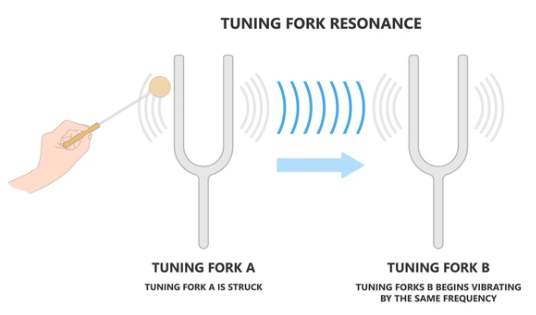
A vibrating tuning fork produces longitudinal sound waves (compressions and rarefactions) by rapidly moving its prongs back and forth, vibrating air particles at a specific frequency. When struck, the tines move apart and together rapidly, creating sound waves that can be visualized as ripples in water or by using a microphone to map pressure changes over time.
Suppose \(\nu_1\) is the known frequency of tuning fork \(A\) and \(\nu_2\) is the unknown frequency of tuning fork \(B\). When the two tuning forks are sounded together, suppose they produce \(b\) beats per second.
Then,
\(
\nu_2=\nu_1+b \text { or } v_1-b
\)
Case-1: The Loading Method (Adding Wax)
Concept: Adding mass to a tuning fork makes it “heavier,” which decreases its frequency (\(\nu_2 \downarrow\)).
If the beat frequency ( \(b\) ) decreases: This means \(\nu_2\) was higher than \(\nu_1\), and by lowering \(\nu_2\), you brought it closer to \(\nu_1\).
Result: \(\nu_2=\nu_1+b\)
If the beat frequency (\(b\)) increases: This means \(\nu_2\) was already lower than \(\nu_1\), and by lowering \(\nu_2\) further, you moved it further away from \(\nu_1\).
Result: \(\nu_2=\nu_1-b\)
Case-2: The Filing Method (Removing Metal):
Concept: Filing the prong removes mass, which makes the fork “lighter” and increases its frequency (\(\nu_2 \uparrow\)).
If the beat frequency (b) decreases: This means \(\nu_2\) was originally lower than \(\nu_1\). By increasing \(\nu_2\), you brought it closer to \(\nu_1\), narrowing the gap.
Result: \(\nu_2=\nu_1-b\)
If the beat frequency (\(b\)) increases: This means \(\nu_2\) was originally higher than \(\nu_1\). By increasing \(\nu_2\) further, you widened the gap.
Result: \(\nu_2=\nu_1+b\)
Example 8: You have two tuning forks, A and B. The frequency of A is known: \(\nu_1=320 \mathrm{~Hz}\). When A and B are sounded together, they produce 4 beats per second. The prong of B is then filed (which increases its frequency).
After filing, they are sounded together again, and the beat frequency is now 2 beats per second. Find the original frequency of B \(\left(\nu_2\right)\).
Solution: Step 1: Identify the two possibilities
Based on the initial beat frequency (\(b=4 \mathrm{~Hz}\)), the original frequency of B could be:
\(\nu_2=320+4=324 \mathrm{~Hz}\)
\(\nu_2=320-4=316 \mathrm{~Hz}\)
Step 2: Apply the Filing Logic
Filing the prong of B increases its frequency (\(\nu_2 \uparrow\)). We need to see which starting value moves closer to 320 Hz (decreasing the beats) when it increases.
Test \(\mathbf{3 2 4 ~ H z}\) : If we increase \(\mathbf{3 2 4}\) (e.g., to \(\mathbf{3 2 5}\) or \(\mathbf{3 2 6}\)), the gap between it and \(\mathbf{3 2 0}\) increases (\(326-320=6\) beats). This contradicts our observation that beats decreased to 2.
Test \(\mathbf{3 1 6 ~ H z}\) : If we increase \(\mathbf{3 1 6}\) (e.g., to \(\mathbf{3 1 8}\)), the gap between it and \(\mathbf{3 2 0}\) decreases (\(320-318=2\) beats). This matches our observation perfectly.
Conclusion: Because increasing the frequency of B caused the beat count to drop, B must have started below A.
Original frequency of \(\mathrm{B}=316 \mathrm{~Hz}\).
Quick “Rule of Thumb” Table
If you are ever in a rush during a test, you can use this mental shortcut:
\(
\begin{array}{|l|l|l|l|}
\hline \text { Action } & \text { Beat Frequency (b) } & \text { Conclusion } & \text { Formula } \\
\hline \text { Loading (Wax) } & \text { Decreases } \downarrow & v_2 \text { was higher } & v_2=v_1+b \\
\hline \text { Loading (Wax) } & \text { Increases } \uparrow & v_2 \text { was lower } & v_2=v_1-b \\
\hline \text { Filing } & \text { Decreases } \downarrow & v_2 \text { was lower } & v_2=v_1-b \\
\hline \text { Filing } & \text { Increases } \uparrow & v_2 \text { was higher } & v_2=v_1+b \\
\hline
\end{array}
\)
Resonance Tube
To observe the resonance phenomenon in an open-ended cylindrical tube. The resonance is a standing wave phenomenon in the air column and occurs when the column length is:
\(\lambda / 4,3 \lambda / 4,5 \lambda / 4\)
where \(\lambda\) is the sound wavelength. Wavelength \(\quad \lambda=2\left(\ell_2-\ell_1\right)\)
End correction \(e=\frac{\ell_2-3 \ell_1}{2}\)

Derivation: A Resonance Column Tube is a classic physics apparatus used to measure the speed of sound in air or the frequency of a tuning fork. It consists of a long glass or plastic cylinder partially filled with water. The water level can be adjusted to change the length of the air column above it.
Step 1: The Physics of the Resonance Tube
Although the tube is open at the top, the water surface at the bottom acts as a fixed boundary. Therefore, the resonance tube behaves like a pipe closed at one end.
When a vibrating tuning fork is held over the mouth of the tube, sound waves travel down and reflect off the water surface. If the length of the air column is such that the reflected wave reinforces the incoming wave, a standing wave is formed, and we hear a loud sound called resonance.
Step 2: Derivation of Resonance Conditions
In a tube closed at one end, a node (zero displacement) always forms at the water surface, and an antinode (maximum displacement) forms near the open end.
First Resonance ( \(\ell_1\))
The shortest air column that produces resonance occurs when the length corresponds to a quarter wavelength. Including the end correction (\(e\)), which accounts for the antinode forming slightly outside the tube:
\(
\ell_1+e=\frac{\lambda}{4} \dots(1)
\)
Second Resonance ( \(\ell_2\))
The next resonance occurs when an additional half-wavelength is added to the column:
\(
\ell_2+e=\frac{3 \lambda}{4} \dots(2)
\)
Third Resonance (\(\ell_3\))
Following the pattern of odd multiples:
\(
\ell_3+e=\frac{5 \lambda}{4} \dots(3)
\)
Step 3: Deriving Wavelength (\({\lambda}\))
To eliminate the unknown end correction (\(e\)), we subtract Equation 1 from Equation 2:
\(
\begin{gathered}
\left(\ell_2+e\right)-\left(\ell_1+e\right)=\frac{3 \lambda}{4}-\frac{\lambda}{4} \\
\ell_2-\ell_1=\frac{2 \lambda}{4} \\
\ell_2-\ell_1=\frac{\lambda}{2} \\
\lambda=2\left(\ell_2-\ell_1\right)
\end{gathered}
\)
Step 4: Deriving End Correction (\(e\))
To find \(e\), we can manipulate the equations to eliminate \(\lambda\). Multiply Equation 1 by 3:
\(
3\left(\ell_1+e\right)=\frac{3 \lambda}{4}
\)
Since both \(3\left(\ell_1+e\right)\) and \(\left(\ell_2+e\right)\) are equal to \(\frac{3 \lambda}{4}\), we set them equal to each other:
\(
\begin{gathered}
3 \ell_1+3 e=\ell_2+e \\
3 e-e=\ell_2-3 \ell_1 \\
2 e=\ell_2-3 \ell_1 \\
e=\frac{\ell_2-3 \ell_1}{2}
\end{gathered}
\)
Example 9: In a resonance column experiment, the first resonance is observed when the air column length is 16 cm, and the second resonance is observed at 51 cm. The tuning fork used has a frequency of 500 Hz.
Find:
(a) The wavelength of the sound (\(\lambda\)).
(b) The end correction of the tube (\(e\)).
(c) The speed of sound in air (\(v\)).
Solution: Step 1: Calculate Wavelength (\({\lambda}\))
Using the formula derived from the difference between the two resonance lengths:
\(
\lambda=2\left(\ell_2-\ell_1\right)
\)
Substitute the values:
\(
\begin{gathered}
\lambda=2(51 \mathrm{~cm}-16 \mathrm{~cm}) \\
\lambda=2(35 \mathrm{~cm})=70 \mathrm{~cm}(\text { or } 0.7 \mathrm{~m})
\end{gathered}
\)
Step 2: Calculate End Correction (\(e\))
Using the formula that relates the two lengths:
\(
e=\frac{\ell_2-3 \ell_1}{2}
\)
Substitute the values:
\(
\begin{gathered}
e=\frac{51-3(16)}{2} \\
e=\frac{51-48}{2} \\
e=\frac{3}{2}=1.5 \mathrm{~cm}
\end{gathered}
\)
Verification: Check if \(\ell_1+e=\lambda / 4\) :
\(
\begin{aligned}
& 16+1.5=17.5 \mathrm{~cm} \\
& \lambda / 4=70 / 4=17.5 \mathrm{~cm}
\end{aligned}
\)
The values match perfectly!
Step 3: Calculate Speed of Sound (\(v\))
Now use the standard wave equation \(v=f \lambda\) :
\(f=500 \mathrm{~Hz}\)
\(\lambda=0.7 \mathrm{~m}\)
\(
v=500 \times 0.7=350 \mathrm{~m} / \mathrm{s}
\)
Summary of Results
Wavelength: 70 cm
End Correction: 1.5 cm (This tells us the antinode forms 1.5 cm above the tube’s mouth)
Speed of Sound: \(350 \mathrm{~m} / \mathrm{s}\)
Intensity of sound in decibels
Sound level, \(\mathrm{SL}=10 \log _{10}\left(\frac{\mathrm{I}}{\mathrm{I}_0}\right)\)
Where \(\mathrm{I}_0=\) threshold of human ear \(=10^{-12} \mathrm{~W} / \mathrm{m}^2\)
Example 10: Doubling the Sound Source
Scenario: A single motorcycle produces a sound level of 90 dB at a certain distance. If a second, identical motorcycle starts up next to it, what is the new total sound level?
Solution: Step-by-Step Logic:
Intensity Adds, Decibels Don’t: You cannot simply add \(90+90=180 \mathrm{~dB}\). Instead, you double the intensity (\(I_{\text {total }}=2 I\)).
Apply the Formula:
\(
S L_{n e w}=10 \log _{10}\left(\frac{2 I}{I_0}\right)
\)
Use Log Rules: \(\log (A \times B)=\log A+\log B\).
\(
\begin{gathered}
S L_{n e w}=10\left[\log _{10}(2)+\log _{10}\left(I / I_0\right)\right] \\
S L_{n e w}=10 \log _{10}(2)+10 \log _{10}\left(I / I_0\right)
\end{gathered}
\)
Calculate: Since \(10 \log _{10}(2) \approx 3\) and the original level was 90 dB :
\(
S L_{n e w}=3+90=93 \mathrm{~dB}
\)
Key Takeaway: Doubling the power/intensity of a sound source always results in a +3 dB increase, regardless of the starting level.
Example 11: Change in Distance (Inverse Square Law)
Scenario: You are standing 2 meters away from a speaker, and the sound level is 100 dB. If you move to a distance of 20 meters, what will the sound level be?
Solution: Step-by-Step Logic:
Inverse Square Law:
Intensity (\(I\)) is inversely proportional to the square of the distance (\(\left.r^2\right)\).
\(
I \propto \frac{1}{r^2}
\)
Find the Intensity Ratio:
The distance increased by a factor of 10 (from 2 m to 20 m). Therefore, the intensity decreases by a factor of \(10^2\), or 100 times.
\(
I_{n e w}=\frac{I_{o l d}}{100}
\)
Calculate the Decibel Drop:
\(
\begin{gathered}
\Delta S L=10 \log _{10}\left(\frac{1}{100}\right) \\
\Delta S L=10 \times(-2)=-20 \mathrm{~dB}
\end{gathered}
\)
Final Result:
\(
100 \mathrm{~dB}-20 \mathrm{~dB}=80 \mathrm{~dB}
\)
Example 12: Tube \(A\) has bolt ends open while tube \(B\) has one end closed, otherwise they are identical. The ratio of fundamental frequency of tube \(A\) and \(B\) is [JEE 2002]
(a) 1 : 2
(b) 1 : 4
(c) 2 : 1
(d) 4 : 1
Solution: (c) To find the ratio of the fundamental frequencies, we compare the physics of air columns in open and closed pipes.
Step 1: Analyze Tube A (Open at both ends)
For a pipe open at both ends, the fundamental frequency (\(f_A\)) occurs when the length of the tube \((L)\) is equal to half a wavelength (\(\lambda / 2\)).
The formula is:
\(
f_A=\frac{v}{2 L}
\)
Step 2: Analyze Tube B (Closed at one end)
For a pipe closed at one end, the fundamental frequency (\(f_B\)) occurs when the length of the tube \((L)\) is equal to a quarter of a wavelength \((\lambda / 4)\).
The formula is:
\(
f_B=\frac{v}{4 L}
\)
Step 3: Calculate the Ratio
Since the tubes are otherwise identical, the length \(L\) and the velocity of sound \(v\) are the same for both. We now find the ratio of \(f_A\) to \(f_B\) :
\(
\text { Ratio }=\frac{f_A}{f_B}=\frac{\frac{v}{2 L}}{\frac{v}{4 L}}
\)
Multiplying by the reciprocal:
\(
\frac{f_A}{f_B}=\frac{v}{2 L} \times \frac{4 L}{v}=\frac{4}{2}=2
\)
This gives us a ratio of \(2: 1\).
Final Answer: The ratio of the fundamental frequency of tube \(A\) to tube \(B\) is \(2: 1\).
Example 13: When temperature increases, the frequency of a tuning fork [JEE 2002]
(a) increases
(b) decreases
(c) remains same
(d) increases or decreases depending on the material
Solution: (b) When the temperature of a tuning fork increases, its frequency decreases.
Here is the breakdown of why this happens:
Thermal Expansion:
When a metal tuning fork is heated, it expands. The length (\(L\)) of the prongs increases. Since the frequency (\(f\)) of a vibrating prong is inversely proportional to the square of its length (\(f \propto 1 / L^2\)), an increase in length results in a lower frequency.
Change in Elasticity:
The more significant factor is the change in the Young’s Modulus (\(Y\)) of the material. As temperature increases, the metallic bonds loosen slightly, making the material less “stiff.” The frequency of a tuning fork is proportional to the square root of the Young’s Modulus:
\(
f \propto \sqrt{Y}
\)
For almost all metals, \(Y\) decreases as temperature rises. Since the fork becomes less elastic (less stiff), it vibrates more slowly.
Change in Density:
While the density (\(\rho\)) also decreases due to expansion, which would theoretically increase frequency (\(f \propto 1 / \sqrt{\rho}\)), this effect is much smaller than the decrease caused by the change in Young’s Modulus and length.
Summary: The combination of increased length and decreased stiffness (Young’s Modulus) results in a net decrease in frequency. This is why musicians often have to retune instruments if the room temperature changes significantly!.
Example 14: length of a string tied to two rigid supports is 40 cm. Maximum length (wavelength in cm ) of a stationary wave produced on it is [JEE 2002]
Solution: For a string fixed at both ends, \(\lambda=\frac{2 L}{n}\).
The maximum occurs when \(n=1\).
\(
\begin{gathered}
\lambda_{\max }=2 L \\
\lambda_{\max }=2 \times 40 \mathrm{~cm} \\
\lambda_{\max }=80 \mathrm{~cm}
\end{gathered}
\)
Example 15: A wave \(y=a \sin (\omega t-k x)\) on a string meets with another wave producing a node at \(x=0\). Then the equation of the unknown wave is
(a) \(y=a \sin (\omega t+k x)\)
(b) \(y=-a \sin (\omega t+k x)\)
(c) \(y=a \sin (\omega t-k x)\)
(d) \(y=-a \sin (\omega t-k x)\)
Solution: (b) To form a node there should be superposition of this wave with the reflected wave. The reflected wave should travel in opposite direction with a phase change of \(\pi\). The equation of the reflected wave will be
\(
\begin{aligned}
& y=a \sin (\omega t+k x+\pi) \\
& \Rightarrow y=-a \sin (\omega t+k x)
\end{aligned}
\)
Explanation: When a wave is reflected from a fixed end (like a wall or a rigid support), it undergoes two specific changes that result in your derived equation:
Directional Change:
To create a standing wave, the reflected wave must travel back toward the source. Mathematically, this changes the sign of the spatial component (\(kx\)):
Incident Wave: \(y_i=a \sin (\omega t-k x)\) (moving in \(+x\) )
Reflected Wave: \(y_r \propto \sin (\omega t+k x)\) (moving in \(-x\) )
Phase Inversion (The \(\pi\) Shift):
At a rigid boundary (\(x=0\)), the medium is not allowed to move. To ensure the total displacement \(y_{\text {net }}=y_i+y_r\) is always zero at that point, the reflected wave must be the “mirror image” of the incident wave. This is represented by a phase shift of \(\pi\) radians \(\left(180^{\circ}\right)\).
Using the trigonometric identity \(\sin (\theta+\pi)=-\sin (\theta)\), we get:
\(
y_r=a \sin (\omega t+k x+\pi)=-a \sin (\omega t+k x)
\)
Verification of the Node:
By superimposing the two waves at \(x=0\) :
\(
\begin{gathered}
y_{n e t}=a \sin (\omega t-0)+[-a \sin (\omega t+0)] \\
y_{n e t}=a \sin (\omega t)-a \sin (\omega t)=0
\end{gathered}
\)
Since the displacement is zero for all values of \(t\) at \(x=0\), a node is successfully formed.
Q16. A tuning fork arrangement (pair) produces 4 beats/sec with one fork of frequency \(288 c p\). A little wax is placed on the unknown fork and it then produces 2 beats \(/ \mathrm{sec}\). The frequency of the unknown fork is
(a) \(286 c p s\)
(b) \(292 c p s\)
(c) \(294 c p s\)
(d) \(288 c p s\)
Solution: (b) To find the frequency of the unknown fork, we need to analyze how the beat frequency changes when we “load” the fork with wax.
Step 1: Analyze the Initial Condition
The beat frequency is the difference between the two frequencies.
Known frequency \(\left(f_1\right)\) : 288 Hz (or cps)
Initial beat frequency: 4 beats/s
This means the unknown frequency (\(f_2\)) could be:
Case A: \(288+4=292 \mathrm{~Hz}\)
Case B: \(288-4=284 \mathrm{~Hz}\)
Step 2: Effect of Adding Wax
Adding wax to a tuning fork increases its mass, which causes it to vibrate more slowly.
Therefore, the frequency of the unknown fork (\(f_2\)) will decrease.
Step 3: Test Both Cases with the New Beat Frequency
After adding wax, the new beat frequency is 2 beats \(/ \mathrm{s}\).
Testing Case A \(\left(f_2=292 \mathrm{~Hz}\right)\) :
If the frequency starts at 292 Hz and decreases, it moves closer to the 288 Hz fork.
As it moves closer, the difference (|292 – 288|) will decrease.
If it drops from 292 to 290 , the beats become \(|290-288|=2\) beats/s.
This matches the observation \((4 \rightarrow 2)\).
Testing Case B (\(f_2=284 \mathrm{~Hz}\)):
If the frequency starts at 284 Hz and decreases (e.g., to 283,282), it moves further away from 288 Hz .
The beat frequency would increase (\(4 \rightarrow 5 \rightarrow 6\)…). This does not match the problem.
Conclusion
The unknown frequency must have been higher than the known frequency so that a decrease in its value reduced the gap between them.
Final Answer: The frequency of the unknown fork is 292 cps.