JEE PYQs Integer Type
SUMMARY
- The motion that repeats itself is called periodic motion.
- The period \(T\) is the time reequired for one complete oscillation, or cycle. It is related to the frequency v by,
\(
T=\frac{1}{f}
\)
The frequency \(v\) of periodic or oscillatory motion is the number of oscillations per unit time. In the SI, it is measured in hertz :
\(
1 \text { hertz }=1 \mathrm{~Hz}=1 \text { oscillation per } \text { second }=1 \mathrm{~s}^{-1}
\) - In simple harmonic motion (SHM), the displacement \(x(t)\) of a particle from its equilibrium position is given by,
\(
x(t)=A \cos (\omega t+\phi) \quad(\text { displacement }),
\)
in which \(A\) is the amplitude of the displacement, the quantity (\(\omega t+\phi\)) is the phase of the motion, and \(\phi\) is the phase constant. The angular frequency \(\omega\) is related to the period and frequency of the motion by,
\(
\omega=\frac{2 \pi}{T}=2 \pi f \quad \text { (angular frequency). }
\) - Simple harmonic motion can also be viewed as the projection of uniform circular motion on the diameter of the circle in which the latter motion occurs.
- The particle velocity and acceleration during SHM as functions of time are given by,
\(
\begin{aligned}
v(t) & =-\omega A \sin (\omega t+\phi) \text { (velocity), } \\
a(t) & =-\omega^2 A \cos (\omega t+\phi) \\
& =-\omega^2 X(t) \text { (acceleration), }
\end{aligned}
\) - The force acting in a simple harmonic motion is proportional to the displacement and is always directed towards the centre of motion.
- A particle executing simple harmonic motion has, at any time, kinetic energy \(K=1 / 2 m v^2\) and potential energy \(U=1 / 2 k x^2\). If no friction is present the mechanical energy of the system, \(E=K+U\) always remains constant even though \(K\) and \(U\) change with time.
- A particle of mass \(m\) oscillating under the influence of Hooke’s law restoring force given by \(F=-k x\) exhibits simple harmonic motion with
\(
\begin{aligned}
&\begin{array}{llr}
\omega=\sqrt{\frac{k}{m}} & & \text { (angular frequency) } \\
T=2 \pi \sqrt{\frac{m}{k}} & & \text { (period) }
\end{array}\\
&\text { Such a system is also called a linear oscillator. }
\end{aligned}
\) - The motion of a simple pendulum swinging through small angles is approximately simple harmonic. The period of oscillation is given by,
\(
T=2 \pi \sqrt{\frac{L}{g}}
\)
Quiz Summary
0 of 39 Questions completed
Questions:
Information
You have already completed the quiz before. Hence you can not start it again.
Quiz is loading…
You must sign in or sign up to start the quiz.
You must first complete the following:
Results
Results
0 of 39 Questions answered correctly
Your time:
Time has elapsed
You have reached 0 of 0 point(s), (0)
Earned Point(s): 0 of 0, (0)
0 Essay(s) Pending (Possible Point(s): 0)
Categories
- Not categorized 0%
- 1
- 2
- 3
- 4
- 5
- 6
- 7
- 8
- 9
- 10
- 11
- 12
- 13
- 14
- 15
- 16
- 17
- 18
- 19
- 20
- 21
- 22
- 23
- 24
- 25
- 26
- 27
- 28
- 29
- 30
- 31
- 32
- 33
- 34
- 35
- 36
- 37
- 38
- 39
- Current
- Review
- Answered
- Correct
- Incorrect
- Question 1 of 39
1. Question
The displacement of a particle, executing simple harmonic motion with time period \(T\), is expressed as \(x(t)=A \sin \omega t\), where \(A\) is the amplitude. The maximum value of potential energy of this oscillator is found at \(t=T / 2 \beta\). The value of \(\beta\) is ____. [JEE Main 2026 (Online) 28th January Morning Shift]
CorrectIncorrectHint
(b) To find the value of \(\beta\), we need to determine the time \(t\) at which the potential energy of the simple harmonic oscillator reaches its maximum value.
Step 1: Understanding Potential Energy in SHM
The potential energy \(U\) of a particle executing simple harmonic motion (SHM) is given by the formula:
\(
U=\frac{1}{2} k x^2
\)
Where:
\(k\) is the force constant (\(k=m \omega^2\))
\(x\) is the displacement at time \(t\)
Given the displacement equation \(x(t)=A \sin \omega t\), we can substitute this into the potential energy formula:
\(
U(t)=\frac{1}{2} k(A \sin \omega t)^2=\frac{1}{2} k A^2 \sin ^2 \omega t
\)
Step 2: Finding the Maximum Potential Energy
The potential energy \(U\) is at its maximum when \(\sin ^2 \omega t=1\). This occurs when:
\(
\sin \omega t= \pm 1
\)
The first instance (after \(t=0\)) where this happens is when the phase angle is \(\pi / 2\) :
\(
\omega t=\frac{\pi}{2}
\)
Step 3: Solving for \(t\) in terms of \(T\)
We know the relationship between angular frequency \(\omega\) and the time period \(T\) is:
\(
\omega=\frac{2 \pi}{T}
\)
Substituting this into our equation for \(t\) :
\(
\begin{gathered}
\left(\frac{2 \pi}{T}\right) t=\frac{\pi}{2} \\
t=\frac{\pi}{2} \cdot \frac{T}{2 \pi} \\
t=\frac{T}{4}
\end{gathered}
\)
Step 4: Comparing with the Given Expression
The problem states that the maximum potential energy is found at:
\(
t=\frac{T}{2 \beta}
\)
By comparing \(t=\frac{T}{4}\) with \(t=\frac{T}{2 \beta}\), we get:
\(
\begin{gathered}
2 \beta=4 \\
\beta=2
\end{gathered}
\) - Question 2 of 39
2. Question
A particle of mass 0.50 kg executes simple harmonic motion under force \(F=-50\left(\mathrm{Nm}^{-1}\right) x\). The time period of oscillation is \(\frac{x}{35} s\). The value of \(x\) is ____. [JEE Main 2024 (Online) 9th April Evening Shift]
(Given \(\pi=\frac{22}{7}\))CorrectIncorrectHint
(c) Step 1: Identify given parameters
The particle is executing simple harmonic motion (SHM). We are given:
Mass of the particle, \(m=0.50 \mathrm{~kg}\)
Restoring force, \(F=-50 \mathrm{Nm}^{-1} x\)
By comparing this with the standard SHM force equation \(F=-k x\), we find the force constant:
\(
k=50 \mathrm{~N} \mathrm{~m}^{-1}
\)
Step 2: Calculate the time period \(T\)
The formula for the time period \(T\) of a simple harmonic oscillator is:
\(
T=2 \pi \sqrt{\frac{m}{k}}
\)
Substituting the given values and using \(\pi=\frac{22}{7}\) :
\(
\begin{gathered}
T=2 \times \frac{22}{7} \times \sqrt{\frac{0.50}{50}} \\
T=\frac{44}{7} \times \sqrt{\frac{1}{100}} \\
T=\frac{44}{7} \times \frac{1}{10}=\frac{4.4}{7}=\frac{44}{70}=\frac{22}{35} \mathrm{~s}
\end{gathered}
\)
Step 3: Solve for \(\boldsymbol{x}\)
The problem states that the time period is \(\frac{x}{35} \mathrm{~s}\). We equate this to our calculated value:
\(
\frac{x}{35}=\frac{22}{35}
\)
Multiplying both sides by 35 :
\(
x=22
\) - Question 3 of 39
3. Question
The position, velocity and acceleration of a particle executing simple harmonic motion are found to have magnitudes of \(4 \mathrm{~m}, 2 \mathrm{~ms}^{-1}\) and \(16 \mathrm{~ms}^{-2}\) at a certain instant. The amplitude of the motion is \(\sqrt{x}, \mathrm{~m}\) where \(x\) is ____. [JEE Main 2024 (Online) 9th April Morning]
CorrectIncorrectHint
(d) Step 1: Identify given parameters
The magnitudes of position (\(x\)), velocity (\(v\)), and acceleration (\(a\)) at a specific instant are given as:
Position \((x)=4 \mathrm{~m}\)
Velocity \((v)=2 \mathrm{~ms}^{-1}\)
Acceleration \((a)=16 \mathrm{~ms}^{-2}\)
Step 2: Determine angular frequency (\(\omega\))
In simple harmonic motion (SHM), the magnitude of acceleration is related to displacement by the formula \(a=\omega^2 x\). Using the given values:
\(
\begin{aligned}
16 & =\omega^2 \times 4 \\
\omega^2 & =\frac{16}{4}=4 \\
\omega & =2 \mathrm{rad} / \mathrm{s}
\end{aligned}
\)
Step 3: Calculate the amplitude (\(A\))
The velocity of a particle in SHM is given by the formula \(v=\omega \sqrt{A^2-x^2}\). Squaring both sides gives:
\(
v^2=\omega^2\left(A^2-x^2\right)
\)
Substitute the known values \(\left(v=2, \omega^2=4, x=4\right)\) :
\(
\begin{gathered}
2^2=4\left(A^2-4^2\right) \\
4=4\left(A^2-16\right) \\
1=A^2-16 \\
A^2=17 \\
A=\sqrt{17} \mathrm{~m}
\end{gathered}
\)
Comparing this with the given form \(A=\sqrt{x} \mathrm{~m}\), we find that \(x=17\). - Question 4 of 39
4. Question
An object of mass 0.2 kg executes simple harmonic motion along \(x\) axis with frequency of \(\left(\frac{25}{\pi}\right) \mathrm{Hz}\). At the position \(x=0.04 \mathrm{~m}\) the object has kinetic energy 0.5 J and potential energy 0.4 J. The amplitude of oscillation is _____ cm. [JEE Main 2024 (Online) 8th April Evening Shift]
CorrectIncorrectHint
(c) To find the amplitude in centimeters, we can use the principle of conservation of energy in simple harmonic motion.
Step 1: Calculate Total Mechanical Energy (\(E\))
The total energy of an oscillator is the sum of its kinetic energy (\(K\)) and potential energy (\(U\)) at any given point.
\(
E=K+U
\)
Given:
\(K=0.5 \mathrm{~J}\)
\(U=0.4 \mathrm{~J}\)
\(
E=0.5+0.4=0.9 \mathrm{~J}
\)
Step 2: Determine the Angular Frequency (\(\omega\))
The relationship between frequency (\(f\)) and angular frequency is \(\omega=2 \pi f\).
Given:
\(
f=\frac{25}{\pi} \mathrm{~Hz}
\)
\(
\omega=2 \pi\left(\frac{25}{\pi}\right)=50 \mathrm{rad} / \mathrm{s}
\)
Step 3: Use the Total Energy Formula to find Amplitude (\(\boldsymbol{A}\))
The total energy is also expressed in terms of amplitude as:
\(
E=\frac{1}{2} m \omega^2 A^2
\)
Given:
\(m=0.2 \mathrm{~kg}\)
\(\omega=50 \mathrm{rad} / \mathrm{s}\)
\(E=0.9 \mathrm{~J}\)
Substituting the values:
\(
\begin{gathered}
0.9=\frac{1}{2}(0.2)(50)^2 A^2 \\
0.9=(0.1)(2500) A^2 \\
0.9=250 A^2
\end{gathered}
\)
Step 4: Solve for \(A\)
\(
A^2=\frac{0.9}{250}=\frac{9}{2500}
\)
Taking the square root of both sides:
\(
A=\sqrt{\frac{9}{2500}}=\frac{3}{50} \text { meters }
\)
Step 5: Convert to Centimeters
To convert meters to centimeters, multiply by 100:
\(
A=\frac{3}{50} \times 100=6 \mathrm{~cm}
\)
The amplitude of oscillation is 6 cm. - Question 5 of 39
5. Question
A particle is doing simple harmonic motion of amplitude 0.06 m and time period 3.14 s. The maximum velocity of the particle is ____ cm/s. [JEE Main 2024 (Online) 6th April Morning Shift]
CorrectIncorrectHint
(d) To find the maximum velocity of the particle, we can use the standard relationship between amplitude, time period, and angular frequency in SHM.
Step 1: Identify the given values
Amplitude \((A)\) : 0.06 m (which is 6 cm)
Time Period (\(T\)): 3.14 s
Note: Since \(\pi \approx 3.14\), we can treat \(T\) as \(\pi\) seconds to simplify the calculation.
Step 2: Calculate the Angular Frequency (\(\omega\))
The formula for angular frequency is:
\(
\omega=\frac{2 \pi}{T}
\)
Substituting the given time period \((T=3.14 \approx \pi)\) :
\(
\omega=\frac{2 \pi}{\pi}=2 \mathrm{rad} / \mathrm{s}
\)
Step 3: Use the Maximum Velocity Formula
The velocity of a particle in SHM is maximum when it passes through the mean position. The formula for maximum velocity (\(v_{\max }\)) is:
\(
v_{\max }=A \omega
\)
Step 4: Calculate the final value in cm/s
Since the question asks for the answer in \(\mathbf{c m} / \mathbf{s}\), let’s use the amplitude in centimeters (\(A=\) 6 cm):
\(
\begin{gathered}
v_{\max }=6 \mathrm{~cm} \times 2 \mathrm{rad} / \mathrm{s} \\
v_{\max }=12 \mathrm{~cm} / \mathrm{s}
\end{gathered}
\)
The maximum velocity of the particle is \(12 \mathrm{~cm} / \mathrm{s}\). - Question 6 of 39
6. Question
The displacement of a particle executing SHM is given by \(x=10 \sin \left(w t+\frac{\pi}{3}\right) m\). The time period of motion is 3.14 s. The velocity of the particle at \(t=0\) is ____ \(\mathrm{m} / \mathrm{s}\). [JEE Main 2024 (Online) 4th April Evening Shift]
CorrectIncorrectHint
(d) To find the velocity of the particle at \(t=0\), we need to derive the velocity equation from the given displacement and use the relationship between the time period and angular frequency.
Step 1: Identify the Displacement Equation
The given displacement is:
\(
x(t)=10 \sin \left(\omega t+\frac{\pi}{3}\right)
\)
From this, we can see the amplitude \(A=10 \mathrm{~m}\) and the initial phase \(\phi=\pi / 3\).
Step 2: Calculate the Angular Frequency (\(\omega\))
The formula for angular frequency is \(\omega=\frac{2 \pi}{T}\).
Given the time period \(T=3.14 \mathrm{~s}\), and noting that \(\pi \approx 3.14\) :
\(
\omega=\frac{2 \pi}{3.14} \approx \frac{2 \pi}{\pi}=2 \mathrm{rad} / \mathrm{s}
\)
Step 3: Derive the Velocity Equation
Velocity \(v(t)\) is the first derivative of displacement with respect to time \(\left(v=\frac{d x}{d t}\right)\) :
\(
\begin{gathered}
v(t)=\frac{d}{d t}\left[10 \sin \left(\omega t+\frac{\pi}{3}\right)\right] \\
v(t)=10 \omega \cos \left(\omega t+\frac{\pi}{3}\right)
\end{gathered}
\)
Step 4: Calculate Velocity at \(t=0\)
Substitute \(t=0\) and \(\omega=2 \mathrm{rad} / \mathrm{s}\) into the velocity equation:
\(
\begin{gathered}
v(0)=10(2) \cos \left(2(0)+\frac{\pi}{3}\right) \\
v(0)=20 \cos \left(\frac{\pi}{3}\right)
\end{gathered}
\)
Since \(\cos \left(\frac{\pi}{3}\right)=\frac{1}{2}\) :
\(
v(0)=20 \times \frac{1}{2}=10 \mathrm{~m} / \mathrm{s}
\)
The velocity of the particle at \(t=0\) is \(10 \mathrm{~m} / \mathrm{s}\). - Question 7 of 39
7. Question
A mass \(m\) is suspended from a spring of negligible mass and the system oscillates with a frequency \(f_1\). The frequency of oscillations if a mass 9 m is suspended from the same spring is \(f_2\). The value of \(\frac{f_1}{f_2}\) is ____. [JEE Main 2024 (Online) 1st February Evening Shift]
CorrectIncorrectHint
(c) To find the ratio of the frequencies, we need to look at how the mass of an oscillating system affects its frequency of vibration.
Step 1: Identify the Frequency Formula
For a mass-spring system, the frequency (\(f\)) is given by the formula:
\(
f=\frac{1}{2 \pi} \sqrt{\frac{k}{m}}
\)
Where:
\(k\) is the spring constant (which remains the same since it’s the “same spring”).
\(m\) is the suspended mass.
Step 2: Set up the expressions for \(f_1\) and \(f_2\)
Case 1: For mass \(m\), the frequency is \(f_1\) :
\(
f_1=\frac{1}{2 \pi} \sqrt{\frac{k}{m}}
\)
Case 2: For mass \(9 m\), the frequency is \(f_2\) :
\(
f_2=\frac{1}{2 \pi} \sqrt{\frac{k}{9 m}}
\)
Step 3: Simplify the expression for \(f_2\)
We can take the constant \(\sqrt{9}\) out of the square root:
\(
f_2=\frac{1}{3}\left(\frac{1}{2 \pi} \sqrt{\frac{k}{m}}\right)
\)
Notice that the term in the parentheses is exactly \(f_1\). So:
\(
f_2=\frac{f_1}{3}
\)
Step 4: Calculate the ratio \(\frac{f_1}{f_2}\)
By rearranging the equation from Step 3:
\(
\frac{f_1}{f_2}=3
\)
The value of \(\frac{f_1}{f_2}\) is 3. - Question 8 of 39
8. Question
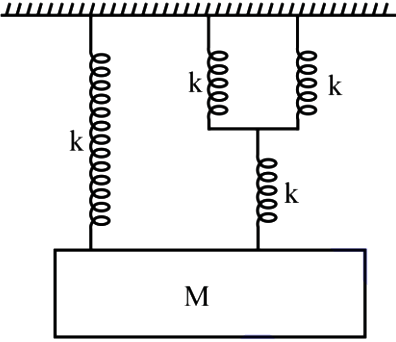
The time period of simple harmonic motion of mass \(M\) in the given figure is \(\pi \sqrt{\frac{\alpha M}{5 k}}\), where the value of \(\alpha\) is ______. [JEE Main 2024 (Online) 31st January Evening Shift]
 CorrectIncorrect
Hint
(a) This configuration is a classic “mixed” spring system. To find the value of \(\alpha\), we need to calculate the equivalent spring constant \(\left(k_{\text {eq }}\right)\) step-by-step.
Step 1: Calculate the Parallel Combination
On the right side, the two upper springs are connected in parallel because they share the same displacement.
\(
k_{\text {parallel }}=k+k=2 k
\)
Step 2: Calculate the Series Combination
This \(2 k\) combination is connected in series with the spring directly below it. The equivalent constant for this right-hand branch (\(k_{\text {right }}\)) is:
\(
\begin{gathered}
\frac{1}{k_{\text {right }}}=\frac{1}{2 k}+\frac{1}{k} \\
\frac{1}{k_{\text {right }}}=\frac{1+2}{2 k}=\frac{3}{2 k} \Longrightarrow k_{\text {right }}=\frac{2 k}{3}
\end{gathered}
\)
Step 3: Calculate the Total Equivalent Spring Constant (\(k_{\text {eq }}\))
Now, the single spring on the left (\(k\)) and the entire right branch (\(k_{\text {right }}\)) are connected in parallel to the mass \(M\) (if the mass moves down by \(x\), both sides stretch by \(x\)).
\(
\begin{gathered}
k_{\text {eq }}=k+k_{\text {right }} \\
k_{\text {eq }}=k+\frac{2 k}{3}=\frac{3 k+2 k}{3}=\frac{5 k}{3}
\end{gathered}
\)
Step 4: Find the Time Period and Solve for \(\alpha\)
The standard formula for the time period is:
\(
T=2 \pi \sqrt{\frac{M}{k_{e q}}}
\)
Substitute \(k_{\text {eq }}=\frac{5 k}{3}\) :
\(
T=2 \pi \sqrt{\frac{M}{5 k / 3}}=2 \pi \sqrt{\frac{3 M}{5 k}}
\)
To match your expression \(\pi \sqrt{\frac{\alpha M}{5 k}}\), we need to move the 2 inside the square root \((2=\sqrt{4})\) :
\(
T=\pi \sqrt{4 \cdot \frac{3 M}{5 k}}=\pi \sqrt{\frac{12 M}{5 k}}
\)
Comparing this to the given expression:
\(
\alpha=12
\) - Question 9 of 39
9. Question
A particle performs simple harmonic motion with amplitude \(A\). Its speed is increased to three times at an instant when its displacement is \(\frac{2 A}{3}\). The new amplitude of motion is \(\frac{n A}{3}\). The value of \(n\) is _____. [JEE Main 2024 (Online) 31st January Morning Shift]
CorrectIncorrectHint
(d) To solve for the new amplitude, we need to find the velocity of the particle at the given displacement and then apply the energy conservation principle for the “new” state of motion.
Step 1: Find the initial velocity (\(v\)) at displacement \(x=\frac{2 A}{3}\)
The velocity of a particle in SHM is given by:
\(
v=\omega \sqrt{A^2-x^2}
\)
Substituting \(x=\frac{2 A}{3}\) :
\(
\begin{gathered}
v=\omega \sqrt{A^2-\left(\frac{2 A}{3}\right)^2} \\
v=\omega \sqrt{A^2-\frac{4 A^2}{9}}=\omega \sqrt{\frac{5 A^2}{9}} \\
v=\frac{\omega A \sqrt{5}}{3}
\end{gathered}
\)
Step 2: Determine the new velocity (\(v^{\prime}\))
The problem states the speed is increased to three times its current value:
\(
\begin{gathered}
v^{\prime}=3 v=3\left(\frac{\omega A \sqrt{5}}{3}\right) \\
v^{\prime}=\omega A \sqrt{5}
\end{gathered}
\)
Step 3: Calculate the new amplitude (\(\boldsymbol{A}^{\boldsymbol{\prime}}\))
Even though the velocity changed, the angular frequency \(\omega\) (which depends on the spring and mass) remains the same. We use the velocity-displacement formula again for the new amplitude \(A^{\prime}\) at the same position \(x=\frac{2 A}{3}\) :
\(
\left(v^{\prime}\right)^2=\omega^2\left(A^{\prime 2}-x^2\right)
\)
Substitute \(v^{\prime}=\omega A \sqrt{5}\) and \(x=\frac{2 A}{3}\) :
\(
\begin{aligned}
(\omega A \sqrt{5})^2 & =\omega^2\left(A^{\prime 2}-\left(\frac{2 A}{3}\right)^2\right) \\
5 \omega^2 A^2 & =\omega^2\left(A^{\prime 2}-\frac{4 A^2}{9}\right)
\end{aligned}
\)
Divide both sides by \(\omega^2\) :
\(
\begin{gathered}
5 A^2=A^{\prime 2}-\frac{4 A^2}{9} \\
A^{\prime 2}=5 A^2+\frac{4 A^2}{9} \\
A^{\prime 2}=\frac{45 A^2+4 A^2}{9}=\frac{49 A^2}{9}
\end{gathered}
\)
Taking the square root:
\(
A^{\prime}=\frac{7 A}{3}
\)
Step 4: Compare and find \(n\)
The problem defines the new amplitude as \(\frac{n A}{3}\). Comparing this to our result:
\(
\begin{aligned}
\frac{n A}{3} & =\frac{7 A}{3} \\
n & =7
\end{aligned}
\) - Question 10 of 39
10. Question
A simple harmonic oscillator has an amplitude \(A\) and time period \(6 \pi\) second. Assuming the oscillation starts from its mean position, the time required by it to travel from \(x=\mathrm{A}\) to \(x=\frac{\sqrt{3}}{2} \mathrm{~A}\) will be \(\frac{\pi}{x} \mathrm{~s}\), where \(x=\) ____. [JEE Main 2024 (Online) 29th January Evening Shift]
CorrectIncorrectHint
(b) To find the value of \(x\), we need to determine the time interval between two specific positions of the particle.
Step 1: Identify the Equation of Motion
Since the oscillation starts from the mean position at \(t=0\), the displacement equation is:
\(
x(t)=A \sin (\omega t)
\)
Step 2: Calculate the Angular Frequency (\(\omega\))
Given the time period \(T=6 \pi \mathrm{~s}\) :
\(
\omega=\frac{2 \pi}{T}=\frac{2 \pi}{6 \pi}=\frac{1}{3} \mathrm{rad} / \mathrm{s}
\)
Step 3: Find the time to reach \(x=A\)
The particle reaches its amplitude \(A\) (the extreme position) when the phase is \(\pi / 2\) :
\(
\begin{gathered}
\omega t_1=\frac{\pi}{2} \\
\frac{1}{3} t_1=\frac{\pi}{2} \Longrightarrow t_1=\frac{3 \pi}{2} \mathrm{~s}
\end{gathered}
\)
Step 4: Find the time to reach \(x=\frac{\sqrt{3}}{2} A\)
Set the displacement equation to the target value:
\(
\begin{gathered}
\frac{\sqrt{3}}{2} A=A \sin \left(\omega t_2\right) \\
\sin \left(\omega t_2\right)=\frac{\sqrt{3}}{2}
\end{gathered}
\)
The first instance this occurs is at \(\omega t_2=\frac{\pi}{3}\) :
\(
\frac{1}{3} t_2=\frac{\pi}{3} \Longrightarrow t_2=\pi \mathrm{s}
\)
Step 5: Calculate the Time Interval
The time required to travel from \(x=A\) to \(x=\frac{\sqrt{3}}{2} A\) is the difference between these two times:
\(
\begin{gathered}
\Delta t=t_1-t_2=\frac{3 \pi}{2}-\pi \\
\Delta t=\frac{\pi}{2} \mathrm{~s}
\end{gathered}
\)
Step 6: Solve for \(x\)
The problem states the time required is \(\frac{\pi}{x} \mathrm{~s}\). Comparing this to our result:
\(
\begin{aligned}
\frac{\pi}{x} & =\frac{\pi}{2} \\
x & =2
\end{aligned}
\) - Question 11 of 39
11. Question
When the displacement of a simple harmonic oscillator is one third of its amplitude, the ratio of total energy to the kinetic energy is \(\frac{x}{8}\), where \(x=\) _____. [JEE Main 2024 (Online) 29th January Morning Shift]
CorrectIncorrectHint
(c) To find the value of \(x\), we need to express both the total energy and the kinetic energy in terms of the amplitude and displacement.
Step 1: Write the expression for Total Energy (\(E\))
The total mechanical energy of a simple harmonic oscillator is constant and depends only on the amplitude \(A\) :
\(
E=\frac{1}{2} k A^2
\)
Step 2: Write the expression for Kinetic Energy (\(K\))
The kinetic energy at any displacement \(y\) is the total energy minus the potential energy (\(U= \left.\frac{1}{2} k y^2\right)\) :
\(
\begin{gathered}
K=E-U=\frac{1}{2} k A^2-\frac{1}{2} k y^2 \\
K=\frac{1}{2} k\left(A^2-y^2\right)
\end{gathered}
\)
Step 3: Substitute the given displacement
The problem states the displacement is one-third of the amplitude \(\left(y=\frac{A}{3}\right)\). Substituting this into the kinetic energy formula:
\(
\begin{gathered}
K=\frac{1}{2} k\left(A^2-\left(\frac{A}{3}\right)^2\right) \\
K=\frac{1}{2} k\left(A^2-\frac{A^2}{9}\right) \\
K=\frac{1}{2} k\left(\frac{8 A^2}{9}\right)
\end{gathered}
\)
Step 4: Calculate the ratio of Total Energy to Kinetic Energy
Now, we divide the Total Energy (\(E\)) by the Kinetic Energy (\(K\)):
\(
\frac{E}{K}=\frac{\frac{1}{2} k A^2}{\frac{1}{2} k\left(\frac{8 A^2}{9}\right)}
\)
The terms \(\frac{1}{2} k A^2\) cancel out, leaving:
\(
\frac{E}{K}=\frac{1}{8 / 9}=\frac{9}{8}
\)
Step 5: Solve for \(x\)
The problem gives this ratio as \(\frac{x}{8}\). Comparing our result to the given expression:
\(
\begin{aligned}
& \frac{9}{8}=\frac{x}{8} \\
& x=9
\end{aligned}
\) - Question 12 of 39
12. Question
A particle executes simple harmonic motion with an amplitude of 4 cm . At the mean position, velocity of the particle is \(10 \mathrm{~cm} / \mathrm{s}\). The distance of the particle from the mean position when its speed becomes \(5 \mathrm{~cm} / \mathrm{s}\) is \(\sqrt{\alpha} \mathrm{cm}\), where \(\alpha=\) ____. [JEE Main 2024 (Online) 27th January Morning Shift]
CorrectIncorrectHint
(c) To find the value of \(\alpha\), we need to use the relationship between velocity, amplitude, and displacement in simple harmonic motion (SHM).
Step 1: Find the angular frequency (\(\omega\))
In SHM, the velocity of the particle at the mean position is the maximum velocity (\(v_{\text {max }}\)). The formula is:
\(
v_{\max }=A \omega
\)
Given:
\(A=4 \mathrm{~cm}\)
\(v_{\max }=10 \mathrm{~cm} / \mathrm{s}\)
Substituting the values:
\(
10=4 \omega \Longrightarrow \omega=\frac{10}{4}=2.5 \mathrm{rad} / \mathrm{s}
\)
Step 2: Use the velocity-displacement formula
The velocity (\(v\)) at any distance (\(y\)) from the mean position is given by:
\(
v=\omega \sqrt{A^2-y^2}
\)
Given:
\(v=5 \mathrm{~cm} / \mathrm{s}\)
\(\omega=2.5 \mathrm{rad} / \mathrm{s}\)
\(A=4 \mathrm{~cm}\)
Step 3: Solve for the distance (\(y\))
Substitute the values into the equation:
\(
5=2.5 \sqrt{4^2-y^2}
\)
Divide both sides by 2.5:
\(
2=\sqrt{16-y^2}
\)
\(
y=\sqrt{12} \mathrm{~cm}
\)
Step 4: Compare and find \(\alpha\)
The problem states the distance is \(\sqrt{\alpha} \mathrm{cm}\). Comparing this to our result:
\(
\begin{gathered}
\sqrt{\alpha}=\sqrt{12} \\
\alpha=12
\end{gathered}
\) - Question 13 of 39
13. Question
At a given point of time the value of displacement of a simple harmonic oscillator is given as \(y=A \cos \left(30^{\circ}\right)\). If amplitude is 40 cm and kinetic energy at that time is 200 J, the value of force constant is \(1.0 \times 10^x \mathrm{Nm}^{-1}\). The value of \(x\) is ____. [JEE Main 2023 (Online) 13th April Morning Shift]
CorrectIncorrectHint
(d) Step 1: Analyze the Displacement (\(y\))
The problem gives the displacement as a function of the amplitude \(A\) and a phase angle.
\(
y=A \cos \left(30^{\circ}\right)
\)
Using the trigonometric value \(\cos \left(30^{\circ}\right)=\frac{\sqrt{3}}{2}\) :
\(
y=A\left(\frac{\sqrt{3}}{2}\right)
\)
Given \(A=40 \mathrm{~cm}=0.4 \mathrm{~m}\), we find:
\(
y=0.4 \times \frac{\sqrt{3}}{2}=0.2 \sqrt{3} \mathrm{~m}
\)
Step 2: Use the Kinetic Energy Formula
The kinetic energy (\(K\)) of an SHO at any displacement \(y\) is the difference between the total energy and the potential energy:
\(
K=\frac{1}{2} k\left(A^2-y^2\right)
\)
Step 3: Substitute and Solve for \(k\)
Substitute the known values (\(K=200 \mathrm{~J}, A=0.4\), and \(y=0.2 \sqrt{3}\)):
\(
200=\frac{1}{2} k\left[(0.4)^2-(0.2 \sqrt{3})^2\right]
\)
\(k=\frac{200}{0.02}=10,000 \mathrm{~N} / \mathrm{m}\)
Step 4: Find the Value of \(x\)
Express the force constant in scientific notation:
\(
k=1.0 \times 10^4 \mathrm{~N} / \mathrm{m}
\)
Comparing this to the required form \(1.0 \times 10^x\), we get:
\(
x=4
\) - Question 14 of 39
14. Question
A rectangular block of mass 5 kg attached to a horizontal spiral spring executes simple harmonic motion of amplitude 1 m and time period 3.14 s. The maximum force exerted by spring on block is ____ N [JEE Main 2023 (Online) 10th April Evening Shift]
CorrectIncorrectHint
(b) Step 1: Calculate the spring constant (\(k\))
The time period \(T\) of a mass-spring system is related to the mass \(m\) and the spring constant \(k\) by the formula:
\(
T=2 \pi \sqrt{\frac{m}{k}}
\)
Rearranging this formula to solve for \(k\) :
\(
T^2=4 \pi^2 \frac{m}{k} \Longrightarrow k=\frac{4 \pi^2 m}{T^2}
\)
Given \(T=3.14 \mathrm{~s}\) (which is approximately \(\pi\)) and \(m=5 \mathrm{~kg}\) :
\(
k=\frac{4 \pi^2 \times 5}{(3.14)^2}
\)
Since \(3.14^2 \approx \pi^2\), they cancel out:
\(
k \approx 4 \times 5=20 \mathrm{~N} / \mathrm{m}
\)
Step 2: Calculate the maximum force (\(F_{\text {max }}\))
According to Hooke’s Law, the force exerted by the spring is \(F=k x\). The force is at its maximum when the displacement \(x\) is equal to the amplitude \(A\).
\(
F_{\max }=k A
\)
Substituting the values \(k=20 \mathrm{~N} / \mathrm{m}\) and \(A=1 \mathrm{~m}\) :
\(
F_{\max }=20 \times 1=20 \mathrm{~N}
\)
The maximum force exerted by the spring on the block is 20 N. - Question 15 of 39
15. Question
A simple pendulum with length 100 cm and bob of mass 250 g is executing S.H.M. of amplitude 10 cm. The maximum tension in the string is found to be \(\frac{x}{40} \mathrm{~N}\). The value of \(x\) is ____. [JEE Main 2023 (Online) 6th April Evening Shift]
CorrectIncorrectHint
(c) To find the value of \(x\), we need to calculate the maximum tension in the string during the pendulum’s oscillation.
Step 1: Identify Given Values
Length \((L): 100 \mathrm{~cm}=1.0 \mathrm{~m}\)
Mass (\(m\)): \(250 \mathrm{~g}=0.25 \mathrm{~kg}\)
Amplitude (\(A\)): \(10 \mathrm{~cm}=0.1 \mathrm{~m}\)
Gravity (\(g\)): \(10 \mathrm{~m} / \mathrm{s}^2\)
Step 2: Determine where Tension is Maximum
The tension \((T)\) in a simple pendulum is maximum at the mean position (the lowest point of the swing). At this point, the tension must support the weight of the bob and provide the centripetal force required for circular motion.
\(
T_{\max }=m g+\frac{m v_{\max }^2}{L}
\)
Step 3: Calculate Maximum Velocity (\(v_{\text {max }}\))
In SHM, the maximum velocity is given by \(v_{\text {max }}=\omega A\).
First, find the angular frequency \(\omega\) :
\(
\begin{aligned}
&\omega=\sqrt{\frac{g}{L}}=\sqrt{\frac{10}{1}}=\sqrt{10} \mathrm{rad} / \mathrm{s}\\
&\text { Now, calculate } v_{\text {max }} \text { : }\\
&\begin{gathered}
v_{\max }=\sqrt{10} \times 0.1 \mathrm{~m} / \mathrm{s} \\
v_{\max }^2=10 \times 0.01=0.1 \mathrm{~m}^2 / \mathrm{s}^2
\end{gathered}
\end{aligned}
\)
Step 4: Calculate Maximum Tension
Substitute the values into the tension formula:
\(
\begin{gathered}
T_{\max }=(0.25 \times 10)+\frac{0.25 \times 0.1}{1} \\
T_{\max }=2.5+0.025 \\
T_{\max }=2.525 \mathrm{~N}
\end{gathered}
\)
Step 5: Solve for \(x\)
The problem states \(T_{\text {max }}=\frac{x}{40}\).
\(
\begin{gathered}
2.525=\frac{x}{40} \\
x=2.525 \times 40 \\
x=101
\end{gathered}
\)
The value of \(x\) is 101. - Question 16 of 39
16. Question
The amplitude of a particle executing SHM is 3 cm. The displacement at which its kinetic energy will be \(25 \%\) more than the potential energy is: ______ cm. [JEE Main 2023 (Online) 1st February Morning Shift]
CorrectIncorrectHint
(b) To find the displacement where the kinetic energy \((K)\) is \(25 \%\) more than the potential energy (\(U\)), we follow these steps:
Step 1: Set up the Energy Relationship
The problem states that \(K\) is \(25 \%\) greater than \(U\). This can be written as:
\(
\begin{gathered}
K=U+25 \% \text { of } U \\
K=U+0.25 U \\
K=1.25 U=\frac{5}{4} U
\end{gathered}
\)
Step 2: Use SHM Energy Formulas
In Simple Harmonic Motion, at any displacement \(x\) from the mean position:
Potential Energy: \(U=\frac{1}{2} k x^2\)
Kinetic Energy: \(K=\frac{1}{2} k\left(A^2-x^2\right)\)
Substitute these formulas into our relationship from Step 1:
\(
\frac{1}{2} k\left(A^2-x^2\right)=\frac{5}{4}\left(\frac{1}{2} k x^2\right)
\)
\(
x=\frac{2}{3} A
\)
Step 4: Substitute the Given Amplitude
Given that the amplitude \(A=3 \mathrm{~cm}\) :
\(
\begin{aligned}
& x=\frac{2}{3} \times 3 \\
& x=2 \mathrm{~cm}
\end{aligned}
\)
The displacement at which the kinetic energy is \(25 \%\) more than the potential energy is 2 cm. - Question 17 of 39
17. Question
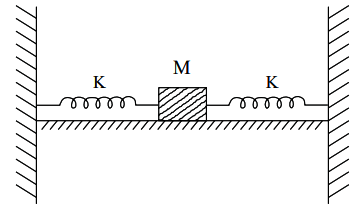
In the figure given below, a block of mass \(M=490 \mathrm{~g}\) placed on a frictionless table is connected with two springs having same spring constant \(\left(\mathrm{K}=2 \mathrm{Nm}^{-1}\right)\). If the block is horizontally displaced through ‘ \(X\) ‘ m then the number of complete oscillations it will make in \(14 \pi\) seconds will be ___. [JEE Main 2023 (Online) 31st January Morning Shift]
 CorrectIncorrect
Hint
(a) To solve for the number of complete oscillations, we first need to determine the effective spring constant (\(K_{\text {eff }}\)) of the system and then find the time period of oscillation.
Step 1: Identify the Spring Arrangement
In the given figure, the block is connected between two springs attached to fixed walls. When the block is displaced to one side (say, to the right) by a distance \(x\) :
The left spring is stretched by \(x\), pulling the block back to the left.
The right spring is compressed by \(x\), pushing the block back to the left.
Since both springs provide a restoring force in the same direction, they act in parallel.
\(
K_{\mathrm{eff}}=K+K=2 K
\)
Given \(K=2 \mathrm{Nm}^{-1}\), we have:
\(
K_{\mathrm{eff}}=2 \times 2=4 \mathrm{Nm}^{-1}
\)
Step 2: Calculate the Time Period (\(T\))
The time period for a mass-spring system is given by:
\(
T=2 \pi \sqrt{\frac{M}{K_{\mathrm{eff}}}}
\)
Substitute the values \(M=490 \mathrm{~g}=0.49 \mathrm{~kg}\) and \(K_{\text {eff }}=4 \mathrm{Nm}^{-1}\) :
\(
\begin{aligned}
T & =2 \pi \sqrt{\frac{0.49}{4}} \\
T & =2 \pi\left(\frac{0.7}{2}\right) \\
T & =0.7 \pi \text { seconds }
\end{aligned}
\)
Step 3: Calculate the Number of Oscillations (\(n\))
The total time given is \(t=14 \pi\) seconds. The number of complete oscillations is the total time divided by the time for one oscillation:
\(
\begin{gathered}
n=\frac{t}{T} \\
n=\frac{14 \pi}{0.7 \pi} \\
n=\frac{14}{0.7}=20
\end{gathered}
\)
The number of complete oscillations the block will make in \(14 \pi\) seconds is 20.Note: In the given configuration, the block is connected between two springs fixed to walls. When the block is displaced, one spring is compressed while the other is stretched. Both springs exert a restoring force in the same direction, meaning they act in parallel. The effective spring constant \(k_{\text {eff }}\) is:\(k_{e f f}=K+K=2K\)
- Question 18 of 39
18. Question
The velocity of a particle executing SHM varies with displacement \((x)\) as \(4 v^2=50-x^2\). The time period of oscillations is \(\frac{x}{7} s\). The value of \(x\) is _____. [JEE Main 2023 (Online) 30th January Evening Shift]
(Take \(\pi=\frac{22}{7}\))CorrectIncorrectHint
(c) To find the value of \(x\), we need to compare the given velocity equation with the standard equation for a particle executing Simple Harmonic Motion (SHM).
Step 1: Standard Equation of Velocity in SHM
The velocity \(v\) of a particle in SHM at a displacement \(x\) is given by:
\(
v=\omega \sqrt{A^2-x^2}
\)
Squaring both sides gives:
\(
v^2=\omega^2\left(A^2-x^2\right)
\)
Step 2: Rearrange the Given Equation
The problem provides the following relation:
\(
4 v^2=50-x^2
\)
Divide the entire equation by 4 to isolate \(v^2\) :
\(
\begin{aligned}
v^2 & =\frac{50}{4}-\frac{x^2}{4} \\
v^2 & =\frac{1}{4}\left(50-x^2\right)
\end{aligned}
\)
Step 3: Compare and Find Angular Frequency (\(\omega\))
By comparing our rearranged equation \(v^2=\frac{1}{4}\left(50-x^2\right)\) with the standard form \(v^2= \omega^2\left(A^2-x^2\right)\), we can identify the coefficients:
\(
\omega^2=\frac{1}{4}
\)
Taking the square root:
\(
\omega=\frac{1}{2} \mathrm{rad} / \mathrm{s}
\)
Step 4: Calculate the Time Period (\(T\))
The relationship between the time period \(T\) and angular frequency \(\omega\) is:
\(
T=\frac{2 \pi}{\omega}
\)
Substitute \(\omega=1 / 2\) and \(\pi=22 / 7\) :
\(
\begin{gathered}
T=\frac{2 \times(22 / 7)}{1 / 2} \\
T=2 \times \frac{22}{7} \times 2 \\
T=\frac{88}{7} \mathrm{~s}
\end{gathered}
\)
Step 5: Solve for \(x\)
The problem states that the time period is \(\frac{x}{7} \mathrm{~s}\).
\(
\begin{aligned}
& \frac{88}{7}=\frac{x}{7} \\
& x=88
\end{aligned}
\) - Question 19 of 39
19. Question
The general displacement of a simple harmonic oscillator is \(x=A \sin \omega t\). Let \(T\) be its time period. The slope of its potential energy (\(U\)) – time (\(t\)) curve will be maximum when \(t=\frac{T}{\beta}\). The value of \(\beta\) is ____. [JEE Main 2023 (Online) 30th January Morning Shift]
CorrectIncorrectHint
(d) To find the value of \(\beta\), we need to analyze the potential energy function \(U(t)\) and find where its rate of change (slope) is at a maximum.
Step 1: Express Potential Energy (\(U\)) as a function of time (\(t\))
The potential energy of a simple harmonic oscillator is given by:
\(
U=\frac{1}{2} k x^2
\)
Substituting the given displacement \(x=A \sin \omega t\) :
\(
U(t)=\frac{1}{2} k A^2 \sin ^2 \omega t
\)
Using the trigonometric identity \(\sin ^2 \theta=\frac{1-\cos 2 \theta}{2}\), we can rewrite this as:
\(
U(t)=\frac{1}{4} k A^2(1-\cos 2 \omega t)
\)
Step 2: Find the Slope of the \(U-t\) curve
The slope is the first derivative of potential energy with respect to time:
\(
\begin{aligned}
\text { Slope } & =\frac{d U}{d t}=\frac{d}{d t}\left[\frac{1}{4} k A^2(1-\cos 2 \omega t)\right] \\
\frac{d U}{d t} & =\frac{1}{4} k A^2(0-(-\sin 2 \omega t \cdot 2 \omega))
\end{aligned}
\)
\(
\frac{d U}{d t}=\frac{1}{2} k A^2 \omega \sin 2 \omega t
\)
Step 3: Maximize the Slope
The slope is a sine function: Slope \(\propto \sin 2 \omega t\). A sine function reaches its maximum value when its argument is \(90^{\circ}\) (or \(\pi / 2\) radians).
\(
2 \omega t=\frac{\pi}{2}
\)
Step 4: Solve for \(t\) in terms of \(T\)
We know that the angular frequency \(\omega=\frac{2 \pi}{T}\). Substitute this into the equation:
\(
\begin{gathered}
2\left(\frac{2 \pi}{T}\right) t=\frac{\pi}{2} \\
\frac{4 \pi t}{T}=\frac{\pi}{2} \\
4 t=\frac{T}{2} \\
t=\frac{T}{8}
\end{gathered}
\)
Step 5: Identify \(\beta\)
The problem states the time is \(t=\frac{T}{\beta}\). Comparing this to our result \(t=\frac{T}{8}\) :
\(
\beta=8
\) - Question 20 of 39
20. Question
A particle of mass 250 g executes a simple harmonic motion under a periodic force \(\mathrm{F}=(-25 x) \mathrm{N}\). The particle attains a maximum speed of \(4 \mathrm{~m} / \mathrm{s}\) during its oscillation. The amplitude of the motion is _____ cm. [JEE Main 2023 (Online) 29th January Evening Shift]
CorrectIncorrectHint
(a) To find the amplitude of the motion, we need to relate the force constant, the mass, and the maximum speed of the particle.
Step 1: Find the Force Constant (\(k\))
The restoring force in SHM is given by \(F=-k x\). By comparing this to the given equation:
\(
F=-25 x
\)
We can see that the force constant \(k=25 \mathrm{~N} / \mathrm{m}\).
Step 2: Calculate the Angular Frequency (\(\omega\))
The angular frequency is determined by the mass (\(m\)) and the force constant (\(k\)).
Given \(m=250 \mathrm{~g}=0.25 \mathrm{~kg}\) :
\(
\begin{gathered}
\omega=\sqrt{\frac{k}{m}} \\
\omega=\sqrt{\frac{25}{0.25}}=\sqrt{100} \\
\omega=10 \mathrm{rad} / \mathrm{s}
\end{gathered}
\)
Step 3: Use the Maximum Speed Formula
In SHM, the maximum speed (\(v_{\text {max }}\)) occurs at the mean position and is defined by:
\(
v_{\max }=\omega A
\)
Where \(A\) is the amplitude. Substituting the given \(v_{\max }=4 \mathrm{~m} / \mathrm{s}\) and our calculated \(\omega= 10 \mathrm{rad} / \mathrm{s}\) :
\(
\begin{gathered}
4=10 \times A \\
A=\frac{4}{10}=0.4 \mathrm{~m}
\end{gathered}
\)
Step 4: Convert to Centimeters
The question asks for the answer in cm:
\(
\begin{gathered}
A=0.4 \times 100 \\
A=40 \mathrm{~cm}
\end{gathered}
\)
The amplitude of the motion is 40 cm. - Question 21 of 39
21. Question
A mass \(m\) attached to free end of a spring executes SHM with a period of \(1 s\). If the mass is increased by 3 kg the period of the oscillation increases by one second, the value of mass \(m\) is _____ kg. [JEE Main 2023 (Online) 24th January Evening Shift]
CorrectIncorrectHint
(a) To find the value of the initial mass \(m\), we can use the relationship between the mass and the time period of a spring-mass system.
Step 1: Set up the initial condition
The time period \(T\) of a spring-mass system is given by the formula:
\(
T=2 \pi \sqrt{\frac{m}{k}}
\)
For the first case, we are given \(T_1=1 \mathrm{~s}\) :
\(
1=2 \pi \sqrt{\frac{m}{k}} \dots(1)
\)
Step 2: Set up the second condition
When the mass is increased by 3 kg, the new mass becomes (\(m+3\)). The problem states the period increases by 1 second, so the new period \(T_2=1+1=2 \mathrm{~s}\).
\(
2=2 \pi \sqrt{\frac{m+3}{k}} \dots(2)
\)
Step 3: Divide the equations to eliminate \(k\)
Divide Eq. 2 by Eq. 1:
\(
\begin{aligned}
& \frac{2}{1}=\frac{2 \pi \sqrt{\frac{m+3}{k}}}{2 \pi \sqrt{\frac{m}{k}}} \\
& 2=\sqrt{\frac{m+3}{m}}
\end{aligned}
\)
Step 4: Solve for \(m\)
Square both sides of the equation to remove the square root:
\(
\begin{gathered}
4=\frac{m+3}{m} \\
4 m=m+3 \\
3 m=3 \\
m=1 \mathrm{~kg}
\end{gathered}
\)
The value of the initial mass \(m\) is 1 kg. - Question 22 of 39
22. Question
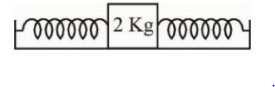
A block of a mass 2 kg is attached with two identical springs of spring constant \(20 \mathrm{~N} / \mathrm{m}\) each. The block is placed on a frictionless surface and the ends of the springs are attached to rigid supports (see figure). When the mass is displaced from its equilibrium position, it executes a simple harmonic motion. The time period of oscillation is \(\frac{\pi}{\sqrt{x}}\) in Sl unit. The value of \(x\) is ____. [JEE Main 2023 (Online) 24th January Morning Shift]
 CorrectIncorrect
Hint
(d) To find the value of \(x\), we need to determine the effective spring constant for this configuration and then calculate the time period of oscillation.
Step 1: Determine the Effective Spring Constant (\(k_{\text {eff }}\))
In the arrangement shown, the block is connected between two identical springs. When the block is displaced to the right by a distance \(x\) :
The left spring is stretched by \(x\), pulling the block to the left with force \(k x\).
The right spring is compressed by \(x\), pushing the block to the left with force \(k x\).
Since both forces act in the same direction to restore the block to equilibrium, the springs are in a parallel-like arrangement.
\(
k_{\mathrm{eff}}=k+k=2 k
\)
Given \(k=20 \mathrm{~N} / \mathrm{m}\) :
\(
k_{\mathrm{eff}}=2 \times 20=40 \mathrm{~N} / \mathrm{m}
\)
Step 2: Calculate the Time Period (\(T\))
The formula for the time period of a mass-spring system is:
\(
T=2 \pi \sqrt{\frac{m}{k_{\mathrm{eff}}}}
\)
Substitute \(m=2 \mathrm{~kg}\) and \(k_{\text {eff }}=40 \mathrm{~N} / \mathrm{m}\) :
\(
T=\frac{2 \pi}{\sqrt{20}}
\)
Step 3: Simplify and Find \(x\)
We need to bring the expression into the form \(\frac{\pi}{\sqrt{x}}\). Let’s manipulate the expression:
\(
T=\frac{2 \pi}{\sqrt{20}}=\frac{\pi}{\frac{\sqrt{20}}{2}}
\)
To bring the 2 inside the square root, we square it \(\left(2^2=4\right)\) :
\(
\begin{gathered}
T=\frac{\pi}{\sqrt{\frac{20}{4}}} \\
T=\frac{\pi}{\sqrt{5}}
\end{gathered}
\)
Comparing this to the given form \(T=\frac{\pi}{\sqrt{x}}\) :
\(
x=5
\) - Question 23 of 39
23. Question
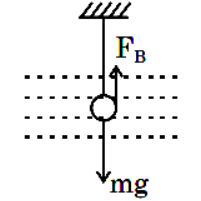
The metallic bob of simple pendulum has the relative density 5. The time period of this pendulum is 10 s. If the metallic bob is immersed in water, then the new time period becomes \(5 \sqrt{x} \mathrm{~s}\). The value of \(x\) will be ____ . [JEE Main 2022 (Online) 29th July Evening Shift]
CorrectIncorrectHint
(b)

\(
\mathrm{mg}^{\prime}=\mathrm{mg}-\mathrm{F}_{\mathrm{B}}
\)
\(
\begin{aligned}
& g^{\prime}=\frac{m g-F_B}{m} \\
& =\frac{\rho_B V g-\rho_w V g}{\rho_B V} \\
& =\left(\frac{\rho_B-\rho_w}{\rho_B}\right) g
\end{aligned}
\)\(
\begin{aligned}
& =\frac{5-1}{5} \times \mathrm{g} \\
& =\frac{4}{5} \mathrm{~g}
\end{aligned}
\)
\(
\mathbf{T}=2 \pi \sqrt{\frac{\ell}{\mathbf{g}}}
\)
\(
\begin{aligned}
& \frac{\mathrm{T}^{\prime}}{\mathrm{T}}=\sqrt{\frac{\mathrm{g}}{\mathrm{~g}^{\prime}}}=\sqrt{\frac{\mathrm{g}}{\frac{4}{5} \mathrm{~g}}}=\sqrt{\frac{5}{4}} \\
& \mathrm{~T}^{\prime}=\mathrm{T} \sqrt{\frac{5}{4}}=\frac{10}{2} \sqrt{5} \\
& \mathrm{~T}^{\prime}=5 \sqrt{5}
\end{aligned}
\)Alternate: To find the value of \(x\), we need to calculate how the “effective gravity” changes when the pendulum bob is immersed in water.
Step 1: Effective Gravity in Water
When the bob is in air, the acceleration acting on it is simply \(g\). When immersed in water, an upward buoyant force acts on the bob, reducing its effective weight.
The effective acceleration \(\left(g^{\prime}\right)\) is given by:
\(
g^{\prime}=g\left(1-\frac{\rho_{\mathrm{water}}}{\rho_{\mathrm{bob}}}\right)
\)
Given the relative density \((\sigma)\) of the bob is 5, we know that \(\frac{\rho_{\text {bob }}}{\rho_{\text {water }}}=5\). Therefore:
\(
g^{\prime}=g\left(1-\frac{1}{5}\right)=g\left(\frac{4}{5}\right)
\)
Step 2: Relation between Time Period and Gravity
The time period \(T\) of a simple pendulum is inversely proportional to the square root of the acceleration due to gravity:
\(
T \propto \frac{1}{\sqrt{g}}
\)
We can set up a ratio between the initial period (\(T=10 \mathrm{~s}\)) and the new period (\(T^{\prime}\)):
\(
\frac{T^{\prime}}{T}=\sqrt{\frac{g}{g^{\prime}}}
\)
Step 3: Calculate the New Time Period
Substitute the value of \(g^{\prime}\) into the ratio:
\(
\begin{gathered}
\frac{T^{\prime}}{10}=\sqrt{\frac{g}{4} g} \\
\frac{T^{\prime}}{10}=\sqrt{\frac{5}{4}}=\frac{\sqrt{5}}{2}
\end{gathered}
\)
Now, solve for \(T^{\prime}\) :
\(
\begin{aligned}
T^{\prime} & =10 \times \frac{\sqrt{5}}{2} \\
T^{\prime} & =5 \sqrt{5} \mathrm{~s}
\end{aligned}
\)
Step 4: Find the Value of \(x\)
The problem states the new time period is \(5 \sqrt{x} \mathrm{~s}\). Comparing this to our result \(5 \sqrt{5} \mathrm{~s}\) :
\(
x=5
\) - Question 24 of 39
24. Question
The potential energy of a particle of mass 4 kg in motion along the x -axis is given by \(\mathrm{U}=4(1-\cos 4 x) \mathrm{J}\). The time period of the particle for small oscillation \((\sin \theta \simeq \theta)\) is \(\left(\frac{\pi}{K}\right) s\). The value of \(K\) is ____. [JEE Main 2022 (Online) 28th July Evening Shift]
CorrectIncorrectHint
(b) To find the value of \(K\), we need to determine the angular frequency \(\omega\) of the system by examining the potential energy function \(U(x)\) for small oscillations.
Step 1: Use the Small Angle Approximation
The potential energy is given as \(U=4(1-\cos 4 x)\). For small oscillations, \(x\) is very small. We can use the Taylor series expansion for \(\cos \theta \approx 1-\frac{\theta^2}{2}\) :
\(
\cos 4 x \approx 1-\frac{(4 x)^2}{2}=1-8 x^2
\)
Substituting this into the potential energy equation:
\(
\begin{gathered}
U \approx 4\left[1-\left(1-8 x^2\right)\right] \\
U \approx 4\left(8 x^2\right)=32 x^2
\end{gathered}
\)
Step 2: Identify the Force Constant (\(k\))
The standard form for potential energy in Simple Harmonic Motion (SHM) is:
\(
U=\frac{1}{2} k x^2
\)
Comparing \(U=32 x^2\) with the standard form:
\(
\frac{1}{2} k=32 \Longrightarrow k=64 \mathrm{~N} / \mathrm{m}
\)
Step 3: Calculate the Angular Frequency (\(\omega\))
The angular frequency is determined by the mass (\(m=4 \mathrm{~kg}\)) and the force constant (\(k= 64 \mathrm{~N} / \mathrm{m}\)):
\(
\begin{gathered}
\omega=\sqrt{\frac{k}{m}}=\sqrt{\frac{64}{4}}=\sqrt{16} \\
\omega=4 \mathrm{rad} / \mathrm{s}
\end{gathered}
\)
Step 4: Calculate the Time Period (\(T\))
The relationship between the time period and angular frequency is:
\(
\begin{gathered}
T=\frac{2 \pi}{\omega} \\
T=\frac{2 \pi}{4}=\frac{\pi}{2} \mathrm{~s}
\end{gathered}
\)
Step 5: Solve for \(K\)
The problem states the time period is \(\left(\frac{\pi}{K}\right) \mathrm{s}\). Comparing this to our result:
\(
\begin{gathered}
\frac{\pi}{K}=\frac{\pi}{2} \\
K=2
\end{gathered}
\) - Question 25 of 39
25. Question
A mass 0.9 kg , attached to a horizontal spring, executes SHM with an amplitude \(\mathrm{A}_1\). When this mass passes through its mean position, then a smaller mass of 124 g is placed over it and both masses move together with amplitude \(A_2\). If the ratio \(\frac{A_1}{A_2}\) is \(\frac{\alpha}{\alpha-1}\), then the value of \(\alpha\) will be ____. [JEE Main 2022 (Online) 27th July Morning Shift]
CorrectIncorrectHint
(d) This problem involves two key physics principles: Conservation of Linear Momentum (at the mean position) and the Conservation of Mechanical Energy (to relate velocity to amplitude).
Step 1: Conservation of Momentum at the Mean Position
When the mass \(M\) passes through the mean position, its velocity is at its maximum (\(v_1\)). At this exact moment, a smaller mass \(m\) is placed on top of it. Since there are no external horizontal forces during this “collision,” momentum is conserved:
\(
M v_1=(M+m) v_2
\)
Where:
\(M=0.9 \mathrm{~kg}=900 \mathrm{~g}\)
\(m=124 \mathrm{~g}\)
\(v_1\) is the initial maximum velocity.
\(v_2\) is the new maximum velocity of the combined system.
Rearranging for the velocity ratio:
\(
\frac{v_1}{v_2}=\frac{M+m}{M}=\frac{900+124}{900}=\frac{1024}{900}
\)
Step 2: Relation Between Velocity and Amplitude
In SHM, the maximum velocity at the mean position is given by \(v_{\text {max }}=\omega A\).
We know \(\omega=\sqrt{\frac{k}{m_{\text {total }}}}\).
For the first case: \(v_1=\sqrt{\frac{k}{M}} A_1\)
For the second case: \(v_2=\sqrt{\frac{k}{M+m}} A_2\)
Taking the ratio \(\frac{v_1}{v_2}\) :
\(
\frac{v_1}{v_2}=\frac{\sqrt{\frac{k}{M}} A_1}{\sqrt{\frac{k}{M+m}} A_2}=\sqrt{\frac{M+m}{M}} \cdot \frac{A_1}{A_2}
\)
Step 3: Combine the Ratios
Equate the results from Step 1 and Step 2:
\(
\begin{aligned}
\frac{M+m}{M} & =\sqrt{\frac{M+m}{M}} \cdot \frac{A_1}{A_2} \\
\frac{A_1}{A_2} & =\sqrt{\frac{M+m}{M}}
\end{aligned}
\)
Substitute the numerical values:
\(
\begin{aligned}
& \frac{A_1}{A_2}=\sqrt{\frac{1024}{900}} \\
& \frac{A_1}{A_2}=\frac{32}{30}=\frac{16}{15}
\end{aligned}
\)
Step 4: Solve for \(\alpha\)
The problem gives the ratio as \(\frac{\alpha}{\alpha-1}\). Comparing this to our result:
\(
\frac{\alpha}{\alpha-1}=\frac{16}{15}
\)
By inspection (or by solving \(15 \alpha=16 \alpha-16\)), we find:
\(
\alpha=16
\) - Question 26 of 39
26. Question
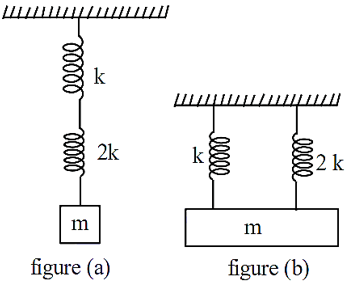
As per given figures, two springs of spring constants \(k\) and \(2 k\) are connected to mass \(m\). If the period of oscillation in figure (a) is 3 s, then the period of oscillation in figure (b) will be \(\sqrt{x} s\). The value of \(x\) is ____. [JEE Main 2022 (Online) 26th July Evening Shift]
 CorrectIncorrect
Hint
(b) To solve this, we need to determine the effective spring constants (\(k_{\text {eff }}\)) for both configurations. In physics problems of this type, the “standard” figures usually show one arrangement in series and the other in parallel.
Step 1: Analyze Figure (a) – Series Arrangement
In a series arrangement, the springs are connected end-to-end. The effective spring constant \(k_s\) is given by:
\(
\begin{gathered}
\frac{1}{k_s}=\frac{1}{k_1}+\frac{1}{k_2}=\frac{1}{k}+\frac{1}{2 k} \\
\frac{1}{k_s}=\frac{2+1}{2 k}=\frac{3}{2 k} \Longrightarrow k_s=\frac{2 k}{3}
\end{gathered}
\)
The time period \(T_a\) is:
\(
T_a=2 \pi \sqrt{\frac{m}{k_s}}=2 \pi \sqrt{\frac{3 m}{2 k}}=3 \mathrm{~s} \dots(1)
\)
Step 2: Analyze Figure (b) – Parallel Arrangement
In a parallel arrangement (or when the mass is between two springs), the springs provide a combined restoring force. The effective spring constant \(k_p\) is:
\(
k_p=k_1+k_2=k+2 k=3 k
\)
The time period \(T_b\) is:
\(
T_b=2 \pi \sqrt{\frac{m}{k_p}}=2 \pi \sqrt{\frac{m}{3 k}} \quad \text { – (Eq. 2) }
\)
Step 3: Find the Ratio and Solve for \(x\)
Divide Eq. 2 by Eq. 1:
\(
\begin{gathered}
\frac{T_b}{T_a}=\frac{2 \pi \sqrt{\frac{m}{3 k}}}{2 \pi \sqrt{\frac{3 m}{2 k}}} \\
\frac{T_b}{3}=\sqrt{\frac{m}{3 k} \cdot \frac{2 k}{3 m}} \\
\frac{T_b}{3}=\sqrt{\frac{2}{9}}=\frac{\sqrt{2}}{3}
\end{gathered}
\)
Solving for \(T_b\) :
\(
T_b=3 \times \frac{\sqrt{2}}{3}=\sqrt{2} \mathrm{~s}
\)
Step 4: Identify the Value of \(x\)
The problem states the period in figure (b) is \(\sqrt{x} \mathrm{~s}\). Comparing this to our result:
\(
x=2
\) - Question 27 of 39
27. Question
A body is performing simple harmonic with an amplitude of 10 cm. The velocity of the body was tripled by air jet when it is at 5 cm from its mean position. The new amplitude of vibration is \(\sqrt{x} \mathrm{~cm}\). The value of \(x\) is ____. [JEE Main 2022 (Online) 29th June Morning Shift]
CorrectIncorrectHint
(d) To find the new amplitude, we need to calculate the velocity of the body at the given position, apply the change, and then use the energy relationship of Simple Harmonic Motion (SHM).
Step 1: Calculate Initial Velocity (\(\boldsymbol{v}_{\mathbf{1}}\))
The velocity of a particle in SHM at a displacement \(y\) is given by:
\(
v=\omega \sqrt{A^2-y^2}
\)
Given the initial amplitude \(A_1=10 \mathrm{~cm}\) and displacement \(y=5 \mathrm{~cm}\) :
\(
\begin{gathered}
v_1=\omega \sqrt{10^2-5^2} \\
v_1=\omega \sqrt{100-25}=\omega \sqrt{75}
\end{gathered}
\)
Step 2: Calculate New Velocity (\(v_2\))
The problem states the velocity was tripled by an air jet:
\(
v_2=3 v_1=3 \omega \sqrt{75}
\)
Step 3: Find the New Amplitude (\(\boldsymbol{A}_{\mathbf{2}}\))
The new velocity \(v_2\) at the same position \(y=5 \mathrm{~cm}\) must satisfy the SHM velocity equation for the new amplitude \(A_2\). Note that \(\omega\) remains the same because the mass and the restoring force constant (the “springiness” of the system) haven’t changed.
\(
v_2=\omega \sqrt{A_2^2-y^2}
\)
Substitute the value of \(v_2\) from Step 2:
\(
3 \omega \sqrt{75}=\omega \sqrt{A_2^2-5^2}
\)
\(
A_2^2=675+25=700
\)
Step 5: Identify the Value of \(x\)
The problem states the new amplitude is \(\sqrt{x} \mathrm{~cm}\). Since \(A_2=\sqrt{700}\), we compare the two:
\(
\begin{gathered}
\sqrt{x}=\sqrt{700} \\
x=700
\end{gathered}
\) - Question 28 of 39
28. Question
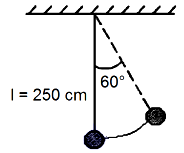
A pendulum is suspended by a string of length 250 cm. The mass of the bob of the pendulum is 200 g. The bob is pulled aside until the string is at \(60^{\circ}\) with vertical as shown in the figure. After releasing the bob, the maximum velocity attained by the bob will be ____ \(\mathrm{ms}^{-1}\). (if \(\mathrm{g}=10 \mathrm{~m} / \mathrm{s}^2\)) [JEE Main 2022 (Online) 28th June Morning Shift]
 CorrectIncorrect
Hint
(a) To solve for the maximum velocity, we use the Law of Conservation of Energy. The potential energy lost by the bob as it falls from its highest point is converted into kinetic energy at the lowest point (the mean position).
Step 1: Find the Vertical Height (\(h\))
When the pendulum is pulled to an angle \(\theta\), it rises a vertical distance \(h\) from its lowest point. Looking at the geometry:
The total length of the string is \(L\).
The vertical distance from the support to the bob’s level at \(60^{\circ}\) is \(L \cos 60^{\circ}\).
The height \(h\) is the difference between the full length and this vertical component.
\(
h=L-L \cos \theta=L(1-\cos \theta)
\)
Given \(L=250 \mathrm{~cm}=2.5 \mathrm{~m}\) and \(\theta=60^{\circ}\) :
\(
\begin{gathered}
h=2.5\left(1-\cos 60^{\circ}\right) \\
h=2.5(1-0.5)=2.5 \times 0.5=1.25 \mathrm{~m}
\end{gathered}
\)
Step 2: Apply Conservation of Energy
At the maximum height, the bob has Potential Energy ( \(P E=m g h\) ) and zero Kinetic Energy. At the lowest point, it has maximum Kinetic Energy ( \(K E=\frac{1}{2} m v^2\) ) and zero Potential Energy relative to that point.
\(
m g h=\frac{1}{2} m v^2
\)
The mass \(m\) cancels out (showing that the velocity is independent of the bob’s weight):
\(
g h=\frac{1}{2} v^2 \Longrightarrow v^2=2 g h
\)
Step 3: Solve for Maximum Velocity (\(v\))
Substitute \(g=10 \mathrm{~m} / \mathrm{s}^2\) and \(h=1.25 \mathrm{~m}\) :
\(
\begin{gathered}
v^2=2 \times 10 \times 1.25 \\
v^2=25 \\
v=\sqrt{25}=5 \mathrm{~ms}^{-1}
\end{gathered}
\)
The maximum velocity attained by the bob will be \(5 \mathrm{~ms}^{-1}\). - Question 29 of 39
29. Question
A particle executes simple harmonic motion. Its amplitude is 8 cm and time period is 6 s. The time it will take to travel from its position of maximum displacement to the point corresponding to half of its amplitude, is ____ s. [JEE Main 2022 (Online) 27th June Evening Shift]
CorrectIncorrectHint
(a) To find the time taken to travel from the maximum displacement to half the amplitude, we use the standard equation of motion for a Simple Harmonic Oscillator.
Step 1: Choose the Equation of Motion
Since the timing starts from the position of maximum displacement (the extreme position), it is most convenient to use the cosine form of the displacement equation:
\(
x=A \cos (\omega t)
\)
Where:
\(x\) is the displacement at time \(t\).
\(A\) is the amplitude (8 cm).
\(\omega\) is the angular frequency.
Step 2: Calculate Angular Frequency (\(\boldsymbol{\omega}\))
The relationship between angular frequency and the time period (\(T=6 \mathrm{~s}\)) is:
\(
\omega=\frac{2 \pi}{T}=\frac{2 \pi}{6}=\frac{\pi}{3} \mathrm{rad} / \mathrm{s}
\)
Step 3: Set up the Displacement Condition
The particle moves from \(x=A\) to \(x=A / 2\). We substitute \(x=A / 2\) into our equation to find the time \(t\) it reaches that point:
\(
\begin{gathered}
\frac{A}{2}=A \cos (\omega t) \\
\frac{1}{2}=\cos (\omega t)
\end{gathered}
\)
Step 4: Solve for Time (\(t\))
We know that \(\cos (\theta)=1 / 2\) when \(\theta=60^{\circ}\) or \(\pi / 3\) radians.
\(
\omega t=\frac{\pi}{3}
\)
Substitute \(\omega=\frac{\pi}{3}\) :
\(
\begin{gathered}
\left(\frac{\pi}{3}\right) t=\frac{\pi}{3} \\
t=1 \mathrm{~s}
\end{gathered}
\)
The time it will take to travel from maximum displacement to half of its amplitude is \(\mathbf{1 s}\). - Question 30 of 39
30. Question
A particle of mass 1 kg is hanging from a spring of force constant \(100 \mathrm{Nm}^{-1}\). The mass is pulled slightly downward and released so that it executes free simple harmonic motion with time period \(T\). The time when the kinetic energy and potential energy of the system will become equal, is \(\frac{T}{x}\). The value of \(x\) is _____. [JEE Main 2021 (Online) 31st August Morning Shift]
CorrectIncorrectHint
(c) To find the value of \(x\), we need to determine the point in time when the energy is split equally between kinetic and potential forms.
Step 1: Set up the Energy Equality
The problem states that at a certain time \(\boldsymbol{t}\), the Kinetic Energy \((K)\) and Potential Energy \((U)\) are equal:
\(
K=U
\)
We also know that the Total Energy (\(E\)) is the sum of both:
\(
E=K+U
\)
Substituting \(K=U\) into the total energy equation:
\(
\begin{gathered}
E=U+U=2 U \\
U=\frac{1}{2} E
\end{gathered}
\)
Step 2: Use the Displacement Relation
The potential energy at any displacement \(y\) is \(U=\frac{1}{2} k y^2\), and the total energy is \(E=\frac{1}{2} k A^2\). Substituting these into our equality:
\(
\begin{aligned}
& \frac{1}{2} k y^2=\frac{1}{2}\left(\frac{1}{2} k \cdot A^2\right) \\
& y^2=\frac{A^2}{2} \Longrightarrow y=\frac{A}{\sqrt{2}}
\end{aligned}
\)
Step 3: Solve for Time (\(t\))
Since the mass was “pulled downward and released,” the motion starts from the extreme position. Therefore, we use the cosine equation for displacement:
\(
y=A \cos (\omega t)
\)
Substitute \(y=\frac{A}{\sqrt{2}}\) :
\(
\begin{aligned}
& \frac{A}{\sqrt{2}}=A \cos (\omega t) \\
& \cos (\omega t)=\frac{1}{\sqrt{2}}
\end{aligned}
\)
We know that \(\cos (\theta)=\frac{1}{\sqrt{2}}\) when \(\theta=\frac{\pi}{4}\).
\(
\omega t=\frac{\pi}{4}
\)
Step 4: Relate to Time Period (\(T\))
Substitute the relation \(\omega=\frac{2 \pi}{T}\) into the equation:
\(
\begin{gathered}
\left(\frac{2 \pi}{T}\right) t=\frac{\pi}{4} \\
t=\frac{\pi}{4} \times \frac{T}{2 \pi} \\
t=\frac{T}{8}
\end{gathered}
\)
Step 5: Identify the value of \(x\)
The problem defines the time as \(t=\frac{T}{x}\). Comparing this to our result:
\(
x=8
\) - Question 31 of 39
31. Question
Two simple harmonic motion, are represented by the equations \(y_1=10 \sin \left(3 \pi t+\frac{\pi}{3}\right) y_2=5(\sin 3 \pi t+\sqrt{3} \cos 3 \pi t)\) Ratio of amplitude of \(\mathrm{y}_1\) to \(\mathrm{y}_2=\mathrm{x}: 1\). The value of \(x\) is ____. [JEE Main 2021 (Online) 27th August Evening Shift]
CorrectIncorrectHint
(a) To find the value of \(x\), we need to determine the amplitude of both SHM equations and then calculate their ratio.
Step 1: Find the Amplitude of \(y_1\)
The first equation is given in the standard form \(y=A \sin (\omega t+\phi)\) :
\(
y_1=10 \sin \left(3 \pi t+\frac{\pi}{3}\right)
\)
By direct comparison, the amplitude of the first motion is:
\(
A_1=10
\)
Step 2: Find the Amplitude of \(y_2\)
The second equation is a linear combination of a sine and a cosine function:
\(
y_2=5(\sin 3 \pi t+\sqrt{3} \cos 3 \pi t)
\)
For an expression of the form \(y=a \sin \theta+b \cos \theta\), the resultant amplitude \(R\) is calculated as:
\(
R=\sqrt{a^2+b^2}
\)
In the case of \(y_2\), we have \(a=1\) and \(b=\sqrt{3}\) (inside the parentheses). Let’s calculate the resultant of the terms inside the bracket first:
\(
\text { Bracket Amplitude }=\sqrt{(1)^2+(\sqrt{3})^2}=\sqrt{1+3}=\sqrt{4}=2
\)
Now, multiply by the coefficient 5 outside the bracket to get the total amplitude \(A_2\) :
\(
A_2=5 \times 2=10
\)
Step 3: Calculate the Ratio
We are looking for the ratio of \(A_1\) to \(A_2\) :
\(
\text { Ratio }=\frac{A_1}{A_2}=\frac{10}{10}=1
\)
The problem states the ratio is \(x: 1\). Comparing \(1: 1\) to \(x: 1\), we find: \(x=1\) - Question 32 of 39
32. Question
Two simple harmonic motions are represented by the equations \(x_1=5 \sin \left(2 \pi t+\frac{\pi}{4}\right)\) and \(x_2=5 \sqrt{2}(\sin 2 \pi t+\cos 2 \pi t)\). The amplitude of second motion is ____ times the amplitude in first motion. [JEE Main 2021 (Online) 26th August Evening Shift]
CorrectIncorrectHint
(b) To find the relationship between the two amplitudes, we need to express both equations in the standard SHM form \(x=A \sin (\omega t+\phi)\) and identify their respective amplitudes.
Step 1: Identify the Amplitude of \(x_1\)
The first equation is already in the standard form:
\(
x_1=5 \sin \left(2 \pi t+\frac{\pi}{4}\right)
\)
By inspection, the amplitude of the first motion is:
\(
A_1=5
\)
Step 2: Simplify and Find the Amplitude of \(x_2\)
The second equation is a combination of a sine and a cosine function:
\(
x_2=5 \sqrt{2}(\sin 2 \pi t+\cos 2 \pi t)
\)
For any expression of the form \(y=a \sin \theta+b \cos \theta\), the resultant amplitude \(R\) is given by:
\(
R=\sqrt{a^2+b^2}
\)
Let’s look at the terms inside the parentheses where \(a=1\) and \(b=1\) :
\(
\text { Resultant of }(\sin 2 \pi t+\cos 2 \pi t)=\sqrt{1^2+1^2}=\sqrt{2}
\)
Now, multiply this by the coefficient \(5 \sqrt{2}\) that is outside the parentheses to get the total amplitude \(\boldsymbol{A}_{\mathbf{2}}\) :
\(
\begin{aligned}
& A_2=5 \sqrt{2} \times \sqrt{2} \\
& A_2=5 \times 2=10
\end{aligned}
\)
Step 3: Compare the Amplitudes
We have \(A_1=5\) and \(A_2=10\). To find how many times larger \(A_2\) is compared to \(A_1\) :
\(
\text { Ratio }=\frac{A_2}{A_1}=\frac{10}{5}=2
\)
The amplitude of the second motion is 2 times the amplitude of the first motion. - Question 33 of 39
33. Question
A particle executes simple harmonic motion represented by displacement function as
\(
x(t)=A \sin (\omega t+\phi)
\)
If the position and velocity of the particle at \(\mathrm{t}=0 \mathrm{~s}\) are 2 cm and \(2 \omega \mathrm{~cm} \mathrm{~s}^{-1}\) respectively, then its amplitude is \(x \sqrt{2} \mathrm{~cm}\) where the value of \(x\) is ___. [JEE Main 2021 (Online) 27th July Evening Shift]CorrectIncorrectHint
(b) To find the value of \(x\), we need to use the initial conditions \((t=0)\) for both the position and velocity functions of the particle.
Step 1: Analyze the Position at \(t=0\)
The displacement function is given as:
\(
x(t)=A \sin (\omega t+\phi)
\)
At \(t=0\), the position is 2 cm :
\(
\begin{gathered}
2=A \sin (0+\phi) \\
2=A \sin \phi-(\text { Eq. } 1)
\end{gathered}
\)
Step 2: Analyze the Velocity at \(t=0\)
The velocity function \(v(t)\) is the derivative of the displacement function:
\(
v(t)=\frac{d x}{d t}=A \omega \cos (\omega t+\phi)
\)
At \(t=0\), the velocity is \(2 \omega \mathrm{~cm} / \mathrm{s}:\)
\(
\begin{gathered}
2 \omega=A \omega \cos (0+\phi) \\
2=A \cos \phi-(\text { Eq. } 2)
\end{gathered}
\)
Step 3: Solve for Amplitude (\(\boldsymbol{A}\))
To eliminate the phase constant \(\phi\), we square both equations and add them together using the identity \(\sin ^2 \phi+\cos ^2 \phi=1\) :
\(
\begin{gathered}
(A \sin \phi)^2+(A \cos \phi)^2=2^2+2^2 \\
A^2\left(\sin ^2 \phi+\cos ^2 \phi\right)=4+4 \\
A^2(1)=8 \\
A=\sqrt{8}=2 \sqrt{2} \mathrm{~cm}
\end{gathered}
\)
Step 4: Identify the Value of \(x\)
The problem states that the amplitude is \(x \sqrt{2} \mathrm{~cm}\). Comparing this to our result:
\(
\begin{gathered}
2 \sqrt{2}=x \sqrt{2} \\
x=2
\end{gathered}
\)
The value of \(x\) is 2.
This result shows that at \(t=0\), the particle was exactly at a phase of \(45^{\circ}(\pi / 4)\), where its potential and kinetic energies are equal. - Question 34 of 39
34. Question
In the reported figure, two bodies A and B of masses 200 g and 800 g are attached with the system of springs. Springs are kept in a stretched position with some extension when the system is released. The horizontal surface is assumed to be frictionless. The angular frequency will be ____ \(\mathrm{rad} / \mathrm{s}\) when \({k}= 20 \mathrm{~N} / \mathrm{m}\). [JEE Main 2021 (Online) 25th July Morning Shift]
 CorrectIncorrect
Hint
(b) To find the angular frequency (\(\omega\)) of this system, we need to treat it as a two-body oscillator connected by an effective spring system.
Step 1: Determine the Effective Spring Constant (\(k_{\text {eff }}\))
Looking at the setup, the two springs are connected end-to-end between the two masses. This is a series arrangement.
The formula for the effective spring constant (\(k_s\)) in series is:
\(
\frac{1}{k_{e f f}}=\frac{1}{k_1}+\frac{1}{k_2}
\)
Given \(k_1=k=20 \mathrm{~N} / \mathrm{m}\) and \(k_2=4 k=80 \mathrm{~N} / \mathrm{m}\) :
\(
\begin{gathered}
\frac{1}{k_{e f f}}=\frac{1}{20}+\frac{1}{80} \\
\frac{1}{k_{e f f}}=\frac{4+1}{80}=\frac{5}{80}=\frac{1}{16} \\
k_{e f f}=16 \mathrm{~N} / \mathrm{m}
\end{gathered}
\)
Step 2: Calculate the Reduced Mass (\(\mu\))
In a system where two masses are free to move and connected by a spring, the oscillation frequency depends on the reduced mass (\(\mu\)), not just one individual mass.
\(
\mu=\frac{m_A \cdot m_B}{m_A+m_B}
\)
Given \(m_A=200 \mathrm{~g}=0.2 \mathrm{~kg}\) and \(m_B=800 \mathrm{~g}=0.8 \mathrm{~kg}\) :
\(
\begin{gathered}
\mu=\frac{0.2 \times 0.8}{0.2+0.8} \\
\mu=\frac{0.16}{1.0}=0.16 \mathrm{~kg}
\end{gathered}
\)
Step 3: Calculate the Angular Frequency (\(\omega\))
The angular frequency for a two-body oscillator is given by:
\(
\omega=\sqrt{\frac{k_{e f f}}{\mu}}
\)
Substitute the values we calculated:
\(
\begin{aligned}
\omega & =\sqrt{\frac{16}{0.16}} \\
\omega & =\sqrt{100} \\
\omega & =10 \mathrm{rad} / \mathrm{s}
\end{aligned}
\)
The angular frequency of the system is \(\mathbf{1 0 ~ r a d} / \mathbf{s}\).
Key Insight: Using the reduced mass allows us to treat the two-body problem as a single-body problem where one end of the spring is “fixed.” This is why the frequency is higher than if you only considered the larger 800 g mass. - Question 35 of 39
35. Question
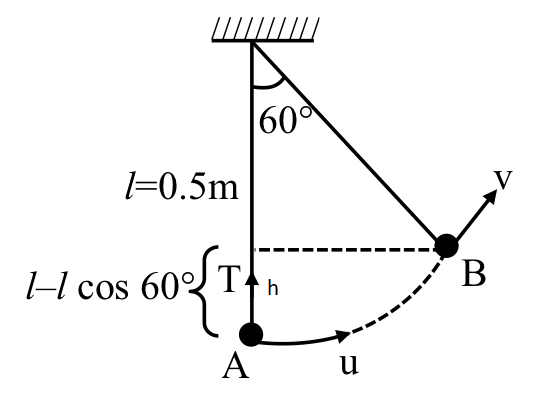
A pendulum bob has a speed of \(3 \mathrm{~m} / \mathrm{s}\) at its lowest position. The pendulum is 50 cm long. The speed of bob, when the length makes an angle of \(60^{\circ}\) to the vertical will be (\(\mathrm{g}=10 \mathrm{~m} / \mathrm{s}^2\)) ____ \(\mathrm{m} / \mathrm{s}\). [JEE Main 2021 (Online) 25th July Morning Shift]
CorrectIncorrectHint
(b)

To solve for the speed of the bob at \(60^{\circ}\), we use the Law of Conservation of Mechanical Energy. The kinetic energy lost as the bob swings upward is equal to the potential energy it gains.
Step 1: Calculate the Height Gained (\(h\))
When the pendulum string of length \(L\) moves from the vertical to an angle \(\theta\), the vertical height \(h\) it rises is:
\(
h=L-L \cos \theta=L(1-\cos \theta)
\)
Given \(L=50 \mathrm{~cm}=0.5 \mathrm{~m}\) and \(\theta=60^{\circ}\) :
\(
\begin{gathered}
h=0.5\left(1-\cos 60^{\circ}\right) \\
h=0.5(1-0.5)=0.5 \times 0.5=0.25 \mathrm{~m}
\end{gathered}
\)
Step 2: Apply Conservation of Energy
Let \(v_0\) be the speed at the lowest position and \(v\) be the speed at \(60^{\circ}\).
Total Energy at Lowest Point \(=\) Total Energy at \(60^{\circ}\)
\(
\frac{1}{2} m v_0^2=\frac{1}{2} m v^2+m g h
\)
Cancel the mass \(m\) and multiply by 2:
\(
\begin{aligned}
& v_0^2=v^2+2 g h \\
& v^2=v_0^2-2 g h
\end{aligned}
\)
Step 3: Solve for the Final Speed (\(v\))
Substitute the known values \(\left(v_0=3 \mathrm{~m} / \mathrm{s}, g=10 \mathrm{~m} / \mathrm{s}^2, h=0.25 \mathrm{~m}\right)\) :
\(
\begin{gathered}
v^2=(3)^2-2(10)(0.25) \\
v^2=9-5 \\
v^2=4 \\
v=\sqrt{4}=2 \mathrm{~m} / \mathrm{s}
\end{gathered}
\)
The speed of the bob when the length makes an angle \(60^{\circ}\) to the vertical will be \(2 \mathrm{~m} / \mathrm{s}\). - Question 36 of 39
36. Question
A particle performs simple harmonic motion with a period of 2 second. The time taken by the particle to cover a displacement equal to half of its amplitude from the mean position is \(\frac{1}{a} \mathrm{~s}\). The value of ‘ \(a\) ‘ to the nearest integer is ____. [JEE Main 2021 (Online) 18th March Morning Shift]
CorrectIncorrectHint
(d) To find the value of \(a\), we use the displacement equation for a particle starting its motion from the mean position.
Step 1: Choose the Equation of Motion
For a particle starting from the mean position (\(x=0\) at \(t=0\)), the displacement \(x\) at any time \(t\) is given by:
\(
x=A \sin (\omega t)
\)
Where:
\(A\) is the amplitude.
\(\omega\) is the angular frequency.
Step 2: Calculate Angular Frequency (\(\omega\))
The relationship between angular frequency and the time period (\(T=2 \mathrm{~s}\)) is:
\(
\omega=\frac{2 \pi}{T}=\frac{2 \pi}{2}=\pi \mathrm{rad} / \mathrm{s}
\)
Step 3: Set up the Displacement Condition
The particle covers a displacement equal to half of its amplitude (\(x=A / 2\)). We substitute this into our equation:
\(
\begin{gathered}
\frac{A}{2}=A \sin (\omega t) \\
\frac{1}{2}=\sin (\omega t)
\end{gathered}
\)
Step 4: Solve for Time (\(t\))
We know that \(\sin (\theta)=1 / 2\) when \(\theta=30^{\circ}\) or \(\pi / 6\) radians.
\(
\omega t=\frac{\pi}{6}
\)
Substitute \(\omega=\pi\) :
\(
\begin{aligned}
& \pi t=\frac{\pi}{6} \\
& t=\frac{1}{6} \mathrm{~s}
\end{aligned}
\)
Step 5: Identify the Value of \(a\)
The problem states the time taken is \(\frac{1}{a} \mathrm{~s}\). Comparing this to our result:
\(
\begin{aligned}
& \frac{1}{a}=\frac{1}{6} \\
& a=6
\end{aligned}
\)
The value of \(a\) is 6.
Notice that traveling from the mean position to \(A / 2\) takes \(1 / 6\) th of the total time period (\(T / 12\)), whereas traveling from the extreme position to \(A / 2\) takes \(1 / 3\) rd of that time (\(T / 6\)). This is because the particle is moving much faster near the center. - Question 37 of 39
37. Question
Consider two identical springs each of spring constant \(k\) and negligible mass compared to the mass \(M\) as shown. Fig. 1 shows one of them and Fig. 2 shows their series combination. The ratios of time period of oscillation of the two SHM is \(T_b / T_a=\sqrt{x}\), where value of \(x\) is ____. (Round off to the Nearest Integer) [JEE Main 2021 (Online) 17th March Morning Shift]
 CorrectIncorrect
Hint
(b) To solve for the value of \(x\), we need to compare the effective spring constants for a single spring versus two identical springs in a series combination.
Step 1: Analyze Figure 1 (Single Spring)
In the first case, a mass \(M\) is attached to a single spring with spring constant \(k\). The time period \(T_a\) is given by the standard formula:
\(
T_a=2 \pi \sqrt{\frac{M}{k}}
\)
Step 2: Analyze Figure 2 (Series Combination)
In the second case, two identical springs (\(k_1=k\) and \(k_2=k\)) are connected in series. The effective spring constant \(k_s\) for a series combination is:
\(
\begin{gathered}
\frac{1}{k_s}=\frac{1}{k}+\frac{1}{k}=\frac{2}{k} \\
k_s=\frac{k}{2}
\end{gathered}
\)
Now, we calculate the new time period \(T_b\) using this effective constant:
\(
\begin{gathered}
T_b=2 \pi \sqrt{\frac{M}{k_s}}=2 \pi \sqrt{\frac{M}{k / 2}} \\
T_b=2 \pi \sqrt{\frac{2 M}{k}}
\end{gathered}
\)
Step 3: Find the Ratio \(T_b / T_a\)
Now we divide \(T_b\) by \(T_a\) to find the relationship:
\(
\frac{T_b}{T_a}=\frac{2 \pi \sqrt{\frac{2 M}{k}}}{2 \pi \sqrt{\frac{M}{k}}}
\)
The \(2 \pi\) and the \(\sqrt{M / k}\) terms cancel out, leaving:
\(
\frac{T_b}{T_a}=\sqrt{2}
\)
Step 4: Identify the Value of \(x\)
The problem states the ratio is \(T_b / T_a=\sqrt{x}\). Comparing this to our result:
\(
\sqrt{x}=\sqrt{2}
\)
\(
x=2
\)
The value of \(x\) is \(\mathbf{2}\).
By putting springs in series, you essentially made the system “softer” (halved the stiffness), which naturally increased the time it takes for one full oscillation. - Question 38 of 39
38. Question
A particle executes S.H.M. with amplitude ‘ \(a\) ‘, and time period ‘ \(T\) ‘. The displacement of the particle when its speed is half of maximum speed is \(\frac{\sqrt{x} a}{2}\). The value of \(x\) is ____ . [JEE Main 2021 (Online) 26th February Evening Shift]
CorrectIncorrectHint
(c) To find the value of \(x\), we need to relate the speed of the particle to its displacement using the standard equations of Simple Harmonic Motion (SHM).
Step 1: Identify Maximum Speed (\(v_{\text {max }}\))
In SHM, the maximum speed of a particle occurs at the mean position and is given by the formula:
\(
v_{\max }=\omega a
\)
Where \(\omega\) is the angular frequency and \(a\) is the amplitude.
Step 2: Use the Velocity-Displacement Relation
The velocity \(v\) of a particle at any displacement \(y\) from the mean position is:
\(
v=\omega \sqrt{a^2-y^2}
\)
Step 3: Set up the Condition
The problem states that the speed \(v\) is half of the maximum speed:
\(
v=\frac{1}{2} v_{\max }
\)
Substituting the expressions from Step 1 and Step 2:
\(
\omega \sqrt{a^2-y^2}=\frac{1}{2}(\omega a)
\)
Step 4: Solve for Displacement (\(y\))
Cancel \(\omega\) from both sides:
\(
\sqrt{a^2-y^2}=\frac{a}{2}
\)
Square both sides to remove the square root:
\(
\begin{gathered}
a^2-y^2=\frac{a^2}{4} \\
y^2=a^2-\frac{a^2}{4} \\
y^2=\frac{3 a^2}{4}
\end{gathered}
\)
Taking the square root of both sides:
\(
y=\frac{\sqrt{3} a}{2}
\)
Step 5: Identify the Value of \(x\)
The problem gives the displacement as \(\frac{\sqrt{x} a}{2}\). Comparing this to our result:
\(
\begin{aligned}
\frac{\sqrt{3} a}{2} & =\frac{\sqrt{x} a}{2} \\
x & =3
\end{aligned}
\)
The value of \(x\) is 3. - Question 39 of 39
39. Question
Time period of a simple pendulum is \(T\). The time taken to complete \(\frac{5}{8}\) oscillations starting from mean position is \(\frac{\alpha}{\beta} T\). The value of \(\alpha\) is ____. [JEE Main 2021 (Online) 26th February Evening Shift]
CorrectIncorrectHint
(d) To find the value of \(\alpha\), we need to break down the motion of the pendulum into distinct segments based on the fraction of the oscillation completed.
Step 1: Analyze 5/8 of an Oscillation
One full oscillation \((T)\) consists of four equal segments (quarters):
Mean to Extreme (\(T / 4\))
Extreme back to Mean (\(T / 4\))
Mean to opposite Extreme (\(T / 4\))
Opposite Extreme back to Mean (\(T / 4\))
The fraction \(\frac{5}{8}\) can be written as:
\(
\frac{5}{8}=\frac{4}{8}+\frac{1}{8}=\frac{1}{2}+\frac{1}{8}
\)
This means the pendulum completes:
One half-oscillation: \(\frac{1}{2} T\) (from mean, to one extreme, and back to mean).
An additional \(1 / 8\) oscillation: This is half of a “quarter-swing” (from mean towards the other extreme).
Step 2: Calculate the Time for the Final Segment
The first half-oscillation takes exactly \(\frac{T}{2}\).
Now we need the time \(t\) to cover the remaining distance. In \(1 / 8\) of an oscillation, the particle travels from the mean position to a displacement \(x\). Since a full oscillation is \(4 A\) (where \(A\) is amplitude), \(1 / 8\) of an oscillation is a distance of \(0.5 A\).
Using the displacement equation starting from the mean:
\(
\begin{gathered}
x=A \sin (\omega t) \\
0.5 A=A \sin (\omega t) \Longrightarrow \sin (\omega t)=\frac{1}{2} \\
\omega t=\frac{\pi}{6}
\end{gathered}
\)
Substitute \(\omega=\frac{2 \pi}{T}\) :
\(
\begin{gathered}
\left(\frac{2 \pi}{T}\right) t=\frac{\pi}{6} \\
t=\frac{T}{12}
\end{gathered}
\)
Step 3: Total Time Taken
Sum the time for the half-oscillation and the final segment:
\(
\begin{gathered}
\text { Total Time }=\frac{T}{2}+\frac{T}{12} \\
\text { Total Time }=\frac{6 T+T}{12}=\frac{7}{12} T
\end{gathered}
\)
Step 4: Identify \(\boldsymbol{\alpha}\)
The problem states the time is \(\frac{\alpha}{\beta} T\). Comparing this to \(\frac{7}{12} T\) :
\(\alpha=7\)
\(\beta=12\)