3.11 JEE Entrance Corner
Q1. A man in a car at location Q on a straight highway is moving with speed \(v\). He decides to reach a point P in a field at a distance d from the highway (point \(M\) ) as shown in the figure. Speed of the car in the field is half to that on the highway. What should be the distance RM, so that the time taken to reach \(P\) is minimum ? [JEE Main 2018]
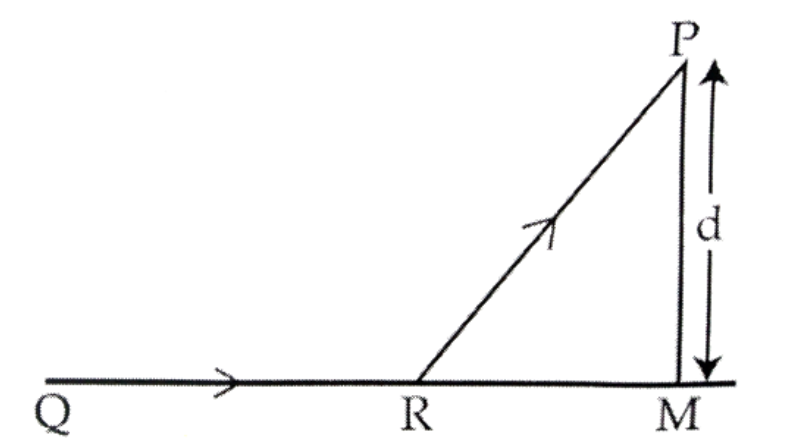
(a) \(d\) (b) \(\frac{d}{\sqrt{2}}\) (c) \(\frac{d}{2}\) (d) \(\frac{d}{\sqrt{3}}\)
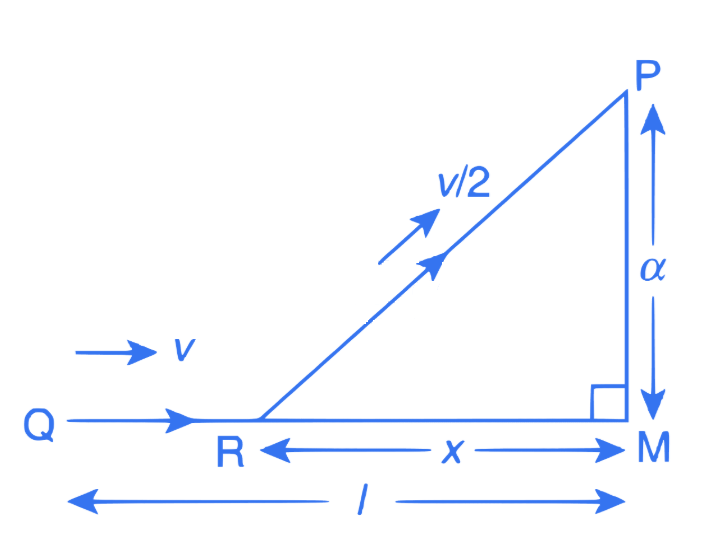
Solution: (d) Let the distance \(\mathrm{QM}=\mathrm{I}\) and distance \(\mathrm{RM}=\mathrm{x}\).
Time to reach from Q to R is \(t_1=\frac{l-x}{v}\)
Time to reach from R to P is \(t_2=\frac{\sqrt{x^2+d^2}}{v / 2}\)
Therefore, \(t=t_1+t_2=\frac{l-x}{v}+\frac{\sqrt{x^2+d^2}}{v / 2}\)
On differentiating, we get
\(
\begin{aligned}
& \frac{d t}{d x}=\frac{0-1}{v}+\frac{1}{v / 2} \frac{1}{2 \sqrt{x^2+d^2}} \times 2 x \\
& \Rightarrow \frac{d t}{d x}=\frac{-1}{v}+\frac{2 x}{v \sqrt{x^2+d^2}}
\end{aligned}
\)
Put \(\frac{d t}{d x}=0\), we get
\(
\begin{aligned}
& \frac{-1}{v}+\frac{2 x}{v \sqrt{x^2+d^2}}=0 \\
& \Rightarrow \frac{2 x}{v \sqrt{x^2+d^2}}=\frac{1}{v} \\
& \Rightarrow 2 x=\sqrt{x^2+d^2} \Rightarrow 4 x^2=x^2+d^2 \\
& \Rightarrow 3 x^2=d^2 \Rightarrow x=\frac{d}{\sqrt{3}}
\end{aligned}
\)
Therefore, the distance \(R M=x=\frac{d}{\sqrt{3}}\), the time taken to reach P is minimum.
Q2: A projectile is given an initial velocity of \((\hat{i}+2 \hat{j}) \mathrm{m} / \mathrm{s}\), where \(\hat{i}\) is along the ground and \(\hat{j}\) is along the vertical. If \(\mathrm{g}=10 \mathrm{~m} / \mathrm{s}^2\), the equation of its trajectory is: [JEE Main 2013]
(a) \(y=x-5 x^2\) (b) \(y=2 x-5 x^2\) (c) \(4 y=2 x-5 x^2\) (d) \(4 y=2 x-25 x^2\)
Solution: (b)
\(
\begin{aligned}
&\begin{aligned}
& \vec{u}=\hat{i}+2 \hat{j}=u_x \hat{i}+u_y \hat{j} \\
& \Rightarrow u \cos \theta=1, u \sin \theta=2
\end{aligned}\\
&\text { Also } x=u_x t \text { and }\\
&\begin{aligned}
& y=u_y t-\frac{1}{2} g t^2 \\
& \Rightarrow y=x \tan \theta-\frac{1}{2} \frac{g x^2}{u_x^2} \\
& \therefore y=2 x-\frac{1}{2} g x^2=2 x-5 x^2
\end{aligned}
\end{aligned}
\)
Q3. A boy can throw a stone up to a maximum height of 10 m . The maximum horizontal distance that the boy can throw the same stone up to will be [JEE Main 2012]
(a) \(20 \sqrt{2} \mathrm{~m}\) (b) 10 m (c) \(10 \sqrt{2} \mathrm{~m}\) (d) 20 m
Solution: (d) We know, \(R=\frac{u^2 \sin 2 \theta}{g}\) and \(H=\frac{u^2 \sin ^2 \theta}{2 g}\);
\(H_{\text {max }}\) is possible when \(\theta=90^{\circ}\)
\(
H_{\max }=\frac{u^2}{2 g}=10 \Rightarrow u^2=10 g \times 2
\)
As \(R=\frac{u^2 \sin 2 \theta}{g}\)
Range is maximum when projectile is thrown at an angle \(45^{\circ}\).
\(
\begin{aligned}
& \Rightarrow R_{\max }=\frac{u^2}{g} \\
& R_{\max }=\frac{10 \times g \times 2}{g}=20 \text { meter }
\end{aligned}
\)
Q4. A water fountain on the ground sprinkles water all around it. If the speed of water coming out of the fountain is \(v\), the total area around the fountain that gets wet is: [JEE Main 2011]
(a) \(\pi \frac{v^4}{g^2}\) (b) \(\frac{\pi}{2} \frac{v^4}{g^2}\) (c) \(\pi \frac{v^2}{g^2}\) (d) \(\pi \frac{v^2}{g}\)
Solution: (a) The range, \(R\), of a projectile launched with an initial velocity \(v\) at an angle \(\theta\) to the horizontal is given by the formula:
\(
R=\frac{v^2 \sin (2 \theta)}{g}
\)
The maximum range, \(R_{\text {max }}\), occurs when the sine function is at its maximum value, which is 1 . This happens at an angle of \(\theta=45^{\circ}\).
Therefore, the maximum range is:
\(
R_{\max }=\frac{v^2}{g}
\)
Calculate the area:
The water is sprinkled all around the fountain, forming a circle. The maximum range, \(R_{\text {max }}\), represents the radius, \(r\), of this circular area. The area of a circle is given by \(A=\pi r^2\).
Substituting the expression for the radius from \(R_{\max }=\frac{v^2}{g}\) into the area formula gives:
\(
A=\pi\left(\frac{v^2}{g}\right)^2
\)
Simplifying the expression, the total area is:
\(
A=\pi \frac{v^4}{g^2}
\)
Q5. A particle is moving with velocity \(\vec{v}=k(y \hat{i}+x \hat{j})\), where \(K\) is a constant. The general equation for its path is [JEE Main 2010]
(a) \(y=x^2+\) constant (b) \(\mathrm{y}^2=\mathrm{x}+\) constant (c) \(x y=\) constant (d) \(\mathrm{y}^2=\mathrm{x}^2+\) constant
Solution: (d) The velocity vector is given by \(\vec{v}=k(y \hat{i}+x \hat{j})\). The components of the velocity are \(v_x=\frac{d x}{d t}\) and \(v_y=\frac{d y}{d t}\).
From the given equation, we can write:
\(
\begin{aligned}
& \frac{d x}{d t}=k y \\
& \frac{d y}{d t}=k x
\end{aligned}
\)
To find the path of the particle, we need an equation relating \(x\) and \(y\). We can eliminate the time variable \(t\) by dividing the two equations:
\(
\frac{d y}{d x}=\frac{d y / d t}{d x / d t}=\frac{k x}{k y}=\frac{x}{y}
\)
The resulting differential equation is separable:
\(
\frac{d y}{d x}=\frac{x}{y}
\)
Rearranging the terms, we get:
\(
y d y=x d x
\)
Now, integrate both sides of the equation:
\(
\begin{aligned}
& \int y d y=\int x d x \\
& \frac{y^2}{2}=\frac{x^2}{2}+C^{\prime}
\end{aligned}
\)
where \(C^{\prime}\) is the constant of integration.
To simplify the equation, we can multiply both sides by 2 :
\(
y^2=x^2+2 C^{\prime}
\)
Since \(2 C^{\prime}\) is an arbitrary constant, we can represent it with a new constant, \(C\).
\(
y^2=x^2+C
\)
This can also be written as:
\(
y^2=x^2+\text { constant }
\)
Q6. A particle has an initial velocity \(3 \hat{i}+4 \hat{j}\) and an acceleration of \(0.4 \hat{i}+0.3 \hat{j}\). Its speed after 10 s is: [JEE Main 2009]
(a) \(7 \sqrt{2}\) units (b) 7 units (c) 8.5 units (d) 10 units
Solution: Given \(\vec{u}=3 \hat{i}+4 \hat{j}, \vec{a}=0.4 \hat{i}+0.3 \hat{j}, t=10 s\)
\(
\begin{aligned}
& \vec{v}=\vec{u}+\overrightarrow{a t} \\
& =3 \hat{i}+4 \hat{j}+(0.4 \hat{i}+0.3 \hat{j}) \times 10 \\
& =7 \hat{i}+7 \hat{j}
\end{aligned}
\)
We know speed is equal to magnitude of velocity.
\(
\therefore|\vec{v}|=\sqrt{7^2+7^2}=7 \sqrt{2} \text { units }
\)
Q7. A particle is moving eastwards with a velocity of \(5 \mathrm{~m} / \mathrm{s}\). In 10 seconds the velocity changes to \(5 \mathrm{~m} / \mathrm{s}\) northwards. The average acceleration in this time is [JEE 2005]
(a) \(\frac{1}{2} m s^{-2}\) towards north (b) \(\frac{1}{\sqrt{2}} m s^{-2}\) towards north-east (c) \(\frac{1}{\sqrt{2}} m s^{-2}\) towards north-west (d) zero
Solution: (c)
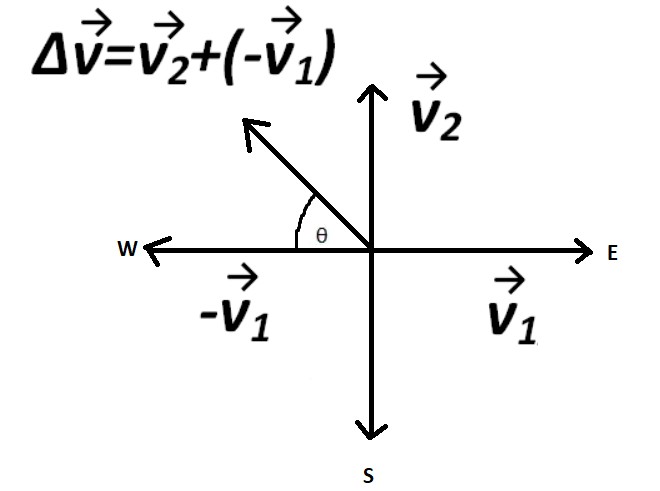
The initial velocity vector is \(\vec{v}_1=5 \hat{i} \mathrm{~m} / \mathrm{s}\) (eastwards).
The final velocity vector is \(\vec{v}_2=5 \hat{j} \mathrm{~m} / \mathrm{s}\) (northwards).
The change in velocity, \(\Delta \vec{v}\), is given by the formula:
\(
\begin{gathered}
\Delta \vec{v}=\vec{v}_2-\vec{v}_1 \\
\Delta \vec{v}=(5 \hat{j}-5 \hat{i}) \mathrm{m} / \mathrm{s}=(-5 \hat{i}+5 \hat{j}) \mathrm{m} / \mathrm{s}
\end{gathered}
\)
The direction of this vector is north-west since the \(\hat{i}\) component is negative (west) and the \(\hat{j}\) component is positive (north).
Calculate the magnitude of the average acceleration:
The magnitude of the change in velocity is:
\(
|\Delta \vec{v}|=\sqrt{(-5)^2+(5)^2}=\sqrt{25+25}=\sqrt{50}=5 \sqrt{2} \mathrm{~m} / \mathrm{s}
\)
The average acceleration, \(\vec{a}_{\text {avg }}\), is the change in velocity divided by the time interval ( \(\Delta t=10 \mathrm{~s}\) ).
\(
\left|\vec{a}_{a v g}\right|=\frac{|\Delta \vec{v}|}{\Delta t}=\frac{5 \sqrt{2} \mathrm{~m} / \mathrm{s}}{10 \mathrm{~s}}=\frac{\sqrt{2}}{2} \mathrm{~m} / \mathrm{s}^2=\frac{1}{\sqrt{2}} \mathrm{~m} / \mathrm{s}^2
\)
The average acceleration is \(\frac{1}{\sqrt{2}} \mathrm{~ms}^{-2}\) towards north-west.
Q8. A projectile can have the same range ‘ \(R\) ‘ for two angles of projection. If \(T_1\) and \(T_2\) be the time of flights in the two cases, then the product of the two time of flights is directly proportional to [JEE Main 2004]
(a) \(R\) (b) \(\frac{1}{R}\) (c) \(\frac{1}{R^2}\) (d) \(R^2\)
Solution: (a) A projectile has the same range for two complementary angles of projection, say \(\boldsymbol{\theta}\) and \(90^{\circ}-\theta\).
\(
\begin{aligned}
&\begin{aligned}
& T_1=\frac{2 u \sin \theta}{g}, T_2=\frac{2 u \cos \theta}{g} \\
& T_1 T_2=\frac{4 u^2 \sin \theta \cos \theta}{g^2} \\
& =\frac{2}{g} \times\left(\frac{u^2 \sin 2 \theta}{g}\right) \\
& =\frac{2 R}{g} \\
& \text { (as } R=\frac{u^2 \sin 2 \theta}{g} \text { ) }
\end{aligned}\\
&\text { Hence, } T_1 T_2 \text { is proportional to } R \text {. }
\end{aligned}
\)
Q9. A ball is thrown from a point with a speed \(v_0\) at an angle of projection \(\theta\). From the same point and at the same instant person starts running with a constant speed \(\frac{v_0}{2}\) to catch the ball. Will the person be able to catch the ball? If yes, what should be the angle of projection \(\theta\) ? [JEE Main 2004]
(a) No (b) Yes, \(30^{\circ}\) (c) Yes, \(60^{\circ}\) (d) Yes, \(45^{\circ}\)
Solution: (c) The position of the ball at time \(t\) can be described by its horizontal and vertical components.
Horizontal position of the ball: \(x_{\text {ball }}(t)=\left(v_0 \cos \theta\right) t\)
Vertical position of the ball: \(y_{\text {ball }}(t)=\left(v_0 \sin \theta\right) t-\frac{1}{2} g t^2\)
The person runs with a constant speed \(\frac{v_0}{2}\) in the horizontal direction.
Horizontal position of the person: \(x_{\text {person }}(t)=\frac{v_0}{2} t\)
Vertical position of the person: \(y_{\text {person }}(t)=0\) (the person remains on the ground)
For the person to catch the ball, their position must match the ball’s position at some time \(t>0\). This means both the horizontal and vertical positions must be equal at that instant.
\(x_{\text {person }}(t)=x_{\text {ball }}(t)\)
\(y_{\text {person }}(t)=y_{\text {ball }}(t)\)
From the vertical position condition, we know the ball must be back on the ground when the person catches it.
\(
0=\left(v_0 \sin \theta\right) t-\frac{1}{2} g t^2
\)
We can factor out \(t\) :
\(
t\left(v_0 \sin \theta-\frac{1}{2} g t\right)=0
\)
This gives two solutions: \(t=0\) (the starting instant) and \(t=\frac{2 v_0 \sin \theta}{g}\). Since we are interested in the time of catching, we use the second solution.
Now, we use the horizontal position condition:
\(
\begin{gathered}
x_{\text {person }}(t)=x_{\text {ball }}(t) \\
\frac{v_0}{2} t=\left(v_0 \cos \theta\right) t
\end{gathered}
\)
We can divide both sides by \(v_0 t\) (since \(v_0 \neq 0\) and \(t \neq 0\) ):
\(
\frac{1}{2}=\cos \theta
\)
Solving for \(\boldsymbol{\theta}\) :
\(
\begin{gathered}
\theta=\arccos \left(\frac{1}{2}\right) \\
\theta=60^{\circ}
\end{gathered}
\)
The person will be able to catch the ball if the angle of projection is \(60^{\circ}\).
Q10. Which of the following statements is FALSE for a particle moving in a circle with a constant angular speed ? [JEE 2004]
(a) The acceleration vector points to the centre of the circle
(b) The acceleration vector is tangent to the circle
(c) The velocity vector is tangent to the circle
(d) The velocity and acceleration vectors are perpendicular to each other.
Solution: (b) For a particle moving in a circle with a constant angular speed, the motion is known as uniform circular motion.
Let’s analyze each statement based on the principles of uniform circular motion:
Constant angular speed implies constant linear speed. Although the magnitude of the velocity is constant, the direction of the velocity vector is continuously changing as the particle moves around the circle.
A change in the velocity vector (either magnitude or direction) means there must be an acceleration. Since the magnitude of the velocity is constant, there is no tangential acceleration. The acceleration is entirely due to the change in the direction of the velocity.
Analysis of the options:
(a) The acceleration vector points to the centre of the circle
This is a fundamental property of uniform circular motion. The acceleration, known as centripetal acceleration, is always directed radially inward, towards the center of the circle.
Therefore, this statement is TRUE.
(b) The acceleration vector is tangent to the circle
As established above, the acceleration vector points towards the center of the circle (radially inward), not along the tangent. The tangential acceleration is zero in uniform circular motion.
Therefore, this statement is FALSE.
(c) The velocity vector is tangent to the circle
The velocity vector is always tangent to the circular path at any given point. The direction of the velocity is the direction of motion at that instant.
Therefore, this statement is TRUE.
(d) The velocity and acceleration vectors are perpendicular to each other
Since the velocity vector is tangential to the circle and the acceleration vector is radial (pointing towards the center), they are always at a 90-degree angle to each other at every point in the motion.
Therefore, this statement is TRUE.
The question asks for the FALSE statement. Based on the analysis, the false statement is (b).
Q11. A boy playing on the roof of a 10 m high building throws a ball with a speed of \(10 \mathrm{~m} / \mathrm{s}\) at an angle of \(30^{\circ}\) with the horizontal. How far from the throwing point will the ball be at the height of 10 m from the ground? \(\left[g=10 \mathrm{~m} / \mathrm{s}^2, \sin 30^{\circ}=\frac{1}{2}, \cos 30^{\circ}=\frac{\sqrt{3}}{2}\right]\) [JEE Main 2003]
(a) 5.20 m (b) 4.33 m (c) 2.60 m (d) 8.66 m
Solution: (d)
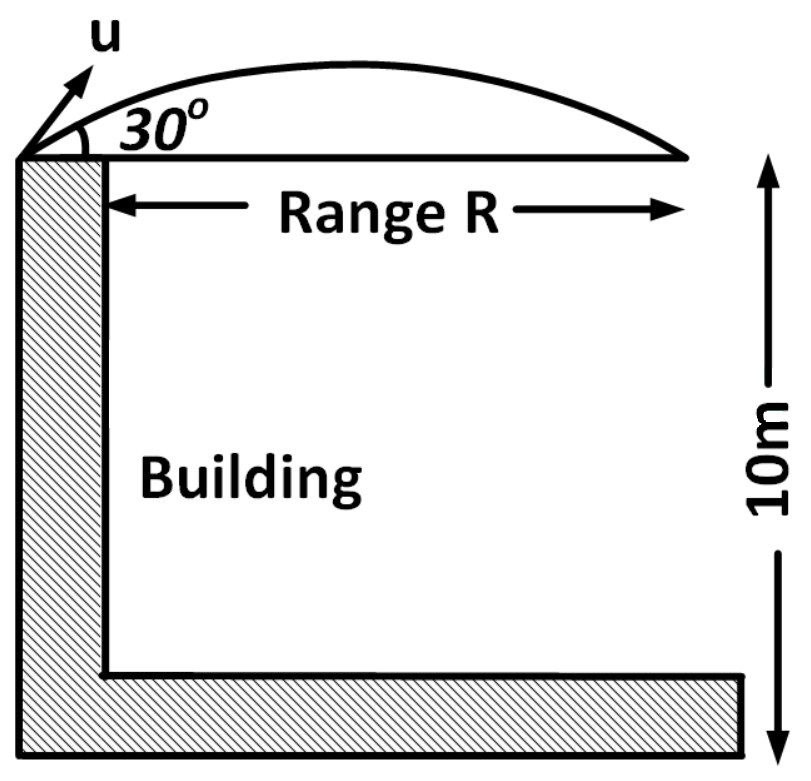
The ball is thrown from a height of 10 m and the question asks for the horizontal distance it travels before returning to the same height of 10 m. This distance is the horizontal range of the projectile. The formula for the range ( \(R\) ) of a projectile launched from a level surface is given by:
\(
R=\frac{u^2 \sin (2 \theta)}{g}
\)
where \(u\) is the initial velocity, \(\theta\) is the angle of projection with the horizontal, and \(g\) is the acceleration due to gravity.
Now, substitute the given values into the range formula:
\(
\begin{aligned}
R & =\frac{(10)^2 \sin \left(60^{\circ}\right)}{10} \\
R & =\frac{100 \times \frac{\sqrt{3}}{2}}{10}=5 \sqrt{3}=8.66 \mathrm{~m}
\end{aligned}
\)
Q12. The co-ordinates of a moving particle at any time ‘ \(t\) ‘ are given by \(x=\alpha t^3\) and \(y=\beta t^3\). The speed of the particle at time ‘ \(t\) ‘ is given by [JEE Main 2003]
(a) \(3 t \sqrt{\alpha^2+\beta^2}\) (b) \(3 t^2 \sqrt{\alpha^2+\beta^2}\) (c) \(t^2 \sqrt{\alpha^2+\beta^2}\) (d) \(\sqrt{\alpha^2+\beta^2}\)
Solution: (b) Coordinates of moving particle at time ‘ \(t\) ‘ are
\(
\begin{aligned}
& x=\alpha t^3 \text { and } y=\beta t^3 \\
& v_x=\frac{d x}{d t}=3 \alpha t^2 \text { and } v_y=\frac{d y}{d t}=3 \beta t^2 \\
& \therefore v=\sqrt{v_x^2+v_y^2}=\sqrt{9 \alpha^2 t^4+9 \beta^2 t^4} \\
& =3 t^2 \sqrt{\alpha^2+\beta^2}
\end{aligned}
\)
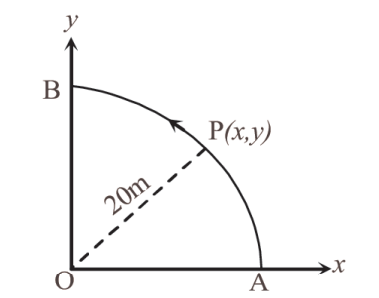
Q13. A point \(P\) moves in counter-clockwise direction on a circular path as shown in the figure. The movement of ‘ \(P\) ‘ is such that it sweeps out a length \(s=t^3+5\), where s is in metres and \(t\) is in seconds. The radius of the path is 20 m. The acceleration of ‘ \(P\) ‘ when \(t=2 \mathrm{~s}\) is nearly. [JEE 2010]
(a) \(13 \mathrm{~m} / \mathrm{s}^2\)
(b) \(12 \mathrm{~m} / \mathrm{s}^2\)
(c) \(7.2 \mathrm{~ms}^2\)
(d) \(14 \mathrm{~m} / \mathrm{s}^2\)
Solution:
\(
\begin{aligned}
& s=t^3+5, r=20 \mathrm{~m}, t=5 \mathrm{sec} \\
& \text { velocity, } v=\frac{d s}{d t}=3 t^2
\end{aligned}
\)
Linear (tangential) acceleration \(a_t=\frac{d v}{d t}=6 t\)
Centripetal acceleration \(a_c=\frac{v^2}{R}=\frac{9 t^4}{R}\)
At \(t=2 s, \quad a t=6 \times 2=12 \mathrm{~m} / \mathrm{s}^2\)
\(
a_c=\frac{9 \times 16}{20}=7.2 \mathrm{~m} / \mathrm{s}^2
\)
\(
\begin{aligned}
&\text { Resultant acceleration }\\
&\begin{aligned}
& =\sqrt{a_t^2+a_c^2} \\
& =\sqrt{(12)^2+(7.2)^2}=\sqrt{144+51.84} \\
& =\sqrt{195.84}=14 \mathrm{~m} / \mathrm{s}^2
\end{aligned}
\end{aligned}
\)
Q14. For a particle in uniform circular motion, the acceleration \(\vec{a}\) at a point \(\mathrm{P}(\mathrm{R}, \theta)\) on the circle of radius R is (Here \(\theta\) is measured from the x -axis) [2010]
(a) \(-\frac{v^2}{R} \cos \theta \hat{i}+\frac{v^2}{R} \sin \theta \hat{j}\)
(b) \(-\frac{v^2}{R} \sin \theta \hat{i}+\frac{v^2}{R} \cos \theta \hat{j}\)
(c) \(-\frac{v^2}{R} \cos \theta \hat{i}-\frac{v^2}{R} \sin \theta \hat{j}\)
(d) \(\frac{v^2}{R} \hat{i}+\frac{v^2}{R} \hat{j}\)
Solution:
\(
\begin{aligned}
&\text { Centripetal Acceleration, }\\
&\begin{aligned}
& a_c=\frac{v^2}{R} \text { towards the centre } \\
&\text { Resultant acceleration vector } \vec{a_r}=-a_c \cos \theta(\hat{i})-a_c \sin \theta(\hat{j}) \\
& =-\frac{v^2}{R} \cos \theta \hat{i}-\frac{v^2}{R} \sin \theta \hat{j}
\end{aligned}
\end{aligned}
\)
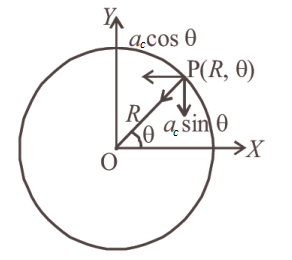
Explanation: For a particle in uniform circular motion, the acceleration vector \(\overrightarrow{\boldsymbol{a}}\) at any point is directed towards the center of the circle. This is called centripetal acceleration, and its magnitude is given by \(a_c=\frac{v^2}{R}\).
The particle is at point \(\mathrm{P}(\mathrm{R}, \theta)\) on a circle of radius \(R\) , with the angle \(\theta\) measured from the positive \(x\) -axis. The center of the circle is at the origin \((0,0)\).
Determine the direction of the acceleration vector: The centripetal acceleration vector \(\vec{a}\) points from the particle’s position back towards the origin ( 0,0 ). The position vector \(\vec{r}\) of the particle is given by \(\vec{r}=R \cos \theta \hat{i}+R \sin \theta \hat{j}\). Since the acceleration vector points in the opposite direction of the position vector, we have \(\vec{a} \propto-\vec{r}\).
Find the components of the acceleration vector:
The components of the acceleration vector are found by projecting the magnitude of the acceleration onto the x and y axes, and accounting for the direction.
The magnitude of the acceleration is \(a=\frac{v^2}{R}\).
The \(x\)-component of the acceleration \(\left(a_x\right)\) is the projection of the acceleration vector onto the \(x\)-axis. It is given by \(-a \cos \theta\) because the acceleration is directed radially inward (towards the origin), which is opposite to the direction of the position vector.
\(
a_x=-\frac{v^2}{R} \cos \theta
\)
The \(y\)-component of the acceleration \(\left(a_y\right)\) is the projection of the acceleration vector onto the \(y\)-axis. It is given by \(-a \sin \theta\) for the same reason.
\(
a_y=-\frac{v^2}{R} \sin \theta
\)
Write the final acceleration vector. Combining the x and y components with their respective unit vectors ( \(\hat{i}\) and \(\hat{j}\) ), we get:
\(
\vec{a}=a_x \hat{i}+a_y \hat{j}=-\frac{v^2}{R} \cos \theta \hat{i}-\frac{v^2}{R} \sin \theta \hat{j}
\)
Q15. Two stones are thrown up simultaneously from the edge of a cliff 240 m high with initial speed of \(10 \mathrm{~m} / \mathrm{s}\) and \(40 \mathrm{~m} / \mathrm{s}\) respectively. Which of the following graph best represents the time variation of relative position of the second stone with respect to the first? [JEE 2015]
(Assume stones do not rebound after hitting the ground and neglect air resistance, take \(g=10 \mathrm{~m} / \mathrm{s}^2\) ) (The figures are schematic and not drawn to scale)
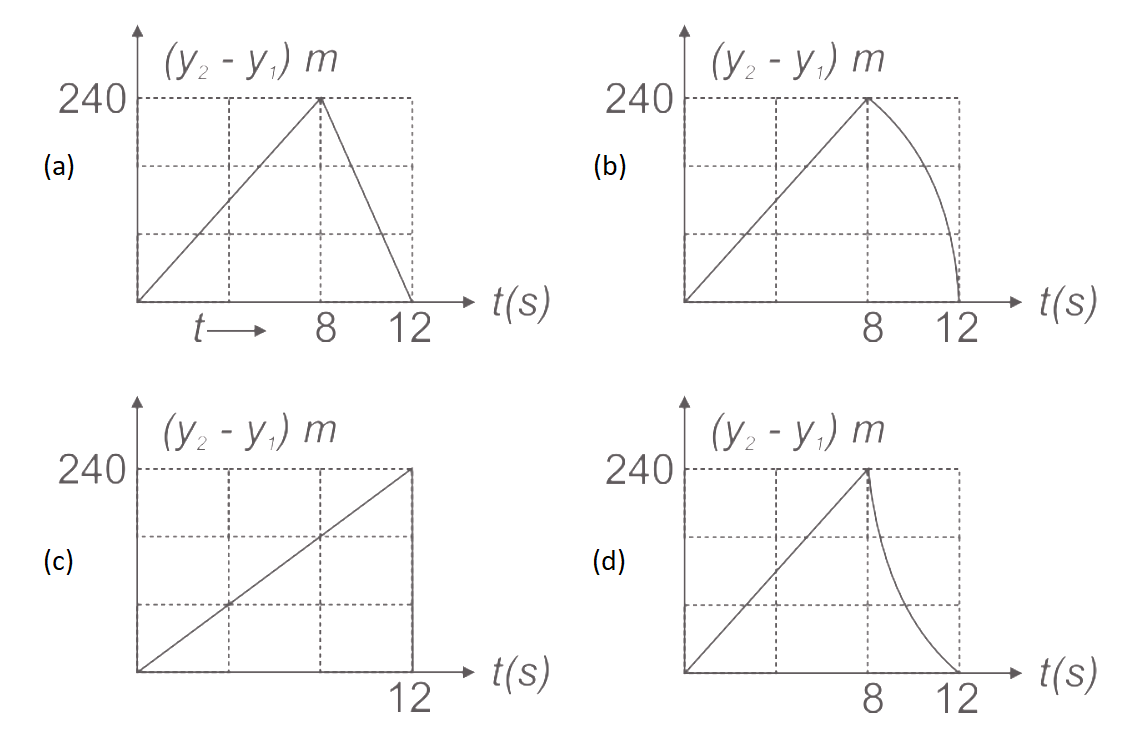
Solution: (d) We know \(s=u t+\frac{1}{2} a t^2\)
For stone 1: \(y_1=10 t-\frac{1}{2} g t^2\)
For stone 2: \(y_2=40 t-\frac{1}{2} g t^2\)
\(
\begin{aligned}
& \Delta y=y_1-y_2=40 t-\frac{1}{2} g t^2-10 t+\frac{1}{2} g t^2=30 t \\
& \Delta y=30 t, \quad \text { for } t \leq 8 s.
\end{aligned}
\)
\(y_1=-240 \mathrm{~m}, t=8 \mathrm{~s}\).
After 8 second stone 1 reaches ground
\(
\begin{aligned}
&\begin{aligned}
& \therefore \Delta y=y_2-y_1 \\
& \quad=40 t-\frac{1}{2} g t^2+240
\end{aligned}\\
&\text { therefore it will be a parabolic curve. }
\end{aligned}
\)
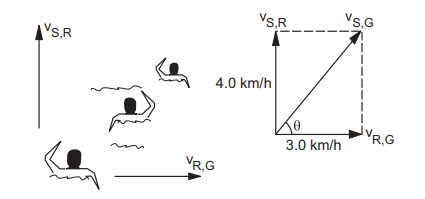
Q16: A swimmer can swim in still water at a rate \(4.0 \mathrm{~km} / \mathrm{h}\). If he swims in a river flowing at \(3.0 \mathrm{~km} / \mathrm{h}\) and keeps his direction (with respect to water) perpendicular to the current, find his velocity with respect to the ground.
Solution: The velocity of the swimmer with respect to water is \(\vec{v}_{S, R}=4.0 \mathrm{~km} / \mathrm{h}\) in the direction perpendicular to the river. The velocity of river with respect to the ground is \(\vec{v}_{R, G}=3.0 \mathrm{~km} / \mathrm{h}\) along the length of the river. The velocity of the swimmer with respect to the ground is \(\vec{v}_{S G}\) where
\(
\overrightarrow{v_{S, G}}=\overrightarrow{v_{S, R}}+\overrightarrow{v_{R, G}}
\)
Figure (below) shows the velocities. It is clear that,
\(
\begin{aligned}
&\begin{aligned}
v_{S, G} & =\sqrt{(4 \cdot 0 \mathrm{~km} / \mathrm{h})^2+(3 \cdot 0 \mathrm{~km} / \mathrm{h})^2} \\
& =5 \cdot 0 \mathrm{~km} / \mathrm{h}
\end{aligned}\\
&\text { The angle } \theta \text { made with the direction of flow is }\\
&\tan \theta=\frac{4.0 \mathrm{~km} / \mathrm{h}}{3.0 \mathrm{~km} / \mathrm{h}}=\frac{4}{3} .
\end{aligned}
\)
Q17. A man is walking on a level road at a speed of \(3.0 \mathrm{~km} / \mathrm{h}\). Rain drops fall vertically with a speed of \(4.0 \mathrm{~km} / \mathrm{h}\). Find the velocity of the raindrops with respect to the man.
Solution: We have to find the velocity of raindrops with respect to the man. The velocity of the rain as well as the velocity of the man are given with respect to the street. We have
\(
\vec{v}_{\text {rain, man }}=\vec{v}_{\text {rain, street }}-\vec{v}_{\text {man, street }} .
\)
Figure below shows the velocities.
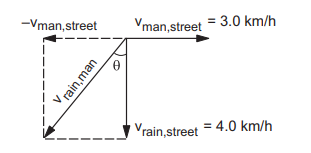
It is clear from the figure that
\(
\begin{aligned}
v_{\text {rain, } \text { man }} & =\sqrt{(4.0 \mathrm{~km} / \mathrm{h})^2+(3.0 \mathrm{~km} / \mathrm{h})^2} \\
& =5.0 \mathrm{~km} / \mathrm{h}
\end{aligned}
\)
The angle with the vertical is \(\theta\), where
\(
\tan \theta=\frac{3 \cdot 0 \mathrm{~km} / \mathrm{h}}{4 \cdot 0 \mathrm{~km} / \mathrm{h}}=\frac{3}{4}
\)
Thus, the rain appears to fall at an angle \(\tan ^{-1}(3 / 4)\) with the speed \(5.0 \mathrm{~km} / \mathrm{h}\) as viewed by the man.
Q18. A stone is dropped from a balloon going up with a uniform velocity of \(5.0 \mathrm{~m} / \mathrm{s}\). If the balloon was 50 m high when the stone was dropped, find its height when the stone hits the ground. Take \(g=10 \mathrm{~m} / \mathrm{s}^2\).
Solution: At \(t=0\), the stone was going up with a velocity of \(5.0 \mathrm{~m} / \mathrm{s}\). After that it moved as a freely falling particle with downward acceleration \(g\). Take vertically upward
as the positive \(X\)-axis. If it reaches the ground at time \(t\),
\(
x=-50 \mathrm{~m}, \quad u=5 \mathrm{~m} / \mathrm{s}, \quad a=-10 \mathrm{~m} / \mathrm{s}^2
\)
We have
\(
x=u t+\frac{1}{2} a t^2
\)
\(
-50 \mathrm{~m}=(5 \mathrm{~m} / \mathrm{s}) \cdot t+\frac{1}{2} \times\left(-10 \mathrm{~m} / \mathrm{s}^2\right) t^2
\)
\(
t=\frac{1 \pm \sqrt{41}}{2} \mathrm{~s}
\)
\(
t=-2.7 \mathrm{~s} \quad \text { or, } 3.7 \mathrm{~s}
\)
Negative \(t\) has no significance in this problem. The stone reaches the ground at \(t=3.7 \mathrm{~s}\). During this time the balloon has moved uniformly up. The distance covered by it is
\(
5 \mathrm{~m} / \mathrm{s} \times 3.7 \mathrm{~s}=18.5 \mathrm{~m}
\)
Hence, the height of the balloon when the stone reaches the ground is \(50 \mathrm{~m}+18.5 \mathrm{~m}=68.5 \mathrm{~m}\).
Q19. A football is kicked with a velocity of \(20 \mathrm{~m} / \mathrm{s}\) at an angle of \(45^{\circ}\) with the horizontal. (a) Find the time taken by the ball to strike the ground. (b) Find the maximum height it reaches. (c) How far away from the kick does it hit the ground ? Take \(g=10 \mathrm{~m} / \mathrm{s}^2\).
Solution: (a) Take the origin at the point where the ball is kicked, vertically upward as the \(Y\)-axis and the horizontal in the plane of motion as the \(X\)-axis. The initial velocity has the components
\(
u_x=(20 \mathrm{~m} / \mathrm{s}) \cos 45^{\circ}=10 \sqrt{ } 2 \mathrm{~m} / \mathrm{s}
\)
and
\(
u_y=(20 \mathrm{~m} / \mathrm{s}) \sin 45^{\circ}=10 \sqrt{ } 2 \mathrm{~m} / \mathrm{s} .
\)
When the ball reaches the ground, \(y=0\).
Using
\(
\begin{aligned}
& y=u_y t-\frac{1}{2} g t^2 \\
& 0=(10 \sqrt{2} \mathrm{~m} / \mathrm{s}) t-\frac{1}{2} \times\left(10 \mathrm{~m} / \mathrm{s}^2\right) \times t^2
\end{aligned}
\)
\(
t=2 \sqrt{ } 2 \mathrm{~s}=2.8 \mathrm{~s}
\)
Thus, it takes 2.8 s for the football to fall on the ground.
(b) At the highest point \(v_y=0\). Using the equation
\(
\begin{aligned}
v_y^2 & =u_y^2-2 g y \\
0 & =(10 \sqrt{2} \mathrm{~m} / \mathrm{s})^2-2 \times\left(10 \mathrm{~m} / \mathrm{s}^2\right) H
\end{aligned}
\)
\(
H=10 \mathrm{~m}
\)
Thus, the maximum height reached is 10 m.
(c) The horizontal distance travelled before falling to the ground is \(x=u_x t\)
\(
=(10 \sqrt{2} \mathrm{~m} / \mathrm{s})(2 \sqrt{2} \mathrm{~s})=40 \mathrm{~m}
\)
Q20. A helicopter on flood relief mission, flying horizontally with a speed \(u\) at an altitude \(H\), has to drop a food packet for a victim standing on the ground. At what distance from the victim should the packet be dropped? The victim stands in the vertical plane of the helicopter’s motion.
Solution: The velocity of the food packet at the time of release is \(u\) and is horizontal. The vertical velocity at the time of release is zero.
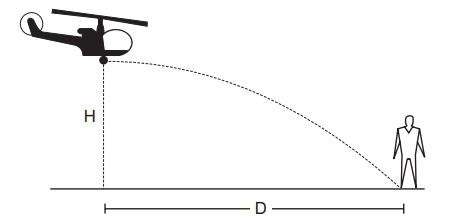
Vertical motion : If \(t\) be the time taken by the packet to reach the victim, we have for vertical motion,
\(
H=\frac{1}{2} g t^2 \quad \text { or, } \quad t=\sqrt{\frac{2 H}{g}} \dots(i)
\)
Horizontal motion : If \(D\) be the horizontal distance travelled by the packet, we have \(D=u t\). Putting \(t\) from (i),
\(
D=u \sqrt{\frac{2 H}{g}} .
\)
The distance between the victim and the packet at the time of release is
\(
\sqrt{D^2+H^2}=\sqrt{\frac{2 u^2 H}{g}+H^2}
\)
Q21. A particle is projected horizontally with a speed \(u\) from the top of a plane inclined at an angle \(\theta\) with the horizontal. How far from the point of projection will the particle strike the plane?
Solution: Take \(X, Y\)-axes as shown in figure below. Suppose that the particle strikes the plane at a point \(P\) with coordinates \((x, y)\). Consider the motion between \(A\) and \(P\).
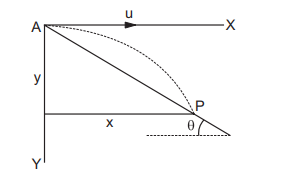
Motion in \(x\)-direction :
\(
\begin{array}{r}
\text { Initial velocity }=u \\
\text { Acceleration }=0 \\
x=u t \dots(i)
\end{array}
\)
Motion in \(y\)-direction :
\(
\begin{array}{r}
\text { Initial velocity }=0 \\
\text { Acceleration }=g \\
y=\frac{1}{2} g t^2 \dots(ii)
\end{array}
\)
Eliminating \(t\) from (i) and (ii)
\(
y=\frac{1}{2} g \frac{x^2}{u^2} .
\)
Also
\(
y=x \tan \theta .
\)
Thus, \(\frac{g x^2}{2 u^2}=x \tan \theta\) giving \(x=0\), or, \(\frac{2 u^2 \tan \theta}{g}\).
Clearly the point \(P\) corresponds to \(x=\frac{2 u^2 \tan \theta}{g}\), then \(y=x \tan \theta=\frac{2 u^2 \tan ^2 \theta}{g}\).
The distance \(A P=l=\sqrt{x^2+y^2}\)
\(
\begin{aligned}
& =\frac{2 u^2}{g} \tan \theta \sqrt{1+\tan ^2 \theta} \\
& =\frac{2 u^2}{g} \tan \theta \sec \theta
\end{aligned}
\)
Q22. A projectile is fired with a speed \(u\) at an angle \(\theta\) with the horizontal. Find its speed when its direction of motion makes an angle \(\alpha\) with the horizontal.
Solution: Let the speed be \(v\) when it makes an angle \(\alpha\) with the horizontal.
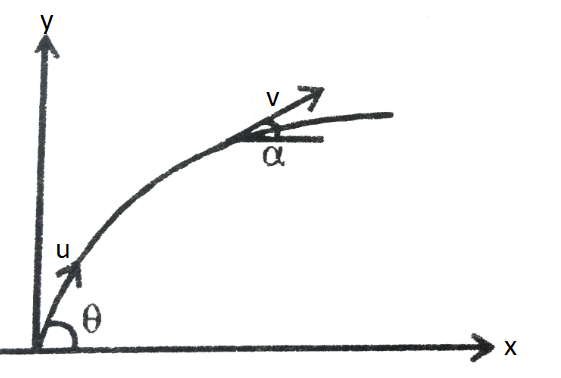
As the horizontal component of velocity remains constant,
\(
\begin{aligned}
& v_x=u_x \\
& v \cos \alpha=u \cos \theta \\
& v=u \cos \theta \cdot \operatorname{Sec} \alpha
\end{aligned}
\)
Q23. A bullet is fired horizontally aiming at an object which starts falling at the instant the bullet is fired. Show that the bullet will hit the object.
Solution: The situation is shown in figure below. The object starts falling from the point \(B\). Draw a vertical line \(B C\) through \(B\). Suppose the bullet reaches the line \(B C\) at a point \(D\) and it takes a time \(t\) in doing so.
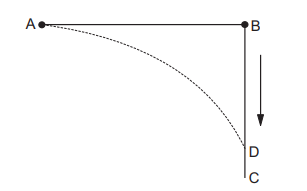
The falling object:
The object is dropped from rest, so its initial vertical velocity is 0.
It is in free fall, meaning its only vertical acceleration is due to gravity, \(g\).
After time \(t\), the vertical distance (BD) it has fallen is given by the kinematic equation:
\(
y_o=v_{o y} t+\frac{1}{2} g t^2=0 \cdot t+\frac{1}{2} g t^2=\frac{1}{2} g t^2 .
\)
The bullet:
The bullet is fired horizontally, so its initial vertical velocity is also 0.
It also experiences the same downward acceleration due to gravity, \(g\).
Its horizontal motion is independent of its vertical motion.
After time \(t\), the vertical distance the bullet has fallen is given by the same equation: \(y_b=v_{o y} t+\frac{1}{2} g t^2=0 \cdot t+\frac{1}{2} g t^2=\frac{1}{2} g t^2\).
Since both the object and the bullet have the same vertical displacement ( \(y_o=y_b\) ) after the same amount of time ( \(t\) ), and the bullet was aimed directly at where the object would have been, the bullet will hit the object.
Q24. A man can swim in still water at a speed of \(3 \mathrm{~km} / \mathrm{h}\). He wants to cross a river that flows at \(2 \mathrm{~km} / \mathrm{h}\) and reach the point directly opposite to his starting point. (a) In which direction should he try to swim (that is, find the angle his body makes with the river flow) ? (b) How much time will he take to cross the river if the river is 500 m wide?
Solution: (a) The situation is shown in figure below. The \(X\)-axis is chosen along the river flow and the origin at the starting position of the man. The direction of the velocity of man with respect to ground is along the \(Y\)-axis (perpendicular to the river). We have to find the direction of velocity of the man with respect to water.
Let \(\quad \overrightarrow{v_{r, g}}=\) velocity of the river with respect to the ground
\(=2 \mathrm{~km} / \mathrm{h}\) along the \(X\)-axis
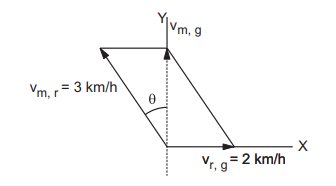
\(
\begin{aligned}
\vec{v}_{m, r} & =\text { velocity of the man with respect to the river } \\
& =3 \mathrm{~km} / \mathrm{h} \text { making an angle } \theta \text { with the } Y \text {-axis }
\end{aligned}
\)
and \(\vec{v}_{m, g}=\) velocity of the man with respect to the ground along the \(Y\)-axis.
We have
\(
\vec{v}_{m, g}=\vec{v}_{m, r}+\vec{v}_{r, g} \dots(i)
\)
Takingcomponentsalongthe \(X\)-axis
\(
0=-(3 \mathrm{~km} / \mathrm{h}) \sin \theta+2 \mathrm{~km} / \mathrm{h}
\)
or, \(\quad \sin \theta=\frac{2}{3}\).
(b) Taking components in equation (i) along the \(Y\)-axis,
\(
\begin{aligned}
v_{m, g} & =(3 \mathrm{~km} / \mathrm{h}) \cos \theta+0 \\
v_{m, g} & =\sqrt{ } 5 \mathrm{~km} / \mathrm{h} . \\
\text { Time } & =\frac{\text { Displacement in } y \text { direction }}{\text { Velocity in } y \text { direction }} \\
& =\frac{0.5 \mathrm{~km}}{\sqrt{ } 5 \mathrm{~km} / \mathrm{h}}=\frac{\sqrt{ } 5}{10} \mathrm{~h} .
\end{aligned}
\)
Q25. A man can swim at a speed of \(3 \mathrm{~km} / \mathrm{h}\) in still water. He wants to cross a 500 m wide river flowing at \(2 \mathrm{~km} / \mathrm{h}\). He keeps himself always at an angle of \(120^{\circ}\) with the river flow while swimming.
(a) Find the time he takes to cross the river. (b) At what point on the opposite bank will he arrive?
Solution: The situation is shown in figure below.
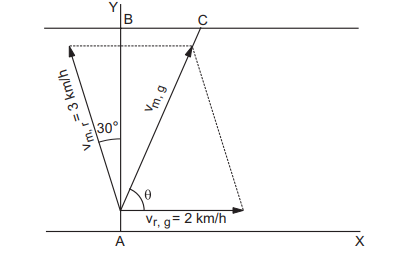
Here \(\vec{v}_{r, g}=\) velocity of the river with respect to the ground
\(\vec{v}_{m, r}=\) velocity of the man with respect to the river
\(\vec{v}_{m, g}=\) velocity of the man with respect to the ground.
(a) We have,
\(
\vec{v}_{m, g}=\vec{v}_{m, r}+\vec{v}_{r, g} \dots(i)
\)
Hence, the velocity with respect to the ground is along \(A C\). Taking \(y\)-components in equation (i),
\(
\vec{v}_{m, g} \sin \theta=3 \mathrm{~km} / \mathrm{h} \cos 30^{\circ}+2 \mathrm{~km} / \mathrm{h} \cos 90^{\circ}=\frac{3 \sqrt{ } 3}{2} \mathrm{~km} / \mathrm{h}
\)
Time taken to cross the river
\(
\begin{aligned}
& =\frac{\text { displacement along the } Y \text {-axis }}{\text { velocity along the } Y \text {-axis }} \\
& =\frac{1 / 2 \mathrm{~km}}{3 \sqrt{ } 3 / 2 \mathrm{~km} / \mathrm{h}}=\frac{1}{3 / 3} \mathrm{~h}
\end{aligned}
\)
(b) Taking \(x\)-components in equation (i),
\(
\begin{aligned}
\vec{v}_{m, g} \cos \theta & =-3 \mathrm{~km} / \mathrm{h} \sin 30^{\circ}+2 \mathrm{~km} / \mathrm{h} \\
& =\frac{1}{2} \mathrm{~km} / \mathrm{h}
\end{aligned}
\)
Displacement along the \(X\)-axis as the man crosses the river
\(
\begin{aligned}
& =(\text { velocity along the } X \text {-axis }) \cdot(\text { time }) \\
& =\left(\frac{1 \mathrm{~km}}{2 \mathrm{~h}}\right) \times\left(\frac{1}{3 \sqrt{ } 3} \mathrm{~h}\right)=\frac{1}{6 \sqrt{ } 3} \mathrm{~km}
\end{aligned}
\)
Q26. A man standing on a road has to hold his umbrella at \(30^{\circ}\) with the vertical to keep the rain away. He throws the umbrella and starts running at \(10 \mathrm{~km} / \mathrm{h}\). He finds that raindrops are hitting his head vertically. Find the speed of raindrops with respect to (a) the road, (b) the moving man.
Solution: When the man is at rest with respect to the ground, the rain comes to him at an angle \(30^{\circ}\) with the vertical. This is the direction of the velocity of raindrops with respect to the ground. The situation when the man runs is shown in the figure below.
Here \(\vec{v}_{r, g}=\) velocity of the rain with respect to the ground \(\vec{v}_{m, g}=\) velocity of the man with respect to the ground and \(\vec{v}_{r, m}=\) velocity of the rain with respect to the man.
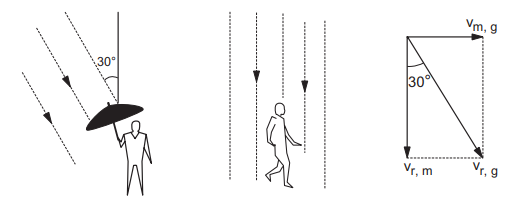
We have,
\(
\vec{v}_{r, g}=\vec{v}_{r, m}+\vec{v}_{m, g} \dots(i)
\)
Taking horizontal components, equation (i) gives
\(
\begin{aligned}
& v_{r, g} \sin 30^{\circ}=v_{m, g}=10 \mathrm{~km} / \mathrm{h} \\
& \text { or, } v_{r, g}=\frac{10 \mathrm{~km} / \mathrm{h}}{\sin 30^{\circ}}=20 \mathrm{~km} / \mathrm{h}
\end{aligned}
\)
Taking vertical components, equation (i) gives
\(
\begin{aligned}
v_{r, g} \cos 30^{\circ} & =v_{r, m} \\
v_{r, m} & =(20 \mathrm{~km} / \mathrm{h}) \frac{\sqrt{ } 3}{2} \\
& =10 \sqrt{ } 3 \mathrm{~km} / \mathrm{h}
\end{aligned}
\)
Q27. A man running on a horizontal road at \(8 \mathrm{~km} / \mathrm{h}\) finds the rain falling vertically. He increases his speed to \(12 \mathrm{~km} / \mathrm{h}\) and finds that the drops make angle \(30^{\circ}\) with the vertical. Find the speed and direction of the rain with respect to the road.
Solution: We have \(\quad \vec{v}_{\text {rain, road }}=\vec{v}_{\text {rain, man }}+\vec{v}_{\text {man, road }} \dots(i)\)
The two situations given in the problem may be represented by the following figure.
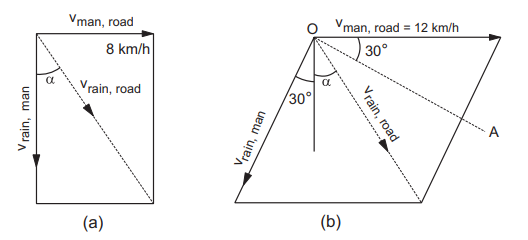
\(v_{\text {rain, road }}\) is same in magnitude and direction in both the figures.
Taking horizontal components in equation (i) for figure (a),
\(
v_{\text {rain }, \text { road }} \sin \alpha=8 \mathrm{~km} / \mathrm{h} \dots(ii)
\)
Now consider figure (b). Draw a line \(O A \perp v_{\text {rain, man }}\) as shown.
Taking components in equation (i) along the line \(O A\).
\(
v_{\text {rain, road }} \sin \left(30^{\circ}+\alpha\right)=12 \mathrm{~km} / \mathrm{h} \cos 30^{\circ} .
\)
From (ii) and (iii),
\(
\begin{aligned}
\frac{\sin \left(30^{\circ}+\alpha\right)}{\sin \alpha} & =\frac{12 \times \sqrt{3}}{8 \times 2} \\
\frac{\sin 30^{\circ} \cos \alpha+\cos 30^{\circ} \sin \alpha}{\sin \alpha} & =\frac{3 \sqrt{3}}{4} \\
\frac{1}{2} \cot \alpha+\frac{\sqrt{3}}{2} & =\frac{3 \sqrt{3}}{4} \\
\cot \alpha & =\frac{\sqrt{3}}{2} \\
\alpha & =\cot ^{-1} \frac{\sqrt{3}}{2} .
\end{aligned}
\)
\(
\text { From (ii), } \quad v_{\text {rain, } \text { road }}=\frac{8 \mathrm{~km} / \mathrm{h}}{\sin \alpha}=4 \sqrt{ } 7 \mathrm{~km} / \mathrm{h} \text {. }
\)
Q28. Three particles A, B and C are situated at the vertices of an equilateral triangle \(A B C\) of side \(d\) at \(t=0\). Each of the particles moves with constant speed \(v\). A always has its velocity along \(A B, B\) along \(B C\) and \(C\) along \(C A\). At what time will the particles meet each other?
Solution: Determine the initial distance from a vertex to the centroid:
The centroid of an equilateral triangle is the point where the medians intersect. The distance from a vertex to the centroid is \(\frac{2}{3}\) of the length of the median. For a triangle with side length \(d\), the length of the median (which is also the altitude) is \(\frac{\sqrt{3}}{2} d\). Therefore, the initial distance of each particle from the centroid is:
\(
R=\frac{2}{3}\left(\frac{\sqrt{3}}{2} d\right)=\frac{d}{\sqrt{3}}
\)
Determine the relative velocity of one particle with respect to another:
Consider the relative velocity of particle A with respect to B . The velocity of \(\mathrm{A}, \vec{v}_A\), is directed along the line segment AB . The velocity of \(\mathrm{B}, \vec{v}_B\), is directed along the line segment BC . The angle between \(\vec{v}_A\) and \(\vec{v}_B\) is the interior angle of the equilateral triangle, which is \(60^{\circ}\).
The relative velocity of B with respect to A is \(\vec{v}_{B A}=\vec{v}_B-\vec{v}_A\). The magnitude of this relative velocity is:
\(
\left|\vec{v}_{B A}\right|^2=v^2+v^2-2 v^2 \cos \left(60^{\circ}\right)=2 v^2-2 v^2\left(\frac{1}{2}\right)=v^2
\)
Therefore, the magnitude of the relative velocity is \(v\).
Calculate the time to meet:
The time it takes for the particles to meet is the initial distance between any two particles divided by the magnitude of their relative velocity along the line connecting them.
The component of the velocity of particle A towards B is simply its speed, \(v\). The component of the velocity of particle B towards A is the projection of \(\overrightarrow{\boldsymbol{v}}_{\boldsymbol{B}}\) onto the line BA . This angle is \(60^{\circ}\). So, the component is \(v \cos \left(60^{\circ}\right)=v / 2\).
The closing velocity between A and B is \(v+v / 2=\frac{3}{2} v\).
The time to meet is the initial distance divided by the closing velocity:
\(
t=\frac{d}{v_{\text {closing }}}=\frac{d}{v+v \cos \left(60^{\circ}\right)}=\frac{d}{v+v / 2}=\frac{d}{3 v / 2}=\frac{2 d}{3 v}
\)
The particles will meet each other at time
\(
t=\frac{d}{v+v \cos \left(60^{\circ}\right)}=\frac{d}{v+v / 2}=\frac{d}{3 v / 2}=\frac{2 d}{3 v}
\)
Q29. A bullet travelling with a velocity of \(16 \mathrm{~m} / \mathrm{s}\) penetrates a tree trunk and comes to rest in 0.4 m. Find the time taken during the retardation.
Solution: Find the acceleration of the bullet:
We can use the kinematic equation \(v_f^2=v_i^2+2 a s\), where:
\(v_f\) is the final velocity ( \(0 \mathrm{~m} / \mathrm{s}\) )
\(v_i\) is the initial velocity \((16 \mathrm{~m} / \mathrm{s})\)
\(a\) is the acceleration
\(s\) is the distance ( 0.4 m )
Substitute the known values into the equation to find the acceleration:
\(
\begin{gathered}
0^2=(16)^2+2 a(0.4) \\
0=256+0.8 a \\
-256=0.8 a \\
a=\frac{-256}{0.8}=-320 \mathrm{~m} / \mathrm{s}^2
\end{gathered}
\)
Find the time taken:
Now that we have the acceleration, we can use the equation \(v_f=v_i+a t\) to find the time ( \(t\) ).
Substitute the known values:
\(
\begin{gathered}
0=16+(-320) t \\
-16=-320 t \\
t=\frac{-16}{-320}=0.05 \mathrm{~s}
\end{gathered}
\)
The time taken for the bullet to come to rest is \(\mathbf{0 . 0 5 ~ s}\).
Q30. A bullet going with speed \(350 \mathrm{~m} / \mathrm{s}\) enters a concrete wall and penetrates a distance of 5.0 cm before coming to rest. Find the deceleration.
Solution: The initial velocity of the bullet is \(v_0=350 \mathrm{~m} / \mathrm{s}\). The bullet comes to rest, so the final velocity is \(v=0 \mathrm{~m} / \mathrm{s}\). The distance it penetrates is \(s=5.0 \mathrm{~cm}\). To use consistent units, convert the distance to meters:
\(
s=5.0 \mathrm{~cm}=0.050 \mathrm{~m}
\)
To find the deceleration (\((a)\)), you can use the kinematic equation that relates initial velocity \(\left(v_0\right)\), final velocity \((v)\), distance \((s)\), and acceleration \((a)\) :
\(
v^2=v_0^2+2 a s
\)
Rearrange the equation to solve for \(a\) :
\(
a=\frac{v^2-v_0^2}{2 s}
\)
Substitute the known values into the equation:
\(
\begin{gathered}
a=\frac{(0 \mathrm{~m} / \mathrm{s})^2-(350 \mathrm{~m} / \mathrm{s})^2}{2(0.050 \mathrm{~m})} \\
a=\frac{-122500 \mathrm{~m}^2 / \mathrm{s}^2}{0.10 \mathrm{~m}} \\
a=-1,225,000 \mathrm{~m} / \mathrm{s}^2
\end{gathered}
\)
The question asks for the deceleration, which is the magnitude of the negative acceleration.
The deceleration of the bullet is \(1,225,000 \mathrm{~m} / \mathrm{s}^2\).
Q31. A ball is thrown horizontally from a point 100 m above the ground with a speed of \(20 \mathrm{~m} / \mathrm{s}\). Find (a) the time it takes to reach the ground, (b) the horizontal distance it travels before reaching the ground, (c) the velocity (direction and magnitude) with which it strikes the ground.
Solution:
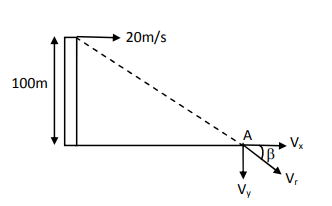
Step 1: Calculate the time to reach the ground
The time it takes for the ball to reach the ground is determined by its vertical motion. Using the kinematic equation for vertical displacement, we can solve for time \(t\). The initial vertical velocity is \(0 \mathrm{~m} / \mathrm{s}\) because the ball is thrown horizontally.
\(
y=y_0+v_{y 0} t+\frac{1}{2} a_y t^2
\)
Plugging in the values ( \(y_0=100 \mathrm{~m}, y=0 \mathrm{~m}, v_{y 0}=0 \mathrm{~m} / \mathrm{s}\), and \(a_y=-9.8 \mathrm{~m} / \mathrm{s}^2\) ):
\(
\begin{gathered}
0=100+(0) t+\frac{1}{2}(-9.8) t^2 \\
0=100-4.9 t^2 \\
4.9 t^2=100 \\
t^2=\frac{100}{4.9} \approx 20.408 \\
t=\sqrt{20.408} \approx 4.52 \mathrm{~s}
\end{gathered}
\)
Step 2: Calculate the horizontal distance traveled
The horizontal distance is determined by the constant horizontal velocity and the time the ball is in the air.
\(
x=v_x t
\)
Using the given horizontal speed ( \(v_x=20 \mathrm{~m} / \mathrm{s}\) ) and the time calculated in Step 1 ( \(t \approx 4.52 \mathrm{~s}\) ):
\(
x=(20 \mathrm{~m} / \mathrm{s}) \times(4.52 \mathrm{~s}) \approx 90.4 \mathrm{~m}
\)
Step 3: Calculate the final velocity (magnitude and direction)
The final velocity has both horizontal and vertical components.
The horizontal velocity ( \(v_x\) ) remains constant: \(v_x=20 \mathrm{~m} / \mathrm{s}\).
The final vertical velocity ( \(v_y\) ) is calculated using:
\(
v_y=v_{y 0}+a_y t
\)
\(v_y=0+\left(-9.8 \mathrm{~m} / \mathrm{s}^2\right)(4.52 \mathrm{~s}) \approx-44.3 \mathrm{~m} / \mathrm{s}\). The negative sign indicates a downward direction.
The magnitude of the resultant velocity ( \(\left|v_r\right|\) ) is found using the Pythagorean theorem:
\(
\begin{gathered}
\left|v_r\right|=\sqrt{v_x^2+v_y^2} \\
\left|v_r\right|=\sqrt{(20)^2+(-44.3)^2}=\sqrt{400+1962.49}=\sqrt{2362.49} \approx 48.6 \mathrm{~m} / \mathrm{s}
\end{gathered}
\)
The direction is the angle \(\boldsymbol{\theta}\) below the horizontal, which can be found using the inverse tangent function:
\(
\begin{gathered}
\theta=\tan ^{-1}\left(\frac{\left|v_y\right|}{\left|v_x\right|}\right) \\
\theta=\tan ^{-1}\left(\frac{44.3}{20}\right) \approx 65.7^{\circ}
\end{gathered}
\)
Q32. A ball is projected from a point on the floor with a speed of \(15 \mathrm{~m} / \mathrm{s}\) at an angle of \(60^{\circ}\) with the horizontal. Will it hit a vertical wall 5 m away from the point of projection and perpendicular to the plane of projection without hitting the floor? Will the answer differ if the wall is 22 m away?
Solution: Here \(u=15 \mathrm{~m} / \mathrm{s}, \theta=60^{\circ}, g=9.8 \mathrm{~m} / \mathrm{s}^2\)
Horizontal range \(\mathrm{X}=\frac{\mathrm{u}^2 \sin 2 \theta}{\mathrm{~g}}=\frac{(15)^2 \sin \left(2 \times 60^{\circ}\right)}{9.8}=19.88 \mathrm{~m}\)
In first case the wall is 5 m away from projection point, so it is in the horizontal range of projectile. So the ball will hit the wall. In second case ( 22 m away) wall is not within the horizontal range. So the ball would not hit the wall.
Q33. A bomb is dropped from a plane flying horizontally with uniform speed. Show that the bomb will explode vertically below the plane. Is the statement true if the plane flies with uniform speed but not horizontally?
Solution: During the motion of bomb its horizontal velocity \(u\) remains constant and is same as that of aeroplane at every point of its path. Suppose the bomb explode i.e. reach the ground in time \(t\).
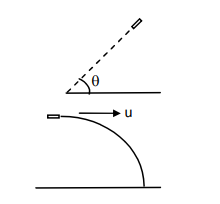
Distance travelled in horizontal direction by bomb = \({ut}=\) the distance travelled by aeroplane. So bomb explode vertically below the aeroplane. Suppose the aeroplane move making angle \(\theta\) with horizontal. For both bomb and aeroplane, horizontal distance is \(\mathrm{u} \cos \theta \mathrm{t}\). t is time for bomb to reach the ground. So in this case also, the bomb will explode vertically below aeroplane.
Q34. A boy standing on a long railroad car throws a ball straight upwards. The car is moving on the horizontal road with an acceleration of \(1 \mathrm{~m} / \mathrm{s}^2\) and the projection velocity in the vertical direction is \(9.8 \mathrm{~m} / \mathrm{s}\). How far behind the boy will the ball fall on the car?
Solution:
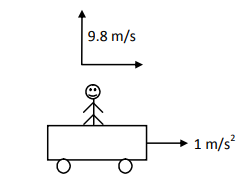
Step 1: Calculate the time of flight of the ball
The time it takes for the ball to go up and come back down to the same height can be found by analyzing its vertical motion. We know the initial vertical velocity is \(v_{y 0}=9.8 \mathrm{~m} / \mathrm{s}\) and the acceleration is due to gravity, \(a_y=-g=-9.8 \mathrm{~m} / \mathrm{s}^2\). The vertical displacement is zero since the ball returns to the car. Using the kinematic equation for vertical motion:
\(
\begin{gathered}
\Delta y=v_{y 0} t+\frac{1}{2} a_y t^2 \\
0=9.8 t+\frac{1}{2}(-9.8) t^2 \\
0=9.8 t-4.9 t^2
\end{gathered}
\)
Solving for \(t\) gives two possible values: \(t=0\) (the initial moment) and \(t=2\) seconds. Therefore, the total time of flight is:
\(
t=\frac{9.8}{4.9}=2 \mathrm{~s}
\)
Step 2: Calculate the horizontal displacement of the ball
The ball’s horizontal motion is not affected by the throw itself. It maintains its initial horizontal velocity, which is the same as the car’s at the moment of the throw. Assuming the car started from rest, the initial horizontal velocity of the ball is \(v_{x 0}=0 \mathrm{~m} / \mathrm{s}\). Since there is no horizontal acceleration on the ball (we neglect air resistance), its horizontal displacement is given by:
\(
\begin{aligned}
& \Delta x_{\text {ball }}=v_{x 0} t+\frac{1}{2} a_{x, \text { ball }} t^2 \\
& \Delta x_{\text {ball }}=(0)(2)+0=0 \mathrm{~m}
\end{aligned}
\)
Step 3: Calculate the horizontal displacement of the car
The railroad car is accelerating at \(a_{\text {car }}=1 \mathrm{~m} / \mathrm{s}^2\). Assuming it starts from rest at the same time the ball is thrown, its displacement after \(t=2\) seconds is:
\(
\begin{gathered}
\Delta x_{c a r}=v_{c a r, 0} t+\frac{1}{2} a_{c a r} t^2 \\
\Delta x_{c a r}=(0)(2)+\frac{1}{2}(1)(2)^2=2 \mathrm{~m}
\end{gathered}
\)
The ball will fall a distance of 2 m behind the boy.
Q35. A staircase contains three steps each 10 cm high and 20 cm wide (figure below). What should be the minimum horizontal velocity of a ball rolling off the uppermost plane so as to hit directly the lowest plane?
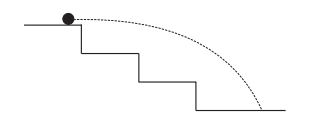
Solution: At minimum velocity it will move just touching point B reaching the ground. O is origin of reference coordinate.
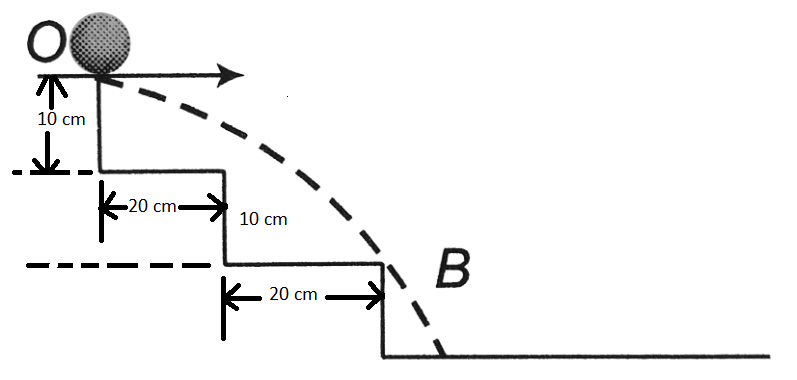
We have:
\(
\begin{aligned}
& \mathrm{x}=40 \mathrm{~cm} \text { OB } \\
& \mathrm{y}=-20 \mathrm{~cm}
\end{aligned}
\)
\(
\begin{aligned}
&\begin{aligned}
& \theta=0^{\circ} \\
& \mathrm{g}=10 \mathrm{~m} / \mathrm{s}^2=1000 \mathrm{~cm} / \mathrm{s}^2 \\
& \therefore y=x \tan \theta-g \frac{x^2 \sec ^2 \theta}{2 u^2} \\
& \Rightarrow-20=-\frac{800000}{2 u^2} \\
& \Rightarrow u=200 \mathrm{~cm} / \mathrm{s}=2 \mathrm{~m} / \mathrm{s}
\end{aligned}\\
&\text { Thus, the minimum horizontal velocity of the ball is } 2 \mathrm{~m} / \mathrm{s} \text {. }
\end{aligned}
\)
Q36. A person is standing on a truck moving with a constant velocity of \(14.7 \mathrm{~m} / \mathrm{s}\) on a horizontal road. The man throws a ball in such a way that it returns to the truck after the truck has moved 58.8 m. Find the speed and the angle of projection (a) as seen from the truck, (b) as seen from the road.
Solution: Step 1: Calculate the time of flight of the ball
The ball returns to the truck after the truck has moved a horizontal distance of 58.8 m at a constant velocity of \(14.7 \mathrm{~m} / \mathrm{s}\). The time of flight of the ball, \(T\), is equal to the time it takes for the truck to travel this distance.
\(
T=\frac{\text { Distance }}{\text { Velocity }}=\frac{58.8 \mathrm{~m}}{14.7 \mathrm{~m} / \mathrm{s}}=4.0 \mathrm{~s}
\)
Step 2: Analyze the motion of the ball as seen from the truck
From the perspective of the man on the truck, the truck is stationary. He throws the ball, and it lands back in his hands. This means the horizontal displacement of the ball relative to the truck is zero. The ball’s motion is purely vertical with respect to the truck.
The time of flight for a projectile with only vertical motion, as seen from this frame of reference, is given by \(T=\frac{2 v_y^{\prime}}{g}\), where \(v_y^{\prime}\) is the initial vertical speed of the ball relative to the truck.
\(
\begin{gathered}
4.0 \mathrm{~s}=\frac{2 v_y^{\prime}}{9.8 \mathrm{~m} / \mathrm{s}^2} \\
v_y^{\prime}=\frac{(4.0 \mathrm{~s})\left(9.8 \mathrm{~m} / \mathrm{s}^2\right)}{2}=19.6 \mathrm{~m} / \mathrm{s}
\end{gathered}
\)
Since the ball has no horizontal velocity relative to the truck, its speed is just its vertical speed, and the angle of projection is purely vertical.
Step 3: Analyze the motion of the ball as seen from the road
From the perspective of an observer on the road (the inertial frame), the ball has both horizontal and vertical components of velocity.
The vertical component of the ball’s velocity, \(\boldsymbol{v}_{\boldsymbol{y}}\), is the same as the vertical velocity relative to the truck, \(v_y^{\prime}\).
\(
v_y=19.6 \mathrm{~m} / \mathrm{s}
\)
The horizontal component of the ball’s velocity, \(v_x\), is equal to the velocity of the truck, because the ball has to travel the same horizontal distance as the truck in the same amount of time to land back on it.
\(
v_x=14.7 \mathrm{~m} / \mathrm{s}
\)
The initial speed of the ball, \(v\), as seen from the road, is the magnitude of the velocity vector.
\(
\begin{aligned}
v & =\sqrt{v_x^2+v_y^2}=\sqrt{(14.7 \mathrm{~m} / \mathrm{s})^2+(19.6 \mathrm{~m} / \mathrm{s})^2} \\
v & =\sqrt{216.09+384.16}=\sqrt{600.25}=24.5 \mathrm{~m} / \mathrm{s}
\end{aligned}
\)
The angle of projection, \(\theta\), is given by \(\tan (\theta)=\frac{v_y}{v_x}\).
\(
\begin{gathered}
\tan (\theta)=\frac{19.6 \mathrm{~m} / \mathrm{s}}{14.7 \mathrm{~m} / \mathrm{s}}=1.333 \\
\theta=\arctan (1.333)=53^{\circ}
\end{gathered}
\)
Q37. The benches of a gallery in a cricket stadium are 1 m wide and 1 m high. A batsman strikes the ball at a level one metre above the ground and hits a mammoth sixer. The ball starts at \(35 \mathrm{~m} / \mathrm{s}\) at an angle of \(53^{\circ}\) with the horizontal. The benches are perpendicular to the plane of motion and the first bench is 110 m from the batsman. On which bench will the ball hit?
Solution:
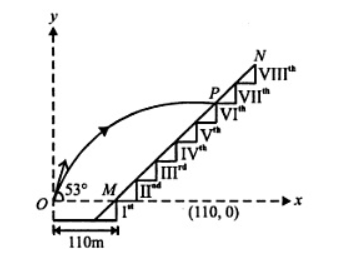
\(
\begin{aligned}
&y=x \tan \theta-\frac{g x^2}{2 u^2 \cos ^2 \theta}\\
&\text { Substituting the values, }\\
&y=1.33 x-0.0113 x^2 \dots(i)
\end{aligned}
\)
Slope, of line \(M N\) in 1 and it passes through point \((110 \mathrm{~m}, 0)\). Hence, the equation of this line can be written as,
\(
y=x-110 \dots(ii)
\)
Point of intersection of two curves is say \(P\). Solving eq. (i) and (ii), we get positive value of \(y\) equal to 4.5 m.
i.e., \(\quad y_p=4.5\)
Height of one step is 1 m . Hence, the ball will collide somewhere between \(y=4 \mathrm{~m}\) and \(y=5 \mathrm{~m}\). Which comes out to be 6th step.
Q38. A man is sitting on the shore of a river. He is in the line of a 1.0 m long boat and is 5.5 m away from the centre of the boat. He wishes to throw an apple into the boat. If he can throw the apple only with a speed of 10 \(\mathrm{m} / \mathrm{s}\), find the minimum and maximum angles of projection for successful shot. Assume that the point of projection and the edge of the boat are in the same horizontal level.
Solution:
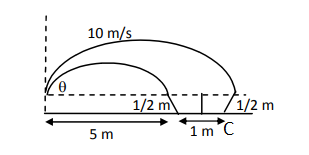
Given:
Length of the boat \(=1.0 \mathrm{~m}\)
Distance between the man and the centre of the boat \((\mathrm{R})=5.5 \mathrm{~m}\)
Initial speed (\(u\)) of throwing the apple by the man \(=10 \mathrm{~m} / \mathrm{s}\)
Acceleration due to gravity \((\mathrm{g})=10 \mathrm{~m} / \mathrm{s}^2\)
We know that the horizontal range is given by
\(
\begin{aligned}
& \mathrm{R}=\frac{u^2 \sin 2 \alpha}{g} \\
& \Rightarrow 5=\frac{(10)^2 \sin 2 \alpha}{10} \\
& \Rightarrow \sin 2 \alpha=\frac{1}{2} \\
& \Rightarrow \alpha=15^{\circ} \text { or } 75^{\circ}
\end{aligned}
\)
Similarly, for the endpoint of the boat, i.e., point C , we have:
\(
\begin{aligned}
& \text { Horizontal range }(\mathrm{R})=6 \mathrm{~m} \\
& \mathrm{R}=\frac{u^2 \sin 2 \alpha}{g} \\
& \Rightarrow 6=\frac{(10)^2 \sin 2 \alpha}{10} \\
& \Rightarrow \sin 2 \alpha=\frac{3}{5} \\
& \Rightarrow \alpha=18^{\circ} \text { or } 71^{\circ}
\end{aligned}
\)
For a successful shot, the angle of projection \(\alpha\) with an initial speed of \(10 \mathrm{~m} / \mathrm{s}\) may vary from \(15^{\circ}\) to \(18^{\circ}\) or from \(71^{\circ}\) to \(75^{\circ}\). The minimum angle is \(15^{\circ}\), and the maximum angle is \(75^{\circ}\), but there is an interval of \(53^{\circ}\) for which the successful shot is not allowed. We can show this by putting the successive value of \(\alpha\) from \(15^{\circ}\) to \(75^{\circ}\).
Q39: A river 400 m wide is flowing at a rate of \(2.0 \mathrm{~m} / \mathrm{s}\). A boat is sailing at a velocity of \(10 \mathrm{~m} / \mathrm{s}\) with respect to the water, in a direction perpendicular to the river. (a) Find the time taken by the boat to reach the opposite bank. (b) How far from the point directly opposite to the starting point does the boat reach the opposite bank?
Solution:
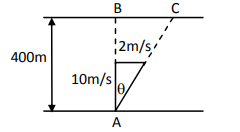
(a) Step 1: Calculate the time taken to cross the river
The time it takes for the boat to cross the river is determined by the river’s width and the boat’s velocity component perpendicular to the river’s flow. The river’s current does not affect the crossing time. The time is calculated using the formula \(t=\frac{\text { width }}{\text { velocity }}\).
Given:
River width, \(w=400 \mathrm{~m}\)
Boat’s velocity relative to the water (perpendicular to the river), \(v_b=10 \mathrm{~m} / \mathrm{s}\)
Calculation:
\(
t=\frac{w}{v_b}=\frac{400 \mathrm{~m}}{10 \mathrm{~m} / \mathrm{s}}=40 \mathrm{~s}
\)
(b) Step 2: Calculate the downstream distance
The downstream distance the boat travels is determined by the river’s current velocity and the time the boat takes to cross the river.
Given:
River current velocity, \(v_r=2.0 \mathrm{~m} / \mathrm{s}\)
Time taken to cross the river, \(t=40 \mathrm{~s}\)
Calculation:
\(
d=v_r \times t=(2.0 \mathrm{~m} / \mathrm{s}) \times(40 \mathrm{~s})=80 \mathrm{~m}
\)
Alternate:
\(
\begin{aligned}
&\text { The boat will reach at point } C \text {. }\\
&\text { In } \triangle A B C, \tan \theta=\frac{B C}{A B}=\frac{B C}{400}=\frac{1}{5}\\
&B C=400 / 5=80 \mathrm{~m} .
\end{aligned}
\)
Q40. A swimmer wishes to cross a 500 m wide river flowing at \(5 \mathrm{~km} / \mathrm{h}\). His speed with respect to water is \(3 \mathrm{~km} / \mathrm{h}\). (a) If he heads in a direction making an angle \(\theta\) with the flow, find the time he takes to cross the river.
(b) Find the shortest possible time to cross the river.
Solution:
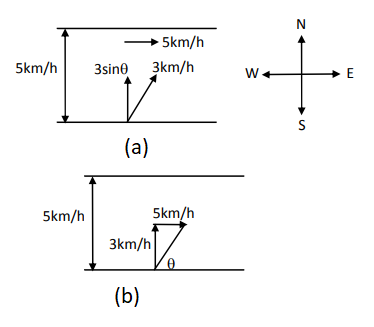
(a) The vertical component \(3 \sin \theta\) takes him to opposite side [As shown in Fig(a)].
\(
\begin{aligned}
& \text { Distance }=0.5 \mathrm{~km}, \text { velocity }=3 \sin \theta \mathrm{~km} / \mathrm{h} \\
& \text { Time }=\frac{\text { Distance }}{\text { Velocity }}=\frac{0.5}{3 \sin \theta} \mathrm{hr} \\
& =10 / \sin \theta \quad \mathrm{minutes}
\end{aligned}
\)
(b) The shortest time to cross the river occurs when the swimmer’s velocity component perpendicular to the flow is maximized. From the equation for time, this happens when \(\sin \theta\) is at its maximum value. The maximum value of \(\sin \theta\) is 1, which occurs when \(\theta=90^{\circ}\). At this angle, the swimmer is heading directly across the river.
The maximum velocity component across the river is \(v_{y, \max }=3 \sin \left(90^{\circ}\right)=3 \mathrm{~km} / \mathrm{h}\). The shortest possible time is:
\(
\begin{aligned}
t_{\min } & =\frac{d}{v_{y, \max }} \\
t_{\min } & =\frac{0.5}{3} \\
t_{\min } & =\frac{1}{6} \mathrm{~h}
\end{aligned}
\)
To convert this to minutes, multiply by 60:
\(
t_{\min }=\frac{1}{6} \times 60=10 \mathrm{~min}
\)
Q41. A swimmer wishes to cross a 500 m wide river flowing at \(5 \mathrm{~km} / \mathrm{h}\). His speed with respect to water is \(3 \mathrm{~km} / \mathrm{h}\).The man has to reach the other shore at the point directly opposite to his starting point. If he reaches the other shore somewhere else, he has to walk down to this point. Find the minimum distance that he has to walk.
Solution:
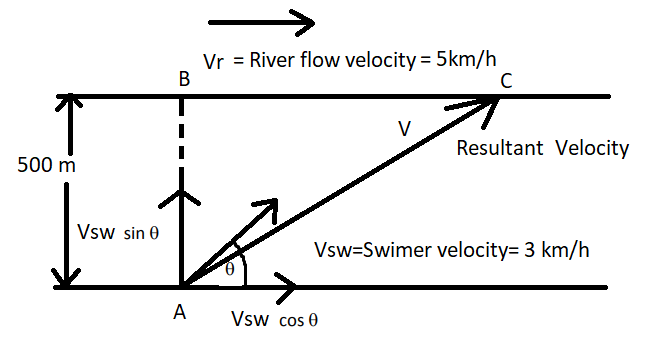
\(B D\) horizontal distance for resultant velocity \(V\).
\(x\)-component of resultant \(\mathrm{v}_{\mathrm{x}}=5+3 \cos \theta\)
The vertical component \(3 \sin \theta\) takes him to opposite side.
Time taken will be \(\mathrm{t}=0.5 / 3 \sin \theta\)
\(x\)-component of resultant velocity \(v_x}=5+3 \cos \theta\)
Horizontal distance BD = \(x=v_x t=(5+3 \cos \theta)\left(\frac{1}{6\sin \theta}\right)\)
\(
x=\frac{5+3 \cos \theta}{6 \sin \theta} .
\)
For \(x\) to be minimum \(\frac{d x}{d \theta}=0\)
\(
\frac{(-3 \sin \theta)(6 \sin \theta)-(5+3 \cos \theta)(6 \cos \theta)}{(6 \sin \theta)^2}=0
\)
\(
\cos \theta=-\frac{18}{30}=-\frac{3}{5}
\)
\(
\sin \theta=\sqrt{1-\cos ^2 \theta}=4 / 5
\)
\(
x=\frac{5+3 \cos \theta}{6 \sin \theta}=\frac{5+3(-3 / 5)}{6 \times(4 / 5)}=\frac{2}{3} \mathrm{~km} .
\)
Q42. An aeroplane has to go from a point \(A\) to another point \(B, 500 \mathrm{~km}\) away due \(30^{\circ}\) east of north. A wind is blowing due north at a speed of \(20 \mathrm{~m} / \mathrm{s}\). The air-speed of the plane is \(150 \mathrm{~m} / \mathrm{s}\). (a) Find the direction in which the pilot should head the plane to reach the point \(B\). (b) Find the time taken by the plane to go from \(A\) to \(B\).
Solution: (a) In resultant direction \(\vec{V}\) the plane reach the point \(B\).
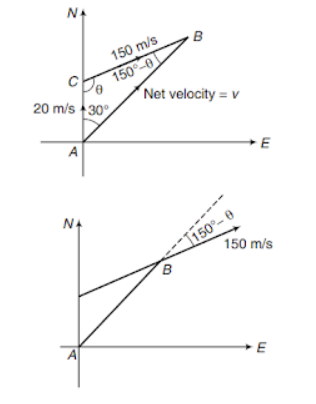
Velocity of wind \(\vec{V}_w=20 \mathrm{~m} / \mathrm{s}\)
Velocity of aeroplane \(\overrightarrow{\mathrm{V}}_{\mathrm{a}}=150 \mathrm{~m} / \mathrm{s}\)
Applying sine law in \(\triangle A B C\), we have
\(\frac{150}{\sin 30^{\circ}}=\frac{v}{\sin \theta}=\frac{20}{\sin \left(150^{\circ}-\theta\right)}\)
From first and third we have,
\(
\begin{aligned}
& & \sin \left(150^{\circ}-\theta\right) & =\frac{20 \sin 30^{\circ}}{150}=\frac{1}{15} \\
& \therefore & 150^{\circ}-\theta & =\sin ^{-1}\left(\frac{1}{15}\right)
\end{aligned}
\)
Hence, we can see that direction of \(150 \mathrm{~m} / \mathrm{s}\) is \(150^{\circ}-\theta\left[\right.\) or \(\left.\sin ^{-1}\left(\frac{1}{15}\right)\right]\), east of the line \(A B\)
(b) \(150^{\circ}-\theta=\sin ^{-1}\left(\frac{1}{15}\right)=3.8^{\circ}\)
\(
\therefore \quad \theta=146.2^{\circ}
\)
From first and second relation,
\(
v=\frac{150 \sin \theta}{\sin 30^{\circ}}
\)
Substituting the values we get,
\(
\begin{aligned}
& v=167 \mathrm{~m} / \mathrm{s} \\
& \therefore \quad t=\frac{A B}{v} \\
& =\frac{500 \times 1000}{167 \times 60} \mathrm{~min}=49.9 \mathrm{~min} \\
& \approx 50 \mathrm{~min}
\end{aligned}
\)
Q43. Two friends \(A\) and \(B\) are standing a distance \(x\) apart in an open field and wind is blowing from \(A\) to \(B\). \(A\) beats a drum and \(B\) hears the sound \(t_1\) time after he sees the event. \(A\) and \(B\) interchange their positions and the experiment is repeated. This time \(B\) hears the drum \(t_2\) time after he sees the event. Calculate the velocity of sound in still air \(v\) and the velocity of wind \(u\). Neglect the time light takes in travelling between the friends.
Solution: Case 1: Wind from A to B
When A beats the drum, B hears the sound. The wind helps the sound travel faster, so the sound travels at a velocity of \((v+u)\) relative to the ground.
The time taken for sound to travel from A to B is \(t_1=\frac{x}{v+u}\).
This gives us the equation: \(1=t_1(v+u)\) or \(1 / t_1=v+u\).
Case 2: A and B interchange positions
Now, B is in the position of A , and A is in the position of B . The wind is still blowing from the original A’s position to the original B’s position.
Therefore, the wind is blowing from B to A.
The sound travels at a velocity of \((v-u)\) relative to the ground.
The time taken for the sound to travel from B to A is \(t_2=\frac{x}{v-u}\).
This gives us the equation: \(1=t_2(v-u)\) or \(1 / t_2=v-u\).
Solving for \(v\) and \(u\)
To find \(\boldsymbol{v}\) (velocity of sound):
Add the two equations:
\(1 / t_1+1 / t_2=(v+u)+(v-u)=2 v\)
Rearrange to solve for \(\boldsymbol{v}\) :
\(2 v=\frac{t_2+t_1}{t_1 t_2}\)
\(\circ v=\frac{x\left(t_1+t_2\right)}{2 t_1 t_2}\)
To find \(u\) (velocity of wind):
Subtract the second equation from the first:
\(1 / t_1-1 / t_2=(v+u)-(v-u)=2 u\)
Rearrange to solve for \(\boldsymbol{u}\) :
\(\circ 2 u=\frac{t_2-t_1}{t_1 t_2}\)
\(\circ u=\frac{x\left(t_2-t_1\right)}{2 t_1 t_2}\)
Q44. Suppose \(A\) and \(B\) in the previous problem change their positions in such a way that the line joining them becomes perpendicular to the direction of wind while maintaining the separation \(x\). What will be the time lag \(B\) finds between seeing and hearing the drum beating by \(A\) ?
Solution:
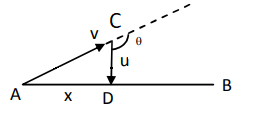
Velocity of sound \(v\), velocity of air \(u\)
Velocity of sound be in direction \(A C\) so it can reach \(B\) with resultant velocity \(A D\).
Angle between v and u is \(\theta>\pi / 2\).
Resultant \(\overrightarrow{\mathrm{AD}}=\sqrt{\left(\mathrm{v}^2-\mathrm{u}^2\right)}\)
Here time taken by light to reach \(B\) is neglected. So time lag between seeing and hearing \(=\) time to here the drum sound.
\(
\begin{aligned}
& t=\frac{\text { Displacement }}{\text { velocity }}=\frac{x}{\sqrt{v^2-u^2}} \\
\Rightarrow & \frac{x}{\sqrt{(v+u)(v-u)}}=\frac{x}{\sqrt{\left(x / t_1\right)\left(x / t_2\right)}} \text { [from question no. 43] } \\
= & \sqrt{t_1 t_2} .
\end{aligned}
\)
Q45. Six particles situated at the corners of a regular hexagon of side \(a\) move at a constant speed \(v\). Each particle maintains a direction towards the particle at the next corner. Calculate the time the particles will take to meet each other.
Solution:
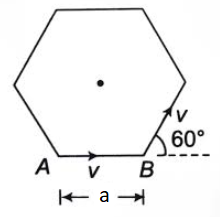
To determine the time taken by six particles situated at the corners of a regular hexagon to meet at the center, we can break down the problem into structured steps.
Understanding the Motion:
Each particle moves towards the next particle in a circular path. As they are positioned at the corners of a regular hexagon, the angle between the direction of motion of any two adjacent particles is \(60^{\circ}\)
Relative Velocity Calculation:
The relative velocity of one particle with respect to another can be calculated using the formula:
\(
V_{A B}=V_A-V_B=v-v \cos (\theta)
\)
where \(\theta\) is the angle between the velocity vectors of the two particles. For adjacent particles, \(\theta=60^{\circ}\)
Substituting \(\theta=60^{\circ}\) into the relative velocity equation gives:
\(
V_{A B}=v-v \cos \left(60^{\circ}\right)=v-v \cdot \frac{1}{2}=v\left(1-\frac{1}{2}\right)=\frac{v}{2}
\)
Displacement Calculation:
The distance each particle needs to cover to meet at the center is equal to the length of the side of the hexagon, denoted as \(a\)
Time Calculation:
The time taken for the particles to meet can be calculated using the formula:
\(
\text { Time }=\frac{\text { Total Displacement }}{\text { Relative Velocity }}=\frac{a}{\frac{v}{2}}=\frac{2 a}{v}
\)
Alternate:
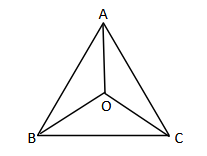
The particles meet at the centroid \(O\) of the triangle. At any instant the particles will form an equilateral \(\triangle \mathrm{ABC}\) with the same centroid.
Consider the motion of particle A. At any instant its velocity makes angle \(30^{\circ}\). This component
is the rate of decrease of the distance AO.
Initially \(\mathrm{AO}=\frac{2}{3} \sqrt{\mathrm{a}^2-\left(\frac{\mathrm{a}}{2}\right)^2}=\frac{\mathrm{a}}{\sqrt{3}}\)
Therefore, the time taken for AO to become zero.
\(
=\frac{a / \sqrt{3}}{v \cos 30^{\circ}}=\frac{2 a}{\sqrt{3} v \times \sqrt{3}}=\frac{2 a}{3 v} .
\)